Article

Eu5VO10: Synthesis Methods and Characterization of Basic Physicochemical Properties

1
Department of Inorganic and Analytical Chemistry, Faculty of Chemical Technology and Engineering, West Pomeranian University of Technology in Szczecin, al. Piastów 42, 71-065 Szczecin, Poland
2
Faculty of Mechanical Engineering and Mechatronics, West Pomeranian University of Technology in Szczecin, al. Piastów 19, 70-310 Szczecin, Poland
*
Authors to whom correspondence should be addressed.
Materials 2026, 19(13), 2782; https://doi.org/10.3390/ma19132782
Submission received: 29 May 2026 / Revised: 24 June 2026 / Accepted: 25 June 2026 / Published: 1 July 2026
(This article belongs to the Section Advanced Materials Characterization)

Abstract

Rare-earth vanadates constitute an important class of functional materials with potential applications as luminophores, in optoelectronics and catalysis. The research for this work was inspired by the incomplete literature data, including the synthesis, structure and physicochemical properties of europium(III) vanadate(V) with the general formula Eu5VO10. The primary goal of this work was to supplement the missing data about this compound and identify its potential applications. This compound was synthesized using three methods, including waste-free methods: ceramic, mechanochemical and a modified Pechini method. The obtained Eu5VO10 was characterized using XRD, DTA–TG, FTIR, UV–Vis–DRS, SEM and gas pycnometry. It was settled that Eu5VO10 crystallizes in the monoclinic system and is thermally stable up to a temperature of approximately 1310 °C, above which it decomposes in the solid phase. Estimated energy gap (Eg) values ranged from ~3.21 eV to ~3.53 eV depending on the synthesis method used, allowing Eu5VO10 to be classified as a wide-bandgap electrical semiconductor. The results also showed that the synthesis method affects the crystallite size of the synthesized compound. The development of synthesis methods and characterization of Eu5VO10 expands our understanding of rare-earth vanadates and their potential applications as functional materials.

1. Introduction

The results of basic research, particularly in the field of solid state chemistry and physicochemistry, play an important role in modern materials engineering, which is focused on the production of new materials using previously unknown phases, including chemical compounds, of key importance to the chemical, electronics and automotive industries.
Knowledge of synthesis methods and conditions, as well as the basic physicochemical properties of new phases, is essential for undertaking further applied research. For example, studies of binary and multicomponent systems of various compounds, including rare earth element (REE) oxides, enable researchers to gain insight into the solid phases formed in these systems. Determining their properties, such as thermal stability, energy gap value, and crystalline structure, is crucial for predicting the physical properties of materials with more complex compositions and, therefore, diverse applications. Knowledge of favourable conditions for the synthesis and phase transformations of new compounds forms the basis for rational management of raw materials, including REE compounds, in line with the concept of sustainable development by eliminating inefficient implementation steps.
Of particular interest from the application point of view are phases containing europium, including europium(III) orthovanadate(V), which, due to its luminescent and magnetic properties, can be used as a component of cathodoluminescent materials, thermoluminophores, scintillators, and crystal lasers [1,2,3,4,5,6,7,8,9]. Also, the presence of Eu3+ ions in the structures of orthovanadates(V) of other elements, e.g., in YVO4, due to their high thermal stability and high quantum efficiency, enables the use of such phases as components in measuring instruments, optoelectronic devices or biochemical markers [1,2,3,4,5,6,7,8,9]. Structural parameters such as crystallinity, particle size, morphology, and defect concentration significantly influence the optical, electrical, magnetic, and photocatalytic behaviour of these materials by modifying charge-carrier dynamics and radiative recombination processes [1,2,3,4,5,6,7,8,9]. Especially in terms of high thermal and chemical stability, REE orthovanadates(V) are meant to be important for many purposes, as they are better than sulfide-based phosphors [1,2,3,4,5,6,7,8,9]. Also, one of the most important and popular application of these phases are as different light sources, where due to the presence of REE in the structure, these f-block elements trivalent cations emit a wide range of wavelengths [1,2,3,4,5,6,7,8,9].
Despite intensive research on binary oxide systems V2O5–RE2O3, europium(III) vanadates(V) with stoichiometry other than europium(III) orthovanadate(V)—EuVO4 remain poorly characterized. The limited literature contains fragmentary and often divergent data [10,11,12]. Basic physicochemical properties of EuVO4, such as structure, optical, electrical, magnetic, and catalytic properties, as well as its applications are known [1,2,3,4,5]. On the other hand, phases with other europium contents, such as Eu5VO10, Eu8V2O17 or Eu3VO7, have only been mentioned in the literature [10,11,12].
Based on the available literature data, it has been established that the most frequently mentioned—apart from EuVO4—europium(III) vanadate(V) is the compound with the formula Eu5VO10, written also as 5Eu2O3·V2O5 or Eu10V2O20. However, the physicochemical characterization of this compound remains incomplete, including information about its structure, thermal stability, or phase transitions, which hinders its reproducible synthesis and prevents the indication of its potential applications. From the literature data, it is only known that the compound Eu5VO10 is formed by heating a mixture of Eu2O3 with V2O5 in a 5:1 molar ratio in 24 h steps in the temperature range of 600–1500 °C [10]. According to another work [11], the synthesis of this compound begins only at ~1200 °C.
The main goal of the presented research was to confirm the formation of the Eu5VO10 compound by high-temperature solid-state reactions and to determine whether this compound can also be obtained by other methods, i.e., a mechanochemical method and the modified Pechini method. Furthermore, the scope of this work included determining the final composition of this obtained compound, calculating its unit cell parameters, checking its thermal stability and estimating the energy band gap (Eg).
The results of the conducted research included, among other things, confirming the formation of the Eu5VO10 phase using three selected methods. Furthermore, basic crystallographic data and its thermal stability were determined, and the obtained vanadate was classified as an electrical semiconductor. This further expands our knowledge of europium(III) vanadate(V) and opens up new possibilities for the engineering of functional materials based on this phase.

2. Materials and Methods

The following reagents were used to carry out the syntheses: europium(III) oxide (99.9%, Alfa Aesar, Karlsruhe, Germany), vanadium(V) oxide (99.9%, Alfa Aesar, Karlsruhe, Germany), ammonium metavanadate(V) (99.9%, POCh, Gliwice, Poland), aqueous ammonia solution (99.9%, Stanlab, Lublin, Poland), aqueous nitric acid solution (99.9%, Stanlab, Lublin, Poland), tartaric acid (99.9%, POCh, Gliwice, Poland), and glycerol (99%, POCh, Gliwice, Poland).
The synthesis of pentaeuropium decaoxovanadate (Eu5VO10) was carried out by three methods: high-temperature solid-state reactions (ceramic method), the mechanochemical method and the modified Pechini method.
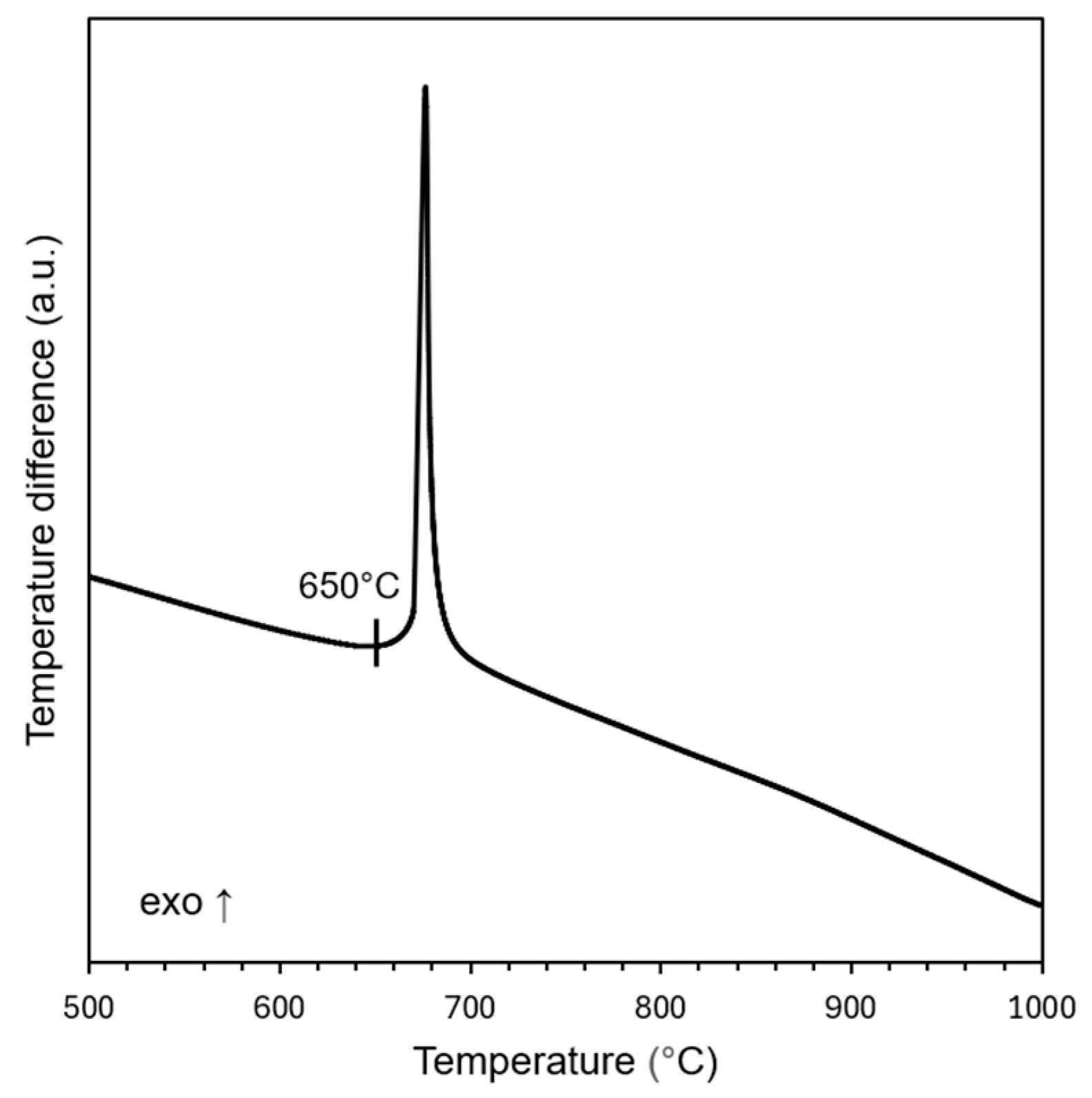
To obtain Eu5VO10 by high-temperature solid-state reactions in the air atmosphere, a mixture of vanadium(V) oxide and europium(III) oxide was prepared in a V2O5:Eu2O3 molar ratio of 1:5. The homogenized oxide mixture was heated in five (I-V) 12 h stages in a muffle furnace (Carbolite, Hope Valley, UK) at temperatures: I: 600 °C; II: 630 °C; III: 1200 °C; IV: 1250 °C; V: 1300 °C. The temperature of the first stage of synthesis was determined based on DTA analysis of the substrate mixture, i.e., V2O5 and Eu2O3. The DTA curve registered from 20 to 1000 °C (Figure 1) at a temperature of approximately 650 ± 5 °C showed the onset of only one well-developed exothermic effect associated with the synthesis of EuVO4 (as confirmed by XRD phase analysis of the same sample after DTA analysis to 1000 °C). The registered diffractogram of this sample was similar to the one presented in Figure 2b. However, to avoid melting components of the reaction mixture (i.e., below the melting point of V2O5 (Tm = 675 °C) [13]) as well as based on the information about similar M5VO10 vanadate [13] it was settled that synthesis should be initiated at the temperature 600 °C.
The temperature of the second stage was increased, but only by 30 °C, which was selected to avoid melting the reaction mixture, especially leftover V2O5 in this sample.
To obtain Eu5VO10 by the second method, i.e., the mechanochemical (high-energy grinding) method, the prepared stoichiometric mixture of vanadium(V) oxide and europium(III) oxide was ground in a planetary ball mill in 15 min stages (a total of 10 h) in a Pulverisitte 6 mill (Fritsch, Idar-Oberstein, Germany). The reaction mixture was placed in a reactor (250 cm3, ZrO2) with grinding balls (20 mm in diameter, ZrO2), maintaining a BPR (ball to powder ratio) of 20:1 and a rotation speed of 620 RPM (revolutions per minute). The synthesis conditions were selected based on the literature data, available, among others, in [13,14].
For the synthesis of Eu5VO10 using the modified Pechini method, two solutions, A and B, were prepared. Solution A was prepared by dissolving europium(III) oxide in 6 mol/dm3 nitric acid, and then adding tartaric acid and glycerol in such an amount that the molar ratio of Eu(NO3)3:C4H6O6:C3H5(OH)3 was 3:1:3. Solution B was ammonium metavanadate(V) dissolved in 3 mol/dm3 aqueous ammonia solution. After 15 min of stirring solution A with a magnetic stirrer, solution B was added to the solution to maintain a Eu:V molar ratio of 5:1 in the reaction mixture. The resulting precipitate was heated, with constant stirring, at 50 °C until the solvent evaporated. The product was first dried at 100 °C for an hour and then calcined at 1300 °C (1 h). The conditions for synthesis using this method were determined based on the literature data regarding the preparation of various oxide phases [15,16,17].
During the conduction of this research, the following methods were used:
  • X-ray powder diffraction (Empyrean II diffractometer (PANalytical, Almelo, The Netherlands) with copper lamp CuKα = 0.15418 nm);
  • Differential thermal analysis with simultaneous thermogravimetry (Discovery SDT 650 thermal analyzer (TA Instruments, New Castle, DE, USA) in temperature range 20–1400 °C) and derivatograph F.Paulik, J.Paulik, L.Erdey (MOM, Budapest, Hungary), in temperature range 20–1000 °C;
  • Fourier transformed infrared spectroscopy (Nicolet iS5 spectrometer (Thermo Fisher Scientific, Waltham, MA, USA) in wavenumber range 400–4000 cm−1);
  • Ultraviolet and visible light diffuse reflectance spectroscopy (V-670 spectrophotometer (Jasco, Tokyo, Japan) in wavelength range 200–800 nm);
  • Gas pycnometry (Ultrapyc 1200e ultrapycnometer (Quantachrome Instruments, Boynton Beach, FL, USA) in the 5N argon gas);
  • Scanning electron microscopy with energy dispersive X-ray spectroscopy (SU-70 microscope (Hitachi, Tokyo, Japan) equipped in EDX NORAN System 7 spectrometer (Thermo Fisher Scientific, Waltham, MA, USA).

3. Results and Discussion

3.1. XRD

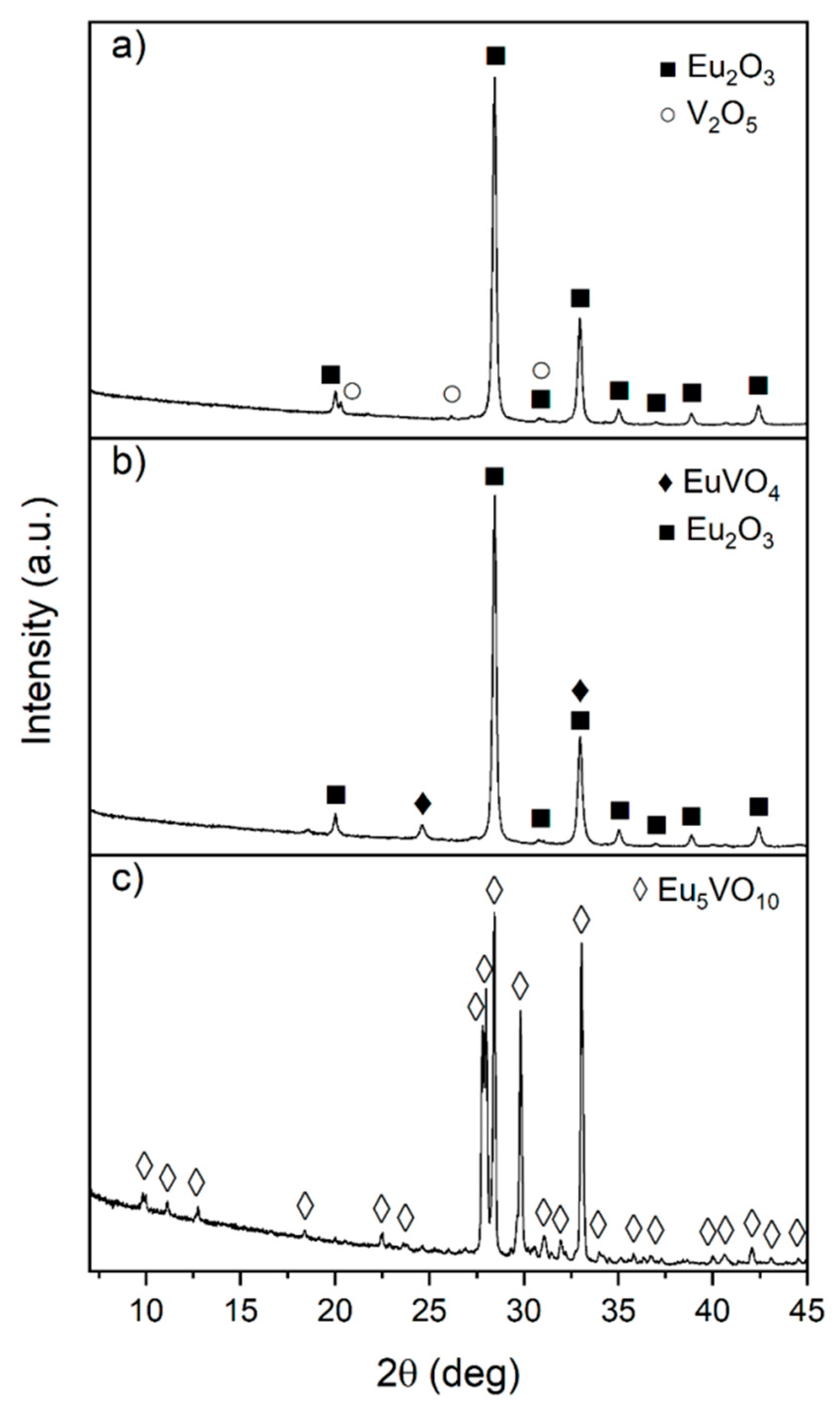
Based on qualitative phase analysis using XRD, it was confirmed that the Eu5VO10 compound was formed by stepwise heating of a mixture of oxides in a molar ratio of Eu2O3:V2O5 of 5:1. Figure 2 shows fragments of the diffraction patterns: the substrate mixture (a), this mixture after the first stage of its heating, i.e., at 600 °C (b), and the sample after the last stage of synthesis at 1300 °C (c).
In the registered diffraction pattern of the reaction mixture after the first stage of its heating (Figure 2b), apart from the diffraction lines belonging to the regular Eu2O3 set (PDF card no. 04-014-9534) [18], additional diffraction lines belonging to the set characterizing EuVO4 (PDF card no. 04-005-7366) were also present. The lack of diffraction lines characterizing orthorhombic V2O5 (PDF card no. 04-008-7123) indicates that during the synthesis of pentaeuropium decaoxovanadate (Eu5VO10), the reaction with the formation of EuVO4 takes place first in the substrate mixture at a temperature of about 600 °C according to the reaction:
Eu2O3(s) + V2O5(s) = 2 EuVO4(s)
The second stage of heating the sample, that is at 630 °C for 12 h, did not cause any changes in its phase composition, i.e., the sample above was two-phase and contained only europium(III) oxide and EuVO4. Compared to the first stage, the diffraction pattern of this sample differed only slightly in terms of the intensity of the recorded lines.
After the third stage of sample heating (1200 °C, 12 h), it was found that a reaction between europium(III) orthovanadate(V) and Eu2O3 had begun in the reaction mixture, forming a phase with X-ray characteristics not included in the PDF5+ database. However, based on the literature data [13] and the similarity of the recorded diffraction lines, i.e., their position and intensity, to those characterizing samarium(III) vanadate(V) with the formula Sm5VO10, it was found that the undescribed diffraction lines belong to the set of Eu5VO10 oxosalt. The synthesis reaction of pentaeuropium decaoxovanadate can therefore be represented by reaction Equation (2), which was confirmed by observing the change in the number of recorded reflections and their intensity after the next stage of sample heating.
EuVO4(s) + 2 Eu2O3(s) = Eu5VO10(s)
After the last heating step, i.e., the 1300 °C (12 h) sample was monophasic and contained only pentaeuropium decaoxovanadate. During the heating of the sample, its colour changed from an orange mixture of substrates, through the light grey colour of the mixture of EuVO4 with Eu2O3 until the light yellow of the compound Eu5VO10.
Due to the lack of information on the basic crystallographic data of the Eu5VO10 compound and a complete X-ray characterization of this phase in the available literature, the next stage of the work involved the indexing and refinement of the diffraction pattern of the europium(III) vanadate(V). The indexing and refinement were performed using the Expo2014 [19] and REFINEMENT software from DHN/PDS package, respectively. From the obtained solutions, the one with the highest figures of merit (FOM) was selected:
M20 = 6.4, F20 = 5.1, R_Q = 0.119%, mean|Δ2θ| = 0.031° Δρ = 0.50%
The results are presented in Table 1.
Based on the obtained indexing and refinement results, it was established that Eu5VO10 crystallizes in the monoclinic system, similarly to other lanthanide compounds with the general formula M5VO10 and the studied structure [13,20]. The calculated unit cell parameters are as follows:
  • a = 8.975(5) Å;
  • b = 7.959(4) Å;
  • c = 13.834(9) Å;
  • β = 92.73(5)°;
  • V = 987.1(7) Å3;
  • Z = 4;
  • Space group: P21 (No. 4).
The correctness of the presented results is indicated by a small difference between the density values calculated from the unit cell parameters (dcalc = 6.53 g/cm3) and determined experimentally using a gas pycnometer (dexp = 6.50 g/cm3).
The next stage of the research was an attempt to obtain Eu5VO10 by methods alternative to the high-temperature one, i.e., mechanochemical and the modified Pechini method.
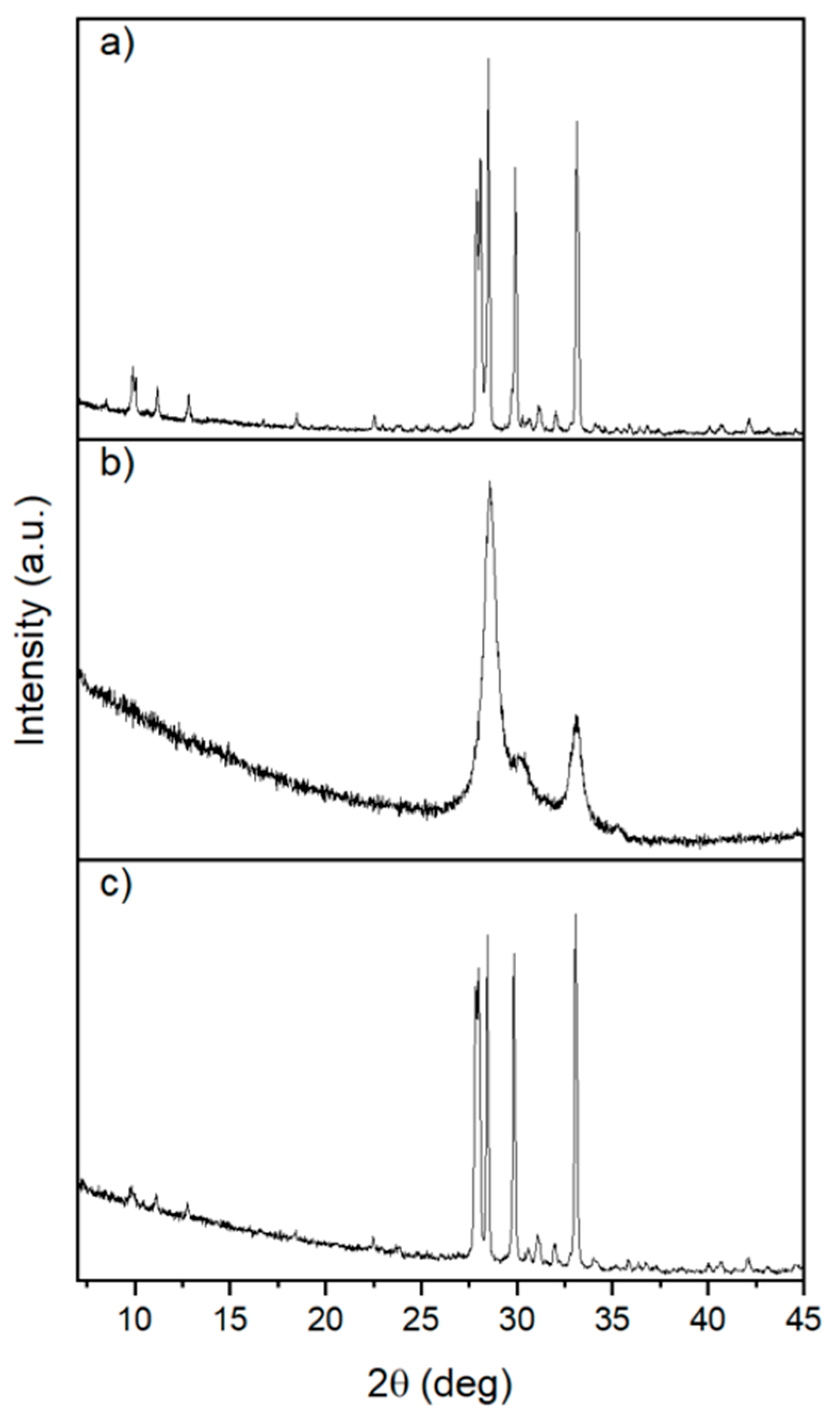
As a result of high-energy milling of the Eu2O3 and V2O5 mixture in a planetary ball mill, after ten hours of reaction, a product was obtained, whose registered diffraction pattern (Figure 3b) was similar to the diffraction pattern of Eu5VO10 synthesized by the ceramic method (Figure 3a).
The presented figure shows that the diffraction patterns of the europium(III) vanadate(V) obtained by these two methods differ in the number of recorded reflections with low relative intensity. This is primarily due to the fact that during the synthesis process in a high-energy planetary mill, multiple collisions of the grinding medium with the grounded material occur, which favours the crystallization of only selected lattice planes of the forming compound, with the highest intensity (I/I0) [21]. It cannot be ruled out that, only after grinding, the developed lattice planes are favoured in the crystallization process of the obtained europium(III) vanadate(V), as well as the fact that a certain portion of the product is in an amorphous form. It should also be noted that the significantly broadened reflections recorded in the Eu5VO10 diffraction pattern of the thus obtained compound indicate nanometric crystallite sizes, which was confirmed by Scherrer’s methods [22]. The calculated grain sizes of pentaeuropium decaoxovanadate are approximately 64 nm. For the calculations, the value of the shape factor a = 0.9 was assumed. After heating of the milled sample at 1300 °C during 3 h, registered XRD reflections were narrow and the number of them increased. The diffractogram of milled and heated Eu5VO10 looked similar to the patterns in Figure 3a,c. The diffraction pattern of the light yellow product obtained by the modified Pechini method (Figure 3c) was almost identical to that obtained by the ceramic method. Also in both cases, according to the Scherrer method, crystallites have around 0.15–0.20 μm size. Based on the observed diffraction line sets, it was determined that each of the three methods—ceramic, mechanochemical, and modified Pechini—could produce Eu5VO10 as the main reaction product.

3.2. SEM–EDX

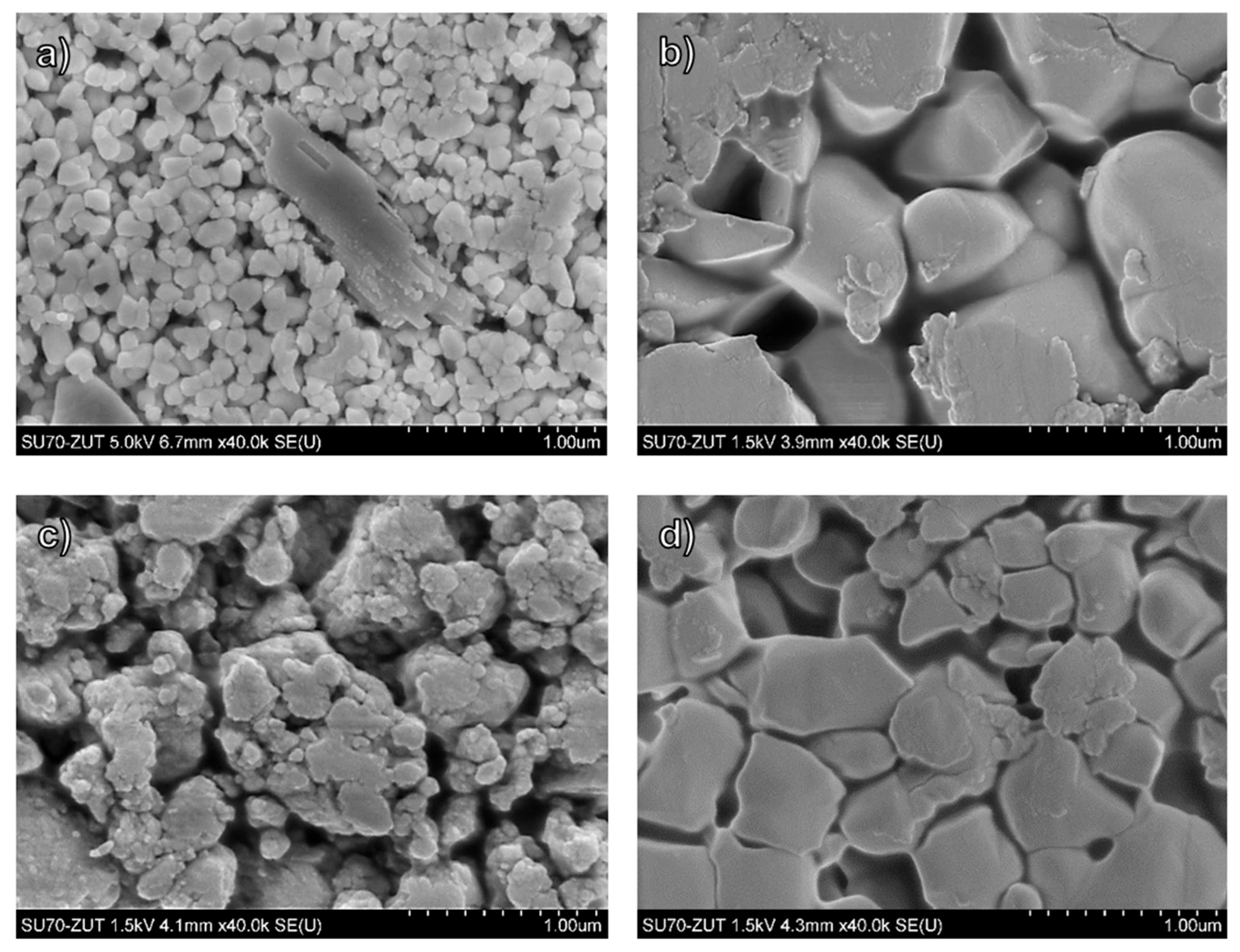
To confirm the size and shape of Eu5VO10 crystallites obtained by different methods, images were obtained using the SEM method, which are shown in Figure 4.
Based on the SEM images, it was found that Eu5VO10 crystallites have the shape of irregular polyhedra, and their sizes do not differ significantly between the high-temperature and modified Pechini synthesis methods. Their average sizes range from ~0.5 to 0.8 μm. In the case of synthesis carried out by the mechanochemical method, the crystallite sizes are varied and range from ~0.1 to ~0.4 μm. These values are in accordance with the calculated size of crystallites which confirms the fact that high-energy ball milling synthesis method promotes the formation of phases with much smaller crystallites, often of nano-sized sizes.
Moreover, to confirm the chemical composition of the obtained europium(III) vanadate(V), EDX analysis was conducted. The results of this analysis, that is average values from three chosen points of every sample, are presented in Table 2.
According to the obtained values of the atomic concentration of metallic elements in the Eu5VO10 compound it was observed that in every sample there are only small differences between the experimental and theoretical values. It confirms that the used chemical formula of the investigated europium(III) vanadate(V) is correct.

3.3. Thermal Stability Test

Due to the fact that no clear effects were registered on the DTA–TG curve of the obtained Eu5VO10 compound up to 1400 °C, in order to determine its thermal stability, the synthesized compound was additionally heated in a furnace in the temperature range of 1300–1400 °C. The furnace temperature was increased every 10 °C and the sample was thermostated at this temperature for 1 h.
After each heating step, the sample was homogenized and its phase composition was determined by XRD. Under the experimental conditions, a change in the number, position, and intensity of the recorded reflections was first observed after heating Eu5VO10 at 1310 °C. Heating the Eu5VO10 compound at this temperature resulted in its thermal decomposition, without any doubt, to Eu2O3 with a monoclinic structure (PDF card no. 04-004-2793) and a phase of as yet experimentally unconfirmed composition. At this stage of the research, it is very probable that, analogously to other compounds with the same molecular formula, e.g., Y5VO10 and Sm5VO10 [13], Eu5VO10 decomposes in the solid state according to the reaction equation:
2 Eu5VO10(s) = Eu2O3(s) + Eu8V2O17(s)
The solid state decomposition of the obtained compound is indicated by the fact that after heating Eu5VO10 at 1310 °C, it did not melt or even partially melt, which means that its decomposition products are characterized by higher melting and/or decomposition temperatures [23].

3.4. FTIR

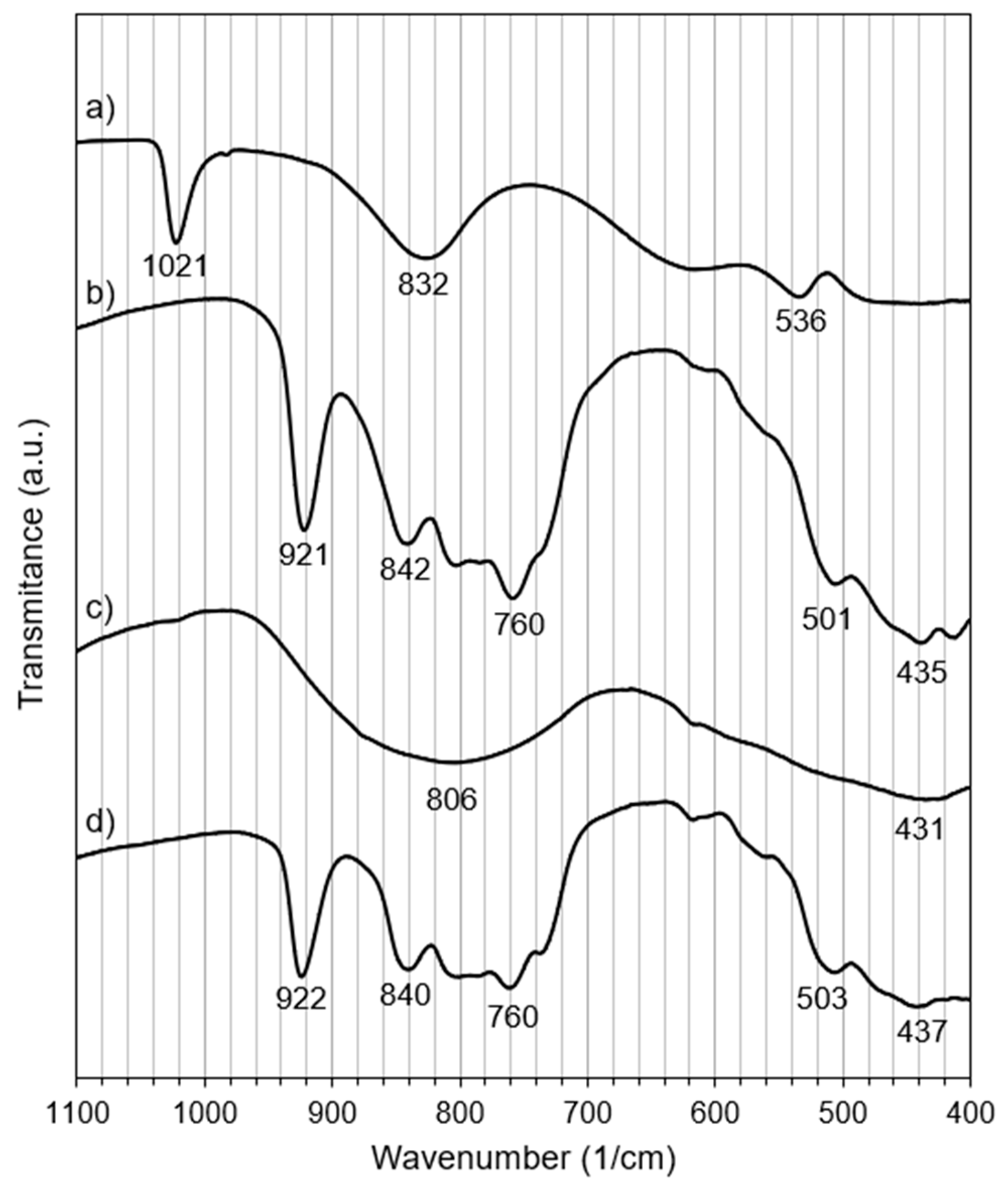
To determine the oxygen polyhedral that built the structure of Eu5VO10, FTIR studies were conducted. Comparative analysis of the spectra of the substrates and the resulting compound led to the conclusion that the IR spectrum of Eu5VO10 vanadate differs significantly from that of the substrate mixture, taking into account both the position of the absorption bands and their intensity. A summary of the recorded transmission spectra in the 400–1100 cm−1 range is presented in Figure 5.
The registered IR spectrum (Figure 5a) of the substrate mixture shows absorption bands which, according to the literature data, correspond to the stretching vibrations of the V–O [11] and Eu–O [24] bonds in the oxygen polyhedra of vanadium and europium. The absorption bands in the range of 700–950 cm−1, visible in the spectra in Figure 5b,d, according to the literature data, can be assigned both to the V–O–V bridge vibrations in the VO4 [11] polyhedra and to the Eu–O bonds in the EuO8 [24] polyhedra. Based on the similarity of the IR spectra of the obtained europium(III) vanadate(V) to other phases with the same formula type, it was concluded that, similarly to Sm5VO10 [13], the structure of Eu5VO10 is likely composed of VO4 tetrahedra [11] and EuO8 dodecahedra [24] connected by edges. It cannot be ruled out that the structure of the studied europium(III) vanadate(V) also includes EuO6 polyhedra [24]. It should be noted that in the case of the phase obtained by the mechanochemical method, one broad, diffuse absorption band (700–970 cm−1) was registered, which further confirms the presence of an amorphous phase in addition to the crystalline phase in the Eu5VO10 sample.

3.5. UV–VIS–DRS

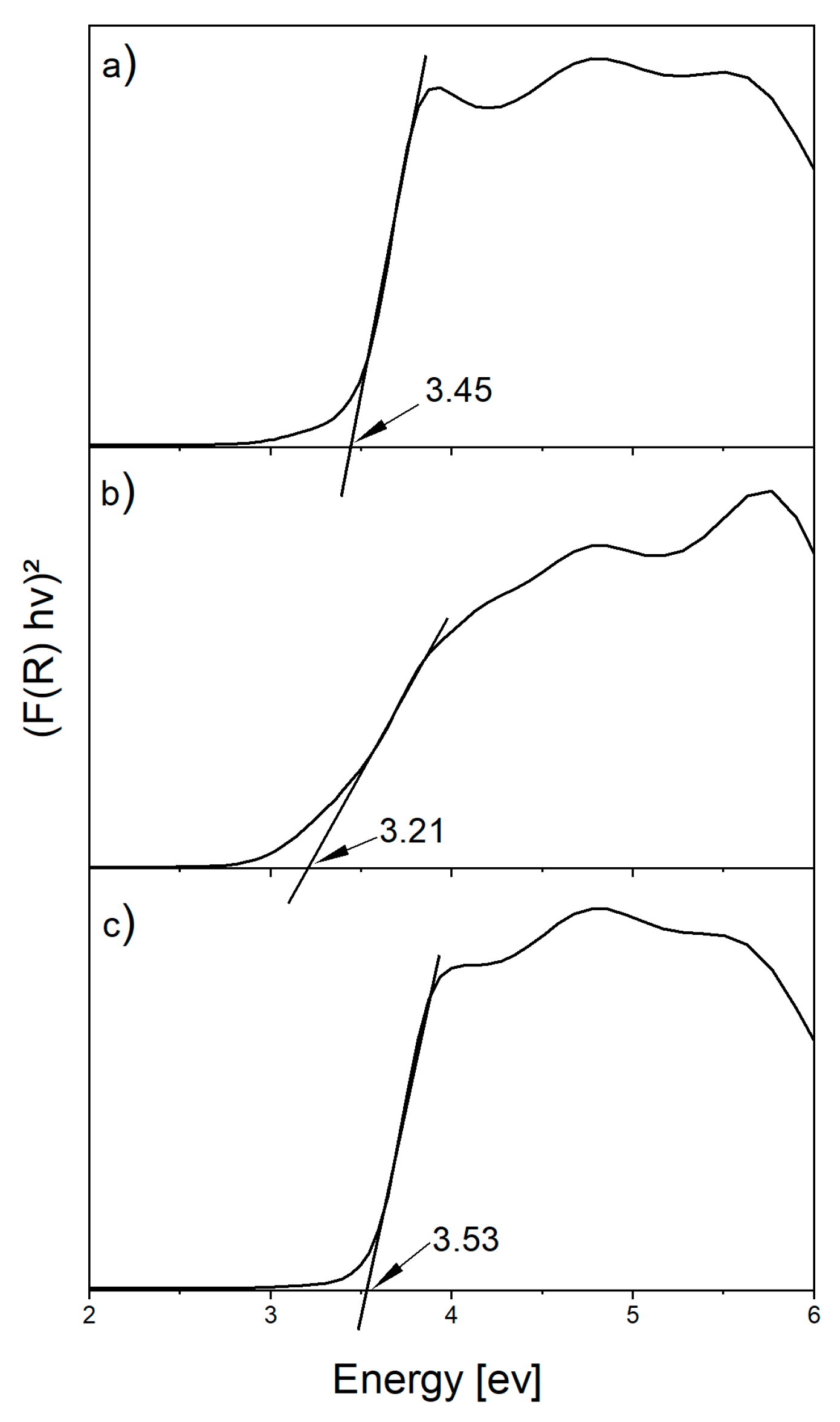
The final step in this study was to estimate the energy gap of Eu5VO10 obtained by three different methods. To this end, a Tauc plot was created from the transformed UV–VIS spectrum, and then a tangent was drawn to the longest straight line segment.
Figure 6 shows the UV–VIS spectrum after Tauc transformation of the Eu5VO10 compound obtained by both the ceramic and mechanochemical methods, as well as the modified Pechini method.
The intersection of the tangent line with the OX axis allows us to estimate the energy gap value. Based on the estimated Eg values, it was determined that, regardless of the synthesis method, Eu5VO10 belongs to the group of electrical semiconductors with a gap above 3.2 eV. Based on the literature data [25] concerning, among others, materials with a similar Eg value (ZnO, GaN, TiO2), it can be indicated that the obtained europium(III) vanadate(V) may find application as a component of phosphors, crystalline lasers, photocatalysts, etc.

4. Conclusions

The results of the conducted and presented studies showed, that:
  • The Eu5VO10 compound formed in the binary V2O5–Eu2O3 oxide system can be synthesized both by high-temperature solid-state reactions and by the modified Pechini method to obtain a microcrystalline material, as well as by the mechanochemical method to obtain a nanocrystalline material with the participation of a microcrystalline material.
  • The synthesis of Eu5VO10 occurs via an intermediate step, in which EuVO4 forms.
  • Eu5VO10 crystallizes in the monoclinic system, with the following calculated unit cell parameters: a = 8.975(5) Å; b = 7.959(4) Å; c = 13.834(9) Å; β = 92.73(5)°. The number of molecules in the unit cell Z is four.
  • The structure of the Eu5VO10 compound mainly consist of VO4 tetrahedrons and EuO8 dodecahedrons or EuO6 octahedrons.
  • The Eu5VO10 compound is thermally stable in the air atmosphere up to the temperature around 1310 °C, above which it decomposes in the solid state to Eu2O3 and Eu8V2O17.
  • Depending on the synthesis method used, the energy gap values are approximately around 3.45 eV for Eu5VO10 synthesized by the classical ceramic method, around 3.21 eV for the phase obtained by the mechanochemical method and around 3.53 eV for vanadate synthesized by the modified Pechini method.
  • The band gap values indicate that regardless of the synthesis method, the Eu5VO10 compound is classified in the wide band gap electrical semiconductors group.

Author Contributions

Conceptualization, K.K. and E.F.; methodology, K.K., E.F. and M.P.; validation, E.F., M.P., P.K. and K.K.; formal analysis, K.K., E.F. and M.P.; investigation, K.K., E.F., M.P. and P.K.; data curation, E.F., M.P., P.K. and K.K.; writing—original draft preparation, K.K.; writing—review and editing, E.F.; visualization, K.K., M.P. and P.K.; supervision, E.F.; project administration, K.K. All authors have read and agreed to the published version of the manuscript.

Funding

This work was supported by Rector of the West Pomeranian University of Technology in Szczecin for PhD students of the Doctoral School, grant number: ZUT/39/2025.

Institutional Review Board Statement

Not applicable.

Informed Consent Statement

Not applicable.

Data Availability Statement

The original contributions presented in this study are included in the article. Further inquiries can be directed to the corresponding authors.

Conflicts of Interest

The authors declare no conflicts of interest.

References

  1. Kim, K.Y.; Yoon, S.J.; Park, K. Synthesis and photoluminescence properties of EuVO4 red phosphors. Ceram. Int. 2014, 40, 9457–9461. [Google Scholar] [CrossRef]
  2. Govindarajan, D.; Joy Johanson, F.; Uma shankar, V.; Joseph Salethraj, M.; Gopalakrishnan, R. Optical, magnetic, and electrochemical properties of EuVO4 nanorods synthesized via solvothermal route. J. Mater. Sci. Mater. Electron. 2021, 32, 19434–19445. [Google Scholar] [CrossRef]
  3. Akbar Hosseini, S. Nanocrystalline EuVO4: Synthesis, characterization, optical and photocatalytic properties. J. Mater. Sci. Mater. Electron. 2016, 27, 10775–10779. [Google Scholar] [CrossRef]
  4. Paszkiewicz, W.; López-Solano, J.; Piszora, P.; Bojanowski, B.; Mujica, A.; Muñoz, A.; Cerenius, Y.; Carlson, S.; Dąbkowska, H. Equation of state and electronic properties of EuVO4: A high-pressure experimental and computational study. J. Alloys Compd. 2015, 648, 1005–1016. [Google Scholar]
  5. Prasad, M.; Pandit, A.K.; Ansari, T.H.; Singh, R.A.; Wanklyn, B.M. Electrical transport properties of EuVO4 single crystal. Phys. Lett. A 1989, 138, 61–64. [Google Scholar] [CrossRef]
  6. Peng, L.; Li, L.; Qin, F.; Wang, C.; Zhang, Z. A multi-mode self-referenced optical thermometer based on low-doped YVO4: Eu3+ phosphor. J. Lumin. 2023, 263, 120168. [Google Scholar]
  7. Carvalho, F.O.; Piropo, G.J.; Lima, A.F.; Lalic, M.V. Structural, electronic and optical properties of the YVO4: Eu3+ red phosphor. Opt. Mater. 2023, 143, 114151. [Google Scholar] [CrossRef]
  8. Pankratov, V.; Popov, A.I.; Shirmane, L.; Kotlov, A.; Feldmann, C. LaPO4:Ce, Tb and YVO4:Eu nanophosphors: Luminescence studies in the vacuum ultraviolet spectral range. J. Appl. Phys. 2011, 110, 053522. [Google Scholar] [CrossRef]
  9. Wang, Y.; Zuo, Y.; Gao, H. Luminescence properties of nanocrystalline YVO4:Eu3+ under UV and VUV excitation. Mater. Res. Bull. 2006, 41, 2147–2153. [Google Scholar] [CrossRef]
  10. Brusset, H.; Madaule-Aubry, F.; Blanck, B.; Glaziou, J.P.; Laude, J.P. Etude des oxydes mixtes de lanthanides et de vanadium(V). Can. J. Chem. 1971, 49, 3700–3707. [Google Scholar] [CrossRef]
  11. Kitayama, K.; Sou, H.; Katsura, T. Phase Equilibria in the Ln2O3–V2O3–V2O5 (Ln=Eu and Yb) Systems at 1200 °C. Bull. Chem. Soc. Jpn. 1983, 56, 3415–3420. [Google Scholar] [CrossRef]
  12. Kiparisov, S.S.; Belyaev, R.A.; Bondarenko, V.V. Rentgenografisheskoye issledovaniye vzaimodeystviya oksiyevropiya s pyatiokisyami vanadiya i niobiya (X-ray study of the interaction of europium oxide with vanadium and niobium pentoxides, rus.). Neorg. Mat. 1973, 9, 68–71. [Google Scholar]
  13. Kwiatkowski, K.; Piz, M.; Filipek, E. High-temperature and mechanochemical synthesis of Sm5VO10 and its unknown properties. Chem. Process Eng. 2023, 44, e44. [Google Scholar]
  14. Piz, M.; Filipek, E.; Kwiatkowski, K.; Dulian, P.; Bąk, W.; Wróbel, R.J. New Ceramic Material Y2-xVxO3+x—Mechanochemical Synthesis and Some Physicochemical Properties. ChemNanoMat 2024, 10, e202400337. [Google Scholar]
  15. Sunde, T.O.L.; Grande, T.; Einarsrud, M.A. Modified Pechini Synthesis of Oxide Powders and Thin Films. In Handbook of Sol-Gel Science and Technology, 1st ed.; Klein, L., Aparicio, M., Jitianu, A., Eds.; Springer: Cham, Switzerland, 2016; pp. 1–30. [Google Scholar]
  16. Kwiatkowski, K.; Filipek, E.; Piz, M. Reinvestigation of phase equilibria up to the solidus line and properties of the phases from the V2O5–Sm2O3 system. J. Therm. Anal. Calorim. 2025, 150, 19833–19845. [Google Scholar]
  17. Piz, M.; Filipek, E. Influence of Yb3+ ion incorporation in the structure of Yttrium Divanadate (V) on the properties of a new ceramic solid solution Y8-yYbyV2O17. Ceram. Int. 2021, 47, 12327–12333. [Google Scholar] [CrossRef]
  18. International Centre for Diffraction Data. Powder Diffraction File (PDF-5+); International Centre for Diffraction Data: Swarthmore, PA, USA, 2026. [Google Scholar]
  19. Cuocci, C.; Corriero, N.; Baldassarre, F.; Dell’Aera, M.; Falcicchio, A.; Rizzi, R.; Altomare, A. Advanced perspectives in the EXPO software for solving crystal structures from powder diffraction data. J. Appl. Cryst. 2022, 55, 411–419. [Google Scholar] [CrossRef]
  20. Yamaguchi, O.; Mukaida, Y.; Shigeta, H.; Takemura, H.; Yamashita, M. Preparation of Alkoxy–Derived Yttrium Vanadate. J. Electrochem. Soc. 1989, 136, 1557–1560. [Google Scholar]
  21. Baláž, P.; Achimovičová, M.; Baláž, M.; Billik, P.; Cherkezova-Zheleva, Z.; Criado, J.M.; Delogu, F.; Dutková, E.; Gaffet, E.; Gotor, F.J.; et al. Hallmarks of mechanochemistry: From nanoparticles to technology. Chem. Soc. Rev. 2013, 42, 7571–7637. [Google Scholar] [CrossRef] [PubMed]
  22. Patterson, A.L. The Scherrer Formula for X-Ray Particle Size Determination. Phys. Rev. 1939, 56, 978–982. [Google Scholar] [CrossRef]
  23. Zinkevich, M. Thermodynamics of rare earth sesquioxides. Prog. Mater. Sci. 2007, 52, 597–647. [Google Scholar] [CrossRef]
  24. Wells, A.F. Structural Inorganic Chemistry, 4th ed.; Oxford University Press: London, UK, 1975; pp. 450–453. [Google Scholar]
  25. Crowley, J.M.; Tahir-Kheli, J.; Goddard, W.A. Resolution of the Band Gap Prediction Problem for Materials Design. J. Phys. Chem. Lett. 2016, 7, 1198−1203. [Google Scholar] [CrossRef]
Figure 1. A fragment of the DTA curve of initial oxides mixture (V2O5:Eu2O3 molar ratio of 1:5).
Materials 19 02782 g001
Figure 2. Fragments of the diffractograms: (a) mixture of substrates; (b) sample after the first synthesis step (600 °C, 12 h); (c) after the last synthesis step (1300 °C, 12 h).
Materials 19 02782 g002
Figure 3. Fragments of diffractograms of the Eu5VO10 obtained by various methods: (a) ceramic, (b) mechanochemical, (c) modified Pechini method.
Materials 19 02782 g003
Figure 4. The SEM images of the samples contained: (a) the mixture of substrates after homogenisation by grinding; Eu5VO10 obtained by various methods: (b) ceramic, (c) mechanochemical, (d) modified Pechini method.
Materials 19 02782 g004
Figure 5. Fragments of IR spectra of the samples contained: (a) a mixture of the substrates; Eu5VO10 obtained by various methods: (b) ceramic, (c) mechanochemical, (d) modified Pechini method.
Materials 19 02782 g005
Figure 6. Summary of UV–VIS spectra after Tauc transformation: Eu5VO10 obtained by various methods: (a) ceramic, (b) mechanochemical, (c) modified Pechini method.
Materials 19 02782 g006
Table 1. The results of the indexing of the Eu5VO10 powder diffractogram.
No.hkldobs [Å]dcalc [Å]I/I0 [%]
11 0 08.97408.964917
20 1 07.93387.958912
30 0 −26.92056.909412
4−1 2 −23.20383.193271
51 0 43.18103.173478
62 0 33.13583.1387100
70 2 −33.00563.011320
83 0 0 2.99042.988380
9−1 2 32.87462.88189
10−2 2 −22.70632.702391
114 0 31.97731.978617
12−4 2 11.94561.944819
13−4 1 −31.91921.920214
14−1 3 51.88461.884415
15−1 4 21.87461.875020
16−1 1 −71.85581.856323
17−4 0 61.64611.645911
18−3 3 51.63691.636415
19−4 2 51.62661.627011
200 5 01.59181.591812
Table 2. The results of the EDX analysis.
ElementAtomic Percent of Elements in Eu5VO10 Obtained with Methods:Theoretical Values
[% at.]
High-Temperature MechanochemicalModified Pechini
Eu84.284.084.883.3
V15.816.015.216.7
Disclaimer/Publisher’s Note: The statements, opinions and data contained in all publications are solely those of the individual author(s) and contributor(s) and not of MDPI and/or the editor(s). MDPI and/or the editor(s) disclaim responsibility for any injury to people or property resulting from any ideas, methods, instructions or products referred to in the content.