Temperature-Rise Suppression Concrete Incorporating Steel-Encapsulated SAP–Water Phase-Change Aggregates: Semi-Adiabatic Characterization, Adiabatic Temperature-Rise Prediction and Finite Element Assessment


Highlights
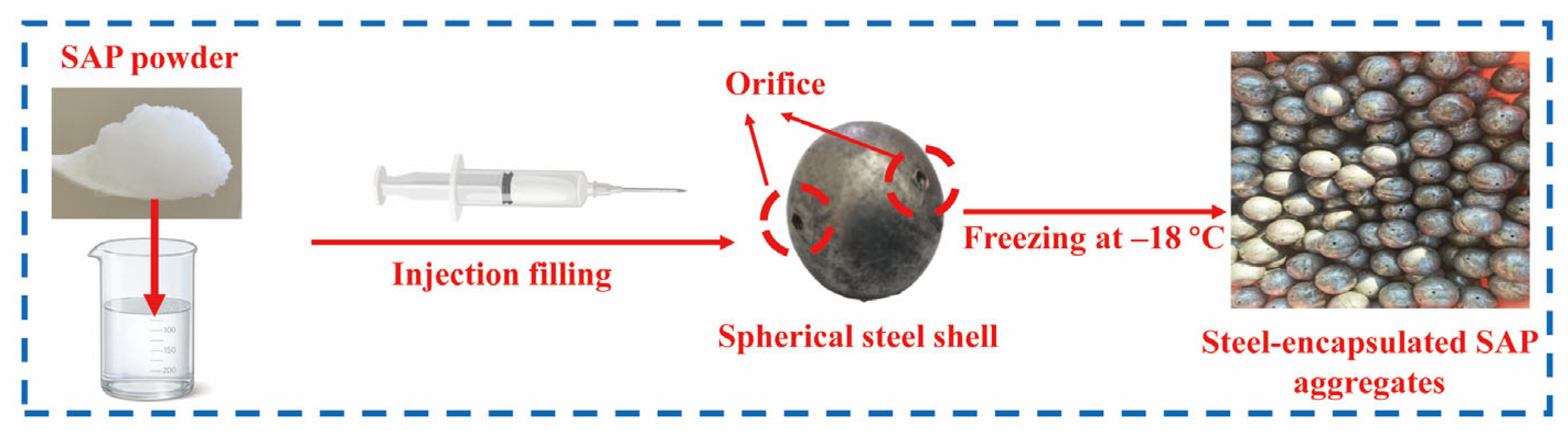
- Steel-encapsulated SAP–water aggregates were developed for temperature-rise suppression concrete.
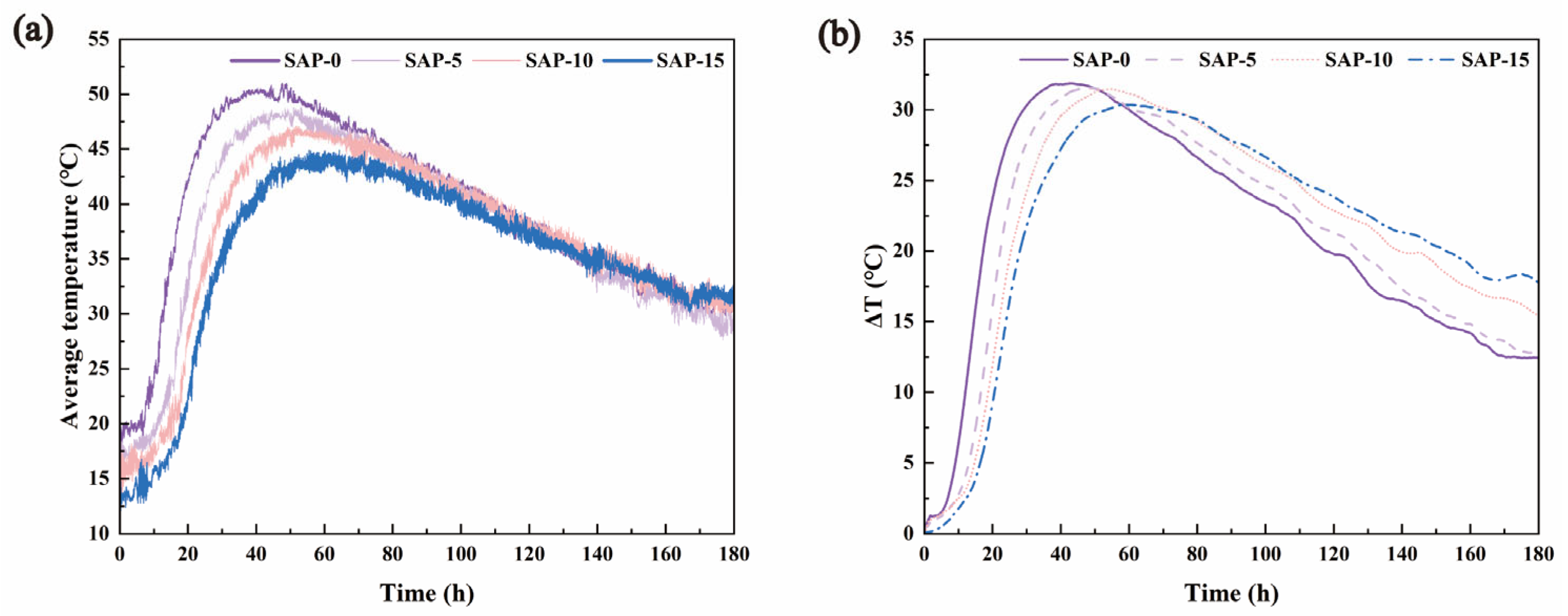
- Semi-adiabatic tests showed reduced peak temperature rise and delayed thermal peaks.
- Adiabatic temperature rise was reconstructed from semi-adiabatic measurements.
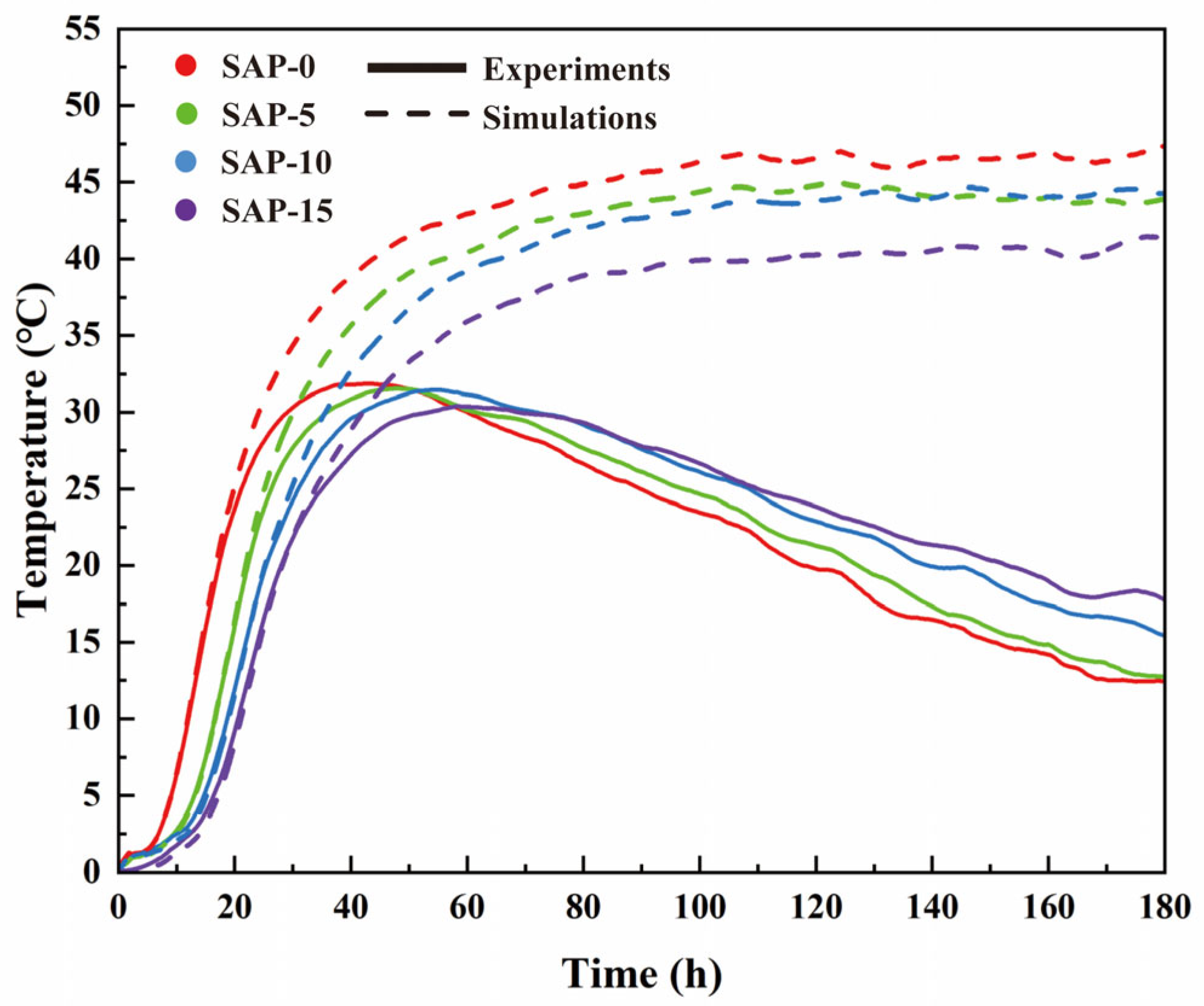
- FEM accurately reproduced the measured thermal evolution of the concrete mixtures.
- SAP-15 reduced pile-cap peak temperatures and mitigated thermal stress development.
Abstract
1. Introduction
2. Experiment Details
2.1. Raw Materials
2.2. Fabrication of the Steel-Encapsulated SAP–Water Aggregates
2.3. Formulation and Mixture of the Temperature-Rise Suppression Concrete
3. Experimental Results and Discussion
3.1. Semi-Adiabatic Temperature Rise Test
3.2. Semi-Adiabatic Temperature Rise Results
4. Simulation of Practical Project
4.1. Calculation of the Adiabatic Temperature Rise
4.2. Validation of the Finite Element Model Against Experimental Semi-Adiabatic Temperature Rise Data
4.3. Finite Element Modeling and Analysis of a Pier (Pile-Cap) Foundation
5. Conclusions
- The incorporation of steel-encapsulated SAP–water phase-change aggregates reduced early-age heat accumulation under semi-adiabatic conditions, leading to both a lower temperature rise and a delayed thermal peak. The strongest effect was observed for SAP-15, in which the peak relative temperature rise decreased from 31.86 °C to 30.40 °C, and the peak time was delayed by 15.13 h.
- Heat-loss-compensated analysis further confirmed the intrinsic thermal-buffering effect of the proposed aggregate system under equivalent adiabatic conditions. With increasing replacement ratio, the maximum adiabatic temperature rise decreased, and the heat-release history became flatter and more delayed. For SAP-15, the maximum adiabatic temperature rise decreased to 40.5 °C, while the specific heat capacity increased to 0.912 kJ/(kg·K).
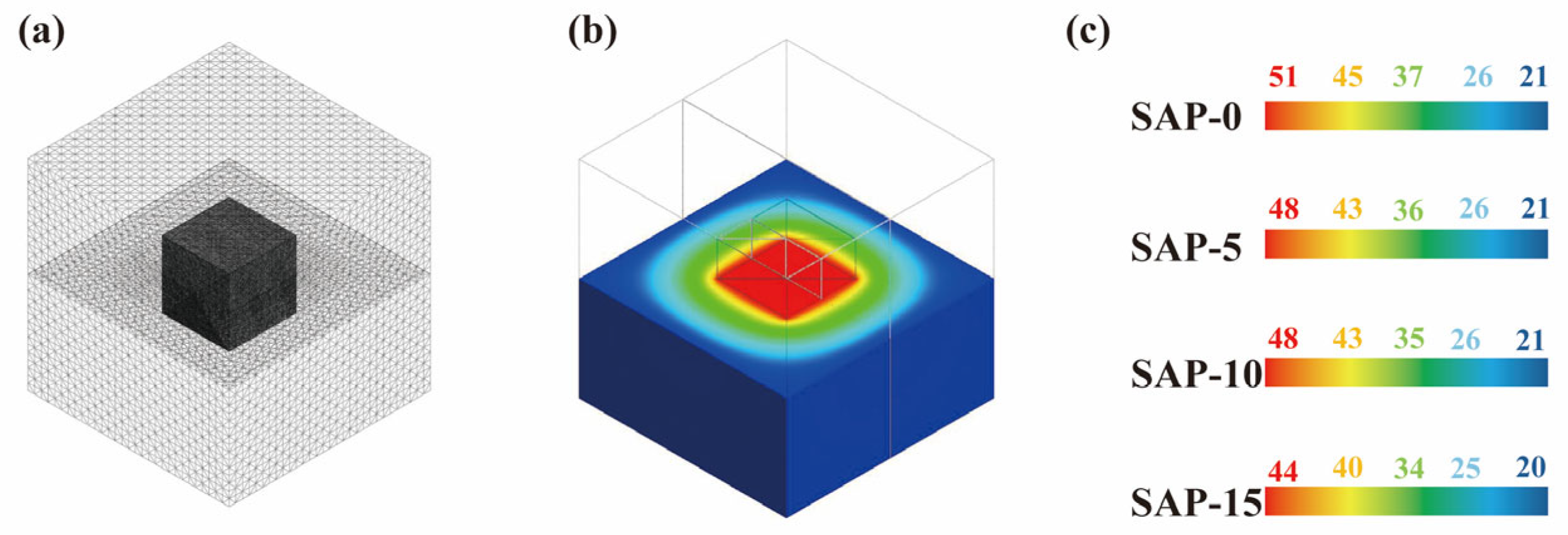
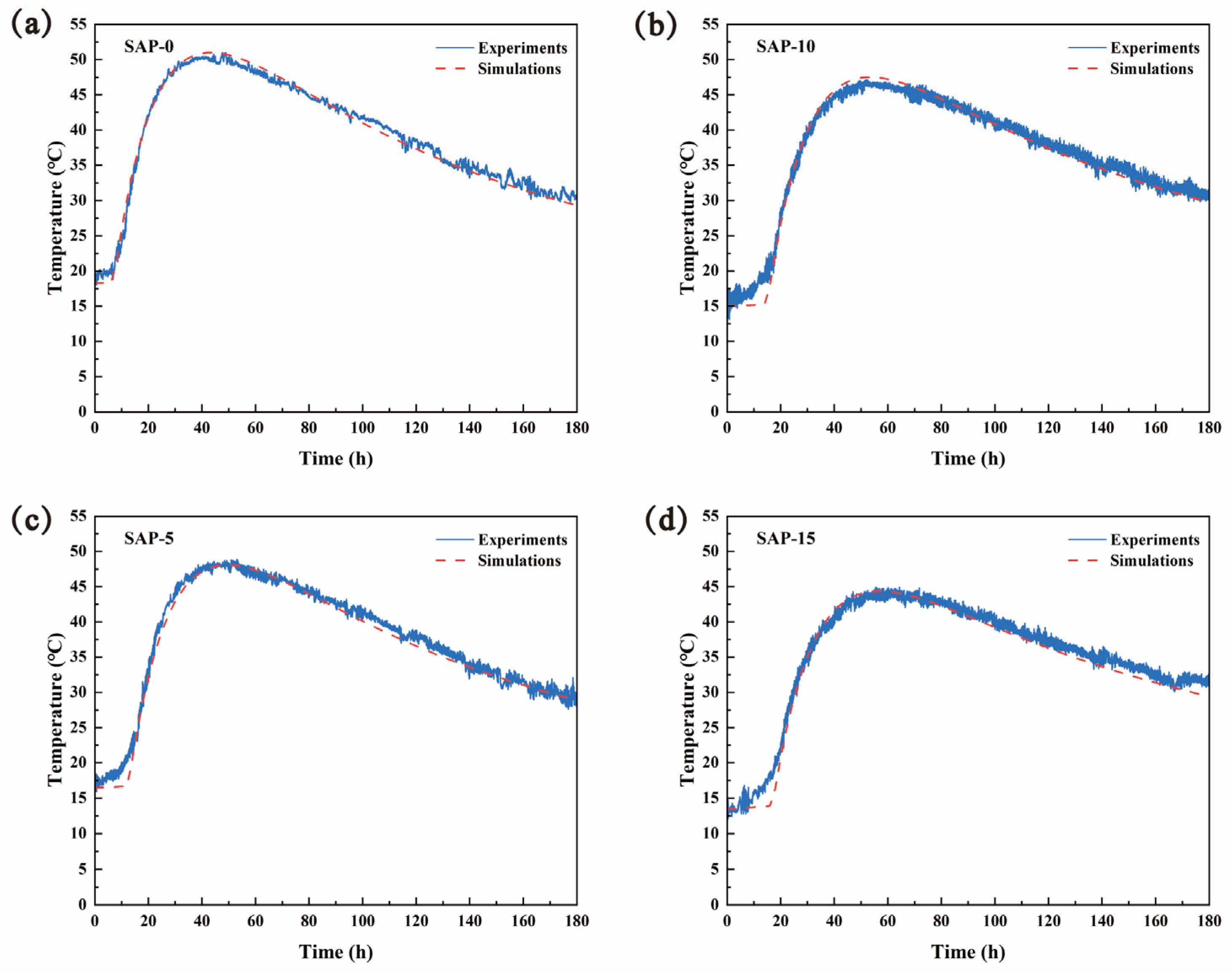
- The finite element model calibrated against the semi-adiabatic test results reproduced the measured temperature histories with good agreement, supporting the reliability of the proposed thermal analysis framework. The simulated peak core temperature decreased from 51 °C for SAP-0 to 44 °C for SAP-15.
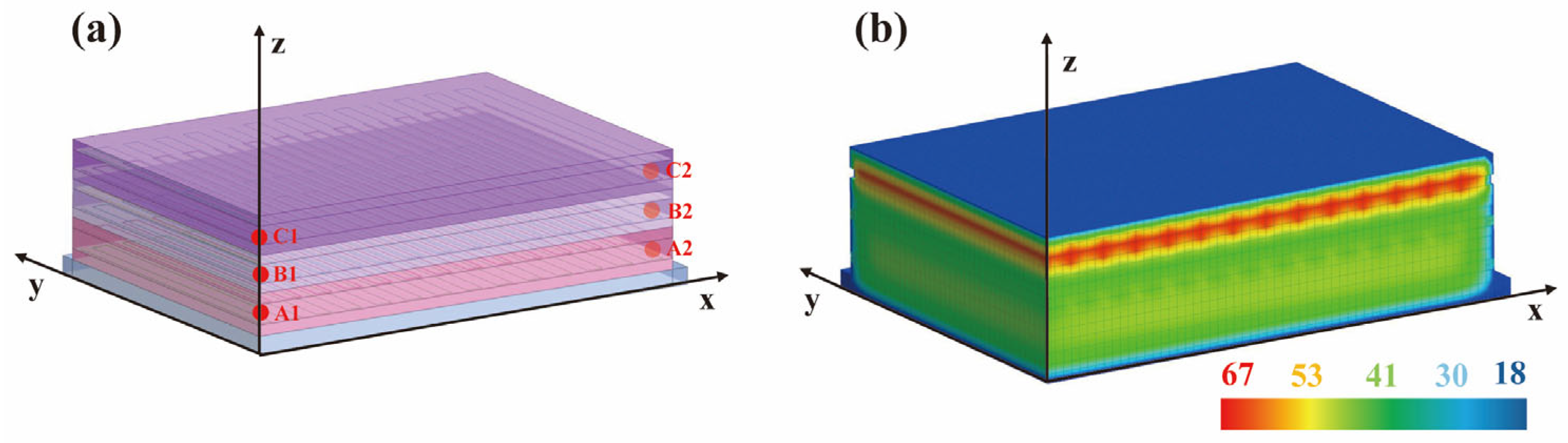
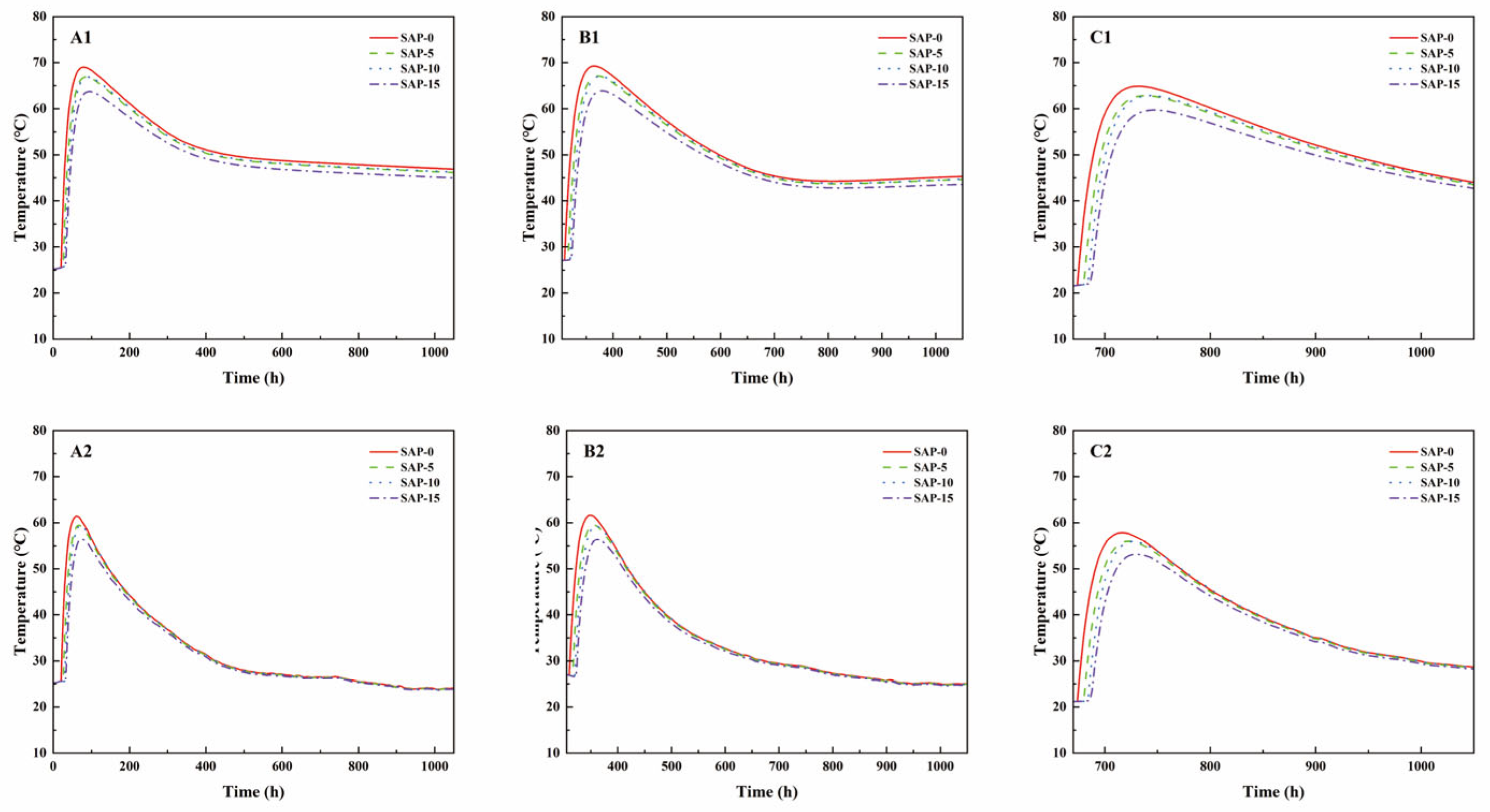
- Engineering-scale simulation of a bridge pile-cap foundation indicated that the laboratory-scale thermal benefit can be translated to mass concrete conditions. For SAP-15, the internal peak temperatures of the three casting layers were reduced by 5.3, 5.6, and 5.2 °C, respectively, relative to the reference concrete, together with a reduction in the temperature difference between the interior and exterior regions.
- Overall, steel-encapsulated SAP–water phase-change aggregates show potential as a material-based strategy for moderating early-age temperature rise and simulated thermal stress in mass concrete. Further evaluation considering age-dependent mechanical properties, actual curing conditions, and cracking-risk criteria is required before direct engineering design application.
Author Contributions
Funding
Data Availability Statement
Conflicts of Interest
Abbreviations
| SAP | Superabsorbent polymer |
| PCM | Phase-change material |
| FEA | Finite element analysis |
| EPS | Expanded polystyrene |
| SSD | Saturated-surface-dry |
| FEM | Finite element method |
References
- Abou-Zeid, M.; Fowler, D.W.; Nawy, E.G.; Allen, J.H.; Halvorsen, G.T.; Poston, R.W.; Barlow, J.P.; Hansen, W.; Rhoads, R.J.; Brander, M.E. Control of cracking in concrete structures. Rep. ACI Comm. 2001, 224, 12–16. [Google Scholar]
- Huang, Y.; Liu, G.; Huang, S.; Rao, R.; Hu, C. Experimental and finite element investigations on the temperature field of a massive bridge pier caused by the hydration heat of concrete. Constr. Build. Mater. 2018, 192, 240–252. [Google Scholar] [CrossRef] [Scilit]
- Liu, D.; Zhang, W.; Tang, Y.; Jian, Y. Prediction of Hydration Heat of Mass Concrete Based on the SVR Model. IEEE Access 2021, 9, 62935–62945. [Google Scholar] [CrossRef] [Scilit]
- Malla, S.; Wieland, M. Analysis of an arch–gravity dam with a horizontal crack. Comput. Struct. 1999, 72, 267–278. [Google Scholar] [CrossRef] [Scilit]
- Saeed, M. Three-dimensional finite element modelling for influence of reduced graphene oxide on cracking index of mass mortar blocks due to heat of hydration. Aust. J. Civ. Eng. 2023, 21, 194–206. [Google Scholar]
- Lin, F.; Song, X.; Gu, X.; Peng, B.; Yang, L. Cracking analysis of massive concrete walls with cracking control techniques. Constr. Build. Mater. 2012, 31, 12–21. [Google Scholar] [CrossRef] [Scilit]
- Kim, Y.-R.; Khil, B.-S.; Jang, S.-J.; Choi, W.-C.; Yun, H.-D. Effect of barium-based phase change material (PCM) to control the heat of hydration on the mechanical properties of mass concrete. Thermochim. Acta 2015, 613, 100–107. [Google Scholar] [CrossRef] [Scilit]
- Chu, I.; Lee, Y.; Amin, M.N.; Jang, B.-S.; Kim, J.-K. Application of a thermal stress device for the prediction of stresses due to hydration heat in mass concrete structure. Constr. Build. Mater. 2013, 45, 192–198. [Google Scholar] [CrossRef] [Scilit]
- Xiong, J.; Wang, D.; Xie, L.; Fan, Z.; Yao, Z. Simulation-Based Heat Transfer Optimization for Mass Concrete in Nuclear Power Station Construction: A Case Study. Buildings 2026, 16, 606. [Google Scholar] [CrossRef] [Scilit]
- Van Tran, M.; La, H.; Nguyen, T. Hybrid machine learning for predicting hydration heat in pipe-cooled mass concrete structures. Constr. Build. Mater. 2025, 481, 141558. [Google Scholar] [CrossRef] [Scilit]
- Leng, L.; Liang, W.; Zhang, C.; Zhang, P.; Tian, W. Influence of temperature rising inhibitor on temperature and stress field of mass concrete. Case Stud. Constr. Mater. 2023, 18, e01888. [Google Scholar] [CrossRef] [Scilit]
- Tian, K.P.; Xu, B.L.; Huang, Y.Y.; Zhou, Y.H.; Ding, Y.M. The Effect of New Pouring Precooling Concrete on Lower Layer Concrete in Different Seasons. Adv. Mater. Res. 2013, 663, 60–64. [Google Scholar] [CrossRef] [Scilit]
- Bourchy, A.; Barnes, L.; Bessette, L.; Chalencon, F.; Joron, A.; Torrenti, J.M. Optimization of concrete mix design to account for strength and hydration heat in massive concrete structures. Cem. Concr. Compos. 2019, 103, 233–241. [Google Scholar] [CrossRef] [Scilit]
- Han, F.; Zou, K.; Su, G.; Jiao, S. Research on the Temperature Field and Temperature Control Measures of Large Volume Concrete of the Foundation Pier During the Hydration Heat Release Process in Severe Cold Regions. Buildings 2025, 15, 1627. [Google Scholar] [CrossRef] [Scilit]
- Kiernozycki, W.; Blyszko, J. The Influence of Temperature on the Hydration Rate of Cements Based on Calorimetric Measurements. Materials 2021, 14, 3025. [Google Scholar] [CrossRef] [Scilit] [PubMed]
- Kim, G.-Y.; Lee, E.-B.; Nam, J.-S.; Koo, K.-M. Analysis of hydration heat and autogenous shrinkage of high-strength mass concrete. Mag. Concr. Res. 2011, 63, 377–389. [Google Scholar] [CrossRef] [Scilit]
- Liu, K.; Yuan, H.; Zhuang, S. Thermo-mechanical behavior of mass concrete with promising ultra-fine SCMs: A multi-scale experimental and numerical study. Case Stud. Constr. Mater. 2026, 24, e05733. [Google Scholar] [CrossRef] [Scilit]
- Kahandawa Arachchi, K.A.D.Y.T.; Mirza, O.; Mashiri, F.; Pathirana, S.; Camille, C. Mechanical and thermal performance of concrete with embedded organic and inorganic PCMs for building applications. Therm. Sci. Eng. Prog. 2026, 69, 104478. [Google Scholar] [CrossRef] [Scilit]
- Zhao, D.; Zhu, L.; Shen, Z.; Miu, Z.; Liu, X. Effect of hydration heat of super-large-section tunnel-lining concrete on structural stress and its mitigation measures. Tunn. Undergr. Space Technol. 2025, 157, 106324. [Google Scholar] [CrossRef] [Scilit]
- Zhang, G.; Cao, F.; Li, T.; Sun, C.; Guo, W.; Ma, Y.; Ren, F.; Wang, Y.; Si, W.; Ma, B. State of the Art on Prevention and Control Measures of Thermal Cracks in Mass Concrete. Sustainability 2025, 17, 11301. [Google Scholar] [CrossRef] [Scilit]
- Bentz, D.P.; Turpin, R. Potential applications of phase change materials in concrete technology. Cem. Concr. Compos. 2007, 29, 527–532. [Google Scholar] [CrossRef] [Scilit]
- Saffari, M.; Piselli, C.; de Gracia, A.; Pisello, A.L.; Cotana, F.; Cabeza, L.F. Thermal stress reduction in cool roof membranes using phase change materials (PCM). Energy Build. 2018, 158, 1097–1105. [Google Scholar] [CrossRef] [Scilit]
- Fernandes, F.; Manari, S.; Aguayo, M.; Santos, K.; Oey, T.; Wei, Z.; Falzone, G.; Neithalath, N.; Sant, G. On the feasibility of using phase change materials (PCMs) to mitigate thermal cracking in cementitious materials. Cem. Concr. Compos. 2014, 51, 14–26. [Google Scholar] [CrossRef] [Scilit]
- Pang, C.; Mao, Y.; Liu z Zhang, C.; Song, X. Effect and mechanism of phase change lightweight aggregate on temperature control and crack resistance in high-strength mass concrete. J. Build. Eng. 2024, 97, 110498. [Google Scholar] [CrossRef] [Scilit]
- Wang, Y.; Wang, C.; Luo, A.; Dong, M.; Su, Q.; Zhou, C.; Zhang, Z.; Pei, Y. Experimental Investigation on a Novel Temperature-Controlled Phase Change Aggregate Concrete: Thermo-Mechanical Properties and Hydration Heat Control. Materials 2023, 16, 5269. [Google Scholar] [CrossRef] [Scilit] [PubMed]
- Cunha, S.; Silva, M.; Aguiar, J. Behavior of cementitious mortars with direct incorporation of non-encapsulated phase change material after severe temperature exposure. Constr. Build. Mater. 2020, 230, 117011. [Google Scholar] [CrossRef] [Scilit]
- Mohaisen, K.O.; Zahir, M.H.; Al-Dulaijan, S.U.; Ahmad, S.; Al-Zahrani, M.M.; Maslehuddin, M. An innovative lightweight aggregate composite phase change material for thermal energy storage enhancement of concrete under hot weather conditions. J. Build. Eng. 2025, 99, 111575. [Google Scholar] [CrossRef] [Scilit]
- Dehdezi, P.K.; Hall, M.R.; Dawson, A.R.; Casey, S.P. Thermal, mechanical and microstructural analysis of concrete containing microencapsulated phase change materials. Int. J. Pavement Eng. 2013, 14, 449–462. [Google Scholar] [CrossRef] [Scilit]
- Li, M.; Zhou, D.; Jiang, Y. Preparation and thermal storage performance of phase change ceramsite sand and thermal storage light-weight concrete. Renew. Energy 2021, 175, 143–152. [Google Scholar] [CrossRef] [Scilit]
- Wei, J.; Zhang, H.; Zhang, W.; Liu, X.; Yang, Y. Experimental study of thermal and mechanical performance of energy storage concrete using phase change aggregates with aluminum shells. Constr. Build. Mater. 2025, 471, 140739. [Google Scholar] [CrossRef] [Scilit]
- Lim, C.-K.; Kim, J.-K.; Seo, T.-S. Prediction of concrete adiabatic temperature rise characteristic by semi-adiabatic temperature rise test and FEM analysis. Constr. Build. Mater. 2016, 125, 679–689. [Google Scholar] [CrossRef] [Scilit]
- Jia, Z.; Li, D.; Wang, Z.; Wang, Z.; Fang, F. Study on Preparation and Thermophysical Properties of Binary Paraffin Phase Change Concrete. Int. J. Concr. Struct. Mater. 2024, 18, 85. [Google Scholar] [CrossRef] [Scilit]
- Ng, P.; Kwan, A. Semi-adiabatic curing test with heat loss compensation for evaluation of adiabatic temperature rise of concrete. HKIE Trans. 2012, 19, 11–19. [Google Scholar] [CrossRef] [Scilit]
- Yang, J.; Tang, L.-S.; Bai, L.; Bao, R.-Y.; Liu, Z.-Y.; Xie, B.-H.; Yang, M.-B.; Yang, W. High-performance composite phase change materials for energy conversion based on macroscopically three-dimensional structural materials. Mater. Horiz. 2019, 6, 250–273. [Google Scholar]
- Yang, J.; Wang, F. Influence of assumed absorption capacity of superabsorbent polymers on the microstructure and performance of cement mortars. Constr. Build. Mater. 2019, 204, 468–478. [Google Scholar] [CrossRef] [Scilit]
- Yeon, J.H. Thermal behavior of cement mortar embedded with low-phase transition temperature PCM. Constr. Build. Mater. 2020, 252, 119168. [Google Scholar] [CrossRef] [Scilit]
- Zhou, L.; Zhou, F.; Peng, Z.; Ge, H.; Shan, F. Reduction of interior temperature of massive concrete using an enhanced heat transfer pipe array with spiral fins. Adv. Struct. Eng. 2021, 24, 1972–1984. [Google Scholar] [CrossRef] [Scilit]
- Zhu, J.; Wang, Z. Experimental modeling and quantitative evaluation of mitigating cracks in early-age mass concrete by regulating heat transfer. J. Build. Eng. 2024, 96, 110641. [Google Scholar] [CrossRef] [Scilit]
- Wang, K.; Dong, K.; Guo, J.; Du, H. Absorption and Release mechanism of superabsorbent polymers and its impact on shrinkage and durability of internally cured concrete—A review. Case Stud. Constr. Mater. 2024, 21, e03909. [Google Scholar] [CrossRef] [Scilit]
- An, G.-H.; Park, J.-M.; Cha, S.-L.; Kim, J.-K. Development of a portable device and compensation method for the prediction of the adiabatic temperature rise of concrete. Constr. Build. Mater. 2016, 102, 640–647. [Google Scholar] [CrossRef] [Scilit]
- Jin, E.-W.; Kim, C.-Y.; Kim, J.-K. Equipment for measuring the adiabatic temperature rise of concrete by compensating heat loss. J. Korea Concr. Inst. 2012, 24, 535–542. [Google Scholar] [CrossRef] [Scilit]
- Liu, S.; Guan, J.; Niu, X.; Liu, X.; Lai, G.; Qian, S.; Zhu, H.; Xie, Z.; Wang, Z.; Cui, S. Effects of temperature rise-inhibiting polycarboxylate superplasticizers on hydration process and mechanical properties of cement-based materials. Inorg. Chem. Commun. 2026, 186, 116203. [Google Scholar] [CrossRef] [Scilit]
- Lin, Y.; Chen, H.-L. Thermal analysis and adiabatic calorimetry for early-age concrete members. J. Therm. Anal. Calorim. 2015, 124, 227–239. [Google Scholar] [CrossRef] [Scilit]
- da Silva, W.R.L.; Šmilauer, V.; Štemberk, P. Upscaling semi-adiabatic measurements for simulating temperature evolution of mass concrete structures. Mater. Struct. 2015, 48, 1031–1041. [Google Scholar]
- Zhang, J.; Zhou, D.; He, X.; Hu, X.; Qiang, S. Comparative Analysis of Temperature and Stress Simulations in Mass Concrete for Sluice Gate Structures Based on Chinese and American Standards. Materials 2024, 18, 100. [Google Scholar] [CrossRef] [Scilit] [PubMed]
- Zhang, S.; Liu, P.; Liu, L.; Huang, J.; Cheng, X.; Chen, Y.; Chen, L.; He, S.; Zhang, N.; Yu, Z. Heat of Hydration Analysis and Temperature Field Distribution Study for Super-Long Mass Concrete. Coatings 2024, 14, 369. [Google Scholar] [CrossRef] [Scilit]
- Ouyang, J.; Chen, X.; Huangfu, Z.; Lu, C.; Huang, D.; Li, Y. Application of distributed temperature sensing for cracking control of mass concrete. Constr. Build. Mater. 2019, 197, 778–791. [Google Scholar] [CrossRef] [Scilit]



| CaO | Al2O3 | SiO2 | P2O5 | MgO | SO3 | K2O | |
|---|---|---|---|---|---|---|---|
| P•O 42.5 | 63.07 | 7.42 | 21.51 | 0.12 | 1.29 | 2.25 | 0.94 |
| Test Condition | Number of Aggregates | Mean Mass Before Mixing (g) | Mean Mass After Mixing (g) | Mass Change Rate (%) | Observation |
|---|---|---|---|---|---|
| Mixed in cement mortar with w/c = 0.47 for 2 min | 15 | 42.21 | 42.13 | 0.18 | No visible leakage |
| Number | Water-Cement Ratio | Water (kg/m3) | Cement (kg/m3) | Fine Aggregate (kg/m3) | Coarse Aggregate (kg/m3) | SAP–Water Phase-Change Aggregate (kg/m3) | Superplasticizer (kg/m3) |
|---|---|---|---|---|---|---|---|
| SAP-0 | 0.47 | 173 | 368 | 744 | 1115 | 0 | 0.7 |
| SAP-5 | 0.47 | 173 | 368 | 744 | 1059.25 | 61.27 | 0.7 |
| SAP-10 | 0.47 | 173 | 368 | 744 | 1003.5 | 122.55 | 0.7 |
| SAP-15 | 0.47 | 173 | 368 | 744 | 947.75 | 183.82 | 0.7 |
| Mixture | Density (kg/m3) | Thermal Conductivity, (W/(m·K)) | Specific Heat Capacity, c (kJ/(kg·K)) | Reaction Factor, r (h−1) | Maximum Adiabatic Temperature Rise, (Q∞) (°C) |
|---|---|---|---|---|---|
| SAP-0 | 2409.28 | 1.340 | 0.801 | 0.0615 | 46.7 |
| SAP-5 | 2411.36 | 1.745 | 0.826 | 0.0608 | 44.2 |
| SAP-10 | 2422.62 | 1.650 | 0.856 | 0.0603 | 44.1 |
| SAP-15 | 2437.53 | 1.353 | 0.912 | 0.0598 | 40.5 |
| Density (kg/m3) | Thermal Conductivity (W/(m·K)) | Specific Heat Capacity (kJ/(kg·K)) | Maximum Temperature Rise (°C) | Elastic Modulus (GPa) | |
|---|---|---|---|---|---|
| SAP-0 | 2409.28 | 1.340 | 0.801 | 46.7 | 42.55 |
| SAP-5 | 2411.36 | 1.745 | 0.826 | 44.2 | 37.8 |
| SAP-10 | 2422.62 | 1.650 | 0.856 | 44.1 | 37.1 |
| SAP-15 | 2437.53 | 1.353 | 0.912 | 40.5 | 38.4 |
| Casting Layer | Internal Peak Temperature (°C) | Max. Temp. Diff. (Inner–Outer) (°C) | |||||
|---|---|---|---|---|---|---|---|
| Temperature (°C) | Reduction (°C) | Reduction Ratio (%) | Temperature (°C) | Reduction (°C) | Reduction Ratio (%) | ||
| SAP-0 | Layer 1 | 69 | / | / | 9.9 | / | / |
| SAP-5 | 66.9 | 2.1 | 3.04 | 8.7 | 1.2 | 12.12 | |
| SAP-10 | 66.7 | 2.3 | 3.33 | 8.0 | 1.9 | 19.19 | |
| SAP-15 | 63.7 | 5.3 | 7.68 | 8.6 | 1.3 | 13.13 | |
| SAP-0 | Layer 2 | 69.3 | / | / | 9.3 | / | / |
| SAP-5 | 67.1 | 2.2 | 3.17 | 8.9 | 0.4 | 4.3 | |
| SAP-10 | 67 | 2.3 | 3.32 | 8.9 | 0.4 | 4.3 | |
| SAP-15 | 63.7 | 5.6 | 8.08 | 7.9 | 1.4 | 15.05 | |
| SAP-0 | Layer 3 | 64.8 | / | / | 7.8 | / | / |
| SAP-5 | 62.6 | 2.2 | 3.4 | 7 | 0.8 | 10.26 | |
| SAP-10 | 62.6 | 2.2 | 3.4 | 6.9 | 0.9 | 11.54 | |
| SAP-15 | 59.6 | 5.2 | 8.02 | 7.1 | 0.7 | 8.97 | |
| 3-Day Temperature Stress (MPa) | ||||||
| A1 | A2 | B1 | B2 | C1 | C2 | |
| SAP-0 | −11.91 | 1.84 | −10.55 | 1.44 | −11.36 | 1.66 |
| SAP-5 | −11.49 | 1.82 | −10.25 | 1.44 | −10.84 | 1.63 |
| SAP-10 | −11.55 | 1.86 | −10.38 | 1.49 | −10.75 | 1.64 |
| SAP-15 | −10.68 | 1.74 | −9.67 | 1.42 | −9.80 | 1.50 |
| 7-Day Temperature Stress (MPa) | ||||||
| A1 | A2 | B1 | B2 | C1 | C2 | |
| SAP-0 | −9.01 | 1.05 | −7.38 | 0.93 | −8.41 | 0.94 |
| SAP-5 | −8.73 | 1.03 | −7.17 | 0.91 | −8.18 | 0.92 |
| SAP-10 | −8.82 | 1.04 | −7.27 | 0.92 | −8.28 | 0.93 |
| SAP-15 | −8.24 | 0.99 | −6.79 | 0.87 | −7.76 | 0.88 |
Disclaimer/Publisher’s Note: The statements, opinions and data contained in all publications are solely those of the individual author(s) and contributor(s) and not of MDPI and/or the editor(s). MDPI and/or the editor(s) disclaim responsibility for any injury to people or property resulting from any ideas, methods, instructions or products referred to in the content. |
© 2026 by the authors. Licensee MDPI, Basel, Switzerland. This article is an open access article distributed under the terms and conditions of the Creative Commons Attribution (CC BY) license.
Share and Cite
Yin, H.; Yuan, T.; Li, Z.; Yin, Z.; Yao, H.; Wang, F. Temperature-Rise Suppression Concrete Incorporating Steel-Encapsulated SAP–Water Phase-Change Aggregates: Semi-Adiabatic Characterization, Adiabatic Temperature-Rise Prediction and Finite Element Assessment. Materials 2026, 19, 2630. https://doi.org/10.3390/ma19122630
Yin H, Yuan T, Li Z, Yin Z, Yao H, Wang F. Temperature-Rise Suppression Concrete Incorporating Steel-Encapsulated SAP–Water Phase-Change Aggregates: Semi-Adiabatic Characterization, Adiabatic Temperature-Rise Prediction and Finite Element Assessment. Materials. 2026; 19(12):2630. https://doi.org/10.3390/ma19122630
Chicago/Turabian StyleYin, Heng, Tianheng Yuan, Zongjin Li, Zhenzhen Yin, Hong Yao, and Fuqiang Wang. 2026. "Temperature-Rise Suppression Concrete Incorporating Steel-Encapsulated SAP–Water Phase-Change Aggregates: Semi-Adiabatic Characterization, Adiabatic Temperature-Rise Prediction and Finite Element Assessment" Materials 19, no. 12: 2630. https://doi.org/10.3390/ma19122630
APA StyleYin, H., Yuan, T., Li, Z., Yin, Z., Yao, H., & Wang, F. (2026). Temperature-Rise Suppression Concrete Incorporating Steel-Encapsulated SAP–Water Phase-Change Aggregates: Semi-Adiabatic Characterization, Adiabatic Temperature-Rise Prediction and Finite Element Assessment. Materials, 19(12), 2630. https://doi.org/10.3390/ma19122630