This is an early access version, the complete PDF, HTML, and XML versions will be available soon.
Article

Wear Behavior of Laser-Cladded TiN-Reinforced AlCoCrFeNi High-Entropy Alloy Coatings on 304 Stainless Steel

1
College of Artificial Intelligence, Wuchang University of Technology, Wuhan 430223, China
2
School of Mechanical Engineering, Wuhan Polytechnic University, Wuhan 430023, China
3
State Key Laboratory of Materials Processing and Die & Mould Technology, School of Materials Science and Engineering, Huazhong University of Science and Technology, 1037 Luoyu Road, Wuhan 430074, China
4
Hubei Lioho-Tianlun Machinery Co., Ltd., No. 1 Chuangye Road, Xiantao Industry Zone, Xiantao 433001, China
*
Authors to whom correspondence should be addressed.
Materials 2026, 19(12), 2563; https://doi.org/10.3390/ma19122563 (registering DOI)
Submission received: 14 May 2026 / Revised: 11 June 2026 / Accepted: 11 June 2026 / Published: 13 June 2026

Abstract

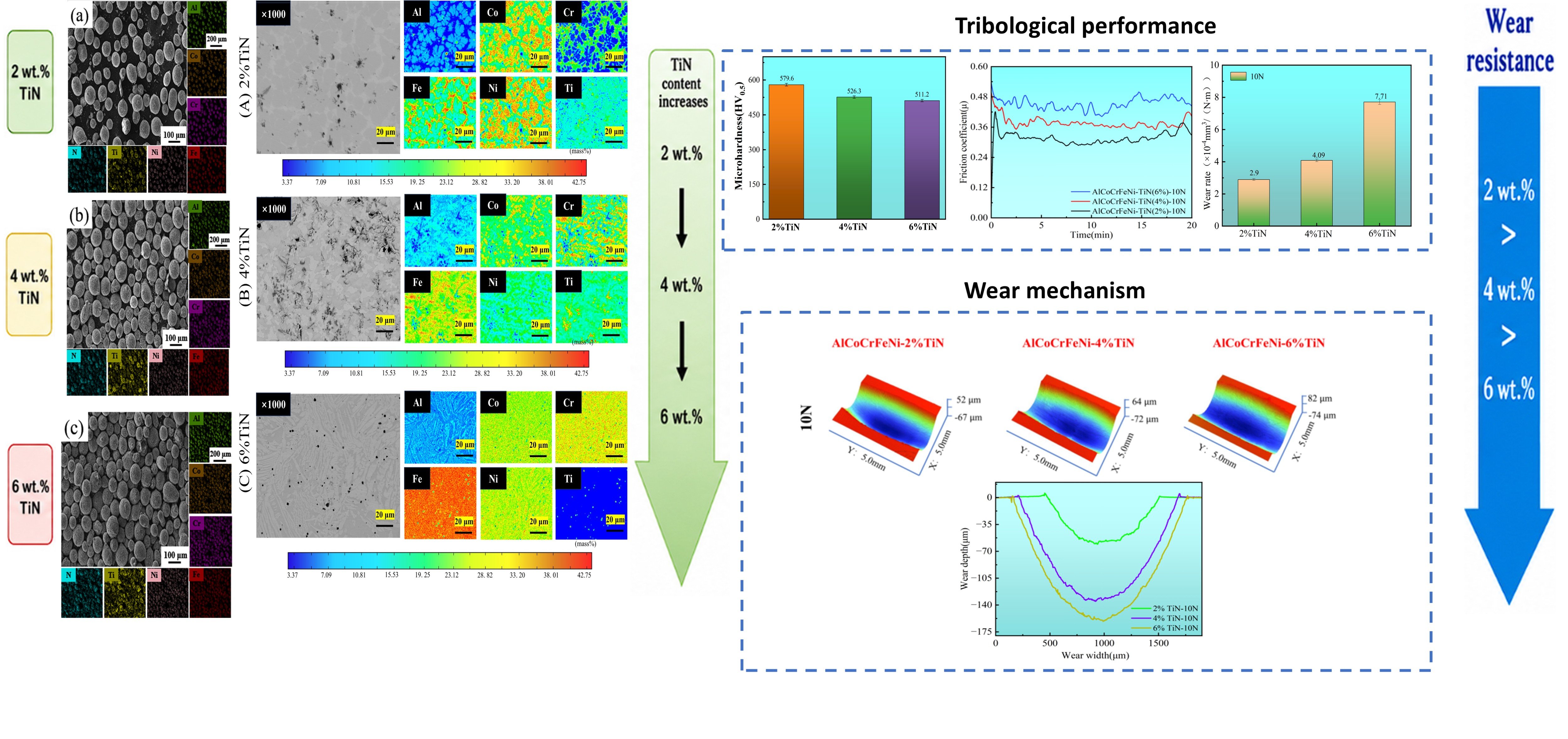
AlCoCrFeNi high-entropy alloy coatings reinforced with different TiN contents (2 wt.%, 4 wt.%, and 6 wt.%) were fabricated on 304 stainless steel by laser cladding. The effects of TiN addition on the microstructure, hardness, friction behavior, and wear resistance of the coatings were investigated. Dry reciprocating sliding tests were conducted under a load of 10 N, a frequency of 5 Hz, a stroke length of 5 mm, and a duration of 20 min using GCr15 bearing steel balls as the counterpart. The results showed that the 2 wt.% TiN coating exhibited the best tribological performance within the investigated composition range, with a microhardness of 579.6 HV0.5, a relatively low and stable friction coefficient of approximately 0.30–0.35, and a wear rate of 2.9 × 10⁻⁴ mm3/(N·m). When the TiN content increased to 4 wt.% and 6 wt.%, the wear resistance decreased, which was mainly associated with particle agglomeration, local stress concentration, and brittle spalling. These results indicate that appropriate TiN addition can improve the load-bearing capacity and wear resistance of laser-cladded AlCoCrFeNi coatings, providing a potential surface-strengthening strategy for 304 stainless steel components under dry sliding conditions.
Keywords: laser cladding; high-entropy alloys; friction and wear; microstructure laser cladding; high-entropy alloys; friction and wear; microstructure
Graphical Abstract