Review

Recovery of Platinum Group Metals from Spent Automotive Catalysts: A Review of Processes and Challenges


1
China Energy Longyuan Environmental Protection Co., Ltd., Beijing 100039, China
2
National Engineering Research Center of Green Recycling for Strategic Metal Resources, Institute of Process Engineering, Chinese Academy of Sciences, Beijing 100190, China
3
Efficient Electrolysis Group, Fuel Cell System and Engineering Laboratory, Dalian Institute of Chemical Physics, Chinese Academy of Sciences, Dalian 116023, China
*
Authors to whom correspondence should be addressed.
Materials 2026, 19(12), 2491; https://doi.org/10.3390/ma19122491
Submission received: 17 April 2026 / Revised: 25 May 2026 / Accepted: 8 June 2026 / Published: 10 June 2026

Abstract

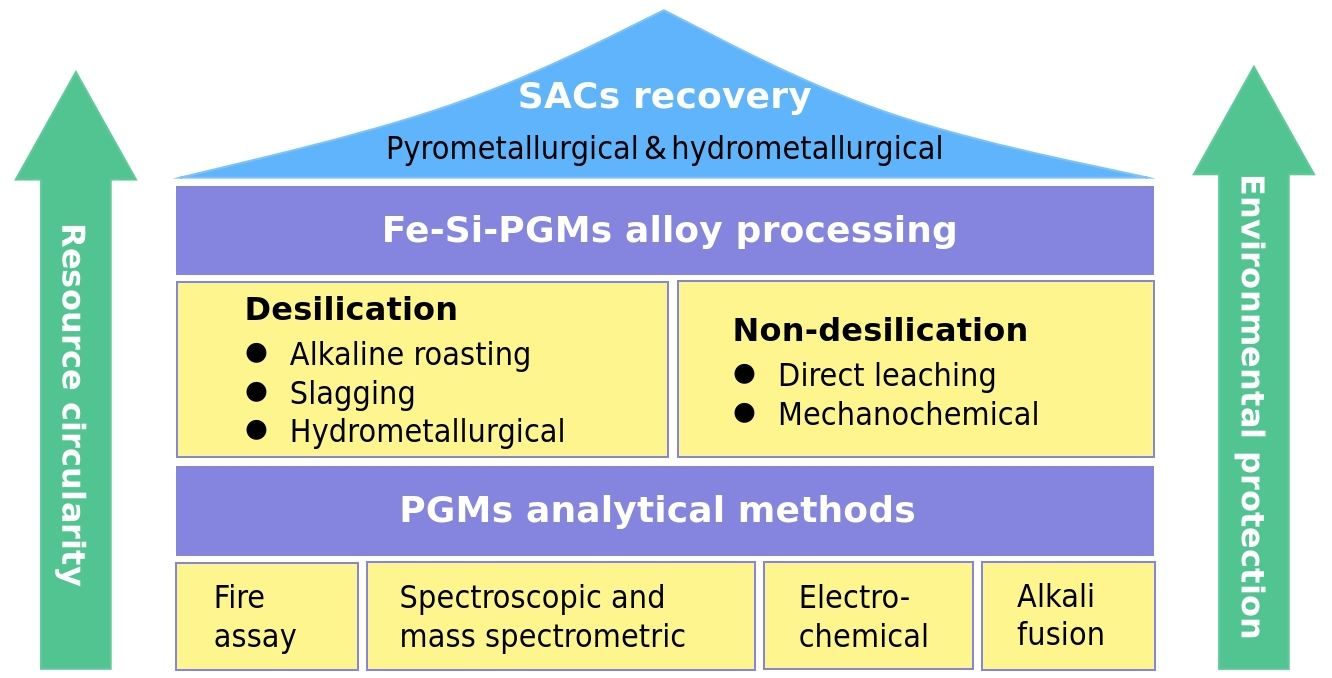
Platinum group metals (PGMs: Pt, Pd, Rh, Ru, Os, Ir) are critical strategic metals. Spent automotive catalysts (SACs) represent one of the most significant secondary sources of PGMs, and their recovery is essential for alleviating the supply–demand imbalance. In the recycling chain, pyrometallurgical processing of SACs generates Fe-Si-based alloy concentrates (termed Fe−Si−PGMs), serving as an important yet challenging intermediate resource for PGM recovery. This review first summarizes the pyrometallurgical and hydrometallurgical processes used for recovering PGMs from SACs, before shifting its focus to the treatment technologies for PGMs in Fe–Si–PGMs alloy. These techniques, including direct extraction, extraction following desilication (via alkaline roasting, slagging, or hydrometallurgical routes), and in situ mechanochemical extraction, are critically evaluated in terms of their advantages and limitations. Furthermore, given that the accurate quantification of trace-level yet high-value PGMs represents another key challenge in the recovery chain due to complex sample matrices, this work systematically outlines and compares the analytical methods commonly employed, such as fire assay, spectroscopic and mass spectrometric techniques, electrochemical methods, and alkali fusion. Finally, several recommendations are provided regarding PGM recovery from SACs, with emphasis on Fe−Si−PGMs alloy processing and analytical methods for PGMs.

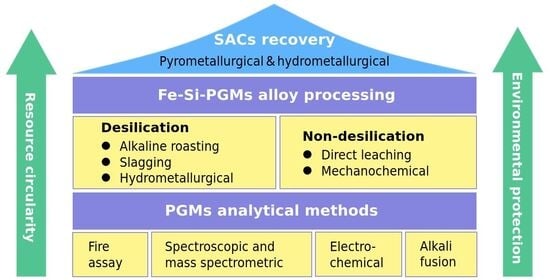
Graphical Abstract

1. Introduction

Accelerating global economic growth and industrialization have intensified the dependence of human society on natural resources, particularly critical metals. Among these, platinum group metals (PGMs: Pt, Pd, Rh, Ir, Os, Ru) are indispensable owing to their unique physicochemical properties, such as exceptional catalytic activity, high-temperature stability, superior corrosion resistance, and excellent electrical conductivity. PGMs serve not only as the core materials for automotive catalysts but are also extensively utilized in critical sectors, including petrochemicals, electronics, fuel cells, biomedicine, aerospace, and high-end jewelry [1,2]. However, as one of the rarest categories of metallic elements on Earth, PGMs possess extremely limited global reserves and a highly concentrated geographical distribution. Global PGM reserves are estimated at approximately 70,000 tonnes, primarily located in only a few countries, such as South Africa, Russia, and Zimbabwe. South Africa alone accounts for about 90% of the global total [3,4]. This pattern of highly concentrated resource distribution, coupled with the intrinsic scarcity of PGMs, the environmental pressures associated with mining, and geopolitical uncertainties, subjects the primary supply to persistent and severe challenges. This results in volatile market prices and poses significant risks to the stability of related global supply chains [5]. Consequently, the recycling and recovery of PGMs from secondary resources are of paramount importance.
Among all application fields of PGMs, the automotive industry undoubtedly represents the largest consumer sector. Spent automotive catalysts (SACs), whose active components are Pd, Pt, and Rh, constitute one of the most significant secondary resources for PGMs. The PGM content in SACs can be hundreds of times higher than that in primary ores, earning them the designation “mobile PGM mines” [3,6]. Furthermore, SACs contain various soluble hazardous substances. If disposed of simply through stockpiling or landfilling, they pose a potential risk of causing severe environmental contamination. Therefore, recovering PGMs from SACs not only effectively alleviates the pressure on mining primary mineral resources, enhances supply chain stability, and reduces material acquisition costs but also carries significant positive implications for environmental protection and sustainable development [7]. The processes for recovering PGMs from SACs can be broadly categorized into two major types: pyrometallurgy and hydrometallurgy. Each category possesses distinct characteristics, and in industrial practice, they are often combined to achieve complementary strengths. Pyrometallurgical processes offer advantages in terms of high throughput and large-scale application, while hydrometallurgical processes demonstrate superior controllability and lower energy consumption [8,9]. These processes, along with their technical features and challenges, form one of the central themes of this review. In practice, the recovery of PGMs from SACs faces multiple challenges, including the deposition of contaminants and the oxidation of PGMs at high temperatures during catalyst deactivation, coupled with the encapsulation of PGMs within the cordierite. Notably, pyrometallurgical techniques utilizing base metal collectors (e.g., Fe, Cu) can effectively transfer PGMs into a metallic phase. This process reduces PGM oxides while achieving preliminary enrichment of PGMs [10]. Among current mainstream pyrometallurgical processes, the use of plasma smelting with an iron collector to recover PGMs from SACs is a significantly advantageous technology. Its core strengths lie in its large processing capacity, high PGM collection efficiency (≥ 99%), environmentally friendly collection process, and suitability for large-scale industrial production. A key product of this process is Fe−Si−PGMs alloy. This alloy represents a typical example of the challenges encountered in PGM recovery, as the presence of silicon in this alloy leads to the formation of a dense Fe-Si matrix, which exhibits strong chemical inertness. This inertness significantly increases the difficulty of subsequent hydrometallurgical leaching of PGMs [11,12]. Current primary treatment methods for Fe−Si−PGMs alloy include direct hydrometallurgical leaching, alkaline roasting, pyrometallurgical slagging, direct hydrometallurgical desilication, and in situ mechanochemical leaching [13]. These processes provide crucial technical references and foundational support for the efficient recovery of PGMs from Fe−Si−PGMs alloy.
Throughout the entire process of research, development, optimization, and monitoring of PGM recovery technologies, accurate and reliable analytical techniques are essential. However, the accurate quantification of PGMs remains inherently difficult due to their extremely high unit value, ultra-low concentrations in feed materials, and the high abundance and compositional complexity of matrix elements [14,15,16]. For instance, during the quantitative analysis of PGMs in Fe−Si−PGMs alloy or other PGM-bearing iron ore, the massive presence of matrix elements can severely interfere with the precise measurement of trace PGMs. Thus, analytical methodology constitutes another critical challenge in the PGM recycling chain. To overcome this challenge, researchers have developed various methods for PGM determination, many of which have made substantial contributions to PGM analysis. However, as with any analytical techniques, each approach is characterized by its own strengths and limitations. Currently, common methods for PGM determination include fire assay, high-resolution continuum source graphite furnace atomic absorption spectrometry (HR-CS GFAAS), X-ray fluorescence spectrometry (XRF), total reflection X-ray fluorescence spectrometry (TXRF), glow discharge mass spectrometry (GDMS), fusion methods, spectrophotometry, electrochemical techniques, and inductively coupled plasma optical emission spectrometry (ICP OES) [16,17,18,19]. In practical applications, the choice of method or a combination thereof is typically dictated by the specific requirements of the scenario.
In summary, confronted by the dual pressures of scarce primary PGM resources and the imperative for resource recovery from waste streams, recycling PGMs from SACs is critical for resource sustainability. This review focuses on two interconnected themes: the processes for PGM recovery from SACs and the associated challenges. It systematically collates fundamental PGM properties and resource availability, then critically examines pyrometallurgical and hydrometallurgical routes for SAC recycling, delineating their technical principles, research advances, and technological characteristics. Particular emphasis is placed on the fundamental properties of the highly inert Fe−Si−PGMs alloy, the main recovery processes, and their respective characteristics, as this alloy represents a significant challenge in the recovery flowsheet. Furthermore, the analytical techniques underpinning the entire recovery chain are reviewed, with discussions on the applicability and limitations of different methods, addressing another key challenge in achieving reliable PGM quantification. Through a thorough synthesis and comparative analysis of existing technologies, this work seeks to provide theoretical insights and technical guidance for developing more efficient, economical, and environmentally friendly PGM recovery and analytical methods, thereby advancing technological progress and fostering the sustainable development of the secondary PGM resource recycling industry.

2. Properties, Resources, and Applications of PGMs

2.1. Physical and Chemical Properties

As illustrated in Figure 1, the six PGMs are all located in the d-block of the periodic table, specifically occupying groups 8, 9, and 10 in the fifth and sixth periods. A defining characteristic of these elements is the sequential filling of d orbitals with the same principal quantum number (n) as the atomic number increases, endowing PGMs with similar physical and chemical properties. The valence electron configurations for the fifth-period PGMs are 4d75s1, 4d85s1, and 4d10, while those for the sixth period are 5d66s2, 5d76s2, and 5d96s1. Generally, the valence electron configuration of an atom significantly influences its chemical behavior. Configurations with completely filled or completely empty valence electron orbitals possess lower energy, thus conferring greater chemical stability. Among PGMs, the valence configurations of Pd (4d10), Os (5d66s2), and Ir (5d76s2) align with this fully filled state, which partially accounts for the stability inherent to PGMs [20,21].
However, from a broader perspective, the valence electron orbitals of PGMs exhibit irregular filling patterns. This phenomenon is likely attributable to energy level interleaving in atoms with high nuclear charge, where the energy levels of (n − 1)d orbitals and ns orbitals become comparable. This proximity creates a strong tendency for electrons from the ns orbital to transfer to the (n − 1)d orbital. This irregular electronic configuration also underpins the chemical stability of PGMs and their resistance to corrosion and oxidation in chemical reactions. PGMs demonstrate excellent stability in common inorganic acids, such as hydrochloric, sulfuric, and nitric acids. While Pd can dissolve in hot concentrated nitric acid, the other elements remain largely inert. At room temperature, PGMs are stable in air and oxygen, except for Os when in powder form. Furthermore, the partially filled d orbitals of PGMs enable the effective adsorption of reactants and the formation of coordination bonds. This process facilitates lowering of the reaction activation energy, promoting a more reactive state of the reactants and thereby imparting exceptional catalytic properties [2]. A prominent example is the hydrogen evolution reaction via water splitting catalyzed by Pt, where this characteristic is distinctly observable [22].

2.2. Resource Status

The global distribution of PGM resources is highly uneven, primarily dictated by geological and mineralization conditions, which have resulted in the concentration of high-grade deposits in limited countries and regions. This imbalance is reflected not only in geographical distribution but also in ore grade and mining economics. PGM resources are mainly located in southeastern Africa, northeastern Europe, northern Asia, and the north-central part of Northern America, where ore grades are generally high and mining is economically feasible [23].
According to the United States Geological Survey (USGS) 2024 report, global PGM reserves are estimated at approximately 71,000 tonnes. The United States, Canada, Russia, South Africa, and Zimbabwe rank as the top five countries in terms of PGM reserves, accounting for 1.15%, 0.44%, 7.75%, 88.73%, and 1.69% of the global total, respectively [24]. It is particularly noteworthy that South Africa, Russia, and Zimbabwe collectively hold over 98% of global PGM reserves, underscoring their extreme geographical concentration and posing significant implications for the security of the global PGM supply and market stability.

2.3. Application Sectors

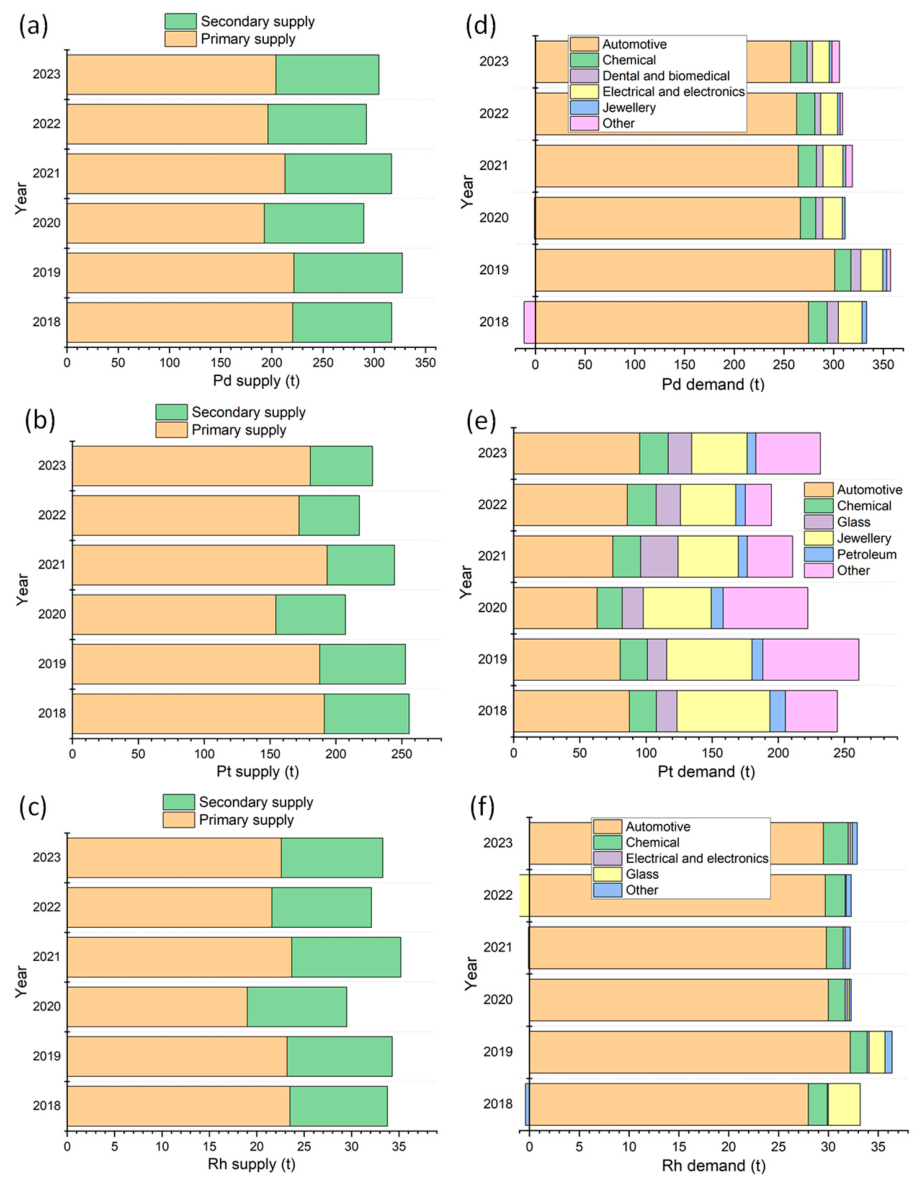
As illustrated in Figure 2, based on data from the Johnson Matthey PGM market reports (2018–2023), the global supply and demand dynamics for PGMs exhibit distinct characteristics [25]. For Pd, the total primary mine supply is 207.9 tonnes, with the recycled supply contributing 100.1 tonnes. The recycled share of 32.5% highlights the significant role of recycling in the Pd supply chain. The demand structure is heavily dominated by automotive catalysts, accounting for 88% of the annual demand, followed by the electronics industry (6.5%), chemical industry (5.6%), biomedical applications (2.5%), and jewelry (1%). The overwhelming PGM demand from automotive catalysts, driven by increasingly stringent global vehicle emission standards, far exceeds that from all other applications. Regarding Pt, the total supply is 234.3 tonnes, with a recycled contribution of 54.5 tonnes (23.3%). This recycled share is 9.2 percentage points lower than that of Pd. Its demand exhibits a more diversified profile: while automotive catalysts remain the largest sector at 34.6% of total demand, the glass manufacturing (7.8%) and chemical (8.9%) industries show relatively higher demand shares, demonstrating the broad utility of Pt in industrial manufacturing. This structural difference primarily stems from the irreplaceable role of Pt in specific applications, such as high-temperature industrial catalysts and glass fiber production. The supply and demand pattern for Rh presents another distinct picture. With a total supply of 33.1 tonnes and a recycled share of 10.8 tonnes (32.6%), its recycled share is comparable to that of Pd. On the demand side, automotive catalysts hold absolute dominance at 90.3%, followed by the chemical industry (5.7%), glass manufacturing (1.9%), and electronics (0.5%). The concentration of Rh demand in automotive catalysts is notably higher than that for Pd and Pt, which is closely related to its unique catalytic reduction performance [26,27].
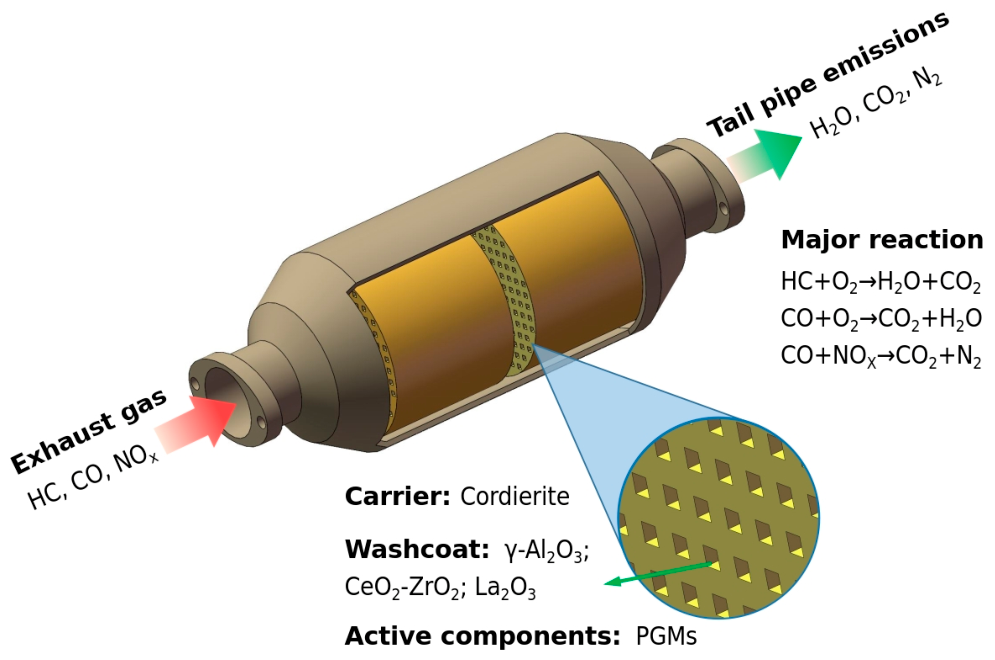
Automotive catalysts represent the largest application sector for Pd, Pt, and Rh. With continuous growth of the global vehicle fleet, the environmental pollution caused by vehicle emissions has become increasingly severe. Concurrently, heightened global emphasis on environmental protection has led to progressively stricter vehicle emission standards. To effectively reduce harmful gas emissions, automotive catalysts have emerged as a critical solution. PGMs play a pivotal role within these catalysts, primarily facilitating catalytic conversion reactions that transform harmful gases into harmless substances [13]. As illustrated in Figure 3, a typical automotive catalyst is primarily composed of a cordierite substrate, a washcoat, and active components. The cordierite provides structural support and acts as the framework for the catalyst, while the washcoat (main composition: γ-Al2O3; oxygen storage material: CeO2-ZrO2; additive: La2O3) enhances performance by improving thermal stability and dispersing the active components. Pd, Pt, and Rh are the active components, each targeting specific pollutants for directional catalysis. Pt and Pd catalyze the oxidation of CO and hydrocarbons, converting them into CO2 and H2O. Rh is primarily employed to catalyze the reduction of NOx, converting it into N2 and H2O [27,28].
Taking China as an example, the current vehicle parc has reached approximately 300 million units, forming a vast automotive consumer market. With the rapid development of the automotive industry and the accelerated pace of vehicle replacement, the number of end-of-life vehicles (ELVs) reached about 16.8 million in 2023. These ELVs represent a significant reservoir of PGMs. Assuming an average PGM content of 2 g per vehicle, the total PGM content amounts to roughly 33.6 tonnes. These data not only highlight the importance of SACs as a secondary resource but also underscores the substantial potential for recycling these metals to alleviate the supply–demand imbalance for PGMs [3,29,30].
Furthermore, the recycling of SACs holds multifaceted significance. From an environmental protection perspective, the recycling process effectively mitigates the pollution of soil, water sources, and the atmosphere by heavy metals and hazardous substances contained in discarded catalysts. Regarding resource utilization, the recovery of PGMs decreases dependence on primary mineral deposits and enhances resource efficiency. In terms of sustainable development, this initiative provides crucial support for achieving green and low-carbon development goals, contributing to the establishment of a resource-efficient and environmentally friendly society. In the future, with continuous advancements in recycling technologies and the gradual improvement of policy frameworks, the recycling of SACs is poised to play an increasingly vital role in resource security, environmental protection, and economic development [31,32].

3. Recovery Processes for SACs

3.1. Hydrometallurgical Processes

3.1.1. Typical Leaching

In the field of PGM recovery from SACs, hydrometallurgical leaching serves as a critical pathway, achieving efficient metal extraction through liquid-phase chemical reactions. Conventional chemical leaching, as a core hydrometallurgical technology, operates through a selective dissolution mechanism. It utilizes the coordination/oxidation reaction characteristics of specific chemical reagents with PGMs to extract these metals from the catalyst substrate. Common lixiviants include cyanide-based solutions and combinations of hydrochloric acid with oxidizing agents.
Cyanide leaching is a chemical process based on the formation of stable cyanide complexes with PGMs. Its core mechanism relies on the strong complexing ability of cyanide to efficiently dissolve and separate PGMs from spent catalysts. Common cyanide lixiviants, such as sodium cyanide or potassium cyanide, react with PGMs under appropriate conditions to generate a series of soluble cyanide complexes, e.g., [Pt(CN)4]2−, [Pd(CN)4]2−, and [Rh(CN)6]3−. Cyanide leaching offers several advantages, the most notable being its high leaching efficiency and excellent selectivity for PGMs. However, the high toxicity of cyanides imposes stringent safety requirements for both the environment and operators during use, and the subsequent treatment costs are relatively high. Consequently, the application of cyanide leaching necessitates careful consideration of its potential risks and cost-effectiveness [33,34].
Leaching using hydrochloric acid combined with oxidants is another effective method for dissolving PGMs. In this process, hydrochloric acid provides the necessary acidic environment, while the oxidant promotes the oxidation of PGMs into soluble chloro-complexes, such as [PtCl6]2−, [PdCl4]2−, and [RhCl6]3−. Common oxidants include HNO3, NaClO3, Cl2, and H2O2. Compared to cyanide leaching, the HCl/oxidant method generally produces less toxic effluents, presents a lower potential environmental hazard, and offers sufficient efficiency to meet the requirements for the industrial recovery of PGMs. However, challenges remain. For instance, while the HCl/HNO3 system is highly efficient in PGM leaching, the use of HNO3 may lead to NOx emissions, posing potential threats to the environment and operator health. Although the HCl/NaClO3 combination mitigates some environmental concerns compared to HNO3, risks of Cl2 emission persist, and the system exhibits strong corrosiveness to equipment, increasing maintenance costs. By contrast, H2O2 possesses strong oxidizing properties, and its reaction products are environmentally benign [35,36]. Such green oxidants warrant further in-depth research and application in the future, guided by the principles of sustainable metallurgy.
In summary, hydrochloric acid/oxidant leaching holds significant value in PGM recovery. However, different oxidant combinations present various trade-offs. While pursuing high recovery rates, it is essential to fully consider the environmental impact and sustainability of the process.

3.1.2. Bioleaching

Bioleaching technology, as an environmentally friendly method for PGM recovery, has garnered significant attention in recent years [37]. Karim et al. [38] employed ultrasonication-assisted pretreatment combined with the cyanogenic bacteria Pseudomonas fluorescens and Bacillus megaterium to recover PGMs from SACs. The pretreatment using nitric acid under ultrasonication effectively removed metals such as copper and zinc that compete with PGMs for cyanide, thereby enhancing the efficiency of the subsequent bioleaching process. Experimental results demonstrated that in a two-step bioleaching process, Pseudomonas fluorescens achieved leaching efficiencies of 38% for Pt, 44% for Pd, and 91% for Rh under conditions of pH 9 and a pulp density of 1% (w/v). Under the same conditions, Bacillus megaterium achieved leaching efficiencies of 35%, 41%, and 82% for Pt, Pd, and Rh, respectively. Further research confirmed that the cyanogenic bacteria Pseudomonas fluorescens and Bacillus megaterium can effectively leach PGMs by producing cyanide, which forms soluble complexes with PGMs [39].
However, bioleaching technology faces practical challenges, including low leaching efficiency with prolonged recovery times, stringent microbial growth constraints (e.g., pH, temperature, nutrients), and the need for strict control over cyanide generation to prevent environmental contamination despite its biodegradability [40]. Future research should focus on developing more efficient and sustainable bioleaching processes.

3.1.3. Photocatalytic Leaching

In recent years, photocatalytic technology has garnered increasing attention in the field of PGM resource recovery due to its unique electron transfer mechanisms. This technology utilizes electron-hole pairs generated upon photoexcitation of semiconductor materials to dissolve PGMs under mild reaction conditions, offering a viable strategy for the recycling of SACs [41].
Chen et al. [42] employed TiO2 as a photocatalyst to dissolve PGMs from SACs under ultraviolet irradiation, where the core of the process lies in selecting an appropriate photocatalyst and solvent. In their study, highly oxidizing radicals generated on the TiO2 surface exhibited a sufficient redox potential to overcome the chemical inertness of PGMs. Experimental results further showed that a mixed solvent system of acetonitrile and dichloromethane (volume ratio 3:1) synergistically enhanced the leaching efficiency of Pt, Pd, and Rh from SACs.
Photocatalytic leaching offers advantages of low energy consumption and mild reaction conditions, typically operating at room temperature and atmospheric pressure. While demonstrating potential for PGM recovery, this technology remains limited in reaction efficiency, stability, and scalability. Future efforts should prioritize overcoming these constraints and developing environmentally friendly reaction media [43].

3.1.4. Solvent Extraction Separation

In hydrometallurgical processes, the efficient separation of PGMs from leachates represents a crucial yet challenging step, primarily due to their highly similar chemical properties, which complicates their distinction and separation in solution. Furthermore, leachates typically contain various impurity metals, which adds to the complexity of the separation process. Successful separation not only enables the independent recovery of different metals but also provides the necessary foundation for subsequent high-purity metal production, which is crucial for meeting the modern industrial demand for high-purity PGMs. Solvent extraction is an effective method for metal separation based on the differential distribution coefficients of metal ions between immiscible phases. This technique holds significant importance in the recovery of Pd, Pt, and Rh [5,26].
In practical applications, commonly used extractants mainly include organophosphorus acids, thiol derivatives, and ionic liquids. For instance, Yamada et al. [44] developed a series of dialkylamino-modified thiodiphenol extractants for the selective recovery of Pd2+ and Pt4+ from SAC leachates. Among these, 2,2′-bis(dihexylaminomethyl)-6,6′-thiobis(4-t-butylphenol) demonstrated excellent selectivity, achieving recoveries of 99.5% for Pd2+ and 99.3% for Pt4+ from the leachate, while recovery rates for impurity metals were below 3%. These extractants form stable complexes with PGMs, enabling effective separation. Additionally, ionic liquids have garnered attention as novel extractants due to their unique physicochemical properties, such as low volatility and high thermal stability. Firmansyah et al. [45] employed trioctyldodecyl phosphonium chloride (P8,8,8,12Cl) as an extractant to selectively recover Pd from SAC leachates. A Pd extraction efficiency of 99% was achieved within 10 min, followed by stripping using thiourea with a stripping efficiency of 90%.
Solvent extraction technology offers significant advantages in PGM recovery, such as high selectivity and recovery rates. However, the technique also presents challenges, including the selection and regeneration of extractants, the stability of the organic phase, and environmental concerns. Therefore, future research should focus on the development of novel extractants and the optimization of extraction processes to enhance the efficiency and sustainability of solvent extraction.

3.1.5. Adsorption Separation

Adsorption separation is a method that utilizes the surface adsorption properties of adsorbents to separate Pd, Pt, and Rh ions. This technology has attracted significant attention due to its high efficiency and environmental friendliness. Commonly used adsorbents primarily include ion-exchange resins, activated carbon, metal–organic frameworks (MOFs), and biosorbents, with ion-exchange resins being the most widely applied [5].
Torrejos et al. [46] synthesized a series of thiacrown ether-based polydentate adsorbents. The study involved constructing a thiacrown ether diol skeleton containing 2 to 4 sulfur atoms, followed by the preparation of microporous resins using epoxy cross-linking technology. This material was employed for the selective recovery of Pt and Pd from SAC leachates. Experimental results indicated that these resins exhibited high selectivity for Pt and Pd adsorption, while showing markedly lower adsorption rates for alkali metals. Furthermore, Hong et al. [47] designed a polyethylenimine (PEI)-functionalized spinning fiber material based on cellulose nanofibers. This biosorbent possessed a porous structure and a high PEI content (32.5 wt%, rich in –NH2 groups), achieving a maximum Pt adsorption capacity of 417.6 mg/g after 24 h of adsorption in a pure Pt solution. When tested in a simulated SAC leachate, the adsorbent achieved simultaneous recoveries of 90% for Pt and 80% for Pd, while showing minimal adsorption for impurity metals such as Ni, Fe, and Mn.
Adsorption separation technology offers notable advantages in the recovery of Pd, Pt, and Rh, such as high selectivity and environmental compatibility. However, certain aspects of this technique require further attention, such as adsorbent stability, regeneration, capacity, and selectivity. Future research should focus on developing novel adsorbent materials and optimizing adsorption processes to improve both the efficiency and sustainability of the separation.

3.1.6. Other Separation Techniques

Selective precipitation is another widely used hydrometallurgical separation technique. It involves the addition of specific precipitating agents to form insoluble precipitates with target metal ions, thereby achieving metal separation. Due to its simplicity and cost-effectiveness, selective precipitation has been extensively applied in the recovery of Pd, Pt, and Rh. Common precipitating agents include hydroxides, sulfides, and halides, which react with PGM ions to form insoluble precipitates. For example, Ilyas et al. [48] employed NH4Cl as a precipitating agent to recover Pt from a leachate, achieving a recovery rate exceeding 98%. This technique offers notable advantages, such as straightforward operation, low cost, and broad applicability. However, challenges remain, including the purification of precipitates, as well as the dosage and selection of precipitating agents.
Membrane separation is an emerging technique that utilizes specific membrane materials for the effective separation of Pd, Pt, and Rh. For example, the separation of Pt, Pd, and Rh can be achieved using polymer inclusion membranes containing P8,8,8,12Cl. The core of membrane separation technology lies in the selection of membrane materials and the optimization of membrane performance. By adjusting parameters such as composition, pore size, and surface charge, the separation efficiency can be enhanced. Furthermore, membrane separation can be combined with other methods, like solvent extraction and adsorption, to achieve more efficient metal recovery [49].
Metal displacement is a traditional separation method based on the reduction potential of PGMs. It involves using a more reactive metal (e.g., iron or zinc) as a reductant to displace Pd and Pt from solution. Rh can be selectively displaced by adding specific reducing agents. The critical factors for successful displacement include controlling the dosage of the reductant and the reaction conditions to achieve optimal results. Following displacement, subsequent steps such as washing, impurity removal, and calcination are typically required to further improve the purity of the recovered PGMs [50].
Solvent extraction, selective precipitation, adsorption, membrane separation, and metal displacement all play established roles in PGM recovery. In practical applications, a suitable separation strategy depends on factors such as target metal concentrations, leachate composition, and cost. The rational integration of multiple technologies can lead to the efficient separation and purification of PGMs.

3.2. Pyrometallurgical Processes

3.2.1. Base Metal Collection

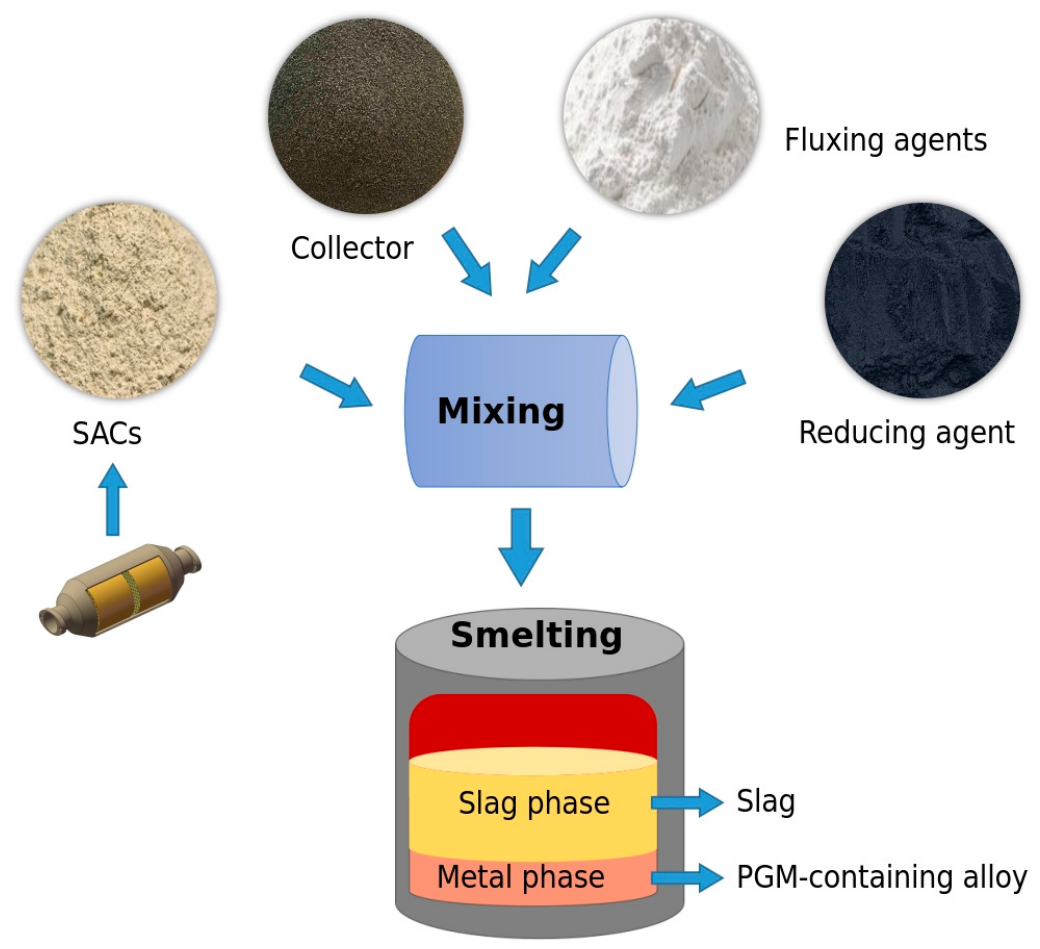
Metal collector-based recovery is one of the most common pyrometallurgical methods. This process involves mixing SACs with a collector metal and fluxing agents (e.g., lime, borax) and subjecting the mixture to high-temperature smelting. During this process, PGMs are concentrated into a metallic phase, achieving directional enrichment by leveraging the physical property differences between the metal and slag phases (as shown in Figure 4). Collector selection is typically based on factors such as PGM affinity, melting point, and environmental friendliness. Commonly used collectors include lead, copper, nickel, iron, bismuth, and sulfur, each with distinct characteristics, as detailed below [51,52].
Lead was one of the earliest metals used for PGM collection. In an arc furnace or blast furnace, lead oxide is reduced to lead, which alloys with PGMs, while the catalyst substrate reports to the slag phase. Lead collection offers operational simplicity, low-temperature operation, and established downstream refining. However, it suffers from drawbacks such as a lengthy processing cycle, lower recovery rates for Rh, and potential environmental and occupational health hazards associated with lead volatilization.
Copper collection has attracted significant attention due to its high recovery rates and lower environmental impact. Copper exhibits strong affinity for PGMs and effectively concentrates them during smelting. For example, Tanaka Kikinzoku Kogyo K.K. employs a copper collection technology where SACs are mixed with copper oxide, flux, and a reductant and smelted in a sealed furnace. The PGMs are concentrated into the copper phase and subsequently recovered via electrolysis, achieving a total PGM recovery rate of up to 98%. This technology can leverage existing non-ferrous metal smelting infrastructure, significantly reducing additional capital investment. Nonetheless, it also has disadvantages, such as a relatively long production cycle and high overall costs.
Nickel and nickel sulfide are often used simultaneously as collectors for PGM recovery from SACs. This process offers high recovery rates and selectivity, but the handling and recovery of sulfides are complex. Furthermore, sulfur-containing gases may be generated during smelting, posing potential environmental challenges and increasing the complexity and cost of off-gas treatment.
In recent years, bismuth collection has also attracted attention. Bismuth shows strong affinity for PGMs and can form alloys with them at relatively low temperatures, enabling effective PGM enrichment. This characteristic offers potential advantages in terms of energy consumption and cost. However, bismuth collection technology is currently still in the laboratory research stage and has not yet been commercially industrialized.
Iron and iron oxides serve as low-cost, environmentally benign, and highly effective collectors, efficiently incorporating PGMs into the iron phase under high-temperature conditions. For example, using iron powder as the collector, carbon as the reductant, and with additions of CaO, Na2O, CaF2, and Na2B4O7, >99% of PGMs were collected at 1300–1400 °C. This approach demonstrates the high collection efficiency achievable with iron-based systems, although some formulations rely on additives that raise environmental concerns. By contrast, iron collection has been successfully adapted in industrial settings using plasma smelting technology, which offers a more environmentally benign collection route with improved energy efficiency (see Section 3.2.4).

3.2.2. Alkaline Roasting

Alkaline roasting primarily employs alkalis (e.g., KOH, NaOH) and alkali metal salts (e.g., Li2CO3, NaClO3, NaHSO4) as fluxes, which chemically react with the components of SACs at elevated temperatures to facilitate PGM recovery.
Specifically, the alkaline roasting treatment of PGMs from SACs typically follows two principal pathways. The first involves converting PGMs into corresponding alkali metal salts (e.g., Na2PtO3, Li2PtO3) through alkaline roasting, followed by leaching with common inorganic acids to extract the PGMs. For instance, Kuzuhara et al. [53] employed lithium salts (Li2CO3 or LiF) to roast SACs, which promoted the formation of PGM oxide salts Li2PdO2, Li2PtO3, and LiRhO2 for Pd, Pt, and Rh, respectively. The study found that Li2CO3 yielded better roasting results than LiF or a mixture of Li2CO3 and LiF. After roasting in air with Li2CO3 at 800 °C for 2 h, followed by leaching with concentrated HCl (12 mol/L), a leachate containing 94.9% Rh, 97.5% Pd, and 100% Pt was obtained. The second pathway involves treating the SAC substrate with alkalis or alkali metal salts to expose the PGMs, thereby enhancing subsequent leaching efficiency. For example, Trinh et al. [54] roasted SACs with NaOH at 600 °C with a sample-to-NaOH mass ratio of 1:1 for 1 h. This was followed by leaching the PGMs using a mixed solution of HCl and NaClO3 at 90 °C for 2 h, ultimately achieving leaching efficiencies of 97.5% for Pt, 98.8% for Pd, and 98.2% for Rh.
Alkaline roasting offers the advantages of simple processing and relatively mild conditions, while its industrial application requires addressing limitations such as severe equipment corrosion, high alkali consumption, and the complexity of subsequent leachate treatment.

3.2.3. High-Temperature Chlorination

The high-temperature chlorination process, also known as chlorination-volatilization or chloridizing roasting, operates on the core principle of selectively reacting PGMs or their carrier materials with chlorine gas or chlorinating agents at elevated temperatures. This reaction forms volatile chlorides, thereby achieving effective separation of PGMs from the catalyst substrate.
In this process, SACs are typically mixed with chlorinating agents (e.g., NaCl, CaCl2, KCl) and roasted at a temperature within 650–900 °C. During roasting, volatile chlorides are evolved and subsequently condensed, achieving concentration of the PGMs. For instance, Xie et al. [55] successfully achieved efficient recovery of Pt, Pd, and Rh by mixing SACs with NaCl powder and introducing chlorine gas for chlorination at 650 °C. The chlorinated residue was then leached with 1 mol/L HCl aqueous solution at 90 °C for 1 h, achieving leaching efficiencies exceeding 97%, 99%, and 90% for Pt, Pd, and Rh, respectively.
The high-temperature chlorination process features a simple flowsheet, low energy consumption, and a high Rh recovery rate, without requiring complex pretreatment. However, it presents challenges such as equipment corrosion, toxic chlorine gas handling, and stringent environmental requirements, which necessitate careful mitigation in practice [56].

3.2.4. Plasma Smelting Iron Collection

While various base metal collectors have been explored, iron-based collection has gained particular industrial prominence. Among iron-based approaches, plasma smelting iron collection has emerged as a mainstream technology, adopted by leading global SAC recycling companies such as Johnson Matthey (UK), Heraeus (Germany), and Sino-Platinum Metals Co., Ltd. (China) for industrial-scale production [56,57].
The plasma smelting iron collection process offers distinct advantages. Specifically, magnetite (Fe3O4) is used as the collector, metallurgical coke powder (C) as the reducing agent, and the smelting temperature is 1500–1600 °C. Only approximately 10% CaO is added to form an environmentally benign quaternary CaO–SiO2–Al2O3–MgO slag, which fully utilizes the cordierite substrate (2MgO•2Al2O3•5SiO2) and avoids adding harmful additives such as Na2B2O4 and CaF2. The pure cordierite has a high melting point of approximately 1900 °C and does not melt alone under the above temperature, but it undergoes structural decomposition in the presence of CaO to form molten slag, releasing the encapsulated PGMs [58,59]. Second, inexpensive and environmentally benign iron achieves collection efficiencies of 99.31%, 99.14% and 97.22% for Pd, Pt and Rh, respectively. Furthermore, plasma smelting delivers rapid, high-intensity heating that instantly reaches metal phase-transformation temperatures, cutting energy use, while its tunable redox environment optimizes PGM enrichment and curbs harmful emissions [11,60].
However, plasma smelting iron collection technology also faces several limitations. A crucial issue is that the Fe−Si−PGMs alloy obtained during the process exhibits strong chemical inertness, which represents a central challenge in the PGM recovery flowsheet [12]. Therefore, understanding the fundamental properties of this alloy (detailed in Section 4) and developing effective downstream processing strategies are of critical importance.
Table 1 compares the technical characteristics, advantages, and limitations of different PGM recovery processes for SACs. In industrial applications, suitable single or combined recovery processes are commonly selected according to technical feasibility, economic efficiency, and environmental performance.

4. Basic Properties of Fe−Si−PGMs Alloy

As introduced in Section 3.2.4, Fe−Si−PGMs alloy is the key intermediate product generated during plasma smelting iron collection. Its strong chemical inertness makes it a pivotal challenge in the overall PGM recovery chain. Detailed characterization of the chemical composition, phase constitution, and elemental distribution of the alloy is therefore essential for understanding the origin of this inertness and for designing effective downstream processing strategies. This section provides such an analysis.

4.1. Chemical Composition and Phase Constitution

As shown in Table 2, Fe−Si−PGMs alloy is primarily composed of two matrix elements, ten impurity elements, and three PGM elements. The matrix elements are Fe and Si. The impurity elements include P, Mn, Al, Ni, Ti, Ca, V, Cr, Mg, and Cu, while the PGM elements are Pd, Pt, and Rh. Fe is the predominant matrix element, with a content as high as 75.48%. This is attributed to the use of iron, which exhibits a high affinity for PGMs during the alloy formation process. The Si content is 15.07%, second only to Fe. This silicon originates primarily from the cordierite substrate of the SACs. Under the high-temperature reducing atmosphere, SiO2 is reduced to Si, which then alloys with Fe to form a highly corrosion-resistant matrix [61,62]. P has a content of 4.33%, mainly derived from engine lubricants and gasoline, and is one of the key factors leading to catalyst deactivation [63]. Furthermore, the presence of impurity elements such as Mn, Al, Ni, Ti, and Mg can also be traced to the cordierite. During plasma smelting, these elements are reduced but not fully incorporated into the slag, leaving trace impurities in the alloy.
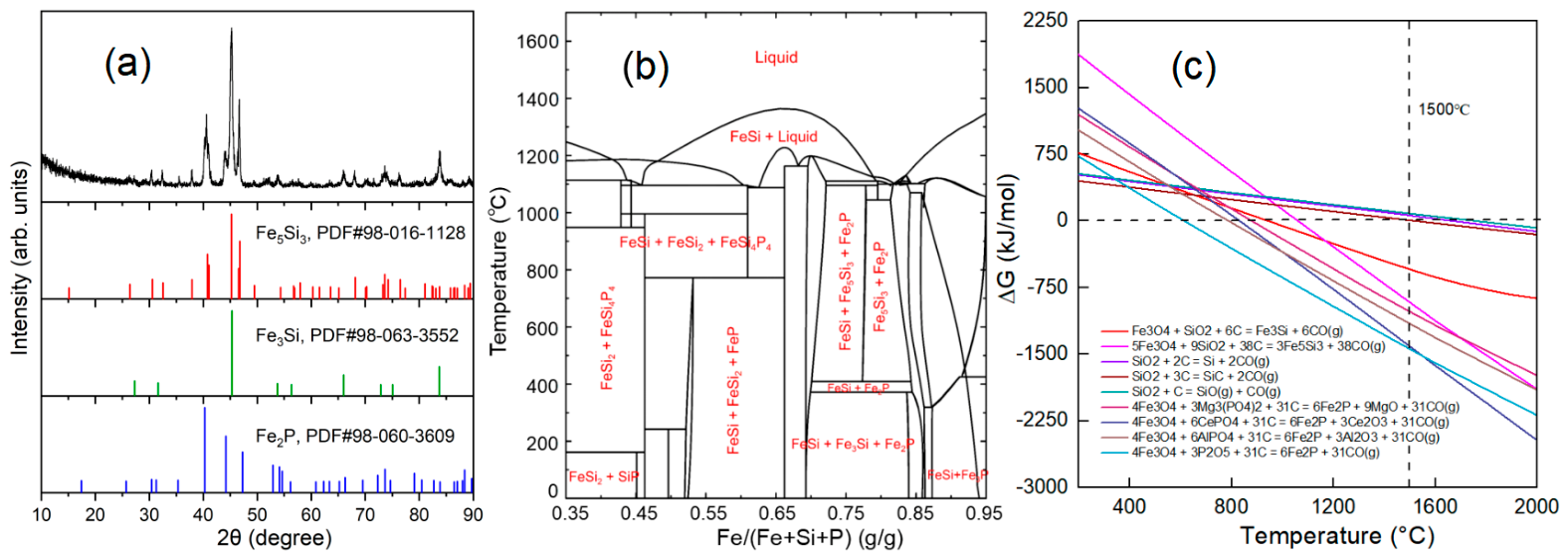
The alloy is dominated by Fe5Si3, Fe3Si, and Fe2P (Figure 5a). The Fe–Si–P ternary diagram (Figure 5b) predicts that within the Fe composition range of 70–83%, the stable phases are FeSi3, FeSi, and Fe2P, corresponding well with the XRD data. Thermodynamic calculations (Figure 5c) indicate that the initial temperatures for the reduction of SiO2 by C to form Si or SiO both exceed the furnace temperature (1500–1600 °C). SiC forms above 1530 °C, and its subsequent decomposition also requires temperatures beyond the furnace temperature [64]. By contrast, the presence of Fe3O4 significantly lowers the reaction temperature, enabling the reduction of SiO2 and the simultaneous formation of Fe5Si3 and Fe3Si at approximately 1060 °C, suggesting that the process is thermodynamically more favorable [65,66]. In SACs, phosphorus is mainly present as Mg3(PO4)2, CePO4, AlPO4, and P2O5, which react with Fe3O4 and C to form Fe2P at an initial temperature of approximately 880 °C, indicating that this reaction readily proceeds [67,68]. Although Fe2P exhibits poor corrosion resistance, the substantial formation of Fe-Si imparts strong chemical inertness to the alloy matrix.

4.2. Elemental Occurrence and Distribution

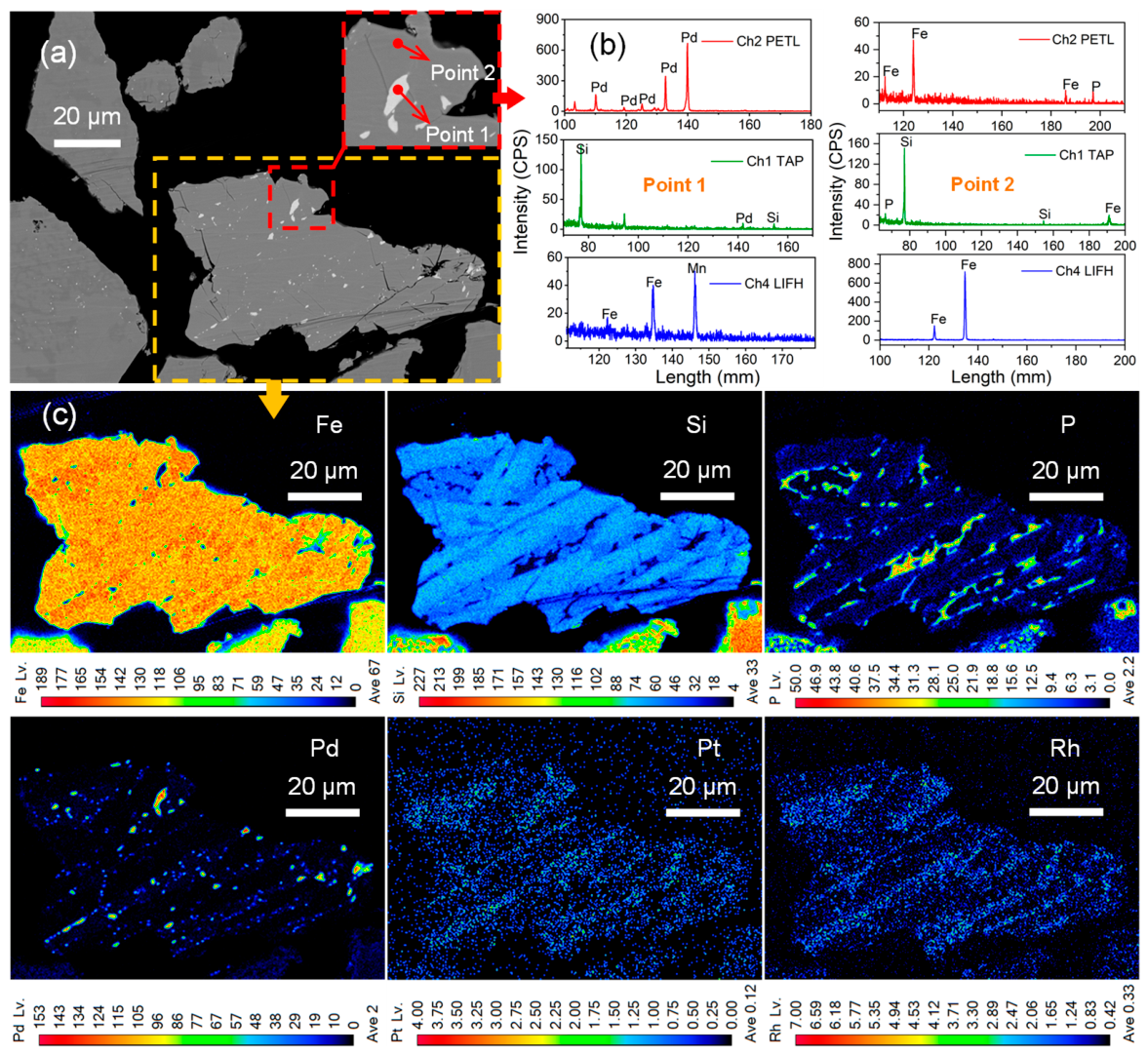
Microstructural analysis of Fe−Si−PGMs alloy (Figure 6a,b) reveals irregular particle shapes. The bright regions (Point 1) are rich in PGMs, chiefly Pd, whereas the dark regions (Point 2) consist mainly of Fe, Si, and P. Elemental mapping (Figure 6c) further shows that Fe and Si are the most extensively and uniformly distributed matrix elements. This is attributed to their high abundance and tendency to form intermetallics, such as Fe3Si and Fe5Si3. The impurity P does not simultaneously combine with both Fe and Si but preferentially associates with Fe to form Fe2P, which segregates at the grain boundaries. Among PGMs, Pd primarily segregates at the grain boundaries, whereas Pt and Rh are distributed uniformly within the matrix. Overall, the distribution of Pd, Pt, and Rh across the alloy is relatively homogeneous [13,62]. The inherent high chemical stability of PGMs, combined with their encapsulation within a highly inert Fe-Si matrix, significantly exacerbates the difficulty of leaching PGMs from Fe−Si−PGMs alloy [42,69]. This combination thus represents a central challenge in the PGM recovery flowsheet, motivating the development of specialized treatment technologies discussed in Section 5.

5. PGM Recovery Processes from Fe−Si−PGMs Alloy

5.1. Direct Hydrometallurgical Leaching

Direct hydrometallurgical leaching involves treating Fe−Si−PGMs alloy directly with lixiviants without specifically targeting silicon removal. Tong et al. [70] employed a two-stage leaching process to treat Fe−Si−PGMs alloy (96.16% Fe, 0.25% Si, and 0.3% PGMs). The first stage (room temperature, 1.7–1.8 mol/L H2SO4, S/L = 1:10, 30 min) used a substoichiometric acid dosage to partially dissolve Fe and produce a low-acidity FeSO4 solution suitable for Fe recovery via freeze crystallization, meanwhile enriching PGMs by approximately 16 times. The second stage (75 °C, 2 mol/L H2SO4, S/L = 1:50, 4 h) applied excess acid to deeply remove Fe from the residue, generating a high-grade PGM concentrate. After the two-stage process, PGMs were concentrated by an average factor of 70.57, reaching a final grade of 21.18% with less than 0.2% dissolution loss. This process demonstrates excellent performance in PGM concentration. However, it involves a lengthy flowsheet and produces substantial leachate, while also being restricted to Fe−Si−PGMs alloy with low silicon content [71].
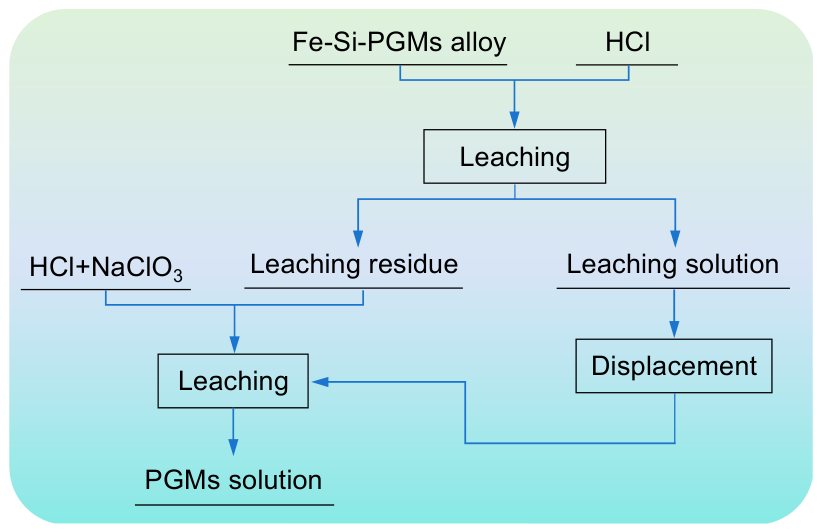
Wu et al. [72] investigated direct hydrometallurgical treatment of high-silicon Fe−Si−PGMs alloy (70% Fe, 10–15% Si, 4–6% PGMs). As shown in Figure 7, the overall process comprises two main stages: bulk Fe removal via HCl leaching, followed by oxidative leaching of PGMs. The first stage uses 6 mol/L HCl at 75 °C for 4 h, removing about 50% of Fe. Under these conditions, a small fraction of the PGMs also dissolved, with Pd being the most soluble, followed by Pt, while Rh remained largely undissolved. These dissolved PGMs were recovered by cementation. In the second stage, the residue was subjected to oxidative leaching in acidic NaClO3 solution under optimized conditions: 6 mol/L HCl, 250 rpm, L/S = 10:1, 80 °C, 2 h, and NaClO3-to-alloy of 1:1. This yielded leaching efficiencies of 62.1% (Pd), 57.3% (Pt), and 25.4% (Rh). These results demonstrate the extremely high corrosion resistance of Fe−Si−PGMs alloy, providing a valuable foundation for subsequent research. However, the leaching efficiencies for PGMs still have considerable room for improvement.

5.2. Alkaline Roasting for Desilication

Alkaline roasting for desilication involves the reaction of alkaline substances with silicon in Fe−Si−PGMs alloy to form soluble silicates, thereby facilitating silicon removal.
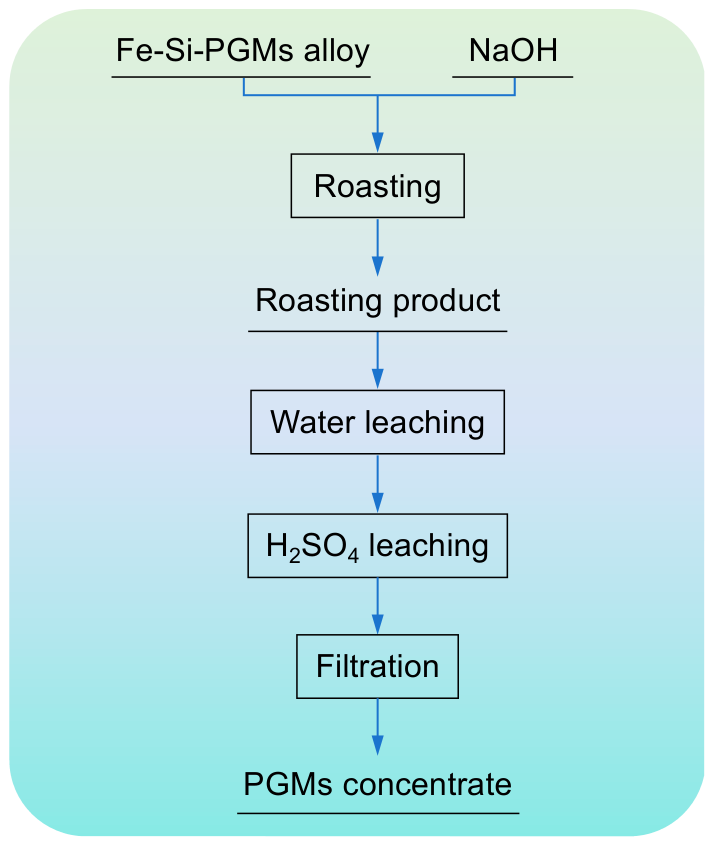
Dong et al. [73] developed a roasting-leaching method to concentrate PGMs from Fe−Si−PGMs alloy, with optimal conditions at 600 °C, 120% NaOH-to-alloy, and 2 h. Roasting converted the alloy mainly into Na4SiO4, NaFeO2, and Fe2O3. Subsequent water and dilute H2SO4 leaching removed NaFeO2 and Fe2O3 (Equations (1)–(5)), respectively, leaving a residue enriched with PGMs (Figure 8). This residue contained 23.4% PGMs, achieving a 9-fold enrichment from the original alloy.
Si + 4 NaOH = Na 4 SiO 4 + 2 H 2
2 Fe + 6 NaOH = 2 Na FeO 2 + 3 H 2 + 2 Na 2 O
2 Na FeO 2 = Fe 2 O 3 + Na 2 O
2 Na FeO 2 + ( n + 1 ) H 2 O = Fe 2 O 3 · nH 2 O + 2 NaOH
Fe 2 O 3 · H 2 O + 3 H 2 SO 4 = Fe 2 ( SO 4 ) 3 + 4 H 2 O
However, this process still has room for further optimization. First, the removal efficiencies for Fe and Si are relatively low. Enhancing their removal requires intensifying the alkali metal roasting process, which inevitably risks oxidizing a portion of the PGMs, thereby increasing the potential for PGM loss. Secondly, the process does not achieve the direct dissolution of PGMs, adding extra process steps compared to direct leaching methods.

5.3. Pyrometallurgical Slagging

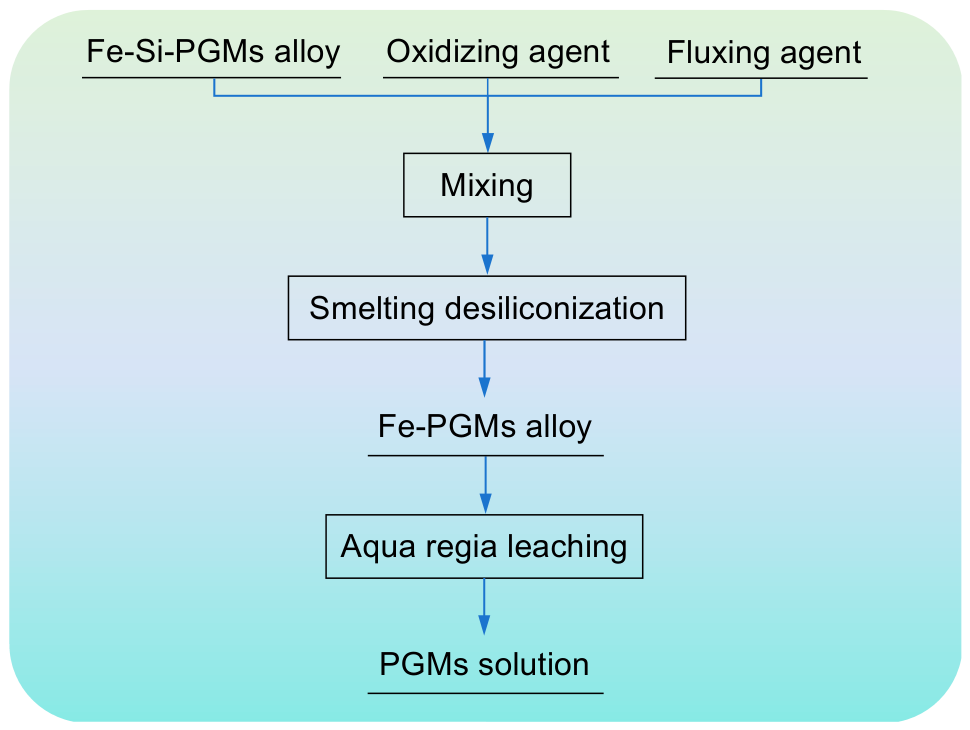
The core principle of the pyrometallurgical slagging desilication combined with aqua regia leaching process lies in oxidizing the silicon in Fe−Si−PGMs alloy to form SiO2. The SiO2 then combines with a slagging agent to enter the slag phase, achieving effective silicon removal. The resulting Fe-PGMs alloy is subsequently leached with aqua regia to obtain a PGM-containing solution (Figure 9).
Li et al. [74] employed a plasma furnace as the smelting unit, using Fe2O3 as the oxidant and CaO as the slagging agent to remove silicon from Fe−Si−PGMs alloy. The study found that increasing the oxidant dosage, smelting temperature, and duration effectively promoted the desilication process. The desilication rate initially increased with CaO up to 20% of the raw material mass, but declined with further addition due to increased melt viscosity. The optimal conditions were determined as 140% of theoretical Fe2O3, 20% CaO, 1600 °C, and 120 min, which reduced alloy silicon from 10% to 0.5% to facilitate subsequent PGM leaching.
In 2023, Yang et al. [75] developed a green slag refining process using a CaO–Al2O3–Fe2O3 slag system to remove >99% of major impurities (Si, Al, Ca, Mg, Ti) from Fe−Si−PGMs alloy, followed by complete alloy dissolution via aqua regia leaching. Pyrometallurgical slagging desilication operates through selective oxidation and alloy composition adjustment. Fluxes (CaO, SiO2, Al2O3) form low-melting-point slags with FeOx. To ensure a green process, fluorides and chlorides should be avoided. The impurities Si, Al, Ti, Ca and Mg, whose oxygen affinities exceed that of Fe, are oxidized to oxides (Equations (6)–(10)) and report to slag, while FeOx is reduced to metallic Fe and enters the alloy.
Si + 2 x FeO x = 2 x Fe + SiO 2
2 Al + 3 x FeO x = 3 x Fe + Al 2 O 3
Ti + 2 x FeO x = 2 x Fe + TiO 2
xCa + FeO x = Fe + xCaO  
xMg + FeO x = Fe + xMgO  
The pyrometallurgical slagging process produces no liquid or gaseous waste, offering environmental benefits, and when combined with aqua regia leaching, it enhances the recovery efficiency of PGMs from Fe–Si–PGMs alloy. However, it is limited by higher energy consumption, potential PGM loss in slag, and the environmental drawbacks of aqua regia leaching.

5.4. Hydrometallurgical Desilication Leaching

Hydrometallurgical desilication combined with aqua regia leaching first disrupts the matrix structure to liberate PGMs, followed by aqua regia leaching of the resulting residue.
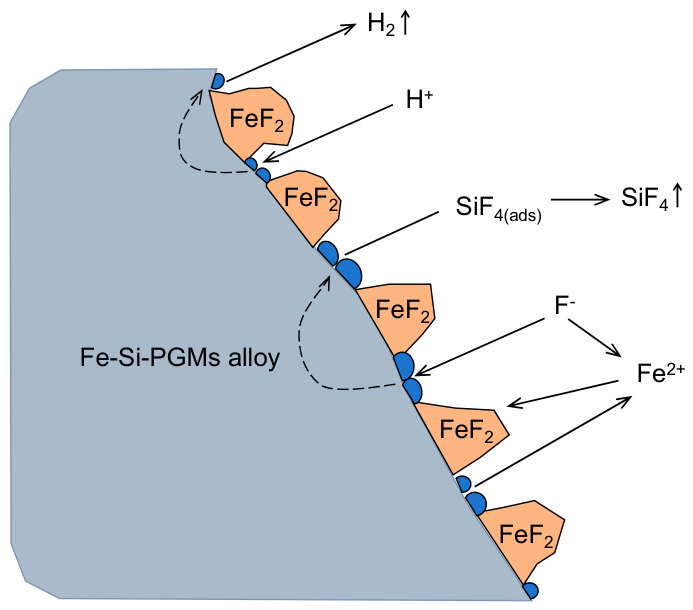
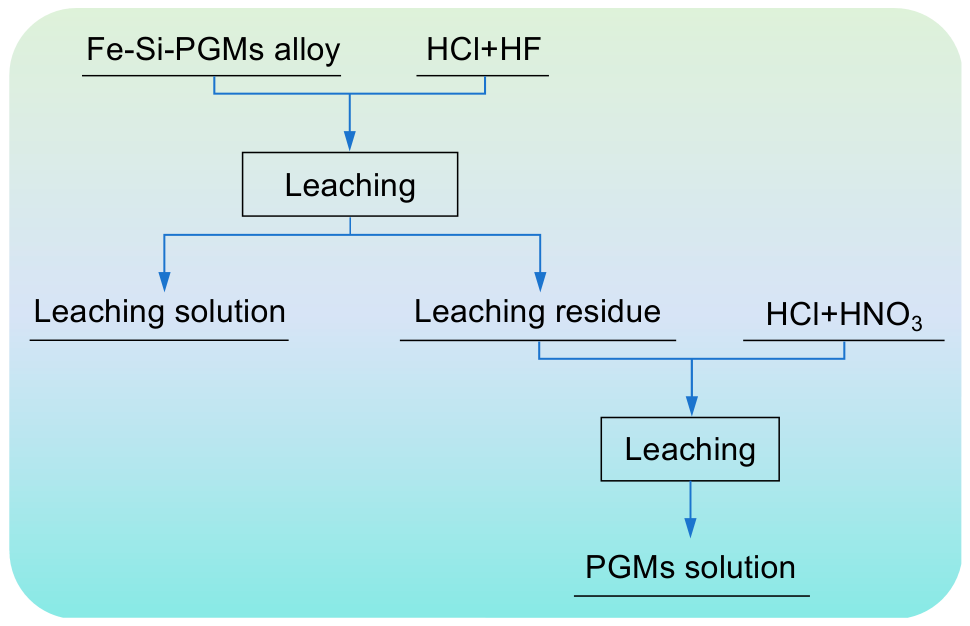
In 2024, Kuzas et al. [76,77] investigated the leaching behavior of Fe–Si–PGMs alloy (76.8% Fe, 11.9% Si, 1.4% PGMs) in various acidic solutions. Using HCl or H2SO4 followed by aqua regia achieved <40% PGM recovery, indicating ineffective breakdown of the inert Fe-Si matrix. Tests with HCl–HF mixtures showed that higher HCl promoted Fe leaching but suppressed Si volatilization, while increased HF enhanced both Fe dissolution and Si release. Elevated temperature significantly improved Fe extraction but had a minor effect on Si leaching.
The mechanism of leaching the Fe–Si–PGMs alloy matrix with a mixed HCl–HF solution is illustrated in Figure 10. During leaching, the alloy matrix reacts with HCl and HF, generating Fe2+ and SiF4 gas (Equation (11)), which explains the promotional effect of HCl on Fe leaching and the simultaneous promotion of both Fe and Si leaching by HF. However, free HF can react with Fe2+ to form FeF2 precipitate (Equation (12)). This precipitate forms a dense film on the surface of the unreacted alloy, hindering contact between the lixiviant and the alloy and the diffusion of reaction products, leading to a decrease in Si leaching efficiency. Leaching kinetics studies revealed that Fe leaching transitioned from chemical reaction control to diffusion control, while Si leaching remained diffusion-controlled throughout, primarily due to the diffusion resistance caused by the FeF2 film. Through the shrinking core model and full factorial experimental analysis, the optimal leaching conditions were identified: 4.36 mol/L HCl, 6.93 mol/L HF, 90 °C, and 80 min. Under these conditions, leaching efficiencies for both Fe and Si could reach 95%. Subsequent treatment of the residue with aqua regia enabled complete dissolution of the PGMs, with the specific process flow shown in Figure 11 [76,77].
Fe x Si y + 2 xHCl + 4 yHF = x FeCl 2 + ySi F 4 + ( x + 2 y ) H 2
FeCl 2 + 2 HF = Fe F 2 + 2 HCl  
Hydrometallurgical desilication combined with aqua regia leaching provides an effective process for destructing the inert alloy matrix to liberate PGMs, achieving their recovery from Fe–Si–PGMs alloy. Nevertheless, concerns remain regarding the use of HF, an extremely corrosive acid that poses serious threats to human health. Additionally, the SiF4 generated during leaching adversely affects human health and the environment [78,79].

5.5. In Situ Mechanochemical Leaching

Mechanochemistry is an interdisciplinary technique that utilizes mechanical energy input to initiate or enhance chemical reactions. It has demonstrated significant potential in fields like materials synthesis, mineral processing, and solid waste valorization. Its characteristics, including mechanical force-induced lattice distortion, increased specific surface area, and accelerated mass transfer, provide a novel approach for the activation and efficient leaching of highly inert materials [80].
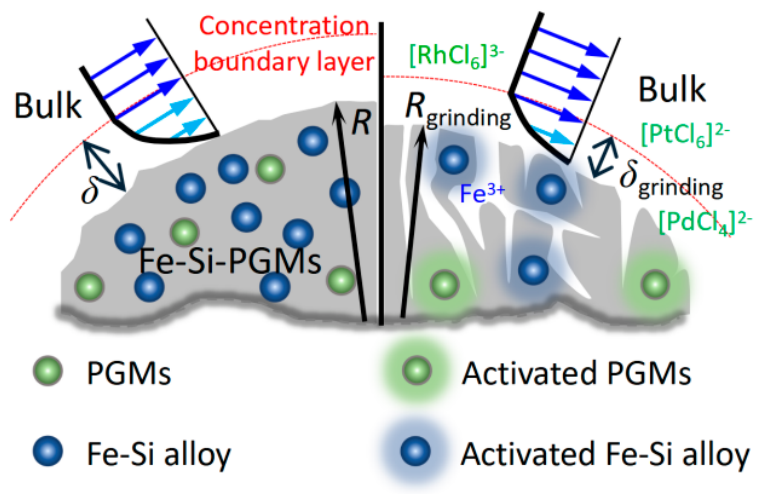
Liu et al. [62] designed an HCl-based ternary lixiviant system for the in situ mechanochemical leaching of Fe–Si–PGMs alloy. Under optimized conditions (L/S of 30:1, 2 mol/L HCl, 0.75 mol/L FeCl3, 2.5 mol/L H2O2, 800 rpm, 4 h), a comprehensive PGM leaching efficiency of 98% was achieved. This system employs FeCl3 and H2O2 as green oxidants, avoiding the generation of harmful NOx associated with traditional aqua regia leaching. The mechanical force serves multiple functions: it simultaneously achieves particle size reduction and surface activation of the alloy, disrupting the Fe-Si matrix and exposing fresh reactive interfaces. It also accelerates lixiviant mass transfer and reduces activation energy, thereby overcoming thermodynamic and kinetic barriers to PGM dissolution (Figure 12) [13]. While in situ mechanochemical leaching offers significant advantages, challenges remain for its scale-up. The positive pressure generated by gas evolution during the reaction and the demanding equipment performance requirements under high rotational speeds necessitate further in-depth research.
A comparison of the above processes for recovering PGMs from Fe–Si–PGMs alloy is summarized in Table 3.

6. Analytical Methods for PGMs

The accurate quantification of PGMs represents another critical challenge in the recovery chain, given their trace levels, high value, and complex matrices. Analytical errors can lead to misestimation of resources, loss of process control, and significant economic or environmental consequences. Therefore, the selection or combination of analytical methods must be based on the specific application scenario, taking into account the principles, advantages, and limitations of each technique (Table 4) [61,81].

6.1. Fire Assay

Fire assay, a classical metallurgical analytical method, applies pyrometallurgical principles to analytical chemistry. It involves separating PGMs from impurities through high-temperature fusion, followed by quantitative determination via weighing or other analytical techniques. This method offers advantages such as strong adaptability to diverse samples and accurate, reliable results. However, the fire assay process is relatively complex, requiring specialized equipment and skilled operators over extended durations. It also poses environmental and health risks due to volatile lead and slag emissions [81,82]. Therefore, when employing fire assay, appropriate measures must be implemented to minimize environmental impact and ensure operator safety.

6.2. HR-CS GFAAS

HR-CS GFAAS is a method that determines PGM concentration by using a high-resolution continuum source to excite the PGM atoms in the sample and measuring the absorption signal at specific wavelengths. Its advantages include high sensitivity and low detection limits, and it is capable of measuring elements at ppm levels. However, this technique has limitations for multi-element simultaneous determination due to constraints on spectral windows and the requirement for consistent thermal behavior of elements. Sample matrices can also interfere with analytical results, and the equipment cost is relatively high [16,83].

6.3. XRF

XRF is a non-destructive analytical technique based on the interaction of X-rays with the sample. Its fundamental principle is that when primary X-rays irradiate a PGM sample, inner-shell electrons of atoms are excited, leading to energy-level transitions and the emission of characteristic secondary X-rays. The energy and intensity of these fluorescent X-rays correlate with the type and concentration of elements in the sample. By detecting these signals, qualitative and quantitative analyses can be performed. XRF offers the advantages of simple operation, rapid analysis, and low cost. However, it has limitations in detection limits and accuracy, especially in complex matrices where matrix effects can cause deviations in PGM content determination [84]. TXRF is an improved method developed from conventional XRF. It uses a smooth reflector to focus X-rays onto the sample, providing more concentrated irradiation, thereby enhancing signal intensity and signal-to-noise ratio. This method significantly lowers detection limits and improves analytical accuracy. However, TXRF still faces challenges with matrix interference and accuracy, and the equipment cost is relatively high [85,86]. XRF-based analytical methods offer significant advantages for the rapid detection of PGM types and contents in solid waste materials such as SACs.

6.4. GD-MS

GD-MS is an analytical technique that combines a glow discharge source with a mass spectrometer. Its fundamental principle involves using ions generated from ionized inert gas under high voltage to bombard the sample surface, causing sputtering and subsequent ionization of atoms from the sample. These ions are then collected and detected by the mass analyzer. GD-MS offers advantages such as high sensitivity, low matrix effects, and a wide linear dynamic range. However, it also presents some limitations: PGM materials with poor conductivity require special treatment, increasing sample preparation complexity and contamination risk; the equipment cost is high, demanding specialized maintenance and operators; and it is primarily suitable for analyzing inorganic solids, with limited capability for liquid samples [87,88,89]. Therefore, in practical application, GD-MS is mainly used for analyzing the purity of high-purity solid PGM materials.

6.5. Fusion

The basic principle of fusion involves converting PGMs in the sample into water-soluble salt compounds. During fusion, the PGM-containing sample is mixed with strongly oxidizing alkaline reagents (e.g., NaOH, KOH, Na2O2) and heated to a high temperature. This process drives a chemical reaction that efficiently breaks down the structure of samples, converting solid PGMs into a soluble form [90]. The fusion method offers high efficiency, broad applicability, and excellent recovery rates for dissolving solid-phase PGMs. Its operation is relatively simple and cost-effective. However, it introduces impurities via strong alkalis and oxidants, requires skilled high-temperature operation, and causes crucible corrosion that potentially contaminates the sample [91,92].

6.6. Spectrophotometry

Spectrophotometry quantifies PGMs by measuring the absorbance of their characteristic colored complexes at specific wavelengths. For instance, Pt is determined by reacting Pt4+ with SnCl2 to form a yellow complex, measuring the absorbance at 403 nm, and calculating the concentration from a standard curve [93]. Zhao et al. [94] determined Rh by forming a violet complex between a rhodium-tin chloride anion and crystal violet cation, measuring the absorbance at 540 nm. Wang et al. [95] leached geological samples for Pd and Pt using a HCl–KClO3–NaCl–NH4HF2 mixture, preconcentrated the metals on thiol cotton, ashed the metal-loaded thiol cotton, dissolved the resulting residues, and finally determined the Pd and Pt contents spectrophotometrically. This method is relatively simple, requires no large instruments, and has low operational costs, offering advantages for field analysis. However, it suffers from interferences from other ions or organics in complex matrices, often requiring masking agents or pretreatment. Results are also sensitive to experimental conditions, demanding strict control for accuracy [96].

6.7. Electrochemical Voltammetry

Electrochemical voltammetry is a powerful technique for PGM analysis based on measuring the current at a working electrode during a potential scan in a solution containing electroactive species. Different electrode materials and scan modes enable the detection and quantification of target PGM ions [97]. For example, adsorption cathodic stripping voltammetry was used to determine Pt in oyster samples from coastal environments. Oyster ash was dissolved in an electrolyte containing H2SO4, formaldehyde, and hydrazine. A three-electrode system with a hanging mercury drop working electrode was used. After preconcentration at −0.3 V, a differential pulse scan from −0.5 V to −1.1 V reduced Pt, generating a current signal proportional to its concentration [98,99]. This method offers high sensitivity, low detection limits, and rapid operation, making it suitable for trace PGM analysis. Limitations include electrode surface fouling or poisoning by organics/impurities and significant matrix interference from factors like acidity and salinity, often requiring masking agents for mitigation [100].

6.8. ICP OES

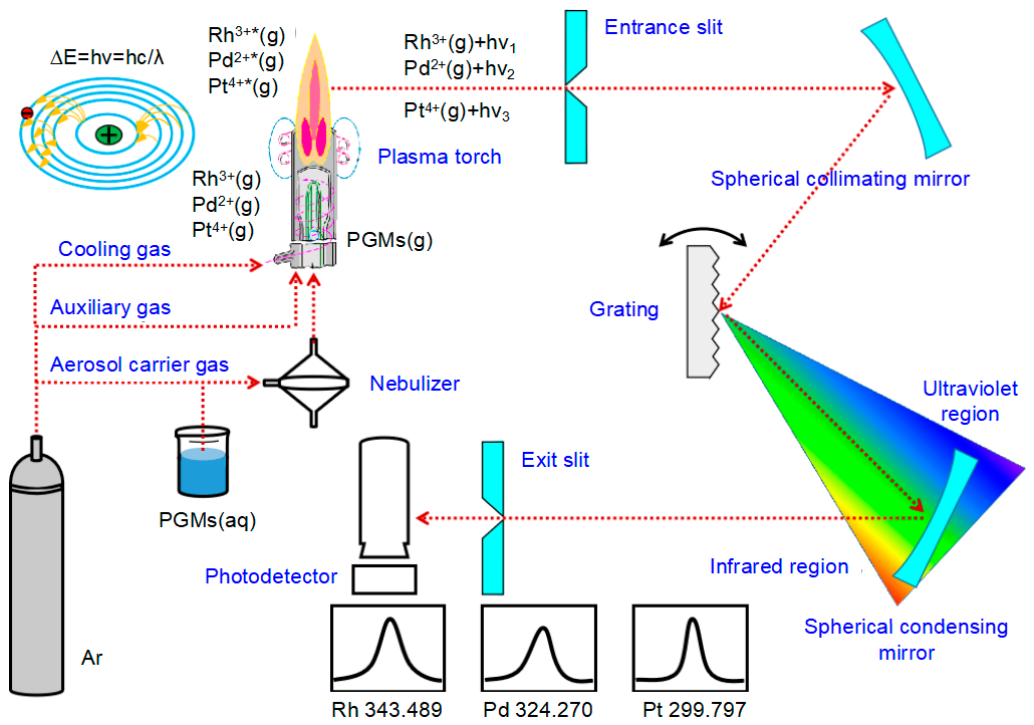
ICP OES currently represents the most widely employed spectroscopic technique for PGM analysis. It operates by introducing a sample into a high-temperature plasma (8000–10,000 K), where atoms/ions are excited and subsequently emit characteristic light upon returning to lower energy states [101]. The intensity of this emitted light, measured at specific wavelengths, correlates with elemental concentration [102]. As shown in Figure 13, samples are nebulized into an aerosol, transported to the plasma, excited, and their emitted light is dispersed and detected. ICP OES offers advantages including multi-element capability, low detection limits, wide linear range, and minimal chemical interference, making it a primary method in PGM metallurgy. However, spectral overlap and matrix effects from complex sample compositions can compromise accuracy, necessitating effective interference mitigation strategies [103,104].
Common methods to mitigate these interferences include sample pretreatment, dilution, matrix matching, standard addition, and correction factor method. However, these approaches require careful attention to avoid introducing new interferents, potential PGM losses, or analyte contamination. Pretreatment can effectively remove matrix components, but attention must be paid to the risk of increased analytical error and PGM loss. Dilution is operationally simple but may reduce analytical sensitivity. While methods such as standard addition and matrix matching can improve measurement accuracy, they are limited by relatively complex and time-consuming [103,105]. The correction factor method offers a convenient and efficient mathematical approach; however, careful consideration must be given to the applicability and accuracy of the correction model [106,107]. For instance, Liu et al. [61] investigated matrix interferences in the analysis of PGMs in Fe–Si–PGMs alloy. They found that the complex matrix caused both spectral and non-spectral interferences. By establishing a mathematical correction model to compensate for matrix effects, the relative errors in the determination of Pd, Pt, and Rh were reduced from above 10.2% to within 5.5%.

7. Summary and Outlook

This review systematically examines PGM recovery from SACs, focusing on two interconnected challenges: Fe–Si–PGMs alloy processing and accurate PGM quantification.
In SAC recycling, pyrometallurgical and hydrometallurgical methods are typically combined: the former is commonly used to enrich PGMs and modify their chemical environment, while the latter is primarily employed for leaching and subsequent deep separation. In Fe–Si–PGMs alloy, the homogeneous distribution of Pd, Pt, and Rh within the inert Fe-Si matrix, combined with their inherent stability, results in strong chemical resistance. Current treatment approaches can be broadly categorized into desilication-leaching and non-desilication leaching. Desilication methods, including alkaline roasting, pyrometallurgical slagging, and hydrometallurgical desilication, significantly enhance PGM leaching rates. However, both alkaline roasting and slagging introduce additional energy-intensive pyrometallurgical steps and increase the risk of PGM loss. Hydrometallurgical desilication poses hazards to human health and the environment. By contrast, non-desilication leaching offers better environmental compatibility and lower energy consumption. However, direct hydrometallurgical leaching suffers from low PGM extraction efficiency due to matrix constraints. In situ mechanochemical leaching, which couples mechanical activation with chemical dissolution, enables effective disruption of the inert matrix and enhanced PGM extraction, although further research is required to optimize the process and reaction environment.
Accurate PGM quantification is complicated by diverse matrices and high precision demands. Each analytical method carries distinct strengths and limitations. Method selection requires comprehensive consideration of the sample matrix, costs, sample state, and analytical requirement. Fire assay effectively separates the matrix, offers strong sample adaptability, and provides high accuracy, but it involves complex procedures and poses environmental and health risks. HR-CS GFAAS demonstrates high accuracy, yet its instrumentation involves considerable cost. XRF-based techniques allow for rapid qualitative analysis, but their quantitative precision is relatively low. GD-MS is primarily applied to the detection of high-purity PGM products, although the equipment is relatively expensive. Fusion can effectively dissolve highly inert PGM materials, but the influence of substantial impurities must be considered. Spectrophotometry features straightforward operation; however, its measurements are prone to interference from coexisting substances. Electrochemical methods offer accuracy and speed, yet their applicability is limited by specific testing system requirements. ICP OES analysis features high detection efficiency and reliable accuracy, making it one of the most prevalent methods in PGM recovery. However, spectral interferences and matrix effects must be taken into consideration.
Future efforts should center on green extraction technologies that integrate technical, economic, and environmental criteria to establish an efficient, clean, and sustainable PGM recycling system.
Whole-process optimization and coupling: Strengthen the integration between pyrometallurgical enrichment and hydrometallurgical extraction–separation, and develop short-process, low-waste integrated flowsheets from SACs to high-value PGM products. Rather than optimizing individual unit operations in isolation, holistic flowsheet design must be emphasized, as industrial practice requires the seamless integration of dissolution, separation, and reduction steps [2]. Improve overall metal recovery, resource efficiency, and process economics by combing multiple metallurgical techniques (e.g., pyrometallurgy, hydrometallurgy, and electrochemistry). Moreover, process optimization should prioritize direct product preparation to eliminate intermediate solidification. Conversion of the PGM chloro-complex route from a ‘liquid–solid–liquid’ to a ‘liquid–liquid’ paradigm would enable direct production of catalyst precursors from leachate, thereby eliminating redundant reduction/redissolution steps, reducing process complexity, and minimizing wastewater generation. Concurrently, industrial-scale selective separation materials (e.g., extractants, ion-exchange resins, adsorbents) for PGMs, particularly for rhodium, warrant development, with particular attention to both stripping and elution efficiencies [8].
Efficient and green processing of Fe–Si–PGMs alloy: Prioritize novel techniques for disrupting the Fe-Si matrix and selectively extracting PGMs in an environmentally benign strategy. Key areas include: (a) advancing mechanochemistry, ultrasound, and microwave-enhanced methods, as well as microbial recovery, toward practical application; (b) developing green and efficient oxidation or ligand systems for PGM dissolution under mild conditions; and (c) optimizing pyrometallurgical desilication to lower energy and material use while minimizing PGM loss to slag. In developing green leaching agents, priority should be given to H2O2, free radicals, and high-valent cerium compounds as oxidants to eliminate the generation of toxic gases such as NOx and Cl2. Concurrently, hydrochloric acid consumption can be reduced through the use of chloride salts (e.g., FeClx, CuCl2) as alternative chlorine sources. Furthermore, the potential of vacuum metallurgy and mechanochemistry warrants further investigation, with a focus on equipment optimization, energy consumption reduction, and scale-up for industrial application [7,108].
Innovations in analytical techniques for PGMs in complex matrices: For samples such as PGM-containing materials and environmental samples, novel analytical methods should aim for simpler pretreatment, higher interference resistance, lower detection limits, and potential on-site/rapid detection. Concurrently, artificial intelligence and big data can be leveraged to optimize analytical strategies and calibration models, enhancing overall efficiency, accuracy, and reliability.

Author Contributions

Conceptualization, M.L.; writing—original draft preparation, M.L.; writing—review and editing, M.L., C.Y., M.T., Y.Z., X.L., C.Z. and Z.L.; visualization, Y.Z.; resources, T.X., F.H., H.W. and J.Y.; supervision, T.X., F.H. and H.W. All authors have read and agreed to the published version of the manuscript.

Funding

This work was financially supported by the Key Technology Development and Demonstration Program for Bulk Solid Waste Disposal and Resource Utilization of China Energy Investment Corporation Co., Ltd. (Project 2, GJNY-23-31-2) and by the National Key Research and Development Program of China (2022YFB3504304 and 2020YFB0408602).

Institutional Review Board Statement

Not applicable.

Informed Consent Statement

Not applicable.

Data Availability Statement

No new data were created or analyzed in this study. Data sharing is not applicable to this article.

Conflicts of Interest

Author Minghui Liu, Chunzhen Yang, Xianghui Liu, Chenyu Zhan, Zihan Li, Faquan He, Hongliang Wang, and Jianhui Yang are from the China Energy Longyuan Environmental Protection Co., Ltd. The authors declare that this study received funding from the Key Technology Development and Demonstration Program for Bulk Solid Waste Disposal and Resource Utilization of China Energy Investment Corporation Co., Ltd. The funder was not involved in the study design, collection, analysis, interpretation of data, the writing of this article or the decision to submit it for publication.

References

  1. Zupanc, A.; Install, J.; Jereb, M.; Repo, T. Sustainable and Selective Modern Methods of Noble Metal Recycling. Angew. Chem. Int. Ed. 2023, 62, e202214453. [Google Scholar] [CrossRef]
  2. Chen, Y.; Qiao, Q.; Cao, J.; Li, H.; Bian, Z. Precious metal recovery. Joule 2021, 5, 3097–3115. [Google Scholar] [CrossRef]
  3. Tang, H.; Peng, Z.; Tian, R.; Ye, L.; Zhang, J.; Rao, M.; Li, G. Platinum-group metals: Demand, supply, applications and their recycling from spent automotive catalysts. J. Environ. Chem. Eng. 2023, 11, 110237. [Google Scholar] [CrossRef]
  4. Li, X.; Li, Y.; Temirov, U.; Wang, J.; Chang, Z. Selective recovery of platinum group metals (PGMs) from aqueous solution: Advances, challenges, and future perspectives. Sep. Purif. Technol. 2025, 379, 134947. [Google Scholar] [CrossRef]
  5. Zheng, H.; Ding, Y.; Wen, Q.; Liu, B.; Zhang, S. Separation and purification of platinum group metals from aqueous solution: Recent developments and industrial applications. Resour. Conserv. Recycl. 2021, 167, 105417. [Google Scholar] [CrossRef]
  6. Wiecka, Z.; Rzelewska-Piekut, M.; Regel-Rosocka, M. Recovery of platinum group metals from spent automotive converters by leaching with organic and inorganic acids and extraction with quaternary phosphonium salts. Sep. Purif. Technol. 2022, 280, 119933. [Google Scholar] [CrossRef]
  7. Kinas, S.; Jermakowicz-Bartkowiak, D.; Pohl, P.; Dzimitrowicz, A.; Cyganowski, P. On the path of recovering platinum-group metals and rhenium: A review on the recent advances in secondary-source and waste materials processing. Hydrometallurgy 2024, 223, 106222. [Google Scholar] [CrossRef]
  8. Rocky, M.M.H.; Rahman, I.M.M.; Endo, M.; Hasegawa, H. Comprehensive insights into aqua regia-based hybrid methods for efficient recovery of precious metals from secondary raw materials. Chem. Eng. J. 2024, 495, 153537. [Google Scholar] [CrossRef]
  9. Fajar, A.T.N.; Hanada, T.; Goto, M. Recovery of platinum group metals from a spent automotive catalyst using polymer inclusion membranes containing an ionic liquid carrier. J. Membr. Sci. 2021, 629, 119296. [Google Scholar] [CrossRef]
  10. Bahaloo-Horeh, N.; Mousavi, S.M. Comprehensive characterization and environmental risk assessment of end-of-life automotive catalytic converters to arrange a sustainable roadmap for future recycling practices. J. Hazard. Mater. 2020, 400, 123186. [Google Scholar] [CrossRef]
  11. Dong, H.; Zhao, J.; Chen, J.; Wu, Y.; Li, B. Recovery of platinum group metals from spent catalysts: A review. Int. J. Miner. Process. 2015, 145, 108–113. [Google Scholar] [CrossRef]
  12. Ding, Y.; Zheng, H.; Zhang, S.; Liu, B.; Wu, B.; Jian, Z. Highly efficient recovery of platinum, palladium, and rhodium from spent automotive catalysts via iron melting collection. Resour. Conserv. Recycl. 2020, 155, 104644. [Google Scholar] [CrossRef]
  13. Liu, M.; Zhao, Y.; Tian, M.; Liu, K.; Hu, G.; Zhang, J.; Xue, T.; Qi, T.; Zhang, H. Extraction of PGMs from insoluble Fe–Si–PGMs alloy by combined thermochemical and mechanochemical leaching: Sustainable, efficient, and scalable. Sep. Purif. Technol. 2024, 333, 125925. [Google Scholar] [CrossRef]
  14. Resano, M.; García-Ruiz, E.; Belarra, M.A.; Vanhaecke, F.; McIntosh, K.S. Solid sampling in the determination of precious metals at ultratrace levels. TrAC Trends Anal. Chem. 2007, 26, 385–395. [Google Scholar] [CrossRef]
  15. Masasire, A.; Rwere, F.; Dzomba, P.; Mupa, M. A new preconcentration technique for the determination of PGMs and gold by fire assay and ICP-OES. J. S. Afr. Inst. Min. Metall. 2022, 122, 29–36. [Google Scholar] [CrossRef]
  16. Eskina, V.V.; Dalnova, O.A.; Filatova, D.G.; Baranovskaya, V.B.; Karpov, Y.A. Direct precise determination of Pd, Pt and Rh in spent automobile catalysts solution by high-resolution continuum source graphite furnace atomic absorption spectrometry. Spectrochim. Acta Part B At. Spectrosc. 2020, 165, 105784. [Google Scholar] [CrossRef]
  17. Atia, T.A.; Spooren, J. Fast microwave leaching of platinum, rhodium and cerium from spent non-milled autocatalyst monolith. Chem. Eng. Process. Process Intensif. 2021, 164, 108378. [Google Scholar] [CrossRef]
  18. Ni, W.; Mao, X.; Yao, M.; Sun, Q.; Guo, X.; Zhang, H.; Liu, L.; Basheer, C. Bismuth-Remaining Cupellation Fire Assay Preconcentration Combined with Inductively Coupled Plasma Mass Spectrometry for the Simultaneous Determination of Ultratrace Au, Pt, Pd, Ru, Rh, and Ir in Geologic Samples. Int. J. Anal. Chem. 2021, 2021, 9960673. [Google Scholar] [CrossRef]
  19. Neyestani, M.R.; Dalali, N. Identification of refractory ores containing Au, Pd and Rh in northeastern Iran and determination of the elements using two Fire Assay methods. J. Chem. Lett. 2025, 6, 121–134. [Google Scholar]
  20. Atkins, P. Shriver and Atkins’ Inorganic Chemistry; Oxford University Press: New York, NY, USA, 2010. [Google Scholar]
  21. Porterfield, W.W. Inorganic Chemistry; Academic Press: Cambridge, MA, USA, 2013. [Google Scholar]
  22. Zhang, X.; Zhang, M.; Deng, Y.; Xu, M.; Artiglia, L.; Wen, W.; Gao, R.; Chen, B.; Yao, S.; Zhang, X. A stable low-temperature H2-production catalyst by crowding Pt on α-MoC. Nature 2021, 589, 396–401. [Google Scholar] [CrossRef] [PubMed]
  23. Wang, F.; Li, X.; Luan, Z.; Zhang, W.; Zhang, W. Global distribution, supply-demand balance, and consumption pattern of platinum-group metal resources. Geol. Bull. China 2022, 41, 1829–1846. [Google Scholar]
  24. Staff, U. USGS mineral review. In Mineral Commodity Summaries; U.S. Geological Survey (USGS): Reston, VA, USA, 2024. [Google Scholar]
  25. Cowley, A. “PGM Market Report May 2023”: A return to more balanced conditions is expected. Johns. Matthey Technol. Rev. 2023, 67, 361–363. Available online: https://matthey.com/pgm-market-report-2023 (accessed on 1 February 2024). [CrossRef]
  26. Xia, J.; Ghahreman, A. Platinum group metals recycling from spent automotive catalysts: Metallurgical extraction and recovery technologies. Sep. Purif. Technol. 2023, 311, 123357. [Google Scholar] [CrossRef]
  27. Xv, B.; Li, Z.; Zha, G.; Liu, D.; Yang, B.; Jiang, W. Recovery of platinum group metals from spent automotive catalysts: Review of conventional techniques and vacuum metallurgy. Resour. Conserv. Recycl. 2025, 215, 108103. [Google Scholar] [CrossRef]
  28. Ge, T.; He, J.-D.; Xu, L.; Xiong, Y.-H.; Wang, L.; Zhou, X.-W.; Tian, Y.-P.; Zhao, Z. Recovery of platinum from spent automotive catalyst based on hydrometallurgy. Rare Met. 2022, 42, 1118–1137. [Google Scholar] [CrossRef]
  29. Sun, S.; Jin, C.; He, W.; Li, G.; Zhu, H.; Huang, J. A review on management of waste three-way catalysts and strategies for recovery of platinum group metals from them. J. Environ. Manag. 2022, 305, 114383. [Google Scholar] [CrossRef]
  30. Zhang, S.; He, X.; Shi, Z.; Ding, Y. Recycling of Platinum Group Metals: Development Status and Prospect. Strateg. Stud. Chin. Acad. Eng. 2024, 26, 120–130. [Google Scholar]
  31. Trinh, H.B.; Lee, J.C.; Suh, Y.J.; Lee, J. A review on the recycling processes of spent auto-catalysts: Towards the development of sustainable metallurgy. Waste Manag. 2020, 114, 148–165. [Google Scholar] [CrossRef]
  32. Wang, Z.; Liu, Y.; Meng, L.; Qu, J.; Guo, Z. Extraction of precious metals by synergetic smelting of spent automotive catalysts and waste printed circuit boards. Process Saf. Environ. Prot. 2023, 175, 554–564. [Google Scholar] [CrossRef]
  33. Chen, J.; Huang, K. A new technique for extraction of platinum group metals by pressure cyanidation. Hydrometallurgy 2006, 82, 164–171. [Google Scholar] [CrossRef]
  34. Xu, B.; Chen, Y.; Zhou, Y.; Zhang, B.; Liu, G.; Li, Q.; Yang, Y.; Jiang, T. A Review of Recovery of Palladium from the Spent Automobile Catalysts. Metals 2022, 12, 533. [Google Scholar] [CrossRef]
  35. Yakoumis, I.; Panou, M.; Moschovi, A.M.; Panias, D. Recovery of platinum group metals from spent automotive catalysts: A review. Clean. Eng. Technol. 2021, 3, 100112. [Google Scholar] [CrossRef]
  36. Xia, J.; Ghahreman, A. Sustainable technologies for the recycling and upcycling of precious metals from e-waste. Sci. Total Environ. 2024, 916, 170154. [Google Scholar] [CrossRef]
  37. Karim, S.; Ting, Y.-P. Recycling pathways for platinum group metals from spent automotive catalyst: A review on conventional approaches and bio-processes. Resour. Conserv. Recycl. 2021, 170, 105588. [Google Scholar] [CrossRef]
  38. Karim, S.; Ting, Y.-P. Ultrasound-assisted nitric acid pretreatment for enhanced biorecovery of platinum group metals from spent automotive catalyst. J. Clean. Prod. 2020, 255, 120199. [Google Scholar] [CrossRef]
  39. Karim, S.; Ting, Y.-P. Bioleaching of platinum, palladium, and rhodium from spent automotive catalyst using bacterial cyanogenesis. Bioresour. Technol. Rep. 2022, 18, 101069. [Google Scholar] [CrossRef]
  40. Ilyas, S.; Kim, H. Recovery of Platinum-Group Metals from an Unconventional Source of Catalytic Converter Using Pressure Cyanide Leaching and Ionic Liquid Extraction. J. Miner. Met. Mater. Soc. 2022, 74, 1020–1026. [Google Scholar] [CrossRef] [PubMed]
  41. Chen, Y.; Shang, H.; Ren, Y.; Yue, Y.; Li, H.; Bian, Z. Systematic Assessment of Precious Metal Recovery to Improve Environmental and Resource Protection. ACS EST Eng. 2022, 2, 1039–1052. [Google Scholar] [CrossRef]
  42. Chen, Y.; Xu, M.; Wen, J.; Wan, Y.; Zhao, Q.; Cao, X.; Ding, Y.; Wang, Z.L.; Li, H.; Bian, Z. Selective recovery of precious metals through photocatalysis. Nat. Sustain. 2021, 4, 618–626. [Google Scholar] [CrossRef]
  43. Chen, Y.; Guan, S.; Ge, H.; Chen, X.; Xu, Z.; Yue, Y.; Yamashita, H.; Yu, H.; Li, H.; Bian, Z. Photocatalytic Dissolution of Precious Metals by TiO2 through Photogenerated Free Radicals. Angew. Chem. Int. Ed. 2022, 61, e202213640. [Google Scholar] [CrossRef]
  44. Yamada, M.; Rajiv Gandhi, M.; Kaneta, Y.; Kimura, N.; Katagiri, H. Thiodiphenol-Based n-Dialkylamino Extractants for Selective Platinum Group Metal Separation from Automotive Catalysts. Ind. Eng. Chem. Res. 2018, 57, 1361–1369. [Google Scholar] [CrossRef]
  45. Firmansyah, M.L.; Kubota, F.; Yoshida, W.; Goto, M. Application of a Novel Phosphonium-Based Ionic Liquid to the Separation of Platinum Group Metals from Automobile Catalyst Leach Liquor. Ind. Eng. Chem. Res. 2019, 58, 3845–3852. [Google Scholar] [CrossRef]
  46. Torrejos, R.E.C.; Escobar, E.C.; Han, J.W.; Min, S.H.; Yook, H.; Parohinog, K.J.; Koo, S.; Kim, H.; Nisola, G.M.; Chung, W.-J. Multidentate thia-crown ethers as hyper-crosslinked macroporous adsorbent resins for the efficient Pd/Pt recovery and separation from highly acidic spent automotive catalyst leachate. Chem. Eng. J. 2021, 424, 130379. [Google Scholar] [CrossRef]
  47. Hong, H.-J.; Yu, H.; Hong, S.; Hwang, J.Y.; Kim, S.M.; Park, M.S.; Jeong, H.S. Modified tunicate nanocellulose liquid crystalline fiber as closed loop for recycling platinum-group metals. Carbohydr. Polym. 2020, 228, 115424. [Google Scholar] [CrossRef] [PubMed]
  48. Ilyas, S.; Srivastava, R.R.; Kim, H.; Cheema, H.A. Hydrometallurgical recycling of palladium and platinum from exhausted diesel oxidation catalysts. Sep. Purif. Technol. 2020, 248, 117029. [Google Scholar] [CrossRef]
  49. Fajar, A.T.N.; Hanada, T.; Firmansyah, M.L.; Kubota, F.; Goto, M. Selective Separation of Platinum Group Metals via Sequential Transport through Polymer Inclusion Membranes Containing an Ionic Liquid Carrier. ACS Sustain. Chem. Eng. 2020, 8, 11283–11291. [Google Scholar] [CrossRef]
  50. Birloaga, I.; Vegliò, F. An innovative hybrid hydrometallurgical approach for precious metals recovery from secondary resources. J. Environ. Manag. 2022, 307, 114567. [Google Scholar] [CrossRef] [PubMed]
  51. Zheng, H.; Ding, Y.; Wen, Q.; Zhao, S.; He, X.; Zhang, S.; Dong, C. Slag design and iron capture mechanism for recovering low-grade Pt, Pd, and Rh from leaching residue of spent auto-exhaust catalysts. Sci. Total Environ. 2022, 802, 149830. [Google Scholar] [CrossRef]
  52. Ding, Y.; Zhang, S.; Liu, B.; Zheng, H.; Chang, C.-c.; Ekberg, C. Recovery of precious metals from electronic waste and spent catalysts: A review. Resour. Conserv. Recycl. 2019, 141, 284–298. [Google Scholar] [CrossRef]
  53. Kuzuhara, S.; Ota, M.; Kasuya, R. Recovery of Platinum Group Metals from Spent Automotive Catalysts Using Lithium Salts and Hydrochloric Acid. Materials 2021, 14, 6843. [Google Scholar] [CrossRef]
  54. Trinh, H.B.; Lee, J.C.; Srivastava, R.R.; Kim, S. Total recycling of all the components from spent auto-catalyst by NaOH roasting-assisted hydrometallurgical route. J. Hazard. Mater. 2019, 379, 120772. [Google Scholar] [CrossRef]
  55. Xie, X.; Qu, Z.; Zhang, B.; Liu, G.; Zhang, F.; Zhang, B. Recovery of platinum group metals from spent automotive catalysts by chlorination roasting. Chin. Resour. Compr. Util. 2020, 38, 19–21. [Google Scholar]
  56. Zhang, F.; Lu, S. Research progress on the recovery of platinum group metals from spent cordierite-based automotive catalysts. Rare Met. Mater. Eng. 2021, 50, 3388–3398. [Google Scholar]
  57. Saguru, C.; Ndlovu, S.; Moropeng, D. A review of recent studies into hydrometallurgical methods for recovering PGMs from used catalytic converters. Hydrometallurgy 2018, 182, 44–56. [Google Scholar] [CrossRef]
  58. Huang, D. Research Progress on Metallurgical Recovery of Platinum Group Metals from Spent Automotive Catalysts. Adv. Eng. Technol. Res. 2025, 15, 1269. [Google Scholar] [CrossRef]
  59. Li, J.; Han, J.; Yang, H.; Wang, G.; Liu, K.; Liu, L.; Li, Y.; Xiong, Q.; Guo, J.; Yang, B.; et al. Cu-Ni Captures Platinum Group Metals from Spent Automotive Exhaust Catalysts. Separations 2026, 13, 89. [Google Scholar] [CrossRef]
  60. He, X.; Li, Y.; Wu, X.; Zhao, Y.; Wang, H.; Liu, W. Preliminary study on plasma smelting technology for enriching platinum group metals. Precious Met. 2016, 37, 1–5. [Google Scholar]
  61. Liu, M.; Zhao, Y.; Tian, B.; Tian, M.; Zhang, J.; Zhang, H.; You, H.; Xue, T.; Qi, T. Investigation and mathematical correction of the matrix complexity effect on platinum group metals using inductively coupled plasma optical emission spectrometry determination. J. Anal. At. Spectrom. 2023, 38, 927–938. [Google Scholar] [CrossRef]
  62. Liu, M.; Zhao, Y.; Li, A.; Chen, C.; Tian, M.; Tian, B.; Xue, T.; Qi, T.; Zhang, H. In Situ Mechanochemical Treatment of the Fe–Si–PGMs Alloy for Enhanced Platinum Group Metal Recovery: Overcoming Thermodynamic and Kinetic Barriers. ACS Sustain. Chem. Eng. 2024, 12, 4506–4516. [Google Scholar] [CrossRef]
  63. Yang, D.; Yang, Q.; Ma, W.; Ma, X.; Wang, S.; Lei, Y. Characteristics of spent automotive catalytic converters and their effects on recycling platinum-group-metals and rare-earth-elements. Sep. Purif. Technol. 2023, 308, 122977. [Google Scholar] [CrossRef]
  64. Yu, Q.; Deng, Y.; Feng, Y.; Li, Z. Phase Transformation of Alumina, Silica and Iron Oxide during Carbothermic Reduction of Fly Ash for Ceramics Production. Metals 2021, 11, 1165. [Google Scholar] [CrossRef]
  65. Shevko, V.; Makhanbetova, B.; Aitkulov, D.; Badikova, A.; Amanov, D. Thermodynamic and Experimental Substantiation of Comprehensive Processing of Zinc Sulfide Ore and Its Concentration Tailings to Extract Non-Ferrous Metals and Produce a Silicon Ferroalloy. Minerals 2024, 14, 819. [Google Scholar] [CrossRef]
  66. Wang, Y.; Zhang, Z.; Liu, C.; Guo, X.; Wei, D.; Du, H.; Wang, H.; Wang, S.; Zhuang, Y.; Xing, P. A clean process for preparing ferrosilicon alloy from coal gasification fine slag by carbothermal reduction processing. Process Saf. Environ. Prot. 2023, 177, 463–471. [Google Scholar] [CrossRef]
  67. Kim, D.; Toops, T.J.; Nguyen, K.; Lance, M.J.; Qu, J. Impact of Primary and Secondary ZDDP and Ionic Liquid as Lubricant Oil Additives on the Performance and Physicochemical Properties of Pd-Based Three-Way Catalysts. Catalysts 2021, 11, 878. [Google Scholar]
  68. Ilmasani, R.F.; Yao, D.; Ho, P.H.; Bernin, D.; Creaser, D.; Olsson, L. Deactivation of phosphorus-poisoned Pd/SSZ-13 for the passive adsorption of NOx. J. Environ. Chem. Eng. 2022, 10, 107608. [Google Scholar] [CrossRef]
  69. Qiao, J.; Chen, A.; Guo, X.; Li, D.; Lin, J. Recovery of Platinum Group Metals from Spent Automobile Exhaust Catalysts. J. Miner. Met. Mater. Soc. 2023, 76, 750–758. [Google Scholar] [CrossRef]
  70. Tong, W.; Dong, H.; Wu, X.; Zhao, J.; Li, B.; Wu, Y.; Bao, S.; Yang, H. Study on enrichment of platinum group metals from iron-trapping using two-stage countercurrent leaching. Precious Met. 2015, 36, 21–24. [Google Scholar]
  71. He, Q.; Zhao, Y.; Zhao, C.; Zhao, J.; Bai, X.; Dong, H. Deep enrichment technology of platinum group metals in iron collector. Precious Met. 2024, 45, 90–95. [Google Scholar]
  72. Wu, X.; He, X.; Li, H.; Zhao, J.; Shi, Q.; Tang, Y.; Li, Y.; Wang, H.; Zhao, Y.; Lei, T. Dissolution research of platinum, palladium and rhodium enriched ferroalloy. Nonferr. Met. 2016, 3, 52–54+67. [Google Scholar]
  73. Dong, H.; Wu, Y.; Li, Y.; Zhao, J.; Wang, Y. Concentrating PGM from a PGM-Containing Ferroalloy by a Roast-Leach Process. Min. Metall. Explor. 2021, 38, 1731–1738. [Google Scholar] [CrossRef]
  74. Li, Y.; Liu, W.; Wang, H.; Yao, Y.; Ning, X.; Chen, M.; Yao, Y.; Zhang, T. Study on the pretreatment process of smelting desiliconization of platinum group metal-bearing ferrosilicon alloy. Precious Met. 2021, 42, 32–36. [Google Scholar]
  75. Yang, Q.; Lei, Y.; Yang, D.; Ma, W.; Ma, X. A harmless slagging treatment to separate key impurities from Fe-PGMs alloys for improving the recovery ratio of PGMs from spent auto-catalysts. J. Environ. Chem. Eng. 2023, 11, 110669. [Google Scholar] [CrossRef]
  76. Kuzas, E.; Sandalov, I.; Karimov, K.; Kritskii, A.; Fomenko, I.; Zhidkov, I.; Abramov, A. Kinetics of Iron Collector Leaching in HCl and HF Media. Metals 2024, 14, 1077. [Google Scholar] [CrossRef]
  77. Kuzas, E.; Sandalov, I.; Kritskii, A.; Karimov, K. Leaching Kinetics of Iron Collector Containing PGMs. Metals 2024, 14, 1416. [Google Scholar] [CrossRef]
  78. Wu, S.; Wang, Y.; Iqbal, M.; Mehmood, K.; Li, Y.; Tang, Z.; Zhang, H. Challenges of fluoride pollution in environment: Mechanisms and pathological significance of toxicity—A review. Environ. Pollut. 2022, 304, 119241. [Google Scholar] [CrossRef] [PubMed]
  79. Solanki, Y.S.; Agarwal, M.; Gupta, A.B.; Gupta, S.; Shukla, P. Fluoride occurrences, health problems, detection, and remediation methods for drinking water: A comprehensive review. Sci. Total Environ. 2022, 807, 150601. [Google Scholar]
  80. Wang, M.; Tan, Q.; Chiang, J.F.; Li, J. Recovery of rare and precious metals from urban mines—A review. Front. Environ. Sci. Eng. 2017, 11, 1. [Google Scholar] [CrossRef]
  81. Yang, D.; Wu, J.; Xiong, Q.; Wang, S.; Ma, W.; Sun, H.; Lei, Y. Accurate Determination of Platinum and Rhodium in Spent Automotive Catalyst via Copper Fire Assay Method for Resource Sustainability. ACS Sustain. Resour. Manag. 2024, 1, 2575–2582. [Google Scholar] [CrossRef]
  82. Wu, Z.; Chen, X. Determination of gold, palladium and platinum in matte by fire assay enrichment and inductively coupled plasma atomic emission spectrometry. Chin. Nonferrous Metall. 2024, 53, 129–137. [Google Scholar]
  83. Ozbek, N. Simultaneous determination of Co, Fe, Ni and K with HR CS GFAAS. Microchem. J. 2019, 145, 1066–1069. [Google Scholar] [CrossRef]
  84. Bowers, C. Matrix Effect Corrections in X-ray Fluorescence Spectrometry. J. Chem. Educ. 2019, 96, 2597–2599. [Google Scholar] [CrossRef]
  85. Marguí, E.; Queralt, I.; Hidalgo, M. Determination of platinum group metal catalyst residues in active pharmaceutical ingredients by means of total reflection X-ray spectrometry. Spectrochim. Acta Part B At. Spectrosc. 2013, 86, 50–54. [Google Scholar]
  86. von Bohlen, A.; Fernandez-Ruiz, R. Experimental evidence of matrix effects in total-reflection X-ray fluorescence analysis: Coke case. Talanta 2020, 209, 120562. [Google Scholar] [CrossRef]
  87. Wang, Z.; Wang, C.; Hu, F.; Li, J. Quantification of trace impurities in graphite by glow discharge mass spectrometry. Spectrosc. Spectr. Anal. 2019, 39, 1256–1261. [Google Scholar]
  88. Saka, T. Glow Discharge Mass Spectrometry. In Compendium of Surface and Interface Analysis; Springer: Singapore, 2018; pp. 211–217. [Google Scholar]
  89. Harrison, W.W.; Hess, K.R.; Marcus, R.K.; King, F.L. Glow discharge mass spectrometry. Anal. Chem. 2008, 58, 341A–356A. [Google Scholar] [CrossRef]
  90. Chaopeng, B.; Hui, P.; Yuting, C.; Jiang, L.; Shengming, Z. Research progress of recovery, purification and recycling of ruthenium from scrap ruthenium materials. Inorg. Chem. Ind. 2024, 56, 24–33. [Google Scholar]
  91. Yao, H.; Yang, H. Study on the composition of the residue after acid dissolution of automotive ceramic catalyst. Automob. Parts 2021, 6, 85–89. [Google Scholar]
  92. Wang, Y.; Yu, Y.; Wang, L.; Zhang, M.; Huang, J.; Wu, L. Research progress on pretreatment methods for analysis of precious metal elements in geological samples. Rock Miner. Anal. 2020, 39, 15–29. [Google Scholar]
  93. He, C.; Quan, M.; Bian, H.; Niu, C. Interference factors and elimination method on the determination of Pt content in Pd-Pt reforming catalyst. Petrochem. Technol. Appl. 2024, 42, 139–143. [Google Scholar]
  94. Zhao, M. Polyvinyl alcohol-sensitized aqueous color reaction of rhodium with stannous chloride and crystal violet–spectrophotometric determination of trace rhodium. Sci. Bull. 1986, 5, 353–355. [Google Scholar]
  95. Wang, Y.; Sun, A.; Li, Z. Field rapid determination of platinum and palladium in geochemical samples by spectrophotometry with sulfhydryl cotton enrichment. Rock Miner. Anal. 2015, 34, 459–463. [Google Scholar]
  96. Liu, X.; Sun, W.; Wen, T.; Wang, T.; Wang, K.; Liu, Z. Status and prospect of analytical methods for precious metal in geological sample. Metall. Anal. 2022, 42, 23–35. [Google Scholar]
  97. Amorello, D.; Orecchio, S.; Barreca, S.; Orecchio, S. Voltammetry for Monitoring Platinum, Palladium and Rhodium in Environmental and Food Matrices. ChemistrySelect 2023, 8, e202300200. [Google Scholar] [CrossRef]
  98. Van der Horst, C.; Silwana, B.; Iwuoha, E.; Somerset, V. Spectroscopic and Voltammetric Analysis of Platinum Group Metals in Road Dust and Roadside Soil. Environments 2018, 5, 120. [Google Scholar] [CrossRef]
  99. Abdou, M.; Zaldibar, B.; Medrano, R.; Schäfer, J.; Izagirre, U.; Dutruch, L.; Coynel, A.; Blanc, G.; Soto, M. Organotropism and biomarker response in oyster Crassostrea gigas exposed to platinum in seawater. Environ. Sci. Pollut. Res. 2018, 27, 3584–3599. [Google Scholar] [CrossRef] [PubMed]
  100. Abdou, M.; Dutruch, L.; Schafer, J.; Zaldibar, B.; Medrano, R.; Izagirre, U.; Gil-Diaz, T.; Bossy, C.; Catrouillet, C.; Hu, R.; et al. Tracing platinum accumulation kinetics in oyster Crassostrea gigas, a sentinel species in coastal marine environments. Sci. Total Environ. 2018, 615, 652–663. [Google Scholar] [CrossRef]
  101. Khan, S.R.; Sharma, B.; Chawla, P.A.; Bhatia, R. Inductively Coupled Plasma Optical Emission Spectrometry (ICP-OES): A Powerful Analytical Technique for Elemental Analysis. Food Anal. Methods 2021, 15, 666–688. [Google Scholar] [CrossRef]
  102. Douvris, C.; Vaughan, T.; Bussan, D.; Bartzas, G.; Thomas, R. How ICP-OES changed the face of trace element analysis: Review of the global application landscape. Sci. Total Environ. 2023, 905, 167242. [Google Scholar] [CrossRef]
  103. Kim, J.; Anawati, J.; Azimi, G. Matrix complexity effect on platinum group metals analysis using inductively coupled plasma optical emission spectrometry. J. Anal. At. Spectrom. 2018, 33, 1310–1321. [Google Scholar] [CrossRef]
  104. Trinh, H.B.; Kim, S.; Lee, J.; Lee, J.-C. Variation in the determination of platinum group metals using ICP OES induced by the effect of complex matrices and the correction method based on multivariate calibration. J. Anal. At. Spectrom. 2022, 37, 330–337. [Google Scholar] [CrossRef]
  105. Chiweshe, T.T.; Purcell, W.; Venter, J.A. Evaluation of PGE Liberation and Chromium Isolation in a Solid UG2 Chromitite Concentrates at Moderate Temperatures Using ICP-OES. J. Miner. Met. Mater. Soc. 2016, 68, 1691–1700. [Google Scholar] [CrossRef]
  106. He, M.; Hu, B.; Chen, B.; Jiang, Z. Inductively Coupled Plasma Optical Emission Spectrometry for Rare Earth Elements Analysis. Phys. Sci. Rev. 2017, 2, 20160059. [Google Scholar] [CrossRef]
  107. Senila, M. Recent Advances in the Determination of Major and Trace Elements in Plants Using Inductively Coupled Plasma Optical Emission Spectrometry. Molecules 2024, 29, 3169. [Google Scholar] [CrossRef] [PubMed]
  108. Li, H.; Liu, X.; Lai, Y.; Li, J.; Xie, D.; Peng, G.; Zhang, H.; Qi, T. Leaching behaviors and mechanisms of Pt, Pd, and Rh from spent chemical catalysts in a Ce(OH)4-HCl system. J. Environ. Manag. 2026, 404, 129503. [Google Scholar] [CrossRef] [PubMed]
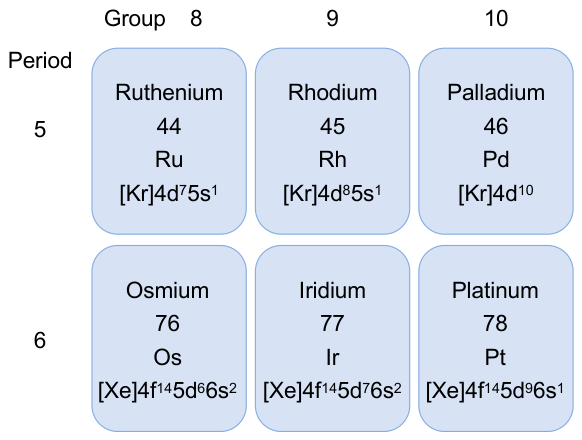
Figure 1. The positions of PGMs in the periodic table.
Materials 19 02491 g001
Figure 2. (ac) The global supply status of Pd, Pt, and Rh, respectively; (df) the global demand status of Pd, Pt, and Rh, respectively [25].
Materials 19 02491 g002
Figure 3. Structural schematic diagram of an automotive catalyst. Adapted from Ref. [26].
Materials 19 02491 g003
Figure 4. Schematic diagram of PGM recovery from SACs using a collector. Adapted from Ref. [51].
Materials 19 02491 g004
Figure 5. (a) XRD pattern of Fe−Si−PGMs alloy; (b) Phase diagram of Fe−Si−P ternary alloy (P = 4%) [62]; (c) ∆G–T curves of key carbothermal reduction reactions.
Materials 19 02491 g005
Figure 6. (a) Microstructure of Fe−Si−PGMs alloy; (b) Electron probe spectra of Points 1 and 2; (c) Distribution of main elements [62].
Materials 19 02491 g006
Figure 7. Two-stage leaching of Fe−Si−PGMs alloy.
Materials 19 02491 g007
Figure 8. Alkaline roasting for silicon removal.
Materials 19 02491 g008
Figure 9. Pyrometallurgical slagging for desiliconization combined with aqua regia leaching.
Materials 19 02491 g009
Figure 10. Schematic diagram of the leaching mechanism of Fe–Si–PGMs alloy in HCl and HF mixed solution [76].
Materials 19 02491 g010
Figure 11. Hydrometallurgical desilication combined with aqua regia leaching.
Materials 19 02491 g011
Figure 12. Schematic illustration of the in situ mechanochemical extraction mechanism of PGMs from Fe–Si–PGMs alloy [62].
Materials 19 02491 g012
Figure 13. The process of analyzing PGMs using ICP OES (* Excited state).
Materials 19 02491 g013
Table 1. Comparison of mainstream PGM recovery processes from SACs.
ProcessPrincipleAdvantagesLimitationsPerformanceRef.
Hydrometallurgical
Cyanide leachingFormation of stable cyanide complexesHigh efficiency, excellent selectivityHigh toxicity, costly waste treatment96% Pt, 98% Pd, 91% Rh leaching[33,34]
HCl + oxidant leachingOxidation to soluble chloro-complexesLower environmental hazard, industrial applicabilityNOx/Cl2 risk, strong equipment corrosion88–96% Pt, 85–99% Pd, 77–95% Rh leaching[35,36]
BioleachingCyanogenic bacteria produce cyanideEnvironmentally friendly, mild conditionsSlow kinetics, low efficiency, strict microbial growth control35–38% Pt, 41–44% Pd, 82–91% Rh leaching[38,39]
Photocatalytic leachingPhotoexcited semiconductors generate electron–hole pairsLow energy consumption, mild conditionsLow efficiency, limited scalability, solvent toxicity98% Pt, 92% Pd, 85% Rh leaching[41,42,43]
Solvent extractionDifferential distribution in immiscible phasesHigh selectivity, high recovery, industrial applicationExtractant selection/regeneration, organic phase stability99% Pd, 99% Pt recovery[5,26,44,45]
Adsorption separationFunctionalized adsorbent (resins, MOFs, biosorbents)High efficiency, environmentally friendlyAdsorbent stability/regeneration, low capacity90% Pt, 80% Pd recovery[5,46,47]
Selective precipitationFormation of insoluble PGM precipitate Simple, low cost, broad applicabilityPrecipitate purification, reagent dosage control>98% Pt recovery[48]
Membrane separationSize exclusion/charge interaction of membranesHigh selectivity, low energy consumptionHigh cost, easy fouling, strict feed requirements96% Pd, 96% Pt, 99% Rh recovery[49]
Metal displacementReduction via more reactive base metalsSimple process, low costPoor selectivity, secondary pollution60% Pt, 100% Pd recovery[50]
Pyrometallurgical
Base metal collectionAlloying PGMs with collectorHigh throughput, industrial application, high efficiencyLong cycle, high energy consumption93% Pd, 95% Pt, 97% Rh recovery[51,52]
Alkaline roastingConversion of PGMs to soluble salts/exposure of encapsulated PGMsSimple process, relatively mild conditionsSevere corrosion, high alkali consumption, complex leachate treatment>98% Pt, >98% Pd, >95% Rh leaching[53,54]
High-temperature chlorinationFormation of volatile PGM chlorideSimple flowsheet, high Rh recoveryEquipment corrosion, toxic chlorine, stringent safety97% Pt, 99% Pd, 90% Rh leaching[55,56]
Plasma smelting iron collectionPlasma smelting with Fe3O4 collector for PGM concentrationHigh efficiency, environmentally benign slag, no harmful additivesFe−Si−PGMs alloy inertness99% Pt, 99% Pd, 97% Rh recovery[11,56,57,58,59,60]
Table 2. Main chemical composition of Fe−Si−PGMs alloy (wt%) [61].
ElementFeSiPPGMsMnAlNi
Content75.4815.074.332.180.820.460.41
ElementTiCaVCrMgCuOthers
Content0.300.240.170.170.090.090.19
Table 3. Comparison of PGM recovery processes from Fe–Si–PGMs alloy.
ProcessPrincipleAdvantagesLimitationsPerformanceRef.
Direct hydrometallurgical leachingTwo-stage H2SO4 leaching to dissolve Fe selectivelyHigh PGM enrichment, low dissolution lossLong flowsheet, large leachate volume, only suitable for low-Si alloyPGMs enriched 70-fold, final grade 21%[70,71]
Direct hydrometallurgical leachingHCl leaching to remove Fe, then NaClO3 oxidative leachingSimple, low energy consumptionLong flowsheet, low PGM leachingPt 57%, Pd 62%, Rh 25% leaching[72]
Alkaline roastingRoasting with NaOH, then leaching to remove Fe and SiSimple, moderate conditions, achieves PGM enrichmentLow Fe/Si removal efficiency, risk of PGM lossPGMs enriched 9-fold, grade 23%[73]
Pyrometallurgical slaggingSlagging of Si with Fe2O3/CaO, then aqua regia leachingGreen impurity removal, efficient impurity removalHigh energy consumption, potential PGM loss, Cl2/NOxSi reduced to 0.5%, complete PGM leaching[74,75]
Hydrometallurgical desilication leachingHCl–HF breaks Fe-Si matrix, then aqua regia leachingEffective destruction of inert alloy matrix, high Fe/Si removalSerious health and environmental risks, HF/Cl2/NOx95% Fe, 95% Si, 100% PGM leaching[76,77]
In situ mechanochemical leachingMechanical activation in HCl–FeCl3–H2O2 systemShort flowsheet, high PGM leaching, no HF/Cl2/NOxChallenging scale-up, demanding equipment requirements>99% PGM leaching[13,62,80]
Table 4. Comparison of analytical methods for PGM quantification.
MethodPrincipleAdvantageLimitationRef.
Fire assayHigh-temperature fusion separationRobust, accurateComplex, toxic emissions[81,82]
HR-CS GFAASAtomic absorption in graphite furnaceHigh sensitivity, low DLLimited multi-element, matrix effects[16,83]
XRF/TXRFCharacteristic X-ray fluorescenceNon-destructive, rapidModerate DL, matrix effects[84,85,86]
GDMSGlow discharge mass spectrometryHigh sensitivity, low matrix effectRequires solids, expensive[87,88,89]
FusionAlkaline oxidative dissolutionHigh efficiency, good recoveryImpurity introduction, corrosion[90,91,92]
SpectrophotometryAbsorbance of colored complexesSimple, low cost, field-readyInterferences, condition-sensitive[93,94,95,96]
Electrochemical voltammetryCurrent response during potential scanHigh sensitivity, fastElectrode fouling, matrix interference[97,98,99,100]
ICP OESAtomic emission in plasmaMulti-element, wide range, low DLSpectral/matrix interferences[61,101,102,103,104,105]
DL = detection limit.
Disclaimer/Publisher’s Note: The statements, opinions and data contained in all publications are solely those of the individual author(s) and contributor(s) and not of MDPI and/or the editor(s). MDPI and/or the editor(s) disclaim responsibility for any injury to people or property resulting from any ideas, methods, instructions or products referred to in the content.