Review

A Review of Mixed Ionic–Electronic Conductors Oxygen Transport Membranes for Oxygen Separation: Materials, Design and Applications


1
School of Materials Science and Engineering, Shanghai University, Shanghai 200444, China
2
State Key Laboratory of Advanced Refractories, Shanghai University, Shanghai 200444, China
*
Author to whom correspondence should be addressed.
Materials 2026, 19(12), 2477; https://doi.org/10.3390/ma19122477
Submission received: 6 May 2026 / Revised: 30 May 2026 / Accepted: 5 June 2026 / Published: 9 June 2026

Abstract

Against the backdrop of the global energy transition, novel oxygen separation technologies that combine high selectivity, high permeability, and stability have become the key to overcoming industrial bottlenecks. Mixed ion–electron conductor (MIEC) ceramic oxygen transport membranes (OTMs), with their 100% oxygen selectivity, high oxygen permeability, and low energy consumption, are regarded as the most promising next-generation oxygen separation technology. Compared with traditional oxygen production approaches including cryogenic distillation and pressure swing adsorption (PSA), these solutions make up for their inherent defects. They have extensive application prospects in oxygen-enriched combustion, CCUS, high-efficiency hydrogen preparation and chemical synthesis processes. This paper systematically reviews the progress in the oxygen transport mechanisms, material systems, structural design, and fabrication processes of MIEC oxygen permeable membranes. Finally, we conducted an in-depth analysis of the key challenges OTMs face when applied to oxygen-enriched combustion including stability in high-temperature, complex flue gas environments and the optimization of oxygen permeability and offered insights into future research and industrialization directions.

1. Introduction

Amid the global energy transition and the urgent need to achieve carbon peaking and carbon neutrality goals, low-carbon, high-efficiency energy production and environmental management technologies have become central focuses in both scientific research and industrial sectors [1,2]. Carbon Capture, Utilization, and Storage (CCUS) technology, as a key pathway for controlling carbon emissions from fossil fuels, relies heavily on high-purity oxygen for critical processes such as oxygen-enriched combustion, efficient hydrogen production, and chemical synthesis [3,4,5]. However, traditional oxygen production technologies face significant limitations: While cryogenic distillation yields high-purity oxygen, it is energy-intensive, equipment-complex, and costly; Pressure Swing Adsorption (PSA) and polymer membrane separation methods are constrained by oxygen purity or scalability, struggling to meet the stringent demands of industrial applications [6,7]. Consequently, developing novel oxygen separation technologies that combine high selectivity, high permeability, and stability has become crucial for overcoming industry bottlenecks [8].
Furthermore, compared to oxygen produced as a byproduct of water electrolysis, ceramic-based membranes offer several irreplaceable core advantages in the field of oxygen separation: they achieve nearly 100% oxygen selectivity through oxygen ion conduction, enabling the direct production of ultra-pure oxygen in a single step without the need for complex purification processes such as hydrogen removal, alkali removal, or drying. This eliminates the risk of explosions caused by hydrogen–oxygen mixtures and corrosion issues associated with alkaline solutions at the source [9]. Additionally, the system consumes less energy and can be coupled with waste heat recovery. With no moving parts, it features low maintenance costs and offers modular design, on-demand oxygen production, and flexibility in high-temperature applications. Capable of producing oxygen independently without relying on hydrogen production coupling, it demonstrates significant advantages in high-purity oxygen production, operational safety, cost-effectiveness, and adaptability to various operating conditions [10].
Dense inorganic ceramic oxygen transport membranes (OTMs) stand out as a highly promising next-generation technology for oxygen separation, owing to their full oxygen selectivity, excellent oxygen permeability, and low energy demand [11]. Numerous studies have focused on the optimization and development of compact membrane-based oxygen generation devices. Among them, Wang et al. [12] developed a compact oxygen generator based on self-heated mixed ionic–electronic conducting hollow fiber membranes (MIEC HFM). This device can operate at a maximum temperature of 970 °C without the assistance of an external furnace. Experimental results demonstrate that both single-fiber and multi-fiber modules achieve an oxygen permeation flux of approximately 0.7 mL·cm−2·min−1, maintaining excellent operational stability with negligible performance degradation during 150 h of long-term continuous operation. In addition, Khajryan et al. [13] proposed a novel compact oxygen separation device that adopts steam as the purge gas for oxygen extraction from air. Specifically, when the operating temperature exceeds 700 °C, the membrane enables the separation of high-purity oxygen by virtue of the oxygen partial pressure difference between the air side and the steam side. This device suffers from inevitable performance attenuation, with a 17% reduction in oxygen permeation flux after five consecutive days of operation. The oxygen transport mechanism in OTM involves complex physicochemical steps such as surface exchange and bulk diffusion. Its performance fundamentally depends on the synergistic alignment of the material’s ionic conductivity, electronic conductivity, and structural stability [14,15,16].
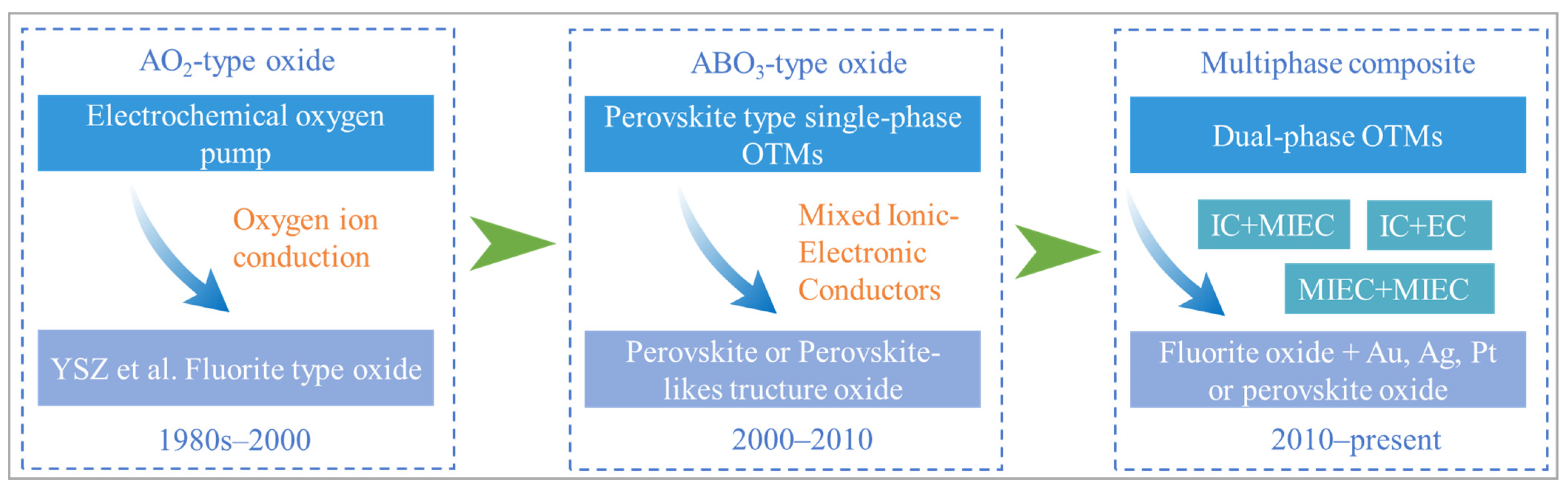
After decades of development, OTM materials have evolved from early electrochemical oxygen pumps and fluorite-type single-phase conductors to perovskite-type mixed conductors and dual-phase composite membrane systems. While single-phase conductors like perovskite materials exhibit high oxygen permeation flux, they generally suffer from insufficient chemical and mechanical stability, prone to phase structure destruction in complex atmospheres containing CO2 and CH4 [17]. Dual-phase membranes, through the composite design of ion-conducting and electron-conducting phases, effectively enhance stability. However, some systems still face challenges such as impaired oxygen ion transport and low permeability. Currently, achieving high oxygen permeability alongside long-term stability under complex atmospheres while simultaneously lowering operating temperatures remains the core bottleneck for the industrial application of OTMs.
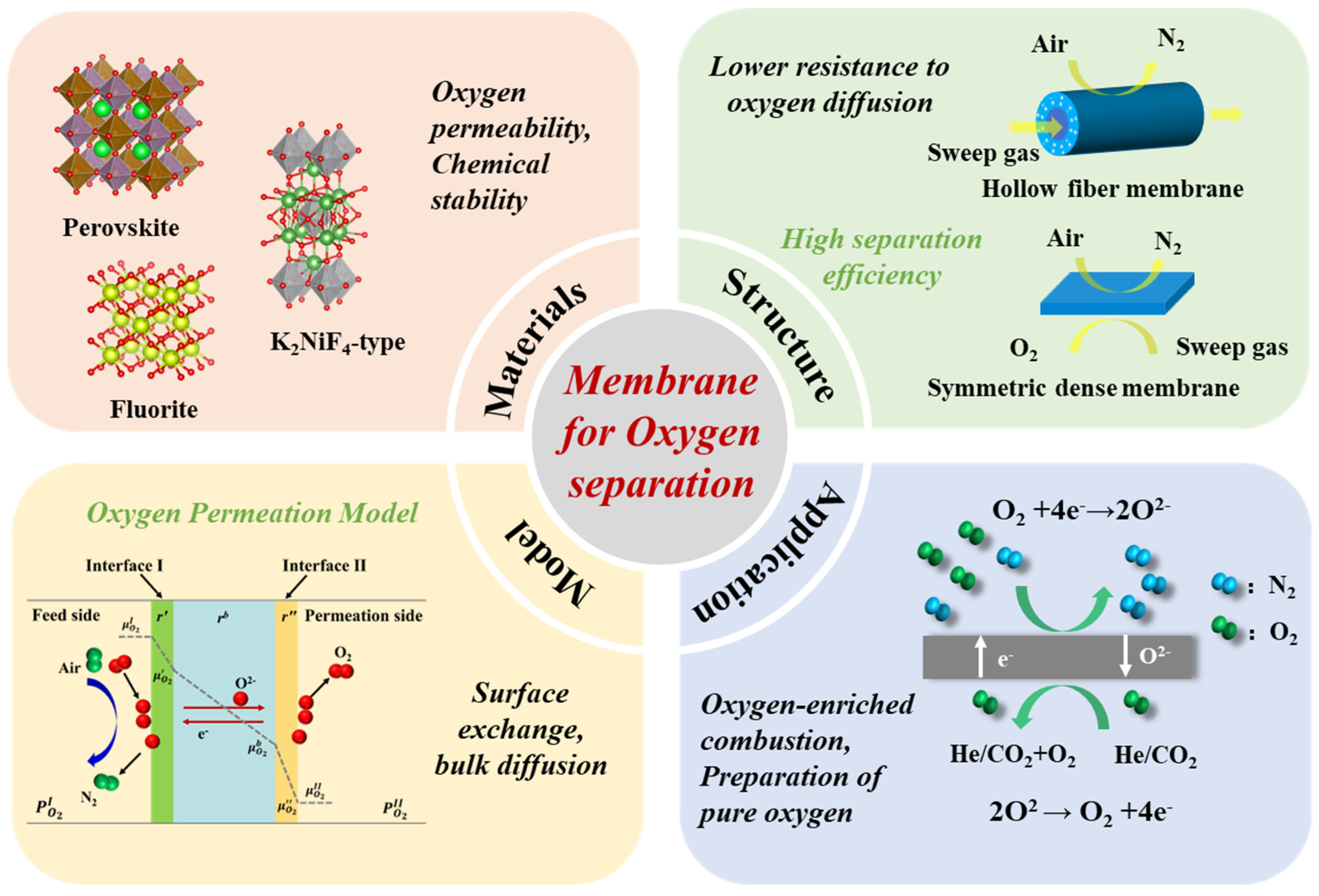
Based on this, this paper focuses on the performance optimization and application expansion of OTM materials, systematically reviewing oxygen transport mechanisms, material system evolution, and preparation process innovations, as shown in Figure 1. By investigating the effects of ion doping, phase composition ratios, and surface modification strategies on material crystal structures, oxygen vacancy evolution, and transport kinetics, the aim is to overcome the “trade-off” effect and develop OTM materials that combine high performance with high reliability. Overall, this review is divided into three main sections. The first section explains that oxygen permeation occurs through diffusion via oxygen vacancies within the membrane; the process is jointly governed by surface exchange reactions and bulk diffusion. It introduces the concept of characteristic thickness to identify rate-limiting steps and summarizes the mainstream models of oxygen permeation flux; The second section classifies membranes by phase into single-phase membranes (fluorite-type, perovskite-type, and K2NiF4-type) and dual-phase membranes (combinations of ion-conducting and electron-conducting phases). It summarizes the doping modifications, permeation performance, and CO2 stability of typical materials over the past decade, noting that biphasic membranes represent the mainstream approach for balancing flux and stability; Part Three introduces three structural types: flat-sheet, tubular, and hollow-fiber. Hollow-fiber and asymmetric sandwich structures can balance permeation performance and mechanical strength. Finally, research progress is summarized, highlighting the need for future breakthroughs in the permeation-stability trade-off, high-temperature limitations, and large-scale fabrication.

2. Oxygen Transport Mechanism and Theory

2.1. Oxygen Ion Transport Process

The oxygen transport process in mixed-conductor oxygen-permeable membranes occurs through the diffusion of oxygen species via vacancies. The oxygen migration process shown above consists of the following stages:
(1)
On the high oxygen partial pressure side, oxygen molecules in ambient air diffuse toward the membrane surface under oxygen concentration gradient driving force and are physically adsorbed on the material surface.
(2)
These surface-active oxygen species further incorporate into the membrane lattice and exist in the form of lattice oxygen ions.
(3)
Propelled by the partial pressure gradient, lattice oxygen ions move from the high-pressure side toward the low-pressure side. Meanwhile, electrons diffuse oppositely to keep the material electrically neutral.
(4)
On the low oxygen partial pressure side, lattice oxygen escapes from the membrane surface through desorption and is finally released as gaseous oxygen.
When carriers are represented by oxygen vacancies and electron-hole pairs, surface exchange reactions can be expressed using Kröger–Vink notation [18], with the purging side corresponding to Equation (1) and the permeation side corresponding to Equation (2):
1 2 O 2 + V O · · O O × + 2 h ·
O O × + 2 h · 1 2 O 2 + V o · ·
where V O · · , h · , and O O × denote oxygen vacancies, electron-hole pairs, and lattice oxygen, respectively.

2.2. Oxygen Transport Mechanism

Analysis of the oxygen transport mechanism reveals that the oxygen transport process involves bulk diffusion of oxygen ions and oxygen vacancies, as well as charge exchange processes at the membrane surface. The controlling factor in the overall oxygen transport process depends on the reactant with the lowest migration rate or the slowest transport process, known as the rate-determining step (RDS) [19]. During oxygen transport, bulk diffusion or oxygen surface exchange may serve as the sole RDS. However, for most oxygen transport membranes (OTMs), oxygen permeability is often jointly governed by bulk diffusion and surface exchange [20,21,22].

2.2.1. Characteristic Thickness

To determine the RDS during oxygen permeation, Bouwmeester et al. [23] defined the characteristic thickness as the thickness of the oxygen-permeable membrane material at which the surface exchange reaction resistance equals the bulk diffusion resistance, as shown in Equation (3):
L c = D K S
In the equation, D and K S represent the diffusion coefficient of oxygen ions and the oxygen surface exchange coefficient, respectively. Two key sets of factors determine the characteristic thickness: the intrinsic ratio of oxygen surface exchange to bulk diffusion, and external experimental variables such as temperature, synthesis method, oxygen partial pressure gradient and surface microstructure of the membrane [24,25,26,27]. It bears no direct relationship to oxygen permeability or oxygen ion conductivity. When the oxygen-permeable membrane thickness L > 10 Lc, bulk diffusion serves as the main controlling factor for permeability. In addition, characteristic thickness, oxygen partial pressure and temperature are influential parameters that cannot be ignored. When the oxygen-permeable membrane thickness L < 10 Lc, oxygen permeability is mainly governed by surface exchange reactions. At L = 10 Lc, the oxygen transmission rate is jointly controlled by both factors.

2.2.2. Bulk Diffusion Control

At elevated temperatures, oxygen transport membranes in hybrid conductors undergo interactions between oxygen ions and electrons due to oxygen chemical potential gradients. If the diffusion process is controlled by bulk diffusion, it can be described by the Wanger equation [25]:
J O 2 = 1 16 F 2 L u O 2 u O 2 t i o n t e σ t o t d u o 2
t i o n = σ i o n σ i o n + σ e = σ i o n σ t o t
where J O 2 is oxygen permeability (mL min−1 cm−2), F is the Faraday constant, L is membrane thickness (cm), te is electron number, t i o n is ion conduction number, u o 2 is chemical potential of oxygen (J mol−1), σtot, σion and σe are total conductivity, ionic conductivity, and electronic conductivity (S cm−1), respectively.

2.2.3. Surface Exchange Control

When the oxygen ionic conductivity rises or the membrane thickness reduces to a critical level, the bulk diffusion resistance of oxygen transport membranes (OTM) can be ignored. In this case, the surface oxygen exchange reaction dominates the overall oxygen transport process and acts as the rate-limiting step. A great disparity between bulk diffusion and surface exchange kinetics leads to an obvious gradient of oxygen chemisorption, which further changes the oxygen migration mechanism. Under such circumstances, the traditional Wagner equation is no longer applicable to accurately characterize the oxygen permeation behavior. Therefore, Ishikawa et al. [28] proposed a new oxygen surface exchange mechanism:
O 2 ( g ) + S ( a d ) O 2 ( a d )
O 2 ( a d ) + e O 2 ( a d )
O 2 ( a d ) + 2 e + 2 S ( a d ) 2 O ( a d )
O ( a d ) + e O ( a d )
O ( a d ) + V O · · O O ×
Equation (6) describes the adsorption process of oxygen molecules, while Equations (7) and (8) correspond to charge exchange, Equation (9) shows the dissociation step, and Equation (10) shows the formation of lattice oxygen.

2.2.4. The Oxygen Permeation Flux Models

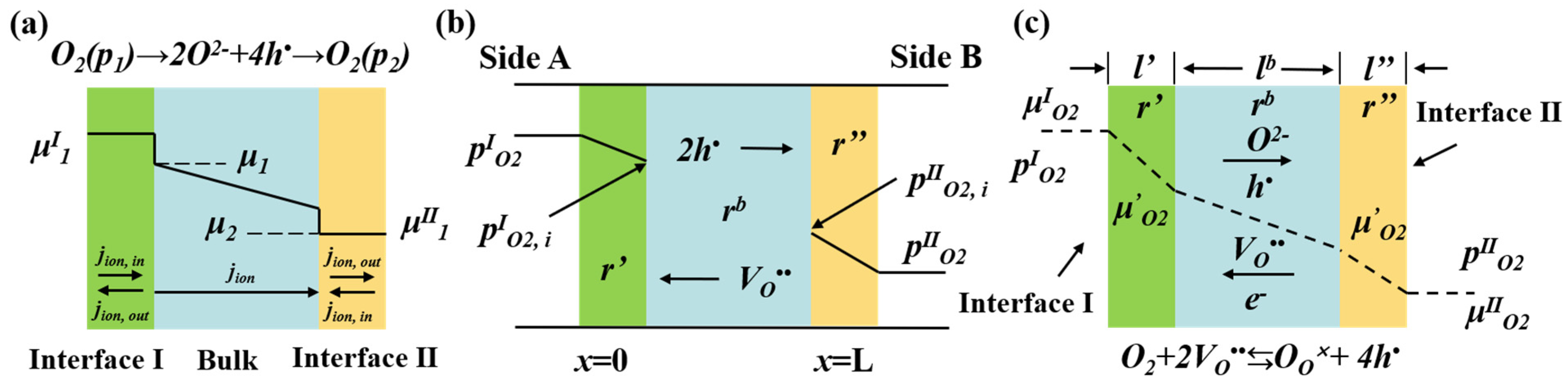
Oxygen permeation flux models can integrate material intrinsic parameters with actual operating conditions to quantitatively predict the oxygen permeation flux of dense oxygen-permeable membranes, effectively distinguish rate-limiting steps such as bulk diffusion and surface exchange, and elucidate the mechanisms of oxygen transport and the structure-property relationships of the materials. A common oxygen permeation model is shown in Figure 2.
Table 1 summarizes the major oxygen permeation flux models according to transport mechanisms and basic assumptions.
Macroscopic thermodynamic modeling of point defects that relates oxygen non-stoichiometry to temperature and oxygen partial pressure using the Kroger-Winkler notation and the law of mass action is a standard and experimentally validated method in this field. These point defect models are typically fitted to experimental data (such as thermogravimetric analysis or coulometric titration) to extract fundamental thermodynamic parameters, which are then used to accurately calculate and predict macroscopic oxygen permeation fluxes.
On the feed side of the membrane, oxygen molecules fill oxygen vacancies to form lattice oxygen and generate two holes; lattice oxygen diffuses into the membrane, and electrons migrate in the opposite direction to achieve charge compensation. On the permeate side, the reverse reaction occurs: lattice oxygen recombines with holes to form oxygen molecules, and oxygen vacancies are re-formed (Equation 11). The rate constants kf and kr characterize the forward and reverse surface exchange reactions on the two sides, respectively. The oxygen permeation flux equations incorporating these parameters are given in Equations (12) and (13) [15].
1 2 O 2 + V O · · O O × + 2 h ·
J O 2 = k f P O 2 1 / 2 C v k r C h · 2
J O 2 = k f C h 2 k f P O 2 1 / 2 C v
Here, C denotes the concentration of the substance indicated by the subscript, the superscript “denotes the feed side, and the subscript” denotes the permeate side of the membrane. The chemical species in Equations are denoted using Kröger–Vink notation.

3. Classification and Research Status

Oxygen transport membranes (OTMs) can be classified into two main categories based on the internal phase composition of the membrane material: single-phase mixed-conductor membranes and dual-phase mixed-conductor membranes. The development of OTM is shown in Figure 3. Among these, single-phase oxygen transport membranes can be further subdivided based on their crystal structure characteristics, primarily including fluorite-type, perovskite-type, layered perovskite-type, and K2NIF4-type structures, among others. The different phase compositions and crystal configurations directly determine the membrane material’s oxygen ion transport mechanism, permeability, and high-temperature stability. In contrast, dual-phase membranes consist of a separate oxygen-ion-conducting phase and an electron-conducting phase. These two phases complement each other’s strengths, effectively addressing the issues inherent in single-phase materials such as poor structural stability, thermal expansion mismatch, and limited conductivity, thereby enhancing the membrane material’s overall oxygen permeability and high-temperature performance. The literature review covers the past decade (2016–2026); typical single-phase OTM materials from this period are listed in Table 2, and dual-phase OTMs are listed in Table 3.

3.1. Single-Phase OTMs

3.1.1. Fluorite-Type

Fluorite-type oxides are a class of functional ceramic materials with a typical cubic crystal structure; they contain a large number of intrinsic lattice vacancies, making it easy to create additional oxygen vacancies through ion doping. Compared to perovskite systems, fluorite-type materials exhibit greater structural stability and can operate for extended periods under high-temperature and complex atmospheric conditions. They are often modified through metal ion doping to further optimize lattice migration pathways and reduce oxygen ion diffusion resistance, thereby enhancing oxygen permeability and conductivity.
Fluorite-type oxides are generally categorized into three major families: ceria-based, zirconia-based and bismuth oxide-based materials [39]. Doping with low-valence metal ions can introduce oxygen vacancies in these systems, endowing them with prominent oxygen ionic conductivity. The development of oxygen transport membranes (OTMs) is rooted in the oxygen ion and electron conduction behaviors of electrolytes and electrodes in solid oxide fuel cells (SOFCs), where fluorite-structured oxides are widely applied as electrolytes, with yttria-stabilized zirconia (YSZ) being a typical representative.
Multiple doping strategies have been developed to optimize the performance of fluorite-structured materials. Research further reveals that gadolinia-doped ceria (GDC) possesses much higher oxygen ionic conductivity than YSZ [40]. Tuller et al. [41] first put forward the application of ceria-based oxides as solid electrolytes. It was verified that CaO-doped CeO2 delivers an oxygen ionic conductivity 20 times greater than CaO-stabilized ZrO2 at 800 °C. Sintering-aided co-doping dopants are introduced to regulate grain boundary atomic diffusion, facilitate material densification, and lower sintering temperature. CuO serves as an effective sintering additive for GDC, forming a ternary Gd2O3-CeO2-CuO phase to trigger liquid-phase sintering. The generated grain boundary liquid phase accelerates grain movement and rearrangement driven by capillary force, effectively improving material compactness [42]. Mixed doping of alkali metals and rare earth elements in cationic multi-element co-doping effectively cuts raw material cost while boosting ionic conductivity. Banerjee et al. [43] prepared Sm-Ca co-doped ceria, and Ce0.8Sm0.05Ca0.15O1.9 achieved a conductivity of 122 mS·cm−1 at 700 °C, 1.6 times higher than single Sm-doped Ce0.8Sm0.2O1.9. Anion-cation hybrid doping further elevates the electrical properties of fluorite materials. Wang et al. [44] fabricated F-Ca co-doped GDC series materials. The optimal Gd0.1Ce0.85Ca0.05F0.1O1.85 exhibited conductivity 4.2 times and 2.2 times that of pristine GDC at 600 °C and 800 °C, respectively.

3.1.2. Perovskite-Type

Among various transition metal oxides, the ABO3-type perovskite has attracted the most research attention and seen the broadest practical applications. The A position is normally filled with large-sized divalent or trivalent rare-earth and alkaline earth metal cations, represented by La and Sr. Trivalent or tetravalent transition metal ions like Fe, Co, and Nb preferentially reside at the B position. Other metal ions with similar radii can partially replace the original cations at A and B sites without causing obvious changes to the crystal structure.
In perovskite-type materials, the B–O bond length equals a/2, while the A–O bond length is √a/2 (a denotes the lattice parameter of the cubic unit cell). The perovskite skeleton is built from eight corner-sharing BO6 octahedra, and A-site cations occupy the central position. Doping different elements at A and B sites will alter the structural symmetry. The tolerance factor is proposed to characterize such structural variations, and its calculation formula is presented in Equation (11):
t = r A + r O 2 ( r B + r O )
In this formula, rA, rB, and rO stand for the ionic radii of A-site, B-site and oxygen ions, and t denotes the tolerance factor. A value of t = 1 corresponds to the perfect perovskite structure. Most practical perovskites deviate from the ideal state and present structural distortion.
To achieve high performance in perovskite oxygen transport membranes (OTMs), particularly their resistance to CO2, doping is commonly employed. B-site doping is the most commonly studied modification strategy for improving material performance. Previous work from Shao’s group [45] revealed that a high doping content effectively improves the resistance to CO2 for SrFe0.8M0.2O3−δ films. Despite this favorable effect, the oxygen permeability of these materials declines accordingly. The doped cations studied herein include Zr4+, Ti4+, Nb5+, W6+, and Mo6+. Certain trivalent ion dopants with fixed valence states (such as Al3+, Gd3+, and Y3+) can also be used to enhance the structural stability of perovskite oxides in a carbon dioxide atmosphere. Perovskite high-valence doping improves structural and chemical stability mainly via charge compensation effect, which restrains excessive oxygen vacancy formation and suppresses reduction in B-site cations. Meanwhile, high-valent ions possess higher charge density to strengthen B-O bonding energy and lattice rigidity, moderate lattice distortion to keep stable crystal phase, raise ion migration energy barrier and hinder element segregation. It also modulates electronic structure to passivate defects, collectively enhancing thermal, redox and long-term operational stability of the material.
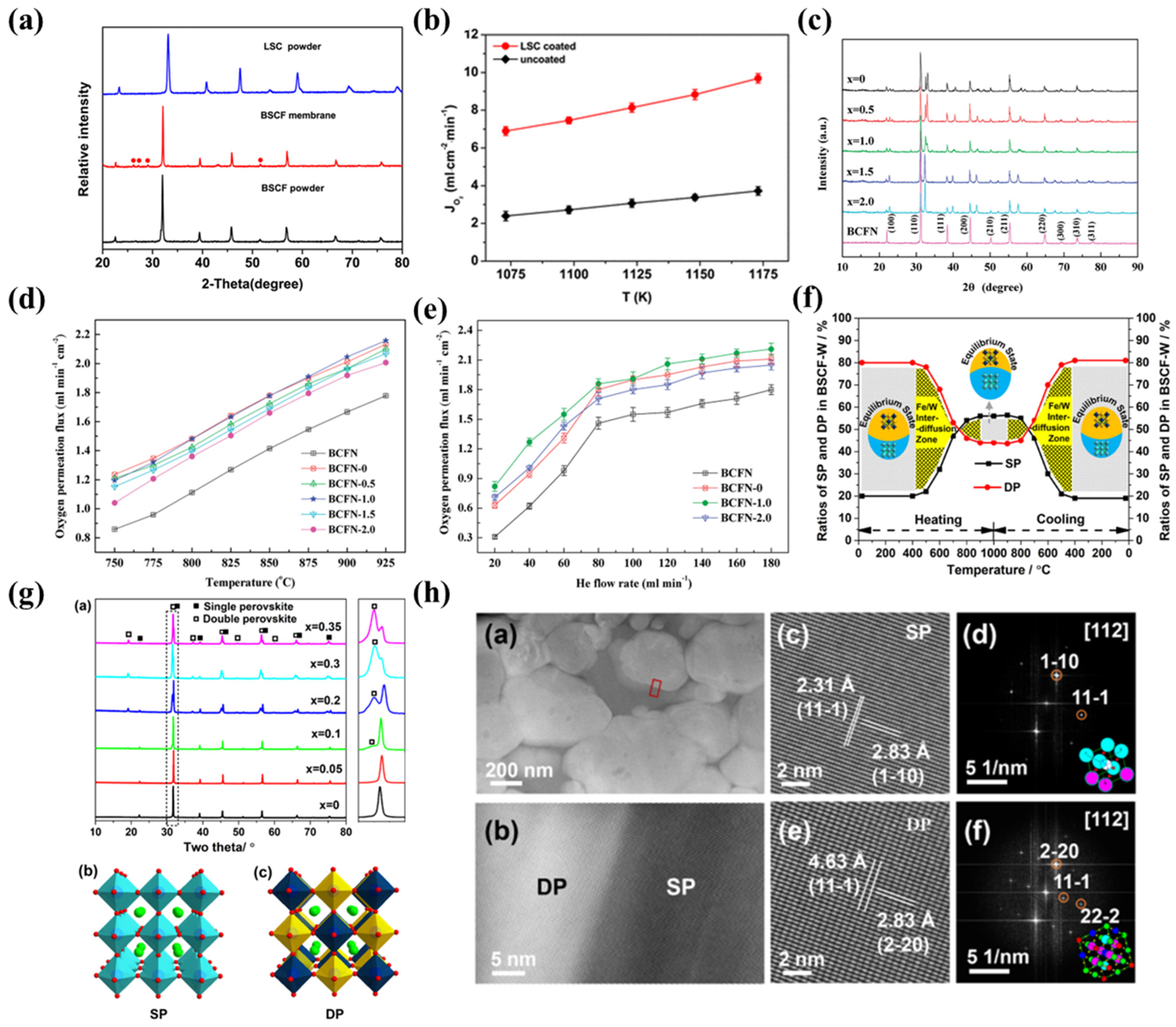
Doping with specific ions can induce a high-temperature phase transition in perovskites, transforming them into a stable cubic phase. The optimized crystal structure effectively suppresses lattice distortion and oxygen vacancy clustering, strengthens internal chemical bonding, and enhances thermal and redox stability, enabling the material to maintain stable performance even under high-temperature and complex operating conditions. Liu et al. [46] found through high-temperature in situ XRD analysis that PSFAl0.1 transforms from the orthorhombic Pnma phase at 370 °C to the Imma phase, and subsequently transforms to the cubic Pm-3m phase upon heating to 720 °C. Within a certain range, Al doping improves material stability while boosting oxygen permeation performance. Perovskites not only possess oxygen transport capabilities but also exhibit certain catalytic properties. Guo et al. [47] coated the BSCF film with LSC; the XRD pattern is shown in Figure 4a. At 1173 K, the oxygen flux of the treated membrane rose obviously to 9.68 mL cm−2 min−1, as shown in Figure 4b. This is an exceptionally high value in the field of OTM. Cheng et al. [48] prepared a series of BCFN films, as shown in Figure 4c. Under helium purge, different coatings exert distinct impacts on the membrane’s oxygen permeation flux from 750 °C to 925 °C, as displayed in Figure 4d. Figure 4e further depicts the flux variation with helium flow rate at a fixed temperature of 875 °C. A notable enhancement in oxygen permeability was observed once the flow rate was elevated to 80 mL min−1. However, once the purge flow rate exceeded 80 mL min−1, the oxygen permeation flux returned to a state of slow increase. He et al. [3] reported on the development of W-doped BSCF composites, which feature two phases: Fe-rich single perovskite (SP) and W-rich double perovskite (DP), both with unique crystallographic properties. In situ high-temperature X-ray diffraction (HT-XRD) analysis was performed on BSCFW0.35. Using XRD data collected upon heating and cooling, the variation in the mass ratio between SP and DP phases of BSCFW0.35 with temperature was determined (Figure 4f). Figure 4g shows the room-temperature XRD pattern of the BSCFW oxide prepared after calcination at 950 °C for 10 h. For W doping levels lower than 0.1, BSCF oxide crystallizes into a single cubic perovskite structure, and no impurity diffraction peaks are observed. To clarify the structural stabilization mechanism of the BSCFW SP/DP composite at intermediate temperatures, high-resolution TEM and EDX analyses were performed on BSCFW0.35 (Figure 4h). The microstructure shows a tightly mixed two-phase structure of SP and DP, with no intermediate phase at their interface, indicating good compatibility.

3.1.3. K2NiF4-Type

Numerous studies have centered on isotropic perovskite materials. In comparison, limited attention has been paid to anisotropic K2NiF4-type mixed conductors with the general A2BO4 formula. These layered composite oxides consist of alternating perovskite (ABO3) and rock-salt (AO) structural slabs. Site A is occupied by alkaline earth metals, rare earth elements (Ln), and other large-radius metal ions, which form a 9-coordinate complex with oxygen. Site B is occupied by a smaller-radius metal ion, typically a transition metal ion, which forms a 6-coordinate complex with oxygen, resulting in an [BO6] octahedral structure.
Ln2NiO4+δ (where Ln = La, Pr, Nd, and other rare earth metals) belongs to the K2NiF4 structural family and can be used in systems such as solid oxide fuel cell cathodes and oxygen-permeable ceramic membranes. Compared to perovskite oxygen-permeable membrane materials, it offers superior stability, but has lower electronic and ionic conductivity, and requires a higher sintering temperature for the ceramic membrane. The latest research on the K2NiF4-type dense OTM series in the recent literature is (Pr0.9La0.1)1.9Ni0.74Cu0.21Ga0.05O4+δ. Li et al. [49] proposed a novel hierarchical porous symmetric support (GPSS) structure for K2NiF4-type (Pr0.9La0.1)2(Ni0.74Cu0.21Ga0.05)O4+δ membrane, addressing the challenge of balancing high oxygen flux with long-term stability. This structure exhibits exceptional stability. At temperatures between 750 and 975 °C, the oxygen permeation rate of the PLNCG-GPSS membrane varied with feed-side oxygen partial pressure. When PO2 increased from 0.1 atm to 0.8 atm, the flux rose from 2.54 up to 16.47 mL min−1 cm−2. This configuration minimizes the diffusion resistance of oxide ions and boosts the surface exchange kinetics on both surfaces of the membrane.
Table 2. Summary of the performances of single-phase membranes.
Membrane MaterialsTemp. (°C)Flow Rate
(mL min−1)
JO2
(mL min−1 cm−2)
Thickness (mm)Ref.
Feed SweepHeCO2
La0.6Sr0.4Co0.2Fe0.8O3−δ9002001000.81 1.25[50]
Ce0.8La0.2−xTixO2−δ 0.6–0.8[51]
SrCo0.8−xFe0.2MoxO3−δ95020050~1.0 1.50[52]
Ba0.5Sr0.5(Co0.8Fe0.2)1−xZnxO3−δ700201200.65 0.40[53]
BaBi0.05Co0.8Nb0.15O3−δ7302002015 /[54]
(Pr0.9La0.1)2(Ni0.74Cu0.21Ga0.05)O4+δCl0.1975//1.11.10.60[55]
Sr0.95Ag0.05Co0.9Nb0.1O3−δ750 1001.14 1.00[56]
Ba0.5Sr0.5Co0.8Fe0.1W0.1O3−δ800 1.5 0.60[57]
BaFe0.95−xCa0.05TixO3−δ950120601.02 0.4[58]
SrCoxFe0.9−xNb0.1O3−δ900501000.90.61.10[59]
Pr0.6Sr0.4Cu0.2Fe0.8O3−δ900 400.400.161.40[24]
La0.6Ca0.4Co1−xFexO3−δ900150290.760.51.00[60]
Ba0.5Sr0.5Co0.8Fe0.2O3−δ950240 8 0.47[61]
Ba0.5Sr0.5Co0.8Fe0.17Y0.03O3−δF0.0990011363.15 1.00[62]
Ba2In2−xCrxO5−δ950130291.4 1.2[63]
La0.6Sr0.4Co0.2Fe0.8O3−δ850100100 0.876 [64]
BaCe0.1Fe0.9O3−δ950150 2.15 0.50[65]
La0.6Sr0.4Co0.2Fe0.8O3−δ-Ag950200501.48 0.30[66]
La0.8Ca0.2Fe0.95Ag0.05O3−δ950 1801.5 [67]
(Pr0.9La0.1)1.9Ni0.74Cu0.21Ga0.05O4+δ975150300.95 0.60[68]
Pr0.6Sr0.4FeO3−δ9503001003.5 0.60[69]
Ba0.6Sr0.4Fe0.92Ti0.08O3−δ900120600.93 1.00[70]
La0.4Bi0.4Sr0.2FeO3−δ 8001001001.13 0.025[71]
KxBa0.5−xSr0.5Co0.8Fe0.2O3−δ750 0.80 1.00[72]
(Pr0.9La0.1)2(Ni0.74Cu0.21Ga0.05)O4+δ975150554.58 0.6[49]
La0.2Pr0.2Nd0.2Ba0.2Sr0.2Co0.8 Fe0.2Ni0.1O3−δ90015060 0.31.00[73]
La0.2Pr0.2Nd0.2Ba0.2Sr0.2Co0.8 Fe0.2O3−δ900150600.330.231.00[74]
SrFe1−xHfxO3−δ850 0.361.00[75]
SrCo0.95P0.05O3−δCl0.05600100801.10 0.025[48]
La0.25Sr0.25Gd0.2Nd0.2Pr0.1CoO3950 1.621.46 [76]

3.2. Dual-Phase OTMs

Most previous studies have focused primarily on doping modifications of perovskite-based materials to improve their tolerance to carbon dioxide. In recent years, fluorite oxides with intrinsic oxygen ionic conductivity have been introduced into perovskite matrices to fabricate dual-phase membranes, offering an alternative approach to overcoming the challenges associated with perovskite membranes. This dual-purpose approach aims to enhance both oxygen permeability and stability [77].
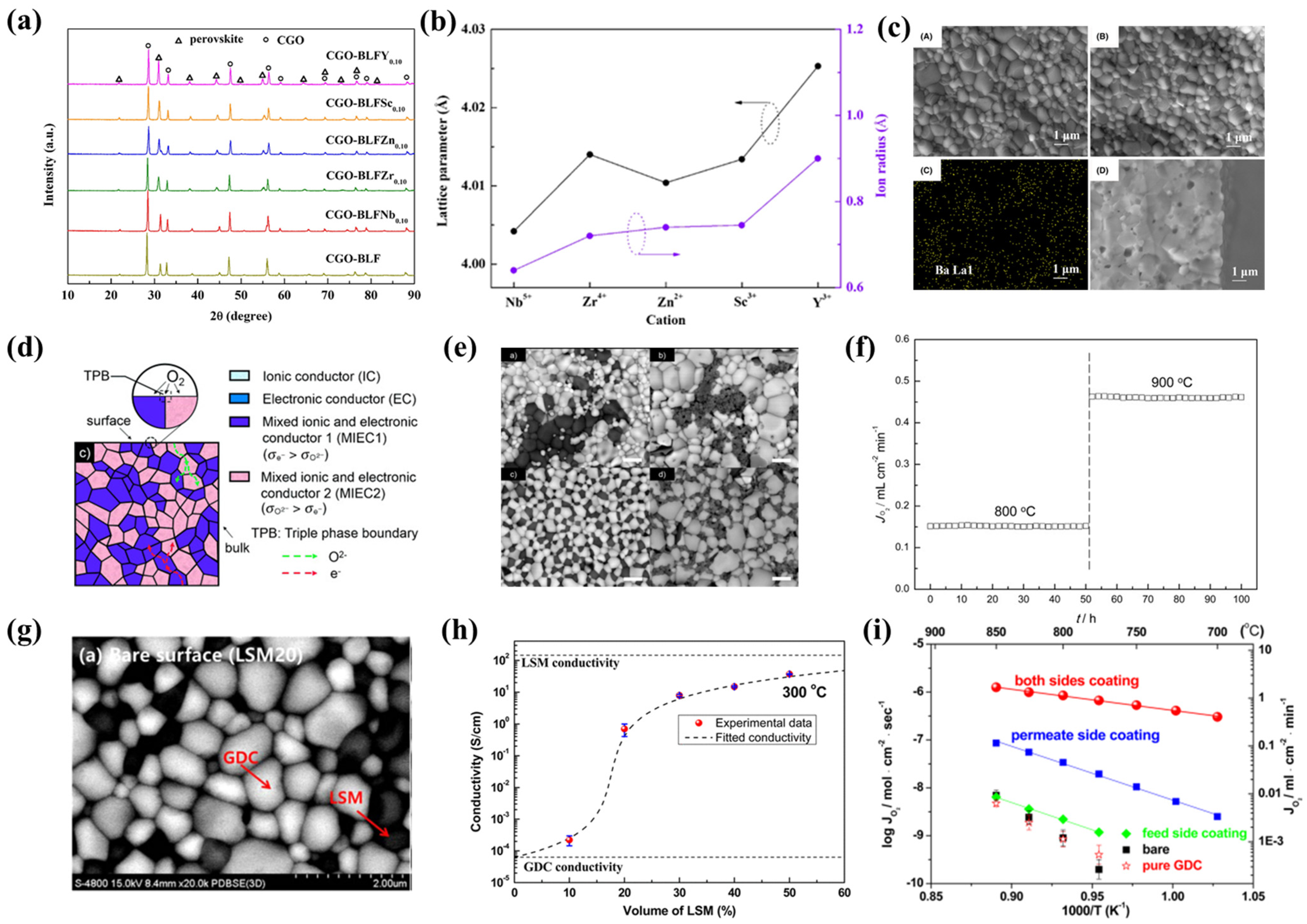
Doping the fluorite phase in biphasic membranes primarily serves to enhance oxygen ion conductivity, increase oxygen vacancies, regulate thermal expansion, improve chemical stability and interfacial compatibility, and increase mechanical strength. This significantly boosts oxygen permeability while maintaining resistance to CO2 and reduction. Chen et al. [78] prepared a series of Ce0.8M0.2O2−δ-La0.5Sr0.5Fe0.8Cu0.2O3−δ (M = La, Pr, Nd, Sm, Gd) biphasic membranes to investigate the effects of rare earth elements on electrical conductivity, structure, oxygen permeability, phase stability, and chemical stability in ionic conductors (cerium-doped). The high oxygen permeation flux in the CGO-LSFCO membrane can be attributed to its well-connected network, while the high electronic conductivity of the ionic conductor (CPO) and oxygen vacancy defects in the CPO-LSFCO samples may be responsible for their superior oxygen permeability. In their systematic work, Zhang et al. [79] studied how different lanthanum (Ln) elements affect the structural features and oxygen permeation performance of Ti-doped dual-phase OTMs (60wt%Ce0.9Ln0.1O2−δ-40wt% Ln0.6Sr0.4Fe0.9Ti0.1O3−δ (CLnO-LnSFTO, Ln = La, Pr, Nd, Sm, Gd, Tb)). It benefits from the combination of fluorite phases and doping with lanthanide elements. All CLnO-LnSFTO OTMs operated stably for 50 h and 100 h, respectively, at 1000 °C under He and CO2 gas purging conditions, with virtually no decline in performance. In dual-phase membrane, the perovskite phase is the primary electron-transporting phase; enhancing the electronic conductivity of the perovskite helps improve the overall oxygen permeability of the dual-phase membrane. Cheng et al. [80] prepared a series of biphasic films doped at the B site of perovskites, with the composition (CGO-BLFM0.10, M = Fe, Nb, Zr, Zn, Sc, Y), as shown in Figure 5a. Figure 5b shows the lattice parameters of the BLFM0.10 oxide, which were obtained by fitting XRD data. It can be observed that, in general, the lattice parameters of BLFM0.10 increase as the radius of the dopant ion increases. The surface microstructures of CGO-BLF and CGO-BLFSc are displayed in Figure 5c. Distinct grain boundaries can be observed, with no cracks or pores existing between grains, which demonstrates the excellent densification of the prepared membranes. In a pure CO2 atmosphere, CGO-BLFSc0.10 exhibited the best oxygen permeation stability.
The above analysis indicates that fluorite-structured materials feature superior ionic conductivity yet inferior electronic conductivity. Accordingly, it is essential to boost the electronic conductivity of fluorite to obtain qualified MIEC oxides. Existing literature has proven that co-doping modification can effectively optimize both the electronic conductivity and sintering characteristics of fluorite oxides. When low-valent ions such as Cu2+ are doped into the fluorite phase, they can generate a large number of oxygen vacancies through charge conservation mechanisms, thereby increasing oxygen permeability. Zhang et al. [81] reported a new series of biphasic mixed ion–electron conductors (OTMs) composed of Ce0.85Nd0.1Cu0.05O2−δ−NdxSr1−xFe1−yCuyO3−δ, which exhibit oxygen permeation fluxes of 2.62 and 1.52 mL min−1 cm−2 under He and CO2 purging conditions, respectively, surpassing all previously reported dense dual-phase OTMs. Compared to the Ce0.9Pr0.1O2−δ-Pr0.6Sr0.4Fe1−xTixO3−δ membrane (oxygen permeability of 0.512 under helium purging) previously reported by this research group, representing a fivefold increase in oxygen permeability at the same temperature and thickness. Fang et al. [82] found that doping copper into the Ce0.9Gd0.1O2−δ oxide enhances both ionic and electronic conductivity, leading to a transition from ionic to mixed conductivity at high temperatures. Figure 5d illustrates the transport pathways for oxygen ions and electrons within the membrane. Figure 5e shows BSE micrographs of the surfaces of dual-phase membranes prepared using different methods, revealing that the membrane prepared using the one-pot method exhibits a uniform grain distribution. Using a 0.5 mm-thick CGCO-LCF one-pot synthesis dual-phase membrane and pure CO2 as the purge gas at 950 °C, an oxygen permeation flux as high as 0.70 mL · min−1 · cm−2 was achieved. The long-term oxygen permeation stability of the one-pot-derived CGCO-LCF membrane was evaluated at 800 °C and 900 °C (Figure 5f). The oxygen flux remained constant during continuous operation, confirming the favorable CO2 tolerance of the membrane. Joo et al. [83] investigated the optimal ratio of the two phases in GDC/LSM membranes. A scanning electron micrograph of the dual-phase membrane is shown in Figure 5g. To determine the minimum LSM content required for electroosmosis, the electrical conductivity of the GDC/LSM composite was measured as a function of its LSM content, as shown in Figure 5h. Therefore, 20 vol.% LSM was determined to be the minimum concentration required to ensure electroosmotic flow in this composite membrane. Figure 5i shows the oxygen permeation flux through a self-supporting LSM20 bimetallic membrane approximately 60 μm thick (with and without a porous LSC coating) under an air/helium gradient.
The mechanical properties of the membrane are critical for its control and amplification in commercial applications. Liu et al. [1] adopted a Vickers indenter under 0.5 kg load to characterize the mechanical properties of the as-prepared membranes. The addition of CP reduced the overall fracture toughness. CP-PSFA suffered more severe crack propagation and possessed lower fracture toughness than pristine PSFA. In addition, the smaller indentations on CP-PSFA surfaces confirmed its higher Vickers hardness.
Table 3. Summary of the performances of dual-phase membranes.
Membrane MaterialsTemp. (°C)Flow Rate
(mL min−1)
JO2
(mL min−1 cm−2)
Thickness (mm)Ref.
Feed Sweep HeCO2
Ce0.9Gd0.1O1.95-(La0.8Sr0.2)0.95MnO3−δ950100300.780.6590.03[84]
Ce0.8Gd0.2O2−δ-Ba0.95La0.05Fe0.9Sc0.1O3−δ9253001000.200.141.00[80]
Ce0.9Gd0.1O2−δ-La0.6Sr0.4Co0.2Fe0.8O3−δ8505005003.5 0.33[85]
Pr0.1Gd0.1Ce0.8O2−δ-CoFe2O4900250500.19 1.00[86]
Nd0.6Sr0.4CoO3−δ-Ce0.9Nd0.1O2−δ1000150600.90.550.40[87]
Pr0.6Sr0.4Co0.5Fe0.5−xNbxO3−δ-Ce0.8Gd0.2O2−δ9003001000.730.600.50[20]
La2NiO4+δ-Sm0.2Ce0.8O1.99501201203.052.25 [88]
Ce0.9Pr0.1O2−δ-Pr0.6Sr0.4Fe1−xAlxO3−δ1000100491.12 0.40[89]
La0.15Sr0.85FeO3−δ-La0.15Ce0.8Cu0.05O2−δ950120600.65 0.6[90]
Ce0.8Sm0.2O2−δ-Sr2Fe1.5Mo0.5O5+δ90030300.200.16 [91]
Ce0.9Pr0.1O2−δ-Pr0.6Sr0.4Fe0.8Al0.2O3−δ1000150491.030.460.33[92]
Ce0.9Pr0.1O2−δ-Pr0.6Ca0.4FeO3−δ1000150491.000.620.30[93]
CSBx-Sm0.6Sr0.4Al0.3Fe0.7O3−δ900100300.83 0.50[94]
Ce0.9Pr0.1O2−δ-La0.5Sr0.5Fe0.9Cu0.1O3−δ900150290.930.710.50[95]
Ce0.8Sm0.2O1.9-La0.8Sr0.2Cr0.5Fe0.5O3−δ800200 0.97 0.05[96]
La0.8Sr0.2MnO3-YSZ [97]
Ce0.9La0.1O2−δ-La0.6Sr0.4Co1−xAlxO3−δ1000150491.020.720.60[98]
Ce0.8Sm0.2O2−δ-SrCo0.9Nb0.1O3−δ1000120601.200.15 [99]
Ce0.85Pr0.1Cu0.05O2−δ-Pr0.4Sr0.6Fe0.95Cu0.05O3−δ1000150491.600.980.60[100]
Ce0.8Sm0.2O2−δ-La0.8Ca0.2Al0.3Fe0.7O3−δ9501001001.841.520.30[101]
Ce0.9Pr0.1O2−δ-Pr0.6Sr0.4Fe1−xInxO3−δ1000150491.070.800.60[102]
Ce0.9Pr0.1O2−δ-Pr0.6Sr0.4Fe1−xGaxO3−δ1000150490.750.410.60[103]
Ce0.9Pr0.1O2−δ-Pr0.6Sr0.4Fe1−xTixO3−δ1000150490.5120.3060.60[104]
Ce0.8Sm0.2O2−δ-Sm0.6Sr0.4Fe1−xCuxO3−δ900100400.480.321.00[105]
Ce0.9Ln0.1O2−δ-Ln0.6Sr0.4Fe0.9Ti0.1O3−δ
(Ln = La, Pr, Nd, Sm, Gd, Tb)
1000150490.600.540.60[79]
Sm0.2Ce0.8O1.9-La0.9Ca0.1Fe0.95−xCuxO3−δ9501001001.99 0.24[106]
Figure 5. (a) XRD patterns of CGO-BLFM0.10 dual-phase; (b) the lattice parameters of BLFM0.10 [84]. (c) SEM-EDS images of the fresh dual-phase membranes: the surface of CGO-BLF and CGO-BLFSc0.10 [84]. (d) Conceptual diagram of electron and ion transport in a dual-phase membrane [81]. (e) Back-scattered electron (BSE) micrographs of the surfaces of biphasic membranes synthesized using different methods (One-pot method and two-pot method) and doped with copper [81]. (f) Stability of oxygen permeation for one-pot CGCO-LCF dual-phase membrane during long-term operation [81]. (g) Scanning electron micrographs of the dual-phase membrane bare surface of the LSM20 membrane [82]. (h) Variation in electrical conductivity of GDC/LSM dual-phase membrane with LSM content at 300 °C [82]. (i). Oxygen permeation fluxes measured through free-standing LSM20 dual-phase membranes with and without a porous La0.6Sr0.4CoO3−δ coating [82].
Materials 19 02477 g005
In addition, the application of OTMs in membrane reactors, where the permeated oxygen is directly utilized in chemical reactions, is an emerging field of research. In particular, dual-phase OTMs in which the membrane is composed of a stable ionic conductor and a stable electronic conductor have attracted significant attention because they can overcome the drawbacks of monophasic membranes, such as mechanical stability under high-temperature and harsh operating conditions. Although considerable progress has been made in developing dual-phase OTMs for both conventional and emerging applications, multiple bottlenecks still limit their practical large-scale deployment.

4. Density Functional Theory Calculations

First-principles calculations are a key theoretical tool for studying the mechanisms and optimizing the performance of OTM materials. The oxygen permeability of oxygen-permeable membranes is primarily determined by the evolution of oxygen vacancies, the migration of oxygen ions between phases, and surface oxygen exchange reactions; conventional experiments struggle to directly observe these microscopic processes at the atomic scale.
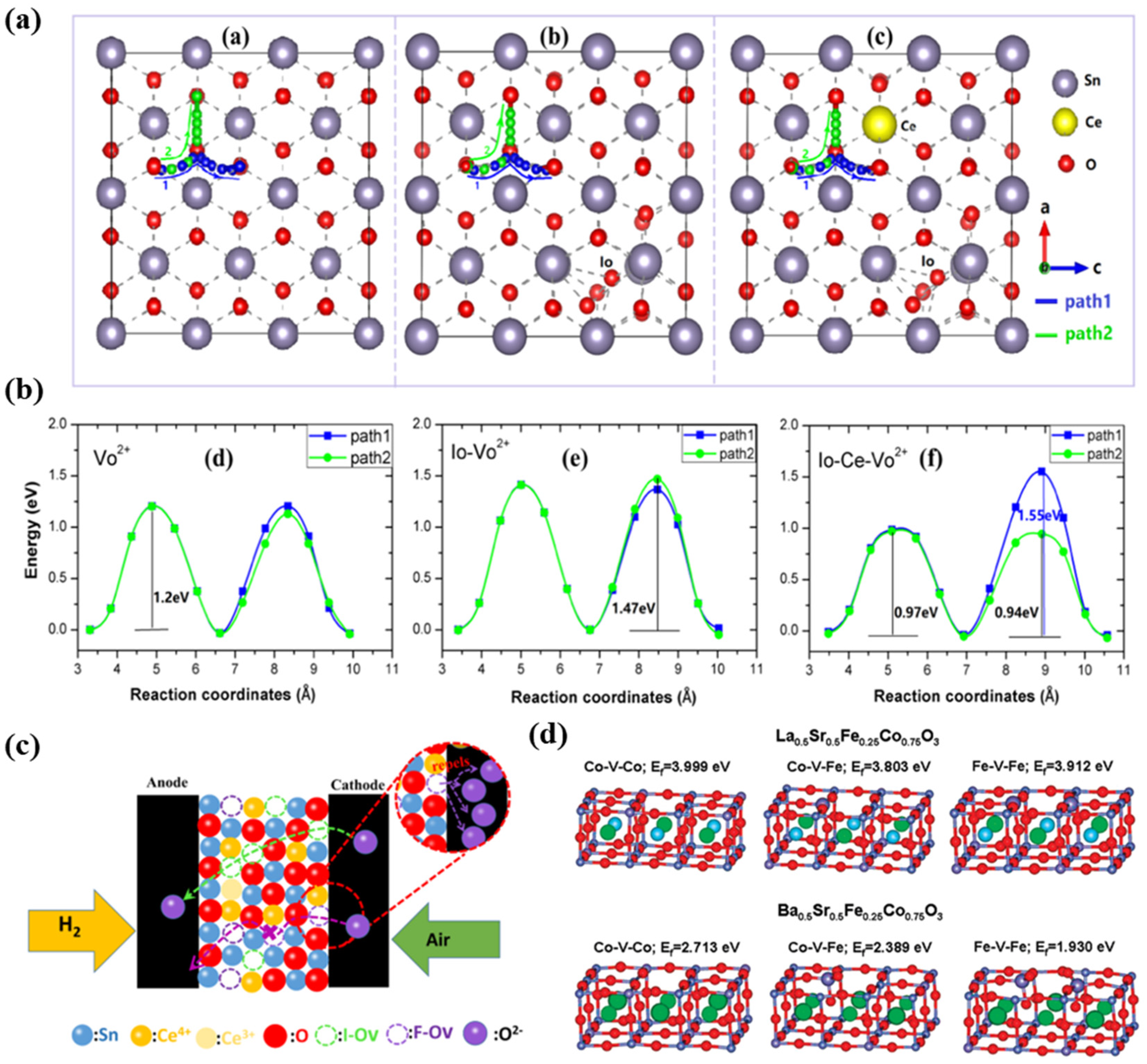
To elucidate the ionic conduction mechanism, in a previous study, Cai et al. [5] doped cerium into tin dioxide to prepare pure Sn1−xCexO2−δ oxides. After combining with Sm0.2Ce0.8O3−δ (SDC), the hybrid system became a semiconductor-ionic material (SIM) and was utilized as the electrolyte membrane in fuel cell assemblies. To elucidate the doping effect of Ce on oxygen ionic conduction, we adopted DFT methods to investigate pristine and Ce-substituted SnO2 systems. As illustrated in Figure 6a, extra ions were incorporated to remove the disturbance caused by interstitial oxygen species. The rotational and hopping energies for oxygen migration in SnO2 and Sn1−xCexO2−δ were computed, and the outcomes are given in Figure 6b. It can be observed that the two oxygen migration paths in pure SnO2 have comparable energy barriers of roughly 1.47 eV, which are all higher than 0.94 eV. The reduction in migration energy barrier verifies that Ce doping effectively boosts oxygen ion mobility. This is the fundamental reason for the improved electrochemical behavior of fuel cells equipped with Ce-doped SnO2 electrolyte membranes. Figure 6c depicts the oxygen ion transport process within a fuel cell. Petkovic et al. [14] calculated the formation energy of oxygen vacancies created by removing oxygen atoms from different “O-bridges” on the perovskite surface. For most of the perovskites considered, the atoms surrounding the vacancies exhibit little relaxation and do not significantly alter the atomic configuration of the perovskite surface (Figure 6d). Across all samples, oxygen vacancy formation energies differ little between the bulk and surface regions, with surface sites exhibiting slightly lower energy.
To gain a deeper understanding of the phenomenon in which moderate Al doping simultaneously enhances both oxygen permeability and stability, Liu et al. [46] employed first-principles calculations to elucidate the formation of oxygen vacancies and the behavior of oxygen migration. Of the five oxygen migration pathways, the O1 route surrounding Al dopants in the Pr5Sr3Fe7Al1O12 supercell yields the minimum migration barrier of 0.67 eV, outperforming the two migration pathways in pure Pr5Sr3Fe8O12. The stronger Al–O bonding compared with Fe–O bonding stretches the neighboring Fe–O bonds. The increased Fe–O bond length enables easier oxygen ion dissociation. Qiao et al. [2] investigated the effects of co-doping with Y3+ and W6+ on the electronic structure. The PDOS values do not cross the Fermi level, indicating that both structures exhibit semiconductor behavior. Due to W doping, Ba8Co6W1Y1O24 has a narrower bandgap than Ba8Co6Y2O24. A narrower bandgap implies stronger electronic conductivity, suggesting that co-doping enhances electronic conductivity. Wei et al. [75] investigated the effect of Hf4+ doping on the mobility of oxygen ions. The calculated electron density maps of SF and Hf-doped SFHf samples on the (100) plane. Clearly, compared to the SF sample, the SFHf sample exhibits an increased electron density around the O ion center, while the density of Fe cations is reduced. Therefore, the incorporation of Hf4+ cations into the SF sample renders the O sites more active. When CO2 is used as the sweep gas, its adsorption behavior on the membrane surface is critical.
By employing first-principles methods such as density functional theory, it is possible to accurately calculate the formation energy of oxygen vacancies and the migration energy barriers of oxygen ions, identify the optimal pathways for ion transport and the rate-limiting steps of reactions, and deeply elucidate the intrinsic mechanisms of oxygen transport in these materials. The oxygen migration energy derived from theoretical calculations reflects the difficulty of oxygen ion diffusion within the crystal lattice. A lower migration energy barrier facilitates oxygen transport, resulting in higher oxygen permeability observed in experiments. In this way, the computational results provide a reasonable explanation for and support the experimental oxygen permeability.

5. Design of Membrane Structures

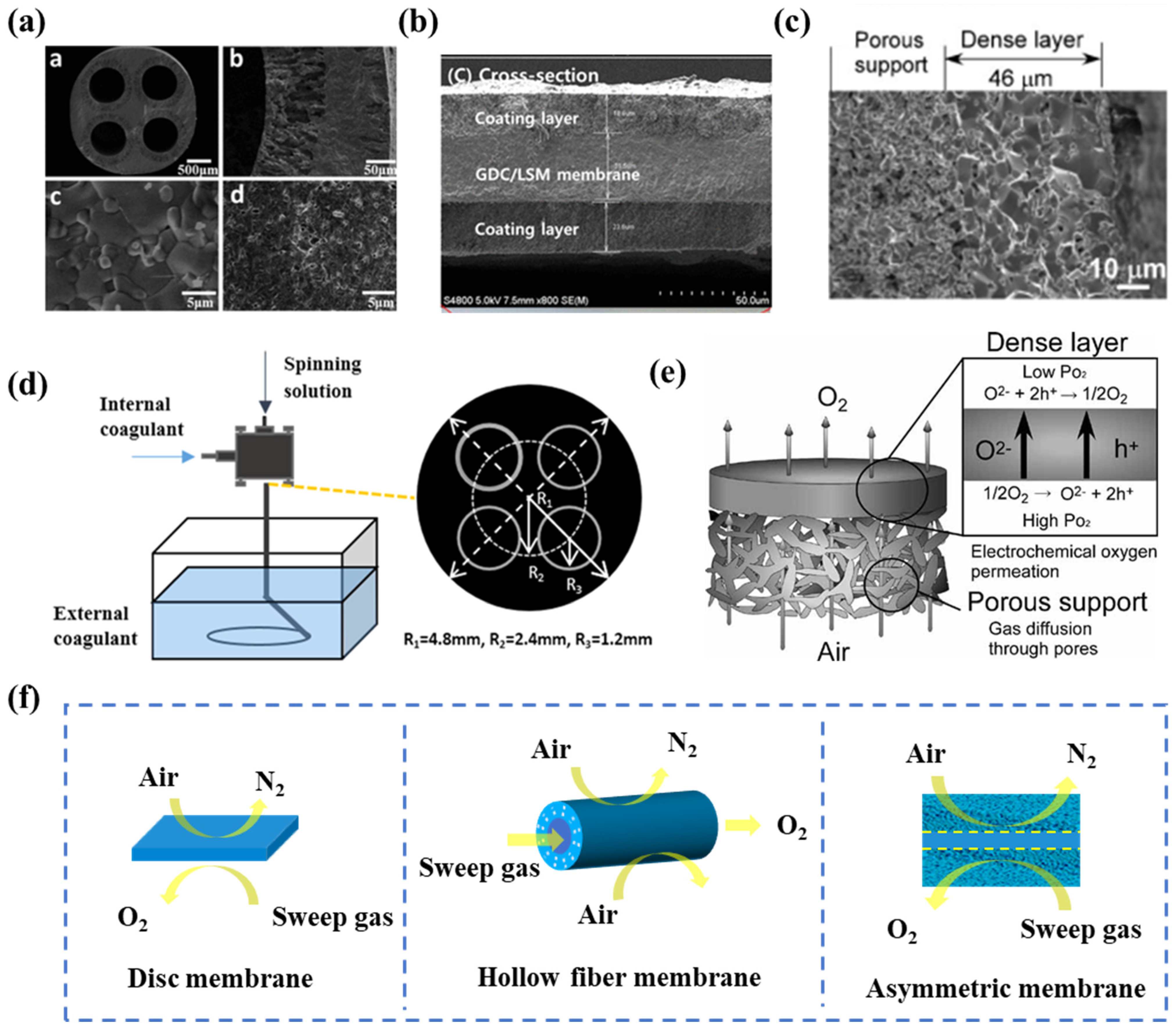
Three primary structural morphologies are commonly adopted for dense inorganic oxygen transport membranes: planar, tubular, and hollow fiber geometries. Although flat-sheet membranes are relatively easy to manufacture, their small surface area limits their sealing performance. The tubular La0.6Sr0.4Co0.2Fe0.8O3−δ membranes prepared by Li et al. [107] resolved the sealing issue; however, due to their relatively large thickness, they have a small specific surface area and poor oxygen permeability. Compared to sheet membranes and tubular membranes, hollow fiber membranes overcome the challenge of sealing while offering a large surface area and thin walls; as a result, under identical test conditions, their oxygen permeability is significantly higher than that of the other two membrane types. Guo et al. [47] modified the surface of BSCF mixed-conductor multi-channel hollow fiber (MCMHF) membranes by spray-coating them with a porous layer of LSC, thereby improving their oxygen permeability, as shown in Figure 7a,d.
In addition to fabricating membranes with a hollow-fiber structure, creating disc-shaped membranes with an extremely thin, asymmetric structure can significantly increase oxygen permeability without compromising the mechanical strength of the membrane. Although disc-sheet membranes have a lower specific surface area than hollow-fiber membranes, when configured in a “sandwich” structure, they offer higher mechanical strength and superior stability and durability compared to hollow-fiber membranes. The asymmetric membrane prepared by Joo et al. [82] is shown in Figure 7b. A micrograph of the 30-μm-thick self-supporting LSM20 membrane coated with LSC clearly shows that the LSC layer is porous and approximately 20 μm thick. The asymmetric films prepared by Watanabe et al. [101] are shown in Figure 7c,e, with the dense layer having a thickness of approximately 46 μm. For the porous support layer, numerous pores measuring approximately 1–2 μm were observed, indicating that the porous morphology did not degrade even after the dense layer was deposited at high temperatures.
Nam et al. [108] achieved a 24-fold increase in oxygen permeability flux in the LSGM-LSCF composite membrane compared to the uncoated membrane by applying an LSCF active coating to both sides of the composite membrane. A unique hierarchical GPSS structure was proposed by Chen et al. [109] for K2NiF4-based PNM05 membranes. Composed of a thin dense film and a porous supporting layer, the GPSS structure improves gas permeation and structural robustness. The oxygen permeability Arrhenius curve of PNM05-GPSS demonstrates a low apparent activation energy. Such a low Ea is ascribed to the distinctive GPSS configuration, which optimizes both bulk oxygen diffusion and surface reaction kinetics. This structure effectively shortens the diffusion path and reduces polarization effects, thereby enhancing efficiency at high temperatures. Figure 7f shows the three most common types of membrane structures currently in use.
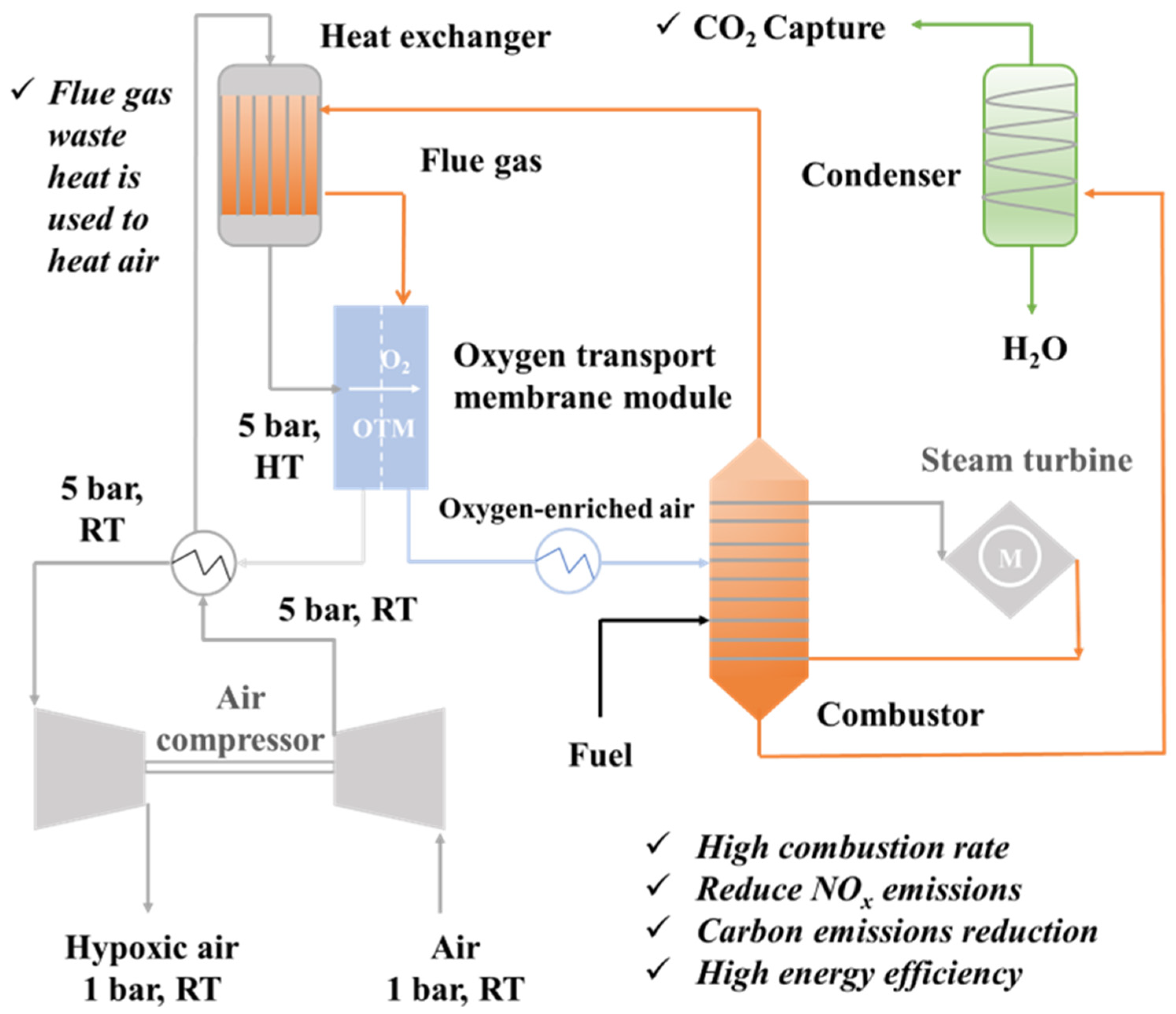
Under oxygen-enriched combustion conditions, the harsh environment characterized by high temperatures, low oxygen partial pressure, flue gas corrosion, and long-term continuous operation places extremely high demands on oxygen-permeable membranes made of mixed conductors [110]. A rational membrane structure and fabrication process are the key to ensuring their successful engineering applications, as shown in Figure 8. The microscopic and macroscopic structures of the membrane directly determine its oxygen permeability and operational stability. A dense, defect-free matrix structure prevents gas leakage and ensures selective oxygen permeation. Controlling grain size, grain boundary structure, and pore distribution can optimize oxygen vacancy concentration and ion diffusion pathways, reduce oxygen transport resistance, and enhance oxygen permeability flux under oxygen-enriched conditions. Additionally, configurations such as gradient structures, support-dense composite membranes, and hollow fibers can balance mechanical strength with permeation area, mitigate issues related to thermal expansion mismatch and thermal stress cracking at high temperatures, and adapt to the long-term high-temperature operating environment of combustion systems.

6. Conclusions

Mixed ionic–electronic conducting (MIEC) oxygen transport membranes (OTMs) have become a core technology for efficient oxygen separation in the context of global carbon neutrality and energy transition, effectively compensating for the shortcomings of traditional oxygen production methods. This review systematically summarizes the oxygen transport mechanism, material system, structural design and preparation progress of MIEC OTMs. The oxygen permeation process is co-dominated by surface exchange reaction and bulk diffusion, and the rate-determining step is closely related to the characteristic thickness, which provides a theoretical basis for performance regulation. Single-phase materials represented by fluorite, perovskite and K2NiF4 types have achieved high oxygen flux through doping modification, but their stability in CO2-containing atmosphere is insufficient. Dual-phase composite membranes composed of ionic conductive phase and electronic conductive phase significantly improve chemical stability while maintaining permeability, becoming the mainstream development direction. In terms of structure, hollow fiber and asymmetric sandwich structure balance permeability and mechanical strength, and surface modification further optimizes transport kinetics. At present, the industrialization of OTMs is still restricted by the trade-off effect between permeability and stability, high operating temperature and scaling preparation.
The primary challenges currently hindering the large-scale commercialization of OTM include the difficulty of forming large, dense membranes; the susceptibility of sealing structures to failure under high-temperature and high-pressure conditions, resulting in high costs for maintaining airtightness; and the high cost of rare earth and precious metal-based raw materials, coupled with the high energy consumption of the sintering process, which makes the overall operating costs uncompetitive in the market. Future research should focus on multi-component co-doping, multi-scale structure design and integrated application with CCUS and hydrogen production systems, so as to promote the practical application of high-performance and high-stability MIEC oxygen permeable membranes.

Author Contributions

Writing—original draft, J.L.; conceptualization, Q.S.; project administration, supervision, H.C. All authors have read and agreed to the published version of the manuscript.

Funding

This work is supported by the National Natural Science Foundation of China (52574471, 52404423, 52334009), the Open Research Fund of Songshan Lake Materials Laboratory (2023SLABFK12), and the Science and Technology Commission of Shanghai municipality (23ZR1421600).

Institutional Review Board Statement

Not applicable.

Data Availability Statement

No new data were created or analyzed in this study. Data sharing is not applicable to this article.

Conflicts of Interest

The authors declare no conflicts of interest.

References

  1. Liu, Y.; Ma, J.; Shen, G.; Sun, Q.; Liu, B.; Duan, T.; Su, F.; Lu, X.; Cheng, H. Thermochemical and Mechanical Properties of Ce0.9Pr0.1O2−δ-Pr0.6Sr0.4Fe0.9Al0.1O3−δ Dual-Phase Membrane. J. Eur. Ceram. Soc. 2024, 44, 6540–6547. [Google Scholar] [CrossRef]
  2. Qiao, W.; Shen, G.; Ma, J.; Chang, L.; Liu, Y.; Lu, X.; Cheng, H. A Co-Doped Strategy for Simultaneously Improving Oxygen Permeability and Stability of BaCoO3−δ Ceramic Membrane. J. Membr. Sci. 2024, 705, 122917. [Google Scholar] [CrossRef]
  3. He, G.; Lan, Q.; Sohn, Y.J.; Baumann, S.; Dunin-Borkowski, R.; Meulenberg, W.A.; Jiang, H. Temperature-Induced Structural Reorganization of W-Doped Ba0.5Sr0.5Co0.8Fe0.2O3−δ Composite Membranes for Air Separation. Chem. Mater. 2019, 31, 7487–7492. [Google Scholar] [CrossRef]
  4. Li, J.; Yang, Q.; Liu, J.; Sun, Q.; Cheng, H. Recent Advances in Thermochemical Water Splitting for Hydrogen Production Using Mixed Ionic-Electronic Conducting Membrane Reactors. Membranes 2025, 15, 203. [Google Scholar] [CrossRef]
  5. Cai, H.; Xia, C.; Wang, X.; Dong, W.; Xiao, H.; Zheng, D.; Wang, H.; Wang, B. Diverse Functions of Oxygen Vacancies for Oxygen Ion Conduction. ACS Appl. Energy Mater. 2022, 5, 11122–11132. [Google Scholar] [CrossRef]
  6. Gu, Z.; Niu, Y.; Fu, L.; Zhou, W.; Liu, Z.; Zhang, G.; Jin, W. Progress in Dense Ceramic Catalytic Membrane Reactors for CO2 Conversion. J. CO2 Util. 2026, 105, 103344. [Google Scholar] [CrossRef]
  7. Zhu, X.; Yang, W. Microstructural and Interfacial Designs of Oxygen-Permeable Membranes for Oxygen Separation and Reaction–Separation Coupling. Adv. Mater. 2019, 31, 1902547. [Google Scholar] [CrossRef] [PubMed]
  8. Li, J.; Bi, S.; Yang, Q.; Sun, Q.; Lu, X.; Cheng, H. In Situ Preparation of Cu Particles Using Segregation Strategy on Membrane Surface for Efficient and Stable CO2 Reduction. J. Membr. Sci. 2026, 749, 125454. [Google Scholar] [CrossRef]
  9. Sikder, B.; Chanda, A. Mechanical Characterization of BSCF, a Prospective Perovskite Material for Oxygen Separation Membrane: A Brief Review. Adv. Eng. Mater. 2016, 18, 1529–1536. [Google Scholar] [CrossRef]
  10. Zhou, X.; Xu, J.; Liang, W.; Gul, S.; He, G.; Jiang, H. A Ceria-Protected Three-Layered Oxygen Transport Membrane for Stable and Efficient Membrane Reactors. Chem. Eng. J. 2025, 515, 163358. [Google Scholar] [CrossRef]
  11. Stournari, V.; ten Donkelaar, S.F.P.; Malzbender, J.; Beck, T.; Singheiser, L.; Bouwmeester, H.J.M. Creep Behavior of Perovskite-Type Oxides Ba0.5Sr0.5(Co0.8Fe0.2)1−xZrxO3−δ. J. Eur. Ceram. Soc. 2015, 35, 1841–1846. [Google Scholar] [CrossRef]
  12. Wang, X.; Rabottini, E.; Gannon, M.; Strub, W.; Menon, N. Electrically Heated Miec Hollow Fiber Membranes for Compact Oxygen Generation. J. Membr. Sci. 2026, 753, 125631. [Google Scholar] [CrossRef]
  13. Khajryan, K.; Hoffmann, R.; Storch, T.; Grab, T.; Kircheisen, R.; Ravkina, O.; Kriegel, R.; Fieback, T. Oxygen Production Using Monolithic Ba0.5Sr0.5Co0.8Fe0.2O3−δ Membranes and Steam as Sweep Gas. J. Membr. Sci. 2026, 740, 124939. [Google Scholar] [CrossRef]
  14. Petkovic, L.M.; Utgikar, V.; Rashkeev, S.N. Structural Stability and Catalytic Activity of Lanthanum-Based Perovskites. J. Phys. Chem. 2011, 115, 8709–8715. [Google Scholar] [CrossRef]
  15. Chen, G.; Feldhoff, A.; Weidenkaff, A.; Li, C.; Liu, S.; Zhu, X.; Sunarso, J.; Huang, K.; Wu, X.-Y.; Ghoniem, A.F.; et al. Roadmap for Sustainable Mixed Ionic-Electronic Conducting Membranes. Adv. Funct. Mater. 2022, 32, 2105702. [Google Scholar] [CrossRef]
  16. Sunarso, J.; Baumann, S.; Serra, J.M.; Meulenberg, W.A.; Liu, S.; Lin, Y.S.; Diniz da Costa, J.C. Mixed Ionic–Electronic Conducting (MIEC) Ceramic-Based Membranes for Oxygen Separation. J. Membr. Sci. 2008, 320, 13–41. [Google Scholar] [CrossRef]
  17. Liu, Y.; Qiao, W.; Wu, N.; Sun, Q.; Duan, T.; Su, F.; Lu, X.; Cheng, H. Surface Modification of Dual-Phase Ceramic Membrane Reactor for Coupling Catalytic CO2 Conversion with Partial Oxidation of Methane. J. Membr. Sci. 2024, 692, 122312. [Google Scholar] [CrossRef]
  18. Wei, Y.; Yang, W.; Caro, J.; Wang, H. Dense Ceramic Oxygen Permeable Membranes and Catalytic Membrane Reactors. Chem. Eng. J. 2013, 220, 185–203. [Google Scholar] [CrossRef]
  19. Fontaine, M.L.; Norby, T.; Larring, Y.; Grande, T.; Bredesen, R. Oxygen and Hydrogen Separation Membranes Based on Dense Ceramic Conductors. Membr. Sci. Technol. 2008, 13, 401–458. [Google Scholar]
  20. Cheng, H.; Wang, P.; Zhao, H.; Li, K.; Lu, X.; Xu, Q. Synthesis, CO2-Tolerance and Rate-Determining Step of Nb-Doped Ce0.8Gd0.2O2−δ–Pr0.6Sr0.4Co0.5Fe0.5O3−δ Ceramic Membranes. Ceram. Int. 2017, 43, 6477–6486. [Google Scholar] [CrossRef]
  21. Li, C.; Li, W.; Chew, J.J.; Liu, S.; Zhu, X.; Sunarso, J. Rate Determining Step in SDC-SSAF Dual-Phase Oxygen Permeation Membrane. J. Membr. Sci. 2019, 573, 628–638. [Google Scholar] [CrossRef]
  22. Geffroy, P.M.; Reichmann, M.; Kilmann, L.; Jouin, J.; Richet, N.; Chartier, T. Identification of the Rate-Determining Step in Oxygen Transport through La(1−x)SrxFe(1−y)GayO3−δ Perovskite Membranes. J. Membr. Sci. 2015, 476, 340–347. [Google Scholar] [CrossRef]
  23. Bouwmeester, H.J.M.; Kruidhof, H.; Burggraaf, A.J. Importance of the Surface Exchange Kinetics as Rate Limiting Step in Oxygen Permeation through Mixed-Conducting Oxides. Solid State Ion. 1994, 72, 185–194. [Google Scholar] [CrossRef]
  24. Wang, Z.; Liu, W.; Wu, Y.; Sun, W.; Liu, W.; Wang, C. A Novel Cobalt-Free CO2-Stable Perovskite-Type Oxygen Permeable Membrane. J. Membr. Sci. 2019, 573, 504–510. [Google Scholar] [CrossRef]
  25. Li, C.; Chew, J.J.; Mahmoud, A.; Liu, S.; Sunarso, J. Modelling of Oxygen Transport through Mixed Ionic-Electronic Conducting (MIEC) Ceramic-Based Membranes: An Overview. J. Membr. Sci. 2018, 567, 228–260. [Google Scholar] [CrossRef]
  26. Zhang, J.; Song, J.; Long, Y.; Kong, F.; Wang, L.; Zhang, Y.; Li, Q.; Wang, Y.; Hui, Y. Seasonal Variability of Hyporheic Water Exchange of the Weihe River in Shaanxi Province, China. Ecol. Indic. 2018, 92, 278–287. [Google Scholar] [CrossRef]
  27. Park, H.J.; Choi, G.M. Oxygen Permeation Characteristics of Zirconia with Surface Modification. Solid State Ion. 2006, 177, 2261–2267. [Google Scholar] [CrossRef]
  28. Ishihara, T.; Yamada, T.; Arikawa, H.; Nishiguchi, H.; Takita, Y. Mixed Electronic–Oxide Ionic Conductivity and Oxygen Permeating Property of Fe-, Co- or Ni-Doped LaGaO3 Perovskite Oxide. Solid State Ion. 2000, 135, 631–636. [Google Scholar] [CrossRef]
  29. Gellings, P.J.; Bouwmeester, H.J.M. Ion and Mixed Conducting Oxides as Catalysts. Catal. Today 1992, 12, 1–101. [Google Scholar] [CrossRef]
  30. Bouwmeester, H.J.M.; Kruidhof, H.; Burggraaf, A.J.; Gellings, P.J. Oxygen Semipermeability of Erbia-Stabilized Bismuth Oxide. Solid State Ion. 1992, 53–56, 460–468. [Google Scholar] [CrossRef]
  31. Xu, S.J.; Thomson, W.J. Oxygen Permeation Rates through Ion-Conducting Perovskite Membranes. Chem. Eng. Sci. 1999, 54, 3839–3850. [Google Scholar] [CrossRef]
  32. Li, S.; Jin, W.; Xu, N.; Shi, J. Synthesis and Oxygen Permeation Properties of La0.2Sr0.8Co0.2Fe0.8O3−δ Membranes. Solid State Ion. 1999, 124, 161–170. [Google Scholar] [CrossRef]
  33. Tan, X.; Li, K. Modeling of Air Separation in a LSCF Hollow-Fiber Membrane Module. AIChE J. 2002, 48, 1469–1477. [Google Scholar] [CrossRef]
  34. Ghadimi, A.; Alaee, M.A.; Behrouzifar, A.; Asadi, A.A.; Mohammadi, T. Oxygen Permeation of BaxSr1−xCo0.8Fe0.2O3−δ Perovskite-Type Membrane: Experimental and Modeling. Desalination 2011, 270, 64–75. [Google Scholar] [CrossRef]
  35. Kim, S.; Yang, Y.L.; Jacobson, A.J.; Abeles, B. Oxygen Surface Exchange in Mixed Ionic Electronic Conductor Membranes. Solid State Ion. 1999, 121, 31–36. [Google Scholar] [CrossRef]
  36. Zhu, X.; Liu, H.; Cong, Y.; Yang, W. Permeation Model and Experimental Investigation of Mixed Conducting Membranes. AIChE J. 2012, 58, 1744–1754. [Google Scholar] [CrossRef]
  37. Van Hassel, B.A. Oxygen Transfer across Composite Oxygen Transport Membranes. Solid State Ion. 2004, 174, 253–260. [Google Scholar] [CrossRef]
  38. Dimitrakopoulos, G.; Ghoniem, A.F. A Two-Step Surface Exchange Mechanism and Detailed Defect Transport to Model Oxygen Permeation through the La0.9Ca0.1FeO3−δ mixed-Conductor. J. Membr. Sci. 2016, 510, 209–219. [Google Scholar] [CrossRef]
  39. Shlyakhtina, A.V.; Lyskov, N.V.; Šalkus, T.; Kežionis, A.; Patrakeev, M.V.; Leonidov, I.A.; Shcherbakova, L.G.; Chernyak, S.A.; Shefer, K.I.; Sadovskaya, E.M.; et al. Conductivity and Oxygen Diffusion in Bixbyites and Fluorites Ln6−xMoO12−δ (Ln = Er, Tm; X = 0, 0.5). Int. J. Hydrogen Energy 2021, 46, 16965–16976. [Google Scholar] [CrossRef]
  40. Guan, X.; Zhou, H.; Liu, Z.; Wang, Y.; Zhang, J. High Performance Gd3+ and Y3+ Co-Doped Ceria-Based Electrolytes for Intermediate Temperature Solid Oxide Fuel Cells. Mater. Res. Bull. 2008, 43, 1046–1054. [Google Scholar] [CrossRef]
  41. Tuller, H.L.; Nowick, A.S. Doped Ceria as a Solid Oxide Electrolyte. J. Electrochem. Soc. 1975, 122, 255. [Google Scholar] [CrossRef]
  42. Lima, C.G.M.; Santos, T.H.; Grilo, J.P.F.; Dutra, R.P.S.; Nascimento, R.M.; Rajesh, S.; Fonseca, F.C.; Macedo, D.A. Synthesis and Properties of CuO-Doped Ce0.9Gd0.1O2−δ Electrolytes for SOFCs. Ceram. Int. 2015, 41, 4161–4168. [Google Scholar] [CrossRef]
  43. Banerjee, S.; Devi, P.S.; Topwal, D.; Mandal, S.; Menon, K. Enhanced Ionic Conductivity in Ce0.8sm0.2o1.9: Unique Effect of Calcium Co-Doping. Adv. Funct. Mater. 2007, 17, 2847–2854. [Google Scholar] [CrossRef]
  44. Wang, Z.; Ye, Z.; Zhang, Y.; Li, C.; Zeng, Y. Fluorite-Doped Gd0.1Ce0.9O1.95 Polycrystalline Electrolytes with Extraordinarily Enhanced Oxide Ionic Conductivities Controlled by Depletion Degree of Oxygen Vacancies at Grain Boundaries. J. Power Sources 2020, 480, 229118. [Google Scholar] [CrossRef]
  45. Zhang, Z.; Chen, D.; Dong, F.; Shao, Z. Efficient and CO2-Tolerant Oxygen Transport Membranes Prepared from High-Valence B-Site Substituted Cobalt-Free SrFeO3−δ. J. Membr. Sci. 2015, 495, 187–197. [Google Scholar] [CrossRef]
  46. Liu, Y.; Duan, T.; Wu, N.; Qiao, W.; Nie, W.; Sun, Q.; Cheng, H. Simultaneously Enhanced Permeability and Stability in Al Doped Pr0.6Sr0.4FeO3−δ Oxygen Transport Membrane for CO2 Capture. J. Membr. Sci. 2023, 668, 121278. [Google Scholar] [CrossRef]
  47. Guo, S.; Zhu, J.; Liu, Z.; Jiang, X.; Zhang, Z.; Jin, W. Enhanced High Oxygen Permeation of Mixed-Conducting Multichannel Hollow Fiber Membrane Via Surface Modified Porous Layer. Ind. Eng. Chem. Res. 2015, 54, 6985–6992. [Google Scholar] [CrossRef]
  48. Cheng, H.; Liu, J.; Lu, X.; Ding, W. Enhancing the Oxygen Permeability of BaCo0.7Fe0.2Nb0.1O3−δ Membranes by Coating GdBaCo2−xFexO5+δ for Partial Oxidation of Coke Oven Gas to Syngas. ACS Appl. Mater. Interfaces 2011, 3, 4032–4039. [Google Scholar] [CrossRef] [PubMed]
  49. Li, H.; Li, Y.; Chen, T.; Xiao, H.; Chen, X. Efficient Pure Oxygen Separation with the Unique Graded Porous Supported Symmetric Flat Mixed Conductor Ceramic Membrane. J. Membr. Sci. 2024, 702, 122805. [Google Scholar] [CrossRef]
  50. Han, N.; Zhang, S.; Meng, X.; Yang, N.; Meng, B.; Tan, X.; Liu, S. Effect of Enhanced Oxygen Reduction Activity on Oxygen Permeation of La0.6Sr0.4Co0.2Fe0.8O3−δ Membrane Decorated by K2NiF4-Type Oxide. J. Alloys Compd. 2016, 654, 280–289. [Google Scholar] [CrossRef]
  51. Kahlaoui, M.; Inoubli, A.; Chefi, S.; Mezni, A.; Kouki, A.; Madani, A.; Chefi, C. Structural, Chemical, and Electrochemical Properties of Co-Doped Fluorite Oxides Ce0.8La0.2−XTlxO2−δ as Electrolyte Materials for Solid Oxide Fuel Cells. Int. J. Hydrogen Energy 2016, 41, 4751–4764. [Google Scholar] [CrossRef]
  52. Bragina, O.A.; Nemudry, A.P. Influence of Mo-Doping on Structure and Oxygen Permeation Properties of SrCo0.8−xFe0.2MoxO3−δ Perovskite Membranes for Oxygen Separation. J. Membr. Sci. 2017, 539, 313–319. [Google Scholar] [CrossRef]
  53. Zhang, X.; Motuzas, J.; Liu, S.; Diniz da Costa, J.C. Zinc-Doped BSCF Perovskite Membranes for Oxygen Separation. Sep. Purif. Technol. 2017, 189, 399–404. [Google Scholar] [CrossRef]
  54. Wang, Z.; Ashok, J.; Pu, Z.; Kawi, S. Low Temperature Partial Oxidation of Methane Via BaBi0.05Co0.8Nb0.15O3−δ-Ni Phyllosilicate Catalytic Hollow Fiber Membrane Reactor. Chem. Eng. J. 2017, 315, 315–323. [Google Scholar] [CrossRef]
  55. Xue, J.; Li, J.; Zhuang, L.; Chen, L.; Feldhoff, A.; Wang, H. Anion Doping CO2-Stable Oxygen Permeable Membranes for Syngas Production. Chem. Eng. J. 2018, 347, 84–90. [Google Scholar] [CrossRef]
  56. Zhang, Z.; Xu, X.; Zhang, J.; Chen, D.; Zeng, D.; Liu, S.; Zhou, W.; Shao, Z. Silver-Doped Strontium Niobium Cobaltite as a New Perovskite-Type Ceramic Membrane for Oxygen Separation. J. Membr. Sci. 2018, 563, 617–624. [Google Scholar] [CrossRef]
  57. Zhang, J.; Zhang, Z.; Chen, Y.; Xu, X.; Zhou, C.; Yang, G.; Zhou, W.; Shao, Z. Materials Design for Ceramic Oxygen Permeation Membranes: Single Perovskite Vs. Single/Double Perovskite Composite, a Case Study of Tungsten-Doped Barium Strontium Cobalt Ferrite. J. Membr. Sci. 2018, 566, 278–287. [Google Scholar] [CrossRef]
  58. Li, K.; Zhao, H.; Lu, Y.; Ma, Y.; Du, Z.; Zhang, Z. High CO2 Tolerance Oxygen Permeation Membranes BaFe0.95−xCa0.05TixO3−δ. J. Membr. Sci. 2018, 550, 302–312. [Google Scholar] [CrossRef]
  59. Wang, Z.; Dewangan, N.; Das, S.; Wai, M.H.; Kawi, S. High Oxygen Permeable and CO2-Tolerant SrCoxFe0.9−xNb0.1O3−δ (X = 0.1–0.8) Perovskite Membranes: Behavior and Mechanism. Sep. Purif. Technol. 2018, 201, 30–40. [Google Scholar] [CrossRef]
  60. Chen, G.; Liu, W.; Widenmeyer, M.; Ying, P.; Dou, M.; Xie, W.; Bubeck, C.; Wang, L.; Fyta, M.; Feldhoff, A.; et al. High Flux and CO2-Resistance of La0.6Ca0.4Co1–xFexO3−δ Oxygen-Transporting Membranes. J. Membr. Sci. 2019, 590, 117082. [Google Scholar] [CrossRef]
  61. Chae, J.W.; Park, Y.K.; Magnone, E.; Park, J.H. Oxygen Permeation Properties of Sm/Sr Co-Doped Ceria Decorated Ba0.5Sr0.5Co0.8Fe0.2O3−δ Hollow Fiber Membrane. J. Ind. Eng. Chem. 2019, 76, 508–514. [Google Scholar] [CrossRef]
  62. Qiu, K.; Liu, Y.; Tan, J.; Wang, T.; Zhang, G.; Liu, Z.; Jin, W. Fluorine-Doped Barium Cobaltite Perovskite Membrane for Oxygen Separation and Syngas Production. Ceram. Int. 2020, 46, 27469–27475. [Google Scholar] [CrossRef]
  63. Widenmeyer, M.; Wiegers, K.-S.; Chen, G.; Yoon, S.; Feldhoff, A.; Weidenkaff, A. Engineering of Oxygen Pathways for Better Oxygen Permeability in Cr-Substituted Ba2In2O5 Membranes. J. Membr. Sci. 2020, 595, 117558. [Google Scholar] [CrossRef]
  64. Zhuang, S.; Han, N.; Chen, R.; Yao, Z.; Zou, Q.; Song, F. Perovskite Oxide Based Composite Hollow Fiber Membrane for CO2 Transport. J. Membr. Sci. 2020, 46, 2538–2544. [Google Scholar] [CrossRef]
  65. Zhu, Y.; Wang, J.; Rykov, A.I.; Zhu, X.; Yang, W. Oxygen Transport Kinetics Affected by Grain Size—A Permeation Model Study. J. Membr. Sci. 2020, 603, 118038. [Google Scholar] [CrossRef]
  66. Han, N.; Zhang, W.; Guo, W.; Xie, S.; Zhang, C.; Zhang, X.; Fransaer, J.; Liu, S. Novel Oxygen Permeable Hollow Fiber Perovskite Membrane with Surface Wrinkles. Sep. Purif. Technol. 2021, 261, 118295. [Google Scholar] [CrossRef]
  67. Zhang, S.; Wang, S.; Jin, Y.; Song, J.; Meng, X.; Meng, B.; Yang, N.; Tan, X.; Zhu, Z.; Liu, S. One Stone Two Birds: Simultaneous Realization of Partial Oxidation of Methane to Syngas and N2 Purification Via Robust Ceramic Oxygen-Permeable Membrane Reactors. Chem. Eng. J. 2021, 419, 129462. [Google Scholar] [CrossRef]
  68. Li, J.; Lei, S.; Deng, B.; Xue, J.; Wang, Y.; Wang, H. Reducing Anisotropic Effects on Oxygen Separation Performance of K2NiF4-Type Membranes by Adjusting Grain Size. J. Membr. Sci. 2021, 618, 118628. [Google Scholar] [CrossRef]
  69. Liu, Y.; Cheng, H.; Sun, Q.; Xu, X.; Chen, S.; Xu, Q.; Lu, X. Phase Transition and Oxygen Permeability of Pr0.6Sr0.4FeO3−δ Ceramic Membrane at High Temperature. J. Eur. Ceram. Soc. 2021, 41, 1975–1983. [Google Scholar] [CrossRef]
  70. Sun, Z.; Liu, Z.; Cai, C.; Deng, H.; Yang, F.; Lu, Y.; Song, X.; An, S.; Zhao, H. High Performance Oxygen Permeation Membrane: Sr and Ti Co-Doped BaFeO3−δ Ceramics. Sep. Purif. Technol. 2022, 289, 120742. [Google Scholar] [CrossRef]
  71. Zhang, G.; Zheng, G.; Bao, X.; Huang, Z.; Chen, T.; Wang, S. Oxygen Permeation Properties of Bi-Doped La0.8Sr0.2FeO3−δ Planar Ceramic Membranes at Intermediate Temperature. Sep. Purif. Technol. 2022, 302, 121980. [Google Scholar] [CrossRef]
  72. Pei, Y.; Liu, Q.; Chen, Y.; Tian, Y.; Li, Y.; Pang, R.; Li, F.; Li, Q. Effects of a-Site Potassium Doping on Oxygen Permeability and Intermediate-Low Temperature Stability of Ba0.5Sr0.5Co0.8Fe0.2O3−δ Membranes. J. Eur. Ceram. Soc. 2024, 44, 1654–1664. [Google Scholar] [CrossRef]
  73. Zhu, Y.; Liu, J.; Liu, Z.; Liu, G.; Jin, W. Design of CO2-Resistant High-Entropy Perovskites Based on Ba0.5Sr0.5Co0.8Fe0.2O3−δ Materials. Materials 2024, 17, 4672. [Google Scholar] [CrossRef]
  74. Zhu, Y.; Chen, M.; Wu, M.; Zhang, G.; Liu, Z.; Liu, G.; Jin, W. The Stability of a-Site Lanthanide High-Entropy Perovskite Materials in a Humid CO2 Atmosphere. Chem. Eng. J. 2025, 522, 167296. [Google Scholar] [CrossRef]
  75. Wei, R.; Zhang, Z.; Wen, Z.; Wang, Y.; Yang, C.; Zhong, Q.; Zhang, J.; Tan, S. Realizing Efficient and Robust Oxygen Permeation over Strontium Ironstone through Hafnium Regulating Strategy. J. Membr. Sci. 2025, 719, 123694. [Google Scholar] [CrossRef]
  76. Xiang, Z.; Chen, R.; Wang, S.; Qin, J.; Zhang, W.; Li, Y.; Zeng, L.; Luo, H. Oxygen Permeability and Stability in the Entropy-Stabilized Co-Based Perovskite Oxygen Permeable Membranes. J. Membr. Sci. 2026, 739, 124936. [Google Scholar] [CrossRef]
  77. Liu, S.; Gavalas, G.R. Oxygen Selective Ceramic Hollow Fiber Membranes. J. Membr. Sci. 2005, 246, 103–108. [Google Scholar] [CrossRef]
  78. Chen, G.; Zhao, Z.; Widenmeyer, M.; Frömling, T.; Hellmann, T.; Yan, R.; Qu, F.; Homm, G.; Hofmann, J.P.; Feldhoff, A.; et al. A Comprehensive Comparative Study of Co2-Resistance and Oxygen Permeability of 60 wt % Ce0.8M0.2O2–δ (M = La, Pr, Nd, Sm, Gd)—40 wt % La0.5Sr0.5Fe0.8Cu0.2O3–δ Dual-Phase Membranes. J. Membr. Sci. 2021, 639, 119783. [Google Scholar] [CrossRef]
  79. Zhang, C.; Xiang, Z.; Zeng, L.; Yu, P.; Li, K.; Wang, K.; Li, L.; Chen, R.; Luo, H. Effects of Lanthanides on the Structure and Oxygen Permeability of Ti-Doped Dual-Phase Membranes. J. Membr. Sci. 2025, 715, 123446. [Google Scholar] [CrossRef]
  80. Cheng, H.; Xiong, X.; Zhao, H.; Gu, Z.; Lu, X.; Xu, Q.; Yao, W. Effects of B-Site Doped Elements in the Electronic-Conducting Perovskite Phase on the Property of Dual-Phase Membranes. Int. J. Appl. Ceram. Technol. 2017, 14, 611–622. [Google Scholar] [CrossRef]
  81. Zhang, C.; Zhu, Y.; Wang, X.; Huang, Y.; Zeng, L.; Li, K.; Yu, P.; Wang, K.; Li, L.; Xiang, Z.; et al. Excellent and CO2-Resistant Permeability of Ce0.85Nd0.1Cu0.05O2−δ-NdxSr1−xFe1−yCuyO3−δ Dual-Phase Oxygen Transport Membranes. J. Membr. Sci. 2024, 696, 122485. [Google Scholar] [CrossRef]
  82. Fang, W.; Liang, F.; Cao, Z.; Steinbach, F.; Feldhoff, A. A Mixed Ionic and Electronic Conducting Dual-Phase Membrane with High Oxygen Permeability. Angew. Chem. Int. Ed. 2015, 54, 4847–4850. [Google Scholar] [CrossRef]
  83. Joo, J.H.; Yun, K.S.; Kim, J.-H.; Lee, Y.; Yoo, C.-Y.; Yu, J.H. Substantial Oxygen Flux in Dual-Phase Membrane of Ceria and Pure Electronic Conductor by Tailoring the Surface. ACS Appl. Mater. 2015, 7, 14699–14707. [Google Scholar] [CrossRef] [PubMed]
  84. Liu, T.; Chen, Y.; Fang, S.; Lei, L.; Wang, Y.; Ren, C.; Chen, F. A Dual-Phase Bilayer Oxygen Permeable Membrane with Hierarchically Porous Structure Fabricated by Freeze-Drying Tape-Casting Method. J. Membr. Sci. 2016, 520, 354–363. [Google Scholar] [CrossRef]
  85. Kwon, Y.-i.; Na, B.T.; Park, J.H.; Yun, K.S.; Hong, S.K.; Yu, J.H.; Joo, J.H. Guidelines for Selecting Coating Materials for a High Oxygen Permeation Flux in a Fluorite-Rich Dual-Phase Membrane. J. Membr. Sci. 2017, 535, 200–207. [Google Scholar] [CrossRef]
  86. Bi, X.; Meng, X.; Liu, P.; Yang, N.; Zhu, Z.; Ran, R.; Liu, S. A Novel CO2-Resistant Ceramic Dual-Phase Hollow Fiber Membrane for Oxygen Separation. J. Membr. Sci. 2017, 522, 91–99. [Google Scholar] [CrossRef]
  87. He, Y.; Shi, L.; Wu, F.; Xie, W.; Wang, S.; Yan, D.; Liu, P.; Li, M.-R.; Caro, J.; Luo, H. A Novel Dual Phase Membrane 40 wt% Nd0.6Sr0.4CoO3−δ–60 wt% Ce0.9Nd0.1O2−δ: Design, Synthesis and Properties. J. Mater. Chem. A 2018, 6, 84–92. [Google Scholar] [CrossRef]
  88. Wei, Q.; Zhang, S.; Meng, B.; Han, N.; Zhu, Z.; Liu, S. Enhancing O2-Permeability and CO2-Tolerance of La2NiO4+δ Membrane Via Internal Ionic-Path. Mater. Lett. 2018, 230, 161–165. [Google Scholar] [CrossRef]
  89. Shi, L.; Wang, S.; Lu, T.; He, Y.; Yan, D.; Lan, Q.; Xie, Z.; Wang, H.; Boubeche, M.; Luo, H. Effects of Al Content on the Oxygen Permeability through Dual-Phase Membrane 60Ce0.9Pr0.1O2−δ-40Pr0.6Sr0.4Fe1−xAlxO3−δ. Ceram. Int. 2019, 45, 20033–20039. [Google Scholar] [CrossRef]
  90. Du, Z.; Ma, Y.; Zhao, H.; Li, K.; Lu, Y. High CO2-Tolerant and Cobalt-Free Dual-Phase Membranes for Pure Oxygen Separation. J. Membr. Sci. 2019, 574, 243–251. [Google Scholar] [CrossRef]
  91. Zhou, H.; Liang, W.; Liang, F.; Jiang, H. Simultaneous Production of Synthesis Gases H2/N2 and H2/CO in a Dual-Phase Mixed Conducting Membrane Reactor. Catal. Today 2019, 331, 2–6. [Google Scholar] [CrossRef]
  92. Shi, L.; Wang, S.; Lu, T.; He, Y.; Yan, D.; Lan, Q.; Xie, Z.; Wang, H.; Li, M.-R.; Caro, J.; et al. High CO2-Tolerance Oxygen Permeation Dual-Phase Membranes Ce0.9Pr0.1O2−δ-Pr0.6Sr0.4Fe0.8Al0.2O3−δ. J. Alloys Compd. 2019, 806, 500–509. [Google Scholar] [CrossRef]
  93. Wang, S.; Shi, L.; Xie, Z.; He, Y.; Yan, D.; Li, M.-R.; Caro, J.; Luo, H. High-Flux Dual-Phase Percolation Membrane for Oxygen Separation. J. Eur. Ceram. Soc. 2019, 39, 4882–4890. [Google Scholar] [CrossRef]
  94. Huang, S.; Li, W.; Cao, Z.; Li, H.; Ma, H.; Zhu, X.; Yang, W. Effect of Bi Doping on the Performance of Dual-Phase Oxygen-Permeable Membranes. J. Membr. Sci. 2019, 579, 342–350. [Google Scholar] [CrossRef]
  95. Chen, G.; Tang, B.; Widenmeyer, M.; Wang, L.; Feldhoff, A.; Weidenkaff, A. Novel CO2-Tolerant Dual-Phase Ce0.9Pr0.1O2–δ–La0.5Sr0.5Fe0.9Cu0.1O3–δ Membranes with High Oxygen Permeability. J. Membr. Sci. 2020, 595, 117530. [Google Scholar] [CrossRef]
  96. Zhang, G.; Bao, X.; Zeng, F.; Minh, N.Q.; Wang, S. Preparation and Characterization of Ce0.8Sm0.2O1.9–La0.8Sr0.2Cr0.5Fe0.5O3−δ Dual-Phase Membranes for Oxygen Permeation. J. Mater. 2020, 6, 224–231. [Google Scholar] [CrossRef]
  97. Lee, E.; Jeong, H.; Shin, T.H.; Myung, J.-h. Determination of the Rate-Determining Step of the Oxygen Reduction Reaction of La0.8Sr0.2MnO3 (LSM)- 8mol% Yttria-Stabilized Zirconia (YSZ): Composition and Microstructure. Ceram. Int. 2021, 47, 1792–1797. [Google Scholar] [CrossRef]
  98. Li, D.; Wang, X.; Tan, W.; Huang, Y.; Zeng, L.; He, Y.; Yu, P.; Luo, H. Influences of Al Substitution on the Oxygen Permeability through 60 wt%Ce0.9La0.1O2−δ-40 wt%La0.6Sr0.4Co1−xAlxO3−δ Composite Membranes. Sep. Purif. Technol. 2021, 274, 119042. [Google Scholar] [CrossRef]
  99. Zhang, Z.; Ning, K.; Xu, Z.; Zheng, Q.; Tan, J.; Liu, Z.; Wu, Z.; Zhang, G.; Jin, W. Highly Efficient Preparation of Ce0.8Sm0.2O2−δ–SrCo0.9Nb0.1O3−δ Dual-Phase Four-Channel Hollow Fiber Membrane Via One-Step Thermal Processing Approach. J. Membr. Sci. 2021, 620, 118752. [Google Scholar] [CrossRef]
  100. Wang, X.; Huang, Y.; Li, D.; Zeng, L.; He, Y.; Boubeche, M.; Luo, H. High Oxygen Permeation Flux of Cobalt-Free Cu-Based Ceramic Dual-Phase Membranes. J. Membr. Sci. 2021, 633, 119403. [Google Scholar] [CrossRef]
  101. Watenabe, K.; Yuasa, M.; Kida, T.; Teraoka, Y.; Yamazoe, N.; Shimanoe, K. High-Performance Oxygen-Permeable Membranes with an Asymmetric Structure Using Ba0.95La0.05FeO3−δ Perovskite-Type Oxide. Adv. Mater. 2010, 22, 2367–2370. [Google Scholar] [CrossRef]
  102. Huang, Y.; Zhang, C.; Wang, X.; Li, D.; Zeng, L.; He, Y.; Yu, P.; Luo, H. High CO2 Resistance of Indium-Doped Cobalt-Free 60 wt.%Ce0.9Pr0.1O2−δ-40 wt.%Pr0.6Sr0.4Fe1−xInxO3−δ Oxygen Transport Membranes. Ceram. Int. 2022, 48, 415–426. [Google Scholar] [CrossRef]
  103. Huang, Y.; Zhang, C.; Zeng, L.; He, Y.; Yu, P.; Li, K.; Luo, H. Dual-Phase Ga-Containing Ce0.9Pr0.1O2−δ-Pr0.6Sr0.4Fe1−xGaxO3−δ Oxygen Transport Membranes with High CO2 Resistance. J. Membr. Sci. 2023, 668, 121260. [Google Scholar] [CrossRef]
  104. Zhang, C.; Zeng, L.; Yu, P.; Li, K.; Wang, K.; Li, L.; Xiang, Z.; Luo, H. Highly Stable Dual-Phase Ce0.9Pr0.1O2−δ-Pr0.6Sr0.4Fe1−xTixO3−δ Oxygen Transport Membranes. J. Membr. Sci. 2024, 693, 122359. [Google Scholar] [CrossRef]
  105. Yu, Q.; Liang, B.; Jia, S.; Li, F.; Li, Q. Effects of Copper Doping on Microstructural Evolution and Oxygen Permeability of Ce0.8Sm0.2O2−δ-Sm0.6Sr0.4Fe1−xCuxO3−δ Dual-Phase Oxygen Permeable Membranes. Ceram. Int. 2024, 50, 48551–48560. [Google Scholar] [CrossRef]
  106. Zhang, S.; Song, J.; Wang, M.; Zhang, Z.; Meng, X.; Liao, Y.; Xi, X.; Liu, S. Balancing Oxygen Permeability and Stability in Co-Free Dual-Phase Membrane Via Synergistic Cu Doping and B-Site Deficiency Engineering. J. Membr. Sci. 2026, 749, 125471. [Google Scholar] [CrossRef]
  107. Li, S.; Qi, H.; Xu, N.; Shi, J. Tubular Dense Perovskite Type Membranes. Preparation, Sealing, and Oxygen Permeation Properties. Ind. Eng. Chem. Res. 1999, 38, 5028–5033. [Google Scholar] [CrossRef]
  108. Nam, G.D.; Kwon, Y.-i.; Lee, S.W.; Ho Shin, T.; Joo, J.H. LaGaO3-Based Composite Membrane with High Oxygen Permeability. Sep. Purif. Technol. 2023, 318, 123919. [Google Scholar] [CrossRef]
  109. Chen, T.; Zou, P.; Xiao, H.; Chen, X. Highly Efficient and Stable Symmetric Porous Supported Mixed Conductor Ceramic Membranes for Pure Oxygen Production. Sep. Purif. Technol. 2025, 362, 131887. [Google Scholar] [CrossRef]
  110. Liu, X.; Zhang, L.; Sun, Q.; Bi, S.; Lin, M.; Cao, G.; Lu, X.; Cheng, H. Grain Boundary Engineering Enables (002)-Textured Zinc Metal Anodes with Superior Reversibility under Ultra-High Current Density. Energy Environ. Sci. 2026, 19, 1202–1214. [Google Scholar] [CrossRef]
Figure 1. A schematic summary of the main components in this review [4].
Materials 19 02477 g001
Figure 2. (a) Sketch showing oxygen permeation through ionic conductive membranes [6]; (b) Distribution of oxygen chemical potential across the MIEC membrane in the Kim model [6]; (c) Schematic representation of oxygen chemical potential decline across an MIEC membrane for Zhu’s model [6].
Materials 19 02477 g002
Figure 3. Development history of OTMs.
Materials 19 02477 g003
Figure 4. (a) XRD profiles of BSCF powder, BSCF membrane and LSC powder [47]. (b) Oxygen permeation fluxes of uncoated and LSC-coated membranes at various temperatures [47]. (c) XRD patterns of the BCFN membranes [48]. (d) Influence of coating condition and operating temperature on oxygen permeation through 1.0 mm GBCF-modified BCFN membranes [48]. (e) Influence of helium flow rate on oxygen permeation fluxes through 1.0 mm-thick GdBaCo2−xFexO5+δ-modified BCFN membranes [48]. (f) Temperature-dependent mass ratios of SP and DP phases in the BSCFW0.35 composite from Rietveld refinement [3]. (g) X-ray diffraction data recorded for the as-prepared Ba0.5Sr0.5(Co0.8Fe0.2)1−xWxO3−δ that had been calcined at 950 °C for 10 h (The green spheres represent Ba and Sr, the green and yellow diamonds represent Co and Fe, and the black diamonds represent W) [3]. (h) Low-resolution HAADF-STEM micrograph of the BSFCW0.35 sample and HAADF-STEM characterization of the boundary between DP and SP crystallites in the marked zone [3].
Materials 19 02477 g004
Figure 6. (a) Oxygen ion transport mechanisms of pure SnO2, SnO2 with interstitial oxygen and Ce-doped SnO2 [5]. (b) Energy transfer barriers in SnO2 with and without Io, and energy transfer barriers for Ce-doped SnO2 [5]. (c) Ion distribution diagram of the cell in the working state [14]. (d) Relaxed atomic configurations for oxygen vacancies for La0.5Sr0.5Fe0.25Co0.75O3 and Ba0.5Sr0.5Fe0.25Co0.75O3 (The green balls represent the A sites in the perovskite, the blue balls represent the B sites, and the red balls represent oxygen atoms) [14].
Materials 19 02477 g006
Figure 7. (a) SEM micrographs of uncoated and LSC-modified BSCF hollow fiber membranes [47]. (b) Cross-sectional SEM micrographs of the LSM20 membrane with LSC layers. (c) Cross-sectional morphology of the fabricated asymmetric BLF membrane [82]. (d) Schematic illustration of the phase inversion process [47]. (e) Schematic drawing of a dense/porous asymmetric membrane [47]. (f) Structural comparison diagrams of graded porous supported symmetric, hollow fiber, and asymmetric dense membranes.
Materials 19 02477 g007
Figure 8. Schematic diagram illustrating the basic principle of CO2 capture via oxygen-enriched combustion using a mixed ion–electron conductor OTM.
Materials 19 02477 g008
Table 1. The oxygen permeation flux models.
ModelsFormulasClassificationRef.
Wagner J O 2 = 1 16 F 2 L u O 2 u O 2 t i o n t e σ t o t d u o 2 Bulk diffusion models[29]
Bouwmeester J O 2 = 1 1 + ( 2 L C / L ) 1 16 F 2 L P o P o σ e σ i o n σ e + σ i o n d ( ln P O 2 ) Mixed factors limited[30]
Xu-Thomson J O 2 = k r / k f ( P O 2 1 / 2 P O 2 1 / 2 ) ( 1 / k f P O 2 1 / 2 ) + ( 2 L / D v ) + ( 1 / k f P O 2 1 / 2 ) Surface reactions models[31]
Li model J O 2 = A o ( P O 2 P O 2 ) ( 1 / k a ) + ( 2 L / D v ) + ( 1 / k d ) Surface reactions models[32]
Tan and Li J O 2 = k r ( P O 2 1 / 2 P O 2 1 / 2 ) 2 k f ( R o R i n ) P O 2 1 / 2 P O 2 1 / 2 D v + R m P O 2 1 / 2 R i n + R m P O 2 1 / 2 R o Surface reactions models[33]
Ghadimi J O 2 = k r / k f ( [ ( a + b Re c ) P O 2 ] n [ ( a + b Re c ) P O 2 ] n ) ( 1 / k f [ ( a + b Re c ) P O 2 ] n ) + ( 2 L / D v ) + ( 1 / k f [ ( a + b Re c ) P O 2 ] n ) Surface reactions models[34]
Kim model J O 2 = 1 4 C i o n D a L ln P O 2 P O 2 Chemical potential difference[35]
Zhu model J O 2 = Δ μ O 2 t o t 16 F 2 1 r t o t Chemical potential difference[36]
Van Hassel J O 2 = k P O 2 n ( Δ μ R T ) Effective medium approximation[37]
D-G model J O 2 = k r 1 ( ( 3 C v ) F e F e s w e e p 2 K 1 P O 2 0.5 C v F e F e X s w e e p 2 ) 2 Defect chemistry model[38]
Disclaimer/Publisher’s Note: The statements, opinions and data contained in all publications are solely those of the individual author(s) and contributor(s) and not of MDPI and/or the editor(s). MDPI and/or the editor(s) disclaim responsibility for any injury to people or property resulting from any ideas, methods, instructions or products referred to in the content.