


Study of Asymmetric Test Configurations by Means of Standard and Revised Virtual Crack-Closure Techniques

Highlights
- The standard VCCT results fall between the revised VCCT results in ADCB and AENF.
- Contact between the specimen arms can lead to unrealistic negative VCCT values.
- In the revised VCCTs, ERR transfer occurs between modes I and II.
Abstract
1. Introduction
1.1. Standard VCCT
1.2. Revised VCCTs
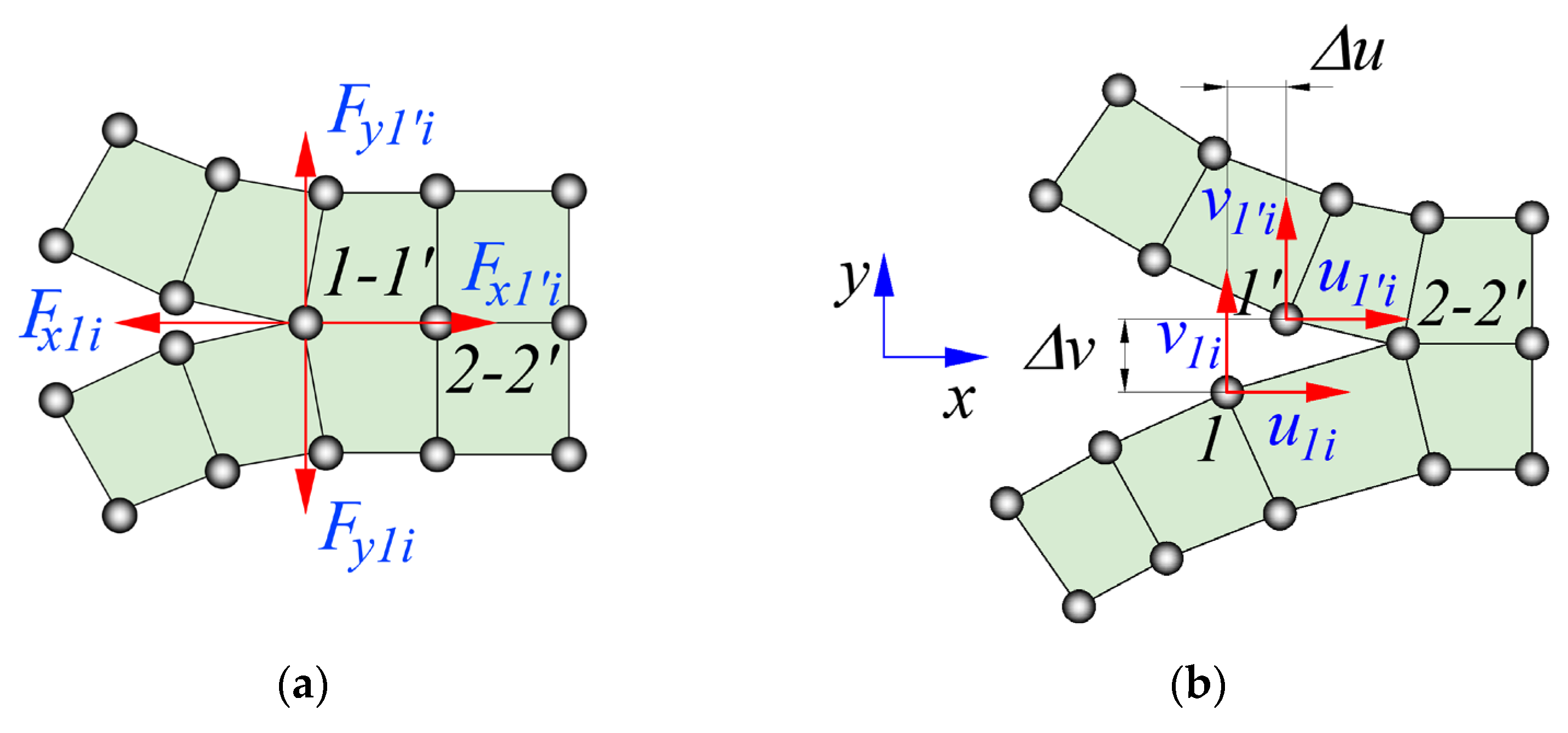
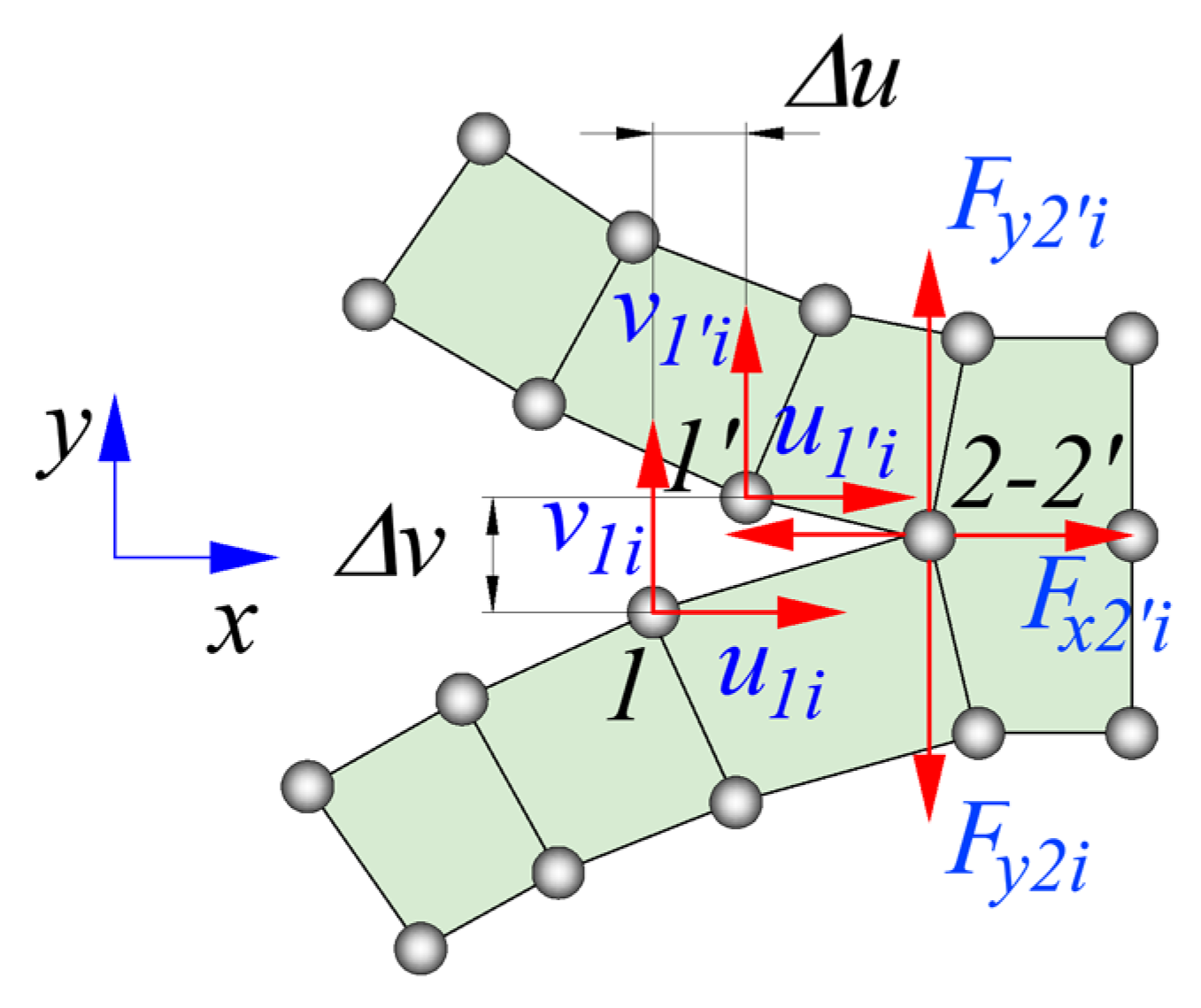
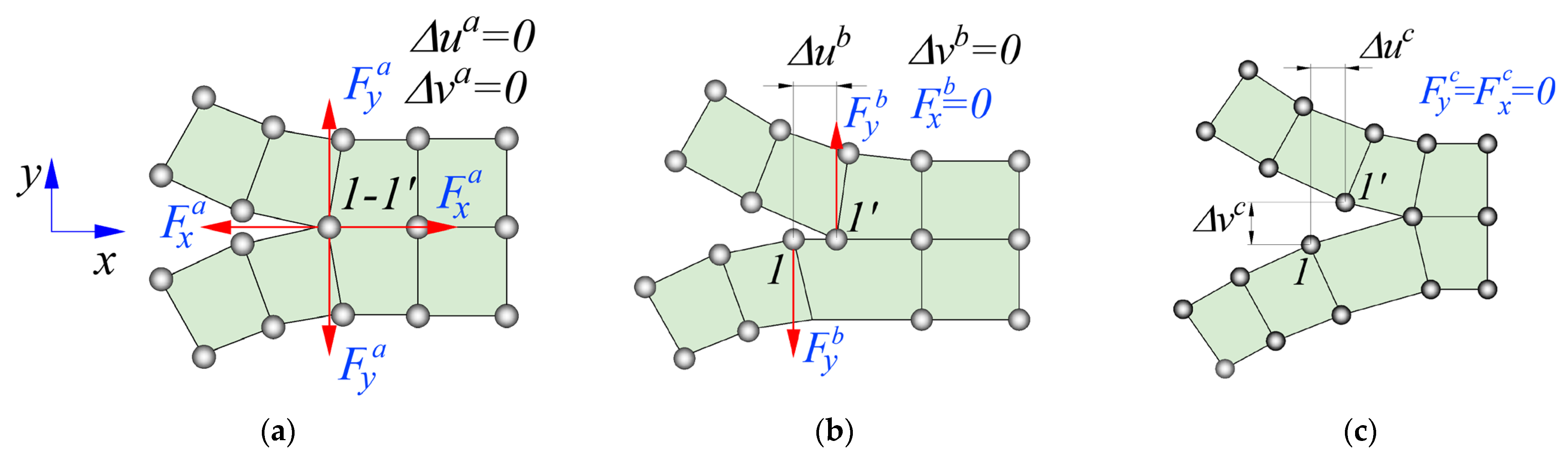
- Pure mode II is obtained when the crack tip opening displacement Δv is zero.
- Pure mode I is obtained when the tangential crack tip force Fx is zero.
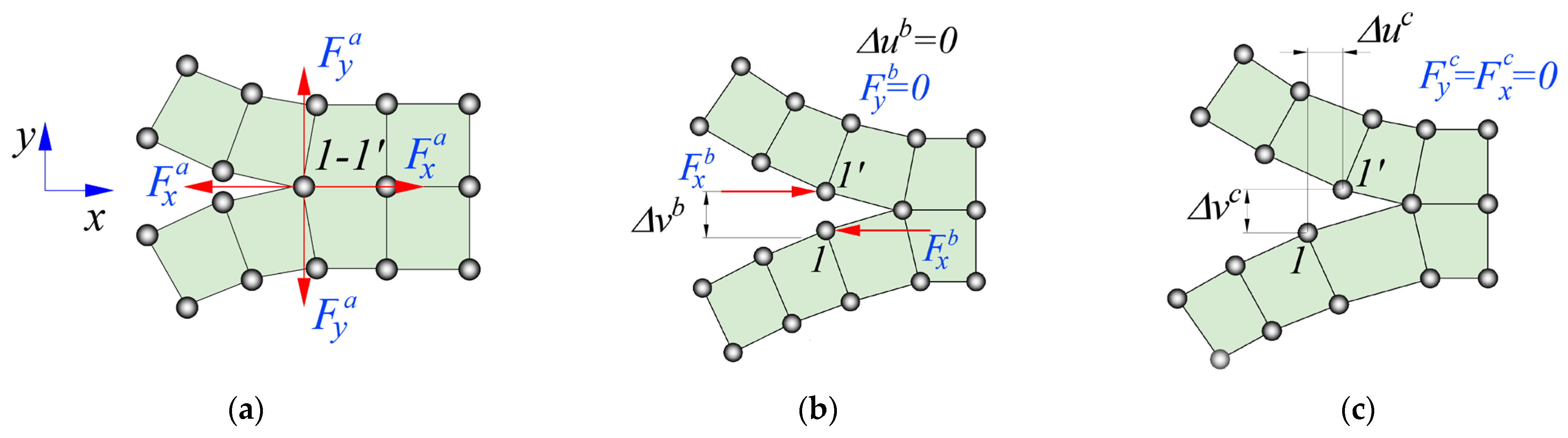
- Pure mode I is obtained when the tangential crack tip displacement Δu is zero.
- Pure mode II is obtained when the crack tip opening force Fy is zero.
2. Materials and Methods
3. Results and Discussion
3.1. ADCB Specimen
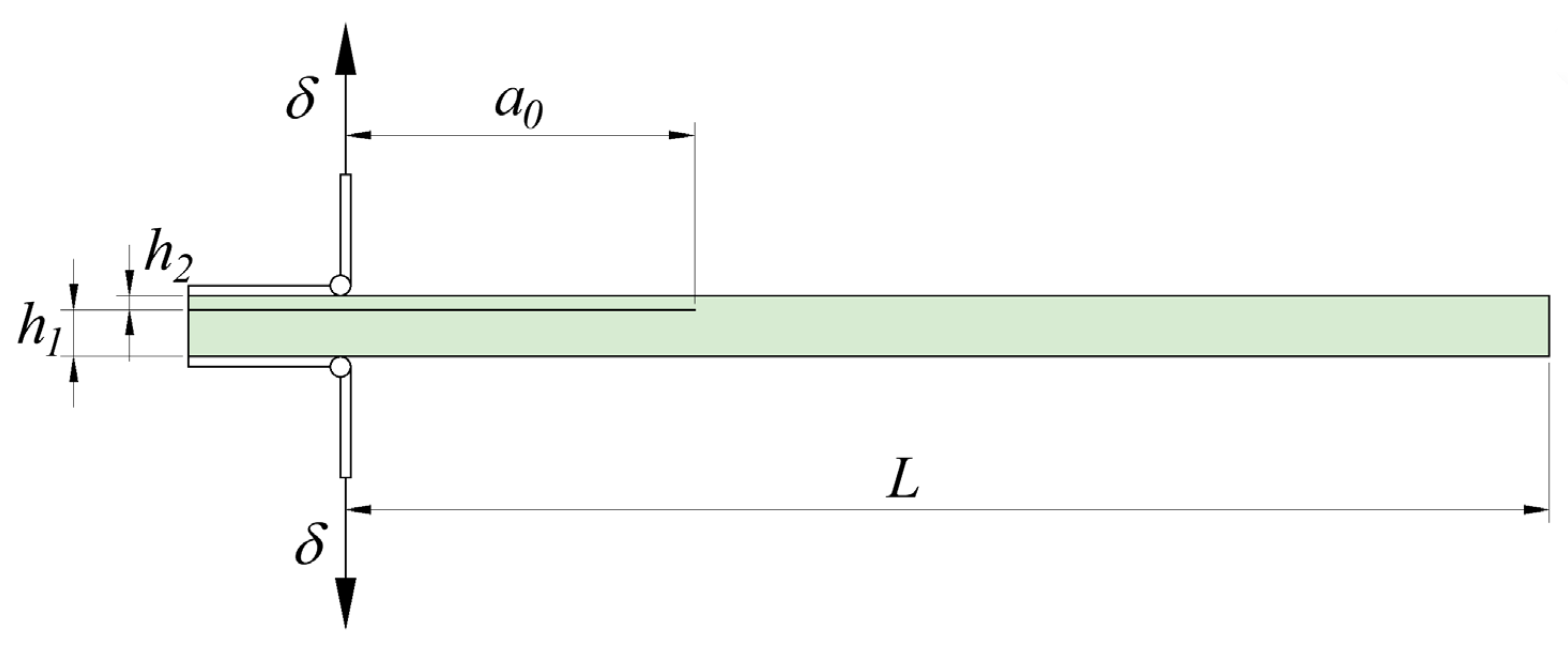
- L = 150 mm;
- a0 = 50 mm;
- h1 = 4 mm;
- h2 = 2 mm.
3.1.1. Standard Two-Step VCCT
3.1.2. Revised I–II VCCT
3.1.3. Revised II–I VCCT
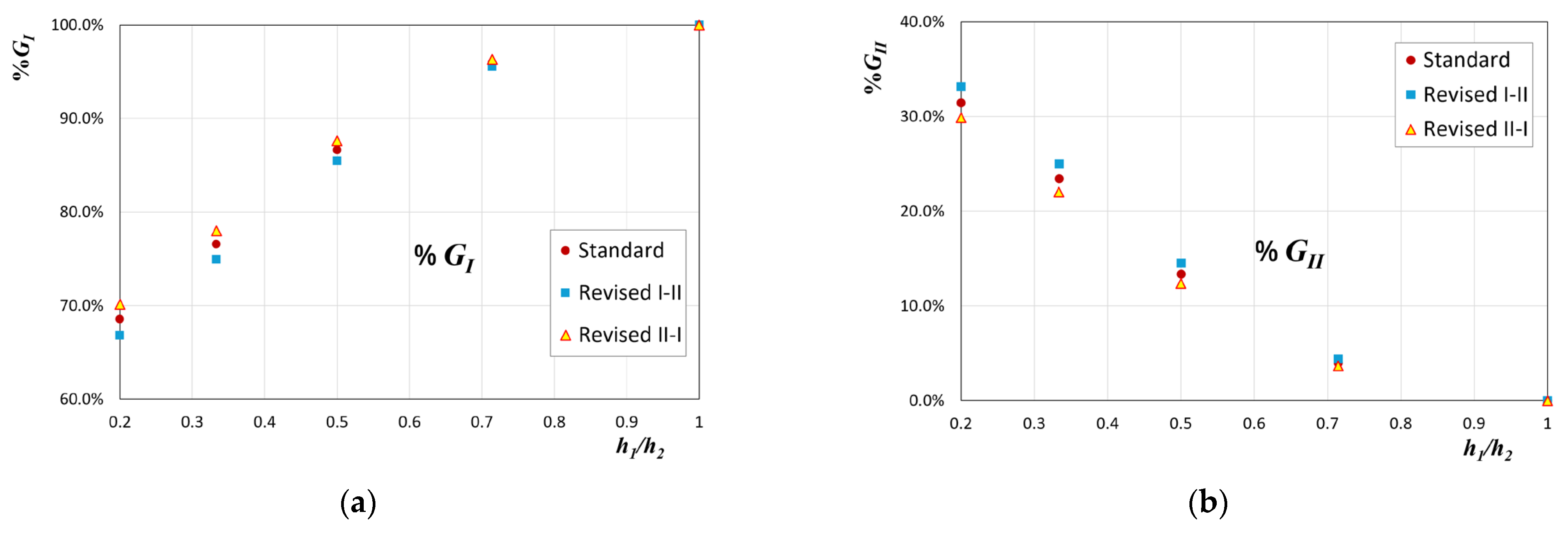
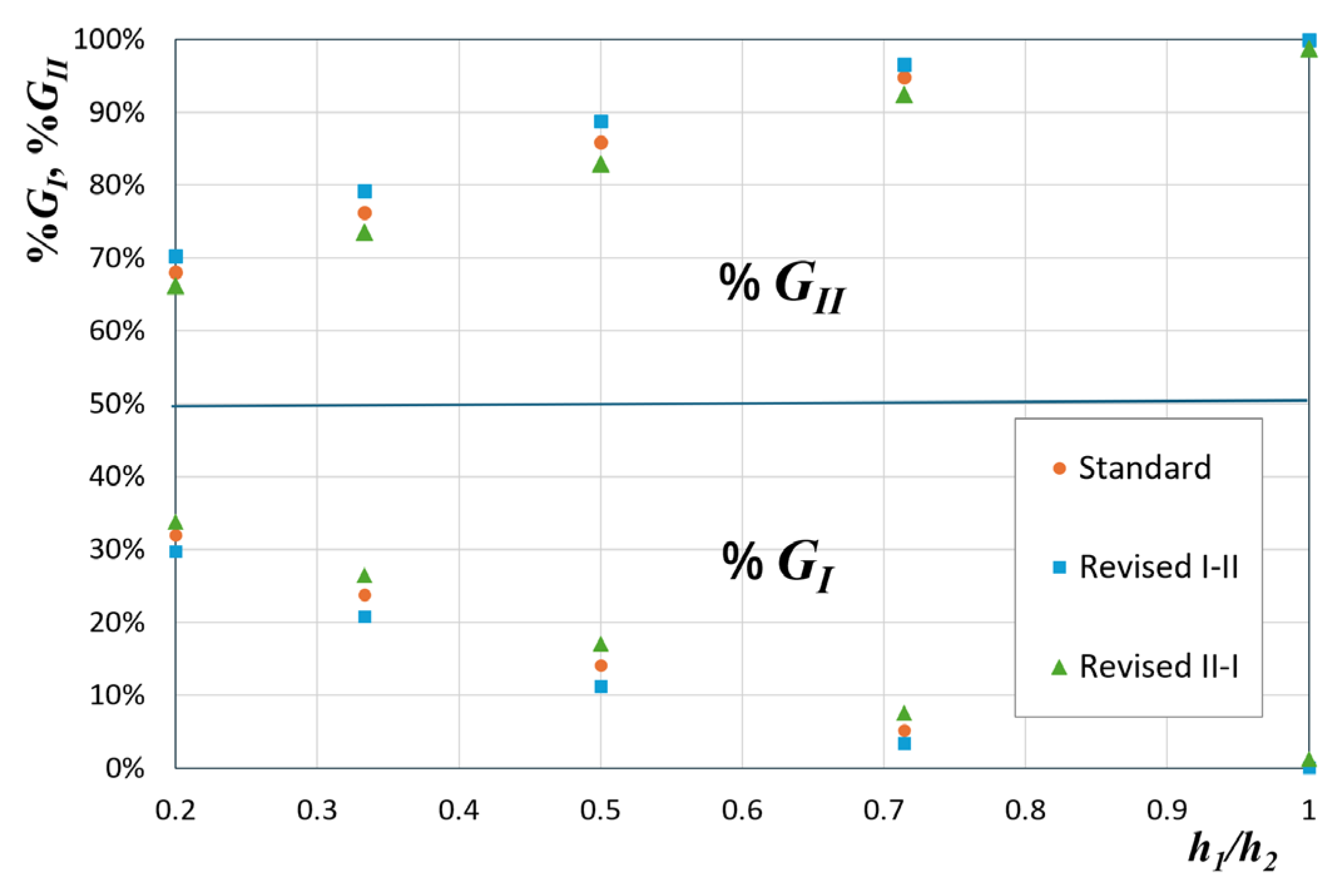
3.1.4. Influence of the Degree of Asymmetry
3.2. AENF Specimen with Lower Arm Stiffer than Upper Arm
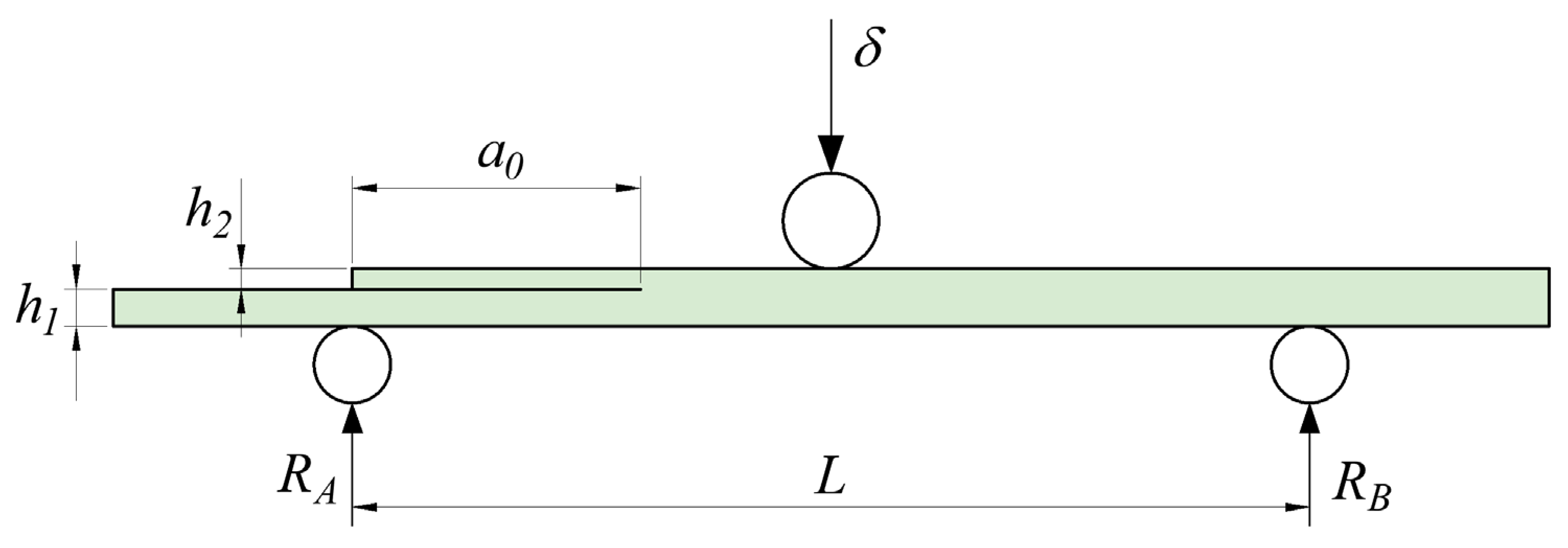
- L = 100 mm;
- a0 = 40 mm;
- h1 = 5 mm;
- h2 = 1 mm.
3.2.1. Standard Two-Step VCCT
3.2.2. Revised I–II VCCT
3.2.3. Revised II–I VCCT
3.3. AENF Specimen with Upper Arm Stiffer than Lower Arm
- L = 100 mm;
- a0 = 40 mm;
- h1 = 1 mm;
- h2 = 5 mm.
3.3.1. Standard Two-Step VCCT
3.3.2. Revised I–II VCCT
3.3.3. Revised II–I VCCT
3.3.4. Influence of the Degree of Asymmetry
4. Conclusions
Author Contributions
Funding
Data Availability Statement
Conflicts of Interest
Abbreviations
| FEM | Finite Element Modelling |
| VCCT | Virtual Crack-Closure Technique |
| ADCB | Asymmetric Double Cantilever Beam |
| AENF | Asymmetric End-Notched Flexure |
References
- Krueger, R. Virtual Crack Closure Technique: History, Approach, and Applications. Appl. Mech. Rev. 2004, 57, 109–143. [Google Scholar] [CrossRef]
- Bonhomme, J.; Argüelles, A.; Castrillo, M.A.; Viña, J. Computational Models for Mode I Composite Fracture Failure: The Virtual Crack Closure Technique versus the Two-Step Extension Method. Meccanica 2010, 45, 297–304. [Google Scholar] [CrossRef]
- Rybicki, E.F.; Kanninen, M.F. A Finite Element Calculation of Stress Intensity Factors by a Modified Crack Closure Integral. Eng. Fract. Mech. 1977, 9, 931–938. [Google Scholar] [CrossRef]
- Irwin, G.R. Fracture. In Handbuch der Physik; Flügge, S., Ed.; Springer: Berlin/Heidelberg, Germany, 1958; Volume VI, pp. 551–590. ISBN 978-3-642-45887-3. [Google Scholar]
- Fracture Analysis Guide. 3.5. VCCT-Based Crack Growth Simulation. Ansys Release 2025R2. 2025. Available online: https://ansyshelp.ansys.com/public/Views/Secured/corp/v252/en/pdf/Ansys_Mechanical_APDL_Fracture_Analysis_Guide.pdf (accessed on 1 June 2026).
- Valvo, P.S. A Revised Virtual Crack Closure Technique for Physically Consistent Fracture Mode Partitioning. Int. J. Fract. 2012, 173, 1–20. [Google Scholar] [CrossRef]
- Valvo, P.S. A Further Step towards a Physically Consistent Virtual Crack Closure Technique. Int. J. Fract. 2015, 192, 235–244. [Google Scholar] [CrossRef]
- Wang, S.; Guan, L. On Fracture Mode Partition Theories. Comput. Mater. Sci. 2012, 52, 240–245. [Google Scholar] [CrossRef]
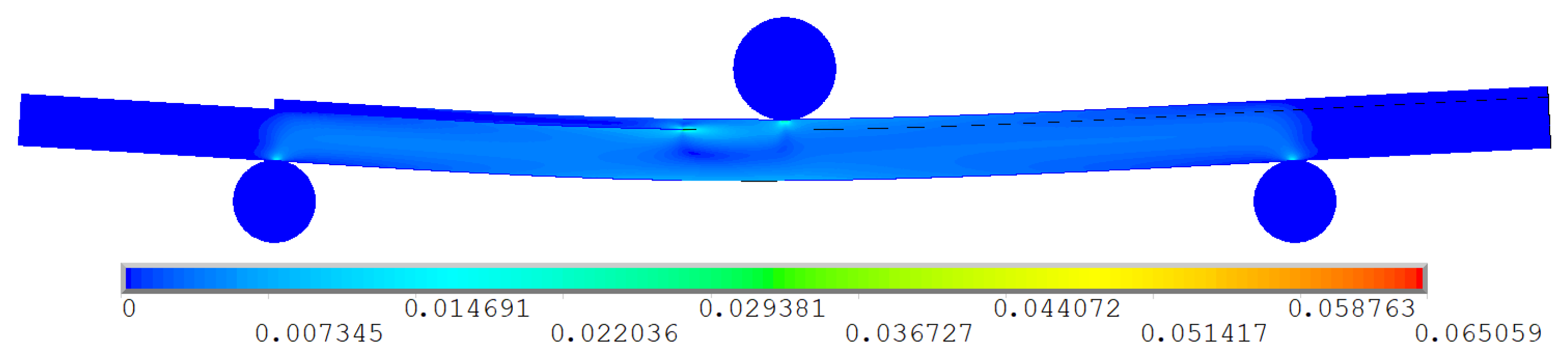
- Bonhomme, J.; Mollón, V. Finite Element Analysis of the Asymmetric ENF Test Specimen. Eng. Fract. Mech. 2025, 327, 111504. [Google Scholar] [CrossRef]
- Wang, S.; Harvey, C.M. Mixed Mode Partition Theories for One Dimensional Fracture. Eng. Fract. Mech. 2012, 79, 329–352. [Google Scholar] [CrossRef]
- Harvey, C.M.; Wang, S. Mixed-Mode Partition Theories for One-Dimensional Delamination in Laminated Composite Beams. Eng. Fract. Mech. 2012, 96, 737–759. [Google Scholar] [CrossRef]
- Wang, S.; Harvey, C.M.; Guan, L. Partition of Mixed Modes in Layered Isotropic Double Cantilever Beams with Non-Rigid Cohesive Interfaces. Eng. Fract. Mech. 2013, 111, 1–25. [Google Scholar] [CrossRef]
- Harvey, C.M.; Eplett, M.R.; Wang, S. Experimental Assessment of Mixed-Mode Partition Theories for Generally Laminated Composite Beams. Compos. Struct. 2015, 124, 10–18. [Google Scholar] [CrossRef]
- Xu, W.; Shi, C.; Liu, B. A Physical Mode Partition and VCCT for Mixed Mode Crack. Eng. Fract. Mech. 2025, 330, 111707. [Google Scholar] [CrossRef]
- Zhou, L.; Wang, J.; Wang, Y.; Li, X.; Chai, Y. The Enriched Finite Element Method-Virtual Crack Closure Technique for Cracked Structures. Thin-Walled Struct. 2023, 187, 110756. [Google Scholar] [CrossRef]
- Ducept, F.; Gamby, D.; Davies, P. A Mixed-Mode Failure Criterion Derived from Tests on Symmetric and Asymmetric Specimens. Compos. Sci. Technol. 1999, 59, 609–619. [Google Scholar] [CrossRef]
- Sundararaman, V.; Davidson, B.D. An Unsymmetric Double Cantilever Beam Test for Interfacial Fracture Toughness Determination. Int. J. Solids Struct. 1997, 34, 799–817. [Google Scholar] [CrossRef]
- Williams, M.L. The Stresses around a Fault or Crack in Dissimilar Media. Bull. Seismol. Soc. Am. 1959, 49, 199–204. [Google Scholar] [CrossRef]
- ISO 15024; Fibre-Reinforced Plastic Composites-Determination of Mode I Interlaminar Fracture Toughness, GIC, for Unidirectionally Reinforced Materials. Intemational Organization for Standardization: Geneva, Switzerland, 2023.
- ASTM D5528/D5528M-21; Standard Test Method for Mode I Interlaminar Fracture Toughness of Unidirectional Fiber-Reinforced Polymer Matrix Composites. ASTM International: West Conshohocken, PA, USA, 2021.
- Sundararaman, V.; Davidson, B.D. An Unsymmetric End-Notched Flexure Test for Interfacial Fracture Toughness Determination. Eng. Fract. Mech. 1998, 60, 361–377. [Google Scholar] [CrossRef]
- ASTM D7905/D7905M-14; Standard Test Method for Determination of the Mode II Interlaminar Fracture Toughness of Unidirectional Fiber-Reinforced Polymer Matrix Composites. ASTM International: West Conshohocken, PA, USA, 2014.
- Bonhomme, J.; Mollón, V.; Viña, J.; Argüelles, A. Influence of Geometric Non-Linearities on the Mixed-Mode Decomposition in Asymmetric DCB Samples. Fibers 2025, 13, 70. [Google Scholar] [CrossRef]
- Valvo, P.S. A Physically Consistent Virtual Crack Closure Technique Accounting for Contact and Interpenetration. Procedia Struct. Integr. 2020, 28, 2350–2369. [Google Scholar] [CrossRef]


| Ex (MPa) | Ey (MPa) | Ez (MPa) | Gxy (MPa) | Gxz (MPa) | Gyz (MPa) | vxy | vxy | vxy |
|---|---|---|---|---|---|---|---|---|
| 144,000 | 10,600 | 10,600 | 5360 | 5360 | 3786 | 0.34 | 0.34 | 0.40 |
| Fx (N) | Fy (N) | Δu (µm) | Δv (µm) | GI (N/m) | GII (N/m) | G (N/m) | −ΔU/BΔa (N/m) |
|---|---|---|---|---|---|---|---|
| −9.40 | 11.89 | −0.58 | 2.97 | 352.8 | 54.5 | 407.3 | 408.5 (0.3%) |
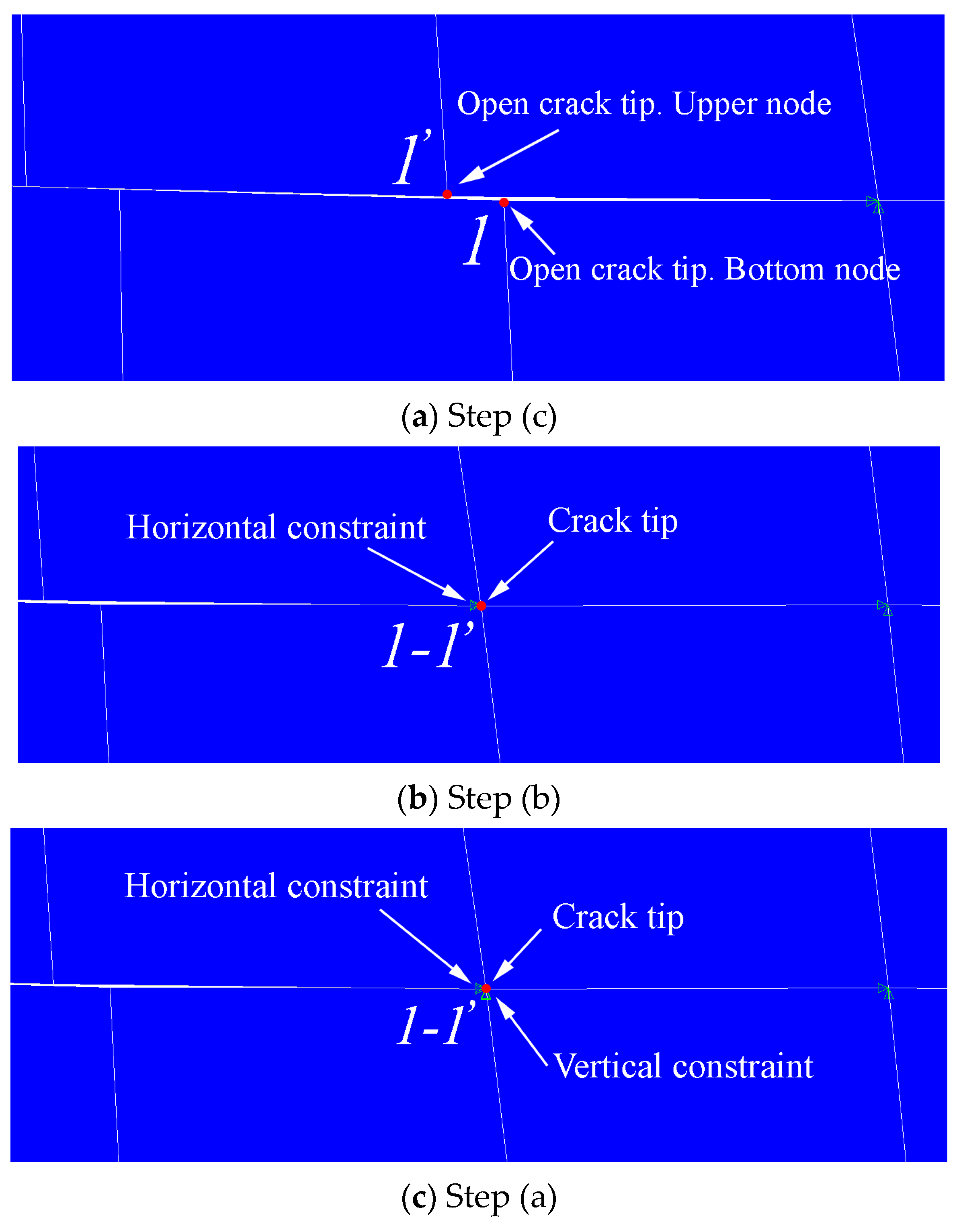
| Step (a) to (b) Pure mode I | Fxa (N) | Fya (N) | Fxb (N) | Fyb (N) | Δub (µm) | Δvb (µm) | GI (N/m) | GII (N/m) |
| −9.40 | 11.89 | −10.22 | 0.00 | 0.00 | 2.93 | 348.3 | 0.0 | |
| Step (b) to (c) Pure mode II | Fxb (N) | Fyb (N) | Fxc (N) | Fyc (N) | Δuc (µm) | Δvc (µm) | GI (N/m) | GII (N/m) |
| −10.22 | 0.00 | 0.00 | 0.00 | −0.58 | 2.97 | 0.0 | 59.2 |
| Procedure | GI (N/m) | GII (N/m) | G (N/m) |
|---|---|---|---|
| Revised I–II VCCT | 348.3 | 59.2 | 407.5 |
| Standard VCCT | 352.8 | 54.5 | 407.3 |
| Difference between revised I–II and standard VCCT | −4.6 | 4.7 | 0.2 (0.0%) |
| Step (a) to (b) Pure mode II | Fxa (N) | Fya (N) | Fxb (N) | Fyb (N) | Δub (µm) | Δvb (µm) | GI (N/m) | GII (N/m) |
| −9.40 | 11.89 | 0.00 | 12.03 | −0.54 | 0.00 | 0.0 | 50.5 | |
| Step (b) to (c) Pure mode I | Fxb (N) | Fyb (N) | Fxc (N) | Fyc (N) | Δuc (µm) | Δvc (µm) | GI (N/m) | GII (N/m) |
| 0.00 | 12.03 | 0.00 | 0.00 | −0.58 | 2.97 | 357.0 | 0.0 |
| Procedure | GI (N/m) | GII (N/m) | G (N/m) |
|---|---|---|---|
| Revised II–I | 357.0 | 50.5 | 407.5 |
| Standard | 352.8 | 54.5 | 407.3 |
| Difference revised II–I and standard VCCT | 4.1 | −4.0 | 0.2 (0.0%) |
| Procedure | GI (N/m) | Δ (%) | GII (N/m) | Δ (%) | G (N/m) |
|---|---|---|---|---|---|
| Revised I–II VCCT | 348.3 | −1.3% | 59.2 | 8.7% | 407.5 |
| Standard VCCT | 352.8 | 54.5 | 407.3 | ||
| Revised II–I VCCT | 357.0 | 1.2% | 50.5 | −7.3% | 407.5 |
| Average values of revised I–II and II–I | 352.6 | 54.9 | 407.5 |
| Fx (N) | Fy (N) | Δu (µm) | Δv (µm) | GI (N/m) | GII (N/m) | −ΔU/BΔa (N/m) |
|---|---|---|---|---|---|---|
| −61.71 | −0.54 | −3.48 | 0.27 | −1.5 | 2149.6 | 2108.6 (−1.8%) |
| Step (a) to (b) Pure mode I | Fxa (N) | Fya (N) | Fxb (N) | Fyb (N) | Δub (µm) | Δvb (µm) | GI (N/m) | GII (N/m) |
| −61.71 | −0.54 | −61.65 | −0.16 | 0.00 | −0.08 | 0.3 | 0.0 | |
| Step (b) to (c) Pure mode II | Fxb (N) | Fyb (N) | Fxc (N) | Fyc (N) | Δuc (µm) | Δvc (µm) | GI (N/m) | GII (N/m) |
| −61.71 | −0.16 | 0.00 | 0.00 | −3.48 | 0.27 | −0.6 | 2147.7 |
| Step (a) to (b) Pure mode II | Fxa (N) | Fya (N) | Fxb (N) | Fyb (N) | Δub (µm) | Δvb (µm) | GI (N/m) | GII (N/m) |
| −61.71 | −0.54 | 0.00 | 1.18 | −3.48 | 0.00 | 0.0 | 2145.4 | |
| Step (b) to (c) Pure mode I | Fxb (N) | Fyb (N) | Fxc (N) | Fyc (N) | Δuc (µm) | Δvc (µm) | GI (N/m) | GII (N/m) |
| 0.00 | 1.18 | 0.00 | 0.00 | −3.48 | 0.27 | 3.3 | 0 |
| Procedure | GI (N/m) | GII (N/m) | G (N/m) |
|---|---|---|---|
| Revised I–II VCCT | 0 | 2147.7 | 2147.7 |
| Standard VCCT | 0 | 2149.6 | 2149.6 |
| Revised II–I VCCT | 3.3 | 2148.7 | 2148.7 |
| Fx (N) | Fy (N) | Δu (µm) | Δv (µm) | GI (N/m) | GII (N/m) | G (N/m) | −ΔU/BΔa (N/m) |
|---|---|---|---|---|---|---|---|
| −49.73 | 16.14 | −2.95 | 4.27 | 689.5 | 1468.7 | 2158.2 | 2138.6 (−0.9%) |
| Step (a) to (b) Pure mode I | Fxa (N) | Fya (N) | Fxb (N) | Fyb (N) | Δub (µm) | Δvb (µm) | GI (N/m) | GII (N/m) |
| −49.73 | 16.14 | −51.48 | 0.00 | 0.00 | 3.99 | 643.4 | 0.0 | |
| Step (b) to (c) Pure mode II | Fxb (N) | Fyb (N) | Fxc (N) | Fyc (N) | Δuc (µm) | Δvc (µm) | GI (N/m) | GII (N/m) |
| −51.48 | 0.00 | 0.00 | 0.00 | −2.95 | 4.27 | 0.0 | 1520.4 |
| Step (a) to (b) Pure mode II | Fxa (N) | Fya (N) | Fxb (N) | Fyb (N) | Δub (µm) | Δvb (µm) | GI (N/m) | GII (N/m) |
| −49.73 | 16.14 | 0.00 | 17.11 | −2.88 | 0.00 | 0.0 | 1433.2 | |
| Step (b) to (c) Pure mode I | Fxb (N) | Fyb (N) | Fxc (N) | Fyc (N) | Δuc (µm) | Δvc (µm) | GI (N/m) | GII (N/m) |
| 0.00 | 17.11 | 0.00 | 0.00 | −2.95 | 4.27 | 730.9 | 0.0 |
| Procedure | GI (N/m) | Δ (N/m) | Δ (%) | GII (N/m) | Δ (N/m) | Δ (%) | G (N/m) |
|---|---|---|---|---|---|---|---|
| Revised I–II VCCT | 643.4 | −46.1 | −6.7% | 1520.4 | 51.7 | 3.5% | 2163.8 |
| Standard VCCT | 689.5 | 1468.7 | 2158.2 | ||||
| Revised II–I VCCT | 730.9 | 41.4 | 6.0% | 1433.2 | −35.5 | −2.4% | 2164.1 |
| Average of I–II and II–I values | 687.2 | 1476.8 | 2163.8 |
Disclaimer/Publisher’s Note: The statements, opinions and data contained in all publications are solely those of the individual author(s) and contributor(s) and not of MDPI and/or the editor(s). MDPI and/or the editor(s) disclaim responsibility for any injury to people or property resulting from any ideas, methods, instructions or products referred to in the content. |
© 2026 by the authors. Licensee MDPI, Basel, Switzerland. This article is an open access article distributed under the terms and conditions of the Creative Commons Attribution (CC BY) license.
Share and Cite
Bonhomme, J.; Mollón, V. Study of Asymmetric Test Configurations by Means of Standard and Revised Virtual Crack-Closure Techniques. Materials 2026, 19, 2421. https://doi.org/10.3390/ma19112421
Bonhomme J, Mollón V. Study of Asymmetric Test Configurations by Means of Standard and Revised Virtual Crack-Closure Techniques. Materials. 2026; 19(11):2421. https://doi.org/10.3390/ma19112421
Chicago/Turabian StyleBonhomme, Jorge, and Victoria Mollón. 2026. "Study of Asymmetric Test Configurations by Means of Standard and Revised Virtual Crack-Closure Techniques" Materials 19, no. 11: 2421. https://doi.org/10.3390/ma19112421
APA StyleBonhomme, J., & Mollón, V. (2026). Study of Asymmetric Test Configurations by Means of Standard and Revised Virtual Crack-Closure Techniques. Materials, 19(11), 2421. https://doi.org/10.3390/ma19112421

