This is an early access version, the complete PDF, HTML, and XML versions will be available soon.
Article

Theoretical and Experimental Study of the Effect of Functional Groups on the Thiazole-5H Proton Chemical Shift in 1H NMR Spectroscopy

by
Angelika Baranowska-Łączkowska
1,* and
Krzysztof Z. Łączkowski
2
1
Department of Physics, Kazimierz Wielki University, Al. Powstańców Wielkopolskich 2, PL-85090 Bydgoszcz, Poland
2
Department of Chemical Technology and Pharmaceuticals, Faculty of Pharmacy, Nicolaus Copernicus University, 2 Jurasz St., PL-85089 Bydgoszcz, Poland
*
Author to whom correspondence should be addressed.
Materials 2026, 19(11), 2400; https://doi.org/10.3390/ma19112400
Submission received: 24 April 2026 / Revised: 26 May 2026 / Accepted: 2 June 2026 / Published: 4 June 2026

Abstract

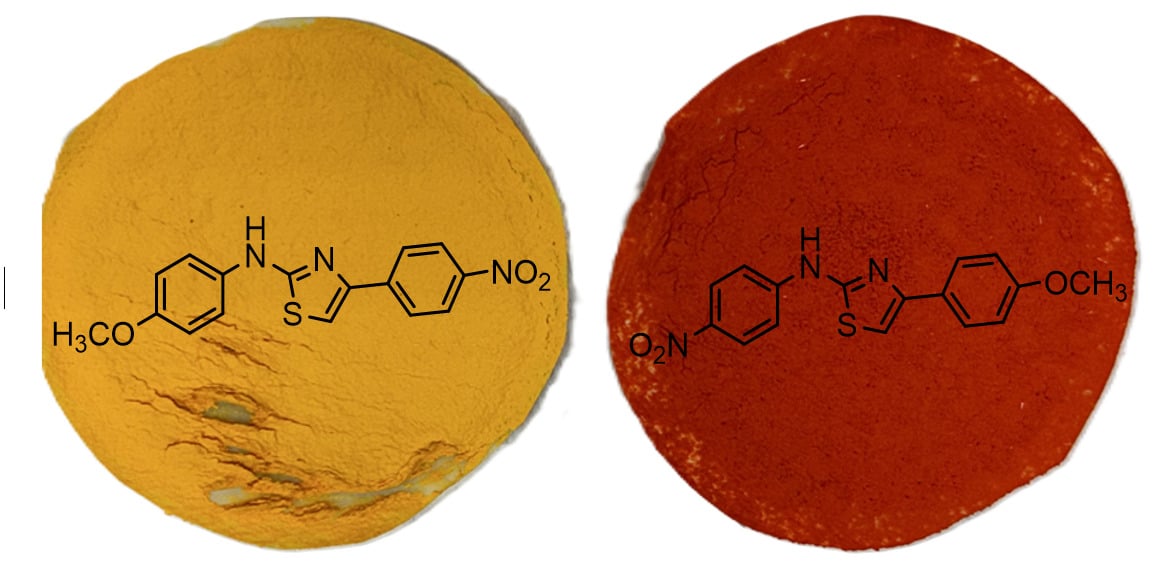
The relationship between the position of the thiazole-5H proton signal and the presence of various substituents in the molecule was investigated in detail from an experimental and theoretical point of view. For this purpose, twenty 2,4-disubstituted thiazole derivatives were carefully chosen and synthesized, and their NMR spectra were recorded. Density functional theory calculations of 1H NMR chemical shifts, frontier molecular orbitals, and molecular electrostatic potential surfaces were performed. The position of the thiazole-5H proton signal in the NMR spectrum is shown to strongly depend on the type and position of substituents in the molecule. Based on the obtained results, we can conclude that compounds with the smallest values of thiazole-5H proton shift are simultaneously those with small electron affinity, ionization potential and molecular electronegativity values, while compounds with the largest values of thiazole-5H proton shift have large electron affinity, ionization potential, and molecular electronegativity and a small HOMO-LUMO energy gap. These relationships become less clear in the case of compounds with intermediate values of the proton shift. Present research is a step towards an easy-to-use tool for predicting electronic effects in materials containing thiazole, based on the position of the thiazole-5H proton NMR signal.
Keywords: thiazole; 1H NMR chemical shift; DFT calculation; frontier orbitals; molecular electrostatic potential surface thiazole; 1H NMR chemical shift; DFT calculation; frontier orbitals; molecular electrostatic potential surface
Graphical Abstract