Bio-Based Smart Packaging Materials for Next-Generation Food Systems


Abstract
1. Introduction
2. Bio-Based Material Platforms for Smart Packaging
2.1. Natural Polymers and Biopolymers
2.1.1. Cellulose and Its Derivatives
2.1.2. Chitosan and Chitin Derivatives
2.1.3. Starch and Alginate
2.1.4. Protein-Based Materials

| Materials | Active Ingredients | Applications | Products | Refs. |
|---|---|---|---|---|
| MC | Jambolao’s anthocyanins | Extend shelf life; indicate freshness. | Meat or seafood | [127] |
| MC-CSNF | Saffron anthocyanins | Monitor pH levels and volatile gas; real-time freshness monitoring. | Meat or seafood | [128] |
| CMC/starch | Purple sweet potato’s anthocyanins | Real-time monitoring of freshness; pH or NH3 level indicator. | Fish | [129] |
| BC | Garlic extract; bromophenol blue | Delay spoilage; pH indicator; monitor freshness. | Meat (e.g., beef) | [130] |
| BC | Pelargonidin | Visual monitoring of freshness. | Tilapia filets | [131] |
| CA | Cur | Thermochromism; temperature sensor to monitor food quality. | Entire supply chain | [132] |
| Guar gum, SA, and carboxylated cellulose nanofibers | Black rice extract, curcumin, and their compounds | Bionic shellfish sensor; visual freshness monitoring. | Chicken, pork, and shrimp | [52] |
| Oxidized chitin nanocrystals/CS | Black rice bran anthocyanins | Monitoring the spoilage process; pH indicator. | Fish and shrimp | [133] |
| CMCS/SA | PC and Cur | Monitor freshness of shrimp; extend shelf life of grapes. | Shrimp and grapes | [74] |
| CS/PVA | Alizarin, 9-Phenanthreneboronic acid, and beeswax | Anti-counterfeiting; food freshness preservation and visual monitoring of spoilage; extend shelf life. | Fish | [85] |
| CS/pectin | Nystatin and epigallocatechin gallate | Slow microbial growth and quality deterioration. | Strawberries | [134] |
| Starch/gelatin | Carrot anthocyanin | pH colorimetric indicators reveal meat spoilage. | Meat | [135] |
| Joha rice starch | Beetroot extract | Monitor food freshness. | Chicken, fish, and Indian cottage cheese | [99] |
| Pectin/SA/xanthan gum | Raspberry pomace extract | Monitor freshness of high-protein foods. | Pork rind and lard | [136] |
| SA-CS | Red prickly pear’s betalain | Monitor freshness. | Salmon | [137] |
| SA-Guar gum | Glucose–glycerol carbon dots | Monitor freshness through humidity changes (fluorescence intensity). | Bread | [138] |
| Fish gelatin/PVA | Vinasse anthocyanins | Freshness monitoring; packaging refrigerated foods | Shrimps | [139] |
| Gelatin/K-carrageenan | Anthocyanins and TiO2 nanoparticles | pH indication; antimicrobial and antioxidant; monitor freshness. | Fish | [140] |
| Soy protein isolate | CNC/Cur/polyvinylpyrrolidone nano-capsules | Monitor freshness. | Shrimp | [141] |
| Collagen | Laponite @Cur-CA | Monitor freshness; extend shelf life. | Shrimp | [142] |
2.2. Bio-Based Polyesters and Emerging Platforms
2.2.1. Polylactic Acid and Polyhydroxyalkanoates
2.2.2. Emerging Bio-Based Polyesters
2.2.3. Structure–Property Relationships Relevant to Smart Packaging Applications
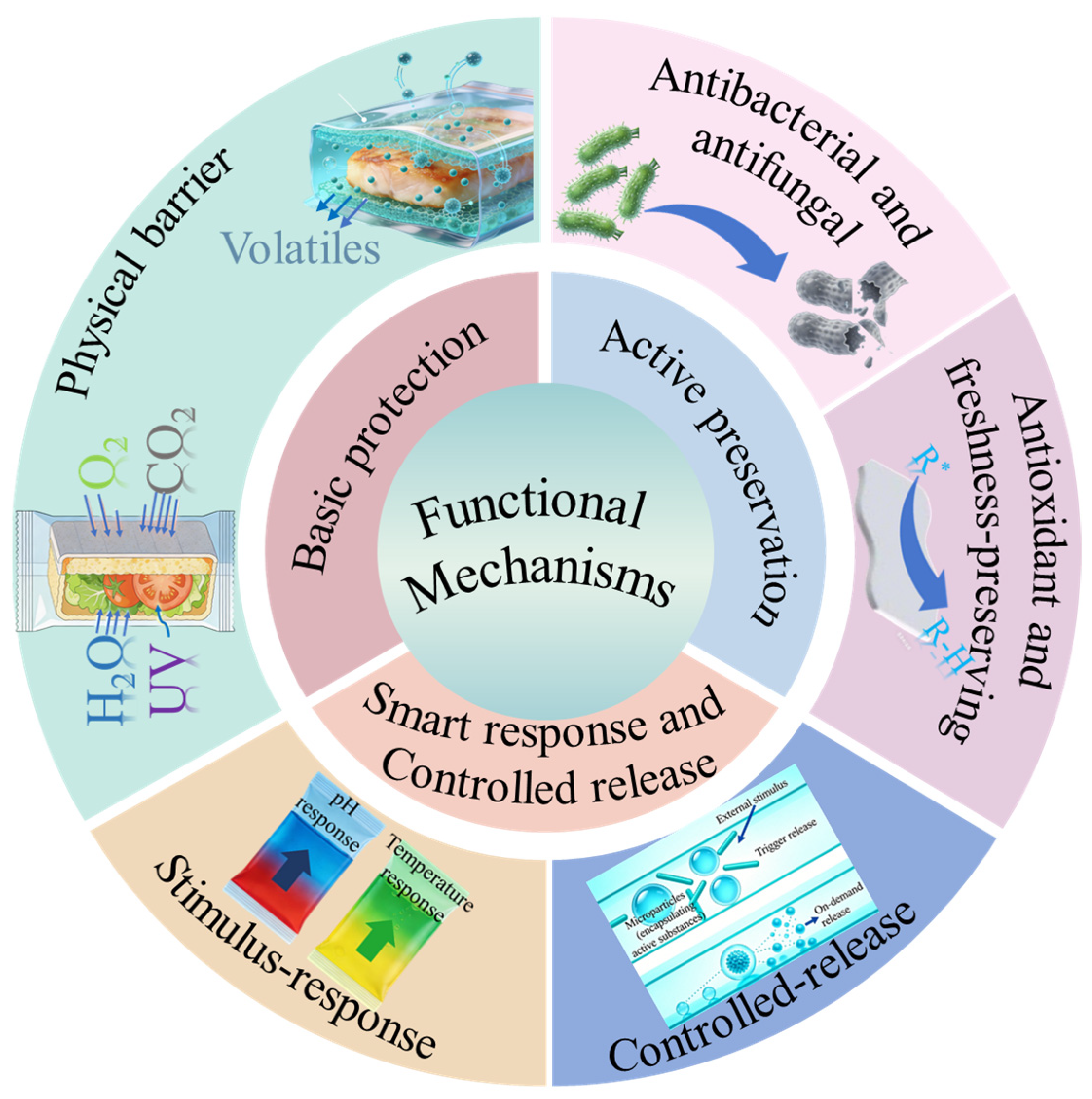
3. Active Functions in Bio-Based Smart Packaging
3.1. Antimicrobial and Antifungal Functions
3.2. Antioxidant and Freshness-Preserving Functions
3.3. Barrier Properties
3.4. Controlled Release and Stimuli-Responsive Systems
| Basic Bio-Based Materials | Smart Components | Food Model | Behavior/Trigger | Refs. |
|---|---|---|---|---|
| Konjac glucomannan/CMC | ACNs | Fish | Red to yellow–green (pH: 2–12) | [228] |
| CNC/nanofiber cellulose | ACNs | Shrimp | Light purple–light green (ammonia and pH (1–13)) | [229] |
| Soy protein isolate/CNC | Cur | Shrimp | Yellow–orange (ammonia and pH (3–11)) | [141] |
| CS/polyvinyl alcohol | Shikonin and nano-ZnO | Shrimp | Dark red–dark bluish (ammonia and temperature) | [230] |
| Cellulose acetate | Cur | Aluminum can (water) | Yellow–red (temperature) | [132] |
| HPMC/Zn2+-SA | Cur | Pork and shrimp | Yellow–red (nitrogen and pH (2–12)) | [184] |
| Starch | Beetroot extract | Chicken and fish | Red–pale yellow (pH: 2–12) | [99] |
| Laponite/caffeic acid | Cur | Shrimp | Yellow–reddish brown (ammonia and pH (3–11)) | [142] |
| PLA/nanofiber cellulose | ACNs | Cherry tomato | Purple–greenish yellow (pH: 2–14) | [231] |
4. Intelligent Sensing, System Integration, and Sustainability Assessment
4.1. Intelligent Sensing and Responsiveness
4.2. Integration of Smart Packaging into Next-Generation Food Systems
4.3. Safety Standards and Lifecycle Considerations
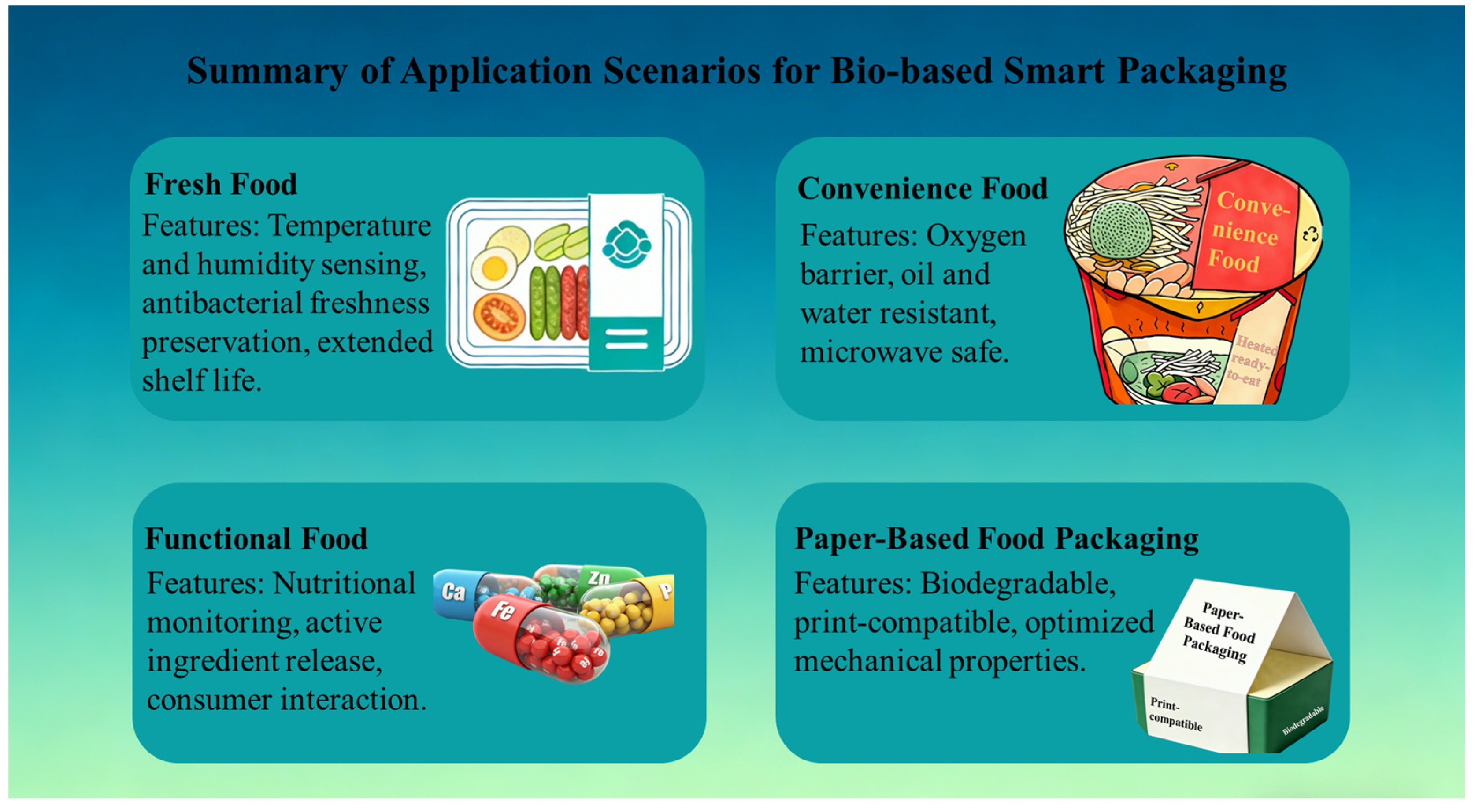
5. Application Scenarios for Bio-Based Smart Packaging Materials
5.1. Fresh Food and Produce
5.2. Convenience Food
5.3. Functional Food
5.4. Paper-Based Food Packaging
6. Challenges and Future Perspectives
6.1. Major Challenges
- The long-term stability and reliability of smart responses require improvement. Natural indicators (such as ACNs) are prone to degradation by light, heat, and oxygen exposure, compromising the reversibility and precision of color changes in complex food systems and during extended storage, while sensor signals drift over time. Similar stability issues also affect other natural active agents—essential oils are volatile and prone to oxidation, while antimicrobial peptides can be degraded by proteolytic enzymes—highlighting a common challenge for incorporating diverse natural compounds into smart packaging. Additionally, the controlled release and matrix compatibility of functional nanomaterials (e.g., nanoparticles, MOFs) also require further optimization.
- Achieving synergistic optimization among performance, cost, and sustainability proves challenging, with these factors mutually constraining commercialization. High-performance bio-based materials (e.g., PHA, nano-cellulose) and smart components (e.g., MOFs) often carry high costs, while their production may conflict with green objectives due to energy and chemical inputs.
- Bottlenecks exist in translating laboratory prototypes to industrial-scale applications. Most smart packaging preparation processes (e.g., precision coating, electrospinning) are complex and inefficient, lacking mature mass production technologies and supporting processes. Concurrently, the absence of unified performance standards and safety assessment protocols severely hinders commercialization.
- Finally, regulatory compliance poses a major obstacle. Approval processes for novel bio-based packaging are time-consuming and costly, particularly due to limited toxicological data and health risk assessments. Furthermore, the incorporation of smart functional components raises concerns about direct food contact safety. While most studies indicate low cytotoxicity, concerns over genotoxicity and nanoparticle migration persist, affecting consumer and regulatory acceptance.
6.2. Future Outlook
7. Conclusions
Author Contributions
Funding
Data Availability Statement
Acknowledgments
Conflicts of Interest
Abbreviations
| CNF | Cellulose nanofiber | CNC | Cellulose nanocrystal |
| MC | Methyl cellulose | HPMC | Hydroxypropyl methylcellulose |
| CA | Cellulose acetate | BC | Bacterial cellulose |
| EC | Ethyl cellulose | CMC | Carboxymethyl cellulose |
| CS | Chitosan | CMCS | Carboxymethyl chitosan |
| PVA | Polyvinyl alcohol | PEF | Poly (ethylene 2,5-furandicarboxylate) |
| ACN | Anthocyanin | PET | Polyethylene terephthalate |
| SA | Sodium alginate | MOF | Metal–organic framework |
| Cur | Curcumin | COF | Covalent organic framework |
| PHA | Polyhydroxyalkanoate | PLA | Polylactic acid |
| PHB | Polyhydroxybutyrate | PHV | Polyhydroxy-valerate |
| LAP | Laponite | EP | Edible package |
References
- Siebler, A.; Keller, J.; Strenger, M.; Prescher, T.; Albrecht, S.; Schmid, M. Function Meets Environment-Approach for the Environmental Assessment of Food Packaging, Taking into Account Packaging Functionality. Sustainability 2026, 18, 1222. [Google Scholar] [CrossRef]
- Zhu, Y.L.; Cui, H.Y.; Li, C.Z.; Lin, L. A novel polyethylene oxide/Dendrobium officinale nanofiber: Preparation, characterization and application in pork packaging. Food Packag. Shelf Life 2019, 21, 100329. [Google Scholar] [CrossRef]
- Zhai, X.D.; Li, Z.H.; Shi, J.Y.; Huang, X.W.; Sun, Z.B.; Zhang, D.; Zou, X.B.; Sun, Y.; Zhang, J.J.; Holmes, M.; et al. A colorimetric hydrogen sulfide sensor based on gellan gum-silver nanoparticles bionanocomposite for monitoring of meat spoilage in intelligent packaging. Food Chem. 2019, 290, 135–143. [Google Scholar] [CrossRef]
- Lin, L.; Gu, Y.L.; Cui, H.Y. Moringa oil/chitosan nanoparticles embedded gelatin nanofibers for food packaging against Listeria monocytogenes and Staphylococcus aureus on cheese. Food Packag. Shelf Life 2019, 19, 86–93. [Google Scholar] [CrossRef]
- Zhou, W.J.; Luo, J.Y.; Zhao, L.H.; Zhao, M.; Ouyang, Z.; Yang, M.H. Influences of different storage environments and packaging materials on the quality of the traditional Chinese health food Herba Menthae Haplocalycis. Food Packag. Shelf Life 2018, 15, 52–61. [Google Scholar] [CrossRef]
- Lin, L.; Liao, X.; Surendhiran, D.; Cui, H.Y. Preparation of ε-polylysine/chitosan nanofibers for food packaging against Salmonella on chicken. Food Packag. Shelf Life 2018, 17, 134–141. [Google Scholar] [CrossRef]
- Upadhyay, A.; Agbesi, P.; Arafat, K.M.Y.; Urdaneta, F.; Dey, M.; Basak, M.; Hong, S.; Umeileka, C.; Argyropoulos, D. Bio-based smart packaging: Fundamentals and functions in sustainable food systems. Trends Food Sci. Technol. 2024, 145, 104369. [Google Scholar] [CrossRef]
- Chrisendo, D.; Piipponen, J.; Heino, M.; Kummu, M. Socioeconomic factors of global food loss. Agric. Food Secur. 2023, 12, 23. [Google Scholar] [CrossRef]
- Gil-Martín, E.; Forbes-Hernández, T.; Romero, A.; Cianciosi, D.; Giampieri, F.; Battino, M. Influence of the extraction method on the recovery of bioactive phenolic compounds from food industry by-products. Food Chem. 2022, 378, 131918. [Google Scholar] [CrossRef]
- Shouket, S.; Khurshid, S.; Khan, J.; Batool, R.; Sarwar, A.; Aziz, T.; Alhomrani, M.; Alamri, A.S.; Sameeh, M.Y.; Filimban, F.Z. Enhancement of shelf-life of food items via immobilized enzyme nanoparticles on varied supports. A sustainable approach towards food safety and sustainability. Food Res. Int. 2023, 169, 112940. [Google Scholar] [CrossRef]
- Shi, C.; Chen, Y.Y.; Li, C.Z.; Al-Asmari, F.; Cui, H.Y.; Lin, L. Potential Application of Lactiplantibacillus plantarum in Food Bio-preservation—A Comprehensive Review with a Focus on the Antibacterial and Anti-Virulence Effects on Foodborne Pathogens. Food Rev. Int. 2024, 40, 2993–3019. [Google Scholar] [CrossRef]
- Yu, X.; Wang, Z.; Gao, Z.; Lang, H.; Shao, X.; Liu, Z. Applications, challenges, and prospects of AI-driven intelligent packaging technologies in the food supply chain under Industry 4.0. Trends Food Sci. Technol. 2025, 165, 105367. [Google Scholar] [CrossRef]
- Mohammadi Khoshoue, F.; Karki, T.; Leminen, V. Recycled Plastics Utilization in Packaging Converting Processes: A Semi-Systematic Review. Adv. Polym. Technol. 2026, 2026, 1728680. [Google Scholar] [CrossRef]
- Periyasamy, T.; Asrafali, S.P.; Lee, J. Recent Advances in Functional Biopolymer Films with Antimicrobial and Antioxidant Properties for Enhanced Food Packaging. Polymers 2025, 17, 1257. [Google Scholar] [CrossRef]
- Cheng, Y.; Wang, J.; Fang, C.; Du, Y.; Su, J.; Chen, J.; Zhang, Y. Recent Progresses in Pyrolysis of Plastic Packaging Wastes and Biomass Materials for Conversion of High-Value Carbons: A Review. Polymers 2024, 16, 1066. [Google Scholar] [CrossRef]
- Torkelis, A.; Dvarioniene, J.; Denafas, G. The Factors Influencing the Recycling of Plastic and Composite Packaging Waste. Sustainability 2024, 16, 9515. [Google Scholar] [CrossRef]
- Zhai, X.D.; Wang, X.Y.; Zhang, J.J.; Yang, Z.K.; Sun, Y.; Li, Z.H.; Huang, X.W.; Holmes, M.; Gong, Y.Y.; Povey, M.; et al. Extruded low density polyethylene-curcumin film: A hydrophobic ammonia sensor for intelligent food packaging. Food Packag. Shelf Life 2020, 26, 100595. [Google Scholar] [CrossRef]
- Lin, L.; Mahdi, A.A.; Li, C.Z.; Al-Ansi, W.; Al-Maqtari, Q.A.; Hashim, S.B.H.; Cui, H.Y. Enhancing the properties of Litsea cubeba essential oil/peach gum/polyethylene oxide nanofibers packaging by ultrasonication. Food Packag. Shelf Life 2022, 34, 100951. [Google Scholar] [CrossRef]
- Rehman, A.; Jafari, S.M.; Aadil, R.M.; Assadpour, E.; Randhawa, M.A.; Mahmood, S. Development of active food packaging via incorporation of biopolymeric nanocarriers containing essential oils. Trends Food Sci. Technol. 2020, 101, 106–121. [Google Scholar] [CrossRef]
- Yang, Z.K.; Zhai, X.D.; Zou, X.B.; Shi, J.Y.; Huang, X.W.; Li, Z.H.; Gong, Y.Y.; Holmes, M.; Povey, M.; Xiao, J.B. Bilayer pH-sensitive colorimetric films with light-blocking ability and electrochemical writing property: Application in monitoring crucian spoilage in smart packaging. Food Chem. 2021, 336, 127634. [Google Scholar] [CrossRef]
- Huang, X.W.; Zhang, K.; Li, Z.H.; Zhang, J.J.; Zhai, X.D.; Zhang, N.; Du, L.Z.; Qin, Z. Exploring the Integration of Anthocyanins with Functional Materials in Smart Food Packaging: From Stabilization to Application. Foods 2025, 14, 2896. [Google Scholar] [CrossRef]
- Murugesan, A.; Li, H.H. Toward Sustainable Food Packaging: Innovations in Biodegradable Materials, Smart Technologies, and AI Integration. Compr. Rev. Food Sci. Food Saf. 2026, 25, e70397. [Google Scholar] [CrossRef]
- Huang, Z.Q.; Zhai, X.D.; Yin, L.T.; Shi, J.Y.; Zou, X.B.; Li, Z.H.; Huang, X.W.; Ma, X.D.; Povey, M. A smart bilayer film containing zein/gelatin/carvacrol and polyvinyl alcohol/chitosan/anthocyanin for Lateolabrax japonicus preservation and freshness monitoring. J. Food Meas. Charact. 2023, 17, 6470–6483. [Google Scholar] [CrossRef]
- Yan, X.X.; Li, Z.W.; Cheng, W.H.; Chen, R.; Liu, J.; Song, J.L.; Xiao, H.N.; Du, H.S.; Guo, J.Q. Cellulose nanocrystals for functional food packaging: Enhancing performance and enabling intelligence. Trends Food Sci. Technol. 2025, 163, 105163. [Google Scholar] [CrossRef]
- Ahmad, K.; Din, Z.U.; Ullah, H.; Ouyang, Q.; Rani, S.; Jan, I.; Alam, M.; Rahman, Z.; Kamal, T.; Ali, S.; et al. Preparation and Characterization of Bio-based Nanocomposites Packaging Films Reinforced with Cellulose Nanofibers from Unripe Banana Peels. Starch-Starke 2022, 74, 2100283. [Google Scholar] [CrossRef]
- Hashim, S.B.H.; Tahir, H.E.; Li, L.; Zhang, J.J.; Zhai, X.D.; Mahdi, A.A.; Awad, F.N.; Hassan, M.M.; Zou, X.B.; Shi, J.Y. Intelligent colorimetric pH sensoring packaging films based on sugarcane wax/agar integrated with butterfly pea flower extract for optical tracking of shrimp freshness. Food Chem. 2022, 373, 131514. [Google Scholar] [CrossRef]
- Ding, F.Y.; Long, S.M.; Huang, X.W.; Shi, J.Y.; Povey, M.; Zou, X.B. Emerging Pickering emulsion films for bio-based food packaging applications. Food Packag. Shelf Life 2024, 42, 101242. [Google Scholar] [CrossRef]
- Li, L.; Luo, X.; Liu, Y.; Teng, M.; Liu, X.; Zhang, X.; Liu, X. Biomimetic reed-leaf nanostructures enabling dual-channel-responsive biopolymer platforms for IoT-embedded intelligent active packaging. Chem. Eng. J. 2025, 522, 167493. [Google Scholar] [CrossRef]
- Rahman, M.; Sobhan, A.; Sadak, O. Emerging trends in intelligent packaging for tackling food waste in the modern food supply chain. Trends Food Sci. Technol. 2026, 167, 105436. [Google Scholar] [CrossRef]
- Du, H.; Sun, X.; Chong, X.; Yang, M.; Zhu, Z.; Wen, Y. A review on smart active packaging systems for food preservation: Applications and future trends. Trends Food Sci. Technol. 2023, 141, 104200. [Google Scholar] [CrossRef]
- Shao, P.; Liu, L.; Yu, J.; Lin, Y.; Gao, H.; Chen, H.; Sun, P. An overview of intelligent freshness indicator packaging for food quality and safety monitoring. Trends Food Sci. Technol. 2021, 118, 285–296. [Google Scholar] [CrossRef]
- Boukoufi, C.; Boudier, A.; Maincent, P.; Vigneron, J.; Clarot, I. Food-inspired innovations to improve the stability of active pharmaceutical ingredients. Int. J. Pharm. 2022, 623, 121881. [Google Scholar] [CrossRef]
- Wu, Y.Q.; Li, W.L.; Feng, Y.R.; Shi, J.Y. Carbon Dots as Multifunctional Nanofillers in Sustainable Food Packaging: A Comprehensive Review. Foods 2025, 14, 3082. [Google Scholar] [CrossRef]
- Zhai, X.D.; Li, Z.H.; Zhang, J.J.; Shi, J.Y.; Zou, X.Y.; Huang, X.W.; Zhang, D.; Sun, Y.; Yang, Z.K.; Holmes, M.; et al. Natural Biomaterial-Based Edible and pH-Sensitive Films Combined with Electrochemical Writing for Intelligent Food Packaging. J. Agric. Food Chem. 2018, 66, 12836–12846. [Google Scholar] [CrossRef]
- Hu, X.T.; Shi, J.Y.; Shi, Y.Q.; Zou, X.B.; Arslan, M.; Zhang, W.; Huang, X.W.; Li, Z.H.; Xu, Y.W. Use of a smartphone for visual detection of melamine in milk based on Au@Carbon quantum dots nanocomposites. Food Chem. 2019, 272, 58–65. [Google Scholar] [CrossRef]
- Atta, O.M.; Manan, S.; Shahzad, A.; Ul-Islam, M.; Ullah, M.W.; Yang, G. Biobased materials for active food packaging: A review. Food Hydrocoll. 2022, 125, 107419. [Google Scholar] [CrossRef]
- Iqbal, M.W.; Riaz, T.; Yasmin, I.; Leghari, A.A.; Amin, S.; Bilal, M.; Qi, X.H. Chitosan-Based Materials as Edible Coating of Cheese: A Review. Starch-Starke 2021, 73, 202100088. [Google Scholar] [CrossRef]
- Mu, R.J.; Hong, X.; Ni, Y.S.; Li, Y.Z.; Pang, J.; Wang, Q.; Xiao, J.B.; Zheng, Y.F. Recent trends and applications of cellulose nanocrystals in food industry. Trends Food Sci. Technol. 2019, 93, 136–144. [Google Scholar] [CrossRef]
- Huang, S.S.; Deng, C.; Zhang, H.L.; Yue, X.J.; Qiu, F.X.; Zhang, T. Antibacterial cellulose-based membrane with heat dissipation and liquid transportation for food packaging applications. Food Bioprod. Process. 2025, 149, 284–293. [Google Scholar] [CrossRef]
- Liu, Y.; Ahmed, S.; Sameen, D.E.; Wang, Y.; Lu, R.; Dai, J.; Li, S.; Qin, W. A review of cellulose and its derivatives in biopolymer-based for food packaging application. Trends Food Sci. Technol. 2021, 112, 532–546. [Google Scholar] [CrossRef]
- Zhang, X.L.; Dai, J.M.; Aziz, T.; Al-Asmari, F.; Shami, A.; Al-Joufi, F.A.; Cui, H.Y.; Lin, L. Advances in green preparation and functionalized applications of cellulose aerogels derived from agricultural waste for food packaging. Trends Food Sci. Technol. 2025, 165, 105352. [Google Scholar] [CrossRef]
- Nath, P.C.; Sharma, R.; Mahapatra, U.; Mohanta, Y.K.; Rustagi, S.; Sharma, M.; Mahajan, S.; Nayak, P.K.; Sridhar, K. Sustainable production of cellulosic biopolymers for enhanced smart food packaging: An up-to-date review. Int. J. Biol. Macromol. 2024, 273, 133090. [Google Scholar] [CrossRef]
- Romao, S.; Bettencourt, A.; Ribeiro, I.A.C. Novel Features of Cellulose-Based Films as Sustainable Alternatives for Food Packaging. Polymers 2022, 14, 4968. [Google Scholar] [CrossRef]
- Yekta, R.; Abedi-Firoozjah, R.; Azimi Salim, S.; Khezerlou, A.; Abdolmaleki, K. Application of cellulose and cellulose derivatives in smart/intelligent bio-based food packaging. Cellulose 2023, 30, 9925–9953. [Google Scholar] [CrossRef]
- Zhou, Z.; Wang, J.; Li, J.; Li, X.; Wang, G.; Lu, W. Sustainable biomass materials: Active and intelligent packaging based on cellulose. Ind. Crops Prod. 2025, 233, 121409. [Google Scholar] [CrossRef]
- Aziz, T.; Li, W.; Zhu, J.; Chen, B. Developing multifunctional cellulose derivatives for environmental and biomedical applications: Insights into modification processes and advanced material properties. Int. J. Biol. Macromol. 2024, 278, 134695. [Google Scholar] [CrossRef]
- Rozas, B.; Bruna, J.E.; Guarda, A.; Galotto, M.J.; Reyes, C.; Valenzuela, X.; Rodriguez-Mercado, F.; Torres, A. Bio-Based Coatings on Cellulosic Materials Resistant to Humidity and Fats. Polymers 2025, 17, 2755. [Google Scholar] [CrossRef]
- Benitez, J.J.; Florido-Moreno, P.; Porras-Vázquez, J.M.; Tedeschi, G.; Athanassiou, A.; Heredia-Guerrero, J.A.; Guzman-Puyol, S. Transparent, plasticized cellulose-glycerol bioplastics for food packaging applications. Int. J. Biol. Macromol. 2024, 273, 132956. [Google Scholar] [CrossRef]
- Krithivasan, R.; Miller, G.Z.; Belliveau, M.; Gearhart, J.; Krishnamoorthi, V.; Lee, S.; Kannan, K. Analysis of ortho-phthalates and other plasticizers in select organic and conventional foods in the United States. J. Expo. Sci. Environ. Epidemiol. 2023, 33, 778–786. [Google Scholar] [CrossRef]
- Mena-Prado, I.; Fernandez-Garcia, M.; del Campo, A.; Bonilla, A.M. Natural Macromolecules Used as Bioplasticizer in Polymer Materials for Food Contact Applications. Packag. Technol. Sci. 2025, 38, 511–526. [Google Scholar] [CrossRef]
- Mena-Prado, I.; Navas-Ortiz, E.; Fernandez-Garcia, M.; Blazquez-Blazquez, E.; Limbo, S.; Rollini, M.; Martins, D.M.; Bonilla, A.M.; del Campo, A. Enhancing functional properties of compostable materials with biobased plasticizers for potential food packaging applications. Int. J. Biol. Macromol. 2024, 280, 135538. [Google Scholar] [CrossRef]
- Liu, Z.; Wang, Q.; Lin, L.; Liu, Q.; Ma, W.; Cheng, Q.; Yang, J.; Tang, F.; Xu, M.; Yang, X.; et al. Engineering a shellfish-inspired bio-based double-layered smart packaging material with enhanced water resistance and barrier performance for universally applicable meat freshness monitoring. Chem. Eng. J. 2024, 501, 157808. [Google Scholar] [CrossRef]
- Jiao, H.X.; Shi, Y.F.; Sun, J.Z.; Lu, X.C.; Zhang, H.X.; Li, Y.; Fu, Y.Y.; Guo, J.Q.; Wang, Q.Q.; Liu, H.; et al. Sawdust-derived cellulose nanofibrils with high biosafety for potential bioprinting. Ind. Crops Prod. 2024, 209, 118025. [Google Scholar] [CrossRef]
- Li, Y.; Liang, W.; Huang, M.G.; Huang, W.Y.; Feng, J. Green preparation of holocellulose nanocrystals from burdock and their inhibitory effects against α-amylase and α-glucosidase. Food Funct. 2022, 13, 170–185. [Google Scholar] [CrossRef]
- Lu, Q.M.; Yu, X.J.; Yagoub, A.A.; Wahia, H.; Zhou, C.S. Application and challenge of nanocellulose in the food industry. Food Biosci. 2021, 43, 101285. [Google Scholar] [CrossRef]
- Liu, L.; Boni, B.O.O.; Ullah, M.W.; Qi, F.Y.; Li, X.H.; Shi, Z.J.; Yang, G. Cellulose: A promising and versatile Pickering emulsifier for healthy foods. Food Rev. Int. 2023, 39, 7081–7111. [Google Scholar] [CrossRef]
- Lu, A.P.; Yu, X.J.; Ji, Q.H.; Chen, L.; Yagoub, A.E.G.; Olugbenga, F.; Zhou, C.S. Preparation and characterization of lignin-containing cellulose nanocrystals from peanut shells using a deep eutectic solvent containing lignin-derived phenol. Ind. Crops Prod. 2023, 195, 116415. [Google Scholar] [CrossRef]
- Zhang, C.; Zheng, Y.M.; Ai, C.; Cao, H.; Xiao, J.B.; El-Seedi, H.; Chen, L.; Teng, H. Effect of carboxymethyl cellulose (CMC) on some physico-chemical and mechanical properties of unrinsed surimi gels. Lwt-Food Sci. Technol. 2023, 180, 114653. [Google Scholar] [CrossRef]
- Zhang, Z.P.; Zhang, Y.; Wang, C.; Liu, X.J.; El-Seedi, H.R.; Gomez, P.L.; Alzamora, S.M.; Zou, X.B.; Guo, Z.M. Enhanced composite Co-MOF-derived sodium carboxymethyl cellulose visual films for real-time and in situ monitoring fresh-cut apple freshness. Food Hydrocoll. 2024, 157, 110475. [Google Scholar] [CrossRef]
- Luo, S.W.; Yu, L.J.; Song, J.F.; Wu, C.E.; Li, Y.; Zhang, C.C. Hybridization of glucosyl stevioside and hydroxypropyl methylcellulose to improve the solubility of lutein. Food Chem. 2022, 394, 133490. [Google Scholar] [CrossRef]
- Rahman, M.S.; Hasan, M.S.; Nitai, A.S.; Nam, S.; Karmakar, A.K.; Ahsan, M.S.; Shiddiky, M.J.A.; Ahmed, M.B. Recent Developments of Carboxymethyl Cellulose. Polymers 2021, 13, 1345. [Google Scholar] [CrossRef]
- Chen, Y.F.; Dai, Y.T.; Zhu, Y.; Xue, S.L.; Qiu, F.X.; Zhang, T. Transparent cellulose acetate/polyvinylidene difluoride films with heat dissipation for agricultural mulch application. Ind. Crops Prod. 2025, 224, 120302. [Google Scholar] [CrossRef]
- Wang, W.; Liang, J.; Wu, Y.Q.; Li, W.L.; Huang, X.W.; Li, Z.H.; Zhang, X.N.; Zou, X.B.; Shi, J.Y. Fish freshness monitoring based on bilayer cellulose acetate/polyvinylidene fluoride membranes containing ZIF-8 loaded curcumin. Food Chem. 2024, 463, 141054. [Google Scholar] [CrossRef]
- Mohammadalinejhad, S.; Almasi, H.; Moradi, M. Immobilization of Echium amoenum anthocyanins into bacterial cellulose film: A novel colorimetric pH indicator for freshness/spoilage monitoring of shrimp. Food Control 2020, 113, 107169. [Google Scholar] [CrossRef]
- Cazón, P.; Vázquez, M. Bacterial cellulose as a biodegradable food packaging material: A review. Food Hydrocoll. 2021, 113, 106530. [Google Scholar] [CrossRef]
- Wang, X.Y.; Zhai, X.D.; Zou, X.B.; Li, Z.H.; Shi, J.Y.; Yang, Z.K.; Sun, Y.; Arslan, M.; Chen, Z.Y.; Xiao, J.B. Novel hydrophobic colorimetric films based on ethylcellulose/castor oil/anthocyanins for pork freshness monitoring. Lwt-Food Sci. Technol. 2022, 164, 113631. [Google Scholar] [CrossRef]
- Rashid, A.; Qayum, A.; Bacha, S.A.S.; Liang, Q.F.; Liu, Y.X.; Kang, L.X.; Chi, Z.Z.; Chi, R.H.; Han, X.; Ekumah, J.N.; et al. Novel pullulan-sodium alginate film incorporated with anthocyanin-loaded casein-carboxy methyl cellulose nanocomplex for real-time fish and shrimp freshness monitoring. Food Hydrocoll. 2024, 156, 110356. [Google Scholar] [CrossRef]
- Zhang, K.; Li, Z.H.; Huang, X.W.; Qin, Y.N.; Zhang, J.J.; Hashim, S.B.H.; Xu, H.Y.; Zhang, R.Y.; Shi, J.Y.; Zou, X.B. Pore-structure-tunable carboxymethyl cellulose/polyvinyl alcohol aerogel functionalized with butterfly pea anthocyanin for real-time visual monitoring of pork freshness. J. Food Compos. Anal. 2025, 148, 108491. [Google Scholar] [CrossRef]
- Khan, S.; Ke, Z.; Shishir, M.R.I.; Karim, N.; Ji, Y.; Xiaobo, Z.; Li, F.J. Synergistic effect of berry wax and miswak extract in a carboxymethylcellulose-based coating for banana preservation. Food Res. Int. 2026, 225, 118120. [Google Scholar] [CrossRef]
- Dăescu, D.I.; Dreavă, D.M.; Todea, A.; Peter, F.; Păușescu, I. Intelligent Biopolymer-Based Films: Promising New Solutions for Food Packaging Applications. Polymers 2024, 16, 2256. [Google Scholar] [CrossRef]
- Cui, H.Y.; Bai, M.; Rashed, M.M.A.; Lin, L. The antibacterial activity of clove oil/chitosan nanoparticles embedded gelatin nanofibers against Escherichia coli O157:H7 biofilms on cucumber. Int. J. Food Microbiol. 2018, 266, 69–78. [Google Scholar] [CrossRef]
- Zhang, C.; Long, Y.H.; Wang, Q.P.; Li, J.H.; An, H.M.; Wu, X.M.; Li, M. The effect of preharvest 28.6% chitosan composite film sprays for controlling the soft rot on kiwifruit and its defence responses. Hortic. Sci. 2019, 46, 180–194. [Google Scholar] [CrossRef]
- Zhang, Z.; Lu, Y.J.; Zhao, Y.M.; Cui, L.J.; Xu, C.; Wu, S.P. Current Developments in Chitosan-Based Hydrogels for Water and Wastewater Treatment: A Comprehensive Review. Chemistryselect 2025, 10, e202404061. [Google Scholar] [CrossRef]
- Tie, S.; Ding, J.; Li, Y.; Wang, W.; Li, Y.; Cao, L.; Li, X.; Zhao, L.; Gu, S. Preparation and characterization of pH-sensitive intelligent films based on carboxymethyl chitosan and sodium alginate for preservation monitoring. Food Control 2026, 179, 111599. [Google Scholar] [CrossRef]
- Zhang, C.; Long, Y.H.; Li, J.H.; Li, M.; Xing, D.K.; An, H.M.; Wu, X.M.; Wu, Y.Y. A Chitosan Composite Film Sprayed before Pathogen Infection Effectively Controls Postharvest Soft Rot in Kiwifruit. Agronomy 2020, 10, 265. [Google Scholar] [CrossRef]
- Godana, E.A.; Yang, Q.Y.; Wang, K.L.; Zhang, H.Y.; Zhang, X.Y.; Zhao, L.N.; Abdelhai, M.H.; Legrand, N.N.G. Bio-control activity of Pichia anomala supplemented with chitosan against Penicillium expansum in postharvest grapes and its possible inhibition mechanism. Lwt-Food Sci. Technol. 2020, 124, 109188. [Google Scholar] [CrossRef]
- Ding, F.Y.; Hu, B.; Lan, S.; Wang, H.X. Flexographic and screen printing of carboxymethyl chitosan based edible inks for food packaging applications. Food Packag. Shelf Life 2020, 26, 100559. [Google Scholar] [CrossRef]
- Ding, F.Y.; Fu, L.; Huang, X.W.; Shi, J.Y.; Povey, M.; Zou, X.B. Self-healing carboxymethyl chitosan hydrogel with anthocyanin for monitoring the spoilage of flesh foods. Food Hydrocoll. 2025, 165, 111270. [Google Scholar] [CrossRef]
- Cheng, K.; Xu, F.F.; Du, J.; Li, C.F.; Wang, Z.K.; Zhang, L.W.; Wang, X.Q.; Liu, J. Enhancing the preservation of blueberry with a tough and biodegradable soy protein isolate-carboxymethyl chitosan film integrated with TiO2 nanotube arrays. Food Packag. Shelf Life 2025, 48, 101467. [Google Scholar] [CrossRef]
- Ashraf, J.; Zhang, J.Y.; Tufail, T.; Awais, M.; Liu, S.Y.; Qi, Y.J.; Ahmed, Z.; Yue, L.M.; Sumei, Z.; Xu, B. Deep eutectic solvent: A promising way to enhance the physicomechanical and antimicrobial properties of pullulan/carboxymethyl chitosan films impregnated with zein-nisin nanofillers for sustainable food packaging. Food Hydrocoll. 2026, 171, 111866. [Google Scholar] [CrossRef]
- Huie, J.; Suqiu, Z.; Haiyan, J.; Zhijian, L.; Lijuan, C.; Nihao, L.; Xinhua, L. Microporous chitosan/polyvinyl alcohol based active packaging materials with integrated gas-transmission, radiation-cooling, anti-microbial, and ultraviolet shielding features. Chem. Eng. J. 2023, 473, 145432. [Google Scholar] [CrossRef]
- Lin, L.; Mao, X.; Sun, Y.; Rajivgandhi, G.; Cui, H. Antibacterial properties of nanofibers containing chrysanthemum essential oil and their application as beef packaging. Int. J. Food Microbiol. 2019, 292, 21–30. [Google Scholar] [CrossRef]
- Cui, H.; Surendhiran, D.; Li, C.; Lin, L. Biodegradable zein active film containing chitosan nanoparticle encapsulated with pomegranate peel extract for food packaging. Food Packag. Shelf Life 2020, 24, 100511. [Google Scholar] [CrossRef]
- Flórez, M.; Guerra-Rodríguez, E.; Cazón, P.; Vázquez, M. Chitosan for food packaging: Recent advances in active and intelligent films. Food Hydrocoll. 2022, 124, 107328. [Google Scholar] [CrossRef]
- Jiang, H.; Zou, L.; Li, Z.; Guo, P.; Ju, H.; Mo, H.; Liu, X. Molecularly orchestrated room-temperature phosphorescent biocomposite for intelligent food packaging: Integrating anti-counterfeiting and real-time visual freshness supervision. Food Packag. Shelf Life 2025, 52, 101660. [Google Scholar] [CrossRef]
- Abelti, A.L.; Teka, T.A.; Fikreyesus Forsido, S.; Tamiru, M.; Bultosa, G.; Alkhtib, A.; Burton, E. Bio-based smart materials for fish product packaging: A review. Int. J. Food Prop. 2022, 25, 857–871. [Google Scholar] [CrossRef]
- Zhai, X.D.; Shi, J.Y.; Zou, X.B.; Wang, S.; Jiang, C.P.; Zhang, J.J.; Huang, X.W.; Zhang, W.; Holmes, M. Novel colorimetric films based on starch/polyvinyl alcohol incorporated with roselle anthocyanins for fish freshness monitoring. Food Hydrocoll. 2017, 69, 308–317. [Google Scholar] [CrossRef]
- Hamadou, A.H.; Zhang, J.Y.; Li, H.T.; Chen, C.; Xu, B. Modulating the glycemic response of starch-based foods using organic nanomaterials: Strategies and opportunities. Crit. Rev. Food Sci. Nutr. 2023, 63, 11942–11966. [Google Scholar] [CrossRef]
- Zhang, J.N.; Zhang, J.J.; Guan, Y.F.; Huang, X.W.; Arslan, M.; Shi, J.Y.; Li, Z.H.; Gong, Y.Y.; Holmes, M.; Zou, X.B. High- sensitivity bilayer nanofiber film based on polyvinyl alcohol/sodium alginate/polyvinylidene fluoride for pork spoilage visual monitoring and preservation. Food Chem. 2022, 394, 133439. [Google Scholar] [CrossRef]
- Yang, Z.K.; Li, M.R.; Li, Y.X.; Huang, X.W.; Li, Z.H.; Zhai, X.D.; Shi, J.Y.; Zou, X.B.; Xiao, J.B.; Sun, Y.; et al. Sodium alginate/guar gum based nanocomposite film incorporating β-Cyclodextrin/persimmon pectin-stabilized baobab seed oil Pickering emulsion for mushroom preservation. Food Chem. 2024, 437, 137891. [Google Scholar] [CrossRef]
- Rashid, A.; Qayum, A.; Bacha, S.A.S.; Liang, Q.F.; Liu, Y.X.; Kang, L.X.; Chi, Z.Z.; Chi, R.H.; Han, X.; Ekumah, J.N.; et al. Preparation and functional characterization of pullulan-sodium alginate composite film enhanced with ultrasound-assisted clove essential oil Nanoemulsions for effective preservation of cherries and mushrooms. Food Chem. 2024, 457, 140048. [Google Scholar] [CrossRef]
- Şomoghi, R.; Mihai, S.; Oancea, F. An Overview of Bio-Based Polymers with Potential for Food Packaging Applications. Polymers 2025, 17, 2335. [Google Scholar] [CrossRef]
- Onyeaka, H.; Obileke, K.; Makaka, G.; Nwokolo, N. Current Research and Applications of Starch-Based Biodegradable Films for Food Packaging. Polymers 2022, 14, 1126. [Google Scholar] [CrossRef]
- Wei, B.X.; Cai, C.X.; Xu, B.G.; Jin, Z.Y.; Tian, Y.Q. Disruption and molecule degradation of waxy maize starch granules during high pressure homogenization process. Food Chem. 2018, 240, 165–173. [Google Scholar] [CrossRef]
- Cai, C.X.; Wei, B.X.; Tian, Y.Q.; Ma, R.R.; Chen, L.; Qiu, L.Z.; Jin, Z.Y. Structural changes of chemically modified rice starch by one-step reactive extrusion. Food Chem. 2019, 288, 354–360. [Google Scholar] [CrossRef]
- Obadi, M.; Xu, B. Review on the physicochemical properties, modifications, and applications of starches and its common modified forms used in noodle products. Food Hydrocoll. 2021, 112, 106286. [Google Scholar] [CrossRef]
- Li, Q.Q.; Liu, S.Y.; Obadi, M.; Jiang, Y.Y.; Zhao, F.F.; Jiang, S.; Xu, B. The impact of starch degradation induced by pre-gelatinization treatment on the quality of noodles. Food Chem. 2020, 302, 125267. [Google Scholar] [CrossRef]
- Sarak, S.; Pisitaro, W.; Rammak, T.; Kaewtatip, K. Characterization of starch film incorporating Hom Nil rice extract for food packaging purposes. Int. J. Biol. Macromol. 2024, 254, 127820. [Google Scholar] [CrossRef]
- Lekurwale, S.; Mahajan, S.; Banerjee, S.K.; Banerjee, S. Systematic evaluations and integration of Assam indigenous Joha rice starch in intelligent packaging films for monitoring food freshness using beetroot extract. Int. J. Biol. Macromol. 2024, 277, 134332. [Google Scholar] [CrossRef]
- Zhang, J.N.; Zhang, J.J.; Zhang, X.A.; Huang, X.W.; Shi, J.Y.; Sobhy, R.; Khalifa, I.; Zou, X.B. Ammonia-Responsive Colorimetric Film of Phytochemical Formulation (Alizarin) Grafted onto ZIF-8 Carrier with Poly(vinyl alcohol) and Sodium Alginate for Beef Freshness Monitoring. J. Agric. Food Chem. 2024, 72, 11706–11715. [Google Scholar] [CrossRef]
- Vrabič-Brodnjak, U.; Ružič, T. Bio-Based Alginate Films Incorporating Bacterial Nanocellulose and Grape Seed Extract for Enhanced Food Packaging. Polymers 2025, 17, 2564. [Google Scholar] [CrossRef]
- Xu, H.N.; Pan, J.Y.; Ma, C.F.; Mintah, B.K.; Dabbour, M.; Huang, L.R.; Dai, C.H.; Ma, H.L.; He, R.H. Stereo-hindrance effect and oxidation cross-linking induced by ultrasound-assisted sodium alginate-glycation inhibit lysinoalanine formation in silkworm pupa protein. Food Chem. 2025, 463, 141284. [Google Scholar] [CrossRef]
- Khan, A.A.; Cui, F.J.; Ullah, M.W.; Qayum, A.; Khalifa, I.; Bacha, S.A.S.; Ying, Z.Z.; Khan, I.; Zeb, U.; Alarfaj, A.A.; et al. Fabrication and characterization of bioactive curdlan and sodium alginate films for enhancing the shelf life of Volvariella volvacea. Food Biosci. 2024, 62, 105137. [Google Scholar] [CrossRef]
- Zhang, J.N.; Zhang, J.J.; Huang, X.W.; Zhai, X.D.; Li, Z.H.; Shi, J.Y.; Sobhy, R.; Khalifa, I.; Zou, X.B. Lemon-derived carbon quantum dots incorporated guar gum/sodium alginate films with enhanced the preservability for blanched asparagus active packaging. Food Res. Int. 2025, 202, 115736. [Google Scholar] [CrossRef]
- Li, Y.; Wang, Z.Y.; Xia, W.R.; Chai, Z.; Feng, J.; Teng, C.; Ma, K.Y.; Hu, X.D.; Xu, L.J. Sodium alginate coated ferritin as ACE inhibitory peptide carrier: Prolonged release property and enhanced transepithelial transport. Food Sci. Biotechnol. 2025, 34, 1867–1878. [Google Scholar] [CrossRef]
- Sun, Q.L.; Zhang, L.; Wang, X.; Wang, Y.; Chen, L.; Zhou, C.S.; Phyllis, O.; Yu, X.J. Sequence-dependent assembly of whey protein-sodium alginate-steviol glycoside ternary complexes: Mechanistic insights and functional modulation. Food Chem. 2026, 501, 147609. [Google Scholar] [CrossRef]
- Man, Y.X.; Zhou, C.S.; Adhikari, B.; Wang, Y.C.A.; Xu, T.T.; Wang, B. High voltage electrohydrodynamic atomization of bovine lactoferrin and its encapsulation behaviors in sodium alginate. J. Food Eng. 2022, 317, 110842. [Google Scholar] [CrossRef]
- Huang, L.R.; Ding, X.N.; Li, Y.L.; Ma, H.L. The aggregation, structures and emulsifying properties of soybean protein isolate induced by ultrasound and acid. Food Chem. 2019, 279, 114–119. [Google Scholar] [CrossRef]
- Huang, L.R.; Ding, X.N.; Dai, C.H.; Ma, H.L. Changes in the structure and dissociation of soybean protein isolate induced by ultrasound-assisted acid pretreatment. Food Chem. 2017, 232, 727–732. [Google Scholar] [CrossRef]
- Zhang, Y.L.; Shao, F.; Wan, X.; Zhang, H.H.; Cai, M.H.; Hu, K.; Duan, Y.Q. Effects of rapeseed protein addition on soybean protein-based textured protein produced by low-moisture extrusion: Changes in physicochemical attributes, structural properties and barrel flow behaviors. Food Hydrocoll. 2024, 149, 109631. [Google Scholar] [CrossRef]
- Adilah, Z.A.M.; Jamilah, B.; Hanani, Z.A.N. Storage stability of mayonnaise packaged in soy protein isolate films incorporated with mango kernel extract. Food Packag. Shelf Life 2023, 40, 101216. [Google Scholar] [CrossRef]
- Cheng, H.; McClements, D.J.; Xu, H.; Zhang, Z.; Zhang, R.; Zhao, J.; Zhou, H.; Wang, W.; Jin, Z.; Chen, L. Development, characterization, and biological activity of composite films: Eugenol-zein nanoparticles in pea starch/soy protein isolate films. Int. J. Biol. Macromol. 2025, 293, 139342. [Google Scholar] [CrossRef]
- Karabulut, G. Advancing sustainable packaging through self-assembly induced amyloid fibrillization of soy and pea protein nanofilms. Food Chem. 2025, 463, 141302. [Google Scholar] [CrossRef]
- Lu, Y.; Luo, Q.; Chu, Y.; Tao, N.; Deng, S.; Wang, L.; Li, L. Application of Gelatin in Food Packaging: A Review. Polymers 2022, 14, 436. [Google Scholar] [CrossRef]
- Rather, J.A.; Akhter, N.; Ashraf, Q.S.; Mir, S.A.; Makroo, H.A.; Majid, D.; Barba, F.J.; Khaneghah, A.M.; Dar, B.N. A comprehensive review on gelatin: Understanding impact of the sources, extraction methods, and modifications on potential packaging applications. Food Packag. Shelf Life 2022, 34, 100945. [Google Scholar] [CrossRef]
- Said, N.S.; Sarbon, N.M. Physical and Mechanical Characteristics of Gelatin-Based Films as a Potential Food Packaging Material: A Review. Membranes 2022, 12, 442. [Google Scholar] [CrossRef]
- Zhou, C.Q.; Abdel-Samie, M.A.; Li, C.Z.; Cui, H.Y.; Lin, L. Active packaging based on swim bladder gelatin/galangal root oil nanofibers: Preparation, properties and antibacterial application. Food Packag. Shelf Life 2020, 26, 100586. [Google Scholar] [CrossRef]
- Liu, C.; Liu, H.; Zheng, Y.; Luo, J.; Lu, C.; He, Y.; Pang, X.; Layek, R. Schiff base crosslinked graphene/oxidized nanofibrillated cellulose/chitosan foam: An efficient strategy for selective removal of anionic dyes. Int. J. Biol. Macromol. 2023, 252, 126448. [Google Scholar] [CrossRef]
- Kumar, A.; Kumar, A.; Wei, S.; Chopra, S.; Rudra, S.G.; Rabbani, A. Biodegradable and smart packaging films for food quality and safety: A review. Appl. Food Res. 2025, 5, 101491. [Google Scholar] [CrossRef]
- Chaudhary, V.; Kajla, P.; Kumari, P.; Bangar, S.P.; Rusu, A.; Trif, M.; Lorenzo, J.M. Milk protein-based active edible packaging for food applications: An eco-friendly approach. Front. Nutr. 2022, 9, 942524. [Google Scholar] [CrossRef]
- Choi, H.-J.; Choi, S.-W.; Lee, N.; Chang, H.-J. Antimicrobial Activity of Chitosan/Gelatin/Poly(vinyl alcohol) Ternary Blend Film Incorporated with Duchesnea indica Extract in Strawberry Applications. Foods 2022, 11, 3963. [Google Scholar] [CrossRef]
- Li, H.; Yang, M.; Liu, G.; Gao, Z. Composite Sustained-Release Antibacterial Films Formed by Hydrogen-Bonding Cross-Linking of Sulfobutylether-β-cyclodextrin@curcumin Inclusion Complexes with Gelatin for Grape Preservation. J. Agric. Food Chem. 2025, 73, 14592–14607. [Google Scholar] [CrossRef]
- Khaliq, A.; Mishra, A.; Shaukat, M.; Rabbani, A. Plant-based dairy substitutes: Current scenario and future prospects. Innov. Agric. 2023, 6, e32880. [Google Scholar] [CrossRef]
- Song, H.-g.; Choi, I.; Lee, J.-S.; Chang, Y.; Yoon, C.S.; Han, J. Whey protein isolate coating material for high oxygen barrier properties: A scale-up study from laboratory to industrial scale and its application to food packaging. Food Packag. Shelf Life 2022, 31, 100765. [Google Scholar] [CrossRef]
- Tavares, L.; Souza, H.K.S.; Gonçalves, M.P.; Rocha, C.M.R. Physicochemical and microstructural properties of composite edible film obtained by complex coacervation between chitosan and whey protein isolate. Food Hydrocoll. 2021, 113, 106471. [Google Scholar] [CrossRef]
- Purewal, S.S.; Kaur, A.; Bangar, S.P.; Singh, P.; Singh, H. Protein-Based Films and Coatings: An Innovative Approach. Coatings 2023, 14, 32. [Google Scholar] [CrossRef]
- da Silva Filipini, G.; Romani, V.P.; Guimarães Martins, V. Biodegradable and active-intelligent films based on methylcellulose and jambolão (Syzygium cumini) skins extract for food packaging. Food Hydrocoll. 2020, 109, 106139. [Google Scholar] [CrossRef]
- Alizadeh-Sani, M.; Tavassoli, M.; McClements, D.J.; Hamishehkar, H. Multifunctional halochromic packaging materials: Saffron petal anthocyanin loaded-chitosan nanofiber/methyl cellulose matrices. Food Hydrocoll. 2021, 111, 106237. [Google Scholar] [CrossRef]
- Jiang, G.; Hou, X.; Zeng, X.; Zhang, C.; Wu, H.; Shen, G.; Li, S.; Luo, Q.; Li, M.; Liu, X.; et al. Preparation and characterization of indicator films from carboxymethyl-cellulose/starch and purple sweet potato (Ipomoea batatas (L.) lam) anthocyanins for monitoring fish freshness. Int. J. Biol. Macromol. 2020, 143, 359–372. [Google Scholar] [CrossRef]
- Dirpan, A.; Djalal, M.; Kamaruddin, I. Application of an Intelligent Sensor and Active Packaging System Based on the Bacterial Cellulose of Acetobacter xylinum to Meat Products. Sensors 2022, 22, 544. [Google Scholar] [CrossRef]
- Liu, H.; Shi, C.; Sun, X.; Zhang, J.; Ji, Z. Intelligent colorimetric indicator film based on bacterial cellulose and pelargonidin dye to indicate the freshness of tilapia fillets. Food Packag. Shelf Life 2021, 29, 100712. [Google Scholar] [CrossRef]
- Pereira, A.; Marques, M.A.; Alves, J.; Morais, M.; Figueira, J.; Pinto, J.V.; Moreira, F.T.C. Irreversible colorimetric bio-based curcumin bilayer membranes for smart food packaging temperature control applications. RSC Adv. 2024, 14, 8981–8989. [Google Scholar] [CrossRef] [PubMed]
- Wu, C.; Sun, J.; Zheng, P.; Kang, X.; Chen, M.; Li, Y.; Ge, Y.; Hu, Y.; Pang, J. Preparation of an intelligent film based on chitosan/oxidized chitin nanocrystals incorporating black rice bran anthocyanins for seafood spoilage monitoring. Carbohydr. Polym. 2019, 222, 115006. [Google Scholar] [CrossRef] [PubMed]
- Fu, X.; Chang, X.; Xu, S.; Xu, H.; Ge, S.; Xie, Y.; Wang, R.; Xu, Y.; Luo, Z.; Shan, Y.; et al. Development of a chitosan/pectin-based multi-active food packaging with both UV and microbial defense functions for effectively preserving of strawberry. Int. J. Biol. Macromol. 2024, 254, 127968. [Google Scholar] [CrossRef] [PubMed]
- Chayavanich, K.; Thiraphibundet, P.; Imyim, A. Biocompatible film sensors containing red radish extract for meat spoilage observation. Spectrochim. Acta Part A Mol. Biomol. Spectrosc. 2020, 226, 117601. [Google Scholar] [CrossRef]
- Yang, J.; Fan, Y.; Cui, J.; Yang, L.; Su, H.; Yang, P.; Pan, J. Colorimetric films based on pectin/sodium alginate/xanthan gum incorporated with raspberry pomace extract for monitoring protein-rich food freshness. Int. J. Biol. Macromol. 2021, 185, 959–965. [Google Scholar] [CrossRef]
- Halloub, A.; Raji, M.; Essabir, H.; Nekhlaoui, S.; Bensalah, M.-O.; Bouhfid, R.; Qaiss, A.e.k. Stable smart packaging betalain-based from red prickly pear covalently linked into cellulose/alginate blend films. Int. J. Biol. Macromol. 2023, 234, 123764. [Google Scholar] [CrossRef] [PubMed]
- Rahman, S.; Chowdhury, D. Guar gum-sodium alginate nanocomposite film as a smart fluorescence-based humidity sensor: A smart packaging material. Int. J. Biol. Macromol. 2022, 216, 571–582. [Google Scholar] [CrossRef]
- Kamer, D.D.A.; Kaynarca, G.B.; Yücel, E.; GÜMÜŞ, T. Development of gelatin/PVA based colorimetric films with a wide pH sensing range winery solid by-product (Vinasse) for monitor shrimp freshness. Int. J. Biol. Macromol. 2022, 220, 627–637. [Google Scholar] [CrossRef]
- Alizadeh Sani, M.; Tavassoli, M.; Salim, S.A.; Azizi-lalabadi, M.; McClements, D.J. Development of green halochromic smart and active packaging materials: TiO2 nanoparticle- and anthocyanin-loaded gelatin/κ-carrageenan films. Food Hydrocoll. 2022, 124, 107324. [Google Scholar] [CrossRef]
- Xiao, Y.; Liu, Y.; Kang, S.; Cui, M.; Xu, H. Development of pH-responsive antioxidant soy protein isolate films incorporated with cellulose nanocrystals and curcumin nanocapsules to monitor shrimp freshness. Food Hydrocoll. 2021, 120, 106893. [Google Scholar] [CrossRef]
- Shi, J.; Sheng, L.; Chen, M.; Wu, X.; Li, X.; Tan, Y.Q. pH-responsive collagen nanocomposite films reinforced by curcumin-loaded Laponite nanoplatelets for dynamic visualization of shrimp freshness. Food Hydrocoll. 2024, 157, 110447. [Google Scholar] [CrossRef]
- Hussain, M.; Khan, S.M.; Shafiq, M.; Abbas, N. A review on PLA-based biodegradable materials for biomedical applications. Giant 2024, 18, 100261. [Google Scholar] [CrossRef]
- Karabagias, V.K.; Giannakas, A.E.; Andritsos, N.D.; Moschovas, D.; Karydis-Messinis, A.; Leontiou, A.; Avgeropoulos, A.; Zafeiropoulos, N.E.; Proestos, C.; Salmas, C.E. Νovel Polylactic Acid/Tetraethyl Citrate Self-Healable Active Packaging Films Applied to Pork Fillets’ Shelf-Life Extension. Polymers 2024, 16, 1130. [Google Scholar] [CrossRef]
- Kirac, F.T.; Dagdelen, A.F.; Saricaoglu, F.T. Recent advances in polylactic acid biopolymer films used in food packaging systems. J. Food Nutr. Res. 2022, 61, 1–15. [Google Scholar]
- Lyn, F.H.; Ismail-Fitry, M.R.; Noranizan, M.A.; Tan, T.B.; Hanani, Z.A.N. Recent advances in extruded polylactic acid-based composites for food packaging: A review. Int. J. Biol. Macromol. 2024, 266, 131340. [Google Scholar] [CrossRef]
- Swetha, T.A.; Bora, A.; Mohanrasu, K.; Balaji, P.; Raja, R.; Ponnuchamy, K.; Muthusamy, G.; Arun, A. A comprehensive review on polylactic acid (PLA)-Synthesis, processing and application in food packaging. Int. J. Biol. Macromol. 2023, 234, 123715. [Google Scholar] [CrossRef] [PubMed]
- Genovesi, A.; Aversa, C.; Barletta, M. Polyhydroxyalkanoates-based Cast Film as Bio-based Packaging for Fresh Fruit and Vegetables: Manufacturing and Characterization. J. Polym. Environ. 2023, 31, 4522–4532. [Google Scholar] [CrossRef]
- Kusuma, H.S.; Sabita, A.; Putri, N.A.; Azliza, N.; Illiyanasafa, N.; Darmokoesoemo, H.; Amenaghawon, A.N.; Kurniawan, T.A. Waste to wealth: Polyhydroxyalkanoates (PHA) production from food waste for a sustainable packaging paradigm. Food Chem. Mol. Sci. 2024, 9, 100225. [Google Scholar] [CrossRef] [PubMed]
- Pandey, V.K.; Shafi, Z.; Tripathi, A.; Singh, G.; Singh, R.; Rustagi, S. Production of biodegradable food packaging from mango peel via enzymatic hydrolysis and polyhydroxyalkanoates synthesis: A review on microbial intervention. Curr. Res. Microb. Sci. 2024, 7, 100292. [Google Scholar] [CrossRef]
- Jannatiha, N.; Gutiérrez, T.J. Recycling and revalorization of PLA and PHA-based food packaging waste: A review. Sustain. Mater. Technol. 2025, 44, e01364. [Google Scholar] [CrossRef]
- Chellali, J.E.; Alverson, A.K.; Robinson, J.R. Zinc Aryl/Alkyl β-diketiminates: Balancing Accessibility and Stability for High-Activity Ring-Opening Polymerization ofrac-Lactide. ACS Catal. 2022, 12, 5585–5594. [Google Scholar] [CrossRef]
- Mafe, A.N.; Edo, G.I.; Ali, A.B.M.; Akpoghelie, P.O.; Yousif, E.; Isoje, E.F.; Igbuku, U.A.; Opiti, R.A.; Ajiduku, L.A.; Owheruo, J.O.; et al. Next-Generation Biopolymers for Sustainable Food Packaging: Innovations in Material Science, Circular Economy, and Smart Technologies. Food Bioprocess Technol. 2025, 18, 9052–9108. [Google Scholar] [CrossRef]
- Wu, Y.; Feng, J.; Hu, G.; Zhang, E.; Yu, H.-H. Colorimetric Sensors for Chemical and Biological Sensing Applications. Sensors 2023, 23, 2749. [Google Scholar] [CrossRef]
- Holler, M.; Alberdi-Cedeño, J.; Auñon-Lopez, A.; Pointner, T.; Martínez-Yusta, A.; König, J.; Pignitter, M. Polylactic acid as a promising sustainable plastic packaging for edible oils. Food Packag. Shelf Life 2023, 36, 101051. [Google Scholar] [CrossRef]
- O’Loughlin, J.; Doherty, D.; Herward, B.; McGleenan, C.; Mahmud, M.; Bhagabati, P.; Boland, A.N.; Freeland, B.; Rochfort, K.D.; Kelleher, S.M.; et al. The Potential of Bio-Based Polylactic Acid (PLA) as an Alternative in Reusable Food Containers: A Review. Sustainability 2023, 15, 5312. [Google Scholar] [CrossRef]
- da Silva Pens, C.J.; Klug, T.V.; Stoll, L.; Izidoro, F.; Flores, S.H.; de Oliveira Rios, A. Poly (lactic acid) and its improved properties by some modifications for food packaging applications: A review. Food Packag. Shelf Life 2024, 41, 101230. [Google Scholar] [CrossRef]
- Abdollahi Moghaddam, M.R.; Hesarinejad, M.A.; Javidi, F. Characterization and optimization of polylactic acid and polybutylene succinate blend/starch/wheat straw biocomposite by optimal custom mixture design. Polym. Test. 2023, 121, 108000. [Google Scholar] [CrossRef]
- Marano, S.; Laudadio, E.; Minnelli, C.; Stipa, P. Tailoring the Barrier Properties of PLA: A State-of-the-Art Review for Food Packaging Applications. Polymers 2022, 14, 1626. [Google Scholar] [CrossRef]
- Tripathy, J.; Mishra, A.; Pandey, M.; Thakur, R.R.; Chand, S.; Rout, P.R.; Shahid, M.K. Advances in Nanoparticles and Nanocomposites for Water and Wastewater Treatment: A Review. Water 2024, 16, 1481. [Google Scholar] [CrossRef]
- Benkraled, L.; Zennaki, A.; Zair, L.; Arabeche, K.; Berrayah, A.; Barrera, A.; Bouberka, Z.; Maschke, U. Effect of Plasticization/Annealing on Thermal, Dynamic Mechanical, and Rheological Properties of Poly(Lactic Acid). Polymers 2024, 16, 974. [Google Scholar] [CrossRef] [PubMed]
- Shi, X.; Cui, L.; Xu, C.; Wu, S. Next-Generation Bioplastics for Food Packaging: Sustainable Materials and Applications. Materials 2025, 18, 2919. [Google Scholar] [CrossRef]
- Trivedi, A.K.; Gupta, M.K.; Singh, H. PLA based biocomposites for sustainable products: A review. Adv. Ind. Eng. Polym. Res. 2023, 6, 382–395. [Google Scholar] [CrossRef]
- Stublić, K.; Ranilović, J.; Ocelić Bulatović, V.; Kučić Grgić, D. Advancing Sustainability: Utilizing Bacterial Polyhydroxyalkanoate for Food Packaging. Processes 2024, 12, 1886. [Google Scholar] [CrossRef]
- Acharjee, S.A.; Bharali, P.; Gogoi, B.; Sorhie, V.; Walling, B.; Alemtoshi. PHA-Based Bioplastic: A Potential Alternative to Address Microplastic Pollution. Water Air Soil Pollut. 2022, 234, 21. [Google Scholar] [CrossRef]
- Gao, H.; Fang, X.; Chen, H.; Qin, Y.; Xu, F.; Jin, T.Z. Physiochemical properties and food application of antimicrobial PLA film. Food Control 2017, 73, 1522–1531. [Google Scholar] [CrossRef]
- Sabapathy, P.C.; Devaraj, S.; Meixner, K.; Anburajan, P.; Kathirvel, P.; Ravikumar, Y.; Zabed, H.M.; Qi, X. Recent developments in Polyhydroxyalkanoates (PHAs) production—A review. Bioresour. Technol. 2020, 306, 123132. [Google Scholar] [CrossRef]
- Patiño Vidal, C.; Muñoz-Shugulí, C.; Guivier, M.; Puglia, D.; Luzi, F.; Rojas, A.; Velásquez, E.; Galotto, M.J.; López-de-Dicastillo, C. PLA- and PHA-Biopolyester-Based Electrospun Materials: Development, Legislation, and Food Packaging Applications. Molecules 2024, 29, 5452. [Google Scholar] [CrossRef]
- Miah, M.R.; Ding, J.; Zhao, H.; Wang, H.; Chu, Q.; Fang, B.; Fan, L.; Wang, J.; Zhu, J. Enhancing the mechanical and barrier properties of biobased polyester incorporated with carboxylated cellulose nanofibers. Mater. Today Commun. 2024, 38, 108538. [Google Scholar] [CrossRef]
- Papageorgiou, G.Z.; Nikolaidis, G.N.; Ioannidis, R.O.; Rinis, K.; Papageorgiou, D.G.; Klonos, P.A.; Achilias, D.S.; Kapnisti, M.; Terzopoulou, Z.; Bikiaris, D.N. A Step Forward in Thermoplastic Polyesters: Understanding the Crystallization and Melting of Biobased Poly(ethylene 2,5-furandicarboxylate) (PEF). ACS Sustain. Chem. Eng. 2022, 10, 7050–7064. [Google Scholar] [CrossRef]
- Xu, C.; Shi, X.K.; Cui, L.J.; Gao, S.J.; Wu, S.P. From biomass to biopolymer: Strategic development of PEF for sustainable material solutions. Biofuels Bioprod. Biorefining-Biofpr 2025, 19, 2542–2580. [Google Scholar] [CrossRef]
- Sousa, A.F.; Patrício, R.; Terzopoulou, Z.; Bikiaris, D.N.; Stern, T.; Wenger, J.; Loos, K.; Lotti, N.; Siracusa, V.; Szymczyk, A.; et al. Recommendations for replacing PET on packaging, fiber, and film materials with biobased counterparts. Green Chem. 2021, 23, 8795–8820. [Google Scholar] [CrossRef]
- Forestier, E.; Combeaud, C.; Guigo, N.; Sbirrazzuoli, N.; Billon, N. Understanding of strain-induced crystallization developments scenarios for polyesters: Comparison of poly(ethylene furanoate), PEF, and poly(ethylene terephthalate), PET. Polymer 2020, 203, 122755. [Google Scholar] [CrossRef]
- Banella, M.B.; Bonucci, J.; Vannini, M.; Marchese, P.; Lorenzetti, C.; Celli, A. Insights into the Synthesis of Poly(ethylene 2,5-Furandicarboxylate) from 2,5-Furandicarboxylic Acid: Steps toward Environmental and Food Safety Excellence in Packaging Applications. Ind. Eng. Chem. Res. 2019, 58, 8955–8962. [Google Scholar] [CrossRef]
- Li, Y.; Zhao, Y.; Dai, Y.; Zhang, Y.; Jiang, M.; Zhou, G. High performance biobased poly(ethylene 2,5-furandicarboxylate) nanocomposites for food and cosmetics packaging materials: PMDA chain extended and TiO2 NPs functionalized. Arab. J. Chem. 2023, 16, 105228. [Google Scholar] [CrossRef]
- Loos, K.; Zhang, R.; Pereira, I.; Agostinho, B.; Hu, H.; Maniar, D.; Sbirrazzuoli, N.; Silvestre, A.J.D.; Guigo, N.; Sousa, A.F. A Perspective on PEF Synthesis, Properties, and End-Life. Front. Chem. 2020, 8, 585. [Google Scholar] [CrossRef]
- Huang, G.; Huang, Y.; Xu, W.; Yao, Q.; Liu, X.; Ding, C.; Chen, X. Cesium lead halide perovskite nanocrystals for ultraviolet and blue light blocking. Chin. Chem. Lett. 2019, 30, 1021–1023. [Google Scholar] [CrossRef]
- Xu, W.; Zhong, L.; Xu, F.; Song, W.; Wang, J.; Zhu, J.; Chou, S. Ultraflexible Transparent Bio-Based Polymer Conductive Films Based on Ag Nanowires. Small 2019, 15, 1805094. [Google Scholar] [CrossRef]
- Han, Y.; Ding, J.; Zhang, J.; Li, Q.; Yang, H.; Sun, T.; Li, H. Fabrication and characterization of polylactic acid coaxial antibacterial nanofibers embedded with cinnamaldehyde/tea polyphenol with food packaging potential. Int. J. Biol. Macromol. 2021, 184, 739–749. [Google Scholar] [CrossRef]
- Cvek, M.; Paul, U.C.; Zia, J.; Mancini, G.; Sedlarik, V.; Athanassiou, A. Biodegradable Films of PLA/PPC and Curcumin as Packaging Materials and Smart Indicators of Food Spoilage. ACS Appl. Mater. Interfaces 2022, 14, 14654–14667. [Google Scholar] [CrossRef]
- Olejnik, O.; Masek, A. Bio-Based Packaging Materials Containing Substances Derived from Coffee and Tea Plants. Materials 2020, 13, 5719. [Google Scholar] [CrossRef]
- Ferri, M.; Papchenko, K.; Degli Esposti, M.; Tondi, G.; De Angelis, M.G.; Morselli, D.; Fabbri, P. Fully Biobased Polyhydroxyalkanoate/Tannin Films as Multifunctional Materials for Smart Food Packaging Applications. ACS Appl. Mater. Interfaces 2023, 15, 28594–28605. [Google Scholar] [CrossRef]
- Ma, Y.; Li, L.; Wang, Y. Development of PLA-PHB-based biodegradable active packaging and its application to salmon. Packag. Technol. Sci. 2018, 31, 739–746. [Google Scholar] [CrossRef]
- Liu, C.; Li, N.; Niu, L.; Li, X.; Feng, J.; Liu, Z. Eco-friendly Smart Packaging Film with High Thermal Stabilities, Antibacterial Activities, and Food Freshness Monitoring. Food Bioprocess Technol. 2024, 18, 1549–1562. [Google Scholar] [CrossRef]
- Qiao, X.; Xie, Y.; Ding, K.; Sun, Y.; Xu, S.; Tang, Q.; Zhang, S.; Guo, J.; Li, H.; Wang, R.; et al. Adaptive response platforms in smart packaging: Endogenous triggering and exogenous activation enable dynamic release of active substances to preserve postharvest fruits and vegetables. Chem. Eng. J. 2025, 523, 168723. [Google Scholar] [CrossRef]
- Ali, S.; Chen, X.; Ajmal Shah, M.; Ali, M.; Zareef, M.; Arslan, M.; Ahmad, S.; Jiao, T.; Li, H.; Chen, Q. The avenue of fruit wastes to worth for synthesis of silver and gold nanoparticles and their antimicrobial application against foodborne pathogens: A review. Food Chem. 2021, 359, 129912. [Google Scholar] [CrossRef]
- Ding, F.; Fu, L. Recent advances in gelatin-cellulose composite films for food packaging applications. Int. J. Biol. Macromol. 2025, 321, 146135. [Google Scholar] [CrossRef]
- Zhang, J.J.; Qin, Z.; Zhang, R.J.; Zhang, J.N.; Huang, X.W.; Zhang, L.D.; Shen, T.T.; Shi, J.Y.; Zou, X.B. Advances in Controlled-Release Packaging for Food Applications. Compr. Rev. Food Sci. Food Saf. 2025, 24, e70311. [Google Scholar] [CrossRef]
- Cui, H.Y.; Wu, J.; Li, C.Z.; Lin, L. Improving anti-listeria activity of cheese packaging via nanofiber containing nisin-loaded nanoparticles. Lwt-Food Sci. Technol. 2017, 81, 233–242. [Google Scholar] [CrossRef]
- El-Mesery, H.S.; Sarpong, F.; Atress, A.S.H. Statistical interpretation of shelf-life indicators of tomato (Lycopersicon esculentum) in correlation to storage packaging materials and temperature. J. Food Meas. Charact. 2022, 16, 366–376. [Google Scholar] [CrossRef]
- Vasanthan, N.; Kwon, D.; Furman, S. Regioselective synthesis of quaternized cellulose nanocrystals and its antibacterial properties in clinical isolates of methicillin-resistant Staphylococcus aureus. Tetrahedron Lett. 2025, 155, 155420. [Google Scholar] [CrossRef]
- Zhan, D.; Yu, Q.; Li, M.; Sun, S.; Ding, M.; Mo, Z.; Ma, R.; Jiang, F.; Song, Z.; Wang, Z.; et al. Sustainable biomacromolecules revolutionizing intelligent food packaging: State-of-the-art review. Int. J. Biol. Macromol. 2025, 319, 145381. [Google Scholar] [CrossRef]
- Asgher, M.; Qamar, S.A.; Bilal, M.; Iqbal, H.M.N. Bio-based active food packaging materials: Sustainable alternative to conventional petrochemical-based packaging materials. Food Res. Int. 2020, 137, 109625. [Google Scholar] [CrossRef]
- Wu, Y.Q.; Zhang, J.J.; Hu, X.T.; Huang, X.W.; Zhang, X.A.; Zou, X.B.; Shi, J.Y. Preparation of edible antibacterial films based on corn starch/carbon nanodots for bioactive food packaging. Food Chem. 2024, 444, 138467. [Google Scholar] [CrossRef]
- Nguyen, Q.-D.; Tran, T.T.V.; Nguyen, N.-N.; Nguyen, T.-P.; Lien, T.-N. Preparation of gelatin/carboxymethyl cellulose/guar gum edible films enriched with methanolic extracts from shallot wastes and its application in the microbiological control of raw beef. Food Packag. Shelf Life 2023, 37, 101091. [Google Scholar] [CrossRef]
- Sahota, S.; Soman, V.; Thakur, D.; Poddar, M.K. Biobased plastics and their nanocomposites: Emerging trends in active and intelligent food packaging applications. J. Food Sci. Technol. 2025, 62, 1618–1633. [Google Scholar] [CrossRef]
- Zhang, D.; Ivane, N.M.A.; Haruna, S.A.; Zekrumah, M.; Elysé, F.K.R.; Tahir, H.E.; Wang, G.; Wang, C.; Zou, X. Recent trends in the micro-encapsulation of plant-derived compounds and their specific application in meat as antioxidants and antimicrobials. Meat Sci. 2022, 191, 108842. [Google Scholar] [CrossRef]
- Leite, L.S.F.; Pham, C.; Bilatto, S.; Azeredo, H.M.C.; Cranston, E.D.; Moreira, F.K.; Mattoso, L.H.C.; Bras, J. Effect of Tannic Acid and Cellulose Nanocrystals on Antioxidant and Antimicrobial Properties of Gelatin Films. ACS Sustain. Chem. Eng. 2021, 9, 8539–8549. [Google Scholar] [CrossRef]
- Miao, W.; Gu, R.; Shi, X.; Zhang, J.; Yu, L.; Xiao, H.; Li, C. Indicative bacterial cellulose films incorporated with curcumin-embedded Pickering emulsions: Preparation, antibacterial performance, and mechanism. Chem. Eng. J. 2024, 495, 153284. [Google Scholar] [CrossRef]
- Gao, X.; Ye, C.; Ma, H.; Zhang, Z.; Wang, J.; Zhang, Z.-H.; Zhao, X.; Ho, C.-T. Research Advances in Preparation, Stability, Application, and Possible Risks of Nanoselenium: Focus on Food and Food-Related Fields. J. Agric. Food Chem. 2023, 71, 8731–8745. [Google Scholar] [CrossRef]
- Ahmadi, A.; Ahmadi, P.; Sani, M.A.; Ehsani, A.; Ghanbarzadeh, B. Functional biocompatible nanocomposite films consisting of selenium and zinc oxide nanoparticles embedded in gelatin/cellulose nanofiber matrices. Int. J. Biol. Macromol. 2021, 175, 87–97. [Google Scholar] [CrossRef]
- Leite, L.S.F.; Bilatto, S.; Paschoalin, R.T.; Soares, A.C.; Moreira, F.K.V.; Oliveira, O.N.; Mattoso, L.H.C.; Bras, J. Eco-friendly gelatin films with rosin-grafted cellulose nanocrystals for antimicrobial packaging. Int. J. Biol. Macromol. 2020, 165, 2974–2983. [Google Scholar] [CrossRef]
- Yang, Z.; Zhai, X.; Zhang, C.; Shi, J.; Huang, X.; Li, Z.; Zou, X.; Gong, Y.; Holmes, M.; Povey, M.; et al. Agar/TiO2/radish anthocyanin/neem essential oil bionanocomposite bilayer films with improved bioactive capability and electrochemical writing property for banana preservation. Food Hydrocoll. 2022, 123, 107187. [Google Scholar] [CrossRef]
- Wang, L.; Chen, C.; Wang, J.; Gardner, D.J.; Tajvidi, M. Cellulose nanofibrils versus cellulose nanocrystals: Comparison of performance in flexible multilayer films for packaging applications. Food Packag. Shelf Life 2020, 23, 100464. [Google Scholar] [CrossRef]
- Shan, P.; Wang, K.; Sun, F.; Li, Y.; Sun, L.; Li, H.; Peng, L. Humidity-adjustable functional gelatin hydrogel/ethyl cellulose bilayer films for active food packaging application. Food Chem. 2024, 439, 138202. [Google Scholar] [CrossRef] [PubMed]
- Cai, M.; Zhang, X.; Zhong, H.; Li, C.; Shi, C.; Cui, H.; Lin, L. Ethyl cellulose/gelatin-carboxymethyl chitosan bilayer films doped with Euryale ferox seed shell polyphenol for cooked meat preservation. Int. J. Biol. Macromol. 2024, 256, 128286. [Google Scholar] [CrossRef]
- Ucpinar Durmaz, B.; Ugur Nigiz, F.; Aytac, A. Active packaging films based on poly(butylene succinate) films reinforced with alkaline halloysite nanotubes: Production, properties, and fruit packaging applications. Appl. Clay Sci. 2024, 259, 107517. [Google Scholar] [CrossRef]
- Pasquier, E.; Mattos, B.D.; Koivula, H.; Khakalo, A.; Belgacem, M.N.; Rojas, O.J.; Bras, J. Multilayers of Renewable Nanostructured Materials with High Oxygen and Water Vapor Barriers for Food Packaging. ACS Appl. Mater. Interfaces 2022, 14, 30236–30245. [Google Scholar] [CrossRef] [PubMed]
- Zhang, X.; Chen, X.; Dai, J.; Cui, H.; Lin, L. A pH indicator film based on dragon fruit peel pectin/cassava starch and cyanidin/alizarin for monitoring the freshness of pork. Food Packag. Shelf Life 2023, 40, 101215. [Google Scholar] [CrossRef]
- Sun, F.; Shan, P.; Liu, B.; Li, Y.; Wang, K.; Zhuang, Y.; Ning, D.; Li, H. Gelatin-based multifunctional composite films integrated with dialdehyde carboxymethyl cellulose and coffee leaf extract for active food packaging. Int. J. Biol. Macromol. 2024, 263, 130302. [Google Scholar] [CrossRef]
- He, B.; Wang, W.; Song, Y.; Ou, Y.; Zhu, J. Structural and physical properties of carboxymethyl cellulose/gelatin films functionalized with antioxidant of bamboo leaves. Int. J. Biol. Macromol. 2020, 164, 1649–1656. [Google Scholar] [CrossRef] [PubMed]
- Shi, B.; Xie, S.; Huang, D.; Wang, Y. Fully bio-based grease resistant composite coating: Chitosan-Genipin-microfibrillated cellulose for sustainable paper food packaging. Int. J. Biol. Macromol. 2025, 311, 143660. [Google Scholar] [CrossRef]
- Mujtaba, M.; Lipponen, J.; Ojanen, M.; Puttonen, S.; Vaittinen, H. Trends and challenges in the development of bio-based barrier coating materials for paper/cardboard food packaging; a review. Sci. Total Environ. 2022, 851, 158328. [Google Scholar] [CrossRef]
- Dai, J.M.; Hu, W.; Yang, H.Y.; Li, C.Z.; Cui, H.Y.; Li, X.Z.; Lin, L. Controlled release and antibacterial properties of PEO/casein nanofibers loaded with Thymol/β-cyclodextrin inclusion complexes in beef preservation. Food Chem. 2022, 382, 132369. [Google Scholar] [CrossRef] [PubMed]
- Wei, B.X.; Yin, L.Q.; Shi, K.; Zou, J.; Fan, Z.M.; Zhu, S.Y.; Xu, B.G. Design of Starch Coatings to Control the In Vitro Release of Insulin From Chitosan Hydrogels. Starch-Starke 2025, 77, e202400099. [Google Scholar] [CrossRef]
- Peng, L.J.; Zhu, A.F.; Ahmad, W.; Adade, S.; Chen, Q.M.; Wei, W.Y.; Chen, X.M.; Wei, J.; Jiao, T.H.; Chen, Q.S. A three-channel biosensor based on stimuli-responsive catalytic activity of the Fe3O4@Cu for on-site detection of tetrodotoxin in fish. Food Chem. 2024, 460, 140566. [Google Scholar] [CrossRef]
- Lin, L.; Wu, J.J.; Li, C.Z.; Chen, X.C.; Cui, H.Y. Fabrication of a dual-response intelligent antibacterial nanofiber and its application in beef preservation. Lwt-Food Sci. Technol. 2022, 154, 112606. [Google Scholar] [CrossRef]
- Zhang, J.Y.; Hamadou, A.H.; Chen, C.; Xu, B. Encapsulation of phenolic compounds within food-grade carriers and delivery systems by pH-driven method: A systematic review. Crit. Rev. Food Sci. Nutr. 2023, 63, 4153–4174. [Google Scholar] [CrossRef] [PubMed]
- Yu, Y.B.; Wu, M.Y.; Wang, C.; Wang, Z.W.; Chen, T.T.; Yan, J.K. Constructing biocompatible carboxylic curdlan-coated zein nanoparticles for curcumin encapsulation. Food Hydrocoll. 2020, 108, 106028. [Google Scholar] [CrossRef]
- Wen, C.T.; Zhang, J.X.; Zhang, H.H.; Duan, Y.Q. New Perspective on Natural Plant Protein-Based Nanocarriers for Bioactive Ingredients Delivery. Foods 2022, 11, 1701. [Google Scholar] [CrossRef]
- Li, C.; Liu, J.; Li, W.; Liu, Z.; Yang, X.; Liang, B.; Huang, Z.; Qiu, X.; Li, X.; Huang, K.; et al. Biobased Intelligent Food-Packaging Materials with Sustained-Release Antibacterial and Real-Time Monitoring Ability. ACS Appl. Mater. Interfaces 2023, 15, 37966–37975. [Google Scholar] [CrossRef]
- Drago, E.; Franco, P.; Campardelli, R.; De Marco, I.; Perego, P. Zein electrospun fibers purification and vanillin impregnation in a one-step supercritical process to produce safe active packaging. Food Hydrocoll. 2022, 122, 107082. [Google Scholar] [CrossRef]
- Zhang, J.J.; Zhang, J.N.; Zhang, R.J.; Huang, X.W.; Li, Z.H.; Zhai, X.D.; Shen, T.T.; Shi, J.Y.; Zou, X.B. Preparation of photodynamic-controlled release packaging for pork preservation and its visualization. Food Chem. 2025, 473, 143005. [Google Scholar] [CrossRef] [PubMed]
- Chen, T.W.; Huang, C.Q.; Ye, C.Z.; Li, L.; Liu, Z.Y.; Huang, W.Q.; Lin, L.; Li, C.Z.; Ye, Y. Controlled release and antibacterial properties of nanofiber membrane loaded with tea saponin. Ind. Crops Prod. 2023, 191, 115935. [Google Scholar] [CrossRef]
- Li, C.Z.; Bai, M.; Chen, X.C.; Hu, W.; Cui, H.Y.; Lin, L. Controlled release and antibacterial activity of nanofibers loaded with basil essential oil-encapsulated cationic liposomes against Listeria monocytogenes. Food Biosci. 2022, 46, 101578. [Google Scholar] [CrossRef]
- Guan, Y.; Li, J.; Wei, Q.; Zhang, K.; Wu, H.; Peng, F.; Gao, H.; Liu, S. Biodegradable xylan/polyhedral oligomeric silsesquioxane based composite films for fruit preservation. Food Chem. 2025, 491, 145209. [Google Scholar] [CrossRef]
- Xu, J.; Wang, F.; Wang, S.; Xiao, M.; Jiang, F. Thin and biodegradable konjac glucomannan–ethyl cellulose/zein bilayer films with directional moisture regulation for cucumber preservation. Food Hydrocoll. 2026, 174, 112358. [Google Scholar] [CrossRef]
- You, P.; Wang, L.; Zhou, N.; Yang, Y.; Pang, J. A pH-intelligent response fish packaging film: Konjac glucomannan/carboxymethyl cellulose/blackcurrant anthocyanin antibacterial composite film. Int. J. Biol. Macromol. 2022, 204, 386–396. [Google Scholar] [CrossRef]
- Shayan, M.; Gwon, J.; Koo, M.S.; Lee, D.; Adhikari, A.; Wu, Q. pH-responsive cellulose nanomaterial films containing anthocyanins for intelligent and active food packaging. Cellulose 2022, 29, 9731–9751. [Google Scholar] [CrossRef]
- Khan, J.; Alam, S.; Begeno, T.A.; Du, Z. Anti-bacterial films developed by incorporating shikonin extracted from radix lithospermi and nano-ZnO into chitosan/polyvinyl alcohol for visual monitoring of shrimp freshness. Int. J. Biol. Macromol. 2024, 260, 129542. [Google Scholar] [CrossRef]
- Zabidi, N.A.; Nazri, F.; Tawakkal, I.S.M.A.; Basri, M.S.M.; Basha, R.K.; Othman, S.H. Characterization of active and pH-sensitive poly(lactic acid) (PLA)/nanofibrillated cellulose (NFC) films containing essential oils and anthocyanin for food packaging application. Int. J. Biol. Macromol. 2022, 212, 220–231. [Google Scholar] [CrossRef]
- Viscusi, G.; Gorrasi, G. Blueberry extract loaded into rice milk/alginate-based hydrogels as pH-sensitive systems to monitor the freshness of minced chicken. Int. J. Biol. Macromol. 2024, 282, 137210. [Google Scholar] [CrossRef]
- Priyadarshi, R.; Ezati, P.; Rhim, J.-W. Recent Advances in Intelligent Food Packaging Applications Using Natural Food Colorants. ACS Food Sci. Technol. 2021, 1, 124–138. [Google Scholar] [CrossRef]
- Forghani, S.; Zeynali, F.; Almasi, H.; Hamishehkar, H. Accurate Monitoring of Shrimp Freshness via Cornflower Anthocyanins-Loaded Bio-based Nanofiber Mats and Casted Films. J. Polym. Environ. 2023, 31, 4258–4273. [Google Scholar] [CrossRef]
- Li, L.Q.; Xie, S.M.; Zhu, F.Y.; Ning, J.M.; Chen, Q.S.; Zhang, Z.Z. Colorimetric sensor array-based artificial olfactory system for sensing Chinese green tea’s quality: A method of fabrication. Int. J. Food Prop. 2017, 20, 1762–1773. [Google Scholar] [CrossRef]
- Ouyang, Q.; Liu, Y.; Chen, Q.S.; Guo, Z.M.; Zhao, J.W.; Li, H.H.; Hu, W.W. Rapid and specific sensing of tetracycline in food using a novel upconversion aptasensor. Food Control 2017, 81, 156–163. [Google Scholar] [CrossRef]
- Zhang, J.J.; Zou, X.B.; Zhai, X.D.; Huang, X.W.; Jiang, C.P.; Holmes, M. Preparation of an intelligent pH film based on biodegradable polymers and roselle anthocyanins for monitoring pork freshness. Food Chem. 2019, 272, 306–312. [Google Scholar] [CrossRef]
- Yu, S.S.; Huang, X.Y.; Wang, L.; Ren, Y.; Zhang, X.R.; Wang, Y. Characterization of selected Chinese soybean paste based on flavor profiles using HS-SPME-GC/MS, E-nose and E-tongue combined with chemometrics. Food Chem. 2022, 375, 131840. [Google Scholar] [CrossRef] [PubMed]
- Liu, R.; Ali, S.; Haruna, S.A.; Ouyang, Q.; Li, H.H.; Chen, Q.S. Development of a fluorescence sensing platform for specific and sensitive detection of pathogenic bacteria in food samples. Food Control 2022, 131, 108419. [Google Scholar] [CrossRef]
- Tripathi, S.; Bisht, S.; Kumar, P.; Mia, M.R.; Gaikwad, K.K. Printable and flexible electronics for smart packaging applications: Status, challenges, and opportunities. J. Mater. Sci. Mater. Electron. 2025, 36, 1583. [Google Scholar] [CrossRef]
- Kang, W.C.; Lin, H.; Jiang, H.; Adade, S.; Xue, Z.L.; Chen, Q.S. Advanced applications of chemo-responsive dyes based odor imaging technology for fast sensing food quality and safety: A review. Compr. Rev. Food Sci. Food Saf. 2021, 20, 5145–5172. [Google Scholar] [CrossRef]
- Ramezani, G.; Assadpour, E.; Zhang, W.; Jafari, S.M. Carbon nanomaterial-based sensors for smart packaging of food products. Ind. Crops Prod. 2025, 232, 121315. [Google Scholar] [CrossRef]
- Mohammadi, Z.; Jafari, S.M. Detection of food spoilage and adulteration by novel nanomaterial-based sensors. Adv. Colloid Interface Sci. 2020, 286, 102297. [Google Scholar] [CrossRef]
- Jin, Z.; Liu, Z.; Wang, Z.; Yang, Y.; Shi, H.; Fan, C.; Liu, Y.; Ji, Q.; Sheng, W.; Ma, L.; et al. Real-time food freshness monitoring with AI assisted colorimetric and fluorescent dual-mode paper-based sensors: Harnessing size-dependent effects of mesoporous Cu2O. Chem. Eng. J. 2025, 526, 170581. [Google Scholar] [CrossRef]
- Wu, X.X.; Yuan, Z.C.; Gao, S.J.; Zhang, X.A.; El-Mesery, H.S.; Lu, W.J.; Dai, X.L.; Xu, R.J. Nanostructure-Engineered Optical and Electrochemical Biosensing Toward Food Safety Assurance. Foods 2025, 14, 3021. [Google Scholar] [CrossRef]
- Hassan, M.M.; Zareef, M.; Jiao, T.H.; Liu, S.S.; Xu, Y.; Viswadevarayalu, A.; Li, H.H.; Chen, Q.S. Signal optimized rough silver nanoparticle for rapid SERS sensing of pesticide residues in tea. Food Chem. 2021, 338, 127796. [Google Scholar] [CrossRef] [PubMed]
- Douaki, A.; Ahmed, M.; Longo, E.; Windisch, G.; Riaz, R.; Inam, S.; Tran, T.N.; Papadopoulou, E.L.; Athanassiou, A.; Boselli, E.; et al. Battery-Free, Stretchable, and Autonomous Smart Packaging. Adv. Sci. 2025, 12, e2417539. [Google Scholar] [CrossRef] [PubMed]
- Naik, A.; Lee, H.S.; Herrington, J.; Barandun, G.; Flock, G.; Guder, F.; Gonzalez-Macia, L. Smart Packaging with Disposable NFC-enabled Wireless Gas Sensors for Monitoring Food Spoilage. ACS Sens. 2024, 9, 6789–6799. [Google Scholar] [CrossRef]
- Narayana, G.P.; Singh, D.K.; Chudasama, M.H.; Deotale, S.; Reddy, N.B.P.; Perumal, T. Intelligent packaging of functional foods: A comprehensive review of its advances, recyclability, and regulatory frameworks. Bioresour. Technol. Rep. 2025, 32, 102449. [Google Scholar] [CrossRef]
- Zhu, J.L.; Zou, M.; Wang, S.J.; Guo, Y.T.; Dai, C.H.; Zhou, M.; Ma, H.L.; Guan, X.Y.; Zhang, L.H. Synergistic fungicidal mechanism of radio frequency heating combined with natamycin against Aspergillus niger spores in shiitake mushrooms revealed at cellular and molecular levels. Food Biosci. 2025, 74, 107899. [Google Scholar] [CrossRef]
- Wang, B.; Deng, J.H.; Jiang, H. Markov Transition Field Combined with Convolutional Neural Network Improved the Predictive Performance of Near-Infrared Spectroscopy Models for Determination of Aflatoxin B1 in Maize. Foods 2022, 11, 2210. [Google Scholar] [CrossRef]
- Dong, C.W.; Zhu, H.K.; Wang, J.J.; Yuan, H.B.; Zhao, J.W.; Chen, Q.S. Prediction of black tea fermentation quality indices using NIRS and nonlinear tools. Food Sci. Biotechnol. 2017, 26, 853–860. [Google Scholar] [CrossRef]
- Feng, Y.; Tang, B.C.; Zhou, D.T.; Zhang, L.H.; Huang, Z.; Cheng, T.; Wang, S.J.; Guan, X.Y.; Lu, X.M. Improving radio-frequency heating uniformity to ensure food safety. J. Food Eng. 2026, 405, 112783. [Google Scholar] [CrossRef]
- Wu, B.G.; Qiu, C.C.; Guo, Y.T.; Zhang, C.H.; Li, D.; Gao, K.; Ma, Y.J.; Ma, H.L. Comparative Evaluation of Physicochemical Properties, Microstructure, and Antioxidant Activity of Jujube Polysaccharides Subjected to Hot Air, Infrared, Radio Frequency, and Freeze Drying. Agriculture 2022, 12, 1606. [Google Scholar] [CrossRef]
- Zhang, L.H.; Zhu, J.L.; Wang, S.J.; Chen, L.; Song, Z.H.; Zhang, L.; Ma, H.L. Effect of radio frequency energy combined with natamycin on Aspergillus niger survival and quality of dried shiitake mushroom with different moisture content. Food Control 2025, 170, 111053. [Google Scholar] [CrossRef]
- Du, L.; Huang, X.; Li, Z.; Qin, Z.; Zhang, N.; Zhai, X.; Shi, J.; Zhang, J.; Shen, T.; Zhang, R.; et al. Application of Smart Packaging in Fruit and Vegetable Preservation: A Review. Foods 2025, 14, 447. [Google Scholar] [CrossRef]
- Ge, C.; Zhang, G.J.; Wang, Y.J.; Shao, D.D.; Song, X.J.; Wang, Z.W. Research Status and Development Trends of Artificial Intelligence in Smart Agriculture. Agriculture 2025, 15, 2247. [Google Scholar] [CrossRef]
- Qureshi, W.A.; Gao, J.M.; Elsherbiny, O.; Mosha, A.H.; Tunio, M.H.; Qureshi, J.A. Boosting Aeroponic System Development with Plasma and High-Efficiency Tools: AI and IoT-A Review. Agriculture 2025, 15, 546. [Google Scholar] [CrossRef]
- Wang, C.Q.; Gu, C.D.; Zhao, X.; Yu, S.S.; Zhang, X.R.; Xu, F.Y.; Ding, L.J.; Huang, X.Y.; Qian, J. Self-designed portable dual-mode fluorescence device with custom python-based analysis software for rapid detection via dual-color FRET aptasensor with IoT capabilities. Food Chem. 2024, 457, 140190. [Google Scholar] [CrossRef]
- Mohamed, T.M.K.; Gao, J.M.; Tunio, M. Development and experiment of the intelligent control system for rhizosphere temperature of aeroponic lettuce via the Internet of Things. Int. J. Agric. Biol. Eng. 2022, 15, 225–233. [Google Scholar] [CrossRef]
- Ding, C.B.; Wang, L.M.; Chen, X.Y.; Yang, H.T.; Huang, L.X.; Song, X.M. A blockchain-based wide-area agricultural machinery resource scheduling system. Appl. Eng. Agric. 2023, 39, 1–12. [Google Scholar] [CrossRef]
- Zhang, Y.Q.; Chen, L.Y.; Battino, M.; Farag, M.A.; Xiao, J.B.; Simal-Gandara, J.; Gao, H.Y.; Jiang, W.B. Blockchain: An emerging novel technology to upgrade the current fresh fruit supply chain. Trends Food Sci. Technol. 2022, 124, 1–12. [Google Scholar] [CrossRef]
- Zhu, X.Y.; Chikangaise, P.; Shi, W.D.; Chen, W.H.; Yuan, S.Q. Review of intelligent sprinkler irrigation technologies for remote autonomous system. Int. J. Agric. Biol. Eng. 2018, 11, 23–30. [Google Scholar] [CrossRef]
- Liu, W.; Zhou, J.H.; Zhang, T.F.; Zhang, P.C.; Yao, M.J.; Li, J.H.; Sun, Z.T.; Ma, G.X.; Chen, X.X.; Hu, J.P. Key Technologies in Intelligent Seeding Machinery for Cereals: Recent Advances and Future Perspectives. Agriculture 2025, 15, 8. [Google Scholar] [CrossRef]
- Shi, Y.Q.; Yang, S.S.; Li, W.T.; Wu, Y.Q.; Luo, W.R. Deep Learning-Driven Intelligent Fluorescent Probes: Advancements in Molecular Design for Accurate Food Safety Detection. Foods 2025, 14, 3114. [Google Scholar] [CrossRef]
- Li, H.H.; Geng, W.H.; Hassan, M.M.; Zuo, M.; Wei, W.Y.; Wu, X.Y.; Ouyang, Q.; Chen, Q.S. Rapid detection of chloramphenicol in food using SERS flexible sensor coupled artificial intelligent tools. Food Control 2021, 128, 108186. [Google Scholar] [CrossRef]
- He, X.; Tang, L.; Li, C.; Hao, J.; Huang, R. Eco-friendly Poly(butylene adipate-co-butylene terephthalate)/Poly(lactic acid) packaging films with grape seed extract for extending the shelf life of strawberries and broccoli. Lwt 2025, 227, 117990. [Google Scholar] [CrossRef]
- Li, H.; Li, C.Z.; Ye, Y.; Cui, H.Y.; Lin, L. Inhibition mechanism of cyclo (L-Phe-L-Pro) on early stage Staphylococcus aureus biofilm and its application on food contact surface. Food Biosci. 2022, 49, 101968. [Google Scholar] [CrossRef]
- Li, H.; Li, J.; Hua, Z.C.; Aziz, T.; Khojah, E.; Cui, H.Y.; Lin, L. Transcriptomic combined with molecular dynamics simulation analysis of the inhibitory mechanism of clove essential oil against Staphylococcus aureus biofilm and its application on surface of food contact materials. Food Bioprod. Process. 2025, 150, 131–140. [Google Scholar] [CrossRef]
- Yang, L.S.; Wan, S.B.; Guo, J.R.; Chen, Q.M.; Dong, L.; Zhang, D.; Qin, Z.; Gao, H.Y. Effect of Amomum tsaoko essential oil on the inhibition and removal of Cronobacter sakazakii biofilm on food contact materials. Food Biosci. 2025, 71, 107258. [Google Scholar] [CrossRef]
- Jayakumar, A.; Radoor, S.; Kim, J.T.; Rhim, J.W.; Nandi, D.; Parameswaranpillai, J.; Siengchin, S. Recent innovations in bionanocomposites-based food packaging films—A comprehensive review. Food Packag. Shelf Life 2022, 33, 100877. [Google Scholar] [CrossRef]
- Bilal, M.; Arslan, M.; Khan, S.; Shi, J.Y.; Li, Z.H.; Guo, Y.M.; Sun, X.; Zou, X.B. Sustainable food packaging: Life cycle assessment, recycling innovations, and Pestalotiopsis microspora in biodegradable solutions. Trends Food Sci. Technol. 2025, 166, 105400. [Google Scholar] [CrossRef]
- Zhang, H.; Noykaew, P.; Kong, H.; Huang, S.; Tian, H.; Xie, Y.; Yu, Z. Functionalized metal-organic frameworks in smart packaging: Synthesis and application in perishable foods. Trends Food Sci. Technol. 2025, 166, 105395. [Google Scholar] [CrossRef]
- Zhang, J.J.; Zhang, J.N.; Zhang, L.D.; Qin, Z.; Wang, T.X. Review of Recent Advances in Intelligent and Antibacterial Packaging for Meat Quality and Safety. Foods 2025, 14, 1157. [Google Scholar] [CrossRef]
- Zhang, J.J.; Huang, X.W.; Zhang, J.N.; Liu, L.; Shi, J.Y.; Muhammad, A.; Zhai, X.D.; Zou, X.B.; Xiao, J.B.; Li, Z.H.; et al. Development of nanofiber indicator with high sensitivity for pork preservation and freshness monitoring. Food Chem. 2022, 381, 132224. [Google Scholar] [CrossRef] [PubMed]
- Kutsanedzie, F.Y.H.; Guo, Z.M.; Chen, Q.S. Advances in Nondestructive Methods for Meat Quality and Safety Monitoring. Food Rev. Int. 2019, 35, 536–562. [Google Scholar] [CrossRef]
- Jiang, W.; Zhou, X.; Yuan, X.; Zhang, L.; Xiao, X.; Zhu, J.; Cheng, W. Multifunctional Metal–Organic Frameworks for Enhancing Food Safety and Quality: A Comprehensive Review. Foods 2025, 14, 4111. [Google Scholar] [CrossRef]
- Zhang, H.Y.; Mahunu, G.K.; Castoria, R.; Apaliya, M.T.; Yang, Q.Y. Augmentation of biocontrol agents with physical methods against postharvest diseases of fruits and vegetables. Trends Food Sci. Technol. 2017, 69, 36–45. [Google Scholar] [CrossRef]
- Zhang, H.Y.; Mahunu, G.K.; Castoria, R.; Yang, Q.Y.; Apaliya, M.T. Recent developments in the enhancement of some postharvest biocontrol agents with unconventional chemicals compounds. Trends Food Sci. Technol. 2018, 78, 180–187. [Google Scholar] [CrossRef]
- Khan, M.J.; Hafeez, F.; Islam, M.R.; Zhu, C.; Xianyu, Y. Advanced Antibacterial Packaging for Food Preservation Through Multifunctional Metal–Organic Framework Nanocomposite. Small 2025, 21, e2501111. [Google Scholar] [CrossRef]
- Yang, W.; Liu, S.; Ren, H.; Huang, Y.; Zheng, S.; Li, S.; Ling, Z.; Fan, W.; Tian, Y.; Pan, L.; et al. Metal–organic frameworks (MOFs)-based materials in food packaging: A review. J. Mater. Sci. 2024, 59, 20157–20175. [Google Scholar] [CrossRef]
- Prasetya, N.B.A.; Masfufah, F.I.S.; Ngadiwiyana, N.; Yassaroh, Y.; Wulandari, R. pH-sensitive chitosan/graphene oxide films enriched with red cabbage anthocyanins for visual spoilage detection in chicken meat. Int. J. Biol. Macromol. 2025, 329, 147866. [Google Scholar] [CrossRef] [PubMed]
- Song, Z.; Ni, W.; Zheng, Y.; Ma, Y.; Cao, Y.; Han, L.; Yu, Q. A polysaccharide smart packaging materials: Anthocyanin microcapsules synergized with nanosilver co-filled gellan gum/sodium alginate film for monitoring chilled mutton freshness. Carbohydr. Polym. 2025, 368, 124221. [Google Scholar] [CrossRef] [PubMed]
- Ribeiro, I.S.; Maciel, G.M.; Bortolini, D.G.; Fernandes, I.d.A.A.; Maroldi, W.V.; Pedro, A.C.; Rubio, F.T.V.; Haminiuk, C.W.I. Sustainable innovations in edible films and coatings: An overview. Trends Food Sci. Technol. 2024, 143, 104272. [Google Scholar] [CrossRef]
- Pedro, A.C.; Paniz, O.G.; Fernandes, I.d.A.A.; Bortolini, D.G.; Rubio, F.T.V.; Haminiuk, C.W.I.; Maciel, G.M.; Magalhães, W.L.E. The Importance of Antioxidant Biomaterials in Human Health and Technological Innovation: A Review. Antioxidants 2022, 11, 1644. [Google Scholar] [CrossRef]
- Echegaray, N.; Goksen, G.; Kumar, M.; Sharma, R.; Hassoun, A.; Lorenzo, J.M.; Dar, B.N. A critical review on protein-based smart packaging systems: Understanding the development, characteristics, innovations, and potential applications. Crit. Rev. Food Sci. Nutr. 2023, 64, 8633–8648. [Google Scholar] [CrossRef]
- Martínez, W.E.C.; Acosta, Y.K.R.; Reyes Acosta, A.V.; de León Gómez, R.E.D.; Patel, A.R.; Verma, D.K.; Aguilar, C.N. Advances in Polylactic acid-based composites as a promising biomaterial for food packaging and biomedical Applications: Reinforcement strategies, functional enhancements, and future research directions. Sustain. Mater. Technol. 2025, 45, e01560. [Google Scholar] [CrossRef]
- Peng, Y.; Sun, Q.C.; Park, Y. The Bioactive Effects of Chicoric Acid As a Functional Food Ingredient. J. Med. Food 2019, 22, 645–652. [Google Scholar] [CrossRef]
- Mintah, B.K.; He, R.H.; Agyekum, A.A.; Dabbour, M.; Golly, M.K.; Ma, H.L. Edible insect protein for food applications: Extraction, composition, and functional properties. J. Food Process Eng. 2020, 43, e13362. [Google Scholar] [CrossRef]
- Jafarzadeh, S.; Yildiz, Z.; Yildiz, P.; Strachowski, P.; Forough, M.; Esmaeili, Y.; Naebe, M.; Abdollahi, M. Advanced technologies in biodegradable packaging using intelligent sensing to fight food waste. Int. J. Biol. Macromol. 2024, 261, 129647. [Google Scholar] [CrossRef]
- Chen, J.; Mu, X.; Tu, C.; Hu, G. Evaluation index system for the implementation of extended producer responsibility system: Chinese beverage paper-based composite packaging manufacturers. Packag. Technol. Sci. 2023, 36, 195–210. [Google Scholar] [CrossRef]
- Mengozzi, A.; Quinteiro, P.; Bot, F.; Dias, M.F.; Reis, F.; Chiavaro, E. Packaging for cured meat: An environmental assessment of plastic multi-material and paper-based solutions. Food Bioprod. Process. 2026, 156, 37–46. [Google Scholar] [CrossRef]
- Shi, J.; Li, T.; Wu, C.; Zhou, D.; Fan, G.; Li, X. Paper-based material with hydrophobic and antimicrobial properties: Advanced packaging materials for food applications. Compr. Rev. Food Sci. Food Saf. 2024, 23, e13373. [Google Scholar] [CrossRef]
- Adibi, A.; Trinh, B.M.; Mekonnen, T.H. Recent progress in sustainable barrier paper coating for food packaging applications. Prog. Org. Coat. 2023, 181, 107566. [Google Scholar] [CrossRef]
- Perumal, T.; Krebs de Souza, C.; Nihues, T.C.; Jain, P.; Gaikwad, K.K.; Roy, S. A review on biopolymer-based oil and water-resistant functional paper coating for food packaging. Food Biosci. 2025, 63, 105656. [Google Scholar] [CrossRef]
- Poddar, D.; Goel, G.; Pattanayek, S.K. Paper-Based Biopolymer Seafood Packaging with Integrated Colorimetric Ammonia Detection for Intelligent Barrier Technologies. Langmuir 2025, 41, 21276–21288. [Google Scholar] [CrossRef]
- Poddar, D.; Pandey, K.; Kim, S.-J.; Yoo, H.M. Development of electrosprayed assisted shellac-MOF particle coated paper for food packaging and its environmental impacts. Sustain. Mater. Technol. 2024, 42, e01192. [Google Scholar] [CrossRef]


| Strategy | Modification | Advantages | Refs. |
|---|---|---|---|
| Nanocomposite materials | Coaxial electrospinning encapsulates cinnamaldehyde (CMA) and tea polyphenols (TPs) within PLA nanofibers. | Significantly enhances mechanical and barrier properties; sequential release of TP and CMA achieves optimal synergistic antimicrobial efficacy. | [179] |
| Polymer blending; functional additives | Cur acts as a responsive indicator and antioxidant within a PLA/polypropylene carbonate (PPC) matrix. | Monitors the freshness of shrimp and other foods; PPC enhances water and oxygen barrier, while Cur provides antioxidant activity. | [180] |
| Functional additives | Caffeic acid and green tea extract are incorporated into PLA as antioxidants. | Enhanced thermal oxidation stability; provides intuitive, intelligent indicators of degradation during oxidation. | [181] |
| Functional additives | Formic acid enables the uniform dispersion of hydrophilic tannic acid within poly(hydroxybutyrate-co-valerate) (PHBV) matrix. | Tannic acid delivers antioxidant, UV shielding, and high barrier performance; intelligently signals spoilage; extended shelf life. | [182] |
| Plasticizers; functional additives | PLA-PHB matrix is enhanced with glycerol monolaurate (GML) for plasticization and cinnamaldehyde for antimicrobial activity. | Excellent mechanical properties and strong antimicrobial activity; preserves freshness. | [183] |
| Layer-by-layer assembly | Introducing carboxylated cellulose nanofibers as nano-reinforcing phases into PEF. | Mechanical and barrier properties significantly outperform pure PEF film; extended shelf life. | [169] |
| Nanocomposite materials | Utilizing PEF as a matrix, nano-TiO2 as a functional additive, and PMDA as a chain extender. | Enhances overall performance; UV/blue light shielding and antibacterial; inhibits Ti migration. | [175] |
Disclaimer/Publisher’s Note: The statements, opinions and data contained in all publications are solely those of the individual author(s) and contributor(s) and not of MDPI and/or the editor(s). MDPI and/or the editor(s) disclaim responsibility for any injury to people or property resulting from any ideas, methods, instructions or products referred to in the content. |
© 2026 by the authors. Licensee MDPI, Basel, Switzerland. This article is an open access article distributed under the terms and conditions of the Creative Commons Attribution (CC BY) license.
Share and Cite
Zhang, Z.; Qian, H.; Shen, C.; Wu, S. Bio-Based Smart Packaging Materials for Next-Generation Food Systems. Materials 2026, 19, 2393. https://doi.org/10.3390/ma19112393
Zhang Z, Qian H, Shen C, Wu S. Bio-Based Smart Packaging Materials for Next-Generation Food Systems. Materials. 2026; 19(11):2393. https://doi.org/10.3390/ma19112393
Chicago/Turabian StyleZhang, Ziao, Haowen Qian, Chun Shen, and Shuping Wu. 2026. "Bio-Based Smart Packaging Materials for Next-Generation Food Systems" Materials 19, no. 11: 2393. https://doi.org/10.3390/ma19112393
APA StyleZhang, Z., Qian, H., Shen, C., & Wu, S. (2026). Bio-Based Smart Packaging Materials for Next-Generation Food Systems. Materials, 19(11), 2393. https://doi.org/10.3390/ma19112393