3.1. Composition-Dependent Crystal Structure and Photoluminescence
Strontium aluminate’s phase and structure can be systematically tuned by the Al/Sr ratio (
x), which, in turn, influences Eu incorporation and luminescence. To validate this, we synthesized a series of Eu-doped strontium aluminate phosphors (with Al/Sr ratios
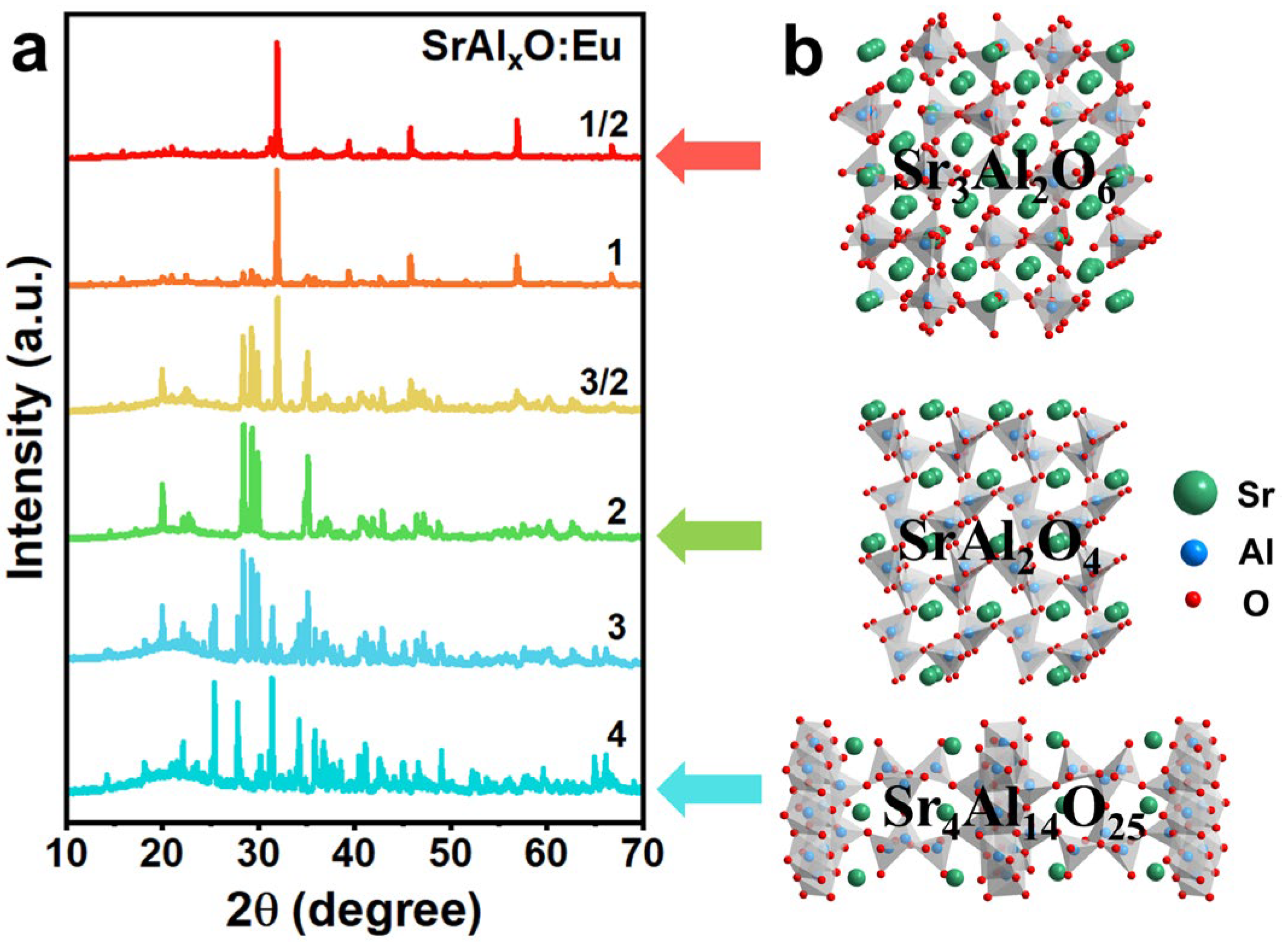
x = 1/2–4 in the reactants, 2 at% Eu doping) and characterized their crystal structures by XRD. As shown in
Figure 1a, changing the Al/Sr ratio causes an evolution of the crystalline phase. The
x = 1/2 sample’s diffraction peaks match the cubic-phase Sr
3Al
2O
6 (
Figure S1a). In cubic Sr
3Al
2O
6 (space group
Pa3), Al
3+ ions are tetrahedrally coordinated by O
2− (forming [AlO
4]
5− units) [
33]. The
x = 2 composition yields diffraction peaks matching monoclinic SrAl
2O
4 (
Figure S1b). Monoclinic SrAl
2O
4 (space group
P2
1) consists of vertex-sharing [AlO
4]
5− tetrahedra forming six-membered rings, with Sr
2+ ions situated in the ring cavities. The
x = 4 sample’s pattern matches orthorhombic Sr
4Al
14O
25 (
Figure S1c). Orthorhombic Sr
4Al
14O
25 (space group
Pmma) features alternating layers of [AlO
6]
9− octahedra and double layers of [AlO
4]
5− tetrahedra [
34]. In intermediate compositions, mixed phases occur: for
x = 1 and 3/2, the XRD reveals a two-phase mixture of Sr
3Al
2O
6 and SrAl
2O
4; for
x = 3, a mixture of SrAl
2O
4 and Sr
4Al
14O
25 is observed. These results demonstrate that by adjusting the Al/Sr ratio in the precursor, one can effectively control the crystalline phase of Eu-doped strontium aluminate phosphors.
Figure 1b presents the crystal structures of the three end-member phases (Sr
3Al
2O
6, SrAl
2O
4, Sr
4Al
14O
25) for visual comparison. The ability to host Eu in these lattices without altering the phase is evidenced by the fact that doping ~2 at% Eu
3+ did not produce any secondary phase peaks in XRD (the patterns of Eu-doped samples align with the undoped standards; see
Figure S1). However, Eu doping strongly influences the photoluminescent properties of each phase.
Table S1 lists the ionic radii of relevant cations: Eu
2+ (1.20 Å) is almost the same size as Sr
2+ (1.18 Å), while Eu
3+ is smaller (0.95 Å). This size matching means Eu
2+ will preferentially occupy Sr
2+ sites in the lattice. Under UV excitation, Eu dopants can be excited (Eu
3+ through charge-transfer bands or f–f transitions; Eu
2+ through 4f–5d transitions) and then emit light upon relaxation. The inserted photographs in
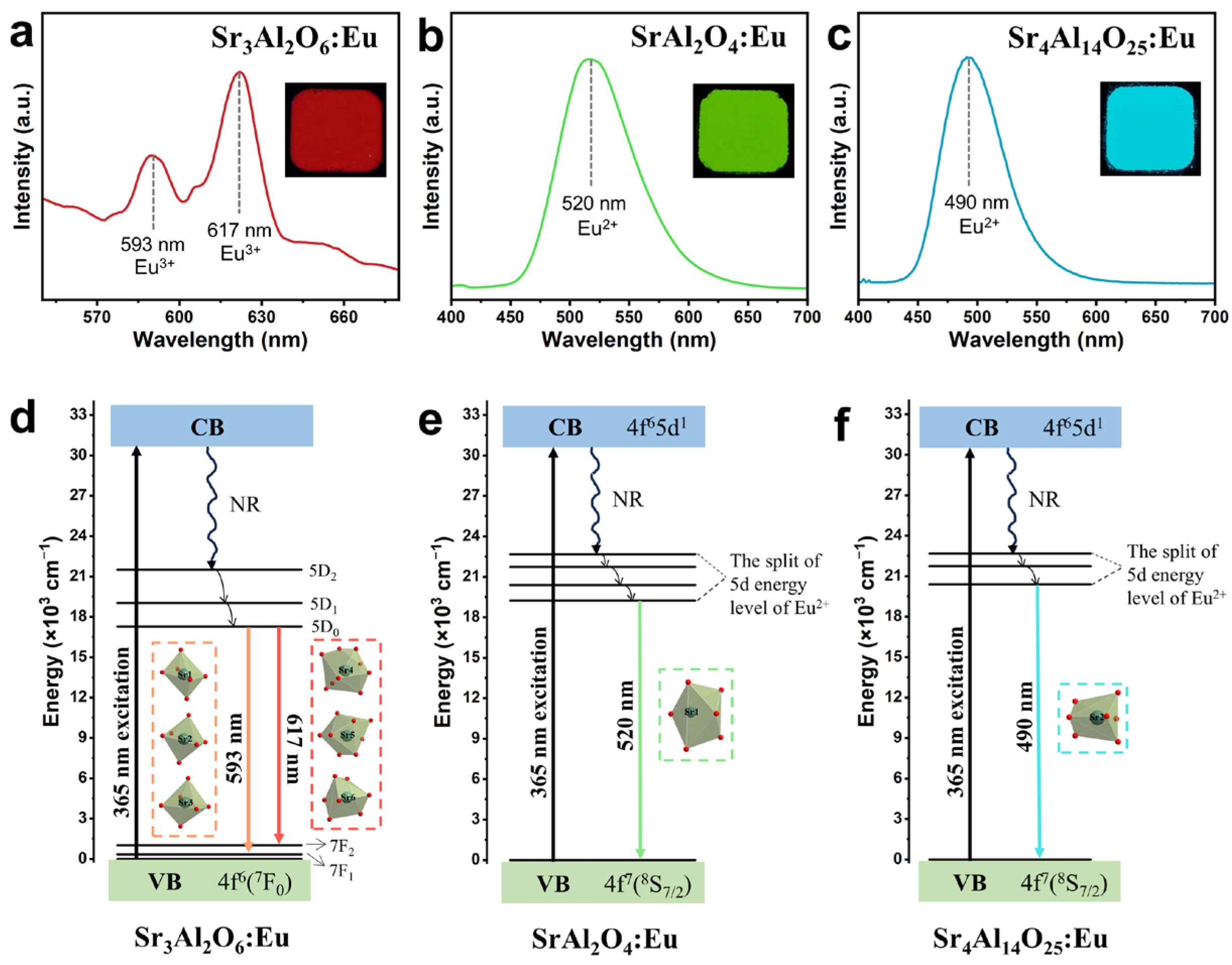
Figure 2a show representative emission colors of three phosphors (
x = 1/2, 2, 4) under a 365 nm UV lamp. The Sr
3Al
2O
6:Eu sample (
x = 1/2) glows red, SrAl
2O
4:Eu (
x = 2) glows green and Sr
4Al
14O
25:Eu (
x = 4) glows blue. Therefore, by changing
x, we achieve a continuous progression of emission hue from red to green to blue in this series. The corresponding PL emission spectra (
Figure 2a) were recorded under 365 nm excitation for those three samples. Consistent with the observed colors, Sr
3Al
2O
6:Eu (
x = 1/2) shows dominant emission peaks in the orange–red region (~593 nm and 617 nm, characteristic of Eu
3+ 5D
0 →
7F
1 and
5D
0 →
7F
2 transitions, respectively). SrAl
2O
4:Eu (
x = 2) exhibits a broad green emission band peaking at ~520 nm, typical of Eu
2+ 4f
65d
1 → 4f
7 transitions in that host. Sr
4Al
14O
25:Eu (
x = 4) shows a broad blue–green emission peaking at ~490 nm (Eu
2+ emission in that host). A clear blue shift of the dominant emission is evident as
x increases: roughly 617 nm (red) → 520 nm (green) → 490 nm (blue). We also measured the absolute quantum yield (AQY) of these samples. Using an integrating sphere, the AQYs for Sr
3Al
2O
6:Eu, SrAl
2O
4:Eu and Sr
4Al
14O
25:Eu were determined to be 9.7%, 46.5% and 29.9%, respectively (
Figure S2 and Table S2). Thus, the SrAl
2O
4:Eu (
x = 2) composition achieves a notably higher efficiency under 365 nm excitation than the other phases.
To understand the origin of emission color differences, we focus on Eu valence, Sr site occupancy, and local crystal-field effects, which together determine the luminescence mechanism.
Figure 2d–f schematically illustrates the luminescence processes in the three host phases. Eu
3+ emission is strongly governed by local site symmetry. In sites with inversion symmetry (Sr1, Sr2, Sr3), the magnetic-dipole
5D
0 →
7F
1 (orange) transition dominates; in non-centrosymmetric sites (Sr4, Sr5, Sr6), the electric dipole
5D
0 →
7F
2 transition (red) is significantly enhanced [
35]. The observed mix of orange (~593 nm) and red (~617 nm) in Sr
3Al
2O
6:Eu thus indicates Eu
3+ distribution over multiple sites. For Eu
2+, emission originates from 4f
6 5d
1 → 4f
7 transitions and is controlled by crystal-field splitting. In SrAl
2O
4 (
Figure 2e), there are two inequivalent Sr
2+ sites: one six-coordinated (Sr1, average Sr-O ~2.70 Å) and one seven-coordinated (Sr2, ~2.67 Å). The dominant green emission at ~520 nm is attributed to Eu
2+ occupying the six-coordinate Sr1 site [
36]. In Sr
4Al
14O
25 (
Figure 2f), there are also two Sr sites: one ten-coordinated (Sr1, average Sr–O ~2.77 Å) and one seven-coordinated (Sr2, ~2.62 Å). The shorter Sr–O bonds at Sr2 create a stronger crystal field, splitting the Eu
2+ 5d levels more and leading to a lower-energy emission [
37]. The emission at ~490 nm (blue–green) is contributed by the Sr2 site. In short, the Al/Sr ratio controls crystal phase, Sr site geometry, and Eu valence/occupation, enabling continuous red–green–blue emission tuning.
Beyond crystal structure, morphology and composition uniformity can also impact luminescence.
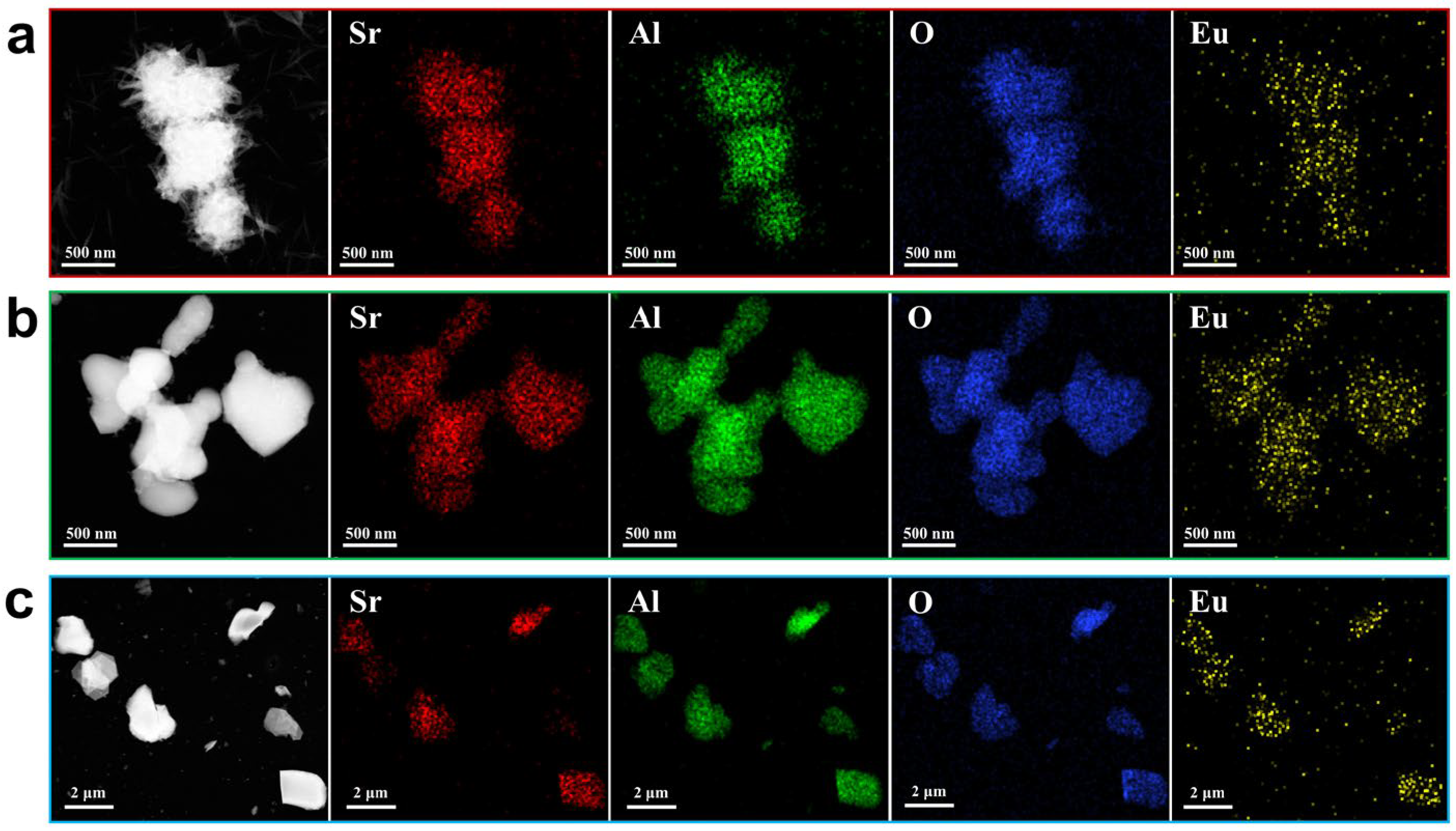
Figure 3 shows TEM images and EDS elemental mapping for representative phosphor particles from three samples (
x = 1/2, 2, 4). As seen in
Figure 3 and
Figure S3, all samples consist of irregularly shaped grains primarily 1–3 µm in size. The Sr
3Al
2O
6:Eu (
x = 1/2) sample exhibits a needle-like morphology, with the phosphor particles aggregated into this form [
38]. Furthermore, the SrAl
2O
4:Eu (
x = 2) sample is mainly composed of particles with a size less than 1 μm, and the Sr
4Al
14O
25:Eu sample exhibits an angular blocky morphology with an increased particle size compared to SrAl
2O
4:Eu. Despite these morphological differences, the EDS maps confirm that Eu is uniformly distributed in all the phosphor particles, with no evidence of Eu-rich clusters or phase segregation. The measured Al/Sr ratios from EDS align closely with the intended stoichiometries (
Figure S4), indicating good compositional control. In summary, composition tuning of the strontium aluminate host leads to distinct crystal phases and Eu site environments, which are the key to achieving a wide range of emission colors in this system.
3.2. Multicolored Luminescent Display and Anti-Counterfeiting Applications
With multicolor emission spanning red to blue available from the Eu-doped strontium aluminate series, we next demonstrate their use in luminescent displays for information encoding.
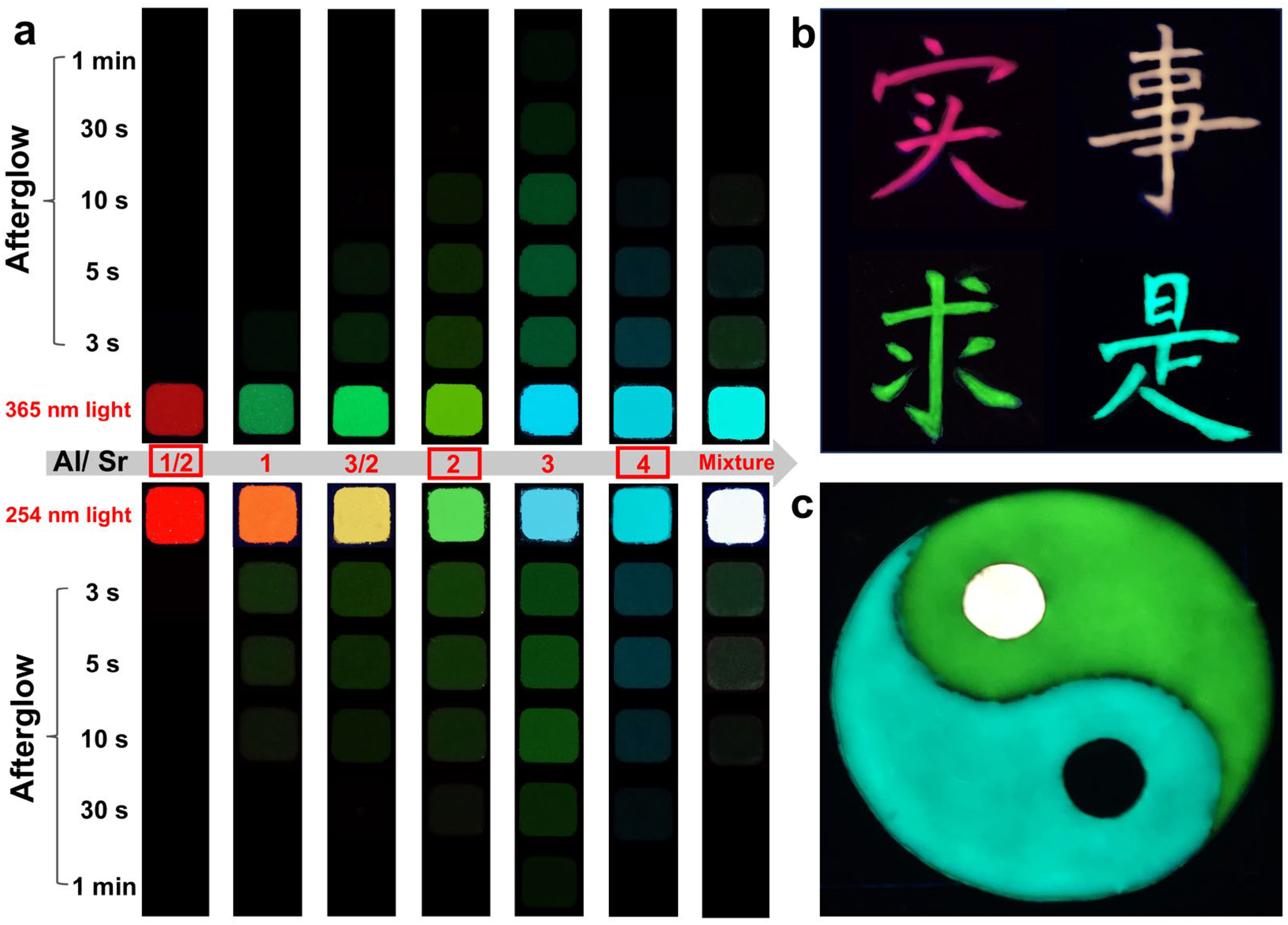
Figure 4a provides an overview of the photoluminescence behavior of the full series under two UV excitation wavelengths (254 nm and 365 nm). The bottom row of panel shows the emission from Eu-doped strontium aluminate powders (
x = 1/2 through 4) under 254 nm excitation, where a smooth progression of color is observed: as
x increases from 1/2 to 4, the emission color shifts from red → orange → yellow → green → cyan → blue. Under 365 nm excitation (top row of
Figure 4a), most compositions emit the same color or slightly dimmer (since 365 nm primarily excites Eu
2+), but interestingly, the
x = 1 and 3/2 samples appeared orange–yellow under 254 nm, compared with their green emission under 365 nm. This indicates their mixed Eu
2+/Eu
3+ character (as discussed in the next section). Additionally, by combining multiple phosphors, we can create white or custom colors: for example, a mixture of Eu-doped strontium aluminate (
x = 1/2, 2, 4) phosphors in a 22:1:1 ratio yields a near-white emission under 254 nm (due to the blend of red, green, and blue), while the same mixture appears blue under 365 nm (since the Eu
2+ emission dominates). Among all samples, the Eu-doped strontium aluminate (
x = 3) phosphor exhibited the longest afterglow (persistent phosphorescence) after the UV lamp was turned off, indicating excellent trap-mediated long decay, likely due to its mixed-phase nature (SrAl
2O
4 + Sr
4Al
14O
25), which can harbor effective trap centers [
20,
39]. The phosphorescence decay curves of the Eu-doped strontium aluminate phosphors (
x = 1/2–4), as shown in
Figure S5, are calculated by fitting a triple-exponential function, consistent with the decay trend recorded in
Figure 4a. The fitted parameters of the phosphorescence decay curves are recorded in
Table S3. Among these phosphors, the Eu-doped strontium aluminate phosphor (
x = 3) exhibits the longest afterglow time.
The rich luminescent colors of the
x = 1/2–4 phosphors provide an ideal material platform for exploiting luminescent display and anti-counterfeiting applications. To this end, we developed a luminescent ink using the phosphors as the luminescent filler. First, an epoxy–amine resin carrier solution was prepared by reacting the phenolic epoxy resin with (3-aminopropyl)triethoxysilane, as shown in
Figure S6a. Then, the luminescent ink was obtained by homogenously blending the PVP-modified phosphors into the epoxy resin carrier solution (at 20 wt% phosphor), as depicted in
Figure S6b. Owing to good uniformity and wettability, the resultant luminescent ink was readily applied with a paintbrush or pen for writing and drawing.
Figure 4b,c show two practical demonstrations of multicolor phosphor inks. In
Figure 4b, four Chinese characters (representing the motto of Tianjin University) were painted on paper using epoxy inks loaded with
x = 1/2 (red), 3/2 (yellow), 2 (green) and 4 (blue) phosphors. Under 254 nm UV illumination, the characters clearly emit in four different colors, corresponding to the chosen phosphor (the image was taken in a dark environment to emphasize the luminescence). In
Figure 4c, a Tai Chi diagram was drawn using inks with
x = 2 (green),
x = 4 (blue) and the white-emitting mixture phosphor. Under 254 nm excitation, the Tai Chi pattern is visible in multiple colors as intended. Intriguingly, when switching to 365 nm excitation, the diagram’s appearance changes because each region’s emission color (or brightness) is different at the longer wavelength: for instance, the region painted with the white-mixture phosphor emits blue under 365 nm instead of white. Additionally, the persistence (afterglow) of each phosphor differs; the region with the
x = 3 phosphor continues to glow the longest time after the UV is turned off. These features could be utilized for multi-layered security: information could be embedded not only in static colors but also in how the image evolves under different excitation wavelengths and in afterglow mode.
Overall, the rich palette of luminescent colors and afterglow behaviors offered by Eu-doped strontium aluminate phosphors provides an appealing platform for anti-counterfeiting inks and dynamic optical tags. The distinct response of each phosphor to different UV wavelengths (254 nm vs. 365 nm) and the presence of persistent luminescence (notably in x = 3) mean that multiple authentication steps can be integrated. For example, a security label could be verified by observing one pattern under a 254 nm lamp and a hidden pattern under a 365 nm lamp, as well as by checking for afterglow—features that are difficult to counterfeit with a single type of material. In the next section, we delve deeper into the photophysical properties underlying these behaviors, including excitation-dependent emission and the role of Eu valence states.
3.3. Spectroscopic Analysis and Excitation-Dependent Emission Behavior
The initial observations above suggest that some Eu-doped strontium aluminate compositions (especially those around
x ~1–3/2) exhibit excitation wavelength-dependent luminescence. We investigate this phenomenon in detail here, alongside optimizing dopant and flux levels for the best performance. First, we determined the optimal Eu doping concentration in the SrAl
2O
4 host (
x = 2, which gave the highest AQY among pure phases).
Figure S7 shows the PL emission intensity of SrAl
2O
4:Eu as a function of Eu doping (1/2–8 at%) under 254 nm excitation. The emission peak position remains ~520 nm for all doping levels (indicating the emission mechanism is unchanged), but the intensity increases with Eu content up to 2 at% and then decreases due to concentration quenching. Thus, 2 at% Eu is optimal for SrAl
2O
4, and we fixed 2 at% Eu for all Eu-doped strontium aluminate samples in this study. Similarly, we found that adding a small amount of H
3BO
3 flux improved crystallinity and luminescence, with an optimum at ~5 at% flux.
Figure S8 shows that 5 at% H
3BO
3 yields the highest PL intensity for SrAl
2O
4:Eu, whereas 0% or 10 at% flux results in weaker emission (too little flux yields incomplete crystallization; too much causes particle growth and reduced emission) [
39]. Therefore, in our final samples, we used 5 at% H
3BO
3 as a flux.
With these optimized conditions, we recorded detailed PL and PLE spectra for all compositions.
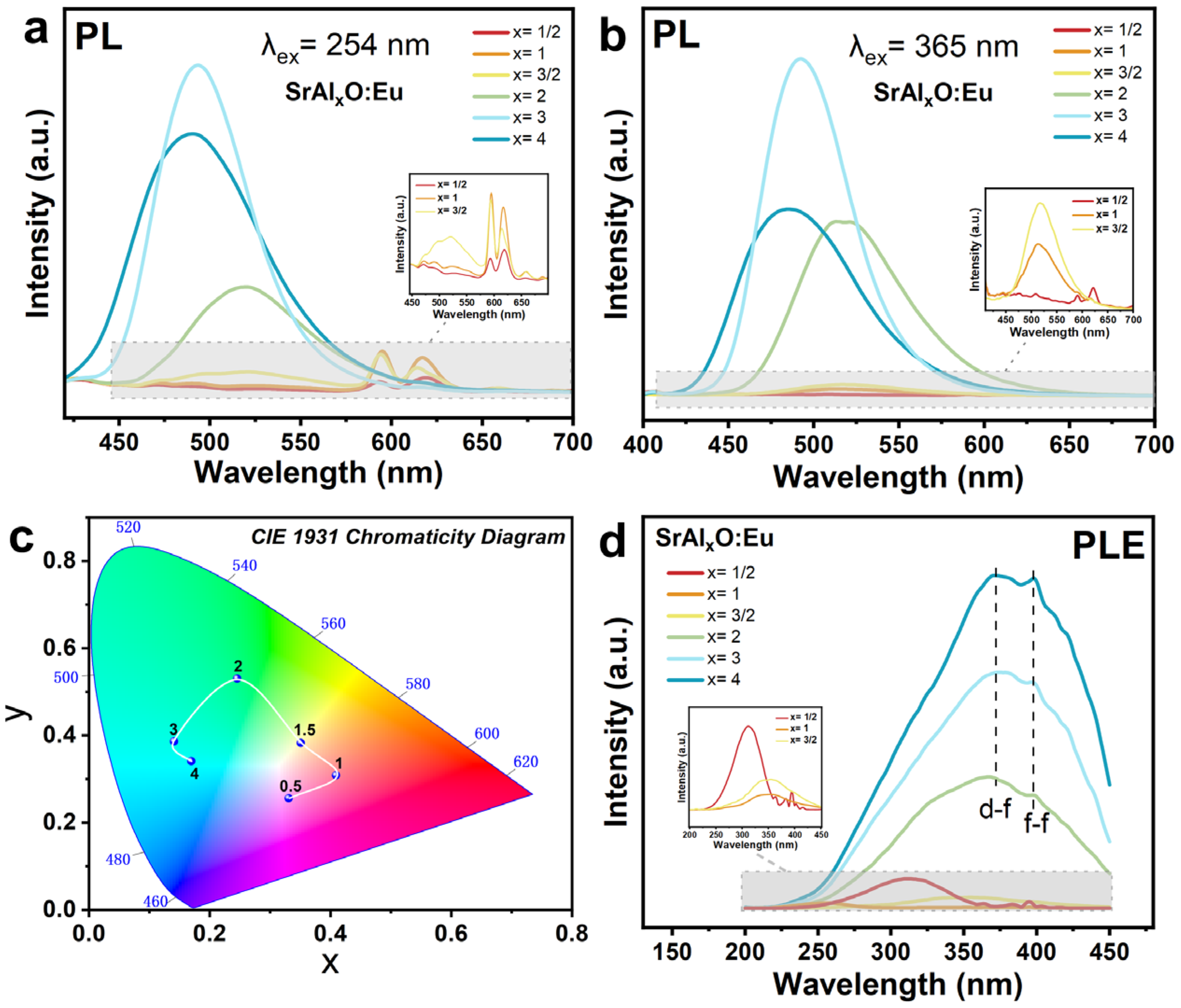
Figure 5a compares the PL spectra of Eu-doped strontium aluminate phosphors (
x = 1/2–4) under 254 nm excitation (which primarily excites Eu
3+ through charge transfer or higher 4f levels). For
x = 1/2, the emission consists of the Eu
3+ lines at ~593 nm and ~617 nm (orange and red). As
x increases to 1, the 593 nm (orange) line intensifies markedly, indicating a strong Eu
3+ 5D
0 →
7F
1 emission, while the 617 nm red line grows only modestly. At
x = 3/2, a broad green band (~520 nm) attributed to Eu
2+ appears and becomes dominant for
x = 2. At
x = 3, the Eu
2+ emission shifts toward ~490 nm (blue–green) and reaches maximum intensity; at
x = 4, the intensity drops slightly, and the peak remains ~490 nm (consistent with the Sr
4Al
14O
25 host). In summary, under 254 nm excitation, the emission evolves from primarily Eu
3+ (red/orange) in Al-poor phases to predominantly Eu
2+ (green/blue) in Al-rich phases.
By contrast,
Figure 5b shows the PL spectra under 365 nm excitation (which selectively excites Eu
2+ because 365 nm photons match Eu
2+ 4f–5d absorption but are too low in energy to significantly excite Eu
3+ from the ground state). Under 365 nm, the
x ≤ 3/2 samples exhibit very weak emissions (since Eu
3+ cannot be effectively excited and the Eu
2+ concentration is low in these samples). As
x increases beyond 3/2, the Eu
2+ emission grows; the brightest sample under 365 nm is again
x = 3, with strong ~490 nm emission. Notably, the spectra for
x = 3 and 4 under 365 nm look similar to those under 254 nm (dominated by Eu
2+ blue emission), whereas the spectra for
x = 1 and 3/2 differ drastically between 254 nm and 365 nm.
For example, the
x = 1 phosphor emitted mainly orange–red (Eu
3+) under 254 nm but emitted green (Eu
2+) under 365 nm, which explains the color change observed in
Figure 4a. This dual behavior is due to the presence of mixed-valence Eu in the phosphors: 254 nm light excites Eu
3+ (via O
2− → Eu
3+ charge-transfer band around 250–270 nm), leading to orange–red emission [
35], whereas 365 nm light directly excites Eu
2+ (4f
7 → 4f
65d
1), yielding green Eu
2+ emission. For
x = 3/2, a similar but less pronounced excitation-dependent color shift is seen (from yellowish under 254 nm to greener under 365 nm), indicating that both Eu
3+ and Eu
2+ contribute. To quantify the emission colors, we calculated the Commission Internationale de l’Éclairage (CIE) chromaticity coordinates for each composition’s emission under 254 nm [
40].
Figure 5c plots these coordinates on a standard CIE 1931 diagram. The trajectory clearly moves through red, orange, yellow, green to blue as
x increases. The specific (x,y) values are listed in
Table S4. This confirms that continuous color tuning has been achieved in this series, a critical property for applications in display and lighting technologies.
To understand the luminescence more scientifically, we measured the PLE spectra (
Figure 5d) and PL spectra (
Figure S9) of the phosphors at the optimal emission and excitation wavelengths, respectively. For
x = 1/2, a broad excitation band peaking at ~312 nm is observed (this is an Eu
3+ charge-transfer band; O
2− → Eu
3+) [
35,
41]. As
x increases to 1 and 3/2, the optimal excitation shifts to longer UV (~350–355 nm). For
x = 2, 3 and 4, the excitation peaks are around 365 nm and 374 nm, which correspond to Eu
2+ 4f–5d transitions. These align well with the diffuse reflectance data:
Figure S10 shows that the undoped strontium aluminate hosts all have a fundamental absorption edge near ~230 nm, but the Eu-doped samples exhibit an absorption tail extending further into the UV as
x increases (reaching ~410 nm for
x = 4). This red-shift of the absorption edge/bandgap with higher Al content (
x) is also reflected in the Tauc plot analysis of optical bandgaps (
Figure S11) [
42]: the bandgap (E
g) narrows from ~4.86 eV at
x = 1/2 to ~2.70 eV at
x = 4. The incorporation of more Al likely introduces defect levels or alters the lattice enough to allow Eu
2+ 5d states to be stabilized at lower energies, hence absorbing longer wavelengths. In summary, the excitation spectra and emission behavior highlight a key advantage of the Eu-doped strontium aluminate system: by selecting the excitation wavelength, one can further tune the output color for certain compositions. This is especially pronounced for the
x ~1–3/2 compositions where both Eu
2+ and Eu
3+ are present. Such excitation-dependent color switching is valuable for applications like dynamic displays or sensors that respond differently to two excitation sources.
To illustrate this, we focus on the Eu-doped strontium aluminate (
x = 1) phosphor that contains a mixed phase (Sr
3Al
2O
6 + SrAl
2O
4) and mixed-valence Eu.
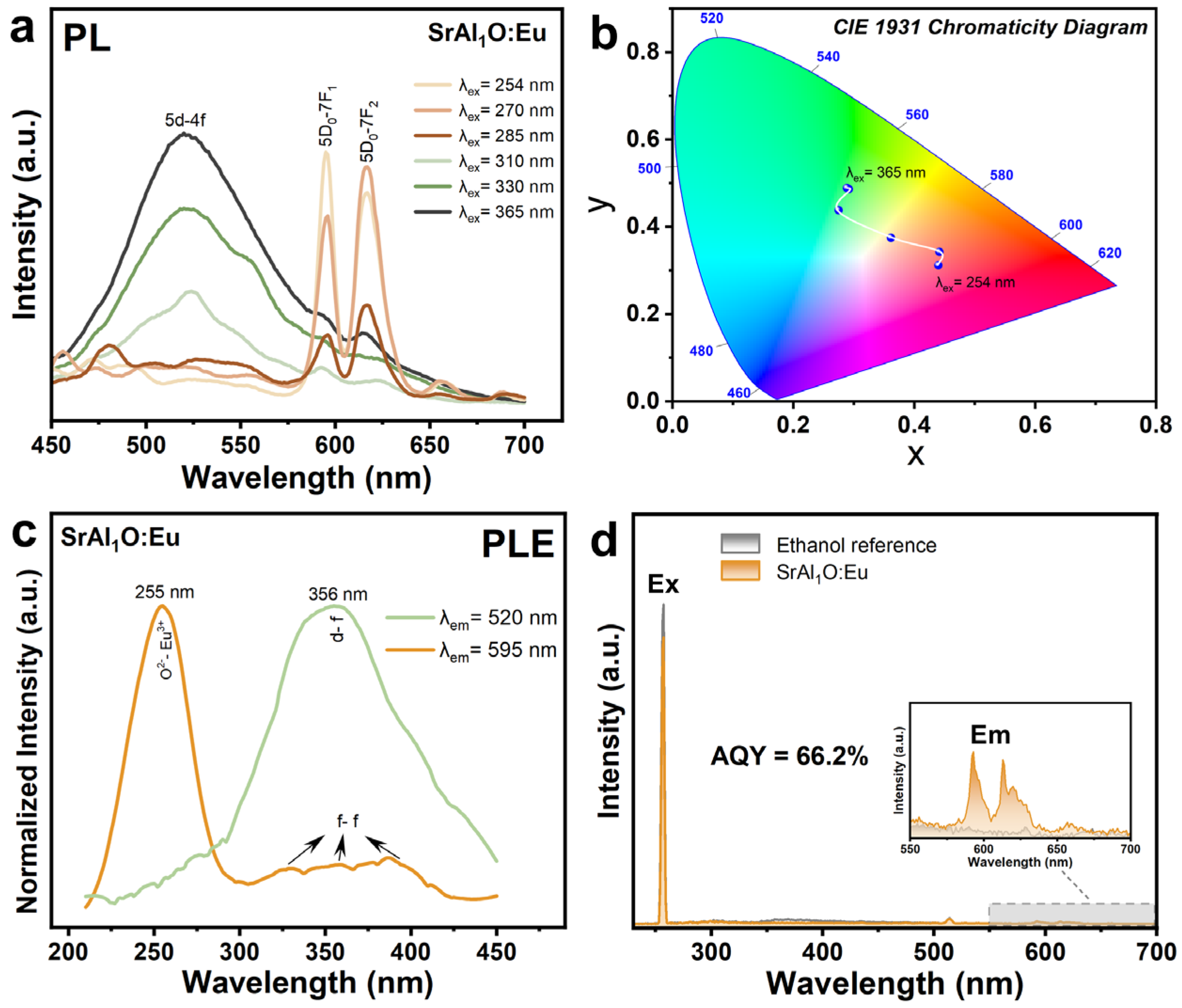
Figure 6a shows its emission spectra under a series of excitation wavelengths from 254 nm to 365 nm. At 254, 270 and 285 nm (short-UV), the spectrum is dominated by Eu
3+ emissions at 593 and 617 nm (red–orange). At longer excitations (310, 330 and 365 nm), a broad Eu
2+ emission band (~520 nm) emerges and eventually dominates, while the Eu
3+ peaks diminish. The gradual shift in color is visualized in the CIE plot in
Figure 6b, where the coordinate moves from the red region (under 254 nm) to green (under 365 nm). The corresponding CIE coordinates are listed in
Table S5. This behavior is due to the differential excitation of Eu
3+ vs. Eu
2+, as discussed above. It also provides insight into Eu
3+ site symmetry: for example, the relative intensity of the Eu
3+ 593 nm vs. 617 nm lines changes with excitation wavelength. We observe that 254 nm excitation yields a higher 593/617 ratio than 270 nm excitation, implying that at slightly different excitation energies, Eu
3+ ions at different lattice sites (with slightly different environments) are preferentially excited [
41]. This subtle effect reflects the presence of multiple distinct Eu
3+ sites (Site A with inversion symmetry; Site B without, as depicted earlier in
Figure 2d). In essence, the Eu-doped strontium aluminate (
x = 1) phosphor acts as a responsive multicolor phosphor, changing its emission color depending on the excitation source.
The excitation spectra corresponding to different emission bands further clarify the valence-selective excitation behavior of Eu ions in the
x = 1 phosphor (
Figure 6c). For the 520 nm emission, the excitation profile exhibits a broad band centered at ~365 nm, which is characteristic of the allowed 4f
65d
1 → 4f
7 transition of Eu
2+. In contrast, when monitoring the 595 nm emission, the excitation spectrum contains a strong band centered at ~255 nm, together with several weaker features in the 300–400 nm region. The ~255 nm band is assigned to the charge-transfer band (CTB) from O
2− 2p orbitals to the partially filled 4f
6 levels of Eu
3+, whereas the weaker bands originate from parity-forbidden 4f-4f transitions of Eu
3+ [
35,
41]. At high-energy excitation (λ < 285 nm), photons readily excite the CTB of Eu
3+, enabling efficient electron transfer from O
2− to Eu
3+ and thus promoting Eu
3+ emission. In the long-wavelength UV region (310–365 nm), the photon energy is insufficient to activate the CTB or higher-lying 4f-4f transitions of Eu
3+, but it aligns well with the 4f
65d
1 excitation energy of Eu
2+, thereby effectively triggering the broad-band Eu
2+ emission. Because the excitation features of Eu
2+ and Eu
3+ exhibit negligible overlap across 210–450 nm, selective excitation becomes feasible, enabling continuous modulation of emission color by tuning the excitation wavelength.
Finally, among our samples, the Eu-doped strontium aluminate phosphor with
x = 1 stands out for its exceptionally high quantum efficiency. Under 365 nm excitation, it emits bright green light with an AQY of 66.2% (
Figure 6d), which is the highest value measured in this work. This AQY is substantially higher than those of the other compositions (
Figures S2 and S12), which range from only a few percent up to ~46% (e.g., SrAl
2O
4:Eu). To contextualize this performance, we compared our AQY values with the reported Eu-activated phosphors (both Eu
2+ and Eu
3+), as summarized in
Table S6. Notably, both SrAl
2O
4:2 at%Eu
2+ (green emission, AQY 46.5%) and the
x = 1 phosphor (high-efficiency emission, AQY 66.2%) rank among the top-performing Eu-doped phosphors in terms of quantum yield. By comparison, many Eu
2+-activated silicate or sulfide phosphors typically exhibit AQYs in the ~10–40% range, while Eu
3+-activated materials often remain below 50% [
43,
44,
45,
46]. Previous research has emphasized that the selection of the host matrix is crucial for achieving high quantum yield, as host materials with low phonon energy and high structural rigidity can effectively minimize non-radiative energy loss [
47,
48,
49]. The outstanding efficiency of the
x = 1 phosphor can be attributed to a favorable combination of activator behavior and host characteristics: the host lattice provides a rigid, low-vibrational environment that suppresses non-radiative relaxation, while the Eu-related emission pathways are well supported by the local coordination environment, enabling efficient radiative recombination. On the one hand, the mixed-phase (Sr
3Al
2O
6/SrAl
2O
4) strontium aluminate host is known to possess a rigid lattice with low phonon energy [
50,
51]. Low phonon energy is critical for suppressing non-radiative relaxation—high-frequency lattice vibrations, which dissipate excitation energy as heat instead of light, are effectively minimized by this structural feature. Similar to the coordination-induced structural rigidity strategy reported to enhance quantum efficiency in phosphorescent materials, the rigid lattice of our mixed-phase host inhibits lattice vibrations and reduces non-radiative decay pathways [
51]. On the other hand, the local coordination environment of Eu ions in the mixed-phase host provides moderate crystal field splitting of the Eu 4f and 5d orbitals. This moderate splitting optimizes the energy level matching between the excited and ground states of both Eu
2+ and Eu
3+, thereby promoting efficient radiative recombination [
52]. Specifically, the crystal field strength reduces the probability of non-radiative transitions (e.g., cross-relaxation between Eu ions) and enhances the radiative transition probabilities of Eu
2+ (4f
65d
1 → 4f
7) and Eu
3+ (
5D
0 →
7F
j), which can significantly improve quantum yield. This high AQY makes the
x = 1 Eu-doped strontium aluminate particularly promising not only for display and optical tagging, but also for luminescence-based sensing applications, as discussed in the following section.
3.4. Thermal Quenching and Luminescence Thermometry
For luminescent materials intended for practical use (e.g., LEDs, optical tags, or sensors), thermal stability of emission is a key performance parameter. We therefore examined the temperature-dependent PL behavior of our phosphors to assess how emission intensity and luminescence performance are preserved at elevated temperatures. As shown in
Figure S13, the emission spectra of three representative samples (Sr
3Al
2O
6:Eu, SrAl
2O
4:Eu and Sr
4Al
14O
25:Eu) were recorded from 300 K up to 570 K under 254 nm excitation. With increasing temperature, all three samples exhibit a gradual decrease in emission intensity due to thermal quenching, but the extent of quenching differs markedly among the phases. At 420 K, Sr
3Al
2O
6:Eu retained ~56% of its room-temperature intensity, whereas SrAl
2O
4:Eu dropped to ~40% and Sr
4Al
14O
25:Eu to ~20%. These results indicate that the Al-rich phases (higher
x) undergo substantially stronger thermal quenching and thus exhibit poorer emission stability at high temperature. At 570 K, Sr
3Al
2O
6:Eu still maintained ~17% of its initial intensity, while SrAl
2O
4:Eu and Sr
4Al
14O
25:Eu were nearly quenched. These results indicate that the Al-rich phases (higher
x) undergo substantially stronger thermal quenching and thus exhibit poorer emission stability at high temperature. The likely reason is that Al-rich lattices contain higher concentrations of defects (e.g., oxygen vacancies or disorder), which act as quenching centers. With increasing temperature, excited-state energy can migrate via these defect states and be non-radiatively deactivated, causing a rapid drop in luminescence [
53]. In contrast, the Sr
3Al
2O
6 host (lower Al content) appears to have fewer such quenching pathways, resulting in comparatively greater thermal robustness.
To further quantify the quenching behavior, we extracted the thermal activation energy (E
a) by fitting the integrated PL intensity as a function of temperature using an Arrhenius-type expression:
I(
T) =
I0/[1 +
Cexp (−E
a/
kT)] [
54]. The fitted results (insets of
Figure S13) yield E
a ≈ 0.22 eV for Sr
3Al
2O
6:Eu, 0.37 eV for SrAl
2O
4:Eu and 0.40 eV for Sr
4Al
14O
25:Eu. Although the Al-rich phases exhibit larger E
a values, their poorer thermal stability is not necessarily contradictory. Instead, it likely reflects different dominant quenching pathways: defect-mediated quenching in SrAl
2O
4 and Sr
4Al
14O
25 may involve higher barriers but also a much denser network of defect/trap states, enabling efficient non-radiative deactivation at relatively lower temperatures despite the larger apparent E
a [
55]. Overall, the key outcome is clear: emission retention decreases systematically with increasing Al content, highlighting the strong phase dependence of thermal quenching in this system.
Interestingly, the Eu-doped strontium aluminate phosphor with
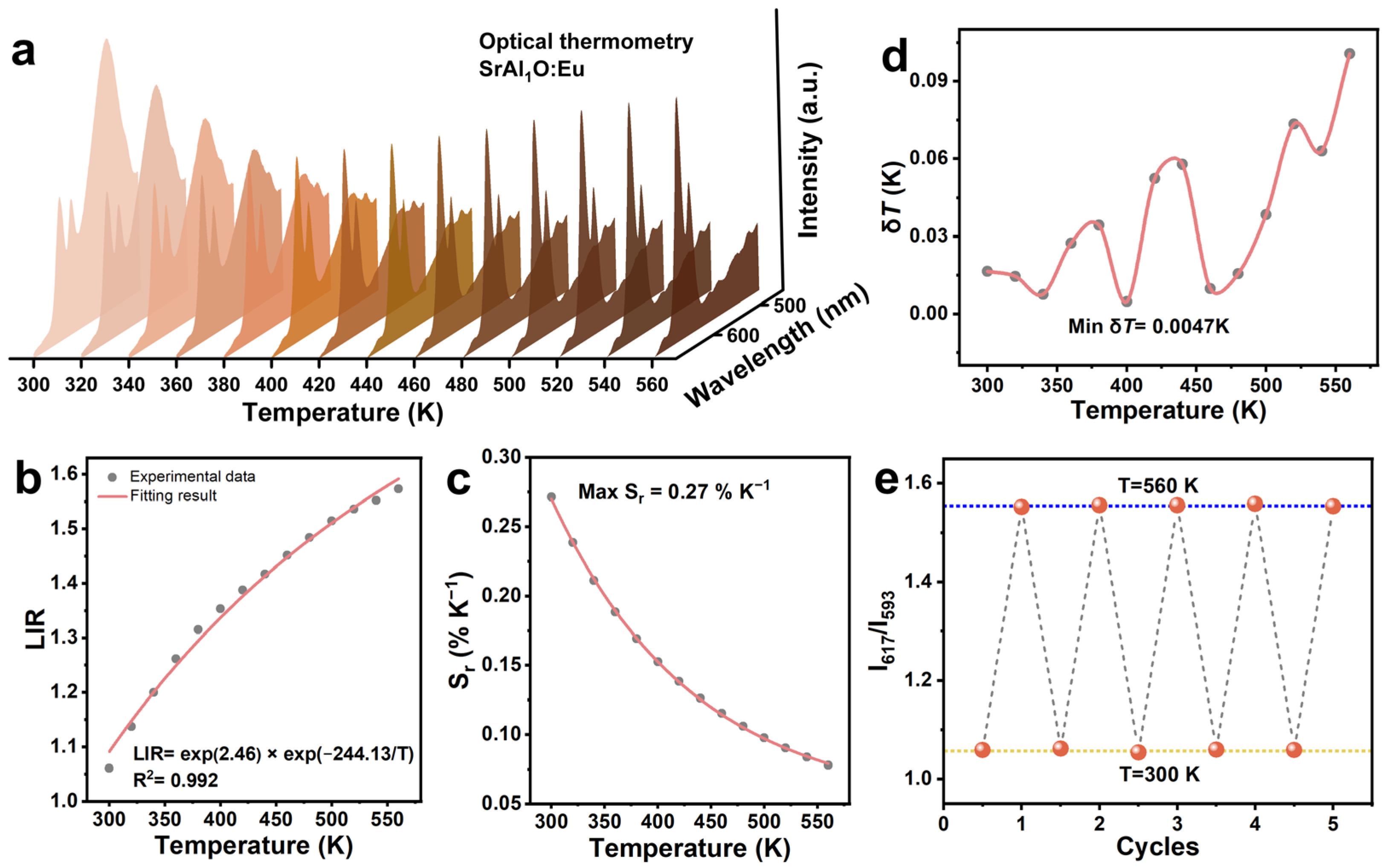
x = 1 exhibits an anomalous temperature response: rather than showing purely monotonic thermal quenching, its emission changes in character as the temperature increases. As shown in
Figure 7a, the emission spectra recorded from 300 K to 560 K under 300 nm excitation (to simultaneously excite both Eu
3+ and Eu
2+ contributions) reveal two opposing trends. With increasing temperature, the Eu
2+ broad-band emission centered at ~511 nm decreases to roughly 20% of its initial intensity, consistent with conventional thermal quenching. In contrast, the Eu
3+ line emissions at ~593 nm and ~617 nm become stronger as temperature rises: at 560 K, the 593 nm line increases to approximately 1.1×, and the 617 nm line to about 1.6×, relative to their intensities at 300 K. This counterintuitive enhancement in Eu
3+ emission is plausibly associated with thermally assisted energy transfer and trap-mediated feeding processes. At elevated temperatures, part of the excited-state energy of Eu
2+ (4f
65d
1) may be more efficiently transferred to nearby Eu
3+ centers (or Eu
3+-related trap states) prior to Eu
2+ radiative relaxation, thereby populating the Eu
3+ 5D
0 level and enhancing Eu
3+ emission. In addition, higher thermal energy can promote the release of trapped charge carriers that preferentially recombine through Eu
3+-associated pathways, further amplifying the Eu
3+ line intensities [
56,
57]. As a consequence, the overall emission color of the
x = 1 phosphor shifts toward a stronger Eu
3+ (red) contribution at higher temperatures.
This temperature-dependent redistribution of emission provides a useful basis for ratiometric optical thermometry using a luminescence intensity ratio (
LIR). We define the
LIR as
LIR =
I617/
I593, where I
617 and I
593 are the peak intensities of the Eu
3+ emissions at 617 nm (red) and 593 nm (orange), respectively. As shown in
Figure 7b, the
LIR increases from ~1.06 at 300 K to ~1.57 at 560 K, indicating a strong and monotonic temperature dependence. The experimental data can be empirically fitted by
LIR =
exp(2.46) ×
exp(−244.13/
T) (T in K), which can be linearized as ln(
I617/
I593) = 2.46 − 244.13(1/
T). Consistent with this,
Figure S14 shows a good linear relationship between ln(
LIR) and 1/
T over the 300–560 K range. Although the fitted slope (−244.13) can be converted into an apparent activation energy (~0.0209 eV), it is most appropriately interpreted here as a phenomenological calibration parameter rather than a direct representation of a single elementary process. Importantly, this calibration enables the temperature to be determined directly from a single emission spectrum via the measured
LIR, which is the fundamental operating principle of luminescence-based optical thermometry.
Two key performance metrics for luminescence-based optical thermometers are the relative sensitivity (
Sr) and the temperature uncertainty (
δT). The relative sensitivity quantifies the fractional change in the luminescence intensity ratio per unit temperature and is defined as
Sr = 1/
LIR·d(
LIR)/d
T. A larger
Sr indicates a stronger temperature response and therefore better sensing capability. The temperature uncertainty
δT reflects the smallest resolvable temperature variation and can be estimated by
δT = (
δ(
LIR)/
LIR)/
Sr, where
δ(
LIR)/
LIR represents the relative measurement error of the
LIR (typically obtained from repeated measurements) [
58,
59,
60]. We evaluated these parameters for the Eu-doped strontium aluminate phosphor (
x = 1). As shown in
Figure 7c,
Sᵣ exhibits a clear temperature dependence, increasing as temperature decreases, consistent with the stronger slope d(
LIR)/d
T at lower temperature. The maximum sensitivity reaches approximately 0.27% K
−1 at 300 K and remains on the order of 0.1–0.2% K
−1 throughout the 300–560 K range. These values are comparable to—and, in some cases, competitive with—many reported lanthanide-based thermometers (
Table S7), which demonstrates the great development potential of Eu-doped strontium aluminate phosphors in optical temperature sensing applications.
In parallel, the temperature uncertainty is exceptionally small. Using repeated measurements to determine
δ(
LIR), we find that
δT remains below 0.1 K across the full 300–560 K interval and reaches a minimum of approximately 0.0047 K near 400 K (
Figure 7d). This very low uncertainty reflects the excellent repeatability of the Eu
3+ emission intensities, in particular, the high reproducibility of the
I617/
I593 ratio with minimal fluctuation across measurements. We further assessed the cycling stability of the thermometer response. The sample was repeatedly heated and cooled between 300 K and 560 K for five cycles, and the
LIR was recorded at both temperature endpoints during each cycle. As shown in
Figure 7e, the
I617/
I593 ratio returns to essentially the same values in every cycle, with no detectable drift or degradation. Consistent with this, the post-cycling XRD pattern (
Figure S15) shows no new phases and no appreciable peak shifts, confirming that the host lattice remains structurally intact and does not undergo detectable thermal decomposition. Overall, these results demonstrate that the
x = 1 phosphor functions as an excellent photoluminescent temperature sensor in the 300–560 K range, combining high sensitivity, very low temperature uncertainty, and excellent reversibility and thermal robustness, all of which are essential for practical sensing applications.
3.5. Photothermal Conversion Under NIR Irradiation
Beyond their photoluminescent behavior, the Eu-doped strontium aluminate phosphors investigated here can also function as photothermal conversion materials. The Eu-related electronic states (involving 4f and 5d levels) enable light absorption extending into the NIR region. Upon NIR excitation, the absorbed energy can be dissipated through non-radiative relaxation pathways, leading to an increase in lattice vibrations and thus heat generation. Efficient NIR-to-heat conversion is attractive for a range of applications, including thermal imaging, photothermal therapy (subject to biocompatibility considerations), and solar/photothermal energy harvesting [
61,
62]. Accordingly, we evaluated the photothermal response of representative phosphors under 808 nm and 980 nm laser irradiation, as well as under simulated sunlight, following the procedures described in the Experimental
Section 2.
Among the compositions studied, the SrAl
2O
4:Eu phosphor (
x = 2) exhibits the most pronounced photothermal response.
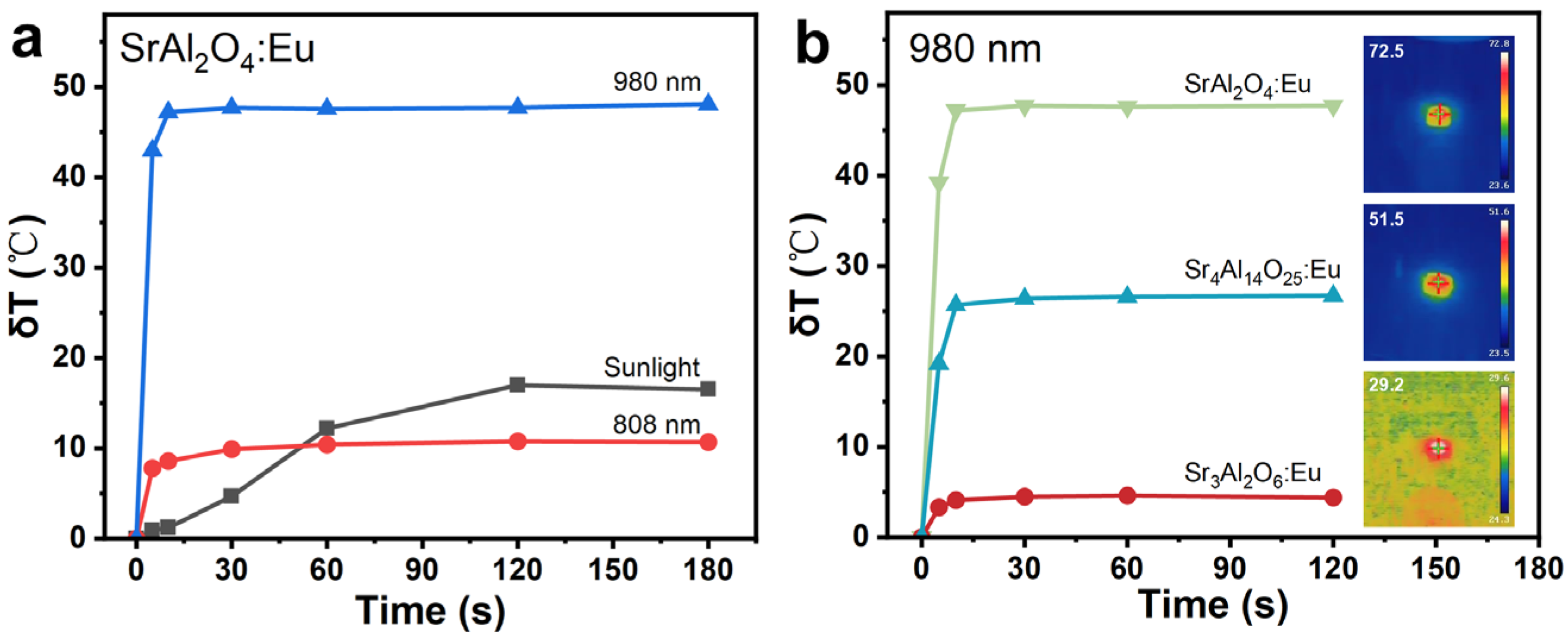
Figure 8a shows the net temperature rise (Δ
T) of SrAl
2O
4:Eu as a function of irradiation time under three excitation sources, each operated at the same power density (1 W·cm
−2): an 808 nm laser, a 980 nm laser and simulated solar illumination. Under 980 nm NIR irradiation, the sample heats rapidly and reaches a steady-state temperature increase of ΔT ≈ 48.0 °C, rising from ambient (~24 °C) to approximately 72 °C within ~10 s. By comparison, irradiation at 808 nm produces only a modest increase of ~10.7 °C within ~30 s, while simulated sunlight yields a moderate rise of ~16.5 °C within ~120 s under the same power density. These results indicate that SrAl
2O
4:Eu couples much more effectively to 980 nm photons, enabling efficient conversion of absorbed optical energy into heat, whereas absorption at 808 nm is significantly weaker. The intermediate response under simulated sunlight is expected, given its broad spectral distribution across the visible and NIR regions. The strong photothermal response under 980 nm excitation is particularly attractive from an application standpoint, since 980 nm is a widely used NIR wavelength with good penetration through many media (e.g., a biological window), enabling practical deployment in remotely triggered heating and related photothermal technologies.
We next compared the photothermal responses of different Eu-doped strontium aluminate compositions under 980 nm excitation since this wavelength produced the strongest heating effect.
Figure 8b shows the time-dependent temperature profiles of Sr
3Al
2O
6:Eu (
x = 1/2), SrAl
2O
4:Eu (
x = 2) and Sr
4Al
14O
25:Eu (
x = 4) under a 980 nm laser (1 W·cm
−2). A clear compositional dependence is observed. SrAl
2O
4:Eu reaches the highest steady-state temperature of approximately 72.5 °C (Δ
T ≈ 47.7 °C) within 10 s, whereas Sr
3Al
2O
6:Eu shows only a small temperature rise to ~29.2 °C (Δ
T ≈ 4.4 °C), and Sr
4Al
14O
25:Eu reaches ~51.5 °C (Δ
T ≈ 26.7 °C). The infrared thermal images (inset of
Figure 8b) further corroborate this trend, visually confirming that SrAl
2O
4:Eu heats much more strongly than the other phases under identical irradiation conditions. Collectively, these results identify the
x = 2 composition as the most efficient photothermal converter among the three representative phases.
The superior photothermal performance of SrAl
2O
4:Eu likely arises from a combination of optical absorption and non-radiative relaxation characteristics. Its moderate effective bandgap (~3.0 eV,
Figure S11) may support stronger NIR absorption through sub-bandgap tail states, Eu-related absorption features, and/or defect-assisted pathways while also providing efficient non-radiative channels for converting absorbed energy into lattice heat. By contrast, the Al-poor Sr
3Al
2O
6:Eu has a bandgap that is too wide (~4.86 eV) to absorb NIR efficiently, resulting in negligible heating. Although the Al-rich Sr
4Al
14O
25:Eu has a narrower bandgap (~2.7 eV), its excitation pathways and local environment may favor radiative emission more strongly, reducing the fraction of absorbed energy converted to heat. In this context, SrAl
2O
4:Eu appears to offer an optimal balance—sufficient NIR coupling combined with effective phonon-mediated dissipation—leading to the highest temperature rise. From an application perspective, the rapid and substantial heating achieved by SrAl
2O
4:Eu under 980 nm excitation shows strong potential for NIR-triggered photothermal coatings and devices. Moreover, because SrAl
2O
4:Eu can also exhibit luminescent responses under NIR excitation, this material system may enable integrated photothermal and photoluminescent readouts, offering a route toward multifunctional sensing and smart thermal-response platforms.