Fractographic Analysis and Fatigue Crack Propagation Behavior of TC4-F Alloy with a Duplex Microstructure

Abstract
1. Introduction
2. Materials and Methods
2.1. Material
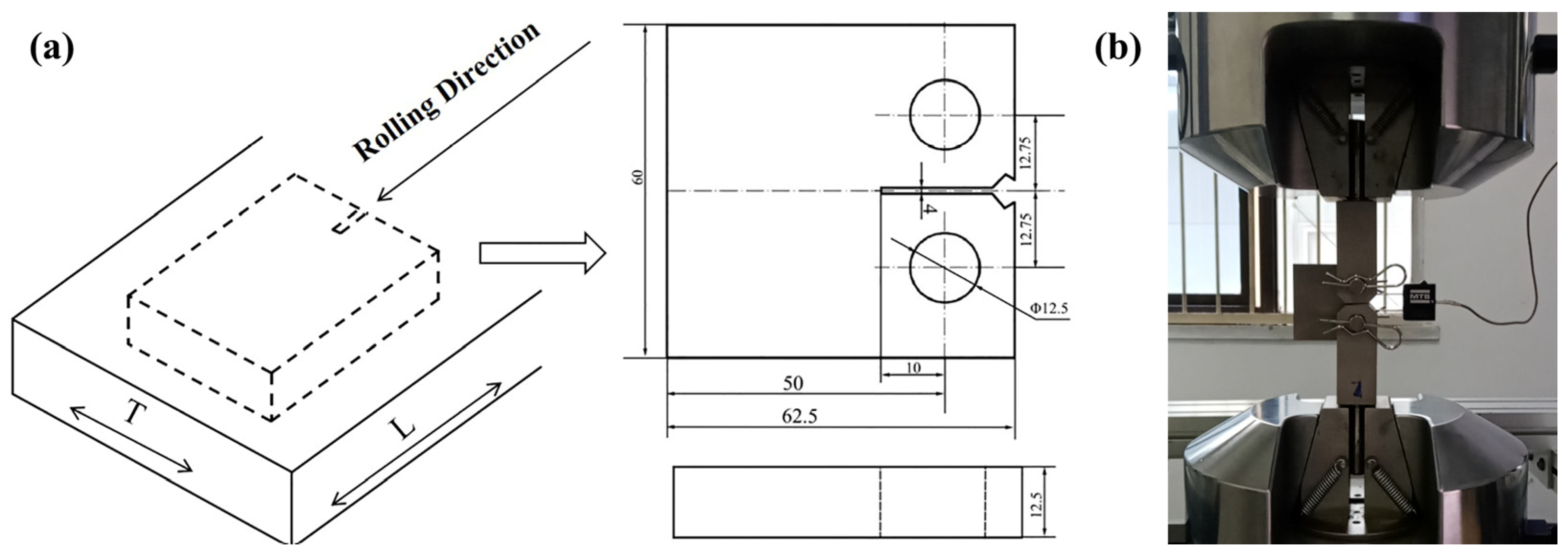
2.2. Fatigue Crack Propagation Tests
2.3. Microstructure Characterization
3. Results
3.1. Microstructure
3.2. Fatigue Crack Propagation Rates
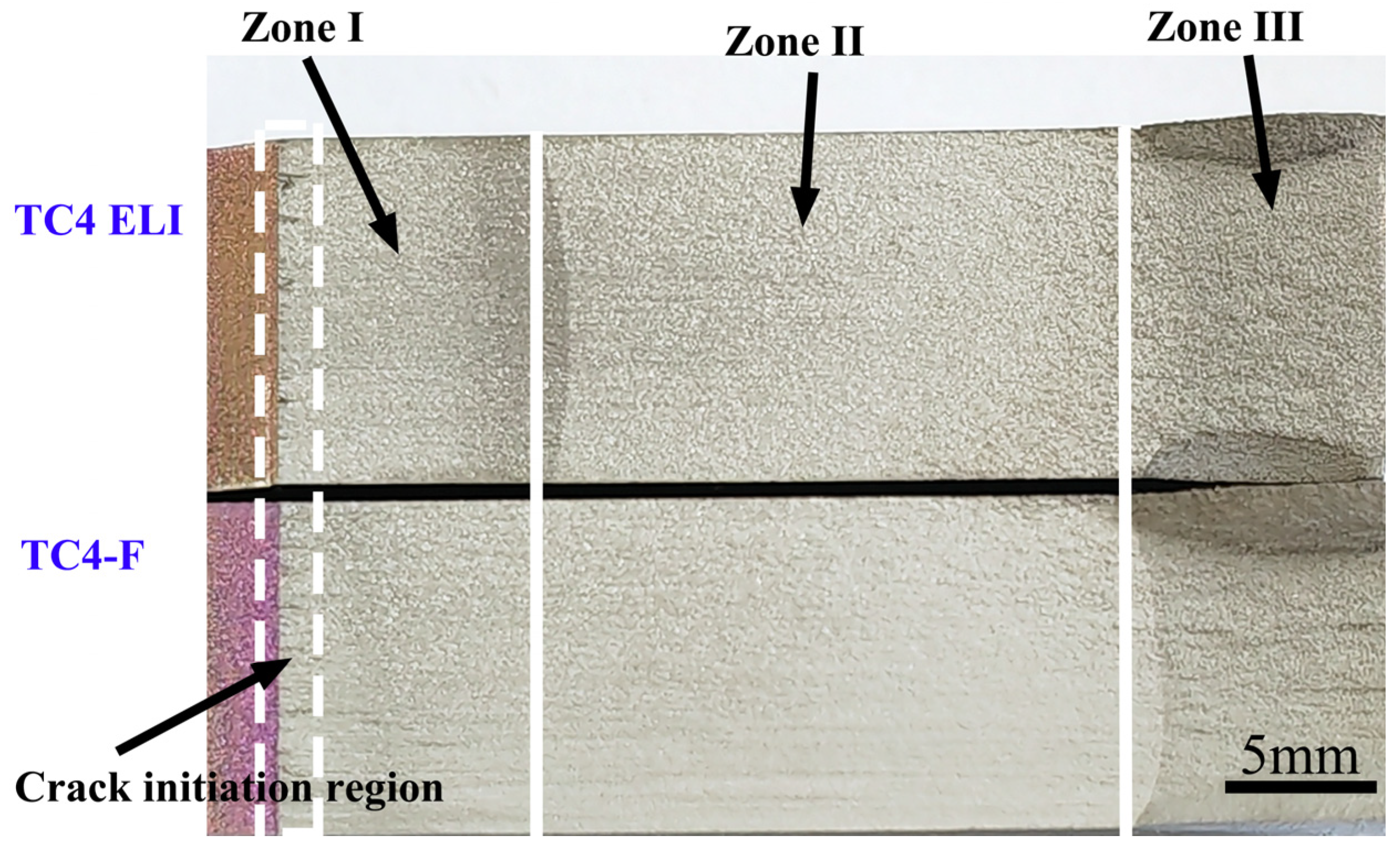
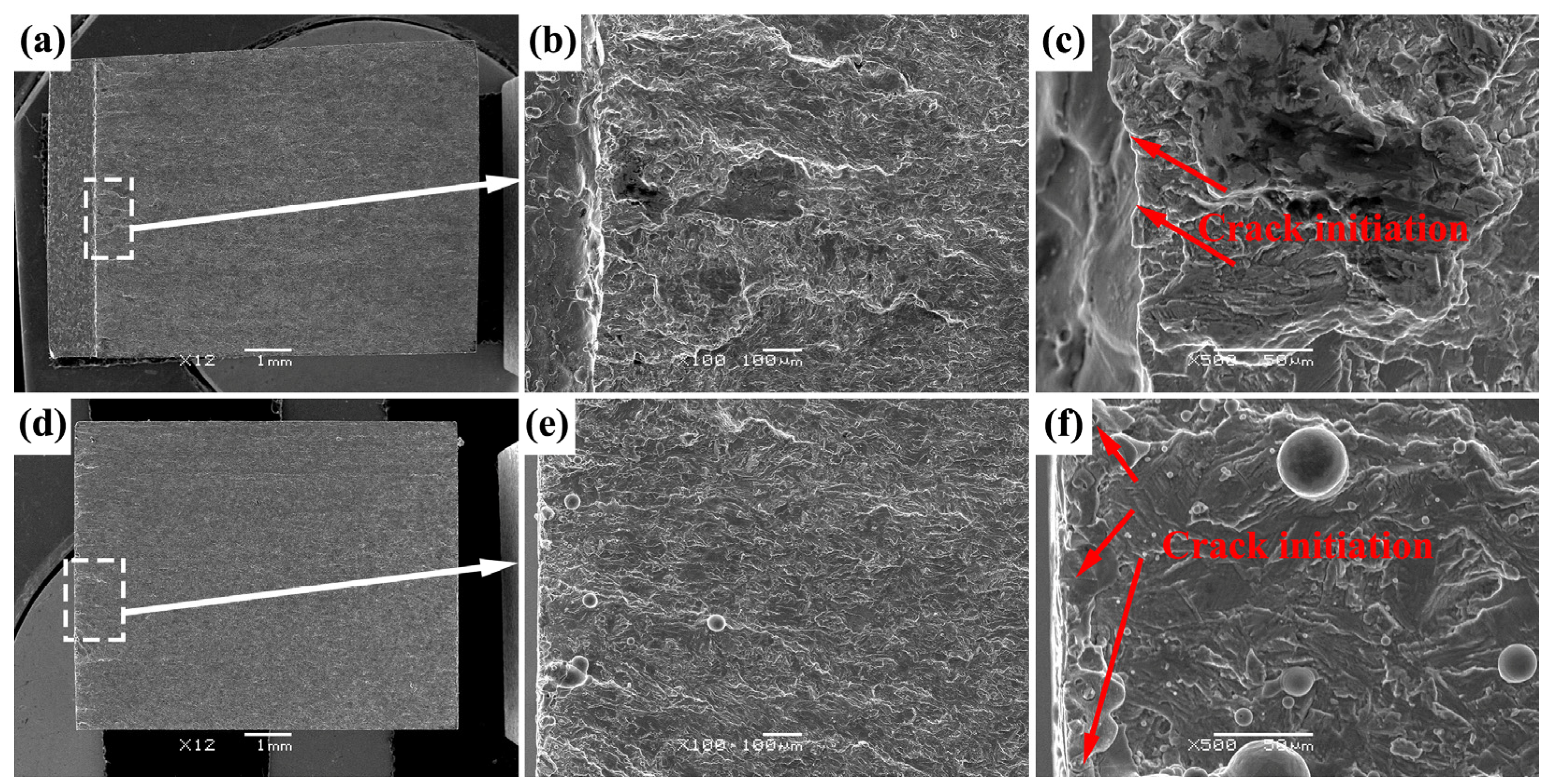
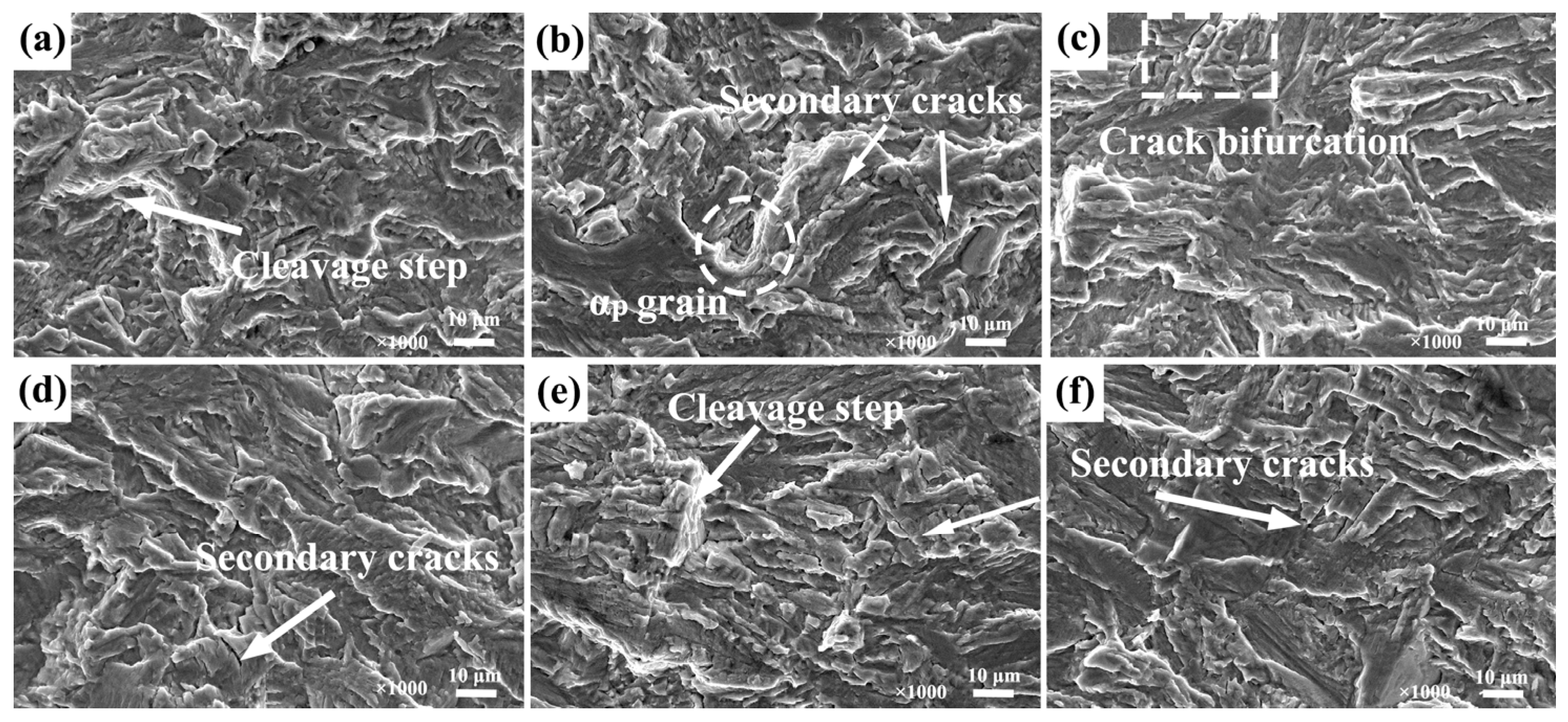
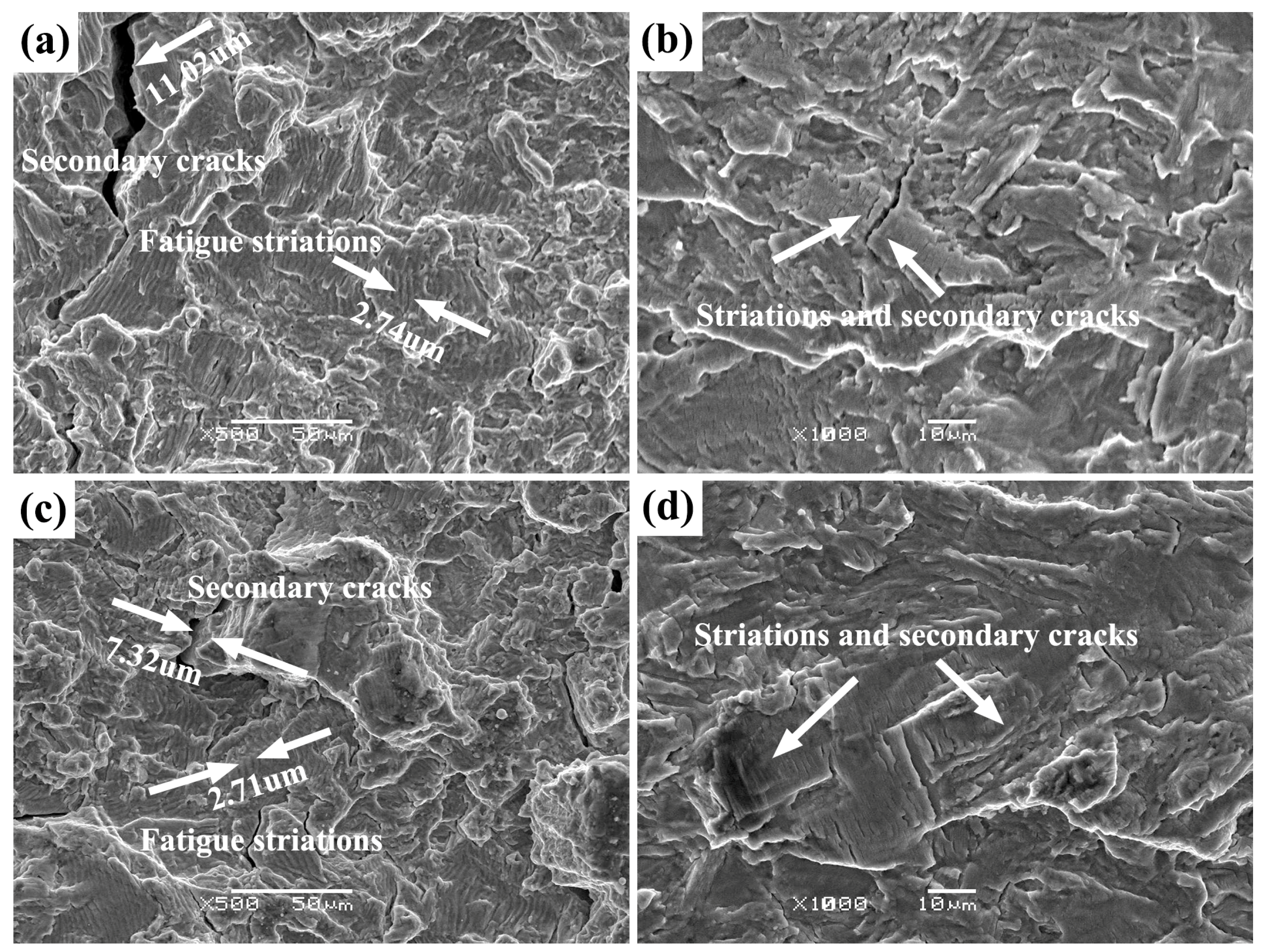
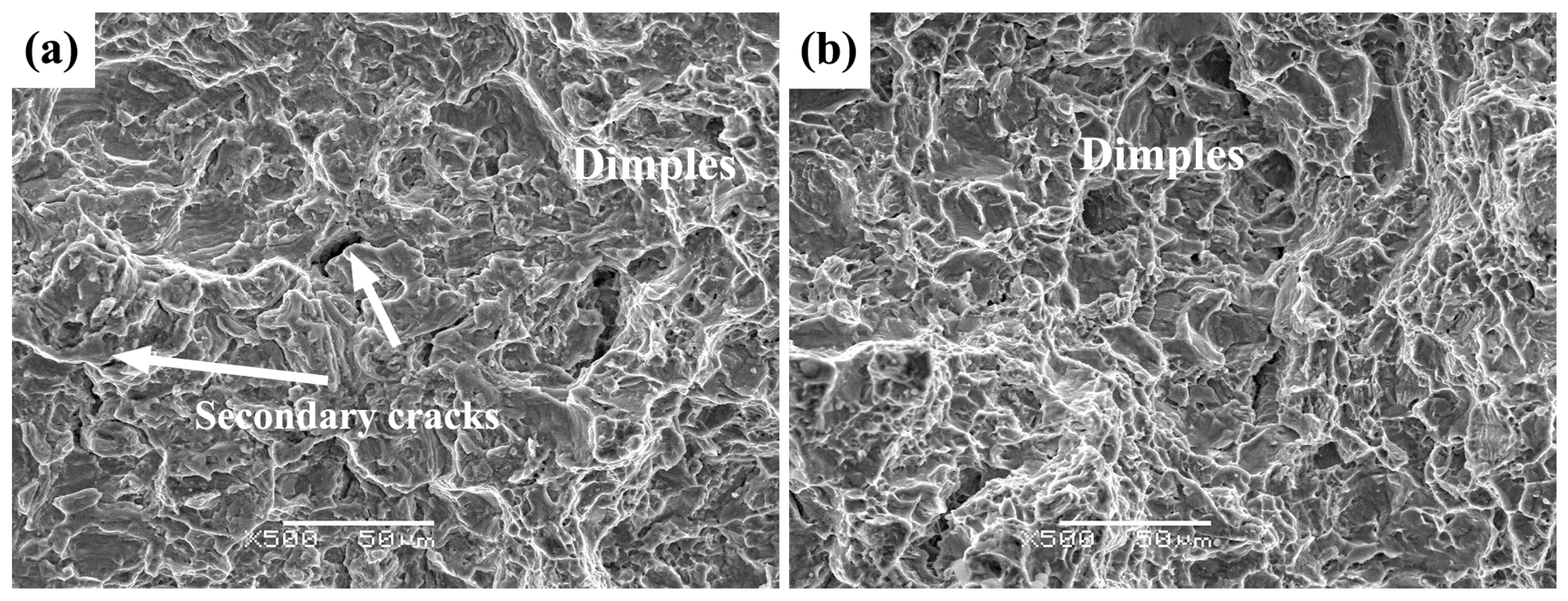
3.3. Fracture Characteristics
- (1)
- Zone I
- (2)
- Zone II
- (3)
- Zone III
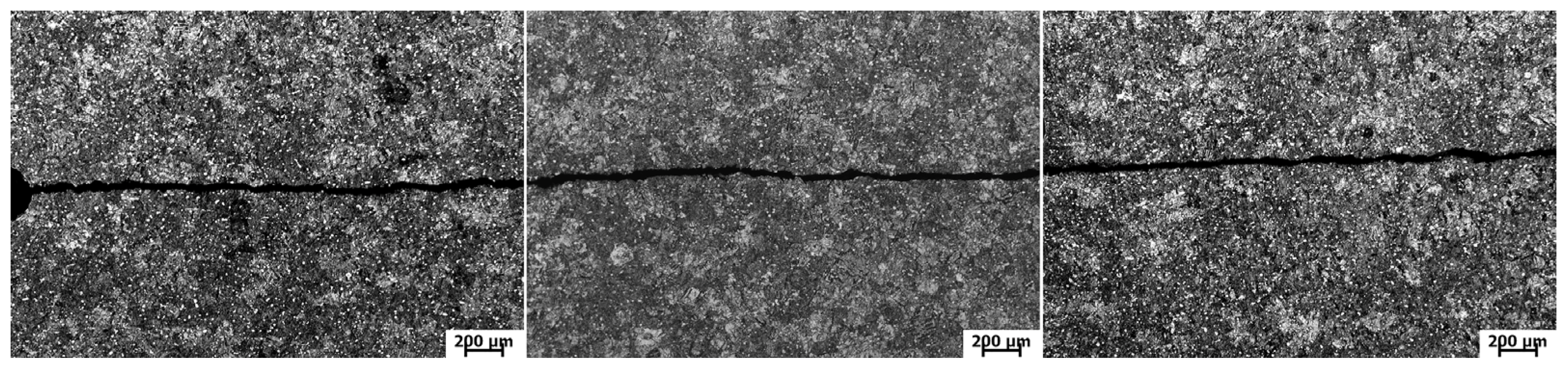
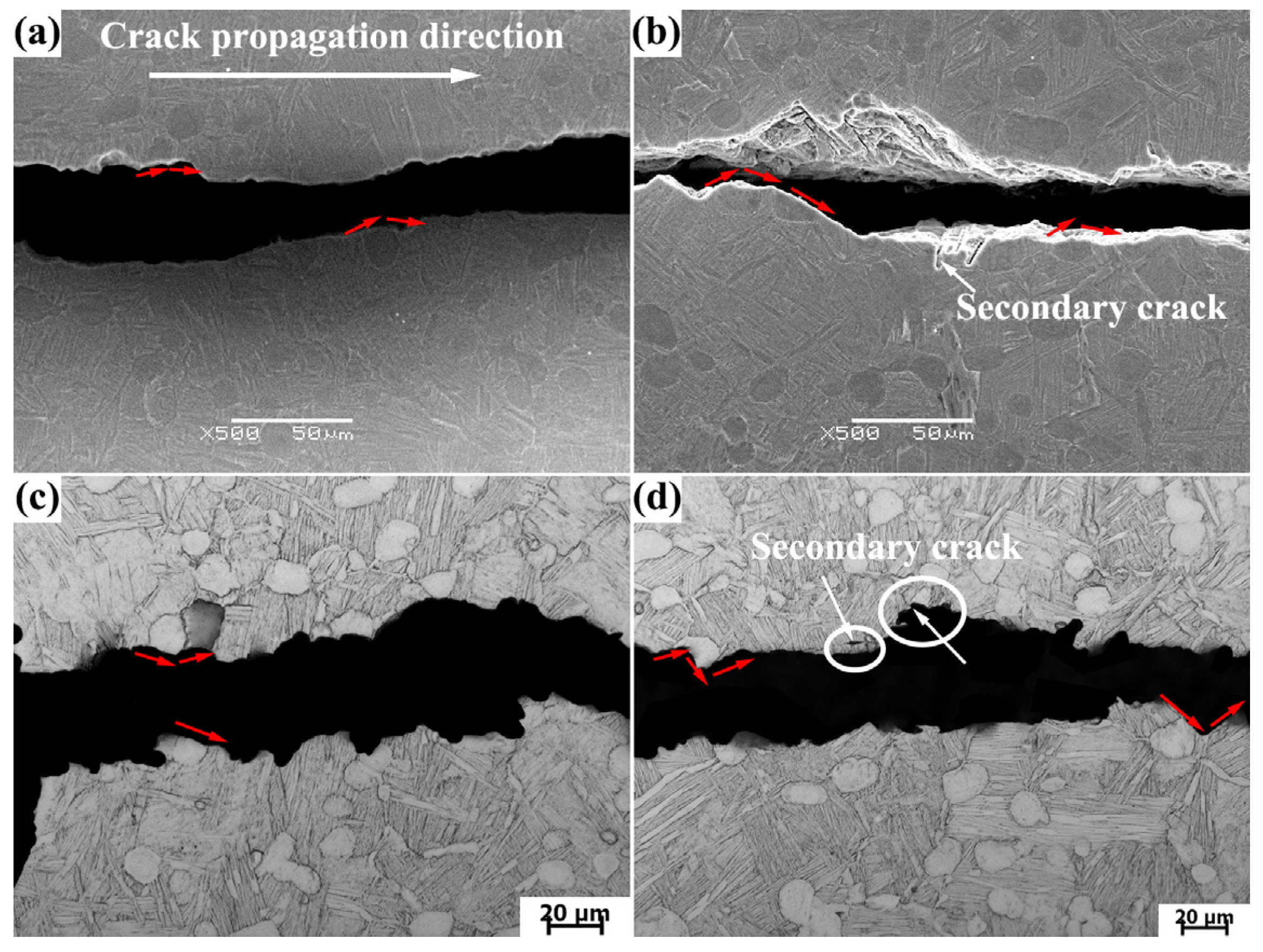
3.4. FCP Path of TC4-F Alloy
4. Discussion
5. Conclusions
- (1)
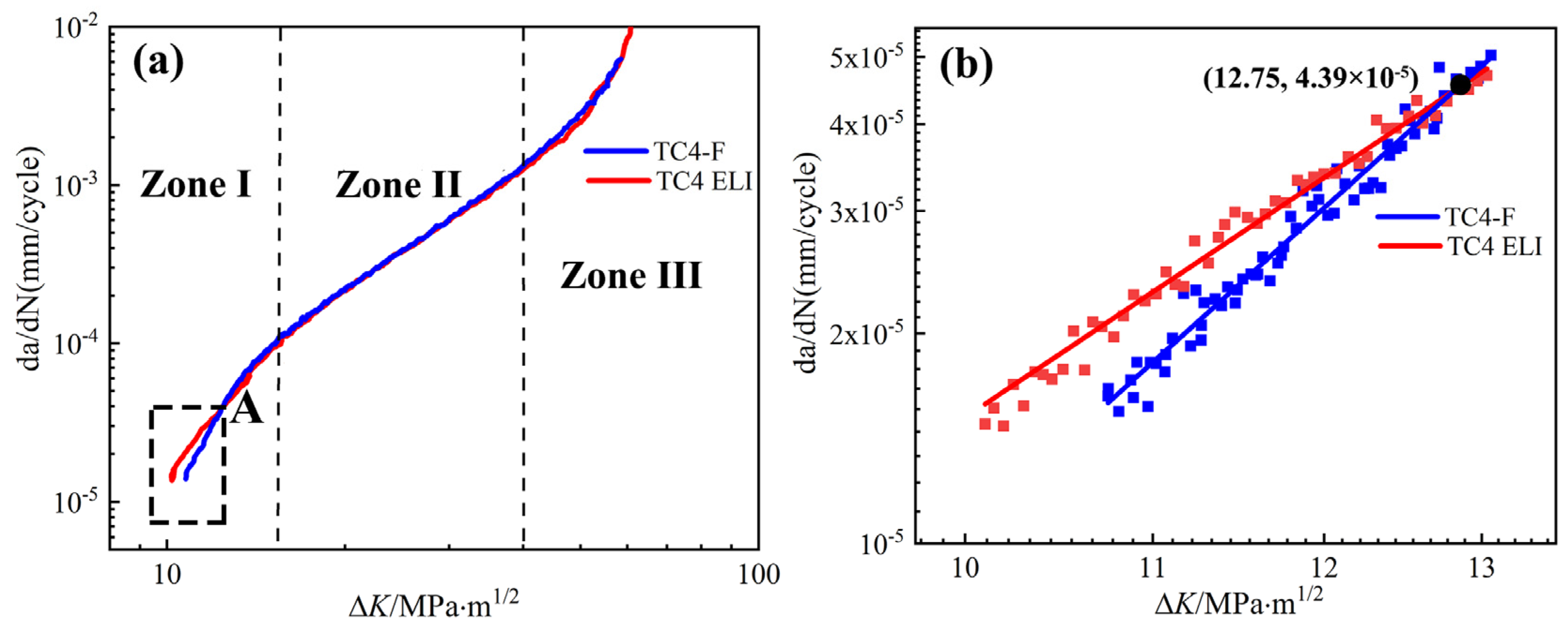
- When ∆K < 12.75 MPa⋅m1/2, the da/dN curves show that TC4-F owns lower fatigue crack-propagation rate. But when ∆K > 12.75 MPa⋅m1/2, the da/dN curves of the two alloys are almost overlapping.
- (2)
- The fracture could be divided into three parts, reflecting the different stages of crack propagation. And the main differences in fracture characteristics between TC4-F and TC4 ELI alloys mainly focus on Zone I, showing a rough section.
- (3)
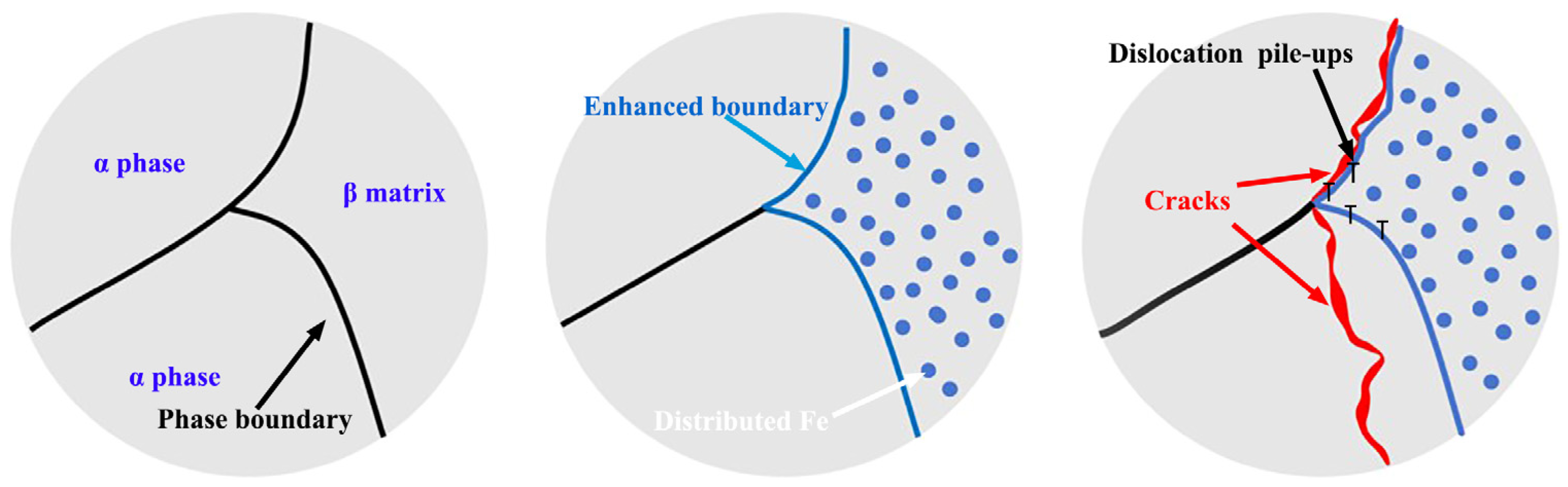
- The addition of trace Fe plays an important role in α/β boundary resistance, reducing the crack growth rate during the stage of crack initiation and early propagation. Also, crack propagating by bypassing the αp phase also helps to reduce the propagation rate.
Author Contributions
Funding
Data Availability Statement
Conflicts of Interest
References
- Zhao, Y.; Li, X.; Fang, W. Microstructure and Mechanical Properties of TC4 Titanium Alloy at the Temperature of 77K. Metals 2023, 13, 1086. [Google Scholar] [CrossRef]
- Ji, X.; Xie, H.; Su, J.; Jiang, F.; Teng, J.; Zhang, H.; Guo, B. Phase Transformation Behaviors and Dislocation Evolutions of an Additively Manufactured Ti-6Al-4V Alloy under Annealing Treatment. Metals 2023, 13, 1061. [Google Scholar] [CrossRef]
- Li, Y.; Huang, W.; Gan, K.; Zhao, Z.; Liu, Y.; Liu, D.; Zhou, L.; Chen, J. Synergistic effect of solution-aging on phase evolution and high-temperature creep resistance in inertia-friction-welded Ti–6Al–4V aerospace components. J. Mater. Res. Technol. 2025, 38, 2875–2885. [Google Scholar] [CrossRef]
- Wang, X.; Xu, S.; Yu, J.; Chen, G.; Dong, W.; Shen, W. Study on impact damage and failure mechanism of marine Ti-6Al-4V thin plate welded structure. Eng. Fail. Anal. 2025, 182, 110114. [Google Scholar] [CrossRef]
- Zheng, H.; Li, Z.; Pu, J.; Song, J. Crevice corrosion behavior of Ti-6Al-4V alloy in simulated inflammatory environment for biomedical applications. J. Alloys Compd. 2026, 1056, 186636. [Google Scholar] [CrossRef]
- Sun, Y.; Alexandrov, I.V.; Dong, Y.; Valiev, R.Z.; Chang, H.; Zhou, L. Optimized low-cycle fatigue behavior and fracture characteristics of Ti–6Al–4V alloy by Fe microalloying. J. Mater. Res. Technol. 2021, 15, 5277–5287. [Google Scholar] [CrossRef]
- Chen, C.; Gao, T.; Chen, T.; Li, B.; Qin, Z.; Chen, R.; Xue, H. Experimental investigation and crystal plasticity simulation for the fatigue crack initiation of the equiaxed Ti-6Al-4V alloy in the very high cycle regime. Eng. Fail. Anal. 2023, 152, 107427. [Google Scholar] [CrossRef]
- Kuang, F.; Zhou, Q.; Yue, L.; Yu, A.; Pan, Y.; Lu, X. Enhancing fatigue resistance of laser directed energy deposition Ti-6Al-4V via α-lamellae regulation. Eng. Fail. Anal. 2026, 184, 110340. [Google Scholar] [CrossRef]
- Junet, A.; Messager, A.; Weck, A.; Nadot, Y.; Boulnat, X.; Buffiere, J.-Y. Internal fatigue crack propagation in a Ti-6Al-4V alloy: An in situ study. Int. J. Fatigue 2023, 168, 107450. [Google Scholar] [CrossRef]
- Ueki, S.; Mine, Y.; Chiu, Y.-L.; Bowen, P.; Takashima, K. Effects of crystallographic orientation and lamellar configuration on fatigue crack propagation in single-colony structures of Ti–6Al–4V alloy: Alternating shear crack growth vs. damage accumulation crack propagation. Mater. Sci. Eng. A 2024, 890, 145885. [Google Scholar] [CrossRef]
- Gao, H.; Zhu, Y.; Yang, J.; Yuan, J.; Wang, T.; Cheng, X. Fatigue crack growth behavior of the gradient titanium alloy: Effects of grain morphology and crystallographic orientation of different α phase. J. Alloys Compd. 2025, 1035, 181589. [Google Scholar] [CrossRef]
- Arakawa, J.; Kawahara, Y.; Kimura, Y.; Hashimoto, S.; Akebono, H.; Sugeta, A. Estimation of the fatigue crack initiation site and life of Ti-6Al-4V alloy for two types of circle and slender crystal grains. Int. J. Fatigue 2024, 181, 108097. [Google Scholar] [CrossRef]
- Miao, X.; Huang, X.; Liu, H.; Rong, Z.; Ding, P. Fatigue crack damage tolerance life prediction based on SCN-IHDMR method. Int. J. Fatigue 2024, 182, 108179. [Google Scholar] [CrossRef]
- Shi, S.; Deng, Q.; Zhang, H.; Feng, L.; Xu, X.; Ding, J.; Chang, H.; Zhou, L. Microstructure stability and damage mechanisms in an α/β Ti-6Al-4V-0.55Fe alloy during low cycle dwell-fatigue at room temperature. Int. J. Fatigue 2022, 155, 106585. [Google Scholar] [CrossRef]
- Sun, Y.; Chen, F.; Qian, S.; Chang, H.; Zhang, W.; Feng, L.; Zhou, L. Low cycle fatigue behavior and deformation mechanism of Ti–6Al–4V-0.55Fe alloy under the control of strain and stress amplitudes. J. Mater. Res. Technol. 2024, 33, 5951–5961. [Google Scholar] [CrossRef]
- Qian, S.; Sun, Y.; Wang, N.; Chang, H.; Feng, L.; Tian, C.; Li, Y.; Zhou, L. Low-cycle fatigue property and damage mechanisms of Ti-6Al-4V-0.55Fe alloy with lamellar microstructure. J. Alloys Compd. 2025, 1013, 178675. [Google Scholar] [CrossRef]
- Sun, Y.; Qian, S.; Chang, H.; Feng, L.; Li, F.; Zhou, L. Low-Cycle Corrosion Fatigue Deformation Mechanism for an α+β Ti-6Al-4V-0.55Fe Alloy. Metals 2024, 14, 720. [Google Scholar] [CrossRef]
- Sun, Y.; Qian, S.; Chang, H.; Duan, W.; Feng, L.; Li, F.; Zhou, L. Improved low cycle fatigue property of Ti–6Al–4V alloy by trace Fe addition. J. Mater. Res. Technol. 2024, 30, 8396–8408. [Google Scholar] [CrossRef]
- GB/T 6398-2017; Metallic Materials—Fatigue Testing—Fatigue Crack Growth Method. National Standards of People’s Republic of China: Beijing, China, 2017.
- Hu, R.; Yu, W.; Shang, G.; Ran, G.; Wang, H. Fatigue crack propagation behavior and damage mechanism of Ti-Mo-Cr-V-Nb-Al alloy in the near-threshold region. Int. J. Fatigue 2026, 202, 109209. [Google Scholar] [CrossRef]
- Wang, J.; Lu, H.; Wen, Z.; Lian, Y.; Li, Z.; Yue, Z. Prediction of fatigue life of TC4 titanium alloy based on normalized equivalent initial flaw size model. Theor. Appl. Fract. Mech. 2022, 122, 103563. [Google Scholar] [CrossRef]
- Liu, G.; Zhao, Q.; Jia, W.; Zhang, Y.; Song, S.; Mao, C.; Zhou, W.; Zhang, S.; Zhao, Y. Microscopic crack propagation mechanism and fatigue crack growth behavior of Ti-5321 alloy formed by laser cladding. J. Alloys Compd. 2025, 1026, 178937. [Google Scholar] [CrossRef]
- Song, W.; Wang, H.; Li, Y.; Zhang, S.; Ren, L.; Yang, K. Ultrafine grained metastable Ti6Al4V5Cu alloy with high strength and excellent low-cycle fatigue property. J. Mater. Sci. Technol. 2022, 129, 240–250. [Google Scholar] [CrossRef]
- Wang, H.; Zhao, Y.; Guo, P.; Qiang, F.; Zhang, L.; Qiao, Z.; Xin, S. Study of the Intrinsic Factors Determining the Near-Threshold Fatigue Crack Propagation Behavior of a High-Strength Titanium Alloy. Metals 2025, 15, 84. [Google Scholar] [CrossRef]
- Zheng, T.; Chen, N.-Z. A cyclic cohesive zone model for predicting hydrogen assisted fatigue crack growth (FCG) of subsea pipeline steels. Int. J. Fatigue 2023, 173, 107707. [Google Scholar] [CrossRef]
- Gao, P.F.; Lei, Z.N.; Li, Y.K.; Zhan, M. Low-cycle fatigue behavior and property of TA15 titanium alloy with tri-modal microstructure. Mater. Sci. Eng. A 2018, 736, 1–11. [Google Scholar] [CrossRef]
- Mcdowell, D.L. Basic issues in the mechanics of high cycle metal fatigue. Int. J. Fract. 1996, 80, 103–145. [Google Scholar] [CrossRef]
- Laird, C. The Influence of Metallurgical Structure on the Mechanisms of Fatigue Crack Propagation. In Fatigue Crack Propagation; 415 ASTM Special Technical Publication; ASTM International: West Conshohocken, PA, USA, 1967; pp. 131–168. [Google Scholar]
- Wolf, E. Fatigue crack closure under cyclic tension. Eng. Fract. Mech. 1970, 2, 37–45. [Google Scholar] [CrossRef]
- Bache, M.; Davies, H.; Davey, W.; Thomas, M.; Berment-Parr, I. Microstructural Control of Fatigue Behaviour in a Novel α + β Titanium Alloy. Metals 2019, 9, 1200. [Google Scholar] [CrossRef]
- Zhu, W.; Ma, C.; Zhang, C.; Hu, K.; Zeng, X. Fatigue crack propagation behavior in Ti−6Al−4V alloy with surface gradient structure fabricated by high-energy shot peening. Trans. Nonferrous Met. Soc. China 2023, 33, 3003–3016. [Google Scholar] [CrossRef]
- Zhang, Z.; Hu, Z.F.; Fan, L.K.; Wang, B. Low Cycle Fatigue Behavior and Cyclic Softening of P92 Ferritic-martensitic Steel. J. Iron Steel Res. Int. 2015, 22, 534–542. [Google Scholar] [CrossRef]
- Li, Y.; Liu, Z.; Fan, E.; Cui, Z.; Zhao, J. The effect of crack tip environment on crack growth behaviour of a low alloy steel at cathodic potentials in artificial seawater. J. Mater. Sci. Technol. 2020, 54, 119–131. [Google Scholar] [CrossRef]
- Ould Chikh, B.; Imad, A.; Benguediab, M. Influence of the cyclic plastic zone size on the propagation of the fatigue crack in case of 12NC6 steel. Comput. Mater. Sci. 2008, 43, 1010–1017. [Google Scholar] [CrossRef]
- Li, J.; Sun, Q.; Zhang, Z.; Li, C.; Qiao, Y. Theoretical estimation to the cyclic yield strength and fatigue limit for alloy steels. Mech. Res. Commun. 2009, 36, 316–321. [Google Scholar] [CrossRef]
- Xiong, Y.; Hu, X.X.; Katsuta, J.; Sakiyama, T.; Kawano, K. Influence of compressive plastic zone at the crack tip upon fatigue crack propagation. Int. J. Fatigue 2008, 30, 67–73. [Google Scholar] [CrossRef]
- Lütjering, G. Influence of processing on microstructure and mechanical properties of (α+β) titanium alloys. Mater. Sci. Eng. A 1998, 243, 32–45. [Google Scholar] [CrossRef]
- Zhai, T.; Jiang, X.P.; Li, J.X.; Garratt, M.D.; Bray, G.H. The grain boundary geometry for optimum resistance to growth of short fatigue cracks in high strength Al-alloys. Int. J. Fatigue 2005, 27, 1202–1209. [Google Scholar] [CrossRef]
- Zhang, K.; Wu, X.; Davies, C.H.J. Effect of microtexture on short crack propagation in two-phase titanium alloys. Int. J. Fatigue 2017, 104, 206–220. [Google Scholar] [CrossRef]




| Al | V | Fe | C | N | O | H | Ti | |
|---|---|---|---|---|---|---|---|---|
| TC4-F | 6.20 | 4.14 | 0.537 | 0.020 | 0.020 | 0.13 | 0.001 | Bal. |
| TCE ELI | 6.20 | 4.28 | 0.076 | 0.010 | 0.017 | 0.09 | 0.002 | Bal. |
Disclaimer/Publisher’s Note: The statements, opinions and data contained in all publications are solely those of the individual author(s) and contributor(s) and not of MDPI and/or the editor(s). MDPI and/or the editor(s) disclaim responsibility for any injury to people or property resulting from any ideas, methods, instructions or products referred to in the content. |
© 2026 by the authors. Licensee MDPI, Basel, Switzerland. This article is an open access article distributed under the terms and conditions of the Creative Commons Attribution (CC BY) license.
Share and Cite
Sun, Y.; Liu, L.; Mao, Z.; Jiang, F.; Zhou, L. Fractographic Analysis and Fatigue Crack Propagation Behavior of TC4-F Alloy with a Duplex Microstructure. Materials 2026, 19, 2238. https://doi.org/10.3390/ma19112238
Sun Y, Liu L, Mao Z, Jiang F, Zhou L. Fractographic Analysis and Fatigue Crack Propagation Behavior of TC4-F Alloy with a Duplex Microstructure. Materials. 2026; 19(11):2238. https://doi.org/10.3390/ma19112238
Chicago/Turabian StyleSun, Yangyang, Li Liu, Zhongyang Mao, Feifei Jiang, and Lian Zhou. 2026. "Fractographic Analysis and Fatigue Crack Propagation Behavior of TC4-F Alloy with a Duplex Microstructure" Materials 19, no. 11: 2238. https://doi.org/10.3390/ma19112238
APA StyleSun, Y., Liu, L., Mao, Z., Jiang, F., & Zhou, L. (2026). Fractographic Analysis and Fatigue Crack Propagation Behavior of TC4-F Alloy with a Duplex Microstructure. Materials, 19(11), 2238. https://doi.org/10.3390/ma19112238