3. Results and Discussion
In alkaline electrocatalytic HER, the hydrogen adsorption free energy (Δ
GH*) alone is insufficient as a descriptor to fully rationalize the catalytic activity, as water dissociation is widely recognized as the rate-determining step (RDS) for the overall reaction in alkaline media. Specifically, the Volmer step, corresponding to the rate-limiting water dissociation process, involves the cleavage of the O–H bond in H
2O to form adsorbed H* and OH* intermediates, as described by:
Unlike the HER in acidic media [
30,
31], the steric hindrance associated with H
2O adsorption and dissociation on the catalyst surface is a non-negligible factor in alkaline electrolytes. This arises from the much larger molecular size of H
2O compared to protons, as well as the requirement for specific adsorption configurations to enable efficient O–H bond cleavage. To unravel the intrinsic activity origin of the Ni
3/TiO
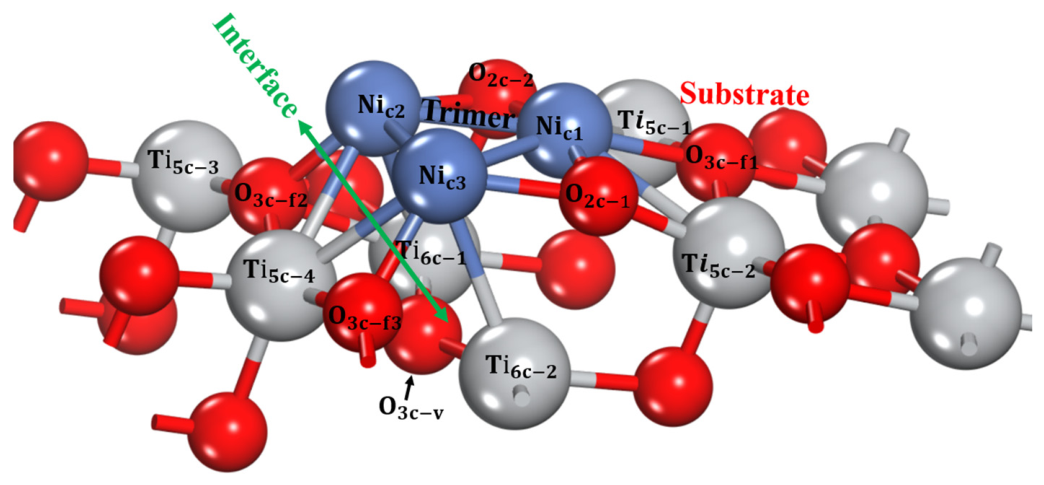
2 catalyst, we divided the catalytic interface into three functionally distinct regions: the TiO
2 substrate, the Ni
3 trimer, and the Ni
3–TiO
2 perimeter interface (
Figure 1). The individual contribution of each region to water adsorption, O–H bond activation, and intermediate desorption is systematically investigated in the subsequent sections.
First, for the Volmer reaction, we performed comprehensive structural optimizations and total energy calculations of the reactant (H
2O*) and products (H* and OH*) on different regions of the Ni
3/TiO
2 surface, considering all high-symmetry adsorption sites (
Figure S1 and all corresponding adsorption energies summarized in
Table S1 in the ESM). The most stable adsorption configurations of H
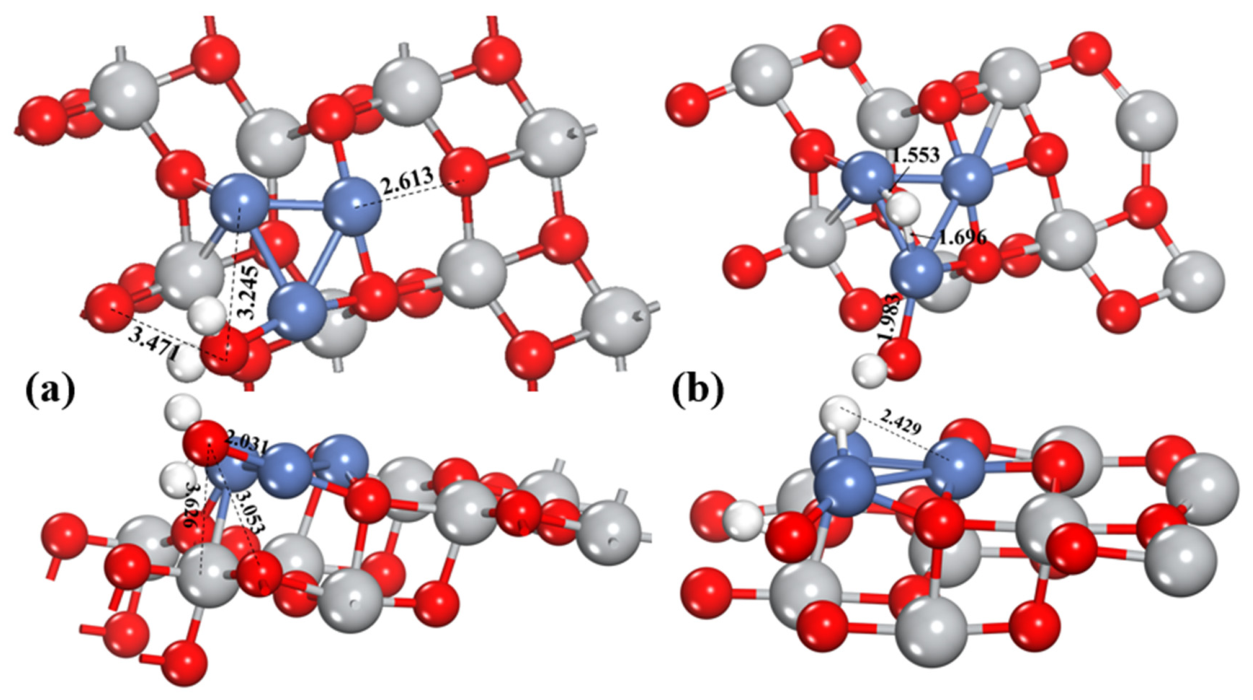
2O*, H*, and OH* are presented in
Figure 2. Notably, although water is a highly polar molecule prone to polarization under electric fields, the strong coordinative interaction between water and the undercoordinated Ti sites on TiO
2, as well as the Ni sites in the trimer, predominates over local electric field effects, giving rise to well-defined adsorption configurations that are insensitive to minor fluctuations in the local electric field. The adsorption behavior of H
2O exhibits a pronounced site-dependent feature across the three functional regions of the Ni
3/TiO
2 catalyst. Specifically, adsorbed H
2O* on the Ni sites adopts a configuration parallel to the (010) facet and perpendicular to the [100] groove, with a large adsorption energy (
Figure 2a). This adsorption energy (−0.56 eV) is less than that reported for Pt
1/TiO
2 SACs (−0.69 eV, converted from −15.8 kcal/mol) under equivalent computational settings of DFT, but without implicit solvation model [
32], and nearly identical to the water adsorption energy at the five-coordinate Ti
5c-1,2 sites on the surface. By contrast, the adsorption energy of H
2O on the Ni
c2,3 atoms along the [100] groove direction decreases to −0.35 eV. Both of these values are significantly more negative more favorable than those at the Ti
5c-3,4 sites at the open interface (−0.22 eV) and the vertically adsorbed configuration on Ni
c2/Ni
c3 sites (−0.23 eV). Most remarkably, H
2O molecules are strongly repelled by the Ni
c1 atom and cannot form stable adsorption complexes on this site.
Similar to the adsorption behavior of H
2O*, the co-adsorption of H* and OH* on the Ni
3/TiO
2 surface also exhibits pronounced site dependence. In sharp contrast to the multiple stable adsorption configurations of H
2O*, only one stable co-adsorption configuration was identified, with the energetically most favorable structure located exclusively at the Ni
3–TiO
2 interface. The adsorption energy differences between the most stable configuration and the other energetically closest metastable structures are 0.25, 0.31 and 0.54 eV, respectively. Note that for the configurational screening of OH* and H* co-adsorption structures, we referred to our previous findings from acidic HER studies, where we confirmed that hydrogen atoms preferentially adsorb on the Ni
3 trimer rather than the TiO
2 support [
5]. Accordingly, we anchored the H* adsorbate on the Ni
3 trimer, with initial positions set at all typical high-symmetry sites (top, bridge, and hollow sites). Using these H* adsorption configurations as starting points, we systematically screened the adsorption of OH* at all remaining high-symmetry sites. In total, 22 initial structural models were constructed, covering all available top sites, as well as Ni–O, Ni–Ti bridge sites (
Figure S2 in the ESM). In this stable configuration, OH* binds to the Ni
c3 site via its O atom, adopting an H-down orientation with the H atom pointing toward the adjacent three-coordinate O
3c-f3 site on the TiO
2 substrate (
Figure 2b). The dissociated H* atom occupies the bridge site between Ni
c2 and Ni
c3, with asymmetric Ni–H bond lengths of 1.553 Å and 1.696 Å. A critical insight from our structural analysis is the exceptional geometric match between the most stable H
2O* adsorption configuration (
Figure 2a) and the energetically preferred H* + OH* co-adsorption state (
Figure 2b). Specifically, the distance between the O atom of H
2O* and the Ni
c3 site, as well as the distance between the dissociable H atom of H
2O* and the Ni
c2–Ni
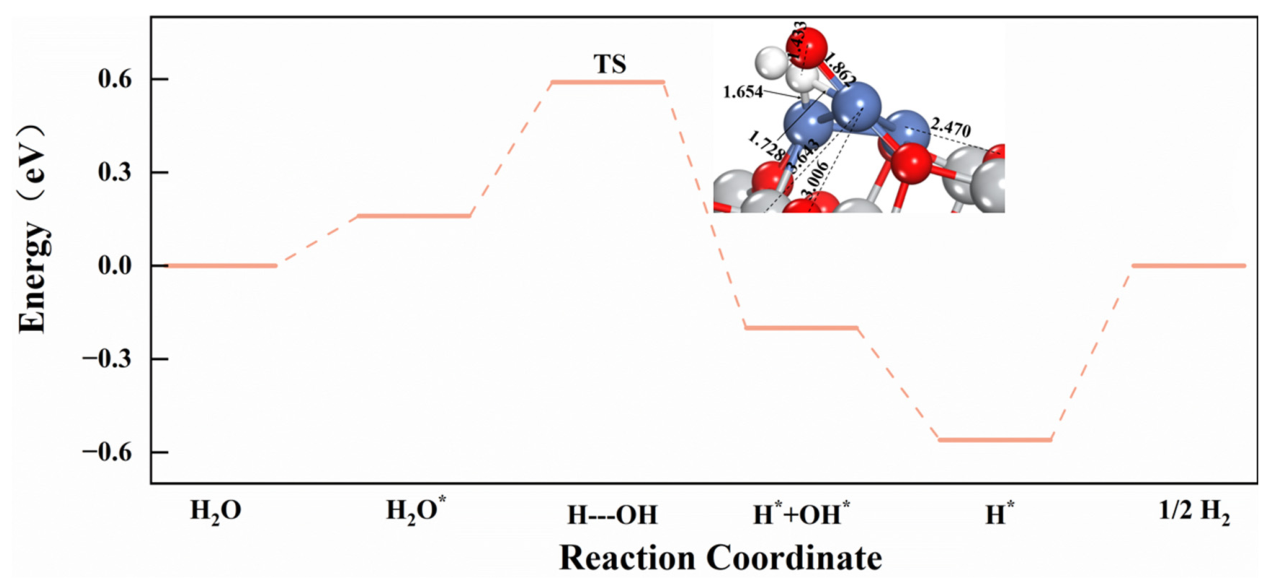
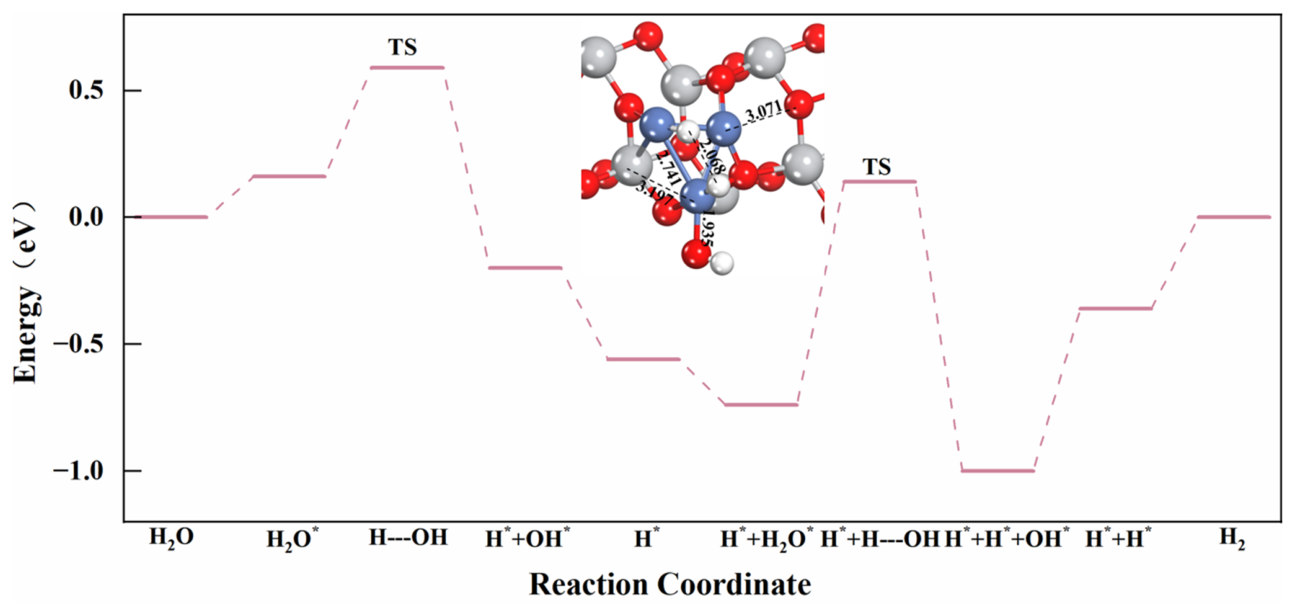
c3 bridge site, are nearly perfectly matched to the corresponding distances in the product state. This distance-matching characteristic minimizes the structural rearrangement required during O–H bond cleavage, which inherently reduces the activation energy barrier. Based on the above rigorous structural analysis, these two configurations were selected as the initial state (IS) and final state (FS) for CI-NEB calculations of O–H bond cleavage in the Volmer step. The Gibbs free energy diagram for the Volmer–Heyrovsky pathway, including all adsorbed intermediates, is presented in
Figure 3.
As illustrated in
Figure 3, the energy barrier for H–OH bond cleavage in the Volmer step is calculated to be only 0.43 eV. This barrier is markedly lower than those reported for state-of-the-art alkaline HER catalysts, including IrRu DACs (0.68 eV) [
33], bulk liquid water (intrinsic O–H bond dissociation barrier: 0.76 eV) [
34], and MoS
2/NiFe-layered double hydroxide heterostructures (0.64 eV) [
35]. Such an ultralow barrier enables facile water dissociation at ambient temperature with negligible kinetic constraints. This bond dissociation process is exothermic with an energy release of 0.79 eV, which maintains the Gibbs free energy of the formed OH* + H* intermediates at a negative value (stable). Subsequently, the transformation from the OH* + H* co-adsorption state to the isolated H* state, corresponding to the reductive desorption of OH* as OH
− from the Ni
c3 site, exhibits a downhill free energy decrease of 0.36 eV. This facile OH
− desorption effectively avoids active site poisoning by strongly adsorbed hydroxyl intermediates, thus ensuring sustainable cyclic utilization of the catalyst. The subsequent generation of H
2 via the Heyrovsky step is an uphill process with a free energy rise of 0.56 eV. Although this value is slightly higher than the kinetic barrier for H–OH bond cleavage, both fall within a low energy range. These results not only demonstrate that Ni
3/TiO
2 is a promising candidate for alkaline HER, but also confirm that the overall H
2 production proceeds smoothly along the Volmer–Heyrovsky pathway. Consequently, the RDS of the overall reaction shifts from water dissociation (the Volmer step with an activation barrier of 0.43 eV, typical for most reported alkaline HER catalysts) to the Heyrovsky step with an activation barrier of 0.56 eV. Given the negligible energy difference between the two barriers (~130 meV), either step may act as the RDS under practical electrocatalytic operating conditions. Overall, our results confirm that the Ni
3/TiO
2 catalyst drastically reduces the water dissociation barrier, which addresses the most long-standing and intractable bottleneck in alkaline HER.
We further elucidate the intrinsic origin of the facile H–OH bond cleavage from the perspective of TS geometry (inset of
Figure 3). The two Ni atoms on the Ni
c2–Ni
c3 edge at the interfacial step are coordinated with two-coordinate (O
2c) and three-coordinate (O
3c) lattice oxygen atoms, respectively. With only moderate electron transfer (0.34 e for Ni
c2 and 0.39 e for Ni
c3), these Ni sites retain high metallic character and strong hydrogen affinity, analogous to bulk metallic Ni [
28]. Consequently, this edge region exerts a strong attractive interaction on the dissociable hydrogen atom of the adsorbed H
2O molecule, with H–Ni
c2 and H–Ni
c3 distances of 1.654 Å and 1.728 Å, respectively. These distances are slightly longer than the corresponding values for the bridge-adsorbed H* in the FS. At the TS, the distance between the dissociating H atom and the O atom of the residual OH group on Ni
c3 reaches 1.433 Å, which is considerably longer than the typical O–H bond length of 0.96 Å in free H
2O. This extended bond length (nearly half the intrinsic O–H bond distance) strongly indicates the occurrence of O–H bond scission, which is further confirmed by a single imaginary frequency of 622.65
i cm
−1 along the reaction coordinate. The residual OH* species remains adsorbed on the Ni
c3 site with an orientation perpendicular to the edge, which is similar to that in the IS, albeit with a slight upward shift. Meanwhile, the O–Ni
c3 bond length decreases from 2.031 Å (IS) to 1.862 Å (TS).
Intriguingly, Bader charge analysis (
Table S2 in the ESM) provides further electronic-level insight into the favorable reaction behavior. At the FS, the OH* intermediate accepts 0.76 e from the Ni
3 trimer, exhibiting a pronounced hydroxylation tendency. This electronic redistribution is in excellent agreement with the low desorption free energy of OH* observed in our thermodynamic calculations. Meanwhile, the dissociated H atom anchored at the Ni
c2–Ni
c3 bridge site exists in a nearly neutral atomic state. Notably, the adjacent Ni
c2 atom bound to the dissociated H* undergoes the least electron loss of only 0.16 e. In sharp contrast, Ni
c1, which has no direct interaction with the intermediates, exhibits an identical electron loss of 0.23 e as Ni
c3. The majority of the electrons donated from the Ni
3 trimer are transferred to the adsorbed OH* species, which directly confirms the delocalized electronic nature of the Ni
3 trimer. Under electrocatalytic conditions, a net current from the external circuit flows during hydrogen evolution at the equilibrium potential (U = 0 V vs. RHE) [
28], leading to significant electron accumulation on the cathodic Ni
3 trimer, independent of the substrate. The electron-enriched Ni
3 trimer actively attracts polarized water molecules via electrostatic interactions and further promotes their polarization, drawing the H species of H
2O (effectively H
+) toward the cathode. Once one electron (e
−) is transferred to the adjacent H
+, the latter is reduced to a H atom, triggering O–H bond cleavage of H
2O and chemisorption of the H atom onto the trimer. These discussions are fully validated by our aforementioned NEB calculations and Bader charge analysis results. In particular, the repulsive interaction between the electron-rich Ni
3/TiO
2 cathode and the hydroxylated OH
− group inevitably drives OH
− desorption from the catalyst surface into the bulk media. The charge states of individual Ni atoms on the H-adsorbed trimer tend to be uniform, with a total charge transfer of 0.54 e compared with the clean surface without H adsorption (
Table S2 in the ESM).
This indicates that once the reduction event occurs, the adsorption behavior of H* on Ni3/TiO2 is insensitive to the pH of the electrolyte (acidic or alkaline conditions). In this context, Ni3/TiO2 can still provide available active sites for the dissociation of a second water molecule, which is involved in H2 generation via Equation (2) and the retention of the second adsorbed H* via Equation (3), following either the Volmer–Heyrovsky or Volmer–Tafel mechanism. Different from SACs and DACs, a unique advantage of TACs is that the Ni3 trimer can provide abundant active sites to simultaneously accommodate fresh reactants and reaction intermediates, reflecting the inherent structural diversity and flexibility of TACs. This feature enables TACs to be compatible with more types of chemical reactions and fundamentally improve the selectivity of multi-step reactions. However, as an active moiety of the electrode (in contrast to the inert substrate), the Ni3 trimer has a limited surface area and spatial extent. This leads to the accumulation of reactants and intermediates on the Ni3 moiety during the reaction (typically at different sites, accompanied by structural flexibility), resulting in inevitable interactions between adsorbed species which can be either favorable or unfavorable for the HER rates. This behavior is distinctly different from the HER on bulk metal surfaces, where individual reaction steps and adsorption processes occur independently at separate sites, and adsorbed species only diffuse together for the final H2 formation.
Hereinafter, Ni
3/TiO
2 with a single pre-adsorbed H* atom is denoted as H-Ni
3/TiO
2. Within the framework of DFT and CI-NEB calculations, we obtained the stable adsorption configuration of H
2O on H-Ni
3/TiO
2, with a corresponding adsorption energy of −0.76 eV. The adsorbed H
2O* binds to the Ni
c3 site and aligns along the [100] groove (
Figure 4a), which is distinct from the water activation behavior and the contribution of oxide supports in SACs under alkaline or acidic conditions [
21,
32]. This difference arises from the Coulombic repulsion between the adsorbed H
2O* and the pre-adsorbed H* on the bridge site of Ni
c2–Ni
c3 edge. To clarify this repulsive interaction, a symmetric isosurface value of ±0.003 e/Å
3 was adopted to plot the differential charge density map for the co-adsorption of H* and H
2O* on Ni
3/TiO
2 (
Figure S3 in the ESM). The yellow isosurface denotes electron accumulation, and the cyan isosurface represents electron depletion. According to the charge distribution, both the Ni
3 trimer and adsorbed H* atom exhibit electron accumulation, while the adsorbed H
2O* molecule shows electron depletion, accompanied by a clear boundary between electron gain and loss in the intermediate region. This observation is highly consistent with the Bader charge analysis results (
Table S2 in the ESM). Notably, an evident cyan negative isosurface emerges between the adsorbed H* atom and the O atom of the water molecule, indicating the formation of an electron depletion region. This region completely separates the electron clouds of the H* atom and H
2O* molecule, suggesting that electrons are repelled away from both species. This behavior is a typical feature of Coulomb repulsion among like-charged electrons. To further corroborate this hypothesis, we selected the optimized configuration H
2O* as the IS, and the configuration with H
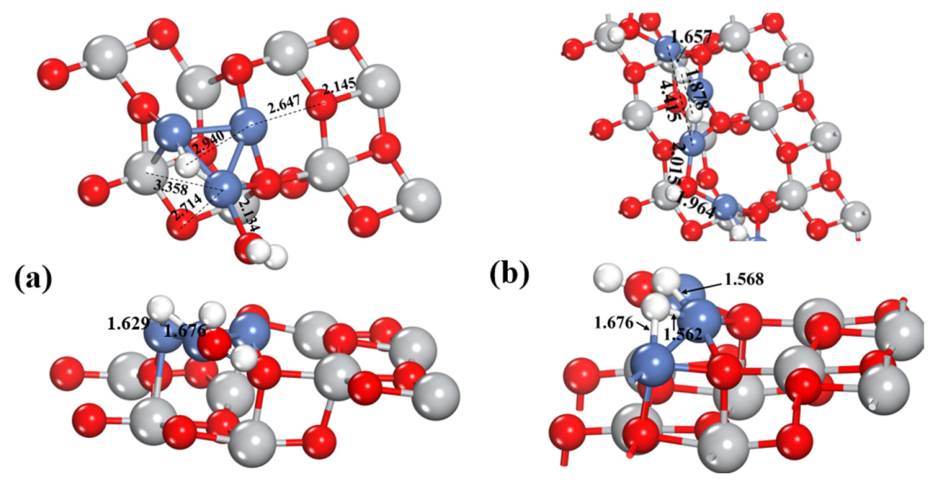
2 parallel to the trimer at a distance of ~4.01 Å as the FS for CI-NEB calculations. During the calculations, we identified a stable intermediate state (designated as FS1, see
Figure 4b) associated with the second water dissociation event. In the FS1, the dissociated OH* is confined within the [100] groove and bridges Ni
c2 and Ni
c3 sites, with Ni–O bond lengths of 2.015 Å and 1.964 Å, respectively. This adsorption is accompanied by the cleavage of the original Ni
c2–Ni
c3 metallic bond, with its bond length increasing from 2.344 Å to 4.415 Å. Such bond breakage is attributed to the stress concentration and electronic state saturation of the Ni
3 trimer, induced by the accumulation of multiple reaction intermediates in the confined space of the trimer, independent of the TiO
2 substrate. The physical origin of this behavior is elucidated in detail as follows. The dissociation of the second water molecule proceeds predominantly on the Ni
3 trimer. Bader charge analysis reveals that the dissociated OH* intermediate accepts 0.62 e from the Ni
c2 and Ni
c3 atoms. Such intense charge transfer significantly reduces the electron density between Ni
c2 and Ni
c3, thereby weakening the metallic bonding interaction between these two atoms. In particular, the Ni
c3 site directly bonded to the OH* group exhibits the lowest charge population, making it difficult for the pre-adsorbed H* atom to extract electrons from Ni
c3 and maintain its atomic adsorbed state. Meanwhile, constrained by spatial steric hindrance, the newly dissociated H* atom can only be trapped at the bridge site near the Ni
c1–Ni
c3 edge. The mutual electrostatic repulsion between the two adsorbed H* atoms first weakens and eventually breaks the H*–Ni
c3 bond. Subsequently, the H* atom rotates to bond with Ni
c1 and occupies the bridge site at the Ni
c1–Ni
c2 edge. Compared with the free Ni
3 trimer, the Ni
3 trimer supported on the TiO
2 (101) surface displays elongated interatomic bond lengths, indicating that the trimer is subjected to tensile stress imposed by the TiO
2 substrate. During the dissociation of the second water molecule, the combined effects of electron transfer and spatial confinement further amplify this tensile stress, as evidenced by the pronounced bond length variations between the coordinated and central Ni atoms. The intensified stress is primarily localized on the already weakened Ni
c2–Ni
c3 bond. The free migration of Ni
c2 along the surface groove represents the optimal pathway for stress relaxation without spatial obstruction. Furthermore, Ni
c2 is attracted by the adsorbed OH* species on Ni
c3, which induces partial electron backflow toward Ni
c2 to compensate its valence state. This is consistent with the higher charge population of Ni
c2 relative to Ni
c3 (
Table S2 in the ESM). Ultimately, the OH* group bridges the two Ni active sites and triggers the cleavage of the Ni
c2–Ni
c3 bond (see the transition state structure in
Figure 5). In summary, the rupture of the Ni
c2–Ni
c3 bond is an inevitable structural evolution during the second water dissociation process. The electron redistribution and structural distortion originating from steric hindrance elevate the reaction activation barrier, whereas the release of concentrated stress facilitates barrier reduction. This well explains why, although the Ni
3 trimer provides abundant active sites to promote the dissociation of the second water molecule, its corresponding energy barrier is considerably higher than that for the first water dissociation (i.e., the Volmer step). This phenomenon has been reported in previous studies [
8], but is absent in SACs or supported nanoparticle catalysts. This structural flexibility gives rise to two critical and unexpected findings. First, the Tafel pathway, which requires two adsorbed H* species, involves two distinct water dissociation steps on Ni
3/TiO
2 with significantly different dissociation barriers. Second, stress-driven structural deformation enables a more flexible evolution of the reaction barrier along the catalytic cycle, through the release or absorption of energy and distance-matching between reactants and products. The Gibbs free energy diagram for the Volmer–Tafel reaction pathway, including all adsorbed intermediates, is presented in
Figure 5.
It is noteworthy that the first half of
Figure 5 largely overlaps with the core portion of
Figure 3. The process from H
2O* adsorption to dissociation generates an adsorbed H* species stabilized on the Ni
3 trimer. This pathway not only recapitulates the aforementioned Volmer–Heyrovsky mechanism but also supplies the first adsorbed H* prerequisite for the Tafel reaction. Proceeding along the reaction coordinate in
Figure 5, a second H
2O dissociation event is required to produce a second adsorbed H* on the Ni
3 trimer, which is indispensable for triggering the Tafel reaction. Importantly, the Ni
3/TiO
2 catalyst features sufficient active sites to accommodate this sequential two-step water dissociation, as illustrated in the latter half of
Figure 5.
Notably, the pre-adsorbed H* species promotes the adsorption of the second H
2O molecule, which proceeds with a downhill free energy change of 0.18 eV. Subsequently, on the H-Ni
3/TiO
2 surface, the second water dissociation step (required to generate the second H* for the H* + H* → H
2 recombination) has an energy barrier of 0.88 eV, ~2.0 times higher than that of the first Volmer step (0.43 eV). This step is highly exothermic, releasing 1.14 eV of energy, which is significantly larger than the 0.79 eV released in the first Volmer step. Intriguingly, the charge states of the H* and OH* species generated from the second water dissociation are nearly identical to those from the first dissociation event. Specifically, the dissociated H* remains in a nearly neutral atomic state, while the OH* intermediate accepts 0.62 e
− from the catalyst system and exhibits characteristic anionic character. Driven by strong electrostatic repulsion from the electron-enriched Ni
3/TiO
2 surface, the anionic OH* species readily detaches from the catalytic interface. Concomitantly, the accumulated lattice strain within the Ni
3 trimer is fully relieved, as evidenced by the contraction of the Ni
c2–Ni
c3 bond length to 2.467 Å from its initial value. This structural recovery enables the reformation of the Ni
c2–Ni
c3 metallic bond, restoring the intact triangular configuration of the Ni
3 trimer. Following OH* desorption, a dihydride species forms on the Ni
c1 site, accompanied by the concerted migration of two edge-bound H* species—located at the bridge sites of the Ni
c1–Ni
c2 and Ni
c1–Ni
c3 edges, with an H*–H* separation of 2.116 Å and a Ni
c2–Ni
c3 bond length of 3.227 Å—to the Ni
c1 active center. Collectively, these two processes are endothermic by a total of 0.64 eV, in sharp contrast to the single OH* desorption step along the Volmer–Heyrovsky pathway, which is exothermic by 0.36 eV. Finally, the recombination of two adsorbed H* to form H
2 (the Tafel step, corresponding to chemical desorption) is an endothermic process with an energy barrier of 0.36 eV, which is lower than the 0.56 eV barrier of the Heyrovsky step (electrochemical desorption). Upon the final formation and desorption of H
2, the Ni
3/TiO
2 catalyst fully reverts to its initial pristine state prior to the catalytic cycle, owing to the high structural stability of the Ni
3 trimer anchored on the TiO
2 (101) surface [
3,
5,
21,
22], thus completing the entire alkaline HER process via the Volmer–Tafel pathway. Taken together, despite the presence of multiple active sites on Ni
3/TiO
2, the requirement for a second water dissociation to generate the additional H* renders the Volmer–Tafel pathway kinetically less favorable than the Volmer–Heyrovsky pathway. The intrinsic origin of this distinct kinetic behavior can be further elucidated by analyzing the electronic structure evolution of the Ni
3 trimer and its orbital interactions with reaction intermediates.
We address the quantum confinement effect of the Ni
3 trimer by analyzing spatial localization/delocalization of metallic states of Ni
3/TiO
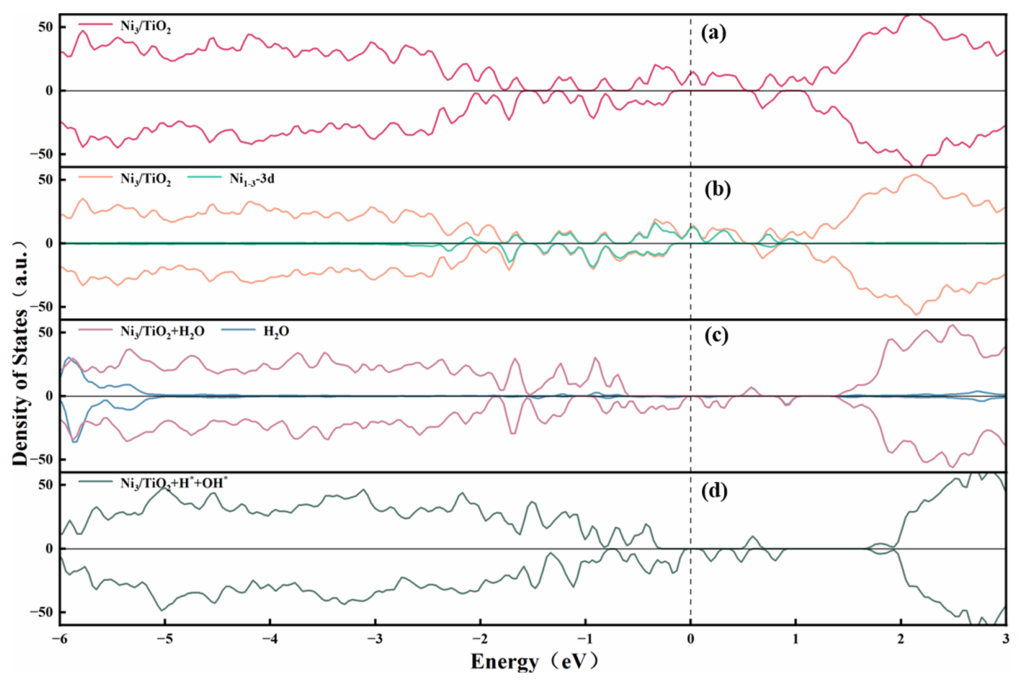
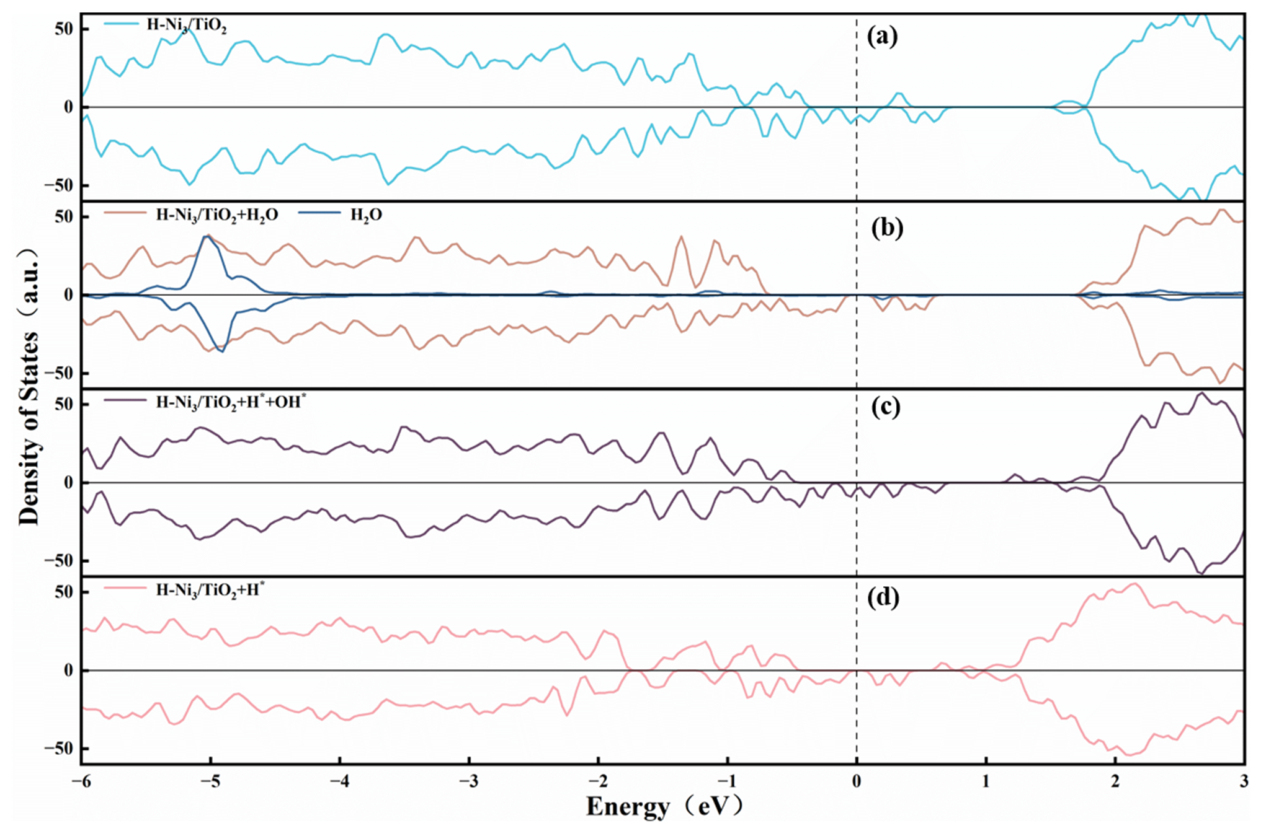
2 on the alkaline HER, following the Volmer–Heyrovsky and Volmer–Tafel pathways. The total and partial density of states (TDOS and PDOS) of intermediates at each stage of the hydrogen production process are summarized in
Figure 6 and
Figure 7.
Figure 6a,b reveal that the continuous and extended metallic state of the Ni
3 trimer fully fills the band gap of anatase TiO
2. This is mainly attributed to the hybridization between Ni-3d orbitals and coordinated O-2p orbitals at the valence band maximum (VBM), which stabilizes the immobilization of the Ni
3 trimer on the TiO
2 substrate. Meanwhile, Bader charge analysis confirms a total of 1.24 e is transferred from the Ni
3 trimer to the TiO
2 support. Since the total electron number of the reactant H
2O molecule and the product OH*/H* species is far smaller than that of the Ni
3/TiO
2 catalyst, their contributions to the overall DOS are negligible in the plots. Therefore, we tracked the evolution of the electronic states of the Ni
3 trimer before and after water dissociation to unravel the intrinsic origin of the reaction barrier.
As shown in
Figure 6c, the adsorption of H
2O molecule leads to the electronic states of the Ni
3 trimer being more concentrated below the E
F. Meanwhile, the polarization effect of the adsorbed H
2O induces a more pronounced polarization splitting of the metallic states, resulting in the absence of electronic states at the E
F. Notably, this weak adsorbate–catalyst interaction does not alter the total amount of electron transfer from the Ni
3 trimer to the TiO
2 substrate; instead, it only triggers charge redistribution among the three Ni atoms via the Ni–Ni metallic bonds. In contrast,
Figure 6d shows that the co-adsorption of H* and OH* intermediates still maintains the metallic states of the Ni
3 trimer mainly below the E
F, but with a more uniform distribution. The polarization splitting is significantly weakened, and the overall electronic states shift closer to the E
F.
Figure 6c,d further reveal that the number of electronic states in the unoccupied states is far lower than that in the occupied states, which visually demonstrates that the electronic states of the Ni atoms are saturated, thus endowing the Ni
3 trimer with higher structural stability. Throughout the entire water dissociation process, the metallic states of the Ni
3 trimer consistently maintain a pronounced continuous and extended character, indicating that the crystal embryo-like Ni
3 trimer possesses an embryonic metallic nature. This is consistent with the results inferred from its lattice orientation behavior as reported in reference [
5]. The driving force for the O–H bond cleavage originates from the intrinsic requirement of the transition of the metallic electronic states from a localized to a delocalized character, while the attenuation of polarization splitting is only a concomitant result of this electronic transition. This result fully confirms the confinement effect of delocalized metallic states among TM atoms.
For the H-Ni
3/TiO
2 system, the desorption of OH* reduces the polarization effect, leading to the emergence of a small number of electronic states at the E
F (
Figure 7a), accompanied by a further upward shift in the d-band center. Upon the re-adsorption of a second water molecule, a consistent trend is observed: the electronic states shift toward deeper energy levels, with a concomitant downward shift in the d-band center. However, compared with
Figure 6c, the overall downward shift in the electronic states in
Figure 7b is less pronounced in the energy range of −0.4 eV to −1.5 eV, and the spin splitting near the E
F is more distinct. This result directly reflects a stronger binding interaction between the water molecule and the H-Ni
3/TiO
2 surface. Since the pre-adsorbed H* has already occupied the optimal product site for water dissociation, the newly generated H* from the second water dissociation must migrate to a new favorable adsorption site, such as the Ni
c1–Ni
c3 edge. This process forces the original pre-adsorbed H* to leave its optimal site and migrate toward the Ni
c1–Ni
c2 edge. Such structural rearrangement induces the cleavage of the Ni
c2–Ni
c3 bond, with the concentrated structural stress evolving synchronously with the structural deformation. On the other hand, the two dissociated H* species adopt equivalent adsorption configurations, as evidenced by
Figure 7c. The spin splitting of the metallic states is significantly reduced, and the electronic states are mainly concentrated near the E
F, which is dominated by the contribution from the adsorbed OH* intermediate. Notably, no obvious spin splitting is observed for energy levels below −0.4 eV, where the electronic states exhibit a uniform and homogeneous distribution. Meanwhile, the d-band center shifts upward, corresponding to the enhanced electronic delocalization of the Ni
3 trimer.
Figure 7d shows that after OH* desorption, the non-equivalent occupation of adsorption sites by the two H* species, combined with the residual structural deformation, leads to a slight increase in spin splitting and a less homogeneous distribution of the electronic states.
In short, our calculations indicate that the hydrogen production process over the Ni
3/TiO
2 TAC in alkaline media is dominated by the Volmer–Heyrovsky reaction, with the RDS being the Volmer or Heyrovsky step. To the best of our knowledge, this unique mechanistic feature has not been previously reported or systematically investigated in studies on HER over FACs. It is unclear whether this phenomenon was unmentioned or intentionally overlooked, even in related studies on SAC/DAC-based HER systems. For the Ni
3/TiO
2 TAC, the HER exhibits a low kinetic barrier that is theoretically favorable for alkaline HER at ambient temperature. Accordingly, its theoretical alkaline HER activity is comparable to that of state-of-the-art non-noble metal acidic HER catalysts under the same computational framework [
33,
34,
35].
In alkaline HER, the water dissociation barrier, which typically acts as the RDS, is widely recognized as the primary descriptor for evaluating catalytic activity. Accordingly,
Table 1 summarizes the Volmer reaction barrier values of the Ni
3/TiO
2 catalyst system and several state-of-the-art alkaline HER catalysts reported recently. As consistently established earlier, a lower RDS energy barrier correlates with enhanced catalytic activity and facile reaction kinetics at room temperature. Strikingly, for the Ni
3/TiO
2 catalyst, the activation barrier of the Volmer step is markedly lowered, rendering it comparable to that of the subsequent Heyrovsky electrochemical hydrogen desorption step. In fact, both activation barriers are maintained at ~0.5 eV, indicating that the alkaline HER process over Ni
3/TiO
2 proceeds spontaneously at room temperature without appreciable kinetic constraints. As a direct consequence, the long-standing bottleneck of intrinsically sluggish water dissociation kinetics that limits overall HER efficiency is effectively overcome for the Ni
3/TiO
2 catalyst. Most importantly, these findings revise the long-held consensus that water dissociation is the sole RDS for alkaline HER, clearly demonstrating that the Heyrovsky reaction can instead become the dominant RDS under optimized conditions. Beyond revising the fundamental mechanistic understanding, in addition to providing abundant active sites for the Volmer–Heyrovsky or Volmer–Tafel pathway, the Ni
3/TiO
2 catalyst exhibits a lower overall reaction barrier than most reported SACs and DACs for alkaline HER (
Table 1).
Collectively, the present findings carry substantial practical and theoretical implications. Building upon these fundamental mechanistic insights, we propose a rational design strategy: enhancing the intrinsic activity of edge-interfacial sites in few-atom catalysts (FACs) to lower the overall reaction energy barriers. Crucially, this approach affords superior catalytic performance compared to state-of-the-art SACs and DACs reported in the latest literature, thereby addressing the persistent challenge of sluggish reaction kinetics in alkaline hydrogen production.
Fundamentally, our combined Bader charge analysis and PDOS calculations unambiguously demonstrate that the Ni
3 trimer possesses pronounced electronic delocalization that undergoes dynamic evolution throughout the entire reaction coordinate. Specifically, these delocalized electronic states enable highly efficient charge transfer between Ni atoms and reaction intermediates. More precisely, the electron-deficient Ni
c3 site bound to OH* can obtain efficient charge compensation from adjacent Ni atoms via the delocalized electronic network. This charge redistribution, in turn, effectively stabilizes the adsorbed H species at the bridge sites between Ni
c1 and Ni
c2—a critical factor underlying the exceptional alkaline HER activity of Ni
3/TiO
2. Taken together, these electronic structure insights, when integrated with our aforementioned mechanistic analysis, establish a comprehensive mechanistic framework for understanding the origin of the enhanced catalytic performance of Ni
3/TiO
2. Importantly, although direct in situ experimental visualization of this dynamic electronic delocalization remains technically challenging, our PDOS calculations unambiguously reveal that the d-band center of the Ni
3 trimer shifts significantly toward the Fermi level relative to the Ni
1/TiO
2 SAC and Ni
2/TiO
2 DAC [
5]. This theoretical prediction is in excellent quantitative agreement with the experimentally measured HER overpotential reduction, thereby providing indirect yet compelling experimental validation of the promotional role of electronic delocalization in boosting catalytic activity. By contrast, SACs and/or DACs exhibit highly localized electronic states and lack such interatomic charge transfer pathways. Consequently, the Ni
3 trimer features significantly enhanced electronic delocalization and constructs more robust and efficient charge transfer channels, which constitute the fundamental electronic origin of the superior HER performance of this triatomic catalyst relative to its SA and DA analogs.