The Properties of Concrete Utilizing Partial Aggregate Replacement with Locally Sourced Mediterranean Agro-Waste

 ,
,  , ,
, ,  and
and
Abstract
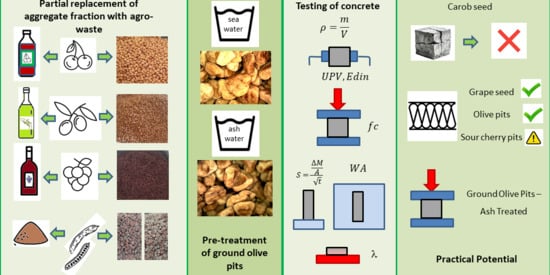
1. Introduction
2. Production and Current Application of Mediterranean Agro-Waste
3. Experimental Part: Material and Method
4. Results and Discussion
5. Conclusions
Author Contributions
Funding
Institutional Review Board Statement
Informed Consent Statement
Data Availability Statement
Acknowledgments
Conflicts of Interest
References
- Sangmesh, B.; Patil, N.; Jaiswal, K.K.; Gowrishankar, T.P.; Selvakumar, K.K.; Jyothi, M.S.; Jyothilakshmi, R.; Kumar, S. Development of Sustainable Alternative Materials for the Construction of Green Buildings Using Agricultural Residues: A Review. Constr. Build. Mater. 2023, 368, 130457. [Google Scholar] [CrossRef]
- Zhang, C.; Hu, M.; Di Maio, F.; Sprecher, B.; Yang, X.; Tukker, A. An Overview of the Waste Hierarchy Framework for Analyzing the Circularity in Construction and Demolition Waste Management in Europe. Sci. Total Environ. 2022, 803, 149892. [Google Scholar] [CrossRef]
- Aguilar-Hernandez, G.A.; Deetman, S.; Merciai, S.; Rodrigues, J.F.D.; Tukker, A. Global Distribution of Material Inflows to In-Use Stocks in 2011 and Its Implications for a Circularity Transition. J. Ind. Ecol. 2021, 25, 1447–1461. [Google Scholar] [CrossRef]
- Obi, F.; Ugwuishiwu, B.; Nwakaire, J. Agricultural Waste Concept, Generation, Utilization and Management. Niger. J. Technol. 2016, 35, 957. [Google Scholar] [CrossRef]
- Chabi, E.; Doko, V.; Hounkpè, S.P.; Adjovi, E.C. Study of Cement Composites on Addition of Rice Husk. Case Stud. Constr. Mater. 2020, 12, e00345. [Google Scholar] [CrossRef]
- Vilaboa Díaz, A.; Francisco López, A.; Bello Bugallo, P.M. Analysis of Biowaste-Based Materials in the Construction Sector: Evaluation of Thermal Behaviour and Life Cycle Assessment (LCA). Waste Biomass Valorization 2022, 13, 4983–5004. [Google Scholar] [CrossRef]
- Amare, M.; Swara, S.; Haish, M.; Pani, A.K.; Saha, P. Performance of Agro-Wastes and Chemical Admixtures Used in Concrete: A Review. Mater. Today Proc. 2023, S2214785323043109. [Google Scholar] [CrossRef]
- Monteiro, P.J.M.; Miller, S.A.; Horvath, A. Towards Sustainable Concrete. Nat. Mater. 2017, 16, 698–699. [Google Scholar] [CrossRef] [PubMed]
- Dias, S.; Almeida, J.; Tadeu, A.; De Brito, J. Alternative Concrete Aggregates - Review of Physical and Mechanical Properties and Successful Applications. Cem. Concr. Compos. 2024, 152, 105663. [Google Scholar] [CrossRef]
- Chao-Lung, H.; Anh-Tuan, B.L.; Chun-Tsun, C. Effect of Rice Husk Ash on the Strength and Durability Characteristics of Concrete. Constr. Build. Mater. 2011, 25, 3768–3772. [Google Scholar] [CrossRef]
- Wu, K.; Han, H.; Rößler, C.; Xu, L.; Ludwig, H.M. Rice hush ash as supplementary cementitious material for calcium aluminate cement—Effects on strength and hydration. Constr. Build. Mater. 2021, 302, 124198. [Google Scholar] [CrossRef]
- Obilade, I.O. Use of Rice Husk Ash as Partial Replacement for Cement in Concrete. Int. J. Eng. Appl. Sci. 2014, 5, 11–16. [Google Scholar]
- Singh, R.; Patel, M. Strength and Durability Characteristics of Binary and Ternary Blends Containing High Volume of Rice Straw Ash and Metakaolin: A Comprehensive Evaluation with Practical Implications. Waste Biomass Valorization 2025, 17, 371–397. [Google Scholar] [CrossRef]
- Charitha, V.; Athira, V.S.; Jittin, V.; Bahurudeen, A.; Nanthagopalan, P. Use of Different Agro-Waste Ashes in Concrete for Effective Upcycling of Locally Available Resources. Constr. Build. Mater. 2021, 285, 122851. [Google Scholar] [CrossRef]
- Sell Junior, F.K.; Wally, G.B.; Magalhães, F.C.; de Pires, M.M.; Kulakowski, M.P.; das Dores do Nascimento, C.; Flores, W.H.; Avellaneda, C.A.O. Effects of Bamboo Leaf Ashes on Concrete Compressive Strength, Water Absorption, and Chloride Penetration. J. Build. Eng. 2024, 97, 110986. [Google Scholar] [CrossRef]
- Aliu, A.O.; Olalusi, O.B.; Awoyera, P.O.; Kiliswa, M. Evaluation of Pozzolanic Reactivity of Maize Straw Ash as a Binder Supplement in Concrete. Case Stud. Constr. Mater. 2023, 18, e01790. [Google Scholar] [CrossRef]
- Tayeh, B.A.; Alyousef, R.; Alabduljabbar, H.; Alaskar, A. Recycling of Rice Husk Waste for a Sustainable Concrete: A Critical Review. J. Clean. Prod. 2021, 312, 127734. [Google Scholar] [CrossRef]
- Sisman, C.B.; Gezer, E.; Kocaman, I. Effects of Organic Waste (Rice Husk) on the Concrete Properties for Farm Buildings. Bulg. J. Agric. Sci. 2011, 17, 40–48. Available online: https://agrojournal.org/17/01-05-11.pdf (accessed on 22 January 2026).
- Yuzer, N.; Cinar, Z.; Akoz, F.; Biricik, H.; Yalcin Gurkan, Y.; Kabay, N.; Kizilkanat, A.B. Influence of Raw Rice Husk Addition on Structure and Properties of Concrete. Constr. Build. Mater. 2013, 44, 54–62. [Google Scholar] [CrossRef]
- Winarno, S. Comparative Strength and Cost of Rice Husk Concrete Block. MATEC Web Conf. 2019, 280, 04002. [Google Scholar] [CrossRef]
- Chen, S.; Zhou, J.; Liu, J.; Bie, Y.; Hu, Q. Sustainable Ecological Pervious Concrete (SEPC) Based on Modified Corn-Cob Coarse Aggregate: Crushing Morphology, Strength, Pore Properties, and Durability. Constr. Build. Mater. 2024, 426, 136194. [Google Scholar] [CrossRef]
- Wang, P.; Liu, H.; Guo, H.; Yu, Y.; Guo, Y.; Yue, G.; Li, Q.; Wang, L. Study on Preparation and Performance of Alkali-Activated Low Carbon Recycled Concrete: Corn Cob Biomass Aggregate. J. Mater. Res. Technol. 2023, 23, 90–105. [Google Scholar] [CrossRef]
- Ashour, A.; Amer, M.; Marzouk, A.; Shimizu, K.; Kondo, R.; El-Sharkawy, S. Corncobs as a Potential Source of Functional Chemicals. Molecules 2013, 18, 13823–13830. [Google Scholar] [CrossRef]
- Pinto, J.; Vieira, B.; Pereira, H.; Jacinto, C.; Vilela, P.; Paiva, A.; Pereira, S.; Cunha, V.M.C.F.; Varum, H. Corn Cob Lightweight Concrete for Non-Structural Applications. Constr. Build. Mater. 2012, 34, 346–351. [Google Scholar] [CrossRef]
- Faustino, J.; Silva, E.; Pinto, J.; Soares, E.; Cunha, V.M.C.F.; Soares, S. Lightweight Concrete Masonry Units Based on Processed Granulate of Corn Cob as Aggregate. Mater. Construcción 2015, 65, e055. [Google Scholar] [CrossRef]
- Helepciuc, C.M.; Barbuta, M.; Serbanoiu, A.A.; Burlacu, A. A Variant of Green Concrete with Industrial and Agricultural Waste. In Proceedings of the 21st International Symposium “The Environment and the Industry”, SIMI 2018, Bucharest, Romania, 20–21 September 2018. [Google Scholar]
- Polat, S. A Research on the Usage of Corn Cob in Producing Lightweight Concrete. Nat. Resour. 2021, 12, 339–347. [Google Scholar] [CrossRef]
- Grădinaru, C.M.; Șerbănoiu, A.A.; Șerbănoiu, B.V. Sunflower Stalks versus Corn Cobs as Raw Materials for Sustainable Concrete. Materials 2021, 14, 5078. [Google Scholar] [CrossRef]
- Grădinaru, C.M.; Barbuta, M.; Vasilică, C.; Serbanoiu, A.A. Characterization of a Lightweight Concrete with Corn Cob Aggregates. In Proceedings of the 17 International Multidisciplinary Scientific GeoConference SGEM 2017, Albena, Bulgaria, 29 June–5 July 2017. [Google Scholar]
- Farooqi, M.U.; Ali, M. Durability Evaluation of Wheat Straw Reinforced Concrete for Sustainable Structures. J. Build. Eng. 2024, 82, 108400. [Google Scholar] [CrossRef]
- Tomar, R.; Kishore, K.; Singh Parihar, H.; Gupta, N. A Comprehensive Study of Waste Coconut Shell Aggregate as Raw Material in Concrete. Mater. Today Proc. 2021, 44, 437–443. [Google Scholar] [CrossRef]
- Ranjith, R. A Review Study on Coconut Shell Aggregate Concrete. J. Struct. Technol. 2017, 2, 1–7. [Google Scholar]
- Yerramala, A.; Ramachandrudu, C. Properties of Concrete with Coconut Shells as Aggregate Replacement. Int. J. Eng. Invent. 2012, 1, 21–31. [Google Scholar]
- Osei, D.Y. Experimental Assessment on Coconut Shells as Aggregate in Concrete. Int. J. Eng. Sci. Invent. 2013, 2, 7–11. Available online: https://ijesi.org/papers/Vol%202(5)/version-4/B250711.pdf (accessed on 18 May 2026).
- Kanojia, A.; Jain, S.K. Performance of Coconut Shell as Coarse Aggregate in Concrete. Constr. Build. Mater. 2017, 140, 150–156. [Google Scholar] [CrossRef]
- Azunna, S.U.; Abd. Aziz, F.N.A.; Abu Bakar, N.; Mohd Nasir, N.A. Mechanical Properties of Concrete with Coconut Shell as Partial Replacement of Aggregates. IOP Conf. Ser. Mater. Sci. Eng. 2018, 431, 032001. [Google Scholar] [CrossRef]
- Gunasekaran, K.; Kumar, P.S.; Lakshmipathy, M. Mechanical and Bond Properties of Coconut Shell Concrete. Constr. Build. Mater. 2011, 25, 92–98. [Google Scholar] [CrossRef]
- Deepak, T.J.; Jalam, A.A.; Loh, E.; Tong, S.Y.; Nair, S. Prognostication of Concrete Characteristics with Coconut Shell as Coarse Aggregate Partial Percentile Replacement Prognostication of Concrete Characteristics with Coconut Shell as Coarse Aggregate Partial Percentile Replacement. Int. J. Sci. Res. Sci. Eng. Technol. 2015, 1, 45–50. [Google Scholar]
- Rajendran, T.; Abdul Rahman, N. Mechanical Properties of Concrete Containing Coconut Shells as Coarse Aggregate Partial Replacement. Malays. J. Sci. Adv. Technol. 2023, 2, 35–42. [Google Scholar] [CrossRef]
- Manaloto, J.A.R. Investigation of the Compressive Strengths of Coconut Shells as Partial Alternative of Coarse Aggregates in Concrete Mix. MUHON J. Archit. Landsc. Archit. Des. Environ. 2022, 9, 1–14. [Google Scholar]
- Alengaram, U.J.; Mahmud, H.; Jumaat, M.Z. Comparison of Mechanical and Bond Properties of Oil Palm Kernel Shell Concrete with Normal Weight Concrete. Int. J. Phys. Sci. 2010, 5, 1231–1239. [Google Scholar]
- Alengaram, U.J.; Mahmud, H.; Jumaat, M.Z.; Shirazi, S.M. Effect of Aggregate Size and Proportion on Strength Properties of Palm Kernel Shell Concrete. Int. J. Phys. Sci. 2010, 5, 1848–1856. [Google Scholar]
- Gibigaye, M.; Godonou, G.F.; Katte, R.; Degan, G. Structured Mixture Proportioning for Oil Palm Kernel Shell Concrete. Case Stud. Constr. Mater. 2017, 6, 219–224. [Google Scholar] [CrossRef]
- Danso, H.; Appiah-Agyei, F. Size Variation of Palm Kernel Shells as Replacement of Coarse Aggregate for Lightweight Concrete Production. Open J. Civ. Eng. 2021, 11, 153–165. [Google Scholar] [CrossRef]
- Yew, M.K.; Mahmud, H.B.; Ang, B.C.; Yew, M.C. Effects of Heat Treatment on Oil Palm Shell Coarse Aggregates for High Strength Lightweight Concrete. Mater. Des. 2014, 54, 702–707. [Google Scholar] [CrossRef]
- Ifeanyi, O.E.; Chima, A.D.; Chukwudubem, N.J. Structural Behavior of Concrete Produced Using Palm Kernel Shell (PKS) as a Partial Substitute for Coarse Aggregate. Am. J. Innov. Sci. Eng. 2023, 2, 1–7. [Google Scholar] [CrossRef]
- Khankhaje, E.; Salim, M.R.; Mirza, J.; Hussin, M.W.; Rafieizonooz, M. Properties of Sustainable Lightweight Pervious Concrete Containing Oil Palm Kernel Shell as Coarse Aggregate. Constr. Build. Mater. 2016, 126, 1054–1065. [Google Scholar] [CrossRef]
- Azunna, S.U. Compressive Strength of Concrete with Palm Kernel Shell as a Partial Replacement for Coarse Aggregate. SN Appl. Sci. 2019, 1, 342. [Google Scholar] [CrossRef]
- Serge, G.N.; Didier, F.; Gilbert, T.; Evrard, M. Study of Physico-Mechanical Properties of Concretes Based on Palm Kernel Shells Originating from the Locality of Haut Nkam in Cameroon. J. Civ. Eng. Constr. Technol. 2020, 11, 13–27. [Google Scholar] [CrossRef]
- Mo, K.H.; Chin, T.S.; Alengaram, U.J.; Jumaat, M.Z. Material and Structural Properties of Waste-Oil Palm Shell Concrete Incorporating Ground Granulated Blast-Furnace Slag Reinforced with Low-Volume Steel Fibres. J. Clean. Prod. 2016, 133, 414–426. [Google Scholar] [CrossRef]
- Cintura, E.; Faria, P.; Molari, L.; Barbaresi, L.; D’Orazio, D.; Nunes, L. A Feasible Re-Use of an Agro-Industrial by-Product: Hazelnut Shells as High-Mass Bio-Aggregate in Boards for Indoor Applications. J. Clean. Prod. 2024, 434, 140297. [Google Scholar] [CrossRef]
- Özocak, M.; Sisman, C.B. Opportunities for the Use of Hazelnut Shell as a Lightweight Aggregate in the Production of Concrete. Cem. Wapno Bet. 2021, 26, 454–464. [Google Scholar] [CrossRef]
- Sada, B.H.; Amartey, Y.D.; Bako, S. An Investigation Into the Use of Groundnut Shell As Fine Aggregate Replacement. Niger. J. Technol. 2013, 32, 54–60. [Google Scholar] [CrossRef]
- Gandhare, P.K.U. Effect on Concrete Properties after Substituting Fine Aggregate by Crushed Groundnut Shells and Addition of Sugarcane Bagasse Ash. Int. J. Trend Sci. Res. Dev. 2018, 2, 1490–1494. [Google Scholar] [CrossRef]
- Alsalami, Z.H.A. Study the Effect of Partially Replacement Sand by Waste Pistachio Shells in Cement Mortar. Appl. Adhes. Sci. 2017, 5, 19. [Google Scholar] [CrossRef]
- Wu, F.; Yu, Q.; Chen, X. Unleashing the Potential of Bio-Based Concrete: Investigating Its Long-Term Mechanical Strength and Drying Shrinkage in Real Climatic Environments. Cem. Concr. Compos. 2023, 143, 105237. [Google Scholar] [CrossRef]
- Wu, F.; Liu, C.; Diao, Z.; Feng, B.; Sun, W.; Li, X.; Zhao, S. Improvement of Mechanical Properties in Polypropylene- and Glass-Fibre-Reinforced Peach Shell Lightweight Concrete. Adv. Mater. Sci. Eng. 2018, 2018, 6250941. [Google Scholar] [CrossRef]
- Wu, F.; Liu, C.; Zhang, L.; Lu, Y.; Ma, Y. Comparative Study of Carbonized Peach Shell and Carbonized Apricot Shell to Improve the Performance of Lightweight Concrete. Constr. Build. Mater. 2018, 188, 758–771. [Google Scholar] [CrossRef]
- Wu, F.; Liu, C.; Sun, W.; Zhang, L. Mechanical Properties of Bio-Based Concrete Containing Blended Peach Shell and Apricot Shell Waste. Mater. Tehnol. 2018, 52, 645–651. [Google Scholar] [CrossRef]
- Wu, F.; Liu, C.; Sun, W.; Ma, Y.; Zhang, L. Effect of Peach Shell as Lightweight Aggregate on Mechanics and Creep Properties of Concrete. Eur. J. Environ. Civ. Eng. 2020, 24, 2534–2552. [Google Scholar] [CrossRef]
- D’Eusanio, V.; Bertacchini, L.; Marchetti, A.; Mariani, M.; Pastorelli, S.; Silvestri, M.; Tassi, L. Rosaceae Nut-Shells as Sustainable Aggregate for Potential Use in Non-Structural Lightweight Concrete. Waste 2023, 1, 549–568. [Google Scholar] [CrossRef]
- Yildiz, S.; Emiroglu, M.; Atalar, O. Apricot Pip Shells Used as Aggregate Replacement. J. Civ. Eng. Manag. 2012, 18, 318–322. [Google Scholar] [CrossRef]
- Yew, M.K.; Tan, C.T.; Yew, M.C.; Lee, F.W.; Beh, J.H.; Lee, J.C. Properties of concrete with untreated and treated oil palm shell: A comprehensive review. J. Build. Eng. 2025, 112, 113627. [Google Scholar] [CrossRef]
- Lee, S.T.; Handika, N.; Tjahjono, E.; Arijoeni, E. Study on the effect of pre-treatment of oil palm shell (OPS) as coarse aggregate using hot water 50-°C and room temperature water 28-°C to lightweight concrete strength. MATEC Web Conf. 2019, 276, 01023. [Google Scholar] [CrossRef]
- Souza, A.B.; Ferreira, H.S.; Vilela, A.P.; Viana, Q.S.; Mendes, J.F.; Mendes, R.F. Study on the feasibility of using agricultural waste in the production of concrete blocks. J. Build. Eng. 2021, 42, 102491. [Google Scholar] [CrossRef]
- Kumar, A.H.; Hashwin, K.; Karthikeyan, K. Eco-efficient light weight concrete with agro-waste aggregates and natural fibers: A sustainability approach. Constr. Build. Mater. 2025, 501, 144387. [Google Scholar] [CrossRef]
- Netinger Grubeša, I.; Marković, B.; Nyarko, M.H.; Krstić, H.; Brdarić, J.; Filipović, N.; Szenti, I.; Kukovecz, Á. Potential of Fruit Pits as Aggregate in Concrete. Constr. Build. Mater. 2022, 345, 128366. [Google Scholar] [CrossRef]
- Sokół-Łętowska, A.; Kucharska, A.Z.; Hodun, G.; Gołba, M. Chemical Composition of 21 Cultivars of Sour Cherry (Prunus cerasus) Fruit Cultivated in Poland. Molecules 2020, 25, 4587. [Google Scholar] [CrossRef]
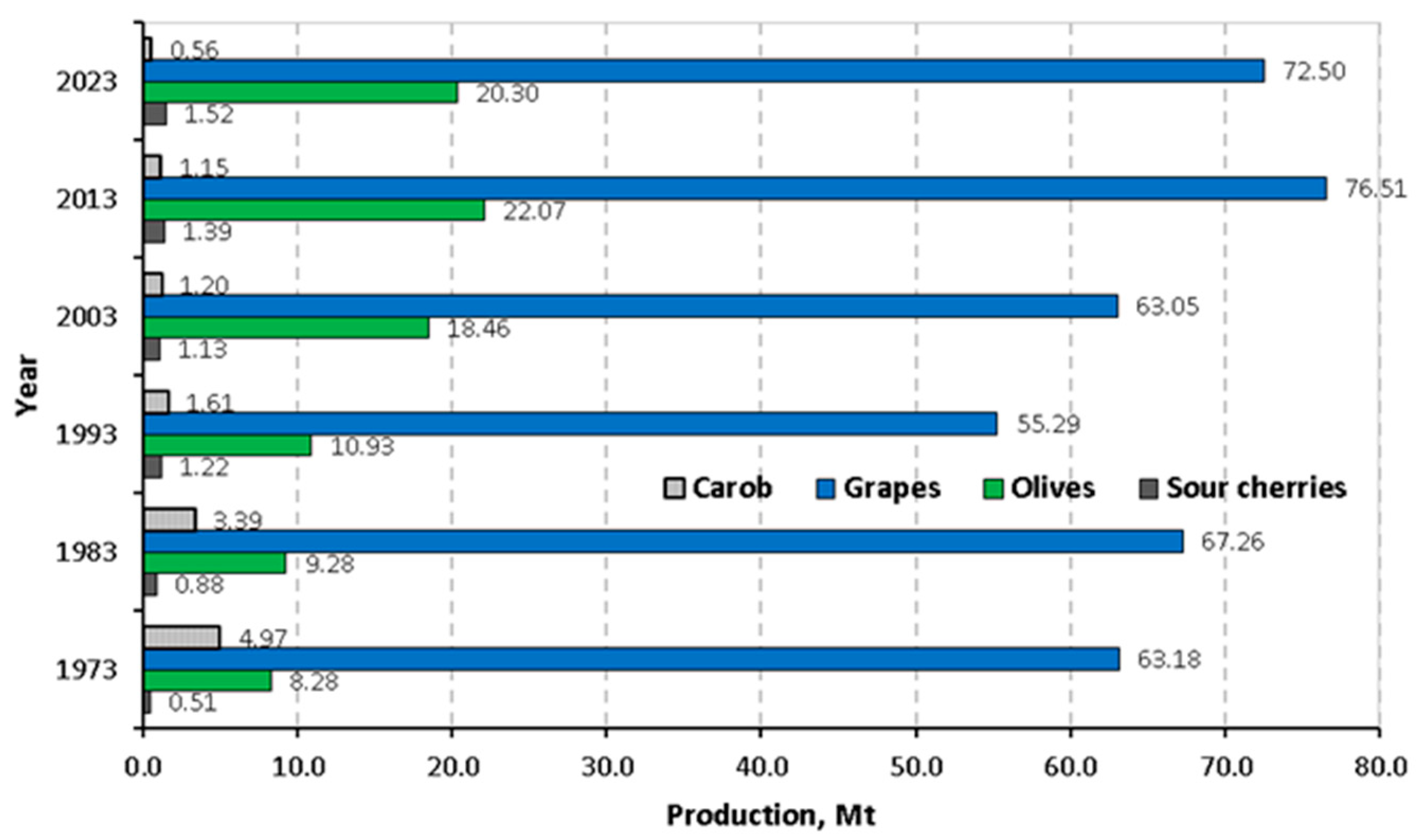
- Food and Agriculture Organization of the United Nations (FAO). Available online: https://www.fao.org/faostat/en/#data/QCL/visualize (accessed on 1 December 2025).
- Argun, M.E.; Ateş, H.; Argun, M.Ş.; Cakmakci, Ö. Management of sour cherry processing industry wastewater by super critical fluid method: Sequential recovery and treatment. Process Saf. Environ. Prot. 2025, 199, 107318. [Google Scholar] [CrossRef]
- Chatzimitakos, T.; Athanasiadis, V.; Kalompatsios, D.; Kotsou, K.; Mantiniotou, M.; Bozinou, E.; Lalas, S.I. Sustainable Valorization of Sour Cherry (Prunus cerasus) By-Products: Extraction of Antioxidant Compounds. Sustainability 2024, 16, 32. [Google Scholar] [CrossRef]
- Pollard, Z.A.; Goldfarb, J.L. Valorization of cherry pits: Great Lakes agro-industrial waste to mediate Great Lakes water quality. Environ. Pollut. 2021, 270, 116073. [Google Scholar] [CrossRef]
- Bhujel, L.; Baral, P.; Ranabhat, S.; Subedi, S.; Aalam, T.; Gyawali, T.R. Utilization of Prunus cerasoides shell (PCS) as sustainable substitute for natural aggregates in concrete. Clean. Waste Syst. 2025, 12, 100348. [Google Scholar] [CrossRef]
- Ferreiro-Cabello, J.; Fraile-Garcia, E.; Pernia-Espinoza, A.; Martinez-de-Pison, F.J. Strength Performance of Different Mortars Doped Using Olive Stones as Lightweight Aggregate. Buildings 2022, 12, 1668. [Google Scholar] [CrossRef]
- Available online: https://sumsova.ba/gospodarstvo/kostice-maslina-koriste-kao-energent-za-grijanje-zamjena-za-pelet (accessed on 22 January 2026).
- El Boukhari, M.; Merroun, O.; Maalouf, C.; Bogard, F.; Kissi, B. Exploring the Impact of Partial Sand Replacement with Olive Waste on Mechanical and Thermal Properties of Sustainable Concrete. Clean. Mater. 2023, 9, 100202. [Google Scholar] [CrossRef]
- Del Río Merino, M.; Guijarro Rodríguez, J.; Fernández Martínez, F.; Santa Cruz Astorqui, J. Viability of Using Olive Stones as Lightweight Aggregate in Construction Mortars. Rev. Constr. 2017, 16, 431–438. [Google Scholar] [CrossRef]
- Los Santos-Ortega, J.; Fraile-García, E.; Ferreiro-Cabello, J. Environmental Assessment of the Use of Ground Olive Stones in Mortars. Reduction of CO2 Emissions and Production of Sustainable Mortars for Buildings. Environ. Impact Assess. Rev. 2025, 110, 107709. [Google Scholar] [CrossRef]
- Netinger Grubeša, I.; Šamec, D.; Juradin, S.; Hadzima-Nyarko, M. Utilizing Agro-Waste as Aggregate in Cement Composites: A Comprehensive Review of Properties, Global Trends, and Applications. Materials 2025, 18, 2195. [Google Scholar] [CrossRef]
- Beres, C.; Simas-Tosin, F.F.; Cabezudo, I.; Freitas, S.P.; Iacomini, M.; Mellinger-Silva, C.; Cabral, L.M.C. Antioxidant Dietary Fibre Recovery from Brazilian Pinot Noir Grape Pomace. Food Chem. 2016, 201, 145–152. [Google Scholar] [CrossRef]
- Badouard, C.; Bogard, F.; Bliard, C.; Lachi, M.; Abbes, B.; Polidori, G. Development and Characterization of Viticulture By-Products for Building Applications. Constr. Build. Mater. 2021, 302, 124142. [Google Scholar] [CrossRef]
- Brassesco, M.E.; Brandao, T.R.S.; Silva, C.L.M.; Pintado, M. Carob bean (Ceratonia siliqua L.): A new perspective for functional food. Trends Food Sci. Technol. 2021, 114, 310–322. [Google Scholar] [CrossRef]
- Laaraj, S.; Salmaoui, S.; Addi, M.; El-rhouttais, C.; Tikent, A.; Elbouzidi, A.; Taibi, M.; Hano, C.; Noutfia, Y.; Elfazazi, K. Carob (Ceratonia siliqua L.) Seed Constituents: A Comprehensive Review of Composition, Chemical Profile, and Diverse Applications. J. Food Qual. 2023, 2023, 3438179. [Google Scholar] [CrossRef]
- Karababa, E.; Coşkuner, Y. Physical properties of carob bean (Ceratonia siliqua L.): An industrial gum yielding crop. Ind. Crops Prod. 2013, 42, 440–446. [Google Scholar] [CrossRef]
- González-Aviña, J.V.; Hosseinpoor, M.; Yahia, A.; Durán-Herrera, A. New biopolymers as viscosity-modifying admixtures to improve the rheological properties of cement-based materials. Cem. Concr. Compos. 2024, 146, 105409. [Google Scholar] [CrossRef]
- Clausell, J.R.; Signes, C.H.; Solà, G.B.; Lanzarote, B.S. Improvement in the rheological and mechanical properties of clay mortar after adding Ceratonia Siliqua L. extracts. Constr. Build. Mater. 2020, 237, 117747. [Google Scholar] [CrossRef]
- Zelada, R.Y.P.; Ubillus, G.S.S.; Huaricallo, Y. Influence of the Addition of Carob Ash to Concrete Under High Water Pressure. Math. Modell. Eng. Probl. 2025, 12, 1655–1670. [Google Scholar] [CrossRef]
- EN 1097-6:2022; Tests for Mechanical and Physical Properties of Aggregates—Part 6: Determination of Particle Density and Water Absorption. The European Committee for Standardization: Brussels, Belgium, 2022.
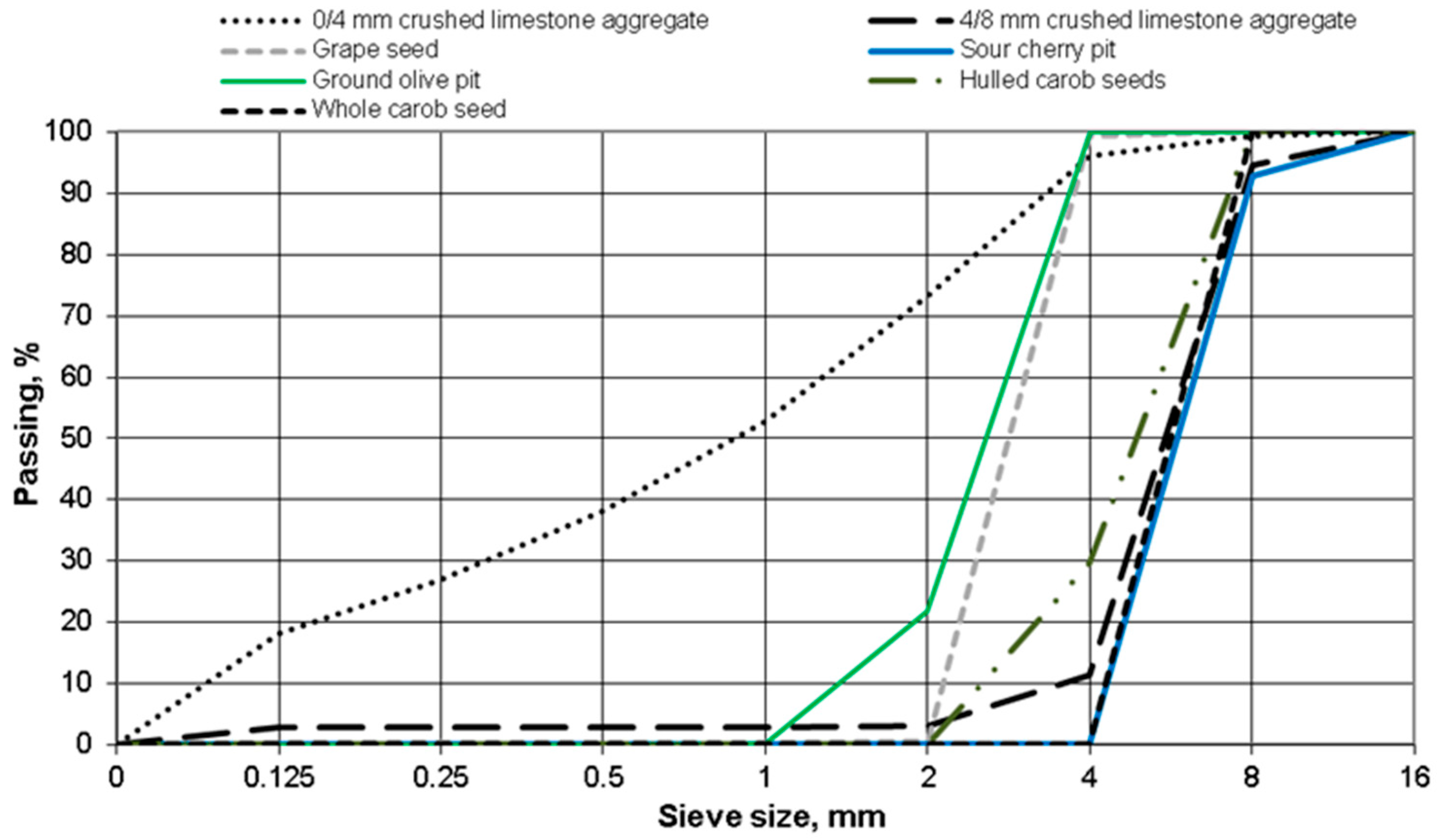
- EN 933-1:1997; Tests for Geometrical Properties of Aggregates—Part 1: Determination of Particle Size Distribution—Sieving Method. The European Committee for Standardization: Brussels, Belgium, 1997.
- Lamlom, S.H.; Abdalrasol, E.M. Effects of Various Pre-Sowing Treatments on Seed Germination of Carob (Ceratonia siliqua L.) From Al-Jabal Al-Akhdar Area (Balagrae, Al-Baida, Libya). J. Agric. Vet. Sci. 2016, 9, 16–24. [Google Scholar] [CrossRef]
- EN 197-1:2011; Cement—Part 1: Composition, Specifications and Conformity Criteria for Common Cements. The European Committee for Standardization: Brussels, Belgium, 2011.
- EN 196-6:2018; Methods of Testing Cement—Part 6: Determination of Fineness. The European Committee for Standardization: Brussels, Belgium, 2018.
- ASTM C430-17; Standard Test Method for Fineness of Hydraulic Cement by the 45-μm (No. 325) Sieve. ASTM International: West Conshohocken, PA, USA, 2017.
- EN 12350-2:2019; Testing fresh concrete—Part 2: Slump-Test. The European Committee for Standardization: Brussels, Belgium, 2019.
- EN 12390-7:2019; Testing Hardened Concrete—Part 7: Density of Hardened Concrete. The European Committee for Standardization: Brussels, Belgium, 2019.
- EN 12504-4:2021; Testing Concrete in Structures—Part 4: Determination of Ultrasonic Pulse Velocity. The European Committee for Standardization: Brussels, Belgium, 2021.
- EN 12390-3:2019; Testing Hardened Concrete—Part 3: Compressive Strength of Test Specimens. The European Committee for Standardization: Brussels, Belgium, 2019.
- Raju, S.; Brindha, D. Durability characteristics of copper slag concrete with fly ash. GRAĐEVINAR 2017, 69, 1031–1040. [Google Scholar] [CrossRef]
- ASTM C1585−13; Standard Test Method for Measurement of Rate of Absorption of Water by Hydraulic-Cement Concretes. ASTM International: West Conshohocken, PA, USA, 2013.
- EN–206:2021; Concrete—Specification, Performance, Production and Conformity (EN 206:2013+A2:2021). The European Committee for Standardization: Brussels, Belgium, 2021.
- Shafigh, P.; Jumaat, M.Z.; Bin Mahmud, H.; Hamid, N.A.A. Lightweight concrete made from crushed oil palm shell: Tensile strength and effect of initial curing on compressive strength. Constr. Build. Mater. 2012, 27, 252–258. [Google Scholar] [CrossRef]
- Achour, C.; Rémond, S.; Belayachi, N. Swelling and shrinkage of plant aggregates: Experimental and treatment effect. Ind. Crops Prod. 2023, 203, 117173. [Google Scholar] [CrossRef]
- Saint-Pierre, F.; Philibert, A.; Giroux, B.; Rivard, P. Concrete Quality Designation based on Ultrasonic Pulse Velocity. Constr. Build. Mater. 2016, 125, 1022–1027. [Google Scholar] [CrossRef]
- Traore, Y.B.; Messan, A.; Hannawi, K.; Gerard, J.; Prince, W.; Tsobnang, F. Effect of oil palm shell treatment on the physical and mechanical properties of lightweight concrete. Constr. Build. Mater. 2018, 161, 452–460. [Google Scholar] [CrossRef]
- BS 1881-203; Testing Concrete—Recommendations for Measurement of Velocity of Ultrasonic Pulses in Concrete. British Standards Institution: London, UK, 1986.
- Willson, M.L.; Tennis, P. Design and Control of Concrete Mixtures, 17th ed.; PCA: Tokyo, Japan, 2021. [Google Scholar]
- Razak, A.B.; Chai, H.K.; Wong, H.S. Near surface characteristics of concrete containing supplementary cementing materials. Cem. Concr. Compos. 2024, 26, 883–889. [Google Scholar] [CrossRef]
- Golewski, G.L. Assessing of water absorption on concrete composites containing fly ash up to 30% in regards to structures completely immersed in water. Case Stud. Constr. Mater. 2023, 19, e02337. [Google Scholar] [CrossRef]
- Yew, M.K.; Bin Mahmud, H.; Ang, B.C.; Yew, M.C. Effects of oil palm shell coarse aggregate species on high strength lightweight concrete. Sci. World J. 2014, 2014, 387647. [Google Scholar] [CrossRef]
- Gunasekaran, K.; Annadurai, R.; Kumar, P.S. A study on some durability properties of coconut shell aggregate concrete. Mater. Struct. 2015, 48, 1253–1264. [Google Scholar] [CrossRef]
- Abutaha, F.; Abdul Razak, H.; Ibrahim, H.A. Effect of coating palm oil clinker aggregate on the engineering properties of normal. Coatings 2017, 7, 175. [Google Scholar] [CrossRef]
- Bailo, G.J.B.; Belivestre, C.M.C.; Blanco, K.J. Performance Evaluation of Coconut Shell as Partial Aggregate Replacement in Concrete: Compressive Strength, Sorptivity, and Sustainability Perspectives. In Proceeding of International Exchange and Innovation Conference on Engineering & Sciences (IEICES); Kyushu University: Fukuoka, Japan, 2025; pp. 1547–1553. [Google Scholar] [CrossRef]
- Netinger Grubeša, I.; Kramarić, D.; Šamec, D.; Crnoja, A. Performance of Bacterial Concrete with Agro-Waste Capsules. Appl. Sci. 2026, 16, 755. [Google Scholar] [CrossRef]
- Available online: https://www.cemex.hr/beton/klasa-betona (accessed on 7 May 2026).
- Volchuk, V.M.; Kotov, M.A.; Plakhtii, Y.G.; Tymoshenko, O.A.; Zinkevych, O.H. Investigation of the influence of the heterogeneous structure of concrete on its strength. Results Mater. 2025, 25, 100659. [Google Scholar] [CrossRef]

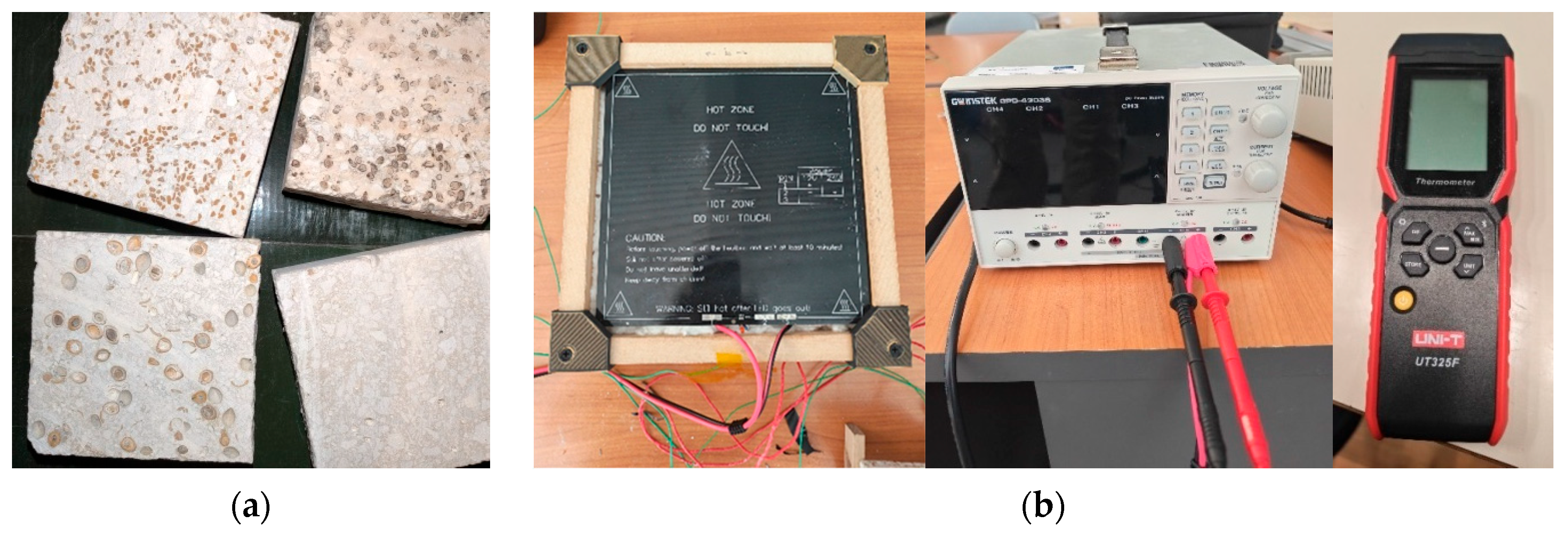
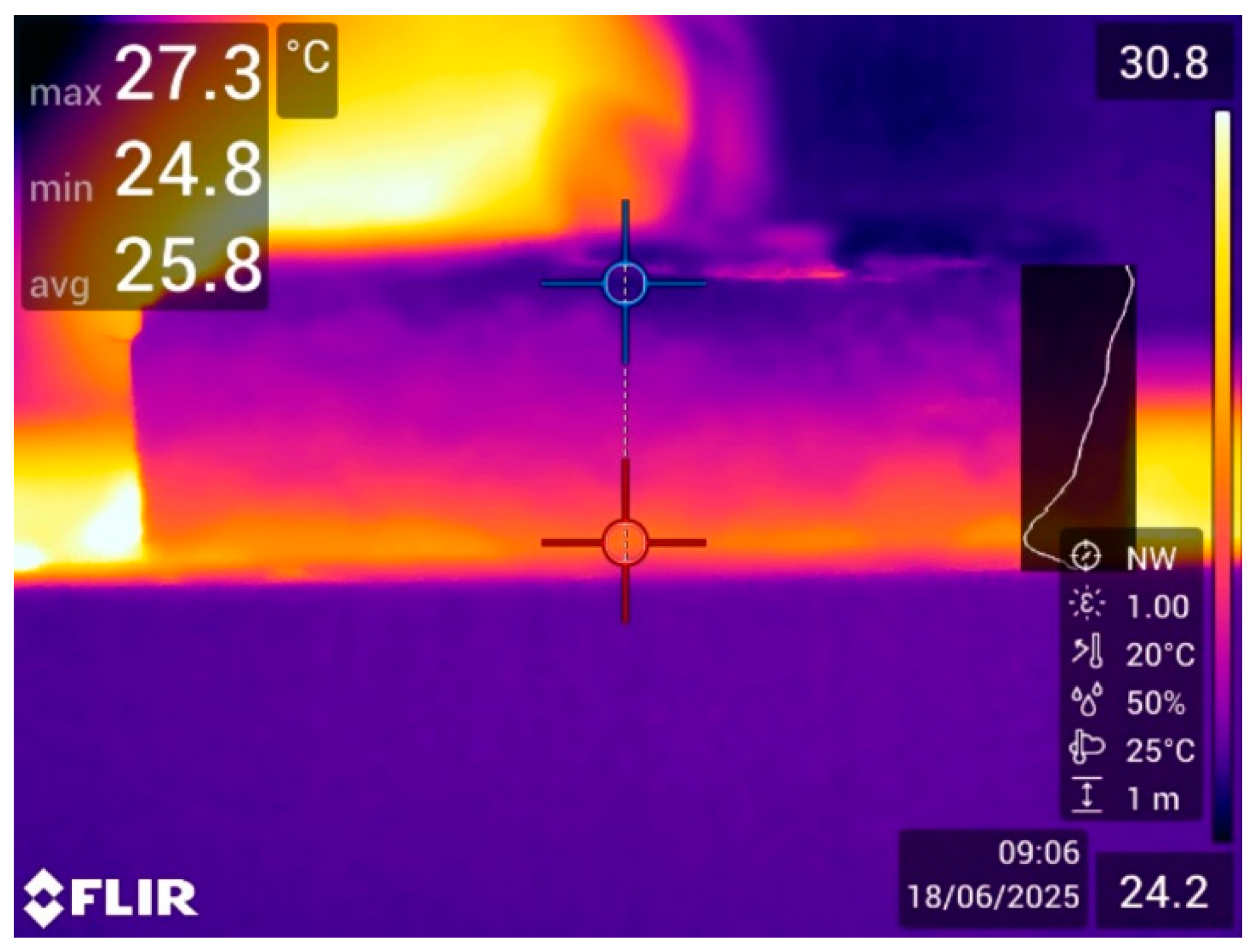
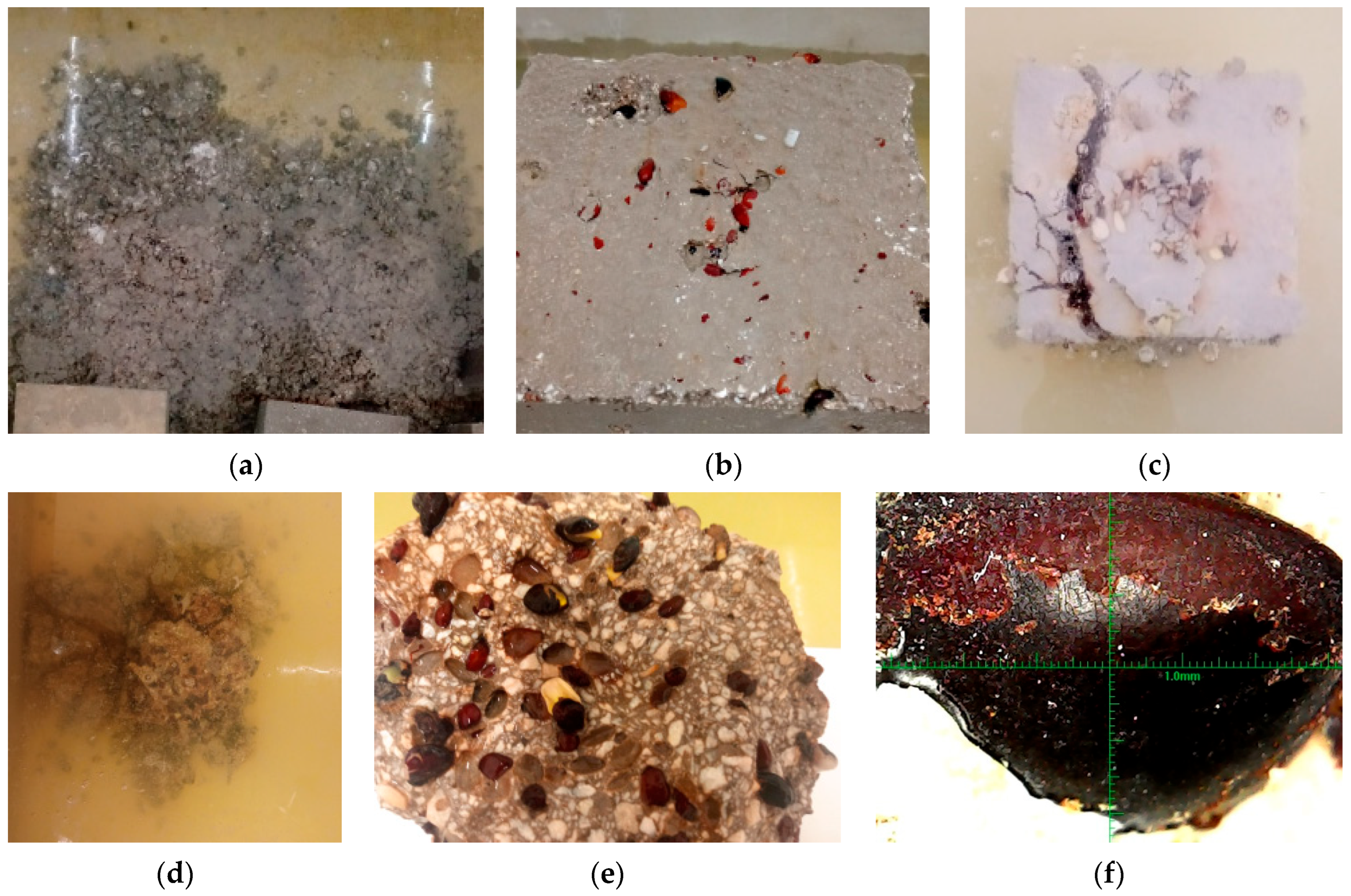
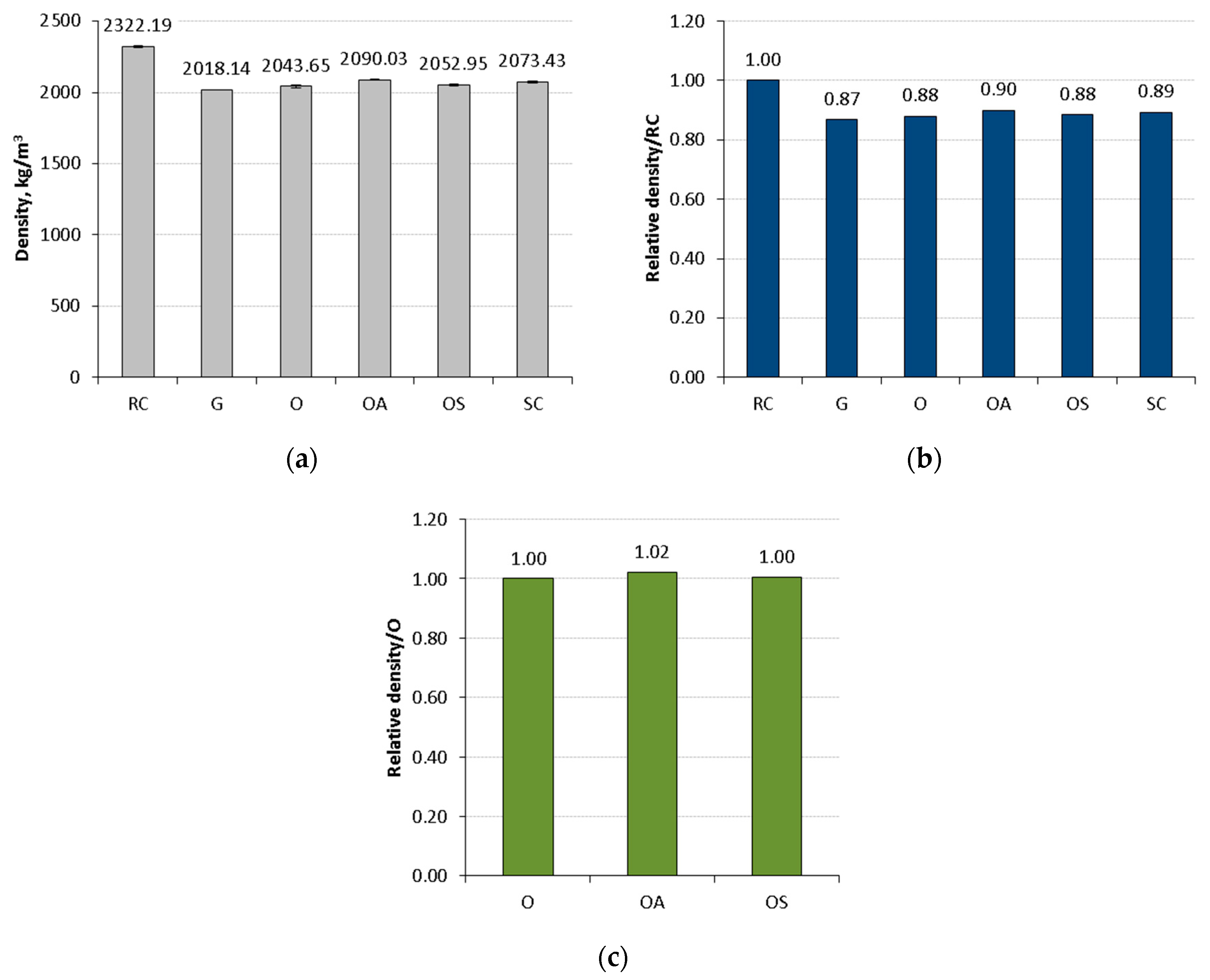

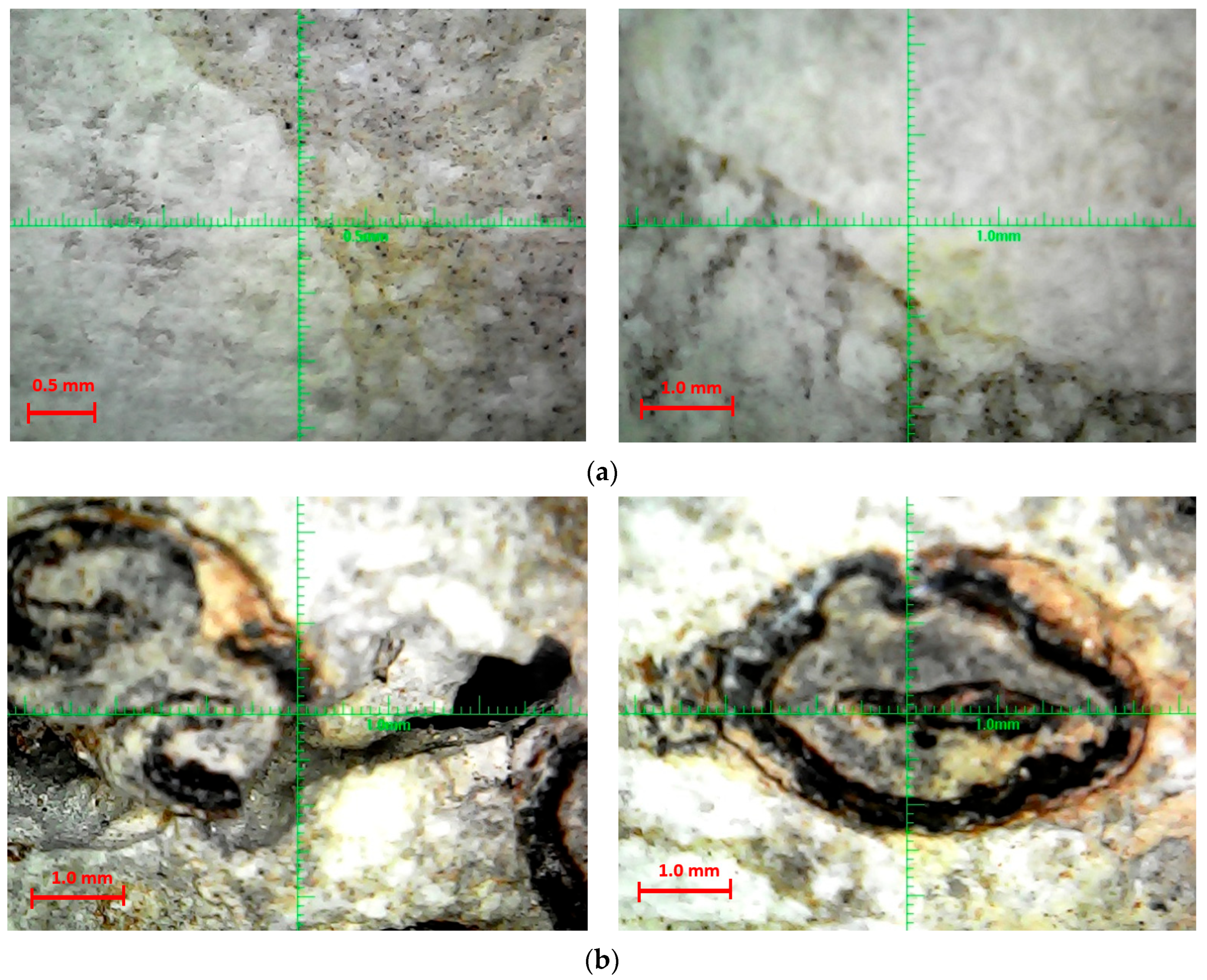
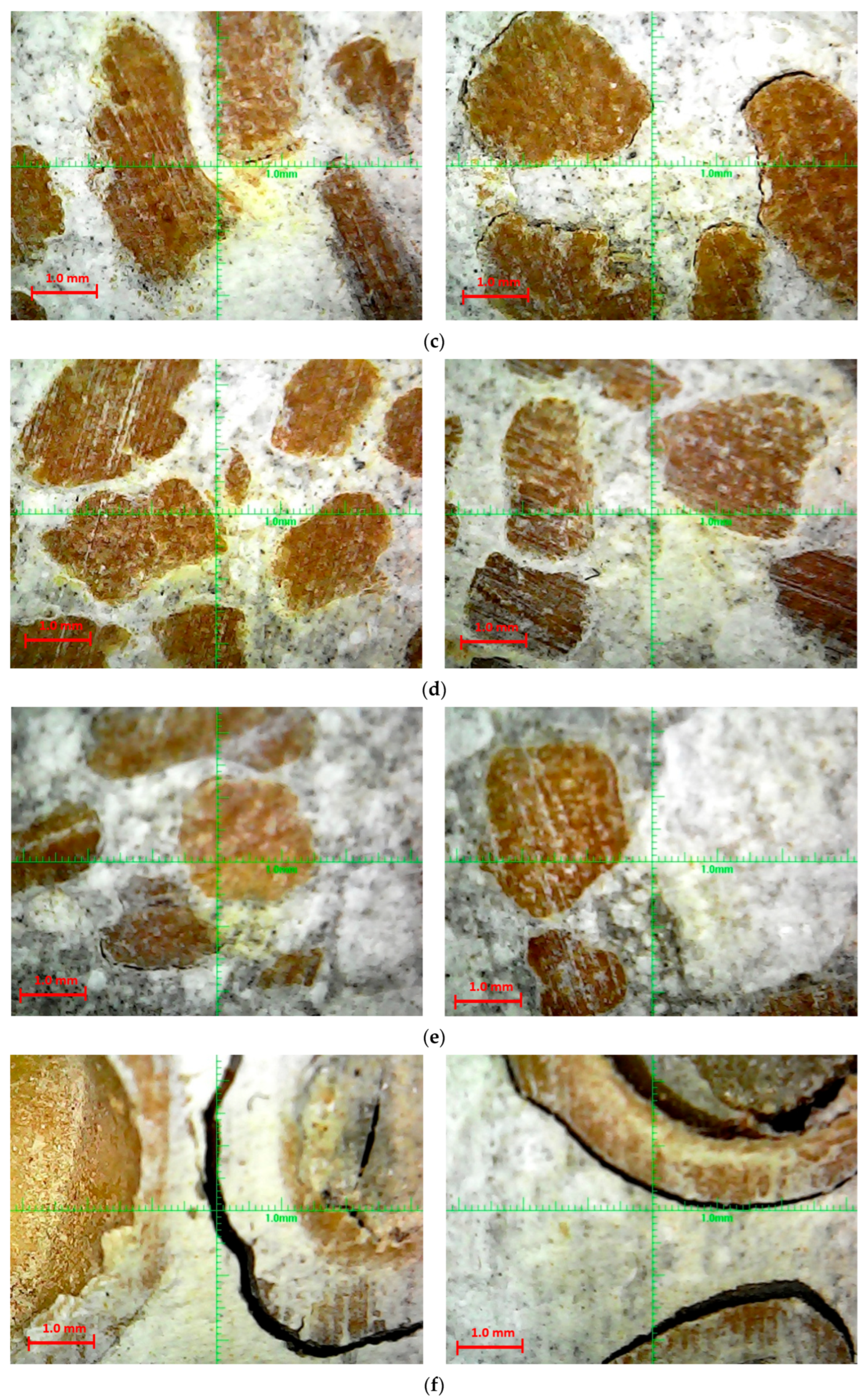

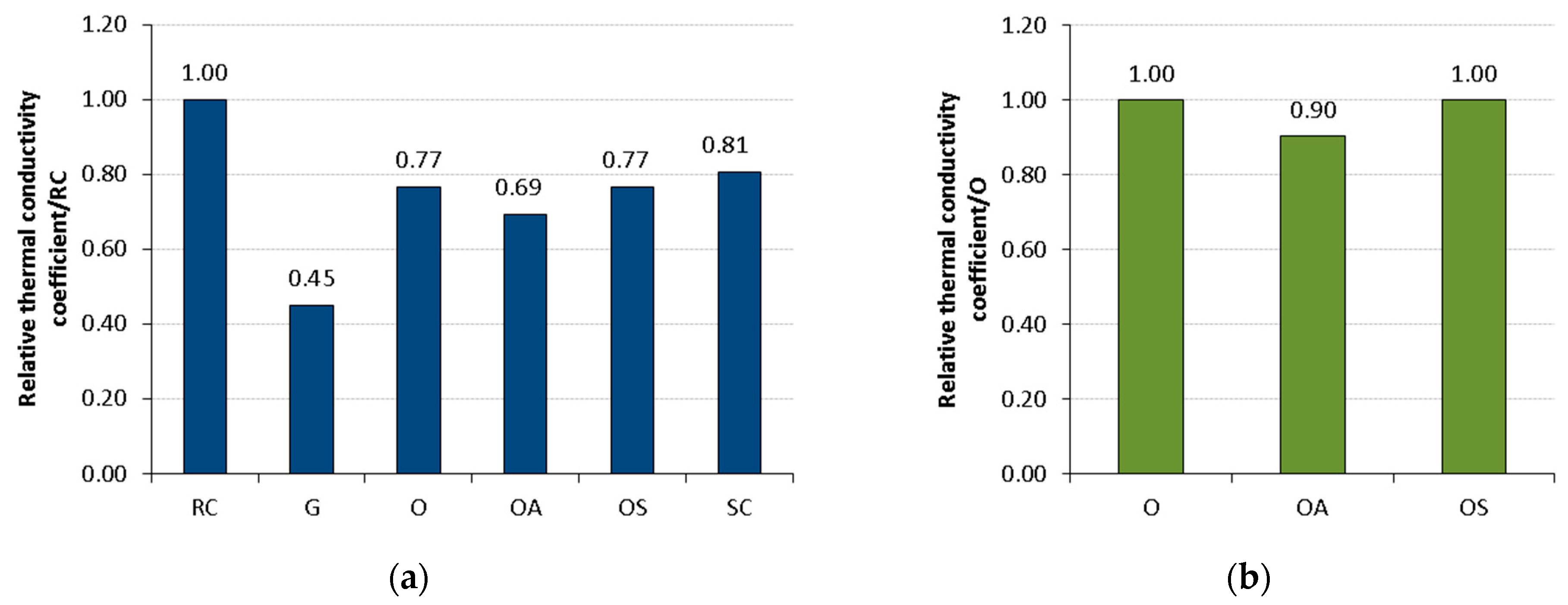

| Type | Appearance | Density (g/cm3) | Bulk Density (g/cm3) | Weight Per Seed (mg) | Length (mm) | Width (mm) | Absorption% |
|---|---|---|---|---|---|---|---|
| Crushed limestone aggregate 0/4 mm |  | 2.69 | 1.62 | - | - | - | 2.56 |
| Crushed limestone aggregate 4/8 mm |  | 2.69 | 1.35 | - | - | - | 2.08 |
| Grape seed |  | 1.10 | 0.62 ± 0.01 | 27.97 ± 0.46 | 6.0 ± 0.4 | 3.0 ± 0.4 | 53.3 |
| Sour cherry pit | 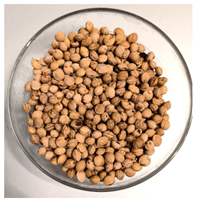 | 0.81 | 0.48 ± 0.01 | 219.74 ± 0.32 | 8.6 ± 0.7 | 7.6 ± 0.5 | 36.4 |
| Untreated ground olive pit | 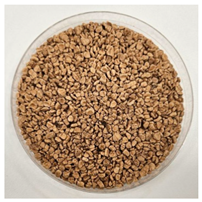 | 1.05 | 0.703 ± 0.008 | - | - | - | 28.7 |
| Ground olive pit treated with ash water | 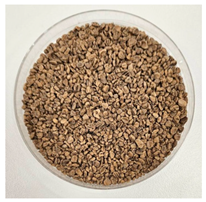 | 0.693 ± 0.010 | - | - | - | 28.6 | |
| Ground olive pit treated with seawater | 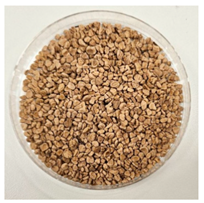 | 0.702 ± 0.025 | - | - | - | 29.8 | |
| Whole carob seed | 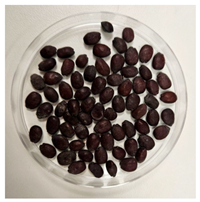 | 1.36 | 0.812 ± 0.024 | 191.69 ± 34.33 | 9.7 ± 0.8 | 6.0 ± 0.8 | |
| Hulled carob seeds | 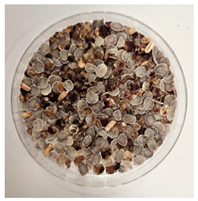 | 0.704 ± 0.115 | 46.99 ± 2.16 | 7.0 ± 0.0 | 5.0 ± 0.0 |
| Components | Mixtures | RC | G | O | OA | OS | SC | WC | HC | |
|---|---|---|---|---|---|---|---|---|---|---|
| Cement, kg | 400 | 400 | 400 | 400 | 400 | 400 | 400 | 400 | ||
| Water, kg; w/c = 0.45 | 180 | 180 | 180 | 180 | 180 | 180 | 180 | 180 | ||
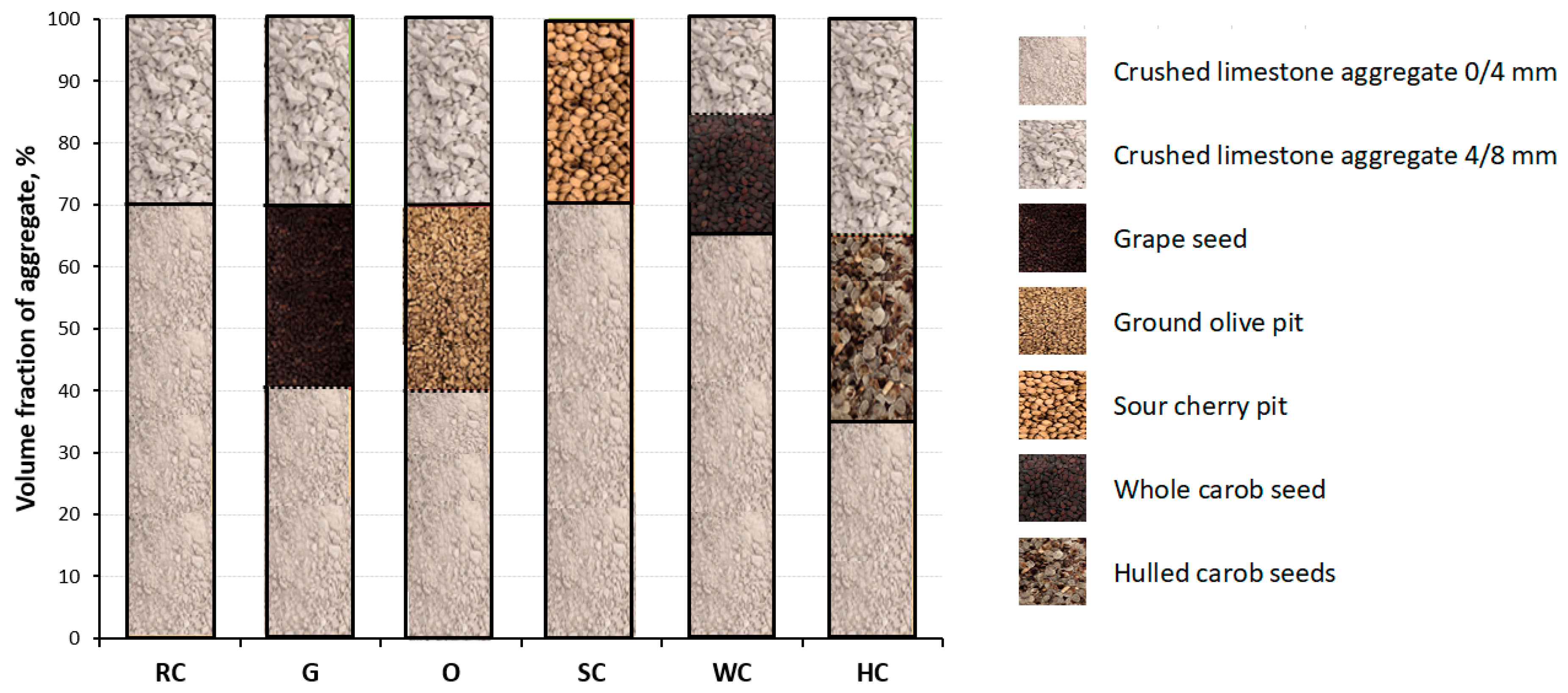
| Aggregate, kg | Crushed limestone | 0/4 mm | 1239.4 | 708.2 | 708.2 | 708.2 | 708.2 | 1239.4 | 1150.9 | 619.7 |
| 4/8 mm | 531.2 | 531.2 | 531.2 | 531.2 | 531.2 | - | 265.6 | 619.7 | ||
| Grape seed | - | 217.2 | - | - | - | - | - | - | ||
| Sour cherry pit | - | - | - | - | - | 160.5 | - | - | ||
| Ground olive pit | untreated | - | - | 207.3 | - | - | - | - | - | |
| ash water | - | - | - | 207.3 | - | - | - | - | ||
| seawater | - | - | - | - | 207.3 | - | - | - | ||
| Carob seed | hulled | - | - | - | - | - | - | - | 268.6 | |
| whole | - | - | - | - | - | - | 179.0 | - | ||
| Superplasticizer, kg | 2 | 2 | 2 | 2 | 2 | 2 | 2 | 2 | ||
| Concrete | RC | G | O | OA | OS | SC | WC | HC |
|---|---|---|---|---|---|---|---|---|
| Slump, mm | 50 | 0 | 255 | 225 | 0 | 95 | 20 | 0 |
| Standardized consistence classes | S2 | S1 | S5 | S5 | S1 | S3 | S1 | S1 |
| Mix | Compressive Strength, MPa | Structural Application | Non-Load Bearing Elements | Insulation Use | Practical Potential |
|---|---|---|---|---|---|
| RC (Reference Concrete) | 54.7 | Yes | Yes | No | Very High |
| OA (Ground Olive Pits–Ash Treated) | 36.8 | Limited | Yes | Yes | Highest among agro-concretes |
| O/OS (Untreated/Seawater Treated Olive Pits) | 28.5, 30.4 | No | Yes | Yes | Moderate |
| SC (Sour Cherry Pits) | 25.3 | No | Limited | Limited | Low |
| G (Grape Seeds) | 10.8 | No | Limited | Yes | Mainly as insulating material |
| HC/WC (Carob–Hulled/Whole) | - | No | No | No | Not suitable for construction |
Disclaimer/Publisher’s Note: The statements, opinions and data contained in all publications are solely those of the individual author(s) and contributor(s) and not of MDPI and/or the editor(s). MDPI and/or the editor(s) disclaim responsibility for any injury to people or property resulting from any ideas, methods, instructions or products referred to in the content. |
© 2026 by the authors. Licensee MDPI, Basel, Switzerland. This article is an open access article distributed under the terms and conditions of the Creative Commons Attribution (CC BY) license.
Share and Cite
Juradin, S.; Netinger Grubeša, I.; Milat, M.; Divić, V.; Šamec, D.; Rapić, D. The Properties of Concrete Utilizing Partial Aggregate Replacement with Locally Sourced Mediterranean Agro-Waste. Materials 2026, 19, 2187. https://doi.org/10.3390/ma19112187
Juradin S, Netinger Grubeša I, Milat M, Divić V, Šamec D, Rapić D. The Properties of Concrete Utilizing Partial Aggregate Replacement with Locally Sourced Mediterranean Agro-Waste. Materials. 2026; 19(11):2187. https://doi.org/10.3390/ma19112187
Chicago/Turabian StyleJuradin, Sandra, Ivanka Netinger Grubeša, Martina Milat, Vladimir Divić, Dunja Šamec, and Dino Rapić. 2026. "The Properties of Concrete Utilizing Partial Aggregate Replacement with Locally Sourced Mediterranean Agro-Waste" Materials 19, no. 11: 2187. https://doi.org/10.3390/ma19112187
APA StyleJuradin, S., Netinger Grubeša, I., Milat, M., Divić, V., Šamec, D., & Rapić, D. (2026). The Properties of Concrete Utilizing Partial Aggregate Replacement with Locally Sourced Mediterranean Agro-Waste. Materials, 19(11), 2187. https://doi.org/10.3390/ma19112187