Article

The Properties of Concrete Utilizing Partial Aggregate Replacement with Locally Sourced Mediterranean Agro-Waste


1
Faculty of Civil Engineering, Architecture and Geodesy, University of Split, Matice hrvatske 15, 21000 Split, Croatia
2
Department of Construction, University North, 42000 Varaždin, Croatia
3
Department of Food Technology, University North, 48000 Koprivnica, Croatia
4
Jolos d.o.o., Gundulićeva 26A, 21000 Split, Croatia
*
Author to whom correspondence should be addressed.
Materials 2026, 19(11), 2187; https://doi.org/10.3390/ma19112187
Submission received: 17 April 2026 / Revised: 12 May 2026 / Accepted: 19 May 2026 / Published: 22 May 2026
(This article belongs to the Special Issue Sustainability and Performance of Cement-Based Materials)

Abstract

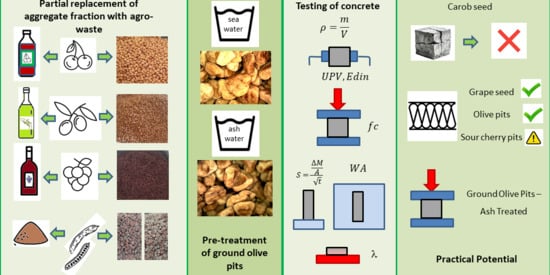
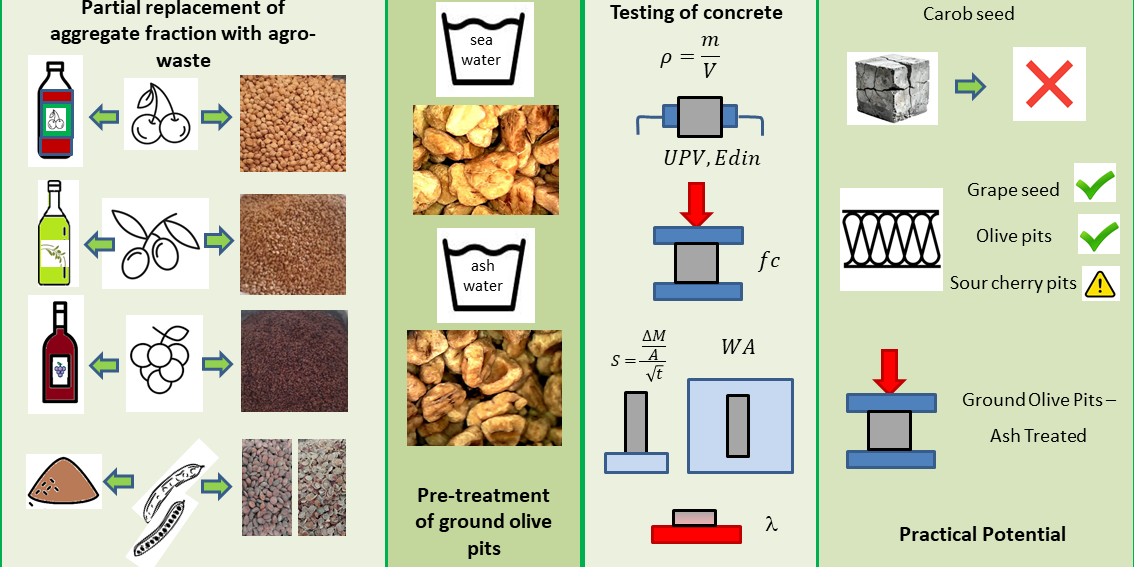
The growth of the global population has led to increased demand for agricultural products, resulting in greater agricultural waste production. One sustainable response to this challenge is using agricultural waste as raw material in building materials. This study examines the potential for partial replacement of natural aggregates in concrete with agricultural waste from typical Mediterranean fruits: sour cherry pits, grape seeds, ground olive pits, and carob seeds. To evaluate the effect of treatment on the behavior of agro-waste aggregates, ground olive pits were used untreated, treated with ash water, or treated with seawater. Carob seed concrete deteriorated during water curing due to seed swelling and tannin-related degradation, revealing its unsuitability without prior stabilization. Partial replacement of natural aggregates with agricultural waste resulted in decreased density, ultrasonic pulse velocity (UPV), dynamic elastic modulus, compressive strength, and thermal conductivity, while increasing saturated water absorption. Treatment with ash water on ground olive pits improved the interfacial transition zone (ITZ), resulting in 29% increase in compressive strength relative to untreated ground olive pits. Concrete with ash water treated ground olive pits demonstrated the highest practical potential among all tested agro-waste concretes.

Graphical Abstract

1. Introduction

Global population growth has intensified demand for essential human needs, particularly food and civil infrastructure, which places substantial pressure on both the agricultural and construction sectors. Expanded agricultural activities have led to greater generation of agro-waste, introducing considerable challenges relating to waste management and environmental sustainability. At the same time, the construction and operation of buildings account for approximately 40% of global carbon dioxide emissions, with about 15% of these emissions stemming from the production of construction materials [1]. In Europe, the construction sector is the leading consumer of natural resources, responsible for nearly half of all material extraction and contributing significantly to resource depletion [2]. Globally, resource extraction has surged from 7 gigatons (Gt) in 1900 to 89 Gt in 2015, representing a thirteen-fold increase in the modern industrial period [3].
Addressing these interconnected environmental challenges necessitates innovative strategies, such as the integration of agro-waste into construction products. Utilizing agricultural waste as a raw material not only presents a green solution for waste disposal but also reduces reliance on traditional natural aggregates. Agro-waste, also known as agricultural waste, refers to non-product residues generated during the cultivation and processing of agricultural products of plant or animal origin [4]. Agro-waste is most commonly reused within the same sector in which it is generated, particularly in the food or agronomic sectors, where it serves purposes such as animal feed, compost, soil amendments, or bio-fertilizers. However, a significant portion of agro-waste is non-digestible, chemically complex, or contains compounds that limit its safe or efficient reuse in food or agricultural applications. Because of these constraints, such waste cannot be directly reintegrated into the original sector. As a result, increasing research efforts are focused on exploring alternative uses of agro-waste in other sectors, including energy production, materials science, construction, and biotechnology, with the aim of adding value while reducing environmental impact. Recent research increasingly explores its use in construction materials [5], both for thermal insulation and as structural components [6].
The integration of agro-waste into concrete supports the advancement of circular economy principles, sustainable development, and improved energy efficiency within the construction industry. Moreover, this approach can offer economic advantages by lowering concrete production costs and mitigating environmental impacts [7]. Such benefits are increasingly critical, given that concrete is the world’s second most widely used substance after water, with annual consumption approaching 30 billion tons [8,9]. Agro-waste can be incorporated into concrete in the form of a powdery substance as a substitute for cement or in the form of an aggregate in which it replaces fine and coarse mineral aggregate. Some examples of cementitious substitute materials are rice husk ash, rice straw ash, bamboo leaf ash, sugarcane ash, corn cob ash, coconut husk ash, wheat straw ash, elephant grass ash, etc. [10,11,12,13,14,15,16], which are all derived from lignocellulose agricultural residues that are inherently rich in cellulose, hemicellulose, lignin, and especially silica. Their common chemical characteristics, a high content of amorphous silica and other reactive oxides, makes them particularly valuable in non-food applications, where they generally exhibit excellent pozzolanic properties, enabling their use in construction materials and cement replacement. Common examples of agro-waste applied in concrete production as aggregate include rice husk [5,17,18,19,20], corn cob [21,22,23,24,25,26,27,28,29], wheat straw [30], coconut shell [31,32,33,34,35,36,37,38,39,40], palm kernel shell [41,42,43,44,45,46,47,48,49,50], hazelnut, peanuts, pistachios shells [51,52,53,54,55], and fruit pits such as peaches, nectarine, and apricot [56,57,58,59,60,61,62]. The agro-aggregates consist of organic waste and are subject to different levels of biological decomposition when exposed to an aggressive environment such as cement composites. One potential solution to this issue is the implementation of technological treatment processes. As stated in references [63,64], the pre-treatment of oil palm shell (OPS) with hot water significantly improves the removal of the oily surface from the shells and increases the bond between the cement paste and the OPS, leading to enhanced mechanical properties. To minimize chemical incompatibility between cement and plant biomass, sugarcane bagasse particles were immersed in cold water for 24 h, whereas coffee husk particles were soaked overnight in water and a 1% NaOH solution for 24 h, followed by washing in cold water [65]. Hydrophobic surface treatments were applied to coconut shell, oil palm shell, and areca nut shell; when reinforced with natural fibers, these offer a viable pathway to environmentally sustainable lightweight concrete that boasts enhanced durability and a lower carbon footprint [66]. Utilizing agricultural waste as aggregates in concrete mixtures primarily enhances thermal and acoustic insulation properties, decreases the density and overall weight of the concrete, and consequently leads to economic advantages. Agricultural waste in fresh concrete can both increase and decrease workability, while in hardened concrete, this mainly reduces its mechanical characteristics, i.e., compressive and tensile strength [67].
To extend current research in this area, the present study focuses on aggregate replacement using pits from four locally sourced Mediterranean fruits: sour cherry, grape, olive, and carob. The production of this fruit will be presented below, as well as previous examples of their application in cement composites.

2. Production and Current Application of Mediterranean Agro-Waste

Sour cherry (Prunus cerasus L.) is one of the most popular fruits, commonly enjoyed fresh and in processed forms [68]. According to Figure 1, in the last 50 years, their production has tripled and in 2023 reached a production of 1.52 Mt [69]. Approximately 85% of cherries are processed, and 30–40% of the total production is intended for the global fruit juice industry [70]. Processing sour cherries generates a significant amount of waste. Once the cherries are juiced and quickly frozen, the leftover pomace, which includes the skin and flesh, along with the pits, is typically discarded [71]. For instance, in the U.S., a single year’s production can generate about 18.1–22.7 kt of this waste (data for 2016), or approx. 15% of the total production [72]. The sour cherry pit (stone) is primarily composed of a hard, lignocellulosic shell that protects the seed inside. This shell consists mainly of cellulose, hemicellulose, and lignin, which give it high mechanical strength and make it resistant to digestion and degradation. Sour cherry pits are a good candidate for use as cement aggregate because they are lightweight, mechanically robust due to their lignocellulosic structure, and have a rough surface that promotes good bonding with the cement matrix. In addition, their chemical stability and status as an agricultural waste make them a sustainable alternative to conventional aggregates. Netinger Grubeša et al. [67] completely replaced the 4–8 mm dolomite aggregate fraction in concrete with cherry sour pits that were either untreated or treated with 2.5 or 5% NaOH. The treatment increased water absorption and the appearance of the pits’ surface, and the concretes with replacement, regardless of the treatment, had lower density, thermal conductivity coefficient, and compressive strength. Bhujel et al. [73] investigated the replacement of natural coarse aggregate with Prunus cerasoides shells at varying proportions ranging from 0% to 40% by weight. Their findings indicated a consistent reduction in density, mechanical strengths, and elastic modulus as the proportion of Prunus cerasoides shells increased. Conversely, water absorption exhibited a steady rise with higher shell content. Comparable compressive strengths for M20 grade concrete were achieved with 10% and 20% Prunus cerasoides shell replacement.
Olives (Olea europaea): Globally, 64.8% of olive production occurs in Europe, with Spain, Italy, and Greece being the leading producers, all located in the Mediterranean region. Annually, over 20.3 Mt of olives are harvested worldwide, which is a 2.5-fold increase compared to 1973 [69]. Olive stones make up a notable portion of the overall weight of this fruit (20–28%) and are regarded as a by-product in the processes of olive oil extraction and the production of pitted table olives [74]. According to [75], for every 100 kg of processed olives, about 30 kg of pits are obtained, which depends on the variety and quality of the fruit. Olive pits, similarly to cherry pits stones, are primarily composed of a hard lignocellulosic structure rich in cellulose, hemicellulose, and especially lignin, along with small amounts of inorganic minerals. This composition makes them non-digestible and unsuitable for food or feed applications, as the rigid structure resists biological breakdown and offers no nutritional value. Owing to their hardness, low density, and rough surface texture, olive stones are therefore better suited for alternative uses. This agricultural waste is used for fuel because it is cheaper than pellets, and has the same function as pellets, or is disposed of in landfills or dumped somewhere in nature, together with the pomace. Ferreiro-Cabello et al. [74] tried to develop a lightweight mortar that includes olive stone residue (in varying percentages), without the need for supplementary treatments. The authors concluded that an aggregate replacement of 0–30% could be accomplished, with the highest replacement of ground olive stones (30%) resulting in a 15% reduction in density compared to the reference mortar. The compressive strength for the various doses examined remained above 70% of the strength of the reference mortar; however, the flexural performance was significantly compromised, exhibiting values of approximately 50%. EL Boukhari et al. [76] used two types of olive waste (olive pomace solid aggregates and olive pomace solid aggregates immersed in olive mill wastewater) as a partial substitute (0–15%) for natural sand in structural concrete. The concrete specimens containing 5% olive pomace solid aggregates and immersed in olive mill wastewater in a dry condition exhibited the closest mechanical properties to the reference concrete. Moreover, the inclusion of olive waste improved the thermal conductivity of the concrete. Del Río Merino et al. [77] tested three types of olive stones (whole pit, crushed, and calcined) as sustainable substitutes for expanded clay aggregates. The authors determined that substituting expanded clay only with calcined olive stones is economically viable in the manufacturing of lightweight mortars, which can reach densities that are up to 30% lower than those achieved with lightweight mortars made from expanded clay. Beyond testing mechanical, thermal, and economic aspects, another study [78] assessed the environmental implications of incorporating ground olive stone as a partial replacement for natural fine aggregate in 1 m3 of mortar at various replacement levels, using a Life Cycle Assessment (LCA) methodology.
Grapes (Vitis vinifera): The cultivation of grapes is of significant global economic relevance due to their extensive use for various purposes, such as fresh consumption, wine production, raisins, juices, and other products [79]. The production of grapes in 2023 amounted to 72.5 Mt, and according to Figure 1, it can be seen that grapes have seen continuous production. Wine production in Europe accounts for 71.4% of production over the past 50 years, and the three countries with the largest wine production are Italy, France and Spain. The wine processing sector produces a notable amount of waste, which constitutes approximately 13.5–14.5% of the total production. The primary waste components derived from grapes include pomace, seeds, and stems. Grape seeds generally account for 2–5% of the overall grape mass and are responsible for approximately 38–52% of the solid waste generated by the wine industry [79,80]. Grape seeds are widely used in the food, cosmetic, and pharmaceutical industries, mainly for the extraction of grape seed oil and polyphenol-rich antioxidants due to their high content of lipids and bioactive compounds. After oil extraction, the remaining solid residue has limited value for food applications because of its rigid lignocellulosic structure and low digestibility. In [67] fine dolomite aggregate was substituted with three types of grape seeds—untreated and pre-treated with 2.5% or 5% NaOH solution. The substitution of fine aggregate with grape seeds led to a decrease in the workability of the concrete, while concrete with untreated grape seeds achieved 10% of the compressive strength, 25% of the thermal conductivity coefficient and 71% of the density compared to the referent concrete. The concrete treated with grape seeds disintegrated, probably due to the elevated tannin content present in the grape seeds. In [81] four groups of aggregates were examined: one group utilized the complete grape pomace, two additional groups employed stalks and skins individually, and a final group consisted of coarsely ground stalks and found that grape by-products appear to exhibit favorable thermal, mechanical, and acoustic properties, making them suitable for use as insulation materials in the construction of public buildings.
Carob (Ceratonia siliqua L.): This is an evergreen Mediterranean plant whose history dates back to ancient Egypt, where it was used as livestock feed. In Arab culture, carob seeds served as a unit of weight, known as a qirat or karat; this standard weight later became the yardstick for measuring gold and precious stones [82]. In the observed period 1973–2023, carob production fell to 11% of the 1973 production, when it amounted to 4.97 Mt (Figure 1). Carob is primarily utilized in food and pharmaceutical industries for locust bean gum extraction, which is valued as a thickening and stabilizing agent [83]. The remaining seed shells are non-digestible and low in nutritional value, making them unsuitable for food or feed applications. In total, 90% of the weight of carob pods is pulp and the remaining 10% are seeds (beans), which are extremely hard [84]. In [85] a new biopolymer from locust (carob) bean gum was used as a viscosity-modifying admixture in cement paste. Cement pastes with carob bean gum showed a significant improvement in rheological properties compared to the reference mixture, but it affected the hydration delay of cement mortars. In a study carried out by Clausell et al. [86], it was shown that carob tannin possesses considerable potential as an additive for clay-based construction materials, particularly as a superplasticizer. Research conducted by Zelada et al. [87] examined the impact of partially adding carob ash to a concrete mix, showing that incorporating 6% carob ash enhanced the mechanical properties and reduced the water penetration depth. In contrast, in the present study, carob seeds are used as aggregates in concrete, as the seeds are very hard.
The aim of the paper is to examine the potential of local agro-waste as aggregate in concrete. In addition, due to the availability of ground olive pits, the effect of environmentally friendly pre-treatments on this material are investigated.

3. Experimental Part: Material and Method

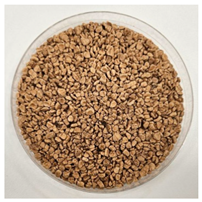
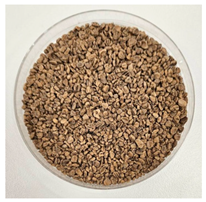
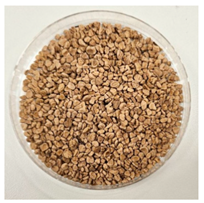
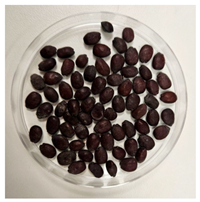
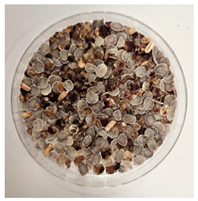
In the experimental part of the paper, a total of 8 mixtures were made: a referent concrete (RC) with crushed limestone aggregate fractions 0/4 and 4/8 mm, four mixtures in which the fine fraction of the aggregate was replaced with grape seeds (G), untreated ground olive pits (O), ground olive pits treated with ash water (OA), ground olive pits treated with seawater (OS), and three mixtures in which the coarse fraction of the aggregate was replaced with sour cherry pits (SC), whole carob seeds (WC) and hulled carob seeds (HC). Grape seeds were collected from a winery Feričanci, region Slavonija, Croatia, ground olive pits from the oil mill near Split, Croatia, sour cherry pits from Vinka plus d.o.o., Vinkovci, Croatia and carob seeds from Green Captain, obrt za proizvodnju, Suđurađ, Šipan, Croatia.
The treatment of ground olive pits was carried out as follows: Ground olive pits were obtained from local oil mills. The sample was divided into 3 groups: the first was simply washed with tap water, the second was placed in ash water, and the third in seawater. Ash water (Lye) is a powerful alkaline base that is produced by combining water with natural wood ashes. For the purposes of this study, ash water was obtained from water in which sieved ash was boiled and then more clean water was added, so that the final solution was 1.5 kg of ash and 15 L of water. Ground olive pits were placed in this solution for a period of 7 days, and then removed from the solution and washed well in tap water and dried in the sun. The seawater treatment also lasted 7 days and the pits were washed with tap water and left to dry in the sun. Other aggregates were used untreated.
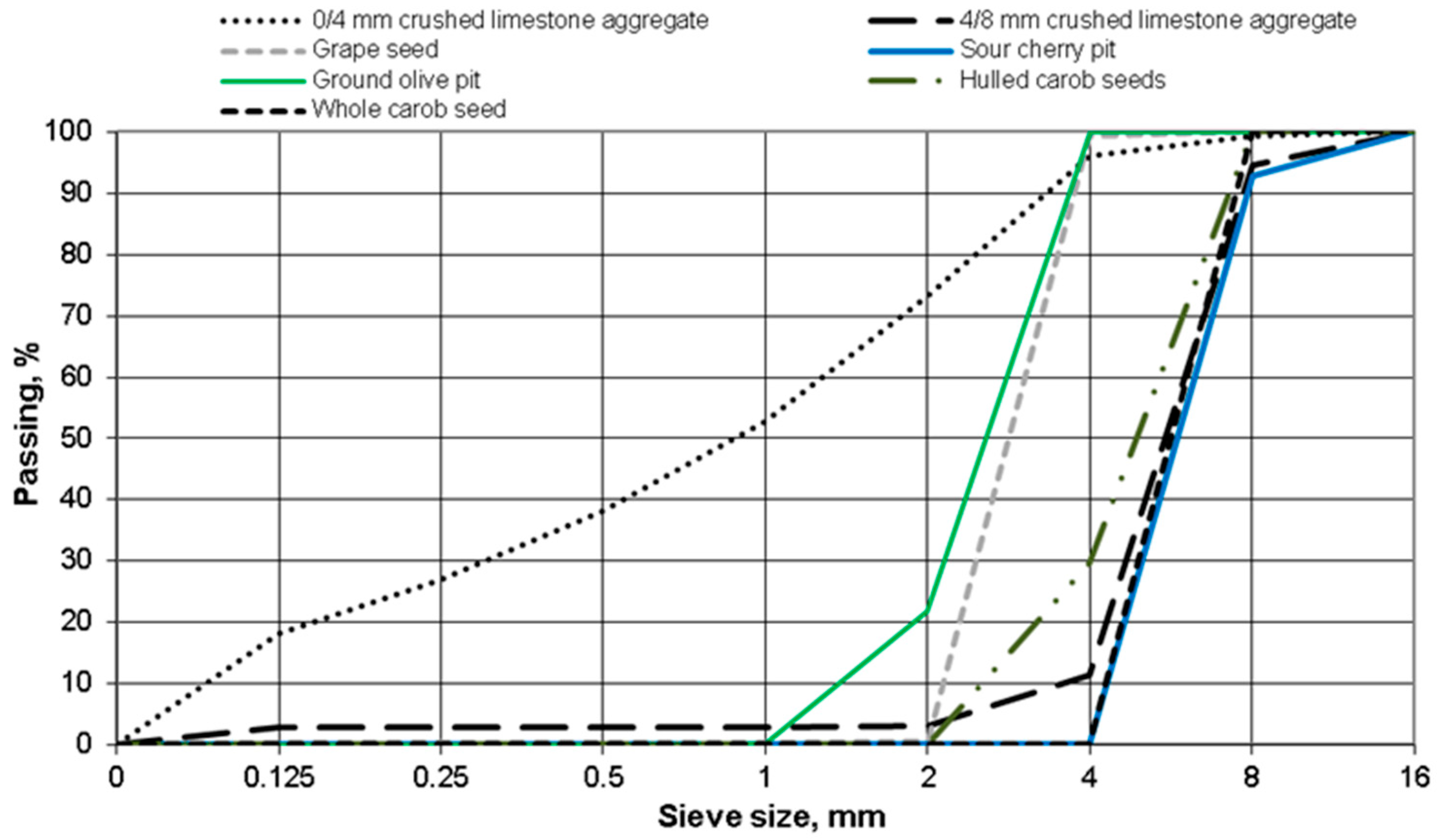
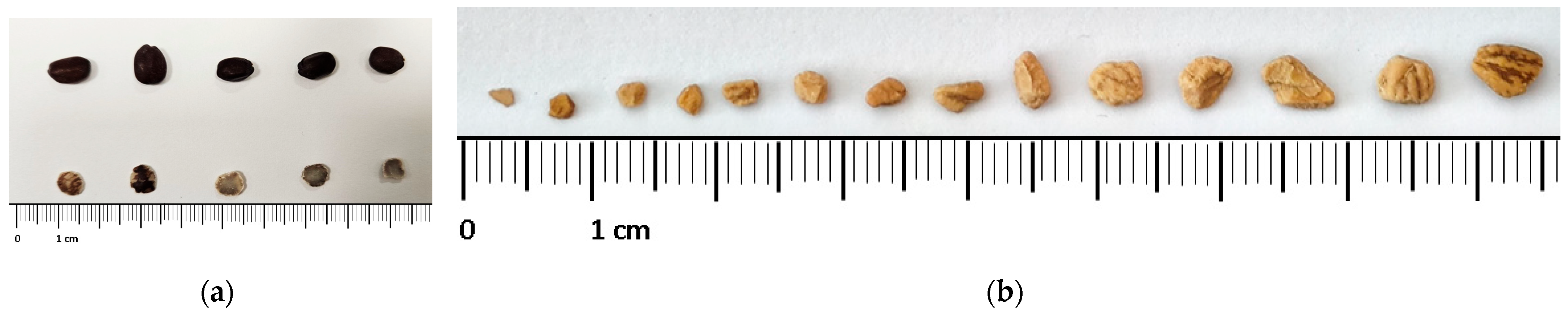
The absorption rates of aggregates were determined in accordance with the EN 1097-6 [88] while the gradation curves (Figure 2) were determined in accordance with the EN 933-1 [89]. Carob seeds possess a remarkable hardness and do not readily absorb water [90]; therefore, their water absorption was not measured. Some other characteristics have been determined on the agro-waste. Characteristics of seeds and pits were examined through assessments of bulk density, seed weight, length, and width. Bulk density was measured by filling a 100 mL graduated cylinder with seeds and recording the corresponding mass. Each measurement was conducted three times for accuracy. Bulk density was calculated as the seed mass (g) divided by the volume occupied in the cylinder (cm3). Seed weight was determined using an analytical balance, where 20 seeds were weighed, and their average mass per seed (mg) was computed. Measurements of seed length and width were carried out on 20 seeds using a metric ruler with a precision of 0.5 mm, and the average dimensions per seed were derived, as illustrated in Figure 3a. Measuring the length, width and weight of ground olive pit pieces is not applicable (Figure 3b), but the particle size is shown by a gradation curve (Figure 2). The properties and appearance of aggregates are given in Table 1.
For the preparation of concrete specimens, a CEM II/A-LL 42.5 R cement manufactured by Cemex Croatia was used, with a density of 3.08 g/cm3 in accordance with EN 197-1 [91], the fineness according to EN 196-6 [92] of 4040 cm2/g and 6.4% residue on a 45-micron sieve according to [93]. The concrete mixtures were prepared using a tap water and superplasticizer derived from modified polycarboxylates (MasterGlenium ACE 430 supplied by Master Builders Solutions GmbH - Podružnica Zagreb za trgovinu, Zagreb, Croatia), which has a density of ρ = 1.06 ± 0.02 g/cm3, pH = 5.5 ± 1.1 and is dosed with 0.5% of the weight of the cement.
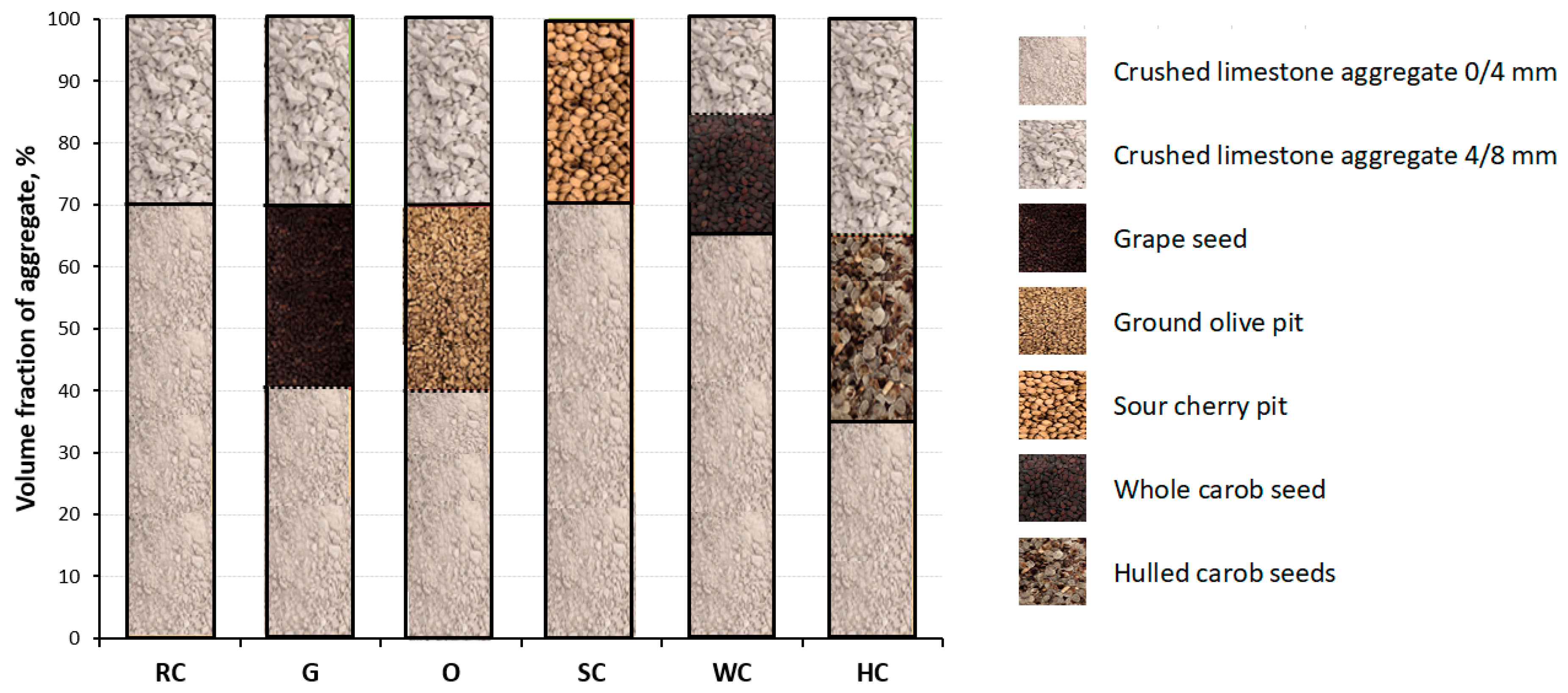
In the RC, G, SC, O, OA and OS mixtures, the volume fraction of the fine fraction was 70% and coarse aggregate was 30%. The amount of fine aggregate replacement in G, O, OA and OS was 30% by volume, while in the SC the amount of coarse aggregate replacement was 30%. In order to examine the influence of particle size distribution on the workability of concrete in mixtures with carob, the particle size distribution was also varied. In mixtures with hulled carob, the volume fraction of fine aggregate was 35% and coarse aggregate was 65%. In the HC mixture, 30% of coarse aggregate was replaced with hulled carob seeds, while in the WC mixture, the volume fraction of fine aggregate was 65% and coarse aggregate was 35% and the replacement of coarse aggregate was 20%. The reason for this is that when separating the seed from the pulp of the carob, it is much more difficult to obtain whole grains, so a smaller amount was supplied. The volume fraction of each type of aggregate is graphically shown in Figure 4. The composition of each mixture is shown in Table 2.
All specimens were compacted using an immersion vibrator except for specimens G, OS and HC due to poor workability; they were compacted on a vibrating table instead. Specimens were demolded after 24 h and put in the pool with water for another 27 days of water curing.
The consistency of fresh concrete was assessed using the slump test method in compliance with EN 12350–2 [94]. The concrete was cast in 150 mm cubes for testing density (EN 12390-7, [95]), ultrasonic pulse velocity (UPV) (EN 12504-4, [96]), and compressive strength (EN 12390-3, [97]). Dynamic modulus of elasticity (Edin) was determined based on UPV (v), presuming a Poisson’s ratio (µ) of 0.2, and the density (ρ) of hardened concrete in accordance with Equation (1):
E d i n = v 2 ρ ( 1 + μ ) ( 1 2 μ ) 1 μ ,
Also the concrete was cast in cylinders of 75 mm diameter and 200 mm height for testing saturated water absorption and sorptivity coefficient S ([98], ASTM C1585-13, [99]), which was determined based on Equation (2):
S = M A t ,
where ΔM is the mass increase in water absorbed by the cylinder surface which was exposed to water, A is cross-section of the cylinder, and t is time measured in hours (in this case t = 24 h). Less than 5 mm of the cylinders were submerged in water, and prior to weighing, any excess surface moisture was carefully removed using a towel.
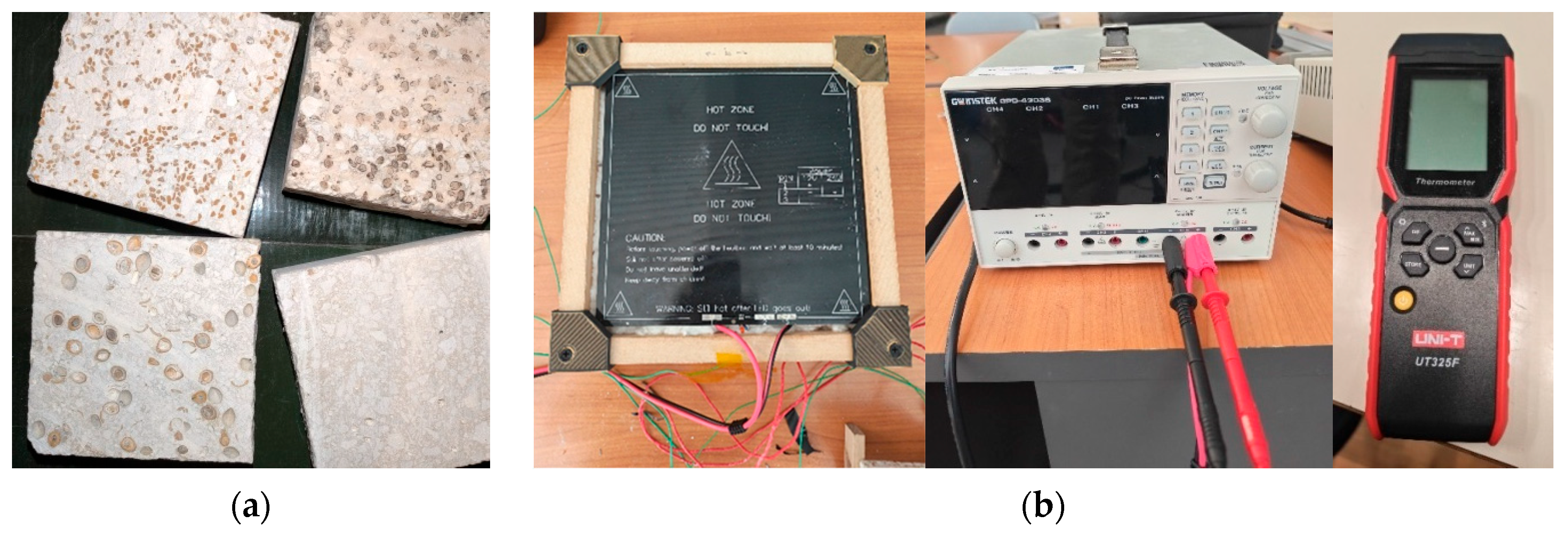
Thermal conductivity was tested on slices cut from 100 mm concrete cubes, with each slice measuring 100 × 100 × 30 mm (Figure 5a). The testing was performed by applying a controlled heat input to the specimen and monitoring temperature at multiple locations.
Heat was supplied using a flat Printed Circuit Board (PCB) heater with dimensions 220 × 220 mm and a nominal power of 16 W. During testing, the heater was operated at approximately 10 W. The specimen was placed flat on the heating plate, with a thermal couplant applied between the specimen and the heater to improve thermal contact. The bottom side of the PCB heater was insulated using a thermal insulation material (ceramic fiber wool). The top surface around the specimen was left uncovered.
Electrically, the heater behaves as a resistor whose resistance varies with temperature. Therefore, voltage and current were measured and recorded during heating, and the instantaneous electrical power was computed from the measured values. In a simplified analysis, it was assumed that the electrical power delivered to the heater corresponds to the heat flux input to the specimen, proportional to the contact area (i.e., losses to the environment, lateral conduction in the heater, and radiative heat transfer were neglected).
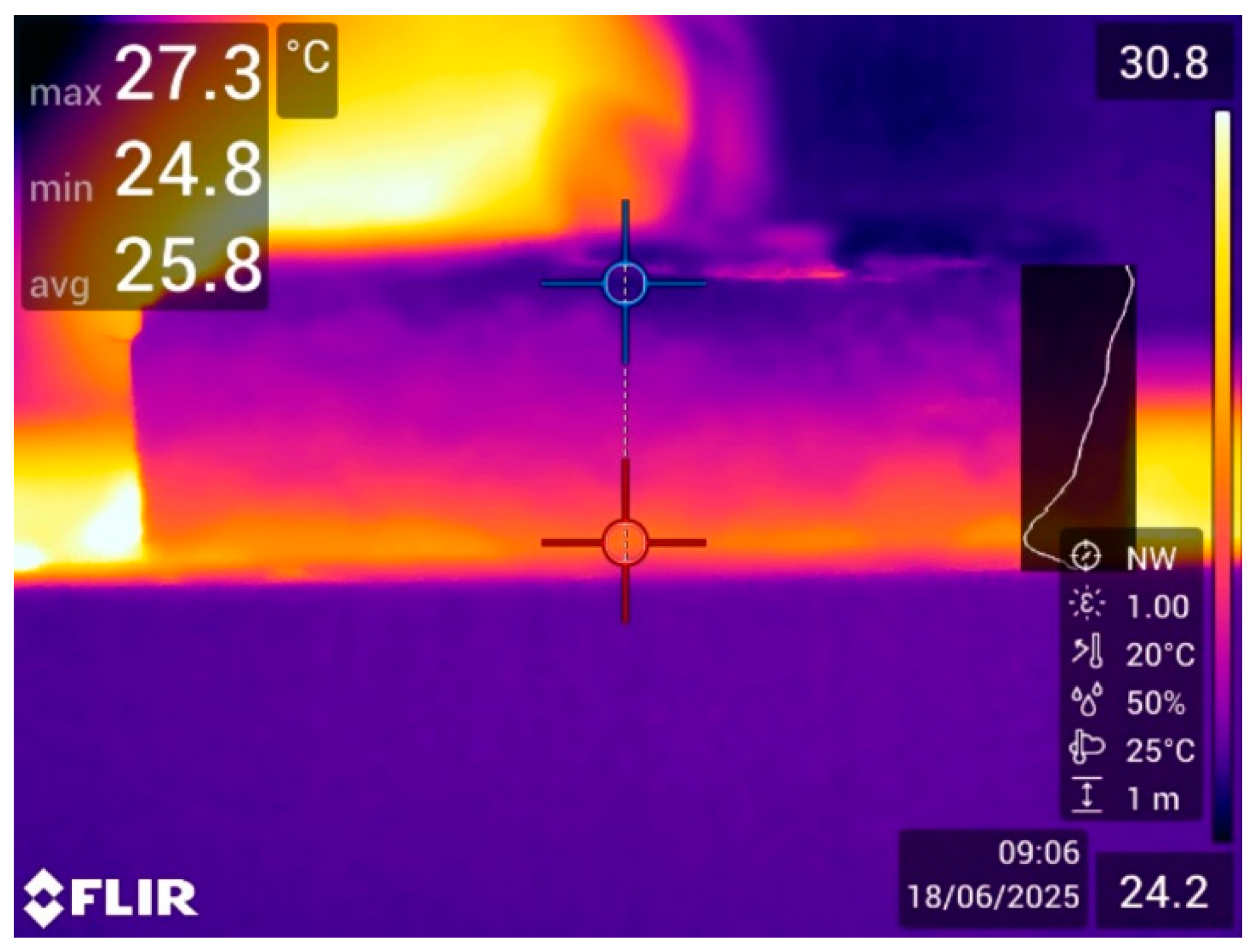
Temperature was measured using type K thermocouples and recorded using a temperature acquisition system (logger). One thermocouple was placed near the heater–specimen interface, while the remaining thermocouples were distributed across the specimen at predefined measurement positions. The test duration was sufficient to capture temperature evolution on all measurement channels. Figure 5b shows the experimental setup. The experiment was also monitored using a thermal camera (FLIR 1020sc 28°) to observe thermal gradients and emissivity variation (Figure 6).
Two approaches were used for data processing. In the simplified approach, measured temperatures were extrapolated to steady state, and thermal conductivity was estimated using the input power, the distances between thermocouples, and the differences between the extrapolated steady-state temperatures. In the more advanced approach, the transient heat conduction equation was solved numerically in MATLAB (MATLAB. Version R2023b, The MathWorks, Inc., Natick, MA, USA, 2023.) for the known specimen geometry and density, using the measured input power curve, while treating thermal conductivity and specific heat capacity as unknown parameters. The numerical model produced time-dependent temperature histories at locations corresponding to the thermocouple positions. An optimization problem was then formulated to identify thermal conductivity and specific heat capacity by minimizing the deviation between the modeled and measured temperatures. Both approaches yielded results with a maximum relative difference of up to 4% (with respect to the advanced model). Results from the simplified model were used further in this analysis.

4. Results and Discussion

The measured slump results are given in Table 3 and standardized consistence classes are determined according to EN 206 [100]. The concrete mixtures were prepared in a laboratory mixer. When preparing mixtures RC, G, SC and OS, extra water was added to the drum to be absorbed by the aggregate, while for mixtures O and OA, the aggregate was previously saturated and then added to the drum. Substituting the fine particles of crushed limestone with grape and olive pits in mixtures G and OS led to a notable decrease in the consistency of the concrete while pre-soaking had a positive effect on the consistency of the O and OA concretes. This pre-saturation process helps reduce excessive water absorption during the mixing phase, as the authors concluded in [63,101]. The SC mixture has better workability compared to the reference concrete, and the reason for this is probably due to the completely round pits and, according to Figure 2, the almost ideal granulometric curve of 4/8 mm. WC and HC have lower workability but also different particle size distribution. The HC mixture had a higher proportion of coarse aggregate and the carob seeds are flatter than WC, so the workability is lower.
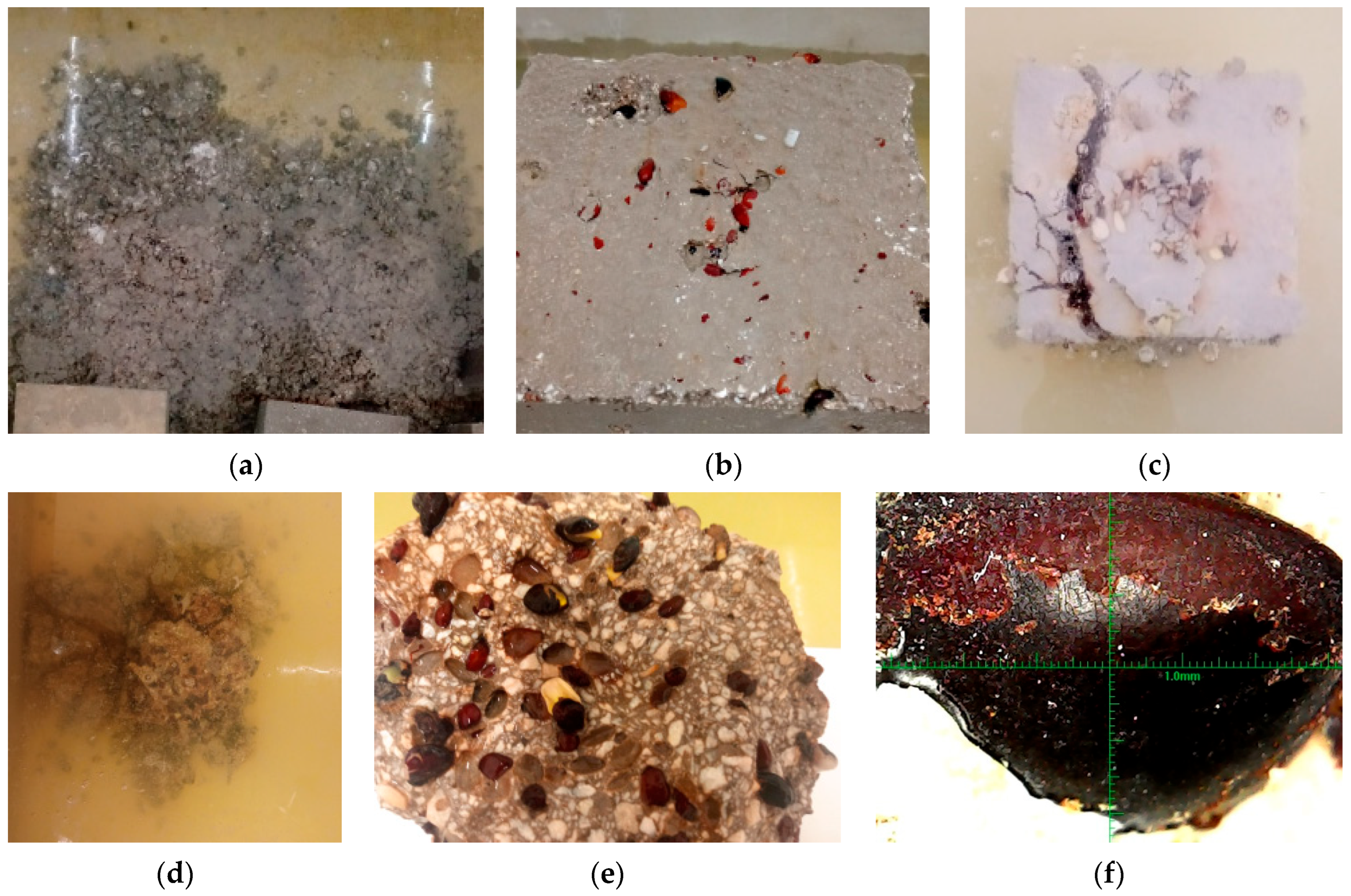
The above mentioned tests were performed in the hardened state of the concrete, at an age of 28 days. It was observed that the specimens with carob HC and WC disintegrated during water curing. The HC mixture disintegrated relatively quickly after being placed in water because it had a higher carob content and hulled seeds (Figure 7a), while the WC mixture disintegrated gradually; see Figure 7b–f. This disintegration is probably attributed to seed swelling and high tannin levels, as carob seeds are rich in tannins, polyphenols, and flavonoids, but carob seeds also serve as natural alternative to synthetic thickeners [83]. Because carob seeds have a hard and impermeable skin, they need some external influence to get water into the center of the seed. In the case of HC specimens, this was not a problem because the seeds were hulled, but for WC specimens this took much longer even though whole seeds were in an alkaline environment. There are studies that have examined swelling plant base aggregates and how pre-treatments affect this, but these are mostly materials based on cellulose, hemicellulose and lignin [102]. Concrete disintegration due to the action of tannins was also observed in the study [67].
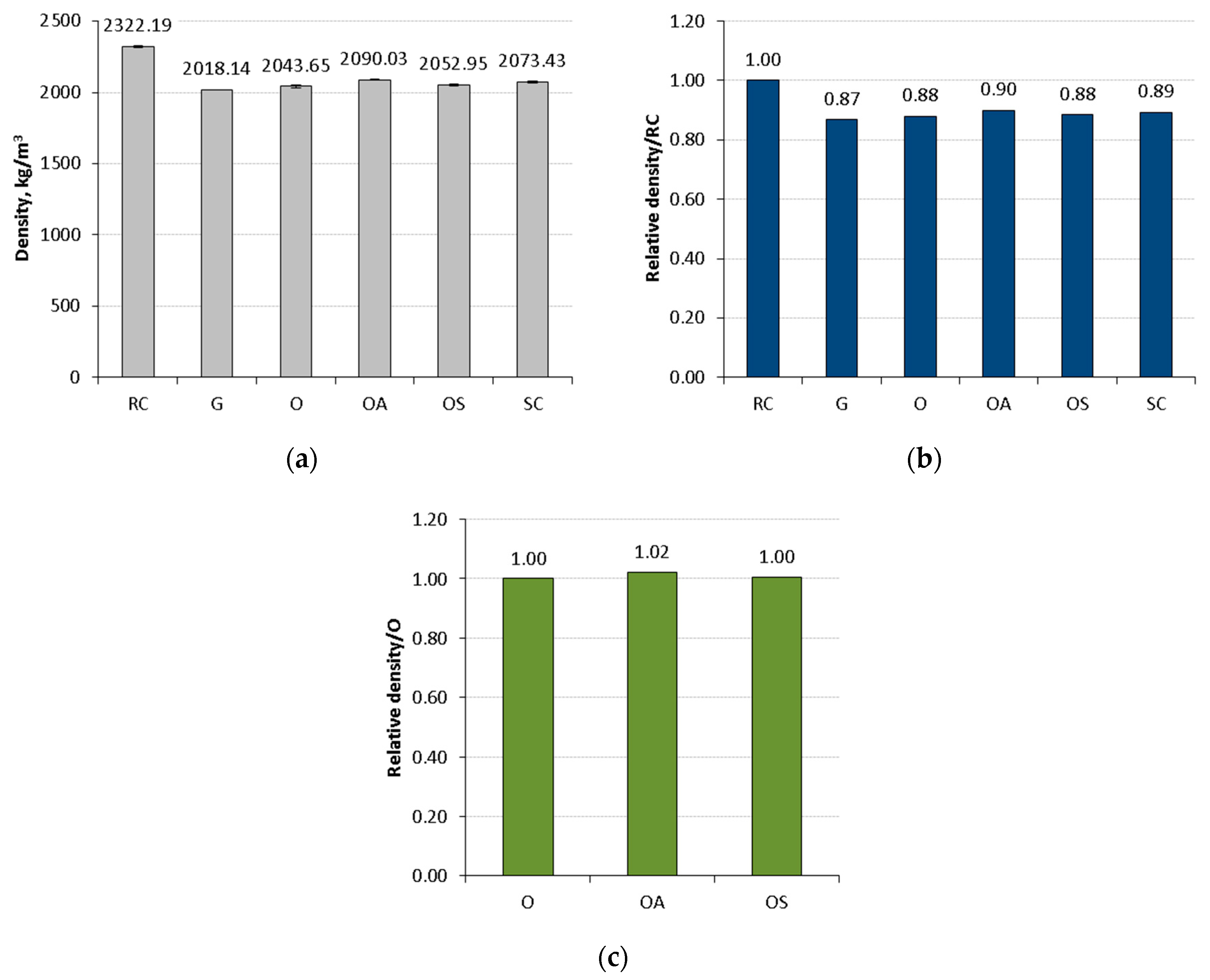
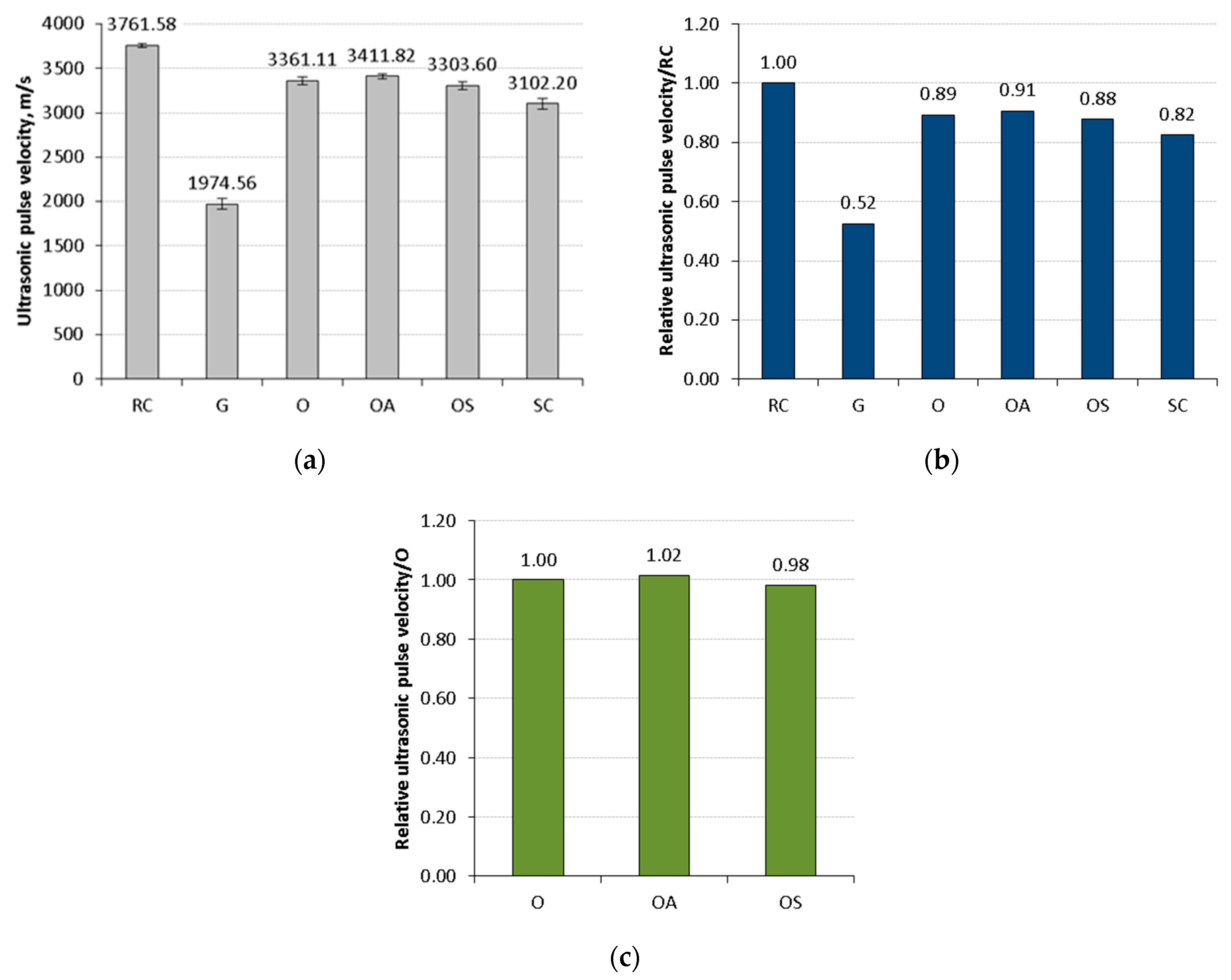
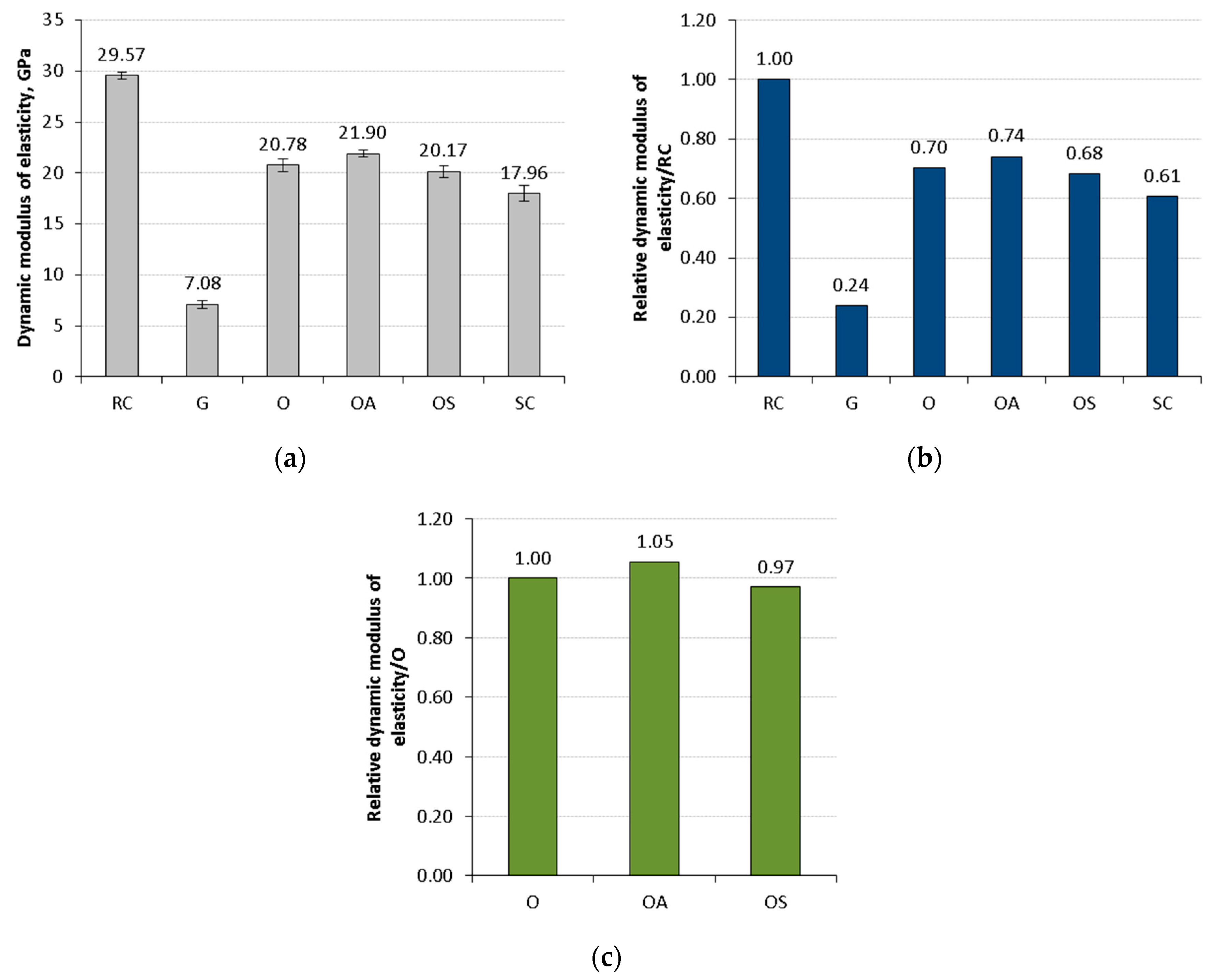
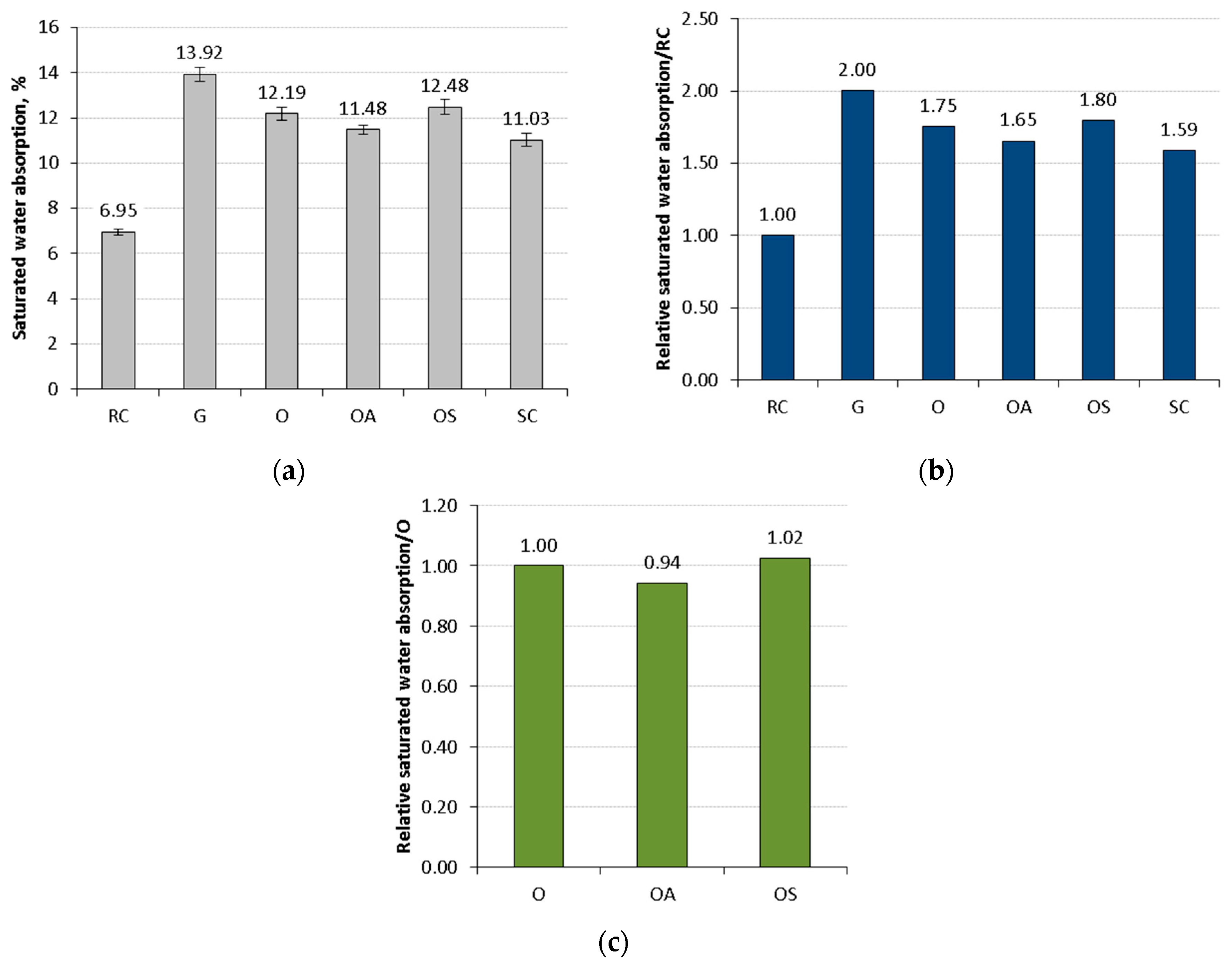
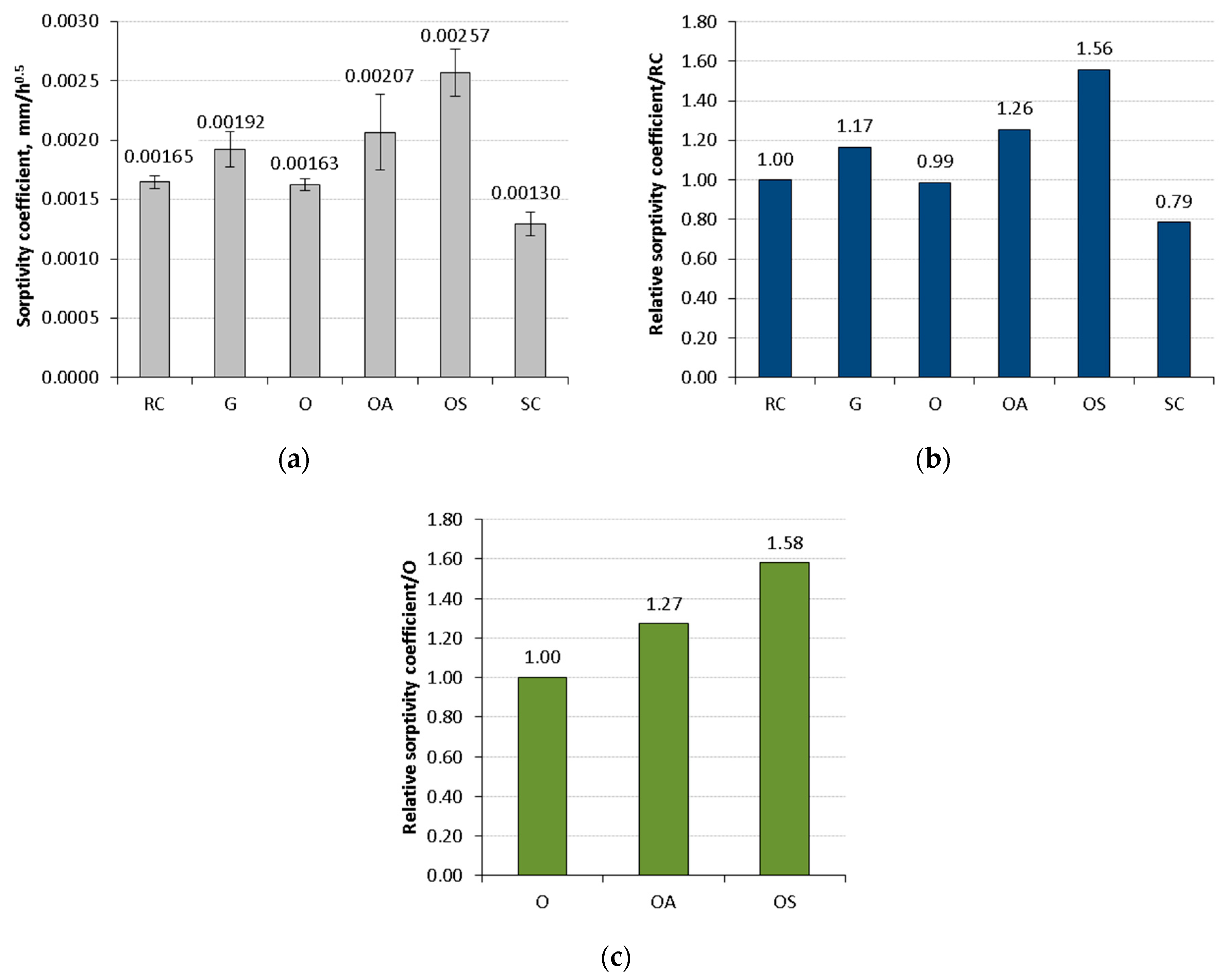
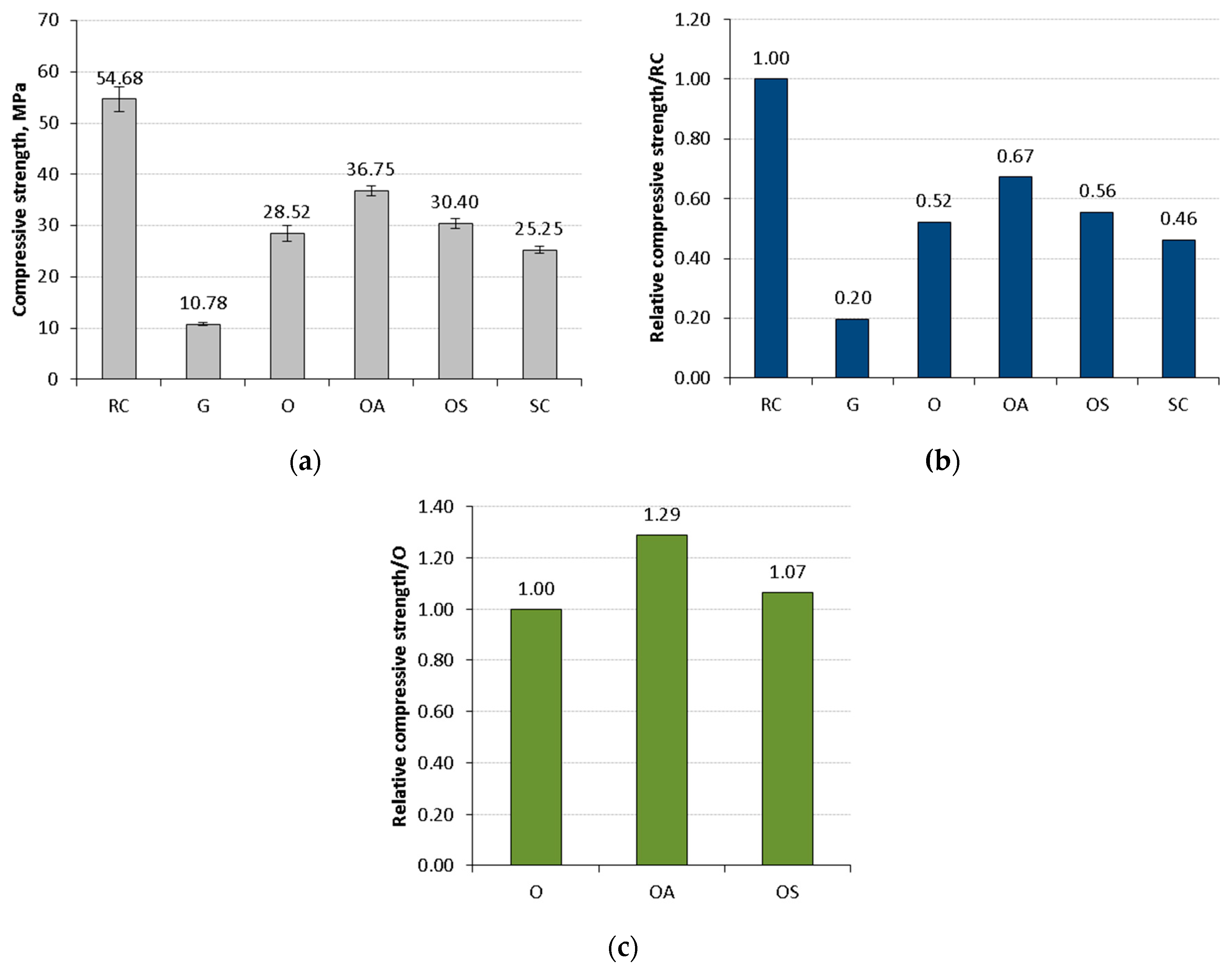
For the remaining specimens, the density, ultrasonic pulse velocity (UPV), dynamic modulus of elasticity, compressive strength, saturated water absorption and sorptivity coefficient results are presented in Figure 8, Figure 9, Figure 10, Figure 11, Figure 12 and Figure 13. Figures marked with (a) show the absolute values of measured values, (b) the relative values express the ratio between the mean measured results of each mixture and that of the reference concrete (RC) and (c) the relative values express the ratio between the mean measured results of mixture with ground olive pits and that of the mixture with untreated ground olive pits (O). The absolute values represent the mean of three measurements and include the standard deviation.
According to Figure 8a, the reference concrete has a density of 2322.19 kg/m3, while the density of concrete with partial replacement of agro-aggregates is 10 to 13% lower than the reference concrete (Figure 8b). All values are above 2000 kg/m3, which places all concretes in the class of normal or ordinary concretes. The ground olive pits treatment with ash water slightly increased the density of the concrete, while the sea treatment did not affect the obtained values (Figure 8c).
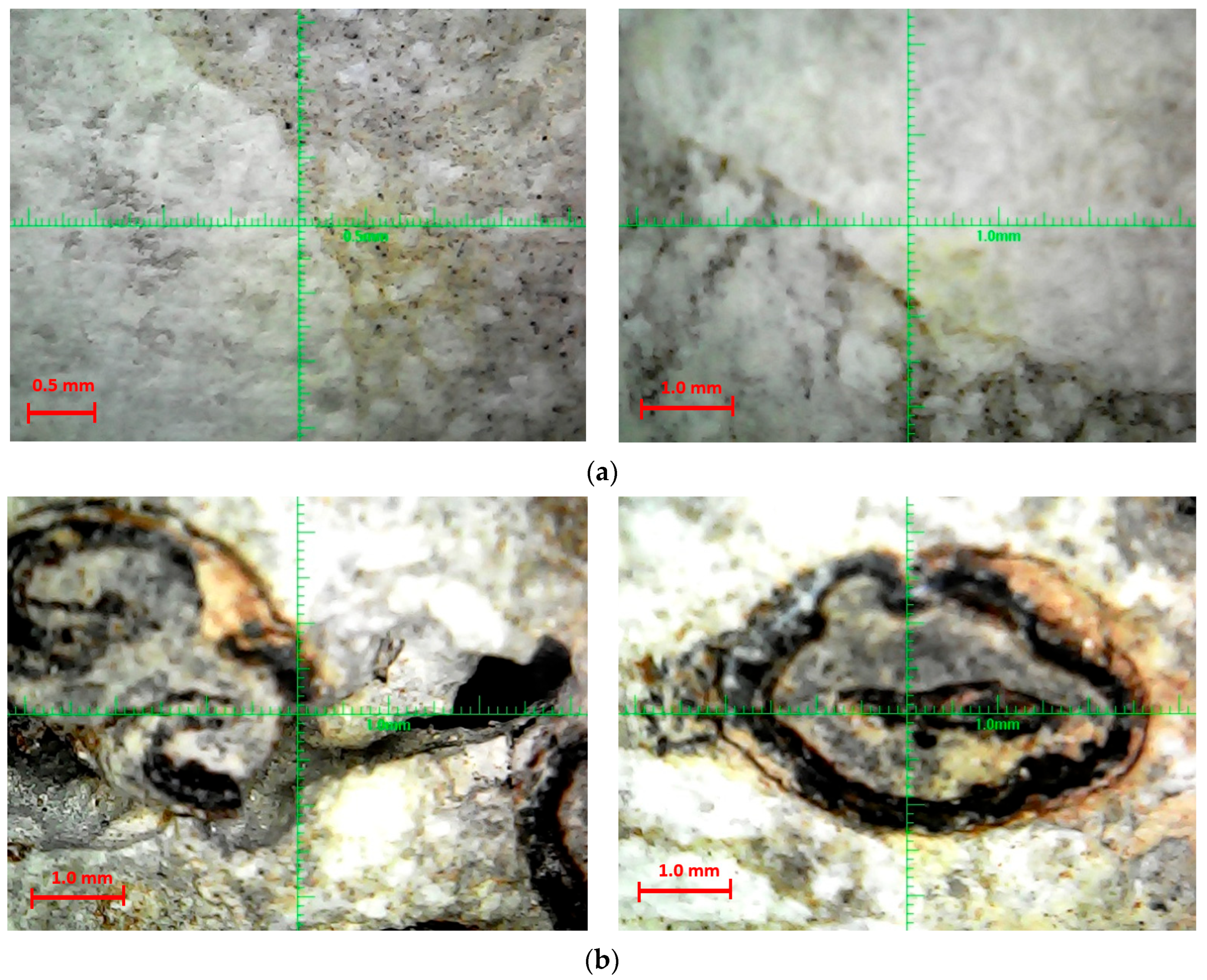
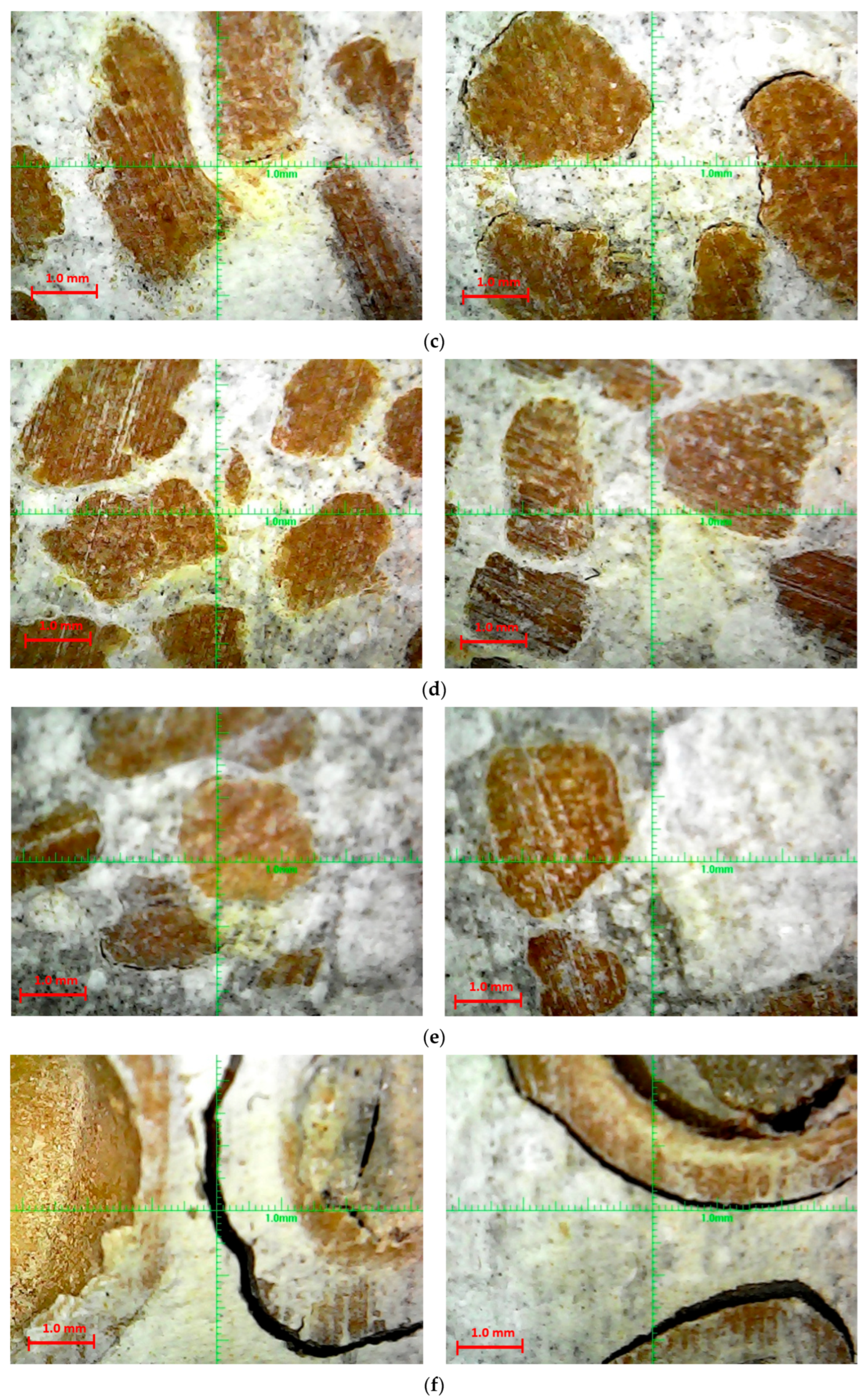
Regarding the UPV, good concrete typically exhibits values in the range from 3600 to 4500 m/s [103]. Based on this criterion, RC is considered as good concrete, O, OA, OS and CH are questionable concretes, and G is poor concrete because it has a UPV value below 2100 m/s [103]; see Figure 9a. According to [104,105], all concretes with agro-aggregate belong to medium quality concretes (3000–3500 m/s), except for G, which is classified as doubtful concrete (2000–3000 m/s). Replacing part of the fine aggregate with grape seeds reduced the UPV value by 48%, while the other mixtures were in the range of 82–91% of referent concrete; Figure 9b. According to Kumar [66], higher reduction occurs due to increased voids, micro-cracks and defective aggregate–matrix transitions, while for concretes with UPV below 3200 m/s, as is the case with SC and especially G, the reason is poor internal compactness from high absorption and low aggregate strength. Figure 14 shows two optical microscope images of each specimen. In Figure 14b,f, the weak interconnection of agro aggregates and paste is clearly visible, i.e., the weak inter-surface transition zone (ITZ). Inside the grape seeds and cherry pits themselves, cavities and inhomogeneity are also visible. The situation is somewhat better with specimens from ground olive pits (O, Figure 14c and OS, Figure 14e), and the highest quality ITZ is visible on samples of reference concrete (RC, Figure 14a) and ground olive pits treated with ash water (OA, Figure 14d). Therefore, it is understandable that the highest UPV result of agro-concretes was obtained with the OA mixture, and the pre-treatment of ground olive pits with ash slightly improved the UPV of the concrete; Figure 9c. A similar trend was observed for the dynamic modulus of elasticity (Figure 10a), except that lower values were achieved compared to UPV, so that mixture G achieved only 24% of the value of the reference mixture, SC 61%, while the mixtures with ground olive stones ranged from 68% to 74%; Figure 10b. Seawater treatment reduced the value of the dynamic modulus of elasticity by 3%, while ash treatment increased it by 5% compared to mixture O; Figure 10c. The obtained values are in accordance with Figure 14.
Compressive strengths ranging from 10.78 MPa (G) to 54.68 MPa (RC) were achieved; Figure 11a. The replacement of a part of the aggregate had a significant impact on the results of compressive strength. The decrease in all compressive strengths can be ascribed to the inferior strength of agro-aggregates in comparison to that of conventional aggregates such as crushed limestone aggregates. According to [63], which reviews the properties of concrete with OPS aggregate, the reduction in compressive strength is associated with a weaker interfacial bond between OPS and the cement paste, as well as the increased porosity and water absorption of the OPS aggregate. According to Figure 14 and Table 1, this is particularly true for grape seeds and sour cherry pits. The reduction in compressive strength is the largest in mix G; replacing 30% of the fine aggregate reduced the strength by 80% compared to the reference concrete, as indicated in Figure 11b. In a study [67] where the fine aggregate was completely replaced with grape seeds, the strength decreased by 90% (6.23 MPa), so the result obtained is in accordance with that research; see Figure 14b and Table 1. Specimens with sour cherry pits achieved a strength of about 28.5% more than in the aforementioned study [67], but closer to the value in [73]. Compared to the reference concrete in this study, SC achieved only 46% of the compressive strength. Treatment of ground olive pits with ash water (OA) improved compressive strength by 29% compared to untreated specimens (O); Figure 11c. The OA mixture achieved 67% of the compressive strength of the reference concrete, which is in accordance with the research [74], although mortars were used there. The pre-treatment of agro aggregates has a significant effect on compressive strength, as shown in [104], where lime treatment of OPS aggregates contributed to an increase in compressive strength by about 8%. Yew et al. [45] indicated that the application of heat treatment improved the surface quality of OPS aggregates, which in turn enhanced the adhesion between the aggregates and the cement paste, resulting in a compressive strength of 49 MPa at 28 days and 52 MPa at 90 days.
If the water absorption is less than 5%, the concrete is deemed to be of high quality [106], but other sources indicate that a water absorption rate of concrete below 10% is classified as low [107,108]. Figure 12a shows that only referent concrete had water absorption under 10%. Agro-concretes have an increase in absorption of 59 to 100% compared to RC; Figure 12b. Such an increase can be attributed to the high water-absorbing characteristics of agro-aggregates compared to crushed limestone aggregates, as shown in Table 1. SC specimens have less water absorption than specimens with ground olive pits (O, OA and OS). Taking the explanation from [109] for behavior of crushed and original OPS aggregate, it could also be applied here: this could be attributed to the jagged and spiky edges of the crushed ground olive pits, which results in the crushed aggregates having a tendency to absorb water. In contrast, the surface texture of the convex faces of the sour cherry pits is relatively smooth, potentially leading to a decrease in water absorption. High increases in agro-concretes have also been measured by some other authors: for coconut shell aggregate concrete, Gunasekaran et al. [110] reported that water absorption was 10.66–11%, while Abutaha et al. [111] reported that when replacing coarse aggregate with oil palm boiler clinker in the range of 20 to 100%, there was an increase in water absorption in the range of 35% to 80%. Treatment of ground olive pits with ash water reduced absorption by 6%, while treatment with seawater increased it by 2% compared to untreated pits; Figure 12c.
The sorptivity coefficient of the concrete specimens is shown in Figure 13. The O and CH mixtures achieved even lower values compared to the reference concrete; Figure 13a,b. Bailo et al. [112] conducted a study on the sorptivity of concrete incorporating coconut shell. The decrease in water absorption observed with increased coconut shell content was likely due to disruption of capillary continuity within the concrete matrix. The authors attributed this to the more irregular and less permeable nature of the coconut shell particles, which creates barriers that impede fluid movement. This is the only property of concrete in which the ash water treatment had an adverse effect (Figure 13c), but it can also be seen that there is a large standard deviation in the individual results; Figure 13a.
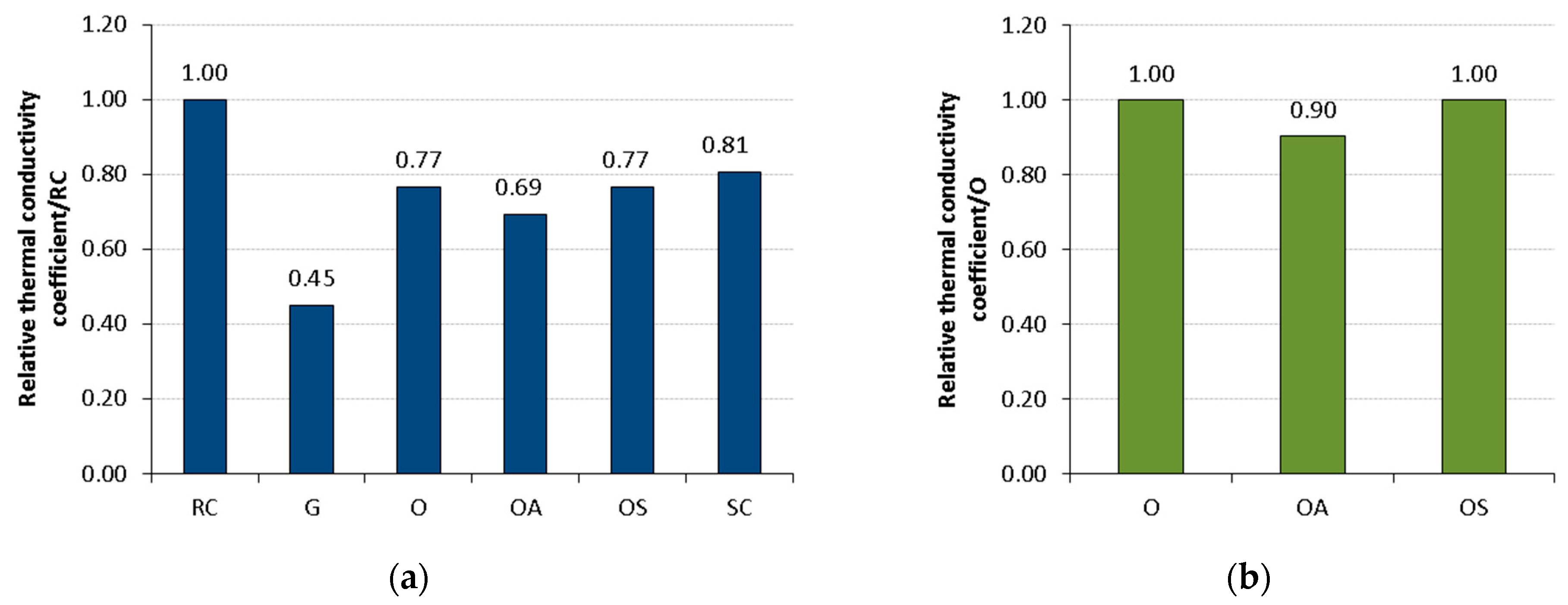
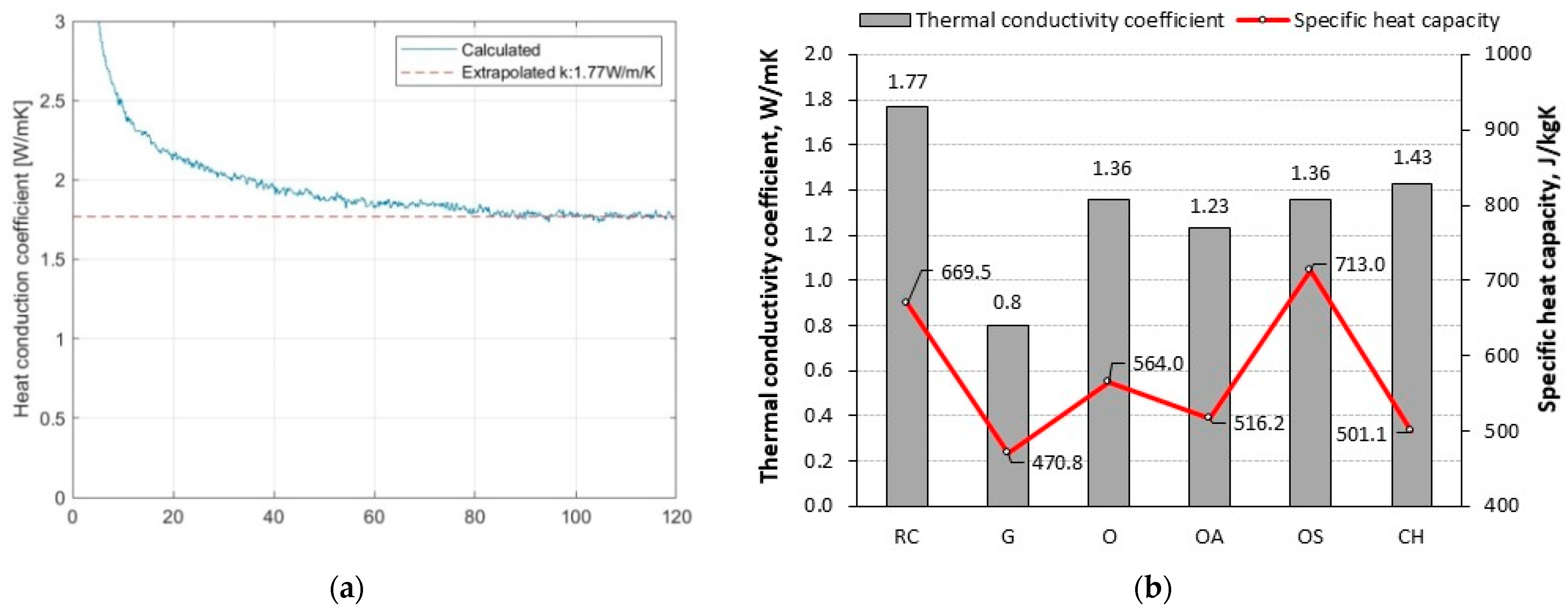
The thermal conductivity coefficients are presented in Figure 15a,b. Figure 15a, created using MATLAB, illustrates an example of the extrapolated and calculated thermal conductivity coefficient, in this case for RC. Figure 15b displays the thermal conductivity coefficients obtained for all types of concrete, along with the corresponding specific heat capacity values. Additionally, Figure 16 highlights the relative thermal conductivity coefficients in comparison to the reference concrete, as well as the relative values for the mixtures containing olives.
The values for specific heat capacity follow the obtained thermal conductivity coefficient, except for the OS mixture. Since the value of specific heat capacity is affected by moisture, it is possible that the treatment of the aggregate with seawater increased the hygroscopicity of the concrete, but the phenomenon should definitely be investigated in more detail. The thermal conductivity coefficient of the reference concrete is 1.77 W/mK, which is expected for normal weight concrete, while the values for agro-concrete are slightly lower; Figure 15b. By replacing natural aggregate with agro-aggregate in the amount of 30% of the total aggregate volume, the reduction in thermal conductivity coefficients is from 19.2 to 54.8% compared to the reference concrete; Figure 16a. The lowest value was obtained for mixture G, with a thermal conductivity of 0.7997 W/mK (Figure 15b). For comparison, in study [67], a mixture with untreated grape seeds reached a value of 0.36 W/mK, corresponding to 25% of the reference concrete value (1.42 W/mK). In that study, the amount of grape seeds used in 1 m3 of concrete was 2.35 times higher than in the present study, which is consistent with the ratio of the resulting thermal conductivity values. A more comparable case is reported in [113], where the authors investigated the effects of replacing 20% of the total aggregate volume with agricultural waste-based capsules made from grape seeds and cherry pits, and found that the thermal conductivity was reduced by 32% and 22%, respectively. The mixtures with untreated cherry pits in the study [67] and here in the present study have almost the same composition, but different thermal conductivity coefficients: 0.70 W/mK and 1.43 W/mK, respectively. As previously noted, they also differ in compressive strength. Mixtures with ground olive pits have a higher reduction in the thermal conductivity coefficient and, again, the best mixture is OA. Treatment with ash water reduced the thermal conductivity coefficient by 10%; Figure 16b.
Based on all the above results, Table 4 was created, which shows the possible applications of the tested concretes as well as their practical potential. Table 4 is made according to [114,115], where concrete class C25/30 is the minimum standard for most structural elements in European construction. This class is widely utilized and is integral to various construction projects, especially in reinforced concrete structures [114]. While the O specimens also exhibit a mean value exceeding 30 MPa, this study, following EN 206 guidelines [100] and the number of available specimens, identifies only the OA specimen as meeting the required criteria. To positively evaluate other specimens containing ground olive pits, a significantly larger series of tests would be necessary.

5. Conclusions

This study investigated the influence of different agro-based aggregates (ground olive pits, grape seeds, sour cherry pits, and carob seeds) on the physical, mechanical, and thermal properties of concrete at 28 days. The results demonstrate that replacing 30% of natural fine aggregate with agro-aggregates significantly affects concrete performance. The most severe deterioration was observed in mixtures containing grape seeds (G), where compressive strength decreased by approximately 80% compared to the reference concrete (RC), accompanied by very low ultrasonic pulse velocity (UPV) and dynamic modulus of elasticity. This reduction is attributed to poor internal compactness, a weak interfacial transition zone (ITZ), high porosity, and inferior mechanical properties of the agro-aggregates.
Mixtures containing sour cherry pits (SC) also showed a considerable reduction in compressive strength (to approximately 46% of RC) and increased water absorption, confirming weak bonding between the aggregate and cement paste. Concrete containing ground olive pits performed notably better than other agro-concretes, particularly when the aggregates were pre-treated with ash water (OA). The ash treatment improved the ITZ quality, increased compressive strength by approximately 29% compared to untreated olive pits (O), enhanced dynamic modulus of elasticity, and slightly reduced water absorption. Among all agro-based concretes, OA exhibited the most balanced performance. All agro-concretes showed increased water absorption compared to the reference concrete, which may limit their durability in aggressive or moisture-exposed environments. However, a significant reduction in thermal conductivity (19–55%) was achieved in all mixtures, indicating strong potential for improved thermal insulation performance. The lowest thermal conductivity was observed in the grape seed mixture, although this was accompanied by poor mechanical performance.
Carob-based concretes (HC and WC) disintegrated during water curing due to seed swelling and tannin-related degradation, indicating unsuitability for structural or long-term construction applications without prior stabilization treatment. Overall, agro-aggregate concretes cannot replace conventional structural concrete in load-bearing applications at the tested replacement ratio. However, treated ground olive pits (OA) show promising potential for non-structural elements where moderate mechanical performance and improved thermal insulation are required.
Future research should focus on optimizing the replacement ratio of agro-aggregates in order to achieve a better balance between mechanical performance and thermal efficiency, particularly by investigating lower substitution levels (10–20%). The optimum concentration of ash in the ash water should be found, in addition to the duration of the treatment. Additional surface pre-treatment methods such as lime treatment, heat treatment, silicate impregnation, or polymer coatings should be explored to improve the interfacial transition zone and reduce water absorption. Long-term durability testing, including freeze–thaw resistance, sulphate attack, chloride penetration, carbonation, shrinkage, and creep, is necessary to assess service-life performance. Further microstructural investigations using SEM and porosimetry would provide deeper insight into pore structure development and bonding mechanisms. Moreover, the incorporation of supplementary cementitious materials (e.g., fly ash, slag, silica fume) should be evaluated to mitigate strength reduction and enhance durability. Finally, comprehensive thermal, acoustic, fire-resistance, and life cycle assessments are recommended to determine the full sustainability potential and practical applicability of agro-aggregate concretes in energy-efficient construction.

Author Contributions

Conceptualization, S.J. and I.N.G.; methodology, S.J. and I.N.G.; software, V.D. and D.R.; validation, S.J., I.N.G., M.M. and D.Š.; formal analysis, S.J., I.N.G., M.M. and D.Š.; investigation, S.J., I.N.G., M.M., V.D., D.Š. and D.R.; resources, D.R.; data curation, V.D., D.Š. and D.R.; writing—original draft preparation, S.J. and I.N.G.; writing—review and editing, M.M., V.D., D.Š. and D.R.; visualization, S.J.; supervision, I.N.G., M.M., V.D. and D.Š.; project administration, M.M.; funding acquisition, V.D. All authors have read and agreed to the published version of the manuscript.

Funding

This research received no external funding.

Institutional Review Board Statement

Not applicable.

Informed Consent Statement

Not applicable.

Data Availability Statement

The original contributions presented in this study are included in the article. Further inquiries can be directed to the corresponding author.

Acknowledgments

This research is partially supported through project KK.01.1.1.02.0027, a project co-financed by the Croatian Government and the European Union through the European Regional Development Fund—the Competitiveness and Cohesion Operational Programme. Additionally, this work was supported by the RESILIO—Resilience and Vulnerability Assessment of Diocletian’s Palace project (IP-UNIST-19), funded through the Institutional Research Projects Programme of the University of Split, and financed by the Recovery and Resilience Facility of the European Union. The authors also acknowledge the financial support provided through the scientific grant Valorisation of Waste Materials for the Development of Sustainable Concrete funded by University North, Croatia.

Conflicts of Interest

Author Dino Rapić is currently employed by Jolos d.o.o. The remaining authors declare that this research was conducted in the absence of any commercial or financial relationships that could be construed as potential conflicts of interest.

References

  1. Sangmesh, B.; Patil, N.; Jaiswal, K.K.; Gowrishankar, T.P.; Selvakumar, K.K.; Jyothi, M.S.; Jyothilakshmi, R.; Kumar, S. Development of Sustainable Alternative Materials for the Construction of Green Buildings Using Agricultural Residues: A Review. Constr. Build. Mater. 2023, 368, 130457. [Google Scholar] [CrossRef]
  2. Zhang, C.; Hu, M.; Di Maio, F.; Sprecher, B.; Yang, X.; Tukker, A. An Overview of the Waste Hierarchy Framework for Analyzing the Circularity in Construction and Demolition Waste Management in Europe. Sci. Total Environ. 2022, 803, 149892. [Google Scholar] [CrossRef]
  3. Aguilar-Hernandez, G.A.; Deetman, S.; Merciai, S.; Rodrigues, J.F.D.; Tukker, A. Global Distribution of Material Inflows to In-Use Stocks in 2011 and Its Implications for a Circularity Transition. J. Ind. Ecol. 2021, 25, 1447–1461. [Google Scholar] [CrossRef]
  4. Obi, F.; Ugwuishiwu, B.; Nwakaire, J. Agricultural Waste Concept, Generation, Utilization and Management. Niger. J. Technol. 2016, 35, 957. [Google Scholar] [CrossRef]
  5. Chabi, E.; Doko, V.; Hounkpè, S.P.; Adjovi, E.C. Study of Cement Composites on Addition of Rice Husk. Case Stud. Constr. Mater. 2020, 12, e00345. [Google Scholar] [CrossRef]
  6. Vilaboa Díaz, A.; Francisco López, A.; Bello Bugallo, P.M. Analysis of Biowaste-Based Materials in the Construction Sector: Evaluation of Thermal Behaviour and Life Cycle Assessment (LCA). Waste Biomass Valorization 2022, 13, 4983–5004. [Google Scholar] [CrossRef]
  7. Amare, M.; Swara, S.; Haish, M.; Pani, A.K.; Saha, P. Performance of Agro-Wastes and Chemical Admixtures Used in Concrete: A Review. Mater. Today Proc. 2023, S2214785323043109. [Google Scholar] [CrossRef]
  8. Monteiro, P.J.M.; Miller, S.A.; Horvath, A. Towards Sustainable Concrete. Nat. Mater. 2017, 16, 698–699. [Google Scholar] [CrossRef] [PubMed]
  9. Dias, S.; Almeida, J.; Tadeu, A.; De Brito, J. Alternative Concrete Aggregates - Review of Physical and Mechanical Properties and Successful Applications. Cem. Concr. Compos. 2024, 152, 105663. [Google Scholar] [CrossRef]
  10. Chao-Lung, H.; Anh-Tuan, B.L.; Chun-Tsun, C. Effect of Rice Husk Ash on the Strength and Durability Characteristics of Concrete. Constr. Build. Mater. 2011, 25, 3768–3772. [Google Scholar] [CrossRef]
  11. Wu, K.; Han, H.; Rößler, C.; Xu, L.; Ludwig, H.M. Rice hush ash as supplementary cementitious material for calcium aluminate cement—Effects on strength and hydration. Constr. Build. Mater. 2021, 302, 124198. [Google Scholar] [CrossRef]
  12. Obilade, I.O. Use of Rice Husk Ash as Partial Replacement for Cement in Concrete. Int. J. Eng. Appl. Sci. 2014, 5, 11–16. [Google Scholar]
  13. Singh, R.; Patel, M. Strength and Durability Characteristics of Binary and Ternary Blends Containing High Volume of Rice Straw Ash and Metakaolin: A Comprehensive Evaluation with Practical Implications. Waste Biomass Valorization 2025, 17, 371–397. [Google Scholar] [CrossRef]
  14. Charitha, V.; Athira, V.S.; Jittin, V.; Bahurudeen, A.; Nanthagopalan, P. Use of Different Agro-Waste Ashes in Concrete for Effective Upcycling of Locally Available Resources. Constr. Build. Mater. 2021, 285, 122851. [Google Scholar] [CrossRef]
  15. Sell Junior, F.K.; Wally, G.B.; Magalhães, F.C.; de Pires, M.M.; Kulakowski, M.P.; das Dores do Nascimento, C.; Flores, W.H.; Avellaneda, C.A.O. Effects of Bamboo Leaf Ashes on Concrete Compressive Strength, Water Absorption, and Chloride Penetration. J. Build. Eng. 2024, 97, 110986. [Google Scholar] [CrossRef]
  16. Aliu, A.O.; Olalusi, O.B.; Awoyera, P.O.; Kiliswa, M. Evaluation of Pozzolanic Reactivity of Maize Straw Ash as a Binder Supplement in Concrete. Case Stud. Constr. Mater. 2023, 18, e01790. [Google Scholar] [CrossRef]
  17. Tayeh, B.A.; Alyousef, R.; Alabduljabbar, H.; Alaskar, A. Recycling of Rice Husk Waste for a Sustainable Concrete: A Critical Review. J. Clean. Prod. 2021, 312, 127734. [Google Scholar] [CrossRef]
  18. Sisman, C.B.; Gezer, E.; Kocaman, I. Effects of Organic Waste (Rice Husk) on the Concrete Properties for Farm Buildings. Bulg. J. Agric. Sci. 2011, 17, 40–48. Available online: https://agrojournal.org/17/01-05-11.pdf (accessed on 22 January 2026).
  19. Yuzer, N.; Cinar, Z.; Akoz, F.; Biricik, H.; Yalcin Gurkan, Y.; Kabay, N.; Kizilkanat, A.B. Influence of Raw Rice Husk Addition on Structure and Properties of Concrete. Constr. Build. Mater. 2013, 44, 54–62. [Google Scholar] [CrossRef]
  20. Winarno, S. Comparative Strength and Cost of Rice Husk Concrete Block. MATEC Web Conf. 2019, 280, 04002. [Google Scholar] [CrossRef]
  21. Chen, S.; Zhou, J.; Liu, J.; Bie, Y.; Hu, Q. Sustainable Ecological Pervious Concrete (SEPC) Based on Modified Corn-Cob Coarse Aggregate: Crushing Morphology, Strength, Pore Properties, and Durability. Constr. Build. Mater. 2024, 426, 136194. [Google Scholar] [CrossRef]
  22. Wang, P.; Liu, H.; Guo, H.; Yu, Y.; Guo, Y.; Yue, G.; Li, Q.; Wang, L. Study on Preparation and Performance of Alkali-Activated Low Carbon Recycled Concrete: Corn Cob Biomass Aggregate. J. Mater. Res. Technol. 2023, 23, 90–105. [Google Scholar] [CrossRef]
  23. Ashour, A.; Amer, M.; Marzouk, A.; Shimizu, K.; Kondo, R.; El-Sharkawy, S. Corncobs as a Potential Source of Functional Chemicals. Molecules 2013, 18, 13823–13830. [Google Scholar] [CrossRef]
  24. Pinto, J.; Vieira, B.; Pereira, H.; Jacinto, C.; Vilela, P.; Paiva, A.; Pereira, S.; Cunha, V.M.C.F.; Varum, H. Corn Cob Lightweight Concrete for Non-Structural Applications. Constr. Build. Mater. 2012, 34, 346–351. [Google Scholar] [CrossRef]
  25. Faustino, J.; Silva, E.; Pinto, J.; Soares, E.; Cunha, V.M.C.F.; Soares, S. Lightweight Concrete Masonry Units Based on Processed Granulate of Corn Cob as Aggregate. Mater. Construcción 2015, 65, e055. [Google Scholar] [CrossRef]
  26. Helepciuc, C.M.; Barbuta, M.; Serbanoiu, A.A.; Burlacu, A. A Variant of Green Concrete with Industrial and Agricultural Waste. In Proceedings of the 21st International Symposium “The Environment and the Industry”, SIMI 2018, Bucharest, Romania, 20–21 September 2018. [Google Scholar]
  27. Polat, S. A Research on the Usage of Corn Cob in Producing Lightweight Concrete. Nat. Resour. 2021, 12, 339–347. [Google Scholar] [CrossRef]
  28. Grădinaru, C.M.; Șerbănoiu, A.A.; Șerbănoiu, B.V. Sunflower Stalks versus Corn Cobs as Raw Materials for Sustainable Concrete. Materials 2021, 14, 5078. [Google Scholar] [CrossRef]
  29. Grădinaru, C.M.; Barbuta, M.; Vasilică, C.; Serbanoiu, A.A. Characterization of a Lightweight Concrete with Corn Cob Aggregates. In Proceedings of the 17 International Multidisciplinary Scientific GeoConference SGEM 2017, Albena, Bulgaria, 29 June–5 July 2017. [Google Scholar]
  30. Farooqi, M.U.; Ali, M. Durability Evaluation of Wheat Straw Reinforced Concrete for Sustainable Structures. J. Build. Eng. 2024, 82, 108400. [Google Scholar] [CrossRef]
  31. Tomar, R.; Kishore, K.; Singh Parihar, H.; Gupta, N. A Comprehensive Study of Waste Coconut Shell Aggregate as Raw Material in Concrete. Mater. Today Proc. 2021, 44, 437–443. [Google Scholar] [CrossRef]
  32. Ranjith, R. A Review Study on Coconut Shell Aggregate Concrete. J. Struct. Technol. 2017, 2, 1–7. [Google Scholar]
  33. Yerramala, A.; Ramachandrudu, C. Properties of Concrete with Coconut Shells as Aggregate Replacement. Int. J. Eng. Invent. 2012, 1, 21–31. [Google Scholar]
  34. Osei, D.Y. Experimental Assessment on Coconut Shells as Aggregate in Concrete. Int. J. Eng. Sci. Invent. 2013, 2, 7–11. Available online: https://ijesi.org/papers/Vol%202(5)/version-4/B250711.pdf (accessed on 18 May 2026).
  35. Kanojia, A.; Jain, S.K. Performance of Coconut Shell as Coarse Aggregate in Concrete. Constr. Build. Mater. 2017, 140, 150–156. [Google Scholar] [CrossRef]
  36. Azunna, S.U.; Abd. Aziz, F.N.A.; Abu Bakar, N.; Mohd Nasir, N.A. Mechanical Properties of Concrete with Coconut Shell as Partial Replacement of Aggregates. IOP Conf. Ser. Mater. Sci. Eng. 2018, 431, 032001. [Google Scholar] [CrossRef]
  37. Gunasekaran, K.; Kumar, P.S.; Lakshmipathy, M. Mechanical and Bond Properties of Coconut Shell Concrete. Constr. Build. Mater. 2011, 25, 92–98. [Google Scholar] [CrossRef]
  38. Deepak, T.J.; Jalam, A.A.; Loh, E.; Tong, S.Y.; Nair, S. Prognostication of Concrete Characteristics with Coconut Shell as Coarse Aggregate Partial Percentile Replacement Prognostication of Concrete Characteristics with Coconut Shell as Coarse Aggregate Partial Percentile Replacement. Int. J. Sci. Res. Sci. Eng. Technol. 2015, 1, 45–50. [Google Scholar]
  39. Rajendran, T.; Abdul Rahman, N. Mechanical Properties of Concrete Containing Coconut Shells as Coarse Aggregate Partial Replacement. Malays. J. Sci. Adv. Technol. 2023, 2, 35–42. [Google Scholar] [CrossRef]
  40. Manaloto, J.A.R. Investigation of the Compressive Strengths of Coconut Shells as Partial Alternative of Coarse Aggregates in Concrete Mix. MUHON J. Archit. Landsc. Archit. Des. Environ. 2022, 9, 1–14. [Google Scholar]
  41. Alengaram, U.J.; Mahmud, H.; Jumaat, M.Z. Comparison of Mechanical and Bond Properties of Oil Palm Kernel Shell Concrete with Normal Weight Concrete. Int. J. Phys. Sci. 2010, 5, 1231–1239. [Google Scholar]
  42. Alengaram, U.J.; Mahmud, H.; Jumaat, M.Z.; Shirazi, S.M. Effect of Aggregate Size and Proportion on Strength Properties of Palm Kernel Shell Concrete. Int. J. Phys. Sci. 2010, 5, 1848–1856. [Google Scholar]
  43. Gibigaye, M.; Godonou, G.F.; Katte, R.; Degan, G. Structured Mixture Proportioning for Oil Palm Kernel Shell Concrete. Case Stud. Constr. Mater. 2017, 6, 219–224. [Google Scholar] [CrossRef]
  44. Danso, H.; Appiah-Agyei, F. Size Variation of Palm Kernel Shells as Replacement of Coarse Aggregate for Lightweight Concrete Production. Open J. Civ. Eng. 2021, 11, 153–165. [Google Scholar] [CrossRef]
  45. Yew, M.K.; Mahmud, H.B.; Ang, B.C.; Yew, M.C. Effects of Heat Treatment on Oil Palm Shell Coarse Aggregates for High Strength Lightweight Concrete. Mater. Des. 2014, 54, 702–707. [Google Scholar] [CrossRef]
  46. Ifeanyi, O.E.; Chima, A.D.; Chukwudubem, N.J. Structural Behavior of Concrete Produced Using Palm Kernel Shell (PKS) as a Partial Substitute for Coarse Aggregate. Am. J. Innov. Sci. Eng. 2023, 2, 1–7. [Google Scholar] [CrossRef]
  47. Khankhaje, E.; Salim, M.R.; Mirza, J.; Hussin, M.W.; Rafieizonooz, M. Properties of Sustainable Lightweight Pervious Concrete Containing Oil Palm Kernel Shell as Coarse Aggregate. Constr. Build. Mater. 2016, 126, 1054–1065. [Google Scholar] [CrossRef]
  48. Azunna, S.U. Compressive Strength of Concrete with Palm Kernel Shell as a Partial Replacement for Coarse Aggregate. SN Appl. Sci. 2019, 1, 342. [Google Scholar] [CrossRef]
  49. Serge, G.N.; Didier, F.; Gilbert, T.; Evrard, M. Study of Physico-Mechanical Properties of Concretes Based on Palm Kernel Shells Originating from the Locality of Haut Nkam in Cameroon. J. Civ. Eng. Constr. Technol. 2020, 11, 13–27. [Google Scholar] [CrossRef]
  50. Mo, K.H.; Chin, T.S.; Alengaram, U.J.; Jumaat, M.Z. Material and Structural Properties of Waste-Oil Palm Shell Concrete Incorporating Ground Granulated Blast-Furnace Slag Reinforced with Low-Volume Steel Fibres. J. Clean. Prod. 2016, 133, 414–426. [Google Scholar] [CrossRef]
  51. Cintura, E.; Faria, P.; Molari, L.; Barbaresi, L.; D’Orazio, D.; Nunes, L. A Feasible Re-Use of an Agro-Industrial by-Product: Hazelnut Shells as High-Mass Bio-Aggregate in Boards for Indoor Applications. J. Clean. Prod. 2024, 434, 140297. [Google Scholar] [CrossRef]
  52. Özocak, M.; Sisman, C.B. Opportunities for the Use of Hazelnut Shell as a Lightweight Aggregate in the Production of Concrete. Cem. Wapno Bet. 2021, 26, 454–464. [Google Scholar] [CrossRef]
  53. Sada, B.H.; Amartey, Y.D.; Bako, S. An Investigation Into the Use of Groundnut Shell As Fine Aggregate Replacement. Niger. J. Technol. 2013, 32, 54–60. [Google Scholar] [CrossRef]
  54. Gandhare, P.K.U. Effect on Concrete Properties after Substituting Fine Aggregate by Crushed Groundnut Shells and Addition of Sugarcane Bagasse Ash. Int. J. Trend Sci. Res. Dev. 2018, 2, 1490–1494. [Google Scholar] [CrossRef]
  55. Alsalami, Z.H.A. Study the Effect of Partially Replacement Sand by Waste Pistachio Shells in Cement Mortar. Appl. Adhes. Sci. 2017, 5, 19. [Google Scholar] [CrossRef]
  56. Wu, F.; Yu, Q.; Chen, X. Unleashing the Potential of Bio-Based Concrete: Investigating Its Long-Term Mechanical Strength and Drying Shrinkage in Real Climatic Environments. Cem. Concr. Compos. 2023, 143, 105237. [Google Scholar] [CrossRef]
  57. Wu, F.; Liu, C.; Diao, Z.; Feng, B.; Sun, W.; Li, X.; Zhao, S. Improvement of Mechanical Properties in Polypropylene- and Glass-Fibre-Reinforced Peach Shell Lightweight Concrete. Adv. Mater. Sci. Eng. 2018, 2018, 6250941. [Google Scholar] [CrossRef]
  58. Wu, F.; Liu, C.; Zhang, L.; Lu, Y.; Ma, Y. Comparative Study of Carbonized Peach Shell and Carbonized Apricot Shell to Improve the Performance of Lightweight Concrete. Constr. Build. Mater. 2018, 188, 758–771. [Google Scholar] [CrossRef]
  59. Wu, F.; Liu, C.; Sun, W.; Zhang, L. Mechanical Properties of Bio-Based Concrete Containing Blended Peach Shell and Apricot Shell Waste. Mater. Tehnol. 2018, 52, 645–651. [Google Scholar] [CrossRef]
  60. Wu, F.; Liu, C.; Sun, W.; Ma, Y.; Zhang, L. Effect of Peach Shell as Lightweight Aggregate on Mechanics and Creep Properties of Concrete. Eur. J. Environ. Civ. Eng. 2020, 24, 2534–2552. [Google Scholar] [CrossRef]
  61. D’Eusanio, V.; Bertacchini, L.; Marchetti, A.; Mariani, M.; Pastorelli, S.; Silvestri, M.; Tassi, L. Rosaceae Nut-Shells as Sustainable Aggregate for Potential Use in Non-Structural Lightweight Concrete. Waste 2023, 1, 549–568. [Google Scholar] [CrossRef]
  62. Yildiz, S.; Emiroglu, M.; Atalar, O. Apricot Pip Shells Used as Aggregate Replacement. J. Civ. Eng. Manag. 2012, 18, 318–322. [Google Scholar] [CrossRef]
  63. Yew, M.K.; Tan, C.T.; Yew, M.C.; Lee, F.W.; Beh, J.H.; Lee, J.C. Properties of concrete with untreated and treated oil palm shell: A comprehensive review. J. Build. Eng. 2025, 112, 113627. [Google Scholar] [CrossRef]
  64. Lee, S.T.; Handika, N.; Tjahjono, E.; Arijoeni, E. Study on the effect of pre-treatment of oil palm shell (OPS) as coarse aggregate using hot water 50-°C and room temperature water 28-°C to lightweight concrete strength. MATEC Web Conf. 2019, 276, 01023. [Google Scholar] [CrossRef]
  65. Souza, A.B.; Ferreira, H.S.; Vilela, A.P.; Viana, Q.S.; Mendes, J.F.; Mendes, R.F. Study on the feasibility of using agricultural waste in the production of concrete blocks. J. Build. Eng. 2021, 42, 102491. [Google Scholar] [CrossRef]
  66. Kumar, A.H.; Hashwin, K.; Karthikeyan, K. Eco-efficient light weight concrete with agro-waste aggregates and natural fibers: A sustainability approach. Constr. Build. Mater. 2025, 501, 144387. [Google Scholar] [CrossRef]
  67. Netinger Grubeša, I.; Marković, B.; Nyarko, M.H.; Krstić, H.; Brdarić, J.; Filipović, N.; Szenti, I.; Kukovecz, Á. Potential of Fruit Pits as Aggregate in Concrete. Constr. Build. Mater. 2022, 345, 128366. [Google Scholar] [CrossRef]
  68. Sokół-Łętowska, A.; Kucharska, A.Z.; Hodun, G.; Gołba, M. Chemical Composition of 21 Cultivars of Sour Cherry (Prunus cerasus) Fruit Cultivated in Poland. Molecules 2020, 25, 4587. [Google Scholar] [CrossRef]
  69. Food and Agriculture Organization of the United Nations (FAO). Available online: https://www.fao.org/faostat/en/#data/QCL/visualize (accessed on 1 December 2025).
  70. Argun, M.E.; Ateş, H.; Argun, M.Ş.; Cakmakci, Ö. Management of sour cherry processing industry wastewater by super critical fluid method: Sequential recovery and treatment. Process Saf. Environ. Prot. 2025, 199, 107318. [Google Scholar] [CrossRef]
  71. Chatzimitakos, T.; Athanasiadis, V.; Kalompatsios, D.; Kotsou, K.; Mantiniotou, M.; Bozinou, E.; Lalas, S.I. Sustainable Valorization of Sour Cherry (Prunus cerasus) By-Products: Extraction of Antioxidant Compounds. Sustainability 2024, 16, 32. [Google Scholar] [CrossRef]
  72. Pollard, Z.A.; Goldfarb, J.L. Valorization of cherry pits: Great Lakes agro-industrial waste to mediate Great Lakes water quality. Environ. Pollut. 2021, 270, 116073. [Google Scholar] [CrossRef]
  73. Bhujel, L.; Baral, P.; Ranabhat, S.; Subedi, S.; Aalam, T.; Gyawali, T.R. Utilization of Prunus cerasoides shell (PCS) as sustainable substitute for natural aggregates in concrete. Clean. Waste Syst. 2025, 12, 100348. [Google Scholar] [CrossRef]
  74. Ferreiro-Cabello, J.; Fraile-Garcia, E.; Pernia-Espinoza, A.; Martinez-de-Pison, F.J. Strength Performance of Different Mortars Doped Using Olive Stones as Lightweight Aggregate. Buildings 2022, 12, 1668. [Google Scholar] [CrossRef]
  75. Available online: https://sumsova.ba/gospodarstvo/kostice-maslina-koriste-kao-energent-za-grijanje-zamjena-za-pelet (accessed on 22 January 2026).
  76. El Boukhari, M.; Merroun, O.; Maalouf, C.; Bogard, F.; Kissi, B. Exploring the Impact of Partial Sand Replacement with Olive Waste on Mechanical and Thermal Properties of Sustainable Concrete. Clean. Mater. 2023, 9, 100202. [Google Scholar] [CrossRef]
  77. Del Río Merino, M.; Guijarro Rodríguez, J.; Fernández Martínez, F.; Santa Cruz Astorqui, J. Viability of Using Olive Stones as Lightweight Aggregate in Construction Mortars. Rev. Constr. 2017, 16, 431–438. [Google Scholar] [CrossRef]
  78. Los Santos-Ortega, J.; Fraile-García, E.; Ferreiro-Cabello, J. Environmental Assessment of the Use of Ground Olive Stones in Mortars. Reduction of CO2 Emissions and Production of Sustainable Mortars for Buildings. Environ. Impact Assess. Rev. 2025, 110, 107709. [Google Scholar] [CrossRef]
  79. Netinger Grubeša, I.; Šamec, D.; Juradin, S.; Hadzima-Nyarko, M. Utilizing Agro-Waste as Aggregate in Cement Composites: A Comprehensive Review of Properties, Global Trends, and Applications. Materials 2025, 18, 2195. [Google Scholar] [CrossRef]
  80. Beres, C.; Simas-Tosin, F.F.; Cabezudo, I.; Freitas, S.P.; Iacomini, M.; Mellinger-Silva, C.; Cabral, L.M.C. Antioxidant Dietary Fibre Recovery from Brazilian Pinot Noir Grape Pomace. Food Chem. 2016, 201, 145–152. [Google Scholar] [CrossRef]
  81. Badouard, C.; Bogard, F.; Bliard, C.; Lachi, M.; Abbes, B.; Polidori, G. Development and Characterization of Viticulture By-Products for Building Applications. Constr. Build. Mater. 2021, 302, 124142. [Google Scholar] [CrossRef]
  82. Brassesco, M.E.; Brandao, T.R.S.; Silva, C.L.M.; Pintado, M. Carob bean (Ceratonia siliqua L.): A new perspective for functional food. Trends Food Sci. Technol. 2021, 114, 310–322. [Google Scholar] [CrossRef]
  83. Laaraj, S.; Salmaoui, S.; Addi, M.; El-rhouttais, C.; Tikent, A.; Elbouzidi, A.; Taibi, M.; Hano, C.; Noutfia, Y.; Elfazazi, K. Carob (Ceratonia siliqua L.) Seed Constituents: A Comprehensive Review of Composition, Chemical Profile, and Diverse Applications. J. Food Qual. 2023, 2023, 3438179. [Google Scholar] [CrossRef]
  84. Karababa, E.; Coşkuner, Y. Physical properties of carob bean (Ceratonia siliqua L.): An industrial gum yielding crop. Ind. Crops Prod. 2013, 42, 440–446. [Google Scholar] [CrossRef]
  85. González-Aviña, J.V.; Hosseinpoor, M.; Yahia, A.; Durán-Herrera, A. New biopolymers as viscosity-modifying admixtures to improve the rheological properties of cement-based materials. Cem. Concr. Compos. 2024, 146, 105409. [Google Scholar] [CrossRef]
  86. Clausell, J.R.; Signes, C.H.; Solà, G.B.; Lanzarote, B.S. Improvement in the rheological and mechanical properties of clay mortar after adding Ceratonia Siliqua L. extracts. Constr. Build. Mater. 2020, 237, 117747. [Google Scholar] [CrossRef]
  87. Zelada, R.Y.P.; Ubillus, G.S.S.; Huaricallo, Y. Influence of the Addition of Carob Ash to Concrete Under High Water Pressure. Math. Modell. Eng. Probl. 2025, 12, 1655–1670. [Google Scholar] [CrossRef]
  88. EN 1097-6:2022; Tests for Mechanical and Physical Properties of Aggregates—Part 6: Determination of Particle Density and Water Absorption. The European Committee for Standardization: Brussels, Belgium, 2022.
  89. EN 933-1:1997; Tests for Geometrical Properties of Aggregates—Part 1: Determination of Particle Size Distribution—Sieving Method. The European Committee for Standardization: Brussels, Belgium, 1997.
  90. Lamlom, S.H.; Abdalrasol, E.M. Effects of Various Pre-Sowing Treatments on Seed Germination of Carob (Ceratonia siliqua L.) From Al-Jabal Al-Akhdar Area (Balagrae, Al-Baida, Libya). J. Agric. Vet. Sci. 2016, 9, 16–24. [Google Scholar] [CrossRef]
  91. EN 197-1:2011; Cement—Part 1: Composition, Specifications and Conformity Criteria for Common Cements. The European Committee for Standardization: Brussels, Belgium, 2011.
  92. EN 196-6:2018; Methods of Testing Cement—Part 6: Determination of Fineness. The European Committee for Standardization: Brussels, Belgium, 2018.
  93. ASTM C430-17; Standard Test Method for Fineness of Hydraulic Cement by the 45-μm (No. 325) Sieve. ASTM International: West Conshohocken, PA, USA, 2017.
  94. EN 12350-2:2019; Testing fresh concrete—Part 2: Slump-Test. The European Committee for Standardization: Brussels, Belgium, 2019.
  95. EN 12390-7:2019; Testing Hardened Concrete—Part 7: Density of Hardened Concrete. The European Committee for Standardization: Brussels, Belgium, 2019.
  96. EN 12504-4:2021; Testing Concrete in Structures—Part 4: Determination of Ultrasonic Pulse Velocity. The European Committee for Standardization: Brussels, Belgium, 2021.
  97. EN 12390-3:2019; Testing Hardened Concrete—Part 3: Compressive Strength of Test Specimens. The European Committee for Standardization: Brussels, Belgium, 2019.
  98. Raju, S.; Brindha, D. Durability characteristics of copper slag concrete with fly ash. GRAĐEVINAR 2017, 69, 1031–1040. [Google Scholar] [CrossRef]
  99. ASTM C1585−13; Standard Test Method for Measurement of Rate of Absorption of Water by Hydraulic-Cement Concretes. ASTM International: West Conshohocken, PA, USA, 2013.
  100. EN–206:2021; Concrete—Specification, Performance, Production and Conformity (EN 206:2013+A2:2021). The European Committee for Standardization: Brussels, Belgium, 2021.
  101. Shafigh, P.; Jumaat, M.Z.; Bin Mahmud, H.; Hamid, N.A.A. Lightweight concrete made from crushed oil palm shell: Tensile strength and effect of initial curing on compressive strength. Constr. Build. Mater. 2012, 27, 252–258. [Google Scholar] [CrossRef]
  102. Achour, C.; Rémond, S.; Belayachi, N. Swelling and shrinkage of plant aggregates: Experimental and treatment effect. Ind. Crops Prod. 2023, 203, 117173. [Google Scholar] [CrossRef]
  103. Saint-Pierre, F.; Philibert, A.; Giroux, B.; Rivard, P. Concrete Quality Designation based on Ultrasonic Pulse Velocity. Constr. Build. Mater. 2016, 125, 1022–1027. [Google Scholar] [CrossRef]
  104. Traore, Y.B.; Messan, A.; Hannawi, K.; Gerard, J.; Prince, W.; Tsobnang, F. Effect of oil palm shell treatment on the physical and mechanical properties of lightweight concrete. Constr. Build. Mater. 2018, 161, 452–460. [Google Scholar] [CrossRef]
  105. BS 1881-203; Testing Concrete—Recommendations for Measurement of Velocity of Ultrasonic Pulses in Concrete. British Standards Institution: London, UK, 1986.
  106. Willson, M.L.; Tennis, P. Design and Control of Concrete Mixtures, 17th ed.; PCA: Tokyo, Japan, 2021. [Google Scholar]
  107. Razak, A.B.; Chai, H.K.; Wong, H.S. Near surface characteristics of concrete containing supplementary cementing materials. Cem. Concr. Compos. 2024, 26, 883–889. [Google Scholar] [CrossRef]
  108. Golewski, G.L. Assessing of water absorption on concrete composites containing fly ash up to 30% in regards to structures completely immersed in water. Case Stud. Constr. Mater. 2023, 19, e02337. [Google Scholar] [CrossRef]
  109. Yew, M.K.; Bin Mahmud, H.; Ang, B.C.; Yew, M.C. Effects of oil palm shell coarse aggregate species on high strength lightweight concrete. Sci. World J. 2014, 2014, 387647. [Google Scholar] [CrossRef]
  110. Gunasekaran, K.; Annadurai, R.; Kumar, P.S. A study on some durability properties of coconut shell aggregate concrete. Mater. Struct. 2015, 48, 1253–1264. [Google Scholar] [CrossRef]
  111. Abutaha, F.; Abdul Razak, H.; Ibrahim, H.A. Effect of coating palm oil clinker aggregate on the engineering properties of normal. Coatings 2017, 7, 175. [Google Scholar] [CrossRef]
  112. Bailo, G.J.B.; Belivestre, C.M.C.; Blanco, K.J. Performance Evaluation of Coconut Shell as Partial Aggregate Replacement in Concrete: Compressive Strength, Sorptivity, and Sustainability Perspectives. In Proceeding of International Exchange and Innovation Conference on Engineering & Sciences (IEICES); Kyushu University: Fukuoka, Japan, 2025; pp. 1547–1553. [Google Scholar] [CrossRef]
  113. Netinger Grubeša, I.; Kramarić, D.; Šamec, D.; Crnoja, A. Performance of Bacterial Concrete with Agro-Waste Capsules. Appl. Sci. 2026, 16, 755. [Google Scholar] [CrossRef]
  114. Available online: https://www.cemex.hr/beton/klasa-betona (accessed on 7 May 2026).
  115. Volchuk, V.M.; Kotov, M.A.; Plakhtii, Y.G.; Tymoshenko, O.A.; Zinkevych, O.H. Investigation of the influence of the heterogeneous structure of concrete on its strength. Results Mater. 2025, 25, 100659. [Google Scholar] [CrossRef]
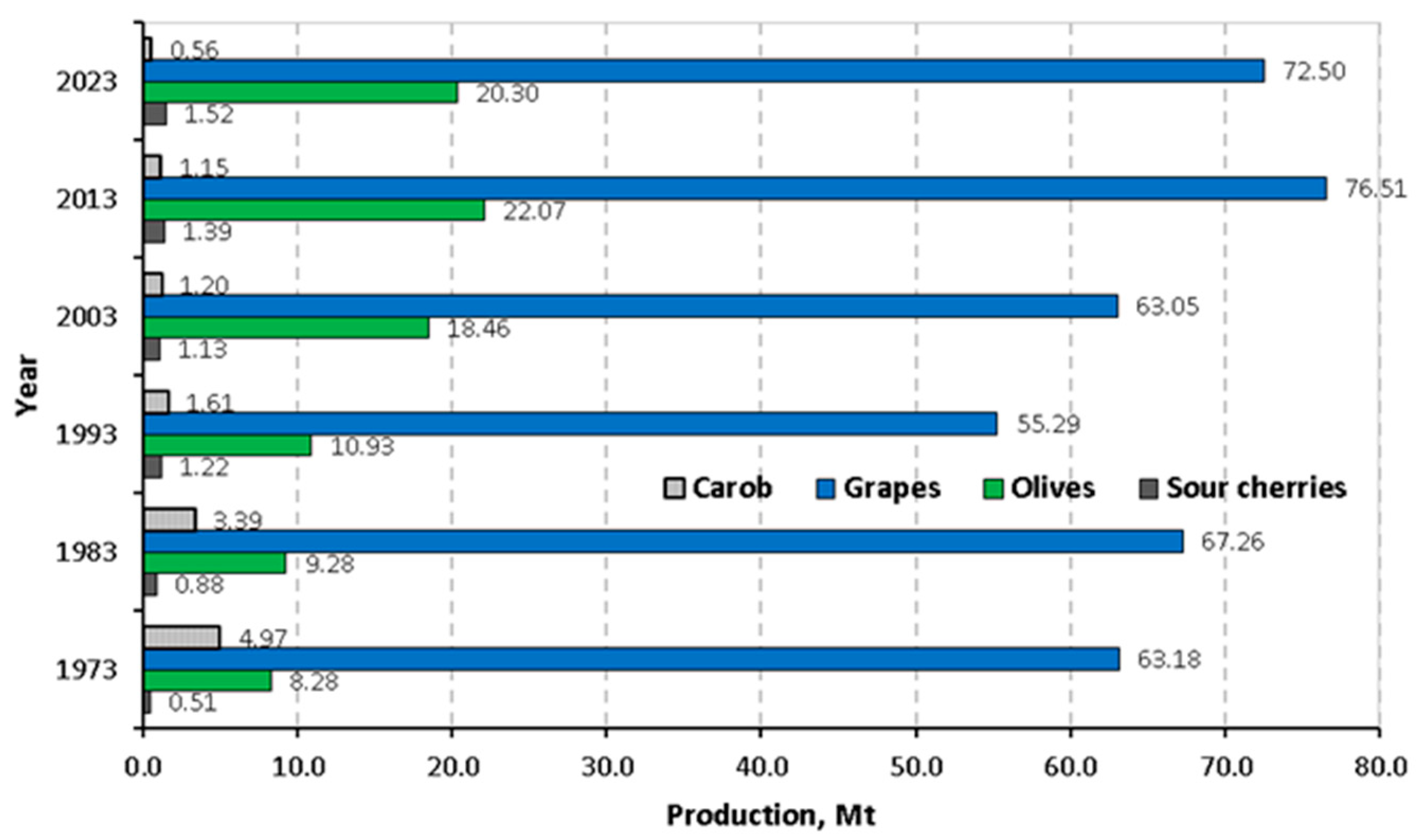
Figure 1. Production of sour cherry, grape, olive and carob in period from 1973 to 2023 according to Food and Agriculture Organization of the United Nations (FAO) [69].
Materials 19 02187 g001
Figure 2. The gradation curves of the aggregates.
Materials 19 02187 g002
Figure 3. Seeds and pits with metric ruler: (a) whole and hulled carob seeds; (b) ground olive pits.
Materials 19 02187 g003
Figure 4. Volume fraction of each aggregate type shown for each mixture.
Materials 19 02187 g004
Figure 5. (a) Concrete slices cut from 100 mm concrete cubes; (b) the experimental set up for thermal conductivity testing.
Materials 19 02187 g005
Figure 6. Thermal gradient recorded using thermal camera.
Materials 19 02187 g006
Figure 7. Disintegration of carob concrete: (a) HC mixture; (b) spalling of WC concrete; (c) cracking of WC concrete; (d) disintegration of WC concrete; (e) remaining part of WC cube; (f) microscopic image of carob seed in concrete.
Materials 19 02187 g007
Figure 8. Density of concrete specimens: (a) absolute values; (b) relative values/RC; (c) relative values/O.
Materials 19 02187 g008
Figure 9. Ultrasonic pulse velocity (UPV) of concrete specimens: (a) absolute values; (b) relative values/RC; (c) relative values/O.
Materials 19 02187 g009
Figure 10. Dynamic modulus of elasticity of concrete specimens: (a) absolute values; (b) relative values/RC; (c) relative values/O.
Materials 19 02187 g010
Figure 11. Compressive strength of concrete specimens: (a) absolute values; (b) relative values/RC; (c) relative values/O.
Materials 19 02187 g011
Figure 12. Saturated water absorption of concrete specimens: (a) absolute values; (b) relative values/RC; (c) relative values/O.
Materials 19 02187 g012
Figure 13. Sorptivity coefficient of concrete specimens: (a) absolute values; (b) relative values/RC; (c) relative values/O.
Materials 19 02187 g013
Figure 14. Microscopic image of concrete specimens: (a) RC: (b) G; (c) O; (d) OA; (e) OS; (f) SC.
Materials 19 02187 g014aMaterials 19 02187 g014b
Figure 15. (a) Thermal conductivity coefficient (W/mK) vs. time (min) for RC; (b) thermal conductivity coefficient (W/mK) and specific heat capacity (J/kgK) for all specimens.
Materials 19 02187 g015
Figure 16. Relative thermal conductivity coefficient: (a) relative values/RC; (b) relative values/O.
Materials 19 02187 g016
Table 1. The properties and appearance of aggregates.
TypeAppearanceDensity
(g/cm3)
Bulk Density (g/cm3)Weight Per Seed (mg)Length (mm)Width (mm)Absorption%
Crushed limestone aggregate 0/4 mmMaterials 19 02187 i0012.691.62---2.56
Crushed limestone aggregate 4/8 mmMaterials 19 02187 i0022.691.35---2.08
Grape seedMaterials 19 02187 i0031.100.62 ± 0.0127.97 ± 0.466.0 ± 0.43.0 ± 0.453.3
Sour cherry pitMaterials 19 02187 i0040.810.48 ± 0.01219.74 ± 0.328.6 ± 0.77.6 ± 0.536.4
Untreated ground olive pitMaterials 19 02187 i0051.050.703 ± 0.008---28.7
Ground olive pit treated with ash waterMaterials 19 02187 i006 0.693 ± 0.010---28.6
Ground olive pit treated with seawaterMaterials 19 02187 i007 0.702 ± 0.025---29.8
Whole carob seedMaterials 19 02187 i0081.360.812 ± 0.024191.69 ± 34.339.7 ± 0.86.0 ± 0.8
Hulled carob seedsMaterials 19 02187 i009 0.704 ± 0.11546.99 ± 2.167.0 ± 0.05.0 ± 0.0
Table 2. Composition for 1 m3 of concrete.
ComponentsMixturesRCGOOAOSSCWCHC
Cement, kg400400400400400400400400
Water, kg; w/c = 0.45180180180180180180180180
Aggregate, kgCrushed limestone0/4 mm1239.4708.2708.2708.2708.21239.41150.9619.7
4/8 mm531.2531.2531.2531.2531.2-265.6619.7
Grape seed -217.2------
Sour cherry pit -----160.5--
Ground olive pituntreated--207.3-----
ash water---207.3----
seawater----207.3---
Carob seedhulled-------268.6
whole------179.0-
Superplasticizer, kg22222222
Table 3. Concrete workability and standardized consistence classes EN 206.
ConcreteRCGOOAOSSCWCHC
Slump, mm500255225095200
Standardized consistence classesS2S1S5S5S1S3S1S1
Table 4. Possible application of concrete with fruit pits and seeds.
MixCompressive Strength, MPaStructural
Application
Non-Load Bearing ElementsInsulation UsePractical Potential
RC (Reference Concrete)54.7YesYesNoVery High
OA (Ground Olive Pits–Ash Treated)36.8LimitedYesYesHighest among agro-concretes
O/OS (Untreated/Seawater Treated Olive Pits)28.5, 30.4NoYesYesModerate
SC (Sour Cherry Pits)25.3NoLimitedLimitedLow
G (Grape Seeds)10.8NoLimitedYesMainly as insulating material
HC/WC (Carob–Hulled/Whole)-NoNoNoNot suitable for construction
Disclaimer/Publisher’s Note: The statements, opinions and data contained in all publications are solely those of the individual author(s) and contributor(s) and not of MDPI and/or the editor(s). MDPI and/or the editor(s) disclaim responsibility for any injury to people or property resulting from any ideas, methods, instructions or products referred to in the content.