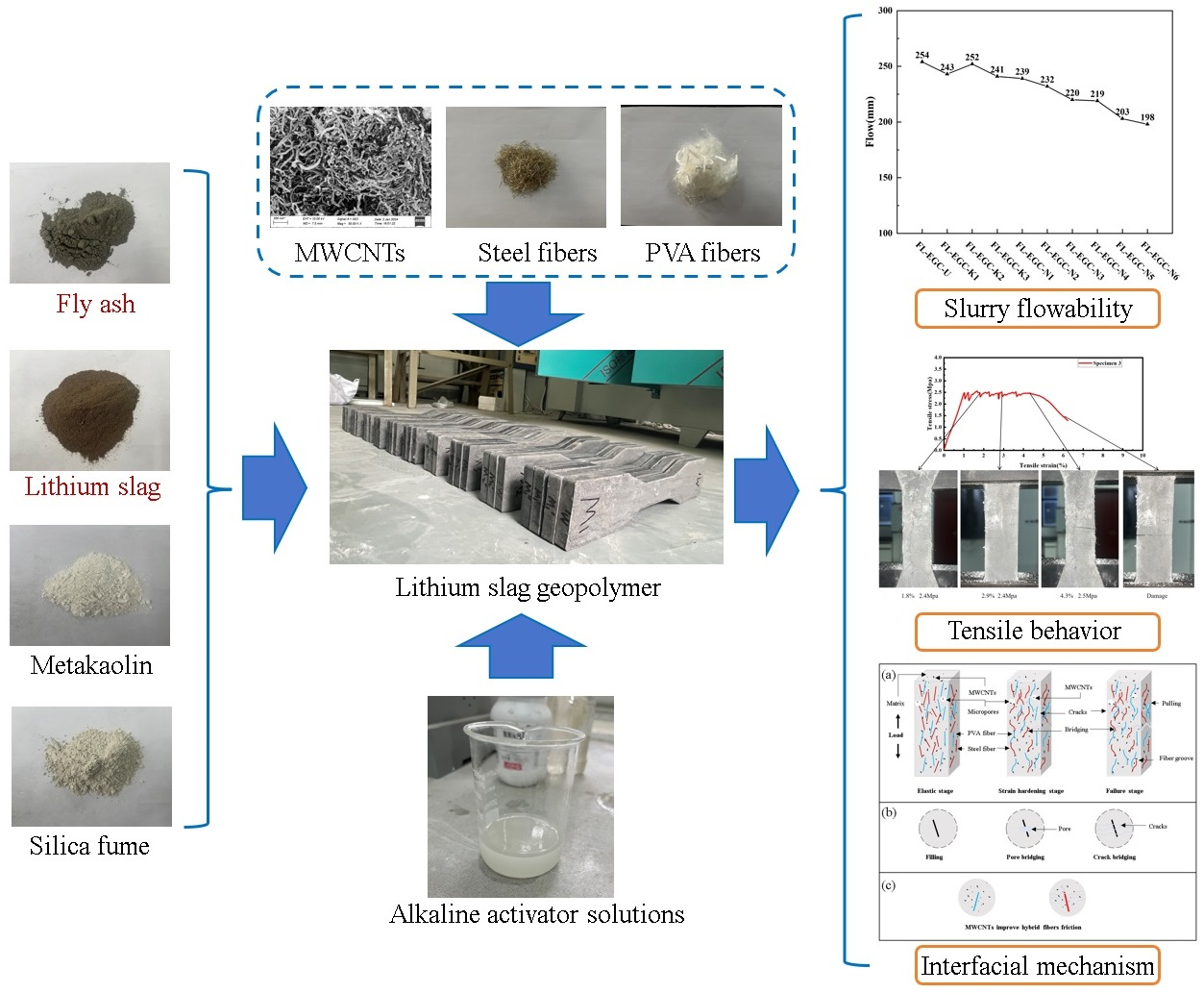
Enhancing Tensile Performance of Lithium Slag Geopolymers Using Hybrid Fibers and Modified Multi-Walled Carbon Nanotubes


Abstract
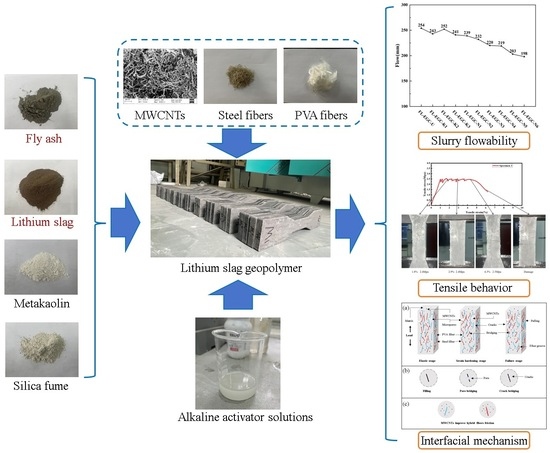
1. Introduction
2. Materials and Experimental Methods
2.1. Raw Materials
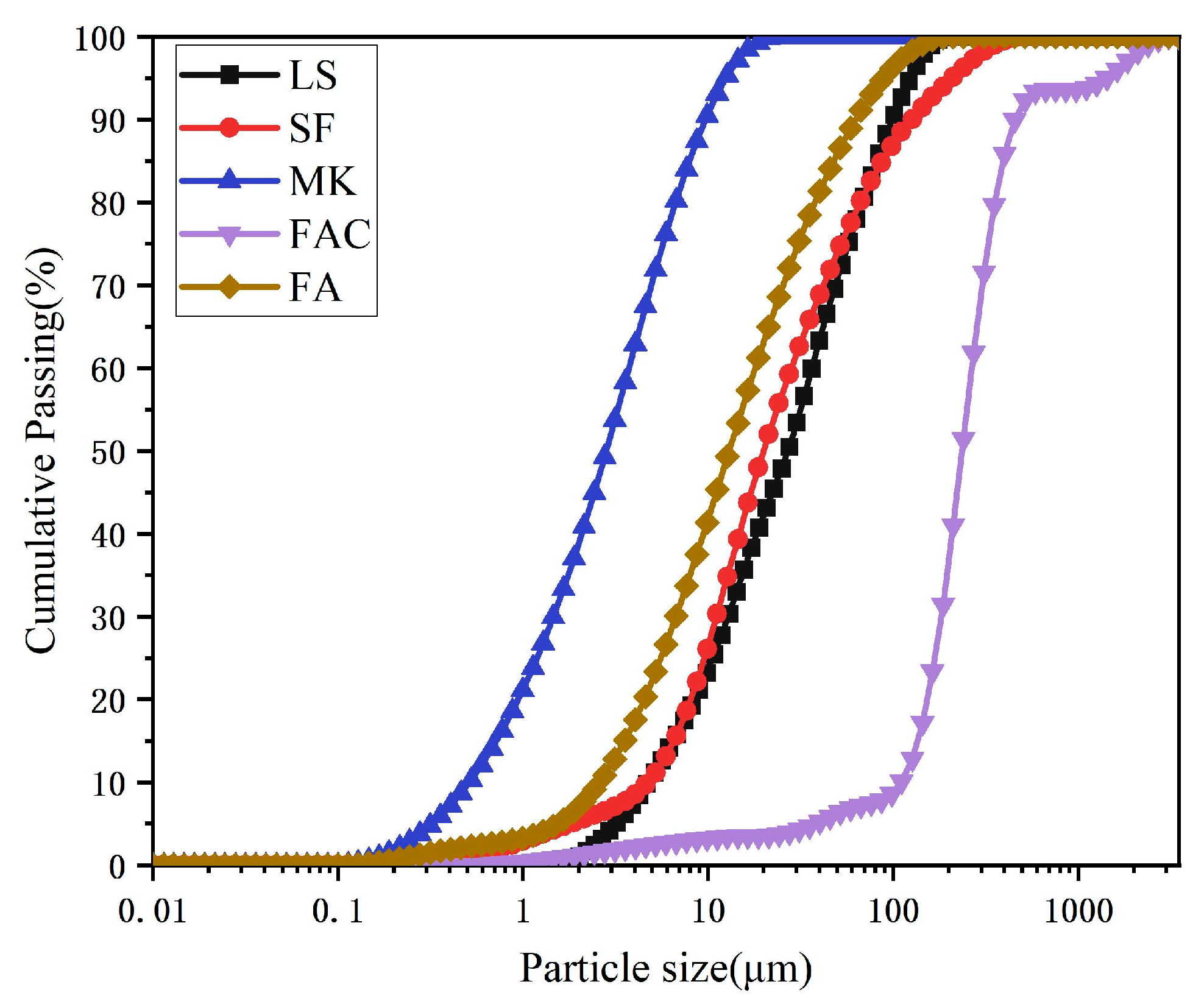
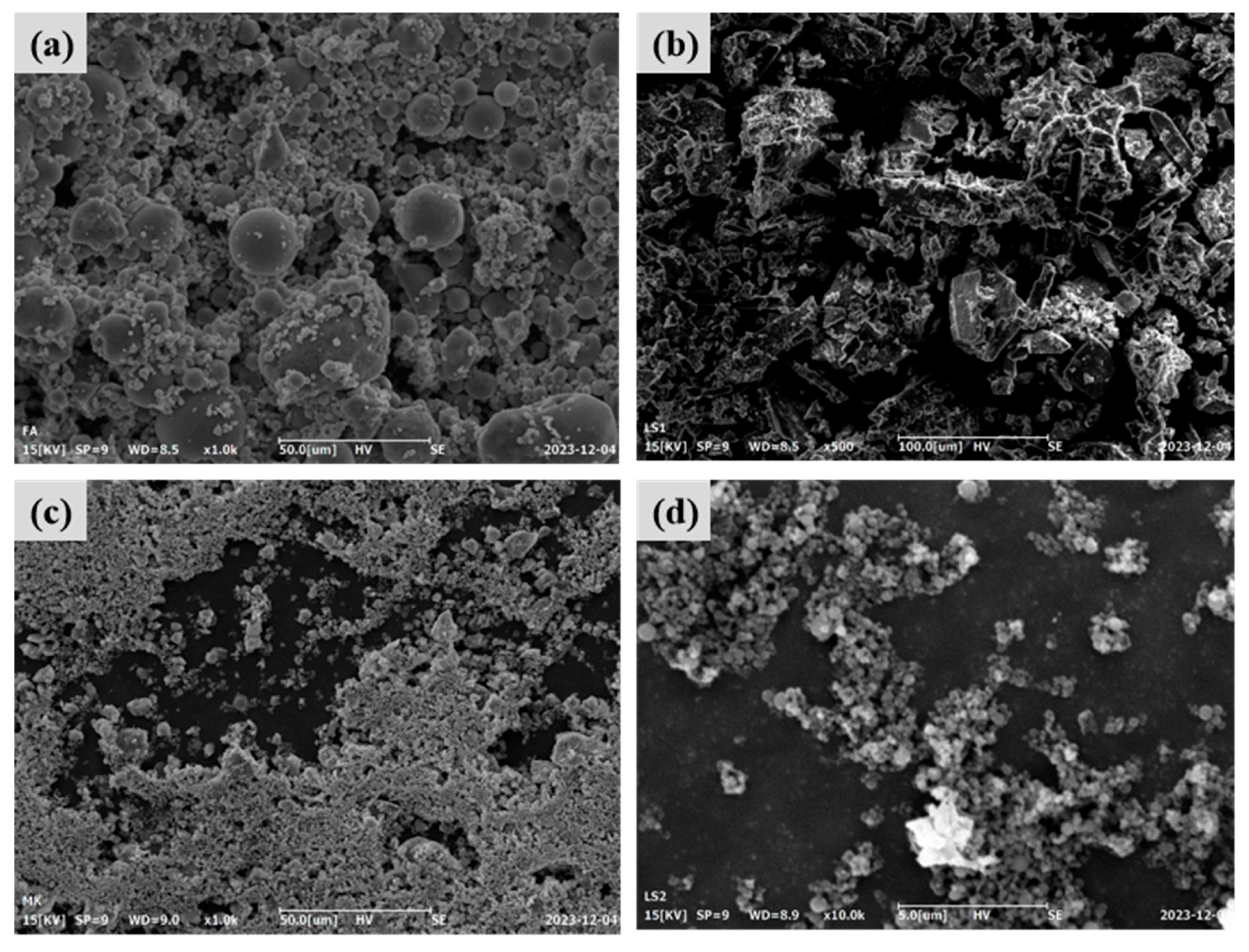
2.1.1. Lithium Slag and Four Cementitious Materials
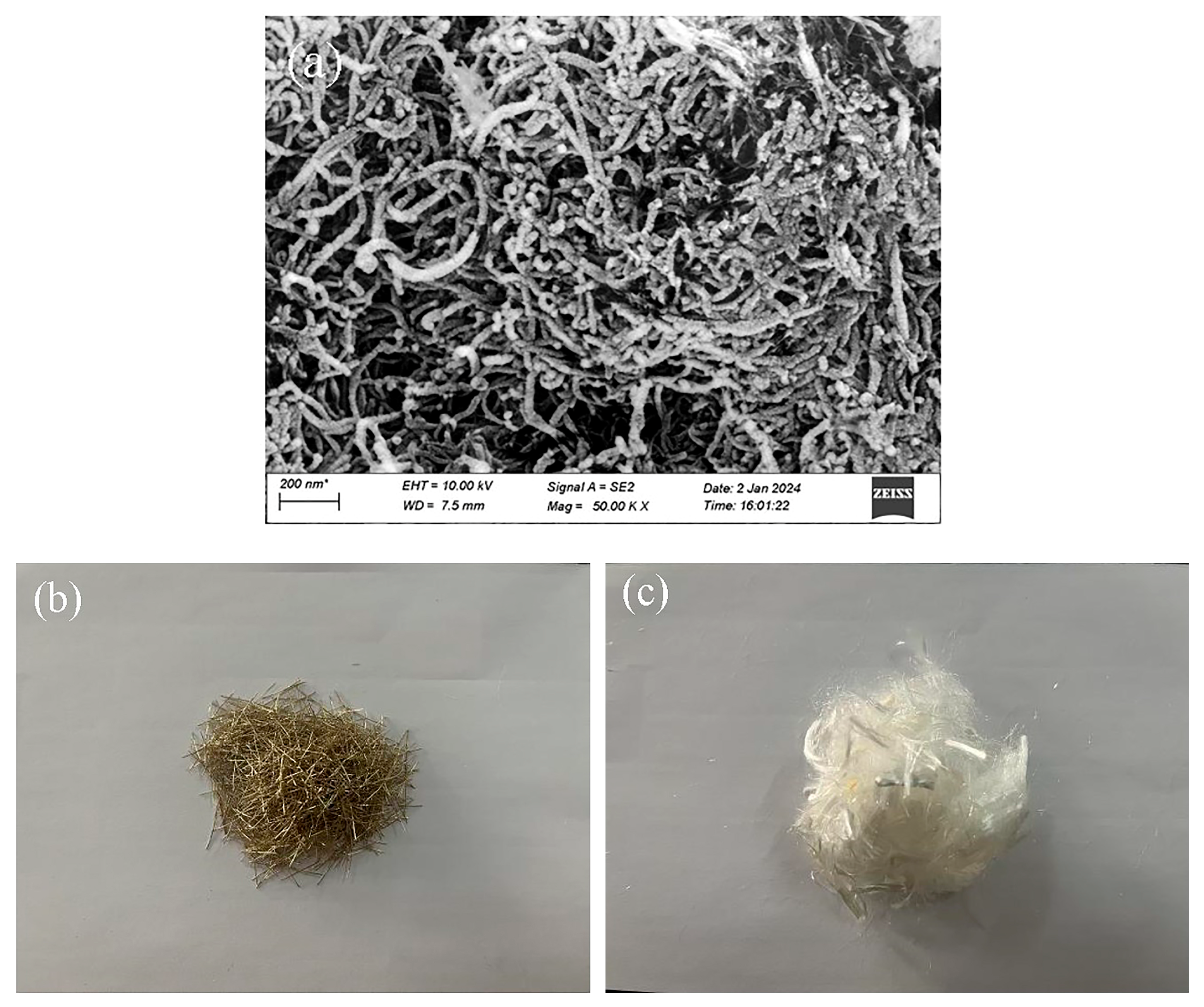
2.1.2. MWCNTs, PVA Fibers, and Steel Fibers
2.1.3. Alkaline Activator Solutions
2.1.4. Carbon Emissions
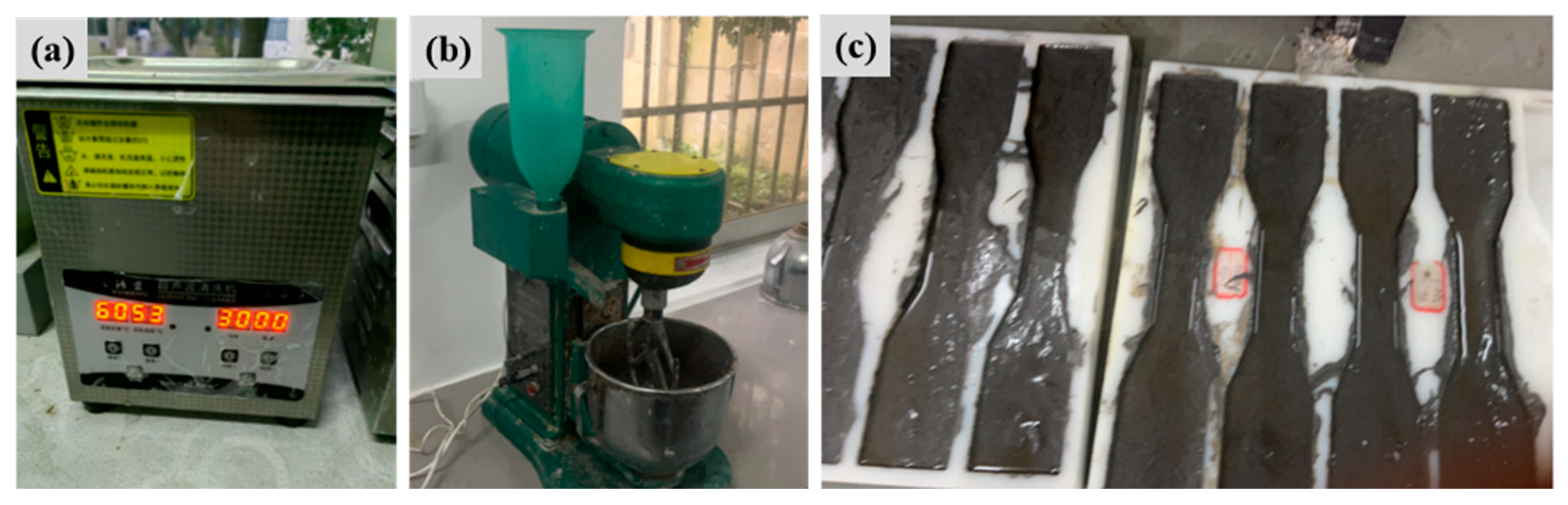
2.2. Preparation of FL-EGC
2.3. Experimental Design Scheme
2.4. Test Methods
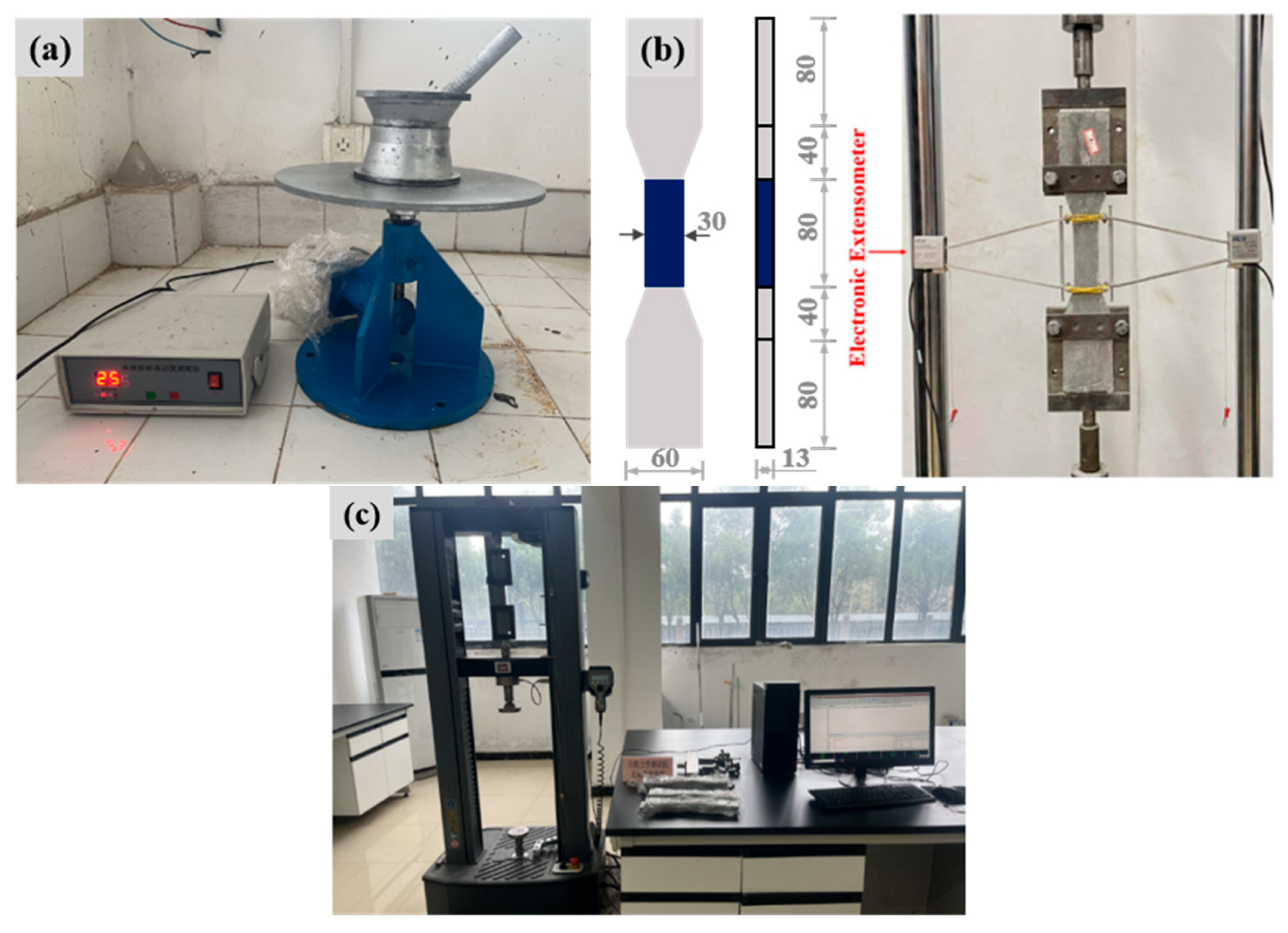
2.4.1. Testing FL-EGC Flowability
2.4.2. Uniaxial Tensile Testing Program
2.4.3. FESEM Analysis
3. Results and Discussion
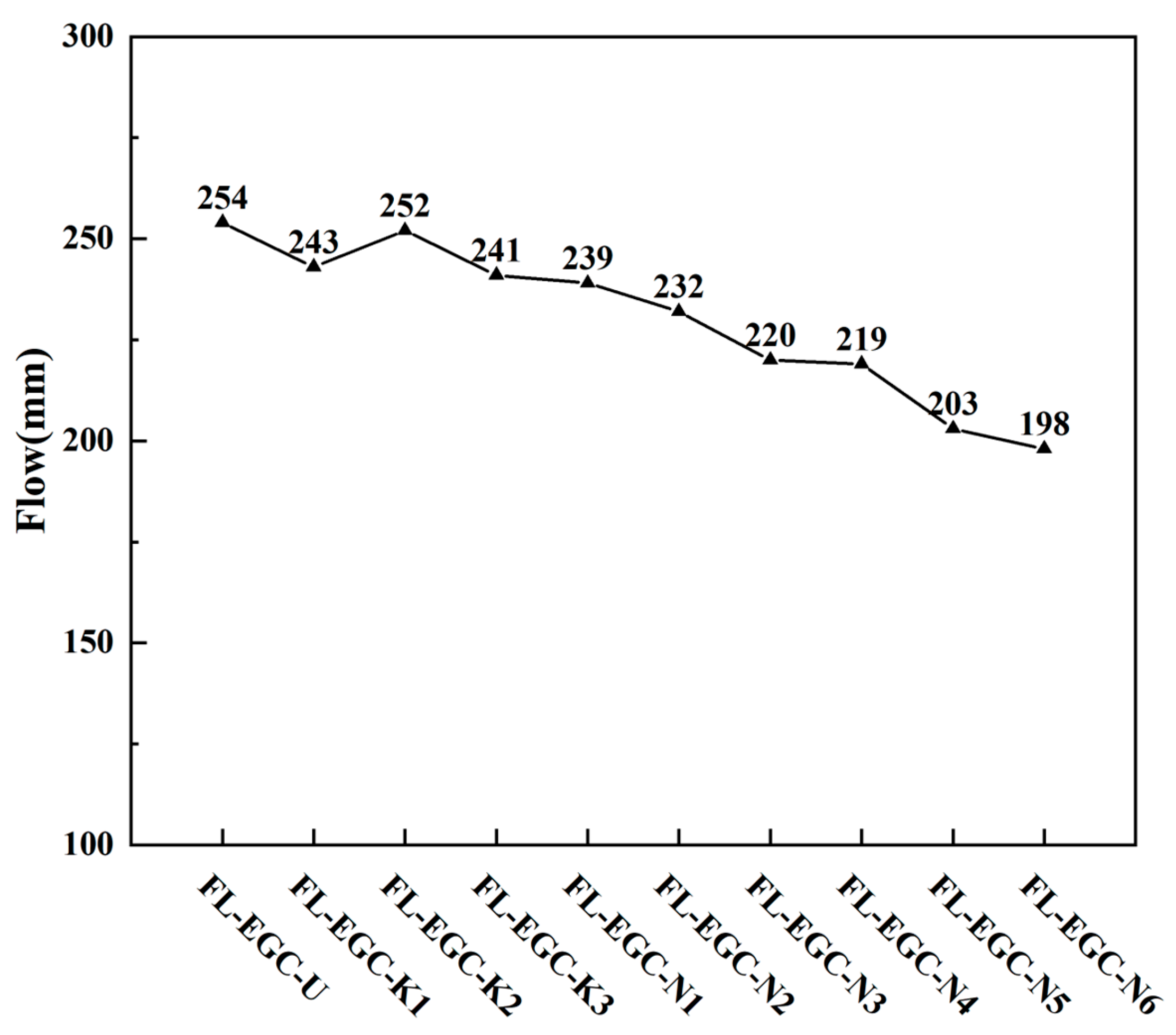
3.1. FL-EGC Slurry Flowability
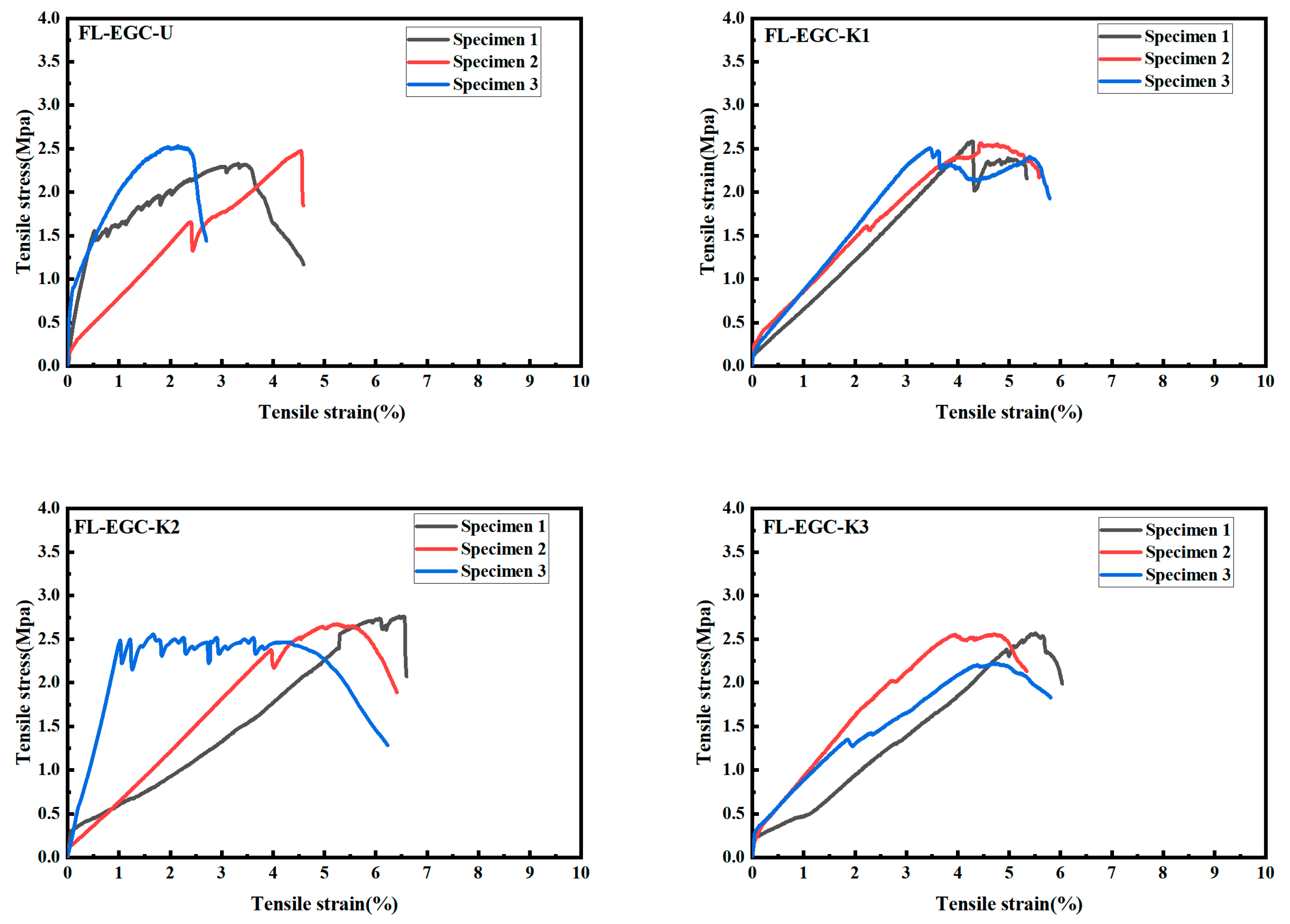
3.2. Tensile Behavior Analysis of FL-EGC with MWCNTs and PVA Fibers
- (1)
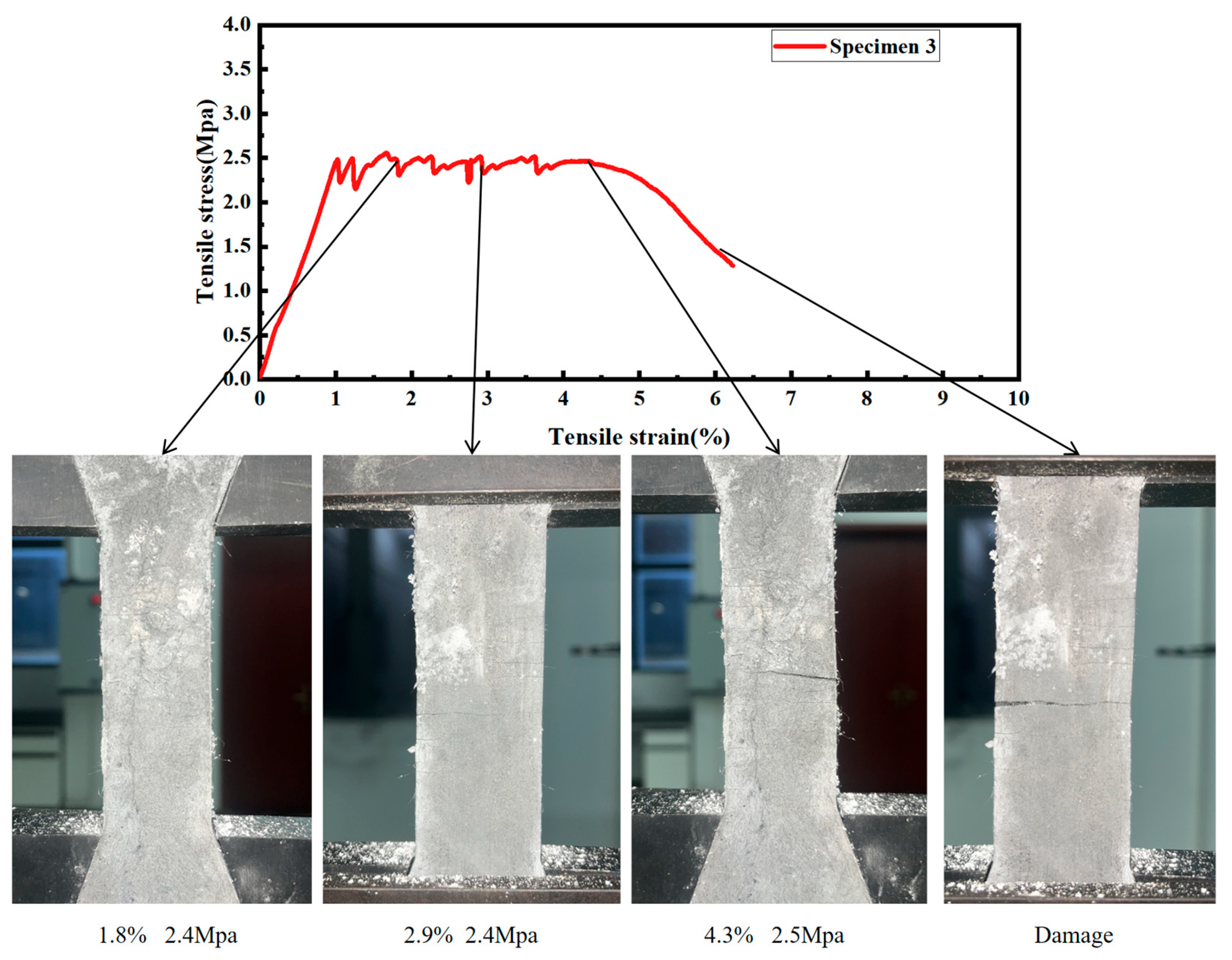
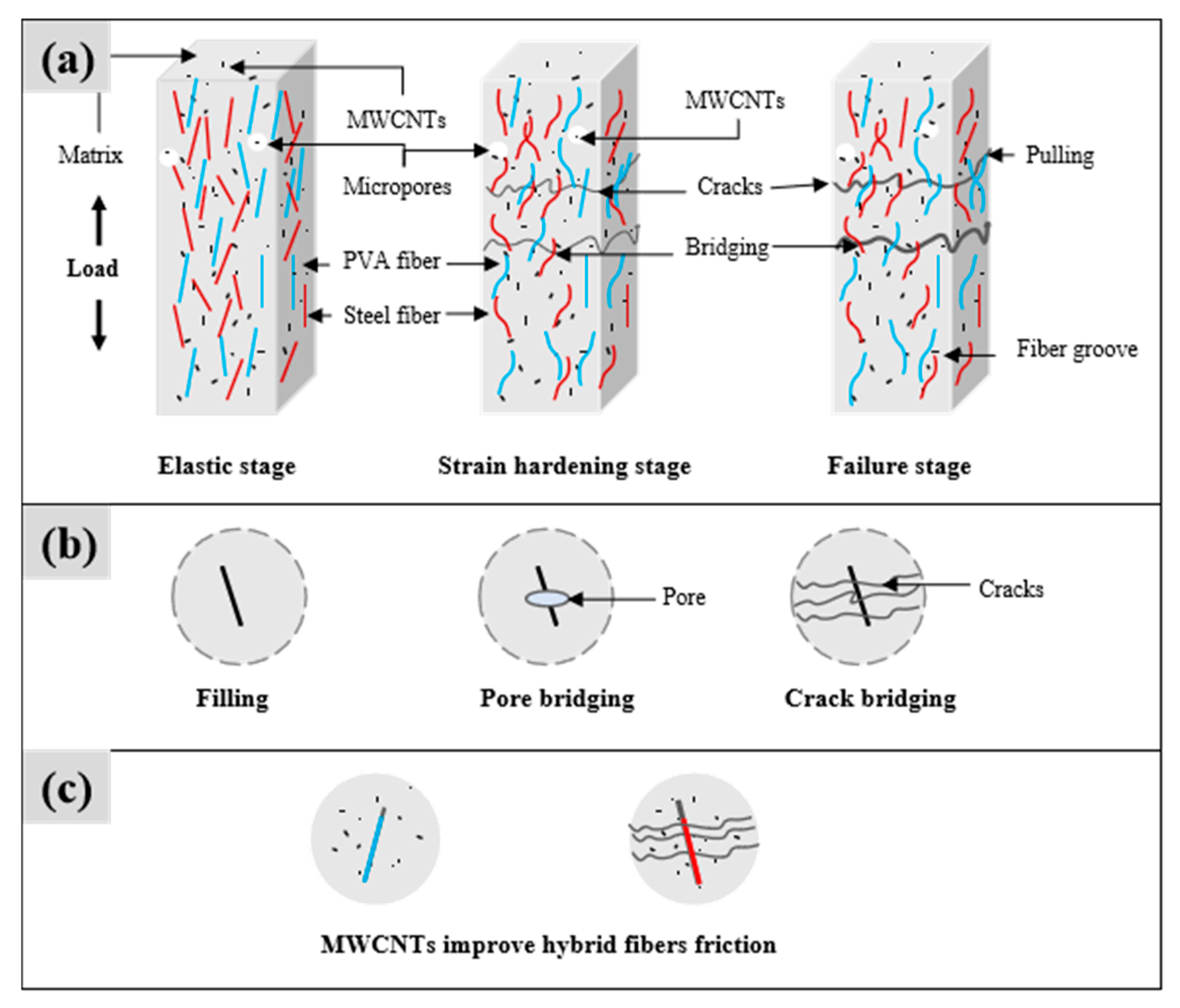
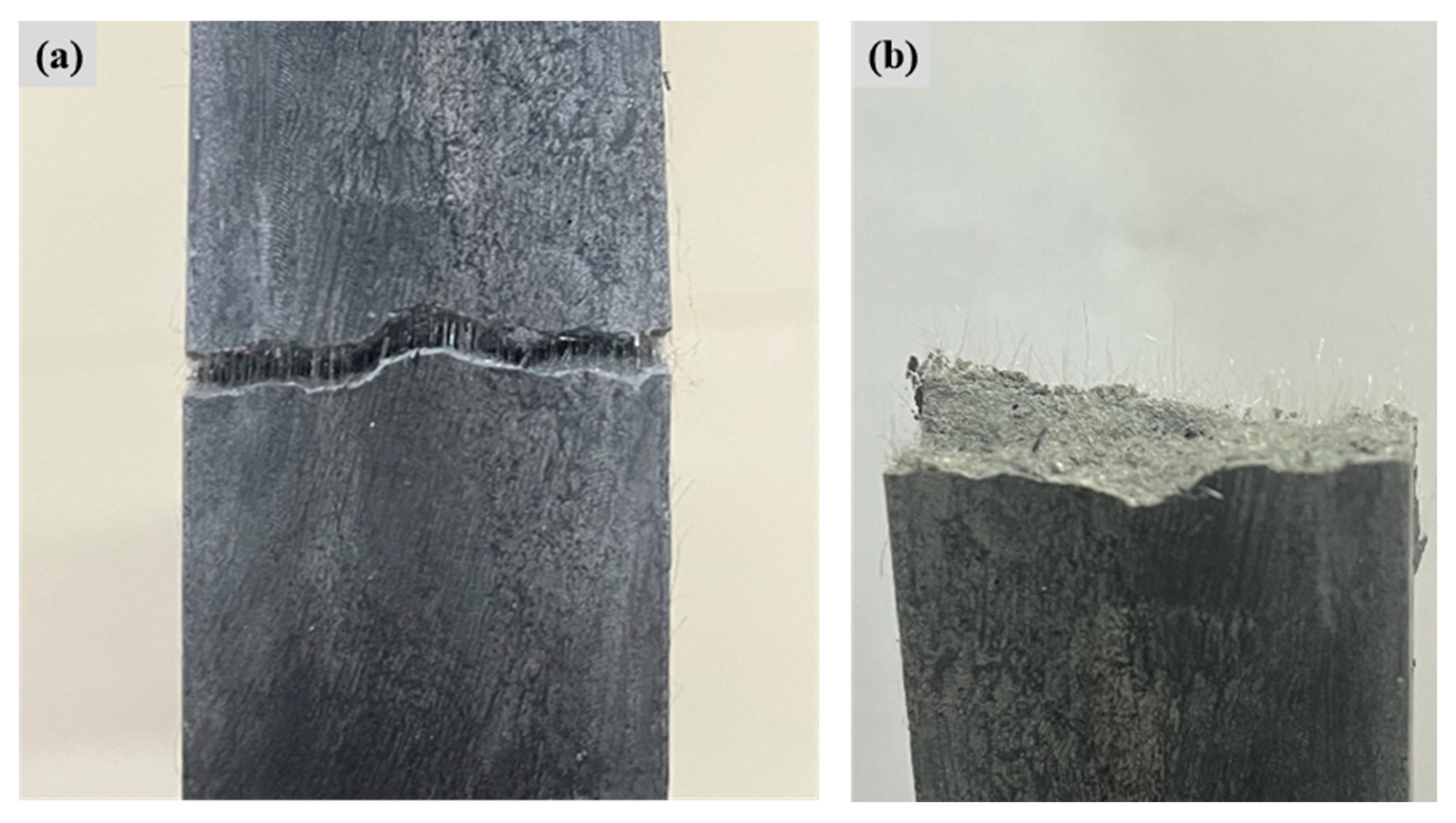
- During the no-crack stage period, the matrix in the specimen and the PVA fibers, MWCNTs share the force, the matrix of the specimen material bears most of the load at this stage, and the deformation of the specimen follows Hooke’s law until the first crack appears.
- (2)
- Crack development stage period, as the tensile load continues, the stress increases slowly or remains unchanged, the strain gradually increases, and new cracks are continuously generated. PVA fibers and modified MWCNTs bridge the broken matrix to withstand the load.
- (3)
- During the crack expansion period, the specimen matrix suffers damage. It loses its load-bearing capacity, and a large number of PVA fibers and MWCNTs are pulled out and fractured. The specimen cracks gradually become more pronounced until the tensile specimen fails under load.
3.3. Tensile Behavior Analysis of PVA Fiber FL-EGC with MWCNTs and Steel
3.4. Microstructure of FL-EGC Blends
3.4.1. Microstructure of FL-EGC with MWCNTs and PVA Fibers
3.4.2. Microstructure of FL-EGC with MWCNTs and Hybridized Fibers
3.5. Interfacial Mechanism of Hybrid Fibers Co-Modified with MWCNTs to Enhance FL-EGC
4. Conclusions
- The incorporation of functionalized MWCNTs and hybrid fibers reduced the flowability of FL-EGC due to their high specific surface area and interaction with the alkaline solution; however, the mixtures remained workable and suitable for laboratory-scale casting.
- Within the tested range, the addition of functionalized MWCNTs at an optimal dosage of 0.15% was associated with increases in ultimate tensile stress, ultimate tensile strain, and strain-specific fracture energy. These improvements are discussed in relation to observed microstructural features, such as crack-bridging and interfacial interaction, rather than as direct mechanistic proof.
- The combined use of PVA fibers, steel fibers, and MWCNTs resulted in improved tensile performance compared with single-fiber systems. PVA fibers primarily contributed to crack control and deformation capacity, while steel fibers enhanced load-bearing capacity through mechanical anchorage. Excessive steel fiber content was observed to reduce deformability.
- Crack spacing and crack width were effectively controlled in the hybrid fiber–MWCNT system, with finer crack distribution observed compared to conventional ECC/EGC materials. These results indicate enhanced crack management behavior under tensile loading.
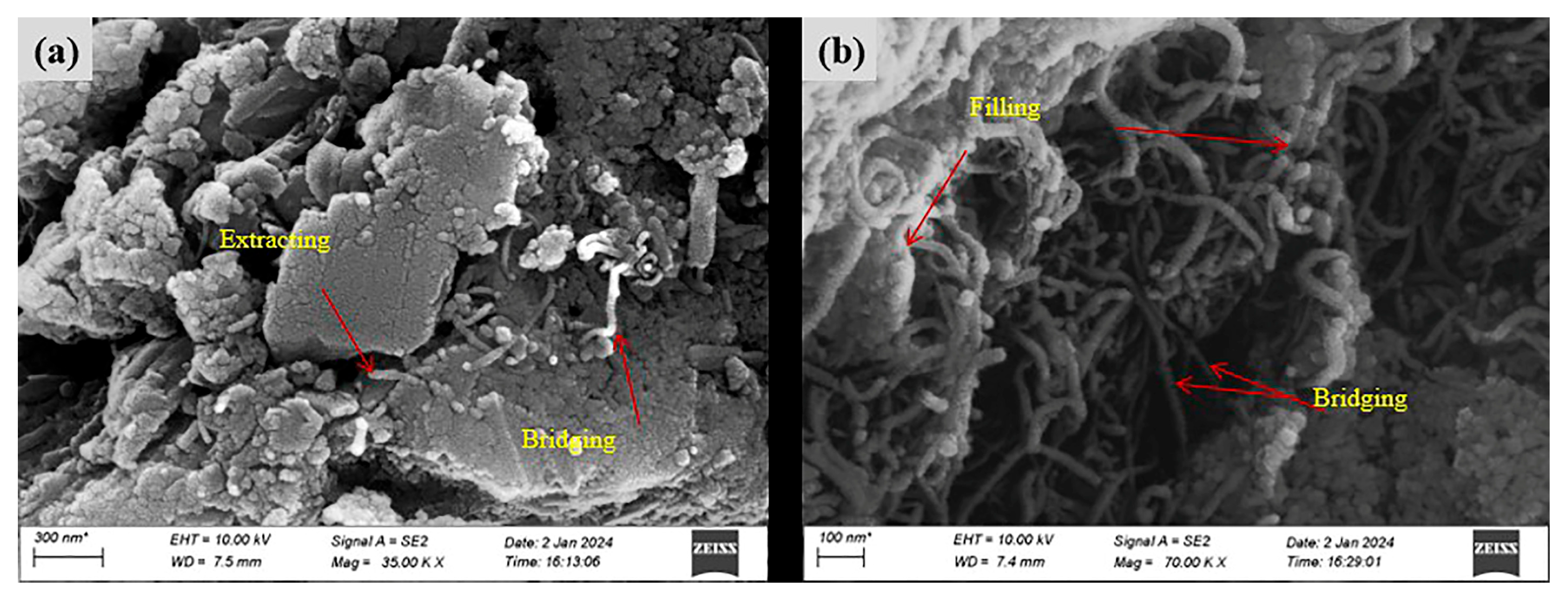
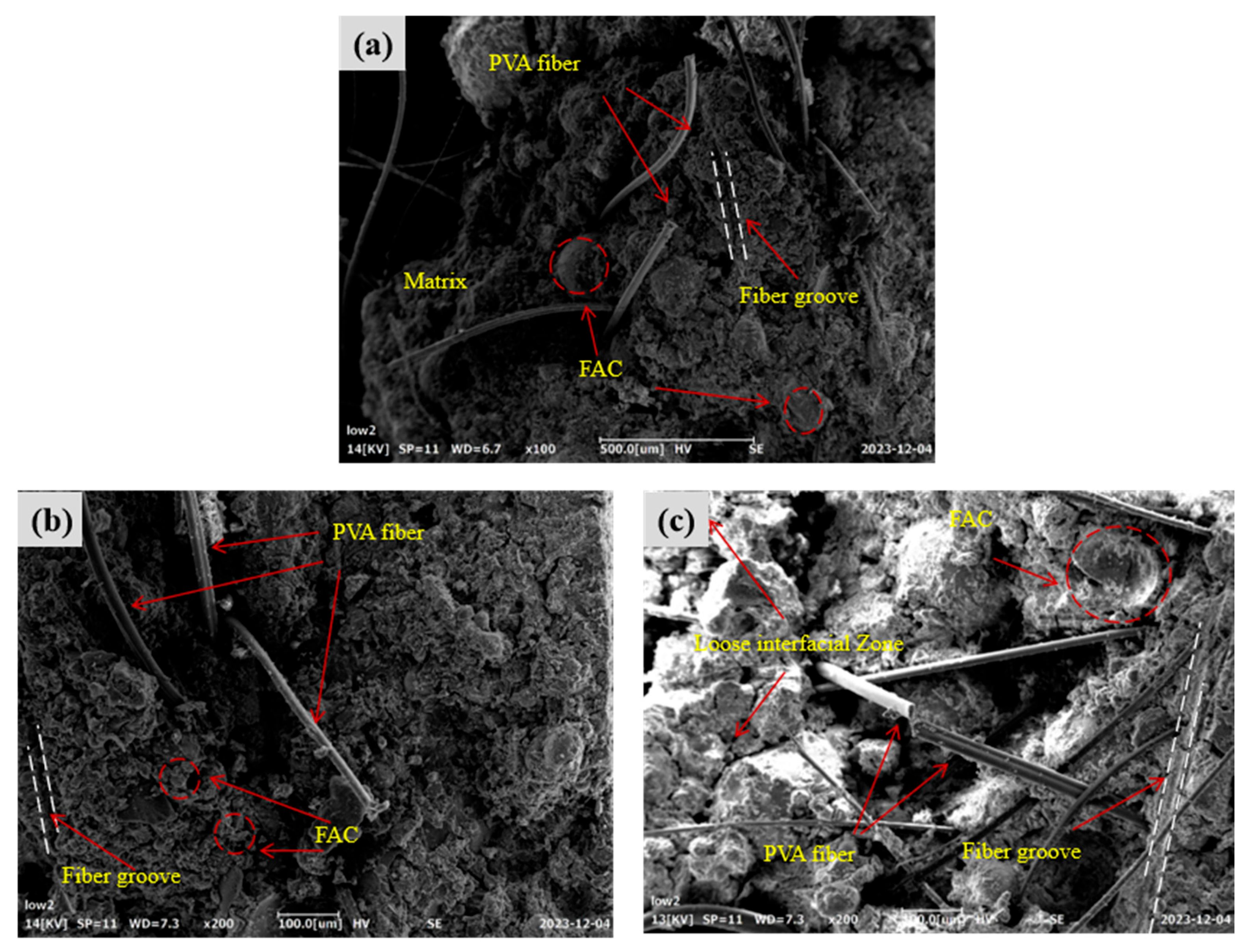
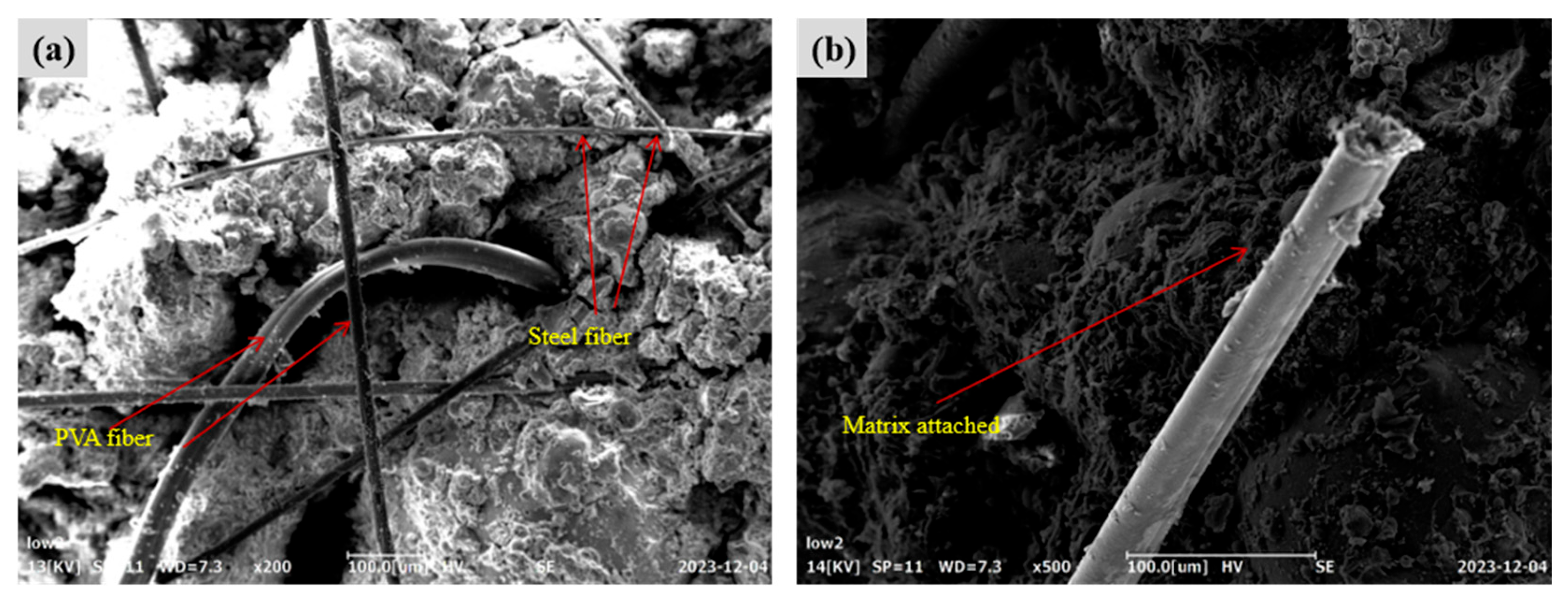
- FESEM observations revealed fiber pull-out, crack-bridging features, and matrix adhesion at fiber surfaces, as well as the presence of MWCNTs near microcracks and pores. These observations provide qualitative microstructural evidence supporting the tensile behavior trends, but do not constitute quantitative validation of reinforcement mechanisms.
Author Contributions
Funding
Data Availability Statement
Conflicts of Interest
References
- Qin, W.; Wang, N.; Huang, Z.; Zhang, Y. Research progress on the lithium extraction process from lepidolite. Foshan Ceram. 2018, 28, 7–10. (In Chinese) [Google Scholar]
- Belviso, C. State-of-the-art applications of fly ash from coal and biomass: A focus on zeolite synthesis processes and issues. Prog. Energy Combust. Sci. 2018, 65, 109–135. [Google Scholar] [CrossRef]
- Guo, X.; Shi, H.; Dick, W.A. Compressive strength and microstructural characteristics of class C fly ash geopolymer. Cem. Concr. Compos. 2010, 32, 142–147. [Google Scholar] [CrossRef]
- Colangelo, F.; Roviello, G.; Ricciotti, L.; Ferrandiz-Mas, V.; Messina, F.; Ferone, C.; Tarallo, O.; Cioffi, R.; Cheeseman, C.R. Mechanical and thermal properties of lightweight geopolymer composites. Cem. Concr. Compos. 2018, 86, 266–272. [Google Scholar] [CrossRef]
- Kong, D.L.Y.; Sanjayan, J.G.; Sagoe-Crentsil, K. Comparative performance of geopolymers made with metakaolin and fly ash after exposure to elevated temperatures. Cem. Concr. Res. 2007, 37, 1583–1589. [Google Scholar] [CrossRef]
- Chen, X.; Zhou, M.; Shen, W.; Zhu, G.; Ge, X. Mechanical properties and microstructure of metakaolin-based geopolymer compound-modified by polyacrylic emulsion and polypropylene fibers. Constr. Build. Mater. 2018, 190, 680–690. [Google Scholar] [CrossRef]
- Zhou, Y.; Xi, B.; Sui, L.; Zheng, S.; Xing, F.; Li, L. Development of high strain-hardening lightweight engineered cementitious composites: Design and performance. Cem. Concr. Compos. 2019, 104, 103370. [Google Scholar] [CrossRef]
- Xi, B.; Zhou, Y.; Yu, K.; Hu, B.; Huang, X.; Sui, L.; Xing, F. Use of nano-SiO2 to develop a high-performance green lightweight engineered cementitious composites containing fly ash cenospheres. J. Clean. Prod. 2020, 262, 121274. [Google Scholar] [CrossRef]
- Huang, X.; Ranade, R.; Zhang, Q.; Ni, W.; Li, V.C. Mechanical and thermal properties of green lightweight engineered cementitious composites. Constr. Build. Mater. 2013, 48, 954–960. [Google Scholar] [CrossRef]
- Aslani, F.; Wang, L.; Zheng, M. The effect of carbon nanofibers on fresh and mechanical properties of lightweight engineered cementitious composite using hollow glass microspheres. J. Compos. Mater. 2019, 53, 2447–2464. [Google Scholar] [CrossRef]
- Ahmed, S.F.U.; Mihashi, H. Strain hardening behavior of lightweight hybrid polyvinyl alcohol (PVA) fiber reinforced cement composites. Mater. Struct. 2011, 44, 1179–1191. [Google Scholar] [CrossRef]
- Xu, L.Y.; Lao, J.C.; Qian, L.P.; Khan, M.; Xie, T.Y.; Huang, B.T. Low-carbon high-strength engineered geopolymer composites (HS-EGC) with full-volume fly ash precursor: Role of silica modulus. J. CO2 Util. 2024, 88, 102948. [Google Scholar] [CrossRef]
- Zhu, J.X.; Weng, K.F.; Liu, W.H.; Huang, B.T.; Peng, K.D.; Zhu, J.H.; Dai, J.G. Thin-layer Ultra-High-Strength Engineered Cementitious Composites (UHS-ECC) reinforced with small-diameter FRP bars for structural strengthening. Thin-Walled Struct. 2024, 205, 112592. [Google Scholar] [CrossRef]
- Xu, L.Y.; Yu, J.; Huang, B.T.; Lao, J.C.; Wu, H.L.; Jiang, X.; Xie, T.Y.; Dai, J.G. Green and Low-Carbon Matrices for Engineered/Strain-Hardening Cementitious Composites (ECC/SHCC): Towards Sustainable and Resilient Infrastructure. J. Clean. Prod. 2025, 496, 144968. [Google Scholar] [CrossRef]
- Nematollahi, B.; Sanjayan, J.; Shaikh, F.U.A. Matrix design of strain hardening fiber reinforced engineered geopolymer composite. Compos. Part B Eng. 2016, 89, 253–265. [Google Scholar] [CrossRef]
- Ohno, M.; Li, V.C. An integrated design method of Engineered Geopolymer Composite. Cem. Concr. Compos. 2018, 88, 73–85. [Google Scholar] [CrossRef]
- Xu, L.Y.; Huang, B.T.; Li, V.C.; Dai, J.G. High-strength high-ductility Engineered/Strain-Hardening Cementitious Composites (ECC/SHCC) incorporating geopolymer fine aggregates. Cem. Concr. Compos. 2022, 125, 104296. [Google Scholar] [CrossRef]
- Hamcumpai, K.; Nuaklong, P.; Chindasiriphan, P.; Jongvivatsakul, P.; Tangaramvong, S.; Di Sarno, L.; Likitlersuang, S. High-strength steel fibre-reinforced geopolymer concrete utilising recycled granite waste and rice husk ash. Constr. Build. Mater. 2024, 433, 136693. [Google Scholar] [CrossRef]
- Nuaklong, P.; Chittanurak, J.; Jongvivatsakul, P.; Pansuk, W.; Lenwari, A.; Likitlersuang, S. Effect of hybrid polypropylene-steel fibres on strength characteristics of UHPFRC. Adv. Concr. Constr. 2020, 10, 1–11. [Google Scholar]
- Nuaklong, P.; Hamcumpai, K.; Keawsawasvong, S.; Pethrung, S.; Jongvivatsakul, P.; Tangaramvong, S.; Pothisiri, T.; Likitlersuang, S. Strength and post-fire performance of fiber-reinforced alkali-activated fly ash concrete containing granite industry waste. Constr. Build. Mater. 2023, 392, 131984. [Google Scholar] [CrossRef]
- Zahid, M.; Shafiq, N.; Razak, S.N.A.; Tufail, R.F. Investigating the effects of NaOH molarity and the geometry of PVA fibers on the post-cracking and the fracture behavior of engineered geopolymer composite. Constr. Build. Mater. 2020, 265, 120295. [Google Scholar] [CrossRef]
- Pang, Y.; Zhu, X.; Yang, M.; Yu, J. Tailoring rheological–strength–ductility properties of self-cleaning geopolymer composites with asphalt emulsion. Constr. Build. Mater. 2021, 308, 124997. [Google Scholar] [CrossRef]
- Al-Majidi, M.H.; Lampropoulos, A.; Cundy, A.B. Tensile properties of a novel fibre reinforced geopolymer composite with enhanced strain hardening characteristics. Compos. Struct. 2017, 168, 402–427. [Google Scholar] [CrossRef]
- Cheng, Z.; An, J.P.; Li, F.; Lu, Y.; Li, S. Effect of fly ash cenospheres on properties of multi-walled carbon nanotubes and polyvinyl alcohol fibers reinforced geopolymer composites. Ceram. Int. 2022, 48, 18956–18971. [Google Scholar] [CrossRef]
- Wang, L.; Zhou, S.H.; Shi, Y.; Tang, S.W.; Chen, E. Effect of silica fume and PVA fiber on the abrasion resistance and volume stability of concrete. Compos. Part B Eng. 2017, 130, 28–37. [Google Scholar] [CrossRef]
- Wang, L.E.I.; Guo, F.; Yang, H.; Wang, Y.A.N.; Tang, S. Comparison of fly ash, PVA fiber, MgO and shrinkage-reducing admixture on the frost resistance of face slab concrete via pore structural and fractal analysis. Fractals 2021, 29, 2140002. [Google Scholar] [CrossRef]
- Wang, L.; Zeng, X.; Li, Y.; Yang, H.; Tang, S. Influences of MgO and PVA fiber on the abrasion and cracking resistance, pore structure and fractal features of hydraulic concrete. Fractal Fract. 2022, 6, 674. [Google Scholar] [CrossRef]
- Li, V.C. On engineered cementitious composites (ECC) a review of the material and its applications. J. Adv. Concr. Technol. 2003, 1, 215–230. [Google Scholar] [CrossRef]
- Chen, K.; Wu, D.; Chen, H.X.; Zhang, G.; Yao, R.; Pan, C.; Zhang, Z. Development of low-calcium fly ash-based geopolymer mortar using nanosilica and hybrid fibers. Ceram. Int. 2021, 47, 21791–21806. [Google Scholar] [CrossRef]
- Alrefaei, Y.; Dai, J.G. Tensile behavior and microstructure of hybrid fiber ambient cured one-part engineered geopolymer composites. Constr. Build. Mater. 2018, 184, 419–431. [Google Scholar] [CrossRef]
- Zhang, H.; Sarker, P.K.; Wang, Q.; He, B.; Jiang, Z. Strength and toughness of ambient-cured geopolymer concrete containing virgin and recycled fibres in mono and hybrid combinations. Constr. Build. Mater. 2021, 304, 124649. [Google Scholar] [CrossRef]
- Khan, M.Z.N.; Hao, Y.; Hao, H.; Shaikh, F.U.A. Mechanical properties of ambient cured high strength hybrid steel and synthetic fibers reinforced geopolymer composites. Cem. Concr. Compos. 2018, 85, 133–152. [Google Scholar] [CrossRef]
- Alomayri, T.; Raza, A.; Shaikh, F. Effect of nano SiO2 on mechanical properties of micro-steel fibers reinforced geopolymer composites. Ceram. Int. 2021, 47, 33444–33453. [Google Scholar] [CrossRef]
- Zhang, P.; Wang, K.; Wang, J.; Guo, J.; Hu, S.; Ling, Y. Mechanical properties and prediction of fracture parameters of geopolymer/alkali-activated mortar modified with PVA fiber and nano-SiO2. Ceram. Int. 2020, 46, 20027–20037. [Google Scholar] [CrossRef]
- Su, Z.; Hou, W.; Sun, Z. Recent advances in carbon nanotube-geopolymer composite. Constr. Build. Mater. 2020, 252, 118940. [Google Scholar] [CrossRef]
- Azeem, M.; Junaid, M.T.; Saleem, M.A. Correlated strength enhancement mechanisms in carbon nanotube based geopolymer and OPC binders. Constr. Build. Mater. 2021, 305, 124748. [Google Scholar] [CrossRef]
- Keshavarz, R.; Aghamohammadi, H.; Eslami-Farsani, R. The effect of graphene nanoplatelets on the flexural properties of fiber metal laminates under marine environmental conditions. Int. J. Adhes. Adhes. 2020, 103, 102709. [Google Scholar] [CrossRef]
- Eslami-Farsani, R.; Aghamohammadi, H.; Khalili, S.M.R.; Ebrahimnezhad-Khaljiri, H.; Jalali, H. Recent trend in developing advanced fiber metal laminates reinforced with nanoparticles: A review study. J. Ind. Text. 2022, 51, 7374S–7408S. [Google Scholar] [CrossRef]
- Aghamohammadi, H.; Eslami-Farsani, R.; Tcharkhtchi, A. The effect of multi-walled carbon nanotubes on the mechanical behavior of basalt fibers metal laminates: An experimental study. Int. J. Adhes. Adhes. 2020, 98, 102538. [Google Scholar] [CrossRef]
- Xing, G.; Xu, Y.; Huang, J.; Lu, Y.; Miao, P.; Chindasiriphan, P.; Jongvivatsakul, P.; Ma, K. Research on the mechanical properties of steel fibers reinforced carbon nanotubes concrete. Constr. Build. Mater. 2023, 392, 131880. [Google Scholar] [CrossRef]
- Nuaklong, P.; Boonchoo, N.; Jongvivatsakul, P.; Charinpanitkul, T.; Sukontasukkul, P. Hybrid effect of carbon nanotubes and polypropylene fibers on mechanical properties and fire resistance of cement mortar. Constr. Build. Mater. 2021, 275, 122189. [Google Scholar] [CrossRef]
- Yan, Y.; Tian, L.; Zhao, W.; Lazaro, S.A.M.; Li, X.; Tang, S. Dielectric and mechanical properties of cement pastes incorporated with magnetically aligned reduced graphene oxide. Dev. Built Environ. 2024, 18, 100471. [Google Scholar] [CrossRef]
- Aslan, A.; Salur, E.; Düzcükoğlu, H.; Şahin, Ö.S.; Ekrem, M. The effects of harsh aging environments on the properties of neat and MWCNT reinforced epoxy resins. Constr. Build. Mater. 2021, 272, 121929. [Google Scholar] [CrossRef]
- Düzcükoğlu, H.; Ekinci, Ş.; Şahin, Ö.S.; Avci, A.; Ekrem, M.; Ünaldi, M. Enhancement of wear and friction characteristics of epoxy resin by multiwalled carbon nanotube and boron nitride nanoparticles. Tribol. Trans. 2015, 58, 635–642. [Google Scholar] [CrossRef]
- Saafi, M.; Andrew, K.; Tang, P.L.; McGhon, D.; Taylor, S.; Rahman, M.; Yang, S.; Zhou, X. Multifunctional properties of carbon nanotube/fly ash geopolymeric nanocomposites. Constr. Build. Mater. 2013, 49, 46–55. [Google Scholar] [CrossRef]
- Abbasi, S.M.; Ahmadi, H.; Khalaj, G.; Ghasemi, B. Microstructure and mechanical properties of a metakaolinite-based geopolymer nanocomposite reinforced with carbon nanotubes. Ceram. Int. 2016, 42, 15171–15176. [Google Scholar] [CrossRef]
- Khater, H.M.; el Gawaad, H.A.A. Characterization of alkali activated geopolymer mortar doped with MWCNT. Constr. Build. Mater. 2016, 102, 329–337. [Google Scholar] [CrossRef]
- Li, F.; Yang, Z.; Chen, D.; Lu, Y.; Li, S. Research on mechanical properties and micro-mechanism of Engineering Geopolymers Composites (EGCs) incorporated with modified MWCNTs. Constr. Build. Mater. 2021, 303, 124516. [Google Scholar] [CrossRef]
- Wu, C.; Zhou, P.; Li, Q.; Li, J.; Zhu, D. Assessing the carbon reduction potential of high-performance concrete in urban construction. Sustain. Chem. Pharm. 2025, 47, 102170. [Google Scholar] [CrossRef]
- Li, S.; Han, G.; Du, B.; Jiang, Z.; Sun, L. Carbon emissions assessment of ultra-high performance concrete in construction industry: Calculation method and case study. Energy Build. 2025, 329, 115260. [Google Scholar] [CrossRef]
- Singh, B.; Ishwarya, G.; Gupta, M.; Bhattacharyya, S.K. Geopolymer concrete: A review of some recent developments. Constr. Build. Mater. 2015, 85, 78–90. [Google Scholar] [CrossRef]
- GB/T 2419-2005; Test Method for Fluidity of Cement Mortar. National Standard of the People’s Republic of China: Beijing, China, 2005.
- JSCE (Japan Society of Civil Engineers). Method of Tests for Flexural Strength and Flexural Toughness of Steel-Fiber-Reinforced Concrete; JSCE-SF4; JSCE: Tokyo, Japan, 1984; Volume 3, pp. 58–61. [Google Scholar]
- Ranjbar, N.; Mehrali, M.; Mehrali, M.; Alengaram, U.J.; Jumaat, M.Z. High tensile strength fly ash based geopolymer composite using copper coated micro steel fiber. Constr. Build. Mater. 2016, 112, 629–638. [Google Scholar] [CrossRef]
- Nguyễn, H.H.; Lương, Q.H.; Choi, J.I.; Ranade, R.; Li, V.C.; Lee, B.Y. Ultra-ductile behavior of fly ash-based engineered geopolymer composites with a tensile strain capacity up to 13.7%. Cem. Concr. Compos. 2021, 122, 104133. [Google Scholar] [CrossRef]
- Redon, C.; Li, V.C.; Wu, C.; Hoshiro, H.; Saito, T.; Ogawa, A. Measuring and modifying interface properties of PVA fibers in ECC matrix. J. Mater. Civ. Eng. 2001, 13, 399–406. [Google Scholar] [CrossRef]







| Chemical Composition | FA | MK | SF | LS | FAC |
|---|---|---|---|---|---|
| SiO2 | 45.1 | 53.00 | 92.2 | 25.79 | 50.6 |
| AI2O3 | 24.2 | 41.50 | 3.17 | 16.84 | 27.1 |
| CaO | 6.45 | / | 0.31 | 29.17 | 2.8 |
| MgO | / | 0.49 | 0.11 | 0.56 | 1.2 |
| Fe2O3 | 0.85 | 0.80 | 0.19 | 2.68 | 7.1 |
| Na2O | 1.2 | 0.18 | / | 0.28 | 0.5 |
| K2O | / | 0.13 | / | 3.87 | 1.3 |
| SO3 | 2.1 | / | / | 9.75 | 0.3 |
| Li2O | / | / | / | 0.26 | / |
| Others | 2.8 | 3.9 | 3.92 | 10.8 | 8.2 |
| Capability | Diameter (nm) | Inside Diameter (nm) | Lengths (μm) | Density (g/cm3) | Specific Surface Area (m2/g) |
|---|---|---|---|---|---|
| MWCNTs | 10–15 | 5–8 | 2–8 | 0.09 | ≫190 |
| Fibroid | Calibre (μm) | Lengths (mm) | Dissociation (MPa) | Modulus (GPa) | Densities (g/cm3) |
|---|---|---|---|---|---|
| Steel | 220 | 13 | 3000 | 214 | 7.9 |
| PVA | 60 | 12 | 1720 | 52.6 | 1.4 |
| Mixture Specimen | FA | MK | SF | LS | FAC | MWCNTs (%) | PVA(%) | Steel (%) |
|---|---|---|---|---|---|---|---|---|
| FL-EGC-U | 1000 | 75 | 75 | 300 | 250 | 0 | 2 | 0 |
| FL-EGC-K1 | 1000 | 75 | 75 | 300 | 250 | 0.10 | 2 | 0 |
| FL-EGC-K2 | 1000 | 75 | 75 | 300 | 250 | 0.15 | 2 | 0 |
| FL-EGC-K3 | 1000 | 75 | 75 | 300 | 250 | 0.2 | 2 | 0 |
| FL-EGC-N1 | 1000 | 75 | 75 | 300 | 250 | 0.15 | 2 | 0.5 |
| FL-EGC-N2 | 1000 | 75 | 75 | 300 | 250 | 0.15 | 2 | 1 |
| FL-EGC-N3 | 1000 | 75 | 75 | 300 | 250 | 0.15 | 2 | 1.5 |
| FL-EGC-N4 | 1000 | 75 | 75 | 300 | 250 | 0.15 | 2.5 | 0.5 |
| FL-EGC-N5 | 1000 | 75 | 75 | 300 | 250 | 0.15 | 2.5 | 1 |
| FL-EGC-N6 | 1000 | 75 | 75 | 300 | 250 | 0.15 | 2.5 | 1.5 |
| Mixture Specimen | Sodium Silicate Solution Modulus (M) | Alkali Equivalent (S) | Water-Solid Ratio (W) | Fly Ash Replacement Rate (%) | Modified Multi-Walled Carbon Nanotube Content (%) | PVA Fiber Content (%) | Steel Fiber (%) |
|---|---|---|---|---|---|---|---|
| FL-EGC-U | 1.4 | 7% | 0.4 | 20 | 0 | 2 | 0 |
| FL-EGC-K1 | 1.4 | 7% | 0.4 | 20 | 0.10 | 2 | 0 |
| FL-EGC-K2 | 1.4 | 7% | 0.4 | 20 | 0.15 | 2 | 0 |
| FL-EGC-K3 | 1.4 | 7% | 0.4 | 20 | 0.2 | 2 | 0 |
| FL-EGC-N1 | 1.4 | 7% | 0.4 | 20 | 0.15 | 2 | 0.5 |
| FL-EGC-N2 | 1.4 | 7% | 0.4 | 20 | 0.15 | 2 | 1 |
| FL-EGC-N3 | 1.4 | 7% | 0.4 | 20 | 0.15 | 2 | 1.5 |
| FL-EGC-N4 | 1.4 | 7% | 0.4 | 20 | 0.15 | 2.5 | 0.5 |
| FL-EGC-N5 | 1.4 | 7% | 0.4 | 20 | 0.15 | 2.5 | 1 |
| FL-EGC-N6 | 1.4 | 7% | 0.4 | 20 | 0.15 | 2.5 | 1.5 |
| Mixture specimen | FL-EGC-U | FL-EGC-K1 | FL-EGC-K2 | FL-EGC-K3 | FL-EGC-N1 |
| Number of parallel tests | 3 | 3 | 3 | 3 | 3 |
| Mixture specimen | FL-EGC-N2 | FL-EGC-N3 | FL-EGC-N4 | FL-EGC-N5 | FL-EGC-N6 |
| Number of parallel tests | 3 | 3 | 3 | 3 | 3 |
| Mixture Number | σtc (MPa) | εtc (%) | σtu (MPa) | εtu (%) | gse (KJ/m3) |
|---|---|---|---|---|---|
| FL-EGC-U | 1.49 ± 0.41 | 0.51 ± 0.02 | 2.44 ± 0.01 | 3.44 ± 0.91 | 53.91 ± 6.03 |
| FL-EGC-K1 | 1.67 ± 0.83 | 2.44 ± 0.03 | 2.57 ± 0.04 | 4.39 ± 0.81 | 62.32 ± 4.25 |
| FL-EGC-K2 | 1.87 ± 0.91 | 1.01 ± 0.51 | 2.75 ± 0.10 | 5.82 ± 0.71 | 113.89 ± 8.96 |
| FL-EGC-K3 | 1.52 ± 0.26 | 1.98 ± 0.53 | 2.45 ± 0.16 | 5.12 ± 0.33 | 84.51 ± 10.61 |
| Mixture Number | Nc | Wc (μm) | Sc (mm) |
|---|---|---|---|
| FL-EGC-U | 23 ± 6 | 34.02 ± 4.61 | 2.70 ± 0.54 |
| FL-EGC-K1 | 34 ± 9 | 31.07 ± 7.32 | 2.11 ± 0.18 |
| FL-EGC-K2 | 59 ± 11 | 29.26 ± 6.71 | 0.90 ± 0.18 |
| FL-EGC-K3 | 41 ± 9 | 32.36 ± 2.67 | 1.04 ± 0.04 |
| Mixture Number | σtc (MPa) | εtc (%) | σtu (MPa) | εtu (%) | gse (KJ/m3) |
|---|---|---|---|---|---|
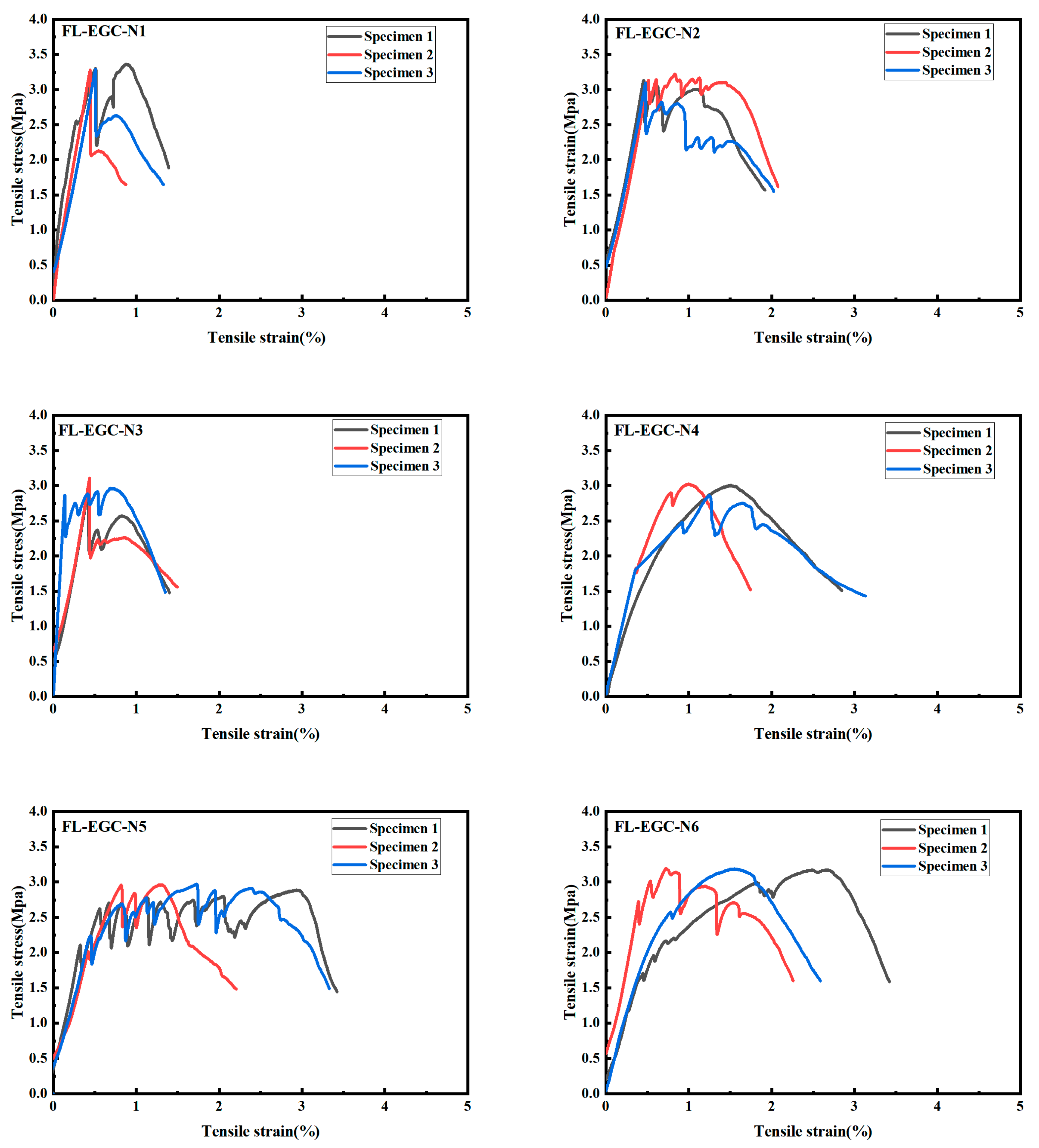
| FL-EGC-N1 | 2.51 ± 0.39 | 0.32 ± 0.01 | 3.36 ± 0.16 | 1.01 ± 0.99 | 35.32 ± 5.87 |
| FL-EGC-N2 | 2.91 ± 0.18 | 0.42 ± 0.03 | 3.24 ± 0.31 | 1.42 ± 0.59 | 46.43 ± 7.34 |
| FL-EGC-N3 | 2.78 ± 0.25 | 0.13 ± 0.01 | 3.12 ± 0.19 | 0.89 ± 0.84 | 29.75 ± 6.03 |
| FL-EGC-N4 | 2.79 ± 0.47 | 0.51 ± 0.01 | 2.96± 0.06 | 1.67 ± 0.26 | 59.21 ± 6.84 |
| FL-EGC-N5 | 2.29 ± 0.09 | 0.40 ± 0.13 | 2.99 ± 0.10 | 3.02 ± 1.02 | 91.21 ± 9.35 |
| FL-EGC-N6 | 2.31 ± 0.20 | 0.34 ± 0.02 | 3.11 ± 0.18 | 2.68 ± 1.10 | 79.47 ± 5.86 |
| Mixture Number | Nc | Wc (μm) | Sc (mm) |
|---|---|---|---|
| FL-EGC-N1 | 13 ± 6 | 68.43± 12.54 | 3.16 ± 1.21 |
| FL-EGC-N2 | 17 ± 4 | 58.26 ± 4.28 | 2.68 ± 0.59 |
| FL-EGC-N3 | 11 ± 6 | 64.35 ± 9.86 | 3.04 ± 1.71 |
| FL-EGC-N4 | 28 ± 5 | 49.92 ± 6.14 | 1.06 ± 0.75 |
| FL-EGC-N5 | 35 ± 11 | 51.46 ± 7.40 | 1.30 ± 0.83 |
| FL-EGC-N6 | 18 ± 9 | 54.65 ± 3.27 | 1.58 ± 0.79 |
Disclaimer/Publisher’s Note: The statements, opinions and data contained in all publications are solely those of the individual author(s) and contributor(s) and not of MDPI and/or the editor(s). MDPI and/or the editor(s) disclaim responsibility for any injury to people or property resulting from any ideas, methods, instructions or products referred to in the content. |
© 2026 by the authors. Licensee MDPI, Basel, Switzerland. This article is an open access article distributed under the terms and conditions of the Creative Commons Attribution (CC BY) license.
Share and Cite
Li, Q.; Deng, C.; Hu, Y.; Luo, M.; Zhu, D.; Wu, C. Enhancing Tensile Performance of Lithium Slag Geopolymers Using Hybrid Fibers and Modified Multi-Walled Carbon Nanotubes. Materials 2026, 19, 213. https://doi.org/10.3390/ma19010213
Li Q, Deng C, Hu Y, Luo M, Zhu D, Wu C. Enhancing Tensile Performance of Lithium Slag Geopolymers Using Hybrid Fibers and Modified Multi-Walled Carbon Nanotubes. Materials. 2026; 19(1):213. https://doi.org/10.3390/ma19010213
Chicago/Turabian StyleLi, Qing, Chong Deng, Yali Hu, Mingxing Luo, Daopei Zhu, and Cai Wu. 2026. "Enhancing Tensile Performance of Lithium Slag Geopolymers Using Hybrid Fibers and Modified Multi-Walled Carbon Nanotubes" Materials 19, no. 1: 213. https://doi.org/10.3390/ma19010213
APA StyleLi, Q., Deng, C., Hu, Y., Luo, M., Zhu, D., & Wu, C. (2026). Enhancing Tensile Performance of Lithium Slag Geopolymers Using Hybrid Fibers and Modified Multi-Walled Carbon Nanotubes. Materials, 19(1), 213. https://doi.org/10.3390/ma19010213