


Abstract
The aim of the presented research is to assess the possibility of manufacturing thin-walled models using innovative 3D printing technology and to determine limitations. This article presents the results of tensile tests of the Continuous Filament Fabrication (CFF) technology for thin-walled sample models. Two types of materials were tested. The first material is pure ONYX based on polyamide, and the second is ONYX with an additional core made of carbon fiber. The paper presents the limitations of using the core in thin-walled structures, and for pure ONYX material, samples were made with different orientations on the 3D printer platform, which allowed determining the effect of the printing direction on the mechanical properties of the samples. In addition, microscopic photographs of the fracture of the broken samples were taken in the paper, based on which the defects of the technological process were identified. It was shown that the strength of thin-walled samples (1 mm, 1.4 mm, and 1.8 mm thick) printed in the Y direction is significantly greater than that of samples printed in the X and Z directions. For example, for 1 mm thick samples printed in the Y direction, the strength is 49.02 MPa, while for samples printed in the X and Z directions, it is 27.71 MPa and 21.28 MPa, respectively. The strength of samples (4 mm thick) reinforced with ONYX + OCF carbon fiber printed in the X direction is 191.36% greater than that of samples made of pure ONYX.
1. Introduction
Additive technologies, commonly referred to as 3D printing, are finding increasing application in various industrial sectors and has become an essential part in the Industry 4.0 [1,2]. Among the well-known technologies is material extrusion (MEX), also known as fused deposition modeling (FDM) or fused filament fabrication (FFF). The engineering materials from which parts are manufactured are crucial for industrial applications. These materials must withstand appropriate mechanical loads, be highly durable, and be economically attractive. In view of this, studies have attempted to mix a variety of materials to make composite filaments for MEX [3,4,5]. One such material is a polyamide filled with carbon microfibers, known as ONYX. ONYX can be modified with various fillers, including long carbon fibers, and is known as ONYX-CF (OCF). Due to its superior mechanical properties compared to other polymer materials used in 3D printing, this material has attracted interest from both industry and academia. Therefore, numerous studies, especially in recent years, have been devoted to research on this material. The largest group of articles describe the results of tests on the mechanical properties of ONYX, for example [6,7,8,9,10,11,12,13,14,15,16,17,18,19].
Extensive results of research on the mechanical properties of ONYX material reinforced with carbon, glass and Kevlar fibers are described in the paper [13]. Static and dynamic tests were performed. It was found that the fiber-reinforced samples exhibited tensile strengths 21, 17, and 15 times greater than those of pure ONYX, respectively. However, pure ONYX exhibited the highest ultimate strain, exceeding the fiber-filled samples by more than nine times. This paper also describes in detail the fatigue test results, particularly the effect of strain rate on strength and the suitability of individual materials for the construction of specific drone components.
The paper [16] presents an analysis of the three-point bending strength of a composite material consisting of polyamide doped with chopped carbon fiber and polyamide reinforced with continuous carbon fiber. The samples were produced by the material MEX in the X and Z printing directions. The test results showed a beneficial effect of continuous carbon fiber reinforcement on both the stiffness and strength of the material. The bending strength of the unreinforced composite printed in the X and Z directions was 77.34 MPa and 128.10 MPa, respectively, while the composite reinforced with continuous carbon fiber printed in the X and Z directions was 147.03 MPa and 143.38 MPa, respectively, which is 190% and 112% times greater than the bending strength of the samples without carbon fiber reinforcement, respectively.
The continuous carbon fibers and ONYX-FR matrix materials were used to build honeycomb-shaped cellular structures, which were then subjected to mechanical property tests [9]. ONYX-FR is the commercial name for flame-retardant polyamide materials filled with carbon fibers, manufactured using Markforged 3D printers (Markforged, Waltham, MA, USA). Based on tests, the structure with a 3.2 mm surface layer thickness and a 12.7 mm core size demonstrated the highest energy absorption and prevented delamination.
Interesting research results were presented in the paper [14]. The mechanical properties of 3D-printed composites consisting of ONYX and glass fibers obtained using Mark Two (Gen 2) 3D printing technology (Markforged, Waltham, MA, USA) are described. Optimal tensile strength was achieved with six face layers and a 45° honeycomb infill, leading to a 132.4% increase in tensile strength and a 24.2% improvement in hardness compared to a sample without fiber reinforcement.
In addition to articles on mechanical properties, there are also works on improving the geometric structure of the surface [18]. Specifically, 100 W laser source was used to reduce the surface roughness of 3D-printed ONYX parts. The surface finishing mechanism, the effect of laser process parameters (laser power, pulse frequency, and laser scanning path) on surface morphology, and the effect of the scanning path on the dimensional accuracy of the tested 3D-printed ONYX samples were determined. A significant surface roughness reduction of 91.15% was achieved on the S3 ONYX sample after polishing with a laser power of 50 W and a frequency of 50 kHz.
It is worth mentioning here a review article on MEX technology and the use of metal fillers to produce parts that, after appropriate thermal treatment, can replace more expensive technologies of sintering or laser melting of metal powders [20]. MEX polymer-metal composite technology is particularly useful in low-volume production, where total cost and production time are crucial. This article also characterizes the printing process parameters and their impact on the functional properties of the resulting components. It also discusses the process’s drawbacks, identifies gaps in existing research, and presents proposals for improving the technology.
From another perspective, OCF structures have been proven to effectively improve the flexural strength of thin-walled profiles of 3 mm [21]. In the study, the failure mechanisms of fibers and the ONYX matrix were characterized through both numerical simulations and microstructural investigations. Furthermore, the OCF system was employed to produce an off-axis tube with a thickness of 3.5 mm [22]. The tube was subjected to buckling tests, and it was reported that the addition of CF significantly strengthened the elbow sections. Microscopic observations at the elbows revealed not only how the tube failed under compressive forces but also confirmed that the fabrication process was geometrically accurate and repeatable, with the CF integrated seamlessly into the ONYX matrix.
Inspired by the above studies, this article investigates the static tensile strength of thin-walled components printed from ONYX material and OCF. Specifically, the tensile strengths of thin-walled samples with thicknesses of 1 mm, 1.4 mm, and 1.8 mm are compared with 4 mm thick reference samples of OCF. In addition, microscopic images of the fractures are analyzed to investigate the failure mechanisms of the components. The aim of this research is to assess the feasibility of manufacturing thin-walled components from ONYX and CF, evaluate their tensile strength and characterize their failure under tensile loading.
The primary limitation of this study, which allows for comparative analysis, is the sample thickness and the lack of international standards ISO/ASTM dedicated to thin-walled elements manufactured using 3D printing, which would standardize the research.
To sum up the current state of knowledge and based on the research experience of the authors of this publication, it can be stated that the issues of manufacturing thin-walled models by 3D printing by material manufacturers are not taken into account, and the research conducted in this area is fragmentary and requires supplementation, which is partially introduced in this publication. The novelty of this publication lies in the fact that the authors have never before encountered research results on thin-walled models produced using CFF technology. This makes this pioneering research, constituting, in a sense, the initial stage of research planned for the author of this article.
2. Materials and Methods
2.1. Materials
The composite tensile samples used in this study were prepared with Markforged® Mark X7 FDM printer with a build volume of 330 × 270 × 200 mm3. The thickness can be set to between 50 and 250 µm. The OCF material (Waltham, MA, USA) is composed of ONYX and long CF. ONYX (Waltham, MA, USA) is nylon PA6 reinforced with short carbon fiber and can be further reinforced with long CF for further strength enhancement (see Table 1 for material properties). In this study, effect of thin wall thicknesses on samples printed using ONYX and OCF was investigated.
Table 1.
Properties of ONYX and CF in used [23,24].
2.2. Methods
2.2.1. CFF Technology
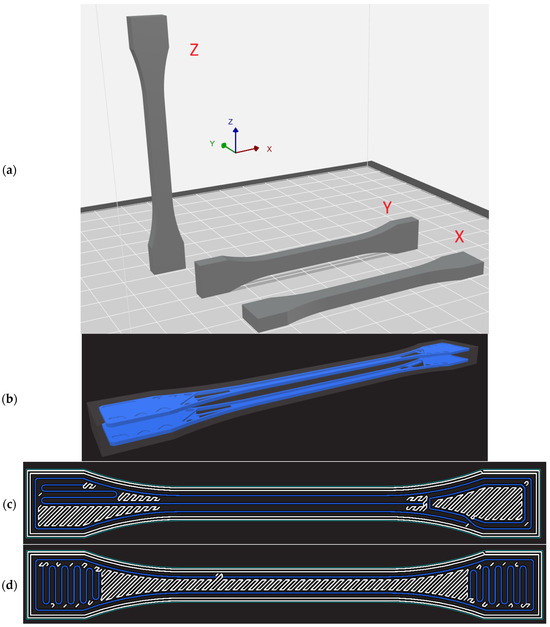
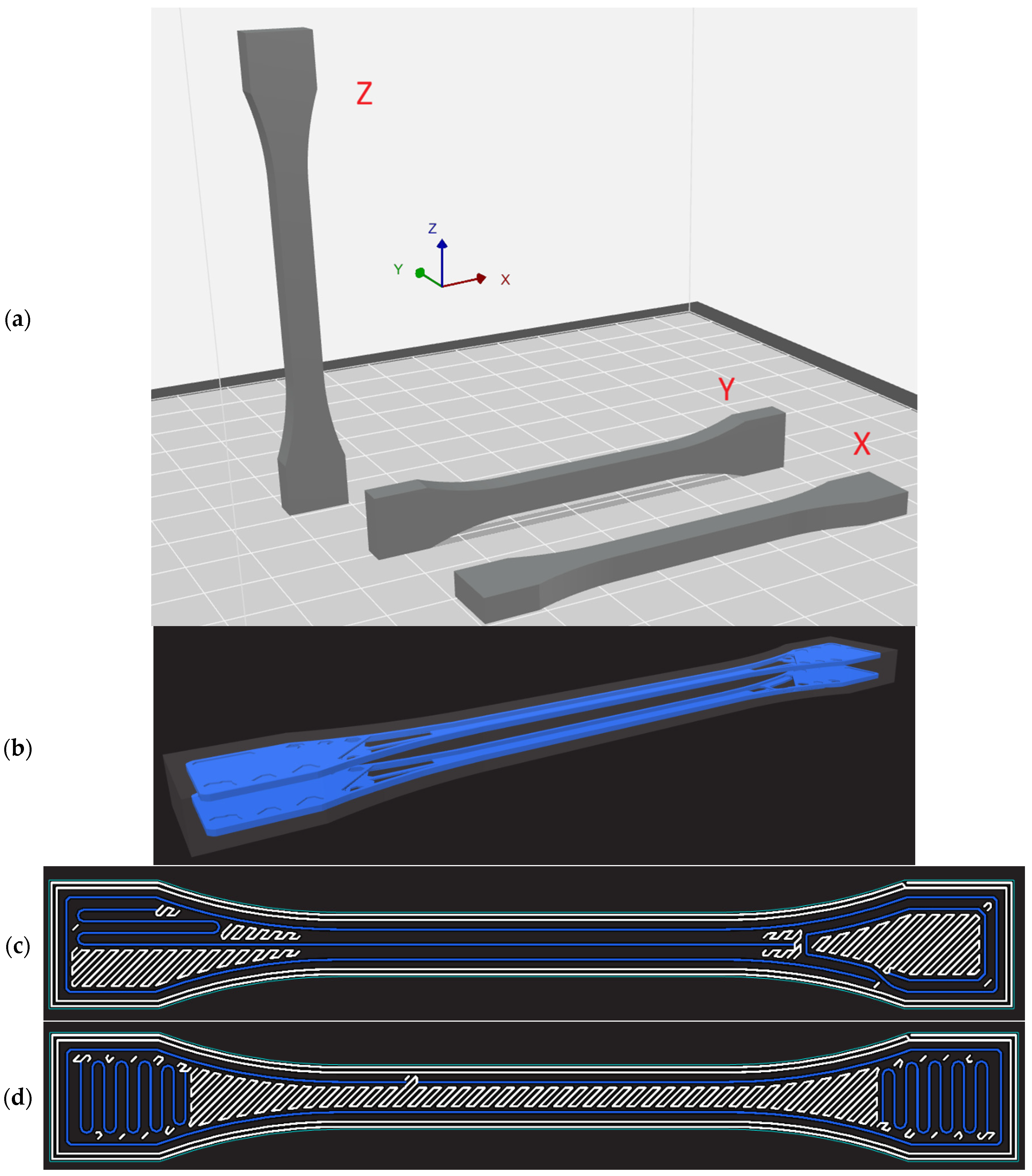
The tensile samples were designed following standard ISO 527-1:2019 [25], with varied thicknesses of 1 mm, 1.4 mm, 1.8 mm, and 4 mm. The example orientation of the OCF and ONYX samples are shown in Figure 1a, while the CF distribution is shown in Figure 1b–d.
Figure 1.
(a) Orientation of sample models on the build platform, (b) Isometric view, (c) layer 5–8, and (d) layer 25–28.
It should be noted that due to the technological constraints, only OCF samples of 4 mm were printed only in X direction. Specifically, the CF was distributed on layer 5 to 8 and layer 25 to 28 of total 32 layers. These thickness of the sample and the positions of the CF layers were selected to satisfy the minimum geometric requirements of the CFF process, which mandates at least two solid ONYX layers above and below each reinforced region to ensure proper fiber anchoring and prevent delamination. Locating the reinforcement zones away from the outer surfaces also improves consolidation between the matrix and the continuous fibers. Furthermore, the spacing between both reinforcement zones provides a more uniform stiffness distribution across the specimen thickness.
Support structures were necessary only for samples printed in the Y orientation due to overhanging geometries. Continuous carbon fiber was used exclusively in the OCF-4-X specimen to reinforce selected layers of the ONYX matrix using Markforged’s Continuous Fiber Fabrication (CFF) technology. The specimens were prepared with thicknesses of 1.0 mm, 1.4 mm, 1.8 mm, and 4.0 mm were prepared in Eiger (https://markforged.com/software, accessed on 1 December 2025) (Markforged slicer, Waltham, MA, USA) to assess the effect of thin-wall geometries.
The process parameters can be found below in Table 2.
Table 2.
Printing process parameters.
2.2.2. Tensile Test
The static tensile test was performed using an Ispekt mini tensile testing machine (Hegewald & Peschke MPT GmbH, Nossen, Germany) with a 3 kN range. The Labmaster software (Version 2.5.3.21) (Hegewald & Peschke MPT GmbH, Nossen, Germany) included with the Inspekt mini machine set the test speed to 1 mm/min.
2.2.3. Microscopy Analysis
Microscopic photographs were taken using two devices: the SMZ-140 microscope (MOTIC Company, Barcelona, Spain) and the MAGUS 650 (Levenhuk, Inc., Tampa, FL, USA).
2.2.4. Dimensional Measurement
Sample dimensions were measured using an electronic micrometer with a measurement accuracy of 0.01 mm. Measurements were taken at three locations on the sample measurement database. Table 3 and Table 4 provide their mean values (ā and ).
Table 3.
Dimensions of samples made with MEX technology from ONYX material.
Table 4.
Dimensions of samples made using MEX technology from OCF material.
3. Results and Discussion
Below, in Section 3.1, Section 3.2 and Section 3.3, the results of geometry measurements, uniaxial tensile tests and microscopic photographs of the samples after breaking are presented.
3.1. Dimensional Accuracy
Table 3 and Table 4 present the results of sample geometry measurements taken using micrometer and caliper—manual measuring instruments with an accuracy of 0.01 mm. These measurement results were used during strength tests, where the average values of sample thickness and width were used in the Labmaster software to determine tensile strength. Table 3 and Table 4 also provide the mean values for each measurement series and the standard deviation (SD).
3.2. Tensile Test Results
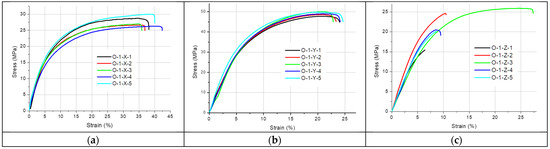
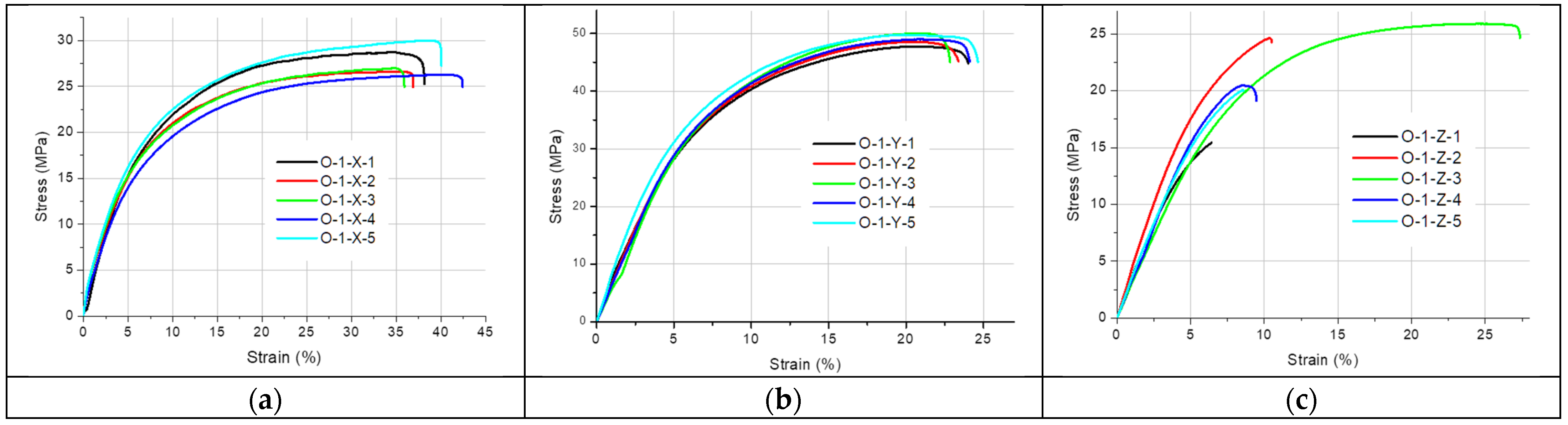
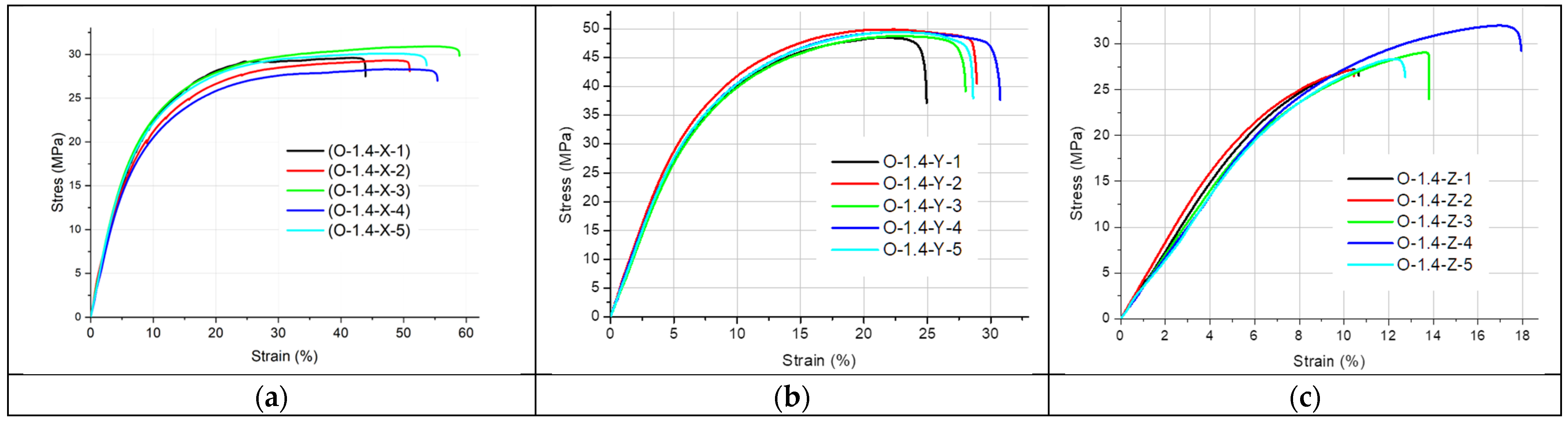
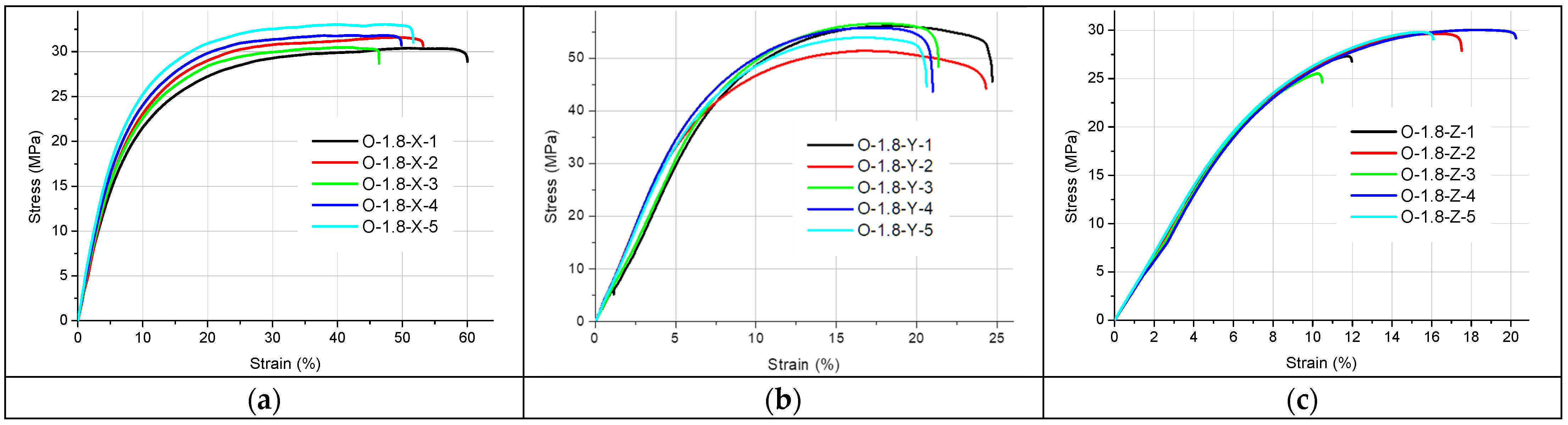
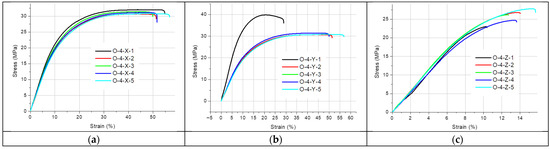
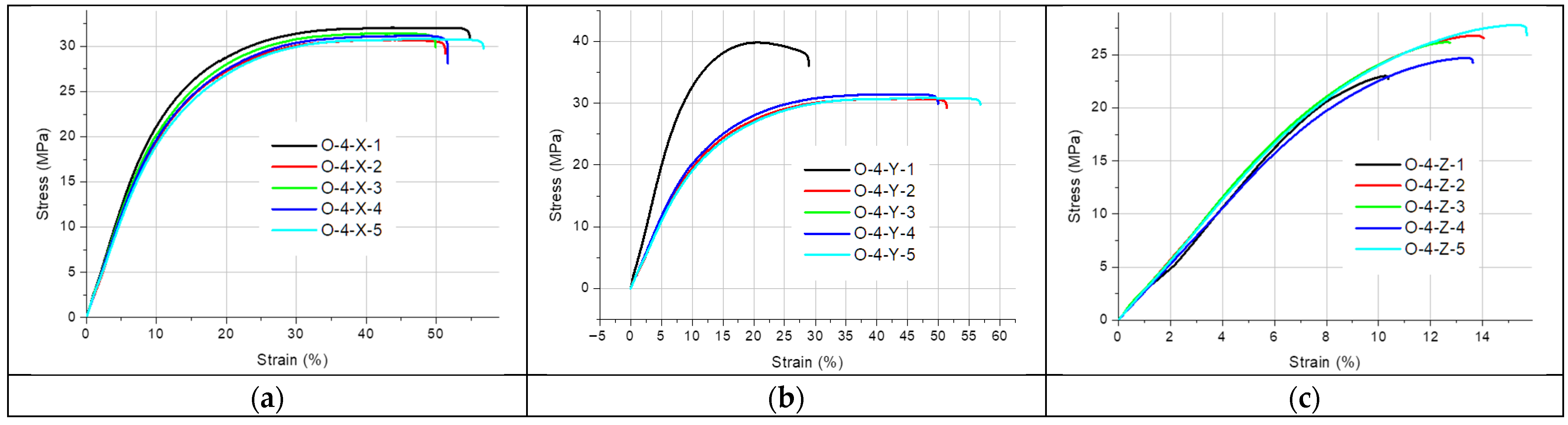
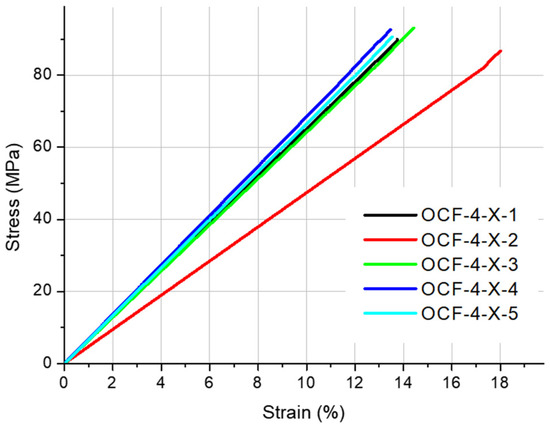
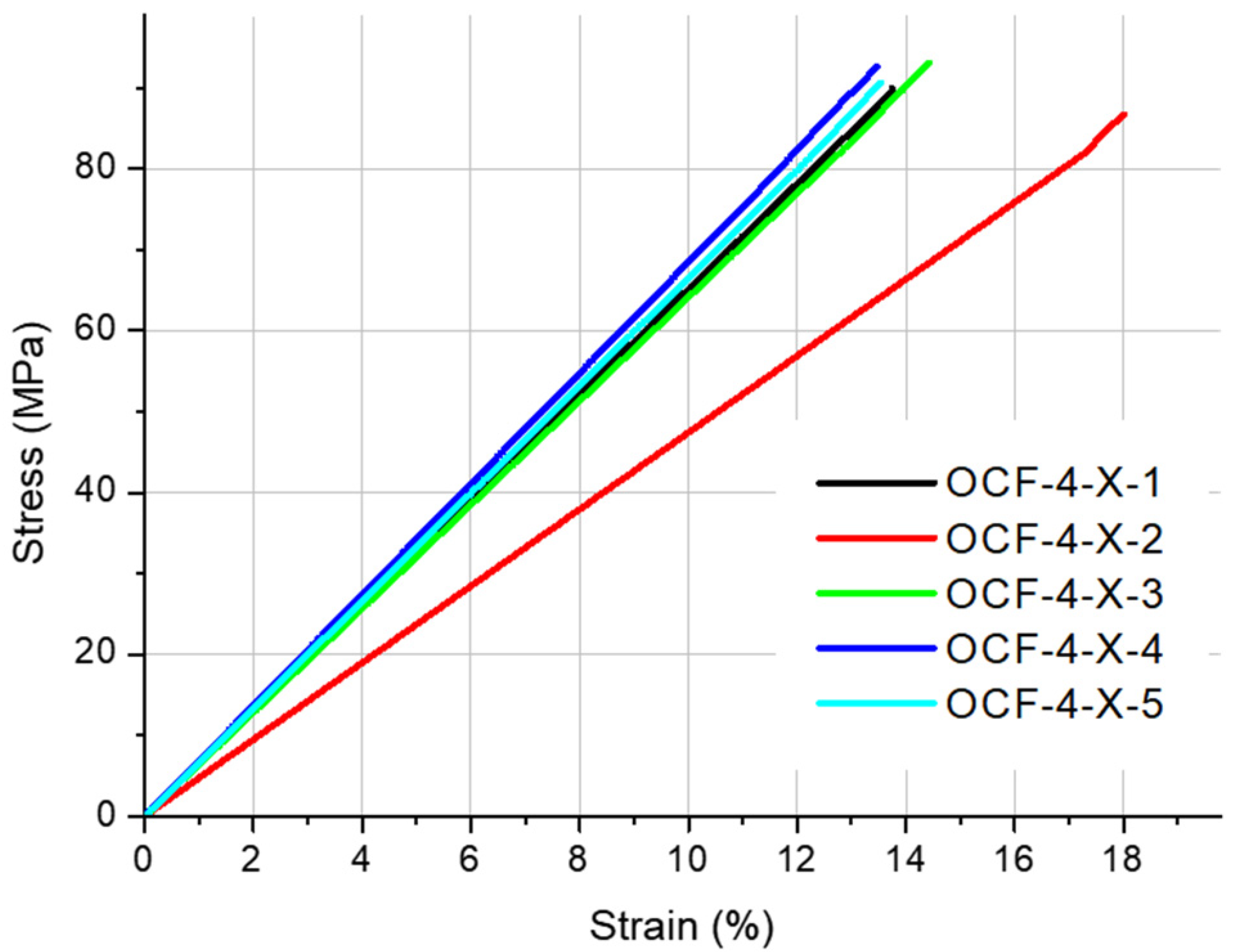
Figure 2, Figure 3, Figure 4, Figure 5 and Figure 6 present the results of the static tensile test. Figure 2, Figure 3 and Figure 4 contain the test results for thin-walled models made only of ONYX material, and Figure 5 presents the results for a 4 mm thick reference sample also made of ONYX material. Furthermore, Figure 6 presents the results of tensile tests for 4 mm thick samples made in the Z direction using two materials: ONYX as the matrix and carbon fiber as the core. Table 5 and Table 6 present the results of tensile strength tests with the determination of the mean value , standard deviation SD and repeatability coefficient V (%) as the ratio of the standard deviation to the mean value.
Figure 2.
Stress–strain curves for the 1 mm thick specimens printed with ONYX material in: (a) the X orientation, (b) the Y orientation and (c) the Z orientation.
Figure 3.
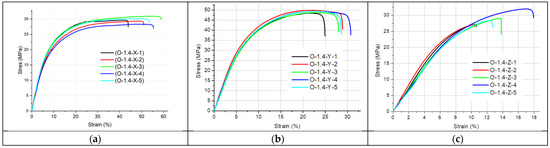
Stress–strain curves for the 1.4 mm thick specimens printed with ONYX material in: (a) the X orientation, (b) the Y orientation and (c) the Z orientation.
Figure 4.
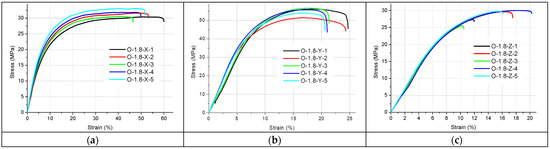
Stress–strain curves for the 1.8 mm thick specimens printed with ONYX material in: (a) the X orientation, (b) the Y orientation and (c) the Z orientation.
Figure 5.
Stress–strain curves for the 4 mm thick specimens printed with ONYX material in: (a) the X orientation, (b) the Y orientation and (c) the Z orientation.
Figure 6.
Stress–strain curves for the 4 mm thick specimens printed with ONYX material in X orientation.
Table 5.
Ultimate tensile strength and the maximum elongation at failure at the point of breakage of samples made with MEX technology from ONYX material.
Table 6.
Ultimate tensile strength and the maximum elongation at failure at the point of breakage of samples made with MEX technology from OCF material.
Two basic problems can be encountered when testing the mechanical properties of samples produced using 3D printing technology, especially thin-walled samples:
- -
- The sample dimensions do not match the dimensions of the CAD model,
- -
- The tensile strength and strain at break, as well as other mechanical property indices, depend on the printing direction, i.e., orientation on the build platform (anisotropy).
Due to the aforementioned problems, shape deviations should be taken into account when analyzing test results and compared to the dimensions of the 3D CAD model. Furthermore, differences in mechanical properties should be analyzed depending on the printing direction (compared to the manufacturer’s specifications), as these are different for each 3D printing technology and printer used. To assess the thickness and width of the samples, the relative percentage differences in the average thickness Δa and width Δb were used, calculated using Formulas (1) and (2) [26]:
where a—sample thickness according to CAD, e.g., a = 1.8 mm, —average sample thickness in a given measurement series based on Table 2 or Table 3. For example, for a thickness of a = 1.8 mm (Table 2) and orientation X, the value = 1.94 mm.
where b—sample width according to CAD, e.g., b = 5 mm, —average sample width in a given measurement series based on Table 2 or Table 3. For example, for width b = 5 mm and orientation X the value = 5.16 mm.
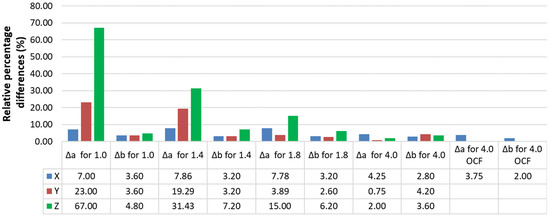
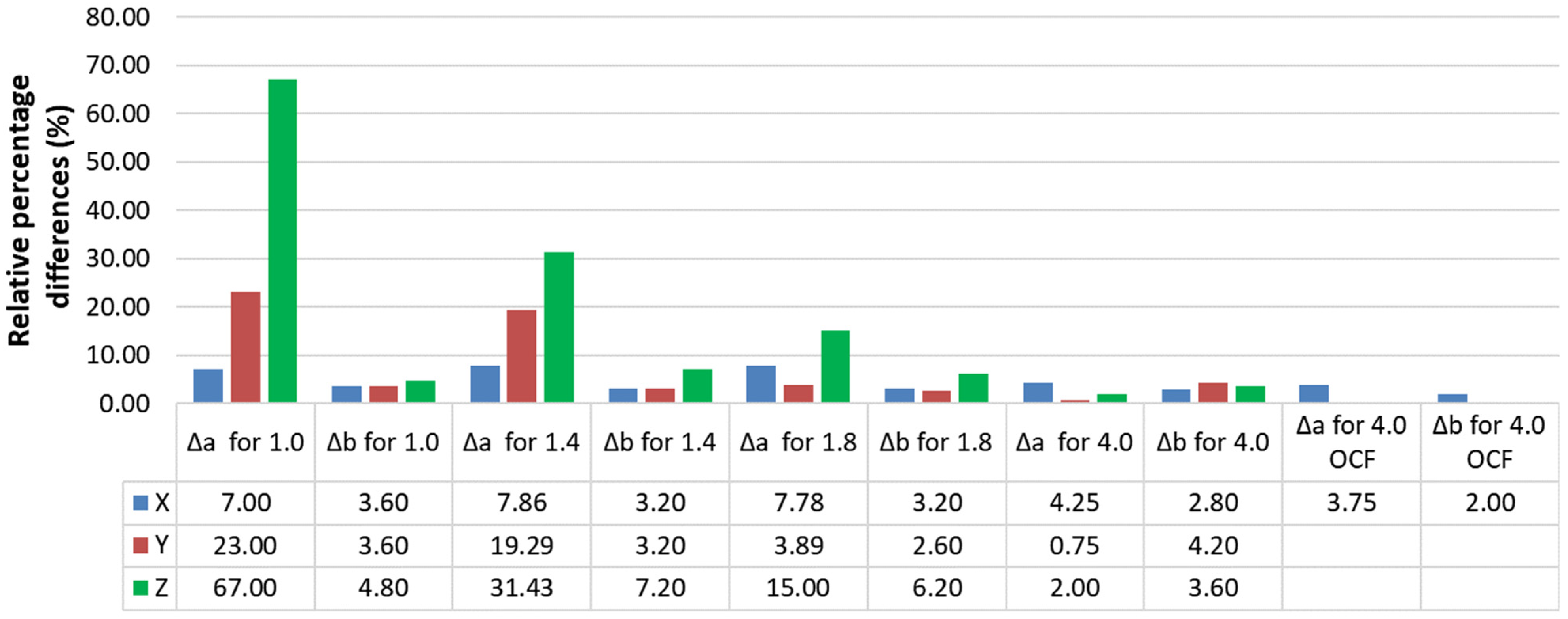
The calculated values of relative percentage differences in thickness Δa and width Δb for individual measurement series, calculated on the basis of data from Table 1 and Table 2, are shown in Figure 7. This is a column chart extended with a data table placed under the horizontal axis.
Figure 7.
Relative percentage differences in thickness and width of samples made of ONYX and ONYX + OCF materials.
The largest relative percentage difference between the CAD dimensions of the designed 1 mm thick samples and the thickness of the ONYX samples printed in the Z orientation was 67%. Other significant differences were 31.43% for the series of samples with a designed thickness of 1.4 mm printed in the Z orientation and 19.29% and 23%, respectively, for the series of 1.4 mm and 1 mm samples printed in the Y orientation. The largest differences between the designed dimensions and the actual dimensions occur for thin-walled samples. For the reference 4 mm thick samples, such large differences were not observed. It should be added that sample thickness “a” always has larger deviations than width “b”, as shown in Figure 7 and Table 2.
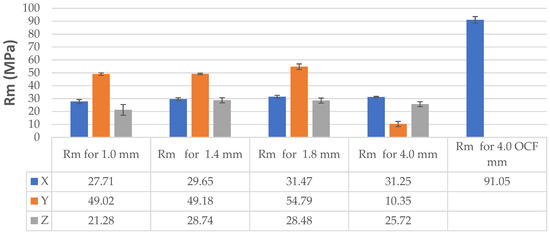
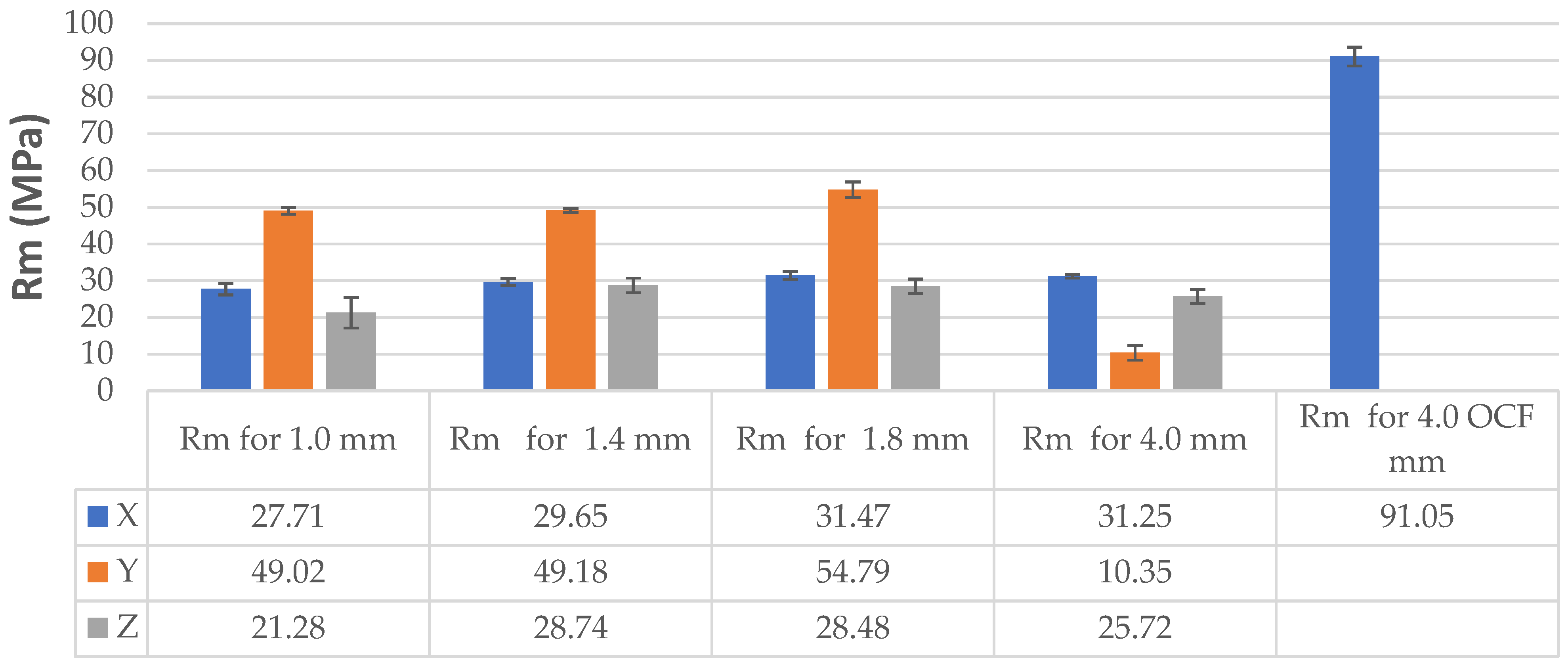
The tensile strength test results in Table 4 and Table 5 are presented visually in a column chart (Figure 8).
Figure 8.
Tensile strength Rm for individual ONYX and OCF samples thicknesses and printing directions.
Analyzing the tensile strength of individual sample series, it can be concluded that the highest strength was achieved by samples printed in the X direction, made of OCF. This is evidenced by the tensile strength test results presented in Table 3 and visually presented in the bar graph (Figure 8). Comparison of 4 mm thick samples printed in the X direction shows that the strength of the OCF carbon fiber-reinforced samples is 191.36% greater than that of pure ONYX.
A certain pattern can be observed for the thin-walled samples. The strength of thin-walled samples printed in the Y direction was significantly higher than that of samples printed in the X and Z directions, ranging from 49.02 MPa to 54.79 MPa, while the X-direction printed samples had tensile strengths ranging from 27.71 MPa to 31.47 MPa. In contrast, the samples printed in the Z direction had a tensile strength ranging from 21.28 MPa to 28.48 MPa. No sudden rupture (without plastic deformation) was observed (see Figure 5) for the samples printed from ONYX material in the Z direction, as is the case with most 3D printing materials and technologies. The OCF sample (Figure 6) did not exhibit plastic deformation, achieving a high tensile strength. The test curves shown in Figure 6 have a completely different course compared to the curves in Figure 5 and determine completely different properties of the models produced with this technology. Furthermore, ONYX exhibits better plastic properties in all directions than OCF and other materials in the MEX technology, such as PLA and those enriched with carbon fibers, which very often exhibit no plastic deformation in the Z direction, as shown in the paper [27]. The tensile strength of the tested thin-walled samples is good in the group of polymeric materials, but it must be remembered that it is many times lower than that of similar elements manufactured by laser additive technology from metal powders [28]. Due to the large results distribution depending on the printing direction, the statistical calculations were verified and compared with the publication [29], which also analyzed models produced by 3D printing and where the author comprehensively presented the possibility of such an analysis.
3.3. Microscopic Analysis
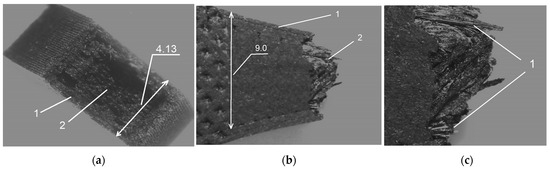
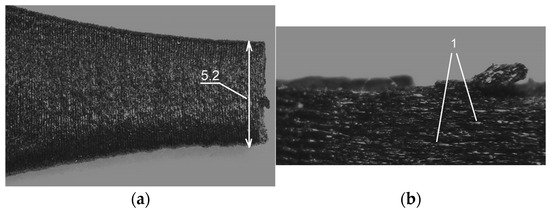
Figure 9 and Figure 10 show photos of selected samples at the fracture site, taken with a stereoscopic microscope. Figure 9a–c show the cross-section of the fractured OCF sample.
Figure 9.
Cross-section of a broken OCF sample, (a,b)—6× magnification, 1—layer of pure ONYX material, 2—carbon fibers, (c)—12.5× magnification, 1—protruding carbon fibers.
Figure 10.
Cross-section of a torn sample of ONYX material with a thickness of 1.8 mm, (a)—6× magnification, (b)—12.5× magnification, 1—visible boundaries of the layers of the applied material.
Figure 9c, the sample after fracture, shows protruding individual carbon fibers (typical for composite materials), and Figure 10b shows the visible boundaries of the layers of the applied material.
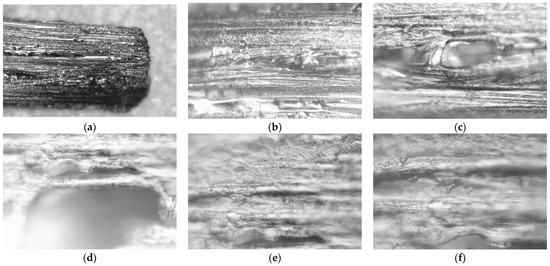
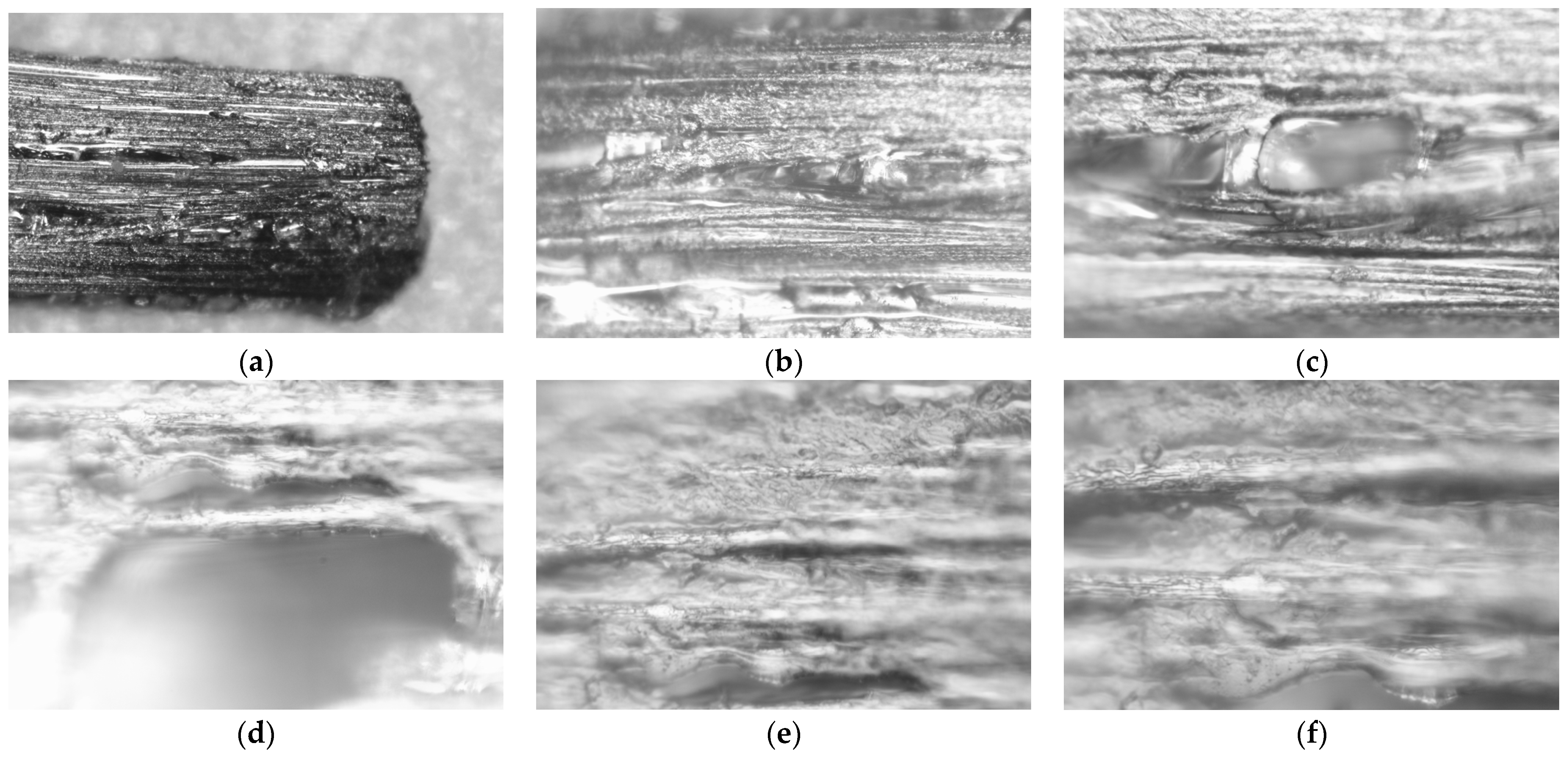
Figure 11 shows microscopic images of the same carbon fiber bundle shown in Figure 9c. The images were taken with the Levenhuk Magus 650 microscope.
Figure 11.
Carbon fiber bundle at the break point of the OCF sample shown in Figure 9c, (a)—100× magnification, (b)—200× magnification, (c)—400× magnification, visible material defect, (d)—1000× magnification, (e)—1000× magnification, (f)—1600× magnification.
Carbon fibers embedded in the ONYX material form bundles that fill the interior of the printed objects, in this case, 4 mm thick samples. Such a bundle, detached from the cross-section of a cracked sample, is shown in Figure 11a. Then, by increasing the microscope magnification, a material defect (probably a gas cavity) was captured, as shown in Figure 11b–d. Such defects can negatively impact the mechanical properties of the manufactured elements. Figure 11e,f show the correct arrangement of carbon fibers in the ONYX material matrix.
4. Conclusions
The presented static tensile test results for thin-walled samples with thicknesses of 1 mm, 1.4 mm, and 1.8 mm compared to 4 mm thick reference samples made of ONYX material demonstrate that it is possible to produce thin-walled elements using 3D printing technology, as they are as strong as the 4 mm thick reference samples, and even exhibit higher strength in some print directions. The thin-walled samples printed in the Y direction have a strength of 49.02 MPa, 49.18 MPa and 54.79 MPa for samples with thicknesses of 1 mm, 1.4 mm and 1.8 mm, respectively, while the reference samples also printed in the Y direction have a strength of 10.35 MPa.
Comparison of 4 mm thick samples printed in the Z direction shows that the strength of the OCF carbon fiber-reinforced samples is 191.36% greater than that of pure ONYX.
The OCF samples did not exhibit plastic deformation, achieving high tensile strength. Samples made of ONYX material for all printing directions showed better plastic properties than OCF.
Author Contributions
Conceptualization, T.K. and J.B.; methodology, T.K., J.B., J.H. and J.M.; software, T.K., J.B., J.H. and J.M.; validation, T.K. and J.B.; formal analysis, T.K. and J.B.; investigation, T.K., J.B., J.H. and J.M.; resources, T.K., J.B., J.H. and J.M.; data curation, T.K. and J.B.; writing—original draft preparation, T.K., J.B., J.H. and J.M.; writing—review and editing, T.K., J.B., J.H. and J.M.; visualization, T.K. and J.B.; supervision, T.K.; project administration, T.K.; funding acquisition, T.K. and J.H. All authors have read and agreed to the published version of the manuscript.
Funding
This article was co-funded by the European Union under the REFRESH–Research Excellence For Region Sustainability and High-tech Industries project number CZ.10.03.01/00/22_003/0000048 via the Operational Programme Just Transition.
Institutional Review Board Statement
Not applicable.
Informed Consent Statement
Not applicable.
Data Availability Statement
The original contributions presented in this study are included in the article. Further inquiries can be directed to the corresponding author.
Conflicts of Interest
The authors declare no conflicts of interest.
References
- Fan, H.; Liu, C.; Bian, S.; Ma, C.; Huang, J.; Liu, X.; Doyle, M.; Lu, T.; Chow, E.; Chen, L.; et al. New Era towards Autonomous Additive Manufacturing: A Review of Recent Trends and Future Perspectives. Int. J. Extrem. Manuf. 2025, 7, 032006. [Google Scholar] [CrossRef] [Scilit]
- Ma, Q.-P.; Nguyen, H.S.; Hajnys, J.; Mesicek, J.; Pagac, M.; Petru, J. A Bibliometric Review on Application of Machine Learning in Additive Manufacturing and Practical Justification. Appl. Mater. Today 2024, 40, 102371. [Google Scholar] [CrossRef] [Scilit]
- Zotti, A.; Paduano, T.; Napolitano, F.; Zuppolini, S.; Zarrelli, M.; Borriello, A. Fused Deposition Modeling of Polymer Composites: Development, Properties and Applications. Polymers 2025, 17, 1054. [Google Scholar] [CrossRef] [Scilit]
- Mesicek, J.; Alexa, P.; Posmykova, E.; Ma, Q.-P.; Musil, A.; Hajnys, J.; Olsovska, E.; Petru, J. Effect of Part Orientation and Thickness on Radiation Shielding in FDM 3D Printing of PET-G Composite with Tungsten. J. Mater. Res. Technol. 2025, 38, 2886–2891. [Google Scholar] [CrossRef] [Scilit]
- Hoang, T.N.; Jiri, P.; Zbynek, S.; David, D. Effects of extrusion parameters on filament quality and mechanical properties of 3D printed PC/ABS components. MMS 2025. [Google Scholar] [CrossRef] [Scilit]
- Li, J.; Xu, S.; Durandet, Y.; Gao, W.; Huang, X.; Ruan, D. Strain Rate Dependence of 3D Printed Continuous Fiber Reinforced Composites. Compos. Part B-Eng. 2024, 277, 111415. [Google Scholar] [CrossRef] [Scilit]
- Barnik, F.; Vasko, M.; Handrik, M.; Dorciak, F.; Majko, J. Comparing Mechanical Properties of Composites Structures on ONYX Base with Different Density and Shape of Fill. In Proceedings of the 13th International Scientific Conference on Sustainable, Modern and Safe Transport (Transcom 2019), Novy Smokovec, Slovakia, 29–31 May 2019; Bujnak, J., Guagliano, M., Eds.; ELSEVIER: Amsterdam, The Netherlands, 2019; Volume 40, pp. 616–622. [Google Scholar]
- Ghabezi, P.; Flanagan, T.; Walls, M.; Harrison, N.M. Degradation Characteristics of 3D Printed Continuous Fibre-Reinforced PA6/Chopped Fibre Composites in Simulated Saltwater. Prog. Addit. Manuf. 2025, 10, 725–738. [Google Scholar] [CrossRef] [Scilit]
- Vellaisamy, S.; Munusamy, R. Experimental Study of 3D Printed Carbon Fibre Sandwich Structures for Lightweight Applications. Def. Technol. 2024, 36, 71–77. [Google Scholar] [CrossRef] [Scilit]
- Nikiema, D.; Balland, P.; Sergent, A. Experimental and Numerical Investigations of 3D-Printed ONYX Parts Reinforced with Continuous Glass Fibers. Arch. Civ. Mech. Eng. 2024, 24, 50. [Google Scholar] [CrossRef] [Scilit]
- Michal, P.; Vasko, M.; Sapieta, M.; Majko, J.; Fiacan, J. The Impact of Internal Structure Changes on the Damping Properties of 3D-Printed Composite Material. Appl. Sci. 2024, 14, 5701. [Google Scholar] [CrossRef] [Scilit]
- Pires, Ê.H.; Netto, J.V.B.; Ribeiro, M.L. Raw Dataset of Tensile Tests in a 3D-Printed Nylon Reinforced with Oriented Short Carbon Fibers. Data Br. 2024, 57, 111149. [Google Scholar] [CrossRef] [Scilit] [PubMed]
- Vedrtnam, A.; Ghabezi, P.; Gunwant, D.; Jiang, Y.; Sam-Daliri, O.; Harrison, N.; Goggins, J.; Finnegan, W. Mechanical Performance of 3D-Printed Continuous Fibre ONYX Composites for Drone Applications: An Experimental and Numerical Analysis. Compos. Part C Open Access 2023, 12, 100418. [Google Scholar] [CrossRef] [Scilit]
- Kumar, B.A.; Kumar, K.S.; Reddy, A.C. Mechanical Properties of 3D-Printed ONYX-Fibreglass Composites: Role of Roof Layers on Tensile Strength and Hardness—Using Anova Technique. Next Mater. 2025, 8, 100650. [Google Scholar] [CrossRef] [Scilit]
- Barnik, F.; Vasko, M.; Saga, M.; Handrik, M.; Sapietova, A. Mechanical Properties of Structures Produced by 3D Printing from Composite Materials. In Proceedings of the XXIII Polish-Slovak Scientific Conference on Machine Modelling and Simulations (MMS 2018), Rydzyna, Poland, 4–7 September 2018; Malujda, I., Dudziak, M., Krawiec, P., Talaska, K., Wilczynski, D., Berdychowski, M., Gorecki, J., Wargula, L., Wojtkowiak, D., Eds.; EDP Sciences: Les Ulis, France, 2019; Volume 254. [Google Scholar]
- Lakomy, M.; Kluczynski, J.; Sarzynski, B.; Jasik, K.; Szachogluchowicz, I.; Luszczek, J. Bending Strength of Continuous Fiber-Reinforced (CFR) Polyamide-Based Composite Additively Manufactured through Material Extrusion. Materials 2024, 17, 2937. [Google Scholar] [CrossRef] [Scilit] [PubMed]
- Lee, G.-W.; Kim, T.-H.; Yun, J.-H.; Kim, N.-J.; Ahn, K.-H.; Kang, M.-S. Strength of ONYX-Based Composite 3D Printing Materials According to Fiber Reinforcement. Front. Mater. 2023, 10, 1183816. [Google Scholar] [CrossRef] [Scilit]
- Maier, R.; Bucaciuc, S.-G.; Mandoc, A.C. Reducing Surface Roughness of 3D Printed Short-Carbon Fiber Reinforced Composites. Materials 2022, 15, 7398. [Google Scholar] [CrossRef] [Scilit]
- Yun, J.-H.; Yoon, G.-W.; Jeon, Y.-J.; Kang, M.-S. Evaluation of the Properties of 3D-Printed ONYX-Fiberglass Composites. Materials 2024, 17, 4140. [Google Scholar] [CrossRef] [Scilit]
- Jasik, K.; Sniezek, L.; Kluczynski, J. Additive Manufacturing of Metals Using the MEX Method: Process Characteristics and Performance Properties—A Review. Materials 2025, 18, 2744. [Google Scholar] [CrossRef] [Scilit]
- Krzikalla, D.; Měsíček, J.; Halama, R.; Hajnyš, J.; Pagáč, M.; Čegan, T.; Petrů, J. On Flexural Properties of Additive Manufactured Composites: Experimental, and Numerical Study. Compos. Sci. Technol. 2022, 218, 109182. [Google Scholar] [CrossRef] [Scilit]
- Kalova, M.; Rusnakova, S.; Krzikalla, D.; Mesicek, J.; Tomasek, R.; Podeprelova, A.; Rosicky, J.; Pagac, M. 3D Printed Hollow Off-Axis Profiles Based on Carbon Fiber-Reinforced Polymers: Mechanical Testing and Finite Element Method Analysis. Polymers 2021, 13, 2949. [Google Scholar] [CrossRef] [Scilit]
- Carbon Fiber. Available online: https://support.markforged.com/portal/s/article/Carbon-Fiber (accessed on 17 October 2025).
- ONYX. Available online: https://support.markforged.com/portal/s/article/Onyx (accessed on 17 October 2025).
- ISO 527-1:2019; Plastics—Determination of Tensile Properties Part 1: General Principles. International Organization for Standardization: Geneva, Switzerland, 2019.
- Bochnia, J.; Blasiak, M.; Kozior, T. Tensile Strength Analysis of Thin-Walled Polymer Glass Fiber Reinforced Samples Manufactured by 3d Printing Technology. Polymers 2020, 12, 2783. [Google Scholar] [CrossRef] [Scilit] [PubMed]
- Bochnia, J.; Blasiak, M.; Kozior, T. A Comparative Study of the Mechanical Properties of FDM 3D Prints Made of PLA and Carbon Fiber-Reinforced PLA for Thin-Walled Applications. Materials 2021, 14, 7062. [Google Scholar] [CrossRef] [Scilit]
- Bochnia, J.; Kozior, T.; Zyz, J. The Mechanical Properties of Direct Metal Laser Sintered Thin-Walled Maraging Steel (MS1) Elements. Materials 2023, 16, 4699. [Google Scholar] [CrossRef] [Scilit] [PubMed]
- Udroiu, R. Quality Analysis of Micro-Holes Made by Polymer Jetting Additive Manufacturing. Polymers 2024, 16, 32. [Google Scholar] [CrossRef] [Scilit] [PubMed]

Disclaimer/Publisher’s Note: The statements, opinions and data contained in all publications are solely those of the individual author(s) and contributor(s) and not of MDPI and/or the editor(s). MDPI and/or the editor(s) disclaim responsibility for any injury to people or property resulting from any ideas, methods, instructions or products referred to in the content. |
© 2025 by the authors. Licensee MDPI, Basel, Switzerland. This article is an open access article distributed under the terms and conditions of the Creative Commons Attribution (CC BY) license.