Assessment of Macroscopic Properties Based on Microhardness Measurements Using the Example of the TiCoCrFeMn High-Entropy Alloy

Abstract
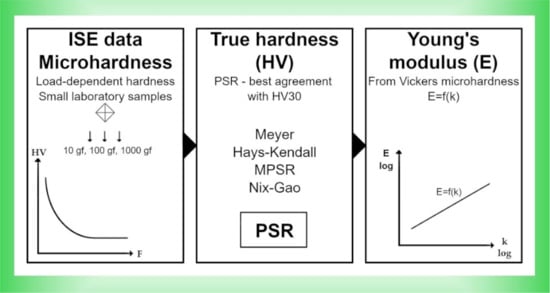
1. Introduction
- (1)
- Annealed materials: 3< < 3;
- (2)
- Work-hardened materials: ≈ 3;
- (3)
- HPT-processed alloys: < 3.
- Work-hardening exponent n (from Meyer’s law);
- Qualitative stress–strain behavior;
- Indentation creep;
- Coating adhesion;
- Stress intensity factor for brittle materials via crack analysis;
- Young’s modulus.
2. Materials and Methods
2.1. Material
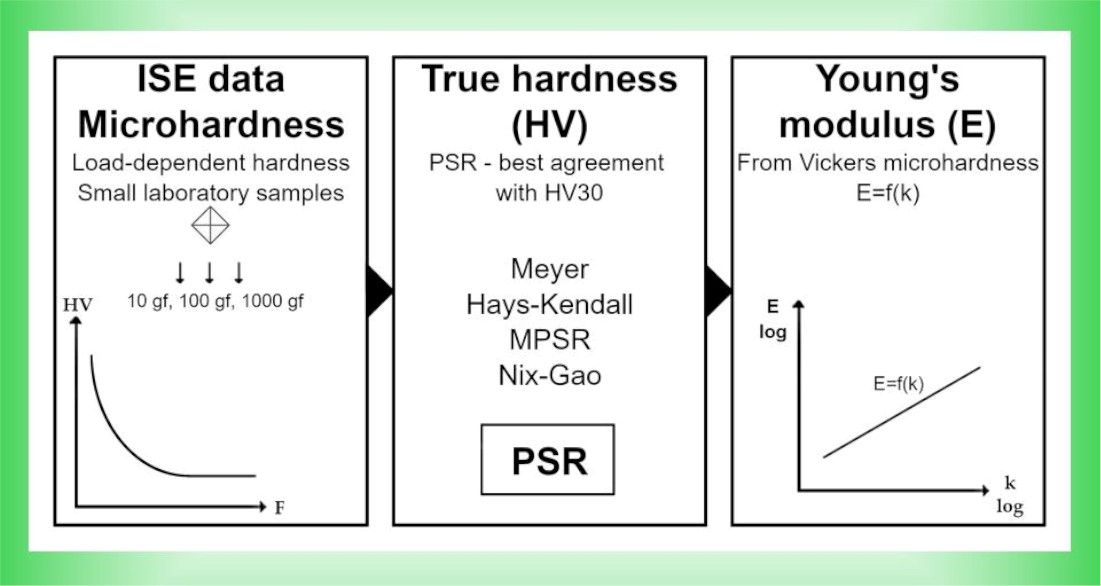
2.2. Research Problem and Methodology
2.3. Determination of Hardness Closest to the True Value


2.3.1. Hays–Kendall Model
2.3.2. Proportional Specimen Resistance (PSR) Model
2.3.3. Modified Proportional Specimen Resistance (MPSR) Model
2.3.4. Nix & Gao Model

| Model | Relation | Regression Equation: | ||
|---|---|---|---|---|
| Y | X | |||
| Hays-Kendall |  | |||
| Li-Bradt (PSR) |  | |||
| MPSR |  | Regression equation | ||
| Y | X | |||
| F | d | |||
| Nix-Gao |  | |||
3. Results
Methodology for Determining Young’s Modulus from Microhardness Measurements
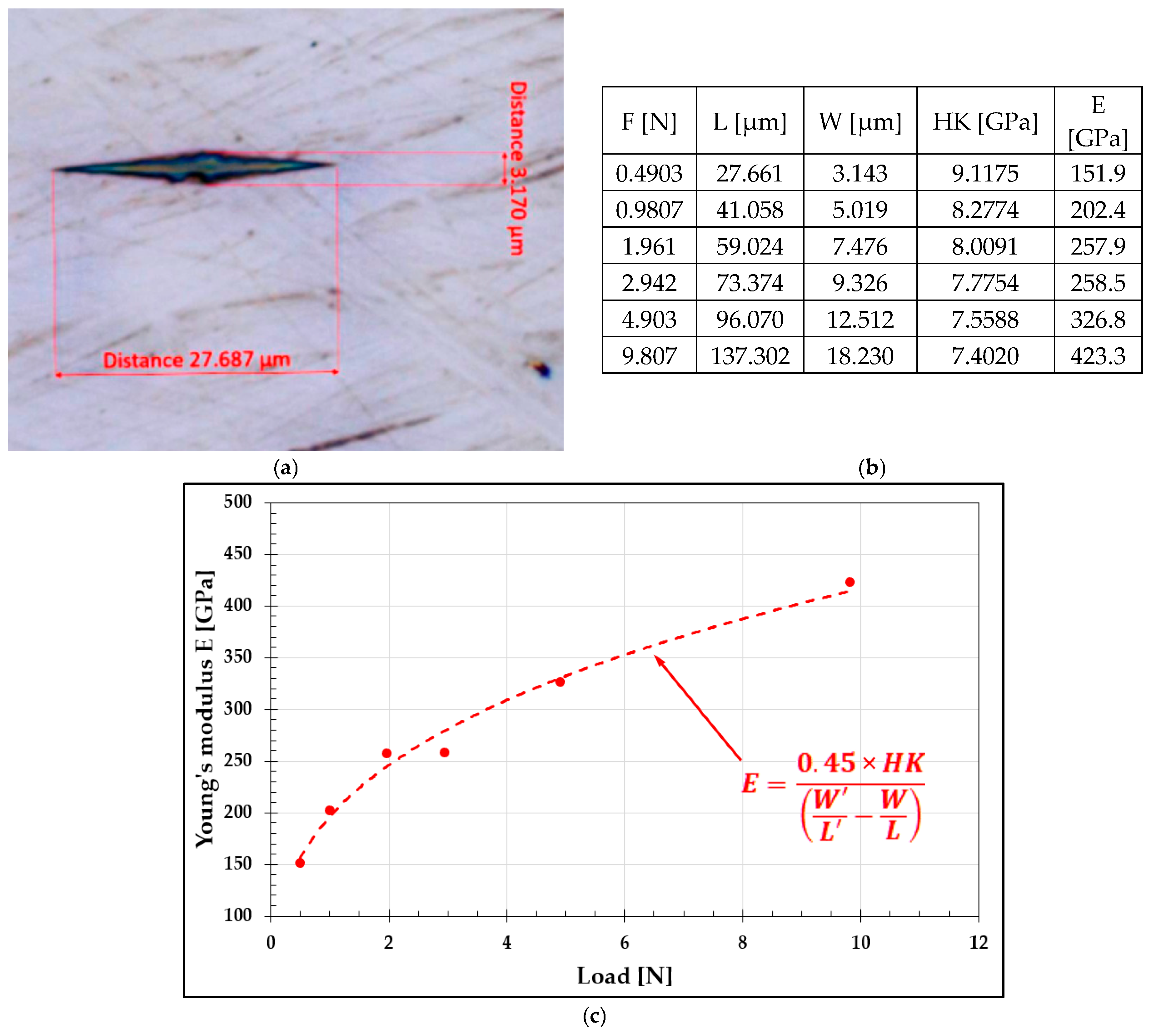
- —ratio of the shorter diagonal to the longer diagonal of the indentation, measured after unloading;
- —ratio of the shorter diagonal to the longer diagonal of the indenter, equal to 0.1406;
- HK—Knoop hardness;
- E—Young’s modulus.
- —fracture toughness [MPa × ];
- —Vickers hardness [MPa];
- P—load applied during the Vickers hardness test [N];
- P0—critical load at which a crack forms [N];
- l—average crack length [μm];
- a—half of the average diagonal length of the indentation [μm].

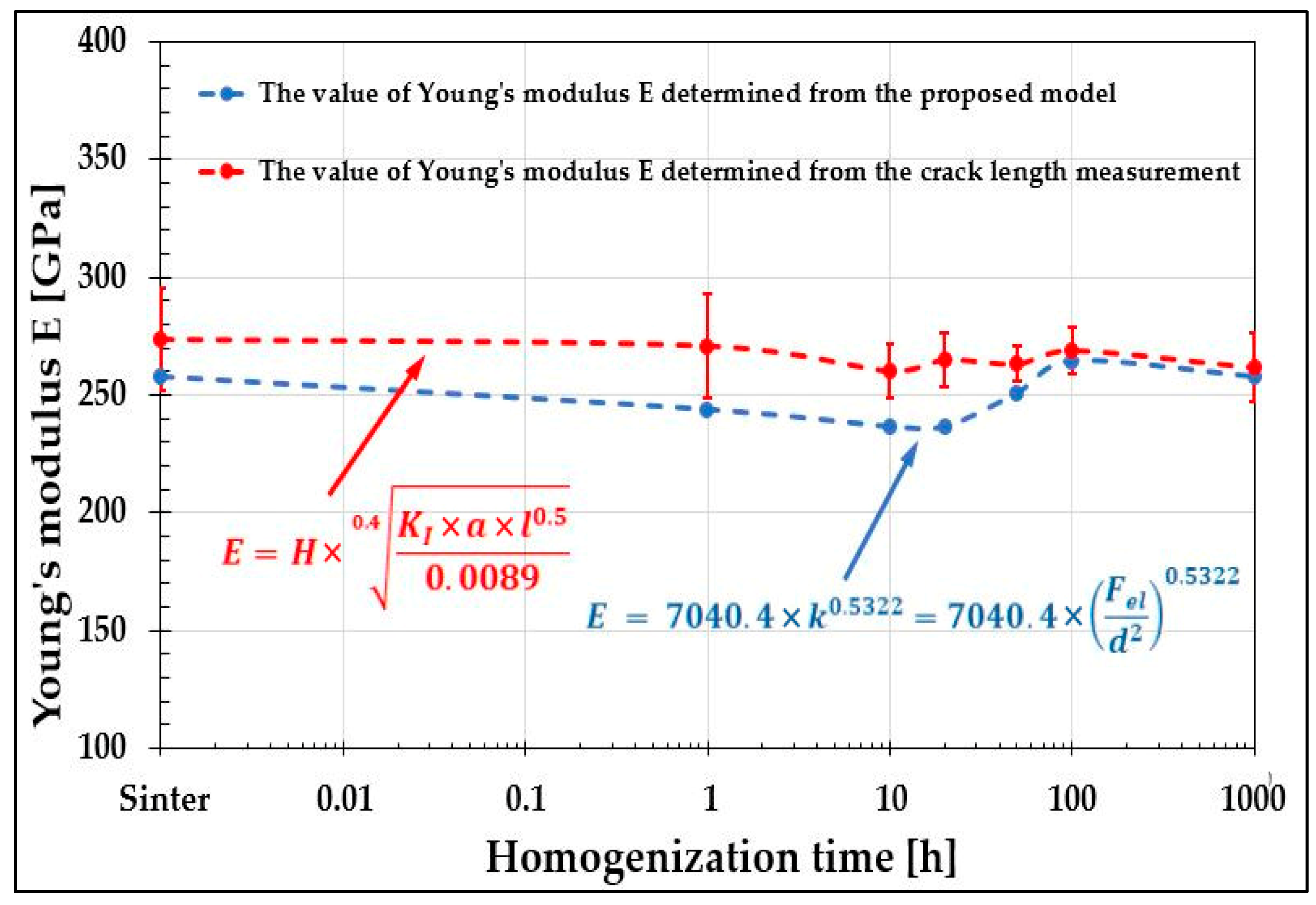
| KI Determined Using the Modified Shetty et al. Model | Young’s Modulus E Determined from the Nihara et al. Model | ||||
|---|---|---|---|---|---|
| P [N] | a [μm] | l [μm] | H0 [MPa] | Palmqvist 0.25 < l/a < 2.5 | |
| 0.491 | 4.38 | 1.49 | 11842.97 | 4.00 | 288 |
| 0.981 | 6.30 | 3.52 | 11447.81 | 3.17 | 278 |
| 1.962 | 9.22 | 7.35 | 10701.98 | 2.76 | 260 |
| 2.943 | 11.34 | 11.46 | 10612.68 | 2.62 | 258 |
| 4.903 | 14.66 | 16.51 | 10580.24 | 2.74 | 257 |
| 9.807 | 21.22 | 29.38 | 10100.5 | 2.78 | 246 |
| 19.610 | 30.05 | 46.81 | 10074.63 | 3.08 | 245 |
| average value | 3.02 | 261.8 | |||
| SD | 0.44 | 14.80 | |||
4. Conclusions
- Among the analyzed models for determining macroscopic hardness based on microhardness measurements, the model proposed by H. Li and R.C. Brandt, which accounts for the proportional increase in the elastic resistance of the sample during indenter penetration (referred to as the PSR model), exhibits the slightest deviation from the actual hardness values.
- The literature-reported method for estimating the Young’s modulus from microhardness measurements using the Knoop method is associated with too large an error, making this model impractical for reliable use.
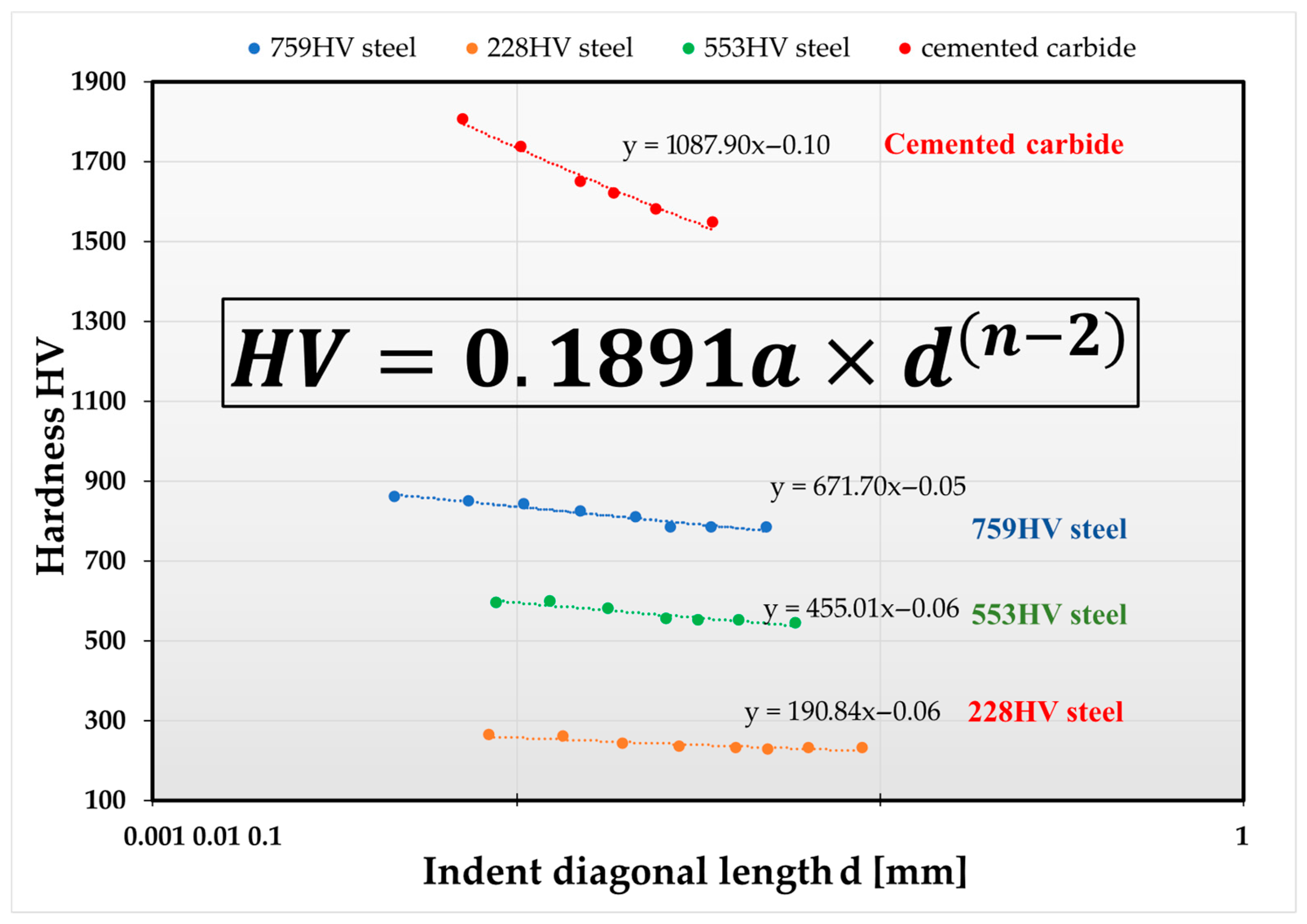
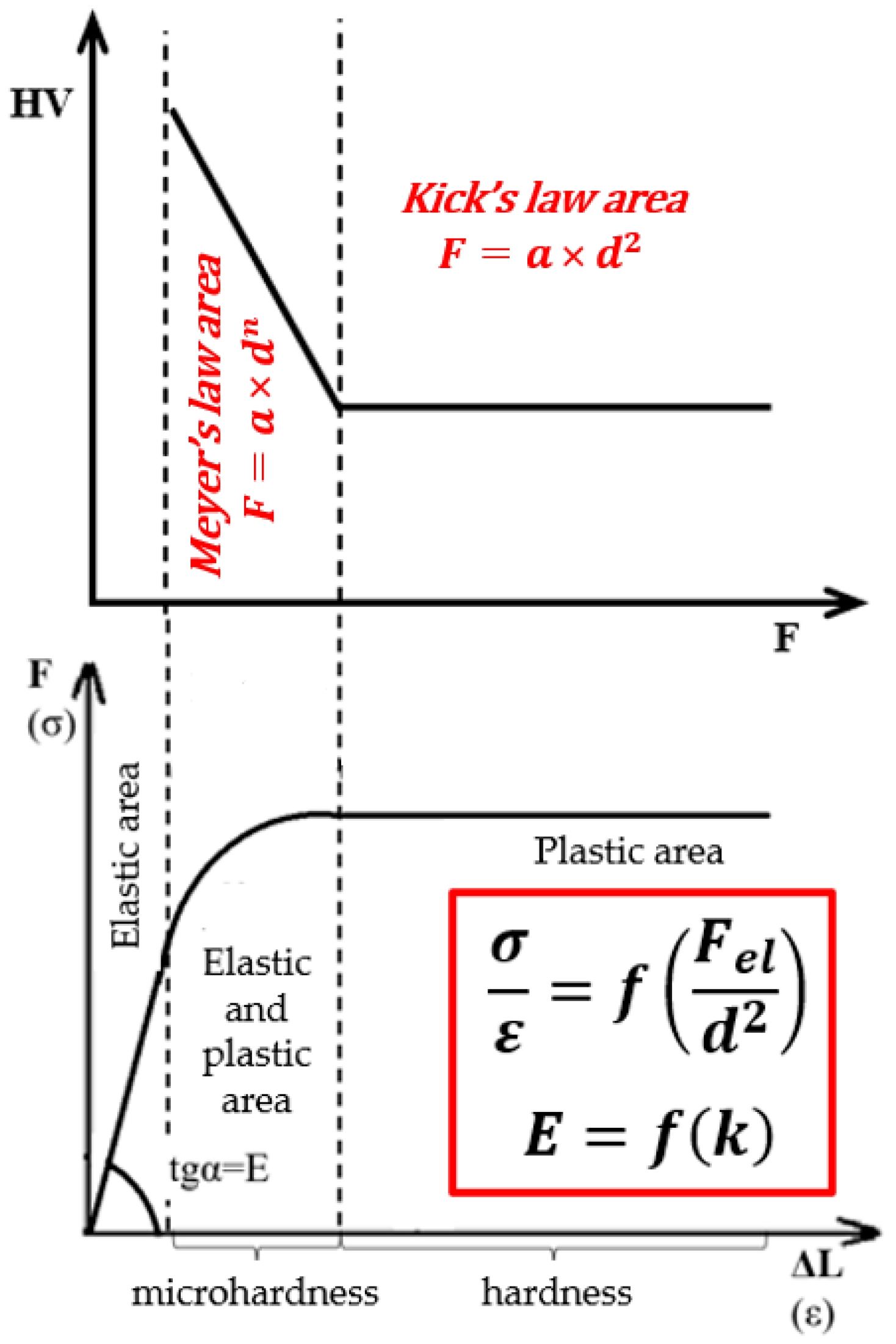
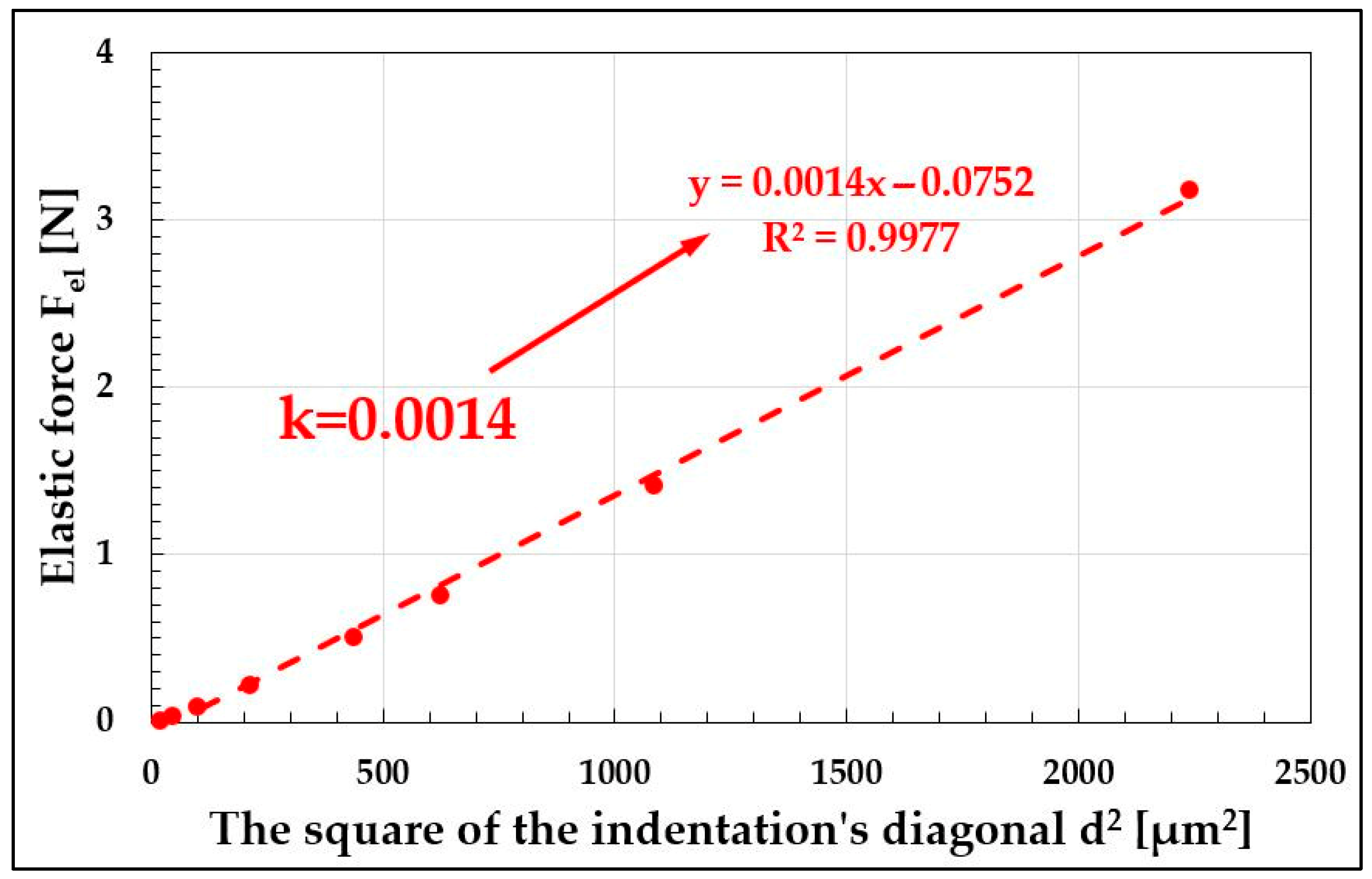
- By applying Meyer’s law together with Kick’s similarity law, it is possible to determine from Vickers microhardness measurements the forces responsible for elastic deformation in the indentation area.
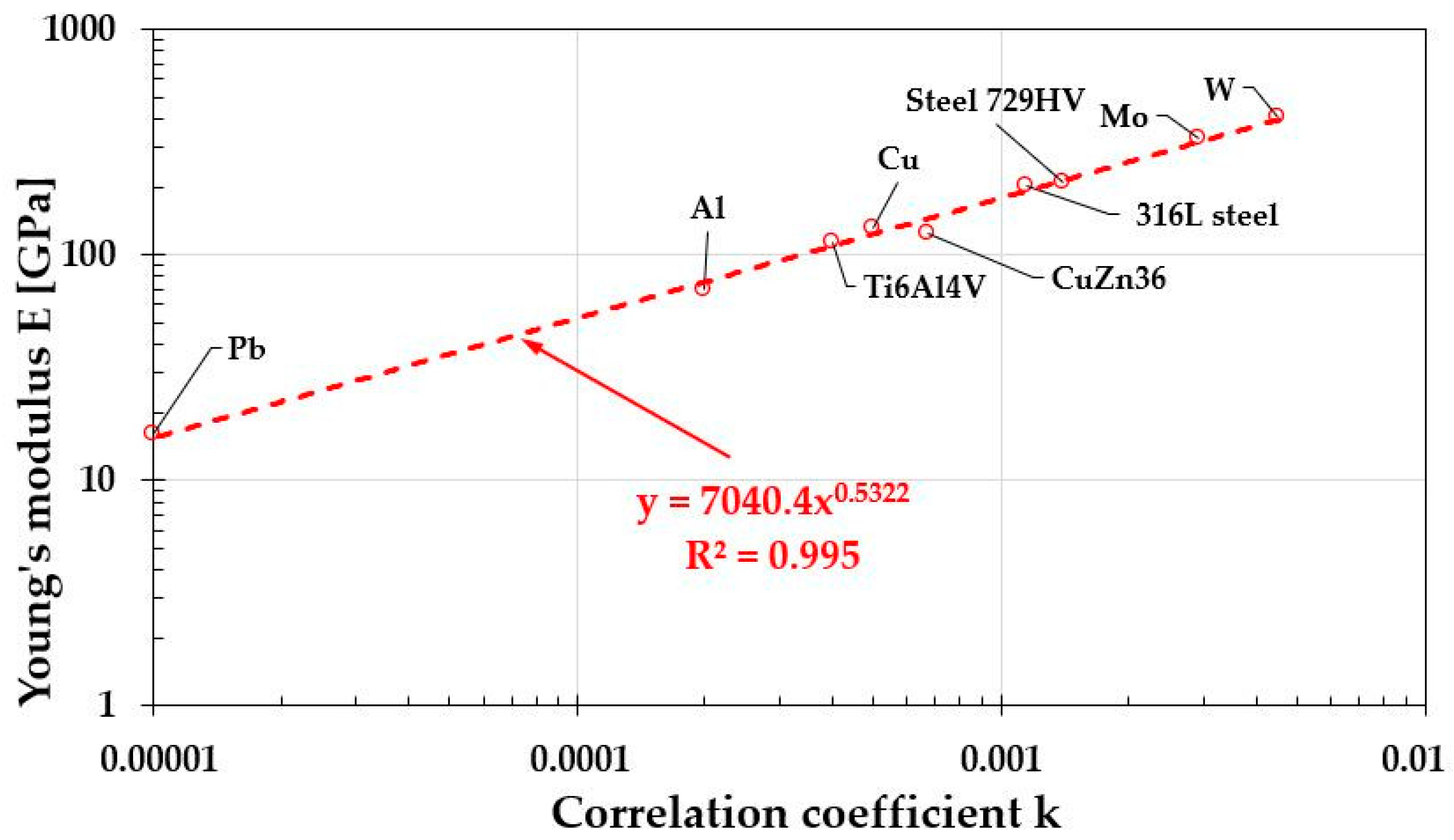
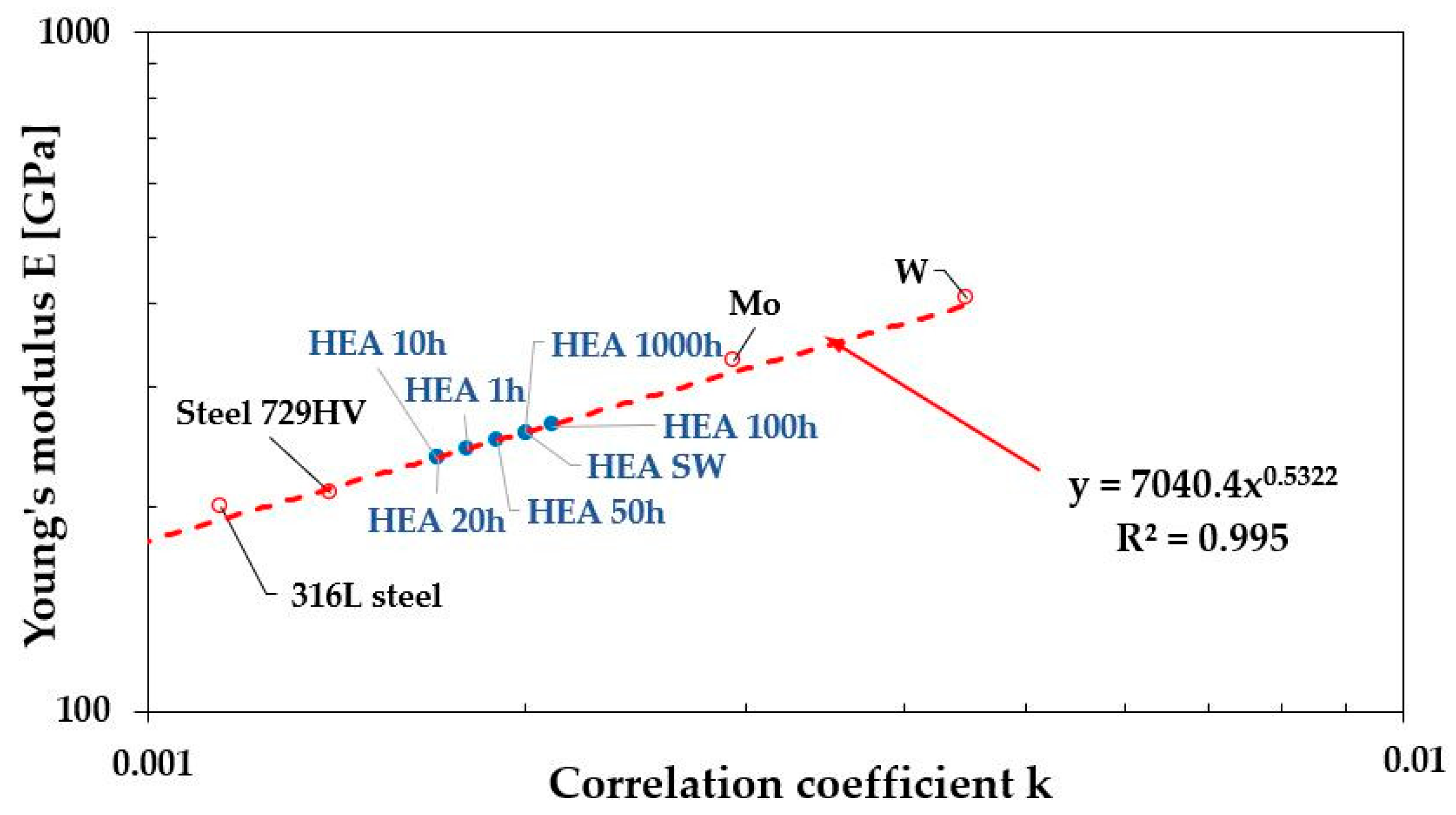
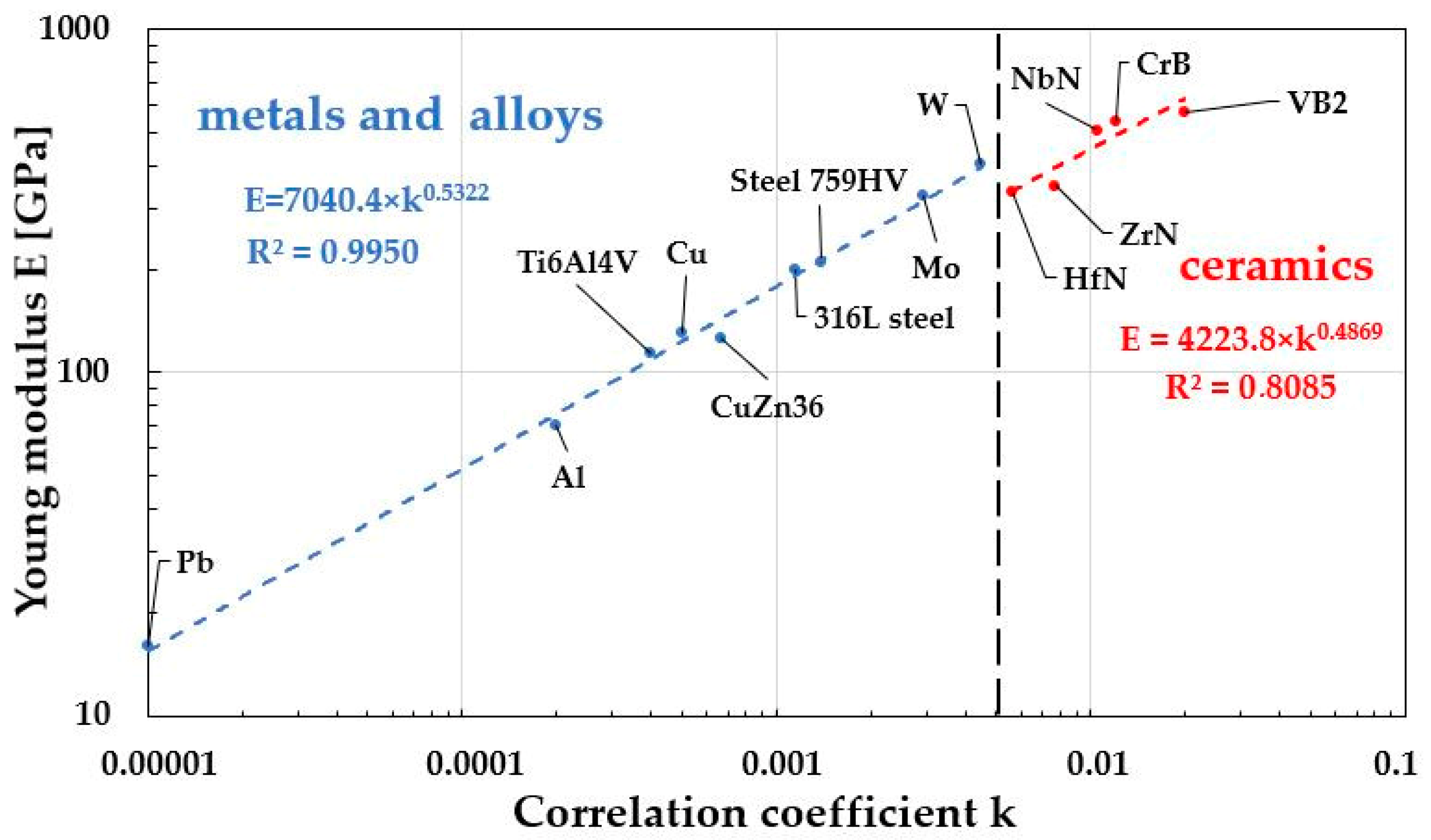
- By determining, for the elastic strain influence zone (ISE), the correlation coefficient , it is possible to establish the functional relationship:
Author Contributions
Funding
Institutional Review Board Statement
Informed Consent Statement
Data Availability Statement
Conflicts of Interest
References
- Lisica, A.; Ostrowski, B.; Ziewiec, W. Laboratorium Materiałoznawstwa; Politechnika Radomska: Radom, Poland, 2012; p. 501. ISBN 837351175X. [Google Scholar]
- Ciszewski, A.; Radomski, T.; Szummer, A. Ćwiczenia Laboratoryjne z Materiałoznawstwa; Oficyna Wydawnicza PW: Warszawa, Poland, 2006; p. 170. ISBN 9788372076373. [Google Scholar]
- Arunkumar, S. A Review of Indentation Theory. Mater. Today Proc. 2018, 5, 23664–23673. [Google Scholar] [CrossRef] [Scilit]
- Zhang, P.; Li, S.X.; Zhang, Z.F. General relationship between strength and hardness. Mater. Sci. Eng. A 2011, 529, 62–73. [Google Scholar] [CrossRef] [Scilit]
- Gorniewicz, D.; Przygucki, H.; Kopec, M.; Karczewski, K.; Jóźwiak, S. TiCoCrFeMn (BCC + C14) High-Entropy Alloy Multiphase Structure Analysis Based on the Theory of Molecular Orbitals. Materials 2021, 14, 5285. [Google Scholar] [CrossRef] [Scilit] [PubMed]
- Gorniewicz, D.; Karczewski, K.; Bojar, Z.; Jóźwiak, S. Structural Stability of Titanium-Based High-Entropy Alloys Assessed Based on Changes in Grain Size and Hardness. Materials 2023, 16, 7361. [Google Scholar] [CrossRef] [Scilit]
- Przygucka, D.; Polkowska, A.; Polkowski, W.; Karczewski, K.; Jóźwiak, S. Titanium Oxide Formation in TiCoCrFeMn High-Entropy Alloys. Materials 2025, 18, 412. [Google Scholar] [CrossRef] [Scilit]
- Broitman, E. Indentation Hardness Measurements at Macro-, Micro-, and Nanoscale: A Critical Overview. Tribol. Lett. 2017, 65, 23. [Google Scholar] [CrossRef] [Scilit]
- Haušild, P. On the breakdown of the Nix-Gao model for indentation size effect. Philos. Mag. 2020, 101, 420–434. [Google Scholar] [CrossRef] [Scilit]
- Koizumi, S.; Hiraga, T.; Suzuki, T.S. Vickers indentation tests on olivine: Size effects. Phys. Chem. Miner. 2019, 47, 8. [Google Scholar] [CrossRef] [Scilit]
- Wang, J.; Volz, T.; Weygand, S.M.; Schwaiger, R. The indentation size effect of single-crystalline tungsten revisited. J. Mater. Res. 2021, 36, 2166–2175. [Google Scholar] [CrossRef] [Scilit]
- Petrík, J.; Blaško, P.; Markulík, Š.; Šolc, M.; Palfy, P. The Indentation Size Effect (ISE) of Metals. Crystals 2022, 12, 795. [Google Scholar] [CrossRef] [Scilit]
- Shahdada, S.A.; McCabea, J.F.; Bullb, S.; Rusbya, S.; Wassella, R.W. Hardness measured with traditional Vickers and Martens hardness methods. Dent. Mater. 2007, 23, 1079–1085. [Google Scholar] [CrossRef] [Scilit]
- Al-Rub, R.K.A. Prediction of micro and nanoindentation size effect from conical or pyramidal indentation. Mech. Mater. 2007, 39, 787–802. [Google Scholar] [CrossRef] [Scilit]
- Du, G.; Yang, X.; Deng, J.; Guo, Y.; Yao, T.; Li, M.; Geng, R. Anisotropic Deformation Behavior and Indentation Size Effect of Monocrystalline BaF2 Using Nanoindentation. Materials 2023, 16, 6469. [Google Scholar] [CrossRef] [Scilit] [PubMed]
- Peng, Z.; Gong, J.; Miao, H. On the description of indentation size effect in hardness testing for ceramics: Analysis of the nanoindentation data. J. Eur. Ceram. Soc. 2004, 24, 2193–2201. [Google Scholar] [CrossRef] [Scilit]
- Kölemen, U. Analysis of ISE in microhardness measurements of bulk MgB2 superconductors using different models. J. Alloys Compd. 2006, 425, 429–435. [Google Scholar] [CrossRef] [Scilit]
- Gong, J.; Wu, J.; Guan, Z. Examination of the Indentation Size Effect in Low-load Vickers Hardness Testing of Ceramics. J. Eur. Ceram. Soc. 1999, 19, 2625–2631. [Google Scholar] [CrossRef] [Scilit]
- Li, H.; Brandt, R.C. The microhardness indentation load/size effect in rutile and cassiterite single crystals. J. Mater. Sci. 1993, 28, 917–926. [Google Scholar] [CrossRef] [Scilit]
- Sundararajan, G.; Roy, M. Hardness Testing. In Encyclopedia of Materials: Science and Technology; Harvard University: Cambridge, MA, USA, 2001; pp. 3728–3736. [Google Scholar]
- Barron, P.J.; Carruthers, A.W.; Fellowes, J.W.; Jones, N.G.; Dawson, H.; Pickering, E.J. Towards V-based high-entropy alloys for nuclear fusion applications. Scr. Mater. 2020, 176, 12–16. [Google Scholar] [CrossRef] [Scilit]
- Pickering, E.; Carruther, A.; Barron, P.; Middleburgh, S.; Armstrong, D.; Gandy, A. High-Entropy Alloys for Advanced Nuclear Applications. Entropy 2021, 23, 98. [Google Scholar] [CrossRef] [Scilit]
- Koželj, P.; Vrtnik, S.; Jelen, A.; Jazbec, S.; Jagličić, Z.; Maiti, S.; Feuerbacher, M.; Steurer Dolinšek, J.W. Discovery of a superconducting high-entropy alloy. Phys. Rev. Lett. 2014, 113, 107001. [Google Scholar] [CrossRef] [Scilit]
- Yuan, Y.; Wu, Y.; Liang, X.; Wang, H.; Liu, X.; Lu, Z. Superconducting Ti15Zr15Nb35Ta35 high-entropy alloy with intermediate electron-phonon coupling. Front. Mater. 2018, 5, 72. [Google Scholar] [CrossRef] [Scilit]
- Feng, G.; Nix, W.D. Indentation size effect in MgO. Scr. Mater. 2004, 51, 599–603. [Google Scholar] [CrossRef] [Scilit]
- Budiarsa, I.N.; Gde Antara, I.N. Strain Hardening Exponent Prediction by Indentation Size Effect (ISE) of Vickers Hardness. Turk. J. Comput. Math. Educ. 2021, 12, 5620–5626. [Google Scholar]
- Bull, S.J.; Page, T.F. An Explanation of the Indentation Size Effect in Ceramics. Philos. Mag. Lett. 1989, 59, 281–288. [Google Scholar] [CrossRef] [Scilit]
- Nix, W.D.; Gao, H. Indentation Size Efects in Crystalline Materials: A Law For Strain Gradient Plasticity. J. Mech. Phys. Solids 1998, 46, 411–425. [Google Scholar] [CrossRef] [Scilit]
- Spary, I.J.; Bushby, A.J.; Jennett, N.M. On the indentation size effect in spherical indentation. Philos. Mag. Philos. Mag. Lett. 2006, 86, 5581–5593. [Google Scholar] [CrossRef] [Scilit]
- Pharr, G.M.; Herbert, E.G.; Gao, Y. The Indentation Size Effect: A Critical Examination of Experimental Observations and Mechanistic Interpretations. Annu. Rev. Mater. Res. 2010, 40, 271–292. [Google Scholar] [CrossRef] [Scilit]
- Petrik, J. On the load dependence of micro-hardness measurements: Analysis of data by different models and evaluation of measurement errors. Arch. Metall. Mater. 2016, 61, 1819–1824. [Google Scholar] [CrossRef] [Scilit]
- Zhou, L.; Zheng, Z.; Wang, Q.; Wu, F.; Hong, J.; Xie, S.; Ni, H.; Feng, Q.; Zhou, M.; Li, M.; et al. A Study on the Effect of Nickel-Plated Graphite Content on the Microstructure and Properties of AlZn/Nickel-Plated Graphite Composite Cold Spray Coatings. Materials 2025, 18, 388. [Google Scholar] [CrossRef] [Scilit]
- ISO 6507-1:2018(E); Metallic Materials—Vickers Hardness Test—Part 1: Test Method. ISO: Geneva, Switzerland, 2018.
- Ciołek, S.; Jóźwiak, S.; Karczewski, K. Possibility of Strengthening Aluminum Using Low Symmetry Phases of the Fe-Al Binary System. Metall. Mater. Trans. A 2019, 50, 1914–1921. [Google Scholar] [CrossRef] [Scilit]
- Matysik, P. Niskosymetryczne fazy z Układu Fe-Al-Identyfikacja Strukturalna i Badanie Właściwości. Ph.D. Thesis, Wojskowa Akademia Techniczna, Warszawa, Poland, 2016. [Google Scholar]
- Pasare, M.M.; Petrescu, M.I. A theoretical model for the true hardness determination of Ni-P/SiC electroplated composites. Mater. Plast. 2008, 45, 87–90. [Google Scholar]
- Hays, C.; Kendall, E.G. An Analysis of Knoop Microhardness. Metallography 1973, 6, 275–282. [Google Scholar] [CrossRef] [Scilit]
- Güdera, H.S.; Şahina, E.; Şahina, O.; Göçmezb, H.; Duranc, C.; Ali Çetinkaraa, H. Vickers and Knoop Indentation Microhardness Study of β-SiAlOn Ceramic. Acta Phys. Pol. A 2011, 120, 1026–1033. [Google Scholar] [CrossRef] [Scilit]
- Turkoz, M.B.; Nezir, S.; Ozturk, O.; Asikuzun, E.; Yildirim, G.; Terzioglu, C.; Varilci, A. Experimental and theoretical approaches on mechanical evaluation of Y123 system by Lu addition. J. Mater. Sci. Mater. Electron. 2013, 24, 2414–2421. [Google Scholar] [CrossRef] [Scilit]
- Petrik, J.; Blasko, P.; Mihaliková, M.; Vasilnáková, A.; Miklos, V. The relationship between the deformation and the indentation size effect (ISE). Metall. Res. Technol. 2019, 116, 622. [Google Scholar] [CrossRef] [Scilit]
- Maity, T.; Das, J. Microstructure and size effect in ultrafine (Ti0.705Fe0.295)100−xSnx (0≤x≤4at.%) composites. J. Alloys Compd. 2014, 585, 54–62. [Google Scholar]
- Machaka, R.; Derry, T.; Sigalas, I.; Herrmann, M. Analysis of the Indentation Size Effect in the Microhardness Measurements in B6O. Adv. Mater. Sci. Eng. 2011, 2011, 539252. [Google Scholar] [CrossRef] [Scilit]
- Rester, M.; Motz, C.; Pippan, R. Microstructural Investigation of the Deformation Zone below Nano-Indents in Copper. MRS Online Proc. Libr. 2008, 1049, 303. [Google Scholar] [CrossRef] [Scilit]
- Taylor, G.I. Plastic Strain in Metals. J. Inst. Met. 1938, 62, 307–324. [Google Scholar]
- Qu, S.; Huang, Y. Indenter tip radius effect on the Nix–Gao relation in micro- and nanoindentation hardness experiments. J. Mater. Res. 2004, 19, 3423–3434. [Google Scholar] [CrossRef] [Scilit]
- Luo, Q.; Kitchen, M. Microhardness, Indentation Size Effect and Real Hardness of Plastically Deformed Austenitic Hadfield Steel. Materials 2023, 16, 1117. [Google Scholar] [CrossRef] [Scilit]
- Song, Y.K.; Varin, R.A. Indentation microcracking and toughness of newly discovered ternary intermetallic phases in discovered ternary intermetallic phases in. Intermetallics 1998, 6, 379–393. [Google Scholar] [CrossRef] [Scilit]
- Žmak, I.; Ćorić, D.; Mandić, V.; Ćurković, L. Hardness and Indentation Fracture Toughness of Slip Cast Alumina and Alumina-Zirconia Ceramics. Materials 2020, 13, 122. [Google Scholar] [CrossRef] [Scilit]
- Wang, P.; Kumar, R.; Sankaran, E.M.; Qi, X.; Zhang, X.; Popov, D.; Cornelius, A.L.; Li, B.; Zhao, Y.; Wang, L. Vanadium Diboride (VB2) Synthesized at High Pressure: Elastic, Mechanical, Electronic, and Magnetic Properties and Thermal Stability. Inorg. Chem. 2018, 57, 1096–1105. [Google Scholar] [CrossRef] [Scilit]
- Zou, Y.; Qi, X.; Zhang, C.; Ma, S.; Zhang, W.; Li, Y.; Chen, T.; Wang, X.; Chen, Z.; Welch, D.; et al. Discovery of Superconductivity in Hard Hexagonal ε-NbN. Sci. Rep. 2016, 6, 22330. [Google Scholar] [CrossRef] [Scilit]
- Han, L.; Wang, S.; Zhu, J.; Han, S.; Li, W.; Chen, B.; Wang, X.; Yu, X.; Liu, B.; Zhang, R.; et al. Hardness, elastic, and electronic properties of chromium monoboride. Appl. Phys. Lett. 2015, 106, 221902. [Google Scholar] [CrossRef] [Scilit]
- Chen, X.-J.; Struzhkin, V.V.; Wu, Z.; Somayazulu, M.; Qian, J.; Kung, S.; Christensen, A.N.; Zhao, Y.; Cohen, R.E.; Mao, H.; et al. Hard Superconducting nitrides. Proc. Natl. Acad. Sci. USA 2005, 102, 3198–3201. [Google Scholar] [CrossRef] [Scilit] [PubMed]


| Homogenization Time | |||||||
|---|---|---|---|---|---|---|---|
| Model | Sinter | 1 h | 10 h | 20 h | 50 h | 100 h | 1000 h |
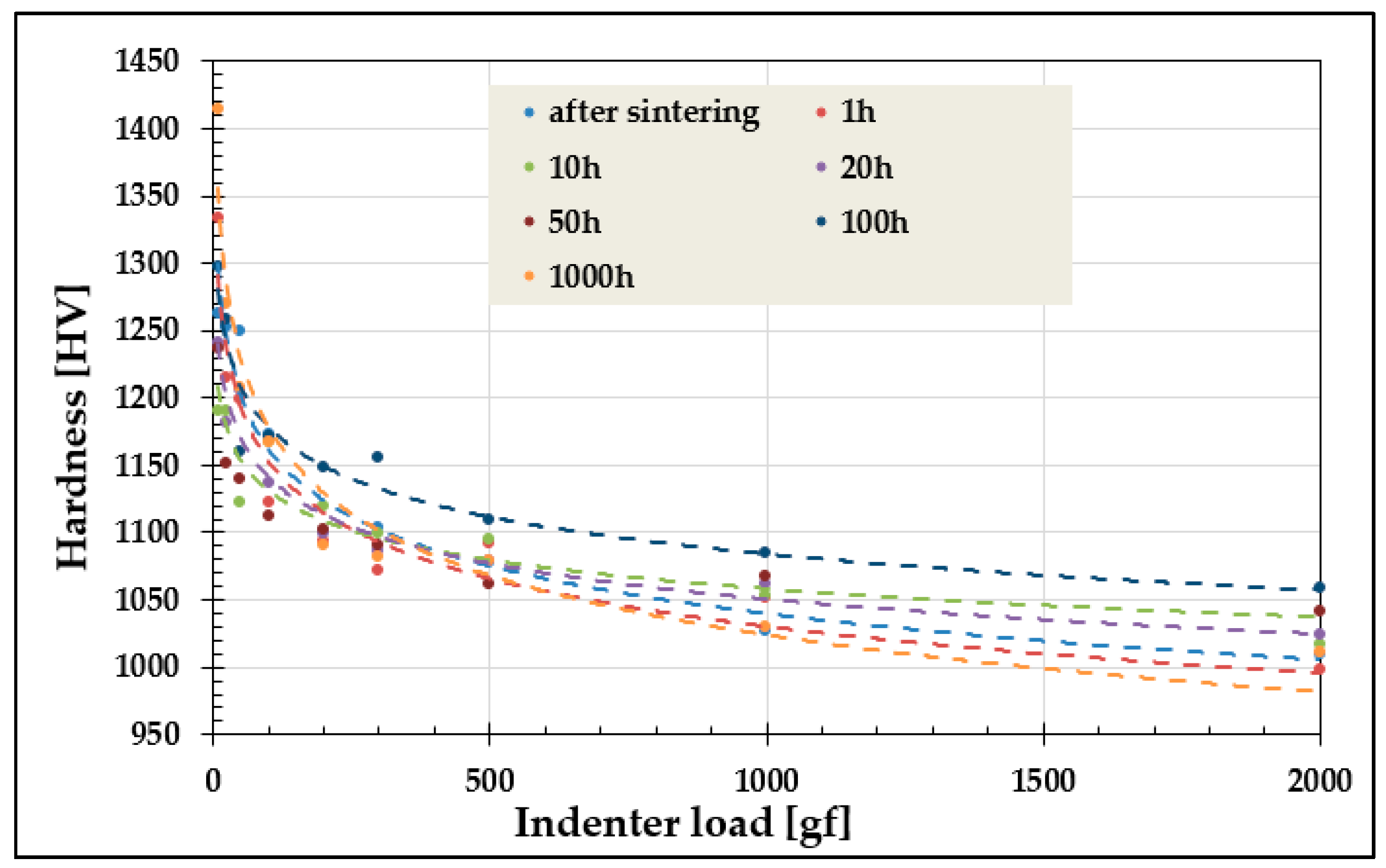
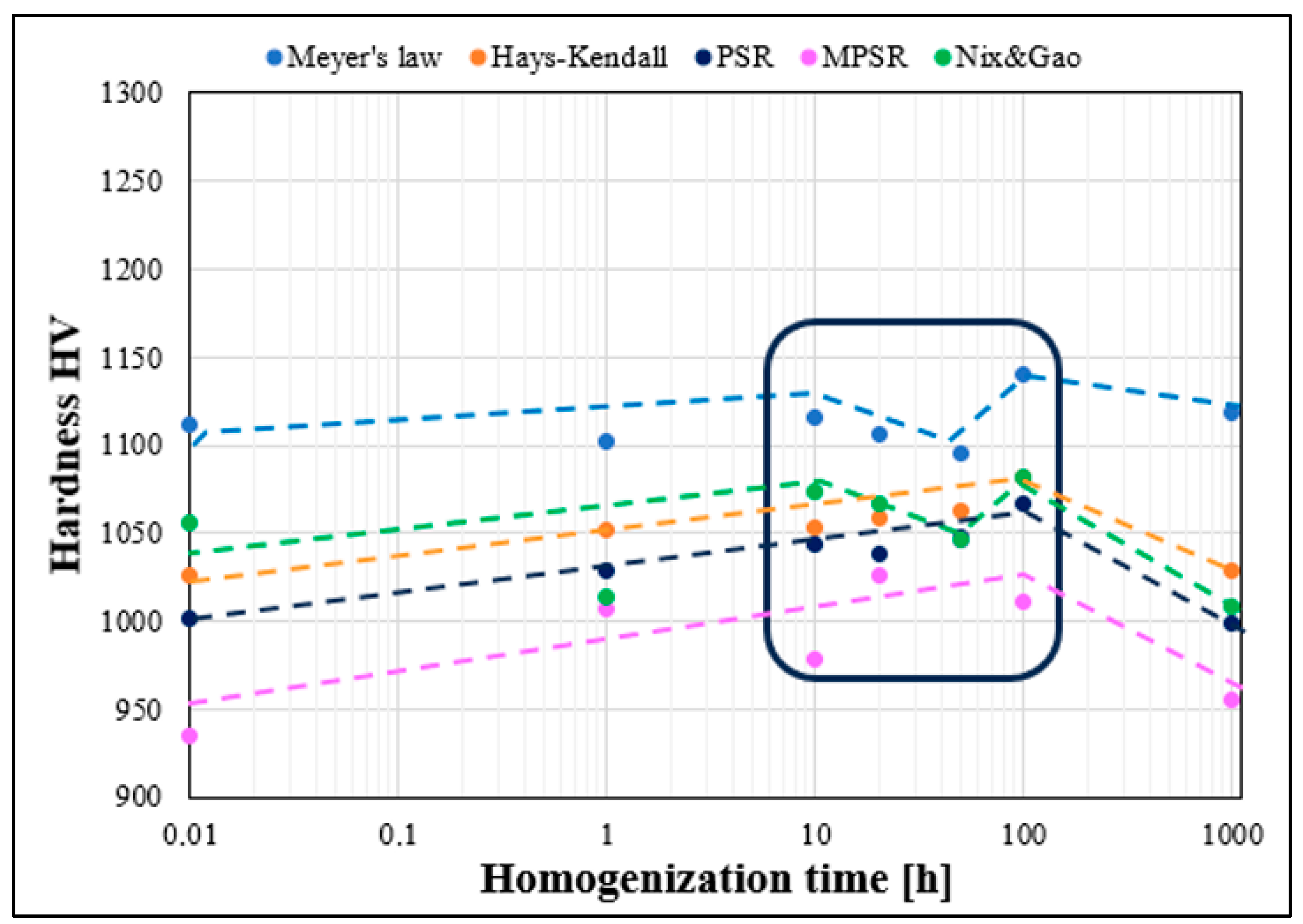
| Meyer’s law | 1112 | 1102 | 1116 | 1106 | 1095 | 1140 | 1119 |
| Hays-Kendall | 1026 | 1051 | 1053 | 1059 | 1063 | 1082 | 1029 |
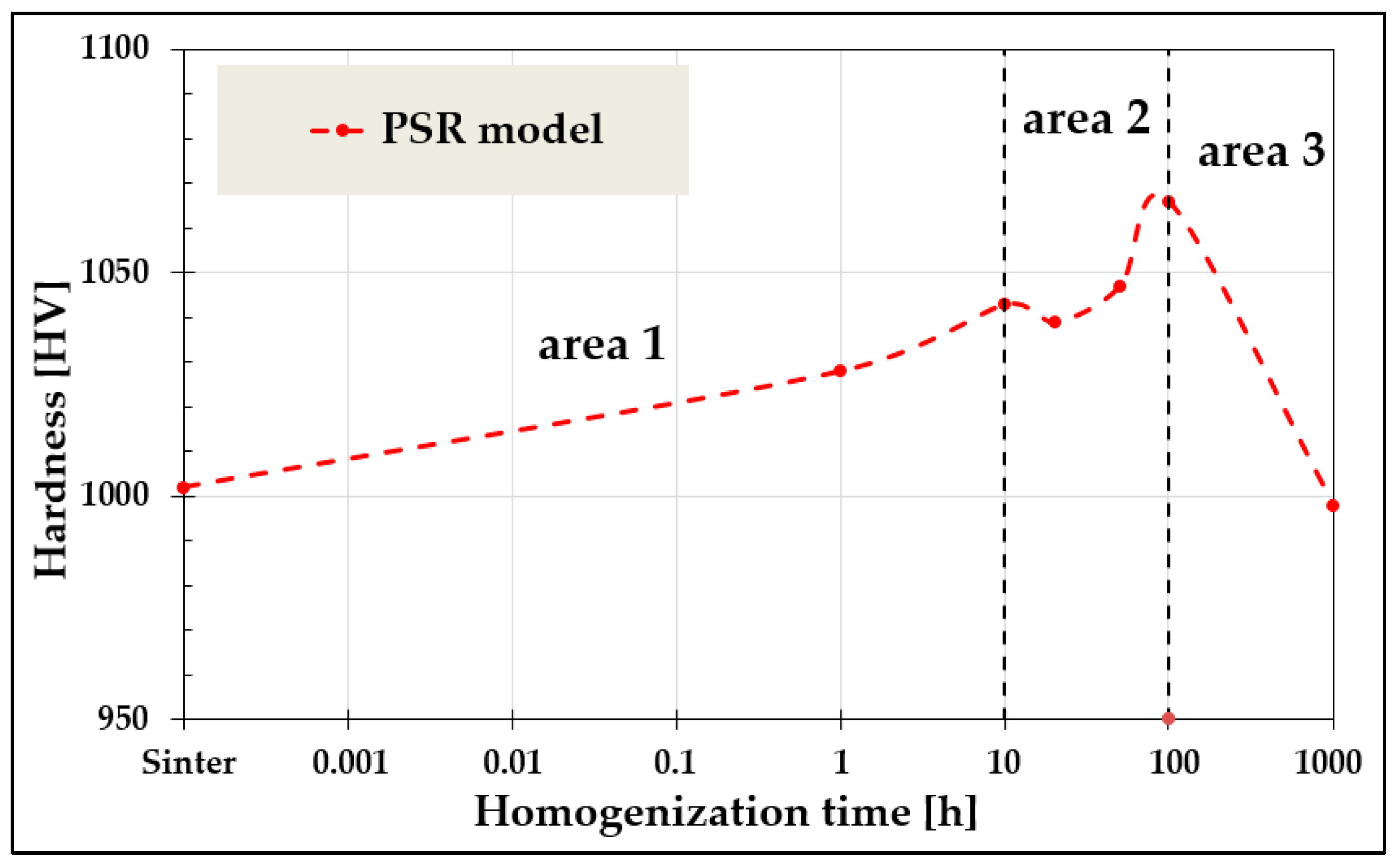
| PSR | 1002 | 1028 | 1043 | 1039 | 1047 | 1066 | 998 |
| MPSR | 934 | 1006 | 978 | 1026 | 1046 | 1011 | 956 |
| Nix-Gao | 1056 | 1013 | 1074 | 1067 | 1047 | 1082 | 1009 |
| Steel Hardness Standard of 228 HV0.1 ± 9 | Steel Hardness Standard of 51.3 HRC | Steel Hardness Standard of 759 HV30 ± 16 | Cemented Carbide | |
|---|---|---|---|---|
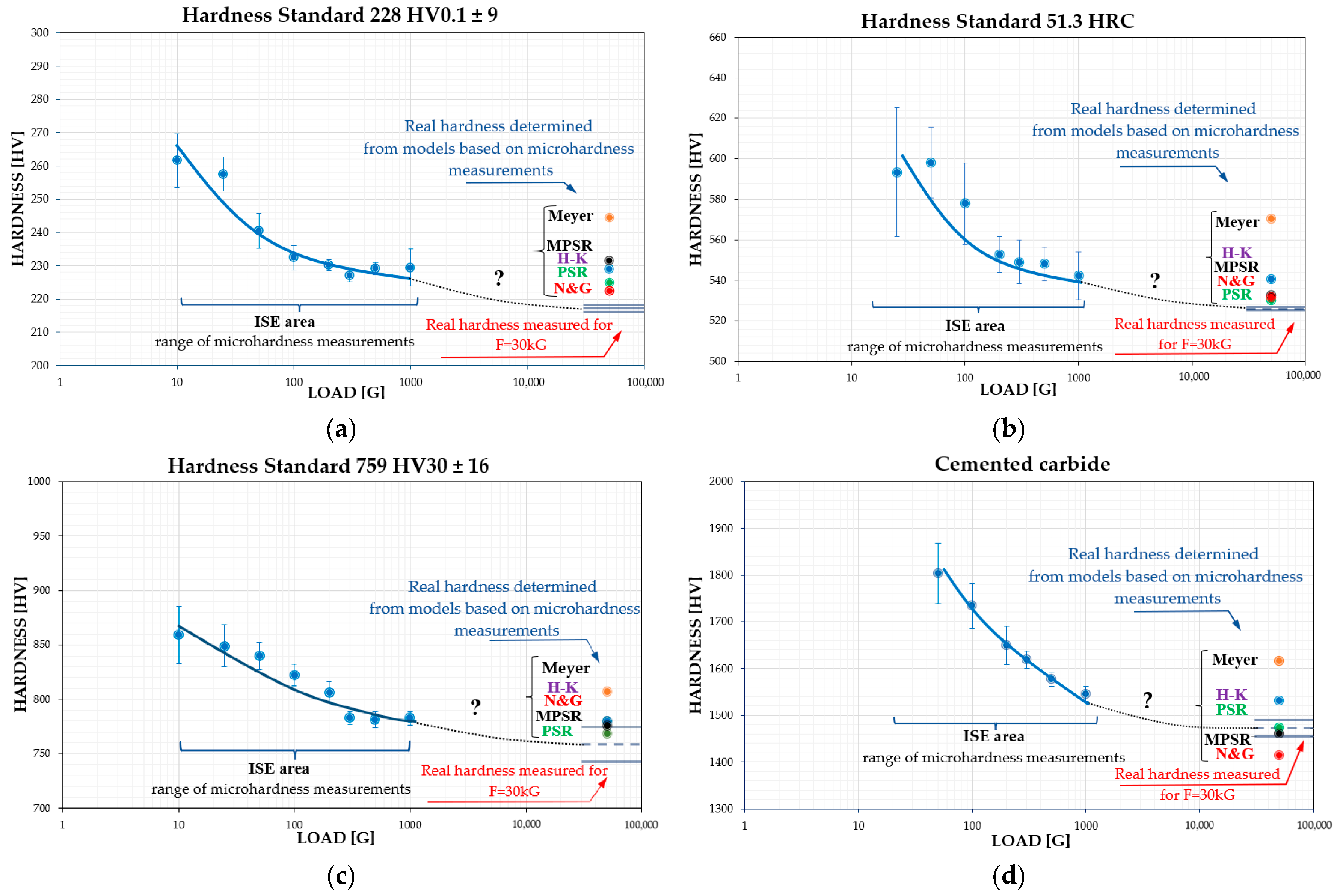
| HV30 (measured) | 217 | 526 | 759 | 1472 |
| Standard deviation | ±1 | ±1 | ±16 | ±18 |
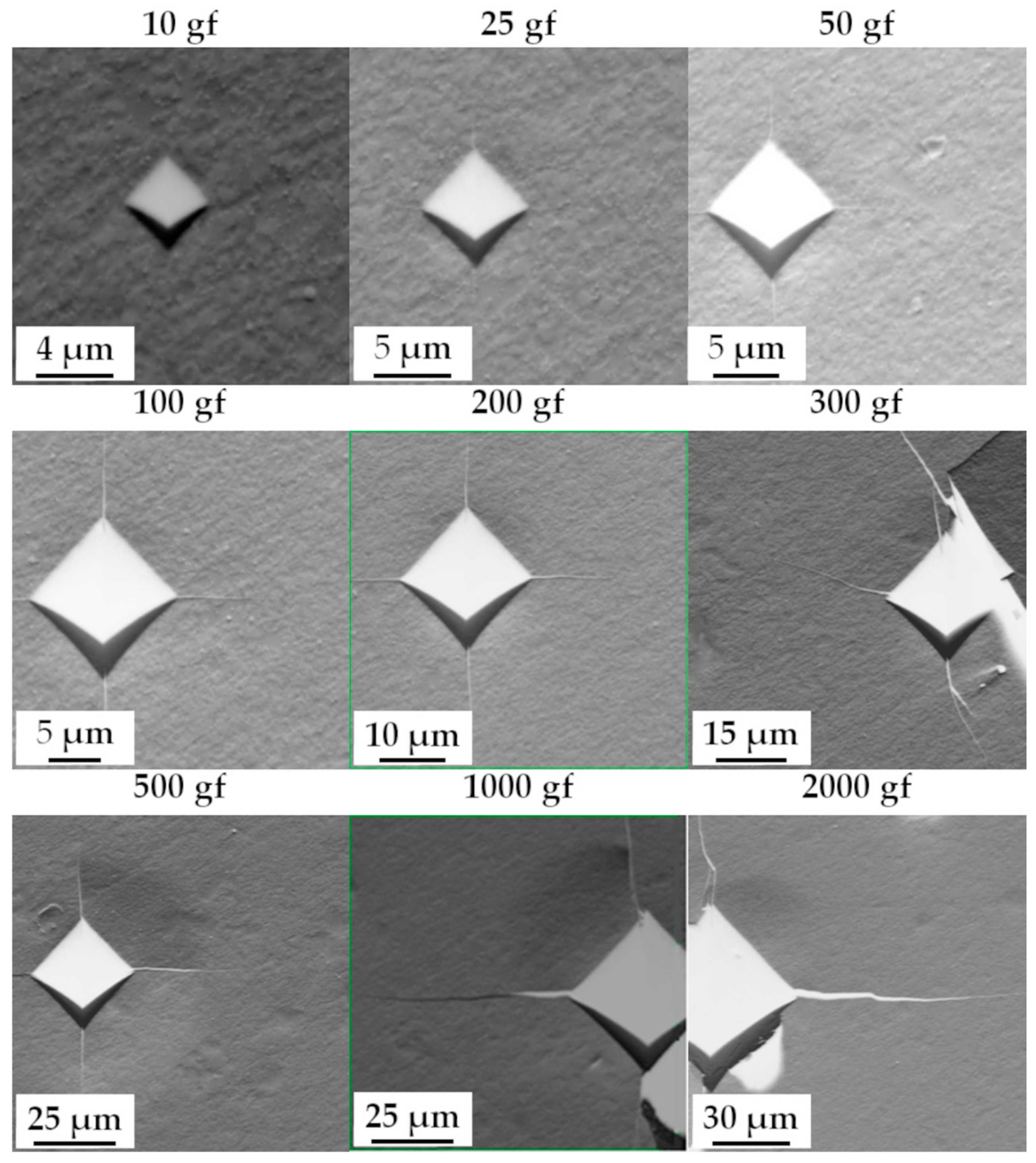
| Load F [gf] | Diagonal of the Hardness Indent of the Tested Material d [µm] | |||
|---|---|---|---|---|
| Steel Hardness Standard of 228 HV0.1 ± 9 | Steel Hardness Standard of 51.3 HRC | Steel Hardness Standard of 759 HV30 ± 16 | Cemented Carbide of 1472 HV30 | |
| 10 | 8.42 | - | 3.85 | - |
| 25 | 13.42 | 8.85 | 6.10 | - |
| 50 | 19.64 | 12.45 | 8.62 | 7.17 |
| 100 | 28.25 | 17.92 | 12.58 | 10.34 |
| 200 | 40.13 | 25.90 | 18.37 | 15.00 |
| 300 | 49.49 | 31.84 | 22.47 | 18.54 |
| 500 | 63.60 | 41.13 | 29.34 | 24.25 |
| 1000 | 89.92 | 58.48 | 42.49 | 34.64 |
| Empirical Model | Real Hardness HV | |||
|---|---|---|---|---|
| Steel Hardness Standard of 228 HV0.1 ± 9 | Steel Hardness Standard of 51.3 HRC | Steel Hardness Standard of 759 HV30 ± 16 | Cemented Carbide of 1472 HV30 | |
| Meyer’s law | 244 | 570 | 880 | 1616 |
| H-K model | 228 | 540 | 828 | 1530 |
| PSR model | 225 | 530 | 815 | 1473 |
| MPSR model | 231 | 532 | 776 | 1460 |
| HV30 | 216 ± 1 | 525 ± 1 | 743 ± 16 | 1454 ± 17 |
| Steel Hardness Standard of 228 HV0.1 | Steel Hardness Standard of 51.3 HRC | Steel Hardness Standard of 759 HV30 | Cemented Carbide 1472 HV30 | Average Value | ||
|---|---|---|---|---|---|---|
| Standard | HV30 | 217 | 526 | 759 | 1472 | --- |
| SD | ±1 | ±1 | ±16 | ±18 | --- | |
| Relative error | --- | --- | --- | --- | --- | |
| H-K Model | HV30 | 229 | 540 | 780 | 1510 | --- |
| SD | ±12 | ±14 | ±21 | ±38 | --- | |
| Relative error | 5.46% | 2.74% | 2.80% | 2.58% | 3.40% | |
| PSR Model | HV30 | 225 | 530 | 769 | 1465 | --- |
| SD | ±8 | ±4 | ±10 | ±7 | --- | |
| Relative error | 3.63% | 0.79% | 1.28% | 0.48% | 1.54% | |
| MPSR Model | HV30 | 231 | 533 | 776 | 1555 | --- |
| SD | ±14 | ±7 | ±17 | ±17 | --- | |
| Relative error | 6.65% | 1.27% | 2.20% | 1.15% | 2.28% | |
| N&G Model | HV30 | 222 | 532 | 780 | 1400 | --- |
| SD | ±5 | ±6 | ±21 | ±72 | --- | |
| Relative error | 2.51% | 1.11% | 2.73% | 4.89% | 2.81% | |
| F [N] | d [µm] | d2 [µm2] | a | n | Fel [N] |
|---|---|---|---|---|---|
| 0.09807 | 4.38 | 19.22 | 0.005794 | 1.926 | 0.011 |
| 0.2452 | 6.84 | 46.85 | 0.005794 | 1.926 | 0.035 |
| 0.4903 | 9.93 | 98.73 | 0.005794 | 1.926 | 0.088 |
| 0.9807 | 14.60 | 213.31 | 0.005794 | 1.926 | 0.219 |
| 1.961 | 20.91 | 437.40 | 0.005794 | 1.926 | 0.504 |
| 2.942 | 24.98 | 624.18 | 0.005794 | 1.926 | 0.757 |
| 4.903 | 32.93 | 1084.58 | 0.005794 | 1.926 | 1.415 |
| 9.807 | 47.31 | 2238.94 | 0.005794 | 1.926 | 3.184 |
| Metals and Their Alloys | Tested TiCoCrFeMn Alloy | ||||
|---|---|---|---|---|---|
| Material | k | E [GPa] | Homogenization Time | k | E [GPa] |
| Al | 0.0002 | 70 | sinter | 0.0020 | 257.7 |
| Cu | 0.0005 | 130 | 1 h | 0.0018 | 243.7 |
| Steel | 0.0014 | 210 | 10 h | 0.0017 | 236.4 |
| Ti6Al4V | 0.0004 | 114 | 20 h | 0.0017 | 236.4 |
| Mo | 0.00293 | 329 | 50 h | 0.0019 | 250.8 |
| Pb | 0.00001 | 16 | 100 h | 0.0021 | 264.5 |
| CuZn36 | 0.00067 | 125 | 1000 h | 0.0020 | 257.7 |
| 316L | 0.00114 | 200 | E = 7040.4 ∗ k0.5322 | ||
| W | 0.00350 | 405 | |||
Disclaimer/Publisher’s Note: The statements, opinions and data contained in all publications are solely those of the individual author(s) and contributor(s) and not of MDPI and/or the editor(s). MDPI and/or the editor(s) disclaim responsibility for any injury to people or property resulting from any ideas, methods, instructions or products referred to in the content. |
© 2025 by the authors. Licensee MDPI, Basel, Switzerland. This article is an open access article distributed under the terms and conditions of the Creative Commons Attribution (CC BY) license.
Share and Cite
Przygucka, D.; Karczewski, K.; Bojar, Z.; Jóźwiak, S. Assessment of Macroscopic Properties Based on Microhardness Measurements Using the Example of the TiCoCrFeMn High-Entropy Alloy. Materials 2026, 19, 118. https://doi.org/10.3390/ma19010118
Przygucka D, Karczewski K, Bojar Z, Jóźwiak S. Assessment of Macroscopic Properties Based on Microhardness Measurements Using the Example of the TiCoCrFeMn High-Entropy Alloy. Materials. 2026; 19(1):118. https://doi.org/10.3390/ma19010118
Chicago/Turabian StylePrzygucka, Dominika, Krzysztof Karczewski, Zbigniew Bojar, and Stanisław Jóźwiak. 2026. "Assessment of Macroscopic Properties Based on Microhardness Measurements Using the Example of the TiCoCrFeMn High-Entropy Alloy" Materials 19, no. 1: 118. https://doi.org/10.3390/ma19010118
APA StylePrzygucka, D., Karczewski, K., Bojar, Z., & Jóźwiak, S. (2026). Assessment of Macroscopic Properties Based on Microhardness Measurements Using the Example of the TiCoCrFeMn High-Entropy Alloy. Materials, 19(1), 118. https://doi.org/10.3390/ma19010118