Article

Studies on the Influence of Compaction Parameters on the Mechanical Properties of Oak Sawdust Briquettes


1
Institute of Machine Design, Faculty of Mechanical Engineering, Poznan University of Technology, 61-138 Poznań, Poland
2
Department of Mechanics and Basics of Machine Design, Faculty of Mechanical Engineering, Czestochowa University of Technology, 42-201 Częstochowa, Poland
3
Department of Mechanical Engineering, Polytechnic Faculty, University of Kalisz, 62-800 Kalisz, Poland
4
MSprojekt plus Sp. z o.o., 64-330 Opalenica, Poland
*
Author to whom correspondence should be addressed.
Materials 2026, 19(1), 119; https://doi.org/10.3390/ma19010119 (registering DOI)
Submission received: 3 December 2025 / Revised: 19 December 2025 / Accepted: 22 December 2025 / Published: 29 December 2025
(This article belongs to the Section Mechanics of Materials)

Abstract

The paper presents research on the compaction process of oak sawdust as a proposal for the management of post-production waste. The variable input parameters whose influence was studied were the particle size of the sawdust, the compaction force, the temperature of the compaction process, and the moisture content of the sawdust. The results obtained were used to determine the density of the briquette and the value of its Young’s modulus obtained from each test sample. The interaction between the input parameters as variables in the tests and the determined values of density and Young’s modulus was analyzed using ANOVA. The highest density value was recorded for the lowest particle size, the highest compaction force and compaction temperature, and a moisture content of 9%. The highest Young’s modulus E value was recorded for a moisture content of 9%, a compaction force of 25 kN, a temperature of 25 °C, and a particle size of S < 1 mm. Variance analysis enabled the optimal selection of compaction process parameters, where the main criterion in general terms was to minimize the energy consumption of the compaction process. The best mechanical properties of the briquette can be obtained for process settings of F = 5 kN, M = 20%, T = 25 °C, S = 2.5–5 mm.

1. Introduction

Energy production methods are currently a major focus of scientific interest. This is due, among other things, to the globally growing demand for energy. There are many reasons for this phenomenon, but the most obvious ones are: the increasing population (it is estimated that the population could reach around 10 billion by 2050) and the economic development of societies—and the associated technological development (in the last 25 years, global average GDP growth has exceeded 2.5% annually, excluding individual years of economic crisis). These factors contribute to the increasing global consumption of energy (including electricity) in everyday life. It has been estimated that between 2013 and 2023, global energy demand grew by an average of around 1.3% per year, and in 2024, this figure reached as high as 2.2%. It is forecast that by 2050, the increase in energy demand will be even higher [1,2].
Thermal and electrical energy obtained from fossil fuels accounts for approximately 85% of all known energy sources globally. The remaining demand is met by renewable sources, including biomass. It is estimated that the share of renewable energy will increase significantly over the next 25 years, with a forecast of at least 30% by around 2050. This is mainly due to the growing environmental awareness of societies, as well as the constantly rising costs of obtaining energy from fossil fuels [3,4].
Currently, renewable energy sources include geothermal power plants, solar devices, hydroelectric and wind power plants, as well as biomass. Biomass is most often directly combusted to obtain thermal energy or undergoes other chemical processes that allow fuel to be obtained from it. Biomass currently accounts for a significant percentage of renewable energy sources. It is estimated that its share in renewable energy sources exceeds 40% in the European Union and reaches as much as 70% in Poland [5,6]. In some parts of the world (usually in less developed regions), biomass has an almost 100% market share among methods of generating thermal energy [7]. Globally, this share is growing year on year, which proves that this renewable energy source is important in the entire energy system. Therefore, research conducted in this area can be considered important and the subject matter relevant.
There are different types of biomass, depending on its source. In addition to biomass of agricultural origin (plant residues and food processing waste), aquatic biomass (algae and aquatic plants used for biofuel production) and waste biomass (industrial and municipal waste), one of the most popular types is wood biomass. This group most often includes biomass from forestry waste (waste from wood processing) and biomass from special energy crops (e.g., willow and poplar) [8,9].
The use of wood biomass, which is waste from wood processing, is in line with current trends in the development of renewable energy sources, while also being one of the ways of managing waste. This type of biomass, taking into account particle size, can be divided into three main groups: wood powder (particles smaller than 1 mm, most often a by-product of wood grinding and milling processes), sawdust (particles ranging from 1 mm to 5 mm in size, which are a by-product of cutting and milling processes) and wood chips (with particle sizes up to 30 mm, which are a by-product of cutting and planning processes). In order to obtain thermal energy from the combustion or gasification of these types of fuels, they are compressed into briquettes or pellets, which improves the technological processes involved in their further processing (including transport and storage) and has a positive effect on the efficiency of the technological process of energy recovery (including combustion or gasification) [10,11].
Many researchers have already undertaken work related to the study of biomass compaction for the purpose of obtaining briquettes and pellets used for energy purposes. The most popular objective of research into this technological process is to determine the impact of process parameters on its course and the quality of the product obtained, in the form of pellets or briquettes. The most frequently studied variable parameters of this process, affecting the compaction process and the properties of the obtained product, are: compaction pressure, moisture content of the compacted material, type of compacted material, process temperature, degree of particle fragmentation before compaction, use of bonding additives, mixing of different types of raw materials in different proportions [12,13,14,15,16,17,18]. Many researchers also analyze the chemical composition of the raw material undergoing briquetting or pelletisation. According to the conclusions of their work, the content of lignin, cellulose and hemicellulose also significantly affects the properties of the resulting product [19,20,21,22,23]. Scientists are also studying the design of equipment used to carry out the biomass compaction process and its impact on the physical properties of the biofuel obtained [24,25,26].
Taking into account studies of specific parameters of the wood biomass compaction process, its course and the characteristics of the obtained biofuel, there are a number of works in which researchers present conclusions regarding the correlation between various parameters of both the input material and the process, and the physical properties of the product.
Adam et al. studied the compaction process of a mixture of spruce and pine sawdust. In their paper, they presented the results of experimental piston compaction tests of this raw material, with a maximum compaction pressure of 200 MPa. At the same time, the authors performed numerical calculations to determine the stress distribution in the briquette during the compaction process, based on an analysis of the distribution of internal forces during its formation. The conclusions from the research indicate a significant influence of friction between the briquette and the compaction sleeve on the stress distribution in the briquette, as well as a large influence of the holding time of the maximum compaction stress on the compaction of the material [27]. This work is a very valuable source of information on the phenomena occurring in the process of obtaining a specific density distribution during the compaction of this type of mixture.
Kamdem, Lemaire and Nikiema conducted research on the compression of wood sawdust, miscanthus grass and wheat straw. In this research, the variable input parameters were: the size of the fractions of individual briquette components, the proportion of individual types of biomass and the compression force. The parameters tested were: density, impact resistance, water resistance and parameters related to the combustion of the briquette obtained (calorific value, ignition time, combustion time and ash residue after combustion). It was shown that all input variables have a significant impact on the tested properties of the briquette. A particularly significant influence was demonstrated in the variability of the composition of the compacted mixture on the parameters related to its combustion [28]. This work is a valuable source of information for researchers studying the combustion process of different types of mixtures, especially in terms of combustion purity and the possibility of obtaining energy from mixtures of different types of biofuels.
Molenda et al. conducted experimental research on the compaction of sawdust from various tree species growing in Eastern Europe: pine, willow, oak, poplar, birch and beech. The researchers determined the effect of sawdust moisture content (2 values tested) and compaction pressure (2 values tested) on: pellet height, density, strength, combustion heat and ash residue. The most important conclusions from their research are that, among the plant species mentioned, oak sawdust obtained the highest mechanical strength parameters after compaction. In addition, it was pointed out that an increase in compaction pressure has a positive effect on pellet strength, while an increase in moisture content has the opposite effect. Despite its excellent mechanical properties and low ash content after combustion, oak pellets did not exhibit the highest combustion heat [29]. This work is a valuable source of information, especially in terms of comparing different types of wood from which sawdust was obtained, in terms of their mechanical strength after compaction.
Garrido, Conesa and Garcia conducted research on the compaction of sawdust and date palm trunks mixed with plastic waste from electronic devices and cars, without the use of an additional bonding agent. The briquetting process for these mixtures was carried out at different component ratios, compaction pressures and temperatures. The conclusions of this research indicate that increasing the briquetting temperature of the tested mixtures has a clearly positive effect on the density and durability of the briquettes (measured by abrasion resistance in accordance with the normative guidelines for this type of product). An interesting conclusion, however, is that while increasing the compaction pressure had a clearly positive effect on the density of the briquettes, it had an ambiguous effect on their durability [30]. This work is a valuable source of information on the possibilities of managing plastic waste in combination with wood sawdust, and above all on the properties of briquettes obtained from these materials.
Orisaleye et al. studied the effect of compaction parameters on the properties of briquettes obtained from abura tree sawdust. The researchers determined the correlation between briquetting temperature, compaction pressure, pressure holding time, and the compressive strength, durability and density of the briquettes obtained. To this end, based on the results of experimental studies, they used ANOVA analysis to determine the correlation between the individual variables. In the conclusions of the study, the authors pointed to the significant impact of compaction pressure on the strength and durability of the briquette, as well as the significant impact of all the tested variable parameters (pressure, temperature, pressure holding time) on the density of the briquette [31,32,33]. In addition to the obvious conclusions regarding the tested material, this study also indicates the possibility of using statistical tools to assess the impact of individual input parameters on the physical properties of briquettes.
The current state of knowledge on the processes of biomass densification in the form of sawdust is based on numerous scientific studies in which researchers most often present the results of studies correlating various input parameters of the briquetting process and the properties of sawdust with the physical properties of the briquettes obtained. Researchers most often focus on testing the strength and durability of briquettes as a function of the pressure and temperature of sawdust pressing. The analyses are performed using various tools, including statistical tools such as ANOVA. However, there is a lack of information in the literature on oak sawdust of different particle sizes, as well as on the correlation between briquette stiffness and variable process parameters.
The analysis of the above-mentioned scientific studies and their results prompted research into the process of compacting waste material in the form of oak sawdust as a post-production material, which, by imparting appropriate mechanical properties during the compaction process, can be used as a biofuel for energy purposes. The following presents research on the process of compacting oak sawdust, where the input data for the process were variable parameters such as particle size, moisture content, compaction force, and process temperature. The desired outcomes of the process are briquette density and Young’s modulus, as these indirectly characterize the calorific value and resistance to mechanical damage occurring during transport and storage. The novelty of the article is the proposal to use post-production waste from parquet flooring in the form of oak sawdust as a biofuel and the search, based on an already performed analysis of interactions (analysis of variance—ANOVA) between the input parameters of the process and the responses of the compaction process settings to make the process as energy-efficient as possible. This is precisely presented by the objective functions in the optimization of the selection of the input parameters of the process.

2. Materials and Methods

The material used in the research was oak sawdust obtained as a by-product of oak parquet flooring manufactured at a production plant in Greater Poland. The sawdust was seasoned for one year in a closed, dry room at room temperature.
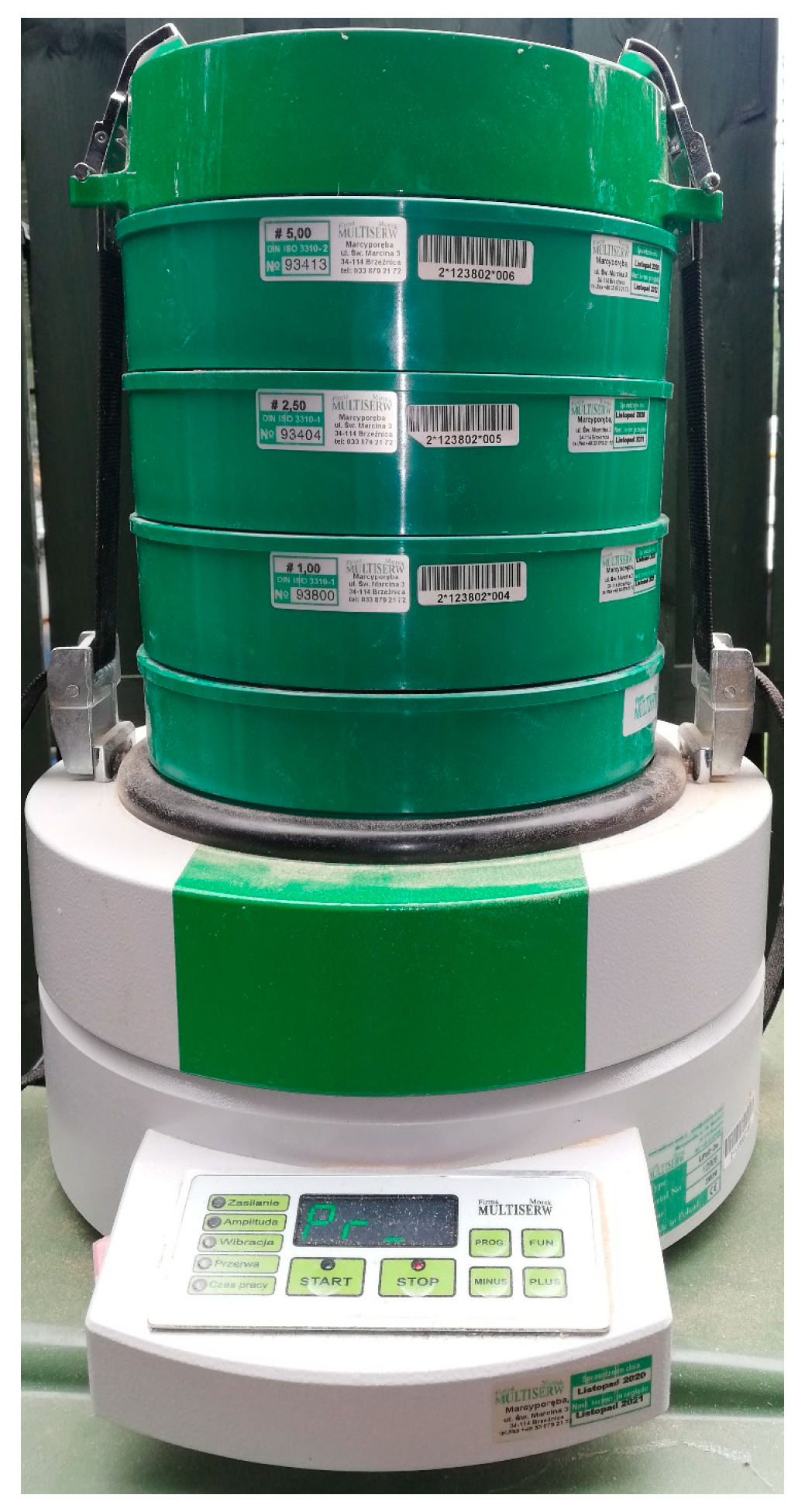
The study used sawdust with two moisture levels. The first moisture level was approximately 9%, and sawdust with this moisture content was classified as dry. It was obtained by drying with a fan heater. This therefore requires additional electricity consumption. The second moisture level was 20%, which the sawdust reached as a result of aging in a dry room at room temperature. During drying, the moisture level was monitored on an ongoing basis until the desired level was achieved, using a Mettler Toledo moisture analyzer (Mettler Toledo, type HR83; Mettler-Toledo AG, 2009, Urdorf, Switzerland). Before the start of the tests, the sawdust was screened to obtain the appropriate fractions related to the particle size, which were then subjected to a compaction process (see Figure 1). For this purpose, a laboratory sieve model LPzE-2e, manufactured by Multi-serw-Morek, Brzeźnica, Poland (see Figure 1), was used, which was constructed using laboratory sieves compliant with [34,35].
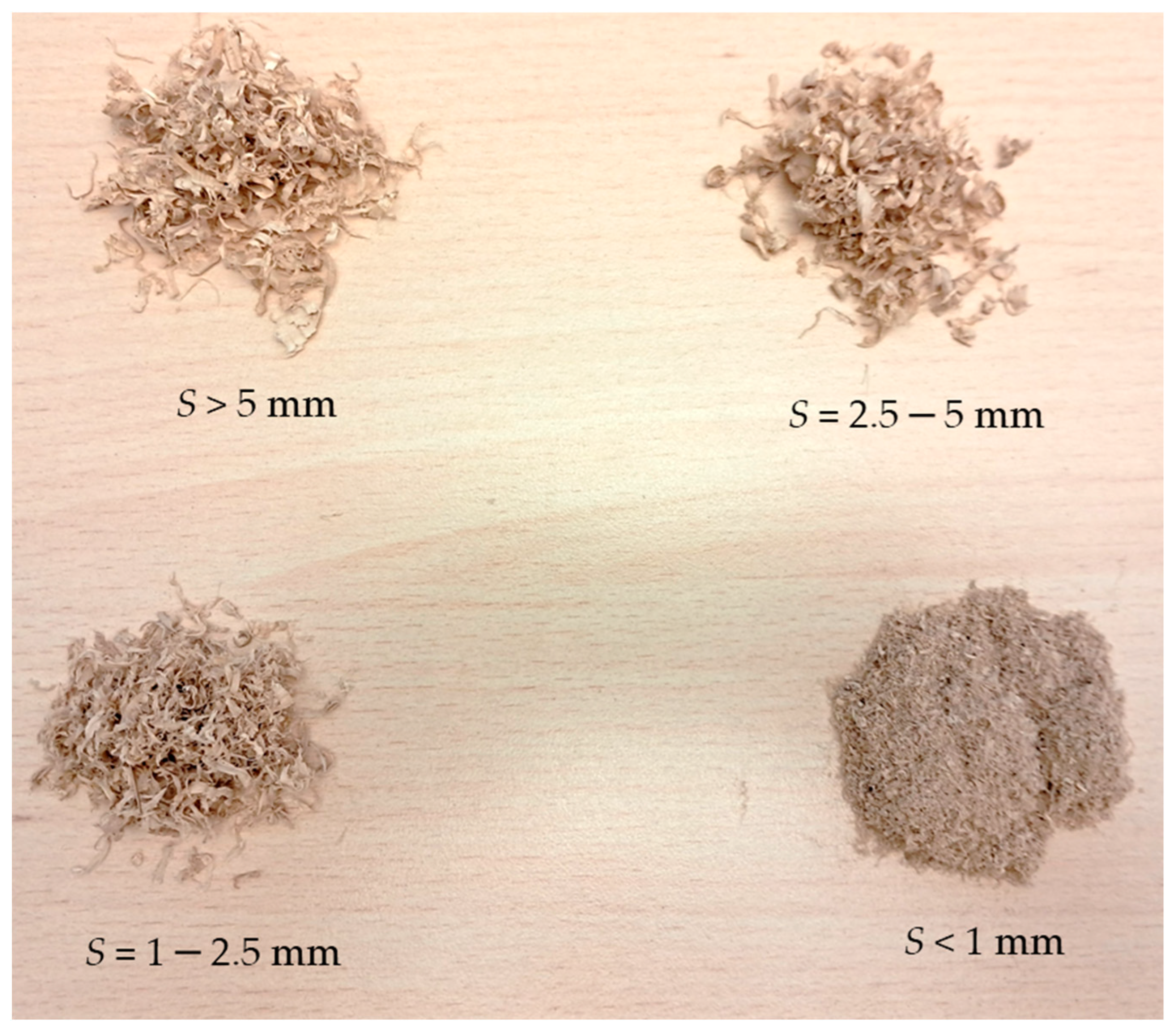
This resulted in the following oak sawdust particle size fractions: S < 1 mm, S = 1–2.5 mm, S = 2.5–5 mm, S > 5 mm (see Figure 2).
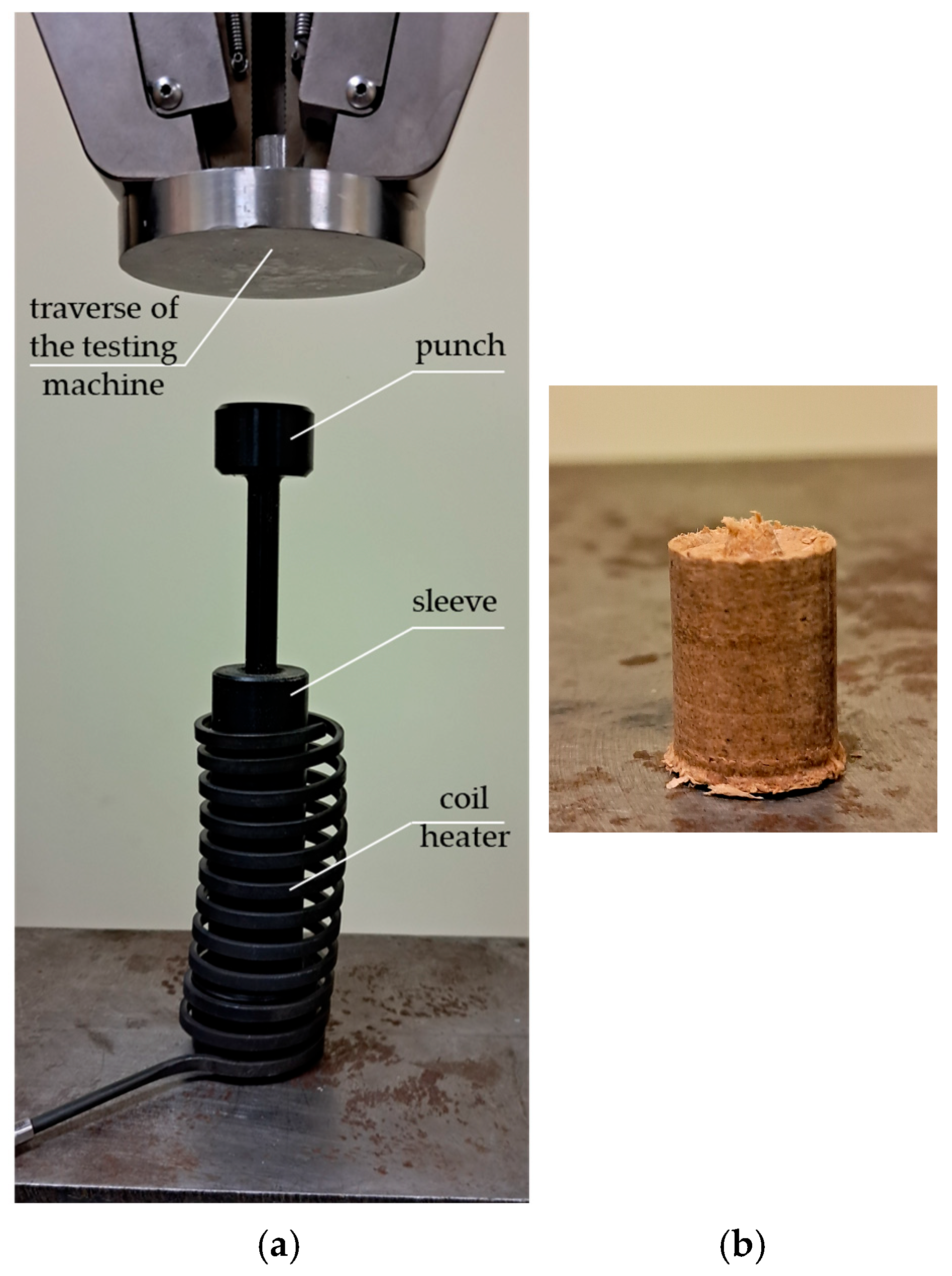
The sawdust material prepared in this way was subjected to a compaction process with a force of 5 kN, 10 kN, 15 kN, 20 kN, and 25 kN at temperatures of 25, 100, 150, and 200 °C. Compaction was performed using a punch-bush assembly with a coil heater shown in Figure 3a. The diameter of both the punch and the sleeve was 10 mm.
For each set of process input parameters, i.e., temperature, compaction force, moisture content, and sawdust particle size, 10 compaction-unloading tests were performed. Based on the obtained characteristics of the change in compaction force (its increase to the set value) as a function of the displacement of the compaction piston, the density of the obtained briquette was determined. Before the test, the amount of sawdust that was poured into the sleeve and compacted by the punch, whose displacement and force were applied by the MTS Insight 50 kN strength testing machine (see Figure 3a), was weighed with a laboratory scale. After compaction, the volume of the briquette obtained was determined. The obtained information made it possible to determine the density D of the briquette produced in each test. Figure 3b shows an example of a briquette obtained from the experiments.
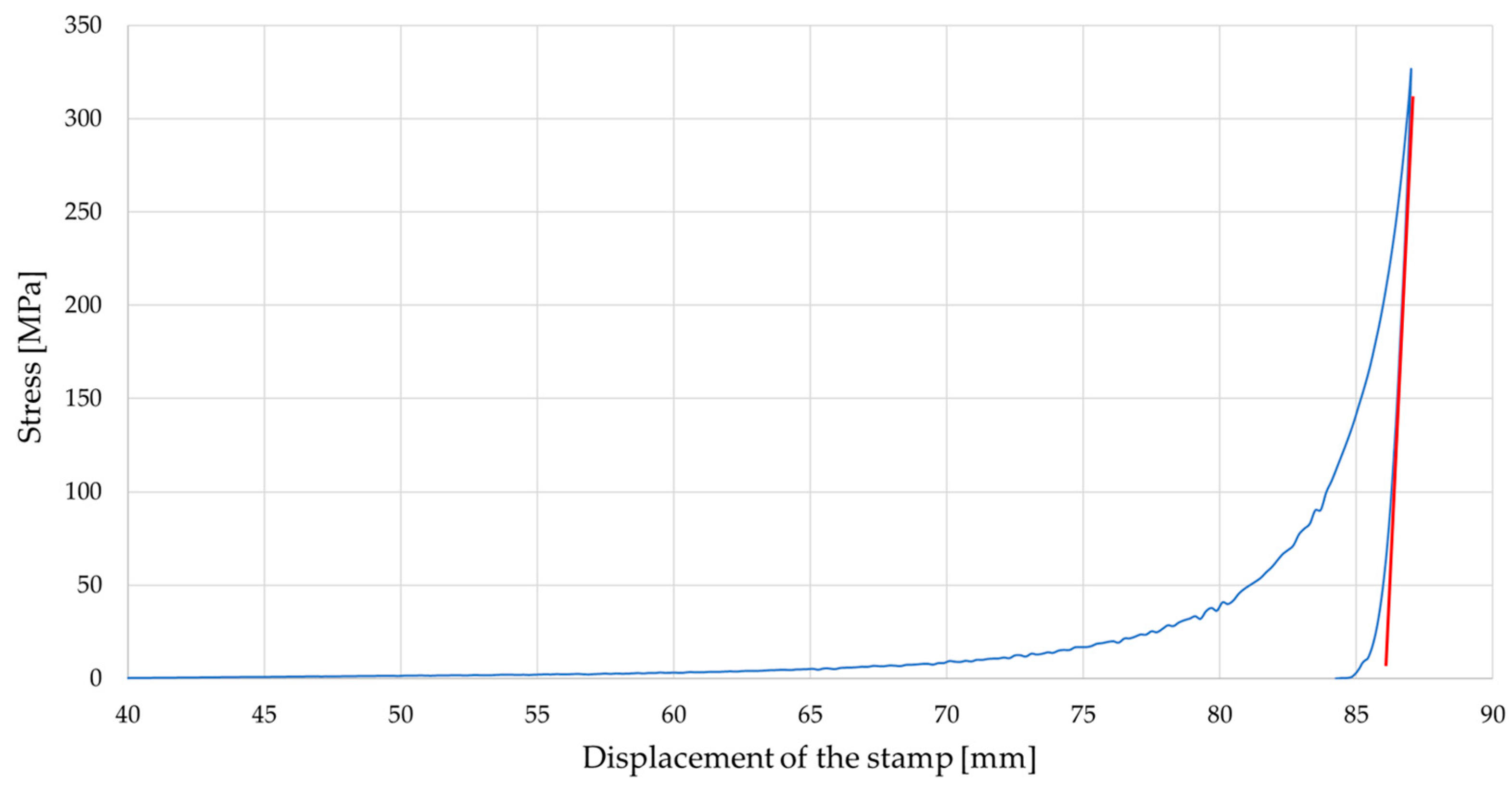
One of the basic parameters required for numerical modeling using the Finite Element Method (FEM) is Young’s modulus. During the analysis of the compaction process, determining this parameter is challenging, as from the very beginning of the process a complex phenomenon occurs that simultaneously involves elastic and plastic deformations of the fragmented material particles. One of the commonly used methods for determining the averaged value of the elastic modulus for such materials is to perform a compaction test followed by unloading of the compacted sample [36]. Young’s modulus E for each conducted test (under specified settings) was determined based on the curve obtained from the compaction–unloading process. Specifically, the segment of the curve corresponding to the unloading phase was used. Two points were identified on this segment, through which a tangent to the unloading curve was drawn (see Figure 4, the red tangent line). Based on the stress and strain values determined at these points, the changes in stress and strain were calculated, which enabled the determination of Young’s modulus using the fundamental relationship:
E = ΔStress/ΔStrain = (Stress2 − Stress1)/(Strain2 − Strain1)
Figure 4 shows an example of the characteristic of changes in the compaction stress σc as a function of the displacement of the piston, obtained on the basis of the tests carried out. The characteristic shown was performed for each test and was also used to determine the value of Young’s modulus.
Table 1 presents the average values of density D and Young’s modulus E from all samples.

3. Results and Discussion

In Table 1, the average values of the density D and Young modulus E for all the conditions applied during the sawdust densification process are presented. It should be remembered that for each process setting value the test was repeated 10 times.
The above research results were used for an Analysis of Variance (ANOVA). Table 2 presents the input data and the responses used for the analysis.

3.1. Multivariate Analysis of Density D

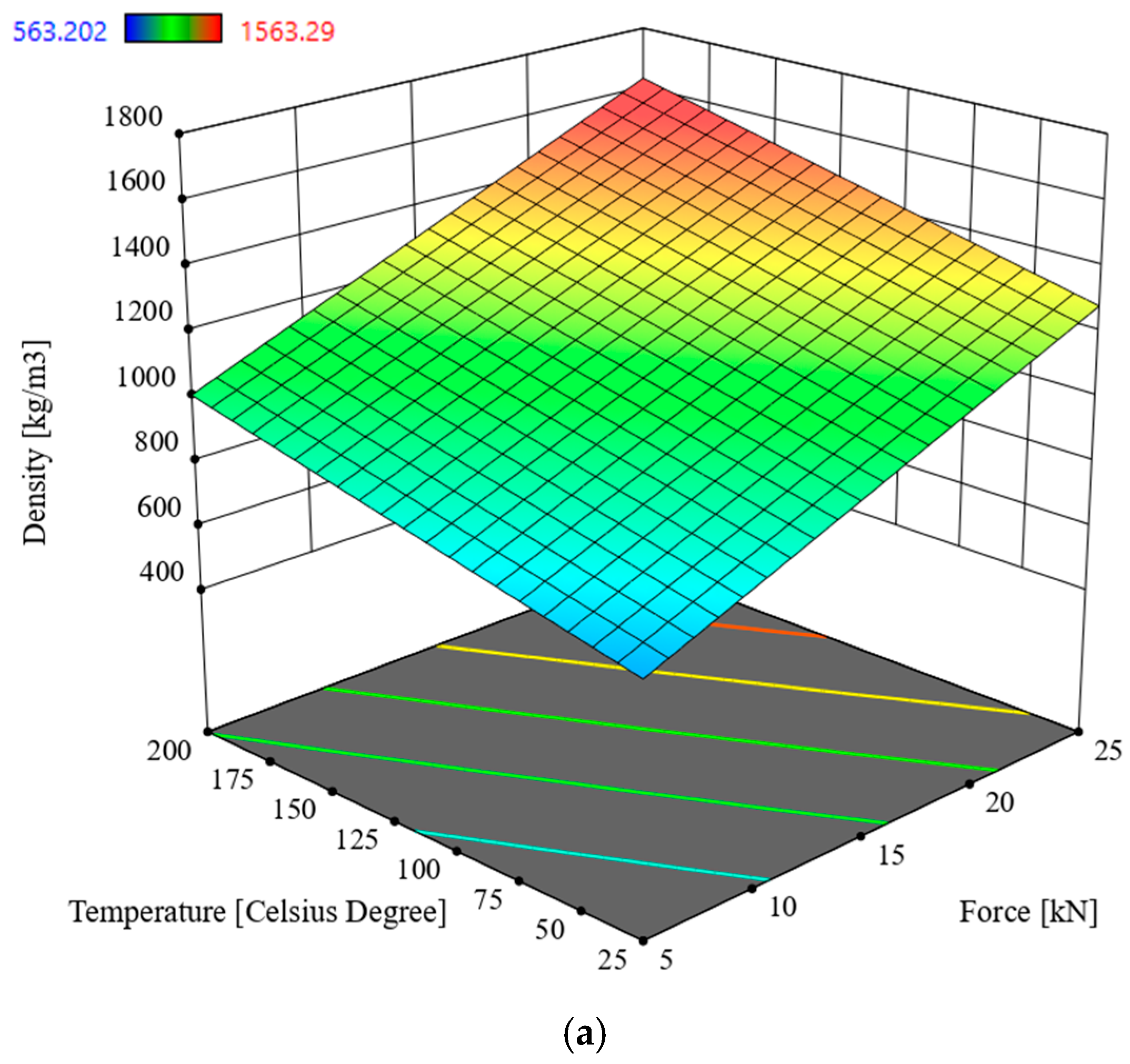
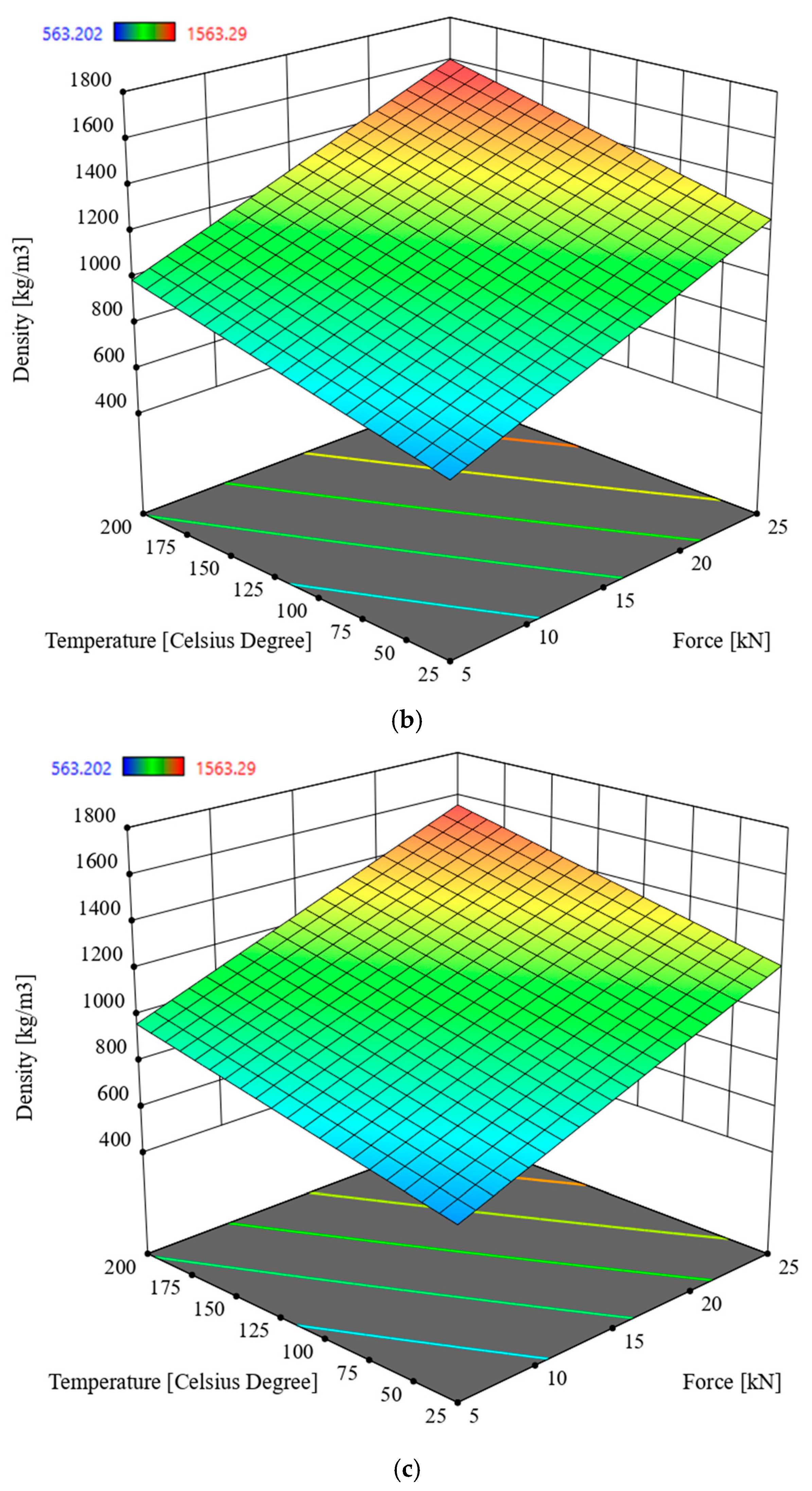
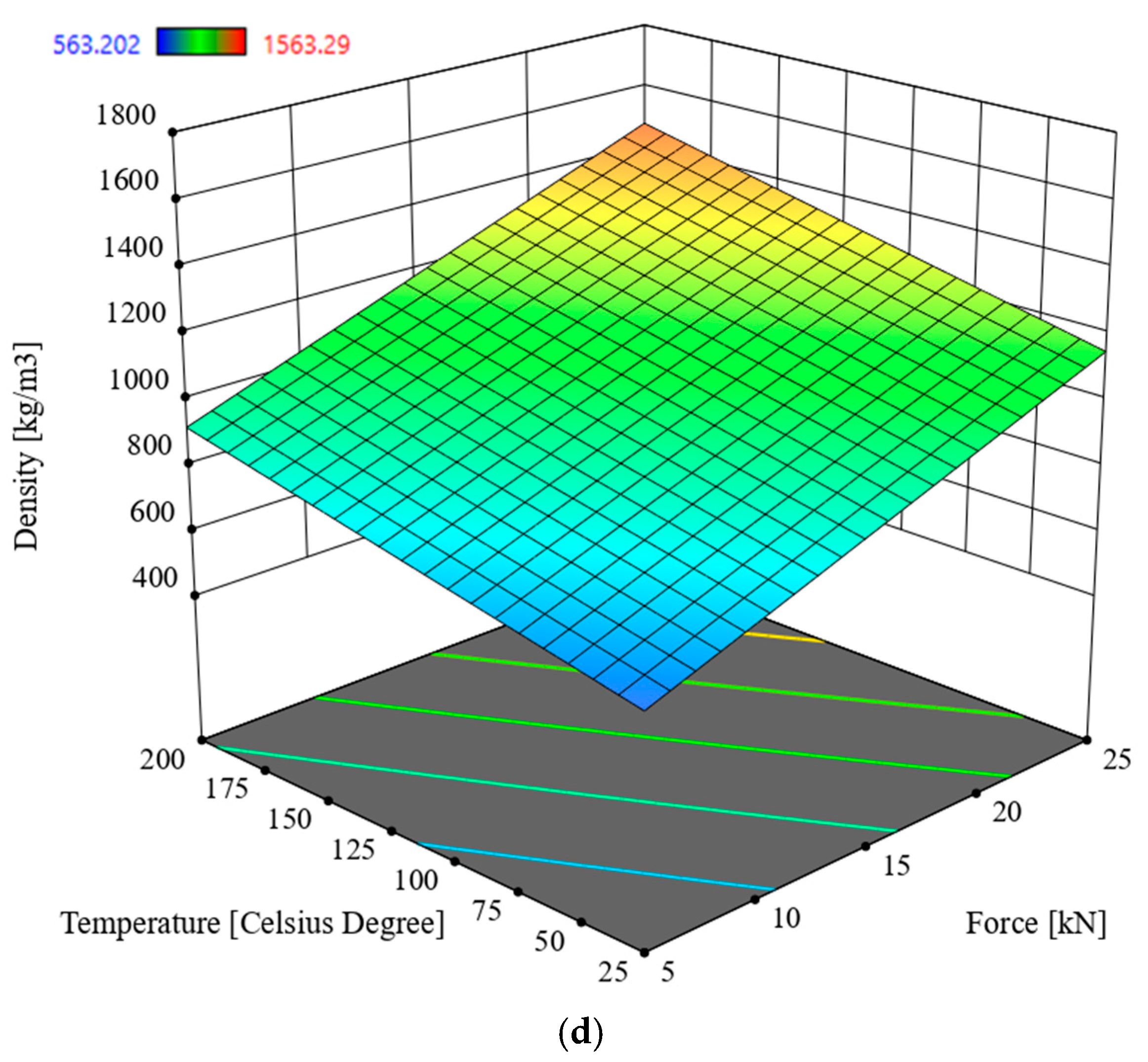
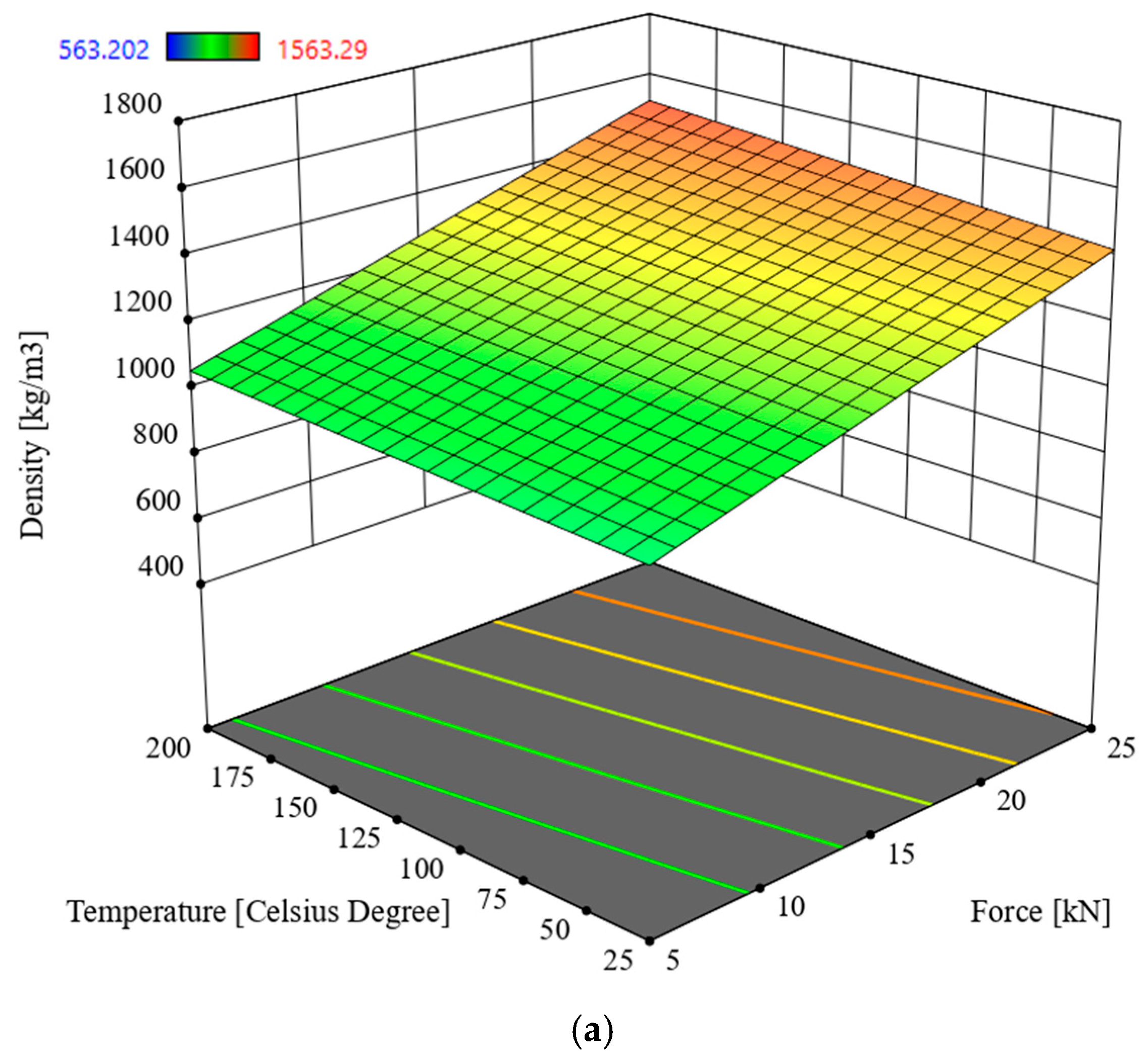
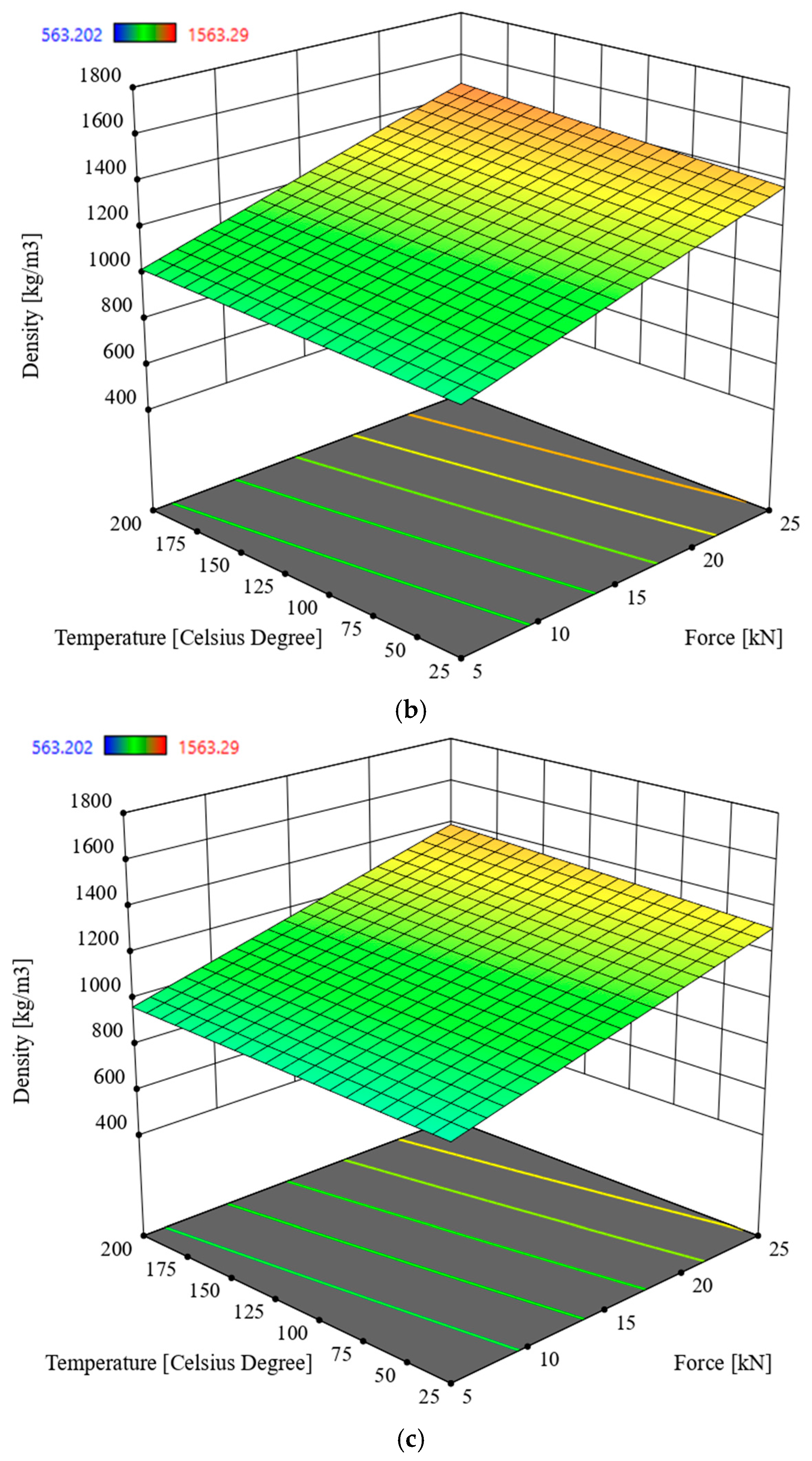
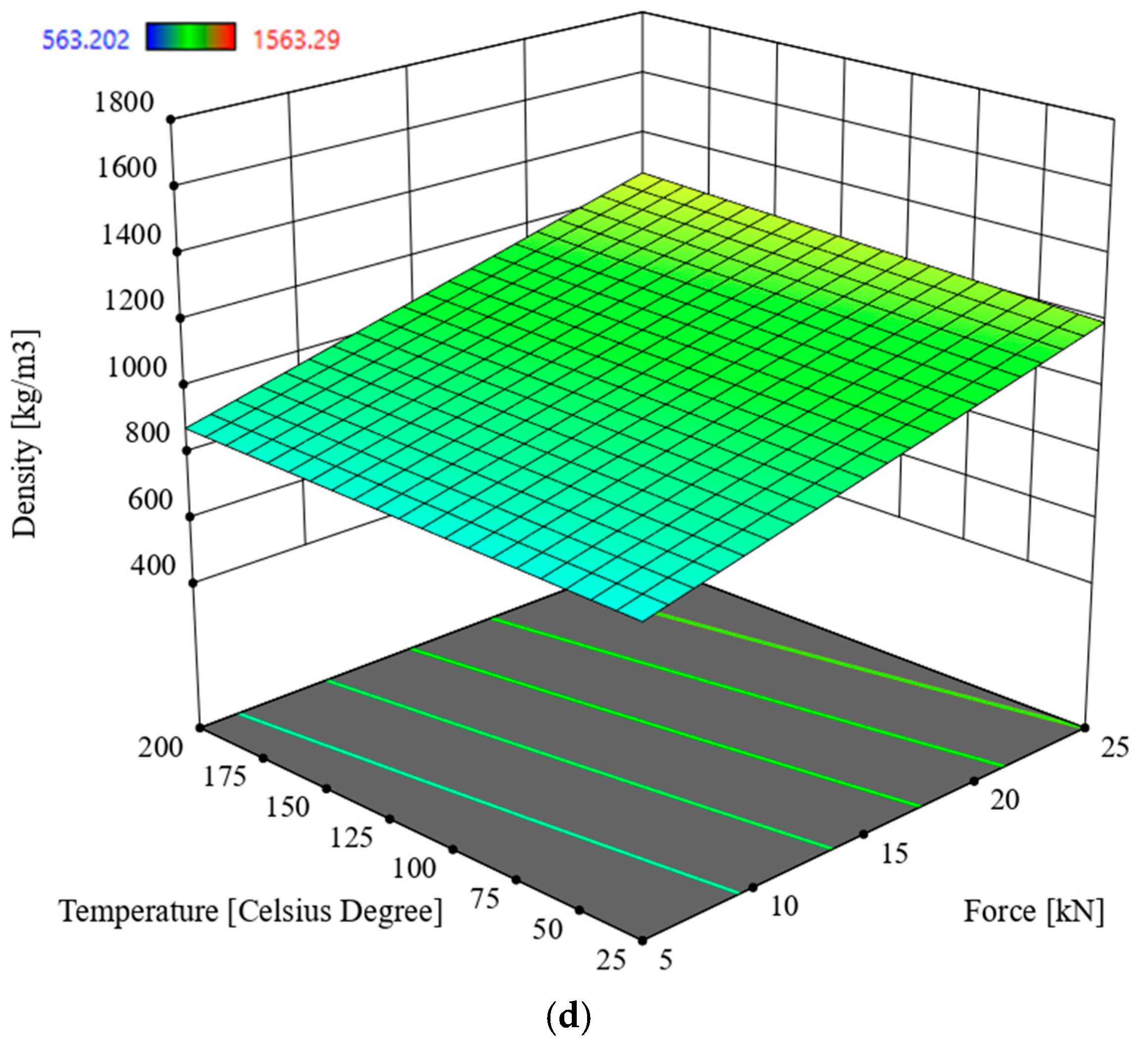
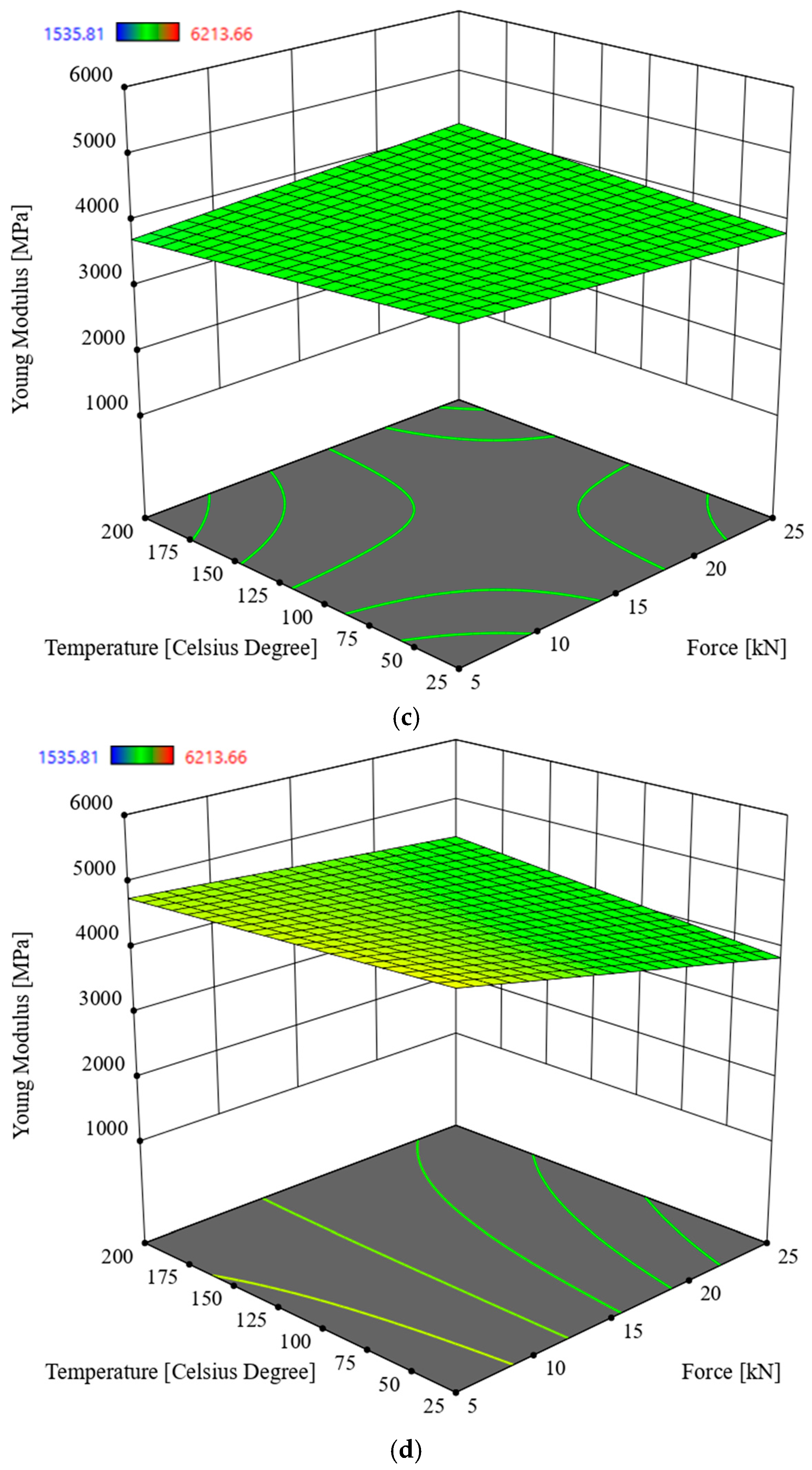
In order to determine the interactions between the input parameters of the process and the response in the form density D of oak sawdust briquettes, Analysis of Variance (ANOVA) was used. The analysis utilized the Reduced 2FI model, which is significant for the analyzed parameters and response. This model is characterized by a significance level of p < 0.0001 and an R2 = 0.8580. The model’s F-statistic value is 90.03 (see Table 3), indicating that the model is significant. The individual components of the model have a significance level p lower than 0.05, which makes the model significant. By using the model described by the correlation (2), it is possible to navigate the experimental design space, as the condition is met: (Predicted R2—Adjusted R2) < 0.2 and Adeg Precision = 43.6013. The model graph is shown in Figure 5 and Figure 6.
D = 192.93451 + 4.83688 × S + 18.02246 × F + 2.96192 T + 34.46923 × M − 0.323901 × S × F − 0.025348 × S × T − 1.61500 × S × M + 0.004380 × F × T − 0.372804 × F × M − 0.132079 × T × M
where D—density [kg/m3], S—particle size [mm], F—compaction force [kN], T—temperature [°C], M—moisture [%].
Based on the data in Table 3, the parameter in the form of compaction force F has a significant impact on briquette density, followed hierarchically by temperature and particle size. The highest density value was recorded for the lowest particle size, the highest compaction force and compaction temperature values, and a moisture content of 9%.

3.2. Multivariate Analysis of Young Modulus E

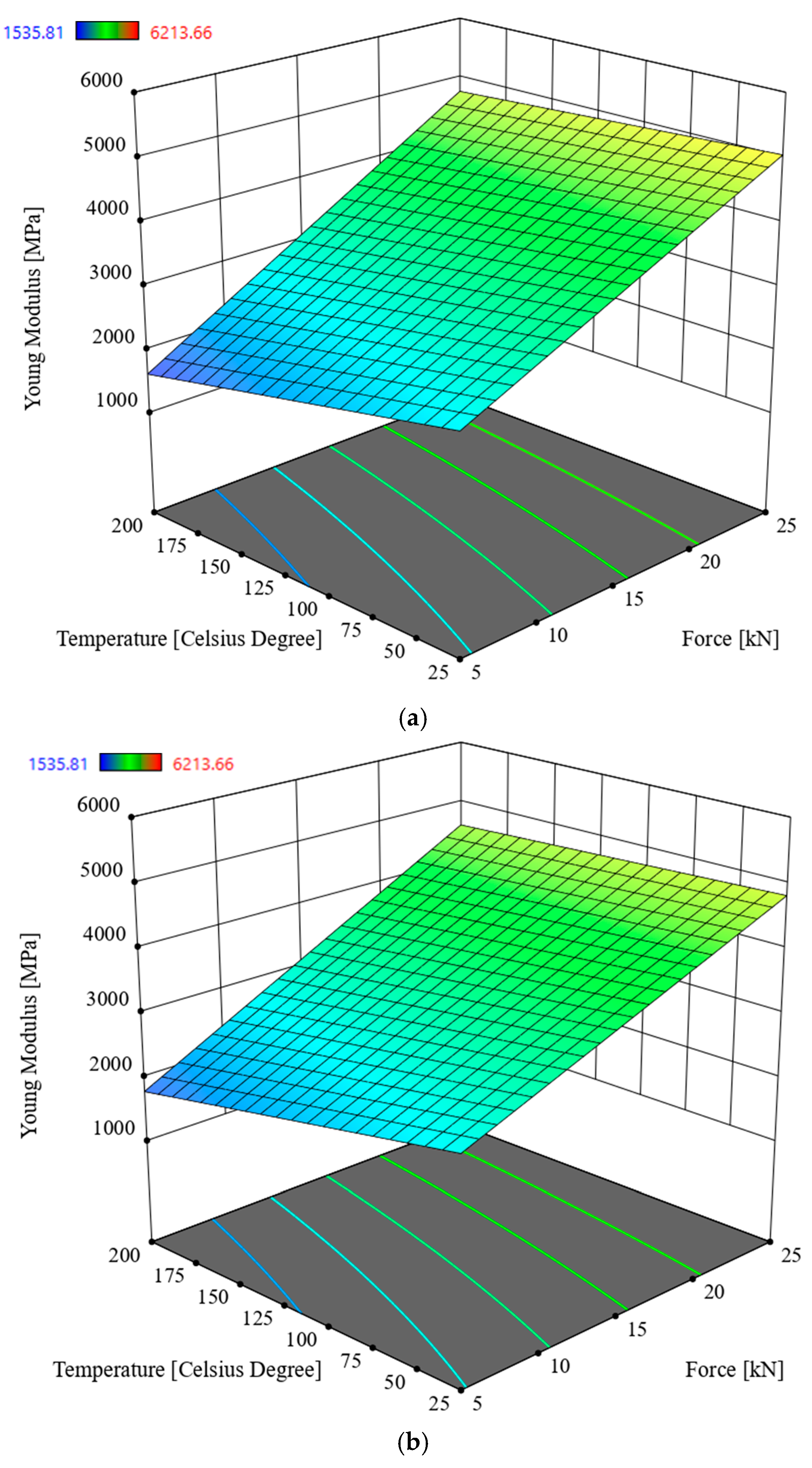
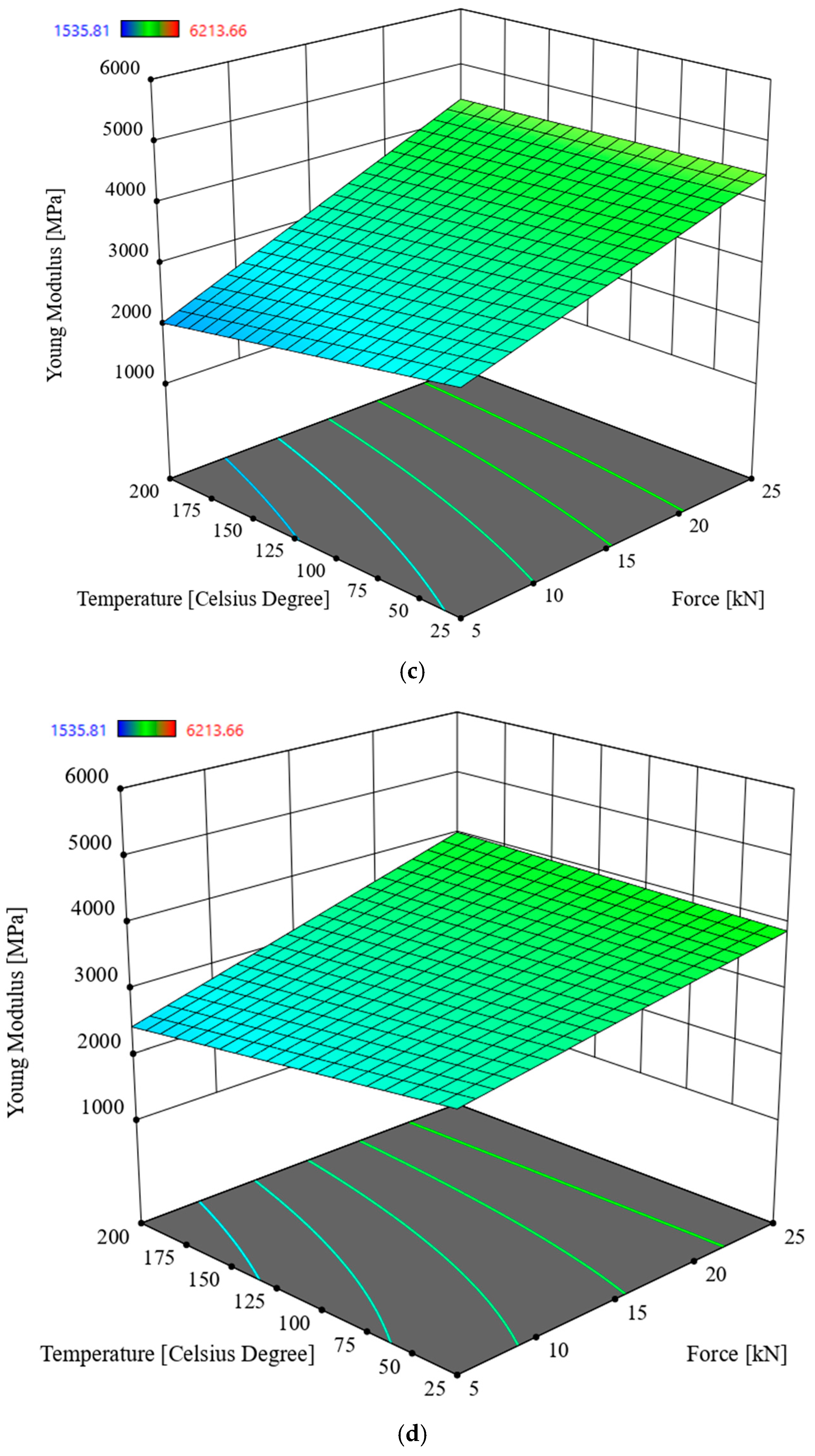
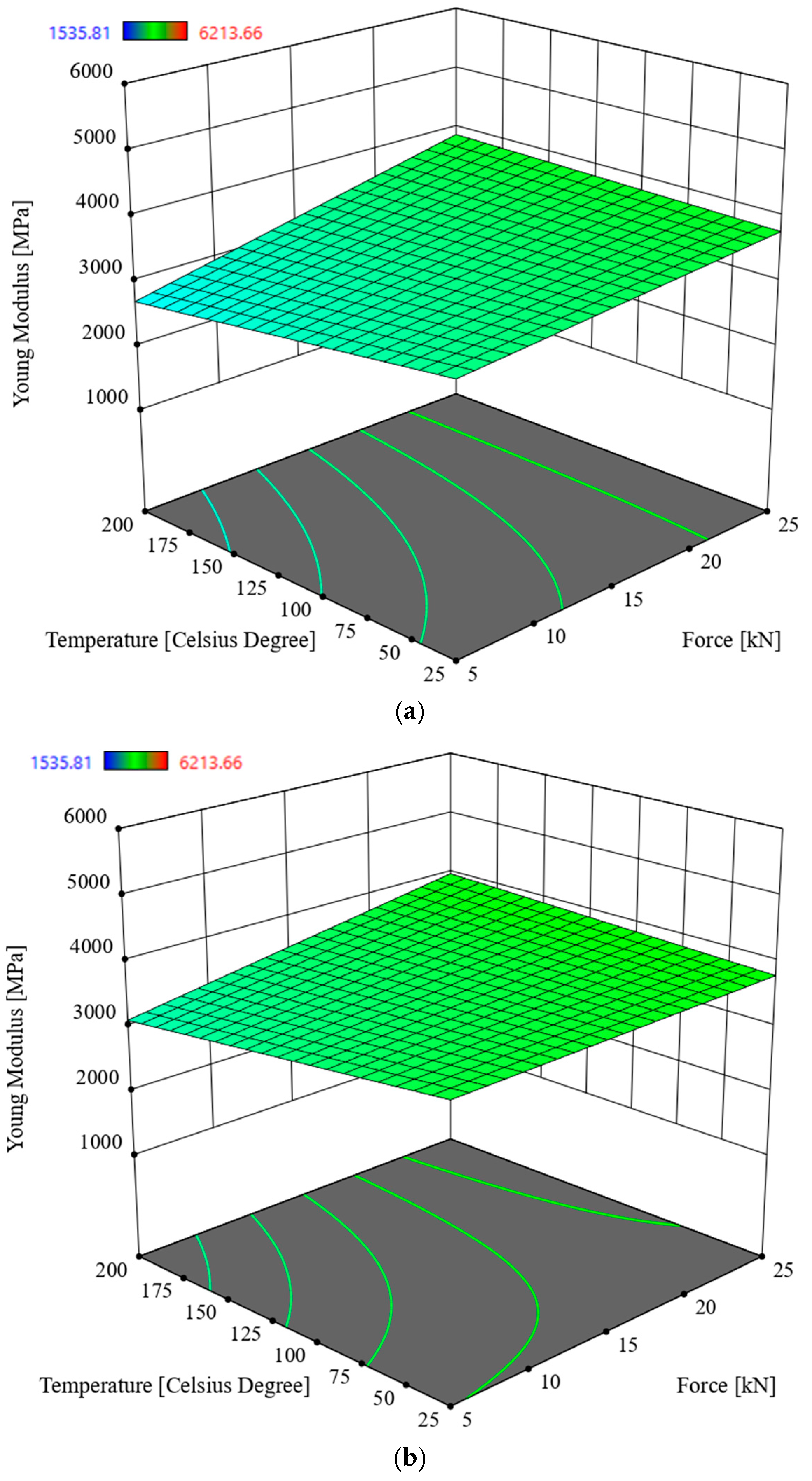
In order to determine the interactions between the input parameters of the process and the response in the Young modulus E of oak sawdust briquettes, Analysis of Variance (ANOVA) was used. The analysis utilized the Reduced 2FI model, which is significant for the analyzed parameters and response. This model is characterized by a significance level of p < 0.0001 and an R2 = 0.3221. The model’s F-statistic value is 7.08 (see Table 4), indicating that the model is significant. The individual components of the model have a significance level p lower than 0.05, which makes the model significant. By using the model described by the correlation (3), it is possible to navigate the experimental design space, as the condition is met: (Predicted R2—Adjusted R2) < 0.2 and Adeg Precision = 12.4208. The model graph is shown in Figure 7 and Figure 8.
E = 1360.61432 − 52.98012 × S + 193.06188 × F − 9.05474 × T + 101.41014 × M − 15.65047 × S × F + 0.472220 × S × T + 22.43142 × S × M + 0.221487 × F × T − 8.88581 × F × M + 0.207498 × T × M
where D—density [kg/m3], S—particle size [mm], F—compaction force [kN], T—temperature [°C], M—moisture [%].
Based on the data contained in Table 4, the parameter in the form of compaction force F has the most significant impact on briquette density, followed hierarchically by moisture content, particle size, and temperature. The highest value of Young’s modulus E was recorded for 9% moisture content, the highest compaction force value, i.e., 25 kN, the lowest temperature value, and the lowest particle size (see Figure 7 and Figure 8).

3.3. Optimization of the Selection of Compaction Process Parameters

Based on the obtained test results and the determined values of density D and Young’s modulus E, the process parameters were optimized. The optimization criteria are presented in Table 5. Due to the desire to minimize the energy consumption of the compaction process, the criterion for the compaction force and compaction temperature values was to minimize these values. For the density D of the briquette and Young’s modulus E, the aim was to achieve their maximum values in order to obtain the best calorific value, which goes hand in hand with an increase in density, and to obtain the highest value of modulus E in order to achieve the best mechanical properties (durability), taking into account the storage and transport of the briquette.
The optimization results are presented in Table 6.
According to Table 6, the best input parameters for the process to meet the objectives set out in Table 5 will be to carry out the briquetting process of oak sawdust with particles in the range S = 2.5–5 mm, with a compaction force of approximately 5 kN at ambient temperature for sawdust moisture content of approximately 20%. This value of moisture content that the sawdust reaches after an appropriate period of aging in a room at room temperature, which does not require additional energy input for drying, except for the appropriate storage time, the amount of which will depend on the initial moisture content of the sawdust. The disadvantage of using a defined fraction, i.e., S = 2.5–5 mm, for compaction is the need to consume energy to power the sifter. Results of optimization show that, if we still insist on minimizing the energy required to produce briquettes, we can skip the sawdust sieving process, obtaining (see Figure 7 and Figure 8) briquettes with a density D that is about 3% lower and a Young’s modulus E that is approximately 6% higher, while maintaining the values of the other input parameters of the compaction process unchanged (see Table 6).
According to the analysis, the compaction force plays a key role, while the process temperature and sawdust moisture content also play a significant, albeit secondary, role. Carrying out the compaction process at a higher temperature is pointless, as it prolongs the material’s heating time and adversely affects its durability. Sitzmann and Buschhart also reached this conclusion [37]. The impact of the compaction force promotes the spread of lignin within the particle structure, where it is transferred to adjacent particles, causing them to bond. This is especially true because the particles deform under the influence of the compaction force, and the distances between them decrease, eliminating empty spaces. Proteins and starch may perform a similar function, gelling individual particles together in the presence of water [38]. Soo min Lee et al. found that during the compaction process of larch and tulipwood sawdust, increasing temperature and moisture improves pellet durability, and lignin is a natural binder between particles [39]. Robert Samuelsson et al., in turn, found that conducted a study on the densification of Scots pine and spruce sawdust. The results showed that low moisture content and long storage time had a positive effect on the increase in density, energy consumption of the pelletizer, mechanical strength of the pellets, and their quality [40]. According to the study results, in the case of densification of oak sawdust, a higher moisture content resulted in a lower density value, which negatively translated into relaxation (the authors noted that relaxation after densification reached higher values). According to So min Lee [39], higher moisture content has a positive effect, and according to Robert Samuelsson et al. [40], a negative effect on the densification process, which depends on the type of material being densified. Similar results were obtained by Roberto García et al. during the pelleting of pine sawdust. The team found that adding small amounts of lignin-rich additives improved the natural binding properties, and that a total moisture content of 13% and the addition of 10% to 20% glycerol improved the densification properties and increased the fuel’s calorific value [41]. The increase in density with increasing temperature, and the resulting higher density for a moisture content of 9% in sawdust, can be explained by the fact that evaporating water does not increase the sample volume, which causes an increase in briquette density. The softening effect of temperature causes a decrease in Young’s modulus E (Figure 5, Figure 6, Figure 7 and Figure 8), making the sawdust more susceptible to the applied densification force, which in turn contributes to an increase in briquette density [38]. Stefan Frodeson et al., who studied the effect of moisture content of compacted material from pine, spruce, and beech sawdust on the energy demand of the compaction process, found that when compacting with a low force of up to 5 kN, the water content of the material did not affect the amount of energy required for the compaction process. The situation was different for compaction with a force above this value. Another conclusion of the researchers was that moisture content has a significant effect on polysaccharide biomass, which is reflected in the compaction process [42]. In the present study, compacting sawdust with a force of 5 kN corresponds to a compressive stress of approximately 63.7 MPa for a sample compacted in a 10 mm diameter sleeve.

4. Conclusions

Research was conducted on the compaction process of waste material in the form of oak sawdust, for moisture content of 9% and 20%, compaction force F of 5, 10, 15, 20, and 25 kN, process temperatures of 25 °C, 50 °C, 100 °C, 150 °C, and 200 °C, and fractions obtained by screening with particle sizes in the ranges S < 1 mm, S = 1–2.5 mm, S = 2.5–5 mm, and S > 5 mm as process settings made it possible to determine the response in the form of the density D of the obtained briquette and its Young’s modulus E. ANOVA was used to analyze the interaction between the above-mentioned input parameters and the obtained responses. On this basis, the following conclusions were drawn and the selection of compaction process parameters was optimized:
-
for sawdust moisture content of 9%, the most significant influence on briquette density D is exerted by compaction force F, followed by temperature T and particle size S,
-
the highest density value was recorded for the lowest particle size, the highest compaction force and compaction temperature, and a moisture content of 9% (see Figure 5 and Figure 6),
-
for sawdust moisture content of 20%, the parameter in the form of compaction force F has a significant impact on briquette density, followed by moisture content, temperature, and particle size,
-
the highest Young’s modulus E was recorded for 9% moisture content, the highest compaction force of 25 kN, the lowest temperature, and the lowest particle size (see Figure 7 and Figure 8),
-
analysis of variance (ANOVA) enabled the optimal selection of compaction process parameters, where the main criterion in general terms was to minimize the energy consumption of the compaction process,
-
the best mechanical properties of the briquette, while maintaining the objective of minimizing the energy consumption of the process (see Table 5), can be obtained for the process settings of F = 5 kN, M = 20%, T = 25 °C, S = 2.5–5 mm (see Table 6),
-
by foregoing sieving (i.e., further reducing the energy consumption of the process), we can obtain briquettes with a density D approximately 3% lower and a Young’s modulus E approximately 6% higher than that obtained from sawdust fractions with particle sizes S = 2.5–5 mm (this results by optimization was given where F = 5 kN, M = 20%, T = 25 °C, S > 5 mm, D = 840.4 kg/m3, E = 5016.6 MPa).

Author Contributions

Conceptualization, D.W. (Dominik Wilczyński); methodology, D.W. (Dominik Wilczyński), K.T. and Ł.W.; software, D.W. (Dominik Wilczyński); validation, D.W. (Dominik Wilczyński) and K.W.; formal analysis, D.W. (Dominik Wilczyński), K.T., D.W. (Dominik Wojtkowiak), T.D., M.K., Z.S., K.K., A.K. and M.S.; investigation, D.W. (Dominik Wilczyński), K.T. and Ł.W.; resources, D.W. (Dominik Wilczyński); data curation, D.W. (Dominik Wilczyński); writing—original draft preparation, D.W. (Dominik Wilczyński), K.T., K.W. and D.W. (Dominik Wojtkowiak); writing—review and editing, D.W. (Dominik Wilczyński), K.T., K.W., D.W. (Dominik Wojtkowiak), T.D., M.K., Z.S., K.K., A.K. and M.S.; visualization, D.W. (Dominik Wilczyński) and K.T.; supervision, D.W. (Dominik Wilczyński); project administration, D.W. (Dominik Wilczyński); funding acquisition, K.T. All authors have read and agreed to the published version of the manuscript.

Funding

This research received no external funding.

Institutional Review Board Statement

Not applicable.

Informed Consent Statement

Not applicable.

Data Availability Statement

The original contributions presented in this study are included in the article. Further inquiries can be directed to the corresponding author.

Acknowledgments

This work was supported by the Ministry of Science and Higher Education in Poland from the subsidy for the maintenance and development of research capacities.

Conflicts of Interest

Author Maciej Szulc was employed by the company MSprojekt plus Sp. z o.o. The remaining authors declare that the research was conducted in the absence of any commercial or financial relationships that could be construed as a potential conflict of interest.

References

  1. Tang, W.S. Powering a safer future with novel energy solutions. Am. Ceram. Soc. Bull. 2025, 104, 26–33. [Google Scholar]
  2. Global Energy Review 2025; International Energy Agency: Paris, France, 2025.
  3. Mohsen, F.M.; Mjbel, H.M.; Challoob, A.F.; Alkhazaleh, R.; Alahmer, A. Advancements in green hydrogen production: A comprehensive review of prospects, challenges, and innovations in electrolyzer technologies. Fuel 2026, 404, 136251. [Google Scholar] [CrossRef]
  4. Seboka, A.D.; Morken, J.; Adaramola, M.S.; Ewunie, G.A.; Feng, L. Optimization of briquetting parameters and their effects on thermochemical fuel properties of biowaste briquettes. Bioresour. Technol. Rep. 2026, 404, 133277. [Google Scholar] [CrossRef]
  5. Wyszomierski, R.; Bórawski, P.; Bełdycka-Bórawska, A. Competitive Potential of Plant Biomass in Poland Compared to Other Renewable Energy Sources for Heat and Electricity Production. Energies 2025, 18, 1892. [Google Scholar] [CrossRef]
  6. Mortadha, H.; Kerrouchi, H.B.; Al-Othman, A.; Tawalbeh, M. A Comprehensive Review of Biomass Pellets and Their Role in Sustainable Energy: Production, Properties, Environment, Economics, and Logistics. Waste Biomass Valorization 2025, 16, 4507–4539. [Google Scholar] [CrossRef]
  7. Coelho Junior, L.M.; Diniz, F.F.; Martins, J.M.; Fuinhas, J.A.; Simoni, F.J.; Santos Júnior, E.P. Worldwide concentration of forest products for energy. Sustain. Energy Technol. Assess. 2025, 77, 104331. [Google Scholar] [CrossRef]
  8. Aphraim, A.; Arlabosse, P.; Nzihou, P.; Minh, D.P.; Sharrock, P. Biomass categories. In Handbook on Characterization of Biomass, Biowaste and Related By-Products, 1st ed.; Nzihou, A., Ed.; Springer International Publishing: Cham, Switzerland, 2020; pp. 1–29. [Google Scholar]
  9. Padder, A.S.; Khan, R.; Rather, R.A. Biofuel generations: New insights into challenges and opportunities in their microbe-derived industrial production. Biomass Bioenergy 2024, 185, 107220. [Google Scholar] [CrossRef]
  10. Warguła, Ł.; Wilczyński, D.; Wieczorek, B.; Palander, T.; Gierz, Ł.; Nati, C.; Sydor, M. Characterizing Sawdust Fractional Composition from Oak Parquet Woodworking for Briquette and Pellet Production. Adv. Sci. Technol. Res. J. 2023, 17, 236–247. [Google Scholar] [CrossRef]
  11. Ibitoye, S.E.; Mahamood, R.M.; Jen, T.-C.; Loha, C.; Akinlabi, E.T. An overview of biomass solid fuels: Biomass sources, processing methods, and morphological and microstructural properties. J. Bioresour. Bioprod. 2023, 8, 333–360. [Google Scholar] [CrossRef]
  12. Tumuluru, J.S.; Wright, C.T.; Hess, J.R.; Kenney, K.L. A review of biomass densification system to develop uniform feedstock commodities for bioenergy application. Biofuels Bioprod. Biorefin. 2011, 5, 683–707. [Google Scholar] [CrossRef]
  13. Liu, J.; Li, T.; Liu, T.; Cai, H. Parametric studies on energy utilization of the Chinese medicine residues: Preparation and properties of densified pellet. Heliyon 2024, 10, e36947. [Google Scholar] [CrossRef]
  14. Bala-Litwiniak, A.; Musiał, D.; Nabiałczyk, M. Computational and Experimental Studies on Combustion and Co-Combustion of Wood Pellets with Waste Glycerol. Materials 2023, 16, 7156. [Google Scholar] [CrossRef]
  15. Liu, S.; Zhang, Y.; Su, Z.; Jiang, T. Improving the Properties of Magnetite Green Pellets with a Novel Organic Composite Binder. Materials 2022, 15, 6999. [Google Scholar] [CrossRef]
  16. Laosena, R.; Palamanit, A.; Luengchavanon, M.; Kittijaruwattana, J.; Nakason, C.; Lee, S.H.; Chotikhun, A. Characterization of Mixed Pellets Made from Rubberwood (Hevea brasiliensis) and Refuse-Derived Fuel (RDF) Waste as Pellet Fuel. Materials 2022, 15, 3093. [Google Scholar] [CrossRef] [PubMed]
  17. Horabik, J.; Bańda, M.; Józefaciuk, G.; Adamczuk, A.; Polakowski, C.; Stasiak, M.; Parafiniuk, P.; Wiącek, J.; Kobyłka, R.; Molenda, M. Breakage Strength of Wood Sawdust Pellets: Measurements and Modelling. Materials 2021, 14, 3273. [Google Scholar] [CrossRef]
  18. Styks, J.; Knapczyk, A.; Łapczyńska-Kordon, B. Effect of Compaction Pressure and Moisture Content on Post-Agglomeration Elastic Springback of Pellets. Materials 2021, 14, 879. [Google Scholar] [CrossRef] [PubMed]
  19. Tang, Y.; Chandra, R.P.; Sokhansanj, S.; Saddler, J.N. The Role of Biomass Composition and Steam Treatment on Durability of Pellets. BioEnergy Res. 2018, 11, 341–350. [Google Scholar] [CrossRef]
  20. Shang, L.; Nielsen, N.P.K.; Stelte, W.; Dahl, J.; Ahrenfeldt, J.; Holm, J.K.; Puig Arnavat, M.; Bach, L.S.; Henriksen, U.B. Lab and Bench-Scale Pelletization of Torrefied Wood Chips—Process Optimization and Pellet Quality. Bioenerg. Res. 2014, 7, 87–94. [Google Scholar] [CrossRef]
  21. Colley, Z.; Fasina, O.O.; Bransby, D.; Lee, Y.Y. Moisture effect on the physical characteristics of switchgrass pellets. Am. Soc. Agric. Biol. Eng. 2006, 49, 1845–1851. [Google Scholar] [CrossRef]
  22. Adapa, P.K.; Tabil, L.G.; Schoenau, G.J. Compaction characteristics of barley, canola, oat, and wheat straw. Biosyst. Eng. 2009, 104, 335–344. [Google Scholar] [CrossRef]
  23. Tumuluru, J.S. Effect of process variables on density and durability of pellets made from high moisture corn stover. Biosyst. Eng. 2014, 119, 45–57. [Google Scholar] [CrossRef]
  24. Orisaleye, J.I.; Ojolo, S.J.; Ajiboye, J.S. Pressure buildup and wear analysis of tapered screw extruder biomass briquetting machines. Agric. Eng. Int. CIGR J. 2019, 21, 122–133. [Google Scholar]
  25. Orisaleye, J.I.; Ojolo, S.J.; Ajiboye, J.S. Mathematical modelling of die pressure of a screw briquetting machine. J. King Saud. Univ.-Eng. Sci. 2019, 32, 555–560. [Google Scholar] [CrossRef]
  26. Kovacova, M.; Matúš, M.; Krizan, P.; Beniak, J. Design theory for the pressing chamber in the solid biofuel production process. Acta Polytech. 2014, 54, 28–34. [Google Scholar] [CrossRef]
  27. Adam, R.; Yiyang, D.; Kruggel-Emden, H.; Zeng, T.; Lenz, V. Influence of pressure and retention time on briquette volume and raw density during biomass densification with an industrial stamp briquetting machine. Renew. Energy 2024, 229, 120773. [Google Scholar] [CrossRef]
  28. Kamdem, B.M.; Lemaire, R.; Nikiema, J. Fuel briquettes produced via the co-treatment of wood sawdust, miscanthus and wheat straw: Physicochemical properties. Ind. Crop. Prod. 2025, 236, 121869. [Google Scholar] [CrossRef]
  29. Molenda, M.; Horabik, J.; Parafiniuk, P.; Oniszczuk, A.; Bańda, M.; Wajs, J.; Gondek, E.; Chutkowski, M.; Lisowski, A.; Wiącek, J.; et al. Mechanical and Combustion Properties of Agglomerates of Wood of Popular Eastern European Species. Materials 2021, 14, 2728. [Google Scholar] [CrossRef]
  30. Garrido, M.A.; Conesa, J.A.; Garcia, M.D. Characterization and Production of Fuel Briquettes Made from Biomass and Plastic Wastes. Energies 2017, 10, 850. [Google Scholar] [CrossRef]
  31. Orisaleye, J.I.; Jekayinfa, S.O.; Ogundare, A.A.; Shituu, M.R.; Akinola, O.O.; Odesanya, K.O. Effects of Process Variables on Physico-Mechanical Properties of Abura (Mitrogyna ciliata) Sawdust Briquettes. Biomass 2024, 4, 671–686. [Google Scholar] [CrossRef]
  32. Dudziak, M.; Knast, P.; Talaśka, K. Analysis of stability of stressed-skin constructions for transport of bulk raw materials. IOP Conf. Ser. Mater. Sci. Eng. 2020, 776, 012006. [Google Scholar] [CrossRef]
  33. Knast, P. Reduction of the value of the bend deflection arising due to external forces and gravity by applying the tensile stress to the axial alignment. IOP Conf. Ser. Mater. Sci. Eng. 2020, 776, 012005. [Google Scholar] [CrossRef]
  34. PN-ISO 3310-1; Tests for Geometrical Properties of Aggregates—Part 2: Determination of Particle Size Distribution—Test Sieves, Nominal Size of Apertures. Polish Committee for Standardization: Warsaw, Poland, 2021.
  35. ASTM E11; Standard Specification for Woven Wire Test Sieve Cloth and Test Sieves. Advancing Standards Transforming Markets: West Conshohocken, PA, USA, 2024.
  36. Cares-Pacheco, M.-G.; Cordeiro-Silva, E.; Gerardin, F.; Falk, V. Consistency in Young’s Modulus of Powders: A Review with Experiments. Powders 2024, 3, 280–304. [Google Scholar] [CrossRef]
  37. Sitzmann, W.; Buschhart, A. Pelleting as Prerequisite for the Energetic Utilization of by-Products of the Wood-Processing Industry; Amandus Kahl GmBH & Co.: Oslo, Norway, 2009. [Google Scholar]
  38. Carone, M.T.; Pantaleo, A.; Pellerano, A. Influence of process parameters and biomass characteristics on the durability of pellets from the pruning residues of Olea europaea L. Biomass Bioenergy 2011, 35, 402–410. [Google Scholar] [CrossRef]
  39. Lee, S.M.; Jun Ahn, B.; Ha Choi, D.; Han, G.S.; Jeong, H.S.; Ahn, S.H.; Yang, I. Effects of densification variables on the durability of wood pellets fabricated with Larix kaempferi C. and Liriodendron tulipifera L. sawdust. Biomass Bioenergy 2013, 48, 1–9. [Google Scholar] [CrossRef]
  40. Samuelsson, R.; Thyrel, M.; Sjöström, M.; Lestander, T.A. Effect of biomaterial characteristics on pelletizing properties and biofuel pellet quality. Fuel Process. Technol. 2009, 90, 1129–1134. [Google Scholar] [CrossRef]
  41. García, R.; González-Vázquez, M.P.; Pevida, C.; Rubiera, F. Pelletization properties of raw and torrefied pine sawdust: Effect of copelletization, temperature, moisture content and glycerol addition. Fuel 2018, 215, 290–297. [Google Scholar] [CrossRef]
  42. Frodeson, S.; Henriksson, G.; Berghel, J. Effects of moisture content during densification of biomass pellets, focusing on polysaccharide substances. Biomass Bioenergy 2019, 122, 322–330. [Google Scholar] [CrossRef]
Figure 1. General view of laboratory sieve shaker (model LPzE-2e, manufactured by Multiserw-Morek, Brzeźnica, Poland).
Materials 19 00119 g001
Figure 2. View of individual fractions of oak sawdust obtained in the sieving process.
Materials 19 00119 g002
Figure 3. General view: (a) of the punch-sleeve assembly with the coil heater, (b) of the briquette obtained after the compaction test with a force of 25 kN at a temperature of approximately 25 °C.
Materials 19 00119 g003
Figure 4. Characteristics of changes in compressive stress as a function of punch displacement for a compaction force of F = 25 kN, T = 25 °C and S < 1 mm.
Materials 19 00119 g004
Figure 5. Density of oak sawdust briquettes, D in the function of the compaction force F and the temperature T for moisture value 9%: (a) particle size S < 1 mm, (b) S = 1–2.5 mm, (c) S = 2.5–5 mm, (d) S > 5 mm.
Materials 19 00119 g005aMaterials 19 00119 g005bMaterials 19 00119 g005c
Figure 6. Density of oak sawdust briquettes, D in the function of the compaction force F and the temperature T for moisture value 20%: (a) particle size S < 1 mm, (b) S = 1–2.5 mm, (c) S = 2.5–5 mm, (d) S > 5 mm.
Materials 19 00119 g006aMaterials 19 00119 g006bMaterials 19 00119 g006c
Figure 7. Young modulus E of oak sawdust briquettes, in the function of the compaction force F and the temperature T for moisture value 9%: (a) particle size S < 1 mm, (b) S = 1–2.5 mm, (c) S = 2.5–5 mm, (d) S > 5 mm.
Materials 19 00119 g007aMaterials 19 00119 g007b
Figure 8. Young modulus E of oak sawdust briquettes in the function of the compaction force F and the temperature T for moisture value 20%: (a) particle size S < 1 mm, (b) S = 1–2.5 mm, (c) S = 2.5–5 mm, (d) S > 5 mm.
Materials 19 00119 g008aMaterials 19 00119 g008b
Table 1. The averaged values of the experimental results from 10 trials are presented as responses to the specific input settings of the process.
Particle Size S [mm]Compaction Force F [kN]Compaction Temperature T [°C]Moisture
M [%]
Density D [kg/m3]Standard Deviation of Density
σD
Young modulus E [MPa]Standard Deviation of
Young Modulus σE
<15259625.831.32246.38134.7
<151009996.769.81815.4290.7
<151509958.276.71734.03104.1
<152009975.719.51706.4668.2
<110259719.614.43693.53147.7
<11010091088.1131.62893.23318.2
<11015091052.9128.42893.54289.3
<11020091070.9133.82951.51354.1
<115259955.9119.44491.69539
<11510091317.3165.93328.44299.5
<11515091291.9164.13738.39299.1
<11520091311.8167.93770.82377.1
<1202591101.4132.15335.04533.5
<12010091456.8180.64032.68403.2
<12015091439.7175.64247.47509.6
<12020091461179.74342.71521.1
<1252591199.9149.96213.66745.6
<12510091549.4195.25046.81605.6
<12515091540.4195.64965.78595.8
<12520091563.3190.74771.34572.5
1–2.55259600.730.22134.06128.2
1–2.551009956.866.91724.6586.2
1–2.551509919.973.51647.3398.8
1–2.552009936.618.71621.1364.8
1–2.510259690.813.83508.85140.3
1–2.51010091044.6126.32748.57302.3
1–2.51015091010.8123.32748.86274.8
1–2.51020091028.1128.52803.93336.4
1–2.515259917.7114.74267.1512.1
1–2.51510091264.6159.33162.01284.5
1–2.51515091240.3157.53551.47284.1
1–2.51520091259.4161.13582.28358.2
1–2.5202591057.4126.85068.29506.8
1–2.52010091398.5173.43831.05383.1
1–2.52015091382.1168.64035.1484.2
1–2.52020091402.6172.54125.58495.2
1–2.5252591151.9143.95902.98708.3
1–2.52510091487.4187.44794.47575.3
1–2.52515091478.8187.84717.49566.1
1–2.52520091500.8183.14532.77543.9
2.5–55259581.929.32089.14125.3
2.5–551009926.964.81688.3484.4
2.5–551509891.171.21612.6596.7
2.5–552009907.418.11587.0163.4
2.5–510259669.213.33434.98137.3
2.5–51010091011.9122.42246.38295.9
2.5–5101509979.2119.41815.42269.2
2.5–5102009995.9124.41734.03229.3
2.5–515259889.1111.11706.46301.2
2.5–51510091225.1154.33693.53278.5
2.5–51515091201.5152.52893.23278.1
2.5–51520091220156.12893.54350.6
2.5–5202591024.3122.92951.51396.1
2.5–52010091354.8167.94491.69375.1
2.5–52015091338.9163.33328.44374.1
2.5–52020091358.7167.13738.39384.6
2.5–5252591115.9139.43770.82493.
2.5–52510091440.9181.55335.04563.2
2.5–52515091432.6181.94032.68554.1
2.5–52520091453.9177.34247.47532.4
>55259563.228.14342.71221.3
>55100989762.76213.66581.6
>551509862.468.95046.81493.6
>552009878.117.54965.78461.4
>510259647.612.94771.34332.9
>5101009979.3118.42134.06286.4
>5101509947.6115.61724.65260.4
>5102009963.9120.41647.33318.7
>515259860.4107.51621.13185.1
>51510091185.6149.33508.85269.6
>51515091162.8147.62748.57269.1
>51520091180.7151.12748.86339.3
>520259991.3118.92803.93480.1
>52010091311.1162.54267.1362.9
>52015091295.7158.43162.01458.7
>52020091314.9161.73551.47469.1
>5252591079.9134.93582.28671.9
>52510091394.4175.65068.29545.5
>52515091386.4176.13831.05536.3
>52520091406.9171.64035.1515.3
<152520911.745.54125.58207.6
<15100201211.884.85902.98119.6
<15150201134.490.74794.47144.7
<1520020964.319.24717.49102.3
<1102520995.719.94532.77166.2
<110100201269.3153.52089.14408.7
<110150201186.4144.71688.34398.7
<110200201056.5132.51612.65332.3
<11525201203150.31587.01228.2
<115100201408.4177.43434.98416.7
<115150201320.2167.62690.71328.5
<115200201288.6164.92690.99397.7
<12025201324.8158.92744.9263.9
<120100201486184.24177.27496.9
<120150201406.2171.53095.44467.2
<120200201431.1176.13476.7242.3
<12525201400.1175.13506.86301.9
<125100201528.9192.64961.59499.7
<125150201468.9186.53750.39227.5
<125200201527.1186.33950.15448.4
1–2.552520863.243.14038.72197.2
1–2.55100201147.380.35778.71113.6
1–2.5515020107485.94693.53137.5
1–2.5520020912.918.24618.1897.2
1–2.5102520942.718.84437.34157.9
1–2.510100201201.7145.42021.74388.3
1–2.510150201123.3137.31633.88378.8
1–2.510200201000.3125.41560.63105.7
1–2.51525201139142.31535.81196.8
1–2.515100201333.5168.13324.18295.9
1–2.515150201249.9158.72603.91207.1
1–2.515200201220.1156.12604.18272.8
1–2.52025201254.3150.52656.36235.7
1–2.520100201406.9174.44042.52472.1
1–2.520150201331.4162.42995.59333.8
1–2.520200201354.9166.63364.55210.2
1–2.52525201325.7165.73393.74266.8
1–2.525100201447.6182.34801.54569.7
1–2.525150201390.8176.63629.41591.1
1–2.525200201445.9176.33822.72516.2
2.5–552520795.339.73908.44293.1
2.5–55100201057.173.95592.3211.2
2.5–5515020989.679.14542.13134.6
2.5–5520020841.216.84469.21195.1
2.5–5102520868.617.34294.2154.6
2.5–510100201107.2133.93460.73380.1
2.5–510150201034.9126.22393.14370.8
2.5–51020020921.6115.22412.71495.1
2.5–51525201049.4131.12558.51584.3
2.5–515100201228.6154.84156.29387.6
2.5–515150201151.7146.23715.98398.5
2.5–515200201124.1143.83987.62462.9
2.5–52025201155.6138.64436.46524.4
2.5–520100201296.3160.75235.83462.1
2.5–520150201226.7149.64631.09620.5
2.5–520200201248.4153.55357.4597.3
2.5–52525201221.4152.64977.76652.7
2.5–525100201333.7168.25639.09557.7
2.5–525150201281.4162.74969.39676.5
2.5–525200201332.1162.55560.33603.1
>552520766.238.35352.83186.8
>55100201018.471.25849.41107.6
>5515020953.476.24998.18130.2
>5520020810.416.26062.6692.1
>5102520836.816.75404.1149.6
>510100201066.7129.23287.69367.8
>51015020997.1121.62273.49358.8
>51020020887.9110.92292.07479.1
>51525201011126.32430.58465.4
>515100201183.6149.13948.48375.1
>515150201109.5140.93530.18385.7
>515200201082.9138.63788.24447.9
>52025201113.4133.64214.64407.5
>520100201248.9154.84974.04447.2
>520150201181.8144.14399.54600.5
>520200201202.7147.95089.53578.1
>52525201176.7147.24728.87631.7
>525100201284.9161.95357.13539.8
>525150201234.5156.74720.92654.7
>525200201283.4156.55282.32583.6
Table 2. A summary of the input coefficients and the responses used in the conducted ANOVA analysis.
NameUnitsTypeLowHigh
Particle size, S[mm]Factor<1>5
Compaction force, F[kN]Factor525
Temperature, T[°C]Factor25200
Moisture, M[%]Factor920
Density, D[kg/m3]Response563.21563.3
Young modulus, E[MPa]Response1535.86213.7
Table 3. ANOVA results. Dependent variable—density—D [kg/m3].
SourceSum of Squaresdf aMean SquareF-Valuep-Value
Model6.993 × 106106.993 × 10590.03<0.0001significant
S5.455 × 10515.455 × 10570.24<0.0001
F4.615 × 10614.615 × 106594.16<0.0001
T7.994 × 10517.994 × 105102.92<0.0001
M88,870.83188,870.8311.440.0009
S. F11907.50111,907.501.530.2176
S. T1524.0611524.060.19620.6584
S. M44,775.03144,775.035.760.0176
F. T2565.3812565.380.33030.5664
F. M1.345 × 10511.345 × 10517.32<0.0001
T. M3.529 × 10513.529 × 10545.43<0.0001
a degrees of freedom.
Table 4. ANOVA results. Dependent variable—Young modulus—E [MPa].
SourceSum of Squaresdf aMean SquareF-Valuep-Value
Model7.883 × 107107.883 × 1067.08<0.0001significant
S4.620 × 10614.620 × 1064.150.0434
F1.907 × 10711.907 × 10717.13<0.0001
T1.532 × 10611.532 × 1061.380.2427
M1.043 × 10711.043 × 1079.370.0026
S. F6.950 × 10616.950 × 1066.240.0136
S. T5.289 × 10515.289 × 1050.47500.4917
S. M8.638 × 10618.638 × 1067.760.0060
F. T1.640 × 10611.640 × 1061.470.2268
F. M1.911 × 10711.911 × 10717.16<0.0001
T. M8.710 × 10518.710 × 1050.78230.3779
a degrees of freedom.
Table 5. Assumed optimization criteria.
Input/Output VariableGoalLower LimitUpper Limit
S [mm]is in range<1>5
F [kN]minimize525
T [°C]minimize25200
M [%]is in range920
D [kg/m3]maximize563.21563.3
E [MPa]maximize1535.86213.7
Table 6. Process parameters that meet the optimization criteria.
S [mm]F [kN]T [°C]M [%]D [kg/m3]E [MPa]
2.5–5525208674737.2
Disclaimer/Publisher’s Note: The statements, opinions and data contained in all publications are solely those of the individual author(s) and contributor(s) and not of MDPI and/or the editor(s). MDPI and/or the editor(s) disclaim responsibility for any injury to people or property resulting from any ideas, methods, instructions or products referred to in the content.