Identification of Mechanical Parameters of the Silicon Structure of a Capacitive MEMS Accelerometer
 , , , and
Abstract
1. Introduction
2. Materials
3. Methods
4. Results and Discussion
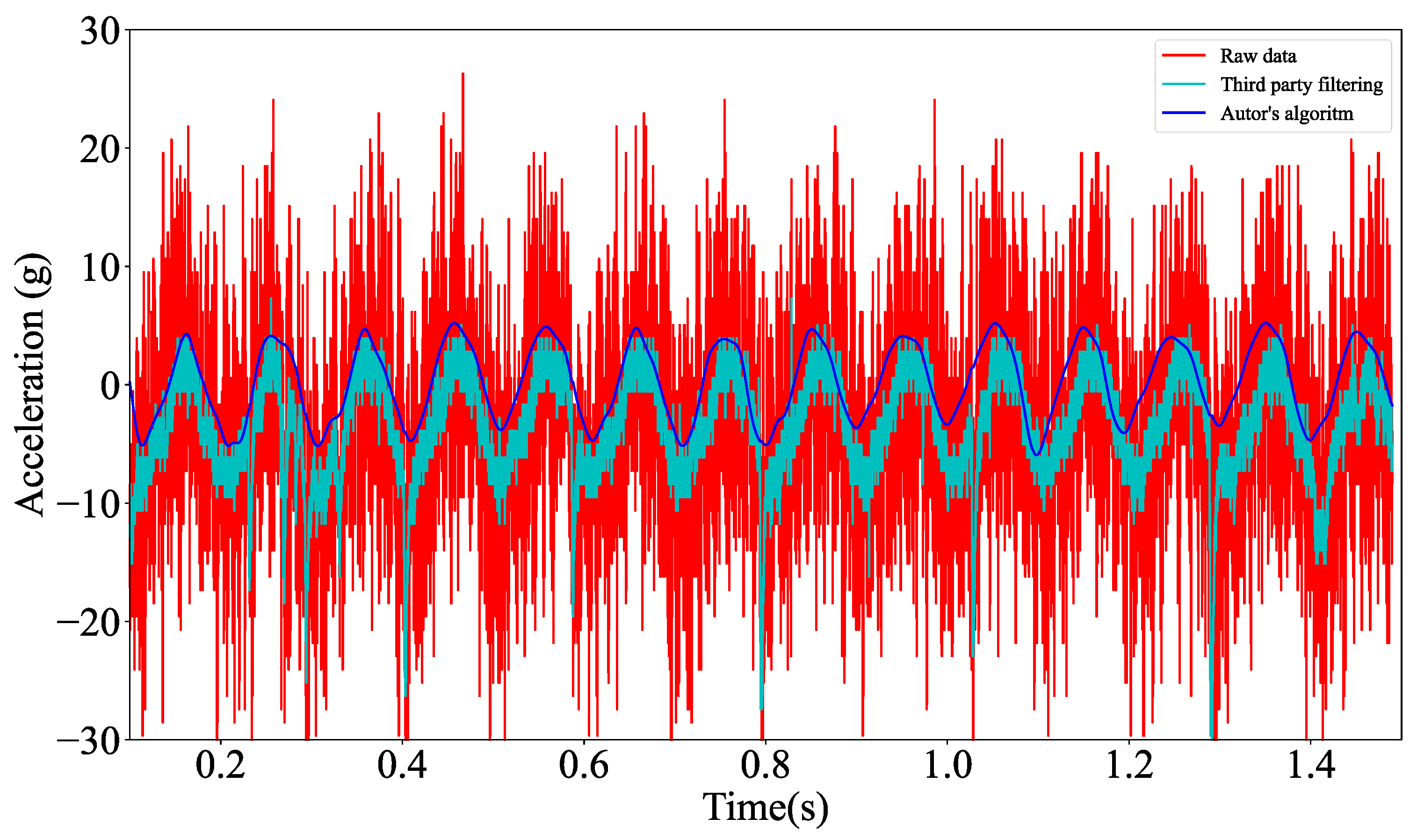
- Red graph—represents raw measurement data from the MEMS sensor, without any filtering. This signal may contain interference, noise and other undesirable effects that affect its quality.
- Cyan graph—shows data after filtering using an external (third-party) system, which implements a moving average algorithm combined with a hardware low-pass filter. This filtering reduces some interference, but its operation may alter the signal characteristics, potentially affecting its correspondence with the actual behaviour of the sensor.
- Blue graph—data after filtering using our own system. This filtering, which combines a hardware low-pass filter, a digitally windowed using a Tukey window, and a digital Butterworth filter implemented via the Python SciPy module, provides a better representation of the actual behaviour of the sensor and is more consistent with the reference results, demonstrating the effectiveness of the proposed filtering approach.
5. Conclusions
Author Contributions
Funding
Institutional Review Board Statement
Informed Consent Statement
Data Availability Statement
Conflicts of Interest
Abbreviations
| EDS | Energy Dispersive Spectroscopy |
| SEM | Scanning Electron Microscope |
| MEMS | Microelectromechanical Systems |
References
- Algamili, A.S.; Khir, M.H.M.; Dennis, J.O.; Ahmed, A.Y.; Alabsi, S.S.; Ba Hashwan, S.S.; Junaid, M.M. A Review of Actuation and Sensing Mechanisms in MEMS-Based Sensor Devices. Nanoscale Res. Lett. 2021, 16, 16. [Google Scholar] [CrossRef]
- He, J.H.; He, C.H.; Qian, M.Y.; Alsolami, A.A. Piezoelectric Biosensor Based on Ultrasensitive MEMS System. Sens. Actuators A Phys. 2024, 376, 115664. [Google Scholar] [CrossRef]
- Valles, A.E.; Alva, V.R.; Belokonov, I. Calibration Method of MEMS Gyroscopes Using a Robot Manipulator. IEEE Aerosp. Electron. Syst. Mag. 2023, 38, 20–27. [Google Scholar] [CrossRef]
- Sedighi, H.M. Size-Dependent Dynamic Pull-in Instability of Vibrating Electrically Actuated Microbeams Based on the Strain Gradient Elasticity Theory. Acta Astronaut. 2014, 95, 111–123. [Google Scholar] [CrossRef]
- Zhu, J.; Liu, X.; Shi, Q.; He, T.; Sun, Z.; Guo, X.; Liu, W.; Sulaiman, O.B.; Dong, B.; Lee, C. Development Trends and Perspectives of Future Sensors and MEMS/NEMS. Micromachines 2020, 11, 7. [Google Scholar] [CrossRef] [PubMed]
- Iannacci, J. Microsystem Based Energy Harvesting (EH-MEMS): Powering Pervasivity of the Internet of Things (IoT)—A Review with Focus on Mechanical Vibrations. J. King Saud Univ. -Sci. 2019, 31, 66–74. [Google Scholar] [CrossRef]
- Lin, S.C.; Lee, B.S.; Wu, W.J.; Lee, C.K. Multi-Cantilever Piezoelectric MEMS Generator in Energy Harvesting. In Proceedings of the 2009 IEEE International Ultrasonics Symposium, Rome, Italy, 20–23 September 2009; pp. 755–758. [Google Scholar] [CrossRef]
- Medesi, A.J.; Hagedorn, F.; Schepperle, M.; Megnin, C.; Hanemann, T. The Co-Casting Process: A New Manufacturing Process for Ceramic Multilayer Devices. Sens. Actuators A Phys. 2016, 251, 266–275. [Google Scholar] [CrossRef]
- Fujita, T.; Renaud, M.; Goedbloed, M.; De Nooijer, C.; Altena, G.; Elfrink, R.; Van Schaijk, R. Reliability Improvement of Vibration Energy Harvester with Shock Absorbing Structures. Procedia Eng. 2014, 87, 1206–1209. [Google Scholar] [CrossRef]
- Sudou, M.; Takao, H.; Sawada, K.; Ishida, M. A Novel RF Induced Power Supply System for Monolithically Integrated Ubiquitous Micro Sensor Nodes. Sens. Actuators A Phys. 2008, 145–146, 343–348. [Google Scholar] [CrossRef]
- Huff, M.A. Mems: An Enabling Technology for the Internet of Things (IoT); Wiley: Hoboken, NJ, USA, 2017; pp. 147–166. [Google Scholar] [CrossRef]
- Hristov, M.H.; Ruskov, S.I.; Denishev, K.H.; Uzunov, I.S.; Grozdanov, V.E.; Gaydazhiev, D.G. Design and Simulation of Horizontal Accelerometers. Annu. J. Electron. 2009. [Google Scholar]
- Akbaba, C.E.; Tanrikulu, Y. MEMS Capacitive Accelerometer: A Review. Artıbilim Adana Alparslan Türkeş Bilim Ve Teknol. Üniversitesi Fen Bilim. Derg. 2023, 6, 41–58. [Google Scholar] [CrossRef]
- Gomathi, T.; Shaby, S.M. Capacitive Accelerometers for Microelectromechanical Applications: A Review. In Proceedings of the 2016 International Conference on Control, Instrumentation, Communication and Computational Technologies (ICCICCT), Kumaracoil, India, 16–17 December 2016; pp. 486–490. [Google Scholar] [CrossRef]
- Zou, X.; Seshia, A.A. A High-Resolution Resonant MEMS Accelerometer. In Proceedings of the 2015 Transducers—2015 18th International Conference on Solid-State Sensors, Actuators and Microsystems, Anchorage, AK, USA, 21–25 June 2015; pp. 1247–1250. [Google Scholar] [CrossRef]
- Dima, D.S.; Covaciu, D. Solutions for Acceleration Measurement in Vehicle Crash Tests. IOP Conf. Ser. Mater. Sci. Eng. 2017, 252, 012007. [Google Scholar] [CrossRef]
- Kciuk, S.; Krzystała, E.; Mężyk, A.; Szmidt, P. The Application of Microelectromechanical Systems (Mems) Accelerometers to the Assessment of Blast Threat to Armored Vehicle Crew. Sensors 2022, 22, 316. [Google Scholar] [CrossRef]
- Sethuramalingam, T.K.; Vimalajuliet, A. Design of MEMS Based Capacitive Accelerometer. In Proceedings of the 2010 International Conference on Mechanical and Electrical Technology, Singapore, 10–12 September 2010; pp. 565–568. [Google Scholar] [CrossRef]
- Hajare, R.; Reddy, V.; Srikanth, R. MEMS Based Sensors—A Comprehensive Review of Commonly Used Fabrication Techniques. Mater. Today Proc. 2021, 49, 720–730. [Google Scholar] [CrossRef]
- Pagliano, S.; Marschner, D.E.; Maillard, D.; Ehrmann, N.; Stemme, G.; Braun, S.; Villanueva, L.G.; Niklaus, F. Micro 3D Printing of a Functional MEMS Accelerometer. Microsyst. Nanoeng. 2022, 8, 105. [Google Scholar] [CrossRef]
- Seena, V.; Hari, K.; Prajakta, S.; Pratap, R.; Ramgopal Rao, V. A Novel Piezoresistive Polymer Nanocomposite MEMS Accelerometer. J. Micromech. Microeng. 2017, 27, 015014. [Google Scholar] [CrossRef]
- Lee, Y.C.; Tsai, C.C.; Li, C.Y.; Liou, Y.C.; Hong, C.S.; Chu, S.Y. Fabrication and Function Examination of PZT-Based MEMS Accelerometers. Ceram. Int. 2021, 47, 24458–24465. [Google Scholar] [CrossRef]
- Tez, S.; Aykutlu, U.; Torunbalci, M.M.; Akin, T. A Bulk-Micromachined Three-Axis Capacitive MEMS Accelerometer on a Single Die. J. Microelectromec. Syst. 2015, 24, 1264–1274. [Google Scholar] [CrossRef]
- Machida, K.; Yamane, D.; Konishi, T.; Iida, S.; Ishihara, N.; Chang, T.-F.M.; Sone, M.; Ito, H.; Masu, K. (Invited) MEMS Accelerometer Fabricated by Gold Multi-Layer Metal Technology. ECS Trans. 2019, 92, 169–184. [Google Scholar] [CrossRef]
- Gholamzadeh, R.; Jafari, K.; Gharooni, M. Design, Simulation and Fabrication of a MEMS Accelerometer by Using Sequential and Pulsed-Mode DRIE Processes. J. Micromech. Microeng. 2017, 27, 015022. [Google Scholar] [CrossRef]
- Aydemir, A.; Terzioglu, Y.; Akin, T. A New Design and a Fabrication Approach to Realize a High Performance Three Axes Capacitive MEMS Accelerometer. Sens. Actuators A Phys. 2016, 244, 324–333. [Google Scholar] [CrossRef]
- Mukhiya, R.; Agarwal, P.; Badjatya, S.; Garg, M.; Gaikwad, P.; Sinha, S.; Singh, A.K.; Gopal, R. Design, Modelling and System Level Simulations of DRIE-Based MEMS Differential Capacitive Accelerometer. Microsyst. Technol. 2019, 25, 3521–3532. [Google Scholar] [CrossRef]
- Kumar Gupta, R.; Manhas, S.K. Design, Simulation, and Modeling of a Highly Sensitive Multicapacitor Piezoelectric MEMS Accelerometer. IEEE Sens. J. 2025, 25, 35418–35425. [Google Scholar] [CrossRef]
- Grigorie, T.L. The Matlab/Simulink Modeling and Numerical Simulation of an Analogue Capacitive Micro-Accelerometer. Part 1: Open Loop. In Proceedings of the 2008 International Conference on Perspective Technologies and Methods in MEMS Design, Lviv, Ukraine, 21–24 May 2008; pp. 105–114. [Google Scholar] [CrossRef]
- Mukhiya, R.; Garg, M.; Gaikwad, P.; Sinha, S.; Singh, A.K.; Gopal, R. Electrical Equivalent Modeling of MEMS Differential Capacitive Accelerometer. Microelectron. J. 2020, 99, 104770. [Google Scholar] [CrossRef]
- Benmessaoud, M.; Nasreddine, M.M. Optimization of MEMS Capacitive Accelerometer. Microsyst. Technol. 2013, 19, 713–720. [Google Scholar] [CrossRef]
- Benevicius, V.; Ostasevicius, V.; Gaidys, R. Identification of Capacitive MEMS Accelerometer Structure Parameters for Human Body Dynamics Measurements. Sensors 2013, 13, 11184–11195. [Google Scholar] [CrossRef] [PubMed]
- ADXL377. Available online: https://www.analog.com/en/products/adxl377.html (accessed on 10 January 2025).
- 333B31. Available online: https://www.pcb.com/products?m=333B31 (accessed on 10 January 2025).
- 352C33. Available online: https://www.pcb.com/products?m=352C33 (accessed on 10 January 2025).


Disclaimer/Publisher’s Note: The statements, opinions and data contained in all publications are solely those of the individual author(s) and contributor(s) and not of MDPI and/or the editor(s). MDPI and/or the editor(s) disclaim responsibility for any injury to people or property resulting from any ideas, methods, instructions or products referred to in the content. |
© 2025 by the authors. Licensee MDPI, Basel, Switzerland. This article is an open access article distributed under the terms and conditions of the Creative Commons Attribution (CC BY) license (https://creativecommons.org/licenses/by/4.0/).
Share and Cite
Kurpanik, K.; Gołombek, K.; Krzystała, E.; Hartwich, J.; Kciuk, S. Identification of Mechanical Parameters of the Silicon Structure of a Capacitive MEMS Accelerometer. Materials 2025, 18, 5676. https://doi.org/10.3390/ma18245676
Kurpanik K, Gołombek K, Krzystała E, Hartwich J, Kciuk S. Identification of Mechanical Parameters of the Silicon Structure of a Capacitive MEMS Accelerometer. Materials. 2025; 18(24):5676. https://doi.org/10.3390/ma18245676
Chicago/Turabian StyleKurpanik, Kamil, Klaudiusz Gołombek, Edyta Krzystała, Jonasz Hartwich, and Sławomir Kciuk. 2025. "Identification of Mechanical Parameters of the Silicon Structure of a Capacitive MEMS Accelerometer" Materials 18, no. 24: 5676. https://doi.org/10.3390/ma18245676
APA StyleKurpanik, K., Gołombek, K., Krzystała, E., Hartwich, J., & Kciuk, S. (2025). Identification of Mechanical Parameters of the Silicon Structure of a Capacitive MEMS Accelerometer. Materials, 18(24), 5676. https://doi.org/10.3390/ma18245676