
Communication

Evolution of Cluster Morphology and Its Impact on Dislocation Behavior in a Strip-Cast HSLA Steel

1
Institute for Carbon Neutrality, University of Science and Technology Beijing, Beijing 100083, China
2
Institute of Steel Sustainable Technology, Liaoning Academy of Materials, Shenyang 110000, China
*
Authors to whom correspondence should be addressed.
Materials 2025, 18(24), 5671; https://doi.org/10.3390/ma18245671
Submission received: 25 October 2025 / Revised: 4 December 2025 / Accepted: 12 December 2025 / Published: 17 December 2025
(This article belongs to the Special Issue Advanced Sheet/Bulk Metal Forming)

Abstract

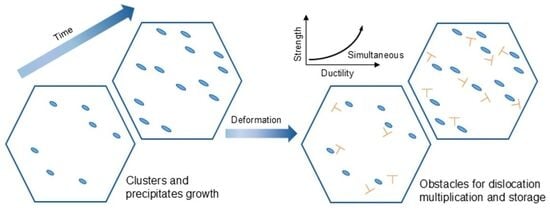
Strip casting presents a sustainable route for producing advanced steels, such as high-strength low-alloy (HSLA) grades. This study investigated how early-stage isothermal holding (120–1800 s at 923 K) affects the evolution of cluster morphology and its subsequent impact on dislocation behavior and mechanical properties in a strip-cast Nb-bearing HSLA steel. Advanced characterization (atom probe tomography) revealed that prolonged holding promotes the growth of nanoscale Nb-(C,N) clusters and precipitates, accompanied by an increase in ferrite fraction. Remarkably, this evolution simultaneously enhances both strength and ductility. Enhanced ductility and sustained work hardening are linked to a higher density and volume fraction of nanoscale particles, which act as potent obstacles for dislocation nucleation and multiplication. These findings establish a critical link between cluster evolution and dislocation-mediated strengthening, providing a basis for optimizing strip-cast steels.

Graphical Abstract

1. Introduction

In recent years, strip casting has emerged as a promising approach in the field of steel production owing to its ability to reduce energy use and greenhouse gas emissions. By combining solidification and hot rolling in a compact line (~50 m), this near-net-shape process eliminates reheating and utilizes rapid solidification rates (102–103 °C/s) to produce thin strips directly, followed by a single hot-rolling pass [1,2,3,4]. Compared with conventional continuous casting, strip casting markedly lowers energy consumption and the carbon footprint, making it attractive for advanced green steels [5].
High-strength low-alloy (HSLA) steels are particularly suited for strip casting due to their mechanical performance and cost-effective microalloying with Nb, V, and Ti [6,7,8]. Their strength mainly arises from nanoscale carbonitride precipitates [9,10]. Wang et al. [11] reported that nanoscale clusters evolve from embryonic states into Guinier–Preston (GP)-like monolayers, and then into precipitates. Similar sequential cluster-to-precipitate transformations and coarsening were later confirmed in Ti–Mo-bearing steels under isothermal conditions [12,13,14]. The advent of atom probe tomography (APT) has further highlighted the role of solute clusters—atomic-scale aggregates without long-range order—as effective strengtheners, analogous to cluster hardening in Al–Cu alloys [15]. This mechanism provides a pathway to achieve both strength and ductility in steels.
The unique rapid solidification of strip casting produces a supersaturated matrix, which upon aging or isothermal holding promotes cluster and fine precipitate formation [1,16]. Aging has been shown to markedly increase strength through cluster formation [1,17]. However, previous studies have only examined the impact of such clusters on the strength–ductility balance, without addressing how these clusters formed during heat treatment, influence dislocation behavior, and contribute to strengthening and ductilizing. Moreover, variations in the coiling process revealed morphological transitions from embryonic monolayer clusters to multilayered clusters [18], which directly affect dislocation multiplication and the balance of strength and ductility. Nevertheless, the evolution of clusters during the critical early stages of isothermal holding and their interactions with dislocations remain insufficiently understood.
To address this, we systematically investigated nanoscale cluster evolution and its impact on dislocation behavior in strip-cast HSLA steel during early-stage isothermal holding. By combining advanced characterization of clusters, precipitates, and dislocations, we clarify how nanoscale transformations govern mechanical response. These insights provide a basis for optimizing the properties of sustainable strip-cast HSLAs.

2. Experimental Section

A strip-cast Nb-bearing HSLA steel with a composition of Fe–0.025C–1.4Mn–0.4Si–0.2Cr–0.05Nb–0.004N (wt.%) was investigated. Sample bars (50 mm × 15 mm × 1.2 mm) were austenitized at 1473 K for 300 s, then isothermally held at 923 K for 120, 300, and 1800 s in a salt bath, followed by water quenching. Microstructure was characterized using optical microscopy (Zeiss AxioVert A1, Carl Zeiss, Oberkochen, Germany), scanning electron microscopy (TESCAN MIRA4, Brno, Czech Republic) with Electron Backscatter Diffraction (EBSD, Oxford Symmetry S2, UK, step size 0.1 µm), and transmission electron microscopy (TEM, TECNAI G2 20 at 200 kV, Hillsboro, OR, USA). Atom probe tomography (APT) specimens were prepared via Focused Ion Beam (FIB, Helios G4 CX, Thermo Fisher Scientific, Hillsboro, OR, USA) and analyzed on a LEAP 6000XR (CAMECA Instruments, Madison, WI, USA). Due to the more pronounced artifact in APT analysis for C compared to substitutional elements [19,20], Nb peaks and molecular NbN ions peaks in the APT spectrum were used to represent solute atoms for analysis. Based on the nearest neighbor distribution, the parameter dmax, the distance between solute atoms was 1 nm, and clusters containing less than 6 solute atoms (Nmin) were ignored. The volume fraction and number density of these particles were estimated from APT results. The former was calculated by dividing the number of atoms within particles by the total number of atoms [21], and the latter was determined by dividing the particle count by the total volume of the needle-shaped sample [20]. Tensile tests were performed on an MTS E45.305 machine (MTS Systems Corporation, Eden Prairie, MN, USA) at a strain rate of 1 mm/min. Dislocation density was measured using an X-ray diffractometer (D8 ADVANCE XRD, Bruker AXS, Karlsruhe, Germany) with a Cu target. Diffraction angles (2θ) ranging from 40° to 120° were measured with a step size of 0.02° under a voltage of 40 kV and a current of 40 mA. The dislocation density was calculated using the Williamson–Hall (WH) equation [22] by analyzing five bcc diffraction peaks ((110), (200), (211), (220), and (310)) planes to calculate the microstrain (e) first, and then computed by the following equation, ρ = 14.4 e 2 / b 2 [23].

3. Results and Discussion

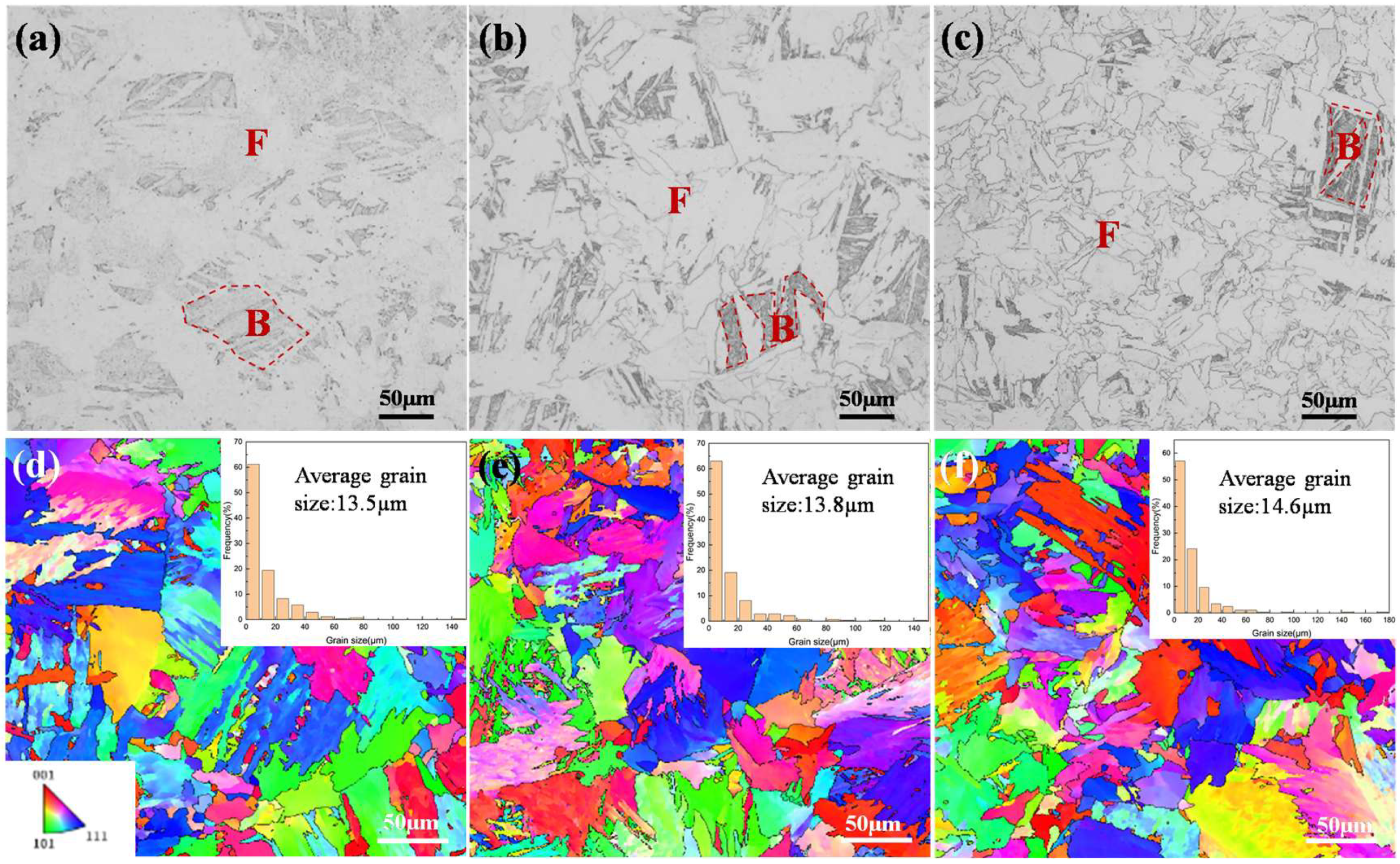
Figure 1 shows the microstructures of samples subjected to isothermal holding at 923 K for 120 s, 300 s, and 1800 s, respectively. These microstructures consist of polygonal ferrite (F) and bainite (B) with the ferrite volume fraction progressively increasing from 64% to 74%, and then to 82% as the holding time increased. The average grain sizes measured via EBSD were 13.5 µm, 13.8 µm, and 14.6 µm for the respective holding times.
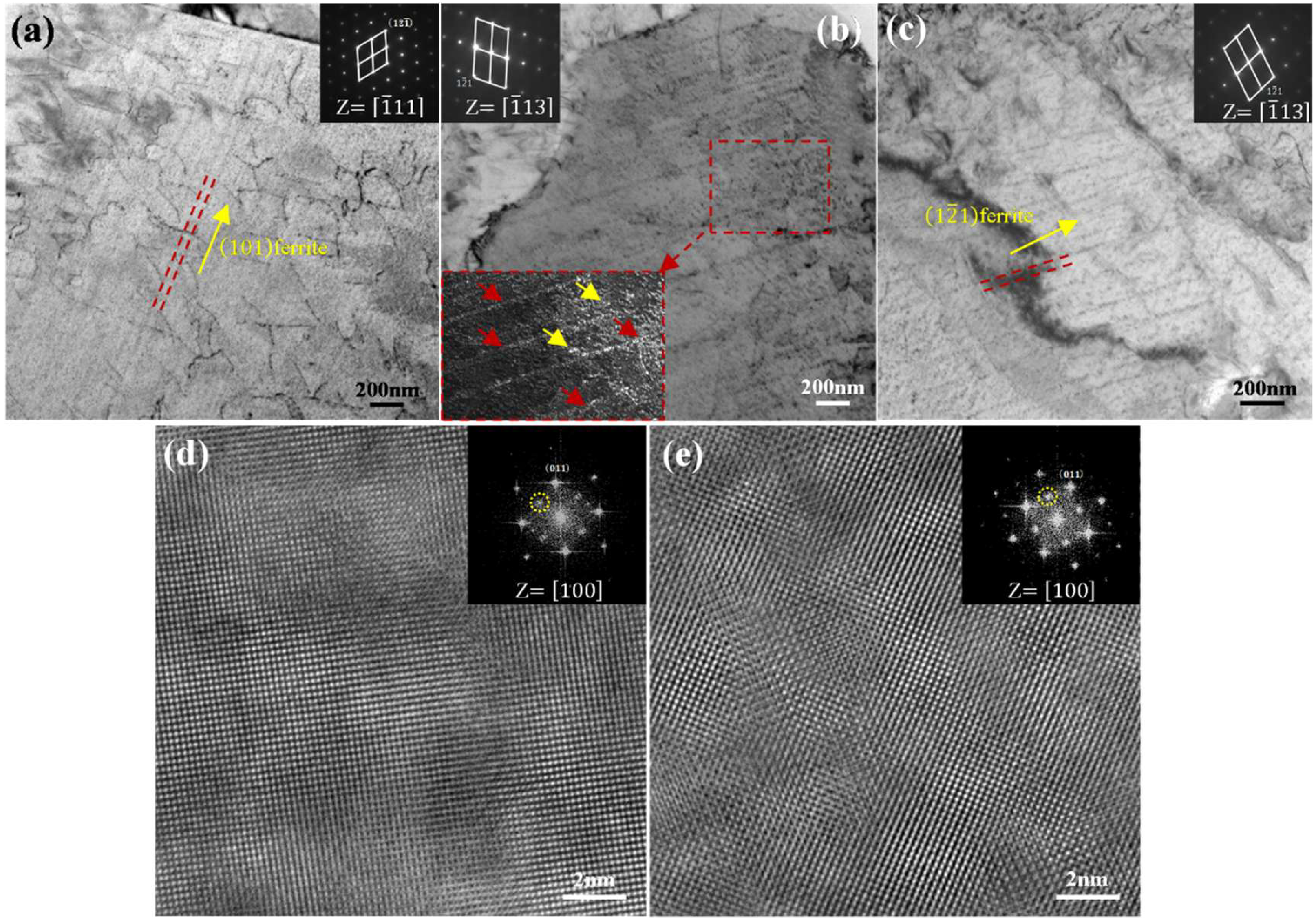
Figure 2 presents TEM images of 120 s, 300 s, and 1800 s samples and high-resolution TEM (HRTEM) images of 120 s and 1800 s samples. TEM identified finely dispersed, row-like precipitates formed during the γ→α transformation [24,25] exhibiting irregular spacing and random alignment (Figure 2b). The selected area diffraction pattern (SADP) indicates that precipitate rows shifted from nearly parallel to (101)α (120 s) toward (121)α (1800 s). Such planes generally correspond to coherent or semi-coherent ferrite interfaces like (110)α [24,25,26,27], although incoherent variants may also appear. Similar interfacial precipitation orientations, e.g., (110)α and near {112}α, have been reported in Ti–Mo steels [26], highlighting the generality of this behavior. HRTEM images of 120 s and 1800 s samples (Figure 2d,e) were taken along the [100]α zone axis. The coherent nature of the particles resulted in their weak visibility under standard TEM imaging.
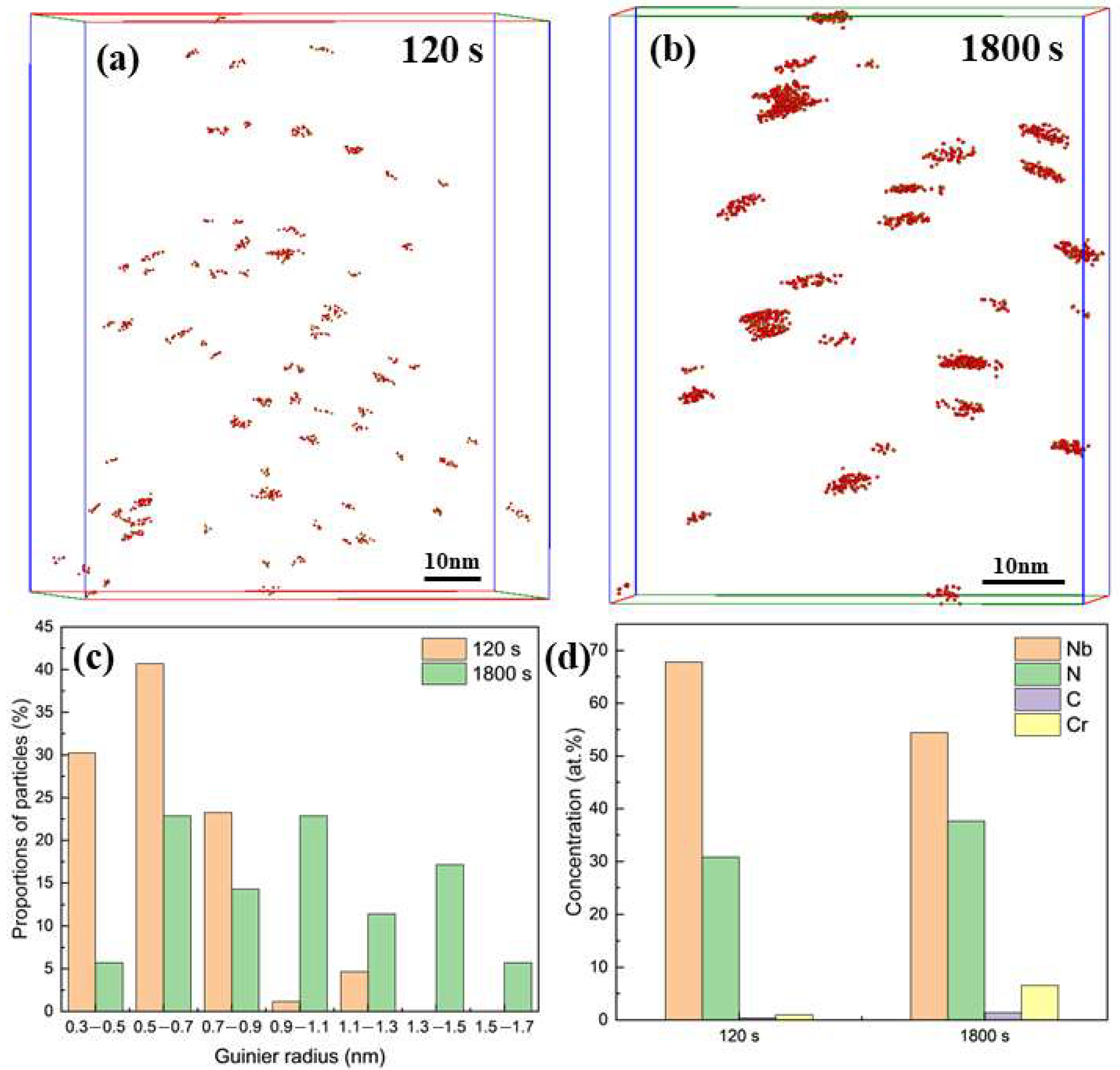
Therefore, to quantitatively analyze the particle size and composition, atom probe tomography (APT) data were processed using the maximum separation method of the 120 s and 1800 s samples, as illustrated in Figure 3a,b. The size distribution of particles, expressed in terms of the Guinier radius (rG), is summarized in Figure 3c. Guinier radii, rG, were calculated from the data of gyration radii (Ig) used by equation r G = 5 / 3 I g . In the 120 s sample, 94% of particles had an rG smaller than 0.9 nm, with an average rG of 0.62 nm. These particles were predominantly irregular in shape. By contrast, after 1800 s of holding, only 43% of particles remained below 0.9 nm, and the average rG increased to 0.98 nm. These particles coarsened into disc-like morphologies, tending toward a more spherical shape as they grew, a phenomenon consistent with previous reports in Nb-bearing steels. APT quantification further showed that the volume fraction of particles increased from 0.0033% to 0.0155%, while the number density slightly decreased from 1.88 × 10²³ m−3 to 1.82 × 10²³ m−3 (as shown in Table 1). This trend suggests that these particles grew at the expense of smaller neighboring clusters with fewer atoms. In addition, compositional analysis confirmed that these particles were enriched in Nb and N, along with minor amounts of C and Cr. Notably, the 1800 s sample contained a higher proportion of carbon, and the atomic ratio of Nb to (N+C) approached unity compared to the 120 s sample, suggesting the formation of more stoichiometric carbonitrides with prolonged aging.
APT analyses indicate that initial Nb–N clusters formed as monolayers on {100} matrix planes [17], acting as embryonic precursors that evolved into multilayered clusters, analogous to Guinier–Preston (GP) zones in Al–Cu alloys [28]. This sequential transformation—from monolayer clusters to multilayered clusters and eventually stable precipitates—was driven by Nb segregation at the migrating γ/α interface, where solute drag slows boundary migration, concentrating Nb, N, and C, facilitating cluster decomposition and the nucleation of larger precipitates [29]. Continuous γ/α interface advancement resulted in periodic interphase precipitation.
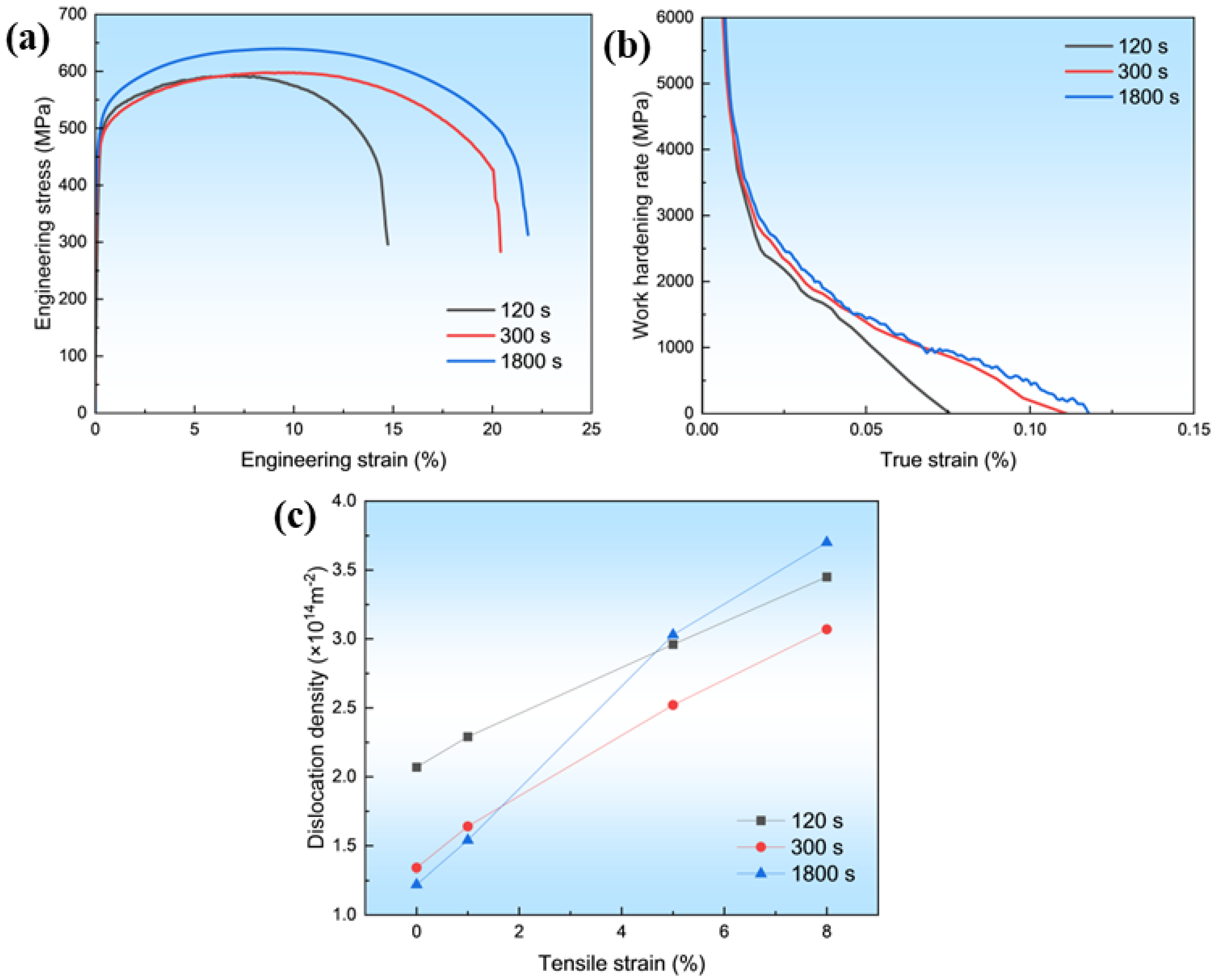
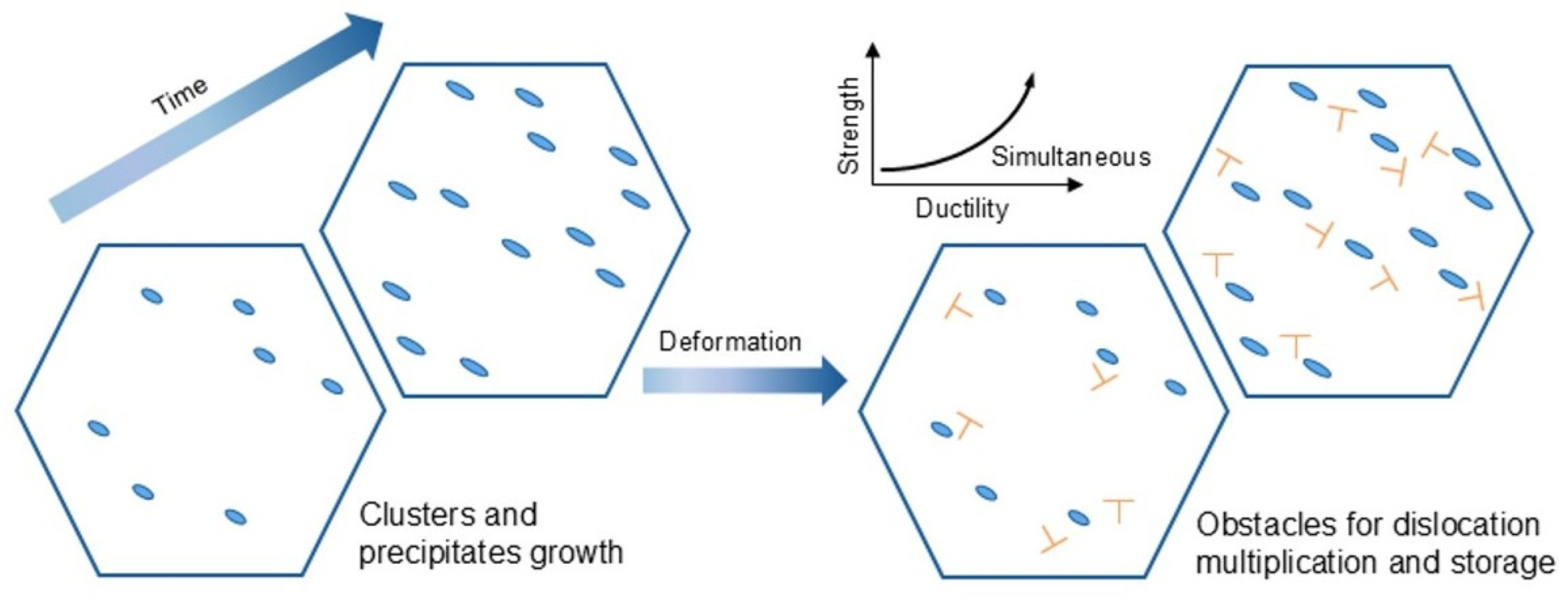
To understand the mechanical property variation of specimens with different isothermal holding times, uniaxial tensile tests at room temperature were performed. Tensile tests (Figure 4a) showed that both strength and elongation increased with holding time from 120 s to 1800 s, reflecting hardening from the evolving nanoscale particles. Work hardening rates (Figure 4b) initially declined rapidly, and then decreased gradually; the 120 s sample showed the highest initial rate, whereas the 1800 s sample maintained superior hardening at larger strains. XRD revealed that dislocation density increased with strain in all samples, but more rapidly in those with longer holding, with the 1800 s sample exhibiting the most pronounced rise (Figure 4c). The higher particle density in the ferrite matrix acted as an effective obstacle to dislocation glide, promoting dislocation multiplication and storage [12], thereby enhancing strain hardening.
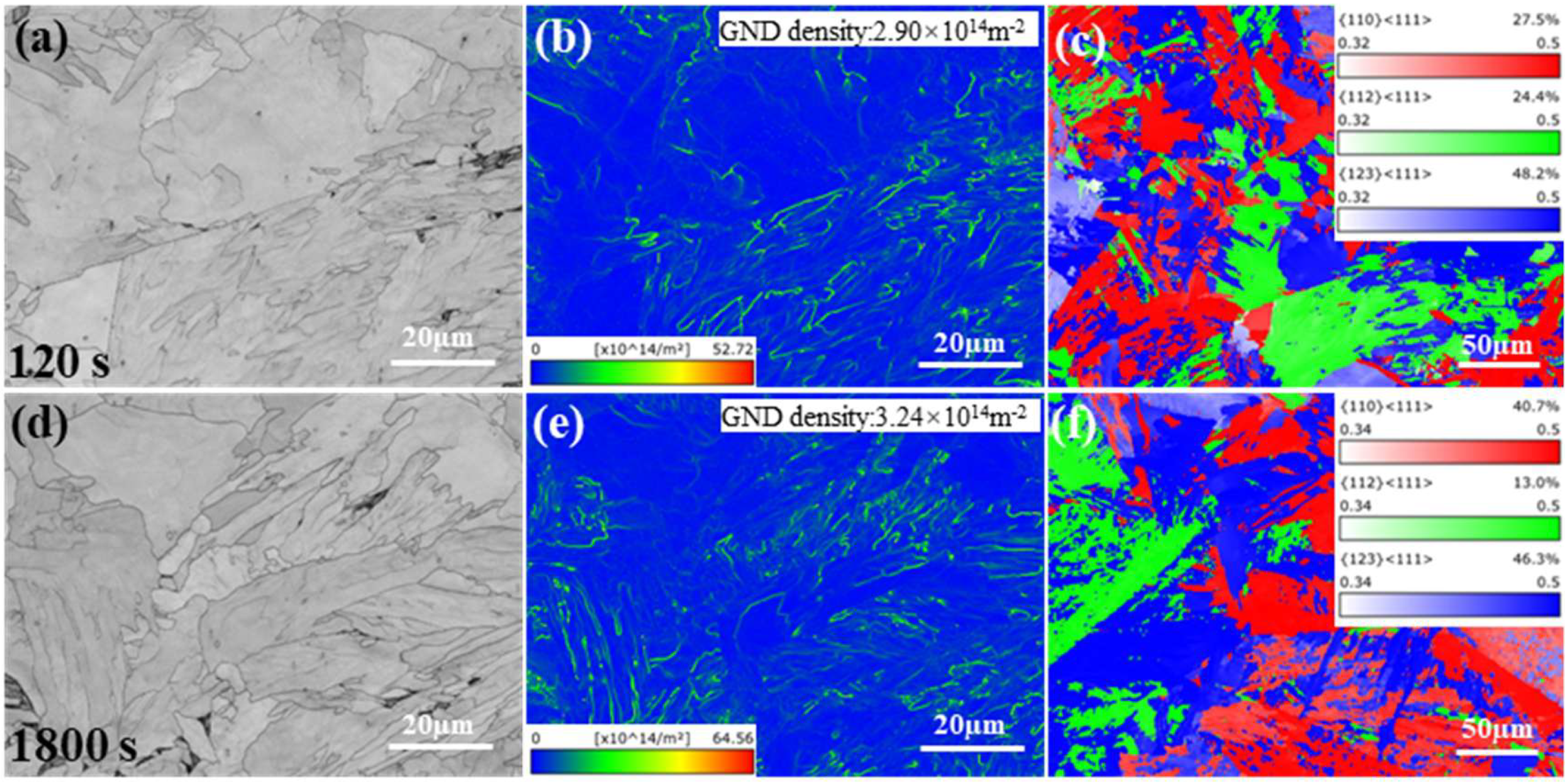
Figure 5 presents the EBSD maps of deformed samples. The analysis at 8% strain showed higher geometrically necessary dislocation (GND) density in the 1800 s sample, consistent with stronger strain gradients induced by dense and volume fraction nanoscale particles (Figure 5b,e) [30]. Schmid factor analysis revealed that the 1800 s sample had more grains favorably oriented for {110}<111> slip and fewer for {112}<111>, influencing work hardening through variation in dislocation multiplication and cross-slip capacity [31,32].
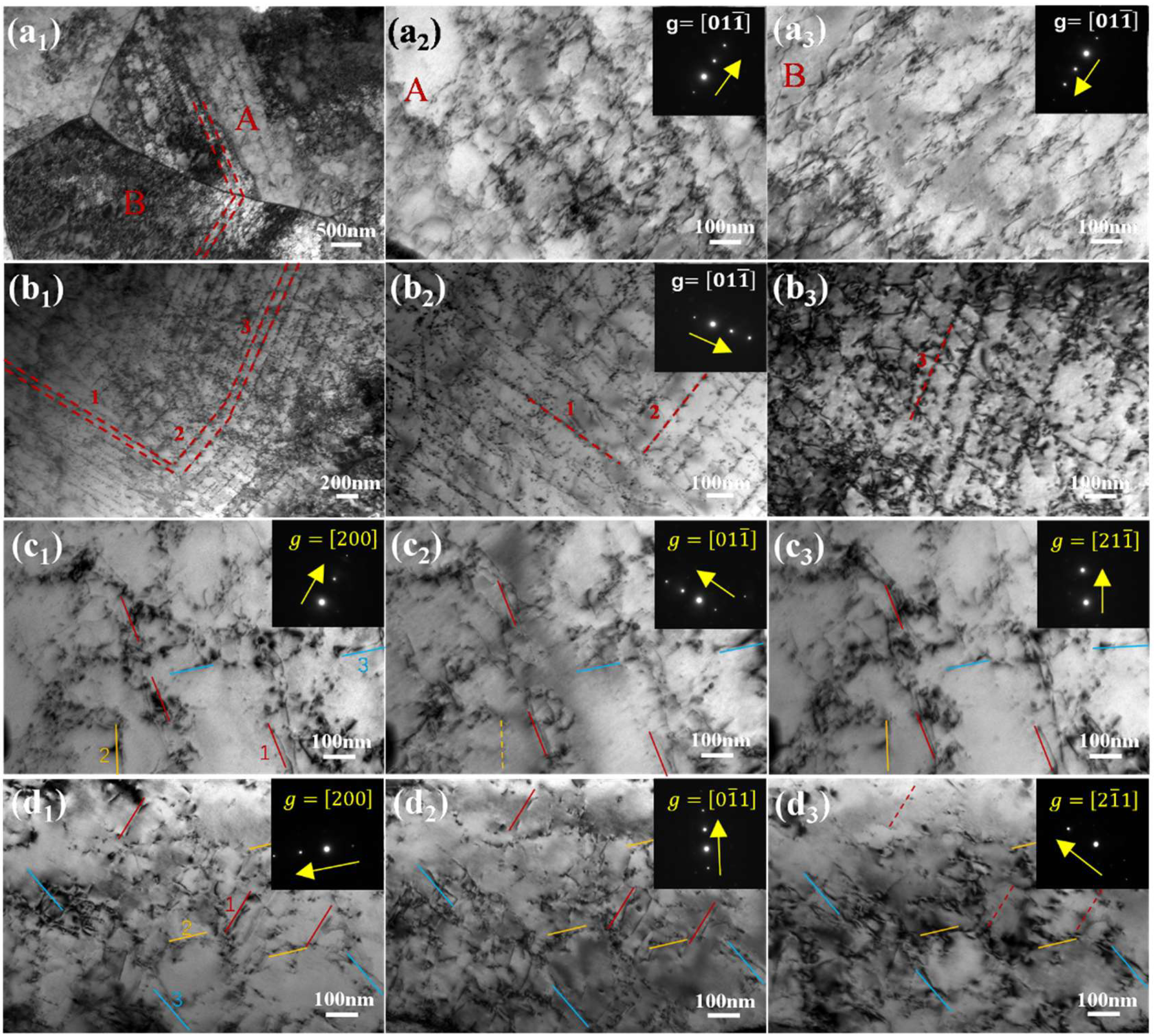
TEM observations of samples deformed to 8% strain (Figure 6) revealed that in the 120 s sample, particles aligned in rows within grains, inducing dislocation loops and pinning points. In the 1800 s sample, high particle density and volume fraction with multidirectional arrangements promoted more homogeneous dislocation distribution and extensive looping. Burgers vector (b) analysis using the g·b = 0 criterion confirmed both screw and mixed 1/2<111> dislocations (as shown in Table 2). The presence of screw dislocations capable of cross-slip facilitates dislocation multiplication and entanglement around particles, contributing to the sustained work hardening observed in the 1800 s sample.
The superior mechanical properties and sustained work hardening of the 1800 s sample are attributed to the growth, increased volume fraction, and high density of nanoscale particles (rG: 0.62 → 0.98 nm), which effectively impede dislocation glide. This promotes extensive dislocation multiplication, activation of multiple slip systems—particularly {110}<111>—and cross-slip of screw dislocations, leading to complex dislocation networks pinned by particles. Consequently, both GNDs and statistically stored dislocations (SSDs) were retained, explaining the enhanced work hardening at larger strains.

4. Conclusions

The evolution of nanoscale Nb–N clusters into stable carbonitrides during isothermal holding was shown to strongly influence the deformation behavior of strip-cast HSLA steel. Particle growth and increased volume fraction effectively promoted dislocation multiplication and cross-slip, leading to enhanced strain hardening. As a result, both strength and ductility improved with prolonged holding, underscoring the importance of controlling cluster–precipitate transformation for optimizing the mechanical performance of strip-cast green steels.

Author Contributions

Conceptualization, H.Y., Y.H., J.L., S.W. and X.M.; Methodology, J.L., J.G., H.Z. and C.Z.; Validation, H.Y., H.W. and C.Z.; Formal analysis, H.Y., J.G. and H.Z.; Investigation, H.Y., J.G., H.Z., H.W. and C.Z.; Resources, Y.H., J.L., S.W. and X.M.; Data curation, H.Y., H.W., C.Z. and J.L.; Writing—original draft, H.Y., C.Z., J.G. and H.Z.; Writing—review & editing, Y.H., J.L., S.W., X.M. and H.W.; Visualization, C.Z., J.G. and H.Z.; Supervision, Y.H., S.W., J.L. and X.M.; Project administration, Y.H. and S.W.; Funding acquisition, S.W. All authors have read and agreed to the published version of the manuscript.

Funding

This research was funded by the National Natural Science Foundation of China (No: 52371017), State Key Laboratory for Advanced Metals and Materials grant (No. 2023-Z03).

Institutional Review Board Statement

Not applicable.

Informed Consent Statement

Not applicable.

Data Availability Statement

Original contributions presented in this study are included in the article. Further inquiries can be directed to the corresponding authors.

Conflicts of Interest

The authors declare that they have no known competing financial interests or personal relationships that could have appeared to influence the work reported in this paper. All authors have read and agreed to the published version of this manuscript.

References

  1. Shrestha, S.L.; Xie, K.Y.; Zhu, C.; Ringer, S.P.; Killmore, C.; Carpenter, K.; Kaul, H.; Williams, J.G.; Cairney, J.M. Cluster strengthening of Nb-microalloyed ultra-thin cast strip steels produced by the CASTRIP® process. Mater. Sci. Eng. A 2013, 568, 88–95. [Google Scholar] [CrossRef]
  2. Xie, K.Y.; Yao, L.; Zhu, C.; Cairney, J.M.; Killmore, C.R.; Barbaro, F.J.; Williams, J.G.; Ringer, S.P. Effect of Nb microalloying and hot rolling on microstructure and properties of ultrathin cast strip steels produced by the CASTRIP® process. Metall. Mater. Trans. A 2011, 42, 2199–2206. [Google Scholar] [CrossRef]
  3. Felfer, P.J.; Killmore, C.R.; Williams, J.G.; Carpenter, K.R.; Ringer, S.P.; Cairney, J.M. A quantitative atom probe study of the Nb excess at prior austenite grain boundaries in a Nb microalloyed strip-cast steel. Acta Mater. 2012, 60, 5049–5055. [Google Scholar] [CrossRef]
  4. Ge, S.; Isac, M.; Guthrie, R.I.L. Progress in Strip Casting Technologies for Steel; Technical Developments. ISIJ Int. 2013, 53, 729–742. [Google Scholar] [CrossRef]
  5. Jiang, L.; Marceau, R.K.W.; Guan, B.; Dorin, T.; Wood, K.; Hodgson, P.D.; Stanford, N. The effect of molybdenum on clustering and precipitation behaviour of strip-cast steels containing niobium. Materialia 2019, 8, 100462. [Google Scholar] [CrossRef]
  6. Charleux, M.; Poole, W.J.; Militzer, M.; Deschamps, A. Precipitation behavior and its effect on strengthening of an HSLA-Nb/Ti steel. Metall. Mater. Trans. A 2001, 32, 1635–1647. [Google Scholar] [CrossRef]
  7. Rodrigues, P.C.M.; Pereloma, E.V.; Santos, D.B. Mechanical properities of an HSLA bainitic steel subjected to controlled rolling with accelerated cooling. Mater. Sci. Eng. A 2000, 283, 136–143. [Google Scholar] [CrossRef]
  8. Liu, G.; Li, Y.; Liao, T.; Wang, S.; Lv, B.; Guo, H.; Huang, Y.; Yong, Q.; Mao, X. Revealing the precipitation kinetics and strengthening mechanisms of a 450 MPa grade Nb-bearing HSLA steel. Mater. Sci. Eng. A 2023, 884, 145506. [Google Scholar] [CrossRef]
  9. Singh, N.; Casillas, G.; Wexler, D.; Killmore, C.; Pereloma, E. Application of advanced experimental techniques to elucidate the strengthening mechanisms operating in microalloyed ferritic steels with interphase precipitation. Acta Mater. 2020, 201, 386–402. [Google Scholar] [CrossRef]
  10. Zhang, Y.J.; Miyamoto, G.; Shinbo, K.; Furuhara, T.; Ohmura, T.; Suzuki, T. Tsuzaki Effects of transformation temperature on VC interphase precipitation and resultant hardness in low-carbon steels. Acta Mater. 2015, 84, 375–384. [Google Scholar] [CrossRef]
  11. Wang, J.; Weyland, M.; Bikmukhametov, I.; Miller, M.K.; Hodgson, P.D.; Timokhina, I. Transformation from cluster to nano-precipitate in microalloyed ferritic steel. Scr. Mater. 2019, 160, 53–57. [Google Scholar] [CrossRef]
  12. Xiong, Z.; Timokhina, I.; Pereloma, E. Clustering, nano-scale precipitation and strengthening of steels. Prog. Mater. Sci. 2021, 118, 100764. [Google Scholar] [CrossRef]
  13. Mukherjee, S.; Timokhina, I.; Zhu, C.; Ringer, S.P.; Hodgson, P.D. Clustering and precipitation processes in a ferritic titanium-molybdenum microalloyed steel. J. Alloys Compd. 2017, 690, 621–632. [Google Scholar] [CrossRef]
  14. Dhara, S.; Marceau, R.K.W.; Wood, K.; Dorin, T.; Timokhina, I.B.; Hodgson, P.D. Precipitation and clustering in a Ti-Mo steel investigated using atom probe tomography and small-angle neutron scattering. Mater. Sci. Eng. A 2018, 718, 74–86. [Google Scholar] [CrossRef]
  15. Dong, X.; Guo, Y.; Wang, J.; Xia, F.; Ma, K.; Duan, H.; Yang, Z.; Wang, P.; Liang, M.; Li, J. Novel AlCu solute cluster precipitates in the Al–Cu alloy by elevated aging and the effect on the tensile properties. Mater. Sci. Eng. A 2023, 862, 144454. [Google Scholar] [CrossRef]
  16. Xie, K.Y.; Zheng, T.; Cairney, J.M.; Kaul, H.; Williams, J.G.; Barbaro, F.J.; Killmore, C.R.; Ringer, S.P. Strengthening from Nb-rich clusters in a Nb-microalloyed steel. Scr. Mater. 2012, 66, 710–713. [Google Scholar] [CrossRef]
  17. Xu, S.; Wang, S.; Li, S.; Cao, R.; Wu, H.; Wu, G.; Gao, J.; Feng, Q.; Li, H.; Mao, X. Achieving high strength and large elongation in a strip casting microalloyed steel by ageing treatment. Mater. Sci. Eng. A 2022, 860, 144217. [Google Scholar] [CrossRef]
  18. Huang, Y.; Xu, S.; Li, X.; Gao, J.; Zhao, H.; Wang, S.; Yang, T.; Liu, S.; Han, X.; Mao, X. Cluster mediated high strength and large ductility in a strip casting micro-alloyed steel. Acta. Mater. 2024, 276, 120102. [Google Scholar] [CrossRef]
  19. Gault, B.; Danoix, F.; Hoummada, K.; Mangelinck, D.; Leitner, H. Impact of directional walk on atom probe microanalysis. Ultramicroscopy 2012, 113, 182–191. [Google Scholar] [CrossRef]
  20. Dong, H.; Chen, H.; Riyahi khorasgani, A.; Zhang, B.; Zhang, Y.; Wang, Z.; Zhou, X.; Wang, W.; Wang, H.; Li, T.; et al. Revealing the influence of Mo addition on interphase precipitation in Ti-bearing low carbon steels. Acta. Mater. 2022, 223, 117475. [Google Scholar] [CrossRef]
  21. Xue, J.; Jin, S.; Hu, R.; Xue, F.; Sha, G. Ion-irradiation-induced clustering in Fe-Mn-Ni-(Si) steels: Nucleation, growth and chemistry evolution. J. Nucl. Mater. 2022, 560, 153477. [Google Scholar] [CrossRef]
  22. Williamson, G.K.; Hall, W.H. X-ray line broadening from filed aluminium and wolfram. Acta Metall. 1953, 1, 22–31. [Google Scholar] [CrossRef]
  23. Takebayashi, S.; Kunieda, T.; Yoshinaga, N.; Ushioda, K.; Ogata, S. Comparison of the dislocation density in martensitic steels evaluated by some X-ray diffraction methods. ISIJ Int. 2010, 50, 875–882. [Google Scholar] [CrossRef]
  24. Yen, H.-W.; Chen, P.-Y.; Huang, C.-Y.; Yang, J.-R. Interphase precipitation of nanometer-sized carbides in a titanium–molybdenum-bearing low-carbon steel. Acta Mater. 2011, 59, 6264–6274. [Google Scholar] [CrossRef]
  25. Zhang, Y.J.; Miyamoto, G.; Shinbo, K.; Furuhara, T. Weak influence of ferrite growth rate and strong influence of driving force on dispersion of VC interphase precipitation in low carbon steels. Acta Mater. 2020, 186, 533–544. [Google Scholar] [CrossRef]
  26. Bikmukhametov, I.; Beladi, H.; Wang, J.; Hodgson, P.D.; Timokhina, I. The effect of strain on interphase precipitation characteristics in a Ti-Mo steel. Acta Mater. 2019, 170, 75–86. [Google Scholar] [CrossRef]
  27. Yen, H.W.; Chen, C.Y.; Wang, T.Y.; Huang, C.Y.; Yang, J.R. Orientation relationship transition of nanometre sized interphase precipitated TiC carbides in Ti bearing steel. Mater. Sci. Technol. 2010, 26, 421–430. [Google Scholar] [CrossRef]
  28. Zhao, Q. Cluster strengthening in aluminium alloys. Scr. Mater. 2014, 84–85, 43–46. [Google Scholar] [CrossRef]
  29. Okamoto, R.; Ågren, J. A model for interphase precipitation based on finite interface solute drag theory. Acta Mater. 2010, 58, 4791–4803. [Google Scholar] [CrossRef]
  30. Liu, M.; Liu, Y.; Li, H. Deformation mechanism of ferrite in a low carbon Al-killed steel: Slip behavior, grain boundary evolution and GND development. Mater. Sci. Eng. A 2022, 842, 143093. [Google Scholar] [CrossRef]
  31. Weygand, D.; Mrovec, M.; Hochrainer, T.; Gumbsch, P. Multiscale Simulation of Plasticity in bcc Metals. Annu. Rev. Mater. Res. 2015, 45, 369–390. [Google Scholar] [CrossRef]
  32. Hussein, A.M.; Rao, S.I.; Uchic, M.D.; Dimiduk, D.M.; El-Awady, J.A. Microstructurally based cross-slip mechanisms and their effects on dislocation microstructure evolution in fcc crystals. Acta Mater. 2015, 85, 180–190. [Google Scholar] [CrossRef]
Figure 1. Evolution of microstructure with isothermal holding time at 923 K. (ac) Optical micrographs showing polygonal ferrite (F) and bainite (B). (df) EBSD-derived orientation maps and grain size distributions for holding periods of 120 s, 300 s, and 1800 s, respectively.
Materials 18 05671 g001
Figure 2. TEM characterization of samples. (ac) TEM images revealing interphase precipitation within ferrite grains for holding periods of 120 s, 300 s, and 1800 s, respectively. (d,e) HRTEM images of samples isothermally held for 120 s and 1800 s, respectively.
Materials 18 05671 g002
Figure 3. Nanoscale characterization of particles. (a,b) Three-dimensional atom map reconstructions from APT analysis of samples isothermally held for 120 s and 1800 s, respectively. (c) Size distribution of particles expressed by Guinier radius (rG). (d) Chemical composition of particles.
Materials 18 05671 g003
Figure 4. Correlation of mechanical response with deformation microstructure. (a) Tensile behavior. (b) Work hardening rates. (c) Evolution of dislocation density with strain.
Materials 18 05671 g004
Figure 5. EBSD maps of deformed samples: (a,d) band contrast, (b,e) GND density, and (c,f) Schmid factor maps for 120 s and 1800 s samples interrupted at 8% tensile strain.
Materials 18 05671 g005
Figure 6. TEM characterization of dislocation structures and their Burgers vector analysis in specimens deformed to 8% strain. General dislocation distributions are shown for (a1a3) 120 s and (b1b3) 1800 s samples. Corresponding two-beam TEM images near the [011]α zone axis for (c1c3) 120 s and (d1d3) 1800 s samples were used to determine dislocation visibility (solid lines: visible; dashed lines: invisible) under different g vectors for Burgers vector analysis.
Materials 18 05671 g006
Table 1. Number density, volume fraction, and average Guinier radius of particles.
SampleNumber Density/×1023 m−3Volume Fraction/%Average Guinier Radius/nm
120 s1.880.00330.62
1800 s1.820.01550.98
Table 2. Contrast of dislocations in different operation reflections; “√” represents visible and “×” invisible.
Sample g = 200 g = 01 1 ¯ g = 21 1 ¯ g = 0 1 ¯ 1 g = 2 1 ¯ 1 bDislocation Type
120s-1 11 1 ¯ Screw
120s-2× 111 / 1 ¯ 11 Mixed
120s-3 11 1 ¯ Mixed
1800s-1 × 11 1 ¯ Screw
1800s-2 1 1 ¯ 1 Mixed
1800s-3 1 1 ¯ 1 Screw
Disclaimer/Publisher’s Note: The statements, opinions and data contained in all publications are solely those of the individual author(s) and contributor(s) and not of MDPI and/or the editor(s). MDPI and/or the editor(s) disclaim responsibility for any injury to people or property resulting from any ideas, methods, instructions or products referred to in the content.