
Simulation of a Multiband Stacked Antiparallel Solar Cell with over 70% Efficiency


Highlights
- New multiband cell removes tunnel junctions with stacked anti-parallel junctions.
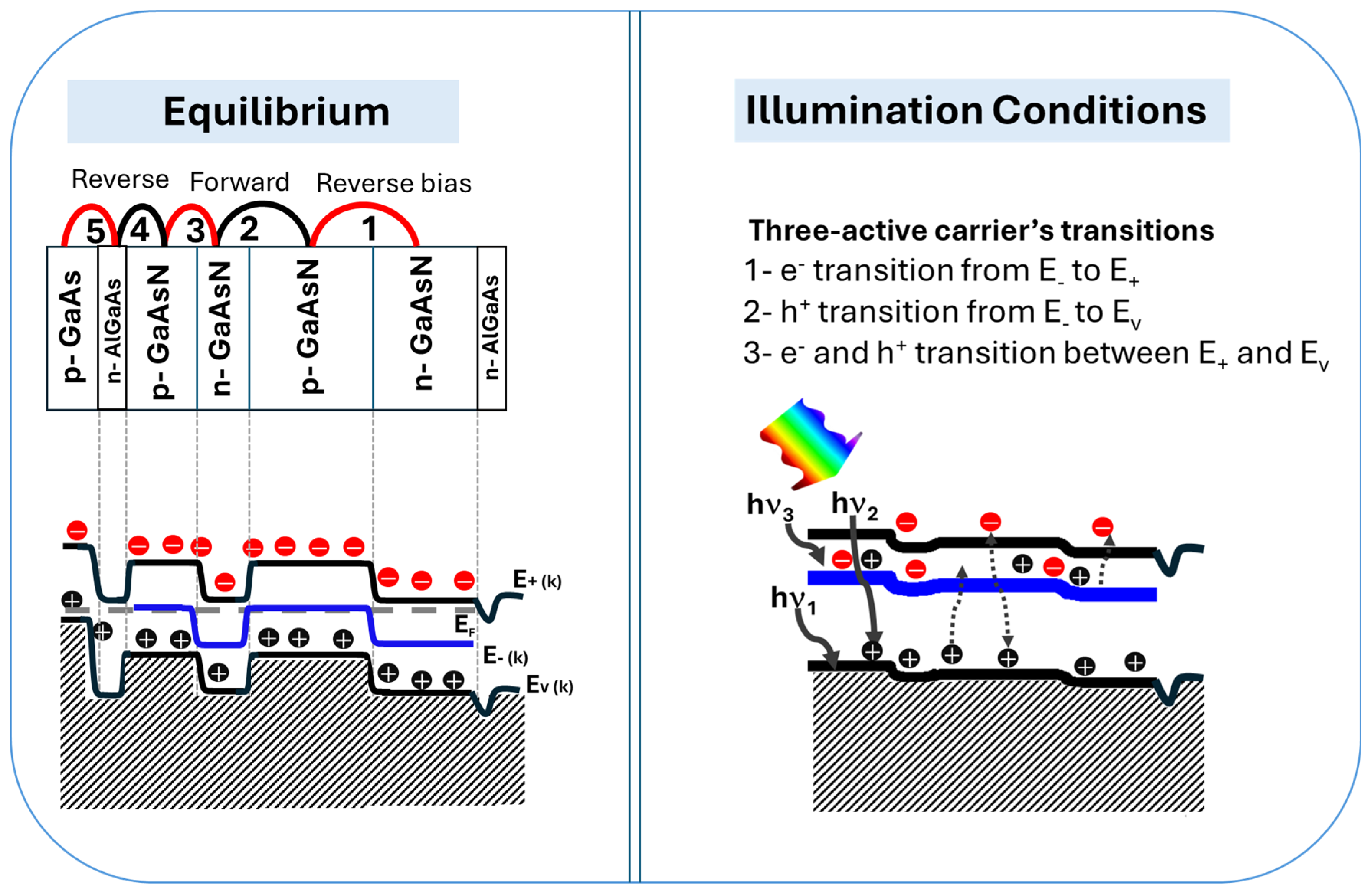
- Uses GaAsN’s three-band structure for bidirectional carrier generation.
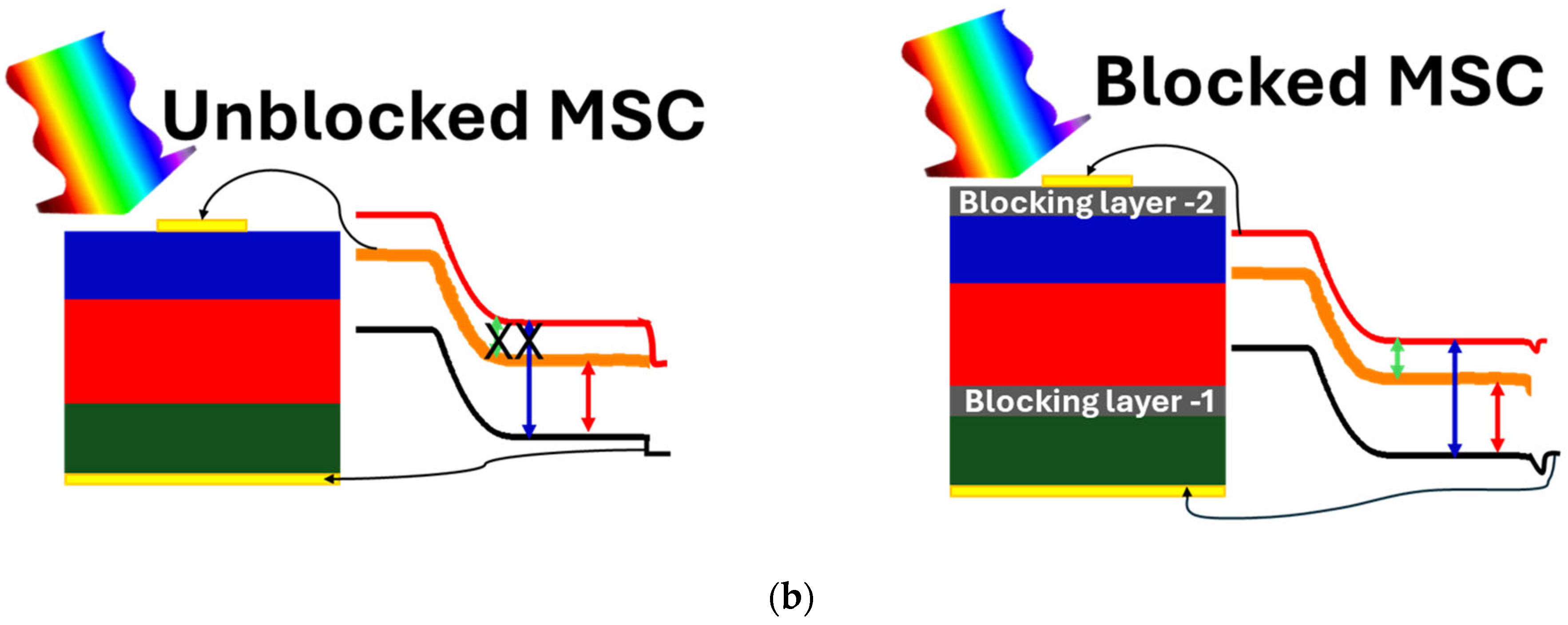
- Blocking layers stop contact recombination while preserving triple absorption.
- Rivals six-junction cell performance with a far simpler fabrication process.
- Establishes highly mismatched alloys as a platform for next-gen photovoltaics.
- Record 70% theoretical efficiency under concentration, per SCAPS-1D simulations.
Abstract
1. Introduction
2. Materials and Device Structure
3. Results
3.1. Photovoltaic Performance
3.2. Energy Band Engineering and Carrier Dynamics
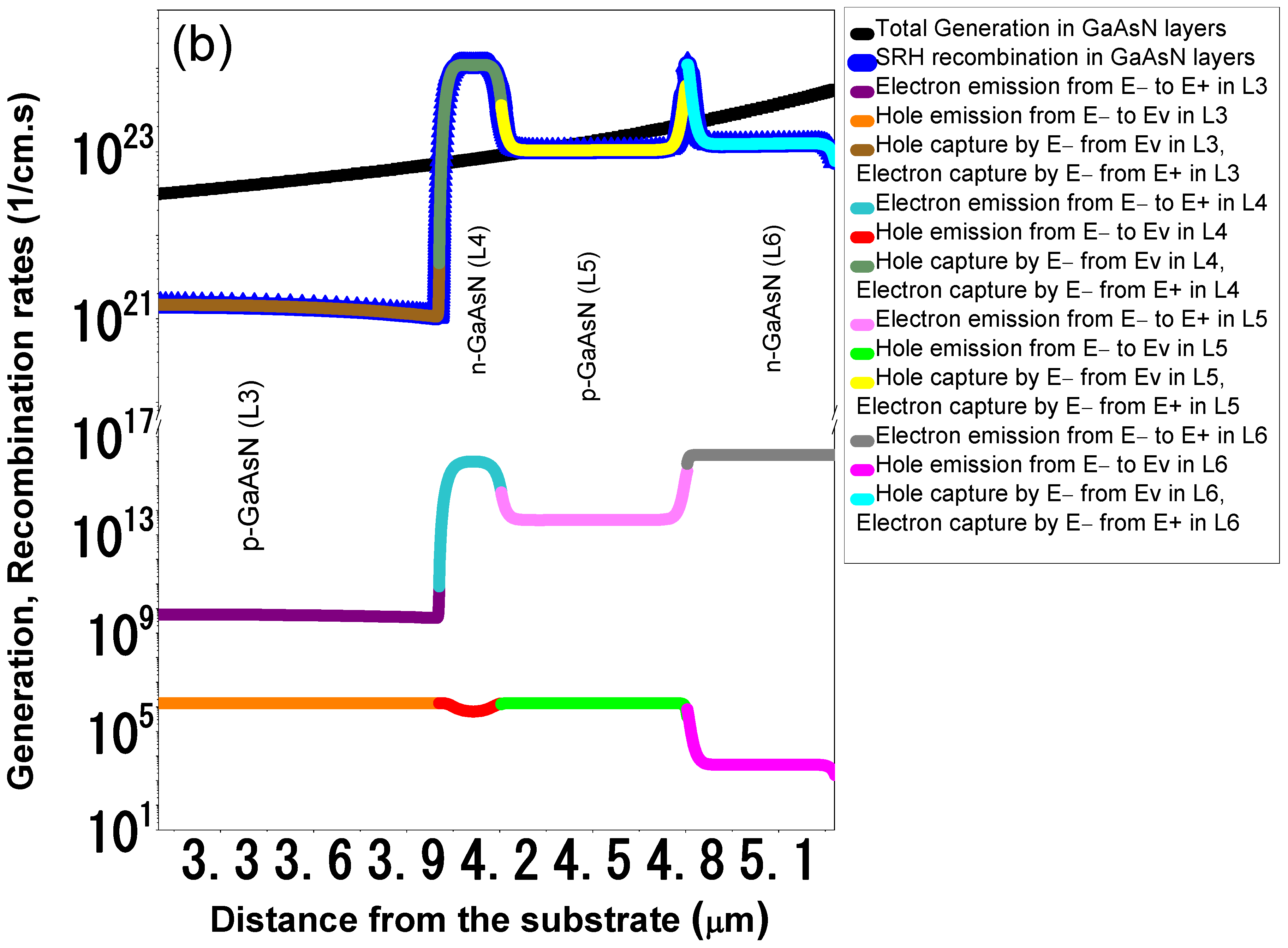
3.3. Carrier Generation and Recombination Rates
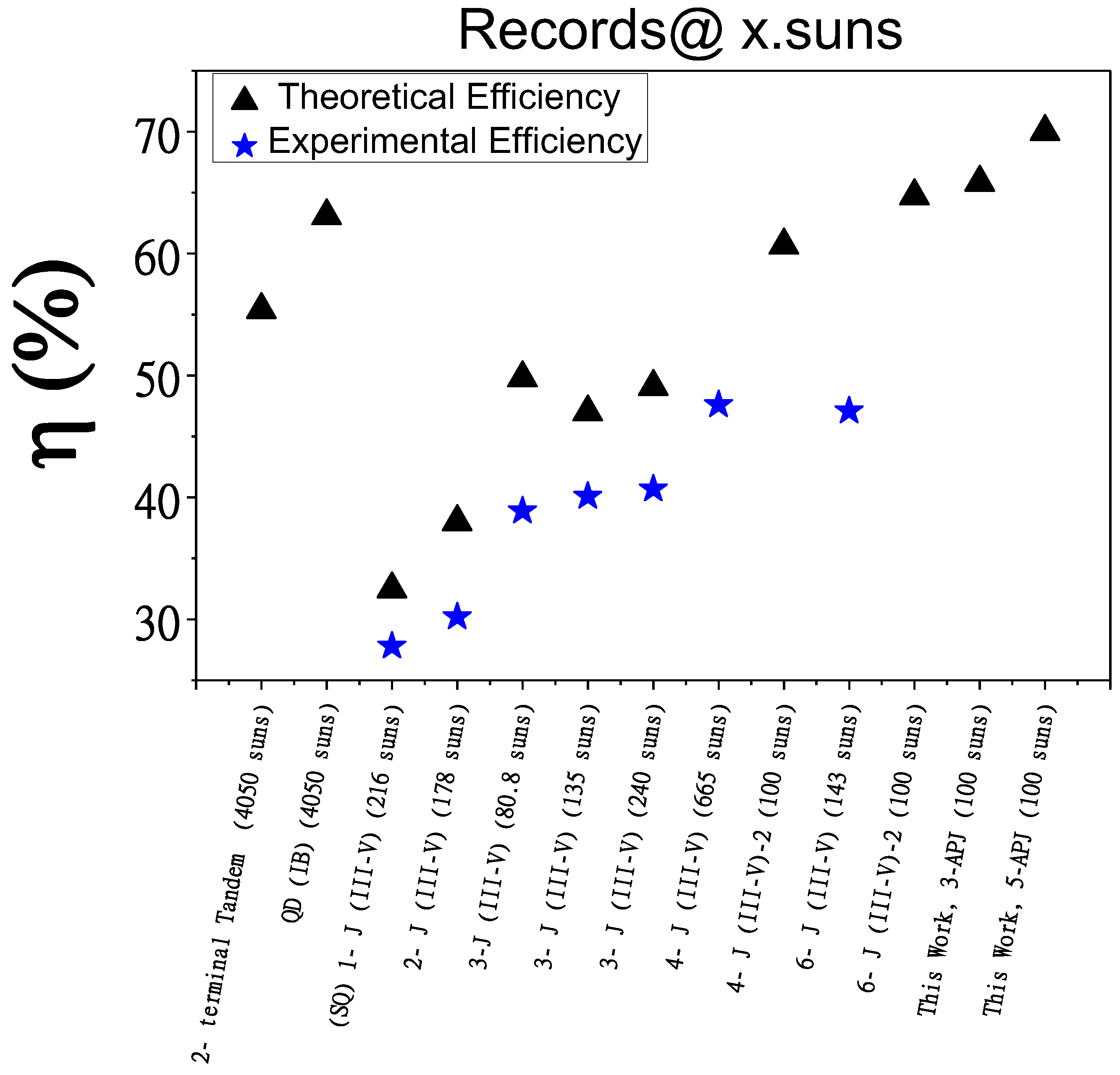
3.4. Record Comparison with III-V Multijunction Solar Cells
4. Conclusions
Supplementary Materials
Author Contributions
Funding
Data Availability Statement
Acknowledgments
Conflicts of Interest
References
- Shockley, W. The Shockley-Queisser limit. J. Appl. Phys. 1961, 32, 510–519. [Google Scholar] [CrossRef]
- Francea, R.M.; Geisza, J.F.; Steinera, M.A.; Schultea, K.L.; Garcíab, I.; Olavarriaa, W.; Younga, M.; Friedmana, D.J. High efficiency 6-junction solar cells for the global and direct spectra. In Proceedings of the 2019 IEEE 46th Photovoltaic Specialists Conference (PVSC), Chicago, IL, USA, 16–21 June 2019; pp. 1–5. [Google Scholar]
- Guo, F.; Li, N.; Fecher, F.W.; Gasparini, N.; Quiroz, C.O.R.; Bronnbauer, C.; Hou, Y.; Radmilović, V.V.; Radmilović, V.R.; Spiecker, E. A generic concept to overcome bandgap limitations for designing highly efficient multi-junction photovoltaic cells. Nat. Commun. 2015, 6, 7730. [Google Scholar] [CrossRef] [PubMed]
- Yamaguchi, M.; Dimroth, F.; Geisz, J.F.; Ekins-Daukes, N.J. Multi-junction solar cells paving the way for super high-efficiency. J. Appl. Phys. 2021, 129, 240901. [Google Scholar] [CrossRef]
- Prete, P.; Lovergine, N. High efficiency III–V nanowire solar cells: The road ahead. Nano Futures 2025, 9, 042502. [Google Scholar] [CrossRef]
- Prete, P.; Lovergine, N. Why III-V nanowires can challenge high-efficiency photovoltaic solar cells. In Proceedings of the Low-Dimensional Materials and Devices 2024, San Diego, CA, USA, 19–21 August 2024; p. 1311405. [Google Scholar]
- Eskandari, M.; Rostami, G.; Dolatyari, M.; Rostami, A.; Heidarzadeh, H. Optimization of power conversion efficiency in multi-band solar cells (theoretical investigation using GA optimization). Opt. Quantum Electron. 2021, 53, 469. [Google Scholar] [CrossRef]
- López, N.; Reichertz, L.; Yu, K.; Campman, K.; Walukiewicz, W. Engineering the electronic band structure for multiband solar cells. Phys. Rev. Lett. 2011, 106, 028701. [Google Scholar] [CrossRef]
- Ojha, V.; Jansen, G.; Patanè, A.; La Magna, A.; Romano, V.; Nicosia, G. Design and characterization of effective solar cells. Energy Syst. 2022, 13, 355–382. [Google Scholar] [CrossRef]
- Luque, A.; Martí, A. Increasing the efficiency of ideal solar cells by photon induced transitions at intermediate levels. Phys. Rev. Lett. 1997, 78, 5014. [Google Scholar] [CrossRef]
- Luque, A.; Martí, A. Towards the intermediate band. Nat. Photonics 2011, 5, 137–138. [Google Scholar] [CrossRef]
- López, N.; Yu, K.M.; Tanaka, T.; Walukiewicz, W. Multicolor electroluminescence from intermediate band solar cell structures. Adv. Energy Mater. 2016, 6, 1501820. [Google Scholar] [CrossRef]
- Geisz, J.; Kurtz, S.; Wanlass, M.; Ward, J.; Duda, A.; Friedman, D.; Olson, J.; McMahon, W.; Moriarty, T.; Kiehl, J. High-efficiency GaInP/GaAs/InGaAs triple-junction solar cells grown inverted with a metamorphic bottom junction. Appl. Phys. Lett. 2007, 91, 023502. [Google Scholar] [CrossRef]
- Geisz, J.F.; France, R.M.; Schulte, K.L.; Steiner, M.A.; Norman, A.G.; Guthrey, H.L.; Young, M.R.; Song, T.; Moriarty, T. Six-junction III–V solar cells with 47.1% conversion efficiency under 143 Suns concentration. Nat. Energy 2020, 5, 326–335. [Google Scholar] [CrossRef]
- Höhn, O.; Schygulla, P.; Klitzke, M.; Lackner, D.; Schön, J.; Oliva, E.; Schachtner, M.; Siefer, G.; Helmers, H.; Dimroth, F. Wafer-Bonded Four-Junction Solar Cell with 47.6% Conversion Efficiency for High Concentrating Photovoltaics. In Proceedings of the 2024 IEEE 52nd Photovoltaic Specialist Conference (PVSC), Seattle, WA, USA, 9–14 June 2024; pp. 117–119. [Google Scholar]
- King, R.; Law, D.C.; Edmondson, K.; Fetzer, C.; Kinsey, G.; Yoon, H.; Sherif, R.; Karam, N. 40% efficient metamorphic GaInP∕ GaInAs∕ Ge multijunction solar cells. Appl. Phys. Lett. 2007, 90, 183516. [Google Scholar] [CrossRef]
- Wu, J.; Shan, W.; Walukiewicz, W. Band anticrossing in highly mismatched III–V semiconductor alloys. Semicond. Sci. Technol. 2002, 17, 860. [Google Scholar] [CrossRef]
- Shan, W.; Walukiewicz, W.; Yu, K.; Ager Iii, J.; Haller, E.; Geisz, J.; Friedman, D.; Olson, J.; Kurtz, S.; Xin, H. Band anticrossing in III–N–V alloys. Phys. Status Solidi B 2001, 223, 75–85. [Google Scholar] [CrossRef]
- Walukiewicz, W.; Alberi, K.; Wu, J.; Shan, W.; Yu, K.; Ager, J. Electronic band structure of highly mismatched semiconductor alloys. In Dilute III-V Nitride Semiconductors and Material Systems; Springer: Berlin/Heidelberg, Germany, 2008; pp. 65–89. [Google Scholar]
- Cotal, H.; Fetzer, C.; Boisvert, J.; Kinsey, G.; King, R.; Hebert, P.; Yoon, H.; Karam, N. III–V multijunction solar cells for concentrating photovoltaics. Energy Environ. Sci. 2009, 2, 174–192. [Google Scholar] [CrossRef]
- Dimroth, F.; Tibbits, T.N.; Niemeyer, M.; Predan, F.; Beutel, P.; Karcher, C.; Oliva, E.; Siefer, G.; Lackner, D.; Fuß-Kailuweit, P. Four-junction wafer-bonded concentrator solar cells. IEEE J. Photovolt. 2015, 6, 343–349. [Google Scholar] [CrossRef]
- Green, M.A.; Dunlop, E.D.; Yoshita, M.; Kopidakis, N.; Bothe, K.; Siefer, G.; Hao, X.; Jiang, J.Y. Solar cell efficiency tables (version 65). Prog. Photovolt. Res. Appl. 2025, 33, 3–15. [Google Scholar] [CrossRef]
- Meillaud, F.; Shah, A.; Droz, C.; Vallat-Sauvain, E.; Miazza, C. Efficiency limits for single-junction and tandem solar cells. Sol. Energy Mater. Sol. Cells 2006, 90, 2952–2959. [Google Scholar] [CrossRef]
- Shen, H.; Walter, D.; Wu, Y.; Fong, K.C.; Jacobs, D.A.; Duong, T.; Peng, J.; Weber, K.; White, T.P.; Catchpole, K.R. Monolithic perovskite/Si tandem solar cells: Pathways to over 30% efficiency. Adv. Energy Mater. 2020, 10, 1902840. [Google Scholar] [CrossRef]
- Futscher, M.H.; Ehrler, B. Efficiency limit of perovskite/Si tandem solar cells. ACS Energy Lett. 2016, 1, 863–868. [Google Scholar] [CrossRef]
- De Vos, A. Detailed balance limit of the efficiency of tandem solar cells. J. Phys. D Appl. Phys. 1980, 13, 839. [Google Scholar] [CrossRef]
- Burgelman, M.; Nollet, P.; Degrave, S. Modelling polycrystalline semiconductor solar cells. Thin Solid Film. 2000, 361, 527–532. [Google Scholar] [CrossRef]
- Kamdem, C.F.; Ngoupo, A.T.; Konan, F.K.; Nkuissi, H.J.T.; Hartiti, B.; Ndjaka, J.-M. Study of the Role of Window Layer Al. Indian J. Sci. Technol. 2019, 12, 37. [Google Scholar] [CrossRef]
- Levinshtein, M. Handbook Series on Semiconductor Parameters; World Scientific: Singapore, 1997; Volume 1. [Google Scholar]
- Tridane, M.; Malaoui, A.; Belaaouad, S. Numerical Simulation of pin GaAs Photovoltaic Cell Using SCAPS-1D. Biointerface Res. Appl. Chem. 2022, 13, 253. [Google Scholar]
- Goldberg, Y.A. ALUMINIUM GALLIUM ARSENIDE (Al; c Ga1_xAs). In Handbook Series on Semiconductor Parameters; World Scientific: Singapore, 1996; Volume 2, p. 1. [Google Scholar]
- Messei, N.; Aida, M. Numerical simulation of front graded and fully graded AlGaAs/GaAs solar cell. Optik 2015, 126, 4432–4435. [Google Scholar] [CrossRef]
- Thordson, J.; Zsebök, O.; Södervall, U.; Andersson, T. Surface Morphology and Structure of GaNxAs1−x. Mater. Res. Soc. Internet J. Nitride Semicond. Res. 1997, 2, e8. [Google Scholar] [CrossRef]
- Chtourou, R.; Bousbih, F.; Bouzid, S.B.; Charfi, F.; Harmand, J.; Ungaro, G.; Largeau, L. Effect of nitrogen and temperature on the electronic band structure of GaAs 1−x N x alloys. Appl. Phys. Lett. 2002, 80, 2075–2077. [Google Scholar] [CrossRef]
- Walukiewicz, W.; Shan, W.; Wu, J.; Yu, K. Band anticrossing in III-NV alloys: Theory and experiments. In Physics and Applications of Dilute Nitrides; CRC Press: Boca Raton, FL, USA, 2004; pp. 37–78. [Google Scholar]
- Spruytte, S.G.; Coldren, C.W.; Harris, J.S.; Wampler, W.; Krispin, P.; Ploog, K.; Larson, M.C. Incorporation of nitrogen in nitride-arsenides: Origin of improved luminescence efficiency after anneal. J. Appl. Phys. 2001, 89, 4401–4406. [Google Scholar] [CrossRef]
- Ptak, A.; Johnston, S.; Kurtz, S.; Friedman, D.; Metzger, W. A comparison of MBE-and MOCVD-grown GaInNAs. J. Cryst. Growth 2003, 251, 392–398. [Google Scholar] [CrossRef]
- Li, W.; Pessa, M.; Ahlgren, T.; Decker, J. Origin of improved luminescence efficiency after annealing of Ga (In) NAs materials grown by molecular-beam epitaxy. Appl. Phys. Lett. 2001, 79, 1094–1096. [Google Scholar] [CrossRef]
- Crespo, C.T. Effect of band occupations in intermediate-band solar cells. Sol. Energy 2019, 178, 157–161. [Google Scholar] [CrossRef]
- Luque, A.; Martí, A.; Stanley, C. Understanding intermediate-band solar cells. Nat. Photonics 2012, 6, 146–152. [Google Scholar] [CrossRef]
- Kaminar, N.; Liu, D.; MacMillan, H.; Partain, L.; Ristow, M.L.; Virshup, G.; Gee, J. Concentrator efficiencies of 29.2% for a GaAs cell and 24.8% for a mounted cell-lens assembly. In Proceedings of the Conference Record of the Twentieth IEEE Photovoltaic Specialists Conference, Washington, DC, USA, 13–17 May 1996; pp. 766–768. [Google Scholar]
- Kurtz, S.; Myers, D.; McMahon, W.; Geisz, J.; Steiner, M. A comparison of theoretical efficiencies of multi-junction concentrator solar cells. Prog. Photovolt. Res. Appl. 2008, 16, 537–546. [Google Scholar] [CrossRef]
- Micha, D.N.; Silvares Junior, R.T. The influence of solar spectrum and concentration factor on the material choice and the efficiency of multijunction solar cells. Sci. Rep. 2019, 9, 20055. [Google Scholar] [CrossRef]
- Adachi, S. Properties of Aluminium Gallium Arsenide; IET: London, UK, 1993. [Google Scholar]
- Shur, M.S. Handbook Series on Semiconductor Parameters, Vol. 2: Ternary and Quaternary III-V Compounds; World Scientific: Singapore, 1996. [Google Scholar]
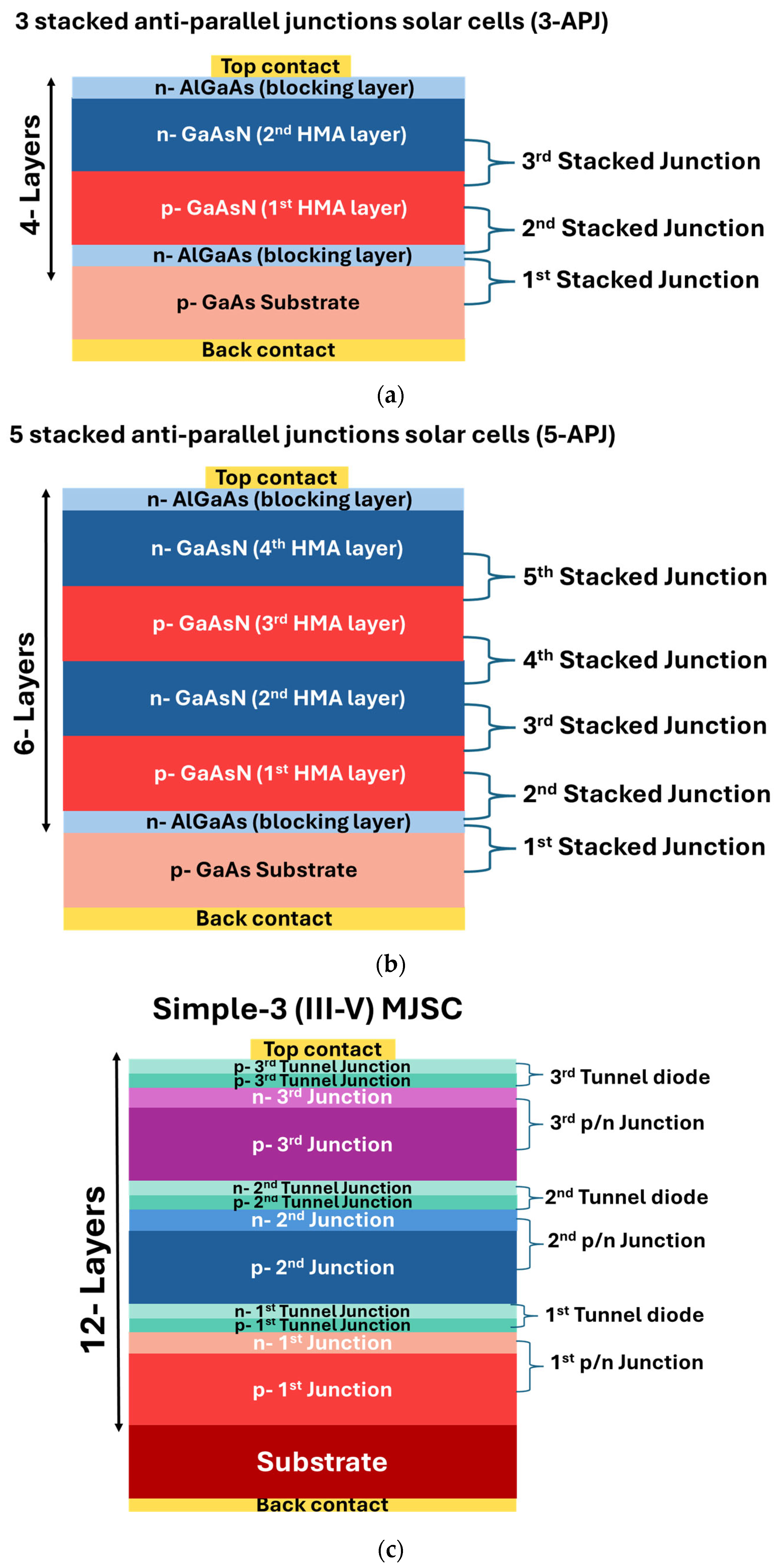




| Material | Carrier’s Concentration (cm−3) | Thickness (nm) | |
|---|---|---|---|
| 3-stacked anti-parallel junctions (3-APJ) | p-GaAs (L1) | 3000 | |
| n-AlGaAs (L2) | 5.0 | ||
| p-GaAsN (L3) | 1000 | ||
| n-GaAsN (L4) | 500 | ||
| n-AlGaAs (L5) | 5.0 | ||
| 5-stacked anti-parallel junctions (5-APJ) | p-GaAs (L1) | 3000 | |
| n-AlGaAs (L2) | 5.0 | ||
| p-GaAsN (L3) | 1000 | ||
| n-GaAsN (L4) | 200 | ||
| p-GaAsN (L5) | 600 | ||
| n-GaAsN (L6) | 500 | ||
| n-AlGaAs (L7) | 5.0 | ||
| Total defect densities (cm−3) | |||
| E− level with respect to the top of Ev (eV) | |||
| capture cross section electrons (cm2) | |||
| capture cross section holes (cm2) | |||
| Diluted nitrogen in GaAsN alloy (%) | |||
| Al percent in AlGaAs blocking layer (%) | 45 | ||
| Minority carrier’s lifetime (ns) | 6.9 | ||
| Total defect concentration between interfaces (cm−2) | |||
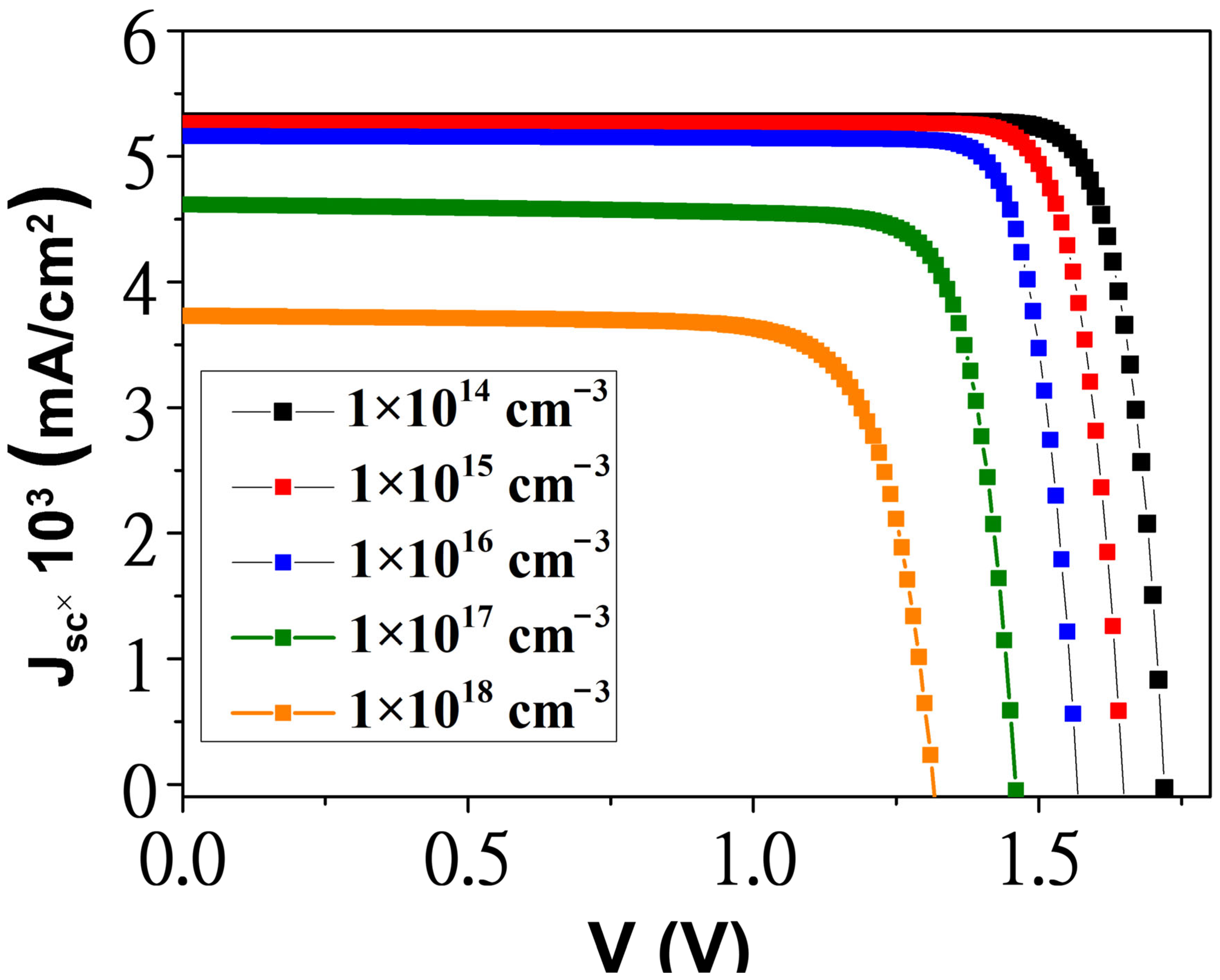
| Defect Density (cm−3) | Voc (V) | (mA/cm2) | FF (%) | η (%) |
|---|---|---|---|---|
| 1.72 | 5.27 | 87.33 | 79.27 | |
| 1.64 | 5.26 | 86.64 | 75.17 | |
| 1.56 | 5.16 | 86.54 | 70.02 | |
| 1.45 | 4.61 | 82.66 | 55.69 | |
| 1.31 | 3.73 | 78.11 | 38.32 |
| Cell Structure | Illumination (No. Suns) | Theoretical Cell Efficiency (%) | Experimental Cell Efficiency (%) | References |
|---|---|---|---|---|
| 2-terminal Tandem | 4050 | 55.4 | -- | [40] |
| QD IBSC | 4050 | 63.1 | -- | [40] |
| (SQ) 1-J (III-V) | 216 | 32.5 | 27.8 | [41] |
| 2-J (III-V) | 178 | 38 | 30.2 | [42] |
| 3-J (III-V) | 80.8 | 49.8 | 38.9 | [13] |
| 3-J (III-V) | 135 | 47 | 40.1 | [16] |
| 3-J (III-V) | 240 | 49.1 | 40.7 | [16] |
| 4-J (III-V) | 665 | -- | 47.6 | [15] |
| 4-J (III-V)-2 | 100 | 60.69 | -- | [43] |
| 6-J (III-V) | 143 | -- | 47.1 | [14] |
| 6-J (III-V)-2 | 100 | 64.73 | -- | [43] |
| 3-APJ | 100 | 65.84 | -- | Present work |
| 5-APJ | 100 | 70 | -- | Present work |
Disclaimer/Publisher’s Note: The statements, opinions and data contained in all publications are solely those of the individual author(s) and contributor(s) and not of MDPI and/or the editor(s). MDPI and/or the editor(s) disclaim responsibility for any injury to people or property resulting from any ideas, methods, instructions or products referred to in the content. |
© 2025 by the authors. Licensee MDPI, Basel, Switzerland. This article is an open access article distributed under the terms and conditions of the Creative Commons Attribution (CC BY) license (https://creativecommons.org/licenses/by/4.0/).
Share and Cite
Ramadan, R.; Yu, K.M.; López Martínez, N. Simulation of a Multiband Stacked Antiparallel Solar Cell with over 70% Efficiency. Materials 2025, 18, 5625. https://doi.org/10.3390/ma18245625
Ramadan R, Yu KM, López Martínez N. Simulation of a Multiband Stacked Antiparallel Solar Cell with over 70% Efficiency. Materials. 2025; 18(24):5625. https://doi.org/10.3390/ma18245625
Chicago/Turabian StyleRamadan, Rehab, Kin Man Yu, and Nair López Martínez. 2025. "Simulation of a Multiband Stacked Antiparallel Solar Cell with over 70% Efficiency" Materials 18, no. 24: 5625. https://doi.org/10.3390/ma18245625
APA StyleRamadan, R., Yu, K. M., & López Martínez, N. (2025). Simulation of a Multiband Stacked Antiparallel Solar Cell with over 70% Efficiency. Materials, 18(24), 5625. https://doi.org/10.3390/ma18245625