Metal-Coordinated Lignosulfonate Catalysts for the Selective Conversion of Hexose: Active Site and Reaction Medium



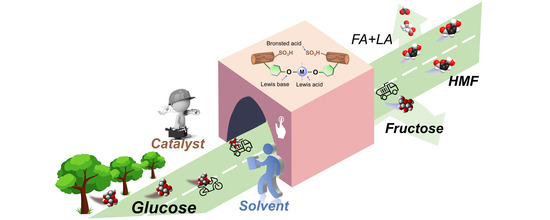
Abstract
Share and Cite
Chen, L.; Zhang, H.; Feng, Y.; Zhao, S.; Zhao, L.; He, W. Metal-Coordinated Lignosulfonate Catalysts for the Selective Conversion of Hexose: Active Site and Reaction Medium. Materials 2025, 18, 5584. https://doi.org/10.3390/ma18245584
Chen L, Zhang H, Feng Y, Zhao S, Zhao L, He W. Metal-Coordinated Lignosulfonate Catalysts for the Selective Conversion of Hexose: Active Site and Reaction Medium. Materials. 2025; 18(24):5584. https://doi.org/10.3390/ma18245584
Chicago/Turabian StyleChen, Luyu, Haoyu Zhang, Yirong Feng, Shuangfei Zhao, Lili Zhao, and Wei He. 2025. "Metal-Coordinated Lignosulfonate Catalysts for the Selective Conversion of Hexose: Active Site and Reaction Medium" Materials 18, no. 24: 5584. https://doi.org/10.3390/ma18245584
APA StyleChen, L., Zhang, H., Feng, Y., Zhao, S., Zhao, L., & He, W. (2025). Metal-Coordinated Lignosulfonate Catalysts for the Selective Conversion of Hexose: Active Site and Reaction Medium. Materials, 18(24), 5584. https://doi.org/10.3390/ma18245584