You are currently viewing a new version of our website. To view the old version click .
Materials
  • Article
  • Open Access

5 December 2025

C15-Structured Zr-Ti-Fe-Ni-V Alloys for High-Pressure Hydrogen Compression
,
and
1
Guangdong Provincial Key Laboratory of Advanced Energy Storage Materials, School of Materials Science and Engineering, South China University of Technology, Guangzhou 510640, China
2
Guangxi Key Laboratory of Advanced Structural Materials and Carbon Neutralization, School of Materials and Environment, Guangxi Colleges and Universities Key Laboratory of Eco-Friendly Materials and Ecological Restoration, Guangxi Minzu University, Nanning 530105, China
*
Author to whom correspondence should be addressed.
Materials2025, 18(24), 5482;https://doi.org/10.3390/ma18245482 
(registering DOI)
This article belongs to the Special Issue Hydrides for Energy Storage: Materials, Technologies and Applications

Abstract

Metal hydride hydrogen compressors (MHHC) offer unique advantages over conventional mechanical compressors in high-pressure hydrogen refueling. In this study, we developed C15-structured Zr-Ti-Fe-Ni-V single-phase alloys for high-pressure hydrogen compression. By designing the alloy compositions—high Ni and low V—and employing a quenching process, the resulting ZrFe2-based alloys exhibit reduced hydriding/dehydriding plateau hysteresis and slope, along with a narrow hydrogen solid solution zone. Notably, the Zr0.8Ti0.2Fe1.2Ni0.7V0.1 alloy elevates the hydrogen pressure from 128.3 atm to 334.5 atm within 283–353 K, delivering an effective hydrogen capacity of 1.02 wt.%. Similarly, the Zr0.9Ti0.1Fe1.2Ni0.7V0.1 alloy increases the hydrogen pressure from 60.4 atm to 221.8 atm across 283–363 K, with a capacity of 0.81 wt.%. This work provides a rational strategy for designing ZrFe2-based alloys for efficient hydrogen compression and storage applications.

1. Introduction

Hydrogen energy, as a clean and renewable energy carrier, plays a crucial role in achieving global carbon neutrality [1,2,3]. Because of its inherently low density under ambient temperature and pressure, hydrogen must be stored either at extremely high pressures or under low-temperature conditions to achieve a higher storage density [4,5]. Currently, commercial high-pressure hydrogen storage systems primarily employ diaphragm compressors for hydrogen refueling [6]. As an alternative to conventional mechanical compressors, metal hydride hydrogen compressors (MHHCs) exploit the unique property of hydrogen storage alloys, in which the hydrogen desorption plateau pressure increases with temperature to realize hydrogen pressurization. This method offers several notable advantages, including enhanced operational safety, lower maintenance costs and intrinsic hydrogen purification capability [7,8,9].
The core performance indicators of MHHCs are the hydrogen compression ratio and the effective hydrogen compression capacity, both of which are closely governed by the thermodynamic properties of the hydrogen storage alloys [10,11,12]. First, the hydrogen compression alloy should exhibit a low slope in the hydrogen absorption/desorption plateau, which facilitates a higher hydrogen compression ratio Rp = PH/PL, where PL and PH represent the right and left inflection points of the hydrogen absorption/desorption plateau on the pressure-composition isotherms (PCI), respectively. Second, the hydrogen compression alloy should possess a low hysteresis coefficient to reduce the energy consumption during cyclic hydrogen absorption and desorption. Furthermore, a high reversible hydrogen storage capacity further enhances the compression efficiency and hydrogen supply capacity. To ensure operational safety and energy efficiency, MHHC systems are typically designed to operate within the temperature range of 283–368 K, using water as the heat-transfer medium to regulate temperature. Depending on the design configuration, the required hydrogen compression ratios are approximately 80–250 atm for single-stage, 200–450 atm for double-stage, and 400–850 atm for three-stage compressors [13,14,15].
Currently, the most widely used hydrogen compression alloys in MHHC are LaNi5-based and TiCr2-based alloys [16,17,18,19,20]. LaNi5-based alloys exhibit several advantages, including fast hydrogen sorption kinetics, good cyclic stability, and strong resistance to impurity poisoning, making them particularly suitable for primary-stage hydrogen compression [16,17]. In contrast, the TiCr2-based alloys are mainly employed in intermediate and high-pressure hydrogen compression, typically operating within the range of 400–850 atm [13,18,19]. Compared with a TiCr2-based alloy that possesses a C14-type hexagonal Laves phase structure, a ZrFe2-based alloy with a C15 cubic structure demonstrates superior intrinsic properties, including ultra-high plateau pressures, flat plateau slopes and low α-phase hydrogen solubility [20,21]. These features are highly beneficial for achieving higher hydrogen compression ratios and greater effective hydrogen capacities. However, despite these advantages, the practical application of ZrFe2-based alloys in hydrogen compressors has been restricted due to their excessively high plateau pressures and pronounced hysteresis effects [22].
As is well known, hydrogen storage properties are fundamentally rooted in the interaction between their crystal structures and hydrogen atoms, manifesting as PCI curves and kinetics performance characteristics. Through the precise regulation of structural features and chemical composition, alloying enables synergistic improvements in the thermodynamics, kinetics, and cyclic stability of hydrogen storage, establishing it as the central strategy for optimizing the overall performance of hydrogen storage alloys. Therefore, to expand the applicability of ZrFe2-based alloys in hydrogen compressors, researchers have focused on reducing the hysteresis coefficient and plateau slope while fine-tuning the plateau pressure, primarily through elemental substitution for Fe [23,24,25,26,27,28]. For instance, the partial substitution of Fe with V effectively lowers the plateau pressure and mitigates hysteresis. However, excessive V addition leads to an increased plateau slope and a reduced hydrogen compression ratio [22,24]. Substituting Fe with Cr or Mn can decrease the plateau pressure of ZrFe2-based alloys while preserving a relatively flat plateau region [25,26]. Nevertheless, these alloying strategies often aggravate hysteresis, thereby decreasing the hydrogen compression ratio and increasing energy consumption. In addition, Ni—having a smaller atomic radius and a stronger affinity for hydrogen than Fe—can reduce the hysteresis coefficient of ZrFe2-based alloys while maintaining a low plateau slope [27]. However, when the Ni content is insufficient, the alloys tend to exhibit undesirable double plateaus on the PCI curves [28].
In this work, elemental substitutions of Ni, V, and Ti were introduced into ZrFe2, which originally has a high Ni content and low Ti/V ratio, to develop an intermediate hydrogen-compressing alloy with a C15 structure suitable for MHHC applications. Furthermore, a quenching process was employed to obtain a homogeneous single-phase structure with superior hydrogen sorption plateau characteristics, including a narrow solid-solution zone and a flat plateau. As a result, two Zr-Ti-Fe-Ni-V alloys exhibiting excellent hydrogen compression properties have been successfully developed.

2. Materials and Methods

2.1. Alloy Preparation

The series of Zr-Ti-Fe-Ni-V alloys (#1-Zr0.8Ti0.2Fe1.15Ni0.7V0.15, #2-Zr0.75Ti0.25FeNi0.8V0.2, #3-Zr0.8Ti0.2Fe0.85Ni0.9V0.25, #4-Zr0.7Ti0.3Fe1.05Ni0.7V0.25, #5-Zr0.8Ti0.2Fe1.2Ni0.7V0.1, #6-Zr0.8Ti0.2Fe1.1Ni0.8V0.1, #7-Zr0.9Ti0.1Fe1.2Ni0.7V0.1 and #8-Zr0.7Ti0.3Fe1.2Ni0.7V0.1) alloys were prepared by vacuum arc-melting in a DHL-1 vacuum-melting furnace. All the raw materials (Zr, Ti, Fe Ni and V ingots, over 99.9% purity) were purchased from Jiangxi GuoYan New Materials Co., Ltd. (Xinyu, China). A total of 10 g of raw materials was placed in the crucible, which was vacuumed to 2 × 10⁻³ Pa under an Ar atmosphere and then filled with 0.7–0.8 atm of high-purity argon. Each sample was smelted seven times for 20–30 s per cycle to ensure uniform alloy composition. The melt loss was kept below 0.5%. A portion of the molten alloy was polished and encased in a quartz tube, which was annealed at 1173 K and 1423 K for 5 days and then quenched in cool water; the heat treatment process diagram is shown in Figure S1. The hardened ingots were crushed and ground into powder after removing the oxide layer, and the alloy powder was then sieved through a 200-mesh screen for structural analysis and performance testing.

2.2. Structural Characterization

The phase structure of the alloys was analyzed by PANalytical Empyrean diffractometer (Malvern Panalytical, Malvern, UK), Cu-Ka radiation (2θ range: 20–100). The Rietveld structure refinement was performed by Fullprof software [29]. The field emission scanning electron microscope (SEM, TESCAN GAIA3, TESCAN, Brno, Czech Republic) equipped with an X-ray energy-dispersive spectrometer (EDS) was used to characterize the microstructure and composition of the samples.

2.3. Hydrogen Storage Measurement

The pressure-composition isotherms (PCI) were measured on a Sieverts-type hydrogen storage performance tester (Advanced Materials Corporation, Pittsburgh, PA, USA). High-purity hydrogen (99.999%) was used as the test gas. This device’s criteria for judging the equilibrium of each point in the PCI curve require one of the following two points: (a) the pressure fluctuation in the sample holder is less than 0.00049 psi/s; (b) the hydrogen was injected into the sample holder and held for more than 30 min. All samples were activated before PCI measurements by heating to 373 K and vacuumed for 30 min, then cooled to 223 K under 220 atm hydrogen and held for 10 h. PCI curves for hydrogen absorption and desorption were measured in a temperature range of 243–288 K and a pressure range between 100 atm and 0.06 atm.

3. Results and Discussion

3.1. Microstructures of Alloys

Figure 1 shows the Rietveld refinement results of the XRD patterns for four as-cast alloys (#1-Zr0.8Ti0.2Fe1.15Ni0.7V0.15, #2-Zr0.75Ti0.25FeNi0.8V0.2, #3-Zr0.8Ti0.2Fe0.85Ni0.9V0.25 and #4-Zr0.7Ti0.3Fe1.05Ni0.7V0.25 alloys); the corresponding structural parameters are summarized in Table 1. It can be observed that all three alloys (#1–#3) crystallized in the C15 Laves phase with the space group Fd-3m (No. 227), whereas the #4 alloy adopts a hexagonal C14-type Laves phase with space group P63/mmc (No. 194). The XRD patterns show that all four alloys are single-phase in nature.
Figure 1. XRD patterns and Rietveld refinement patterns of the #1-Zr0.8Ti0.2Fe1.15Ni0.7V0.15 (a), #2-Zr0.75Ti0.25FeNi0.8V0.2 (b), #3-Zr0.8Ti0.2Fe0.85Ni0.9V0.25 (c), and #4-Zr0.7Ti0.3Fe1.05Ni0.7V0.25 (d) alloys.
As the Ti content increases from 0.2 to 0.25 and the Ni content decreases from 0.9 to 0.7, the alloys consistently exhibit a stable C15 single-phase structure. It is well known that the formation of Laves phases of AB2-type alloys is strongly influenced by the valence electron concentration (e/a) and the atomic radius ratio (RA/RB) [30]. Generally, a higher e/a value combined with a lower RA/RB ratio tends to promote the structural transition from the C15 phase to the C14 phase. As shown in Table 1, the e/a and RA/RB values of three alloys are #1 (1.58, 1.240), #2 (1.67, 1.234), #3 (1.75, 1.239), and #4 (1.75, 1.225). These results suggest that the formation of a C15 structure in ZrFe2-based alloys requires two critical conditions for value range of the e/a and RA/RB ratio. Table S1 summarizes the Laves phase structures, valence electron concentrations (e/a), and atomic radius ratios (RA/RB) of large number of alloys across C15-type ZrFe2-based systems. Figure S2 illustrates the correlation between the C14 and C15 Laves phase structures of ZrFe2-based alloys and the two key parameters that e/a on the x-axis and RA/RB on the y-axis. The observed structural trends are summarized as follows: (1) when RA/RB < 1.22 or e/a > 2.43, the ZrFe2-based alloy stabilizes in the C14 phase; (2) when RA/RB > 1.22 and e/a < 1.75, the ZrFe2-based alloy adopts the C15 phase; (3) when RA/RB > 1.22 and 1.75 < e/a < 2.43, the ZrFe2-based alloy exhibits the coexistence of C14 and C15 phases. Therefore, the formation conditions of the C15 structure in Zr-Ti-Fe-Ni-V alloys are RA/RB > 1.234 and e/a value < 1.75. This criterion is consistent with previous findings for other C15-structured Zr-Y-Fe and Zr-Fe-Al alloys [22,31].
Table 1. Structure parameters of #1–#4 alloys.
Alloyse/aRA/RBPhasea (Å)c (Å)V3)
#11.581.240C156.9994 342.91
#21.671.234C156.9917 341.78
#31.751.239C157.0053 343.78
#41.751.225C144.94538.0605170.72
Where e/a = Z1C1 + Z2C2 + … + ZmCm, Zi (i = 1 − s) is the number of valence electrons of element i, Ci is the atomic fraction of element i, and C1 +… + Cm = 1. The valence electron number of metallic elements is the number of atomic groups, but the valence electron number of VIIIB group elements such as Fe and Ni is zero [32]. RA = R1X1 + R2X2 + … + RmXm (RB = RaYa + RbYb + … + RnYn), Ri (i = 1 − m) is the atomic radius of the A-side element; Rj(j = 1 − n) is the atomic radius of the B-side element; and X1 + X2 +… + Xm = 1, Y1 + Y2 +… + Yn = 1.
Figure 2a–c show the SEM images and EDS elemental mappings of the as-cast alloys. Although the XRD results show that all three alloys (#1–#3) crystallize in a single C15 phase, distinct phase contrast variations are visible in the backscattered SEM images. These differences in contrast are associated with the non-uniform distribution of Zr, Ti, Fe, and Ni elements, as confirmed by the elemental mappings. Specifically, Fe does not fully dissolve with Ti and Ni in the as-cast alloys, resulting in marked compositional inhomogeneity. This is primarily attributed to the wide solid solubility range of ZrFe2 phase, in which moderate compositional fluctuations do not induce the precipitation of a secondary phase. A similar phenomenon has also been observed in studies of ZrFe2-type Zr-Ti-Fe-Mn alloys [33].
Figure 2. Backscattering SEM morphologies and elemental mappings of #1-Zr0.8Ti0.2Fe1.15Ni0.7V0.15 (a), 2-Zr0.75Ti0.25FeNi0.8V0.2 (b), #3-Zr0.8Ti0.2Fe0.85Ni0.9V0.25 (c), and the Zr0.8Ti0.2Fe1.15Ni0.7V0.15 alloys quenched at 1173 K (d) and 1423 K (e).
To optimize the microstructure, the #1 alloy (Zr0.8Ti0.2Fe1.15Ni0.7V0.15) was selected for quenching treatments at different temperatures. After quenching at 1173 K, Figure 2d shows a slight phase-contract difference but improved elemental uniformity. When the quenching temperature is increased to 1423 K, the alloy exhibits a completely homogeneous elemental distribution and a well-defined single-phase microstructure. This is caused by the increasing atomic diffusion energies of Zr, Ti, Fe and Ni elements at elevated temperatures, which promotes atomic mobility. Additionally, high-temperature annealing reduces lattice defects and creates more pathways for atomic diffusion.
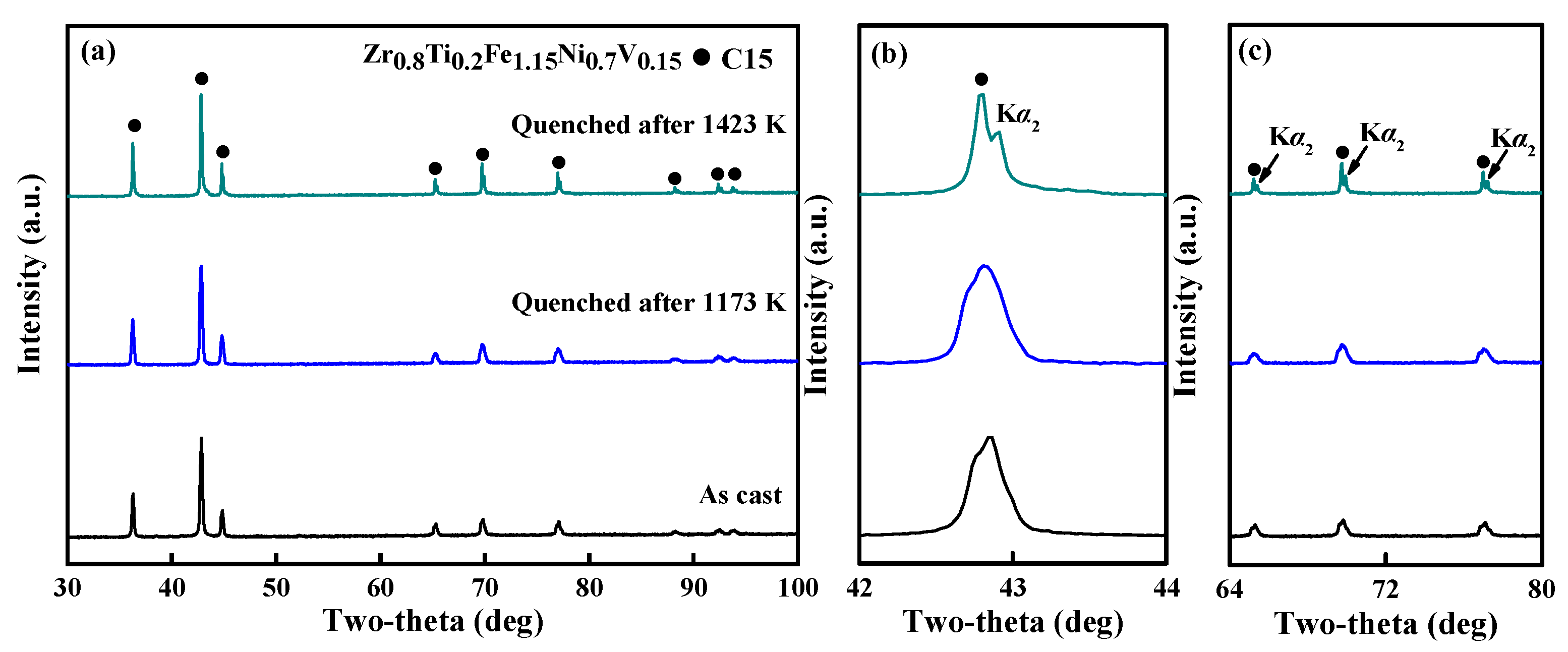
The XRD patterns of the quenched alloys (Figure 3a) confirm that the C15 structure is retained in all samples. A close examination of the enlarged profiles (Figure 3b,c) shows that the broadened peaks in both the as-cast alloy and the 1173 K-quenched alloy correspond to overlapping C15 phases with a slightly different composition, as illustrated in Figure 2. In contrast, the 1423 K-quenched alloy displays sharp and well-resolved diffraction peaks, where each distinct Kα1 peak is accompanied by a clearly separated Kα2 peak with an intensity ratio of approximately 2:1.
Figure 3. XRD patterns of Zr0.8Ti0.2Fe1.15Ni0.7V0.15 alloys at different quenching treatments with 2 theta range of 30–100° (a), 42–44° (b), and 64–80° (c).
This result provides further evidence of enhanced crystallinity and the successful formation of a uniform single-phase structure at higher quenching temperatures. Overall, these findings demonstrate that the quenching process effectively refines the microstructure of multicomponent Zr-Fe-Ni-Ti-V alloys, promoting compositional homogeneity and structural stability.

3.2. Hydrogen Storage Properties

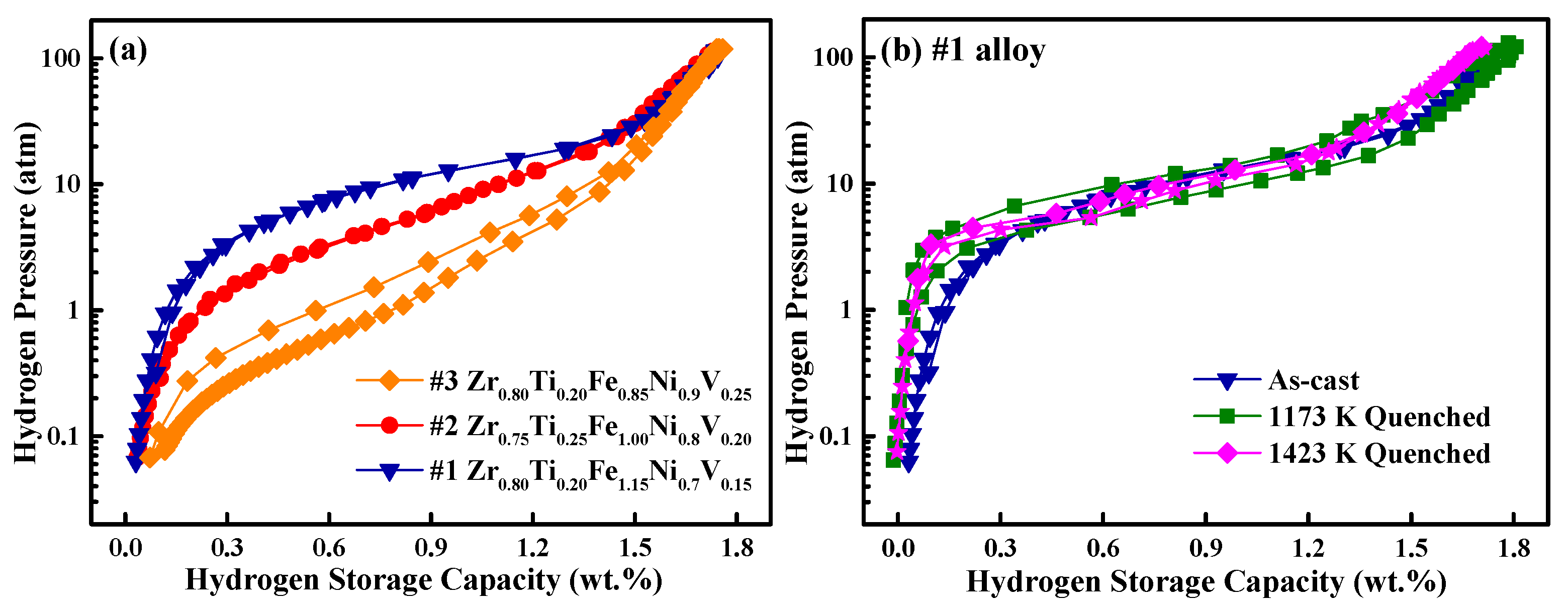
The PCI curves tested at 243 K of the #1–#3 as-cast alloys, and the quenched #1 alloy are shown in Figure 4, with corresponding hydrogen absorption/desorption performance data summarized in Table 2. The #1-Zr0.8Ti0.2Fe1.15Ni0.7V0.15 alloy exhibits higher hydrogen storage capacity and plateau pressure than both the #2-Zr0.75Ti0.25Fe1Ni0.8V0.2 and #3-Zr0.8Ti0.2Fe0.85Ni0.9V0.25 alloys. The content of elements in alloys has a direct impact on hydrogen storage performance. The elevated V and Ni contents are the main reasons contributing to the decreased hydrogen storage capacity and plateau pressure [28,34]. In addition, both #1 and #2 alloys exhibit significantly low Hf values, and their hydrogen absorption/desorption PCI curves are almost overlapped. However, the Hf value of #3 alloy slightly increases up to 0.5 with increasing Ni content, potentially due to the excessive Ni content and the strong affinity between Ni and H [35]. Notably, the Sf value of all the three as-cast alloys exceeds 1.5, which may be attributed to the heterogeneous microstructure and inhomogeneous compositions [36]. Therefore, the Ni content should be maintained below 0.9, while the V content should not exceed 0.15.
Figure 4. PCI curves at 243 K for #1–#3-Zr-Ti-Fe-Ni-V alloys (a) and a comparison of #1 alloy when as-cast, 1173 K-quenched, and 1423 K-quenched (b).
Table 2. Hydrogen storage thermodynamics properties of alloys at 243 K.
Figure 4b compares the PCI curves of the #1 alloy (Zr0.8Ti0.2Fe1.15Ni0.7V0.15) before and after quenching. The hydrogen storage capacity shows a slight increase after quenching at 1173 K but a decrease when quenched at 1423 K. This is because the elemental distribution in the alloy evolved from three distinct regions to two after quenching at 1173 K, indicating enhanced compositional homogenization contributes to an improved hydrogen storage capacity. As temperature further increased to 1423 K, the alloy achieved full elemental uniformity, accompanied by the elimination of structural defects. However, this reduction in defect density and phase boundary interfaces diminished the number of available sites for hydrogen atom accommodation, leading to a decrease in hydrogen storage capacity. Furthermore, both quenched alloys demonstrated reduced desorption plateau pressures compared to the as-cast alloy, indicating that the more homogeneous composition achieved after quenching optimizes the diffusion pathways of hydrogen atoms, reducing the diffusion energy barrier and thus decreasing the hydrogen desorption plateau pressure. The 1423 K-quenched alloy displays a lower hydrogen absorption pressure but a higher desorption pressure compared with the 1173 K-quenched sample, resulting in a lower hysteresis factor (Hf = 0.12). The quenching process significantly enhances compositional homogeneity and plateau features, as evidenced by the narrowing of the hydrogen solid solution zone (Cs) from 0.29 wt.% in the as-cast state to 0.09 wt.% after quenching at 1423 K. This is primarily attributed to the wide solid solubility range of the ZrFe2 phase, which accommodates moderate compositional fluctuations without inducing secondary phase precipitation. High-temperature annealing further contributes by reducing lattice defects and facilitating atomic diffusion through the creation of additional diffusion pathways. As shown in Figure 2, when the #1 alloy was quenched at 1173 K, the element distribution changed from three distinct regions to two, indicating a gradual homogenization. When the temperature was raised to 1423 K, the alloy achieved complete elemental homogeneity. The resulting compositional optimization improves hydrogen diffusion kinetics by providing more coherent diffusion channels, thereby yielding a flatter desorption plateau and reduced hysteresis. This improvement indicates that the quenching process effectively increases the hydrogen compression efficiency [39]. Compared with other C15 structure alloys, all the Zr-Ti-Fe-Ni-V alloys studied in this study for hydrogen compression have a flatter hydrogen absorption/desorption plateau, lower hysteresis, and a similar slope factor [22,31,33].
Therefore, these results demonstrate that a relatively high Ni content and low V content in ZrFe2-based alloys are beneficial for improving the slope factor and hysteresis factor of the hydrogen absorption/desorption plateaus. The primary role of V lies in enhancing structural stability through electron hybridization, thereby improving hydrogen storage capacity and diffusion kinetics. In contrast, Ni functions by forming intermetallic compounds and regulating phase structure, which enables a balanced trade-off between hydrogen storage capacity and cycling stability, thus facilitating performance optimization in multi-component alloys [40]. Accordingly, a quenching temperature of 1423 K was selected as the optimal condition for fabricating single-phase C15-structured alloys with enhanced hydrogen storage and compression properties.

3.3. Optimization of Alloy’s Composition and Hydrogen Storage Performance

To further improve the plateau characteristics, four modified alloys with reduced V content were designed based on the #1 alloy’s composition (Zr0.8Ti0.2Fe1.15Ni0.7V0.15). These alloys, #5 (Zr0.8Ti0.2Fe1.2Ni0.7V0.1), #6 (Zr0.8Ti0.2Fe1.1Ni0.8V0.1), #7 (Zr0.9Ti0.1Fe1.2Ni0.7V0.1), and #8 (Zr0.7Ti0.3Fe1.2Ni0.7V0.1), were developed by optimizing the Ni and Ti contents. All samples were prepared via quenching at 1423 K to ensure compositional homogeneity.
The XRD patterns and SEM images (Figures S3 and S4) confirm that all four alloys possess a single C15 phase with a uniform elemental distribution. As summarized in Table 3, the cell volume shows a slight decrease from 341.92 Å3 to 341.22 Å3 with increasing Ni content (from 0.7 to 0.8). In contrast, a more significant reduction in cell volume, from 345.55 Å3 to 338.23 Å3, is observed as the Ti content rises from 0.1 to 0.3. These variations in cell volume directly correlate with the elevation of plateau pressure in the alloys, suggesting that atomic substitution plays a key role in tuning the thermodynamic properties of the C15 structure.
Table 3. Cell volume and hydrogen storage properties of alloys quenched at 1423 K.
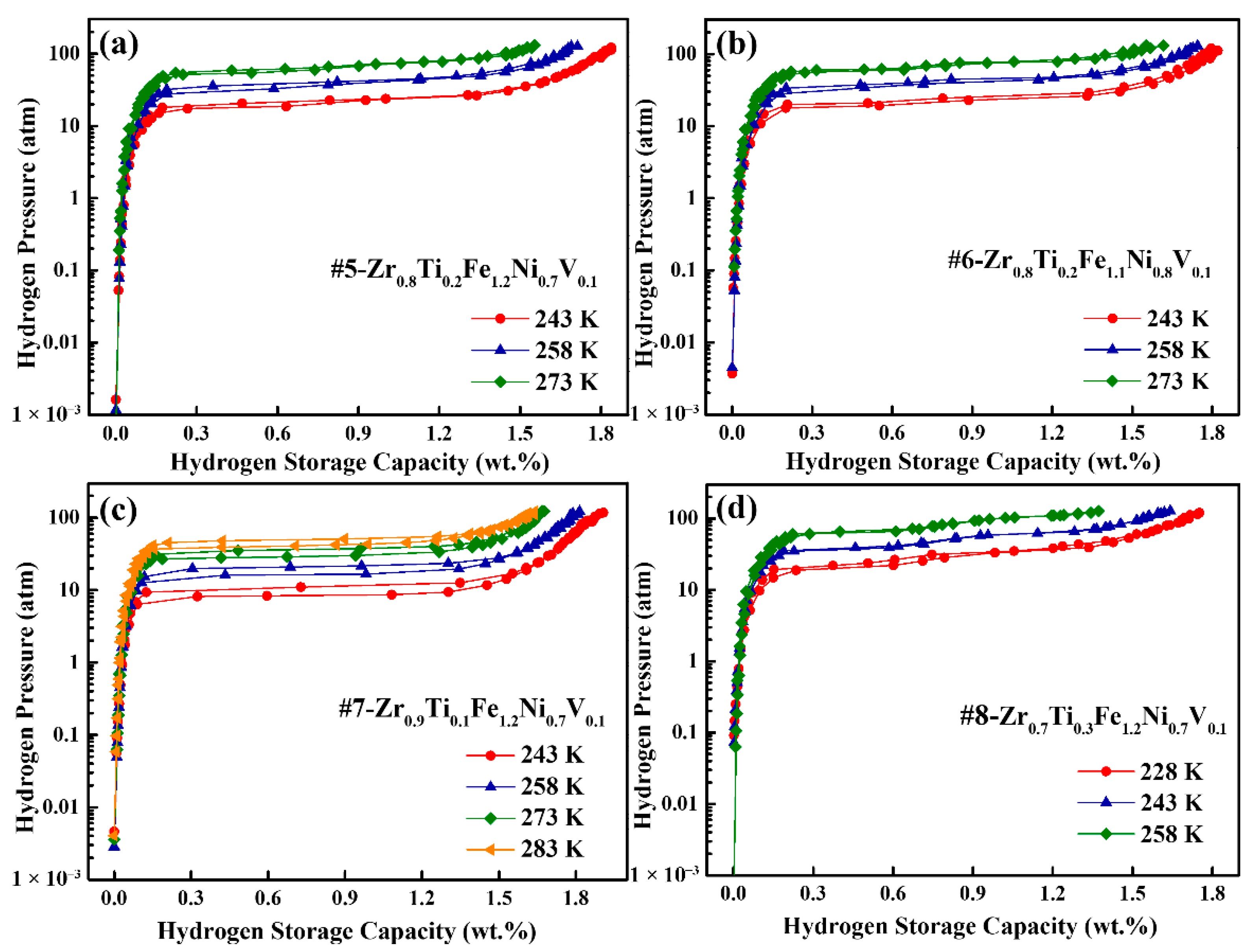
The PCI curves of the #5–#8 alloys measured at different temperatures are shown in Figure 5, and the corresponding hydrogen storage properties are summarized in Table 3. All alloys exhibit distinct and well-defined hydriding/dehydriding plateaus, accompanied by complete hydrogen release upon dehydrogenation. It is also noted that these alloys exhibit narrow solid solution zones, which help to improve the effective hydrogen compression capacity. Among the tested compositions, the #7 alloy (Zr0.9Ti0.1Fe1.2Ni0.7V0.1) exhibits the highest capacity (1.90 wt.%) at 243 K, while the #8 alloy (Zr0.7Ti0.3Fe1.2Ni0.7V0.1) shows the lowest capacity (1.75 wt.%) at the same temperature, suggesting a correlation between hydrogen storage capacity and absorption plateau pressures.
Figure 5. PCI curves of (a) #5-Zr0.8Ti0.2Fe1.2Ni0.7V0.1, (b) #6-Zr0.8Ti0.2Fe1.1Ni0.8V0.1, (c) #7-Zr0.9Ti0.1Fe1.2Ni0.7V0.1 and (d) #8-Zr0.7Ti0.3Fe1.2Ni0.7V0.1 alloys at different temperatures.
As expected, the plateau pressures increase with higher Ni and Ti contents. The hydrogen absorption and desorption pressures gradually increase from 23.20/20.64 atm (#5) to 26.71/22.03 atm (#6) as the Ni content rises from 0.7 to 0.8. In contrast, the plateau pressures for the alloys with varying Ti content exhibit a more pronounced increase. Specifically, the hydrogen absorption and desorption pressures rise sharply from 11.82/8.50 atm (#7, Ti = 0.1) to 33.25/30.07 atm (#8, Ti = 0.3) at 243 K. This substantial difference highlights the significantly greater impact of Ti content on plateau pressure compared to the influence of Ni content.
Compared with the PCI curve of #1 alloy (Zr0.8Ti0.2Fe1.15Ni0.7V0.15) at 243 K in Figure 4, the PCI curves of the #5–#8 alloys at same temperature show a significantly reduced plateau slope, while maintaining a consistently low hysteresis factor. Among them, the #7 alloy (Zr0.9Ti0.1Fe1.2Ni0.7V0.1) shows a notably low slope factor of 0.19 at 243 K, which is much lower than the value of 1.59 observed for the #1 alloy. The Sf value decreases slightly with increasing Ni content but increases with higher Ti content. In addition, the Hf value increases from 0.10 for the Ti = 0.3 alloy to 0.33 for the Ti = 0.1 alloy. This trend is consistent with previous observations reported for Zr-Fe-Mn-V alloys [33].
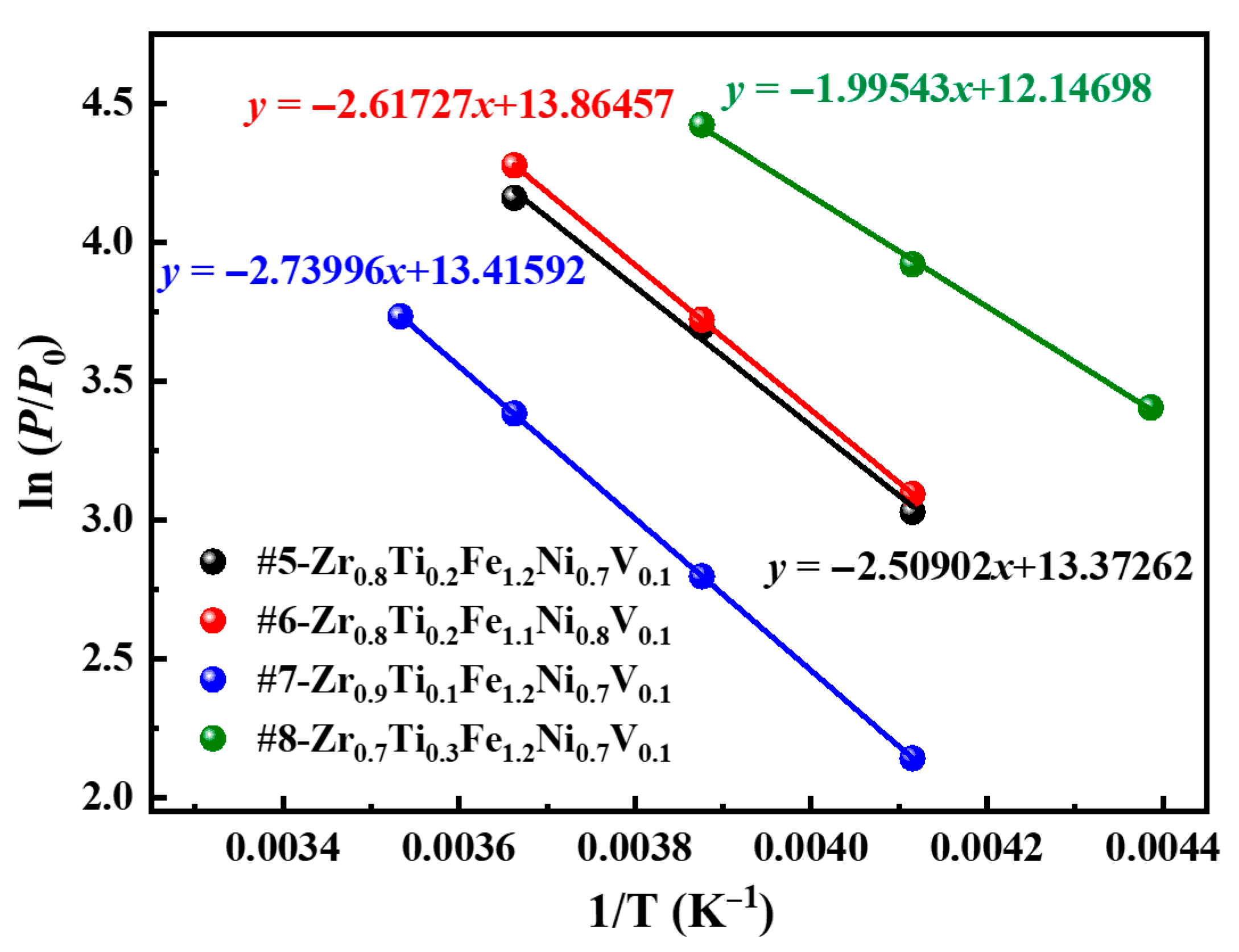
Figure 6 shows the van’t Hoff curves of four alloys, derived from the thermodynamic relation: ln (P/P0) = ΔH/RT − ΔS/R [41]. In this equation, R denotes the universal gas constant and T represents the absolute temperature in Kelvin. The data reveals a strong linear correlation between lnP and 1/T, which enables the determination of the enthalpy change (ΔHd) and entropy change (ΔSd) associated with hydrogen desorption. The calculated values are summarized in Table 3. The ΔHd values exhibit a slight increase with increasing Ni content, rising from 20.86 kJ/mol for the #5 alloy (Ni = 0.7) to 21.76 kJ/mol for the #6 alloy (Ni = 0.8). Conversely, the ΔHd decreases with increasing Ti content, dropping from 22.78 kJ/mol for the #6 alloy (Ti = 0.1) to 16.59 kJ/mol for the #8 alloy (Ti = 0.3). This trend reflects the strong hydrogen affinity of Ti, which reduces the stability of the hydride phase and consequently lowers the desorption enthalpy. Furthermore, these alloys demonstrate a lower hydrogen desorption enthalpy relative to Zr-Y-Fe [31] and Zr-Ti-Fe-Mn [33] alloys, which reduces the thermodynamic stability of the hydride phase and facilitates more efficient hydrogen release during the decompression process. Based on the fitted van’t Hoff plots, the extrapolated hydrogen desorption plateau pressures of the four alloys range from 67 atm to 70 atm at 298 K, and from 286.7 atm to 677.6 atm at 353 K. These results confirm the excellent potential of the developed alloys for high-pressure hydrogen compression applications.
Figure 6. van’t Hoff plots of four alloys.
Moreover, the XRD patterns of all the #5–#8 alloys after hydrogen absorption and desorption cycle are shown in Figure S5, and the corresponding cell parameters summarized in Table S2. All the alloys retain the C15 single-phase structure after hydrogen absorption and desorption cycle, as evidenced by the sharp and intense XRD diffraction peaks in Figure S4. The minimal change in cell volume before and after PCI measurements further supports its structural stability. Notably, the #8 alloy exhibits a mere 0.047% cell volume contraction after hydrogen desorption, confirming the robustness of the crystal structure during hydrogen absorption/desorption cycles.

3.4. Hydrogen Compression Performance

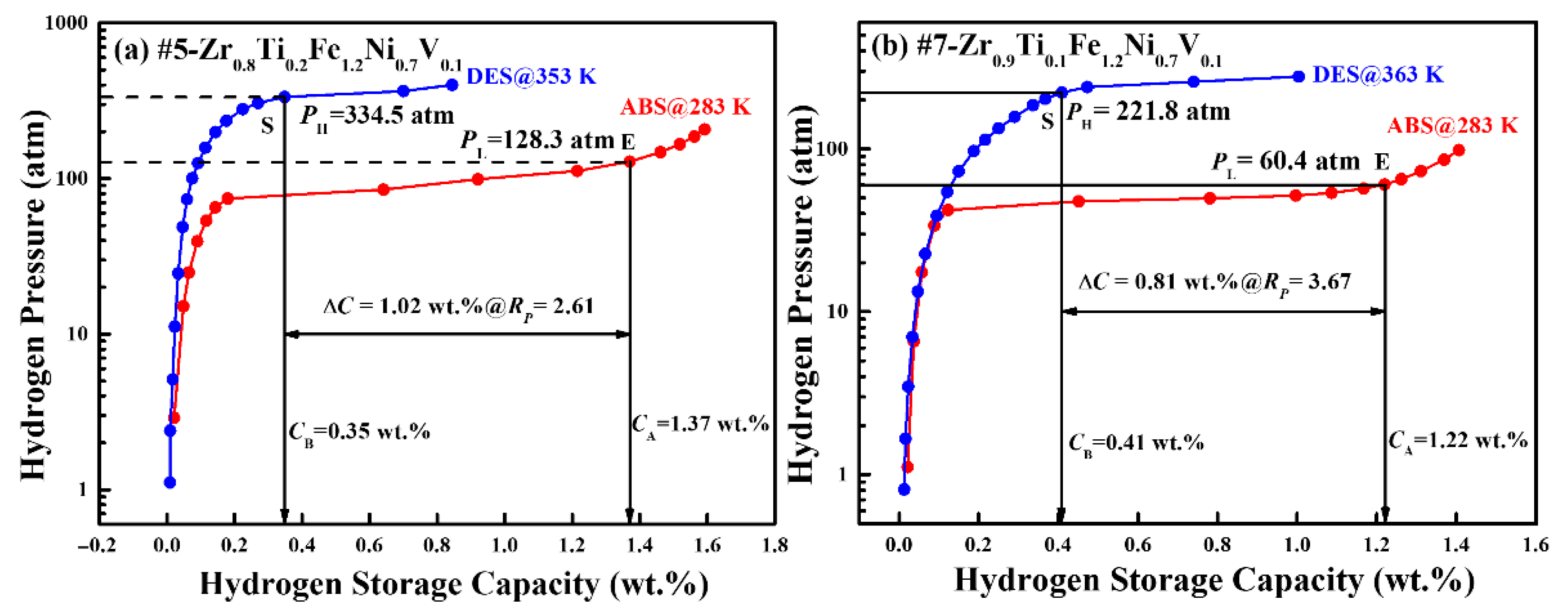
The #5 alloy (Zr0.8Ti0.2Fe1.2Ni0.7V0.1) and #7 alloy (Zr0.9Ti0.1Fe1.2Ni0.7V0.1) were selected for PCI measurement under optimized working conditions, with test temperatures ranging from 283 K to 363 K and a maximum hydrogen pressure of 400 atm. The PCI curves are shown in Figure S6. The hydrogen absorption PCI curve was first recorded at the lower temperature (TL), followed by the desorption PCI measured at the higher temperature (TH). The resulting PCI curves for both alloys are shown in Figure 7, and the corresponding hydrogen compression performance data are summarized in Table 4.
Figure 7. Measured PCI curves of 5#-Zr0.8Ti0.2Fe1.2Ni0.7V0.1 (a) and #7-Zr0.9Ti0.1Fe1.2Ni0.7V0.1 (b) alloys at working temperatures.
Table 4. Comparison of hydrogen compression properties for different alloys.
In these PCI curves, the endpoint (E) of the hydrogen absorption plateau at TL is adopted to determine the hydrogen absorption capacity (CA) and the input pressure (PL) for the MHHC process, while the point (S) on the hydrogen desorption plateau at TH corresponds to the remained capacity (CB) and output pressure (PH). The reversible hydrogen capacity (Cc = CA–CB) and the compression ratio (Rp = PH/PL) are thus obtained, reflecting the effective hydrogen storage capacity and the cyclic efficiency of hydrogen compression [42,43,44].
The #5 alloy (Zr0.8Ti0.2Fe1.2Ni0.7V0.1) exhibits a hydrogen absorption capacity of 1.37 wt.% at 283 K under hydrogen pressure of 128.3 atm. It provides a reversible 1.02 wt.% of hydrogen above a hydrogen pressure of 334.5 atm at 353 K, corresponding to a hydrogen compression ratio of 2.61. In comparison, the #7 alloy (Zr0.9Ti0.1Fe1.2Ni0.7V0.1) delivers a hydrogen absorption capacity of 1.22 wt.% at 283 K under 60.4 atm, and releases 0.81 wt.% of hydrogen at 363 K and 221.8 atm, achieving a higher hydrogen compression ratio of 3.67. Both Zr-based alloys exhibit a hydrogen compression performance comparable to or even superior to those of previously reported C14-structured Ti-based alloys, as summarized in Table 4. For instance, Peng et al. [42] developed a Ti1.08Cr1.3Mn0.2Fe0.5 alloy, which is capable of compressing hydrogen from 237.4 atm to 535.2 atm within the temperature range of 298–363 K, achieving an effective hydrogen compression capacity of 0.66 wt.% and a compression ratio of 2.25. Therefore, the present ZrFe2-based alloys achieve comparable or higher compression ratios (up to 3.67), together with larger reversible hydrogen capacities (>0.8 wt.%), highlighting their strong potential for practical applications in MHHC.
The superior hydrogen compression performance of these ZrFe2-based alloys can be primarily attributed to their C15 cubic Laves phase structure, which possesses higher crystallographic symmetry and a more isotropic lattice compared with C14 hexagonal structure. This structural characteristic effectively minimizes local stress concentration during hydrogen absorption and desorption, thereby suppressing lattice distortion and improving plateau characteristics. In addition, the quenching process plays a key role in promoting compositional homogeneity and suppressing secondary phase formation, which further reduces hysteresis and enhances plateau flatness. Further, the combined effect of high Ni and low V contents contributes to the flattening of the plateau and the narrowing of the solid solution region, both of which are essential for achieving a high hydrogen compression ratio.
From an application standpoint, these findings suggest that the rational design of C15-type multicomponent alloys through compositional optimization and thermal treatment can yield high-performance hydrogen compression materials. The obtained hydrogen compression ratios (2.61–3.67) and reversible capacities (0.81–1.02 wt.%) meet or exceed the operational requirements for medium- and high-pressure stages in multi-stage MHHC. Moreover, the narrow solid solution zone and low hysteresis ensure minimal energy loss and long-term reliability.

4. Conclusions

This study investigates the effects of elemental substitution (Ti, Ni and V) and the quenching process on the microstructure and hydrogen compression performance of C15-structured ZrFe2-based alloys. The key findings are summarized as follows: 1. a high Ni content combined with low V content effectively reduce the hysteresis effect and improve the plateau slope; 2. the quenching process promotes the formation of a single-phase structure with uniform composition, improving plateau characteristics while narrowing the hydrogen solid solution zone; 3. the Zr0.8Ti0.2Fe1.2Ni0.7V0.1 alloy can increase the hydrogen pressure from 128.3 atm to 334.5 atm with an effective hydrogen compression capacity of 1.02 wt.% within the temperature range of 283–353 K. The Zr0.9Ti0.1Fe1.2Ni0.7V0.1 alloy can increase the hydrogen pressure from 60.4 atm to 221.8 atm within the temperature range of 283–363 K, providing an effective hydrogen compression capacity of 0.81 wt.%. These results emphasize the significant potential of ZrFe2-based alloys for hydrogen compression applications.

Supplementary Materials

The following supporting information can be downloaded at: https://www.mdpi.com/article/10.3390/ma18245482/s1, Figure S1: Heat treatment process diagram and equipment. Figure S2: Laves phase structure of ZrFe2-based alloys as a function of valence electron concentration (e/a) and atomic radius ratio (RA/RB). Figure S3: XRD patterns of Zr0.8Ti0.2Fe1.9−xNixV0.1 (a) and Zr1−yTiyFe1.2Ni0.7V0.1 (b) alloys quenched under 1423 K. Figure S4: SEM image and EDS mappings of the Zr0.8Ti0.2Fe1.9−xNixV0.1 (x = 0.7, 0.8, 0.9) and Zr1−yTiyFe1.2Ni0.7V0.1 (y = 0.1, 0.3) alloys quenched under 1423 K. Figure S5: XRD patterns of Zr0.8Ti0.2Fe1.9−xNixV0.1 (a) and Zr1−yTiyFe1.2Ni0.7V0.1 (b) alloys after hydrogen absorption/desorption process. Figure S6: PCI curves of 5# alloy at 283 K (a) and 353 K (b). Table S1: Alloy systems with ZrFe2 Laves phase formation pattern. Table S2: Structure parameters of #5–#8 alloys before and after hydrogen absorption/desorption. References [31,33,45,46,47,48,49,50] are cited in the Supplementary Materials.

Author Contributions

Conceptualization, H.W.; methodology, data curation and writing—original draft preparation, C.Q.; formal analysis, writing—review and editing, J.X.; project administration and funding acquisition, H.W. All authors have read and agreed to the published version of the manuscript.

Funding

This work was financially supported by the National Natural Science Foundation of China (Grant No. 52471226).

Data Availability Statement

The original contributions presented in this study are included in the article/Supplementary Materials. Further inquiries can be directed to the corresponding author.

Conflicts of Interest

The authors declare no conflict of interest.

References

  1. Guo, X.W.; Shi, L.X.; Ma, C.; Zhang, W.T.; Xia, C.Q.; Yang, T. Effects of Ti Substitution by Zr on Microstructure and Hydrogen Storage Properties of Laves Phase AB2-Type Alloy. Materials 2025, 18, 3438. [Google Scholar] [CrossRef] [PubMed]
  2. Asano, K.; Bannenberg, L.J.; Schreuders, H.; Hashimoto, H.; Isobe, S.; Nakahira, Y.; Machida, A.; Kim, H.; Sakaki, K. Distortion and Destabilization of Mg Hydride Facing High Entropy Alloy Matrix. ACS Appl. Energy Mater. 2024, 7, 11644–11651. [Google Scholar] [CrossRef]
  3. Bebon, L.; Maynadier, A.; Gaillard, Y.; Chapelle, D. Multiscale Elastic Modulus Characterization of Ti0.5Fe0.45Mn0.05, an Iron–Titanium–Manganese Alloy Dedicated to Hydrogen Storage. Materials 2024, 17, 6100. [Google Scholar] [CrossRef] [PubMed]
  4. Ouyang, L.Z.; Dong, H.W.; Peng, C.H.; Sun, L.X.; Zhu, M. A new type of Mg-based metal hydride with promising hydrogen storage properties. Int. J. Hydrogen Energy 2007, 32, 3929–3935. [Google Scholar] [CrossRef]
  5. Chen, Y.P.; Jia, Y.X.; Xiao, X.Z.; Cao, Z.M.; Zhou, P.P.; Zhan, L.J.; Piao, M.Y.; Chu, F.; Yuan, S.C.; Chen, L.X. Development of Ti-Zr-Mn-Cr-(V-Fe) based alloys for hydrogen feeding system in hydrogen metallurgy application. Int. J. Hydrogen Energy 2024, 86, 1376–1385. [Google Scholar] [CrossRef]
  6. Tu, J.Y.; Zhou, P.P.; Chen, S.L.; Shen, S.Y.; Liu, X.Y.; Xiao, X.Z.; Li, Z.N.; Ouyang, L.Z. Solid-state hydrogen storage alloys for production-storage and transportation-application coupling at ambient temperature: A review. Mater. Sci. Eng. R Rep. 2026, 167, 101089. [Google Scholar] [CrossRef]
  7. Sdanghi, G.; Maranzana, G.; Celzard, A.; Fierro, V. Review of the current technologies and performances of hydrogen compression for stationary and automotive applications. Renew. Sust. Energy Rev. 2019, 102, 150–170. [Google Scholar] [CrossRef]
  8. Muthukumar, P.; Patel, K.S.; Sachan, P.; Singhal, N. Computational study on metal hydride based three-stage hydrogen compressor. Int. J. Hydrogen Energy 2012, 37, 3797–3806. [Google Scholar] [CrossRef]
  9. Sharma, V.K.; Kumar, E.A. Metal hydrides for energy applications-classification, PCI characterisation and simulation. Int. J. Energy Res. 2017, 41, 901–923. [Google Scholar] [CrossRef]
  10. Lototsky, M.V.; Yartys, V.A.; Marinin, V.S.; Lototsky, N.M. Modelling of phase equilibria in metal-hydrogen systems. J. Alloys Compd. 2003, 356–357, 27–31. [Google Scholar] [CrossRef]
  11. Muthukumar; Maiya, P.M.; Murthy, S.S. Parametric studies on a metal hydride based single hydrogen compressor. Int. J. Hydrogen Energy 2002, 27, 1083–1092. [Google Scholar] [CrossRef]
  12. Lototskyy, M.V.; Yartys, V.A.; Pollet, B.G.; Bowman, R.C., Jr. Metal hydride hydrogen compressors: A review. Int. J. Hydrogen Energy 2014, 39, 5818–5851. [Google Scholar] [CrossRef]
  13. Galvis, E.A.R.; Leardini, F.; Ares, J.R.; Cueva, F.; Fernandez, J.F. Experimental behavior of a three-stage metal hydride hydrogen compressor. J. Phys.-Energy 2020, 2, 034006. [Google Scholar] [CrossRef]
  14. Dashbabu, D.; Kumar, E.A.; Jain, I.P. Thermodynamic analysis of a metal hydride hydrogen compressor with aluminum substituted LaNi5 hydrides. Int. J. Hydrogen Energy 2023, 48, 37886–37897. [Google Scholar] [CrossRef]
  15. Laurencelle, F.; Dehouche, Z.; Morin, F.; Goyette, J. Experimental study on a metal hydride based hydrogen compressor. J. Alloys Compd. 2009, 475, 810–816. [Google Scholar] [CrossRef]
  16. Wang, X.H.; Bei, Y.Y.; Song, X.C.; Fang, G.H.; Li, S.Q.; Chen, C.P.; Wang, Q.D. Investigation on high-pressure metal hydride hydrogen compressors. Int. J. Hydrogen Energy 2007, 32, 4011–4015. [Google Scholar] [CrossRef]
  17. Au, M.; Wang, Q.D. Rare earth-nickel alloy for hydrogen compression. J. Alloys Compd. 1993, 201, 115–119. [Google Scholar] [CrossRef]
  18. Wang, X.H.; Chen, R.G.; Zhang, Y.; Chen, C.P.P.; Wang, Q.D. Hydrogen storage alloys for high-pressure suprapure hydrogen compressor. J. Alloys Compd. 2006, 420, 322–325. [Google Scholar] [CrossRef]
  19. Vanhanen, J.P.; Hagström, M.T.; Lund, P.D. Combined hydrogen compressing and heat transforming through metal hydrides. Int. J. Hydrogen Energy 1999, 24, 441–448. [Google Scholar] [CrossRef]
  20. Ji, K.; Banerjee, T.; Witman, M.D.; Allendorf, M.D.; Stavila, V.; Singh, P. Design of lightweight BCC multi-principal element alloys with enhanced hydrogen storage using a machine learning-driven genetic algorithm. J. Mater. Chem. A 2025, 13, 41274. [Google Scholar] [CrossRef]
  21. Way, L.; Charbonnier, V.; Fadonougbo, J.; Clulow, R.; Lei, L.; Ling, S.; Grant, D.; Dornheim, M.; Banerjee, T.; Breunig, H.; et al. Efficiently predicting pressure-composition-temperature diagrams to discover low-stability metal hydrides. ChemRxiv 2025. [Google Scholar] [CrossRef]
  22. Qin, C.S.; Wang, H.; Jiang, W.; Liu, J.W.; Ouyang, L.Z.; Zhu, M. Comparative study of Ga and Al alloying with ZrFe2 for high-pressure hydrogen storage. Int. J. Hydrogen Energy 2022, 27, 13409–13417. [Google Scholar] [CrossRef]
  23. Banerjee, S.; Kumar, A.; Pillai, C.G.S. Improvement on the hydrogen storage properties of ZrFe2 Laves phase alloy by vanadium substitution. Intermetallics 2014, 51, 30–36. [Google Scholar] [CrossRef]
  24. Zhang, T.B.; Wang, X.F.; Hu, R.; Li, J.S.; Yang, X.W.; Xue, X.Y.; Fu, H.Z. Hydrogen absorption properties of Zr(V1−xFex)2 intermetallic compounds. Int. J. Hydrogen Energy 2012, 37, 2328–2335. [Google Scholar] [CrossRef]
  25. Koultoukis, E.D.; Makridis, S.S.; Pavlidou, E.; Rango, P.D.; Stubos, A.K. Investigation of ZrFe2-type materials for metal hydride hydrogen compressor systems by substituting Fe with Cr or V. Int. J. Hydrogen Energy 2014, 39, 21380–21385. [Google Scholar] [CrossRef]
  26. Jain, A.; Jain, R.K.; Agarwal, S.; Sharma, R.K.; Kulshrestha, S.K.; Jain, I.P. Structural and Mossbauer spectroscopic study of cubic phase ZrFe2−xMnx hydrogen storage alloy. J. Alloys Compd. 2008, 454, 31–37. [Google Scholar] [CrossRef]
  27. Jaina, A.; Jaina, R.K.; Agarwala, S.; Ganesanb, V.; Lallab, N.P.; Phaseb, D.M.; Jaina, I.P. Synthesis, characterization and hydrogenation of ZrFe2−xNix (x = 0.2, 0.4, 0.6, 0.8) alloys. Int. J. Hydrogen Energy 2007, 32, 3965–3971. [Google Scholar] [CrossRef]
  28. Sivov, R.B.; Zotov, T.A.; Verbetsky, V.N.; Filimonov, D.S.; Pokholok, K.V. Synthesis, properties and Mössbauer study of ZrFe2−xNix hydrides (x = 0.2–0.8). J. Alloys Compd. 2011, 509, 763–769. [Google Scholar] [CrossRef]
  29. Boultif, A.; Louer, D. Powder pattern indexing with the dichotomy method. J. Appl. Cryst. 2004, 37, 724–731. [Google Scholar] [CrossRef]
  30. Stein, F.; Palm, M.; Sauthoff, G. Structure and stability of Laves phases. Part I. Critical assessment of factors controlling Laves phase stability. Intermetallics 2004, 12, 713–720. [Google Scholar] [CrossRef]
  31. Qin, C.S.; Wang, H.; Liu, J.W.; Ouyang, L.Z.; Zhu, M. Tuning hydrogen storage thermodynamic properties of ZrFe2 by partial substitution with rare earth element Y. Int. J. Hydrogen Energy 2021, 46, 18445–18452. [Google Scholar] [CrossRef]
  32. Pang, H.L.; Li, Z.M.; Zhou, C.; Wang, H.; Ouyang, L.Z.; Yuan, S.R.; Zhu, Y.J.Z.A.N.M. Achieving the dehydriding reversibility and elevating the equilibrium pressure of YFe2 alloy by partial Y substitution with Zr. Int. J. Hydrogen Energy 2018, 43, 14541–14549. [Google Scholar] [CrossRef]
  33. Qin, C.S.; Zhou, C.; Ouyang, L.Z.; Liu, J.W.; Zhu, M.; Sun, T.; Wang, H. High-pressure hydrogen storage performances of ZrFe2 based alloys with Mn, Ti, and V addition. Int. J. Hydrogen Energy 2020, 45, 9836–9844. [Google Scholar] [CrossRef]
  34. Zotov, T.A.; Sivov, R.B.; Movlaev, E.A.; Mitrokhin, S.V.; Verbetsky, V.N. IMC hydrides with high hydrogen dissociation pressure. J. Alloys Compd. 2011, 5, S839–S843. [Google Scholar] [CrossRef]
  35. Balasubramaniam, R. Hysteresis in metal–hydrogen systems. J. Alloys Compd. 1997, 253–254, 203–206. [Google Scholar] [CrossRef]
  36. Shilov, A.L.; Efremenko, N.E. Effect of sloping pressure “plateau” in two-phase regions of hydride systems. Russ. J. Phys. Chem. A+ 1986, 12, 3024–3028. [Google Scholar]
  37. Young, K.; Ouchi, T.; Reichman, B.; Koch, J.; Fetcenko, M.A. Improvement in the low-temperature performance of AB5 metal hydride alloys by Fe-addition. J. Alloys Compd. 2011, 509, 7611–7617. [Google Scholar] [CrossRef]
  38. Flanagan, T.B.; Park, C.N.; Oates, W.A. Hysteresis in solid state reactions. Prog. Solid State Chem. 1995, 23, 291–363. [Google Scholar] [CrossRef]
  39. Qian, S.; Northwood, D.O. Hysteresis in metal-hydrogen systems: A critical review of the experimental observations and theoretical models. Int. J. Hydrogen Energy 1988, 13, 25–35. [Google Scholar] [CrossRef]
  40. Banerjee, T.; Ji, K.; Xia, W.Y.; Ouyang, G.Y.; Rose, T.D.; Hlova, I.Z.; Ueland, B.; Johnson, D.D.; Wang, C.Z.; Balasubramanian, G.; et al. Machine-learning and first-principles investigation of lightweight medium-entropy alloys for hydrogen-storage applications. Int. J. Hydrogen Energy 2025, 154, 149916. [Google Scholar] [CrossRef]
  41. Zhu, Z.D.; Zhu, S.; Zhao, X.; Cheng, H.H.; Yan, K.; Liu, J.J. Effects of Ce/Y on the cycle stability and anti-plateau splitting of La5−xCexNi4Co (x = 0.4, 0.5) and La5−yYyNi4Co (y = 0.1, 0.2) hydrogen storage alloys. Mater. Chem. Phys. 2019, 236, 121725. [Google Scholar] [CrossRef]
  42. Peng, Z.Y.; Li, Q.; Sun, J.Y.; Chen, K.; Jiang, W.B.; Wang, H.; Liu, J.W.; Ouyang, L.Z.; Zhu, M. Ti-Cr-Mn-Fe-based alloys optimized by orthogonal experiment for 85 MPa hydrogen compression materials. J. Alloys Compd. 2022, 891, 161791. [Google Scholar] [CrossRef]
  43. Li, H.; Wang, X.H.; Dong, Z.H.; Xu, L.; Chen, C.P. A study on 70 MPa metal hydride hydrogen compressor. J. Alloys Compd. 2010, 502, 503–507. [Google Scholar] [CrossRef]
  44. Yartys, V.A.; Lototskyy, M.V.; Tolj, I.; von Colbe, J.B.; Denys, R.V.; Davids, M.W.; Nyamsi, S.N.; Swanepoel, D.; Berezovets, V.V.; Zavaliy, I.Y.; et al. HYDRIDE4MOBILITY: An EU project on hydrogen powered forklift using metal hydrides for hydrogen storage and H2 compression. J. Energy Storage 2025, 109, 115192. [Google Scholar] [CrossRef]
  45. Zotov, T.; Movlaev, E.; Mitrokhin, S.; Verbetsky, V. Interaction in (Ti,Sc)Fe2-H2 and (Zr,Sc)Fe2-H2 systems. J. Alloys Compd. 2008, 459, 220–224. [Google Scholar] [CrossRef]
  46. Jiang, L.; Tu, Y.; Tu, H.; Chen, L. Microstructures and hydrogen storage properties of ZrFe2.05−xVx (x = 0.05–0.20) alloys with high dissociation pressures for hybrid hydrogen storage vessel application. J. Alloys Compd. 2015, 627, 161–165. [Google Scholar] [CrossRef]
  47. Bereznitsky, M.; Jacob, I.; Bloch, J.; Mintz, M.H. Thermodynamic and structural aspects of hydrogen absorption in the Zr(AlxFe1−x)2 system. J. Alloys Compd. 2003, 351, 180–183. [Google Scholar] [CrossRef]
  48. Zhou, C.; Wang, H.; Ouyang, L.Z.; Liu, J.W.; Zhu, M. Achieving high equilibrium pressure and low hysteresis of Zr-Fe based hydrogen storage alloy by Cr/V substitution. J. Alloys Compd. 2019, 806, 1436–1444. [Google Scholar] [CrossRef]
  49. Sivov, R.B.; Zotov, T.A.; Verbetsky, V.N. Interaction of ZrFe2 doped with Ti and Al with hydrogen. Inorg. Mater. 2010, 46, 372–376. [Google Scholar] [CrossRef]
  50. Cao, Z.; Ouyang, L.; Wang, H.; Liu, J.; Sun, L.; Felderhoff, M.; Zhu, M. Development of ZrFeV alloys for hybrid hydrogen storage system. Int. J. Hydrogen Energy 2016, 41, 11242–11253. [Google Scholar] [CrossRef]
Disclaimer/Publisher’s Note: The statements, opinions and data contained in all publications are solely those of the individual author(s) and contributor(s) and not of MDPI and/or the editor(s). MDPI and/or the editor(s) disclaim responsibility for any injury to people or property resulting from any ideas, methods, instructions or products referred to in the content.

Article Metrics

Citations

Article Access Statistics

Article metric data becomes available approximately 24 hours after publication online.