Article

Assessment of the Service Life of Polyethylene Pipes with Controlled Defects Using Internal Pressure Test


by
Ioana-Daniela Manu
,
Marius Gabriel Petrescu
,
Cătălin Blag
* and
Ramadan Ibrahim Naim
*
Mechanical Engineering Department, Petroleum-Gas University of Ploiesti, 100680 Ploiesti, Romania
*
Authors to whom correspondence should be addressed.
Materials 2025, 18(23), 5407; https://doi.org/10.3390/ma18235407
Submission received: 6 October 2025 / Revised: 18 November 2025 / Accepted: 28 November 2025 / Published: 30 November 2025

Abstract

Controlled geometry defects can be volumetric defects, usually located on the outer surface of the pipe, having different orientations and lengths and identical depths. This type of defect corresponds to the type obtained using a damage mechanism, as presented by API 579-1/ASME FFS-1, Part 9, called crack-type defects. The research presented in this paper was intended to evaluate the influence of controlled defects on the strength of an HDPE water pipe, PE100 (Ø 90 × 5.4), SDR 17, PN 10 bar, subjected to internal pressure. The methods applied were the internal pressure test and numerical simulation. The article’s main findings were the critical pressure Pcr, the critical time tcr, the critical depth of defect acr, and the remaining service life t. The remaining service life was approximately 83 years for the pipe with a defect oriented circumferentially, and 69 years for the pipe with a defect oriented longitudinally.

1. Introduction

Researching the influence of defects on the strength of high-density polyethylene (HDPE) pipes is imperative because of the presence of defects, such as lack of material, geometric discontinuities, and cracks, which can result from manufacturing, transportation, storage, and/or installation [1].
The article proposes a method for evaluating the mechanical behavior of defective HDPE water pipes made of PE100 (Ø 90 × 5.4), SDR 17, PN 10 bar, under internal pressure, presenting with defects with controlled geometry that correspond to a level 2 assessment of crack-like flaws, according to Part 9 of the Fitness-For-Service (FFS) regulations [2].
Such defects can initiate braking points when transient flows in these pipes occur during operation—especially when water hammer phenomena occur [3,4,5,6].
HDPE pipes without defects are characterized by a certain lifetime value under normal operating conditions. HDPE pipes have a remaining service life, or lifespan, before they require replacement or repair due to normal damage [7]. Under optimal operating conditions, HDPE pipes work longer than the estimated 50 years, and have a service life of up to 100 years under good monitoring [8].
The fitness-for-service assessment of defective pipelines is a quantitative evaluation of whether the defective pipelines are suitable for continuous use and how to continue to use them [9].
The mechanical performance of a traditional notched HDPE pipe (NHP) with various groove depths and shapes, including U-type, V-type, and L-type (linear type), are critical for the safety assessment [10].
In [9], a numerical analysis was performed in which the defect length was varied, depending on the outer diameter of the pipe, the pipe wall thickness, and the order of magnitude of the defect length. The maximum von Mises stress in the pipeline gradually increased with increasing defect length. When the defect length reached 30 mm, the maximum von Mises stress had almost no effect on the von Mises stress in the pipeline. When the order of magnitude of the axial length of the pipeline was greater than 2, the critical failure load of the pipeline tended to remain unchanged [9].
The scientific purpose of this article is to determine the critical pressure Pcr, the critical time tcr, the critical depth of defect acr, and the remaining service life t for HDPE pipes containing controlled defects, through the internal pressure test and numerical simulation.

2. Materials and Methods

2.1. Materials

2.1.1. Pipes and End Caps

For testing of polyethylene pipes under the internal pressure test, three sections of HDPE water pipe, PE100 (Ø 90 × 5.4), SDR 17, PN 10 bar were used, 300 mm in length. The sections were cut from a pipe intended for drinking water distribution networks.
The PE100 material has the physical and mechanical parameters indicated in Table 1. All values were recorded at 23 °C.
The pipes were tested safely thanks to the two type A steel end caps [13].
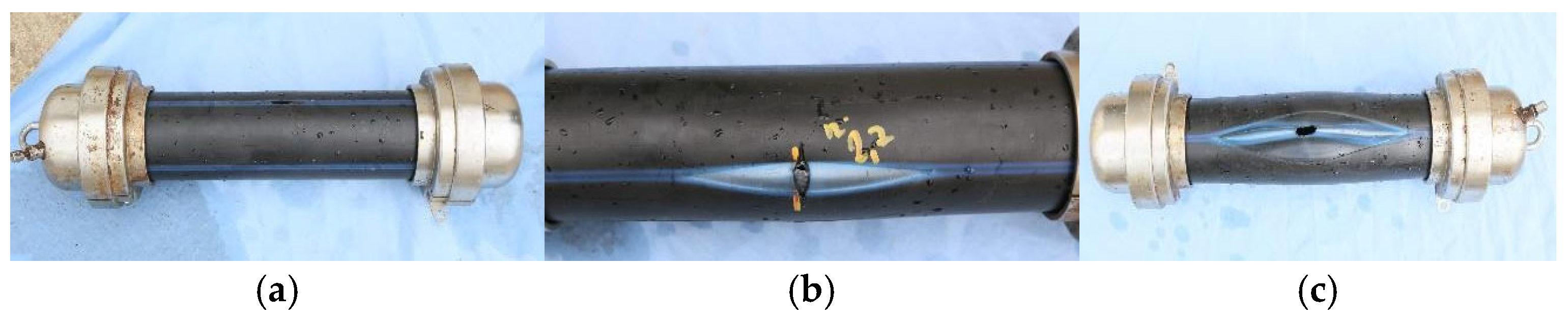
Three pipe samples were used in the research, as shown in Figure 1: (WD)—pipe without defect (Figure 1a), (CD)—pipe with a defect oriented circumferentially (Figure 1b), and (LD)—pipe with defect oriented longitudinally (Figure 1c).
The dimensions of the defects on the outer surface of the two pipes are presented in Table 2.

2.1.2. Experimental Installation for Internal Pressure Test of HDPE Pipes

For the internal pressure test of the three PE100 pipes, the experimental installation, called IPT Equipment, model 1751-0313, produced by IPT für Prüftechnik Gerätebau GmbH & Co. KG, Todtenweis, Germany, was used, as described in [14].
The pressure machine was calibrated by the manufacturer, and the internal pressure was monitored using a digital pressure transducer with an accuracy of ±0.05 bar (±5 kPa), corresponding to 99.5% accuracy at a pressure of 10 bar. The equipment is periodically maintained and recalibrated according to the manufacturer’s specifications.

2.1.3. Milling Cutter Used for Cutting Notches

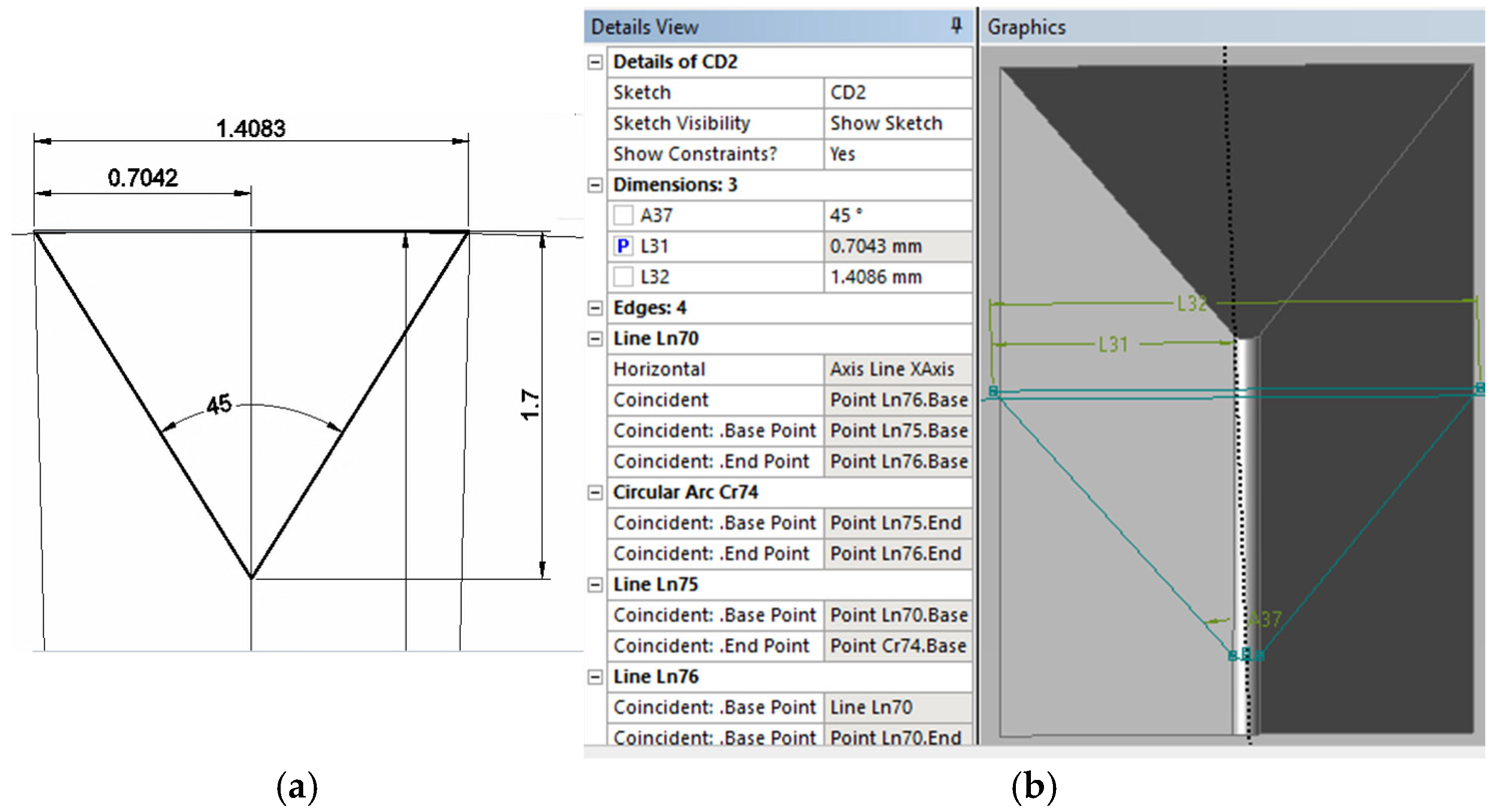
The notches made on the outer surface of the pipes, which constitute the controlled defects, were carried out with an angular milling cutter at 45°.

2.2. Test Method

2.2.1. Assessment of Crack-like Flows According to Part 9 of Fitness-for-Service (FFS)

In general, the structural integrity of a pipe under internal pressure can be evaluated by a limit state criterion, represented by the equivalent stress σech.
The expression of the equivalent stress σech is obtained by adaptation from [15], according to the Huber–Hencky–Mises version of the energy hypothesis, which considers only the energy from variations in shape.
The adaptation consists of the equivalent principal stresses σ1, σ2, and σ3 with circumferential stress σc, longitudinal stress σl, and radial stress σr, thus σ1 = σc, σ2 = σl, and σ3 = σr.
The equivalent stress is determined by Equation (1).
σech = {1/2[(σc − σl)2 + (σl − σr)2 + (σr − σc)2]}1/2
The structural integrity of a thin-walled pipe under internal pressure presenting a defect located on the outer surface can be evaluated by the equivalent stress σech, which is computed with relationship (2) and adapted for radial stress, σr = 0.
σech = (1/2)∙(σc − σ1)1/2,
The circumferential stress σc is obtained according to [1], depending on the maximum recorded internal pressure Pi for bursting in the tested pipe with outer diameter De, wall thickness s, and without defects, with relationship (3).
σc = [(De − s)∙Pi]/(2∙s),
The longitudinal stress value σl is half of the circumferential stress value σc [16].
According to [17], the circumferential stress σc in the case of pipes with an outer surface defect is determined by replacing the difference (De − s) with mean diameter Dm and maximum recorded internal pressure Pi, with the crack initiation pressure Pcrack, through relationship (4).
σc = (Dm∙Pcrack)/(2∙s),
According to [18], the crack initiation pressure Pcrack is computed with relationship (5), depending on yield strength σy, outer radius Re, inner radius Ri, the depth of the defect a, the wall thickness s, and the half-length of the defect measured in the direction in which the defect extends.
Pcrack = σy∙{[((Re)2/(Ri)2) − 1]/[1 + (4∙(Re)2)/(Re + Ri)2)]∙[1 − ((a/s)/(1 + (0.3/(2c)/(4∙Re)))1/2]},
The highest value of the critical pressure Pcr is recorded in the case of pipes without defects. The explanation could be that the presence of a defect in the pipe material would cause the stress to concentrate near the geometric defect. This concentration accelerates the pipe’s rupture under the influence of internal pressure.
The remaining service life t of an HDPE pipe operated under optimal pressure and temperature conditions that presents an initial defect of known dimensions can be determined using a calculation formula that considers the stress intensity factor, K [19].
The initial defect of known dimensions can occur in one of three modes of independent kinematic movements, as described by Irvin [20]. One of the three modes can be mode I, or the mode of tensile opening, which is characterized by the stress intensity factor KI. The stress intensity factor KI is included in the toughness ratio Kr. The toughness ratio Kr, together with the load ratio Lr, represents the coordinates of the Failure Assessment Diagram (FAD) [21]. The relationships for determining the values of these coordinates are relationship (6) and (7), respectively.
Lr = σcy,
Kr = KI/KIc,
The relationship between the stress intensity factor for mode I, KI, and the critical stress intensity factor KIc, given by relationship (8), is used to evaluate the non-initiation condition of the rupture process of the HDPE pipe.
KI ≤ KIc,
According to the API 579-1/ASME FFS-1 standard, evaluation level 2 [2], the pairs of points that constitute the curve representing the FAD diagram are obtained by relationship (9) [21].
Kr = [1 − 0.14 (Lr)2]∙{0.3 + 0.7∙exp [−0.65 (Lr)6]},
The HDPE pipe is broken at critical pressure value Pcr, corresponding to the critical time value tcr, and the critical depth of defect, acr.

2.2.2. Internal Pressure Test

For experimental testing, a metallic Bourdon-type pressure gauge was mounted on one of the ends of the tested HDPE pipe. The automatic data recording system was also attached to the same end. The experimental system provides protection against shock through the one-way valve.
At the opposite end, the HDPE pipe was filled by supplying water at 23 ± 2 °C, under pressure.
The slow and progressive increase in pressure during the test was maintained until bursts/failures occurred in the pipes. The pressure from the specimens was continuously recorded through the automatic data recording system IPT Data Logging, model no. 1780, produced by IPT Institut für Prüftechnik Gerätebau GmbH & Co. KG, Todtenweis, Germany.

2.2.3. Failure Assessment Diagram (FAD)

The two coordinate axes of the FAD, namely the X-axis and Y-axis, represent the load ratio Lr and toughness ratio Kr, respectively.
On the coordinate axes, the benchmarks from 0 to 1.4 are considered as an example.
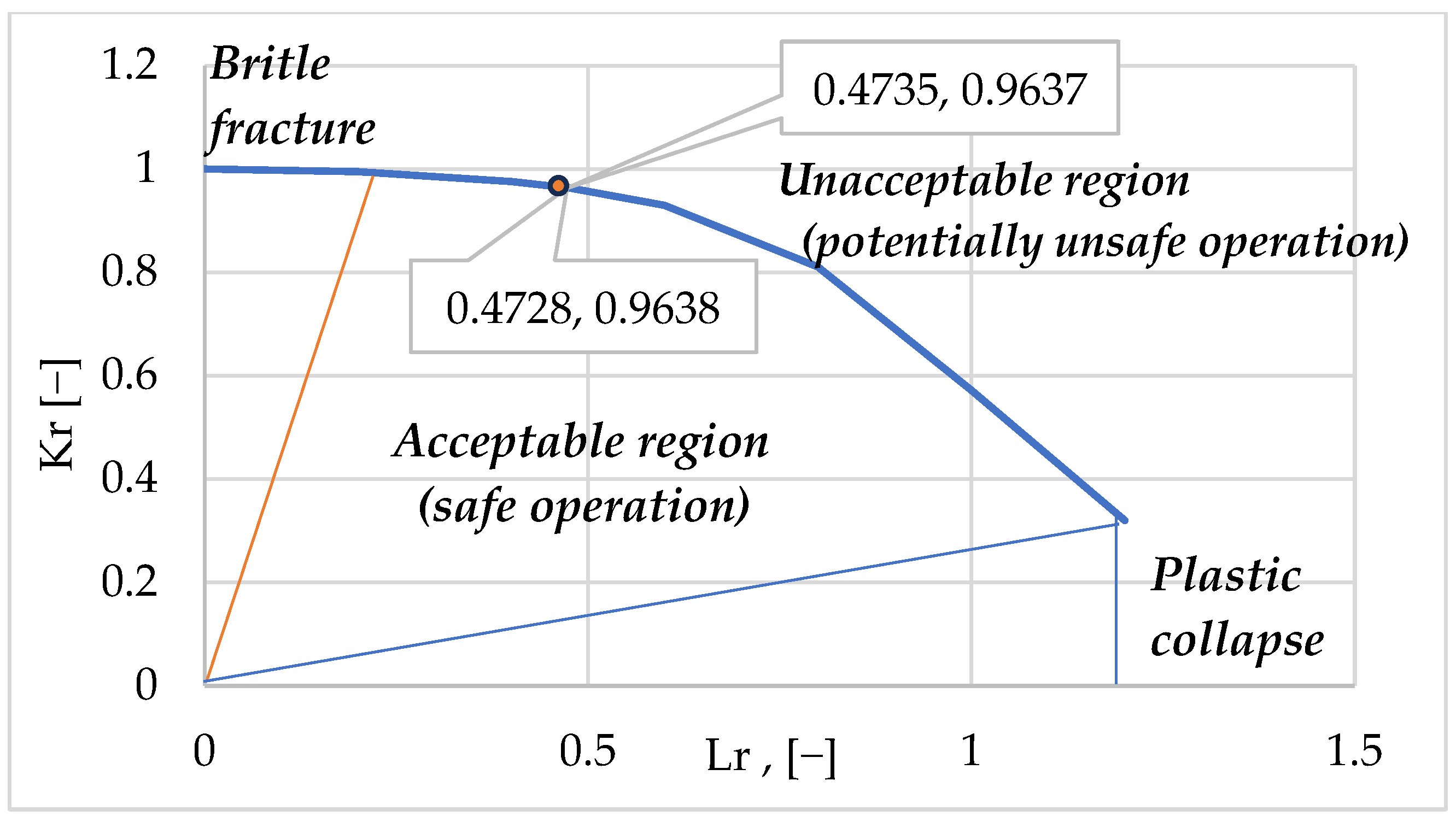
The FAD shows two operating regions: safe and potentially unsafe.
The curve in the FAD is plotted by positioning the pairs of assessment points (Lri, Kri).
The assessment points (Lri, Kri) represented under the curve in the FAD indicate the acceptable defects, and the assessment points (Lri, Kri) represented over the curve in the FAD indicate the unacceptable defects.

2.2.4. Numerical Analysis

To accurately characterize the behavior of HDPE pipes subjected to internal pressure, the numerical analysis using the finite element method FEM was carried out in the ANSYS program.
The influence of the presence of defects on the strength of HDPE pipes was highlighted by increasing the depth and the length of the defects from 10% to 70% of the depth and the length of the respective pipes.
In the GEOMETRY stage of the ANSYS program, the representation of the defect in the plan drawn in the AutoCAD 2024 program, shown in Figure 2a, and the sketch of the defect made in Design Modeler 2024, shown in Figure 2b, were used.
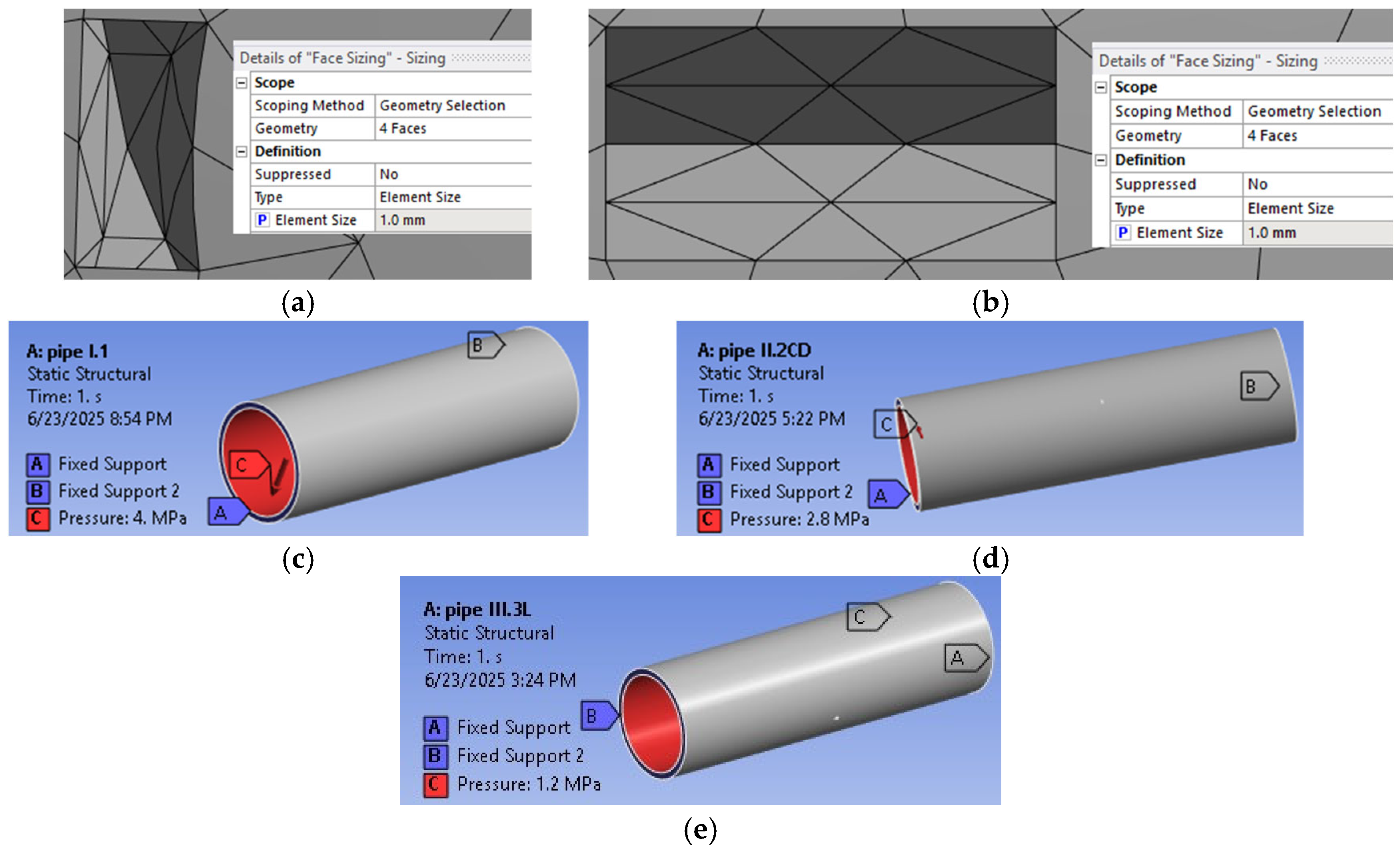
In the numerical analysis the element size used in the meshing step was the default, both in the pipe wall and in the areas where defects were modeled.
For the WD pipe, 5053 discretization nodes connected in 3253 elements in total were used, of which 2461 were Solid 187 and 792 were SURF 154 elements.

2.2.5. Determining the Remaining Service Life

The remaining service life t is one of the factors on which the efficiency of the polyethylene pipeline system used for water distribution depends. The formula for determining the remaining service life, according to [19], is presented in relationship (10), where ai is the initial defect depth.
t = a i s 1 5.54 × 1 0 8 × K I 4.66 d a ,
The analytical expression of the stress intensity factor KI, according to [22], is presented in relationship (11).
KI = {MF + [Φ∙(c/a)1/2 − MF]∙(a/s)8}∙{[σ∙(π∙a)1/2]/Φ}∙MTM,
MF is the factor that depends on the geometry of the defect (a/c). This factor is determined by relationship (12).
MF = [1 − (a/c)2] 1/2,
Φ is the complete elliptic integral of the second degree, which is determined by relationship (13).
Φ = 0 π / 2 1 e f 2 × sin 2 φ × d φ ,
In relationship (13), ef is the elliptical modulus or eccentricity, determined with relationship (14), depending on the defect angle, φ, which is calculated by relationship (15).
ef = tanφ,
φ = cos−1 (a/c),
MTM is the correction factor that considers that the increase in stress is due to the radial deformation in the vicinity of the defect, and which is determined by relationship (16).
MTM = {1 − [(a/s)/MT]/[1 − (a/s)]},
MT is the Folias correction factor, for λ < 1, which is determined by relationship (17).
MT = (1 + 1.61∙λ2)1/2,
λ is a ratio that is determined, depending on the mean radius, Rm, by relationship (18).
λ = c/(Rm∙s)1/2,
The mean radius, Rm, represents the arithmetic mean between the outer radius, Re, and the inner radius, Ri. The mean radius, Rm, is determined by relationship (19).
Rm = (Re + Ri)/2,
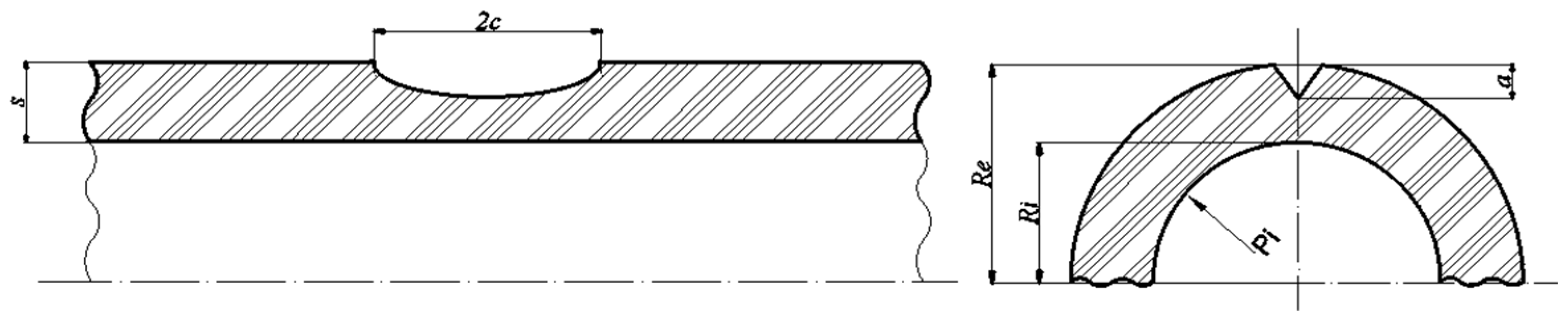
To highlight the geometric characteristics of the PE100 pipe and the unpenetrated semi-elliptic defect positioned on its outer surface, wall thickness s, outer and inner radii Re and Ri, defect length 2c, and defect depth a were presented in Figure 3. The internal pressure Pi was also noted in Figure 3.

3. Results

3.1. Results Obtained from the Internal Pressure Test

3.1.1. Bursting Failure Analysis

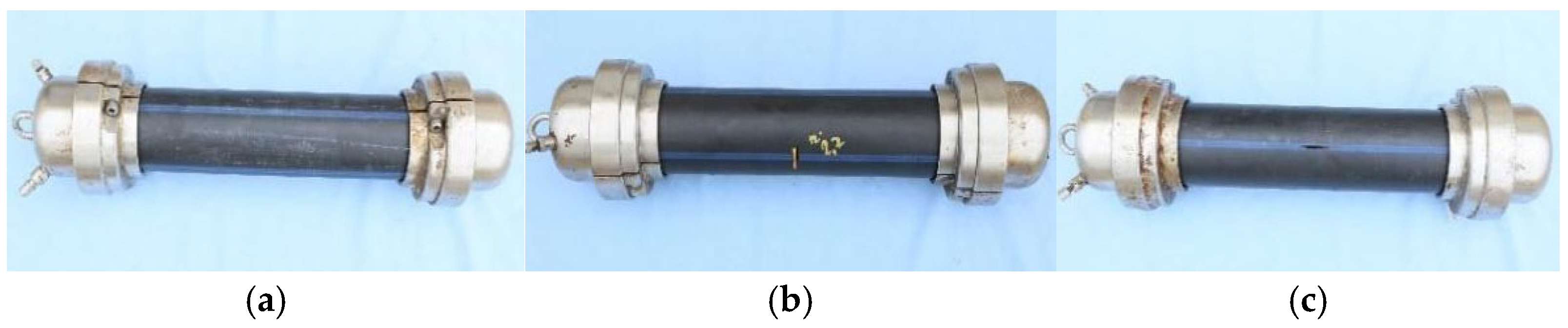
Pipes without and with controlled defects, which burst in the internal pressure test, are presented in Figure 4.
The burst in the pipe without a defect was a brittle fracture that occurred without significant pipe deformation. The failure was manifested by the development of very fine cracks, which had a parallel direction relative to the pipe axis.
The failure of the pipe with a circumferentially oriented defect was a ductile failure. The pipe material was strongly deformed and expelled outwards.
The failure of the pipe with a longitudinally oriented defect was parrot-beak type, and occurred when the pipe swelled and the wall thinned until failure. The crack had the same direction as the pipe axis.

3.1.2. Values of Critical Pressure Pcr, and Critical Time tcr

The values of critical pressure Pcr and critical time tcr recorded for the three PE100 pipes subjected to the internal pressure test are presented in Table 3.
A simple statistical analysis of the critical pressure and time values indicates consistent differences between the pipe’s conditions, reinforcing the reliability of the experimental observations.
The role of the experimental test data is to discover and demonstrate that a circumferentially oriented defect will lead to a slower failure of the pipe than if the defect is oriented longitudinally (in which case the principal stress is perpendicular to the defect contour in the direction of the major axis).

3.2. Results Obtained When Drawing the FAD

The input data required to determine the two pairs of assessment points are shown in Table 4. The values of circumferential stress σc for both tested pipes (the CD pipe and the LD pipe) were computed with relationships (4) and (5). The value of yield strength σy was mentioned in Table 1. The values of load ratio Lr were calculated with relationship (6). The values of stress intensity factor KI were calculated with relationship (11). The value of critical stress intensity factor KIc was mentioned in Table 1.

3.3. Results Obtained Through Numerical Analysis

The details of the dividing grids are presented in Figure 5a,b. The boundary settings are presented in Figure 5c–e.
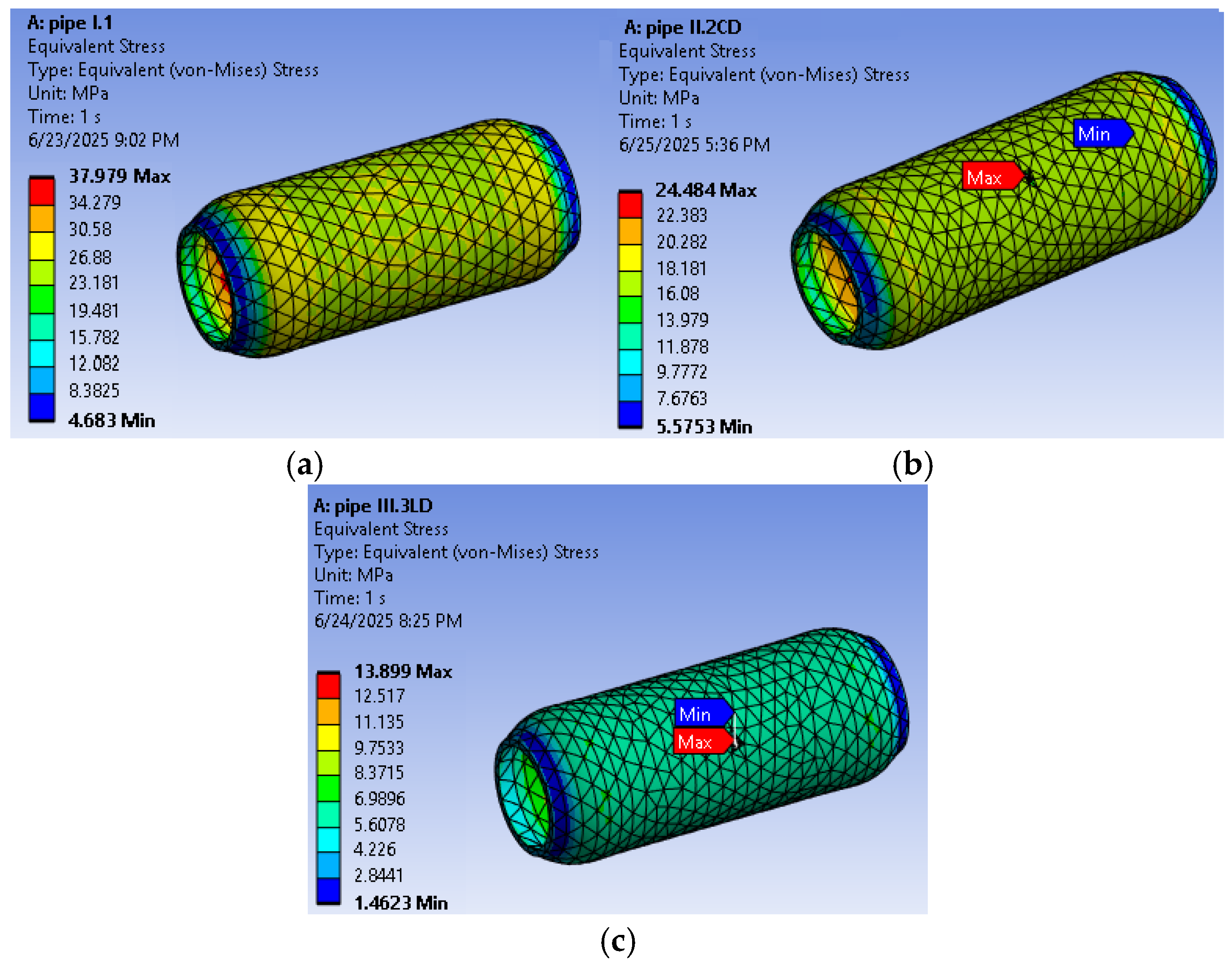
The results of the numerical evaluation of pipes with and without controlled defects, as well as the equivalent stress distribution, are presented in Figure 6a–c.

3.4. Results About Remaining Life

This evaluation applies to pipes with standard dimensional ratios (SDR) of 7.4, 6, and 5, and pipes that withstand permissible operating pressure between 24.4 and 10 bar after 10, 25, and 50 years of operation [23].
The influence of the defect depth on the equivalent stress that develops in the pipe wall is presented in relationship (20) for the CD pipe, and in relationship (21) for the LD pipe.
The influence of the defect length of the equipment stress that develops in the pipe wall is presented in relationship (22) for the CD pipe, and in relationship (23) for the LD pipe.
σech,a,CD = 2.6667a2 − 5.5808a + 28.785
σech,a,LD = −0.0016a3 + 0.0125a2 − 0.03x + 10.986
σech,2c,CD = 0.0009(2c)4 − 0.0385(2c)3 + 0.57(2c)2 − 2.7514(2c) + 30.682
σech,2c,LD = −2E−06(2c)4 + 0.0001(2c)3 − 0.0017(2c)2 + 0.0109(2c) + 10.944

4. Discussion

4.1. Discussion About Internal Pressure Test

For the comparative study of the behavior of the three pipes subjected to the internal pressure test, the values of the internal pressure, the circumferential stress, and the longitudinal stress are presented in Table 5.

4.2. Discussion About Numerical Analysis

The values of equivalent stress for the pipes with circumferentially and longitudinally oriented defects under the conditions of changing the defect depth are presented in Table 6.
The increase in defect depth causes an insignificant increase in equivalent stress in the pipe wall.
The values of equivalent stress for the pipes with circumferentially and longitudinally oriented defects under the conditions of changing the defect length are presented in Table 7.
The increase in defect length causes a significant increase in equivalent stress in the pipe wall when the defect length reached 30 mm. This confirms the conclusion from [9], for the pipe with a defect oriented longitudinally.
For the pipe with the circumferentially oriented defect, the critical depth of the defect acr was calculated by substituting the equivalent stress–defect depth relationship, as shown in Figure 7. This dependency relationship was rewritten by replacing the term y with the maximum equivalent stress corresponding to the pipe without defects, σech = 37.976 MPa, and the term x with the critical depth of defect acr, obtaining Equation (24).
2.6667∙(acr)2 − 5.5808∙(acr) + 28.785 = 37.976,
The determined critical depth of defect value is acr = 3.1775 mm.

4.3. Discussion About FAD

In the FAD, represented in Figure 7, the curve that contains the two pairs of points (Lr, Kr) is plotted (0.4728, 0.9638) and (0.4735, 0.9637), respectively, corresponding to the two defects on the outer surface of the defective pipes.
In the FAD, the curve separates the two operating regions, the acceptable region (safe operation) and the unacceptable region (potentially unsafe operation). The thin red line represents the boundary of the brittle region, and the blue line shows the plastic collapse boundary. Both regions are predicted by the FAD.

4.4. Discussion About the Remaining Service Life

To determine the remaining service life of pipes with controlled defects subjected to the internal pressure test, relationships (10)–(18) were used. The input data used to determine the values of the remaining service life are shown in Table 8. The results are presented in Equations (25) and (26). To accurately determine the remaining service life of pipes with controlled defects, the number 8760 h/year was considered.
t = 0.0017 0.0054 1 5.54 × 1 0 8 × 0.598 6 4.66 d x = 729852
t = 0.0017 0.0054 1 5.54 × 1 0 8 × 0.622 4 4.66 d x = 608594
Compared to similar studies [7,8], the results show compatible trends in the influence of defect geometry on failure pressure and lifetime prediction, confirming the validity of the assessment methodology applied in this work.

4.5. Comparison Between the Results of the Experimental Test and Numerical Evaluation

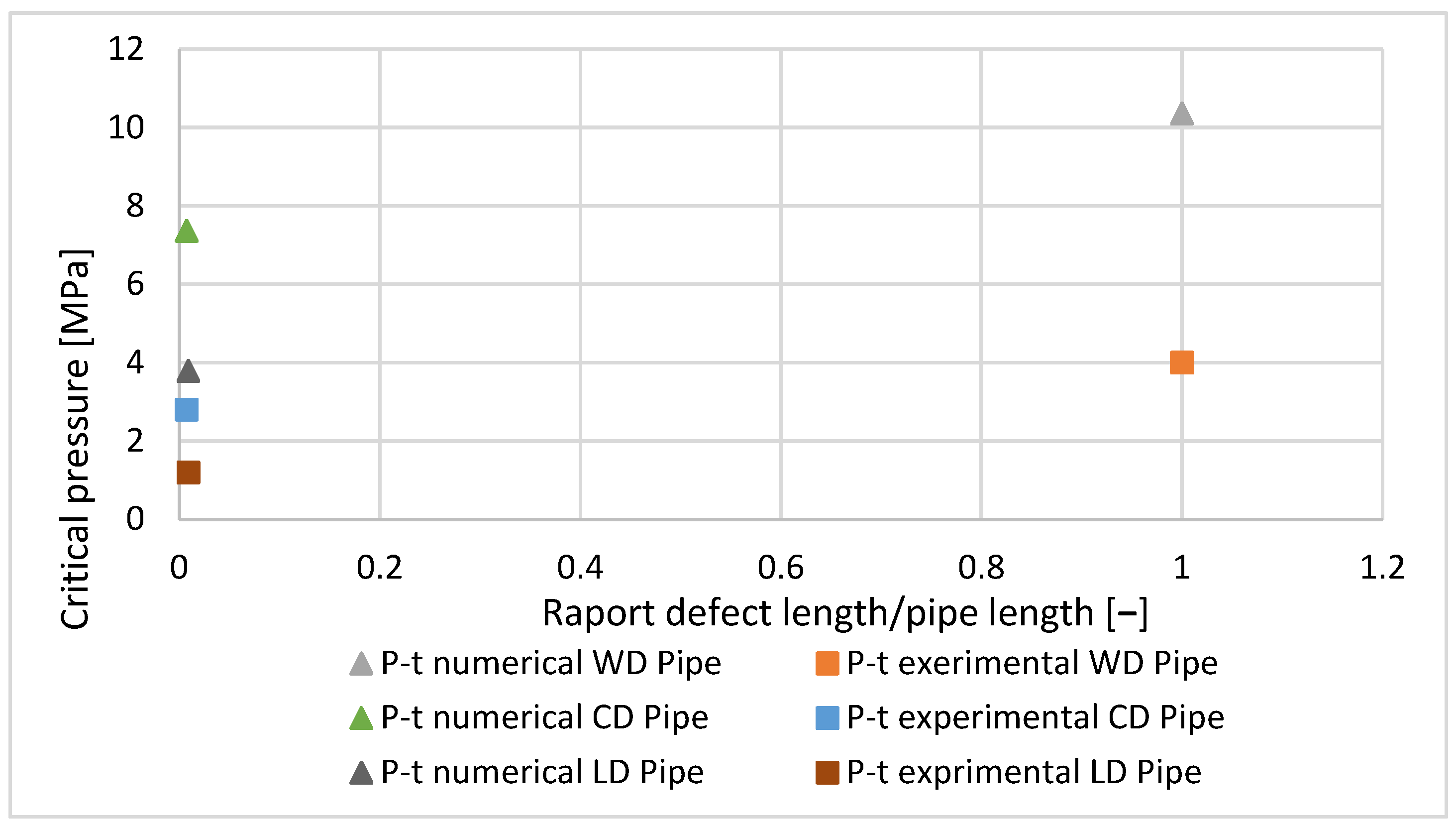
The numerical evaluation had the same conditions (pressure and defect dimensions) as the internal pressure test. For this reason, the results of numerical simulation and the results of the internal pressure test were compared to find out where they agreed. The comparison is illustrated in Figure 8.
The maximum critical pressure values correspond to the pipe without defects, and are as follows: 10.37 MPa for the numerical simulation and 4 MPa for the experimental test.
In Figure 8 there is no agreement between the experimental and numerical results because the linear elastic constitutive model of the material was used in the FEM, although the material has nonlinear viscoelastic properties. For this reason, the maximum stress of 37.979 MPa is higher than the yield stress of the material.

5. Conclusions

This study provides a comprehensive framework for evaluating the service life of HDPE pipes with outer surface defects of controlled geometry, by integrating an experimental internal pressure test, numerical simulation through finite element analysis, and fracture mechanism via the FAD.
This approach departs from generalized or empirical assessment by enabling defect-specific predictions of burst pressure, critical time to failure, and remaining service life based on defect type, orientation, and dimensions.
According to the experimental test data, a circumferentially oriented defect will lead to a slower failure of the pipe than a longitudinally oriented defect (where the principal stresses are perpendicular to the defect contour in the direction of the major axis).
Through the application of the FAD methodology, supplemented with finite element simulation, the study demonstrates that both safe and unsafe defect conditions can be discriminated with high reliability. The possible correlation between experimental and numerical results further validates the applicability of the proposed methodology.
These findings have direct implications for pipeline design, condition assessment, and maintenance strategies. By quantifying the influence of the defect orientation and geometry, the results support optimized inspection intervals and risk-informed replacement decisions for water distribution systems employing HDPE infrastructure.
Moreover, the methodology developed is transferable to other pressurized thermoplastic pipeline systems, such as those used in gas distribution or industrial fluid transport, offering a scalable tool for structural integrity assessment under real-world operating conditions.
A notable limitation of this study is the reduced length of the tested pipe segments, which may not fully replicate the stress distributions encountered in long-span networks. Future research may address this by extending the analysis to full-scale pipes, including internal or multiple defect scenarios, and incorporating variable environmental factors such as temperature fluctuations or external mechanical loads.
Overall, this research contributes a validated, physics-based approach for evaluating the mechanical resilience and residual life of HDPE pipelines with outer surface flaws, reinforcing the role of fracture mechanics in predictive maintenance and infrastructure safety.

Author Contributions

Conceptualization, I.-D.M. and M.G.P.; methodology, I.-D.M., M.G.P., C.B., and R.I.N.; software, I.-D.M. and R.I.N.; investigation, I.-D.M., M.G.P., C.B., and R.I.N.; writing—original draft preparation, I.-D.M., M.G.P., and R.I.N.; writing—review and editing, I.-D.M., M.G.P., and R.I.N.; supervision, M.G.P. All authors have read and agreed to the published version of the manuscript.

Funding

This research received no external funding.

Data Availability Statement

The original contributions presented in this study are included in the article. Further inquiries can be directed to the corresponding authors.

Conflicts of Interest

The authors declare no conflicts of interest.

Abbreviations

The following abbreviations are used in this manuscript:
APIAmerican Petroleum Institute
ASMEAmerican Society of Mechanical Engineers
FADFailure assessment diagram
FEMFinite element method
FFSFitness-for-service
HDPEHigh-density polyethylene
NHPTraditional notched HDPE pipe
PE100High-density polyethylene material with a minimum required strength of 10 MPa
PNNominal pressure
CDPipe with a defect oriented circumferentially
LD Pipe with a defect oriented longitudinally
WDPipe without defect
SDRStandard dimensional ratio
aDefect depth [mm]
aiInitial defect depth [mm]
acrCritical depth of defect [mm]
2cDefect length, measured in the direction in which the defect extends [mm]
DeOuter diameter of pipe [mm]
σcCircumferential stress [MPa]
σechEquivalent stress [MPa]
σlLongitudinal stress [MPa]
σrRadial stress [MPa]
efElliptic modulus or eccentricity [−]
E Young’s modulus [MPa]
KStress intensity factor [MPa∙m1/2]
KIStress intensity factor for mode I of opening through tensile [MPa∙m1/2]
KIcCritical stress intensity factor [MPa∙m1/2]
KrToughness ratio [−]
LrLoad ratio [−]
MFFactor that depends on the geometry of the defect (a/c) [−]
MTFolias correction factor [−]
MTMCorrection factor that considers the increase in stress due to the radial deformation [−]
PiMaximum recorded internal pressure [MPa]
PcrCritical pressure [MPa]
PcrackCrack initiation pressure [MPa]
ReOuter radius [mm]
RiInner radius [mm]
RmMean radius [mm]
sWall thickness [mm]
tRemaining service life [years]
tcrCritical time [s]
εrTensile elongation at 23 °C
λRatio determined by mean radius [−]
νPoisson ratio [−]
ρDensity at 23 °C
σcCircumferential stress [MPa]
σechEquivalent stress [MPa]
σlLongitudinal stress [MPa]
σrRadial stress [MPa]
σtrUltimate tensile strength at 23 °C [MPa]
σyYield strength [MPa]

References

  1. Manu, I.D. Research on the Influence of Defects on the Strength of Polyethylene Piping. Ph.D. Thesis, Petroleum-Gas University, Ploiesti, Romania, 24 July 2024. [Google Scholar]
  2. API 579-1/ASME FFS-1; Fitness-For-Service, Part 9, Assessment of Components Operating in Crack-like Flaws Range. American Society of Mechanical Engineers: New York City, NY, USA; API Publishing Services: Washington, DC, USA, 2021.
  3. Kubrak, M.; Kodura, A.; Malesińska, A.; Urbanowicz, K. Water hammer in Steel–Plastic Pipes Connected in Series. Water 2022, 14, 3107. [Google Scholar] [CrossRef]
  4. Daikh, A.; Aminallah, L.; Merdji, A.; Gaidi, L.; Alkhaldi, H.; Roy, S.; Msomi, V.; Mukdadi, O.M. Analysis of the harmfulness of the water hammer phenomenon in high density poly-ethylene (HDPE) pipes. Int. J. Press. Vessel. Pip. 2023, 204, 104963. [Google Scholar] [CrossRef]
  5. Kraiem, D.; Triki, A. Elucidating the water-hammer surge behaviour in steel/high and low density PolyEthylene—Based piping systems. ISH J. Hydraul. Eng. 2023, 29, 298–306. [Google Scholar] [CrossRef]
  6. Urbanowicz, K.; Duan, H.-F.; Bergant, A. Transient Flow of Liquid in Plastic Pipes. Stroj. Vestn.—J. Mech. Eng. 2020, 66, 77–90. [Google Scholar] [CrossRef]
  7. Abdulah Shrrat Omar, O. Evaluation of Pipe Materials in Water System Networks Using the Theory of Advanced Multi-Criteria Analysis. Sustainability 2023, 15, 4491. [Google Scholar] [CrossRef]
  8. Sanjuan-Delmás, D.; Petit-Boix, A.; Gasol, C.M.; Farreny, R.; Villalba, G.; Suárez-Ojeda, M.E.; Gabarell, X.; Josa, A.; Rieradevall, J. Environmental assessment of drinking water transport and distribution network use phase for small to medium-sized municipalities in Spain. J. Clean. Prod. 2015, 87, 573–582. [Google Scholar] [CrossRef]
  9. Liu, J.; Zhang, H.; Wang, B.; Zhang, D.; Ji, B.; Fei, F.; Liu, X. An Accurate and Efficient Fitness-For-Service Assessment Method of Pipes with Defects under Surface Load. Energies 2021, 14, 5521. [Google Scholar] [CrossRef]
  10. Zheng, X.; Zhang, X.; Ma, L.; Wang, W.; Yu, J. Mechanical characterization of notched high density polyethylene pipe: Testing and prediction. Intern. J. Press. Vessel. Pip. 2019, 173, 11–19. [Google Scholar] [CrossRef]
  11. ISO 1183-1:2025; Plastics—Methods for Determining the Density of Non-Cellular Plastics—Part 1: Immersion Method, Liquid Pycnometer Method and Titration Method. International Organization for Standardization: Geneva, Switzerland, 2019.
  12. ISO 527-1:2019; Plastics—Determination of Tensile Properties—Part 1: Plastics—Determination of Tensile Properties—Part 1: General Principle. International Organization for Standardization: Geneva, Switzerland, 2019.
  13. ISO 1167-1; Thermoplastics Pipes, Fittings, and Assemblies for the Conveyance of Fluids—Determination of the Resistance to Internal Pressure, Part 1: General Method. International Organization for Standardization: Geneva, Switzerland, 2006.
  14. Manu, I.D.; Petrescu, M.G.; Zisopol, D.G.; Ramadan, I.N.; Ilinca, C.N. The Mechanical Behavior of High-Density Polyethylene under Short-Time Hydraulic Pressure Test. Eng. Technol. Appl. Sci. Res. 2024, 14, 14062–14068. [Google Scholar] [CrossRef]
  15. Buzdugan, G. Materials Strength; Technical Publishing: Bucharest, Romania, 1974; p. 229. [Google Scholar]
  16. Menon, E.S. Liquid Pipeline Hydraulics; Marcel Dekker, Inc.: New York City, NY, USA, 2004; p. 67. [Google Scholar]
  17. Jahani, S. Characterisation and Analysis of Polyethylene Pipes and Polymers in Water Pressure Pipe Applications. Ph.D. Thesis, Loughborough University, Loughborough, UK, 2019. Available online: https://hdl.handle.net/2134/37165 (accessed on 22 February 2024).
  18. Bouaziz, M.A.; Guidara, M.A.; Schmitt, C.; Hadj-Taïeb, E.; Azari, Z.; Dmytrakh, I. Structural integrity analysis of HDPE pipes for water supplying network. Fatigue Fract. Eng. Mater. Struct. 2018, 42, 792–804. [Google Scholar] [CrossRef]
  19. Aluchi, V. Research on the Operating Characteristic of Polyethylene Pipes Used in Natural Gas Distribution. Ph.D. Thesis, Petroleum-Gas University, Ploiesti, Romania, 2013. [Google Scholar]
  20. Cioclov, D. Mechanics of Material Failure; Publishing House of the Socialist Republic of Romania: Bucharest, Romania, 1977. [Google Scholar]
  21. Coêlho, G.d.C.; Silva, A.A.; Santos, M.A.; Lima, A.G.B.; Santos, N.C. Stress Intensity Factor of Semielliptical Surface Crack in Internally Pressurized Hollow Cylinder—A Comparison between BS 7910 and API 579/ASME FFS-1 Solutions. Materials 2019, 12, 1042. [Google Scholar] [CrossRef] [PubMed]
  22. Ulmanu, V.; Zecheru, G. Determination of the Fatigue Durability of Heavy Drill Rods Based on the Concepts of Fracture Mechanics of Materials; Romanian Academy Publishing House: Bucharest, Romania, 1994; p. 48. [Google Scholar]
  23. DIN 8074; Polyethylene (PE) Pipes—Dimensions. Deutsches Institut fur Normung: Berlin, Germany, 1999.
Figure 1. The pipes with and without defects practiced in a controlled manner, subjected to internal pressure: (a) the WD pipe; (b) the CD pipe; (c) the LD pipe.
Materials 18 05407 g001
Figure 2. The representation of the defect: (a) in AutoCAD program; (b) in DesignModeler.
Materials 18 05407 g002
Figure 3. Section in PE100 pipe showing an unpenetrated semi-elliptic defect on the outer surface [1].
Materials 18 05407 g003
Figure 4. Pipes without and with controlled defects, which burst in the internal pressure test: (a) pipe without defect; (b) CD pipe; (c) LD pipe.
Materials 18 05407 g004
Figure 5. The details of the dividing grids (a,b) and the boundary settings (ce).
Materials 18 05407 g005
Figure 6. The results of the numerical evaluation under equivalent (von Mises) stress: (a) WD pipe; (b) CD pipe; (c); LD pipe.
Materials 18 05407 g006
Figure 7. The FAD (processed after [21]).
Materials 18 05407 g007
Figure 8. Comparison between the results of the numerical simulation and the results of the experimental test.
Materials 18 05407 g008
Table 1. The PE100 type of HDPE material has the following physical and mechanical parameters.
Physical and Mechanical Characteristics
Name and Symbol
Values and UnitsMethods
Density, ρ958–960 [g/cm3]ISO 1183 [11]
Poisson ratio, ν0.45 [−]Experimental testing 1
Young’s modulus, E1100 [MPa]ISO 527 [12]
Yield strength, σy29.6234 [MPa]Experimental testing
Ultimate tensile strength, σt14.6082 [MPa]Experimental testing
Tensile elongation, εr737.7127 [%]Experimental testing
Critical stress intensity factor, KIc0.742 [MPa m1/2]Experimental testing
1 Experimental Testing was carried out on PE100 specimens [1].
Table 2. The width, length, and depth of defects practiced in a controlled manner in two pipes.
Tested PipeDefect Width,
l, [mm]
Defect Length,
2c, [mm]
Defect Depth,
a, [mm]
CD pipe 11.412.21.7
LD pipe 21.412.71.7
1 CD—pipe with a defect oriented circumferentially; 2 LD—pipe with a defect oriented longitudinally.
Table 3. The values of critical pressure Pcr and critical time tcr were recorded for the three PE100 pipes.
Tested PipeCritical Pressure Pcr, [MPa]Critical Time tcr, [s]
WD pipe4.058
CD pipe2.829
LD pipe1.228
Table 4. The input data required to draw the FAD are presented under the mechanical parameters.
Tested PipeCircumferential Stress σc, [MPa]Yield Strength σy, [MPa]Load
Ratio Lr, [−]
Stress
Intensity
Factor KI, [MPa∙m1/2]
Critical Stress Intensity
Factor KIc,
[MPa∙m1/2]
Toughness
Ratio Kr, [−]
CD pipe14.025729.62340.47350.62240.7430.8377
LD pipe14.00610.47280.59860.8057
Table 5. The values of internal pressure, the circumferential stress, and the longitudinal stress are presented for the comparative study of behavior of the three pipes subjected to the internal pressure test.
Tested PipeInternal Pressure Pi, [MPa]Circumferential Stress σc, [MPa]Longitudinal Stress σl, [MPa]
WD pipe4.031.33315.6667
CD pipe2.821.93310.9667
LD pipe1.29.44.7
Table 6. The values of equivalent stress for the pipes with circumferentially and longitudinally oriented defects change with the change in defect depth.
Defect Depth
a, [mm]
CD PipeLD Pipe
Equivalent Stress
σech, [MPa]
0.5423.12612.469
1.0822.56215.98
1.6223.36514.108
1.724.48413.899
2.1622.47513.785
2.723.96712.368
3.2424.10313.408
3.7823.29312.942
Table 7. The values of equivalent stress for the pipes with circumferentially and longitudinally oriented defects change with the change in defect length.
CD PipeLD Pipe
Length Defect
2c, [mm]
Equivalent Stress
σech, [MPa]
Length Defect
2c, [mm]
Equivalent Stress
σech, [MPa]
2.224.4842.713.899
3023.2413019.221
6023.4316019.608
9023.5629018.537
12024.23112019.723
15023.67915020.416
18023.70318021.14
21023.47421018.997
Table 8. The values of the remaining service life of pipes with controlled defects subjected to the internal pressure test are computed as functions of the geometrical and mechanical characteristics.
Tested PipeOuter
Diameter
De, [m]
Defect Depth
a, [m]
Defect Length 2c, [m]Defect Half-Length
c, [m]
Mean
Radius
Rm, [m]
Wall Thickness s, [m]Ratio
λ, [−]
Folias
Correction Factor
MT, [−]
CD pipe0.090.00170.00220.00110.04230.00540.07381.0044
LD pipe0.00270.0135
Tested pipeCorrection
factor MTM, [−]
Defect angle φ, [°]Elliptic modulus or eccentricity ef, [−]Complete
elliptic integral of second degree
Φ, [−]
Factor depends on the defect
geometry
MF, [−]
Equivalent
stress
σech, [MPa]
Stress intensity
factor
KI,
[MPa∙m1/2]
Remaining service life
t, [years]
CD pipe1.00093.941.02640.75490.95313.00460.598683.3164
LD pipe3.260.12141.475513.17390.622469.4742
Disclaimer/Publisher’s Note: The statements, opinions and data contained in all publications are solely those of the individual author(s) and contributor(s) and not of MDPI and/or the editor(s). MDPI and/or the editor(s) disclaim responsibility for any injury to people or property resulting from any ideas, methods, instructions or products referred to in the content.