Article

Optimization of Welding Parameters Using an Improved Hill-Climbing Algorithm Based on BP Neural Network for Multi-Bead Weld Smoothness Control

1
College of Intelligent Manufacturing and Automotive, Chongqing Polytechnic University of Electronic Technology, Chongqing 401331, China
2
Chongqing Key Laboratory of Advanced Mold Intelligent Manufacturing, School of Material Science and Engineering, Chongqing University, Chongqing 400044, China
3
Key Laboratory of Advanced Reactor Engineering and Safety, Ministry of Education, Collaborative Innovation Center of Advanced Nuclear Energy Technology, Institute of Nuclear and New Energy Technology, Tsinghua University, Beijing 100084, China
*
Authors to whom correspondence should be addressed.
Materials 2025, 18(17), 4084; https://doi.org/10.3390/ma18174084
Submission received: 18 June 2025 / Revised: 23 July 2025 / Accepted: 8 August 2025 / Published: 31 August 2025
(This article belongs to the Section Materials Simulation and Design)

Abstract

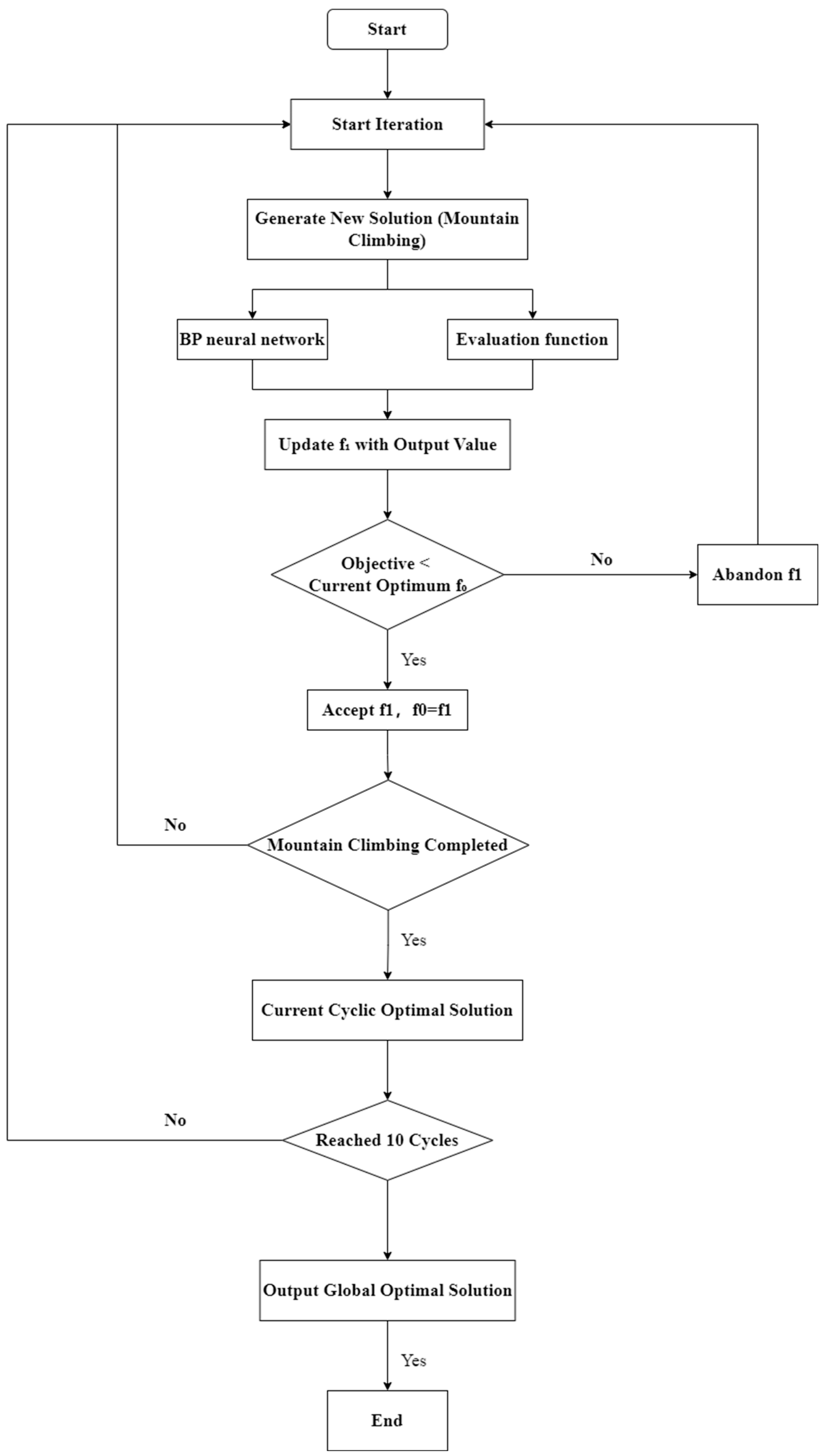
In multi-pass welding processes, achieving a uniform and smooth weld surface is crucial for mechanical performance and dimensional accuracy. However, the complex nonlinear relationships between welding parameters and weld bead geometry present significant challenges for traditional optimization methods. This study proposes an intelligent prediction and optimization framework that integrates a backpropagation (BP) neural network with an improved hill-climbing algorithm to enhance weld surface smoothness in automated multi-bead overlay welding. Experimental data collected under varying arc voltages, wire feed rates, and welding speeds were used to train the neural network. The improved hill-climbing algorithm adaptively adjusts weights and biases in the BP model to overcome issues of local minima and slow convergence. Comparative results demonstrate that the proposed method significantly outperforms conventional BP approaches in terms of prediction accuracy and convergence efficiency. Furthermore, optimal welding parameters identified by the model yield smoother weld surfaces, reducing the need for post-processing. This work provides a novel solution for intelligent control and real-time optimization in advanced welding systems.
Keywords: welding parameter optimization; BP neural network; hill-climbing algorithm; weld bead morphology; automated overlay welding; surface smoothness prediction welding parameter optimization; BP neural network; hill-climbing algorithm; weld bead morphology; automated overlay welding; surface smoothness prediction