Homogenization Method for Modeling and Analysis of the Honeycomb Structure—Simulation Study and Validation



Abstract
1. Introduction
2. Materials and Methods
2.1. Honeycomb Panels
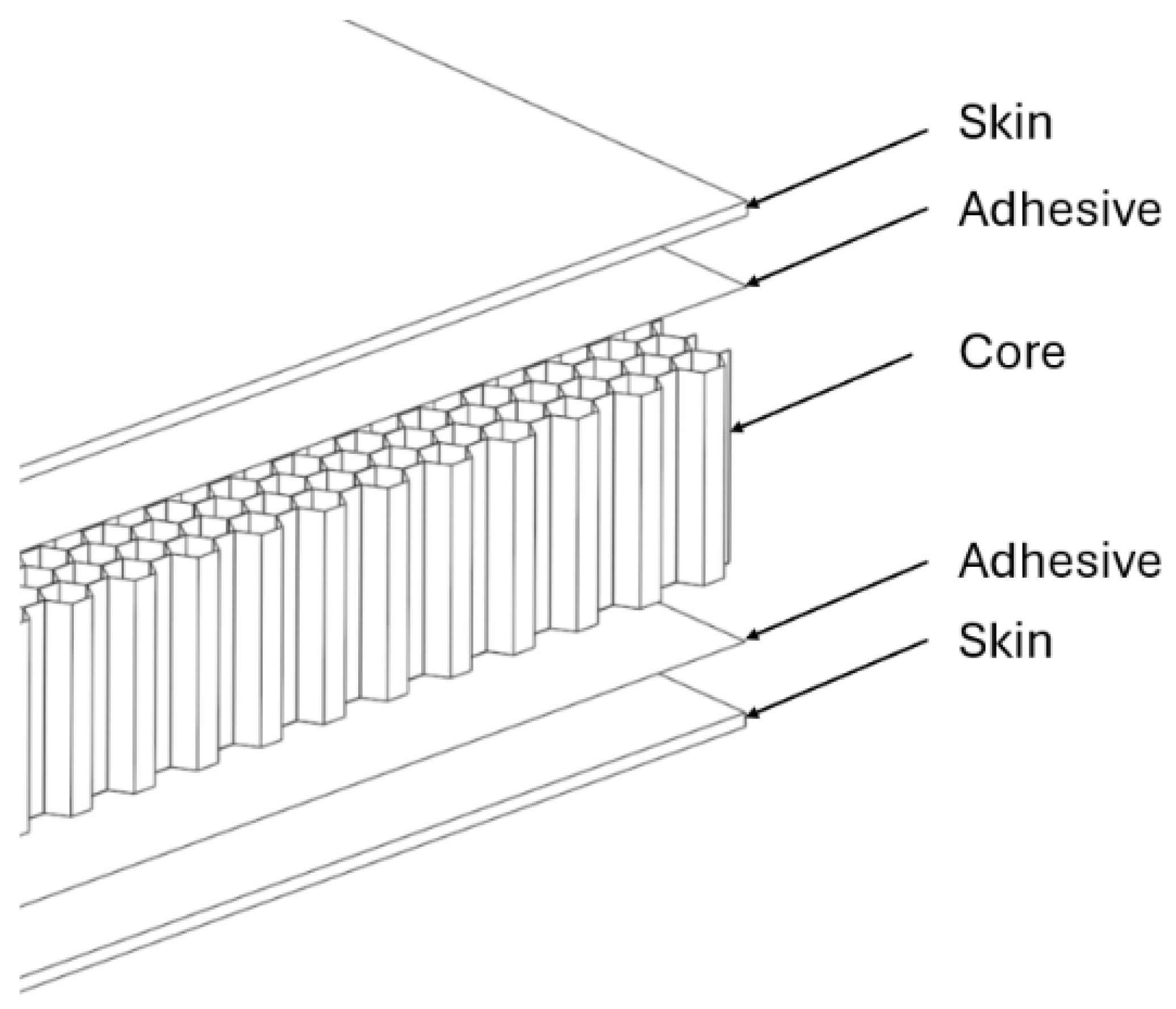
- High flexural stiffness;
- High strength-to-weight ratio;
- Finished edges for mechanical or structural purposes (e.g., connection);
- Multiple manufacturing options;
- Good level of energy absorption in case of impact load;
- Good damping level in case of harmonic load or vibration.
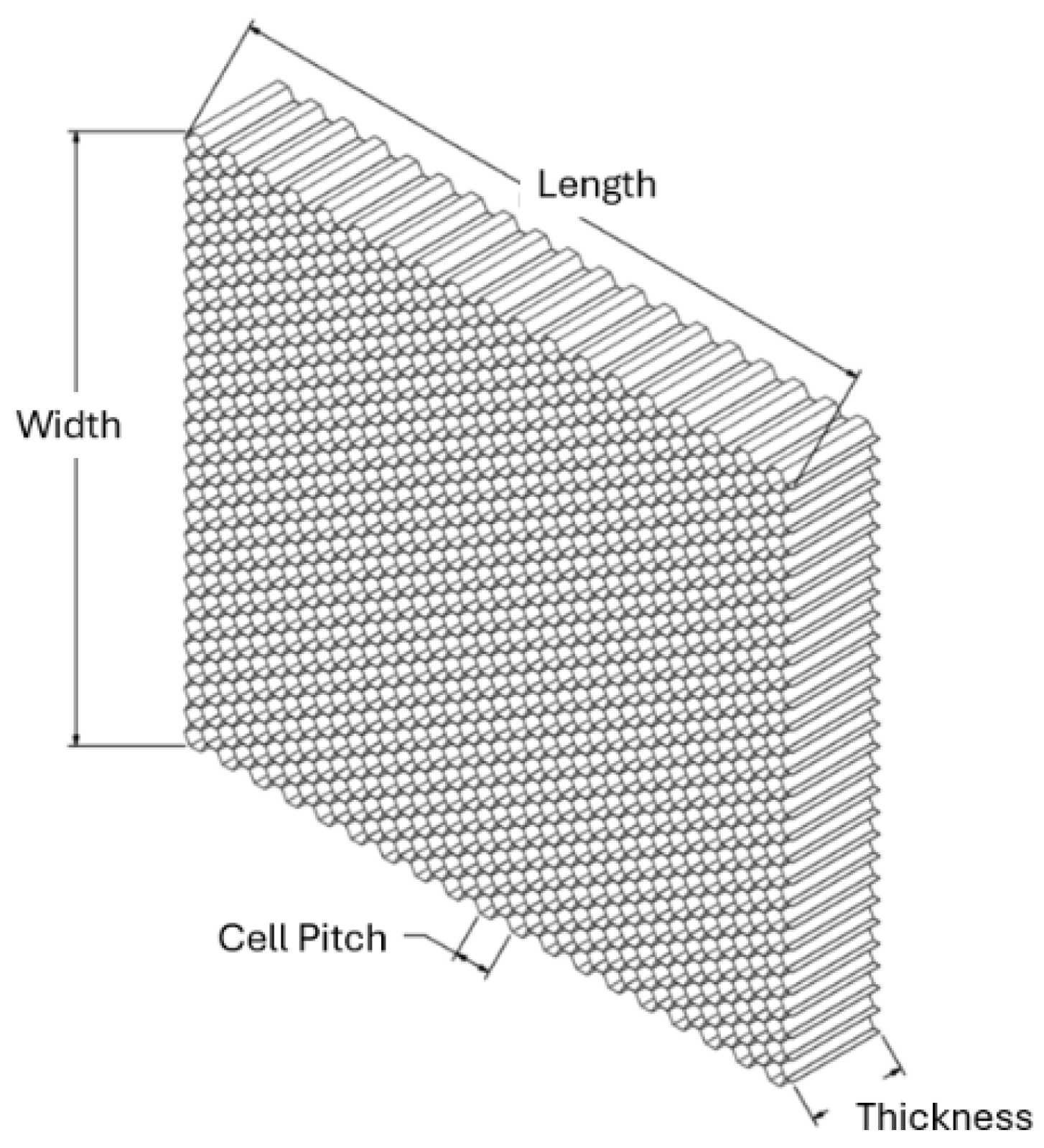
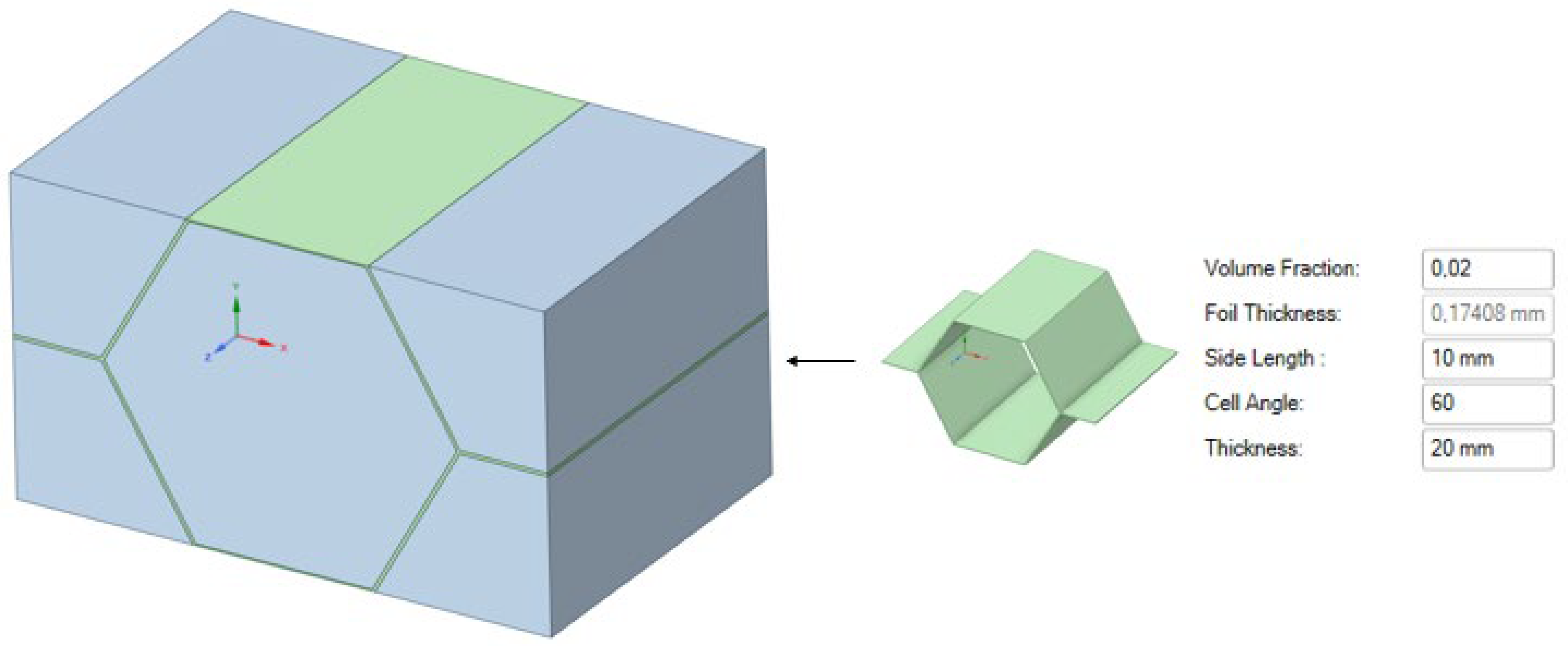
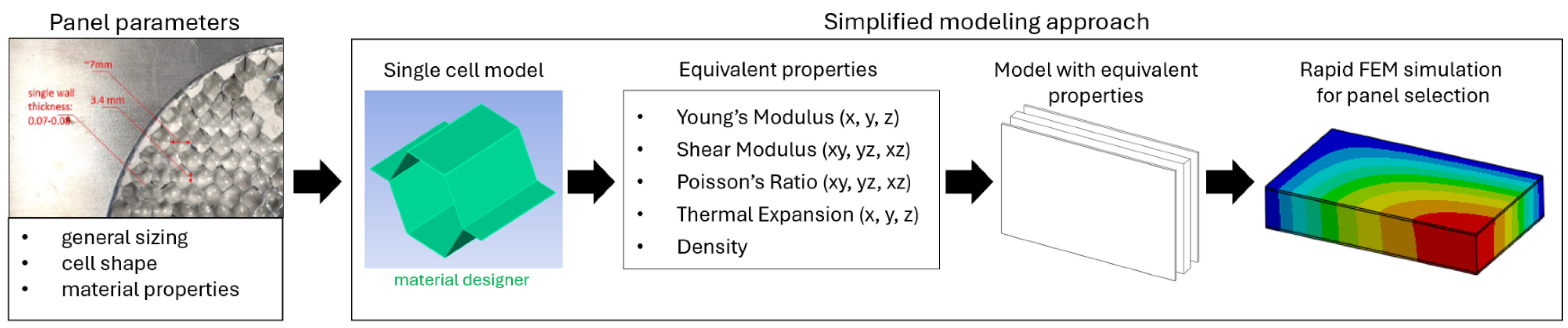
2.2. Core Homogenization
2.3. Theoretical Background
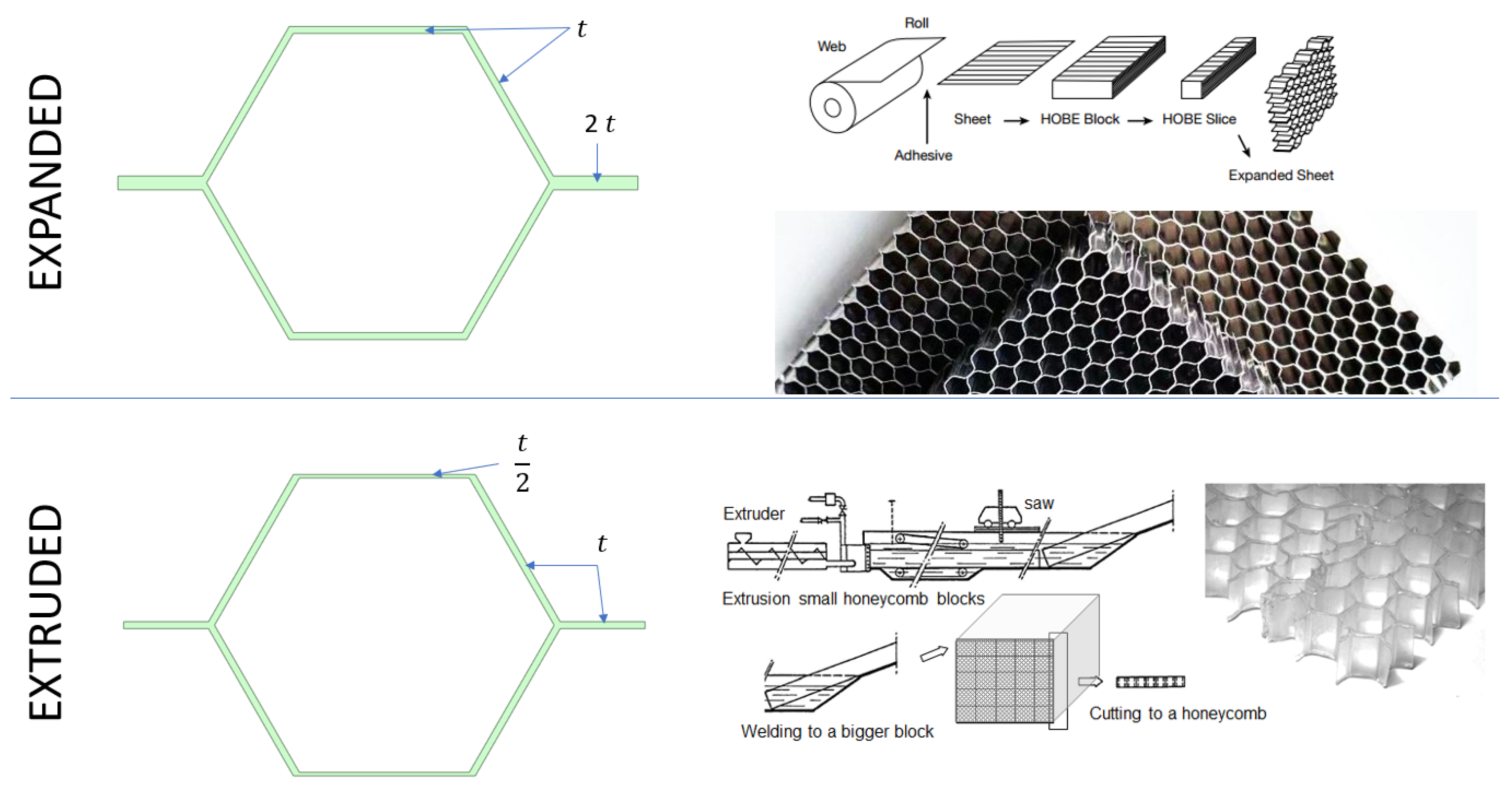
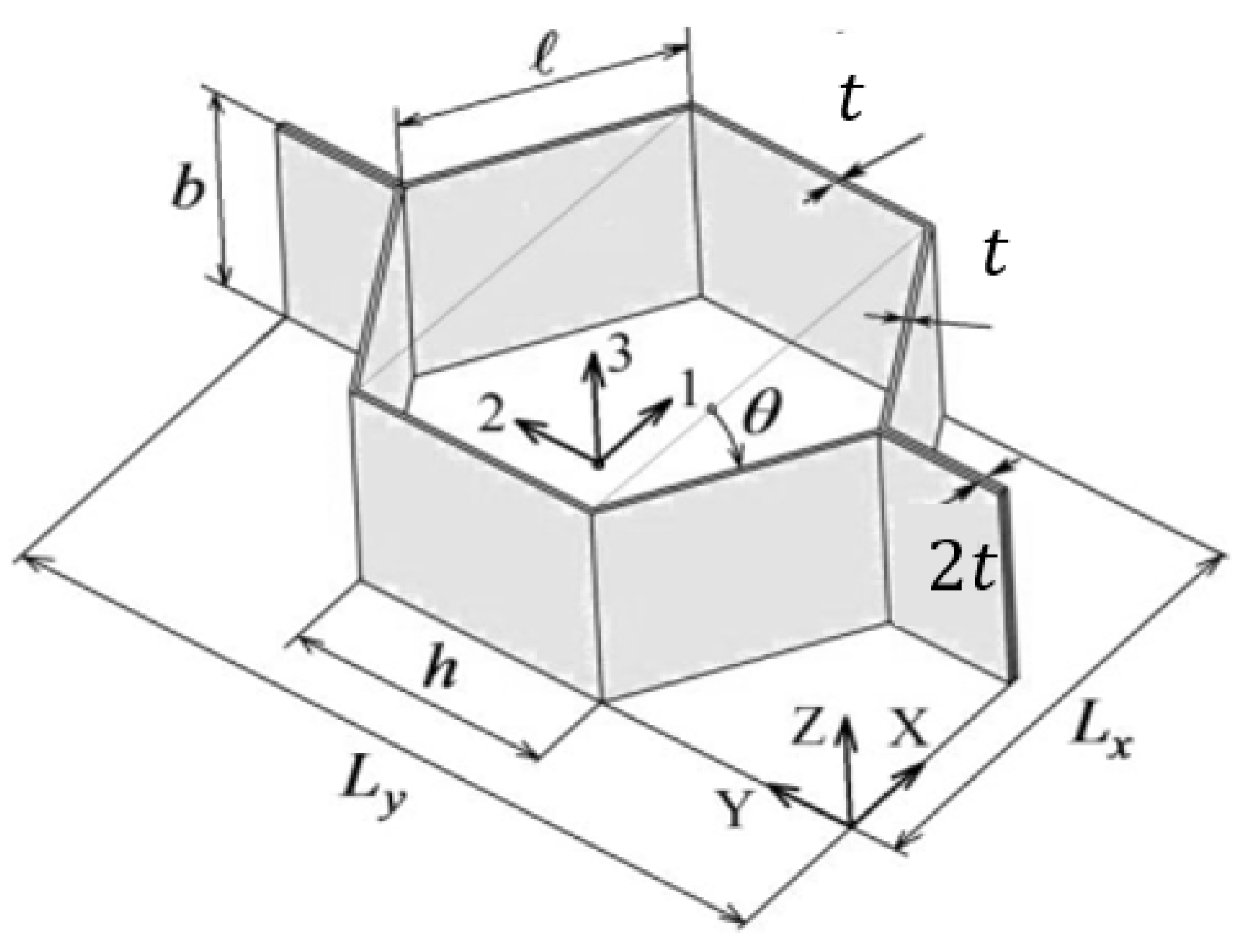
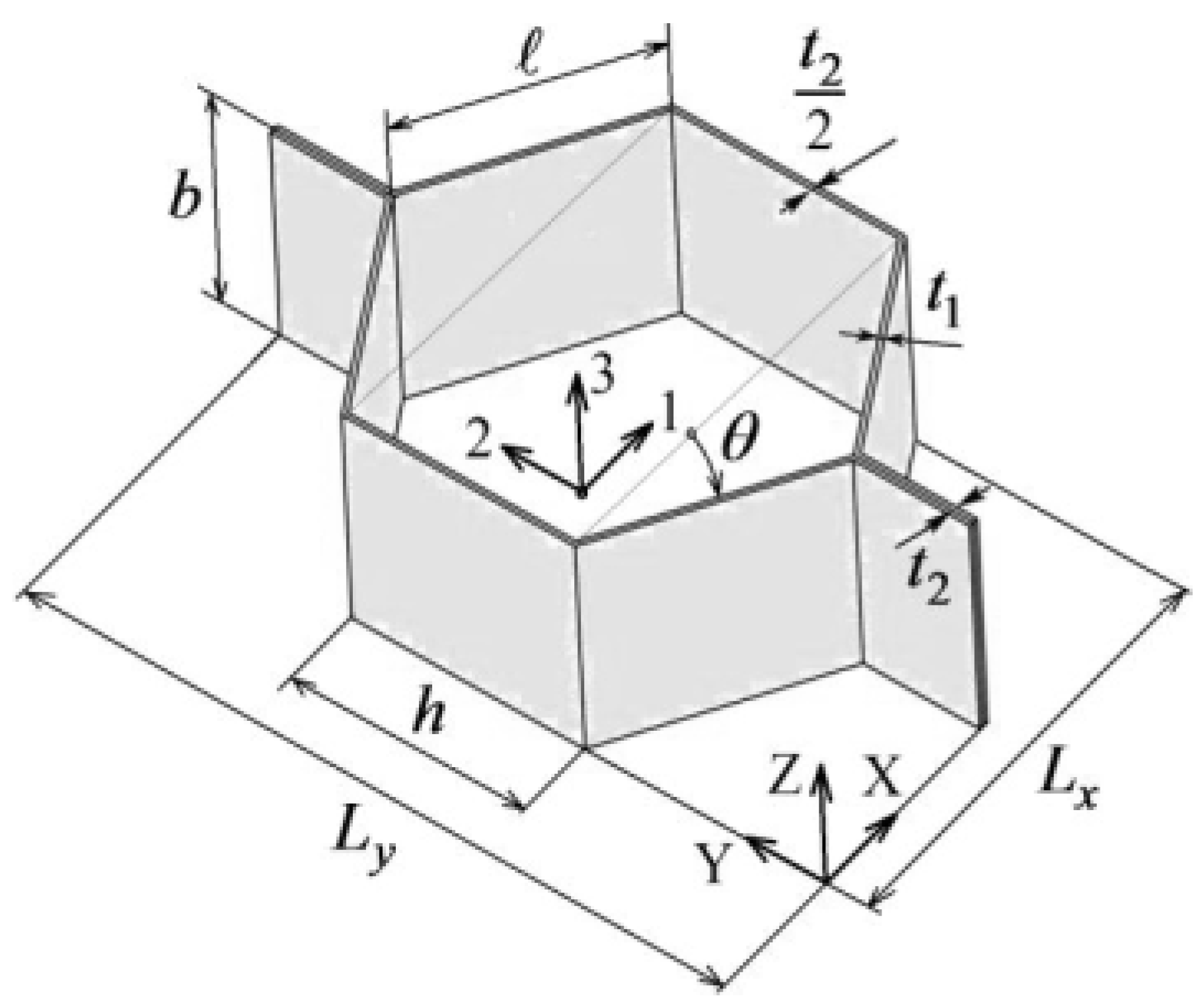
2.3.1. Expanded Core
2.3.2. Extruded Core
3. Results
3.1. Analytical Calculation and Comparison with Commercial Software Output
3.2. Some Guidelines for Using ANSYS Material Designer®
3.3. FE Modeling
- Honeycomb structures are periodic,
- Cell structure is uniform and perfect,
- Honeycomb structures are made of one orthotropic linear-elastic material,
- Bonding between cells is perfect.
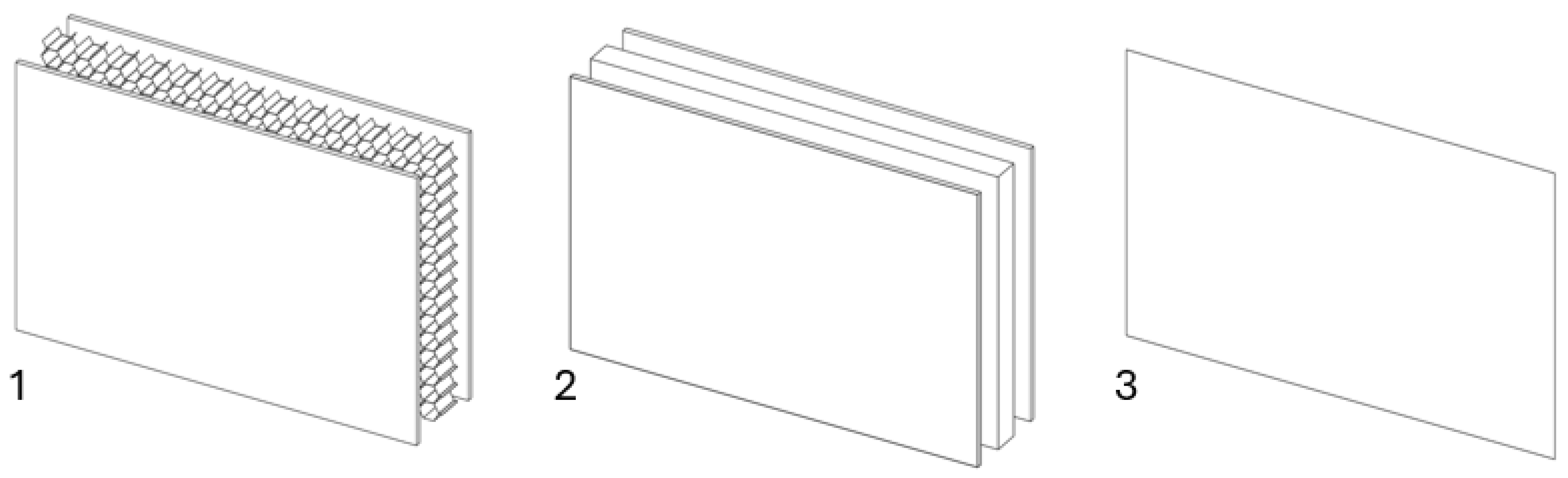
3.4. Levels of Complexity
- Based on the full shapes of the core and skins (heaviest, time consuming, most accurate).
- Based on orthotropic material properties using homogeneous bodies—solids (easy to model, fast, accurate, allows us to extract forces between skins and core).
- Based on orthotropic material properties using shells (lightest, fastest, potentially less accurate).
3.4.1. Level 1: Fully Modeled Shape (L1)
- Skins (face-sheets)The simplest components to define, as they can be represented either by a single shell or a solid block, depending on the chosen modeling approach (here, a full solid model was created).When considering skins, only two variables need to be taken into account: thickness and material type (size matches the overall panel size). It is naturally possible to have different thicknesses and material types for each side of the panel, if necessary.
- Bonding adhesiveRegarding the adhesive, the chosen approach involved defining the contact within the finite element model as bonded and evaluating the shear stress transmitted through it during post-processing.If such evaluated shear stress exceeds the allowable limit determined through tests on the components, it would indicate that the bonding fails to meet the required criteria.
- Honeycomb coreThe honeycomb core in this modeling approach is fully modeled. Each single core cell is patterned in the Y and Z direction to match the required shape (excess is cut off).
3.4.2. Level 2: Solids Using Homogenization (L2)
3.4.3. Level 3: Shells Using Homogenization (L3)
3.5. Mesh Convergence Study
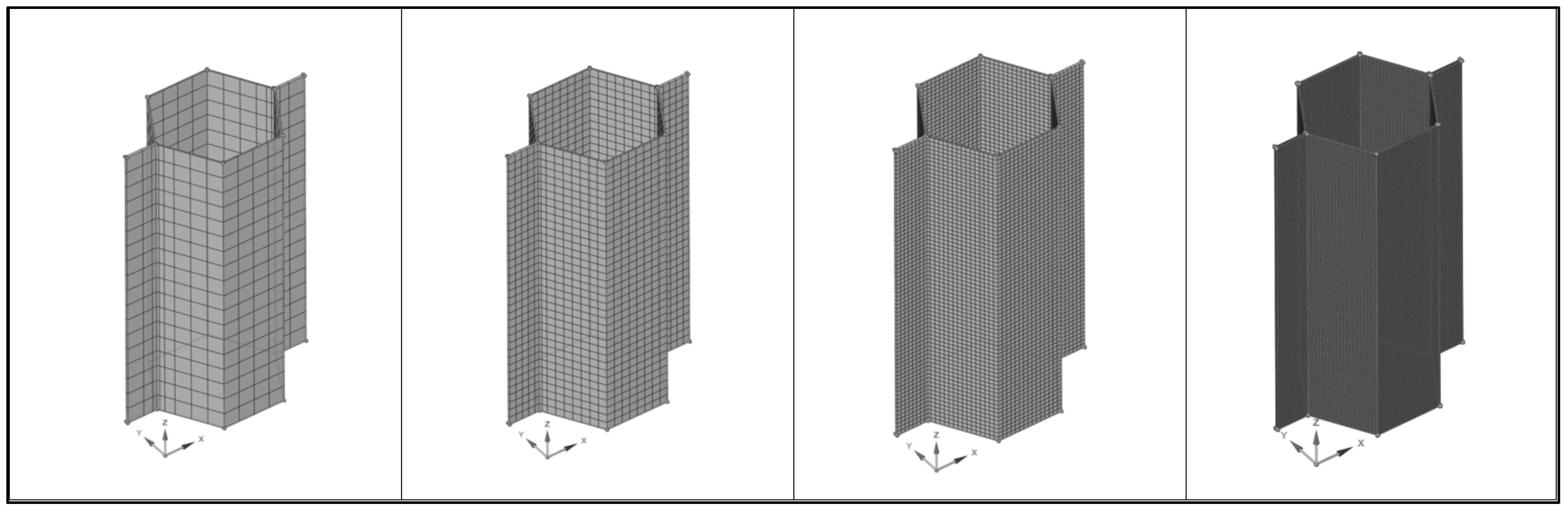
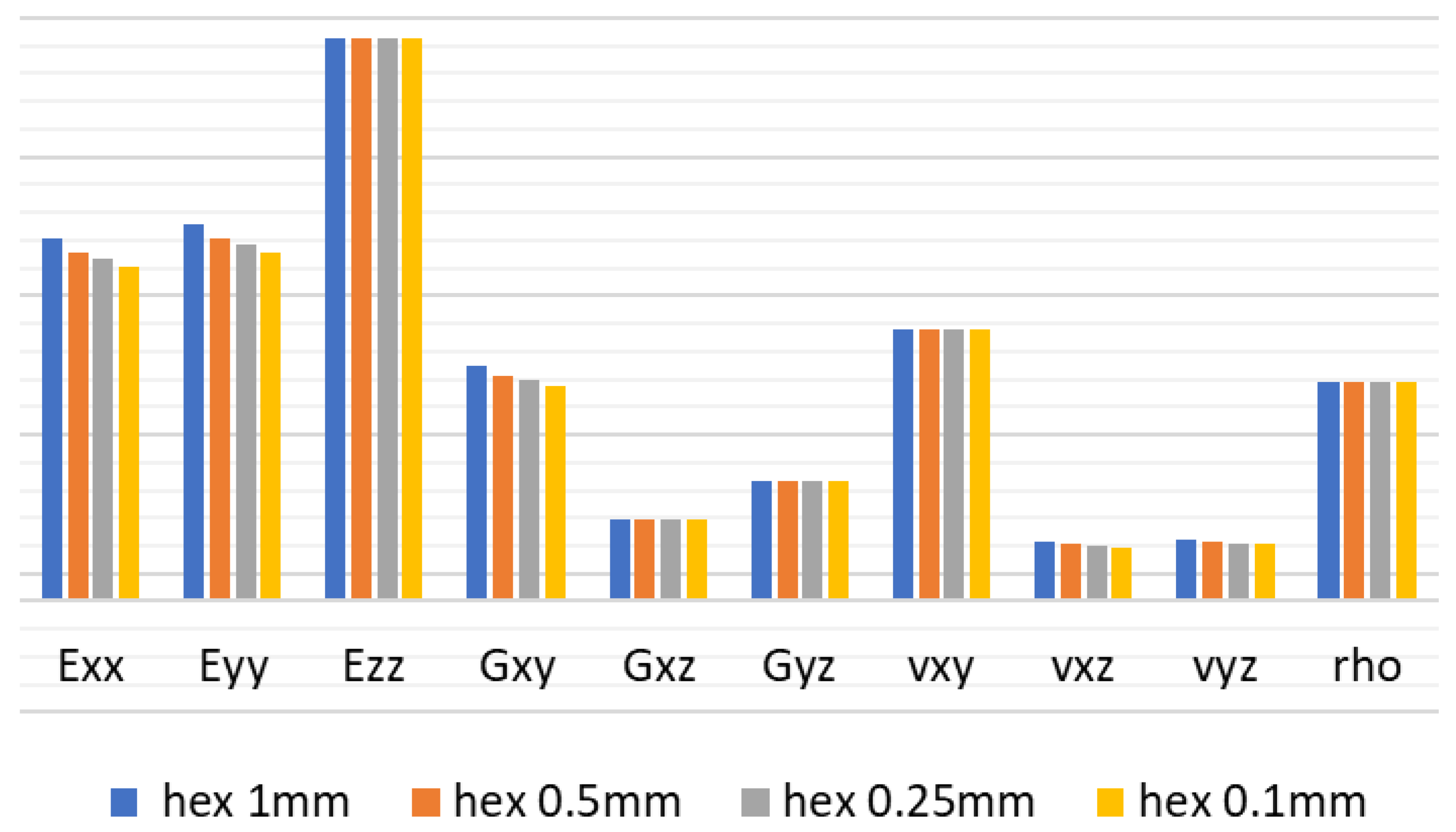
3.5.1. Hexahedral Mesh Convergence Study
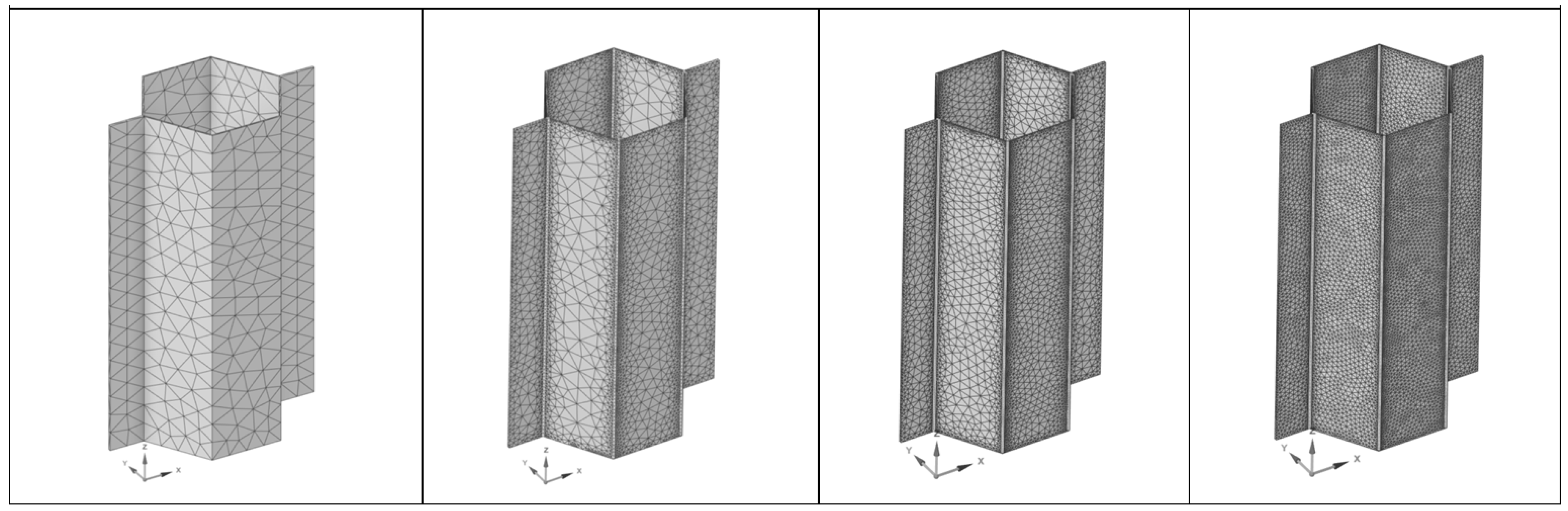
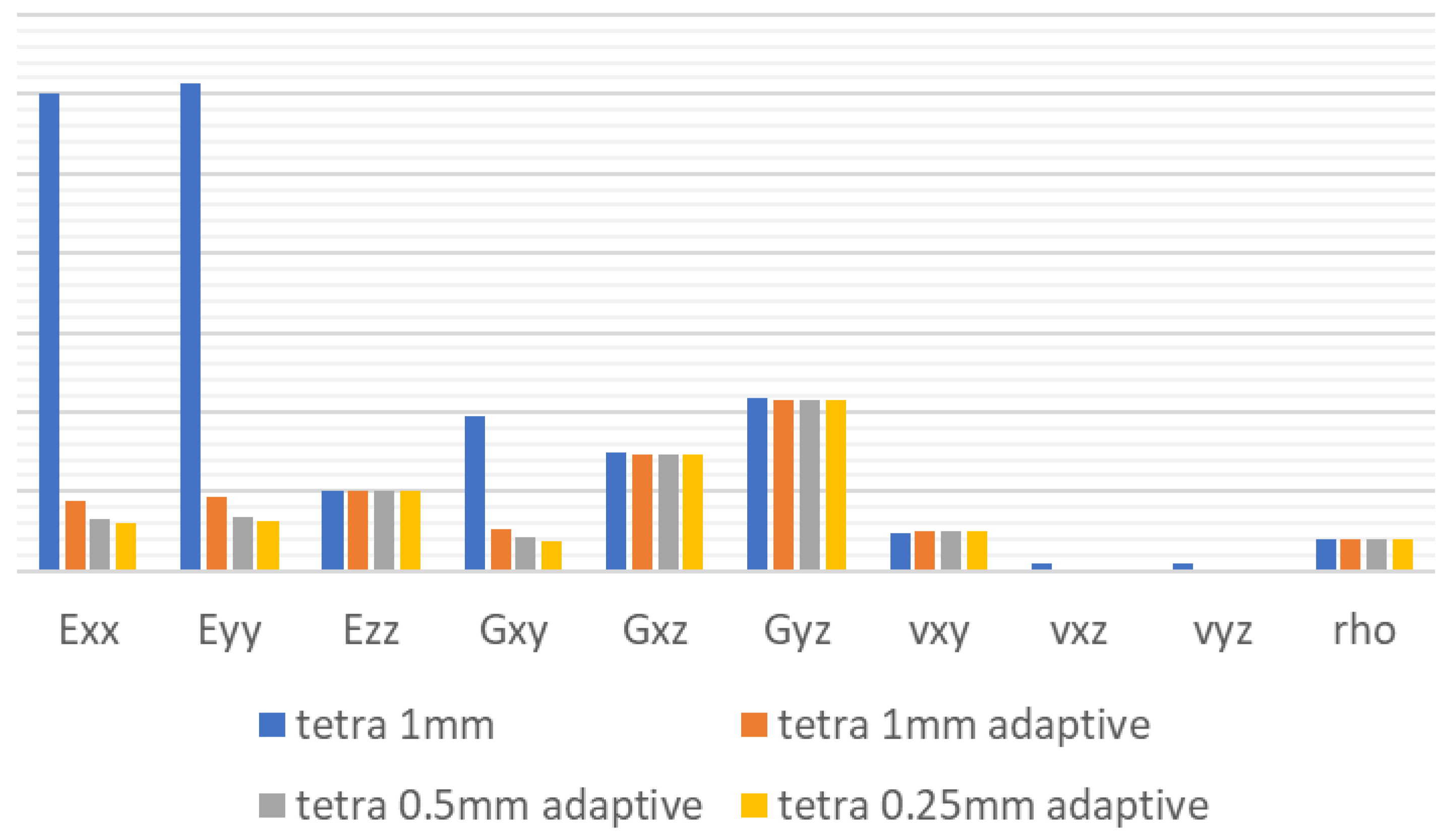
3.5.2. Tetrahedral Mesh Convergence Study
- Analytical vs. Material Designer calculations for the orthotropic properties of a honeycomb core show significant differences.
- Differences are also visible between Material Designer calculation itself, depending on the mesh type selected and refinement level.
- Hexahedral mesh proves more accurate than tetrahedral mesh in comparison to analytical calculations on lower mesh quality levels; however, the difference is non-existent with higher refinement levels.
- Shear in the XY plane (Gxy) provides the highest differences between analytical and material designer calculations, which are significant even after mesh refinement.
- Tetrahedral mesh tends to stiffen the structure significantly when coarse and without adaptive edge setting.
- On the highest level of refinement checked, there is practically no difference in the results between tetrahedral and hexahedral mesh.
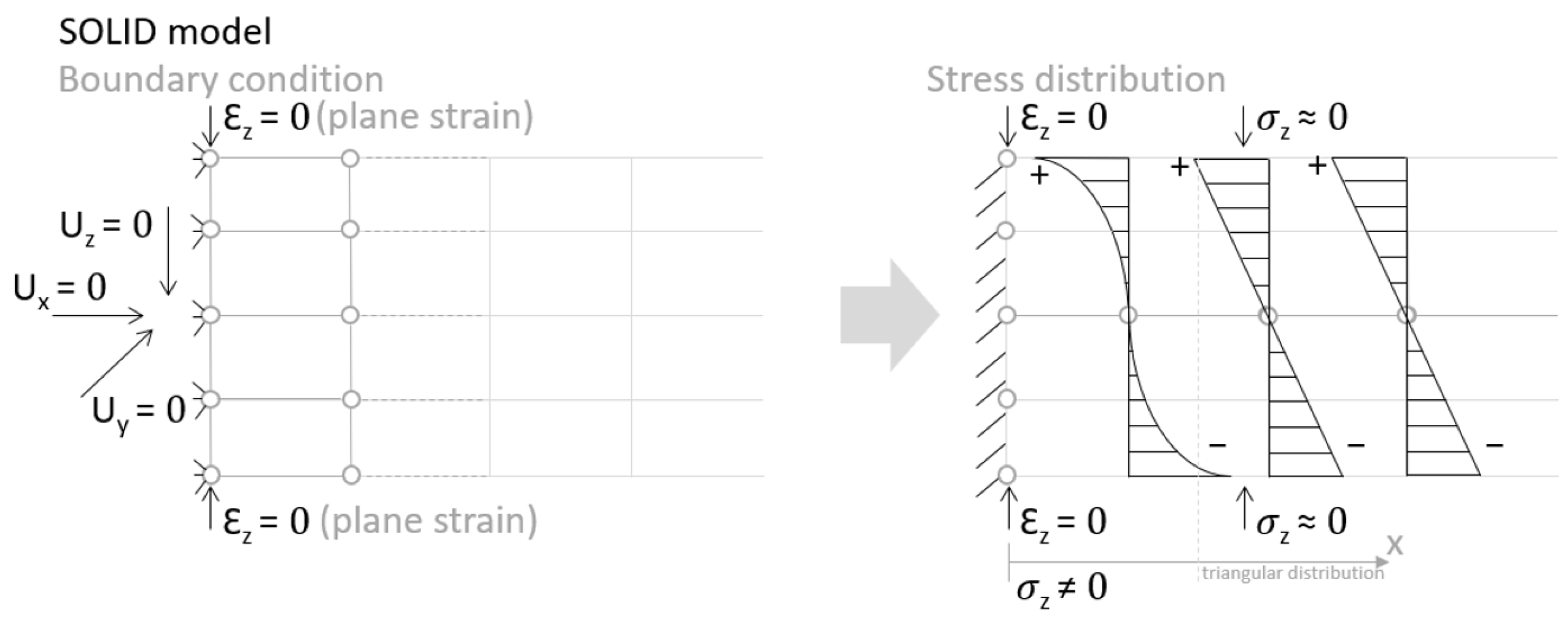
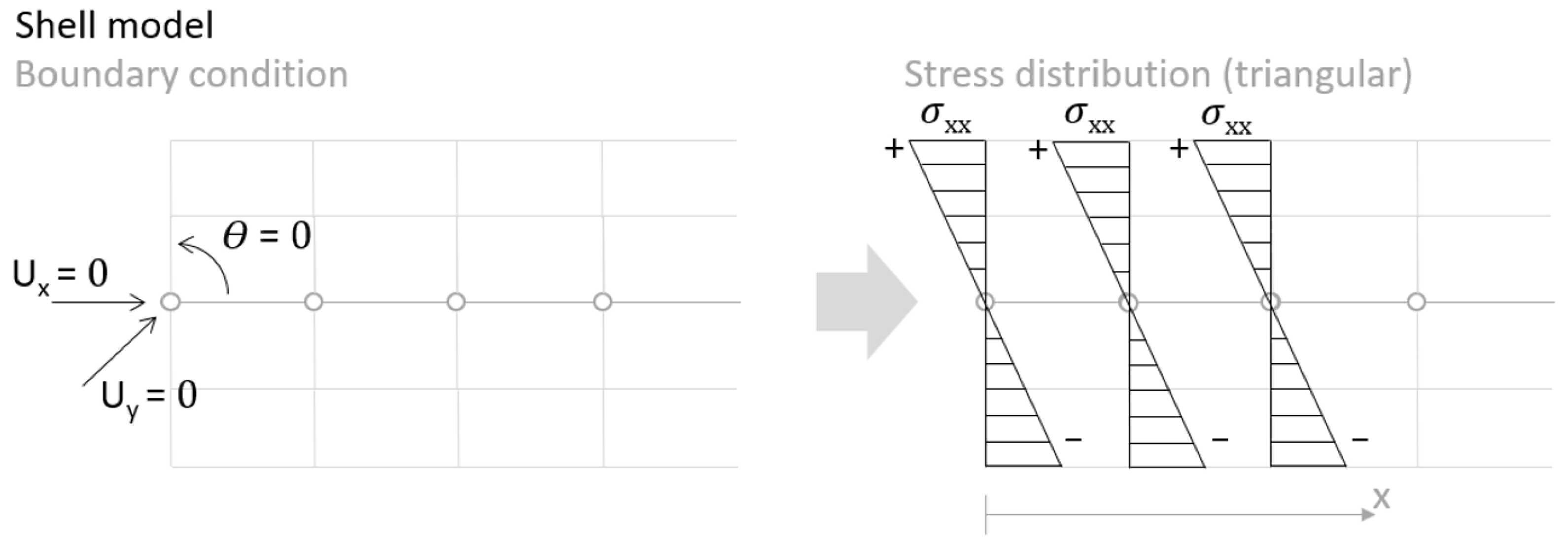
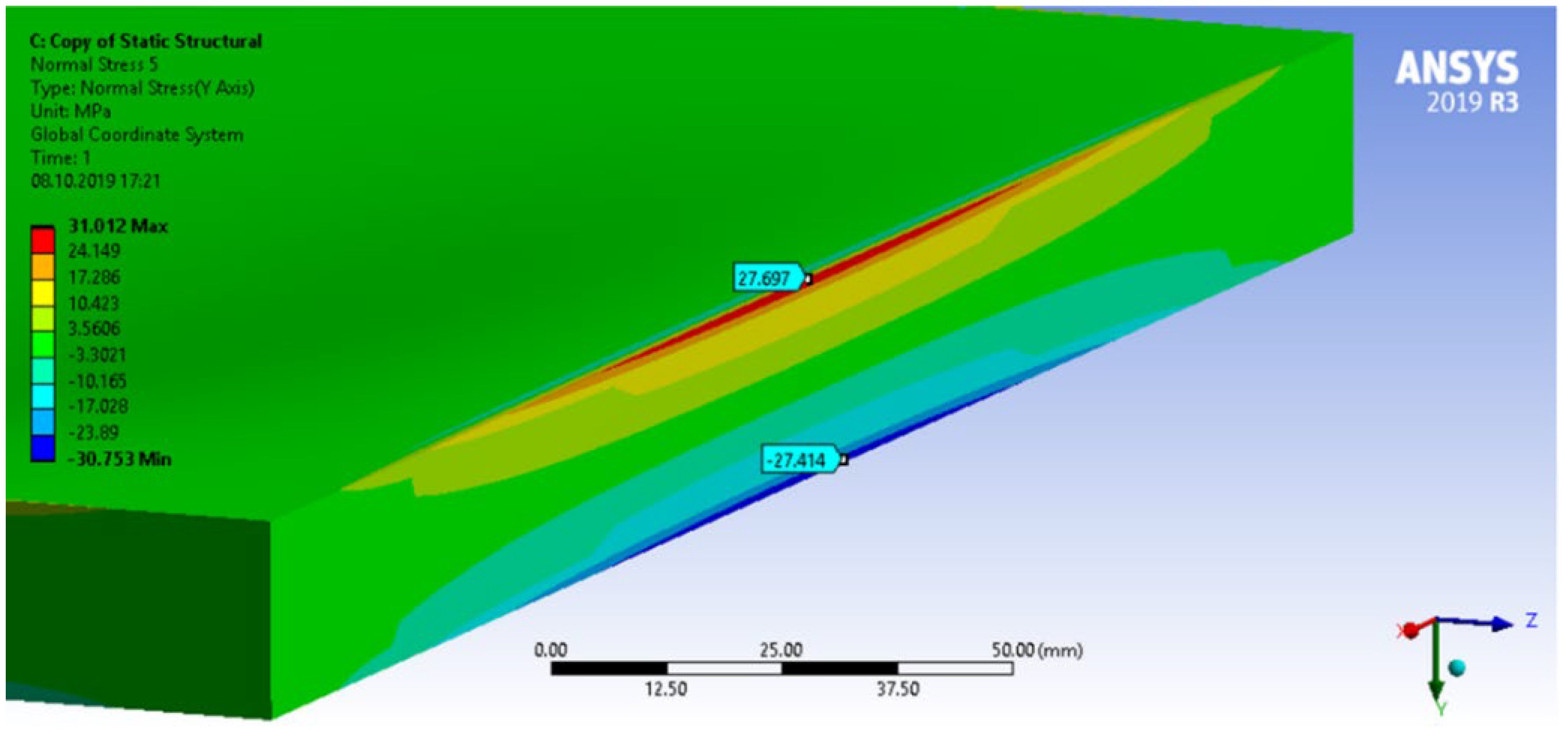
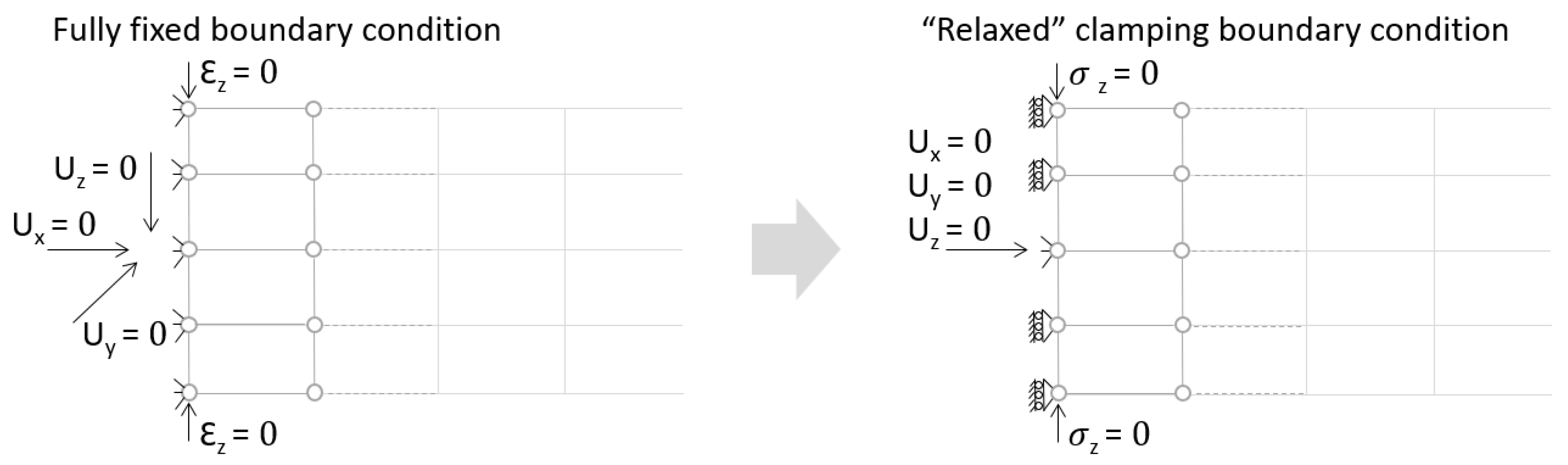
3.6. Boundary Conditions and Its Effect on Results
3.7. Comparison of Proposed Simplification Methods
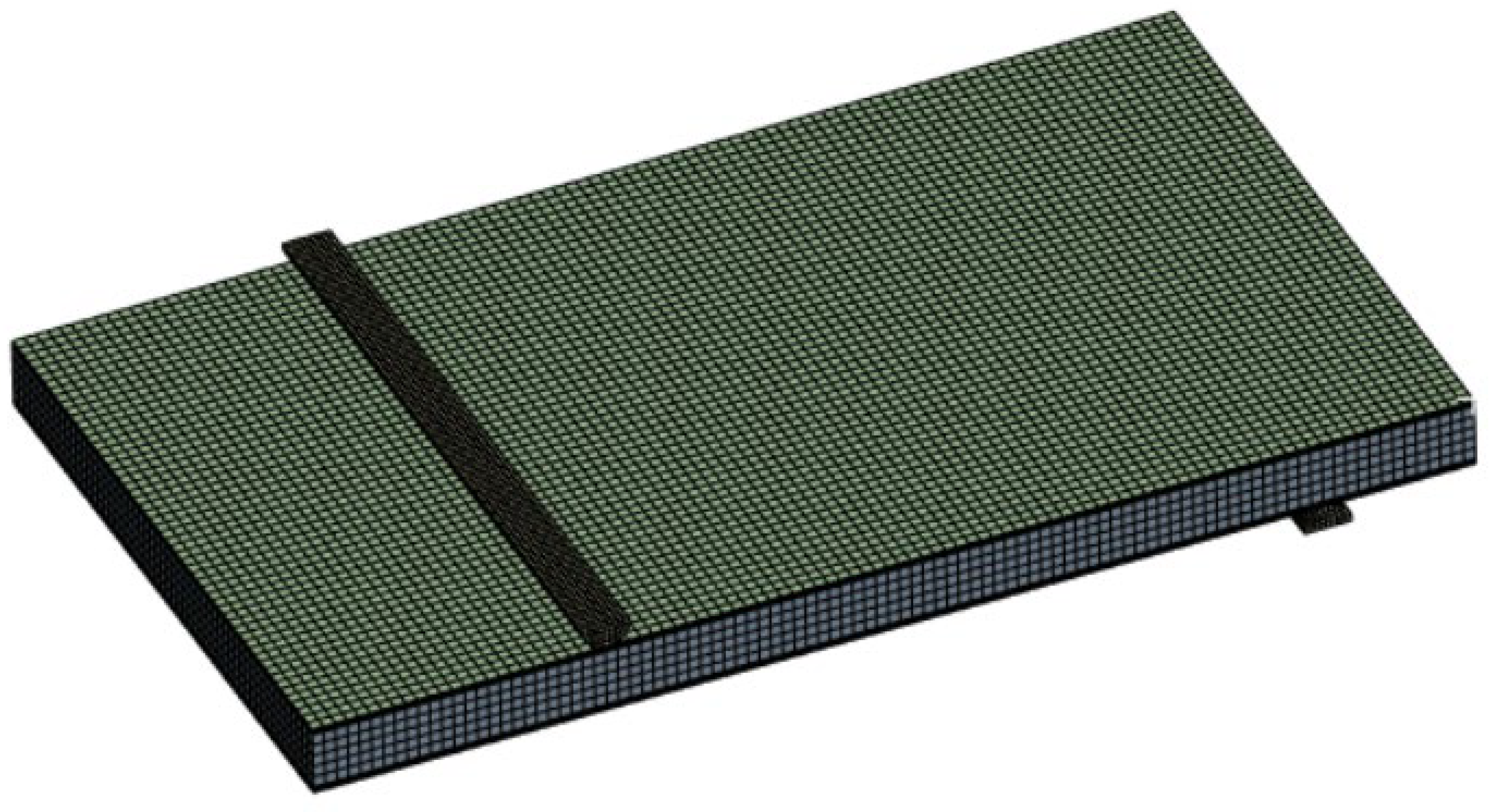
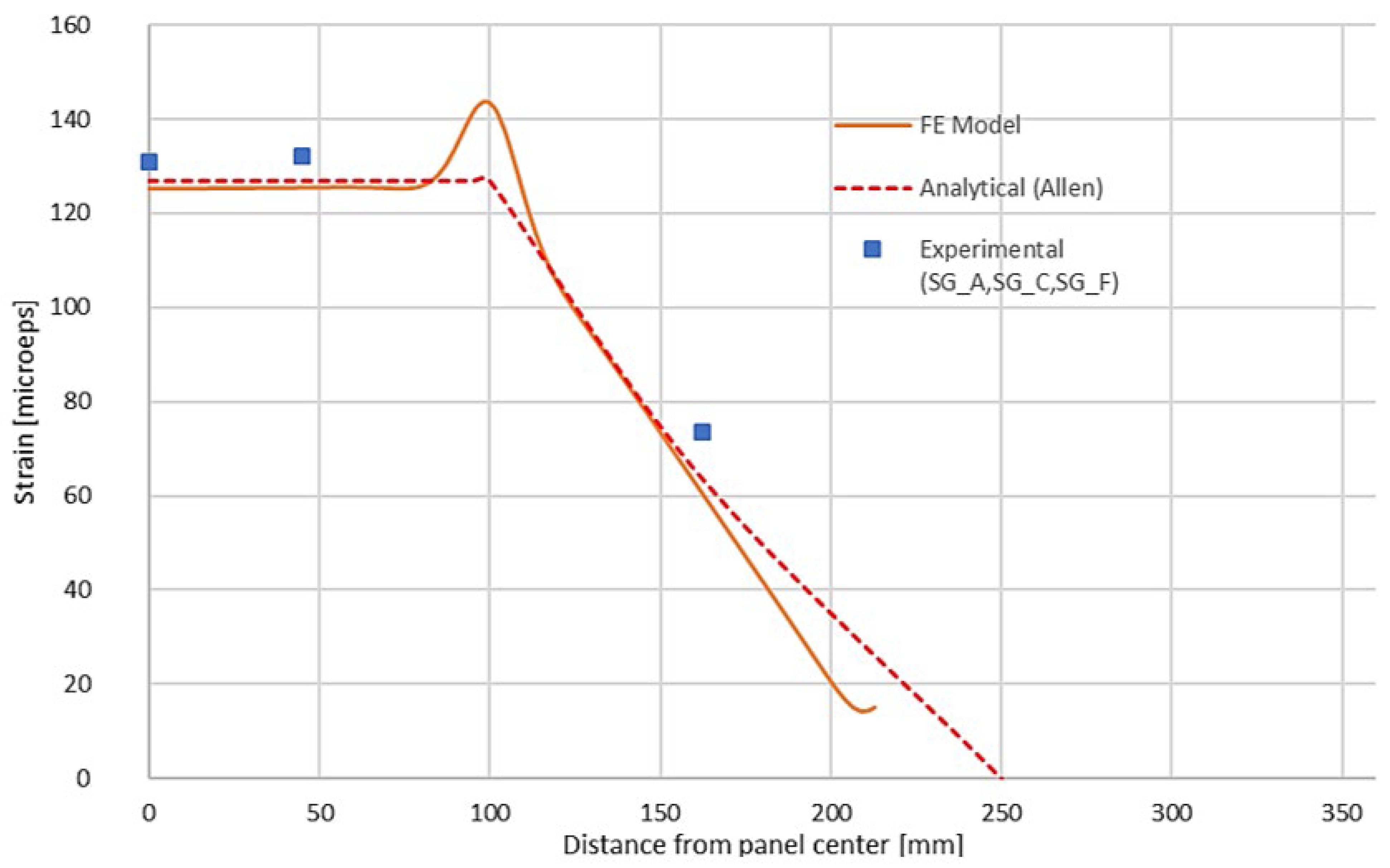
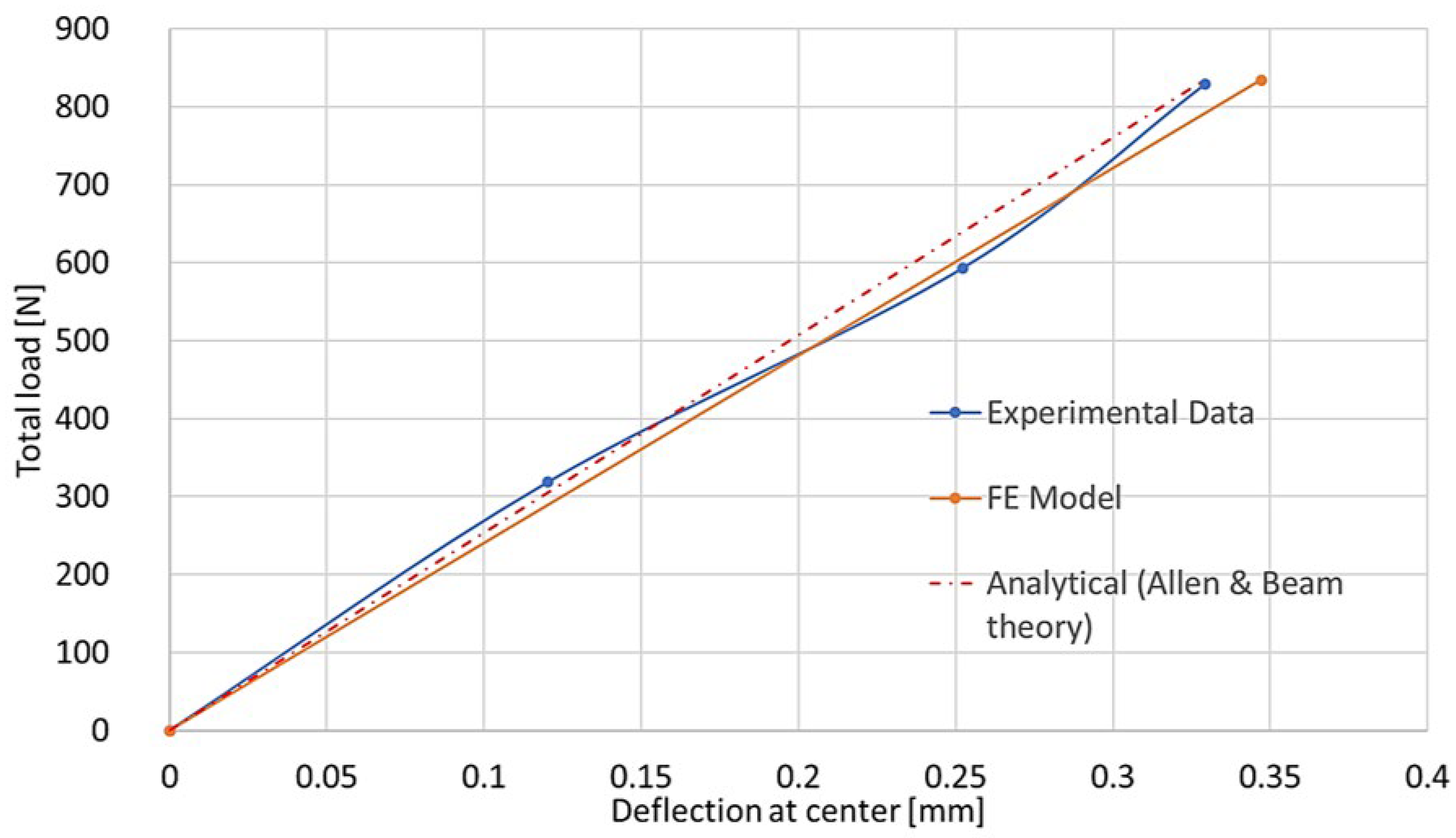
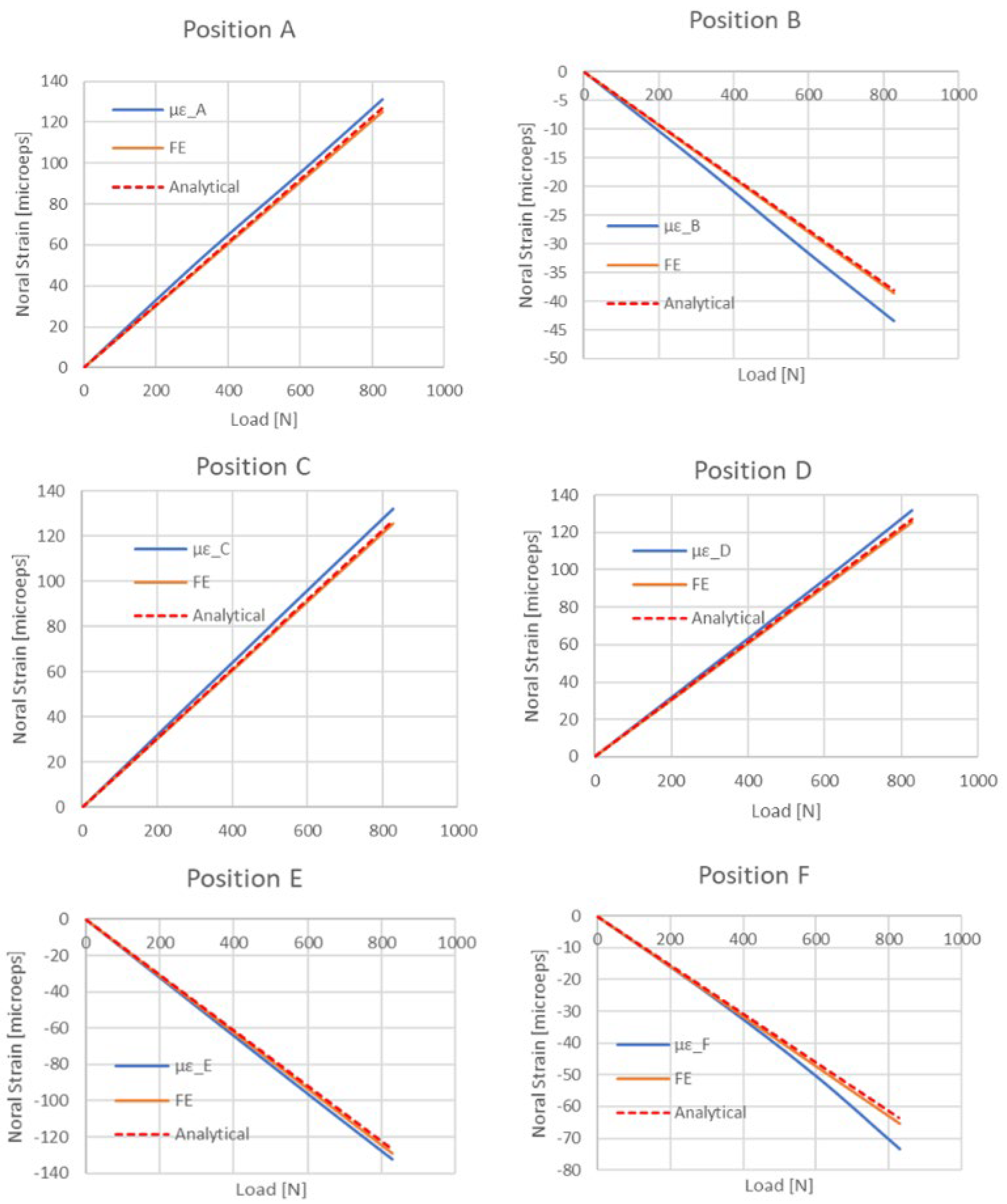
3.8. Verification
3.9. Test Results
4. Discussion
5. Conclusions
- Validate the model, either by testing or comparison with analytical calculation.
- If using tools, e.g., ANSYS Material Designer®, clearly define and comprehend the input parameters required: material properties, geometric dimensions, and boundary conditions.
- For most approaches, the best method of modeling will be through the use of orthotropic material properties on homogeneous bodies—solids (easy to model, fast, accurate, allows us to extract forces between skins and core).
- Sufficiently small mesh of either hexahedral or tetrahedral elements with quadratic formulation will provide accurate results.
- For analysis, use “relaxed” boundary conditions (refer to chapter 5 for details) or try to set them as close as possible to the real ones.
Author Contributions
Funding
Institutional Review Board Statement
Informed Consent Statement
Data Availability Statement
Conflicts of Interest
References
- Dowling, N.E. Honeycomb Sandwich Structures for Aerospace Applications. In Handbook of Composites; Chapman & Hall: Boca Raton, FL, USA, 1997. [Google Scholar]
- Sahib, M.M.; Kovács, G.; Szávai, S. Weight Optimization of All-Composite Sandwich Structures for Automotive Applications. In Vehicle and Automotive Engineering 4; Jármai, K., Cservenák, Á., Eds.; VAE 2022; Lecture Notes in Mechanical Engineering; Springer: Cham, Switzerland, 2023. [Google Scholar]
- Palomba, G.; Epasto, G.; Sutherland, L.; Crupi, V. Aluminium honeycomb sandwich as a design alternative for lightweight marine structures. Ships Offshore Struct. 2021, 17, 2355–2366. [Google Scholar] [CrossRef]
- Lestari, W.; Qiao, P. Dynamic characteristics and effective stiffness properties of honeycomb composite sandwich structures for highway bridge applications. J. Compos. Constr. 2006, 10, 148–160. [Google Scholar] [CrossRef]
- Smardzewski, J.; Kramski, D. Modelling stiffness of furniture manufactured from honeycomb panels depending on changing climate conditions. Thin-Walled Struct. 2019, 137, 295–302. [Google Scholar] [CrossRef]
- Silberschmidt, V.V. Honeycomb Structures for Industrial Applications: Recent Advances and Future Directions. Int. J. Appl. Ceram. Technol. 2021, 18, 1235–1249. [Google Scholar]
- Dung, L.; Tien, D.; Minh, D. Numerical simulation for the honeycomb core sandwich panels in bending by homogenization method. Int. J. Mech. 2021, 15, 88–94. [Google Scholar] [CrossRef]
- Ali, A.; Arhore, E.; Ghasemnejad, H.; Yasaee, M. Experimental and numerical investigation of multi-layered honeycomb sandwich composites for impact mechanics applications. Results Eng. 2024, 21, 101817. [Google Scholar] [CrossRef]
- Buitrago, B.L.; Santiuste, C.; Sánchez-Sáez, S.; Barbero, E.; Navarro, C. Modelling of composite sandwich structures with honeycomb core subjected to high-velocity impact. Compos. Struct. 2010, 92, 2090–2096. [Google Scholar] [CrossRef]
- Kouznetsova, V. Computational Homogenization for the Multi-Scale Analysis of Multi-Phase Materials. Ph.D. Thesis, Technische Universiteit Eindhoven, Eindhoven, The Netherlands, January 2002. [Google Scholar]
- Carrera, E.; Valvano, S.; Filippi, A.; Petrolo, M.; Augello, R.; De Pasqualis, F.C.; Minerva, M.A.; Pellegrino, D.; Varello, P. A review of numerical modeling of honeycomb structures and materials. Compos. Struct. 2017, 178, 288–298. [Google Scholar]
- Tymoshenko, S. Theory of Plates and Shells; McGraw-Hill Book Company: New York, NY, USA, 1959. [Google Scholar]
- Allen, H. Analysis and Design of Structural Sandwich Panels; Pergamon Press: Oxford, UK, 1969. [Google Scholar]
- Gilioli, A.; Sbarufatti, C.; Manes, A.; Giglio, M. Compression after impact test (CAI) on NOMEX (TM) honeycomb sandwich panels with thin aluminum skins. Compos. Part B Eng. 2014, 67, 313–325. [Google Scholar] [CrossRef]
- Chang, B.; Wang, Z.; Bi, G. Study on the Energy Absorption Characteristics of Different Composite Honeycomb Sandwich Structures under Impact Energy. Appl. Sci. 2024, 14, 2832. [Google Scholar] [CrossRef]
- Ding, H.; Zhu, T.; Wang, X.; Yang, B.; Xiao, S.; Yang, G.; Chen, J. Repeated impact response of honeycomb sandwich panels based on the failure parameters of adhesive layer and material. Mech. Adv. Mater. Struct. 2024, 32, 282–294. [Google Scholar] [CrossRef]
- Sadiq, S.E.; Bakhy, S.H.; Jweeg, M.J. Optimum vibration characteristics for honeycomb sandwich panel used in aircraft structure. J. Eng. Sci. Technol. 2021, 16, 1463–1479. [Google Scholar]
- Aumjaud, P. Vibration Damping of Lightweight Sandwich Structures; University of Exeter: Exeter, UK, 2015. [Google Scholar]
- ANSYS User’s Guide; Release 22.2; ANSYS, Inc.: Canonsburg, PA, USA, 2023.
- Sorohan, S.; Sandu, M.; Constantinescu, D.M.; Sandu, A.G. On the evaluation of mechanical properties of honeycombs by using finite element analyses. Incas Bull. 2015, 7, 33–49. [Google Scholar]
- Sather, E.; Krishnamurthy, T. An Analytical Method to Calculate Effective Elastic Properties of General Multifunctional Honeycomb Cores in Sandwich Composites; NASA/TM: Washington, DC, USA, 2019.
- D7249/D7249M—12; Standard Test Method for Facing Properties of Sandwich Constructions by Long Beam Flexure. ASTM: West Conshohocken, PA, USA, 2020.



| Unit | Analytical Calculation | Material Designer | Difference [%] | |
|---|---|---|---|---|
| Exx | MPa | 1.14 | 1.202 | −4.8% |
| Eyy | MPa | 1.15 | 1.253 | −8.6% |
| Ezz | MPa | 2045 | 2024 | 1.0% |
| Gxy | MPa | 0.344 | 0.773 | −55.5% |
| Gxz | MPa | 295 | 294 | 0.2% |
| Gyz | MPa | 295 | 430 | −31.4% |
| vxy | - | 0.999 | 0.978 | 2.2% |
| vxz | - | 0.0002 | 0.0002 | 0% |
| vyz | - | 0.0002 | 0.0002 | 0% |
| rho | kg m−3 | 79.77 | 78.96 | 1.0% |
| Unit | Analytical | Hex 1 mm | Hex 0.5 mm | 0.25 mm | Hex 0.1 mm | |||||
|---|---|---|---|---|---|---|---|---|---|---|
| Exx | MPa | 1.14 | 1.31 | 14% | 1.26 | 10% | 1.23 | 8% | 1.20 | 5% |
| Eyy | MPa | 1.15 | 1.36 | 19% | 1.31 | 14% | 1.28 | 12% | 1.25 | 9% |
| Ezz | MPa | 2045 | 2024 | −1% | 2024 | −1% | 2024 | −1% | 2024 | −1% |
| Gxy | MPa | 0.34 | 0.85 | 146% | 0.81 | 135% | 0.79 | 131% | 0.77 | 125% |
| Gxz | MPa | 295 | 294 | 0% | 294 | 0% | 294 | 0% | 294 | 0% |
| Gyz | MPa | 295 | 430 | 46% | 430 | 46% | 430 | 46% | 430 | 46% |
| vxy | - | 0.9993 | 0.9783 | −2% | 0.9781 | −2% | 0.9781 | −2% | 0.9781 | −2% |
| vxz | - | 0.0002 | 0.0002 | 15% | 0.0002 | 11% | 0.0002 | 8% | 0.0002 | 6% |
| vyz | - | 0.0002 | 0.0002 | 20% | 0.0002 | 15% | 0.0002 | 13% | 0.0002 | 10% |
| rho | kg m−3 | 79.77 | 78.96 | −1% | 78.96 | −1% | 78.96 | −1% | 78.96 | −1% |
| Unit | Analytical | Tetra 1 mm | Tetra 1 mm Adaptive | Tetra 0.5 mm Adaptive | Tetra 0.25 mm Adaptive | |||||
|---|---|---|---|---|---|---|---|---|---|---|
| Exx | MPa | 1.14 | 12.00 | 948% | 1.79 | 56% | 1.32 | 16% | 1.19 | 4% |
| Eyy | MPa | 1.15 | 12.29 | 973% | 1.86 | 63% | 1.38 | 21% | 1.25 | 9% |
| Ezz | MPa | 2045 | 2024 | −1% | 2024 | −1% | 2024 | −1% | 2024 | −1% |
| Gxy | MPa | 0.34 | 3.90 | 1033% | 1.05 | 206% | 0.84 | 143% | 0.77 | 124% |
| Gxz | MPa | 295 | 298 | 1% | 294 | 0% | 294 | 0% | 294 | 0% |
| Gyz | MPa | 295 | 437 | 48% | 430 | 46% | 429 | 46% | 429 | 46% |
| vxy | - | 0.9993 | 0.9752 | −2% | 0.9778 | −2% | 0.9780 | −2% | 0.9780 | −2% |
| vxz | - | 0.0002 | 0.0020 | 957% | 0.0003 | 58% | 0.0002 | 17% | 0.0002 | 5% |
| vyz | - | 0.0002 | 0.0020 | 983% | 0.0003 | 64% | 0.0002 | 22% | 0.0002 | 10% |
| rho | kg m−3 | 79.77 | 78.96 | −1% | 78.96 | −1% | 78.96 | −1% | 78.96 | −1% |
| L1 | L2 | L3 |
|---|---|---|
| Computing time | ||
| 48 s | 22 s (54% decrease) | 9 s (81% decrease) |
| Deflection distribution | ||
 |  |  |
| Uzmax = 0.22 mm | Uzmax = 0.22 | Uzmax = 0.20 |
| Stress (von-Mises) −Core | ||
| σmax = 257 | σmax = 5.6 | σmax = 5.3 |
 |  |  |
| Stress (von-Mises) −Face-sheets | ||
| σmax = 162 | σmax = 169 | σmax = 52 |
 |  |  |
| Stress—Normal X—Path through the middle | ||
 |  |  |
 |  |  |
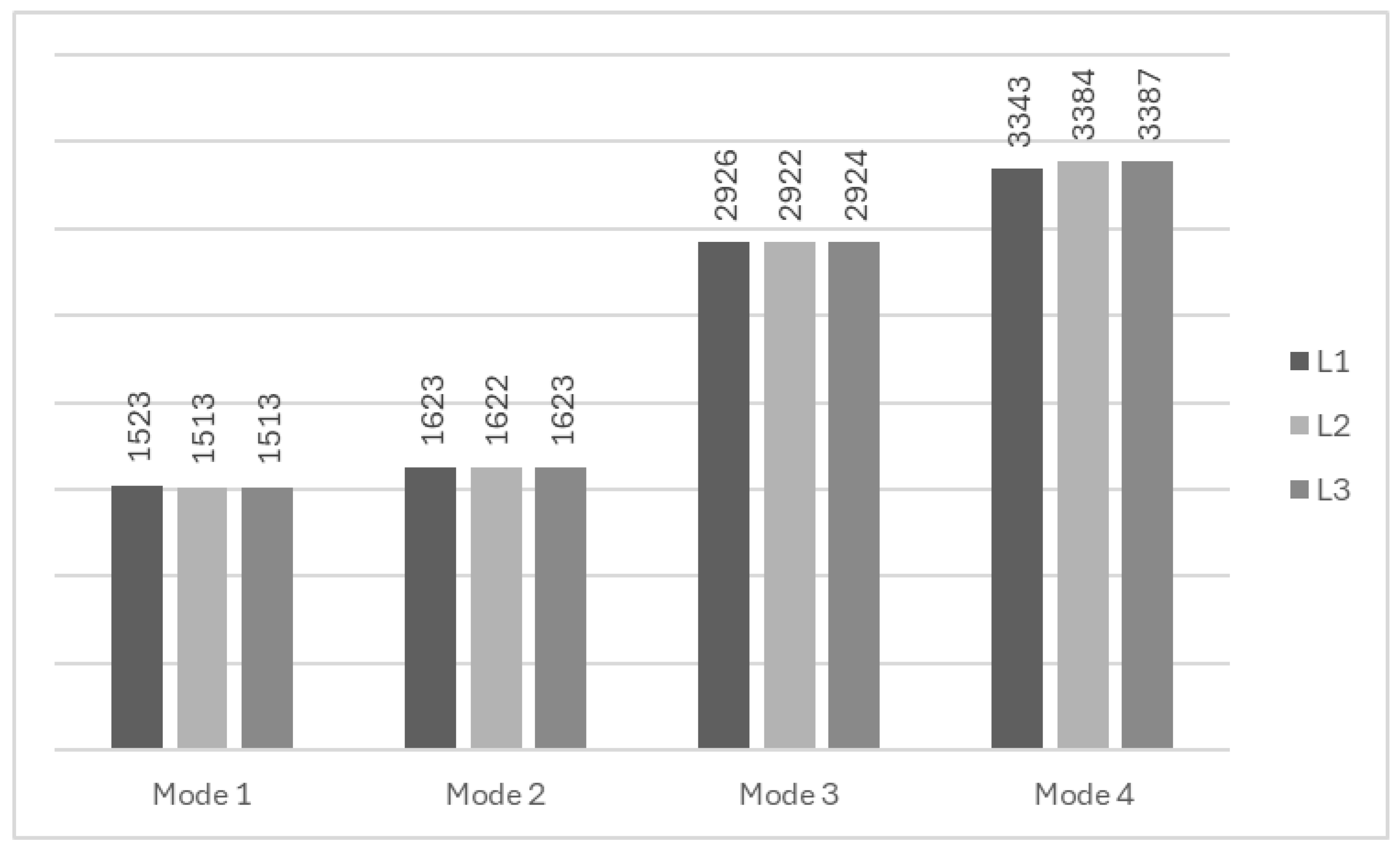
| L1 | L2 | L3 |
|---|---|---|
| Mode 1 | ||
 |  |  |
| Mode 2 | ||
 |  |  |
| Mode 3 | ||
 |  |  |
| Mode 4 | ||
 |  |  |
Disclaimer/Publisher’s Note: The statements, opinions and data contained in all publications are solely those of the individual author(s) and contributor(s) and not of MDPI and/or the editor(s). MDPI and/or the editor(s) disclaim responsibility for any injury to people or property resulting from any ideas, methods, instructions or products referred to in the content. |
© 2025 by the authors. Licensee MDPI, Basel, Switzerland. This article is an open access article distributed under the terms and conditions of the Creative Commons Attribution (CC BY) license (https://creativecommons.org/licenses/by/4.0/).
Share and Cite
Michalski, Ł.; Kubiak, T.; De Mercato, L. Homogenization Method for Modeling and Analysis of the Honeycomb Structure—Simulation Study and Validation. Materials 2025, 18, 3884. https://doi.org/10.3390/ma18163884
Michalski Ł, Kubiak T, De Mercato L. Homogenization Method for Modeling and Analysis of the Honeycomb Structure—Simulation Study and Validation. Materials. 2025; 18(16):3884. https://doi.org/10.3390/ma18163884
Chicago/Turabian StyleMichalski, Łukasz, Tomasz Kubiak, and Luigi De Mercato. 2025. "Homogenization Method for Modeling and Analysis of the Honeycomb Structure—Simulation Study and Validation" Materials 18, no. 16: 3884. https://doi.org/10.3390/ma18163884
APA StyleMichalski, Ł., Kubiak, T., & De Mercato, L. (2025). Homogenization Method for Modeling and Analysis of the Honeycomb Structure—Simulation Study and Validation. Materials, 18(16), 3884. https://doi.org/10.3390/ma18163884