Article

A Simulation Study on Sieving as a Powder Deposition Method in Powder Bed Fusion Processes

by
Panagiotis Avrampos
* and
George-Christopher Vosniakos
*
Manufacturing Technology Laboratory, School of Mechanical Engineering, National Technical University of Athens, Heroon Polytehniou 9, 15773 Athens, Greece
*
Authors to whom correspondence should be addressed.
Materials 2024, 17(14), 3382; https://doi.org/10.3390/ma17143382
Submission received: 13 June 2024 / Revised: 29 June 2024 / Accepted: 4 July 2024 / Published: 9 July 2024
(This article belongs to the Special Issue Modelling and Applications for Additive Manufacturing)

Abstract

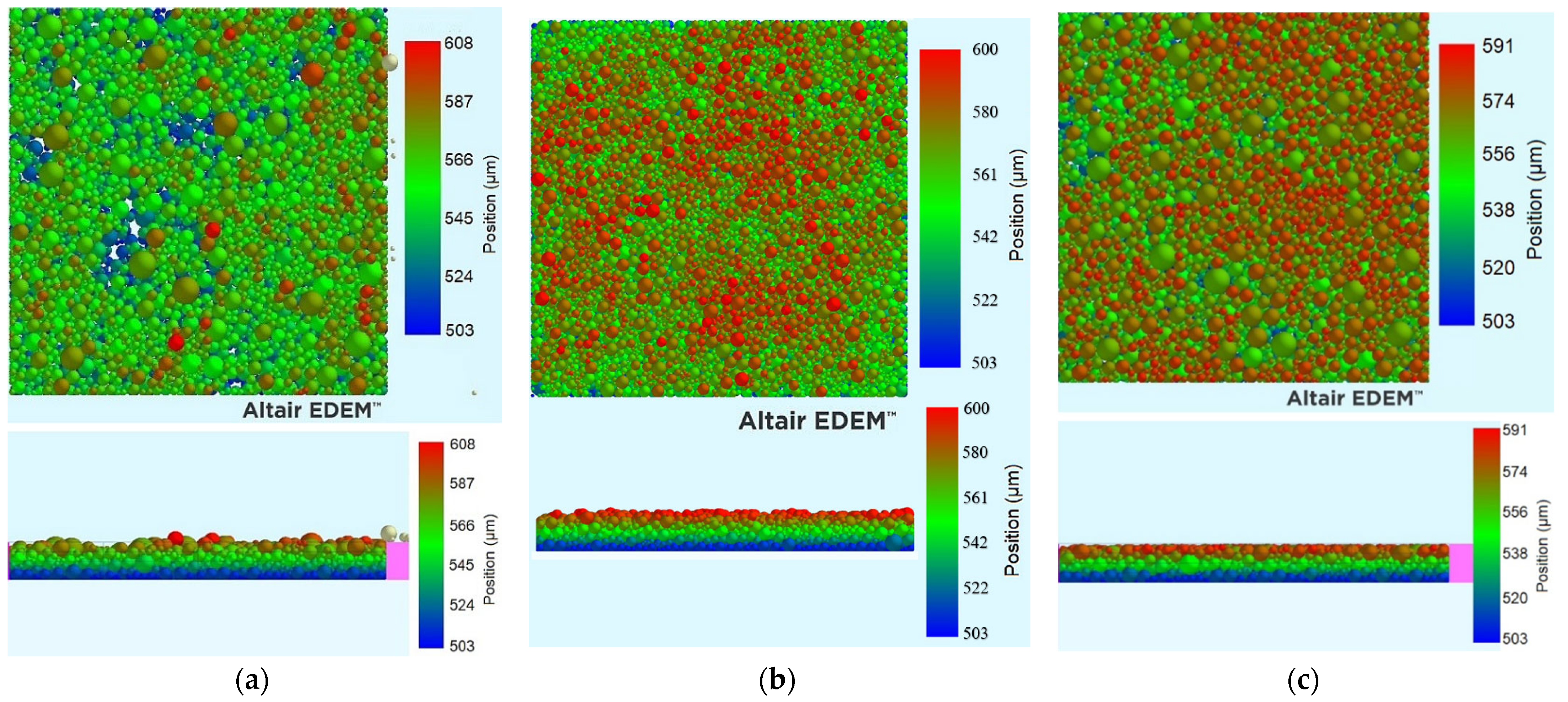
Powder deposition of even and homogeneous layers is a major aspect of every powder bed fusion process. Powder sieving is commonly performed to powder batches outside of the PBF machine, prior to the part manufacturing stage. In this work, sieving is examined as a method of powder deposition rather than a method to solely filter out agglomerates and oversized particles. Initially, a DEM powder model that has been validated experimentally is implemented, and the sieving process is modelled. The sieving process is optimized in order to maximize mass flow, duration of its linear stage and total mass sieved during linearity. For this, a Taguchi design of experiments with subsequent analysis of variance is deployed, proving that the larger the initial powder loaded in the sieve, the larger the sieve stimulation necessary, both in terms of oscillating frequency and amplitude. The sieve’s aperture shape is also evaluated, proving that the more sides the canonical polygon has, the less the mass flow per aperture for the same maximum passing particle size. Then, the quality of the layer produced via controlled sieving is examined via certain layer quality criteria, such as the surface roughness, layer thickness deviation, surface coverage ratio and packing density. The findings prove that controlled sieving can outperform powder deposition via a non-vibrated doctor blade recoater, both in terms of layer surface quality and duration of layer deposition, as proven by surface skewness and kurtosis evaluation.
Keywords: powder sieving; mesh; vibration; discrete element method; layer quality; roughness; surface coverage; layer thickness; packing density powder sieving; mesh; vibration; discrete element method; layer quality; roughness; surface coverage; layer thickness; packing density