Article

Multi-Objective Optimization of Thin-Walled Composite Axisymmetric Structures Using Neural Surrogate Models and Genetic Algorithms

by
Bartosz Miller
and
Leonard Ziemiański
*,†
Faculty of Civil and Environmental Engineering and Architecture, Rzeszow University of Technology, Al. Powstancow Warszawy 12, 35-959 Rzeszow, Poland
*
Author to whom correspondence should be addressed.
These authors contributed equally to this work.
Materials 2023, 16(20), 6794; https://doi.org/10.3390/ma16206794
Submission received: 15 September 2023 / Revised: 16 October 2023 / Accepted: 18 October 2023 / Published: 20 October 2023

Abstract

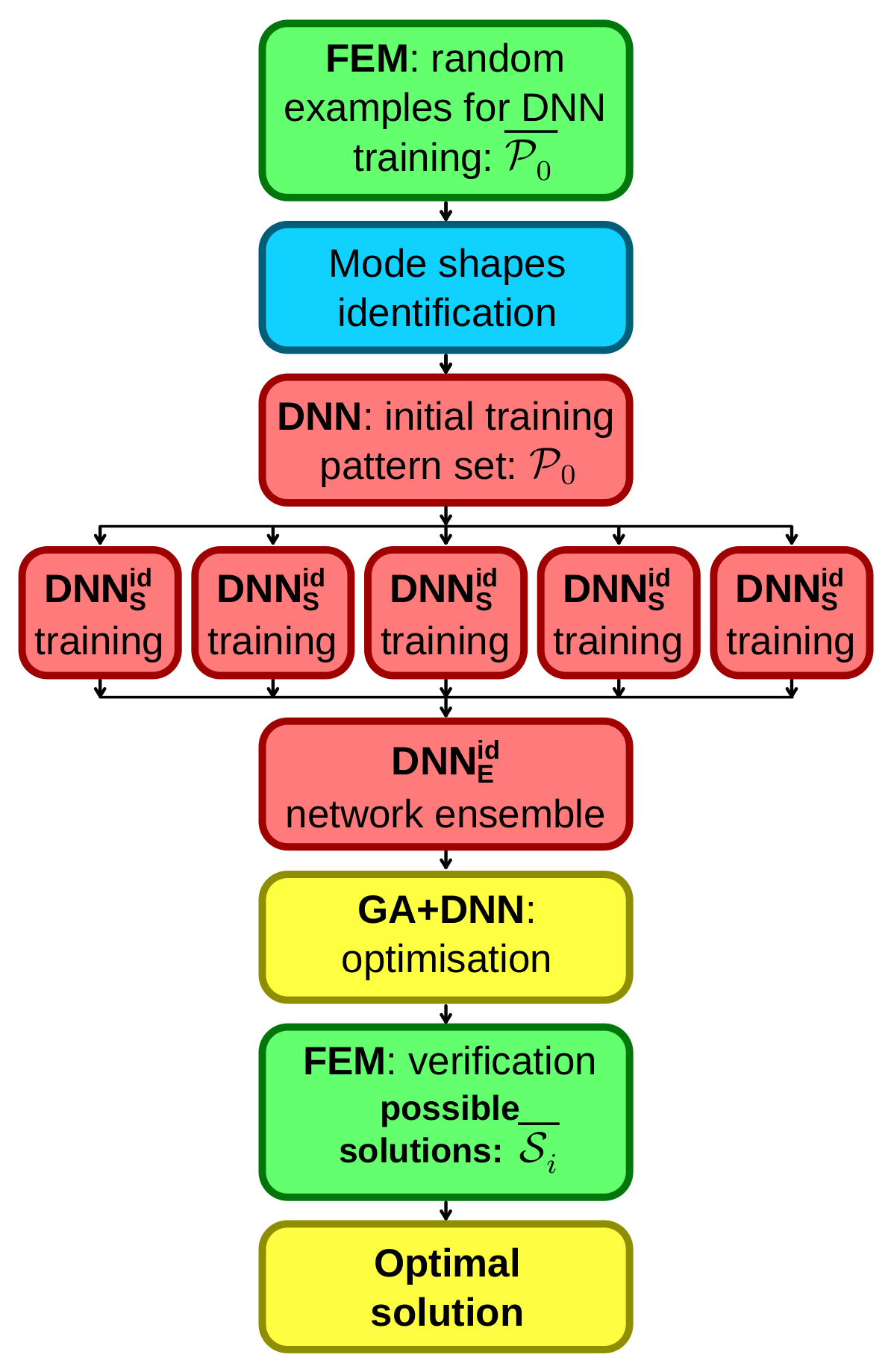
Composite shells find diverse applications across industries due to their high strength-to-weight ratio and tailored properties. Optimizing parameters such as matrix-reinforcement ratio and orientation of the reinforcement is crucial for achieving the desired performance metrics. Stochastic optimization, specifically genetic algorithms, offer solutions, yet their computational intensity hinders widespread use. Surrogate models, employing neural networks, emerge as efficient alternatives by approximating objective functions and bypassing costly computations. This study investigates surrogate models in multi-objective optimization of composite shells. It incorporates deep neural networks to approximate relationships between input parameters and key metrics, enabling exploration of design possibilities. Incorporating mode shape identification enhances accuracy, especially in multi-criteria optimization. Employing network ensembles strengthens reliability by mitigating model weaknesses. Efficiency analysis assesses required computations, managing the trade-off between cost and accuracy. Considering complex input parameters and comparing against the Monte Carlo approach further demonstrates the methodology’s efficacy. This work showcases the successful integration of network ensembles employed as surrogate models and mode shape identification, enhancing multi-objective optimization in engineering applications. The approach’s efficiency in handling intricate designs and enhancing accuracy has broad implications for optimization methodologies.
Keywords: shell; composite; optimization; surrogate model; genetic algorithms; artificial neural networks shell; composite; optimization; surrogate model; genetic algorithms; artificial neural networks