Review

Fire Retardant Phase Change Materials—Recent Developments and Future Perspectives

by
Kinga Pielichowska
1,*,
Natalia Paprota
1 and
Krzysztof Pielichowski
2
1
Department of Biomaterials and Composites, Faculty of Materials Science and Ceramics, AGH University of Science and Technology, Al. Mickiewicza 30, 30-059 Kraków, Poland
2
Department of Chemistry and Technology of Polymers, Faculty of Chemical Engineering and Technology, Cracow University of Technology, ul. Warszawska 24, 31-155 Kraków, Poland
*
Author to whom correspondence should be addressed.
Materials 2023, 16(12), 4391; https://doi.org/10.3390/ma16124391
Submission received: 30 April 2023 / Revised: 3 June 2023 / Accepted: 9 June 2023 / Published: 14 June 2023
(This article belongs to the Section Energy Materials)

Abstract

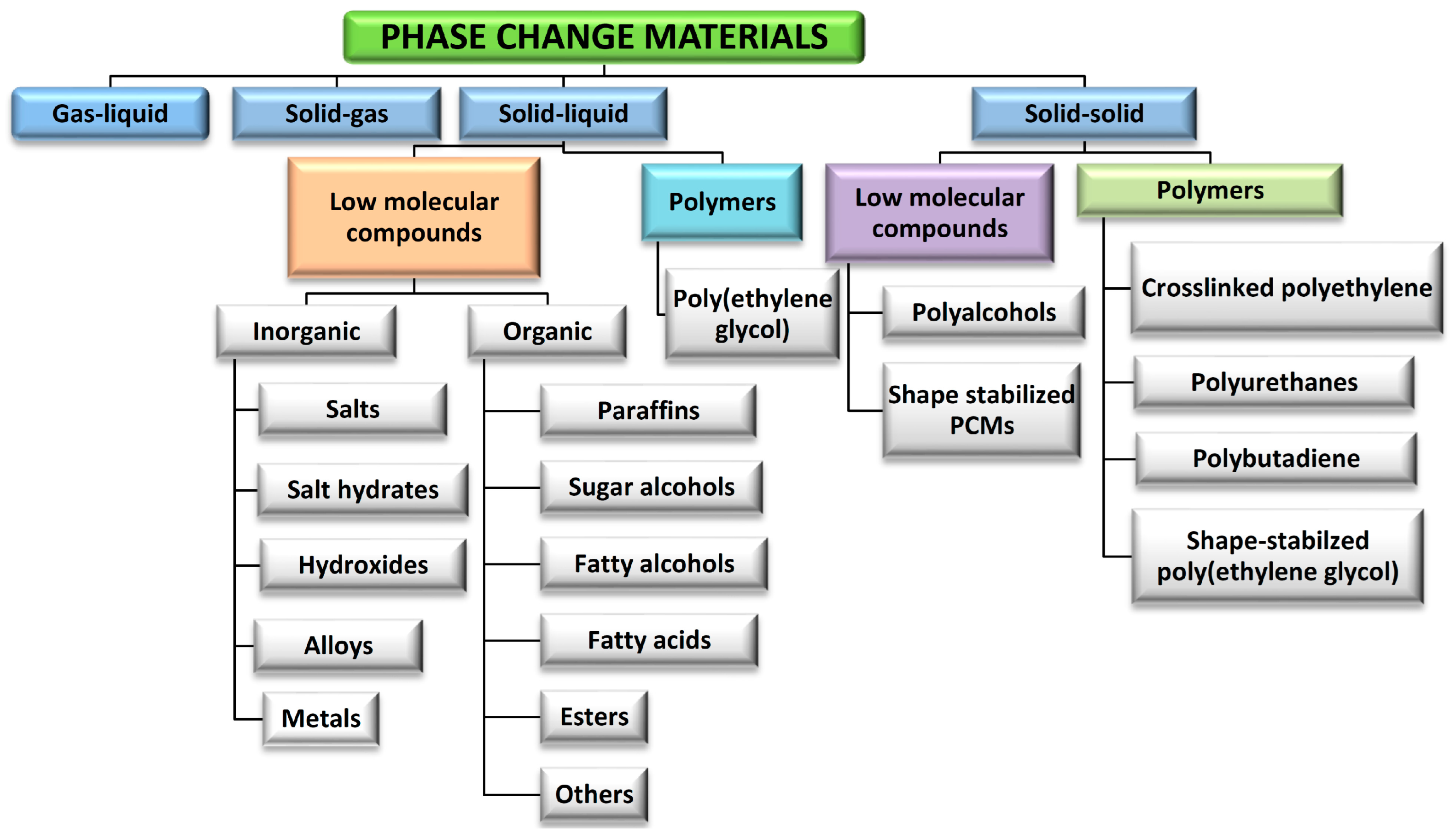
The accumulation of thermal energy in the form of latent heat of phase transition using phase change materials (PCMs) is one of the most attractive and studied research areas with huge application potential in both passive and active technical systems. The largest and most important group of PCMs for low-temperature applications are organic PCMs, mainly paraffins, fatty acids, fatty alcohols, and polymers. One of the major disadvantages of organic PCMs is their flammability. In many applications such as building, battery thermal management, and protective insulations, the crucial task is to reduce the fire risk of flammable PCMs. In the last decade, numerous research works have been performed to reduce the flammability of organic PCMs, without losing their thermal performance. In this review, the main groups of flame retardants, PCMs flame retardation methods as well as examples of flame-retarded PCMs and their application areas were described.
Keywords: phase change materials; flammability; paraffins; fatty acids; poly(ethylene glycol); battery thermal management phase change materials; flammability; paraffins; fatty acids; poly(ethylene glycol); battery thermal management