Review

Perspectives on Nanomaterials and Nanotechnology for Sustainable Bioenergy Generation

by
Kalaimani Markandan
1,* and
Wai Siong Chai
2,*
1
Department of Chemical & Petroleum Engineering, Faculty of Engineering, Technology and Built Environment, UCSI University, Kuala Lumpur 56000, Malaysia
2
Department of Mechanical and Electro-Mechanical Engineering, National Sun Yat-sen University, Kaohsiung 80424, Taiwan
*
Authors to whom correspondence should be addressed.
Materials 2022, 15(21), 7769; https://doi.org/10.3390/ma15217769
Submission received: 18 September 2022 / Revised: 22 October 2022 / Accepted: 27 October 2022 / Published: 3 November 2022
(This article belongs to the Special Issue Technology and Applications of Green Energy-Based Materials)

Abstract

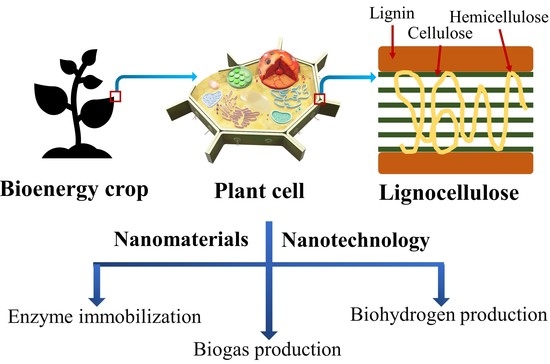
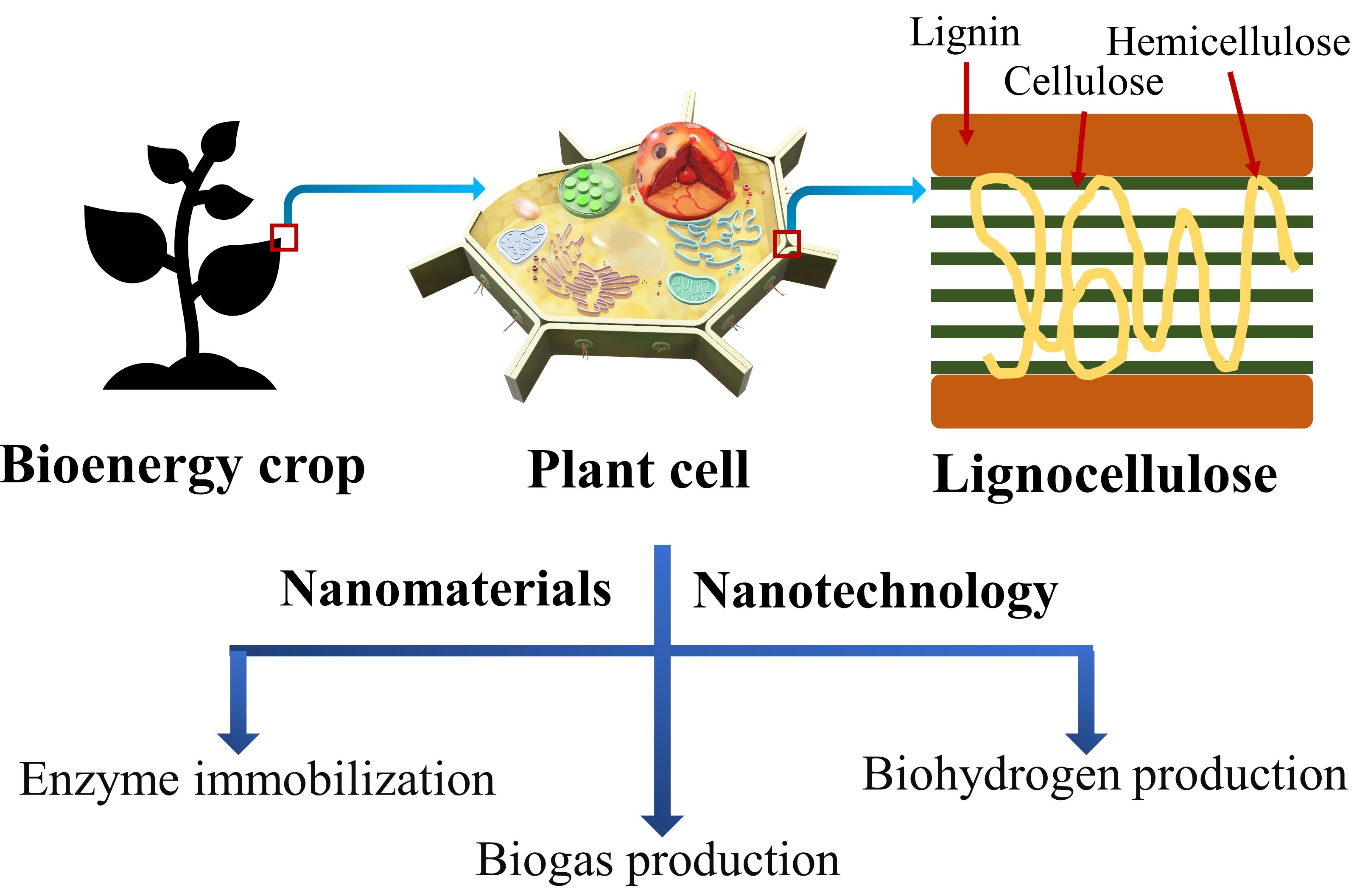
The issue of global warming calls for a greener energy production approach. To this end, bioenergy has significant greenhouse gas mitigation potential, since it makes use of biological products/wastes and can efficiently counter carbon dioxide emission. However, technologies for biomass processing remain limited due to the structure of biomass and difficulties such as high processing cost, development of harmful inhibitors and detoxification of produced inhibitors that hinder widespread usage. Additionally, cellulose pre-treatment is often required to be amenable for an enzymatic hydrolysis process. Nanotechnology (usage of nanomaterials, in this case) has been employed in recent years to improve bioenergy generation, especially in terms of catalyst and feedstock modification. This review starts with introducing the potential nanomaterials in bioenergy generation such as carbon nanotubes, metal oxides, silica and other novel materials. The role of nanotechnology to assist in bioenergy generation is discussed, particularly from the aspects of enzyme immobilization, biogas production and biohydrogen production. Future applications using nanotechnology to assist in bioenergy generation are also prospected.
Keywords: nanomaterials; bioenergy generation; enzyme immobilization; biohydrogen; biogas; nanotechnology nanomaterials; bioenergy generation; enzyme immobilization; biohydrogen; biogas; nanotechnology
Graphical Abstract