Co-Sensitization Effects of Indoline and Carbazole Dyes in Solar Cells and Their Neutral–Anion Equilibrium in Solution


Abstract
1. Introduction
2. Materials and Methods
2.1. Preparation of the Solar Cells
2.2. MK2 and D205 Solutions Studies
3. Results and Discussion
3.1. Co-Sensitization of the Dyes in the Cells
3.2. Solvatochromic Studies and Anionic Forms of the Dyes
3.3. Theoretical Studies and Anionic Forms of the Dyes
4. Conclusions
Supplementary Materials
Author Contributions
Funding
Institutional Review Board Statement
Informed Consent Statement
Data Availability Statement
Conflicts of Interest
References
- O’Regan, B.; Grätzel, M. A Low-Cost, High-Efficiency Solar Cell Based on Dye-Sensitized Colloidal TiO2 Films. Nature 1991, 353, 737–740. [Google Scholar] [CrossRef] [Scilit]
- Sugathan, V.; John, E.; Sudhakar, K. Recent improvements in dye sensitized solar cells: A review. Renew. Sustain. Energy Rev. 2015, 52, 54–64. [Google Scholar] [CrossRef] [Scilit]
- Lee, C.P.; Li, C.T.; Ho, K.C. Use of organic materials in dye-sensitized solar cells. Mater. Today 2017, 20, 267–283. [Google Scholar] [CrossRef] [Scilit]
- Lin, L.Y.; Yeh, M.H.; Lee, C.P.; Chang, J.; Baheti, A.; Vittal, R.; Justin Thomas, K.R.; Ho, K.C. Insights into the co-sensitizer adsorption kinetics for complementary organic dye-sensitized solar cells. J. Power Sources 2014, 247, 906–914. [Google Scholar] [CrossRef] [Scilit]
- Islam, A.; Swetha, T.; Karim, M.R.; Akhtaruzzaman, M.; Han, L.; Singh, S.P. Tuning of spectral response by co-sensitization in black-dye based dye-sensitized solar cell. Phys. Status Solidi Appl. Mater. Sci. 2015, 212, 651–656. [Google Scholar] [CrossRef] [Scilit]
- Luo, J.; Wan, Z.; Jia, C.; Wang, Y.; Wu, X. A co-sensitized approach to efficiently fill the absorption valley, avoid dye aggregation and reduce the charge recombination. Electrochim. Acta 2016, 215, 506–514. [Google Scholar] [CrossRef] [Scilit]
- Han, L.; Islam, A.; Chen, H.; Malapaka, C.; Chiranjeevi, B.; Zhang, S.; Yang, X.; Yanagida, M. High-efficiency dye-sensitized solar cell with a novel co-adsorbent. Energy Environ. Sci. 2012, 5, 6057. [Google Scholar] [CrossRef] [Scilit]
- Jia, H.L.; Li, S.S.; Gong, B.Q.; Gu, L.; Bao, Z.L.; Guan, M.Y. Efficient cosensitization of new organic dyes containing bipyridine anchors with porphyrins for dye-sensitized solar cells. Sustain. Energy Fuels 2019, 4, 347–353. [Google Scholar] [CrossRef] [Scilit]
- Richhariya, G.; Kumar, A. Fabrication and characterization of mixed dye: Natural and synthetic organic dye. Opt. Mater. 2018, 79, 296–301. [Google Scholar] [CrossRef] [Scilit]
- Lee, H.; Kim, J.; Kim, D.Y.; Seo, Y. Co-sensitization of metal free organic dyes in flexible dye sensitized solar cells. Org. Electron. 2018, 52, 103–109. [Google Scholar] [CrossRef] [Scilit]
- Sharma, G.D.; Singh, S.P.; Kurchania, R.; Ball, R.J. Cosensitization of dye sensitized solar cells with a thiocyanate free Ru dye and a metal free dye containing thienylfluorene conjugation. RSC Adv. 2013, 3, 6036–6043. [Google Scholar] [CrossRef] [Scilit]
- Naik, P.; Keremane, K.S.; Elmorsy, M.R.; Su, R.; El-Shafei, A.; Adhikari, A.V. Highly efficient carbazole based co-sensitizers carrying electron deficient barbituric acid for NCSU-10 sensitized DSSCs. Sol. Energy 2018, 169, 386–391. [Google Scholar] [CrossRef] [Scilit]
- Younas, M.; Harrabi, K. Performance enhancement of dye-sensitized solar cells via co-sensitization of ruthenium (II) based N749 dye and organic sensitizer RK1. Sol. Energy 2020, 203, 260–266. [Google Scholar] [CrossRef] [Scilit]
- Koyyada, G.; Chitumalla, R.K.; Thogiti, S.; Kim, J.H.; Jang, J.; Chandrasekharam, M.; Jung, J.H. A new series of EDOT based co-sensitizers for enhanced efficiency of cocktail DSSC: A comparative study of two different anchoring groups. Molecules 2019, 24, 3554. [Google Scholar] [CrossRef] [Scilit]
- Wu, Z.; Wei, Y.; An, Z.; Chen, X.; Chen, P. Co-sensitization of N719 with an organic dye for dye-sensitized solar cells application. Bull. Korean Chem. Soc. 2014, 35, 1449–1454. [Google Scholar] [CrossRef] [Scilit]
- Luo, J.; Wan, Z.; Jia, C.; Wang, Y.; Wu, X.; Yao, X. Co-sensitization of Dithiafulvenyl-Phenothiazine Based Organic Dyes with N719 for Efficient Dye-Sensitized Solar Cells. Electrochim. Acta 2016, 211, 364–374. [Google Scholar] [CrossRef] [Scilit]
- Su, R.; Lyu, L.; Elmorsy, M.R.; El-Shafei, A. Structural studies and photovoltaic investigation of indolo[2,3-: B] quinoxaline-based sensitizers/co-sensitizers achieving highly efficient DSSCs. New J. Chem. 2020, 44, 2797–2812. [Google Scholar] [CrossRef] [Scilit]
- Athanas, A.B.; Subramaniam, K.; Thangaraj, S.; Kalaiyar, S. Amine functionalized homoleptic ruthenium(II) sensitizer for dye-sensitized solar cells: A combined effect of ancillary ligands and co-sensitization. Int. J. Energy Res. 2020, 44, 1899–1908. [Google Scholar] [CrossRef] [Scilit]
- Naik, P.; Su, R.; Elmorsy, M.R.; El-Shafei, A.; Adhikari, A.V. Investigation of new carbazole based metal-free dyes as active photo-sensitizers/co-sensitizers for DSSCs. Dye. Pigment. 2018, 149, 177–187. [Google Scholar] [CrossRef] [Scilit]
- Chang, S.M.; Lin, C.L.; Chen, Y.J.; Wang, H.C.; Chang, W.C.; Lin, L.Y. Improved photovoltaic performances of dye-sensitized solar cells with ZnO films co-sensitized by metal-free organic sensitizer and N719 dye. Org. Electron. 2015, 25, 254–260. [Google Scholar] [CrossRef] [Scilit]
- Tanaka, E.; Michaels, H.; Freitag, M.; Robertson, N. Synergy of co-sensitizers in a copper bipyridyl redox system for efficient and cost-effective dye-sensitized solar cells in solar and ambient light. J. Mater. Chem. A 2020, 8, 1279–1287. [Google Scholar] [CrossRef] [Scilit]
- El Bitar Nehme, V.A.; El Bitar Nehme, M.A.; Ghaddar, T.H. New pyridyl-based dyes for co-sensitization in dye sensitized solar cells. Sol. Energy 2019, 187, 108–114. [Google Scholar] [CrossRef] [Scilit]
- Freitag, M.; Teuscher, J.; Saygili, Y.; Zhang, X.; Giordano, F.; Liska, P.; Hua, J.; Zakeeruddin, S.M.; Moser, J.-E.; Grätzel, M.; et al. Dye-sensitized solar cells for efficient power generation under ambient lighting. Nat. Photonics 2017, 11, 372–378. [Google Scholar] [CrossRef] [Scilit]
- Michaels, H.; Rinderle, M.; Freitag, R.; Benesperi, I.; Edvinsson, T.; Socher, R.; Gagliardi, A.; Freitag, M. Dye-sensitized solar cells under ambient light powering machine learning: Towards autonomous smart sensors for the internet of things. Chem. Sci. 2020, 11, 2895–2906. [Google Scholar] [CrossRef] [Scilit] [PubMed]
- Zhang, D.; Stojanovic, M.; Ren, Y.; Cao, Y.; Eickemeyer, F.T.; Socie, E.; Vlachopoulos, N.; Moser, J.E.; Zakeeruddin, S.M.; Hagfeldt, A.; et al. A molecular photosensitizer achieves a Voc of 1.24 V enabling highly efficient and stable dye-sensitized solar cells with copper(II/I)-based electrolyte. Nat. Commun. 2021, 12, 2–11. [Google Scholar] [CrossRef] [Scilit]
- Kakiage, K.; Yano, T.; Fujisawa, J.; Hanaya, M. Highly-efficient dye-sensitized solar cells with collaborative sensitization by silyl-anchor andcarboxy-anchor dyes. Chem. Commun. 2015, 51, 15894–15897. [Google Scholar] [CrossRef] [Scilit]
- Ji, J.M.; Zhou, H.; Eom, Y.K.; Kim, C.H.; Kim, H.K. 14.2% Efficiency Dye-Sensitized Solar Cells by Co-sensitizing Novel Thieno[3,2-b]indole-Based Organic Dyes with a Promising Porphyrin Sensitizer. Adv. Energy Mater. 2020, 10, 2000124. [Google Scholar] [CrossRef] [Scilit]
- Yang, L.N.; Lin, L.G.; Meng, A.L.; Li, Z.J. Theoretical insights into co-sensitization mechanism in Zn-porphyrin and Y123 co-sensitized solar cells. J. Photochem. Photobiol. A Chem. 2019, 369, 25–33. [Google Scholar] [CrossRef] [Scilit]
- Chenab, K.K.; Zamani-Meymian, M.R. Developing efficient dye-sensitized solar cells by inclusion of ferrocene and benzene π-bridges into molecular structures of triphenylamine dyes. Mater. Sci. Semicond. Process. 2022, 151, 107018. [Google Scholar] [CrossRef] [Scilit]
- Salimi Beni, A.; Zarandi, M.; Hosseinzadeh, B.; Najafi Chermahini, A. Density functional theory study of carbazole dyes: Potential application of carbazole dyes in dye-sensitized solar cells. J. Mol. Struct. 2018, 1164, 155–163. [Google Scholar] [CrossRef] [Scilit]
- Wang, Z.S.; Koumura, N.; Cui, Y.; Takahashi, M.; Sekiguchi, H.; Mori, A.; Kubo, T.; Furube, A.; Hara, K. Hexylthiophene-functionalized carbazole dyes for efficient molecular photovoltaics: Tuning of solar-cell performance by structural modification. Chem. Mater. 2008, 20, 3993–4003. [Google Scholar] [CrossRef] [Scilit]
- Kakiage, K.; Aoyama, Y.; Yano, T.; Otsuka, T.; Kyomen, T.; Unno, M.; Hanaya, M. An achievement of over 12 percent efficiency in an organic dye-sensitized solar cell. Chem. Commun. 2014, 50, 6379–6381. [Google Scholar] [CrossRef] [Scilit]
- Ito, S.; Miura, H.; Uchida, S.; Takata, M.; Sumioka, K.; Liska, P.; Comte, P.; Péchy, P.; Grätzel, M. High-conversion-efficiency organic dye-sensitized solar cells with a novel indoline dye. Chem. Commun. 2008, 41, 5194–5196. [Google Scholar] [CrossRef] [Scilit]
- Glinka, A.; Gierszewski, M.; Gierczyk, B.; Burdziński, G.; Michaels, H.; Freitag, M.; Ziółek, M. Interface Modification and Exceptionally Fast Regeneration in Copper Mediated Solar Cells Sensitized with Indoline Dyes. J. Phys. Chem. C 2020, 124, 2895–2906. [Google Scholar] [CrossRef] [Scilit]
- Gierszewski, M.; Glinka, A.; Grądzka, I.; Jancelewicz, M.; Ziółek, M. Effects of Post-Assembly Molecular and Atomic Passivation of Sensitized Titania Surface: Dynamics of Electron Transfer Measured from Femtoseconds to Seconds. ACS Appl. Mater. Interfaces 2017, 9, 17102–17114. [Google Scholar] [CrossRef] [Scilit]
- Glinka, A.; Gierszewski, M.; Ziółek, M. Effects of Aqueous Electrolyte, Active Layer Thickness and Bias Irradiation on Charge Transfer Rates in Solar Cells Sensitized with Top Efficient Carbazole Dyes. J. Phys. Chem. C 2018, 122, 8147–8158. [Google Scholar] [CrossRef] [Scilit]
- Gierszewski, M.; Glinka, A.; Grądzka, I.; Gierczyk, B.; Ziółek, M. Testing New Concepts in Solar Cells Sensitized with Indoline Dyes—Alkoxysilyl Anchoring Group, Molecular Capping, and Cobalt-Based Electrolyte. J. Phys. Chem. C 2018, 122, 25764–25775. [Google Scholar] [CrossRef] [Scilit]
- Sobuś, J.; Karolczak, J.; Komar, D.; Anta, J.A.; Ziółek, M. Transient states and the role of excited state self-quenching ofindoline dyes in complete dye-sensitized solar cells. Dye. Pigment. 2015, 113, 692–701. [Google Scholar] [CrossRef] [Scilit]
- Sobuś, J.; Kubicki, J.; Burdziński, G.; Ziółek, M. Carbazole Dye-Sensitized Solar Cells Studied from Femtoseconds to Seconds—Effect of Additives in Cobalt- and Iodide-Based Electrolytes. ChemSusChem 2015, 8, 3118–3128. [Google Scholar] [CrossRef] [Scilit]
- Sobuś, J.; Gierczyk, B.; Burdziński, G.; Jancelewicz, M.; Polanski, E.; Hagfeldt, A.; Ziółek, M. Factors Affecting the Performance of Champion Silyl-Anchor Carbazole Dye Revealed in the Femtosecond to Second Studies of Complete ADEKA-1 Sensitized Solar Cells. Chem. A Eur. J. 2016, 22, 15807–15818. [Google Scholar] [CrossRef] [Scilit]
- Pydzińska-Białek, K.; Glinka, A.; Drushliak, V.; Nowaczyk, G.; Florczak, P.; Ziółek, M. Impact of improvements in mesoporous titania layers on ultrafast electron transfer dynamics in perovskite and dye-sensitized solar cells. Phys. Chem. Chem. Phys. 2020, 22, 21947–21960. [Google Scholar] [CrossRef] [Scilit] [PubMed]
- Gierszewski, M.; Grądzka, I.; Glinka, A.; Ziolek, M. Insights into the limitations of solar cells sensitized with ruthenium dyes revealed in time-resolved spectroscopy studies. Phys. Chem. Chem. Phys. 2017, 19, 20463–20473. [Google Scholar] [CrossRef] [Scilit] [PubMed]
- Magde, D.; Wong, R.; Seybold, P.G. Fluorescence Quantum Yields and Their Relation to Lifetimes of Rhodamine 6G and Fluorescein in Nine Solvents: Improved Absolute Standards for Quantum Yields. Photochem. Photobiol. 2002, 75, 327. [Google Scholar] [CrossRef] [Scilit]
- Glinka, A.; Kubicki, J.; Ziółek, M. Complexity of electron injection dynamics and light soaking effects in efficient dyes for modern dssc. Energies 2021, 14, 407. [Google Scholar] [CrossRef] [Scilit]
- Burdziński, G.; Karolczak, J.; Ziółek, M. Dynamics of Local Stark Effect Observed for a Complete D149 Dye-Sensitized Solar Cell. Phys. Chem. Chem. Phys. 2013, 15, 3889–3896. [Google Scholar] [CrossRef] [Scilit]
- ZTaft, R.W.; Kamlet, M.J. The solvatochromic comparison method. 2. The alpha.-scale of solvent hydrogen-bond donor (HBD) acidities. J. Am. Chem. Soc. 1976, 98, 2886–2894. [Google Scholar]
- Smortsova, Y.; Oher, H.; Miannay, F.; Vanel, R.; Dubois, J.; Kalugin, O.; Idrissi, A. Solvatochromic effects on a class of indoline derivatives organic photosensitizers: About the in fl uence of hydrogen-bond acceptor and donor abilities parameters. J. Mol. Liq. 2017, 245, 76–84. [Google Scholar] [CrossRef] [Scilit]
- Ziółek, M.; Yang, X.; Sun, L.; Douhal, A. Interrogating the Ultrafast Dynamics of an Efficient Dye for Sunlight Conversion. Phys. Chem. Chem. Phys. 2010, 12, 8098–8107. [Google Scholar] [CrossRef] [Scilit]
- Fakis, M.; Hrobárik, P.; Stathatos, E.; Giannetas, V.; Persephonis, P. A time resolved fluorescence and quantum chemical study of the solar cellsensitizer D149. Dye. Pigment. 2013, 96, 304–312. [Google Scholar] [CrossRef] [Scilit]
- Sobuś, J.; Burdziński, G.; Karolczak, J.; Idígoras, J.; Anta, J.A.; Ziółek, M. Comparison of TiO2 and ZnO Solar Cells Sensitized with an Indoline Dye: Time-Resolved Laser Spectroscopy Studies of Partial Charge Separation Processes. Langmuir 2014, 30, 2505–2512. [Google Scholar] [CrossRef] [Scilit]
- Frisch, M.J.; Trucks, G.W.; Schlegel, H.B.; Scuseria, G.E.; Robb, M.A.; Cheeseman, J.R.; Scalmani, G.; Barone, V.; Mennucci, B.; Petersson, G.A.; et al. Gaussian 09; Revision E.01; Gaussian, Inc.: Wallingford, CT, USA, 2009. [Google Scholar]
- Ham, H.W.; Kim, Y.S. Theoretical study of indoline dyes for dye-sensitized solar cells. Thin Solid Films 2010, 518, 6558–6563. [Google Scholar] [CrossRef] [Scilit]
- Lambert, C.; Mao, Y.; Zheng, Y.; Tao, X.; Hu, P.; Huang, M. Characterization of high-performance organic dyes for dye-sensitized solar cell: A DFT/TDDFT study. Can. J. Chem. 2016, 1118, 1109–1118. [Google Scholar] [CrossRef] [Scilit]
- Howie, W.H.; Claeyssens, F.; Miura, H.; Peter, L.M. Characterization of Solid-State Dye-Sensitized Solar Cells Utilizing High Absorption Coefficient Metal-Free Organic Dyes. J. Am. Chem. Soc. 2008, 130, 1367–1375. [Google Scholar] [CrossRef] [Scilit]
- Pastore, M.; Angelis, F. De Aggregation of Organic Dyes on TiO2 in Dye-Sensitized Solar Cells Models: An ab Initio Investigation. ACS Nano 2010, 4, 556–562. [Google Scholar] [CrossRef] [Scilit]
- Bahers, T.L.; Pauporte, T.; Scalmani, G.; Adamo, C.; Ciofini, I. A TD-DFT investigation of ground and excited state properties in indoline dyes used for dye-sensitized solar cells. Phys. Chem. Chem. Phys. 2009, 11, 11276–11284. [Google Scholar] [CrossRef] [Scilit]
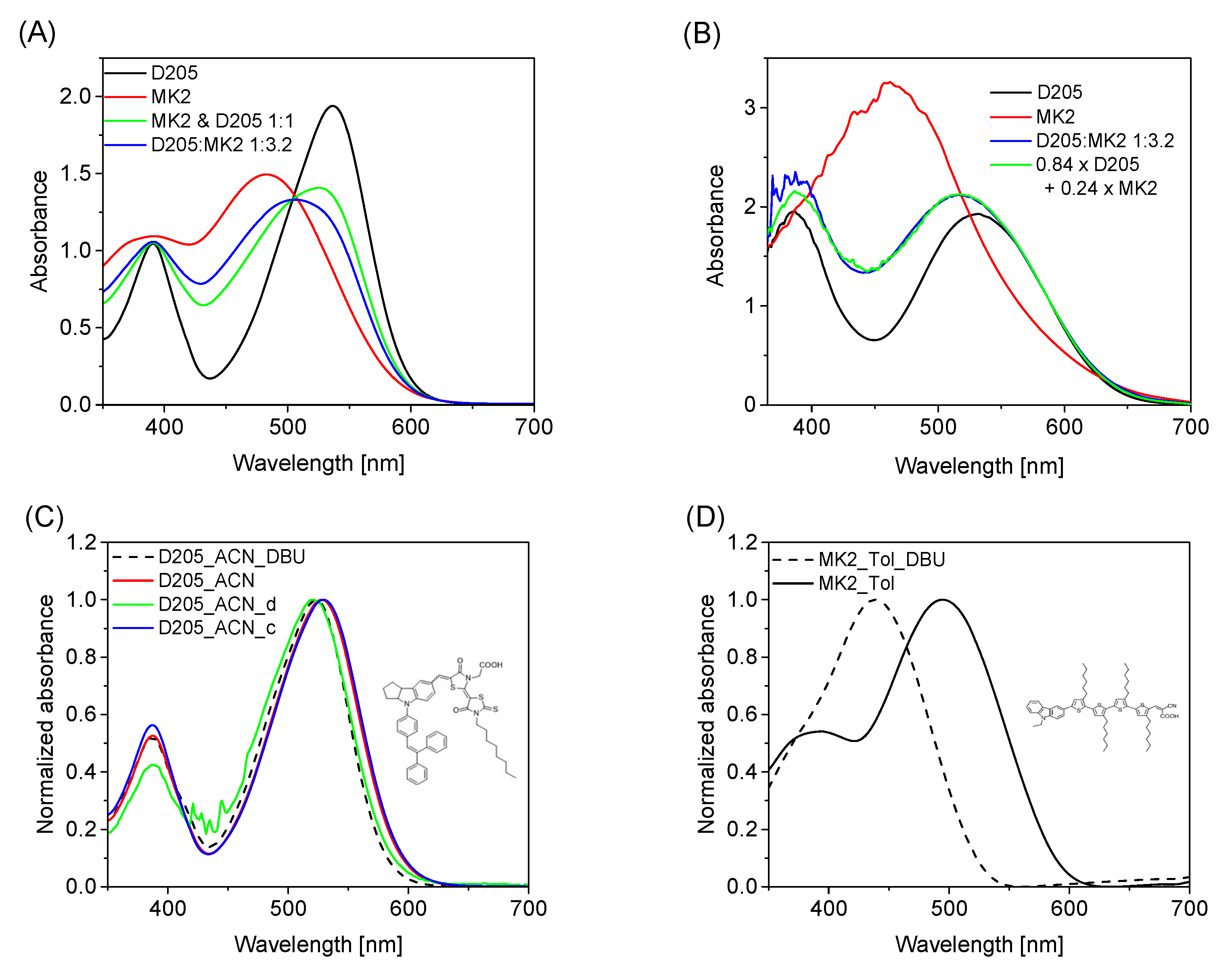


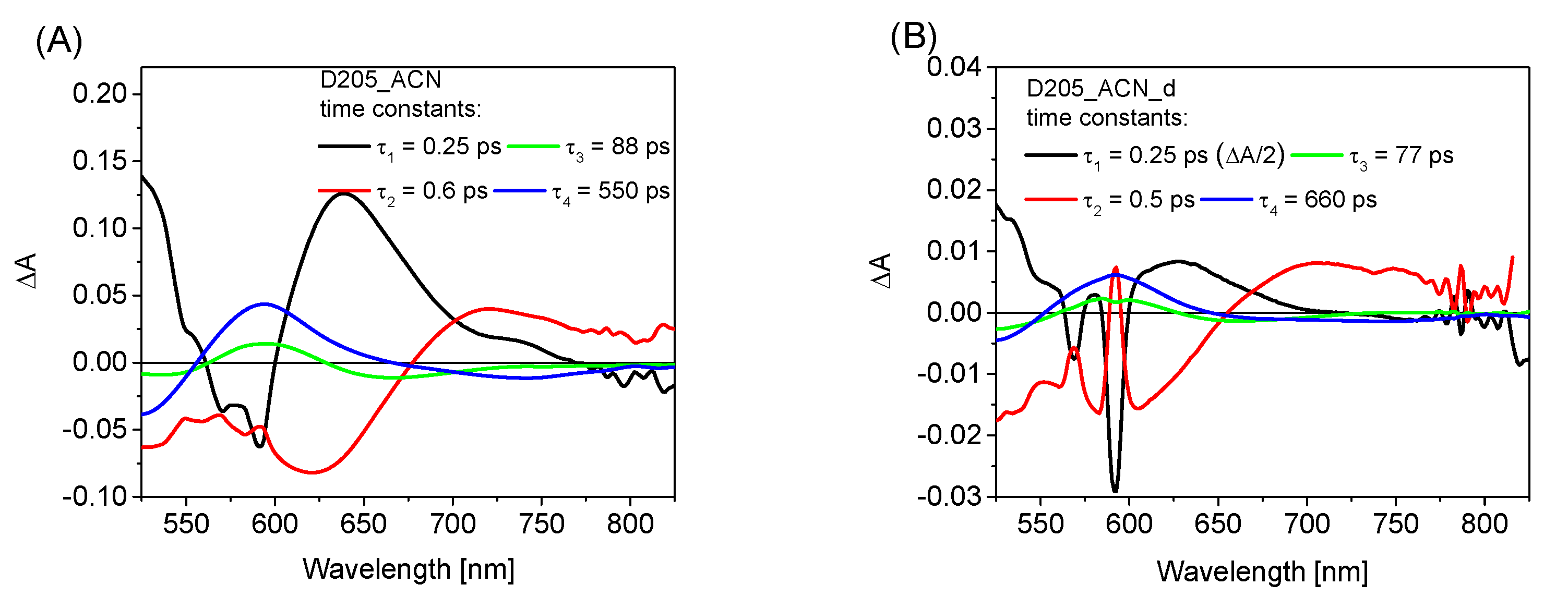
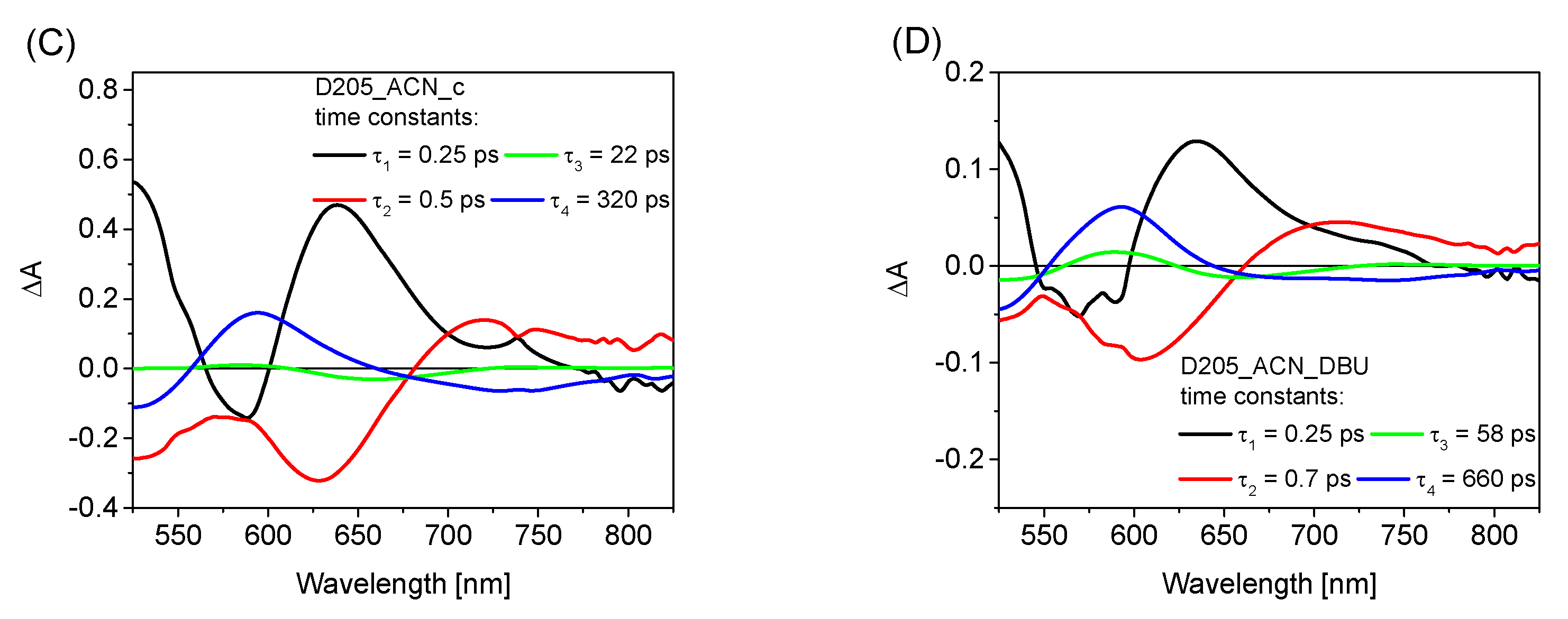


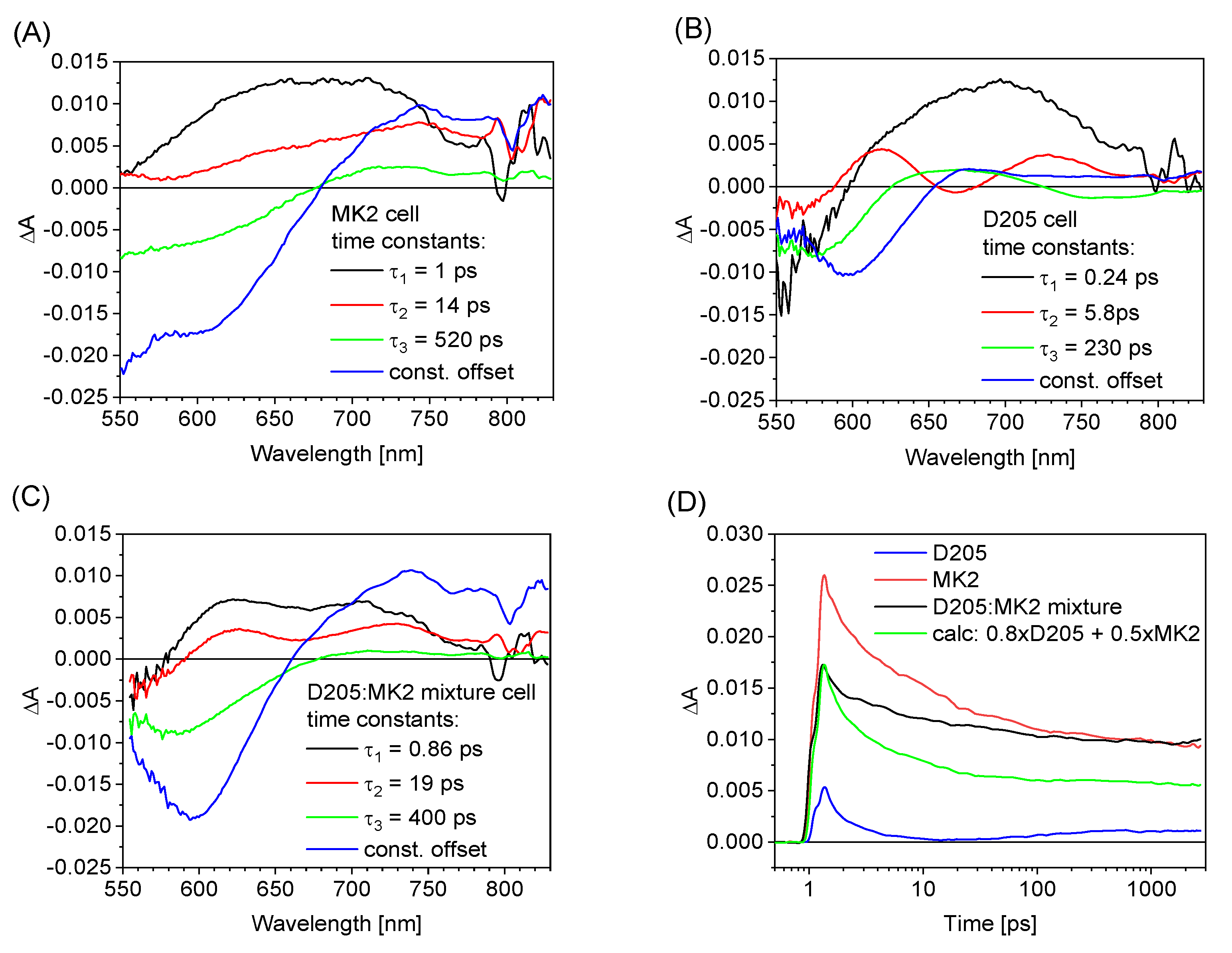
| D205:MK2 Concentration Ratio in Solution | D205:MK2 Absorbance Ratio on TiO2 | Number of Dyes (Normalized to Only D205 Sample) | D205:MK2 Ratio of Dyes Concentrations on TiO2 |
|---|---|---|---|
| 1:0 (only D205) | 1.00:0.00 | 1.00 | 100%:0% |
| 1:1.5 | 0.92:0.16 | 1.17 | 79%:21% |
| 1:2 | 0.86:0.16 | 1.11 | 78%:22% |
| 1:3.2 | 0.84:0.24 | 1.21 | 69%:31% |
| 1:4.2 | 0.90:0.40 | 1.52 | 59%:41% |
| 0:1 (only MK2) | 0.00:1.00 | 3.08 | 0%:100% |
| Sample | VOC, V | FF | JSC, mA/cm2 | PCE, % |
|---|---|---|---|---|
| D205 | 0.72 | 0.66 | 8.95 | 4.24 |
| MK2 | 0.74 | 0.57 | 11.54 | 4.82 |
| D205:MK2 1:4.2 | 0.72 | 0.66 | 11.32 | 5.41 |
| Solution | λabs [nm] | λF [nm] | ՓF | τ [ps] | kr/108 [s−1] | Σknr/108 [s−1] |
|---|---|---|---|---|---|---|
| D205 | ||||||
| ACN_c | 528 | 637 | 0.03 | 350 | 0.9 | 27.7 |
| ACN | 528 | 628 | 0.05 | 480 | 1.1 | 19.7 |
| ACN_d | 519 | 621 | 0.07 | 520 | 1.3 | 17.9 |
| ACN_DBU | 523 | 623 | 0.08 | 540 | 1.4 | 17.1 |
| DCM | 546 | 632 | 0.07 | 670 | 1.0 | 13.9 |
| DCM_DBU | 536 | 622 | 0.08 | 500 | 1.6 | 18.4 |
| EtOH | 527 | 627 | 0.05 | 350 | 1.4 | 27.2 |
| EtOH_DBU | 528 | 627 | 0.05 | 330 | 1.4 | 28.9 |
| Tol | 537 | 584 | 0.10 | 190 * | 5.1 | 47.6 |
| Tol_DBU | 524 | 571 | 0.10 | 130 * | 7.7 | 69.2 |
| tert-Bu | 533 ** | 618 | 0.09 | 600 | 1.5 | 15.2 |
| tert-Bu_DBU | 531 | 615 | 0.15 | 830 | 1.8 | 10.2 |
| THF | 532 | 626 | 0.05 | 550 | 0.9 | 17.3 |
| THF_DBU | 524 | 622 | 0.07 | 850 | 0.8 | 11.0 |
| MK2 | ||||||
| Tol | 495 | 642 | 0.15 | 670 * | 2.2 | 12.7 |
| Tol_DBU | 439 | 582 | 0.21 | 570 * | 3.7 | 13.9 |
Publisher’s Note: MDPI stays neutral with regard to jurisdictional claims in published maps and institutional affiliations. |
© 2022 by the authors. Licensee MDPI, Basel, Switzerland. This article is an open access article distributed under the terms and conditions of the Creative Commons Attribution (CC BY) license (https://creativecommons.org/licenses/by/4.0/).
Share and Cite
Gierszewski, M.; Glinka, A.; Ziółek, M. Co-Sensitization Effects of Indoline and Carbazole Dyes in Solar Cells and Their Neutral–Anion Equilibrium in Solution. Materials 2022, 15, 7725. https://doi.org/10.3390/ma15217725
Gierszewski M, Glinka A, Ziółek M. Co-Sensitization Effects of Indoline and Carbazole Dyes in Solar Cells and Their Neutral–Anion Equilibrium in Solution. Materials. 2022; 15(21):7725. https://doi.org/10.3390/ma15217725
Chicago/Turabian StyleGierszewski, Mateusz, Adam Glinka, and Marcin Ziółek. 2022. "Co-Sensitization Effects of Indoline and Carbazole Dyes in Solar Cells and Their Neutral–Anion Equilibrium in Solution" Materials 15, no. 21: 7725. https://doi.org/10.3390/ma15217725
APA StyleGierszewski, M., Glinka, A., & Ziółek, M. (2022). Co-Sensitization Effects of Indoline and Carbazole Dyes in Solar Cells and Their Neutral–Anion Equilibrium in Solution. Materials, 15(21), 7725. https://doi.org/10.3390/ma15217725