


New Materials for Orthodontic Interceptive Treatment in Primary to Late Mixed Dentition. A Retrospective Study Using Elastodontic Devices

 ,
, 
 and
and 
Abstract
1. Introduction
2. Materials and Methods
2.1. Study Sample
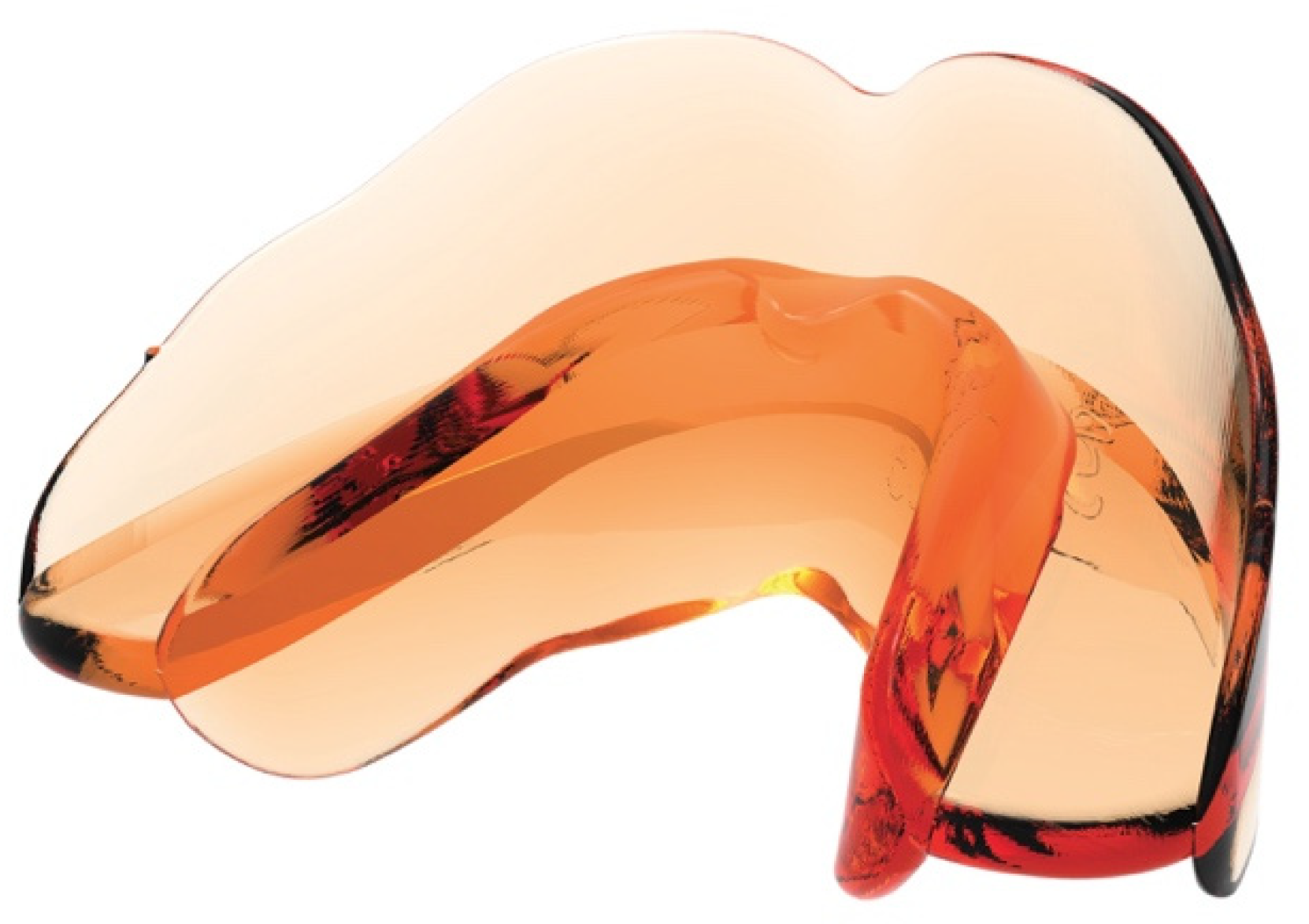
2.2. Treatment Protocol
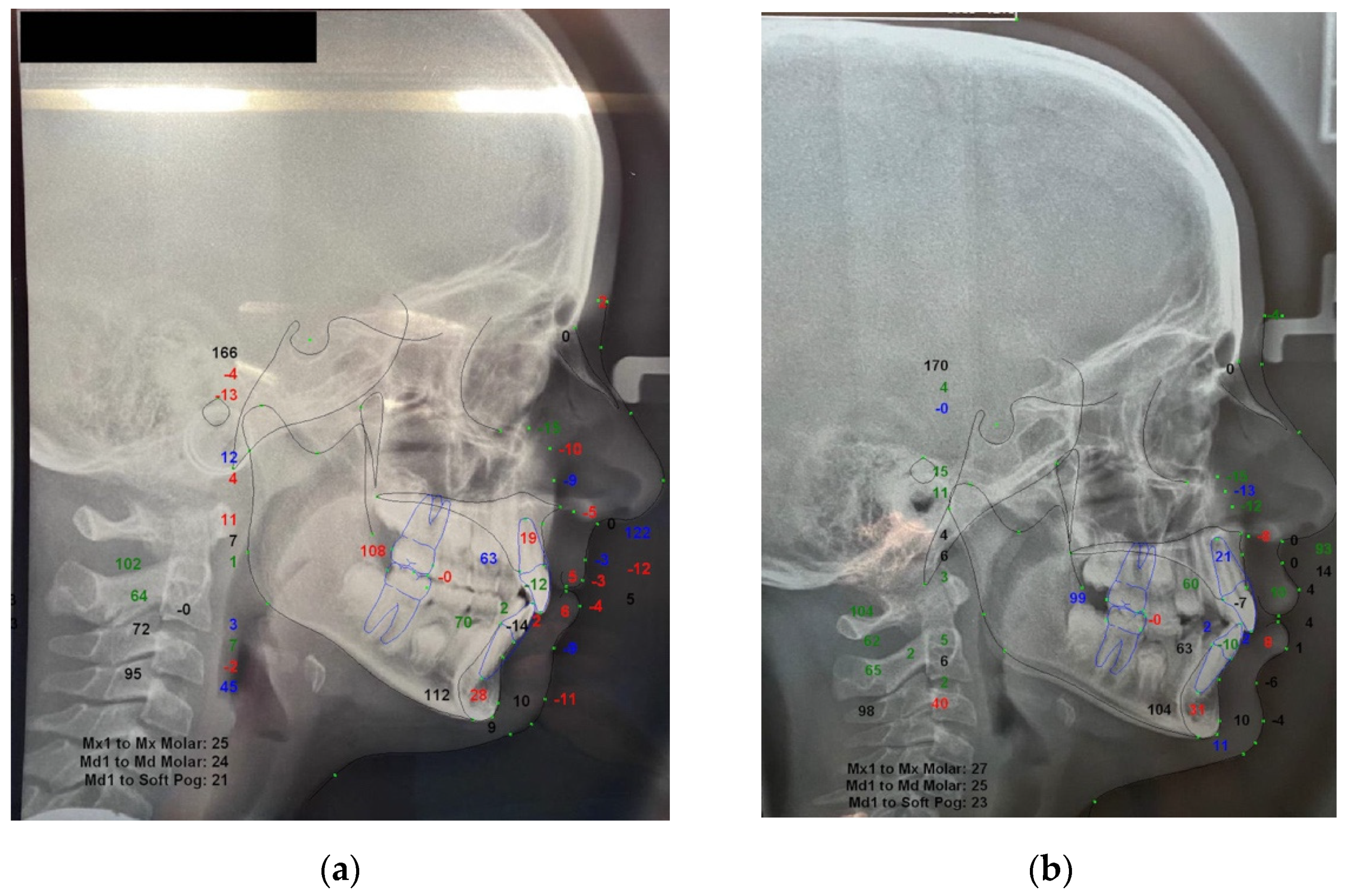
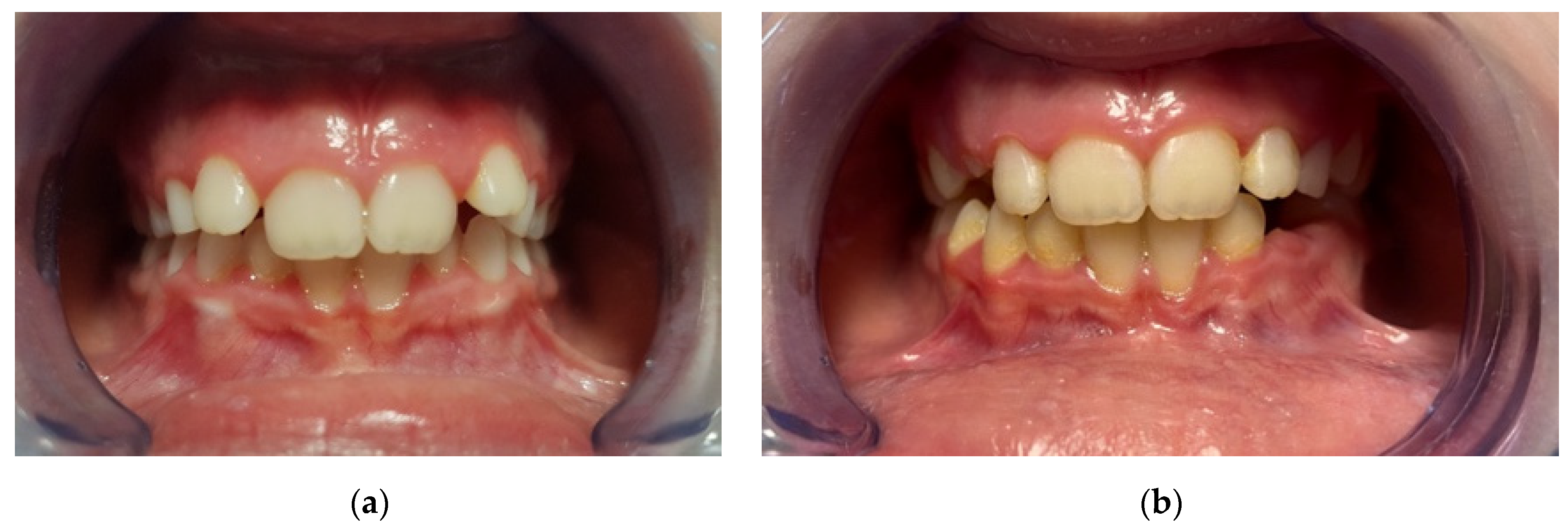
2.3. Data Measurements
- -
- Overjet (mm).
- -
- Overbite (mm).
- -
- Crowding (distribution): (1) aligned dentition, (2) mild crowding (≤2 mm), (3) moderate crowding (3–4 mm).
- -
- Severe crowding (>4 mm).
- -
- Angle malocclusion (distribution): class I, class II, class I/II.
2.4. Statistical Analysis
3. Results
4. Discussion
Limitations
5. Conclusions
Author Contributions
Funding
Institutional Review Board Statement
Informed Consent Statement
Data Availability Statement
Conflicts of Interest
References
- Tausche, E.; Luck, O.; Harzer, W. Prevalence of malocclusions in the early mixed dentition and orthodontic treatment need. Eur. J. Orthod. 2004, 26, 237–244. [Google Scholar] [CrossRef] [Scilit]
- Keski-Nisula, K.; Lehto, R.; Lusa, V.; Keski-Nisula, L.; Varrela, J. Occurrence of malocclusion and need of orthodontic treatment in early mixed dentition. Am. J. Orthod. Dentofac. Orthop. 2003, 124, 631–638. [Google Scholar] [CrossRef] [Scilit]
- Ingelsson-Dahlström, M.; Hagberg, C. The longitudinal development of malocclusion in postnormal children with little respectively urgent need for orthodontic treatment. Swed. Dent. J. 1994, 18, 49–57. [Google Scholar] [PubMed]
- Al Nimri, K.; Richardson, A. Interceptive orthodontics in the real world of community dentistry. Int. J. Paediatr. Dent. 2008, 10, 99–108. [Google Scholar] [CrossRef] [Scilit] [PubMed]
- Pavlow, S.S.; McGorray, S.P.; Taylor, M.G.; Dolce, C.; King, G.J.; Wheeler, T.T. Effect of early treatment on stability of occlusion in patients with Class II malocclusion. Am. J. Orthod. Dentofac. Orthop. 2008, 133, 235–244. [Google Scholar] [CrossRef] [Scilit]
- Harrison, J.; O’Brien, K.; Worthington, H. Orthodontic treatment for prominent upper front teeth in children. Cochrane Database Syst. Rev. 2007. [Google Scholar] [CrossRef] [Scilit]
- Corbett, M.C. Class II treatment with elastodontics. J. Clin. Orthod. 1992, 26, 419–424. [Google Scholar] [PubMed]
- Methenitou, S.; Shein, B.; Ramanathan, G.; Bergersen, E.O. Prevention of overbite and overjet development in the 3 to 8 year old by controlled nighttime guidance of incisal eruption: A study of 43 individuals. J. Pedod. 1990, 14, 219–230. [Google Scholar] [PubMed]
- Massaro, C.; Garib, D.; Cevidanes, L.; Janson, G.; Yatabe, M.; Lauris, J.R.P.; Ruellas, A.C. Maxillary dentoskeletal outcomes of the expander with differential opening and the fan-type expander: A randomized controlled trial. Clin. Oral Investig. 2021. [Google Scholar] [CrossRef] [Scilit]
- Bergersen, E.O. Preventive eruption guidance in the 5-to-7-year-old. J. Clin. Orthod. 1995, 29, 382–395. [Google Scholar]
- Pangrazio-Kulbersh, V.; Berger, J.L.; Chermak, D.S.; Kaczynski, R.; Simon, E.S.; Haerian, A. Treatment effects of the mandibular anterior repositioning appliance on patients with Class II malocclusion. Am. J. Orthod. Dentofac. Orthop. 2003, 123, 286–295. [Google Scholar] [CrossRef] [Scilit]
- Tallgren, A.; Christiansen, R.L.; Ash, M.; Miller, R.L. Effects of a myofunctional appliance on orofacial muscle activity and structures. Angle Orthod. 1998, 68, 249–258. [Google Scholar]
- Myrlund, R.; Dubland, M.; Keski-Nisula, K.; Kerosuo, H. One year treatment effects of the eruption guidance appliance in 7- to 8-year-old children: A randomized clinical trial. Eur. J. Orthod. 2014, 37, 128–134. [Google Scholar] [CrossRef] [Scilit]
- Rabie, A.; She, T.; Hägg, U. Functional appliance therapy accelerates and enhances condylar growth. Am. J. Orthod. Dentofac. Orthop. 2003, 123, 40–48. [Google Scholar] [CrossRef] [Scilit] [PubMed]
- Singh, G.; Clark, W. Localization of mandibular changes in patients with class II division 1 malocclusions treated with twin-block appliances: Finite element scaling analysis. Am. J. Orthod. Dentofac. Orthop. 2001, 119, 419–425. [Google Scholar] [CrossRef] [Scilit] [PubMed]
- Jaju, P.P.; Jaju, S.P. Cone-beam computed tomography: Time to move from ALARA to ALADA. Imaging Sci. Dent. 2015, 45, 263–265. [Google Scholar] [CrossRef] [Scilit]
- Ramirez-Yañez, G.; Sidlauskas, A.; Junior, E.; Fluter, J. Dimensional changes in dental arches after treatment with a prefabricated functional appliance. J. Clin. Pediatr. Dent. 2007, 31, 279–283. [Google Scholar] [CrossRef] [Scilit] [PubMed]
- Keski-Nisula, K.; Keski-Nisula, L.; Salo, H.; Voipio, K.; Varrela, J. Dentofacial changes after orthodontic intervention with eruption guidance appliance in the early mixed dentition. Angle Orthod. 2008, 78, 324–331. [Google Scholar] [CrossRef] [Scilit]
- Janson, G.; Nakamura, A.; Chiqueto, K.; Castro, R.; De Freitas, M.R.; Henriques, J.F.C. Treatment stability with the eruption guidance appliance. Am. J. Orthod. Dentofac. Orthop. 2007, 131, 717–728. [Google Scholar] [CrossRef] [Scilit]
- Musumeci, G.; Castrogiovanni, P.; Leonardi, R.; Trovato, F.M.; Szychlinska, M.A.; Di Giunta, A.; Loreto, C.; Castorina, S. New perspectives for articular cartilage repair treatment through tissue engineering: A contemporary review. World J. Orthop. 2014, 5, 80–88. [Google Scholar] [CrossRef] [Scilit]
- McNamara, J.A., Jr.; Howe, R.P.; Dischinger, T.G. A comparison of the Herbst and Fränkel appliances in the treatment of Class II malocclusion. Am. J. Orthod. Dentofac. Orthop. 1990, 98, 134–144. [Google Scholar] [CrossRef] [Scilit]
- Janson, G.; De Souza, J.E.P.; De Freitas, M.R.; Henriques, J.F.C.; Cavalcanti, C.T. Occlusal changes of Class II malocclusion treatment between Fränkel and the eruption guidance appliances. Angle Orthod. 2004, 74, 521–525. [Google Scholar] [PubMed]
- Janson, G.R.; Da Silva, C.C.A.; Bergersen, E.O.; Henriques, J.F.C.; Pinzan, A. Eruption Guidance Appliance effects in the treatment of Class II, Division 1 malocclusions. Am. J. Orthod. Dentofac. Orthop. 2000, 117, 119–129. [Google Scholar] [CrossRef] [Scilit]
- Tartaglia, G.M.; Grandi, G.; Mian, F.; Sforza, C.; Ferrario, V.F. Non-invasive 3D facial analysis and surface electromyography during functional pre-orthodontic therapy: A preliminary report. J. Appl. Oral Sci. 2009, 17, 487–494. [Google Scholar] [CrossRef] [Scilit]
- Stavridi, R.; Ahlgren, J. Muscle response to the oral-screen activator. An EMG study of the masseter, buccinator, and mentalis muscles. Eur. J. Orthod. 1992, 14, 339–349. [Google Scholar] [CrossRef] [Scilit]
- Nucera, R.; Giudice, A.L.; Rustico, L.; Matarese, G.; Papadopoulos, M.A.; Cordasco, G. Effectiveness of orthodontic treatment with functional appliances on maxillary growth in the short term: A systematic review and meta-analysis. Am. J. Orthod. Dentofac. Orthop. 2016, 149, 600–611.e3. [Google Scholar] [CrossRef] [Scilit]
- Musumeci, G.; Trovato, F.M.; Loreto, C.; Leonardi, R.; Szychlinska, M.A.; Castorina, S.; Mobasheri, A. Lubricin expression in human osteoarthritic knee meniscus and synovial fluid: A morphological, immunohistochemical and biochemical study. Acta Histochem. 2014, 116, 965–972. [Google Scholar] [CrossRef] [Scilit]

| Parameters | Treated Group | Control Group | Significance ** | ||||||||
|---|---|---|---|---|---|---|---|---|---|---|---|
| T0 | T1 | Significance * | T0 | T1 | Significance * | ||||||
| Mean | SD | Mean | SD | Mean | SD | Mean | SD | ||||
| Overjet | 5.1 | 0.8 | 2.5 | 0.5 | p < 0.05 | 4.7 | 1.1 | 5 | 1.2 | NS | p < 0.05 |
| Overbite | 4.5 | 0.9 | 1.9 | 1.2 | p < 0.05 | 4.2 | 1.3 | 4.9 | 1.4 | p < 0.05 | p < 0.05 |
| Parameters | T0 | Significance | T1 | ||||
|---|---|---|---|---|---|---|---|
| Subjects | TG | CG | TG | CG | Significance | ||
| n | n | n | Mean | ||||
| Maxilla | Crowding | 14 | 11 | NS | 10 | 15 | NS |
| Normal | 6 | 9 | 10 | 5 | |||
| Total | 20 | 20 | 20 | 20 | |||
| Mandibular | Crowding | 16 | 17 | NS | 6 | 20 | NS |
| Normal | 4 | 3 | 14 | 0 | |||
| Total | 20 | 20 | 20 | 20 | |||
| Parameters | T0 | T1 | ||||
|---|---|---|---|---|---|---|
| TG | CG | Significance | TG | CG | Significance | |
| n | n | n | Mean | |||
| Class I | 6 | 7 | NS | 13 | 8 | NS |
| Class II | 13 | 10 | 2 | 9 | ||
| Class I/II | 4 | 3 | 5 | 3 | ||
| Total | 20 | 20 | 20 | 20 | ||
| Parameters | Treated Group | ||||
|---|---|---|---|---|---|
| T0 | T1 | Significance * | |||
| Mean | SD | Mean | SD | ||
| SNA^ | 79.4 | 0.96 | 80.06 | 1.19 | NS |
| SNB^ | 74.6 | 1.07 | 77.3 | 1.31 | p < 0.05 |
| ANB^ | 4.7 | 0.66 | 2.76 | 0.69 | p < 0.05 |
| IIA^ | 130.1 | 6.5 | 131.8 | 5.6 | p < 0.05 |
Publisher’s Note: MDPI stays neutral with regard to jurisdictional claims in published maps and institutional affiliations. |
© 2021 by the authors. Licensee MDPI, Basel, Switzerland. This article is an open access article distributed under the terms and conditions of the Creative Commons Attribution (CC BY) license (http://creativecommons.org/licenses/by/4.0/).
Share and Cite
Fichera, G.; Martina, S.; Palazzo, G.; Musumeci, R.; Leonardi, R.; Isola, G.; Lo Giudice, A. New Materials for Orthodontic Interceptive Treatment in Primary to Late Mixed Dentition. A Retrospective Study Using Elastodontic Devices. Materials 2021, 14, 1695. https://doi.org/10.3390/ma14071695
Fichera G, Martina S, Palazzo G, Musumeci R, Leonardi R, Isola G, Lo Giudice A. New Materials for Orthodontic Interceptive Treatment in Primary to Late Mixed Dentition. A Retrospective Study Using Elastodontic Devices. Materials. 2021; 14(7):1695. https://doi.org/10.3390/ma14071695
Chicago/Turabian StyleFichera, Grazia, Stefano Martina, Giuseppe Palazzo, Rosaria Musumeci, Rosalia Leonardi, Gaetano Isola, and Antonino Lo Giudice. 2021. "New Materials for Orthodontic Interceptive Treatment in Primary to Late Mixed Dentition. A Retrospective Study Using Elastodontic Devices" Materials 14, no. 7: 1695. https://doi.org/10.3390/ma14071695
APA StyleFichera, G., Martina, S., Palazzo, G., Musumeci, R., Leonardi, R., Isola, G., & Lo Giudice, A. (2021). New Materials for Orthodontic Interceptive Treatment in Primary to Late Mixed Dentition. A Retrospective Study Using Elastodontic Devices. Materials, 14(7), 1695. https://doi.org/10.3390/ma14071695


