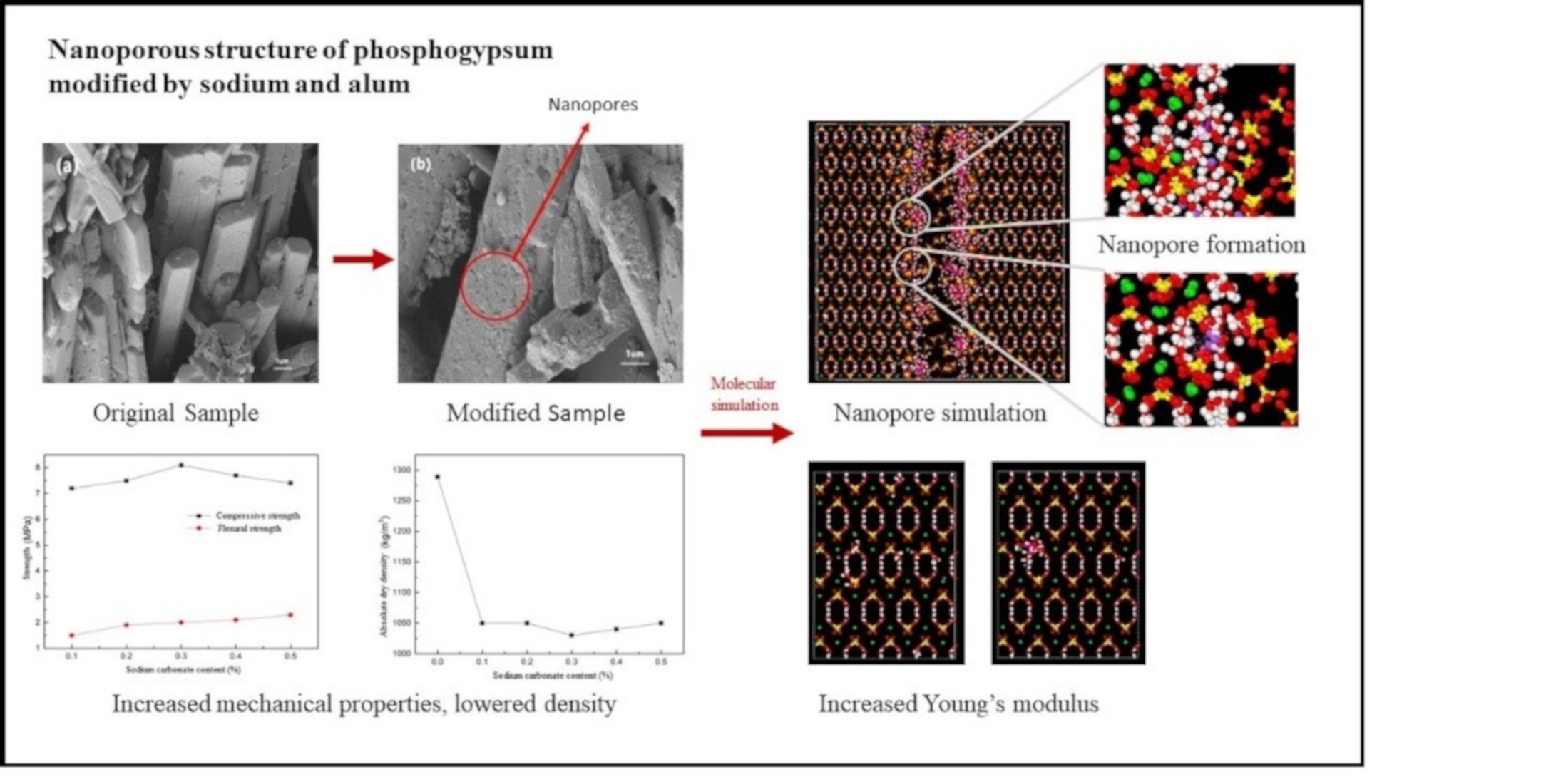
Performance and Nanostructure Simulation of Phosphogypsum Modified by Sodium Carbonate and Alum

Abstract
Share and Cite
Zhong, D.; Wang, J.; Hou, G.; Wang, L.; Wu, Q.; Lu, B. Performance and Nanostructure Simulation of Phosphogypsum Modified by Sodium Carbonate and Alum. Materials 2021, 14, 5830. https://doi.org/10.3390/ma14195830
Zhong D, Wang J, Hou G, Wang L, Wu Q, Lu B. Performance and Nanostructure Simulation of Phosphogypsum Modified by Sodium Carbonate and Alum. Materials. 2021; 14(19):5830. https://doi.org/10.3390/ma14195830
Chicago/Turabian StyleZhong, Dongqing, Jingchen Wang, Guihua Hou, Luming Wang, Qian Wu, and Bao Lu. 2021. "Performance and Nanostructure Simulation of Phosphogypsum Modified by Sodium Carbonate and Alum" Materials 14, no. 19: 5830. https://doi.org/10.3390/ma14195830
APA StyleZhong, D., Wang, J., Hou, G., Wang, L., Wu, Q., & Lu, B. (2021). Performance and Nanostructure Simulation of Phosphogypsum Modified by Sodium Carbonate and Alum. Materials, 14(19), 5830. https://doi.org/10.3390/ma14195830