Article

Removal Effect of Basic Oxygen Furnace Slag Porous Asphalt Concrete on Copper and Zinc in Road Runoff
State Key Laboratory of Silicate Materials for Architectures, Wuhan University of Technology, Wuhan 430070, China
*
Author to whom correspondence should be addressed.
Materials 2021, 14(18), 5327; https://doi.org/10.3390/ma14185327
Submission received: 12 July 2021 / Revised: 30 August 2021 / Accepted: 6 September 2021 / Published: 16 September 2021
(This article belongs to the Special Issue Concrete and Construction Materials)

Abstract

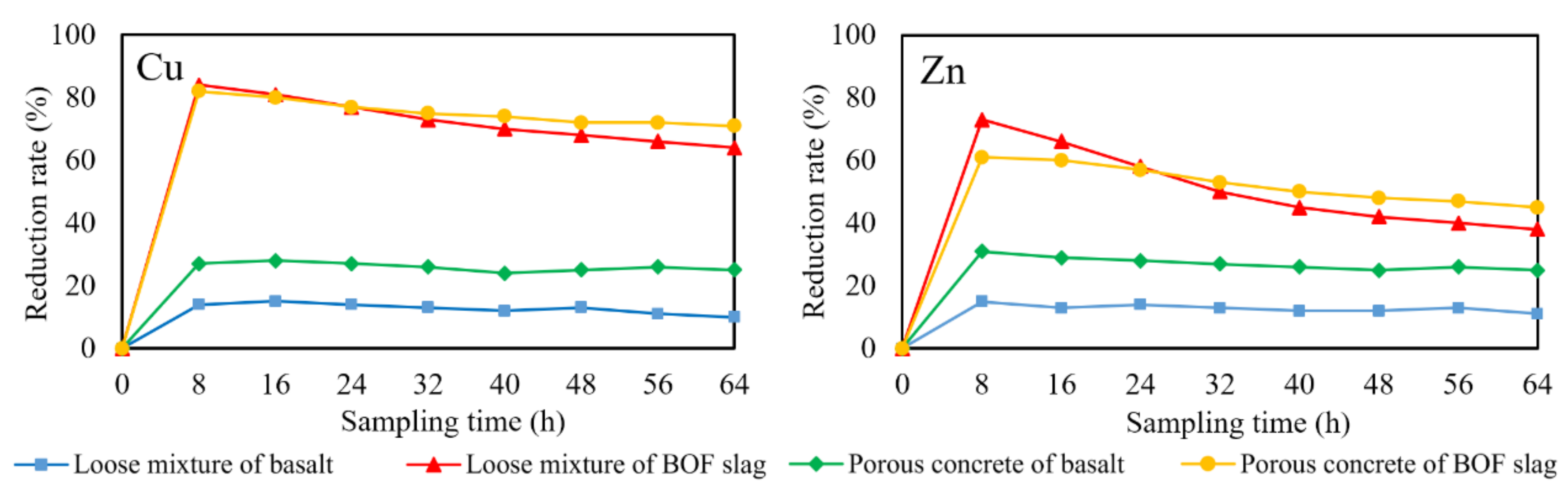
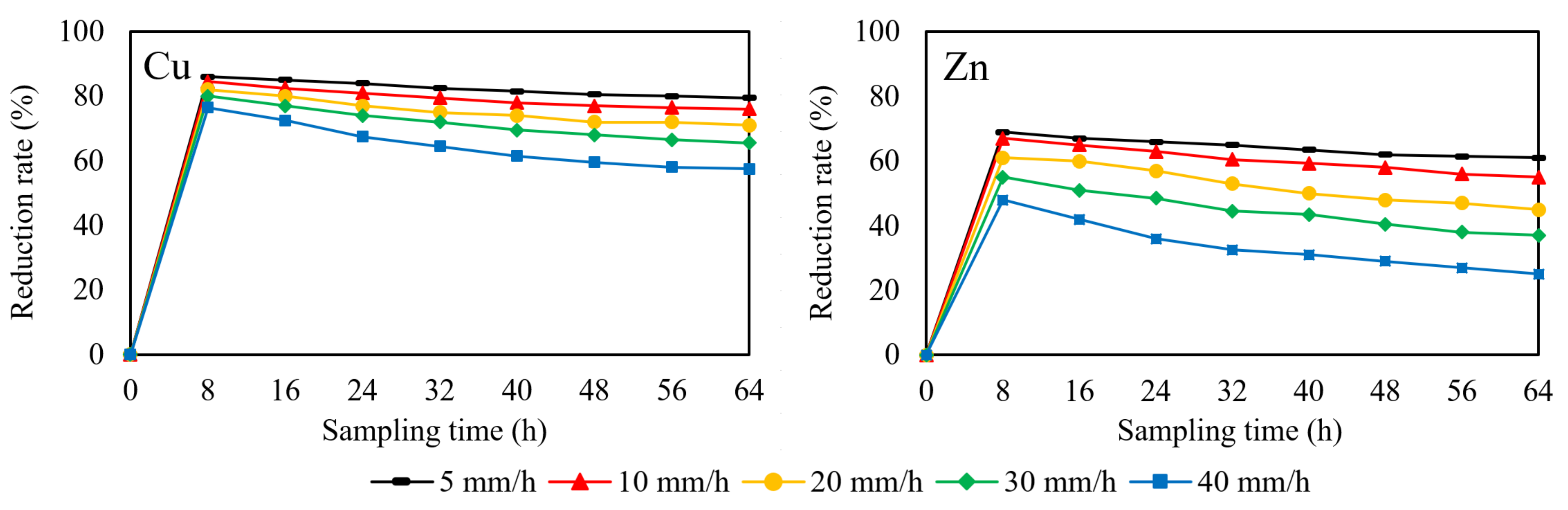
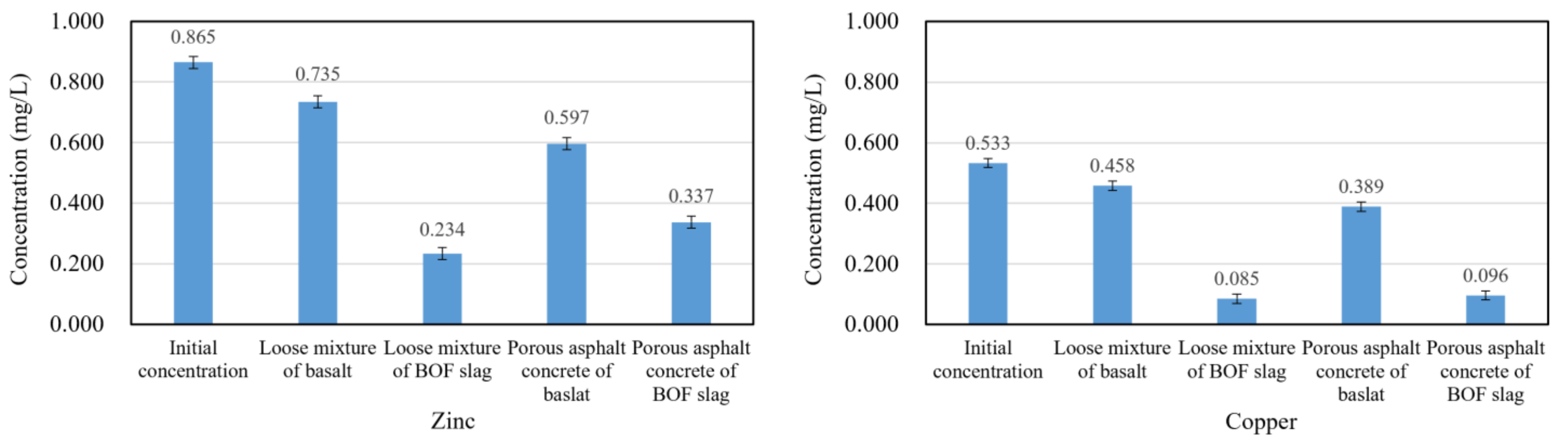
In order to improve the utilization efficiency of road runoff and the remove effects of heavy metals, porous asphalt pavements have been used as an effective measure to deal with heavy metals in road runoff. However, the removal effect on dissolved heavy metal is weak. In this paper, basic oxygen furnace (BOF) slag was used as aggregate in porous asphalt concrete to improve the removal capacity of heavy metal. Road runoff solution with a copper concentration of 0.533 mg/L and a zinc concentration of 0.865 mg/L was artificially synthesized. The removal effect of BOF slag porous asphalt concrete on cooper and zinc in runoff was evaluated by removal tests. The influence of rainfall intensity and time on the removal effect was discussed. The results obtained indicated that BOF slag porous asphalt concrete has a better removal effect on copper. The removal rate of copper is 57–79% at the rainfall intensity of 5–40 mm/h. The removal rate of zinc is more susceptible to the changes of rainfall intensity than copper. The removal rate of zinc in heavy rain conditions (40 mm/h) is only 25%. But in light rain conditions (5 mm/h), BOF slag porous asphalt concrete maintains favorable removal rates of both copper and zinc, which are more than 60%. The heavy metal content of runoff infiltrating through the BOF slag porous asphalt concrete meets the requirements for irrigation water and wastewater discharge. The results of this study provide evidence for the environmentally friendly reuse of BOF slag as a road material and the improvement of the removal of heavy metal by porous asphalt concrete.
Keywords: heavy metals; road runoff; porous asphalt pavement; steel slag; removal effect heavy metals; road runoff; porous asphalt pavement; steel slag; removal effect