Review

SHS-Derived Powders by Reactions’ Coupling as Primary Products for Subsequent Consolidation

1
Department of Mechanical and Industrial Engineering, Tallinn University of Technology, Ehitajate 5, 19180 Tallinn, Estonia
2
A.B. Nalbandyan Institute of Chemical Physics, National Academy of Sciences of the Republic of Armenia, P. Sevak 5/2, Yerevan 0014, Armenia
*
Author to whom correspondence should be addressed.
Materials 2021, 14(17), 5117; https://doi.org/10.3390/ma14175117
Submission received: 14 July 2021 / Revised: 29 August 2021 / Accepted: 1 September 2021 / Published: 6 September 2021
(This article belongs to the Special Issue Collection of Papers in Materials Science from Estonia)

Abstract

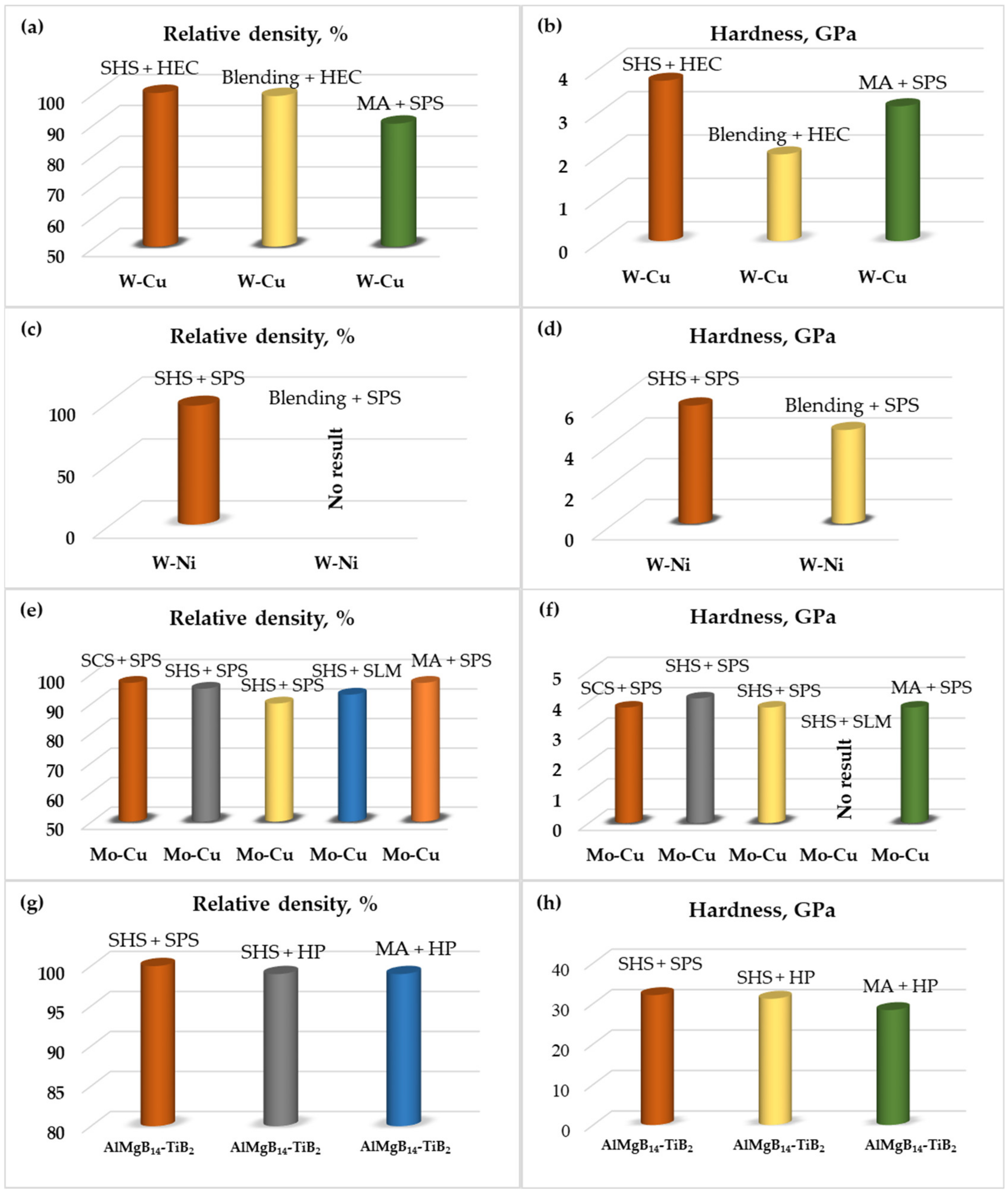
The capability of self-propagating high-temperature synthesis (SHS) to produce powders that are characterized by a high sintering ability, owing to high heating and cooling rates inherent to the exothermic reaction, is of a special interest for the industry. In particular, SHS-derived powders comprise a significant defect concentration in order to effectively enhance the mass transfer processes during the sintering, which allows for the successful consolidation of difficult-to-sinter materials at relatively low sintering temperatures. From this perspective, the design of precursors suitable for sintering, synthesis in a controlled temperature regime and the optimization of geometrical and structural parameters of SHS powders as a potential feedstock for the consolidation is of key importance. Here, we report on the comparative studies concerning the SHS processing of composites for advanced powder metallurgy techniques. The synthesis and sintering peculiarities of the SHS through coupled reactions in the Me’O3(WO3,MoO3)-Me’’O(CuO,NiO)-Mg-C, Ti-B-Al12Mg17 systems are comparatively reviewed. The SHS coupling approach was used for the preparation of powders with a tuned degree of fineness (a high specific surface area of particles), a high-homogeneity and a controllable distribution of elements via both the regulation of the thermal regime of combustion in a wide range and the matching of the thermal and kinetic requirements of two interconnected reactions. Microstructural features of the powder feedstock greatly contributed to the subsequent consolidation process.
Keywords: self-propagating high-temperature synthesis; combustion synthesized powder; thermal coupling; sintering; microstructure; mechanical properties self-propagating high-temperature synthesis; combustion synthesized powder; thermal coupling; sintering; microstructure; mechanical properties