


Abstract
Economic and social factors compel large-scale changes in energy systems. An ongoing transition in the United States is driven by environmental concerns, changing patterns of energy end-use, constraints on petroleum supply. Analysis of prior transitions shows that energy intensity in the U.S. from 1820 to 2010 features a declining trend when traditional energy is included, in contrast to the “inverted U-curve” seen when only commercial energy is considered. This analysis quantifies use of human and animal muscle power, wind and water power, biomass, harvested ice, fossil fuels, and nuclear power, with some consumption series extending back to 1780. The analysis reaffirms the importance of innovation in energy conversion technologies in energy transitions. An increase in energy intensity in the early 20th century is explained by diminishing returns to pre-electric manufacturing systems, which produced a transformation in manufacturing. In comparison to similar studies for other countries, the U.S. has generally higher energy intensity.
1. Introduction
The dramatic economic, social, technological and environmental changes that accompany energy transitions are well documented (examples include Schurr and Netschert (1960) [1], Smil (1991) [2], Grubler (2012) [3], Kander et al. (2007) [4], Fouquet (2008) [5]). Major changes in the energy conditions of life—fire, agriculture, fossil fuels—are milestones in human history. Are we in the midst of another major energy transition? Energy supply is changing rapidly in some nations. Penetration rates of low-carbon generation have increased from 50% to 56% in recent years in Europe, as European Union countries work toward renewable energy and greenhouse gas emissions targets. In the United States, wind and solar power are expanding rapidly, natural gas is replacing coal for electricity generation on a large scale, and petroleum use has plateaued.
However, other evidence suggests that major change in energy supply can also be slow. In 1990 fossil fuels accounted for 86 percent of primary energy use in the United States; in 2013 that share stood at 82 percent. Petroleum use in China, India, and in countries in the Middle East is projected to expand. These examples illustrate the strong inertia of fossil fuel systems that have well-established infrastructures on both the supply and demand sides, and powerful political support due to the tremendous wealth associated with the sale of those fuels.
History also informs us that changes in energy end use are equally important drivers of energy transitions, especially those changes that improve the efficiency of energy conversion and lower the cost of energy services to the consumer while at the same time improving the quality of those services (Grubler, 2012) [3]. For example, the use of kerosene in oil lamps, a new and cheaper fuel in an old device, did not transform lighting in the United States. A new technology—the electric lamp—did revolutionize lighting. Electricity in 1907 sold for about $7.50 per GJ [6], while kerosene sold for about $1 per GJ [7]. The superior attributes of the incandescent bulb in terms of light quality, health, and safety more than compensated for the initial higher cost of its energy. At a larger scale, Fouquet (2008) [5] presents a seven century history of energy in the United Kingdom from the perspective of changes in the efficiency and price of three key energy services: heat, power, and light.
We concur with Grubler’s observation (2012) [3] that research into historical energy transitions can reveal patterns, dynamics, and drivers of past changeovers in energy systems that, in turn, can help us understand our current energy situation. To this end, we construct a database of energy use in the United States that begins in 1780 and, in doing so we significantly extend our understanding of the nation’s energy history compared to previous research. We follow the methods of Kander et al. (2007) [4] who develop a consistent framework for the estimation of so-called traditional energy sources—food, fodder, wind used for sailing ships and mechanical power, firewood, water used in mills, among others—and how to connect those estimates to the current system of reporting commercial energy use (fossil fuels, nuclear, modern biomass, solar and wind power, hydropower, among others).
Our analysis is organized in five sections. The second section describes the data sources and calculations used to construct the historical series of traditional energy use and links those series to the modern record. The third section presents results from the use of the historical series to understand the nation’s major transitions, and to understand long run changes in the aggregate efficiency of energy use as measured by the energy/real GDP ratio. The fourth section discusses the driving forces behind the observed patterns of energy, and explores how the current energy transition is similar and dissimilar to historic transitions. Finally, we end with some conclusions regarding the role of historical analysis for current decision-making in regards to energy.
2. Calculation of Primary Energy Use
Detailed, systematic accounts of energy production, use, storage and trade are a relatively recent phenomenon. The start dates of the major energy statistics databases are 1949 (U.S. Energy Information Administration), 1960 (International Energy Agency), and 1965 (BP Statistical Review of World Energy). But we know that current patterns have been heavily influenced by a much longer history of change in policies, technologies, scientific advances, and culture (e.g., Nye, 1998) [8]. A few influential studies of energy in the United States (e.g., Dewhurst 1955 [9], Schurr and Netschert 1960 [1]) took a longer view, but even those were principally limited to the “energy commodities” that were traded in markets.
Databases that cover only commercial energy sources omit the important role that traditional energy played in the evolution of industrial economies, and in the critical ongoing that they play in many developing nations. Kander et al. [4] developed a framework to estimate historical traditional energy use. We apply their methodology here to the United States, with important modifications to account for the unique energy conditions of the nation. The historical energy series we construct are then linked to the modern record as complied by the U.S. Energy Information Administration.
2.1. Food
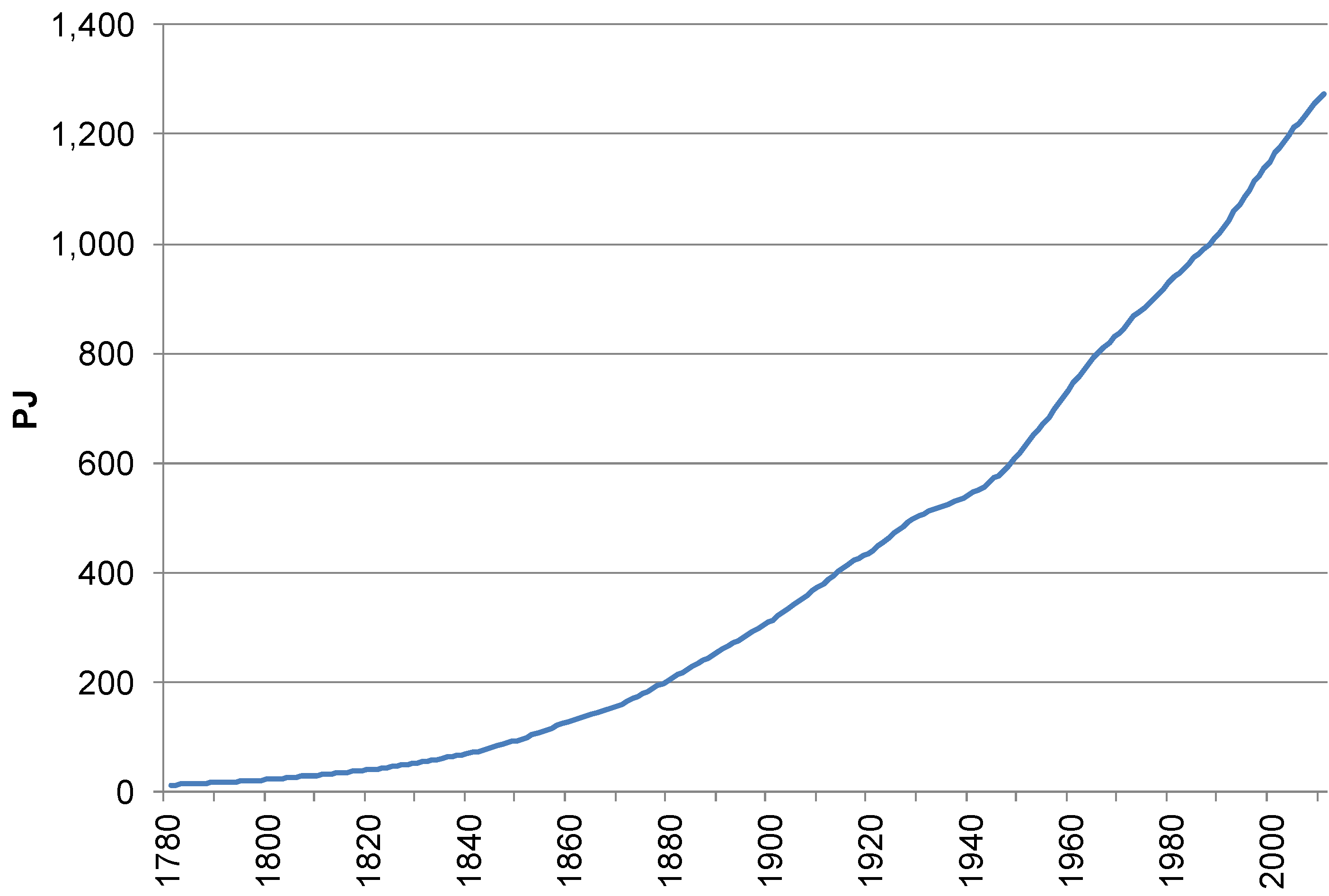
Food is the fuel for human labor, the dominant source of work in society until the introduction of draft animals. Consistent with previous studies, we assume an average value of 2700 kcal/person/day (11.3 MJ). There probably is considerable variation around this average. For example, average intake was over 2700 kcal/person/day in the Revolutionary era for population groups as varied as slaves, prisoners of war, militia, and both the British Army and the Continental Army [6]. Allen (2009) [10] notes a wide range of calorie intake in Europe and Asia in the 18th century, finding England to be the most prosperous region in that era with an average intake of around 2500 calories, with poorer regions closer to 1900 calories. Total food consumption is shown in Figure 1 and has a linear relationship to population.
Figure 1.
Food consumption in the United States, 1780–2010. Sources: Population from [6]; food input estimated at 2700 calories per day per person based on [4,6].
2.2. Draft Animal Fodder
Draft animals produced a fundamental change in the human condition because their power output (up to ≈1 kW) dwarfed that of human labor (≈50 W). Wrigley (2010) [11] highlights how increasing agricultural productivity in Britain enabled the Industrial Revolution. The greater power of these animals meant that fewer farmers were needed to supply Britain with food. Fouquet (2008) [5] notes the contribution of horseshoes, harnesses, and heavy plows from the medieval period to this trend. With increased productivity, a larger proportion of the population could pursue other occupations, such as artisans, merchants, laborers, and factory workers. The same trend is seen in the development of the United States, where draft animals were the largest source of motive power until 1880, when they were surpassed by coal. Draft animals improved productivity in agriculture, which produced a larger fraction of non-farm workers well before the development of tractors and synthetic fertilizers. The early stages of industrialization of American agriculture involved draft animal-powered machinery such as the McCormick Reaper.
Allen (2009) [10] notes that England was inclined to substitute other energy inputs for labor due to high wage rates This was also true in Colonial America. Numerous sources note that draft animals were less expensive in the Colonies and early United States than in England, while human labor was more expensive. Draft animal energy inputs are shown in Figure 2, below.
Figure 2.
Draft animal energy inputs in the United States, 1780–2010. Sources: Draft animal populations from [6,12,13]. Post-1960 declined estimated based on 1945–1960 rate. Animal energy inputs estimated at 18,900 calories per day per animal, based on [2,14,15].
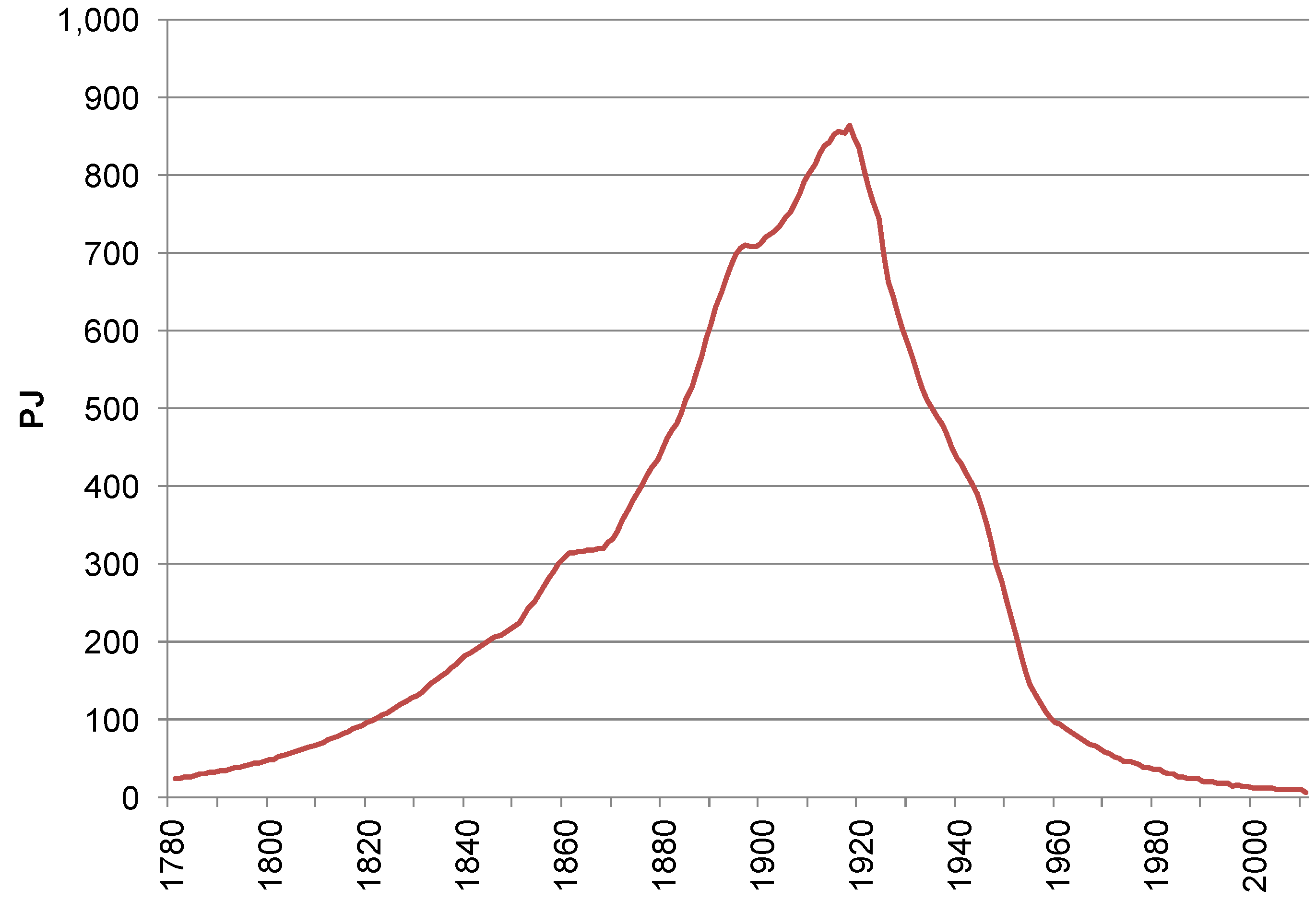
Anderson (2004) ([16], p. 303) advises, “While there is no way to estimate the population of livestock, animals certainly outnumbered colonists by 1670”. Falconer and Bidwell (1925) [12] offer estimates for specific counties and states around 1800, and the 1850 Census [13] provides data for 1840. Variation in draft animal ownership between states in 1840 is greater than the variation within states over time from 1800 to 1840. Based on this observation, we assign each state its per-capita ownership rates from the 1840 Census for the period 1780–1839. Dewhurst (1955) [9], Kinsman (1925) [17], Daugherty (1928) [18], and U.S. Bureau of the Census (1975) [6] all provide figures for the late nineteenth and early twentieth centuries. We assume a 9% annual decline since 1960 (the rate of decline from 1945 to 1960). It is possible that at some year between 1960 and the present, virtually all farms inclined to replace animals with tractors had done so, with the decline halting at that point.
The food energy required to obtain motive power from draft animals is the entire amount of food supplied to all draft animals. A draft animal requires about seven times the food of a person, or about 18,900 calories (79.1 MJ) per day (Kander (2002) [14], Smil (1991) [2], and Lindmark (2007) [15]). It was common to leave livestock to graze in a semi-wild state, either year-round in the Chesapeake region or seasonally in New England (Schlebecker, 1975 [19]; Anderson, 2004 [16]).
2.3. Wind
In the early period of the nation’s history, wind was harnessed almost exclusively by sailing vessels. Dewhurst (1955) [9] estimates the work output from sailing by assuming 3500 h per year of operation at an average of 6 miles per hour, with a power requirement of 1 horsepower-hour (HP-hr) per 45 ton-miles. Thus, annual work output is 467 HP-hr (1254 MJ) per ton of registered vessel. Dewhurst estimates efficiency losses due to rigging at about 50 percent, so primary wind energy extracted is about 2500 MJ per ton per year.
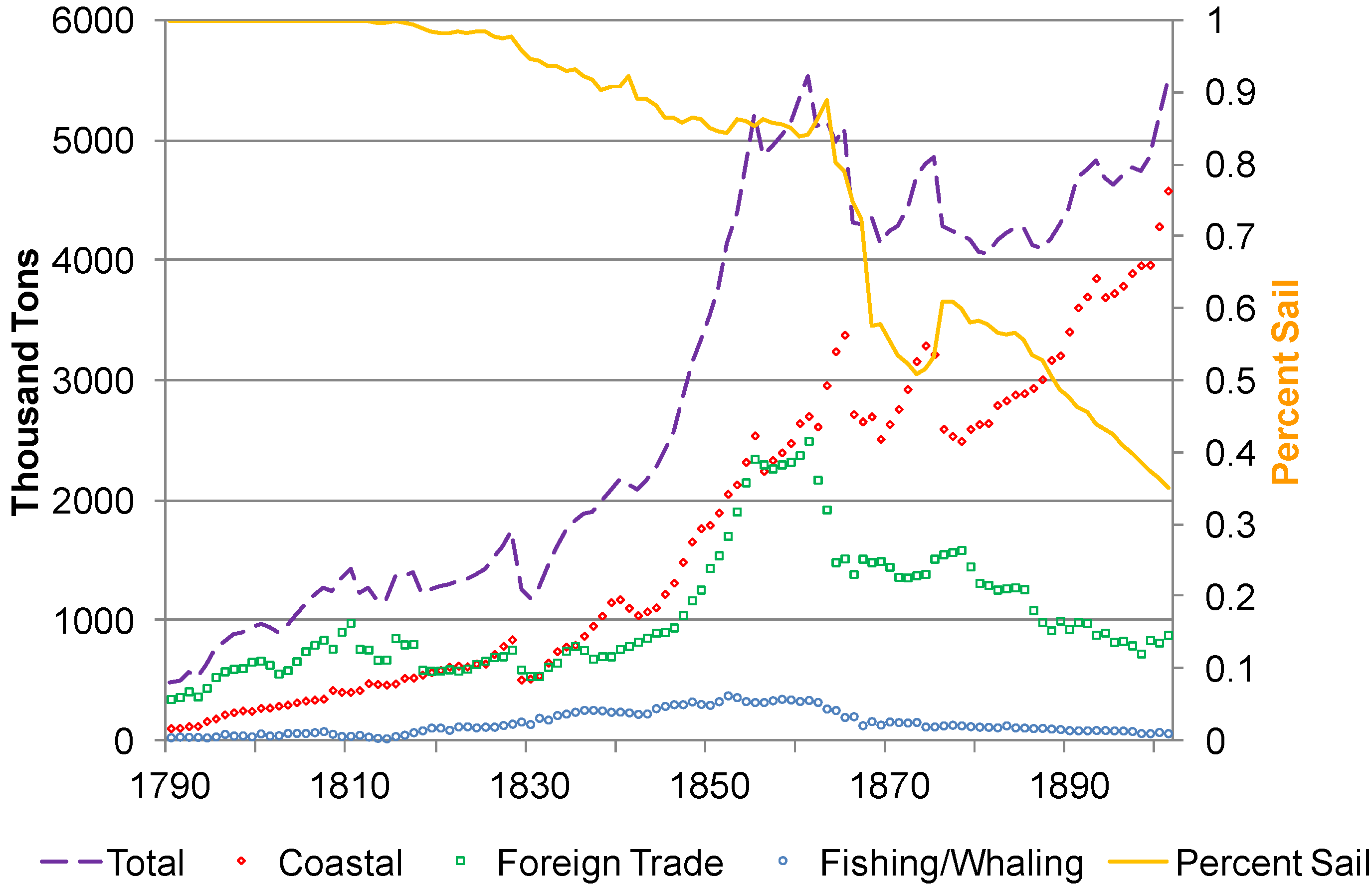
United States Bureau of the Census (1975) [6] records the tonnage involved in foreign trade, as well as that involved in whaling, fishing, or coastal shipping. Sailing vessel tonnage is specifically that of U.S.-flagged merchant ships. Sailing ship statistics are shown in Figure 3, below. Recreational yachts are not included, although virtually all sailing vessels in the present day fall under that classification. Ideally they would be included, as modern statistics for fossil fuel consumption do include recreational use.
The rapid decrease of sailing vessels after 1860 is due in part to a shift to steamships, but also reflects an overall decline of the United States merchant fleet. Some of the decrease is attributable to improved record-keeping that cleared from the records many ships that had long since been sold, dismantled, or lost at sea. The conversion from sail to steam took place over about a 50-year period, from 1866, when the merchant fleet was 75 percent sail, until 1918, when it was 75 percent steam and motor. Sailing ships responded to the challenge of steamships by improving performance and speed, as exemplified by the clipper ships of the late 1800s. The incremental improvements of a mature technology proved unable to keep pace with the greater advances possible in a revolutionary new technology (Foster and Kaplan (2001) [20], Cutler (1984) [21], Geels (2002) [22]). More than speed, the reliability of steamships proved to be a crucial advantage over sailing vessels.
The windmill arrived in the New World with the establishment of New Amsterdam in 1624, a Dutch colonial settlement on the southern tip of Manhattan Island that served as capital city of New Netherland, later re-named to New York City. Windmills also existed in the Colonial era in Cape Cod, Long Island, Williamsburg, and other areas without sufficient waterpower for grist mills. However, there is no reliable information of the number or characteristics of the early windmills. Such information began to appear in the mid-nineteenth century with the American farm windmill or “Western mill” introduced by Daniel Halladay in 1854. It enjoyed widespread utilization until the 1930s to pump water for households, agriculture and the steam locomotive. At their peak in about 1930, an estimated 600,000 windmills were in operation in the United States (Gipe, 1995) [23]. Several million windmills were sold in the United States from 1860 to 1900 (Smil, 1991) [2]. Wind power was harnessed for work at a greater efficiency than fossil fuels would be capable of for centuries, and so its share of work output was routinely far in excess of its share of energy input. In the U.S. in 1850, for example, wind represented 0.3% of energy inputs, but 13% of mechanical work output.
Figure 3.
U.S. maritime fleets, 1790–1901. Sources: Sailing tonnage from [6]. Calculations of energy input from [9].
Wind turbines reappeared in the 1970s. Brown (2009) [24] provides data on U.S. wind turbine capacity back to 1980, and U.S. Energy Information Administration (EIA) (2012) [25] provides electricity generation figures from 1989. By 2010, use of wind energy per capita was six times the previous per-capita peak. The statistics of wind energy are shown in Table 1, below.
Table 1.
Wind energy in the United States, 1790–2010. Sources: Mechanical windmills from [9]. Wind turbine data from [24] for 1980 and [25] for 1990–2010. Energy input calculations based on 36% efficiency of energy extraction for useful work, as in [9].
2.4. Water
In colonial America, watermills harnessed rivers to grind grain, saw logs, and perform other work. Fouquet (2008) [5] notes the relatively rapid expansion of watermills in medieval England, with a doubling in mill power capacity over 1086–1300 and an expansion of the applications for waterpower. Compared to draft animals, mills had higher capital costs, but lower operating costs. Much of Colonial America had suitable conditions for watermills, especially the Northeast. The first half of the nineteenth century saw the rise of water-powered factories, growing out of Slater’s mill in 1793. The Boston Manufacturing Company’s plant on the Charles River, built in 1814, pioneered a system of drive belts that was the basis for mechanical power transmission for the next century.
Calculating the energy consumption of watermills requires estimating their number, average power capacity, hours of operation, and efficiency. Hunter (1979) [26] estimates watermills at 7500 in 1790, extrapolating from the incomplete 1810 and 1820 Census reports. Hunter’s estimate is probably too conservative. In 1796, William Winterbotham estimated the number of mills at between 10,000 and 20,000. An estimate of 13,000 mills for 1790 corresponds to one mill for every 300 inhabitants. A 1793 survey of Worcester, Massachusetts found one mill for every 250 inhabitants, and a survey for New Jersey found one mill for every 175 inhabitants. Hunter considers the 1840 Census [27] to undercount mills, and so presents a value of 71,000 mills for 1840.
Smil (1991) [2] estimates the average waterwheel in the 18th century at 3.7 kW. Linear growth in the number of mills is assumed from 1790 to 1840. After 1840, installed capacity is assumed to grow linearly until it reaches the values from the 1870 Census [28]. Mills are assumed to operate 2200 h per year, with this value leading the 1870 Census [28] and 1880 Census [29] figures for capacity to agree with Dewhurst’s values for energy production. Grist mills grew in the early 1800s from small systems grinding grain for a local community to larger “merchant mills” that shipped ground flour to other regions (Howell and Keller, 1977 [30]). This change is likely the reason for the decrease in the number of mills between 1840 and 1870, even as there work output grew substantially. Equation (1) uses the efficiency (ηi) of the conversion energy in flowing water () to shaft to calculate the primary energy input :
Dewhurst (1955) [9] estimates ηi for waterwheels from 1850 through 1950. We use the 1850 value for earlier years, and the 1950 value for later years. Dewhurst’s 1950 value of 90% efficiency ηi is consistent with recently reported values for hydroelectric efficiency (Power Resources Office, 2005) [31]. Results are shown in Table 2.
Table 2.
Water power in the United States, 1790–2010. Sources: [2,9,26,28,29]. See Section 2.4 for calculation details.
In 1882, one of the world’s first hydropower plants began operations in Appleton, Wisconsin, on the Fox River. The Vulcan Street plant sent power to two paper mills and a residence. The arrival of hydropower on the American scene was due the confluence of several phenomena: improvements in Fourneyron’s water turbine after its introduction in 1827; improvements in Pixii’s electric generator (1832), especially the introduction of alternating current (AC) power in the 1880s by Tesla and others; and the ability to transmit high voltage power over long distances, as exemplified the by the hydroelectric facility at Niagara Falls.
Schurr and Netschert (1960) [1] report total hydroelectric generation of 101 billion kWh in 1950. A kilowatt-hour of electricity has an energy content of 3.6 MJ, but if generated by fossil fuels it might have required several times that much energy. The United States Energy Information Administration multiplies hydroelectric generation by the prevailing fossil fuel heat rate, counting hydropower’s contribution as equal to the fossil fuels that would be needed to replace it. Therefore, EIA [25] reports 1.49 EJ supplied by hydroelectricity in 1950. Smil (2008) [32] uses a straight thermal equivalent, which puts the 1950 hydropower energy input at 0.36 EJ. A similar difference of opinion exists over the quantification of energy inputs from other forms of primary electricity, such as nuclear or wind power.
Our approach is similar to that of Smil (2008) [32]. It employs Equation (1), above, with hydroelectric generation reported by EIA as Ep and efficiency of 90% as ηi. The value Ei is the kinetic and potential energy extracted from the environment. In 2010, U.S. hydroelectric power extracted roughly 1 EJ of energy from the environment; it would take about 2.5 EJ of fossil fuels to replace the electricity that hydropower provides. The apparent decline since 1990 in Table 2 is a statistical artifact. Hydroelectric generation exceeded the 1990 level in the years 1995–1999 and in 2011.
2.5. Wood
When the first European immigrants arrived on the North American continent around 1630, the total area of forest land was an estimated 1037 million acres, representing about 46 percent of the total land area. The abundant forests provided European settlers with a level of thermal comfort in winter that surpassed that in the Old World where forests were depleted. Wood was also in demand to produce charcoal, a key ingredient in the manufacture of pig iron along with iron ore and limestone.
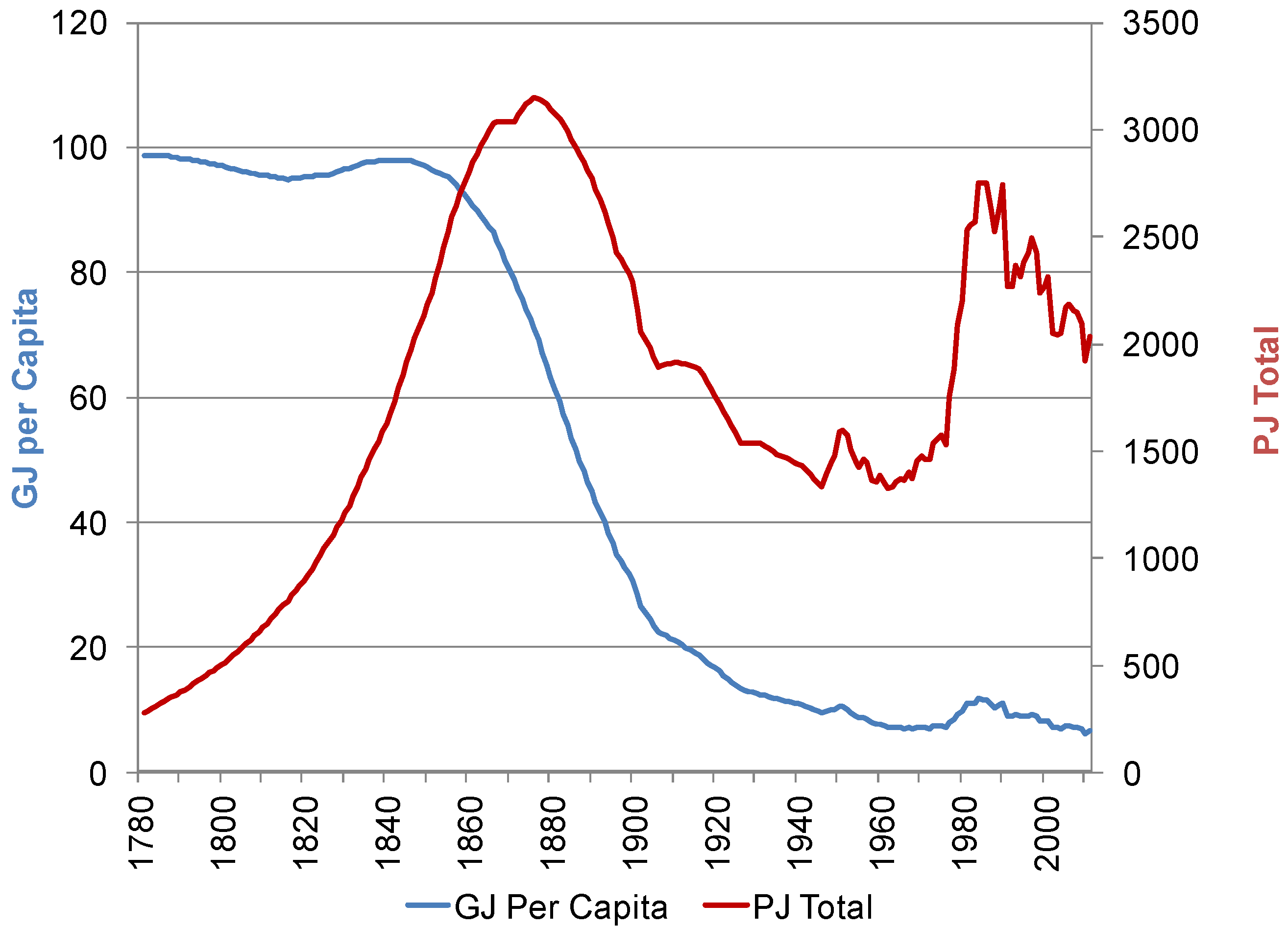
Reynolds and Pierson (1942) [33] estimate firewood consumption in the early U.S. based on climate, demographics, housing conditions, deployment of stoves, and market penetration of coal. They reports annual consumption peaking at 4.5 cords per capita in 1840, or about 100 GJ per capita. For comparison, a poor country in a warmer climate may use 10 GJ per capita, and Northern and Western Europe in the nineteenth century used 15–50 GJ per capita in wood stoves [2].
Fuel wood produced as a byproduct of clearing land accounted for “more than half, possibly much more” of all fuel wood used between 1850 and 1860 ([1], p. 50). Stoves were slow to gain acceptance because the fuel savings from increased efficiency did not warrant the high capital cost (including transportation) and the additional labor required to cut wood small enough for use in stoves. The Franklin stove was invented in the 1740s, but even in the densely-populated Northeast “the general and widespread use of the wood stove did not come about much before 1840 ([33], p. 4)”.
The vast majority of firewood was used for heating, but wood also performed mechanical work in steam engines. Railroad use of fuel wood peaked at 3 percent of overall wood use in 1860, when wood represented 90 percent of locomotive fuel [34]. Wood for all steam power (railroads, steamboats, and industry) was about 5 percent of total wood consumption in 1860 [9]. Wood was also burned to produce charcoal for iron smelting (about 100 million cords), and lumber waste was burned for power by sawmills (about 550 million cords). These latter quantities are excluded from the data series in [33]; they represent about 13 EJ of energy, out of nearly 12 billion cords (240 EJ) consumed from 1780 through 1930. Statistics of fuel wood consumption are shown in Figure 4, below. Energy content used in this analysis is from [9], with a cord of wood at 22.1 GJ prior to 1900, 21.3 GJ in 1900, and 20.5 GJ after 1900. The declining energy content is due to a larger proportion of softwood used.
Figure 4.
U.S. fuel wood consumption, 1780–2010. Sources: [33] and [25].
Wood remained the primary source of space heating for 2.8 million U.S. homes in 2009, and a secondary source of space heating for an additional 8.8 million homes (EIA 2013a) [35]. Wood and wood waste currently represent the third largest source of renewable electricity, behind wind and hydropower.
2.6. Other Bioenergy
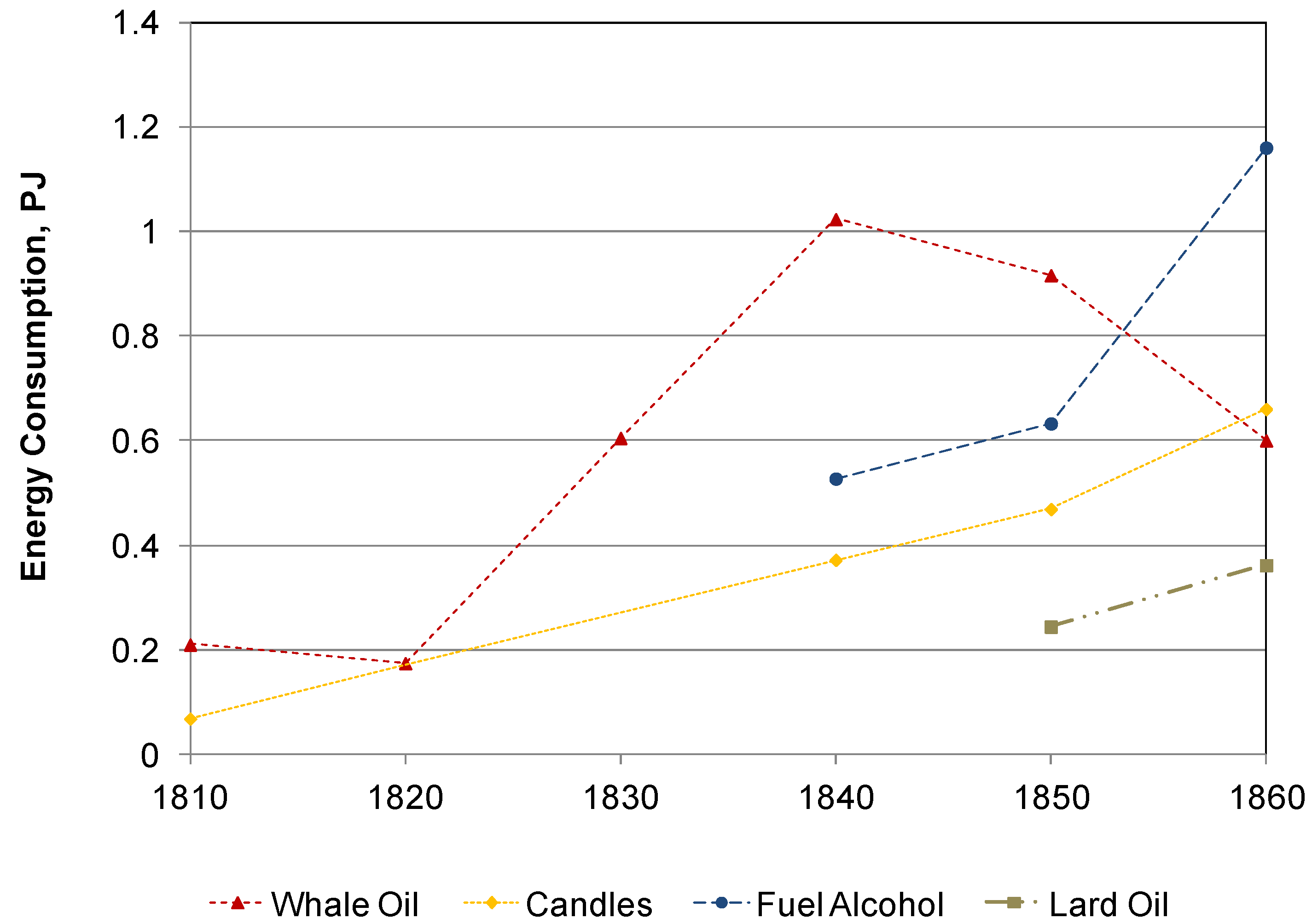
Other bioenergy used for energy in the nineteenth century included whale oil, spermaceti, lard oil, tallow, and camphene (a fuel made from alcohol, turpentine, and camphor oil). These fuels were generally used for lighting. Tallow candles, animal oils, and alcohol-based fuels each represented energy inputs of about 1 PJ in 1860, when the United States’ energy consumption was about 3800 PJ. Petroleum was 3 PJ in 1860, its first full year of use, and wind and water energy inputs were about 11 and 8 PJ respectively. The total of “other bioenergy” is three orders of magnitude less than fuel wood (2800 PJ) in energy terms, but in economic terms it is probably only one order of magnitude less. These lighting fuels were valued at roughly $20 million; consumption of 125 million cords of wood represents perhaps 200 million worker-days, valued at about $200 million. These lighting fuels were roughly two orders of magnitude more valuable per unit of energy than heating fuels.
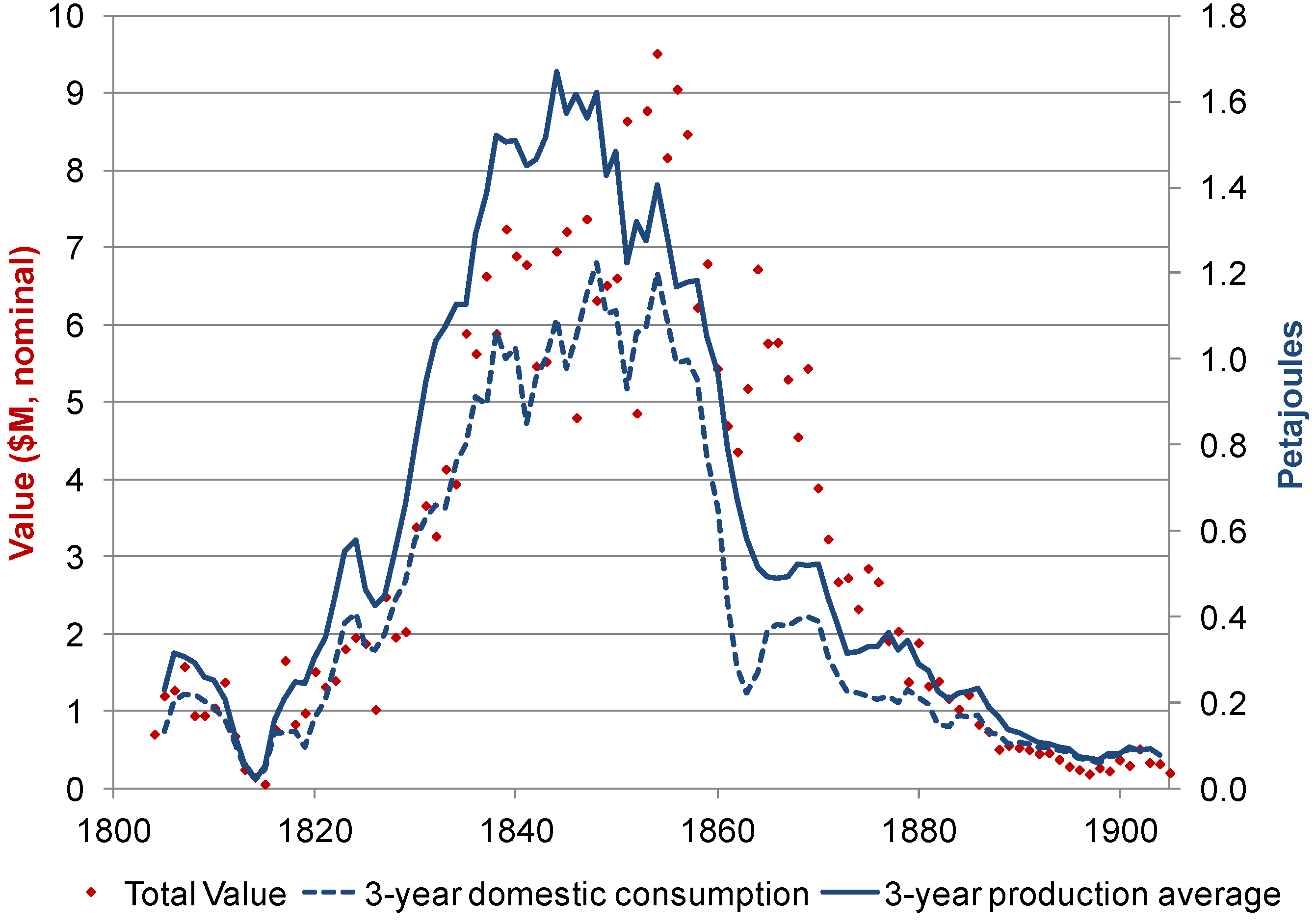
The whale oil production series from 1804 through 1905 is based on Clark (1887) [36], Starbuck (1878) [37], and Tower (1907) [38] (Figure 5). Sperm whale oil peaked in the early 1840s. It commanded high prices due to its superior performance in lamps, providing bright light with minimal odor. Lard oil was prone to congealing (Davis et al., 1997) [39], and fish oil had an unpleasant smell and produced lower-quality light (Fouquet and Pearson, 2006) [40]. The demonstrated demand for high-quality lighting spurred innovation and competition. Lard oil improved due to new refining techniques in the late 1830s, gas lighting companies operated in the five largest cities by 1840, and camphene entered the lighting market in the 1830s [39]. The three-year running average of the combined whale oil yield peaked at 1.7 PJ in 1844. Domestic consumption was likely near 1 PJ in most of the years between 1836 and 1858.
Figure 5.
Whale oil production, consumption, and total value. Sources: [36,37,38].
Biomass such as tallow and spermaceti was widely used for making candles prior to the development of paraffin from petroleum. The Census often reported the combined dollar value of tallow candles and soap. Assuming tallow candles to represent 50 percent of the combined dollar output in 1850 and 1860 and employing prices from Bezanson, Gray, and Hussey (1937) [41] results in the quantities shown in Figure 6.
Figure 6.
Consumption of other biomass fuels, 1810–1860. Sources: [13,27,42]. Candle quantity inferred from prices in [41].
The 1860 Census [42] reported a range of fuels used in the U.S., shown in Table 3. Bezanson, Gray, and Hussey (1937) [41] and Bezanson (1954) [43] allow conversion of dollar values into volume. Noncommercial use of biomass fuels, such as tallow candles rendered and consumed on farms, or charcoal produced and consumed by the same foundry, would not be included here.
Table 3.
Commercial energy production in the United States census, 1860. Source: [42].
Alcohol was used for fuel and as a chemical feedstock, in addition to its consumption as spirits. Distilleries in the mid-1800s sold between 33% and 80% of their product as fuel [44]. Wells (1866) [45] estimates 1860 consumption of distilled spirits for burning fluid at over 25 million gallons, or about 28% of total production. Escalating taxes were applied to alcohol to pay for the Civil War, and alcohol-based fuels rapidly lost market share to petroleum.
Biomass-based fuels such as biodiesel and ethanol have increased in recent years. In 2000, biofuels amounted to 232 PJ, equal to 0.6% of petroleum consumption. In 2010, biofuels totaled 1841 PJ, equal to 4.9% of petroleum consumption. This increase is driven by several political reasons, including “energy security” local economic development, and climate change. Biofuels have uncertain climate benefits. Indirect impacts on land use are potentially large, if the demand for biofuels causes a rise in food prices that leads to the clearing of forested land for agriculture. Searchinger et al. (2008) [46] and Fargione et al. (2008) [47] investigate these impacts.
The rapid rise of petroleum led numerous commentators both at the time and since to surmise that the discovery of oil “saved the whales”, including Freese (2004) [48], Levitt and Dubner (2009) [49], and others. However, Ellis (1991) [50] points out that modern mechanized fleets could hunt blue whales, which the older wooden ships could not. Modern whaling killed over one million whales between 1904 and 1978, compared to about 300,000 during the nineteenth century [45]. Baker and Clapham (2004) [51] put the twentieth century total as two million for the Southern Hemisphere alone. Environmentalism “saved the whales” although some species face fishing pressure. Petroleum lowered the value of whale oil enough that societies would allow the conservation movement to curtail whaling, but that there remained any continued demand for whale oil for a century after the discovery of petroleum is a testament to another attribute of energy resources: as long as they have a significant energy return on investment, markets will find some use for them.
2.7. Ice
Ice cut from frozen ponds and lakes in the winter provided another form of energy in nineteenth century America. It has not normally been included in surveys of energy use, but it launched an energy service that now accounts for a considerable portion of United States electricity demand. The ice trade was comparable in value to crude petroleum production in 1880 [52], and comparable in energy content to wind and waterpower in that decade. The ice trade pioneered the commercial provision of a new energy service, and contributed to societal developments that influenced later patterns of energy use. These range from the popularity of ice cream and lager beer to the transport of exotic fruit, fresh-caught fish, and butchered meat.
A “ton of refrigeration” is derived from the heat absorbed by a ton of ice as it melts, which is 288,000 British Thermal Units (BTU), or 304 MJ. Jones (1984) [53] notes that the peak year was 1886, in which ice cut from frozen lakes amounted to 25 million tons. This represents about 7.6 PJ out of the 6940 PJ used in that year, so about 1 part in 1000. This far exceeds the peak amount of energy obtained from whaling (about 1.8 PJ produced in 1847). By 1886, wind accounted for about 6 PJ extracted from the environment, and waterpower about 10 PJ. Ice was therefore of similar magnitude to those energy inputs, and about 13% the size of oil’s energy inputs in that year.
Harvested ice found markets in brewing (due to the increasing popularity of lager beer, beginning in the 1840s), meat-packing (due to expanding railroads and local pressures to move slaughterhouses out of city centers), fishing, and domestic use. By 1845, fish from Boston and Maine were packed on ice and sent inland on railroads, and ice was carried on board fishing ships for preserving the catch [54]. Artificial ice-making began to take hold in the warmer Southern cities where the price of natural ice was high, beginning with a New Orleans plant selling ice for $35/ton in 1868 [55]. New York City’s consumption in 1906 was 4 million tons of ice, of which manufactured ice supplied only 700,000 tons [56]. Cummings (1949) [57] places the supply of natural and manufactured ice as nearly equal in 1914; both cooling technologies were soon thereafter replaced by electromechanical refrigeration for most purposes.
The decline of the natural ice industry was caused principally by reductions in the cost of manufactured ice. In energy terms, harvested ice was replaced by coal, which supplied the manufactured ice plants either directly or through central power stations. Substantial improvements in the operations of the natural ice industry were outpaced by even greater advances in manufactured ice [58]. In this regard, the transition from natural ice to manufactured ice is similar to the transition from sailing ships to steamships, as the pressures of competition spurred innovation in the established technology. Pollution increased costs of harvested ice. The lower Hudson River became so contaminated with sewage that its ice could not be used, and more remote sources had to be tapped [56].
2.8. Coal
The previous seven sections document the harnessing of energy flows. With proper management, an economy dependent on muscle power, wind, water, fuelwood, tallow, alcohol fuels, and ice would not face any long-term depletion of its energy resources. Wrigley (2010) [11] characterizes such systems as organic. Wrigley (p. 193) states, “An industrial revolution is physically impossible without access to energy on a scale which does not exist and cannot be secured in organic economies … Wind and water power do not suffice”. In the United States, water-powered factories, charcoal-smelted iron, and wood-fueled locomotives and steamboats sustained the first decades of industrial expansion. However, mineral fuels, which tap into energy stocks rather than flows, can support a much higher level of industrial activity—for as long as those resources last.
The ancestors of most American colonists had heated their homes with coal. Britain, and particularly England, faced land-based limits to fuelwood use since the Renaissance era. But the American colonists settled in the heavily forested East Coast, and relied on wood for heating energy. Philadelphia in 1820 was only beginning to shift from fuel wood to coal [48], and wood cost slightly less per MJ than coal in that city in 1826–1827 [1]. Despite the longstanding use of coal in England, the knowledge of how to burn coal effectively did not persist in many regions of Colonial America [1]. Attempts to market coal in the 1840s faced considerable resistance due to unfamiliarity with its use. Attempts at using anthracite as a fuel failed in Philadelphia in 1803 [48], and early railroads experienced similar failures [34]. Eventually, declining costs of coal enabled the fuel to overcome initial reluctance to its use. Coal was $7–$10/ton in the 1830s, but had fallen to $3/ton by the mid-1850s, and in 1862 the Baltimore and Ohio railroad could obtain coal at $0.75/ton [34]. The ability of railroads to obtain cheap coal was in part a result of their ownership of coal mines.
More than any other factor, the gravimetric and spatial energy density of coal enabled it to surpass wood. A kilogram of coal has about 33 percent more energy than a kilogram of dry wood. This gravimetric energy density advantage enables modest cost savings in transportation. An acre of coal field has several thousand times more energy content than an acre of forest. A forest might have 20 cords of wood per acre, equivalent to about 15 tons of coal. At a yield of 1800 tons per acre-foot, a coal seam one inch thick would have ten times the energy content of the forest. The concentration of so much energy in one place allowed for tremendous savings in fuel transportation costs by routing rail lines through coal fields or locating factories near mine-mouths. Wrigley [11] recounts that in Britain as well, coal’s spatial density provided a powerful impetus to modernize transportation infrastructure. Steam engines became the dominant power source for factories around 1870, and held that position for around 45 years. Electric motors supplanted steam engines by 1920. In this transition, coal continued to be the most important energy source for factories, although now first converted into electricity and then into motive power.
Schurr and Netschert (1960) [1], Freese (2004) [48], Eavenson (1942) [59], and many others provide an excellent discussion of coal’s ascent as an energy resource in the United States. Wrigley (2010) [11], Allen (2009) [10], and Fouquet (2008) [5] focus on England or Great Britain, but many of the same factors influenced coal’s history in the United States. As the defining fuel of the Industrial Revolution, coal has been strongly tied to cultural views. It shapes these views and is shaped by them. Turnheim and Geels (2012) [60] discuss the loss of coal’s cultural legitimacy in Great Britain as a factor in the industry’s demise, as its competitors positioned themselves as “clean” and “modern”. Coal also necessitated changes in aesthetics. Coal soot from domestic heating led to the abandonment of tapestries in interior decoration, and soot from railroads led to decreased use of color in the design of both locomotives and the uniforms of engineers [48], possibly also diminishing the social status of the engineer.
Data on U.S. coal production and consumption prior to 1800 is very sparse, with Eavenson (1942) [59] providing estimates for imports and for production from Virginia fields. Table 4, below, shows the record of U.S. coal consumption.
Table 4.
Coal consumption in the United States, 1780–2010. Sources: [6] for 1800–1900; [1] for 1910–1950; [25] for 1960–2010. Consumption for 1780 and 1790 estimated using a 9% annual growth rate to reach 1800 level.
2.9. Oil
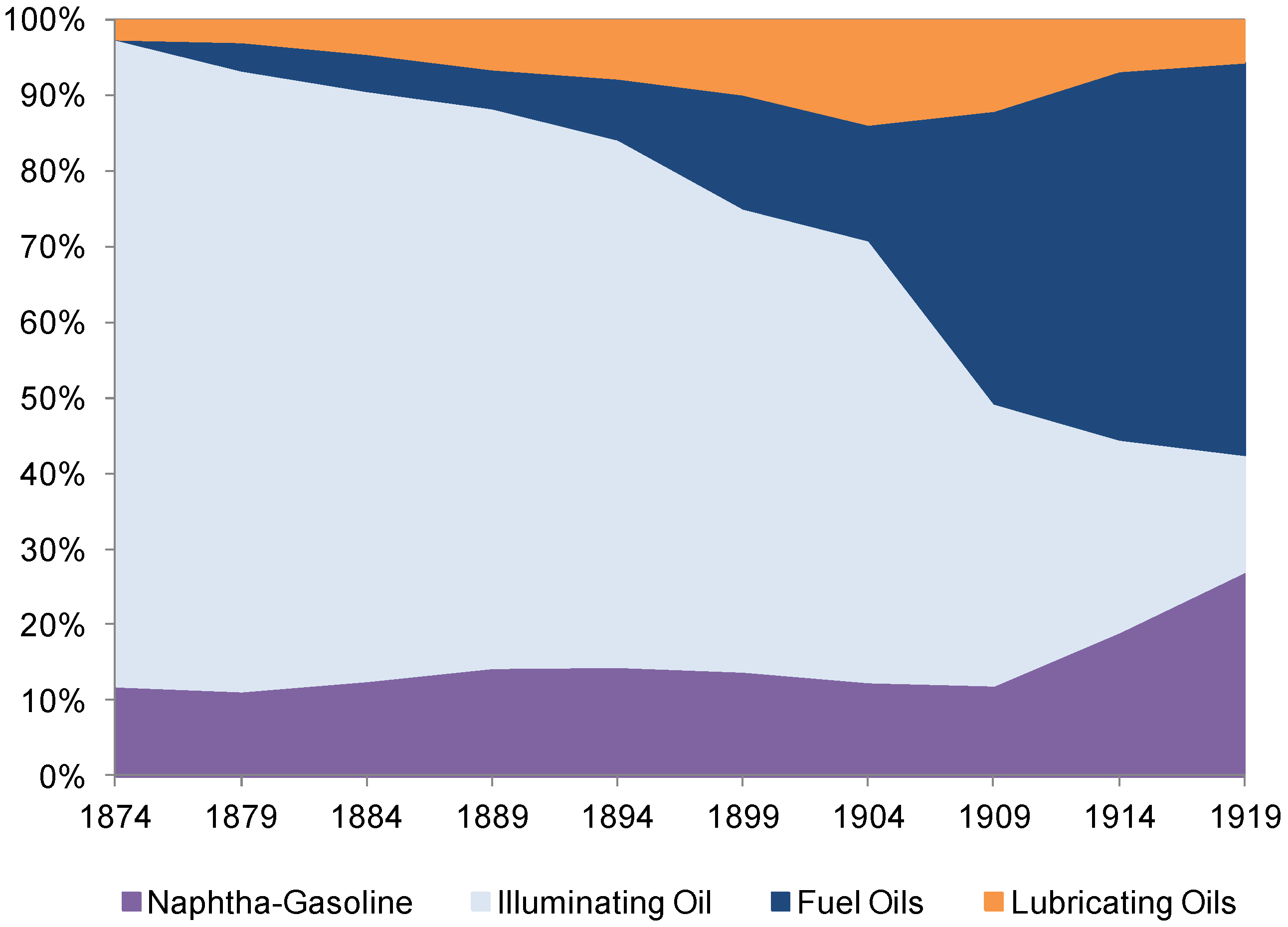
The discovery of oil at Titusville in 1859 was the beginning of the American oil industry. Williamson and Daum [61] characterize from 1859 to 1899 as “The Age of Illumination”. Figure 7 shows the transition in shares of refinery output over the period 1874–1919 (prior to this, the mix was similar to that in 1874), based on [61,62,63]. Illuminating oils represented 82 period of refinery output from 1883 to 1885, but just under 50 period by 1904.
As transportation became a more important application for petroleum, gasoline and fuel oil became the dominant products. Kerosene and lubricating oil have since dwindled to minimal components of refinery output. Fuel oil comprised over 50 percent of refinery output in the years 1920 and 1925, but motor gasoline overtook it by 1930.
Figure 7.
Shares of U.S. oil refinery output, 1874–1919. Sources: [61,62,63].
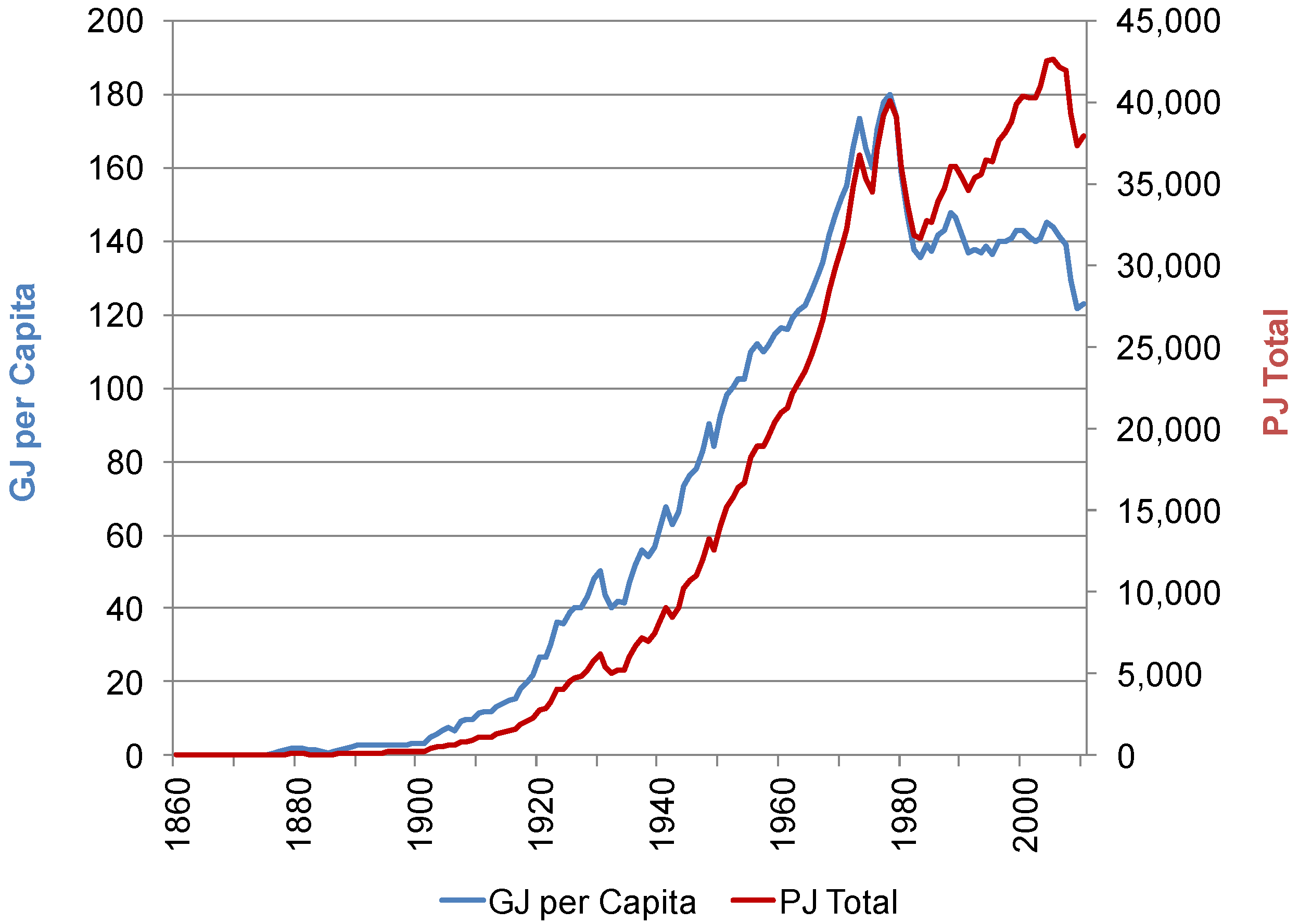
Oil production is well documented over the industry’s period of existence. We follow EIA’s methodology by including natural gas liquids with petroleum consumption. Totals of United States petroleum consumption are shown in Figure 8.
Figure 8.
U.S. petroleum consumption, 1860–2010. Sources: [1] for 1860–1948; [25] for 1949–2010.
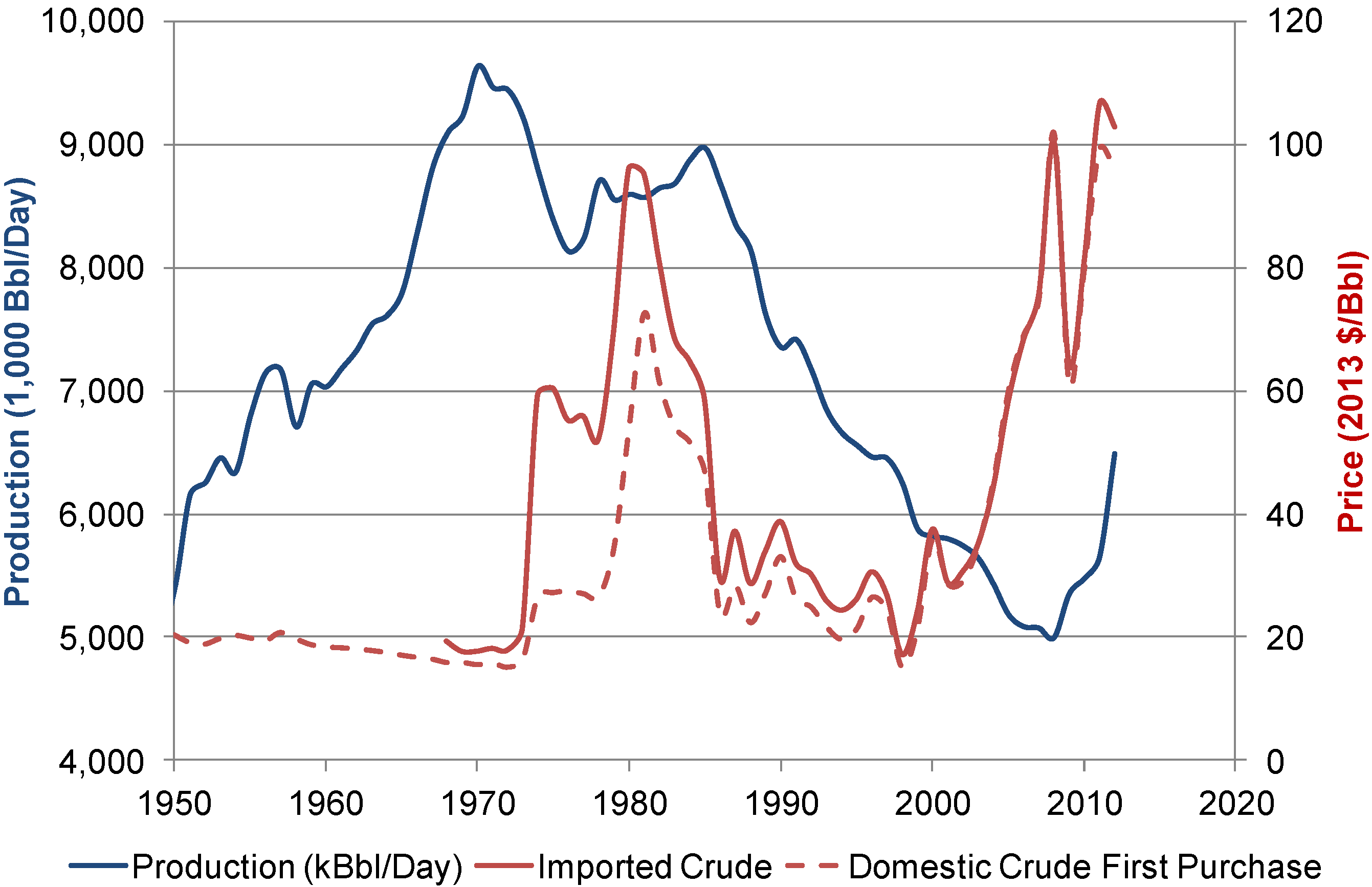
Domestic petroleum production grew until 1970, then peaked and declined as production grew more expensive. Depletion of low-cost resources raised the cost of producing domestic oil, and the availability of a low-cost substitute (imported oil) led to declining production. Recent advances in horizontal drilling and hydraulic fracturing technology have enabled tight oil production to expand in North Dakota, Texas and other regions. Oil production has also increased in the Gulf of Mexico due to advances in the methods of offshore exploration and production in deep water. As a result, after nearly 40 years of decline, oil production in the United States increased from 2009 to 2012, as seen in Figure 9. This production increase has been motivated by higher prices (also seen in Figure 9). These higher real oil prices have suppressed demand, with petroleum consumption per capita falling by 15 percent from 2005 to 2010.
Figure 9.
U.S. oil production and price, 1950–2012. Sources: [64] for prices; [65] for production levels.
2.10. Natural Gas
Natural gas is a relatively young industry with a well-documented record of production. Naturally occurring natural gas was discovered and identified in the United States as early as 1626, when French explorers discovered Native Americans igniting gases that were seeping into and around Lake Erie. In 1821, William Hart of Fredonia, New York drilled a 27 foot deep well in an effort to get a larger flow of gas from a surface seepage of natural gas. This was the first well intentionally drilled to obtain natural gas.
Without any way to transport it effectively, natural gas was usually vented to the atmosphere, burned when co-produced with coal and oil, or simply left in the ground when found alone. It took the construction of pipelines to bring natural gas to new markets. Improvements in metals, welding techniques, and pipe made pipeline construction more economically attractive beginning in the late 1920s.
Natural gas subsequently captured a significant share of applications from industry to electricity generation to residential and commercial space heating. Household demand for clean fuel was one reason for increased production of natural gas [2]. In addition to producing fewer emissions, natural gas furnaces and stoves require virtually no attention on the part of the homeowner, compared to coal furnaces and stoves which required considerable stoking and cleaning [66]. In some cities, policy initiatives aimed at reducing air pollution served to encourage the use of natural gas [67].
Prior to the widespread development of natural gas resources, manufactured gas from coal provided light. “Town gas” was an energy carrier, not an energy resource, and does not have a consumption series of its own; consumption of coal includes that used to produce town gas. Gas lighting experienced competitive pressures from electricity, and made strides in improving efficiency during this transition. Welsbach’s first incandescent mantle for gas lighting was patented in 1885. Fouquet and Pearson (2006) [40] consider this to have tripled the efficiency of gas lights. Much like the case of sailing ships or ice harvesting, improvements in the mature technology were outpaced by innovations in the emerging technology, in this case electric lights. Natural gas consumption is shown in Figure 10, below.
Figure 10.
U.S. natural gas consumption, 1880–2010. Sources: [1] for 1880–1948; [25] for 1949–2010.
2.11. Nuclear Power
This analysis only considers nuclear power used for central station electricity generation. Nuclear energy used for naval vessel propulsion is not included. Figure 11 uses the EIA conversion of nuclear power generation to energy supply, based on the thermal heat rate of nuclear power plants.
Figure 11.
U.S. nuclear energy consumption, 1960–2010. Source: [25].
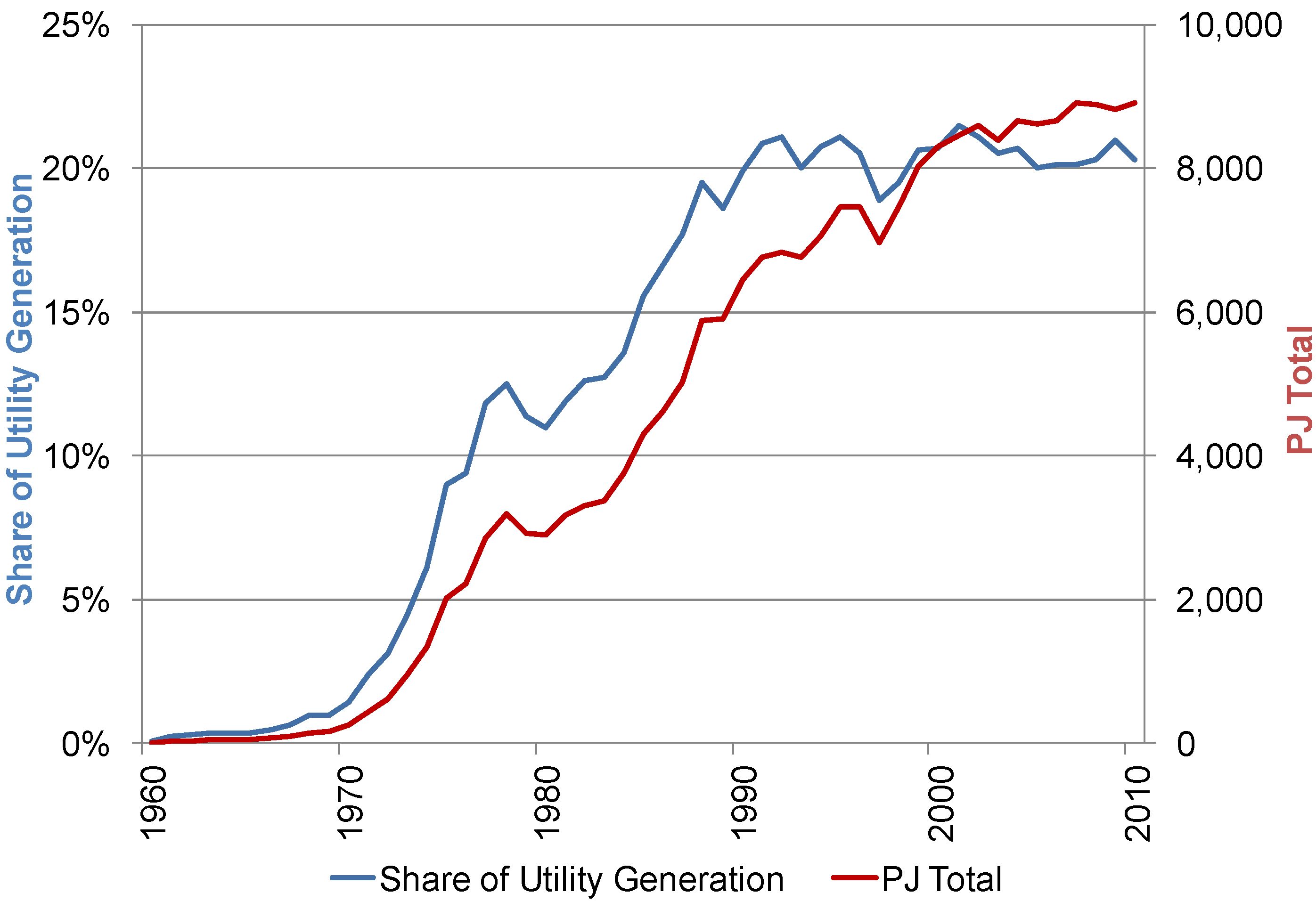
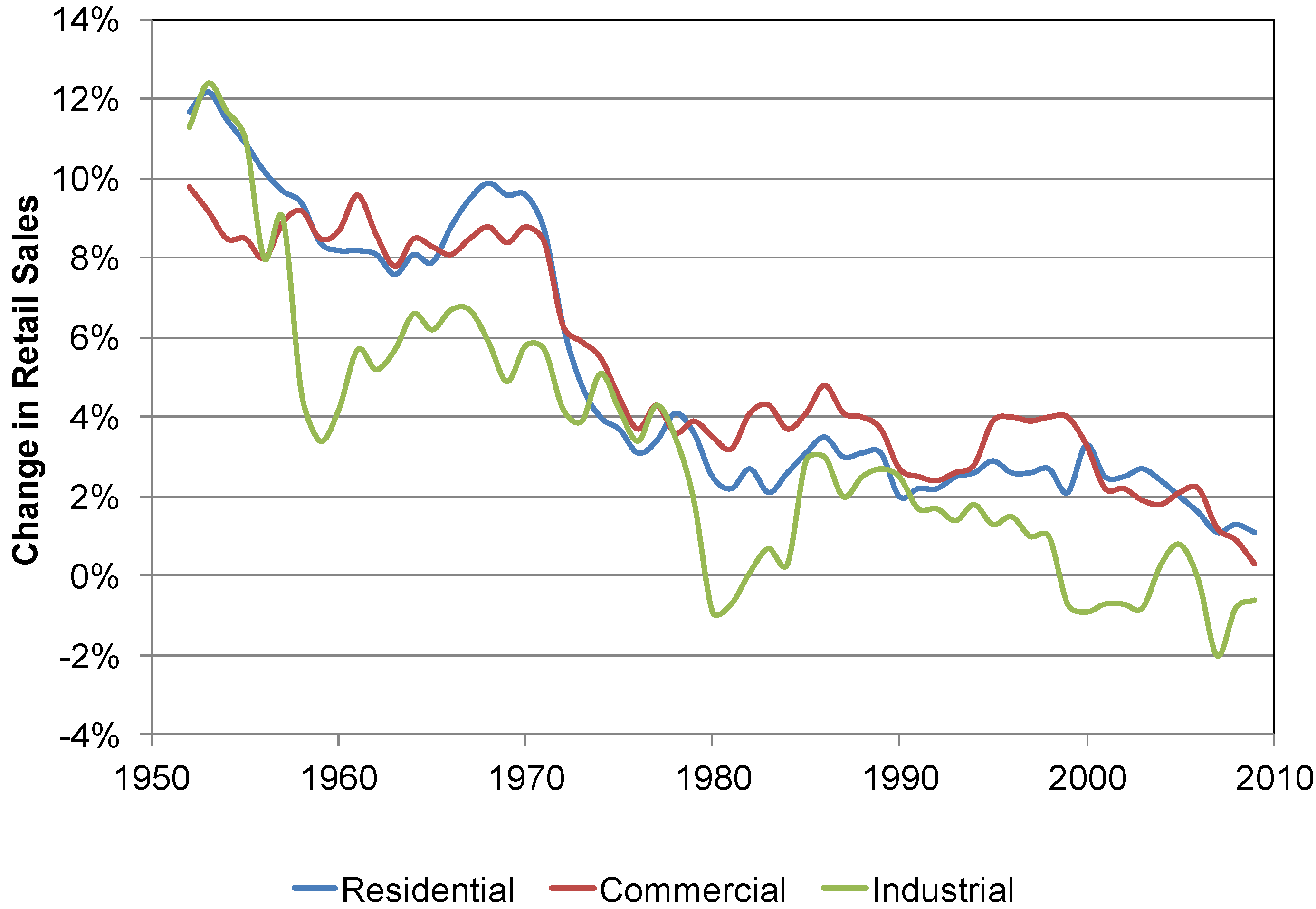
Nuclear power grew rapidly in its early years, and many analysts forecast that it would claim a large share at least of the electricity market, if not overall energy consumption (e.g., Marchetti (1992) [68]; Haefele et al. (1981) [69]; Kursunoglu (1983) [70]; Fortescue (1983) [71]). But nuclear power’s share of net electricity generation peaked at about 22 percent in the early 1990s, and plateaued recently at 18 to 19 percent. Grubler (2012) [3], Smil (2008) [38], and others described this is as a transition that failed to occur. A number of factors contributed to the stall, including slower demand growth for electricity (Figure 12), rising costs for new installed nuclear capacity, safety concerns due to accidents at Three Mile Island (1979, Pennsylvania) and Chernobyl (1986, Ukraine) and Fukushima Daiichi (2011, Japan), the absence of plans for long term waste disposal, and possible connections to weapons proliferation.
Figure 12.
U.S. electricity retail sales growth rates, Five-Year average, 1952–2009. Source: [25].
2.12. Chemical Energy
Chemical energy used in the nineteenth century included gunpowder, matches, explosives, and batteries. Although not of major significance in energy terms, they were moderately significant in economic terms and had a high value per energy unit. Gunpowder is an energy carrier that was often both mineral and biomass-derived. Black powder was partly charcoal by composition, and some potassium nitrate was obtained from guano. At about 1.4 MJ per pound, gunpowder has roughly one-tenth the energy content of coal. The 1840 production of 9 million pounds would be equal in energy content to about 450 tons of coal, whereas actual coal production in that year was 1.3 million tons.
Chemical energy was more significant in terms of energy expenditures, with perhaps $12 million for combined gunpowder, high explosives, fireworks, and matches in 1880, compared to about $100 million for coal, $16 million for oil, and $28 million for ice. Electrochemical batteries are not explicitly recorded in most Census reports, although they provided the power for telegraphs from 1844 until the 1880s.
3. Results
3.1. Primary Energy Use
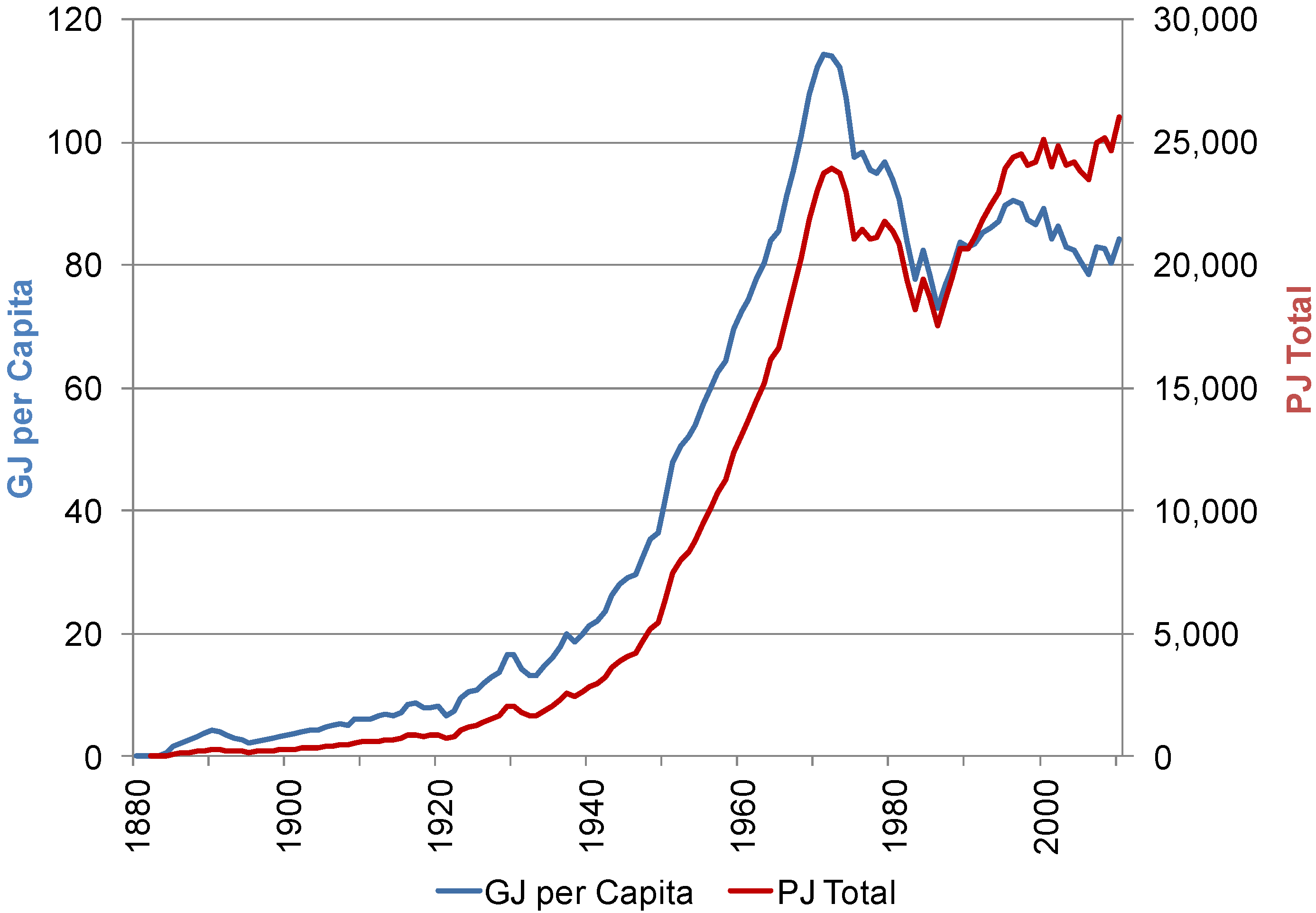
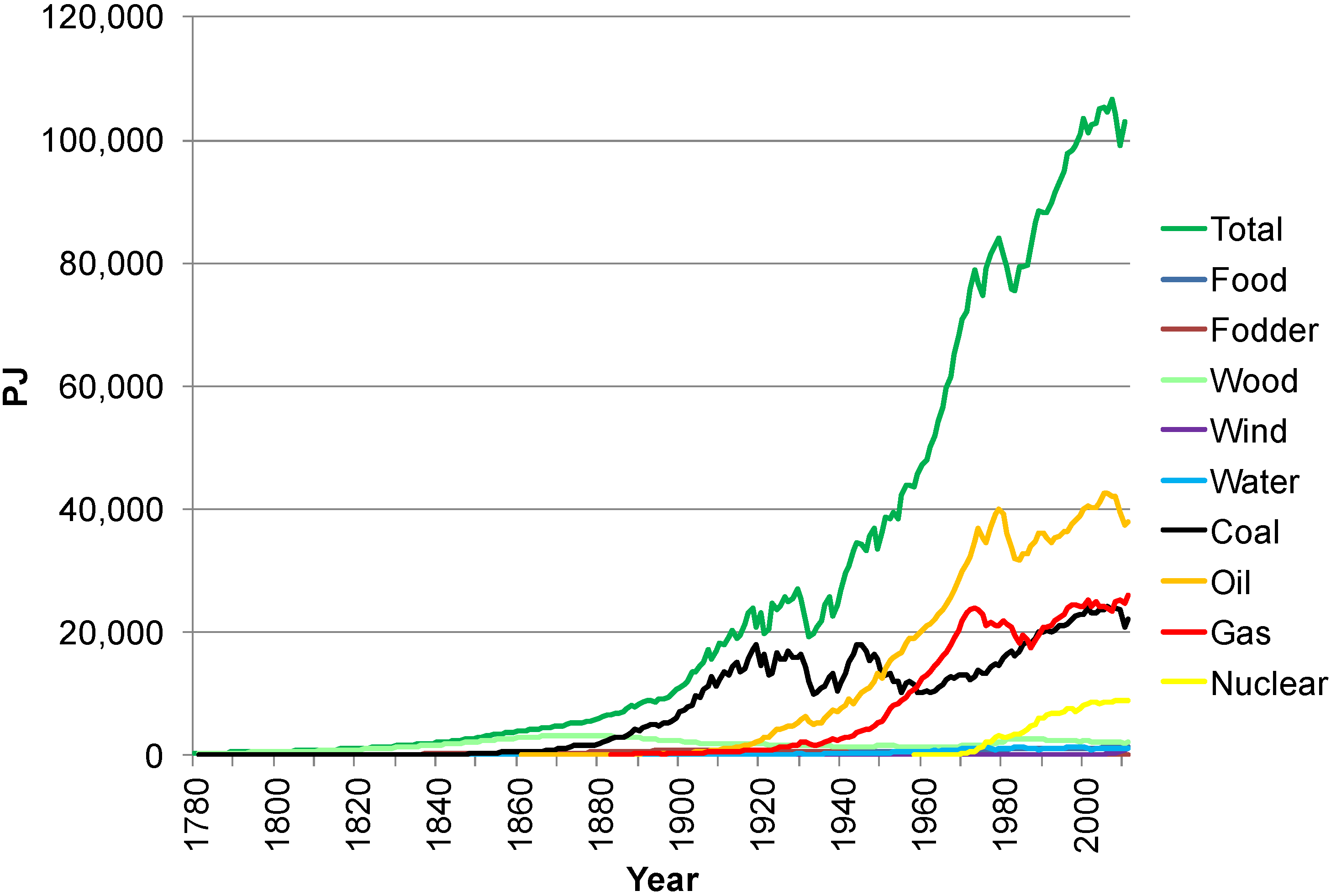
Figure 13 shows energy use in the United States from 1780 to 2010, including traditional and commercial sources of energy. The most striking feature of the nation’s energy use is the substantial increase in the quantity consumed, from about 0.3 EJ in 1780 to about 105 EJ in 2007. Energy use in 2000 was nearly ten times as great as it was in 1900, and in 1900 it was eighteen times as great as it was in 1800. The secular increase in energy use is coincident with similar increases in population, economic growth, and rising affluence. The impacts of major geopolitical and economic events are clearly visible: the Great Depression, major recessions, world wars, and the oil price shocks of the 1970s and 1980s.
Figure 13.
U.S. energy consumption, 1780–2010. Sources: various; see individual energy series in Section 2.
3.2. Transitions in Primary Energy Supply
What determines the start and endpoint of an energy transition? This is not an easy question to answer since many energy systems are in a constant state of flux, albeit very slowly in many cases. In terms of national primary energy use, Smil (2010) [72] argues that the time when a new energy source captures five percent of total energy demand is a reasonable benchmark for the start of a transition. With that in mind, we can turn to a discussion of the major energy transitions in the United States since 1780 (Figure 14 and Figure 15).
One of the most striking features is the dominant role that wood played in the nation’s early economic development. Coal is generally regarded as the fuel of the Industrial Revolution, but that is a misconception as Figure 14 and Figure 15 clearly demonstrate. Wood retained a 50 percent share of total energy use through the mid-1880s. At the turn of the twentieth century, it still accounted for nearly 25 percent of energy use. The United States’ share of total world manufacturing output had surpassed Germany’s by 1860, and surpassed the UK’s share sometime around 1890 (Bairoch, 1982) [73]. Coal is known to have been essential to the ascendancy of American industry on a global scale as a source of heat and power, and later as a source for thermal energy in electricity generation. However, the early launch phase of that ascendancy was clearly powered by the nation’s forests.
Figure 14.
Shares of inputs to U.S. energy consumption, 1780–2010. Sources: various; see individual energy series in Section 2.
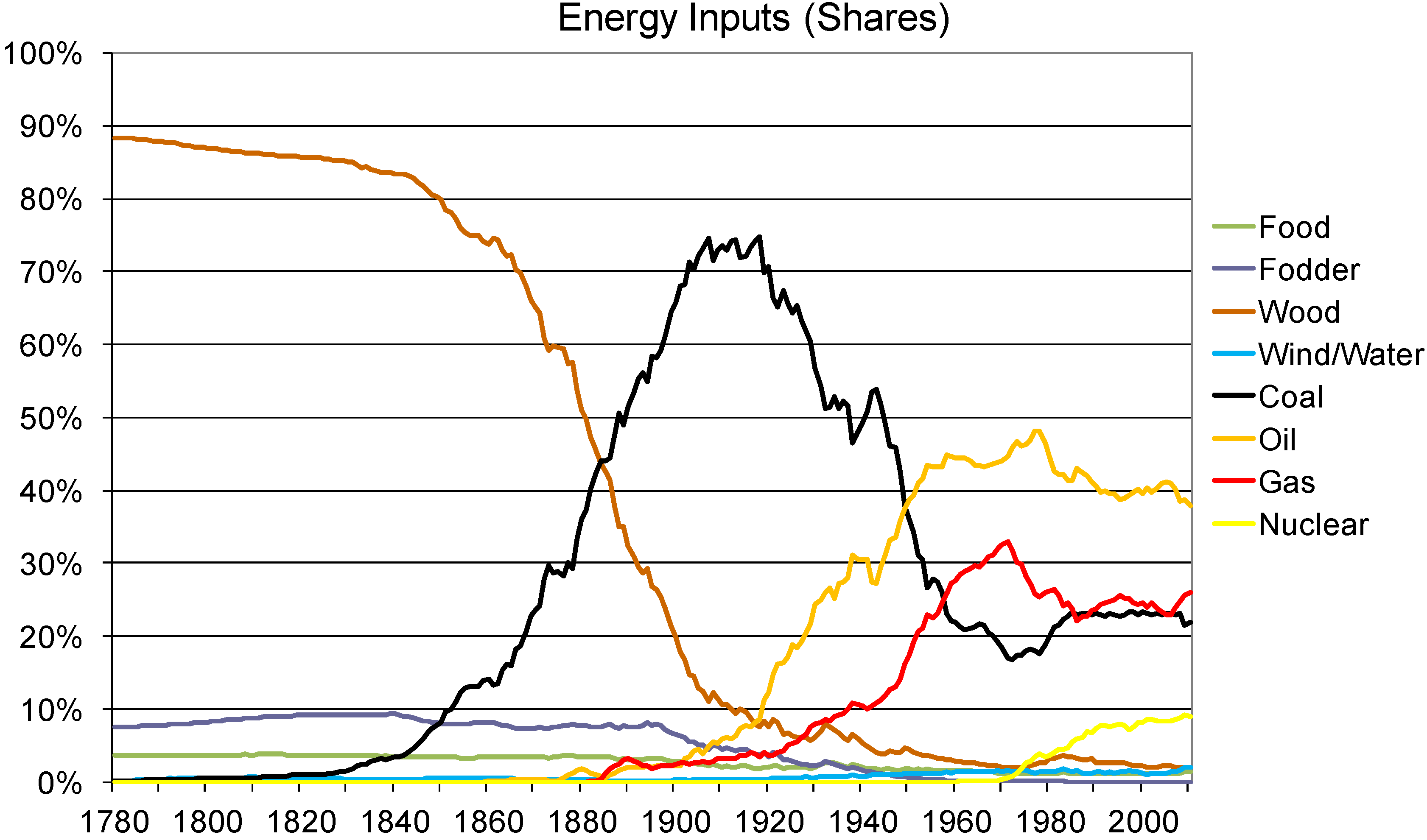
Figure 15.
Shares of inputs to U.S. energy consumption, 1780–2010. Sources: various; see individual energy series in Section 2.
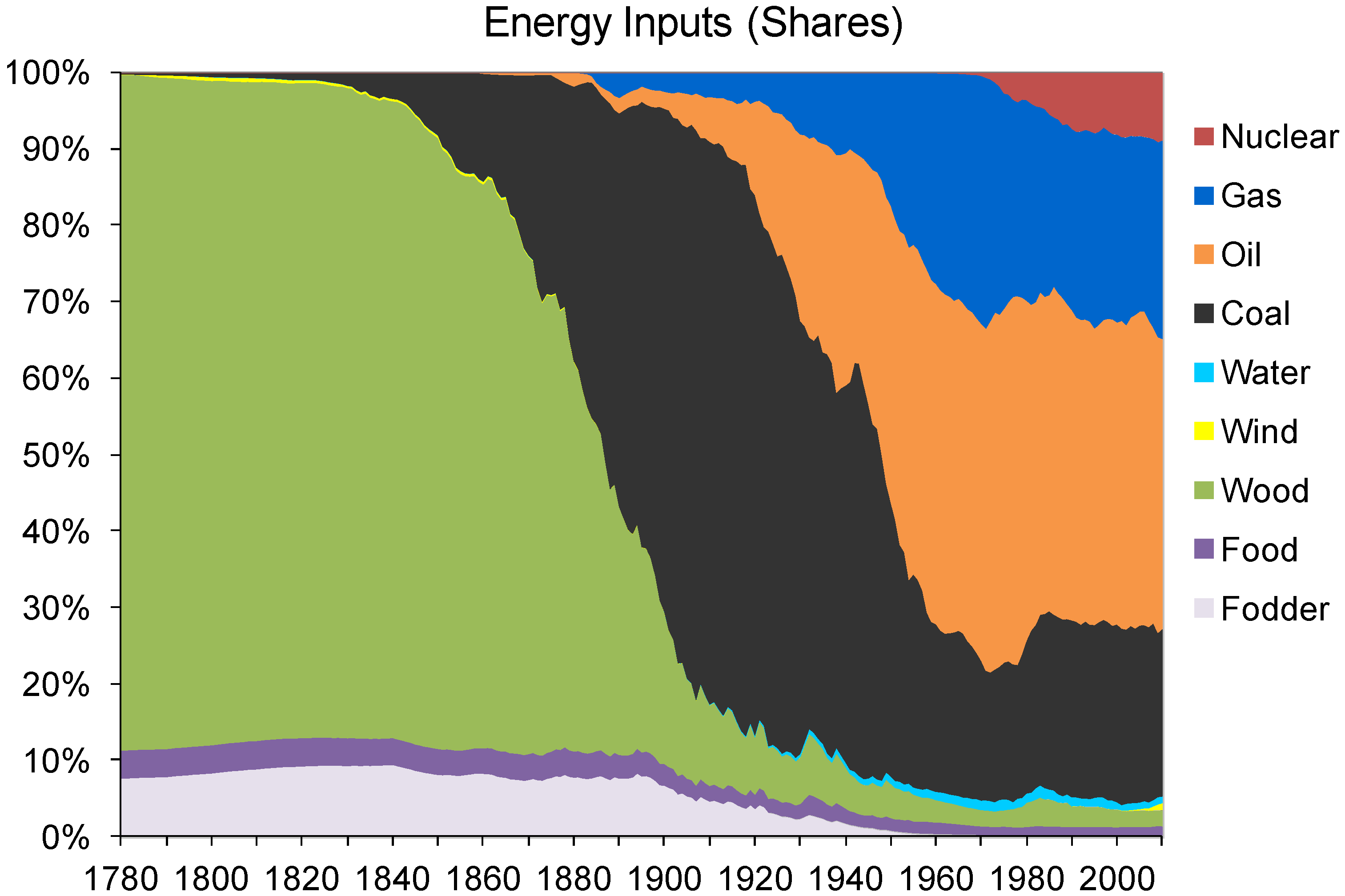
The first major transition was from wood to coal. Coal reached a five percent share of energy use in the mid-1840s, but it took another quarter century for its share to reach 25 percent. It did not reach a 50 percent share until the late 1880s, some four decades after the “launch” of its ascendancy. The principal applications of coal that drove its ascendancy were the steam engine, in transportation and stationary applications, iron production, and electricity generation. The peak of coal’s dominance occurred in the first decade of the twentieth century when it accounted for about 75 percent of energy use. This occurred approximately seventy years after it captured its initial five percent share.
The next major transition was the replacement of coal by oil. The first oil was produced in 1859 in the United States, but it did not capture a five percent share until about 1905. Oil was very slow to replace the dominant role of coal. It was not until the development of the gasoline and diesel engines in the late nineteenth century, and their realization through the automobile in the early twentieth century, that oil began to rapidly increase its share. The discovery of large quantities of oil in California, the Gulf Coast, and the mid-continent region in the first decades of the twentieth century generated large quantities of cheap fuel for the automobile. Oil achieved a 25 percent share of total energy use in about 1930, but it wasn’t until the post-World War II boom in motor vehicle adoption that oil actually surpassed coal’s share of total energy use. That occurred in about 1950, nearly half-century after oil captured its initial five percent share. Oil’s share peaked at just under 50 percent in the late 1970s.
The overall pattern of natural gas’ share of energy use roughly mirrors that for oil, but it is displaced in time by several decades, and gas’ maximum share never matches that of oil. Natural gas reaches five percent of energy use in about 1925; its share rapidly expands when much of nation’s natural gas pipeline system was constructed in the 1930s and 1940s. Natural gas surpassed coal in terms of its share of energy use in about 1960. The share of gas peaked in about 1971 at 33 percent of total energy use.
3.3. Mechanical Work
Work refers to the services provided by energy. Although the term can encompass energy services such as lighting, cooling, and chemical synthesis, early energy scholars focused on mechanical work. Motive power was the first application in which machines competed with and replaced draft animals and human laborers. The measurement of cars engines in horsepower illustrates the quantity of mechanical power that supports modern American citizens compared their ancestors. Dewhurst ([9], p. 1102) notes, “of special significance for the economy are the amounts and kinds of energy devoted to the performance of work and the amounts of work performed … It includes only those operations which have been or could be done (however inadequately) by the muscle power of animals and men” (italics in original). The emphasis on mechanical energy is not a feature of most modern energy analyses. It is interesting to see from a historical perspective how many “workers” were built as sailing ships and waterwheels in the 19th century.
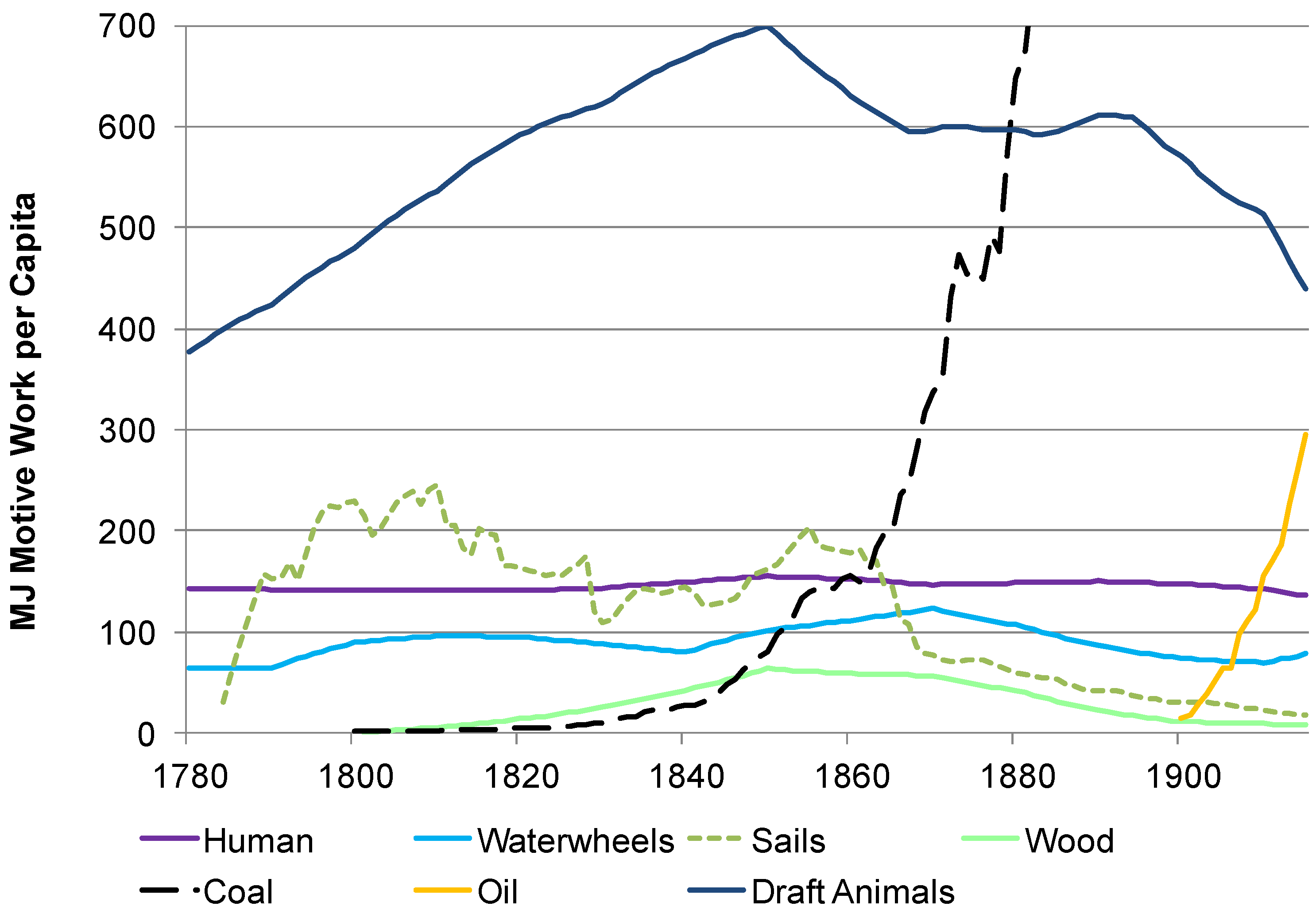
The contributions of the energy sources to the performance of mechanical work are shown in Figure 16. Wind and water are much more significant in mechanical work output than in energy input, amounting to the same order of magnitude as human muscle power in the mid-1800s, as seen in Figure 16. Animal power is consistently above 300 MJ per capita from 1780 until 1923. Coal quickly rises off the graph, as does oil once the automobile comes on the scene.
Throughout most of the nineteenth century different fuels dominated energy supply and work output, with wood for the former and animal muscle for the latter. The steam engine (and, later, the internal combustion engine) allowed thermal fuels to be converted into mechanical work. Since 1880, fossil fuels have come to dominate both energy inputs and mechanical work output. About 56% of mechanical work (using Dewhurst’s definition) in 2010 was transportation, which was nearly all supplied by petroleum. The remainder of mechanical work was done in industrial processes, appliances, construction equipment, and other uses.
Figure 16.
Mechanical work output per capita by resource, 1780–1910. Source: various; see individual energy series in Section 2. Work output calculations based on [9].
3.4. Energy Intensity
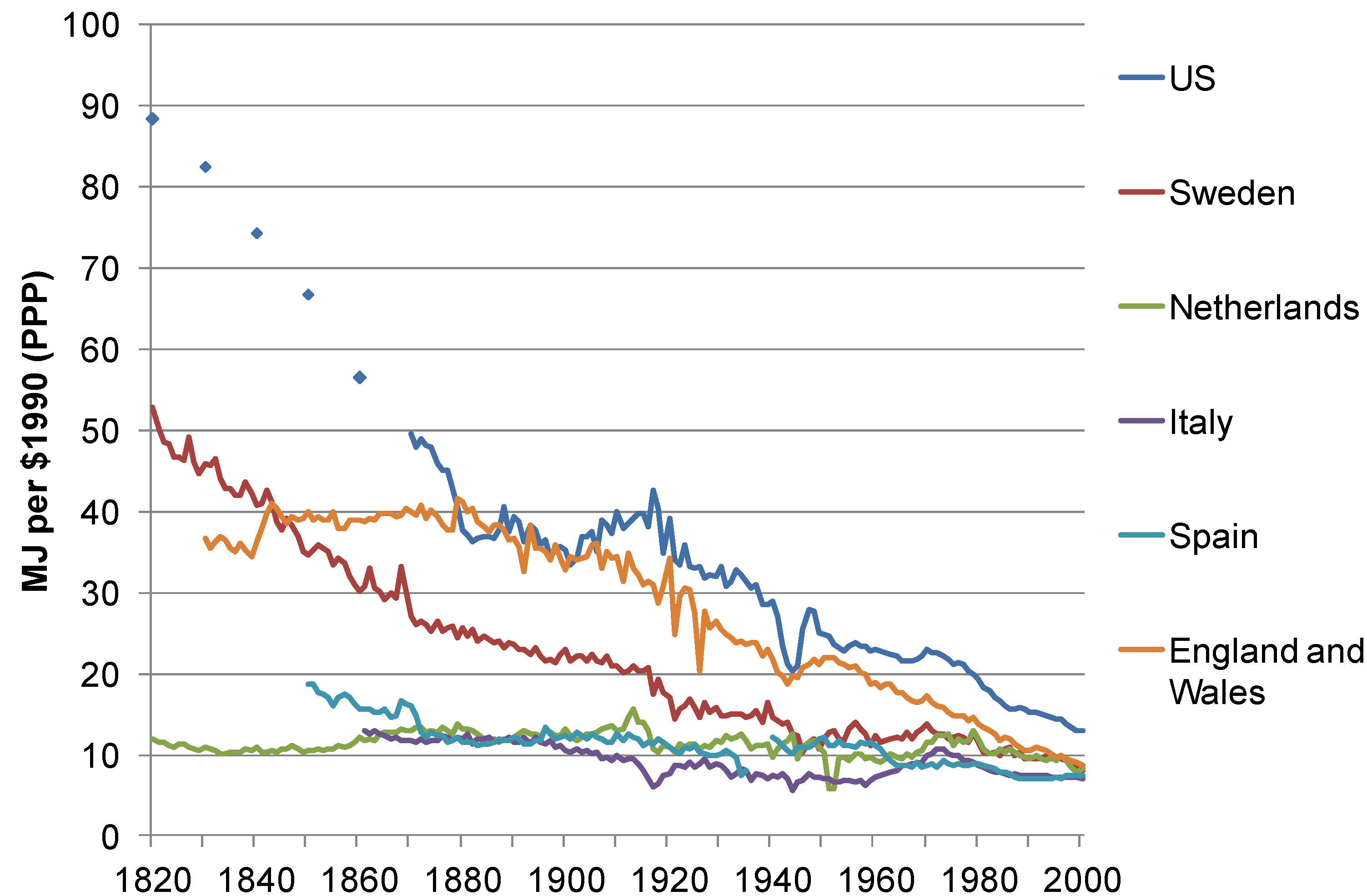
The energy intensity of an economy is typically measured by its energy/real GDP (E/GDP) ratio, which in turn is often used as an aggregate measure of the “efficiency” of energy use. Conventional wisdom regarding the E/GDP ratio is that it exhibits an inverted U-shape over the long run. But conventional wisdom is based on energy series that include only commercial energy; in this case the long-run E/GDP ratio does follow an inverted U-shape (Figure 17). This led analysts to conclude that energy intensity increases with the onset of industrialization and modernization (Schurr and Netschert (1960) [1]; Humphrey and Stanislav (1979) [74]; Goldemberg and Reddy (1990) [75]). But when traditional energy is included, a different pattern emerges: a fairly steady, secular decline in the long run E/GDP ratio since 1820, the first year for which we have reliable estimates of GDP for the United states (Maddison (2010) [76]). This result is consistent with the pattern observed in European nations for which traditional energy has been similarly assessed (Figure 18).
Figure 17.
U.S. energy intensity 1820–2010. Sources: various; see individual energy series in Section 2.
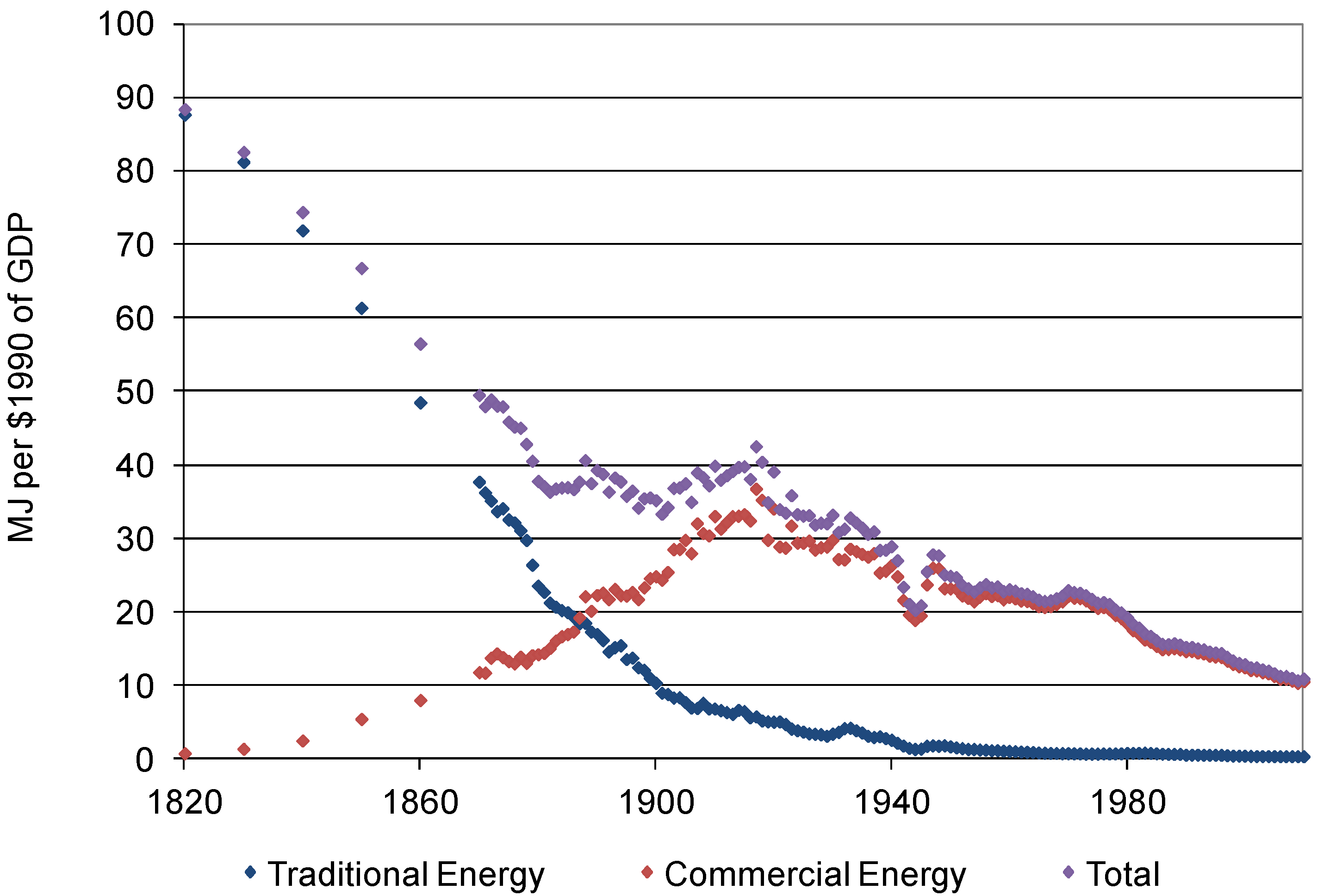
Figure 18.
Energy intensity in selected countries, 1800–2000. Sources: [4] for Sweden, The Netherlands, Italy, and Spain; [77] for England and Wales; this analysis for US.
3.4.1. Energy Quality
There are two major forces behind the long run decline in the E/GDP ratio: energy quality and energy efficiency. Energy quality has many different meanings in the literature, but here we use a very explicit definition: the marginal increase in GDP produced by the use of one additional heat unit of a fuel (Cleveland et al., 2000) [78]. The marginal product of a fuel is determined in part by a complex set of attributes unique to each fuel such as physical scarcity, capacity to do useful work, energy density, cleanliness, amenability to storage, safety, flexibility of use, cost of conversion, and so on. Fuels have different marginal products. For example, a joule of oil is more useful in many tasks than is a joule of coal (Adams and Miovic, 1968 [79]; Mitchell, 1974 [80]; Webb and Pearce, 1975 [81]). The price per joule of various fuels reflects their differences in quality. In the United States, the price of a joule of natural gas to the consumer averaged 5 times the price of a joule of coal from 2000 to 2010. A joule of motor gasoline and electricity averaged 10 and 15 times, respectively, the price of coal.
When viewed over long term, a clear driving force behind the decline in the E/GDP ratio in the United States was the repeated substitution of higher quality fuels for lower quality fuels (Figure 14). Because the “E” in E/GDP is measured in joules, the shift from wood → coal → oil and natural gas → primary electricity would, ceteris paribus, reduce the E/GDP ratio. This interpretation is supported by Kaufmann’s (1992) [82] econometric analysis of the E/GDP ratio in Japan, the UK, Germany and France in which shows that changes in fuel mix are an important driver of the E/GDP ratio in the post-World War II period.
3.4.2. Energy Efficiency
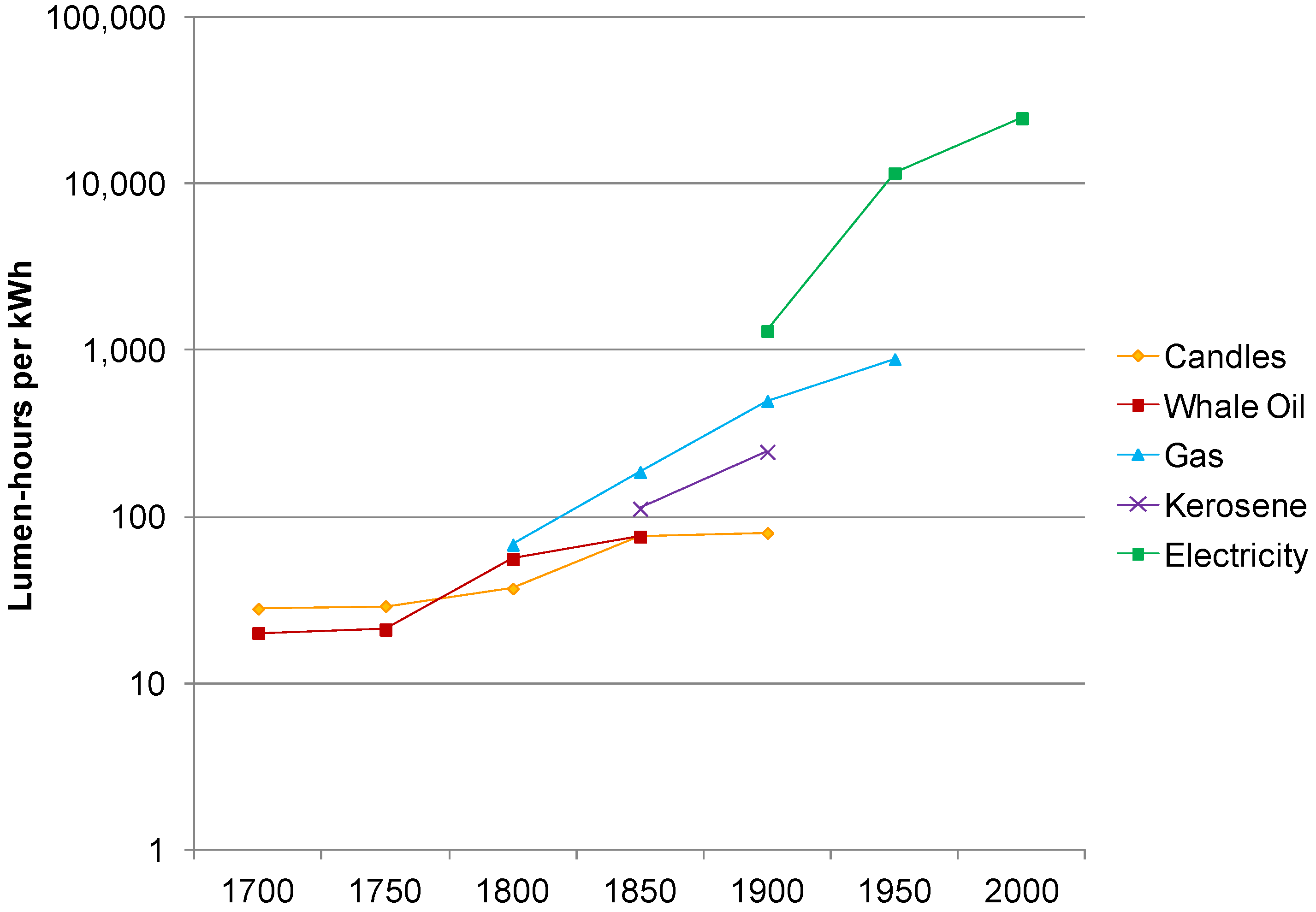
Improvement in the efficiency of energy end use is the other major driver of the long run decline in the E/GDP ratio in the United States. Technological improvements increase the efficiency of energy converters in two ways: incremental improvements in the existing technologies, and from the adoption of new technologies. The 300-year record of lighting technologies in the United States illustrates this point (Figure 19). Whale oil, candles, and kerosene each showed dramatic improvements in efficiency as measured by lumen-hours delivered per kWh, but all were less efficient than manufactured gas. Similarly, the electric lamp is far more efficient than all previous lighting technologies, and its efficiency has dramatically over time. Nearly every other major energy conversion process has shown similar improvements, including the steam engine, steam turbine, internal combustion engine, and the gas turbine (Smil, 1991) [2], as well as the conversion of energy to low, medium, and high temperature heat (Ayres et al., 2003) [83].
Figure 19.
Efficiency of lighting technologies, 1700–2000. Source: [40].
Despite the overall decline in energy intensity, the U.S. witnessed a 40-year period, from roughly 1880 until 1920, in which energy intensity either stayed constant or increased (Figure 17). Daugherty (1928) [18] noted that production per wage earner did not rise as fast as installed power capacity per wage earner from 1889 to 1919, and suggested that increasing mechanization was showing diminishing economic returns. As Geels (2006) [84] describes, factories in the late 19th and early 20th centuries stopped seeing significant economies of scale due to constraints on building size and shape, machine arrangement, and power losses from transmission. The inefficiencies of millwork at large scale, evident in the increasing energy intensity, led manufacturers to develop new technologies and processes. Some of these changes, such as the shift from on-site steam engines to grid-connected electric motors, are discussed in [18]. Advances in manufacturing included not only technological solutions, but also operational innovations, such as Frederick Taylor’s “scientific management” system. Landscape developments accelerated this transition. The First World War required reconfiguration of manufacturing for the production of munitions and vehicles. The coal price spike from 1917 to 1924 provided an additional incentive to improve efficiency. The new manufacturing systems exemplified by Henry Ford’s River Rouge plant of 1920 led economic output to increase faster than energy consumption. Devine (1983) [85] shows that 1920 marked a turning point in energy intensity, which began declining after a period of increase, and in productivity of capital, which began increasing after a period of decline. The year 1920 also marked a decades-long acceleration of growth in labor productivity, and the point at which electric motors surpassed steam engines as sources of mechanical drive. Since 1920, there has been no ten-year period over which energy intensity has increased in the U.S. Reduction in energy intensity is not an inevitable consequence of economic development. It is possible for a country’s energy use to increase faster than its economy over a period of 10 or 20 years, or even more
Allen (2009) [10] notes how the demands of particular niches or localities can spur research on improving efficiency. Cornish steam engines led the way in improving efficiency, since coal was expensive in Cornwall. Reducing coal consumption would not have been nearly as important in Newcastle coal mines as in Cornish tin mines. Allen observes that not only innovation but also adoption of technology is driven by local economic factors. France had outstanding scientists and inventors, but the economics did not warrant spending capital and energy to replace relatively inexpensive labor. Fouquet (2008) ([5], p. 13) adds that technical progress is “highly volatile and unpredictable”, being driven by chance as well as by investment, patent life, and industrial structure.
4. Discussion
4.1. The Inertia of Fossil Fuels
The transition in our energy systems required to stem the environmental and health consequences of hydrocarbon fuels will not be driven by the scarcity those fuels. The shares of the fossil fuels exhibit plateau-like behavior beginning in the 1990s, the longest period of stability since the Industrial Revolution (Figure 14). Although there may be further shifts from coal to gas, the overall dominance of fossil fuels is likely to continue for an extended period. A massive infrastructure exists to utilize the fossil fuels, and large quantities of potentially recoverable oil, natural gas, and coal exist.
There are about 640,000 EJ of potentially recoverable, conventional and unconventional fossil fuels; this quantity dwarfs the 420 EJ of fossil fuel that we currently consume each year. Technological and economic conditions must be right to enable the commercial extraction of those fuels. Recent history demonstrates the power of technological advances to expand the resource base. Horizontal drilling and hydraulic fracturing have combined to create a new energy boom in North America by making it profitable to develop oil sands, shale gas and tight oil. It is reasonable to assume that these and other unconventional fossil fuels could continue to be brought into production by technical advances for a considerable time into the future. This highlights a frequently overlooked point: proponents of renewable energy argue that cost reductions for new technologies will quickly make them competitive with conventional energy. This will drive a substitution of renewables for fossil fuels. But innovation is also occurring in the development of the fossil fuels, so the renewables are chasing a moving target.
Large-scale extraction of unconventional fossil fuels poses great environmental risk. Since 1751 approximately 365 billion metric tons of carbon (1351 billion metric tons of CO2) have been released to the atmosphere from the consumption of fossil fuels and cement production (Boden et al., 2010) [86]. The amount of carbon in potentially recoverable fossil fuels (≈15,000 Pg) is about 40 times the amount of carbon that has been released to the atmosphere from the consumption of fossil fuels and cement production since 1751. More than 80 percent of the carbon remaining in fossil fuels is contained in coal. Tapping this vast store of carbon would make it impossible to limit future temperature rise to 2 °C as recommended by parties to the United Nations Framework on Climate Change. The only force that appears to be able to alter this picture in the foreseeable future is a strong policy that internalizes the substantial external environmental and social costs of fossil fuels, especially climate change.
4.2. Comparison to European Countries
Figure 20 compares our results in the United States to those of the Environment, Growth, and Pollution (EGP) Network for European countries ([4,77]).
Figure 20.
Energy consumption per capita in selected countries, 1800–2000. Sources: [4] for Sweden, The Netherlands, Italy, and Spain; [77] for England and Wales; this analysis for US.
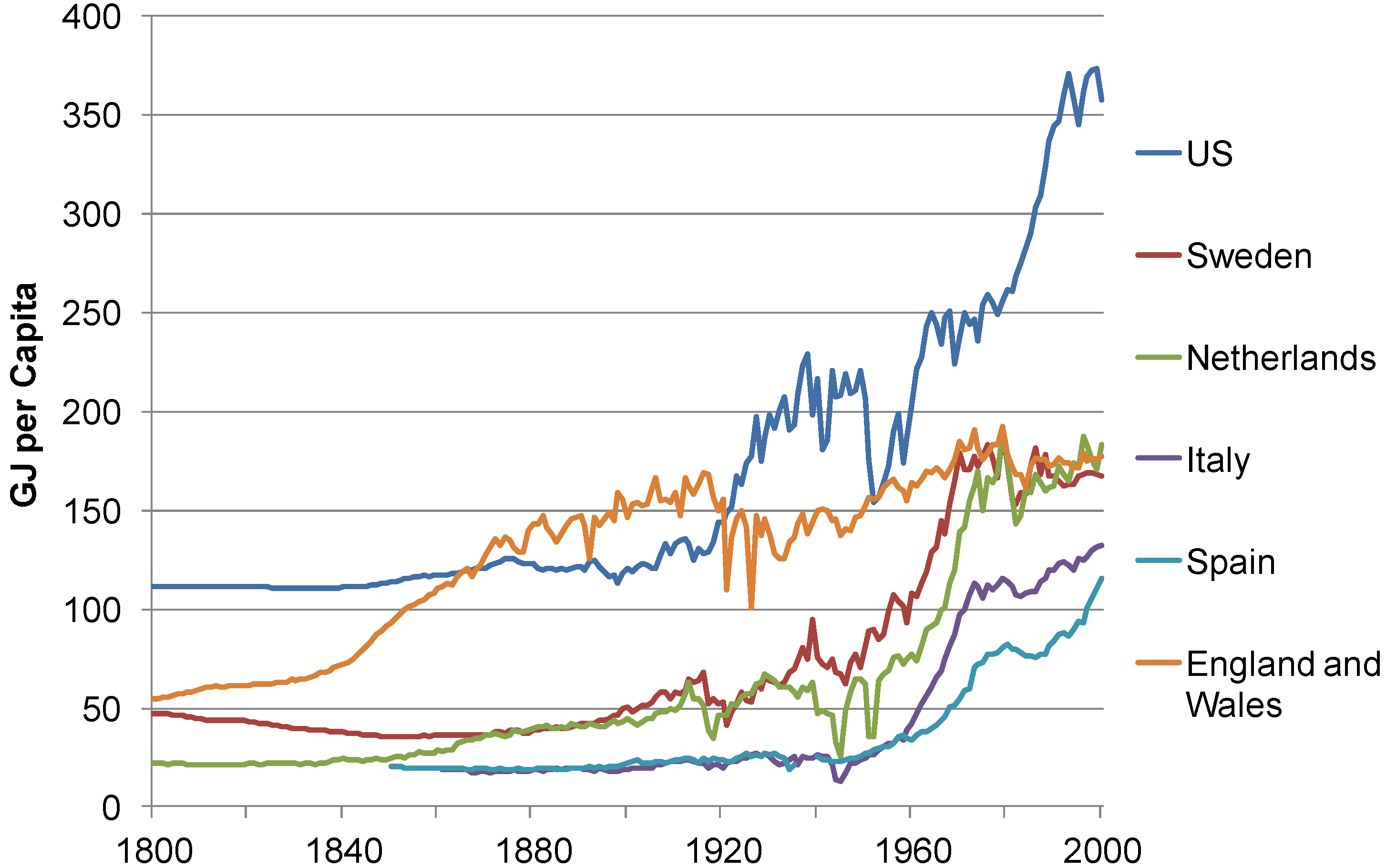
Fuel wood consumption in the early United States far exceeded even that of a colder European country such as Sweden. This abundance of firewood, and the extravagance of its use, have long been noted (see variously [33,87,88]). Much of this abundance was driven by the need to clear land for farming. Schurr and Netschert [1] estimate that settlers cleared 5 million acres per year for farmland in the decade 1850–1960; assuming a low yield of only 15 cords per acre this becomes 75 million cords per year, out of total 100 to 125 million cords per year consumed for fuel. Kander (2002) [14] estimated Sweden’s 1800 consumption at about 33 GJ per capita. Sweden was an early adopter of technologies that increased energy efficiency, such as the chimney damper and the Cronstedt stove. Stoves became widespread enough to reduce per-capita fuel wood consumption in the U.S. only around 1850. England was no longer heavily forested by 1800, so its fuel wood consumption was only about 2 GJ per capita in that year. The Netherlands was similarly limited, at only 3 GJ per capita. Per-capita fuel wood consumption in Spain in 1850 and Italy in 1861 was one-third that of Sweden, but three times as great as in the Netherlands.
The early U.S. had more draft animals per capita than Sweden, Italy, or Spain, and significantly more than the densely populated countries of England, Wales, and the Netherlands. At no time in Warde’s series did animal feed exceed human food in England and Wales, while in the U.S. it was routinely twice as high, and up to 260% of the human food energy input.
4.3. Motivating Factors in Transitions: Early/Late Adopters and Niche Markets
Energy technologies or systems with a relatively short period of dominance are often pioneers in serving a new energy demand. There are several reasons why they may be replaced:
- •
- They are optimal at small scale, but encounter diminishing returns at larger market sizes;
- •
- They assume initial leadership due to low initial costs, but are surpassed by technologies that require larger scale or market size to be economical;
- •
- The demonstrated demand serves to stimulate innovation, which leads to competitors emerging; and,
- •
- Innovations developed by the pioneer directly enable future competitors.
Examples include the following:
- •
- Whale oil’s heyday lasted from 1830 to 1870, peaking in 1847 for volume and 1853 for dollar value. The demonstrated demand for lighting fuel and its diminishing returns to scale were manifest in its high price. These factors encouraged research in alternative lighting fuels.
- •
- Coal oil, developed in the 1850s, was soon replaced by petroleum kerosene, which was available at lower cost and employed many of the same refining technologies.
- •
- Horse travel in the cities had a relatively short period of dominance, with alternatives emerging as it horse-drawn transportation neared logistical limits. These alternatives included the electric streetcar and the bicycle.
- •
- Bicycles had a short period of massive popularity in the 1890s. Numerous features of the 1890s bicycle industry would be transferred into the automobile industry, such as pneumatic tires, variable speed transmission, advocacy for paved roads, extensive advertising, and mechanized mass production. Automotive inventor Hiram Maxim specifically noted that the bicycle “could not satisfy the demand which it had created” ([62], p. 186), a common downfall of pioneer technologies.
- •
- Small wind turbines proliferated in the Midwest in the 1920s and 1930s. At a small scale, they had a lower cost per kilowatt-hour than central-station power plants. The demonstrated demand for electricity, and sales of lights and appliances, provided the impetus for the U.S. government to proceed with rural electrification programs in the 1930s.
The factors influencing energy transitions extend beyond the inherent characteristics of the technology and the price of fuels. Geels (2002) [22] provides an extensive discussion of the relationship of human networks to technology transitions. The three levels of organization are niches, regimes, and landscapes. Technology transitions are the outcome of developments at multiple levels affecting actors through a network of linkages. Niches are particular applications or market segments where a new technology is first applied. Niches are embedded in regimes, such as the broader energy sector. A regime includes a network of actors and social groups; a set of rules, including policy, knowledge, practices, principles, and behavioral norms; and material elements such as sector-specific infrastructure and machines. Regimes are embedded within sociotechnical landscapes, deep structural trends that provide the context for the actors within the regimes. Landscapes include spatial arrangement of cities, transportation infrastructure, fundamental economic and political structures, cultural values, environmental pressures, and “technology-external factors”. Geels (2002, p. 1260) notes, “The context of landscape is even harder to change than that of regimes. Landscapes do change, but more slowly than regimes”.
The energy transitions of the United States can be viewed through this perspective, with niche applications being particularly prominent in the development of electric lighting, batteries, and photovoltaic systems. Trains and steamships also began as niche technologies, but much of their development occurred in the United Kingdom. The energy regime has changed numerous times, from household provision of energy use to regulated monopolies to competitive markets. Associated regimes, such as manufacturing, have improved through stepwise reconfiguration as detailed in Geels (2006) [84], incorporating new technologies incrementally. Major landscape changes, both nationally and globally, have been affected by energy regimes, with the location of petroleum deposits playing a major role in the strategic decisions of the Second World War and the price of oil playing a major role in the trajectory of the Cold War. Yergin (2009) [89] discusses the impact of oil on these landscape changes.
Emerging energy technologies will gain market share in certain niches and markets, depending on the costs of inputs (as emphasized in Allen [10]), the valuation placed on their performance characteristics (including emissions), and where the innovation takes place. As these technologies mature, they will be adopted by other markets. Grubler (2012) [3] also notes that late adopters have the advantage of moving into and out of energy systems more quickly than early adopters. The latecomers face lower expenses since some technological progress has been accomplished by the early adopters. Allen (2009) [10] reinforces this observation with example of iron smelting with blast furnaces in France, and uses local economics to explain why a country might choose to be a late adopter. Compared to Britain, France had low-cost labor and high-cost energy. A furnace that reduced labor requirements compared to earlier ironworking methods, but consumed prodigious amounts of coal, might make sense in Wales but not in France. France skipped the first several generations of coal-fired blast furnaces, adopting later generations of the technology after the English had improved the designs to reduce fuel consumption.
Other disadvantages of pioneers are higher sunk costs in older technologies, and, in some cases, investment of human capital providing resistance to change. A “leapfrog” scenario is the ultimate extension of Grubler’s “last-in, first-out” observation, being “never-in.” In such a scenario, less developed countries lacking an extensive fossil fuel infrastructure skip that step altogether and instead develop low-carbon energy systems. One example that proponents hope to replicate is the way that some African countries went straight to cell phone networks without ever having land-lines (Sauter and Watson, 2008) [90]. Carbon-free energy may face a steeper climb, since end-use technologies such as telephones have more rapid transitions than energy supply technologies.
4.4. Scale
Any energy option has a range of scales at which it is competitive. Below that level of demand, the technology’s advantages do not warrant the requisite capital investment. Above that point, constraints lead to diminishing returns. Consider rural electrification. If electricity demand is low, it is not economical to lay power lines. Small wind turbines and photovoltaic systems with battery backup will have a lower cost. At a higher level of demand, grid extension from a distant power plant becomes the least-cost option. At a very high level of demand, transmission capacity may be strained, and locating a power plant in the area may become the least-cost option. Grid extension has a window of viability over a certain range of demand. This is seen repeatedly in energy transitions. Options developed for smaller scale are replaced by those that require larger scale to be economical, perhaps requiring investments in infrastructure or manufacturing. Rather than simple storehouses, manufactured ice required factories and decades of research and development. Oil and gas pipelines, electricity generators and grids, and automobile factories and highways all represent major capital investment. None of these would have been developed had not prior smaller-scale technologies demonstrated and grown a demand for energy services.
4.5. The Quality of Energy Services
Energy quality embodies the notion that energy services include a broad spectrum of performance characteristics. Not all vehicle-miles represent equally valuable transportation, nor do all BTUs represent equally comfortable heating. The history of energy transitions in the United States shows many instances of new energy technologies succeeding on quality of service. This is more common with end-use technologies, but in some cases fuels compete on performance characteristics. The competition among lamp oils in the 1840s and 1850s is a vivid illustration of competing claims and advantages. No fuel was bright, safe, and inexpensive; all met only one or two of these criteria. Chemical batteries, despite costing much more per kilowatt-hour than grid electricity, offer portability and convenience that warrant their higher price. Photovoltaic technology has found niche applications for off-grid power ranging from the space program to camping equipment. Among end-use technologies, early electric lights competed against gas lighting by offering superior safety in environments such as factories and theaters. Automobiles competed against streetcars by offering greater flexibility and speed.
The rise of electricity allowed a wide range of fuels to contribute to energy supply. Daugherty ([18], p. 28) notes, “The electric generator and the electric motor are, of course, not prime movers, but the current produced by one and used by the other has enabled this country to use sources of power which otherwise would be largely untouched”. This refers to water power, which had been rendered a minor niche player for direct motive power by the steam engine. Water power could not be easily transported, and so water-driven factories had to be sited on fast-moving rivers. Hydroelectricity could be transported much more readily, allowing water to return to competitiveness. This aspect of electricity generation is seen repeatedly. Coal lost its market share in transportation to oil, and its market share in heating (both residential and industrial) to natural gas. Electricity generation not only opened up a new market for coal—enabling it to recover and exceed its previous levels of consumption—but also opened up markets for low-quality coal that had previously been ignored, such as lignite. More recently, electricity has enabled the reintroduction of wind power to the U.S. energy economy.
Lighting technology saw a succession of changes, not always corresponding to changes in the fuel. A single fuel, coal, supplied lighting technologies from gas lights and oil lamps to incandescent bulbs to LEDs. A single lighting technology, the oil lamp, utilized fuels made from whale blubber, pig fat, vegetable seeds, coal, petroleum, or alcohol and turpentine. Similarly, a modern electric light can be supplied by any of a variety of different energy resources. Transitions in lighting end-use technologies expanded the provision of energy services much more than did changing the fuel. New energy end-use technologies can offer new or greatly improved energy services, offering superior quality of service or orders of magnitude improvements in efficiency.
4.6. The Quality of Energy Sources
The history of energy transitions in the United States is one of increasing energy quality. By key metrics such as energy return on investment (EROI) (Cleveland, 2005) [91] and energy and power density (Smil, 2010) [72], fossil fuels were superior (“higher quality”) to wood, food, and fodder. Even in these cases, the energy quality was not strictly an inherent property of the fuels, but rather a composite of the fuel’s own properties, the infrastructure for producing it, the technology for utilizing it, and the ability to mitigate the impacts. For much of the early industrial period, coal was not a superior fuel to wood, but a “backstop resource” that was lower-quality but existed in greater abundance, as detailed in Allen (2009) [10]. Making coal of comparable quality to wood for many applications required development of new technological processes such as coking. Cost reductions in the United States resulted from improved transportation infrastructure such as laying railroad tracks through coal fields. This monetized the advantage of the greater spatial energy density of coal compared to wood, and improved EROI by reducing the energy demands for transporting the fuel.
The current list of substitutes for fossil fuels have some decidedly lower quality attributes. Their EROI is lower than fossil fuels. The spatial power density for renewable electricity generation is markedly lower than generation from fossil fuel combustion. Changing the power density-determined infrastructure of energy systems that were created over more than a century for electricity generation from fossil fuel combustion will not be easy, and will take significant time to unfold (Smil, 2010). In addition, the intermittency of solar and wind power means they are not “dispatchable”. Their low capacity factor adds an additional cost to their utilization compared to generation from fossil and nuclear fuels. The spatial distribution of renewable energy flows means that significant new infrastructures will be needed to collect, concentrate and deliver useful amounts of power and energy to demand centers.
The “low quality” challenges associated with renewable energy are not insurmountable. For example, innovation has raised the EROI for electricity generation from solar photovoltaic systems (Raugei et al., 2012) [92]. Expanded market penetration of electric vehicles could provide a massive amount of storage capacity that would mitigate the effects of intermittency (Kempton and Tomić, 2005) [93]. Perhaps most importantly, renewable energy generally has a much lower external cost compared to fossil fuels, so any policy that incorporates the external costs of climate change and health impacts will immediately make some forms renewable energy more viable.
4.7. Implications for Future Transitions
Smil (2003) ([94], p. 162) recounts the observation of Cesare Marchetti in 1979 that energy transitions seemed to be regular and predictable, “as though the system had a schedule, a will, and a clock”. But Smil (2003) argues that it is possible that energy transitions cannot be mathematically modeled, and that scenarios are better used in a normative sense, saying what should happen rather than what will happen. Similarly, Nye (1998) [8] argues that transitions are the consequence of human decisions and not deterministic trends. Rifkin (2011) [95] also stresses the importance of culture and choices, rather than assuming that mathematical models can explain energy use. Fouquet (2008) [5] also notes that demand for energy services is not fixed, and is significantly affected by culture and by advertising. Fouquet (p. 190) notes, “So, before transport technologies were introduced, there was generally not an important potential demand for these technologies”. Other energy services were associated with conspicuous consumption, and Fouquet (p. 291) observes, “It was the rich and socially mobile, and the advertising companies (and the large corporations paying the publicity) that enabled new technologies to spread”. Some aspects of innovation and technology adoption can be quantified and modeled, but others are essentially unpredictable.
Researchers are not attempting to predict future changes when we say that transitions in energy supply technologies have historically happened on the order of 40–50 years. Nevertheless, the record demonstrates that societies can accommodate shifts on that timescale. Goals to transition to a low-carbon energy system over 40 years, as have been repeatedly issued by organizations, nations, and states in the past two decades, are not unrealistic seen from this point of view.
Transitions in energy supply technologies may take several decades, but Lovins et al. (2005) [96] observes that transitions in end-use technologies are more rapid, at about 12–15 years. Examples include the transition from horses to automobiles, from steam to diesel/electric locomotives, and from landlines to cellphones. Transitions are fastest for purchases done at the individual level, since the industrial stock consists of large capital investments that have a slower turnover. Grubler (2012) [3] postulates that, because of the more rapid adoption of end-use technologies, a transition to a low-carbon economy will be best accomplished by a focus on end uses. He also notes, “Performance … initially dominates economics as a driver of technological change and diffusion” (p. 11). In this case, Grubler is emphasizing that end use technologies can overcome high financial cost by providing high utility. Building on Grubler’s theses, emerging low-carbon end-use technologies should focus on performance characteristics, including but not limited to their lower emissions or energy use. The shift from desktop computers to laptops and smartphones illustrates these principles. Reduced energy consumption was not the goal of a shift to laptops and smartphones, but a necessary attribute in order to deliver portability. Advances in lithium-ion batteries, in large part driven by the laptop and phone markets, have in turn accelerated development of electric vehicles. Electric vehicles will do well to compete on grounds other than energy cost. For example, by having independent wheel motors, an electric vehicle can be designed to offer superior handling and easier parallel parking. As Schurr and Netschert (1960) [1] advised for nuclear power, simply providing a replacement fuel in an existing system is unlikely to effect an energy transition. For the time being, the environmental benefits or technological novelty of electric vehicles seem sufficient to sustain demand. In the long run, substantially superior performance is likely to be instrumental to the success of electric vehicles.
Energy demands such as transportation are shaped by culture, and are not entirely fixed. The technologies to meet these demands have a range of performance characteristics, such as safety, speed, comfort, status, and environmental impact. How those attributes are valued is likewise shaped by culture, climate, and economics, and the resultant valuation determines which technology option has superior performance. Technologies are not always unequivocally “better” or “worse” than one another. If the speed, privacy, and comfort of the automobile made it better than the bicycle, why would any individual who own a car choose to bike to work? And yet commuters in major cities all over the world make this decision. In part, the fact that the bicycle requires physical exertion is what makes it a “high quality” form of transport for many individuals, improving physical and mental well-being. Changing diets and awareness of health effects have made the exertion of biking a positive, rather than a negative. Other benefits of biking include reduced emissions and, in congested cities, possibly faster travel. For the commuters considered, the bicycle has superior performance to the automobile.
4.8. The Closing of the Environmental Frontier
Ahmed Zaki Yamani, the powerful former oil minister for Saudi Arabia, once observed that “The Stone Age didn’t end for lack of stone, and the oil age will end long before the world runs out of oil” (Maass 2005) ([97], p. 35). Indeed, the oil age, and more generally the fossil fuel age, may end to a shortage of waste assimilation capacity.
The transition from wood to coal occurred when the human population was small, its affluence was modest, and its technologies were much less powerful than today. As a result, environmental impacts associated with energy had negligible global impact, although local impacts were at times quite significant. Fouquet (2011) [98] demonstrates the high external cost of English coal on that country’s GDP. Fouquet (2008) [5] notes efforts by King Charles II to remove major coal-using industries from London after the Great Fire of 1666, and Taylor (1848) [99] reports a royal proclamation of Edward I in 1306 that forbade burning of coal in London while Parliament was in session. As a pioneer in the large-scale use of coal, England suffered significant health impacts from air pollution before other countries did. Fouquet (2011) [98] estimates that air pollution cost 15%–20% of England’s GDP from 1870 to 1890. The vast majority of coal’s economic costs were externalized. These external costs decreased after 1890 due to a combination of suburbanization (reducing pollutant concentration), smoke control policies, and a shift to cleaner fuels, to the point of being around 2% of GDP in 2000. These external costs were high enough to overwhelm the nominal cost savings from coal. Fouquet (2008) [5] finds that, when external costs are considered, the total social cost of coal-fueled steam power was higher than that of draft animal power until about 1890. England tolerated high levels of pollution in the name of progress, but had far higher levels of damage caused by this pollution than was acknowledged.
The world today is not at the level of pollution seen in London in 1890. Still, any future energy transition will operate under a new set of environmental constraints, notably the fact that the planet has only one atmosphere and that adverse impacts of emitted pollutants often cannot be confined to one location, one region, or even one continent (National Research Council, 2010) [100]. Long-transport is common for primary pollutants such as soot particles, windblown dust, mercury from coal-fired power plants, pesticides from agricultural operations, and nitrogen oxides from motor vehicles. Secondary pollutants are also transported long distances, and include ozone, hydrogen peroxide, sulfuric and nitric acids, and secondary smog particles. Long range transport is in part responsible for the impacts of acid deposition over wide areas of Western Europe, eastern North America, and southeastern China. The most prominent reminder that the atmosphere a global commons is the relatively uniform concentration of carbon dioxide in the atmosphere that is generated by billions of point sources distributed across the planet. Future energy systems must be designed and deployed with environmental constraints that were absent from the minds of the inventors of the steam engine and internal combustion engines.
5. Conclusions
Our examination of the energy consumption of the United States from 1780–2010 employs the tools of economic history. Contemporary accounts, Census reports, and more recent estimates are combined to provide a more complete picture of energy use in the United States. End-use technologies were critical for driving transitions, and often are downplayed compared to transitions in energy sources. Accounting for traditional energy results the energy/GDP ratio exhibiting a declining trend over time, as found by Kander et al. (2007) [6] for several European countries. A stagnation of energy intensity over the period 1880–1920 is the result of inefficient application of steam power, with the millwork system encountering diminishing returns to scale. The electrification of industry reversed this trend, as described in Devine (1983) [85]. The vast gains in efficiency created by technological progress allow societies to employ higher-cost energy resources with a net reduction in cost per unit of energy service delivered. This approach is implicitly or explicitly used in energy policy. Improved energy efficiency by itself cannot solve environmental problems such as air pollution or climate change. Rather, efficiency allows the solutions to be painless (or nearly so), by redirecting a portion of the economic gains from efficiency to installing pollution controls or developing cleaner energy resources. The recognition of environmental externalities and of the finiteness of fossil energy resources on a human timescale represent changes in the way the United States thinks about energy. Improving efficiency coupled with pollution standards since 1970 mark this as the beginning of an energy transition. Energy consumption per capita has plateaued and slightly declined. Vehicle fuel economy has improved. Air pollution has declined, and the policy tools have been put into place to deal with it and with other environmental problems. Research and development on renewable energy technologies had led to remarkable declines in costs and increases in deployment. An energy transition is ongoing.
Acknowledgments
We thank James Baldwin, Edward Cunningham, and Robert Kaufmann (all of Boston University), and Jennie Stephens of Clark University for their useful critique of this work. This work was supported by a grant from the Mellon Foundation through the Energy Transitions and Society project under the John E. Sawyer Seminars on the Comparative Studies of Cultures. A precursor analysis to this work was developed for the Pardee Center for the Study of the Longer-Range Future under the direction of Adil Najam.
Author Contributions
Peter A. O’Connor performed the research, compiled data, prepared the manuscript, and created the graphics. Cutler J. Cleveland suggested the topic, provided extensive references, and conducted review and revision.
Conflicts of Interest
The authors declare no conflict of interest.
References
- Schurr, S.; Netschert, B. Energy in the American Economy 1850–1975; Resources for the Future/Johns Hopkins Press: Baltimore, MD, USA, 1960. [Google Scholar]
- Smil, V. General Energetics: Energy in the Biosphere and Civilization; John Wiley & Sons: New York, NY, USA, 1991. [Google Scholar]
- Grubler, A. Energy transitions research: Insights and cautionary tales. Energy Policy 2012, 50, 8–16. [Google Scholar] [CrossRef]
- Kander, A.; Gales, B.; Malanima, P.; Rubio, M. North versus South: Energy transition and energy intensity in Europe over 200 years. Eur. Rev. Econ. Hist. 2007, 11, 219–253. [Google Scholar] [CrossRef]
- Fouquet, R. Heat, Power and Light: Revolutions in Energy Services; Edward Elgar: Cheltenham, UK & Northampton, MA, USA, 2008. [Google Scholar]
- U.S. Bureau of the Census. Historical Statistics of the United States, Colonial Times to 1970, Bicentennial Edition; U.S. Department of Commerce: Washington, DC, USA, 1975.
- Woodward, S.M.; Fleming, B.P. Tests of alcohol lamps and stoves. Sci. Am. Suppl. 1907, 64, 180–182. [Google Scholar]
- Nye, D. Consuming Power: A Social History of American Energies; MIT Press: Cambridge, MA, USA, 1999. [Google Scholar]
- Dewhurst, J.F. America’s Needs and Resources: A New Survey; The Twentieth Century Fund: New York, NY, USA, 1955. [Google Scholar]
- Allen, R.C. The British Industrial Revolution in Global Perspective; Cambridge University Press: Cambridge, UK, 2009. [Google Scholar]
- Wrigley, E.A. Energy and the English Industrial Revolution; Cambridge University Press: Cambridge, UK, 2010. [Google Scholar]
- Falconer, J.I.; Bidwell, P.W. History of Agriculture in the Northern United States, 1620–1860; Carnegie Institution of Washington: Washington, DC, USA, 1925. [Google Scholar]
- U.S. Bureau of the Census. Statistical View of the United States, Supplementary Material for Seventh Census of the United States; Robert Armstrong: Washington, DC, USA, 1854.
- Kander, A. Economic Growth, Energy Consumption and CO2 Emissions in Sweden 1800–2000. Ph.D. Thesis, Lund University, Lund, Sweden, June 2002. [Google Scholar]
- Lindmark, M. Estimates of Norwegian Energy Consumption 1835–2000; Umeå University & Department of Economics, Norwegian School of Economics: Umeå, Sweden, 2007. [Google Scholar]
- Anderson, V.D. Creatures of Empire; Oxford University Press: New York, NY, USA, 2004. [Google Scholar]
- Kinsman, C.D. An Appraisal of Power Used on Farms in the United States; U.S. Department of Agriculture: Washington, DC, USA, 1925.
- Daugherty, C.R. The Development of Horsepower Equipment in the United States; University of Pennsylvania: Pennsylvania, PA, USA, 1928. [Google Scholar]
- Schlebecker, J.T. Whereby we Thrive; Iowa State University Press: Ames, IA, USA, 1975. [Google Scholar]
- Foster, R.N.; Kaplan, S. Creative Destruction; Currency/Doubleday: New York, NY, USA, 2001. [Google Scholar]
- Cutler, C. Greyhounds of the Sea: The Story of the American Clipper Ship; Naval Institute Press: Annapolis, MD, USA, 1984. [Google Scholar]
- Geels, F.W. Technological transitions as evolutionary reconfiguration processes: A multi-level perspective and a case-study. Res. Policy 2002, 31, 1257–1274. [Google Scholar] [CrossRef]
- Gipe, P. Wind Energy Comes of Age; John Wiley & Sons: New York, NY, USA, 1995. [Google Scholar]
- Brown, L. Plan B 4.0: Mobilizing to Save Civilization (Supporting Dataset); W.W. Norton & Company: New York, NY, USA, 2009. [Google Scholar]
- Energy Information Administration (2012). Annual Energy Review. Available online: http://www.eia.gov/totalenergy/data/annual/showtext.cfm?t=ptb0408 (accessed on 15 July 2014).
- Hunter, L.C.; Bryant, L. Waterpower in the century of the steam engine. In A History of Industrial Power in the United States 1780–1930; University Press of Virginia: Charlottesville, VA, USA, 1979; Volume 1. [Google Scholar]
- U.S. Bureau of the Census. Sixth Census of the United States; Thomas Allen: Washington, DC, USA, 1841.
- U.S. Bureau of the Census. Ninth Census of the United States, Volume III: The Statistics of Wealth and Industry of the United States; Government Printing Office: Washington, DC, USA, 1872.
- U.S. Bureau of the Census. Tenth Census of the United States, Volume II: Report on the Manufactures of the United States; Government Printing Office: Washington, DC, USA, 1883.
- Howell, C.; Keller, A. The Mill at Philipsburg Manor Upper Mills and a Brief History of Milling; Sleepy Hollow Restorations, Inc.: Tarrytown, NY, USA, 1977. [Google Scholar]
- Power Resources Office (2005). Hydroelectric Power. Available online: http://www.usbr.gov/power/edu/pamphlet.pdf (accessed on 10 December 2013).
- Smil, V. Energy in Nature and Society: General Energetics of Complex Systems; MIT Press: Cambridge, MA, USA, 2008. [Google Scholar]
- Reynolds, R.V.; Pierson, A.H. Fuel Wood Used in the United States: 1630–1930; U.S. Department of Agriculture: Washington, DC, USA, 1942.
- White, J.H. A History of the American Locomotive: Its Development 1830–1880; Courier Dover Publications: New York, NY, USA, 1979. [Google Scholar]
- EIA (2013a). Residential Energy Consumption Survey 2009. Table HC6.1. Available online: http://www.eia.gov/consumption/residential/data/2009/ (accessed on 10 December 2013).
- Clark, A.H. History and Present Condition of the Fishery. In The Fisheries and Fishery Industries of the United States; Goode, G.B., Ed.; United States Commission of Fish and Fisheries: Washington, DC, USA, 1887. [Google Scholar]
- Starbuck, A. A History of the American Whale Fishery from Its Earliest Inception to the Year 1876; Alexander Starbuck: Waltham, MA, USA, 1878. [Google Scholar]
- Tower, W.S. A History of the American Whale Fishery; University of Philadelphia Press: Philadelphia, PA, USA, 1907. [Google Scholar]
- Davis, L.E.; Gallman, R.E.; Gleiter, K. In Pursuit of Leviathan; University of Chicago Press: Chicago, IL, USA, 1997. [Google Scholar]
- Fouquet, R.; Pearson, P. Seven Centuries of Energy Services: The Price and Use of Light in the United Kingdom (1300–2000). Energy J. 2006, 27, 139–177. [Google Scholar] [CrossRef]
- Bezanson, A.; Gray, R.; Hussey, M. Wholesale Prices in Philadelphia 1784–1861; University of Philadelphia Press: Philadelphia, PA, USA, 1937. [Google Scholar]
- U.S. Bureau of the Census. Eighth Census of the United States: Manufactures of the United States in 1860; Government Printing Office: Washington, DC, USA, 1895.
- Bezanson, A. Wholesale Prices in Philadelphia 1852–1896; University of Philadelphia Press: Philadelphia, PA, USA, 1954. [Google Scholar]
- Kovarik, W.; Henry, F.; Charles, F. Kettering and the Fuel of the Future. Autom. Hist. Rev. 1998, 32, 7–27. [Google Scholar]
- Wells, D. Distilled Spirits as a Source of National Revenue; Special Report No. 5; United States Revenue Commission: Washington, DC, USA, 1866. [Google Scholar]
- Searchinger, T.; Heimlich, R.; Houghton, R.A.; Dong, F.; Elobeid, A.; Fabiosa, J.; Tokgoz, S.; Hayes, D.; Yu, T.-H. Use of U.S. croplands for biofuels increases greenhouse gases through emissions from land-use change. Science 2008, 319, 1238–1240. [Google Scholar] [CrossRef] [PubMed]
- Fargione, J.; Hill, J.; Tilman, D.; Polasky, S.; Hawthorne, P. Land clearing and the biofuel carbon debt. Science 2008, 319, 1235–1238. [Google Scholar] [CrossRef] [PubMed]
- Freese, B. Coal: A Human History; Da Capo Press: Cambridge, MA, USA, 2004. [Google Scholar]
- Levitt, S.D.; Dubner, S.J. Superfreakonomics; William Morrow: New York, NY, USA, 2009. [Google Scholar]
- Ellis, R. Men and Whales; Alfred A. Knopf: New York, NY, USA, 1991. [Google Scholar]
- Baker, C.S.; Clapham, P.J. Modeling the past and future of whales and whaling. Trends Ecol. Evol. 2004, 19, 365–371. [Google Scholar] [CrossRef] [PubMed]
- Hall, H. The ice industry of the United States. In Report on Power and Machinery Employed in Manufactures; Trowbridge, W.P., Ed.; Government Printing Office: Washington, DC, USA, 1888; Hall’s chapter is dated 1883. [Google Scholar]
- Jones, J.C., Jr. America’s Icemen: An Illustrative History of the United States Ice Industry 1665–1926; Jobeco Books: Humble, TX, USA, 1984. [Google Scholar]
- Anderson, O.E. Refrigeration in America; Kennikat Press: Port Washington, NY, USA, 1972. [Google Scholar]
- Utterback, J. Mastering the Dynamics of Innovation; Harvard Business School Press: Boston, MA, USA, 1994. [Google Scholar]
- Weightman, G. The Frozen-Water Trade: A True Story; Hyperion: New York, NY, USA, 2003. [Google Scholar]
- Cummings, R.O. The American Ice Harvests; University of California Press: Berkeley, CA, USA, 1949. [Google Scholar]
- Utterback, J. The dynamics of innovation. Educause Rev. 2004, 39, 42–51. [Google Scholar]
- Eavenson, H.N. The First Century and a Quarter of American Coal Industry; Privately printed: Pittsburgh, PA, USA, 1942. [Google Scholar]
- Turnheim, B.; Geels, F.W. Regime destabilization as the flip side of energy transitions: Lessons from the history of the British coal industry (1913–1997). Energy Policy 2012, 50, 35–49. [Google Scholar] [CrossRef]
- Williamson, H.F.; Daum, A.R. The American Petroleum Industry: The Age of Illumination 1859–1899; Northwestern University Press: Eavenston, IL, USA, 1959. [Google Scholar]
- Williamson, H.F.; Daum, A.R. The American Petroleum Industry: The Age of Energy 1899–1959; Northwestern University Press: Eavenston, IL, USA, 1959. [Google Scholar]
- Peckham, S.F. Production, Technology, and Uses of Petroleum and Its Products, supporting material for Tenth Census of the United States; U.S. Government Printing Office: Washington, DC, USA, 1884.
- Energy Information Administration (2014b). Short-Term Energy Outlook: Real Prices Viewer. Available online: http://www.eia.gov/forecasts/steo/realprices/ (accessed on 17 September 2014).
- Energy Information Administration (2014c). U.S. Field Production of Crude Oil. Available online: http://www.eia.gov/dnav/pet/pet_crd_crpdn_adc_mbblpd_a.htm (accessed on 17 September 2014).
- Wright, L. Home Fires Burning: The History of Domestic Heating and Cooking; Routledge & Kegan Paul: London, UK, 1964. [Google Scholar]
- Tarr, J.A. Changing fuel use behavior and energy transitions: The pittsburgh smoke control movement, 1940–1950. J. Soc. Hist. 1981, 14, 561–588. [Google Scholar] [CrossRef] [PubMed]
- Marchetti, C. Nuclear energy and its future. Perspect. Energy 1992, 2, 19–34. [Google Scholar]
- Haefele, W.; Anderer, J.; McDonald, A.; Nakicenovic, N. Energy in a Finite World: Volume 1, Paths to a Sustainable Future; Ballinger: Cambridge, MA, USA, 1981. [Google Scholar]
- Kursunoglu, B.N. Introduction. In Energy for Developed and Developing Countries; Kursunoglu, B.N., Couture, J., Millunzi, A.C., Perlmutter, A., Scott, L., Eds.; D.C. Heath and Company: Lexington, MA, USA & Toronto, ON, Canada, 1983; pp. 1–2. [Google Scholar]
- Fortescue, P. Future tasks for nuclear energy. In Energy for Developed and Developing Countries; Kursunoglu, B.N., Couture, J., Millunzi, A.C., Perlmutter, A., Scott, L., Eds.; D.C. Heath and Company: Lexington, MA, USA & Toronto, ON, Canada, 1983; pp. 51–57. [Google Scholar]
- Smil, V. Energy Transitions: History, Requirements, Prospects; Praeger: Santa Barbara, CA, USA, 2010. [Google Scholar]
- Bairoch, P. International industrialization levels from 1750 to 1980. J. Eur. Econ. Hist. 1982, 11, 269–333. [Google Scholar]
- Humphrey, W.S.; Stanislav, J. Economic growth and energy consumption in the UK, 1700 to 1975. Energy Policy 1979, 7, 29–42. [Google Scholar] [CrossRef]
- Reddy, A.K.N.; Goldemberg, J. Energy for the developing world. Sci. Am. 1990, 263, 65–74. [Google Scholar] [CrossRef]
- Maddison, A. Historical Statistics of the World Economy 1–2008 AD. 2010. Available online: http://www.ggdc.net/MADDISON/Historical_Statistics/horizontal-file_02–2010.xls (accessed on 10 December 2013).
- Warde, P. Energy Consumption in England and Wales, 1560–2000; CNR: Naples, Italy, 2007. [Google Scholar]
- Cleveland, C.J.; Kaufmann, R.; Stern, D.I. Aggregation and the role of energy in the economy. Ecol. Econ. 2000, 32, 301–317. [Google Scholar] [CrossRef]
- Adams, F.G.; Miovic, P. On relative fuel efficiency and the output elasticity of energy consumption in Western Europe. J. Ind. Econ. 1968, 17, 41–56. [Google Scholar] [CrossRef]
- Mitchell, E.J. U.S. Energy Policy: A Primer; American Enterprise Institute: Washington, DC, USA, 1974. [Google Scholar]
- Webb, M.; Pearce, D. The economics of energy analysis. Energy Policy 1975, 3, 318–331. [Google Scholar] [CrossRef]
- Kaufmann, R.K. A biophysical analysis of the energy/real GDP ratio: Implications for substitution and technical change. Ecol. Econ. 1992, 6, 35–56. [Google Scholar] [CrossRef]
- Ayres, R.U.; Ayres, L.W.; Warr, B. Exergy, power and work in the US economy, 1900–1998. Energy 2003, 28, 219–273. [Google Scholar] [CrossRef]
- Geels, F.W. Major system change through stepwise reconfiguration: A multi-level analysis of the transformation of American factory production (1850–1930). Technol. Soc. 2006, 28, 445–476. [Google Scholar] [CrossRef]
- Devine, W.D., Jr. From shafts to wires: Historical perspective on electrification. J. Econ. Hist. 1983, 43, 347–372. [Google Scholar] [CrossRef]
- Boden, T.A.; Marland, G.; Andres, R.J. Global, Regional, and National Fossil-Fuel CO2 Emissions; Carbon Dioxide Information Analysis Center, Oak Ridge National Laboratory, U.S. Department of Energy: Oak Ridge, TN, USA, 2010. [Google Scholar]
- Lillard, R.G. The Great Forest; Alfred A. Knopf, Inc.: New York, NY, USA, 1948. [Google Scholar]
- Coxe, T. A Statement of the Arts and Manufactures of the United States of America for the Year 1810; Adam Cornman: Philadelphia, PA, USA, 1814. [Google Scholar]
- Yergin, D. The Prize; Free Press: New York, NY, USA, 2009. [Google Scholar]
- Sauter, R.; Watson, J. Technology Leapfrogging: A Review of the Evidence; Science and Technology Policy Research, University of Sussex: Brighton, UK, 2008. [Google Scholar]
- Cleveland, C.J. Net energy from the extraction of oil and gas in the United States. Energy 2005, 30, 769–782. [Google Scholar] [CrossRef]
- Raugei, M.; Fullana-i-Palmer, P.; Fthenakis, V. The energy return on energy investment (EROI) of photovoltaics: Methodology and comparison with fossil fuel life cycles. Energy Policy 2012, 45, 576–582. [Google Scholar] [CrossRef]
- Kempton, W.; Tomić, J. Vehicle-to-grid power fundamentals: Calculating capacity and net revenue. J. Power Sources 2005, 144, 268–279. [Google Scholar] [CrossRef]
- Smil, V. Energy at the Crossroads; MIT Press: Cambridge, MA, USA, 2003. [Google Scholar]
- Rifkin, J. The Third Industrial Revolution: How Lateral Power Is Transforming Energy, the Economy, and the World; Palgrave Macmillan: New York, NY, USA, 2011. [Google Scholar]
- Lovins, A.B.; Datta, E.K.; Bustnes, O.-E.; Koomey, J.G.; Glasgow, N.J. Winning the Oil Endgame; Rocky Mountain Institute: Snowmass, CO, USA, 2005. [Google Scholar]
- Maass, P. The breaking point. New York Times Magazine, 21 August 2005; 30–35, 50, 56–5930–35, 50, 56–59. [Google Scholar]
- Fouquet, R. Long-run trends in energy-related external costs. Ecol. Econ. 2011, 70, 2380–2389. [Google Scholar] [CrossRef]
- Taylor, R.C. Statistics of Coal: The Geographical and Geological Distribution of Mineral Combustables Or Fossil Fuel; J.W. Moore: Philadelphia, PA, USA, 1848. [Google Scholar]
- National Research Council (NRC). Global Sources of Local Pollution: An Assessment of Long-Range Transport of Key Air Pollutants to and from the United States; National Academies Press: Washington, DC, USA, 2010. [Google Scholar]
© 2014 by the authors; licensee MDPI, Basel, Switzerland. This article is an open access article distributed under the terms and conditions of the Creative Commons Attribution license (http://creativecommons.org/licenses/by/4.0/).