1. Introduction
Tunnel kilns are widely used in the ceramic industry due to their ability to provide continuous production, stable operating conditions, and relatively high thermal efficiency compared with traditional batch kilns. In these systems, ceramic products are transported through multiple thermal zones on moving kiln cars. At the same time, combustion gases flow through the kiln chamber to provide the heat required for drying, preheating, firing, and cooling. Because ceramic firing typically requires temperatures between approximately 900 °C and 1300 °C, tunnel kilns are among the most energy-intensive units in ceramic manufacturing.
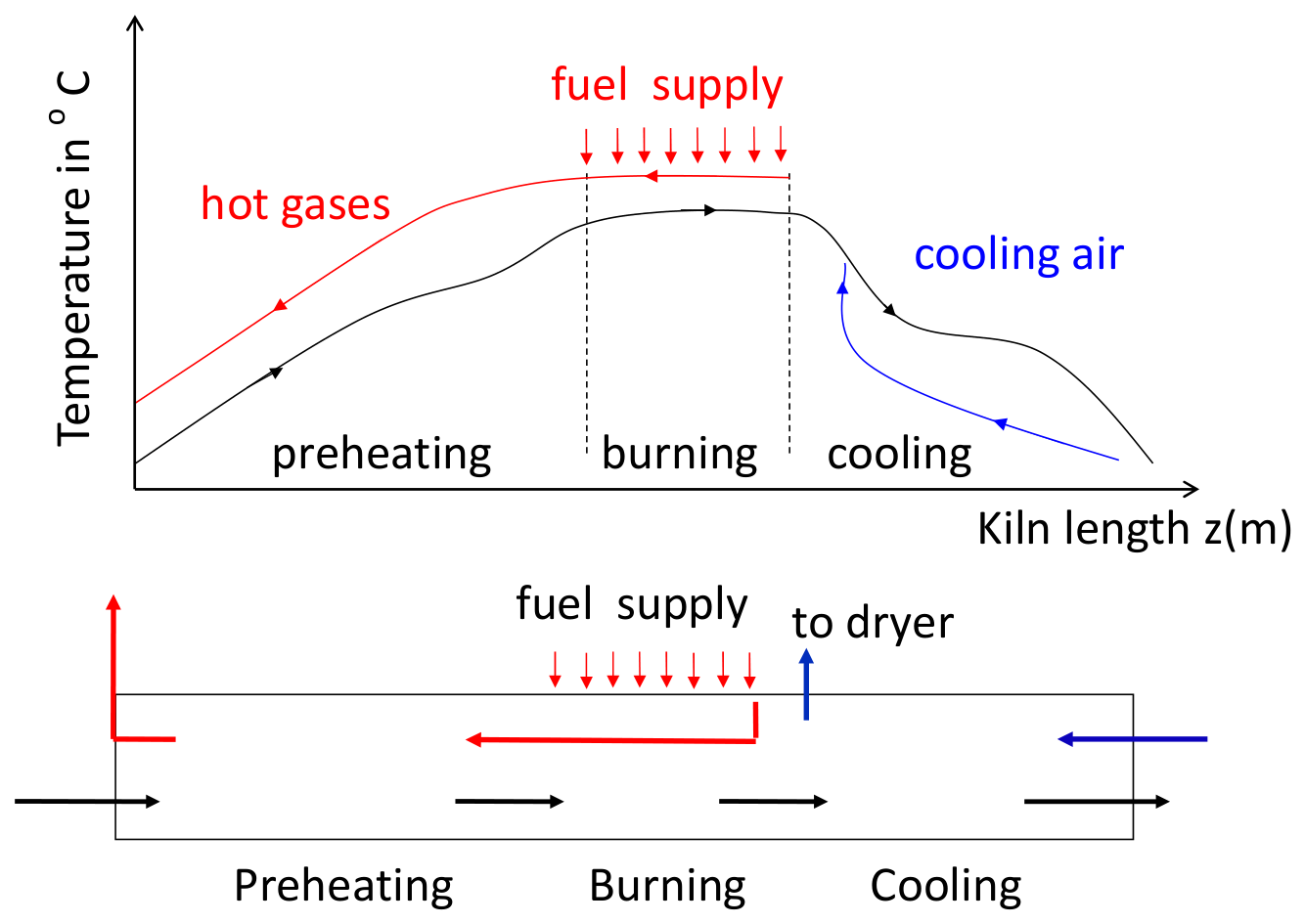
Tunnel kilns are generally divided into three main operating zones: the preheating zone, the firing zone, and the cooling zone. In the preheating zone, green ceramic products are gradually heated by hot flue gases leaving the firing zone, allowing partial heat recovery and reducing fuel consumption. The firing zone is the central section of the kiln, where burners provide the energy to reach the desired firing temperature and enable sintering and phase transformations in the ceramic material. In the cooling zone, ambient air is introduced to cool the fired products while simultaneously recovering heat for reuse in the preheating process. This counter-current heat exchange between gases and solids significantly enhances the overall thermal efficiency of tunnel kiln systems, as shown in
Figure 1 [
1]. Where the red lines refer to hot gases, blue lines refer to cooling air, and black lines refer to solid materials.
The thermal behavior of tunnel kilns is governed by complex interactions between conduction, convection, and radiation heat transfer mechanisms, coupled with fluid flow dynamics and physicochemical transformations of ceramic materials during firing. These interrelated processes determine the temperature distribution within the kiln atmosphere, the ceramic load, and the kiln structure, ultimately affecting product quality, energy consumption, and operational stability. Therefore, a comprehensive understanding of heat transfer and thermal interactions in tunnel kilns is essential for optimizing kiln design and improving operational efficiency.
In recent years, attention has increased toward improving the energy efficiency and environmental sustainability of tunnel kiln operations. Ceramic manufacturing is an energy-intensive process that contributes to greenhouse gas emissions due to high fuel consumption during firing. As a result, numerous studies have investigated strategies such as optimized airflow management, advanced firing techniques, improved insulation, and waste heat recovery systems to reduce energy consumption. In addition, modifications in brick arrangement, gas flow patterns, and combustion control have been explored to enhance temperature uniformity and heat transfer efficiency within the kiln.
Alongside experimental investigations, numerical modeling has emerged as a powerful tool for analyzing thermal processes in tunnel kilns. Mathematical models and computational fluid dynamics (CFD) simulations enable detailed analysis of temperature distribution, gas flow behavior, and heat transfer mechanisms. These approaches provide insights that are often difficult to obtain experimentally and support the optimization of kiln design and operation.
More recently, the integration of digital technologies and Industry 4.0 concepts has opened new opportunities for improving tunnel kiln performance. Digital Twin systems, real-time monitoring platforms, and intelligent control strategies enable enhanced process optimization, predictive maintenance, and improved operational reliability.
Despite extensive research on tunnel kiln operation, previous reviews have primarily focused on specific aspects such as energy efficiency, numerical modeling, or combustion analysis, often treating these processes independently and without a unified evaluation framework. In addition, limited attention has been given to comparing different modeling approaches with respect to validation levels, industrial applicability, and scalability, particularly under realistic operating conditions.
The novelty of this review lies in providing a structured and integrated system-level analysis that simultaneously evaluates thermal behavior, fluid flow, combustion processes, material transformations, energy recovery strategies, and emerging digital technologies. Unlike previous reviews, this study explicitly compares analytical, experimental, CFD-based, and data-driven approaches using consistent evaluation criteria, including modeling assumptions, validation methods, scale of application, and practical implementation constraints.
Furthermore, this review establishes direct links between subsystem interactions and overall kiln performance, highlighting trade-offs among heat transfer enhancement, pressure drop penalties, energy efficiency, and operational stability. It also incorporates recent developments in Digital Twin and Industry 4.0 technologies within the context of tunnel kilns, bridging the gap between conventional thermal analysis and real-time optimization frameworks.
By combining multi-scale analysis, comparative evaluation, and system-level integration, this work provides a more realistic and practically oriented foundation for the design, optimization, and digital transformation of next-generation tunnel kiln systems.
1.1. Methodology of Literature Review
This review adopts a structured narrative methodology to provide a comprehensive and critical assessment of recent developments in tunnel kiln technology, with emphasis on heat transfer, energy efficiency, and digital optimization.
1.1.1. Literature Search Strategy
The literature survey was conducted using major scientific databases, including Scopus, Web of Science, ScienceDirect, and Google Scholar. The search was performed using combinations of relevant keywords, such as tunnel kiln, ceramic manufacturing, heat transfer in kilns, airflow and combustion in kilns, CFD modeling of tunnel kilns, energy efficiency and heat recovery, emissions and sustainability in ceramic production, and Digital Twin and Industry 4.0 in thermal systems.
The review primarily covers studies published over the last 20–25 years, with particular emphasis on recent contributions from the last 5–10 years to capture current trends and technological advancements.
1.1.2. Selection Criteria
The selection of studies was guided by several criteria. Priority was given to peer-reviewed journal articles and high-quality conference papers that provide original contributions in modeling, experimental investigation, or system-level analysis. Studies focusing on industrial tunnel kilns or representative scaled systems were considered particularly relevant.
In addition, the review includes studies addressing key aspects such as heat transfer, fluid flow, combustion processes, energy optimization, environmental performance, and digital technologies. Studies with limited technical relevance, insufficient methodological clarity, or redundant contributions were excluded to ensure the quality and consistency of the analysis.
1.1.3. Classification of Reviewed Studies
To ensure a systematic and coherent analysis, the selected literature was classified into several main categories, including thermal modeling and heat transfer analysis, process optimization and firing behavior, flow dynamics and convective heat transfer, operational parameters and system performance, heat recovery and energy optimization strategies, experimental heat transfer enhancement techniques, CFD and numerical simulation approaches, environmental impact and sustainability assessment, and Digital Twin and Industry 4.0 applications.
Within each category, studies were further evaluated based on the modeling approach (analytical, empirical, CFD-based, or hybrid), the level of validation (theoretical, laboratory-scale, pilot-scale, or industrial), and their applicability to real-world tunnel kiln systems.
1.1.4. Review Approach and Analysis Framework
This work is conducted as a critical narrative review, focusing not only on summarizing existing studies but also on comparing different modeling and experimental approaches, identifying key assumptions and limitations, and evaluating industrial applicability and scalability.
Particular emphasis is placed on system-level integration, where heat transfer, combustion, airflow behavior, material transformation, energy recovery, and control strategies are analyzed as interconnected processes rather than isolated components. This structured approach ensures both comprehensive coverage of the literature and a consistent basis for comparative and system-level analysis.
Table 1 provides a structured classification of the main modeling approaches used in tunnel kiln studies, including analytical, mathematical, CFD-based, empirical, and experimental methods. The comparison highlights differences in dimensionality, underlying assumptions, validation level, scale of application, and industrial relevance.
As shown in
Table 1, modeling approaches vary significantly in their level of detail, computational requirements, and applicability to real industrial systems. Analytical and empirical models offer simplicity and low computational cost, making them suitable for preliminary analysis and system-level estimation; however, they are limited by simplifying assumptions and lack spatial resolution. In contrast, CFD-based models provide detailed insight into flow and heat transfer behavior, but their high computational cost and dependence on boundary conditions and turbulence modeling can restrict their use in large-scale or real-time applications.
Mathematical models represent an intermediate approach, balancing complexity and computational efficiency while capturing key thermal behaviors. Experimental studies, although essential for validation, are typically limited to laboratory-scale conditions and may not fully represent industrial operating environments. Overall, the comparison reveals a clear gap between high-fidelity modeling and practical industrial implementation, highlighting the need for integrated approaches that combine accuracy, validation, and scalability. This structured classification also provides a consistent basis for the comparative analysis presented throughout this review.
2. Thermal Behavior and Heat Transfer Modeling in Tunnel Kilns
Tunnel kilns are widely used in the ceramic industry because they allow continuous production while maintaining relatively high thermal efficiency. A detailed understanding of the thermal behavior and heat transfer mechanisms occurring inside these systems is essential for optimizing kiln operation, improving product quality, and reducing energy consumption. Consequently, many studies have focused on developing mathematical models to describe temperature distribution, heat transfer mechanisms, and energy utilization in tunnel kilns.
Refaey [
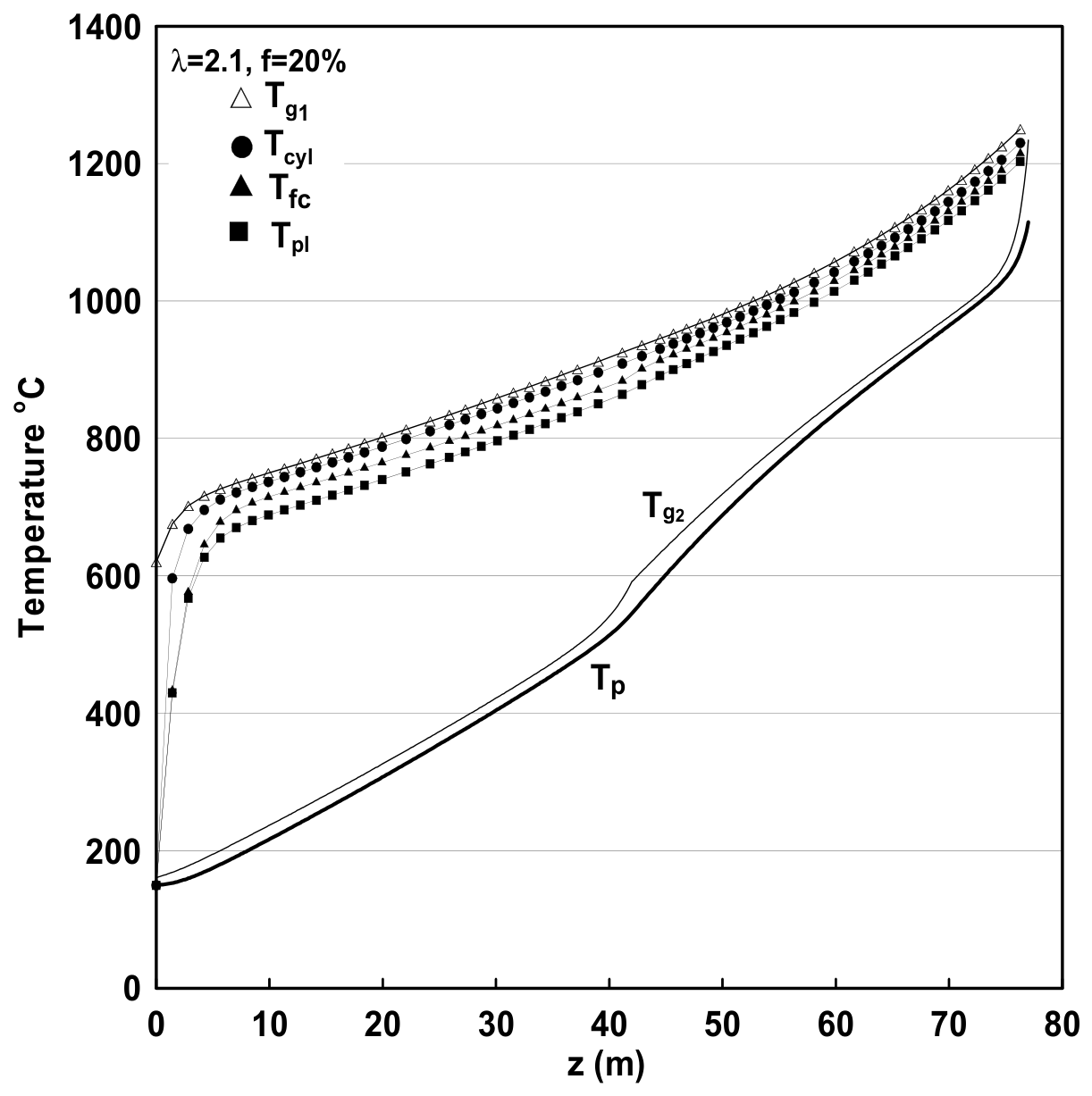
1] developed a simplified mathematical model to analyze heat transfer and temperature distribution in ceramic tunnel kilns. The model is based on energy balance equations formulated as a system of ordinary differential equations that describe the thermal interaction between combustion gases and the ceramic load as they move along the kiln length. The formulation allows prediction of the temperature profiles of both the gas phase and the solid ceramic products. Numerical solutions of the governing equations were obtained using the MATLAB R2010b (The MathWorks, Inc., Natick, MA, USA) bvp4c boundary value problem solver to determine temperature evolution throughout the kiln. The study also investigated the influence of key operating parameters, particularly the firing zone length and excess air ratio, on the overall energy consumption of the process. The results indicated that energy consumption increases gradually as the firing zone length increases; however, the increase remains relatively small when the firing zone represents less than approximately 30% of the total kiln length. In addition, the study examined both convective and radiative heat transfer mechanisms as shown in
Figure 2. Then, the gas circulation using (CFD) simulations was analyzed, providing valuable insights into temperature distribution and heat transfer processes within tunnel kilns.
Oba et al. [
2] conducted a comprehensive thermal analysis of a tunnel kiln used for the production of ceramic roof tiles through a combined numerical and experimental approach. A three-dimensional model based on the finite volume method was developed to simulate heat transfer mechanisms, including conduction, convection, and radiation within the kiln. The study demonstrated that fuel combustion, airflow patterns, and load configuration strongly influence temperature distribution along the kiln. Experimental validation showed good agreement with the numerical results, confirming the model’s reliability. Furthermore, the analysis revealed that a significant portion of the input energy is lost through the kiln walls and exhaust gases, highlighting the importance of optimizing heat recovery and thermal insulation to improve overall energy efficiency.
Dugwell and Oakley [
3] developed a comprehensive mathematical model to predict gas and product temperature profiles during the firing of refractory materials in tunnel kilns. In this model, the kiln is represented as a sequence of plug-flow regions where heat transfer occurs between the hot combustion gases and the ceramic load, separated by well-mixed adiabatic regions where burners and air leaks are introduced. The model considers the combined effects of conduction, convection, and radiation. Heat conduction inside the ceramic material during firing can be described by the transient heat diffusion equation given in Equation (1) [
3].
where
represents the temperature of the ceramic material (K),
t is time (s),
is the thermal conductivity (W/mK),
is the density (kg/m
3), and
is the specific heat capacity of the material (J/kg.K). The model was implemented in both one- and two-dimensional forms to analyze heat transfer within the ceramic load and in the surrounding gas flow. Validation with industrial kiln measurements showed good agreement between predicted and measured gas and product temperature profiles, demonstrating that the model can effectively simulate kiln operation and assist in optimizing firing conditions and fuel consumption.
Essenhigh [
4] proposed an analytical approach for predicting tunnel kiln performance using the integral energy equation. The method applies overall energy balance principles to the kiln system, relating the heat supplied by fuel combustion to the heat absorbed by the ceramic load, heat losses through kiln walls, and energy carried away by exhaust gases. This simplified approach allows estimation of temperature profiles and fuel requirements without complex numerical simulations, making it useful for preliminary design analysis and performance evaluation of industrial tunnel kilns.
Durakovic and Delalic [
5] explored the temperature distribution in a tunnel kiln used for brick production, aiming to improve energy efficiency and product quality. The authors developed a mathematical model describing the stationary temperature field inside the kiln chamber. The stationary temperature field along the kiln length can be described by the governing equation shown in Equation (2) [
5].
where
represents the temperature field inside the kiln,
represents the external heat input associated with fuel combustion, and
is a parameter related to the kiln system’s thermal characteristics. The model was solved using boundary conditions corresponding to the inlet and outlet temperatures of the kiln chamber. The results demonstrate that the temperature field within the kiln can be effectively predicted using the developed mathematical model, enabling improved control of firing conditions and optimized fuel consumption in brick manufacturing processes.
These findings highlight that mathematical models used in tunnel kiln analysis differ significantly in their predictive capability, computational requirements, and applicability to industrial conditions. Simplified energy-balance and one-dimensional models are computationally efficient and useful for preliminary analysis, parametric studies, and operational trend evaluation; however, they generally neglect spatial non-uniformities, transient effects, and localized thermo-fluid interactions. In contrast, multidimensional and CFD-based models provide a more detailed representation of coupled heat transfer mechanisms, fluid flow behavior, and temperature distribution, enabling improved prediction of kiln performance under complex conditions. Nevertheless, these advanced models require substantial computational resources, detailed input data, and careful selection of boundary conditions and turbulence models, which may limit their practical implementation in routine industrial applications.
Furthermore, although several studies report good agreement between model predictions and experimental or plant data, validation is often limited in scope. It lacks systematic uncertainty analysis, making it difficult to assess model robustness across different kiln configurations and operating regimes. This indicates that selecting an appropriate modeling approach should consider not only predictive accuracy but also data availability, computational feasibility, and the intended application, whether for design, optimization, or real-time process control. Consequently, there remains a need for scalable modeling frameworks that balance accuracy and computational efficiency while remaining relevant to industrial tunnel kiln operations.
3. Process Optimization and Firing Behavior in Tunnel Kilns
Optimizing firing conditions and properly understanding material behavior during heating are essential for improving product quality, energy efficiency, and operational stability in tunnel kiln processes. Several studies have investigated the optimization of firing zones, drying behavior, and thermal transformations of clay materials in order to enhance the performance of ceramic firing systems.
Kaya et al. [
6] developed a mathematical optimization model for the firing zone of a tunnel kiln to determine optimal fuel and air distribution that minimizes fuel consumption while maintaining stable firing conditions. The model describes the heat transfer and combustion processes occurring between the hot gases and the ceramic load along the kiln length. Heat transfer mechanisms include convection between the gas and brick surfaces as well as radiation between the kiln walls and the brick load. The energy balance for the gas phase in the firing zone can be expressed as Equation (3) [
6]:
where
and
represent the gas, brick, outside, and wall temperatures (K),
denotes the convective heat transfer coefficient (W/m
2K),
is the heat transfer area (m
2),
is the specific heat (J/kg.K)
is the gas mass flux (kg/m
2s), g is blowing mass flux (kg/m
2 s), and
represents the heat released from pulverized coal combustion (W/m
2),
is the heating value (j/kg). The third term to the right of the equation acts as a source term due to blowing.
In addition, the heat balance for the brick load is described as Equation (4) [
6]:
where f
c is the carbon percentage in the brick body (%), and F is the view factor.
This equation which accounts for convective heat transfer, radiative heat exchange with the kiln walls, and heat released by the combustion of admixed coal within the brick body. The optimization framework minimized the total fuel cost by adjusting operating variables, including pulverized coal feed rate, secondary air distribution, and internal fuel content within the bricks. The results showed that optimized fuel and air distribution significantly reduce energy consumption while maintaining appropriate temperature profiles within the firing zone.
Another important stage influencing overall kiln performance is the drying process of ceramic bricks before firing. Almeida et al. [
7] developed a combined theoretical and experimental study to investigate heat and mass transfer during the drying of hollow ceramic bricks in an industrial crossflow tunnel dryer. The study employed a mathematical model based on coupled energy and mass balance equations for both the drying air and the porous ceramic material, solved numerically using the finite volume method. Moisture evolution in the product was described using an empirical thin-layer drying model, which was validated against experimental data, showing good agreement. The results highlighted the influence of airflow conditions, temperature distribution, and brick arrangement on drying behavior. It was also observed that moisture removal and temperature evolution vary along the dryer length, leading to non-uniform drying conditions that may affect product quality. These findings emphasize the importance of controlled drying conditions to minimize defects and ensure uniform moisture reduction before firing.
The thermal behavior of clay materials during firing was further investigated by Vasić et al. [
8], who analyzed the thermal characteristics of montmorillonite and hydromica brick clays using differential thermal analysis (DTA), thermogravimetric analysis (TGA), and dilatometry. The study demonstrated that understanding mineralogical composition and thermal reactions of clay materials is essential for designing suitable firing curves that prevent cracking, excessive shrinkage, or thermal shock.
Thermal analysis revealed several key reactions occurring during heating. At temperatures below approximately 200 °C, physically adsorbed water dehydrates. Between approximately 300 °C and 500 °C, decomposition of organic matter takes place, while dehydroxylation of clay minerals occurs in the temperature range of about 500–600 °C. Carbonate decomposition typically occurs between 600 °C and 800 °C, followed by sintering and vitrification processes at higher temperatures. Dilatometric measurements also showed that expansion occurs near the quartz phase transformation temperature, followed by significant shrinkage above approximately 800 °C due to densification of the ceramic body.
These investigations collectively demonstrate that process optimization in tunnel kilns must be viewed as an interrelated thermophysical system in which firing conditions, drying behavior, and material attributes continuously interact. Optimization models, such as those proposed by Kaya et al. [
6], effectively reduce fuel consumption by regulating air-fuel distribution; however, they are generally formulated under simplified assumptions, such as steady-state operation and uniform material properties, which may limit their applicability to actual industrial conditions. Drying studies similarly emphasize the significant impact of airflow conditions, internal geometry, and pore structure on moisture extraction and defect development; however, many modeling methodologies rely on simplified representations that fail to capture the intricacies of coupled heat and mass transfer in industrial-scale systems. Concurrently, thermal characterization investigations, such as those conducted by Vasić et al. [
8], reveal that mineralogical transformations impose significant constraints on heating rates and firing schedules; yet, these material-dependent effects are infrequently incorporated into system-level optimization frameworks. Consequently, current methodologies often focus on specific facets of kiln operation rather than considering the process as a whole. The absence of integration may lead to product faults, energy inefficiencies, and operational instability. Consequently, there is a clear need for more comprehensive and integrated approaches that integrate combustion behavior, drying dynamics, and material transformations, enabling more reliable and adaptable optimization of tunnel kiln performance in authentic industrial settings.
4. Flow Dynamics and Convective Heat Transfer in Tunnel Kilns
Understanding the fluid flow behavior and convective heat transfer mechanisms inside tunnel kilns is essential for improving thermal efficiency, ensuring temperature uniformity, and enhancing product quality. Several studies have investigated the influence of brick arrangements, gas circulation, and flow distribution on heat transfer performance using both experimental measurements and computational fluid dynamics (CFD) simulations.
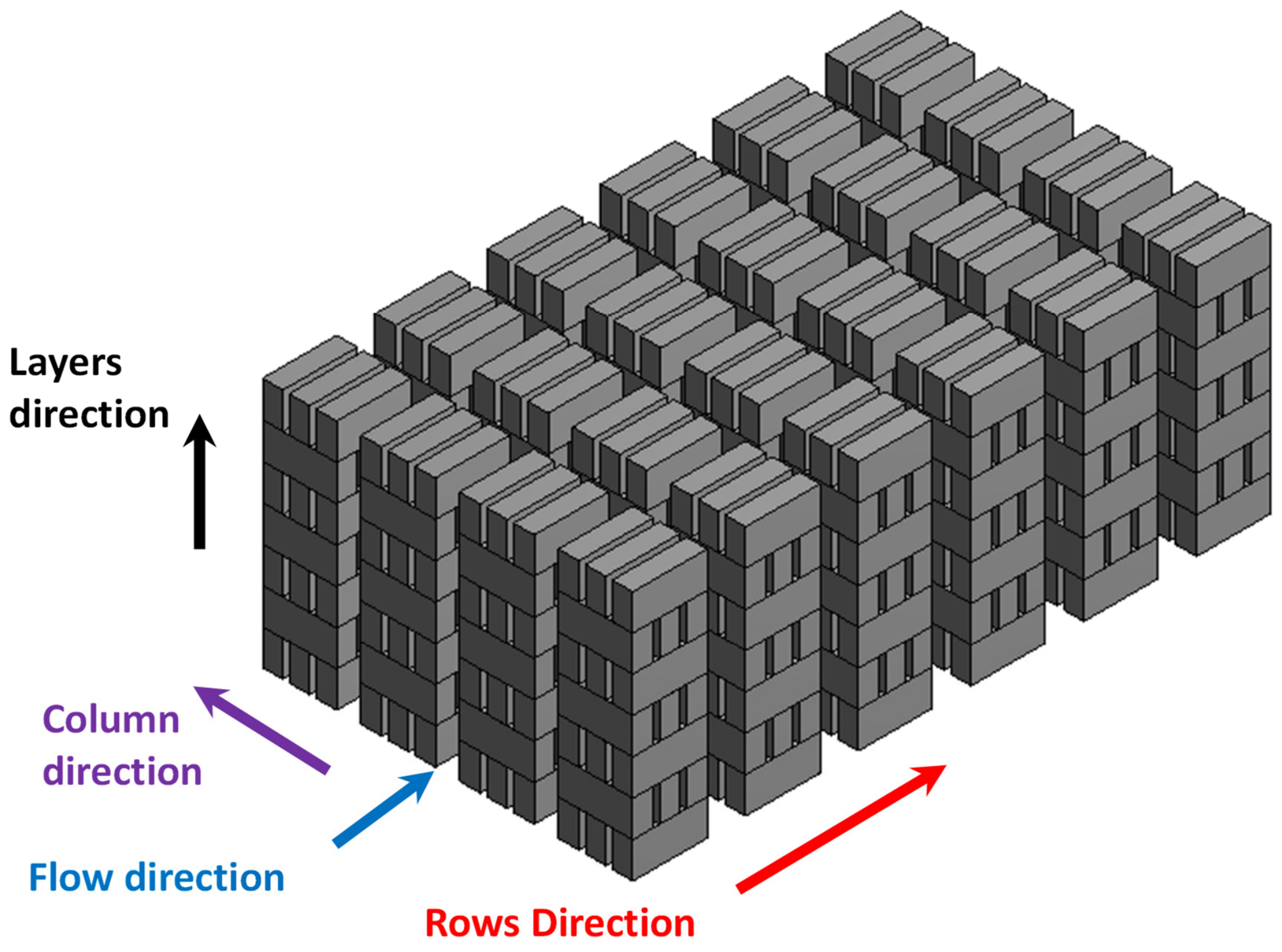
Abou-Ziyan [
9] experimentally investigated the convective heat transfer characteristics associated with different brick arrangements in tunnel kilns using a laboratory-scale experimental setup representing a section of a kiln at a scale of 1:4. Six different brick settings were examined for Reynolds numbers ranging from approximately 6000 to 33,000 under constant heat flux conditions. The study evaluated the effects of brick orientation, column spacing, and flow direction on both convective heat transfer coefficients and pressure drop across the brick setting. The findings showed that both pressure drop and convective heat transfer strongly depend on the geometric configuration of the brick arrangement. Increasing the brick spacing from 5 mm to 26 mm in lattice settings increased the Nusselt number by approximately 56% at a Reynolds number of 15,000. The study also proposed empirical correlations for predicting convective heat transfer in tunnel kiln settings. One of the correlations obtained for the Nusselt number can be expressed as Equation (5) [
9]:
where
is the Nusselt number,
is the Reynolds number, and the geometric parameters (a, b) describe the spacing (s) in (m) and void fraction
of the brick setting, with a correlation coefficient of 0.98. The results indicated that lattice brick settings with equal spacing between columns and rows provide higher heat transfer coefficients and improved energy efficiency in tunnel kiln operation.
Further investigations into convective heat transfer in lattice brick settings were conducted by Abou-Ziyan et al. [
10], who used a three-dimensional CFD model to determine local and area-averaged convective heat transfer coefficients for longitudinal and transverse bricks arranged in tunnel kilns. The simulations were validated against available experimental measurements and employed different turbulence models, including the standard.
, RNG
, and
models. The
turbulence model provided the best agreement with experimental results. The numerical simulations revealed that improving flow uniformity inside the kiln channels significantly enhances heat transfer performance. Specifically, the convective heat transfer coefficients increased by approximately 17% for longitudinal bricks and 27% for transverse bricks when uniform flow distribution was achieved. These improvements can reduce specific energy consumption and improve production quality in brick manufacturing processes.
The mixing behavior of combustion gases inside tunnel kilns was further studied using CFD techniques by Al-Hasnawi et al. [
11], who analyzed the influence of side air injection on gas mixing in the kiln cross-section. A three-dimensional CFD model was developed in FLUENT to simulate the temperature field between kiln cars in the preheating zone. The study examined the effects of nozzle position, injection velocity, number of nozzles, and injection flow rate on the mixing performance. The CFD showed that using two side nozzles located on opposite walls significantly improves the mixing of the two axial flows passing through the ware and the side gaps. The mixing quality increased substantially until the impulse flow rate reached approximately 4 N, beyond which further increases had a limited effect. The predicted temperature distribution obtained from CFD simulations showed excellent agreement with analytical calculations, with a maximum deviation of approximately 0.5%.
Flow distribution within tunnel kilns was also investigated by Almutairi et al. [
12], who developed a three-dimensional CFD model to analyze airflow behavior through lattice brick settings. The study demonstrated that non-uniform airflow distribution is common in tunnel kilns due to differences in flow resistance between the brick-setting channels and the gaps between the brick load and the kiln walls or roof. This phenomenon results in higher gas velocities in the wall and roof gaps, leading to uneven heat transfer and potential product quality issues. The governing equations used in the CFD simulations include the conservation equations for mass, momentum, and energy, i.e., Equations (6)–(8) [
12]:
Energy equation:
where
is fluid density, (kg/m
3), t represents time (s), and the velocity components (m/s) in the three spatial directions are represented by
,
, and
in the
,
, and
directions, respectively. P denotes the pressure (Pa),
is the dynamic viscosity (Pa·s), and
represents the gravitational acceleration component (m/s
2). The term
corresponds to the body force per unit volume (N/m
3). In the energy equation,
is the temperature (K),
is the thermal conductivity (W/m.K),
is the specific heat (J/kg.K), and
represents the volumetric heat source term (W/m
3).
Using these equations, the study identified the optimal dimensions of various flow channels required to achieve uniform airflow inside tunnel kilns. The results indicated that uniform flow can be achieved when the dimensions of the column, wall, ceiling, and extension channels are approximately 0.50, 0.25, 0.20, and 0.36 of the brick column width, respectively. Achieving uniform airflow improves both heat transfer efficiency and product quality, although it may slightly increase pressure drop and pumping power requirements.
The influence of gas circulation systems on heat transfer performance in tunnel kilns was investigated by Redemann and Specht [
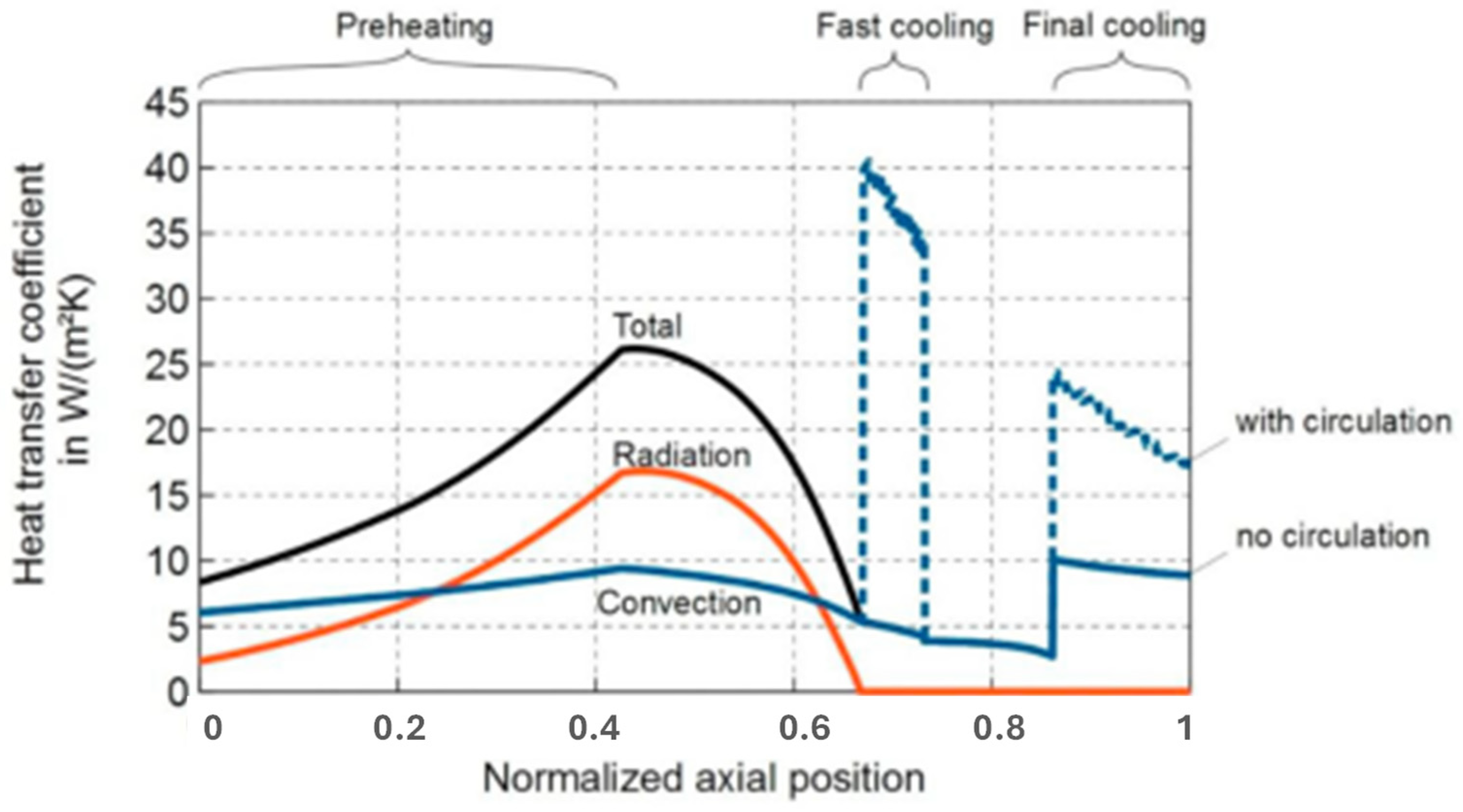
13], who developed a mathematical model to simulate the firing process of ceramic products. The model incorporates both convective and radiative heat transfer mechanisms and evaluates the influence of gas velocity on heat transfer between the combustion gases and the ceramic load. The results indicated that improving gas circulation significantly enhances convective heat transfer, particularly in the cooling zone, where large amounts of heat can be recovered.
Figure 3 demonstrates the axial variation in the heat transfer coefficient with and without gas circulation in the cooling zone. The study suggested that a mean gas velocity of approximately 20 m/s through the brick setting is required to achieve efficient heat transfer and reduce energy losses in roof-tile tunnel kilns.
Yu [
14] developed a dynamic model of tunnel kiln operation to describe the transient heat and mass transfer processes occurring during firing. The model is based on coupled energy and mass conservation equations for both the gas phase and the ceramic load, accounting for heat conduction within the material and convective heat transfer with the surrounding gases. The study demonstrated that the temperature distribution along the kiln is strongly influenced by the interactions among gas flow, load movement, and the material’s thermal properties. Furthermore, the results highlighted the importance of controlling operational parameters, such as fuel input and airflow conditions, to achieve stable thermal profiles and consistent product quality in industrial tunnel kiln systems.
In addition to heat transfer and flow distribution studies, Refaey [
1] investigated gas circulation behavior during the firing of sanitaryware products using 3-D CFD simulations. Due to the complex geometry of sanitaryware products, combustion gases tend to flow preferentially through the gaps between the products and the kiln walls rather than through the product stack itself. The study demonstrated that side air injection can significantly improve gas circulation and mixing in the kiln cross-section. The governing equations for the CFD simulation included the continuity and momentum equations, such as Equation (9) [
1]:
where
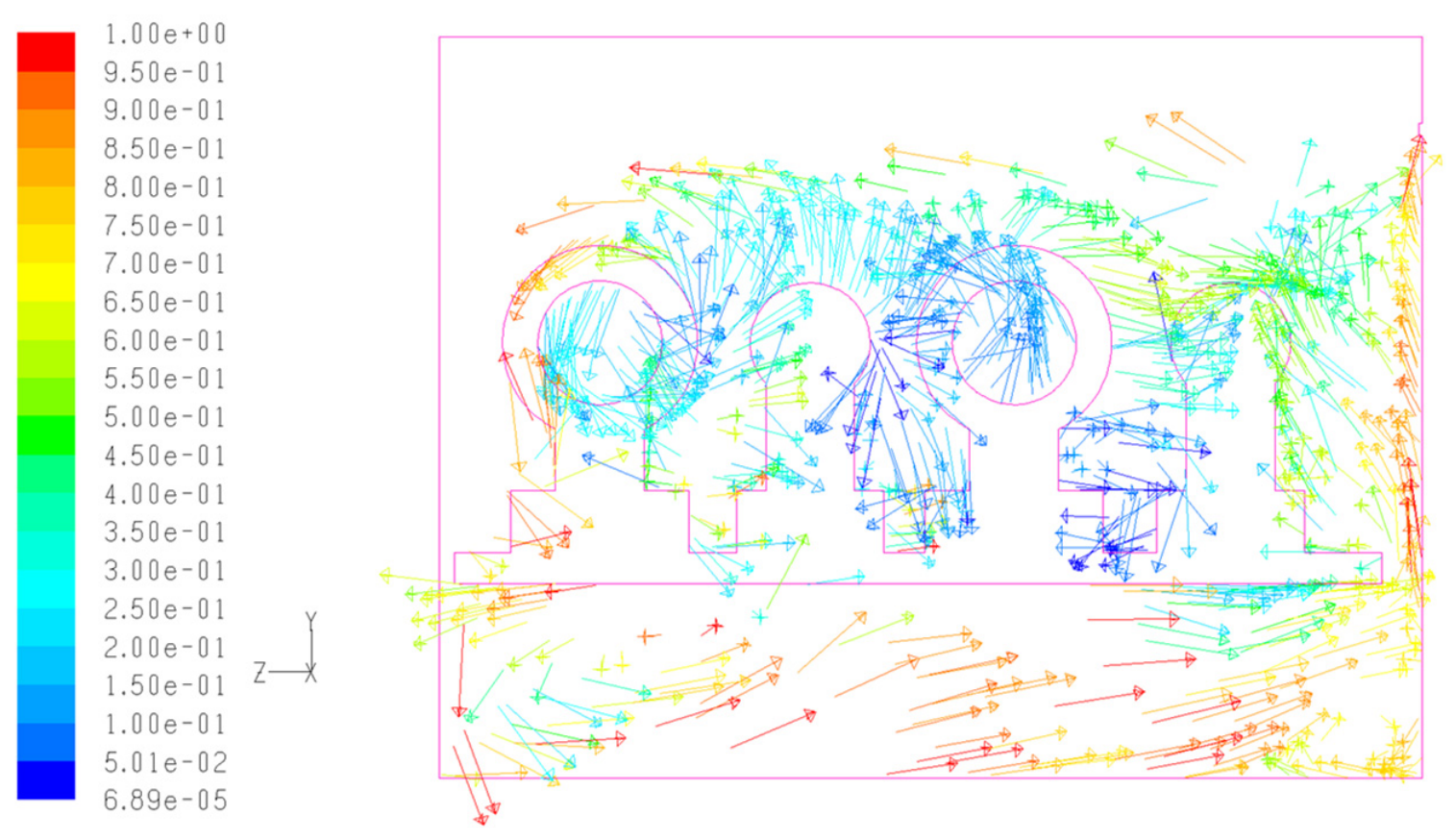
represents the velocity vector of the gas flow. The results showed that radial velocity components generated by side nozzles and burners play a critical role in enhancing cross-sectional mixing and improving convective heat transfer inside the sanitaryware kiln.
Figure 4 demonstrates the velocity vectors in a cross-sectional plane passing through the upper nozzle in the computational domain. The average gas velocity within the investigated domain was approximately 1 m/s, underscoring the need for additional mixing mechanisms to improve heat transfer efficiency during sanitaryware firing.
Fluid flow behavior remains one of the most influential yet difficult-to-control factors in tunnel kiln operation, directly affecting heat transfer efficiency and temperature uniformity. Both experimental and CFD studies demonstrate that optimized brick arrangements and improved flow distribution can significantly enhance convective heat transfer. However, these improvements are highly sensitive to geometric configurations and operating conditions, limiting their general applicability.
Empirical correlations proposed for predicting convective heat transfer are typically derived under controlled laboratory conditions with specific brick settings and Reynolds number ranges. As a result, their direct application to full-scale industrial kilns where flow maldistribution, complex stacking patterns, and variable boundary conditions exist should be approached with caution. Additional validation or coupling with numerical models is often required for reliable industrial predictions.
CFD simulations provide detailed insight into flow structures, mixing behavior, and local heat transfer characteristics, but their accuracy depends strongly on model assumptions, boundary conditions, and turbulence model selection. Non-uniform airflow distribution remains a persistent issue, particularly due to preferential flow through wall and roof gaps, leading to uneven heating and potential product defects. While strategies such as side air injection and channel geometry optimization can improve flow uniformity, they may introduce increased pressure drop and operational complexity.
Overall, existing studies often treat flow dynamics independently from other kiln subsystems, despite their strong coupling with combustion and heat transfer processes. This highlights the need for integrated modeling and control approaches that simultaneously account for flow behavior, thermal interactions, and operational constraints under realistic industrial conditions. While these findings highlight the importance of flow behavior, their interaction with heat transfer mechanisms requires further examination, as discussed in the following section.
The reviewed studies demonstrate that heat transfer in tunnel kilns cannot be considered independently of fluid flow and combustion processes. Gas flow distribution directly controls convective heat transfer, while combustion dynamics determine temperature fields and heat availability. These coupled interactions also influence material transformation processes, including drying, sintering, and phase changes, highlighting the need for integrated analysis rather than isolated subsystem evaluation.
5. Operational Factors and Thermal Performance Optimization in Tunnel Kilns
In addition to heat transfer fundamentals and flow behavior, tunnel kiln performance is strongly influenced by operational factors such as kiln car design, heating configuration, fuel distribution, firing-zone control, and product geometry. These parameters directly affect temperature uniformity, firing stability, and energy consumption, and therefore have received considerable attention in both mathematical and experimental studies.
Zhang et al. [
15] developed a mathematical model to investigate the thermal behavior of kiln cars as they travel through a tunnel kiln. Since kiln cars are heated and cooled along with the ceramic load, they represent a significant energy loss during firing. The model accounted for transient heat conduction within the kiln car and for convective and radiative boundary conditions. Forced convection over kiln car surfaces was evaluated using classical Nusselt number correlations, Equations (10) and (11) [
15], including for laminar flow,
and for turbulent flow,
The results showed that the kiln car absorbs a considerable fraction of the thermal energy supplied to the kiln, confirming that reducing kiln car heat storage is an important strategy for improving overall energy efficiency.
The role of kiln car mass was examined further by Alex et al. [
16], who developed a mathematical model to simulate the firing process in tunnel kilns producing bricks and roof tiles. The model describes the temperatures of the ware, gas, and kiln car using ordinary differential equations that account for the main heat transfer mechanisms in the kiln. Their simulations showed that the kiln car’s thermal mass has a major effect on the firing process and total energy demand. By reducing the weight of the kiln car layers while maintaining the required firing curve, the authors demonstrated that energy consumption can be reduced by up to 40%. This result highlights the importance of lightweight kiln car design for improving tunnel kiln efficiency.
Heating system configuration has also been shown to affect kiln thermal performance. Ibrahim et al. [
17] experimentally investigated the effect of heating element positions on the thermal behavior of a brick tunnel kiln using a 1:4 scaled test section. Nine different heater arrangements were tested over Reynolds numbers ranging from approximately 15,938 to 30,890. The results indicated that heater position significantly influences both local and average heat transfer performance. The average Nusselt number ranged from about 186 to 285, and the optimum configuration produced a maximum improvement of approximately 48.8% in the average Nusselt number. In addition, the largest increase in local Nusselt number with increasing Reynolds number occurred near the wall in the longitudinal direction, reaching about 55.7% for one configuration. These findings confirm that the placement of heating elements can substantially improve thermal performance and heat transfer effectiveness in tunnel kilns.
The thermal operation of the firing zone was previously studied by Abbakumov and Vel’sin [
18], who developed a mathematical model and computational procedure to analyze the firing zone of an automated tunnel kiln. Their study focused on controlling firing conditions and selecting suitable operating parameters for automated kiln operation. The model was intended to support process control by predicting thermal behavior in the firing zone and evaluating different control strategies. The authors concluded that automated control of the firing zone can improve the accuracy of maintaining temperature conditions and support better operational performance in tunnel kilns.
A broader numerical and experimental thermal analysis was presented by Nicolau and Dadam [
19], who developed a thermal model for a tunnel kiln used in ceramic production. Their model was based on mass and energy conservation equations applied to a three-dimensional kiln geometry and implemented using a finite-volume approach. The study considered conduction, convection, and radiation between the load, cars, gases, and kiln walls, and generated three-dimensional temperature distributions and a complete thermal energy balance for the process. The results demonstrated that combining numerical simulation with experimental measurements is an effective tool for kiln design and retrofit, especially when different fuels, such as natural gas and sawdust, are used.
The effect of fuel distribution along the firing zone was investigated by Refaey et al. [
20], who developed a simplified one-dimensional mathematical model to predict gas and solid temperature profiles in tunnel kilns. The kiln was represented as a counter-current heat exchanger in which hot combustion gases flow in the opposite direction to the ceramic load. The overall gas–solid energy balance in the tunnel kiln can be written as Equation (12) [
20].
where
and
are the solid and gas mass flow rates (kg/s),
and
are their specific heat capacities (J/kg.K),
are the solid outlet, solid inlet, gas outlet and air temperatures (K),
is the wall heat losses (W) and
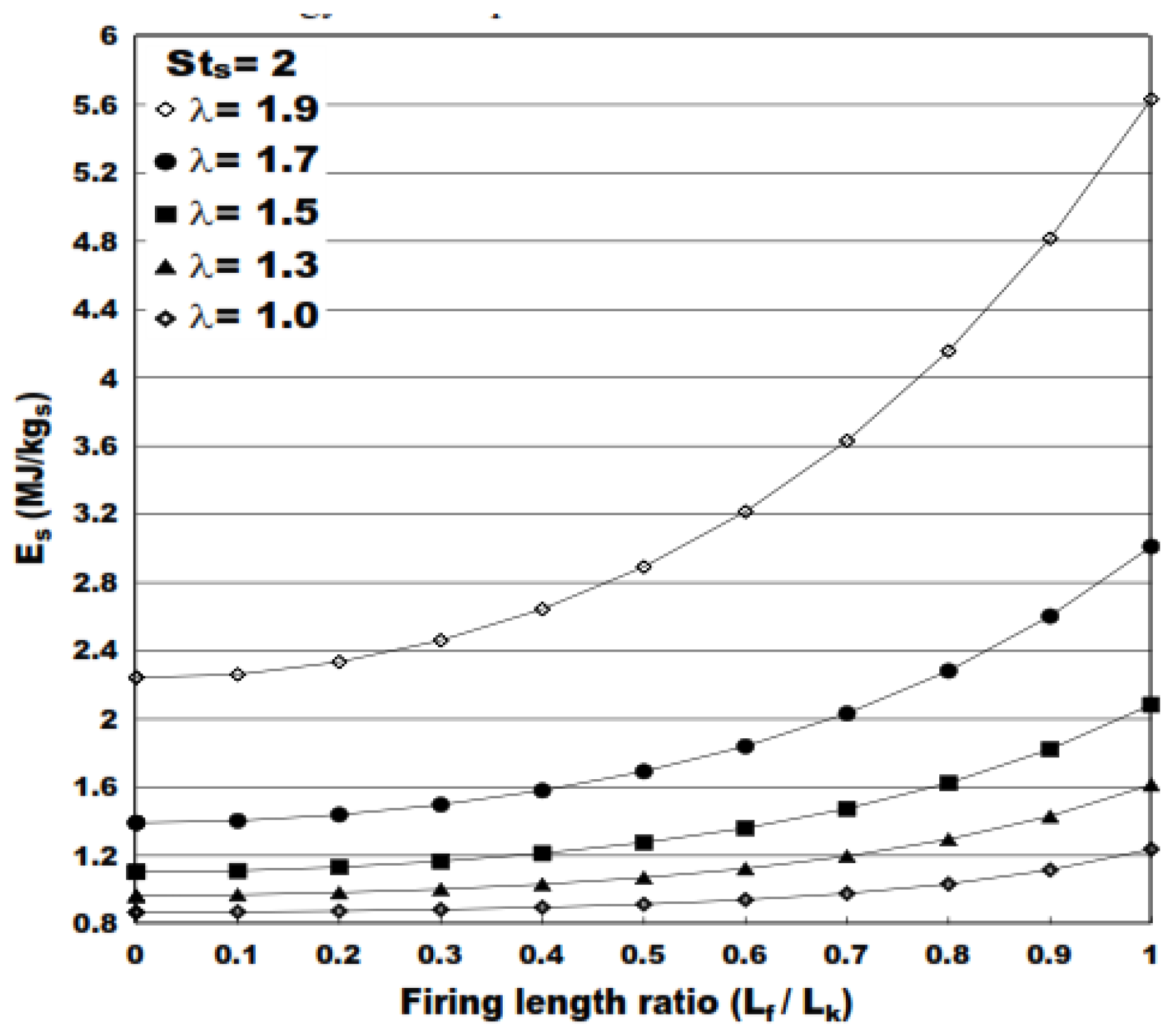
is the heat supplied by the fuel (W). A key implication is that energy consumption increases progressively with firing-zone length, but the increase remains relatively small when the firing zone is shorter than about 30% of the total kiln length, as demonstrated in
Figure 5. Where Es is the energy consumption, Sts is the Stanton number, and λ is the excess air number. This suggests that minimizing the firing zone length while maintaining proper firing conditions can reduce energy consumption.
Refaey [
1] extended the thesis and developed a modeling approach for tunnel kilns used to fire vitrified clay pipes. A simplified product geometry was used to clarify the main heat transfer behavior in the preheating and firing zones. The model was solved using MATLAB and the bvp4c solver to obtain the gas and solid temperature profiles along the kiln. The results showed that the excess air ratio strongly influences the thermal process and can be used to control product heating. The study also emphasized that increasing the heat transfer coefficient is an effective way to reduce kiln energy consumption. Therefore, both excess air control and heat transfer enhancement were identified as important operational parameters for improving the firing of vitrified clay pipes.
This literature indicates that operational parameters significantly influence the thermal efficiency and stability of tunnel kiln systems; however, their effects are highly interdependent and cannot be reliably assessed in isolation. While simulations of kiln car behavior indicate that thermal mass is a major contributor to energy losses, the practical implementation of lightweight designs must balance mechanical strength, durability, and economic constraints, which are often neglected in modeling-based analyses.
Similarly, optimization of heating configurations and fuel distribution has been shown to substantially enhance heat transfer and temperature uniformity. Nevertheless, these improvements are strongly dependent on flow dynamics and kiln geometry, suggesting that isolated optimization of heating elements may not yield consistent performance across varying industrial conditions.
Simplified one-dimensional, steady-state models used to evaluate firing-zone residence time and excess air ratio provide useful preliminary insights; however, they often overlook transient phenomena, spatial nonuniformities, and real-time operational variability. Furthermore, although automation and advanced control strategies can improve firing stability, their effectiveness depends on the availability of accurate predictive models and reliable sensor data, which remain limited in many industrial kiln operations.
Overall, the findings indicate that improving tunnel kiln performance requires a system-level optimization approach integrating kiln design, fuel management, airflow distribution, and control strategies. This highlights a critical research gap: the development of adaptive, real-time optimization frameworks that respond to dynamic operating conditions while ensuring consistent product quality and energy efficiency.
6. Heat Recovery and Energy Optimization in Tunnel Kilns
Improving energy efficiency in tunnel kilns is essential, as the firing process represents the most energy-intensive stage in ceramic production. A significant portion of the supplied thermal energy is lost through exhaust gases and cooling processes. Consequently, numerous studies have focused on waste heat recovery and optimization of heat transfer mechanisms to reduce overall fuel consumption.
One of the most widely investigated strategies is the recovery of thermal energy from the cooling zone. Mezquita et al. [
21] demonstrated that reusing hot air extracted from the cooling zone in the firing process can significantly reduce fuel consumption. Their results showed that the effectiveness of heat recovery strongly depends on airflow management and kiln operating conditions.
Meng [
22] proposed an advanced solid–solid recuperation concept in which heat is transferred directly from fired products to incoming unfired materials via controlled gas recirculation. Both analytical modeling and CFD simulations revealed that the gap between brick stacks plays a critical role in minimizing ventilator power consumption, with an optimal range of 10–20 mm. The study indicated that a counter-traveling kiln configuration could reduce total energy consumption to approximately 40% of that of conventional systems, mainly due to reduced exhaust gas losses.
Further improvements in cooling-zone performance were investigated by Kaya et al. [
23], who developed a mathematical model to analyze airflow distribution and heat transfer. Their results showed that dividing the cooling zone into multiple suction and blowing regions can optimize heat recovery while minimizing pressure drop. Similarly, Soussi et al. [
24] demonstrated that optimizing the recovered air mass flow rate can reduce fuel consumption by approximately 4.6%, highlighting the importance of balanced flow management.
At a broader system level, Carvalho and Nogueira [
25] emphasized the role of advanced numerical modeling in optimizing high-temperature industrial systems. Their work demonstrated that integrating three-dimensional modeling of flow, combustion, and radiation can improve both energy efficiency and operational control.
In addition to process optimization, reducing structural thermal losses is also critical. Alex et al. [
26] showed that the thermal mass of kiln cars significantly affects energy consumption. Their results indicated that reducing kiln car mass and improving insulation materials can lead to substantial energy savings.
Table 2 provides a comparative overview of the main energy optimization and heat recovery strategies reported in the literature, classified by type, validation level, scale of application, and practical limitations. This structured comparison enables a more realistic assessment of their effectiveness beyond theoretical predictions.
As shown in
Table 2, energy optimization strategies exhibit significant variation in both performance and level of industrial validation. While approaches such as waste heat recovery and kiln car optimization have been successfully implemented at an industrial scale, many advanced concepts, including solid–solid recuperation and renewable integration, remain limited to pilot-scale or theoretical investigations.
Moreover, improvements in heat transfer performance are often accompanied by increased pressure drop and higher fan power requirements, which can offset part of the energy savings. This highlights the importance of evaluating enhancement techniques based on overall system performance rather than isolated thermal gains.
The results also indicate that optimizing individual subsystems, such as airflow distribution or recovered air mass flow, typically leads to modest efficiency improvements when considered independently. Therefore, significant energy savings can be achieved only through integrated optimization that accounts for heat recovery, flow dynamics, combustion behavior, and material properties.
Despite advances in numerical modeling, practical implementation remains constrained by computational cost, uncertainty in boundary conditions, and limited availability of reliable industrial data. These challenges underscore the need for adaptive, real-time optimization frameworks that dynamically adjust operating conditions in response to process feedback. Such approaches are essential for achieving sustainable and scalable improvements in tunnel kiln energy performance.
Energy recovery strategies are inherently linked to airflow patterns, combustion efficiency, and heat transfer mechanisms within the kiln. For example, improved cooling-zone heat extraction depends on the gas flow distribution, which, in turn, affects upstream thermal conditions and fuel consumption. Therefore, energy optimization cannot be achieved effectively without considering the interactions among heat transfer, fluid flow, and combustion processes at the system level.
7. Experimental Heat Transfer Enhancement in Tunnel Kiln Cooling Zones
The cooling zone of tunnel kilns plays a crucial role in energy recovery and thermal management during ceramic production. Efficient heat transfer between hot fired bricks and cooling air improves energy utilization and reduces overall fuel consumption. Several experimental studies have investigated methods to enhance convective heat transfer in this region by modifying brick arrangements or by introducing flow-control devices, such as guide vanes.
Refaey et al. [
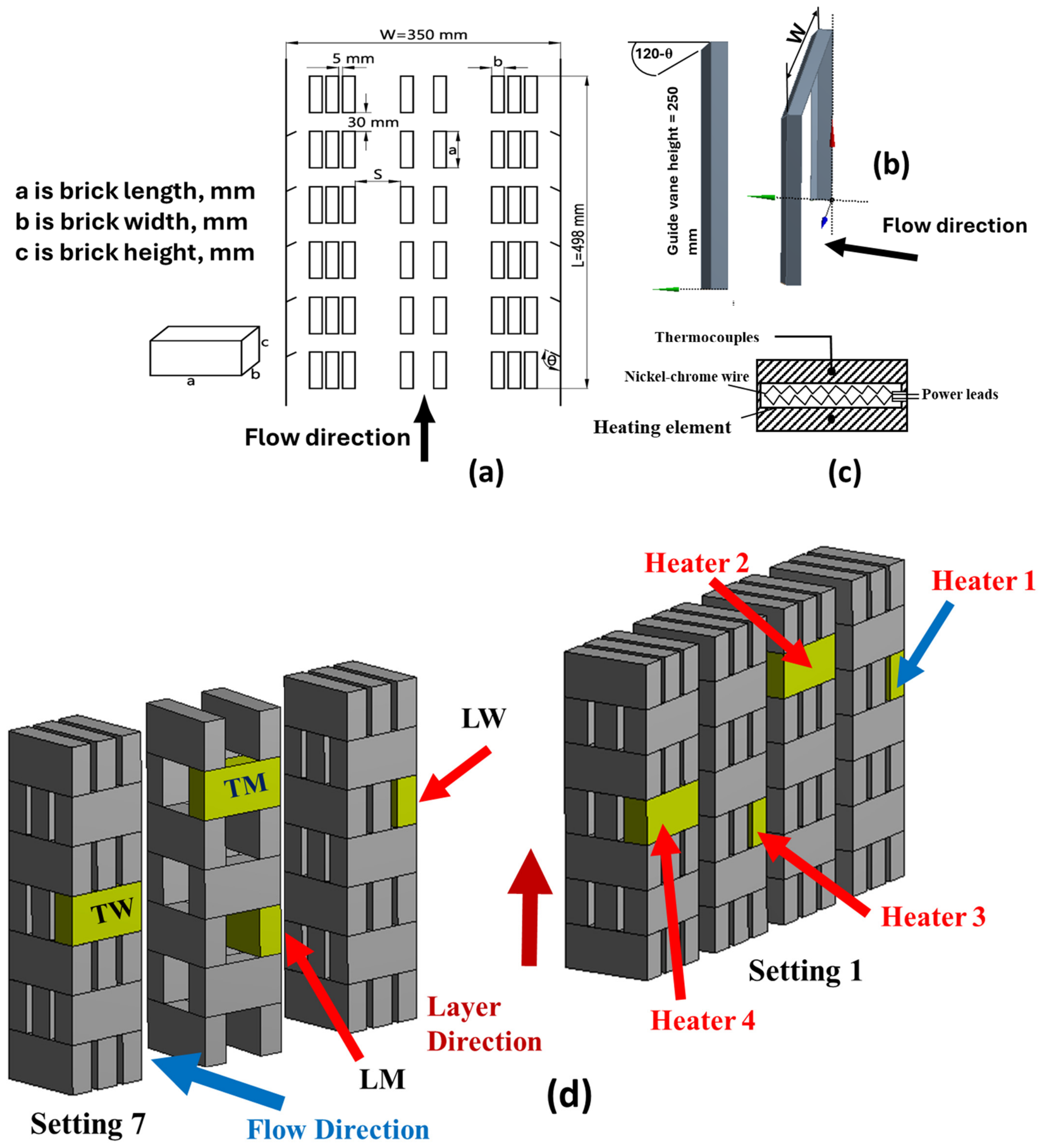
27] conducted an experimental investigation to enhance convective heat transfer in the cooling zone of a brick tunnel kiln using guide vanes mounted on the side walls of the kiln duct. A scaled experimental test rig (1:4 scale) was constructed to simulate the cooling section of a tunnel kiln. The experiments were performed for 10 different brick settings over a Reynolds number range of 11,867 ≤ Re ≤ 25,821.
Figure 6 illustrates a detail of one of the investigated settings in the study. The guide vanes were installed with attack angles of 120°, 135°, and 150° to direct the airflow toward the confined regions between brick columns. The investigations revealed that both the brick setting pattern and vane angle significantly influence heat transfer and pressure drop. The highest enhancement in heat transfer was observed for a longitudinal brick arrangement located in the middle column, achieving a maximum increase of approximately 94.5% in the average Nusselt number at θ = 135° and Re = 22,407. Empirical correlations were also developed to predict the Nusselt number as a function of Reynolds number, vane angle, and geometric parameters of the brick setting.
Side-wall guide vanes (SV) and U-shaped guide vanes (UV) were introduced by Refaey et al. [
28] to enhance tunnel kiln cooling. Seven brick settings were tested for Reynolds numbers 13,609–27,634. U-shaped guide vanes generate more turbulence and flow mixing than side-wall configurations, resulting in higher convective heat transfer rates. Thermal performance was measured as the average heat transfer rate/pumping power. The UV guide vane arrangement improved thermal performance while minimizing pressure losses. It was also suggested to determine the average Nusselt number as a function of Reynolds number, vane angle, and brick spacing using empirical correlations.
In a subsequent study, Refaey et al. [
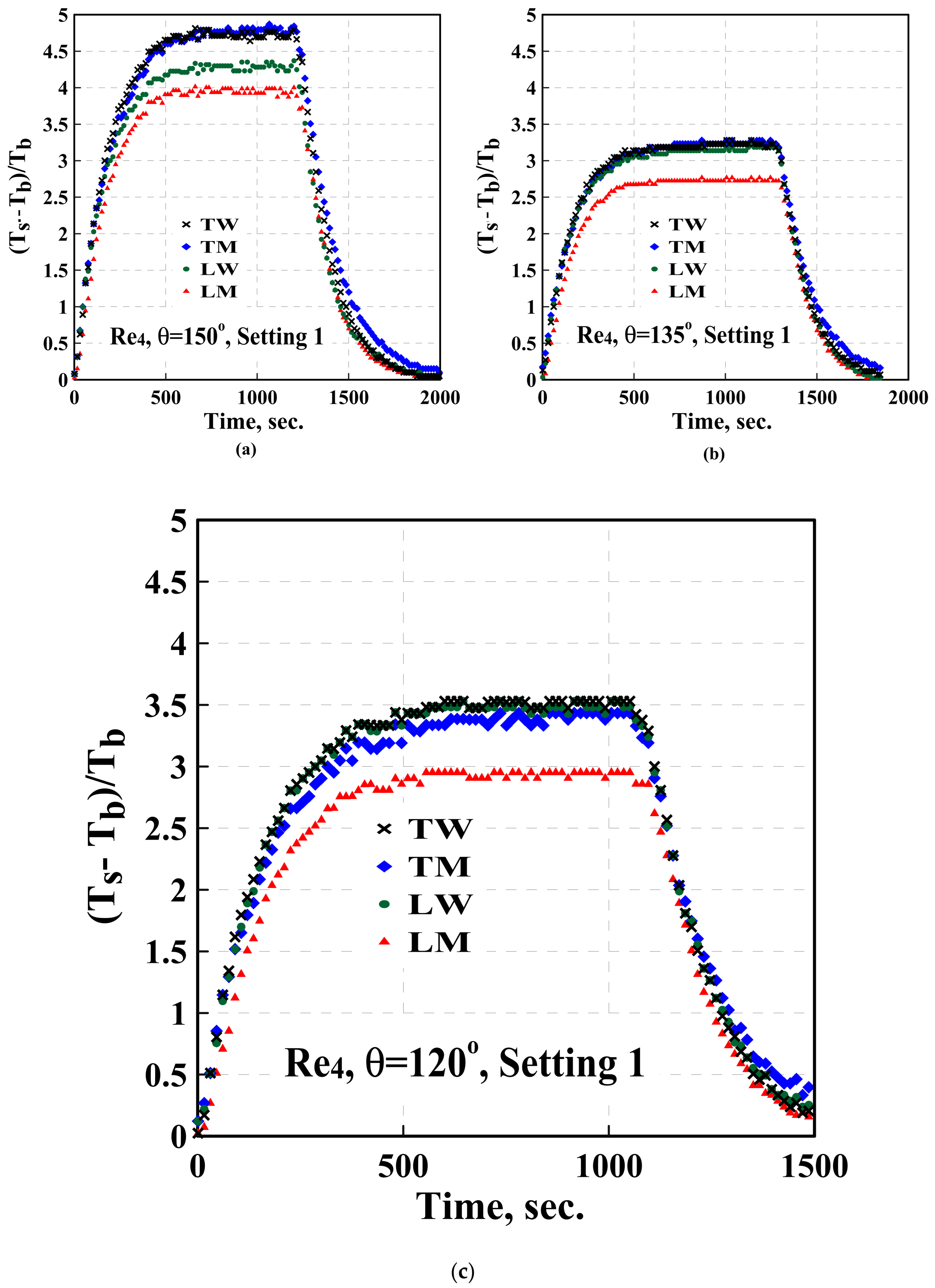
29] investigated the transient thermal behavior of a brick tunnel kiln equipped with U-shaped guide vanes. The experiments were carried out in a similar-scale test facility and focused on the time-dependent development of the heat transfer coefficient during cooling.
Figure 7 shows the geometrical configuration and experimental setup of the investigated brick settings in the study. Tests were conducted over Reynolds numbers ranging from 14,285 to 25,480 and for three vane attack angles (120°, 135°, and 150°). The results revealed that the average heat transfer coefficient (AHTC) increases significantly when guide vanes are used, particularly for the vane angle of 135°, which provides the best thermal performance. The time variation in the normalized average brick temperature for different vane angles is shown in
Figure 8. The study reported a maximum enhancement of approximately 48% in the heat transfer coefficient compared with the configuration without guide vanes. These results confirm that guide vanes act as effective turbulence generators, improving airflow mixing and accelerating the cooling process of bricks inside the kiln.
Morad et al. [
30] conducted an additional experimental study utilizing perforated bricks to examine convective heat transmission in the cooling zone of a tunnel kiln. Ten distinct perforated brick layouts were examined throughout a Reynolds number range of 10,000 ≤ Re ≤ 21,000 using a laboratory-scale test rig that represented a 1:4-scale replica of a tunnel kiln section. According to the study, brick holes improve heat transfer by increasing airflow penetration into the brickwork. The significance of brick spacing in affecting heat transfer characteristics was demonstrated by the experimental findings, which showed that the Nusselt number in the longitudinal direction decreased by approximately 21% as the spacing between columns increased. Furthermore, for certain brick layouts, the largest improvement in the Nusselt number was 25.2% in the transverse direction and 36.6% in the longitudinal direction. In order to forecast the average Nusselt number as a function of Reynolds number and geometric characteristics like the spacing ratio s/a and void %, empirical correlations were constructed.
Table 3 summarizes the main heat transfer enhancement techniques applied in tunnel kiln cooling zones, highlighting their thermal performance relative to associated pressure drop penalties and fan power requirements.
As shown in
Table 3, heat transfer enhancement techniques can significantly improve convective performance in the cooling zone, with reported increases in Nusselt number ranging from approximately 15% to over 90%, depending on the configuration. Flow-control devices such as guide vanes generate strong turbulence and enhance airflow mixing between brick columns, resulting in substantial heat transfer improvement. In particular, U-shaped and side-wall vanes demonstrate high effectiveness, although their performance is accompanied by increased pressure drop and higher fan power requirements.
In contrast, passive modifications such as perforated bricks and optimized column spacing provide more balanced performance by improving airflow distribution while maintaining moderate or even reduced pressure losses. This indicates that thermal enhancement should not be evaluated independently, but rather in conjunction with aerodynamic and energy penalties to ensure optimal overall system efficiency.
To further illustrate the performance of these enhancement techniques,
Table 4 presents a comparative summary of key experimental studies, including their methodologies, operating conditions, and main findings.
The experimental studies summarized in
Table 4 confirm that the cooling zone offers significant potential for improving heat recovery and overall thermal efficiency in tunnel kilns. Guide vanes consistently enhance convective heat transfer by promoting turbulence and improving airflow penetration, with optimal vane angles (typically around 135°) yielding the highest performance improvements.
However, these benefits come at the cost of aerodynamic penalties. Increased turbulence and flow redirection lead to higher pressure drops and increased fan power requirements, which are often not fully accounted for in experimental evaluations. As a result, optimization based solely on heat transfer enhancement may not lead to optimal system performance.
Similarly, modifications in brick geometry, such as perforations and optimized spacing, improve local heat transfer and airflow distribution. Nevertheless, their implementation must consider practical constraints, including mechanical strength, manufacturability, and product quality requirements.
Another limitation is that most experimental investigations are conducted under controlled or steady-state conditions, which may not fully capture the transient and coupled behavior of industrial kilns. Furthermore, empirical correlations derived from these studies are often restricted to specific configurations and operating ranges.
Overall, the results highlight a clear gap between experimental findings and system-level implementation. Future research should focus on integrating experimental data with CFD modeling and real-time operational control to develop multiscale optimization frameworks that improve cooling-zone performance within the context of the entire kiln system. This integrated evaluation framework provides a more realistic basis for selecting heat transfer enhancement strategies under practical industrial constraints.
8. Computational Fluid Dynamics and Numerical Simulation of Tunnel Kiln Processes
Computational Fluid Dynamics (CFD) and numerical simulation techniques have become essential tools for analyzing complex thermal and fluid flow processes in tunnel kilns. These methods allow researchers to investigate temperature distributions, gas flow patterns, combustion processes, and heat transfer mechanisms within kiln systems without relying solely on expensive, time-consuming experimental investigations. Consequently, CFD simulations have been widely used to optimize kiln design, improve heat transfer efficiency, and reduce energy consumption in ceramic manufacturing processes.
Refaey et al. [
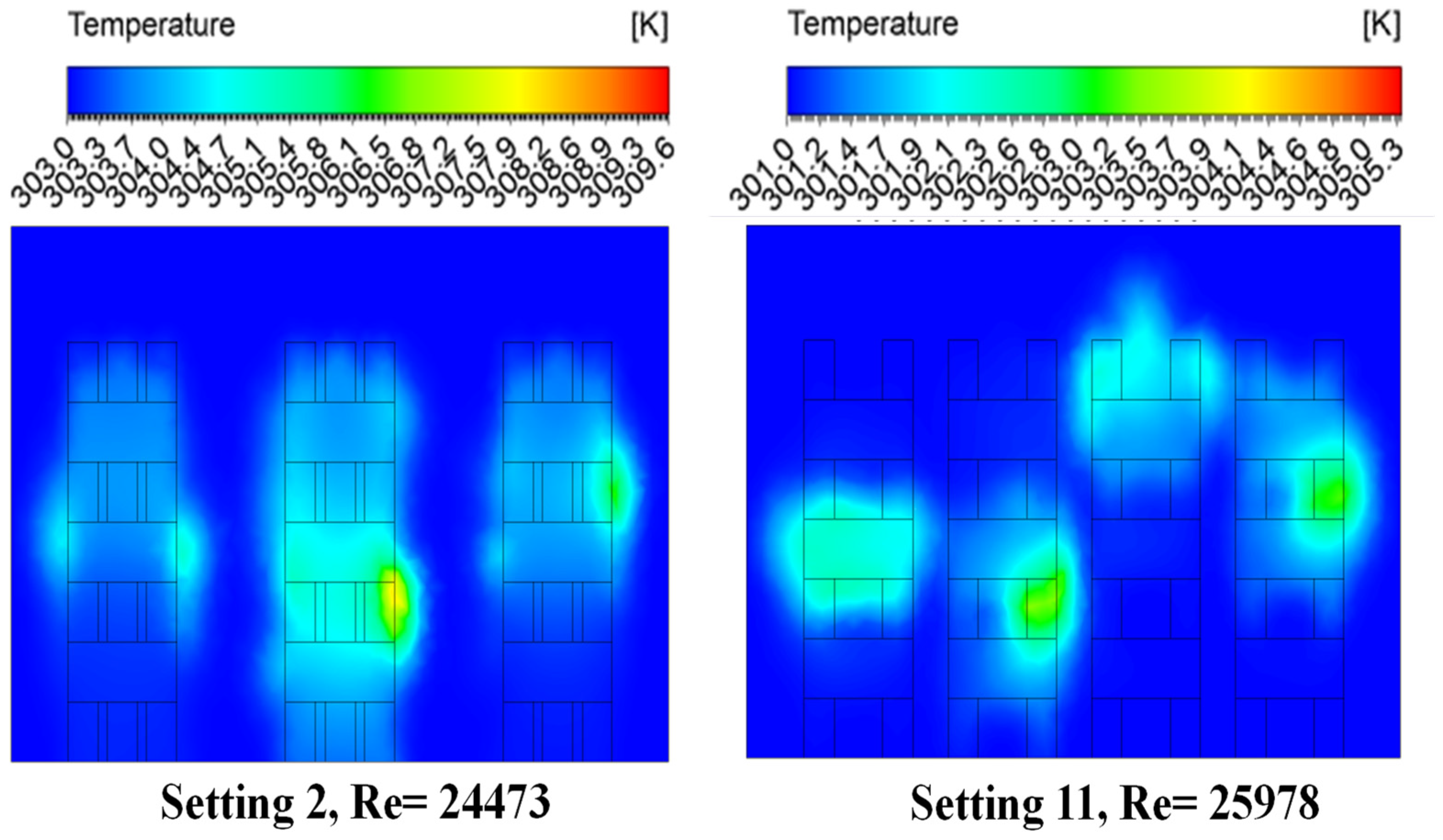
31] performed a detailed CFD investigation of convective heat transfer in the cooling zone of a brick tunnel kiln, considering different lattice brick arrangements. The numerical simulations were conducted using ANSYS Fluent and validated against experimental measurements. Three previously tested brick settings were simulated and compared with a newly proposed arrangement. The findings showed that increasing the brick spacing significantly enhances convective heat transfer.
Figure 9 represented the temperature contours in the transversal plane (T5) for the investigated configuration. Specifically, increasing brick spacing from 5 mm to 16 mm resulted in a maximum enhancement of approximately 15.3% in the Nusselt number for longitudinal bricks at
. The study confirmed that CFD models can reliably predict heat transfer behavior in tunnel kiln brick settings and can be used as a design tool for optimizing kiln configurations.
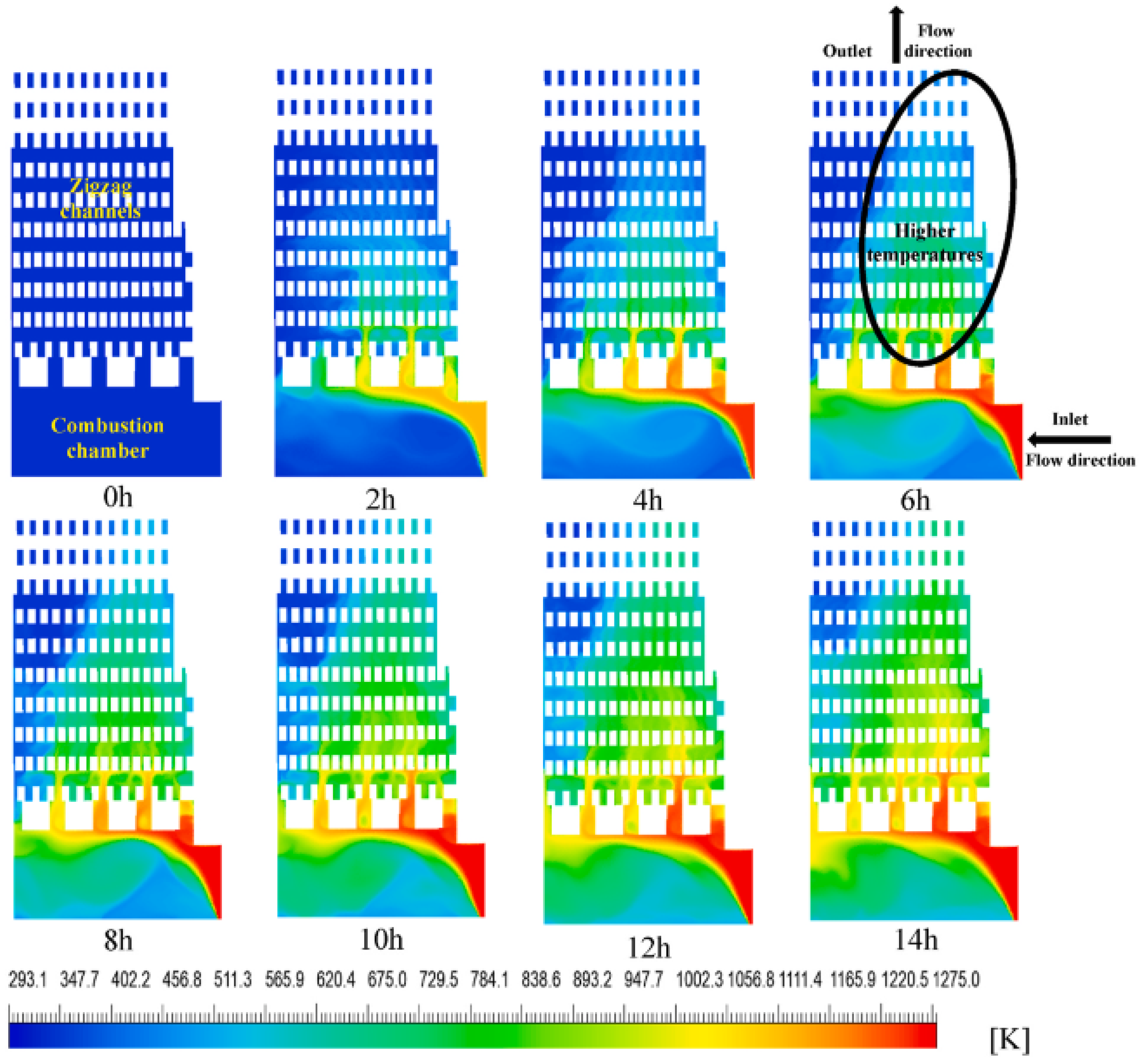
CFD has also been used to investigate conventional kiln combustion and fire. Ngom et al. [
32] studied clay brick burning in a conventional kiln using transient CFD modeling. Simulations were conducted in ANSYS-FLUENT utilizing a conventional k-ε turbulence model and an eddy-dissipation combustion model. Temperature fields, velocity distribution, and oxygen mass percentage were studied during firing. Results revealed that the kiln temperature progressively raised to 900 °C, suitable for brick burning (
Figure 10). The oxygen mass percentage was highest at the inlet and decreased steadily throughout the kiln, indicating progressive burning. These findings show that CFD simulation can evaluate the combustion kinetics and temperature changes during brick burning.
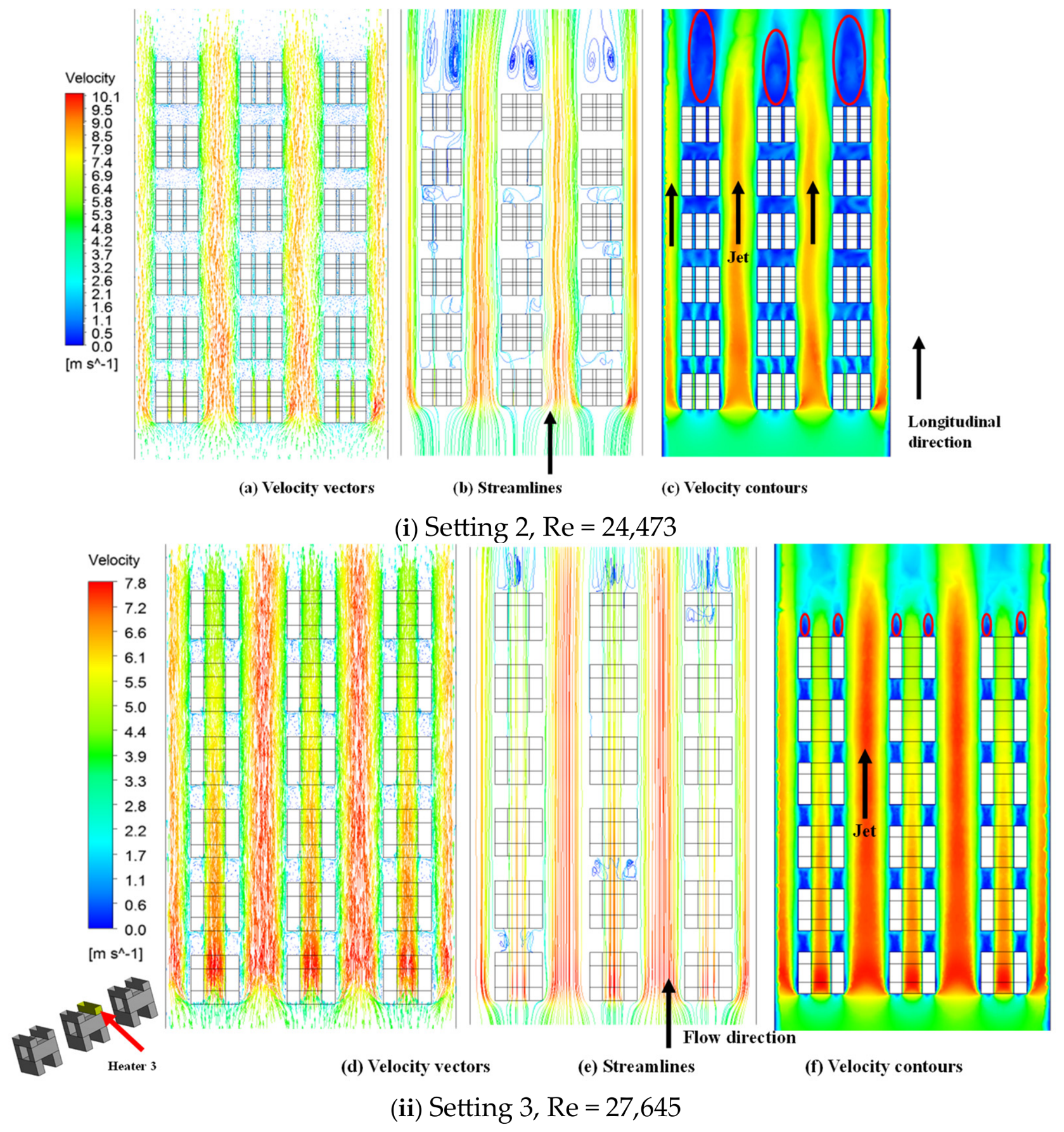
Refaey et al. [
33] conducted additional numerical examinations of tunnel kiln flow behavior, analyzing fluid flow parameters for four distinct lattice brick configurations by CFD simulations. The research assessed velocity vectors, streamlines, and vortex formation in the kiln’s cooling zone. The BSL k-ω turbulence model demonstrated strong concordance with experimental findings. The simulations indicated that airflow velocity in the wall channels is much greater than in the brick column channels, leading to an uneven flow distribution across the kiln’s cross-section.
Figure 11 shows the flow characteristics, including the velocity distribution and streamlines, for different brick settings. Among the examined setups, setting 3 exhibited the optimal cooling performance owing to enhanced airflow circulation and decreased stagnation zones. The results underscore the significance of brick configuration in regulating flow patterns and enhancing heat transfer efficiency in tunnel kilns.
The heat transfer and combustion gases in an industrial tunnel kiln have been modeled numerically. Naccache et al. [
34] simulated the gas flow and heat transfer in a ceramic tunnel kiln using a two-dimensional numerical model. The DTRM was used to represent radiation heat transport in FLUENT’s finite-volume simulations. The study explored how porosity, permeability, and gas intake temperature affect kiln performance. The computational results matched actual observations and revealed that tunnel kilns may use natural gas as an alternative fuel, decreasing pollution emissions and operational costs.
CFD models have been employed to investigate kiln emissions and combustion. Tehzeeb et al. [
35] employed ANSYS-CFX computational fluid dynamics simulations to evaluate a brick tunnel kiln. The study analyzed kiln temperature distribution and pollutant generation utilizing turbulence, combustion, radiation, and emission models. Analogous to industrial kiln environments, the simulated temperature gradient ranged from 300 K in the cooling zone to 1300 K in the combustion zone. The simulation forecasted CO
2 and NOx emissions at 1.01 m
3/s and 0.108 m
3/s, respectively, illustrating the efficacy of CFD techniques in evaluating the environmental performance of kiln systems.
Beyene et al. [
36] performed a three-dimensional CFD simulation of a biogas-fired clay brick kiln to examine the temperature distribution during brick firing. The model incorporated combustion reactions and heat transport between flue gases and clay bricks, utilizing the conventional k-ε turbulence model. The findings demonstrated that bricks situated closer to the combustion chamber endure higher temperatures than those farther away. Thus, bricks farther from the burner require longer burning times to achieve consistent quality. The research emphasized the viability of biogas as an alternative fuel for brick kiln operations.
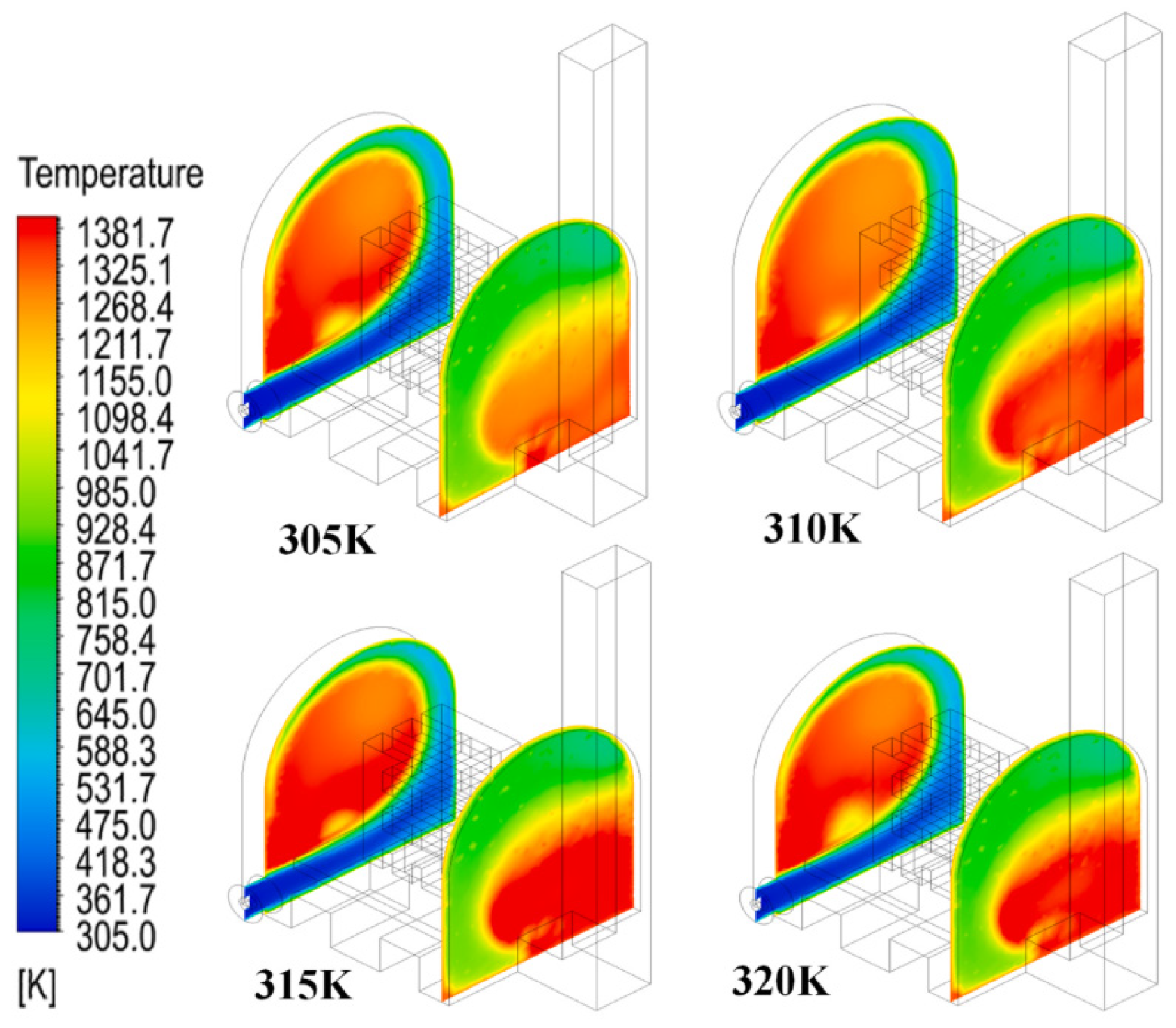
More recent CFD research has focused on transient thermal behavior in kiln systems. Alonso-Romero et al. [
37] performed a transient numerical analysis to predict the evolution of hot gases inside a kiln loaded with bricks. Four numerical approaches were compared, including the Properties Fitted to Temperature Polynomials (PFTP) and Ideal Gas Law (IGL) models. The simulations were validated against experimental measurements. The outcomes demonstrated that the IGL model provided the most accurate temperature prediction with a mean relative error of approximately 4.4%. The study also demonstrated that adding a 0.07 m layer of ceramic fiber insulation increased gas temperature by about 12.7%, improving kiln thermal performance (
Figure 12).
In addition to kiln simulations, numerical modeling has also been used to optimize furnace design for improved energy efficiency. Balli et al. [
38] developed a combined experimental and numerical model to analyze the thermal behavior of an industrial ceramic furnace. The model predicts spatial and temporal temperature distribution within the furnace and evaluates energy consumption. A consistent trend is observed that the optimized design achieved approximately 83% energy savings compared with the traditional furnace system. While simultaneously reducing CO
2 emissions by about 87.36%. These results highlight the significant potential of numerical modeling for improving the sustainability and energy efficiency of high-temperature ceramic processing systems.
In addition to system-level modeling, accurate representation of material properties is crucial for improving the reliability of thermal simulations. Pichler et al. [
39] developed a numerical model to predict the effective thermal conductivity of hollow bricks at high temperatures using a unit cell approach. The model accounts for heat conduction in both the solid and gas phases, as well as surface-to-surface radiation within the brick cavities. Various radiation modeling approaches were evaluated and validated against detailed computational fluid dynamics (CFD) simulations and experimental measurements. The results demonstrated that radiative heat transfer becomes dominant at elevated temperatures, significantly affecting the overall thermal behavior of the bricks. These findings highlight the importance of accurately representing cavity geometry and surface emissivity in numerical simulations, particularly for improving temperature prediction in tunnel kiln applications.
CFD has become a key tool for analyzing thermo-fluid behavior in tunnel kilns, enabling detailed evaluation of velocity fields, temperature distribution, combustion processes, and species transport. Compared with simplified analytical models, CFD provides a more comprehensive representation of kiln operation, particularly when validated against experimental data. It is especially effective in identifying flow non-uniformities, recirculation zones, and localized heat transfer variations, which are critical for optimizing kiln design, improving brick arrangements, and enhancing thermal efficiency. In addition, incorporating combustion and emission models enables simultaneous assessment of energy performance and environmental impact.
Despite these advantages, several limitations restrict the practical application of CFD in industrial environments. Model accuracy depends strongly on assumptions related to turbulence modeling, boundary conditions, and thermophysical properties, which can introduce uncertainty. Moreover, many studies rely on steady-state or simplified transient simulations that do not fully capture the dynamic and coupled nature of real kiln operation. High computational cost further limits the use of detailed three-dimensional models in real-time optimization or large-scale parametric studies. In practice, CFD is often applied in isolation, without integration into system-level optimization frameworks that account for operational variability, material behavior, and heat recovery.
These challenges highlight the need for hybrid modeling approaches that combine the accuracy of CFD with reduced-order or data-driven models suitable for real-time applications. Future research should focus on integrating CFD with advanced control systems and on validating these approaches under industrial conditions to enable adaptive, energy-efficient kiln operation.
As summarized in
Table 5, CFD and numerical modeling are widely applied to analyze heat transfer, combustion behavior, and airflow distribution in tunnel kilns. Most studies employ commercial solvers such as ANSYS Fluent or CFX with standard turbulence models (e.g., k–ε, k–ω). While these approaches consistently demonstrate CFD’s ability to predict temperature fields, combustion efficiency, and emission trends, the results also indicate that performance improvements are highly dependent on design parameters, including brick configuration, airflow distribution, fuel type, and insulation. Importantly, the table shows that these studies are predominantly conducted under controlled or simplified conditions, underscoring the need for more integrated, industrially validated modeling frameworks.
9. Environmental Impacts, Emission Control, and Sustainability in Ceramic Kiln Operations
The production of ceramics is inherently energy-intensive and associated with significant environmental impacts, primarily due to fuel consumption during firing and emissions from combustion and the decomposition of raw materials. Tunnel kilns operate continuously at high temperatures and are major contributors to greenhouse gas emissions and air pollution, making environmental performance a critical concern in modern ceramic manufacturing.
Environmental assessment approaches reported in the literature can be broadly classified into process-level energy analysis, emission inventory methods, and life-cycle assessment (LCA), as summarized in
Table 6. Among these, LCA studies consistently identify the firing stage as the dominant environmental hotspot. Ros-Dosdá et al. [
40] showed that natural gas consumption is the primary contributor to global warming potential and fossil fuel depletion, while electricity use contributes to ozone depletion. In addition, product characteristics such as thickness and glazing significantly influence environmental performance, indicating that kiln operation and product design should be evaluated simultaneously. These findings highlight the strong coupling between energy consumption, process design, and environmental impact in tunnel kiln operations.
From an emissions perspective, suboptimal combustion and outdated kiln technologies result in elevated levels of particulate matter, SOx, NOx, and CO. Pariyar et al. [
41] demonstrated that these emissions have severe environmental and health implications, underscoring the need for improved combustion control and advanced emission mitigation systems.
A range of strategies has been proposed to reduce environmental impacts, including heat recovery, optimization of combustion conditions, and modification of raw materials. Hussnain et al. [
42] reported that waste heat recovery and improved combustion control can significantly reduce fuel consumption and associated emissions. In addition to these technical strategies, regulatory frameworks such as NESHAP standards and Chinese emission limits have played a significant role in promoting cleaner production technologies and continuous emission monitoring systems [
43,
44].
However, these measures are often applied at the subsystem level and do not fully capture the complex interactions between combustion, heat transfer, material properties, and operating conditions. As a result, improvements in individual components may not lead to substantial overall environmental benefits.
Similarly, Gonzalez et al. [
45] demonstrated that substituting carbonate-rich raw materials can reduce CO
2 emissions by up to 65%. In addition, integrating waste heat recovery with renewable energy systems has shown promising results in reducing both emissions and operational costs [
46].
Table 6 summarizes the main environmental assessment methodologies used in the literature, highlighting their scope, advantages, and limitations.
As shown in
Table 6, most studies rely on process-level or emission-based analyses, while comprehensive life-cycle approaches remain relatively limited due to their data requirements and complexity. This highlights the need for integrated assessment frameworks that combine environmental, economic, and operational considerations.
Despite these advances, a major limitation in current research is the lack of integration between environmental assessment tools and real-time process optimization. While LCA provides valuable long-term insights, it is not directly applicable to dynamic operational control. Emerging approaches, including renewable energy integration, advanced sensing, and Digital Twin systems, offer promising pathways for bridging this gap. However, their adoption is constrained by challenges related to economic feasibility, data availability, and system complexity.
From an industrial perspective, the effectiveness of sustainability strategies depends on operational robustness, including resistance to fouling, material degradation, and long-term performance stability under harsh kiln conditions. In addition, factors such as maintenance requirements, system integration complexity, and capital investment significantly influence the feasibility of implementation.
Table 7 provides a comparative overview of representative studies addressing environmental impacts and sustainability in ceramic kiln systems.
As summarized in
Table 7, most studies evaluate environmental improvements at the laboratory or process level, with limited full-scale industrial validation. Furthermore, many approaches are assessed independently, without accounting for interactions between energy efficiency, emissions reduction, and operational constraints.
Achieving sustainable tunnel kiln operation requires a system-level approach that integrates environmental assessment, process modeling, real-time monitoring, and adaptive control. The literature indicates that meaningful and sustained improvements can be achieved only by combining multiple strategies, such as heat recovery, material optimization, and emission control, within a unified framework that accounts for their interactions and trade-offs.
However, practical implementation depends not only on technical performance but also on economic and operational feasibility. Approaches such as advanced airflow control, enhanced sensing, and Digital Twin integration can significantly improve performance but introduce additional challenges, including capital costs, maintenance requirements, increased system integration complexity, and data management demands. These factors must be carefully balanced to ensure successful industrial deployment and long-term sustainability.
These findings further emphasize that environmental performance is governed by the combined effects of energy consumption, combustion behavior, heat transfer efficiency, and material processing conditions. As a result, meaningful emission reductions require coordinated optimization across all interacting subsystems rather than isolated improvements.
10. Digital Twin and Industry 4.0 Approaches for Sustainable Industrial Systems
Recent advances in digital technologies and Industry 4.0 have introduced powerful tools for improving energy efficiency, process monitoring, and sustainability in industrial systems. Among these, the Digital Twin (DT) concept has emerged as a key enabler for integrating real-time data, physics-based models, and optimization algorithms to support dynamic process control and decision-making.
Arvanitidis et al. [
47] developed a physics-based modeling and control framework for an industrial tunnel kiln operating under varying production conditions. The model incorporates thermal behavior, gas–solid interactions, and sintering kinetics to predict product quality, while a feedback control strategy determines optimal burner set-points. The results demonstrated that adaptive firing strategies can improve energy efficiency while maintaining stable operation and consistent product quality.
In a complementary study, Arvanitidis et al. [
48] proposed a bi-objective optimization framework that accounts for the trade-off between productivity and energy consumption. By integrating thermal modeling with sintering kinetics, the approach generates Pareto-optimal operating conditions, highlighting the importance of multi-objective optimization in practical kiln operation.
Despite these advances, it is important to distinguish between kiln-specific implementations and broader conceptual Digital Twin frameworks. While the work of Arvanitidis et al. provides direct industrial relevance through physics-based modeling and control under variable conditions, most existing studies focus on generalized DT architectures or cross-sector applications. As a result, the practical deployment of Digital Twin systems in tunnel kilns remains limited in terms of industrial validation, technology readiness, and long-term performance assessment.
More broadly, Digital Twin technology has been widely explored for improving energy efficiency across industrial sectors. Ba et al. [
49] conducted a systematic review showing that DT applications enable real-time monitoring, predictive maintenance, and energy optimization, with reported energy savings of up to 30%. However, several challenges hinder large-scale implementation, including high deployment costs, complex data integration, cybersecurity concerns, and the need for reliable, high-fidelity sensor data.
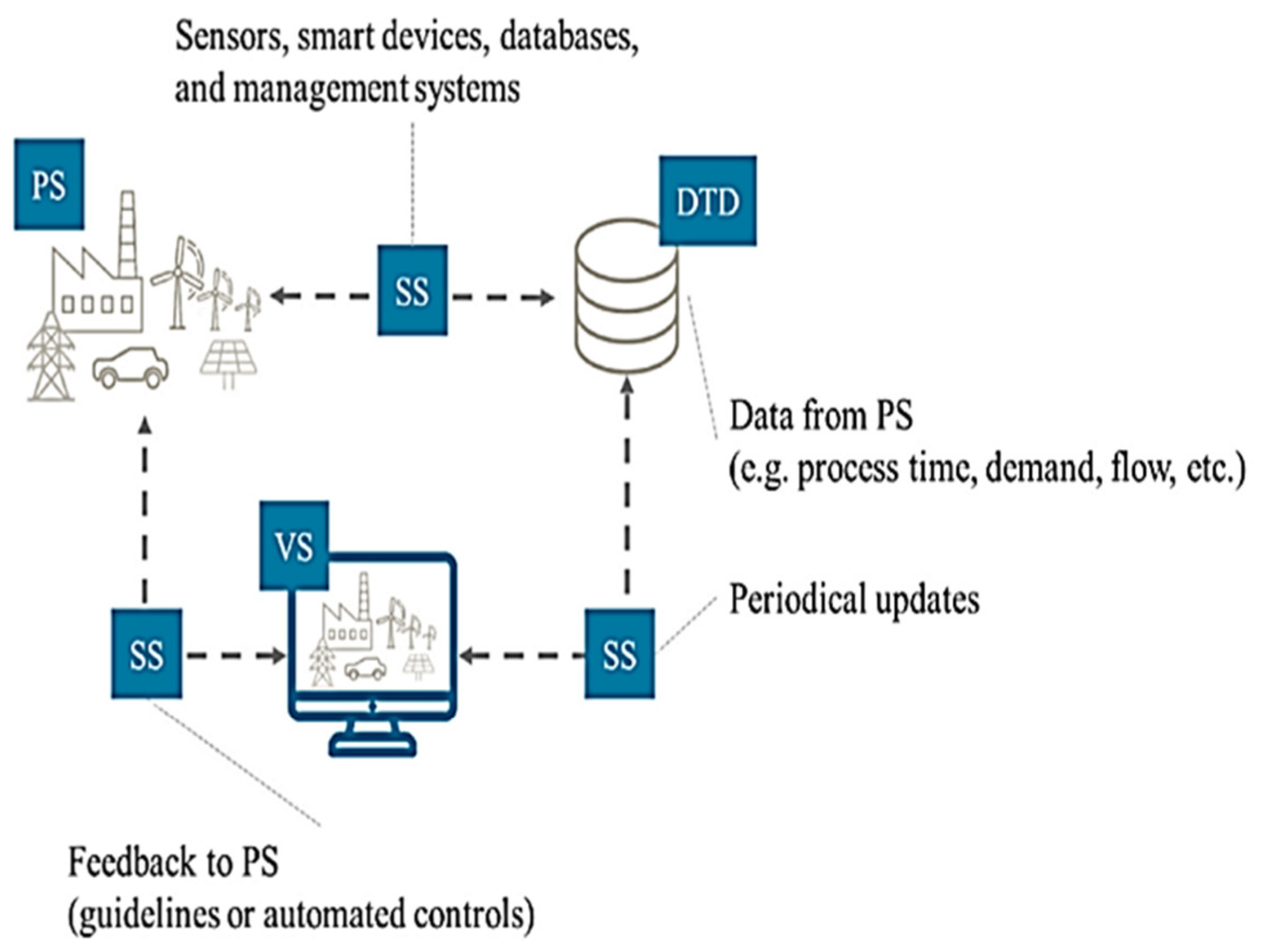
Figure 13 illustrates the general architecture of a Digital Twin system for industrial applications. A true Digital Twin for tunnel kilns requires continuous synchronization between physical operation and virtual models through reliable sensor networks and real-time data assimilation.
Similarly, Shahmoradi et al. [
50] reviewed Digital Twin applications in the power generation sector and proposed a classification framework based on time-scale horizons and hierarchical levels (component, system, and service). The study demonstrated that DT technology enhances condition monitoring, fault detection, predictive maintenance, and operational optimization, thereby improving efficiency and reducing emissions.
From an architectural perspective, Li et al. [
51] introduced a six-dimensional Digital Twin framework (DT-6D) for complex industrial systems, integrating physical and virtual entities, data, services, connections, and models. This structure enables scalable data integration, real-time monitoring, and advanced analytics, supporting predictive and optimization-driven applications.
In manufacturing contexts, Karmaoui et al. [
52] explored integrating Digital Twins with Lean principles through a DT-based Value Stream Mapping approach. By combining IoT data, digital models, and lean tools, the framework enhances process transparency, reduces waste, and improves resource utilization.
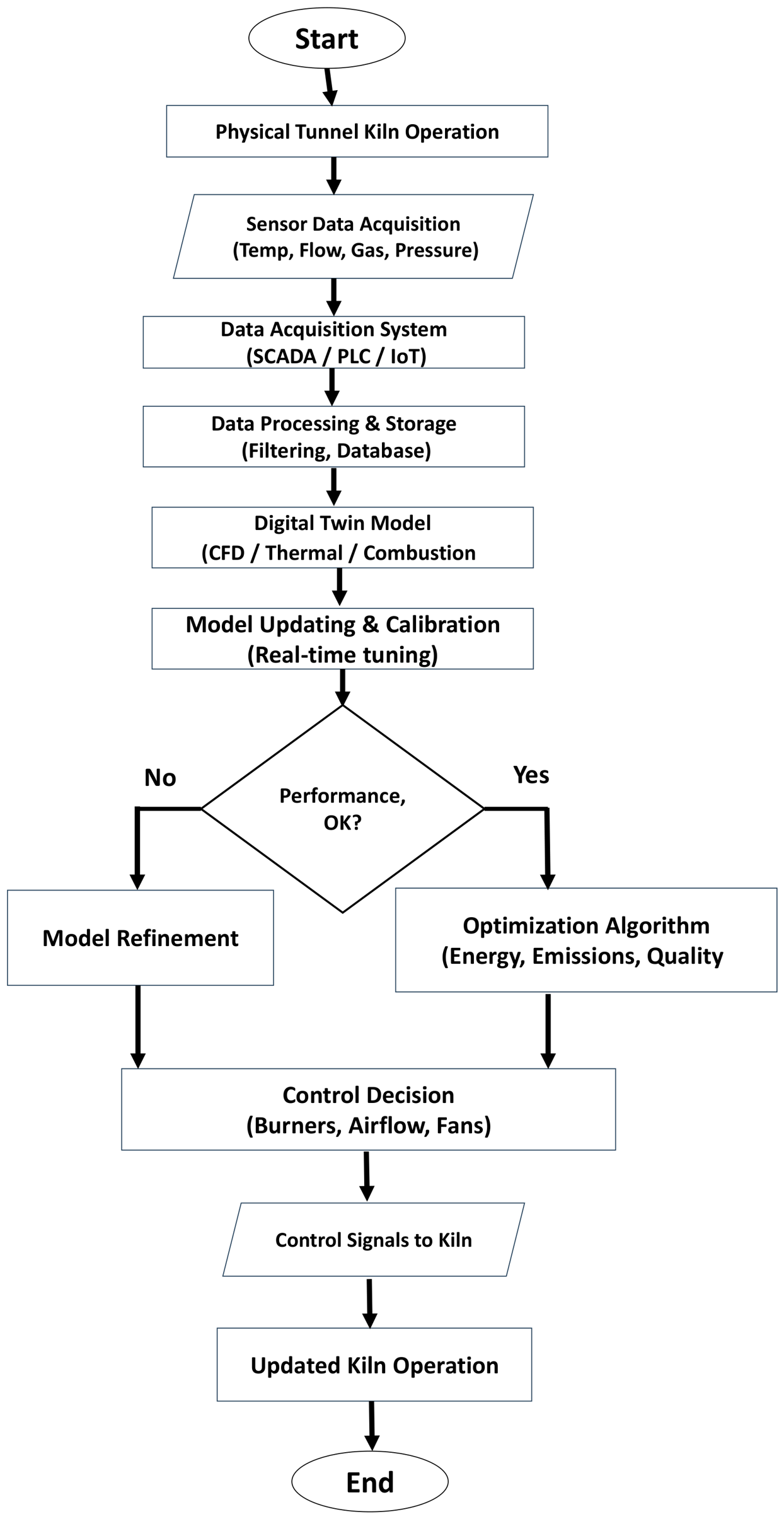
To clarify the practical implementation of Digital Twin technology in tunnel kiln systems,
Table 8 presents a structured architecture that outlines the main functional components and their roles. This architecture integrates sensing, data processing, physics-based modeling, data-driven analytics, optimization, and control, providing a comprehensive framework for real-time monitoring and adaptive process management.
As shown in
Table 8, an effective Digital Twin system relies on the seamless integration of multiple layers, from data acquisition to control feedback. Sensor networks and data infrastructure form the foundation for real-time information exchange, while physics-based and data-driven models enable accurate prediction and optimization of kiln operation. The optimization and control layers translate these insights into actionable decisions, allowing dynamic adjustment of operating conditions.
However, the implementation of such architectures in tunnel kilns remains limited, primarily due to challenges related to data availability, model calibration, computational requirements, and system integration complexity. These constraints highlight the need for scalable and robust Digital Twin frameworks tailored to the specific operational conditions of industrial kilns. This architecture demonstrates that the value of Digital Twin technology lies not only in individual components but in their coordinated interaction within a fully integrated system.
Despite these advances, most Digital Twin applications remain either domain-specific or conceptual, with limited direct implementation in tunnel kiln systems. While existing studies demonstrate clear benefits such as predictive maintenance, real-time monitoring, and energy optimization, their effectiveness depends strongly on the availability of high-quality data and accurate model calibration. Moreover, key challenges persist, including high implementation costs, complex data integration, cybersecurity concerns, and the lack of a standardized architecture for industrial deployment.
To clarify the practical implementation of Digital Twin technology in tunnel kilns,
Figure 14 presents a proposed architecture that links physical kiln operation with sensing, data processing, model updating, optimization, and control feedback. The architecture is intended to support real-time monitoring and adaptive control of key operating variables affecting energy consumption, emissions, and product quality.
As shown in
Figure 14, a practical Digital Twin for tunnel kilns should begin with reliable sensor networks capable of capturing thermal, flow, combustion, and product-related data. These data are transferred through SCADA, PLC, or IoT-based acquisition systems, processed, and used to continuously update physics-based or reduced-order models. The updated model then supports optimization algorithms that determine improved operating conditions, such as burner settings, airflow distribution, fan speed, kiln car movement, and heat recovery control. The resulting feedback loop enables adaptive operation rather than static control, which is essential for improving energy efficiency, reducing emissions, and maintaining product quality under variable industrial conditions.
Table 9 provides a comparative overview of recent Digital Twin and Industry 4.0 studies, highlighting clear differences between tunnel kiln-specific implementations and broader cross-sector frameworks. As shown, kiln-focused studies primarily rely on physics-driven modeling and process optimization, with strong relevance to thermal behavior, firing control, and energy efficiency under variable production conditions. In contrast, most studies from other industrial domains emphasize generalized Digital Twin architectures, data integration frameworks, and predictive maintenance strategies, often without direct adaptation to the specific constraints of tunnel kiln systems.
A critical limitation remains the insufficient integration across different operational levels, including physical processes, real-time monitoring, and decision-making. Many existing implementations focus on isolated optimization tasks or generic system representations rather than fully integrated, adaptive control frameworks. This indicates that the potential of Digital Twin technology in tunnel kilns remains underutilized.
Therefore, future research should focus on developing scalable and integrated Digital Twin platforms that combine high-fidelity modeling, IoT-based sensing, and advanced analytics. Such systems would enable real-time optimization of energy consumption, emissions, and product quality, supporting the transition toward intelligent and sustainable industrial manufacturing. Achieving this level of integration is essential for unlocking the full potential of Digital Twin technology in industrial tunnel kiln applications.
Digital Twin technology provides a framework for integrating these coupled processes by linking heat transfer, combustion, fluid flow, material transformation, and control systems within a unified platform. This enables system-level optimization that cannot be achieved through conventional isolated modeling approaches.
11. Future Research Directions in Sustainable Tunnel Kiln Technology
Notwithstanding considerable advancements in heat transfer research, energy efficiency, and process optimization, some pivotal problems persist in achieving fully sustainable, high-performance tunnel kiln operations. Future research should move beyond incremental enhancements to adopt integrated, system-level methodologies that combine sophisticated modeling, digital technologies, and adaptive energy management strategies.
A primary objective is to create high-fidelity multiphysics models that accurately represent the interrelated dynamics of heat transfer, fluid flow, combustion, and material changes during firing. Although several current studies depend on simplified steady-state or one-dimensional models, actual kiln operation is fundamentally transient and spatially heterogeneous. Progressing towards fully integrated three-dimensional transient models that incorporate radiative heat transport and sintering dynamics would markedly improve predictive precision and facilitate more reliable process optimization.
The integration of artificial intelligence (AI) and machine learning concurrently presents significant promise for enhancing process monitoring and control. Contemporary tunnel kilns produce substantial amounts of operational data that can be used to detect hidden patterns, forecast system performance, and enhance control strategies in real time. Hybrid methodologies that integrate physics-based modeling with data-driven procedures are notably advantageous, since they reconcile interpretability with flexibility.
The advancement of Digital Twin systems signifies a significant progression towards real-time, adaptive kiln optimization. A comprehensive Digital Twin for tunnel kilns requires ongoing synchronization between physical operations and virtual models, supported by high-fidelity sensor data, rigorous calibration, and effective computational frameworks. Although existing research demonstrates the promise of these systems, issues of data integration, computational costs, and industrial implementation must be addressed to facilitate large-scale adoption.
Energy optimization remains a primary research focus, especially through advanced heat recovery and system integration techniques. In addition to traditional waste heat recovery, future research should investigate the incorporation of regenerative systems, high-efficiency recuperators, and heat pump technologies. Integrating tunnel kilns with renewable energy sources, such as solar thermal systems or biomass, is a feasible approach to diminishing reliance on fossil fuels and enhancing environmental performance.
From an ecological standpoint, mitigating emissions remains a crucial goal. Future research should focus on low-carbon combustion technologies, alternative fuels, and carbon-reduction measures. Innovative methods, such as hydrogen combustion and electrification via renewable energy, have the potential to decarbonize ceramic manufacturing; however, their technical feasibility, economic viability, and scalability require further research.
Furthermore, optimizing kiln loading arrangements and product design presents potential to enhance heat transfer efficiency and temperature uniformity. Advanced optimization methods, including CFD integrated with evolutionary algorithms, can uncover optimal stacking configurations that improve thermal performance while preserving product quality.
Future developments in tunnel kiln technology will rely on the creation of integrated, multi-scale frameworks that concurrently handle thermal processes, flow dynamics, material behavior, and environmental performance. Accomplishing this necessitates hybrid techniques that integrate high-fidelity modeling, data-driven analytics, and real-time monitoring. Moreover, robust collaboration between academia and industry is crucial to guarantee that research findings are scalable, economically feasible, and consistent with real operational limitations. These integrated methodologies are essential for facilitating energy-efficient, low-carbon, and intelligent ceramic production systems.
12. Conclusions
Tunnel kilns remain essential in modern ceramic manufacturing due to their ability to achieve continuous production, high thermal efficiency, and consistent product quality. However, the firing process remains the most energy-intensive stage, making its optimization critical for improving both industrial performance and environmental sustainability.
This review highlights that tunnel kiln operation is governed by strongly coupled interactions among fluid flow, heat transfer, combustion behavior, and material transformations. While significant progress has been achieved through analytical modeling, experimental studies, and CFD simulations, many existing approaches remain limited by simplified assumptions, isolated subsystem analyses, and restricted validation, thereby constraining their applicability in real industrial conditions.
Energy optimization strategies, including heat recovery, airflow management, combustion control, and reducing kiln car thermal mass, demonstrate considerable potential to reduce fuel consumption. However, their effectiveness depends heavily on integrated implementation, as isolated improvements often yield limited overall benefits. Similarly, heat transfer enhancement techniques can significantly improve thermal performance but must be evaluated alongside associated pressure-drop penalties and operational constraints.
From an environmental perspective, the firing stage remains the dominant contributor to emissions. Although approaches such as life-cycle assessment, alternative materials, and waste heat recovery provide viable mitigation pathways, their impact depends on coordinated, system-level integration rather than independent application.
A key finding of this review is that future progress in tunnel kiln technology requires a transition from fragmented optimization approaches toward integrated, multi-scale frameworks that combine modeling, experimental validation, and real-time data. In this context, Digital Twin and Industry 4.0 technologies offer a promising pathway for enabling continuous monitoring, predictive control, and adaptive optimization of kiln operation. However, challenges related to data availability, model accuracy, computational cost, and industrial implementation remain significant barriers.
Therefore, advancing tunnel kiln systems toward sustainable and energy-efficient operation depends on achieving a balance between model accuracy, validation, industrial scalability, and real-time optimization capability. Addressing these challenges will enable the development of robust, adaptive, and low-carbon ceramic manufacturing systems.