


Abstract
Electric vehicles are an important carrier for achieving energy savings and emission reductions in the transportation sector. As the decision-making core of the powertrain, the energy management strategy is responsible for power allocation and energy scheduling and directly determines vehicle economy, power-source lifetime, and overall performance. Model predictive control can handle multiple constraints and objectives within a prediction horizon and realize online closed-loop decision-making via receding-horizon optimization and has become an important research direction for energy management of electric vehicles. This paper presents the basic principles and typical modeling framework of model predictive control and reviews its research progress in hybrid electric vehicle energy management. The related studies are categorized and comparatively analyzed from three perspectives—prediction methods, solution strategies, and optimization objectives—and the characteristics of different approaches are summarized. The review shows that model predictive control has advantages in multi-objective trade-offs and adaptation to time-varying operating conditions. However, practical implementation still faces significant barriers, including prediction uncertainty and computational complexity. Finally, the challenges and future directions of model-predictive-control-based energy management strategies are discussed.
1. Introduction
Against the backdrop of worsening global environmental pollution and tightening constraints on petroleum resources, energy consumption and emissions in the transportation sector have become increasingly prominent issues [1]. This is especially true in highly urbanized and densely populated areas, where vehicle exhaust has become one of the major sources of air pollution [2,3]. Conventional fuel vehicles emit a wide range of pollutants during operation, including carbon dioxide, sulfur dioxide, and PM2.5. These emissions not only degrade regional environmental quality but also pose long-term potential risks to public health [4]. At the same time, the heavy dependence of the transportation energy system on petroleum has made energy security an increasingly pressing concern. Oil consumption is currently concentrated mainly in transportation, petrochemicals, and related sectors. Given the limited reserves of global fossil energy resources, there is an urgent need to reduce dependence on conventional petroleum by developing alternative energy sources and improving energy utilization efficiency [5,6].
Vehicle electrification is widely regarded as an important pathway for achieving energy conservation and emission reduction in the transportation sector [7,8]. The introduction of global carbon neutrality goals and the continued transition of the energy structure have further accelerated the shift of the automotive industry toward electrification. In terms of energy utilization efficiency, the fuel efficiency of conventional internal combustion engine vehicles is typically only around 15–18%, whereas the overall efficiency of pure electric drivetrains can reach approximately 60–70% [9]. This substantial gap in efficiency provides a strong technical driving force for vehicle electrification. According to the Global EV Outlook 2025 released by the International Energy Agency, global electric vehicle (EV) sales are expected to exceed 20 million units in 2025, accounting for more than one-quarter of total new car sales worldwide [10]. With declining technology costs and stronger policy support, the global market share of EV sales is expected to surpass 40% by 2030. The global growth trend of EVs is shown in Figure 1. This rapid market expansion reflects the accelerating global transition toward electric mobility. In addition to reducing greenhouse gas emissions, EVs also make a positive contribution to environmental protection [11,12].
Figure 1.
Global EV market size: (a) Electric car sales and share in total car sales, (b) Electric car sales shares. Adapted from IEA, Global EV Outlook 2025 launch presentation, 14 May 2025, licensed under CC BY 4.0 [10].
1.1. Classification of Electric Vehicles
EVs refer to a broad class of vehicles that span the transition from traditional internal combustion engine vehicles (ICEVs) to fully electric-drive vehicles [13]. The evolution process is illustrated in Figure 2. According to differences in energy sources and degree of electrification, electric vehicles are generally classified into battery electric vehicles (BEVs), fuel cell hybrid electric vehicles (FCHEVs), and internal combustion engine hybrid electric vehicles (ICEHEVs) [14,15,16]. The characteristics of these vehicle categories are summarized in Table 1.
Figure 2.
Evolutionary process of EVs.
Table 1.
Characteristics of different vehicle categories.
Compared with single-energy vehicles, hybrid configurations that couple multiple energy sources can achieve higher overall efficiency and lower pollutant emissions [17]. For this reason, HEVs have maintained rapid growth in recent years, and their share in the passenger vehicle market has continued to increase. Typical powertrain structures of two different types of HEVs are shown in Figure 3.
Figure 3.
Powertrain structures of two HEV types.
(1) FCHEV: An FCHEV typically consists of a fuel cell (FC) together with a battery or a supercapacitor, while an electric motor serves as the main traction device [18,19]. FCs offer important advantages such as clean emissions and high energy density. However, their dynamic response characteristics and relatively high cost limit their ability to operate effectively as a standalone power source [20,21]. By introducing a battery or supercapacitor as a power buffer, the energy storage unit can compensate for transient power demand and reduce the peak power requirement imposed on the FC [22]. This design can also facilitate fuel-cell sizing and enhance both the overall efficiency and the durability of the onboard power system. As a result, FCHEVs are often regarded as a promising electrification solution for applications that require long driving range and fast refueling [23].
(2) ICEHEV: An ICEHEV uses a conventional internal combustion engine together with a battery system as its main energy sources, and power output is achieved through coordinated operation of the engine and the electric motor [24]. Depending on the motor power rating and battery capacity, ICEHEVs can be further divided into micro hybrids, mild hybrids, medium hybrids, full hybrids, and plug-in hybrid electric vehicles (PHEVs). Among these, PHEVs are often regarded as an intermediate solution that combines features of conventional ICEVs and BEVs, offering more flexible operating modes [25]. In short-distance commuting scenarios, a PHEV can run in pure electric mode and achieve near-zero-emission driving over a certain range. Under long-distance or high-load conditions, it can switch to hybrid drive mode, where the fuel system extends the driving range. The introduction of the battery system allows the engine to operate more frequently in its high-efficiency region, reducing low-efficiency operation and lowering pollutant emissions [26,27].
The introduction of electric motors and energy storage systems not only provides additional power support under high-demand conditions but also enables the recovery of kinetic energy through regenerative braking. The diversified combination of energy sources in HEVs can significantly improve both the operational flexibility of the powertrain and overall energy utilization efficiency. However, the presence of multiple power sources also greatly increases system control complexity [28]. Power distribution among the engine, motor, and battery must simultaneously satisfy vehicle power demand and state of charge (SOC) constraints. At the same time, fuel economy and the aging of key components must also be taken into account. Achieving optimal power flow distribution under dynamic driving conditions has become a central challenge in HEV-related research [29]. As a result, a large number of researchers have focused on developing advanced energy management strategies (EMSs) to achieve efficient power allocation under a wide range of driving conditions [30,31].
1.2. Development of Energy Management Strategies
EMSs play a crucial role in improving the performance of HEVs, especially in extending battery life, reducing fuel consumption, and enhancing driving performance [32]. For this reason, an EMS is widely regarded as one of the key enabling technologies for wide deployment of HEVs. Improper energy allocation can compromise system efficiency and can adversely impact vehicle safety. At present, studies on EMSs for HEVs is generally divided into three categories: rule-based, optimization-based, and learning-based strategies [33,34]. An overview of these three categories is shown in Figure 4.
Figure 4.
Overview of different EMSs.
Rule-based EMSs are the most widely used, because they are simple to implement and require relatively low computational effort, making them well suited to real-time onboard control [35,36]. These methods are usually built on engineering experience. Control rules are predefined and then executed online during vehicle operation. Such rules are commonly expressed in the form of “if–then” statements. They allocate power between the engine and the motor by considering variables such as SOC, driver power demand, and vehicle speed. Since these strategies generally do not rely on prior knowledge of future driving conditions, they offer clear advantages in practical engineering applications [37]. However, their performance depends heavily on expert tuning, and they are not well suited to adaptive adjustment under dynamically changing external conditions. To ensure stable performance across different scenarios, extensive calibration, validation, and parameter tuning are usually required in practice [38].
Optimization-based EMSs formulate the power distribution problem as a constrained optimization problem, and then solve for the optimal control law using numerical algorithms [39]. Compared with rule-based strategies, these methods have a clearer theoretical foundation. They also tend to deliver more stable energy-saving performance when operating conditions vary significantly. In general, optimization-based EMSs can be divided into global optimization and online optimization methods [40]. Global optimization methods assume that the future driving cycle is known in advance, and they optimize energy allocation over the entire driving period within a unified objective function. Representative methods include linear programming, dynamic programming (DP), and Pontryagin’s Minimum Principle (PMP) [41]. Among them, DP can obtain the global optimum by searching discretized state and control spaces, and it is therefore often used as a benchmark for evaluating the performance of other strategies. However, global optimization methods rely strongly on future driving information and involve high computational complexity, which makes them difficult to deploy directly on onboard controllers [42,43]. To meet real-time requirements, researchers have further developed online optimization methods, among which the equivalent consumption minimization strategy (ECMS) and model predictive control (MPC) are the most representative [44]. ECMS introduces an equivalence factor to convert electrical energy consumption into equivalent fuel consumption, and then performs local minimization at each control instant. In this way, it can achieve energy-saving performance close to the global optimum with relatively low computational cost [45]. MPC can be viewed as a middle ground between DP and ECMS, and it has become a major research direction in HEV energy management. Within a receding horizon framework, MPC uses a system model to predict short-term future behavior and solves for the optimal control sequence over the prediction horizon under given constraints. In this way, a global optimal control problem is transformed into a local optimization problem over a finite horizon, which significantly reduces computational burden [46]. At the same time, MPC has strong scalability. It can be readily combined with methods such as neural networks and pattern recognition algorithms, which further enhances control performance in complex environments [47].
Learning-based EMSs are data-driven at their core. They improve adaptability by learning power allocation patterns from historical data [48,49,50]. Their implementation generally follows two main paths. One is supervised learning, which learns an approximate optimal control law from high-quality samples or offline optimal solutions. The other, represented by reinforcement learning, treats energy management as a sequential decision-making problem and learns the control policy directly by maximizing long-term rewards. For example, Lin et al. [51] proposed a multi-agent-based EMS that used a soft actor–critic algorithm to regulate torque distribution and achieved reduced energy consumption. Lei et al. [52] developed a reinforcement learning-based EMS toolchain and significantly improved strategy performance by adjusting the update step size of the Q-value function. It should be noted, however, that learning-based EMSs depend heavily on data distribution and training environments, and their interpretability remains limited. In addition, under the requirement that safety constraints such as SOC limits and torque bounds must be strictly satisfied, the reliability verification of these methods still faces considerable challenges [53].
1.3. Advantages of MPC in HEVs
In HEV energy management, the effectiveness of MPC mainly comes from its predictive capability and receding-horizon optimization. At each sampling step, the controller uses the current system state to set up a finite-horizon optimal control problem. After solving the problem subject to system constraints, it obtains a control sequence but only the first control input is applied. At the next sampling step, the optimization is repeated using the updated state information [54]. By repeating this process online, MPC can respond to changes in system conditions in a timely manner and, at the same time, keep the computational demand within an acceptable range. Compared with other EMSs, the advantages of MPC are more evident. Rule-based EMSs are simple to implement and easy to deploy in engineering practice. However, their control logic relies mainly on experience-based rules, which makes it difficult for them to achieve satisfactory performance under complex or rapidly changing driving conditions [55]. Global optimization-based EMSs can obtain the global optimum when the entire driving cycle is known in advance. However, such methods are generally limited to offline analysis or scenarios with fixed routes, and are difficult to apply directly to real-time onboard control [56]. Learning-based EMSs are often constrained by training data and scenario transferability, and their interpretability remains a major challenge [57]. In contrast, MPC-based EMSs provide a more practical engineering solution by balancing global optimality and real-time implementability. For this reason, they have attracted widespread attention in both research and applications of HEV energy management [58,59,60].
The essence of an HEV powertrain lies in the coordinated operation of multiple energy sources and multiple actuators. The engine and the electric motor can each provide propulsion torque independently, while the battery also recovers energy through regenerative braking. As a result, there are multiple feasible combinations for power allocation at any given moment [61]. Vehicle performance is therefore determined not only by hardware parameters but also by how the control strategy organizes the flow of power. Under complex and dynamic driving conditions, unreasonable power allocation may lead to frequent engine start–stop events and operation away from high-efficiency regions. This can reduce fuel economy and accelerate the degradation of key components [62]. MPC is able to incorporate the multi-objective, multi-constraint, and multi-timescale characteristics of HEV energy management into a unified optimization framework, improving overall energy utilization efficiency. In recent years, many MPC-based EMSs have been proposed for different powertrain architectures and application scenarios. Chen et al. [63] considered the adaptability of PHEV EMSs to real traffic conditions and proposed a long- and short-term EMS that uses limited traffic information and speed prediction to constrain the state of charge and optimize the powertrain. Hou et al. [64] developed an adaptive EMS for connected PHEVs based on regional traffic-level prediction, which enhances adaptability by accurately obtaining future regional traffic conditions. Jia et al. [65] proposed a predictive EMS guided by deep reinforcement learning to maximize the operating efficiency and lifetime of FCHEVs. Their method innovatively integrates driving-intention-based speed prediction with health-aware control. Hu et al. [66] established a dynamic system model for FCHEVs and proposed a proximal policy optimization framework with hydrogen consumption prediction to optimize the EMS of fuel cell vehicles. Based on existing studies, the advantages of MPC in HEV energy management can be summarized in the following three aspects.
(1) Forward-looking power allocation enabled by short-term prediction
MPC can incorporate short-term prior information, such as vehicle speed prediction and traffic conditions, into the prediction horizon, and use rolling optimization to plan power flow in advance. This mechanism allows the controller not only to respond to the current power demand in real time but also to prepare for upcoming acceleration, deceleration, and load fluctuations. In this way, frequent engine start–stop events and operation outside efficient regions can be reduced, leading to better energy utilization efficiency.
(2) Effective handling of multiple constraints
HEV energy management is simultaneously subject to SOC limits, current and power bounds, and safety-related constraints. MPC can embed these constraints into the optimization problem in a unified form and solve for the control sequence within the feasible region. This ensures that both the state variables and control inputs remain within their physical limits. Compared with strategies that rely on empirical thresholds, this approach provides stronger feasibility guarantees and helps reduce the risk of accelerated aging in key components.
(3) Strong capability for multi-objective trade-offs
HEV energy management usually requires a comprehensive balance among fuel economy, dynamic response, and protection of power source lifetime. These objectives are often in significant conflict with one another. MPC can produce a more integrated solution through mechanisms such as weight design and hierarchical objectives. When further combined with health-aware control, it can also proactively reduce the proportion of high-damage operating conditions while still meeting vehicle power demand.
1.4. Scope and Contributions of This Review
HEVs are typically equipped with two or more energy sources. By exploiting the complementary characteristics of different energy sources in terms of energy density and dynamic response, HEVs can improve system efficiency while meeting vehicle power demands [67]. As the core control module of a hybrid powertrain, the EMS determines how power is distributed among different energy units, and thus directly affects overall vehicle energy consumption and fuel economy [68]. It is also closely related to the degradation of key components such as batteries and fuel cells, which in turn influences vehicle operating stability and reliability. Although existing EMSs have developed into a relatively rich technical framework, many strategies still make local decisions based only on the current state. As a result, they often struggle to maintain stable performance under rapidly changing real-world driving conditions. In contrast, MPC can incorporate short-term predictive information within a finite prediction horizon and solve the control sequence under constraints through a receding-horizon optimization mechanism. This gives it stronger engineering practicality. However, despite the growing body of research on MPC for HEV energy management, a systematic review is still lacking. In particular, the applicable conditions and performance boundaries of different MPC improvement techniques have not yet been organized into a clear framework.
To enhance the systematic nature of this review, the relevant literature was collected through a structured search process in major academic databases, including Web of Science, Scopus, IEEE Xplore, and ScienceDirect. The search mainly covered studies published between 2015 and 2025, using combinations of keywords such as “hybrid electric vehicle”, “fuel cell hybrid electric vehicle”, “plug-in hybrid electric vehicle”, “model predictive control”, “predictive control”, and “energy management strategy”. The inclusion criteria focused on peer-reviewed journal articles written in English that explicitly addressed MPC-based energy management for HEVs, PHEVs, or FCHEVs. Studies were excluded if they were duplicated records, lacked clear relevance to MPC-based EMSs, or mainly focused on unrelated topics such as component design without addressing control strategy. On this basis, the selected literature was further categorized according to prediction methods, solution strategies, and optimization objectives.
Figure 5 presents the overall framework of this review. Based on a systematic survey of the relevant literature, this paper summarizes the development of MPC applications in HEV energy management from the following three aspects:
Figure 5.
Framework of this review.
(1) Prediction methods in MPC: This part reviews the sources of predictive information and modeling methods used in MPC, compares the performance characteristics of different prediction strategies, and summarizes typical approaches for improvement.
(2) MPC under different solution strategies: This part examines common problem formulations and solution pathways, and analyzes the strengths, limitations, and use cases of representative approaches.
(3) MPC with different optimization objectives: This part summarizes how objectives such as energy consumption, economy, and emissions are formulated, presents representative application cases, and discusses mechanisms for multi-objective trade-offs.
The rest of this paper is organized as follows. Section 2 introduces the basic principles of MPC-based EMSs and the associated problem modeling framework. Section 3 discusses different types of prediction methods used in MPC. Section 4 summarizes various solution schemes and implementation strategies. Section 5 reviews MPC approaches designed for different optimization objectives. Finally, Section 6 provides conclusions and future perspectives.
2. Materials and Methods
MPC is an advanced control method that has been widely used in the control of complex systems. It uses a system model to predict future behavior over a finite horizon and determines control actions by solving a constrained optimization problem online. By repeatedly updating the optimization using real-time measurements, MPC offers strong adaptability in systems with multivariable coupling and time-varying operating conditions.
2.1. Working Principle of MPC
The basic operation of MPC is summarized as follows. At each sampling instant, the future system states and outputs over a certain horizon are predicted using the current measured state and a prediction model. Based on these predictions, an open-loop optimization problem over a finite horizon is formulated and solved online to obtain an optimal control sequence. Then, only the first control move is implemented on the plant. At the following time step, the updated system state is obtained, and the prediction and optimization steps are repeated in a rolling manner. In general, MPC consists of three main components: (1) a prediction model, (2) rolling optimization, and (3) feedback correction. Figure 6 illustrates the general signal flow of MPC. At each sampling instant, the current measured state is first taken as the initial condition and sent to the prediction model. Based on the system model and external disturbance information, the future state and output trajectories over the prediction horizon are estimated. These predicted variables are then used by the optimizer to solve a finite-horizon constrained optimization problem and generate an optimal control sequence. Only the first control action is applied to the plant, while the remaining control sequence is discarded. At the next sampling instant, the updated system state is measured again and fed back to the controller, so that prediction and optimization can be repeated in a receding-horizon manner.
Figure 6.
General process of MPC.
Formally, consider a discrete-time system model, as shown in Equation (1):
where xk is the state vector, uk is the control input, and dk represents external disturbances.
At time step k, MPC takes the current state xk as the initial condition and solves the following typical optimization problem over the prediction horizon Np, as expressed in Equation (2):
where Np denotes the prediction horizon, Nc denotes the control horizon, represents the system state transition function, denotes the stage cost, and denotes the terminal cost. X and U represent the constraint sets for the system states and control inputs, respectively.
For a representative HEV energy-management problem, the state variable is often chosen as the battery SOC, while the decision variables may include engine power Peng, motor power Pmot, or battery power Pbat over the prediction horizon. A typical MPC objective is to minimize a weighted sum of fuel consumption, SOC tracking error, and control variation, subject to the power balance requirement and physical constraints of the powertrain. In general, the optimization problem can be written as minimizing fuel-related cost together with penalties on SOC deviation and excessive control fluctuations. The constraints typically include SOC bounds, engine/motor/battery power limits, and ramp-rate or smoothness constraints, while the demanded traction power must be satisfied at each prediction step. Such a formulation reflects the essential trade-off in HEV energy management between fuel economy, battery sustainability, and real-time implementability.
2.2. Application of MPC in EMS
In the practical EMS of an HEV, the controller must not only allocate instantaneous power but also plan the evolution of the SOC so that SOC remains within a reasonable range. Proper SOC reference planning can be regarded as prescribing the long-term profile of power splitting ahead of time. This directly affects how close the EMS can get to the global optimum while remaining implementable online. Figure 7 further illustrates the decision process of MPC-based EMSs for HEVs. Historical driving information and the current vehicle state are first used to predict future operating variables, such as vehicle speed, traction power demand, or SOC evolution trend. Based on these predicted inputs, the controller constructs a rolling optimization problem that determines the future power allocation among the power sources while satisfying system constraints. The resulting control sequence is then evaluated, and only the first power-distribution command is implemented on the vehicle. After execution, the updated vehicle state is fed back into the next prediction and optimization cycle, thereby forming a closed-loop decision-making process for HEV energy management. Accurate online estimation of battery SOC is a prerequisite for MPC-based energy management, because SOC is a key state variable for controller initialization, constraint enforcement, and terminal trajectory tracking [69,70]. In practical applications, however, SOC cannot be measured directly and its estimation is affected by temperature variation, battery aging, sensor noise, and model mismatch. Recent studies have shown that deep-learning-based SOC estimation methods, including hybrid recurrent/convolutional architectures, Kolmogorov–Arnold networks, and explainable neural frameworks, can better capture the nonlinear battery dynamics under varying operating conditions [71,72,73]. From the perspective of MPC, improving SOC estimation accuracy can reduce state-feedback bias, enhance SOC planning consistency, and improve the feasibility and robustness of rolling optimization. Nevertheless, challenges such as cross-condition generalization, interpretability, and onboard computational burden still need to be addressed.
Figure 7.
EMS of HEV based on MPC.
For a representative HEV case, the MPC optimization problem can be formulated in a more explicit form as Equation (3):
where is the instantaneous fuel consumption rate, SOC is the battery state of charge, is the reference SOC trajectory, is the terminal SOC target, denotes the control increment, is the prediction horizon, and are the weighting coefficients associated with fuel consumption, SOC tracking, control smoothness, and terminal SOC penalty, respectively. Typical constraints include power balance, SOC bounds, and actuator operating limits, which ensure the feasibility of the HEV energy-management process in practical applications.
At each sampling instant, the MPC-based EMS for an HEV executes the following procedure. First, the current vehicle state is measured or estimated, including the battery SOC, vehicle speed, and required traction power. Second, short-term future operating variables, such as vehicle speed, traction power demand, or the SOC trend, are predicted over the prediction horizon using historical and current information. Third, the controller formulates a finite-horizon optimization problem based on the HEV powertrain model, the predicted variables, the objective function in Equation (3), and the physical constraints of the system. Fourth, the optimization solver computes the optimal control sequence for the prediction horizon. Fifth, only the first control action is implemented for real-time power split among the engine, motor, and battery. Finally, at the next sampling instant, the updated state is fed back to the controller, and the prediction and optimization steps are repeated in a receding-horizon manner. For clarity, the online execution flow at each sampling instant is summarized in Algorithm 1.
| Algorithm 1. Online execution flow of MPC-based EMS for HEVs |
| 1. Initialize: set sampling instant k = 0, prediction horizon Np, control horizon Nc, initial state x(k), and controller parameters. 2. Measure/estimate current state: obtain battery SOC, vehicle speed, demanded traction power, and other available state variables. 3. Predict future information: use historical and current information to predict the future speed, traction power demand, and/or SOC reference trajectory over the horizon [k, k + Np]. 4. Construct optimization problem: build the MPC cost function and constraints based on the HEV powertrain model, predicted variables, SOC bounds, actuator limits, and power balance requirement. 5. Solve finite-horizon problem: compute the optimal control sequence 6. Apply first control action: implement only to determine the real-time power split among the engine, motor, and battery. 7. Update system state: obtain the new measured/estimated state x(k + 1) after system response. 8. Shift horizon: set k ⬅ k + 1, move the prediction horizon forward, and repeat Steps 2–7 until the trip ends. |
(1) Parameter prediction and SOC planning
MPC first builds a predictive model based on historical vehicle operation data and the current state, and then estimates the vehicle operating states and power demand over a finite prediction horizon, such as future traction power demand and vehicle speed trends. Within the prediction horizon, this predictive information, together with predefined performance objectives, is used to generate control decisions and further construct an SOC reference trajectory for rolling optimization to track. In general, SOC must be constrained within a certain range to avoid overcharging and overdischarging, slowing battery degradation. In existing studies, the most common SOC planning methods include the following: (1) Linear SOC planning: Under relatively fixed route conditions, and considering that electrical energy is usually less expensive than fuel, SOC can be planned to decrease approximately linearly toward a target lower bound at the end of the trip, thereby improving overall economy. This method is simple in structure and easy to implement, but its adaptability to changing operating conditions is limited [74,75]. (2) SOC planning based on historical databases: In this approach, a database of historically optimal SOC trajectories is constructed offline, and learning methods are used to extract the mapping between different driving conditions and SOC evolution. During online operation, a more suitable SOC target trajectory is constructed based on the current vehicle state and operating condition features. This method offers a certain degree of predictive capability and practical feasibility, but it depends on the quality and coverage of the database [76,77,78]. (3) SOC planning using intelligent transportation system (ITS) information: By using ITS or V2X information, richer trip-related prior information can be obtained, allowing the calculation of energy consumption and SOC evolution trajectories that are closer to the global optimum. This method usually has greater potential for economic improvement, but it relies on the quality of external information and the availability of communication links [79,80].
(2) Rolling optimization
After obtaining the predicted vehicle operating states and SOC planning information over the prediction horizon, MPC formulates an optimization problem that includes the powertrain model and system constraints, and then solves it online to obtain the optimal power distribution sequence over the future horizon. This process must simultaneously satisfy the time-varying SOC reference profile, power limits, and additional operational constraints, so as to achieve optimal performance within the feasible region. By solving the problem repeatedly over a finite horizon, MPC significantly reduces computational complexity while effectively translating short-term predictive information into an executable forward-looking power allocation strategy.
(3) Feedback correction
When the input sequence produced by receding-horizon optimization is applied to the vehicle, MPC usually implements only the first control input. The new vehicle state generated during actual operation is then incorporated into the historical data and used to update state estimation. At the next sampling instant, the controller uses the latest state as the initial condition to perform prediction and optimization again, and computes a new power distribution profile using the updated predictive information. In this way, feedback correction is achieved.
3. Prediction Methods in MPC
Within the MPC framework, the predictive fidelity of the prediction layer in estimating future operating parameters determines the effectiveness of the control actions computed via receding-horizon optimization, and thus has a significant impact on the final energy-saving performance. Prediction errors may accumulate and amplify along the optimization path, weakening the forward-looking advantage of MPC over a finite horizon. It should also be noted that actual vehicle operating conditions are highly nonlinear and stochastic. They are influenced by factors such as driving behavior and traffic density, which makes high-accuracy prediction inherently challenging. According to differences in modeling mechanisms and information sources, existing prediction methods used in MPC can generally be classified into four categories: (1) conventional analytical models, (2) Markov chain-based statistical models, (3) neural network-based data-driven models, and (4) ITS-enhanced prediction methods.
3.1. Prediction Methods Based on Analytical Models
Analytical models rely on vehicle kinematic assumptions and use local historical information to extrapolate future driving-condition variables. These methods usually do not depend on large-scale offline training. They require relatively low online computational effort and are easy to deploy in real time on onboard controllers. For this reason, they are often used as baseline predictors in the prediction layer of MPC [81]. However, under highly uncertain traffic conditions, such as congested stop-and-go traffic and car-following disturbances, analytical models have limited ability to capture nonlinear changes in driving conditions. Their prediction errors often increase as the prediction horizon becomes longer [82]. Based on existing studies, the use of analytical models in MPC can be summarized into three main types: (1) prediction based on kinematic assumptions, (2) prediction based on sliding-window fitting, and (3) stochastic prediction based on linear time-series structures.
When the prediction horizon is short, the most common approach is to perform extrapolation under the assumption of constant speed or constant acceleration. This method is suitable for approximating local linear variations over a short time scale. To avoid unreasonable predictions, saturation constraints are usually imposed on the predicted variables in engineering implementation [83,84]. Kinematics-based extrapolation can be expressed by Equations (4) and (5):
where and denote the measured vehicle speed at time k and the predicted vehicle speed, respectively; H is the prediction step; is the sampling period; and is the longitudinal acceleration at time k.
To better capture local trends, historical data within a sliding time window can be fitted using low-order functions, and the fitted result can then be extrapolated over the prediction horizon. Typical approaches include low-order polynomial fitting and linear regression-based extrapolation. To account for time-varying operating conditions, a forgetting factor can also be introduced into recursive least squares so that greater weight is assigned to the most recent observations. In this way, short-horizon prediction stability can be improved while maintaining real-time performance [85]. This method can be expressed as Equation (6):
where p denotes the order of the fitting polynomial, and cm represents the fitting coefficients.
Another type of analytical method treats vehicle speed or power demand as a stochastic time-series process. It uses linear time-series models, such as AR, ARMA, and ARIMA, to extract the autocorrelation structure of the sequence and achieve multi-step recursive prediction [86]. Kalman filtering can be further incorporated to update model parameters online. Studies have shown that the combination of an AR model and Kalman filtering can effectively improve short-term power demand prediction accuracy [87]. A linear time-series model can be expressed as Equation (7):
where denotes the AR model coefficients, p is the order of the AR model, and is the disturbance term.
Analytical models offer several advantages, including simple implementation, strong interpretability, and good real-time performance. They are therefore well suited as fast baseline solutions for the prediction layer of MPC. However, their expressive capability remains limited under complex driving scenarios. To limit computational cost while maintaining predictive accuracy, analytical models are often integrated with statistical or data-driven models [88].
3.2. Prediction Methods Based on Markov Chains
A Markov chain (MC) is a probabilistic model with discrete time and discrete states. Its core property is that the state at the next moment depends only on the current state. Vehicle operating conditions can be regarded as a stochastic evolution process jointly influenced by driver intention and the external environment. For this reason, MCs are widely used for short-term prediction of variables such as vehicle speed and power demand [89]. MC-based prediction models usually require past measurements to derive a transition probability matrix (TPM). Let the discrete state set be . Then, the TPM can be defined as Equation (8):
where denotes the discrete system state at time t, and represents a discrete state in the state space.
The TPM describes the statistical transition patterns among different discrete states. The most common approach is to discretize vehicle speed into intervals and then establish a speed TPM to generate future speed trajectories [90,91]. Some studies further extend the state into higher-dimensional combinations, such as the joint state of speed and acceleration, or the joint state of speed, acceleration, and power, and then construct the corresponding high-dimensional TPMs [92,93,94]. In addition, there are power-based TPMs that take traction power as the discrete object, which can better capture variations in traction demand [95].
After the TPM is established, a common approach is to obtain future predictions through multi-step propagation of the state distribution. Let denote the state distribution vector at time t. For a prediction horizon of H, the prediction can be expressed as Equation (9):
where denotes the power of the TPM. Based on this, a predicted sequence can be generated from the most probable future states and then used as the external input over the prediction horizon of MPC.
To further improve prediction performance, researchers have proposed a variety of enhancements to MC-based models. These improvements can generally be grouped into the following categories.
(1) State-space optimization
Traditional methods often improve local accuracy by using finer discretization intervals. However, this can easily lead to a rapid increase in the number of states and place higher demands on the amount of data required. More recent studies tend to treat state partitioning itself as an optimization problem. Methods such as global search and state-space reconstruction are used to optimize the boundaries of discrete states. In this way, prediction accuracy and the effectiveness of transition probability estimation can be improved without causing excessive growth in state dimension [96,97].
(2) Dynamic updating of transition probabilities
Because traffic conditions and driver intentions are strongly time-varying, a fixed TPM may lead to model mismatch and accumulated rolling prediction errors. In recent years, many studies have adopted online updating or self-learning mechanisms. These methods incrementally revise the transition statistics using recent observations during rolling prediction, improving the model’s adaptability to nonstationary driving conditions [98,99].
(3) Multi-model competitive integration
A single Markov model often cannot fully capture the statistical differences across different road types and driving styles. To address this issue, recent work has explored parallel and competitive combinations of multiple models to reduce the risk of model mismatch. A typical approach is to build competitive speed predictors based on reconstructed Markov state spaces, and then obtain more stable short-term prediction outputs through weight switching. This improves prediction robustness in scenarios involving changes in driving conditions [100,101].
(4) Variable prediction horizons
A fixed prediction horizon often struggles to balance computational burden and predictive benefit. This is especially true under fluctuating traffic conditions. An overly long horizon may amplify prediction errors and increase computational cost, whereas an overly short horizon weakens the forward-looking capability of MPC. To address this issue, recent studies have proposed MPC with variable prediction horizons, in which the horizon length is adjusted dynamically according to driving mode recognition results [102,103].
3.3. Prediction Methods Based on Neural Networks
Neural networks (NNs) represent a typical category of data-driven models [104,105]. They possess powerful capabilities in approximating complex nonlinear functions, making them widely applicable in modeling nonlinear systems [106,107]. Owing to their ability to represent complex mapping relationships, NNs have been extensively integrated into MPC frameworks for short-horizon forecasting of HEV operating variables. They have shown particular strength in modeling variables related to vehicle speed, power demand, and driving behavior [80,108]. Compared with analytical models and statistically structured methods such as MC, NNs can learn the latent relationships between driving conditions and driver behavior directly from historical data, without requiring predefined assumptions about parameter evolution. This makes them more suitable for capturing the complex dynamic characteristics of vehicles under non-linear operating conditions.
Existing studies have confirmed the effectiveness of incorporating NN-based predictors into MPC for EMS applications. For example, Lin et al. [109] trained a long short-term memory (LSTM) network using datasets collected under different driving conditions and proposed an adaptive vehicle speed prediction method based on driving-condition recognition. Zhu et al. [110] developed a multi-source, multi-feature speed predictor based on LSTM using environmental information, and achieved improved optimization performance. Yao et al. [111] introduced a generalized regression neural network and constructed its architecture based on the Akaike information criterion, thereby enabling online vehicle speed prediction. In addition to these studies, other commonly used prediction networks in the literature include radial basis function neural networks (RBFNNs) [112,113], backpropagation neural networks (BPNNs) [114], and temporal convolutional networks (TCNs) [115]. Because different network structures vary in their generalization ability, they also show clear differences in prediction accuracy and deployability. Based on their structural characteristics, NN-based methods for predicting HEV operating parameters can generally be divided into two categories. The first includes traditional feedforward networks represented by BPNNs and RBFNNs. These models are relatively simple in structure and have lower implementation cost [116,117,118]. The second includes more complex network models represented by deep neural networks (DNNs) [119], recurrent neural networks (RNNs) [101], and their variants. These models can make better use of feature learning and thus offer stronger predictive performance under complex driving conditions [120,121].
Beyond using NN solely for short-horizon prediction, recent studies over the last five years have shown a broader trend toward deeper integration of machine learning and MPC in vehicle energy management. Representative directions include reinforcement learning-assisted MPC for improving real-time adaptability [122], learning-based MPC frameworks that combine data-driven decision making with health-aware control [123], receding-horizon strategies enhanced by GRU/LSTM-based prediction and deep reinforcement learning for better robustness under varying driving conditions [124], and NN-optimized MPC for improving online solution efficiency in hybrid commercial vehicles [125]. These studies suggest that the role of machine learning in MPC-based EMS is gradually evolving from single-module prediction enhancement toward the joint design of prediction, adaptation, and optimization. This trend is expected to further improve the adaptability, robustness, and engineering feasibility of MPC-based energy management for electric and hybrid vehicles.
Another important issue for NN-based prediction methods is cross-cycle generalization. In practical applications, prediction models are often trained using specific standard cycles or historical datasets, whereas actual vehicle deployment may occur under substantially different operating conditions, such as congested urban traffic, stop-and-go roads, or driver behaviors not represented in the training data. A predictor trained on structured cycles such as WLTP may suffer performance degradation when applied to real urban traffic with stronger stochasticity and nonstationarity. This distribution mismatch can reduce prediction accuracy and further weaken the effectiveness of rolling optimization in MPC.
To further improve prediction accuracy and enhance the optimization benefit of MPC, recent studies have mainly advanced NN-based prediction models in the following three directions.
(1) Using network architectures with stronger representation ability
Early BPNN and RBFNN models mainly relied on shallow nonlinear approximation, which limited their ability to capture coupled features in congested car-following and stop-and-go conditions. In recent years, research has increasingly moved toward deeper architectures with sequence modeling capability. Attention mechanisms, temporal convolution, and Transformer-based structures have also been introduced to strengthen the capture of long-range dependencies and reduce prediction bias caused by traffic disturbances [126,127].
(2) Adaptive prediction for nonstationary conditions
NN-based predictors commonly face distribution shift when applied across different driving scenarios. Fixed-parameter models are therefore prone to mismatch when traffic conditions change abruptly. To address this issue, recent studies have, on the one hand, adopted driving-state recognition and segmented modeling to achieve scenario-aware prediction. On the other hand, mechanisms such as meta-learning and transfer learning have been used to improve rapid adaptation under small-sample scenarios. These methods are often further combined with reference trajectory generation strategies to enhance robustness [128,129].
(3) Multi-step and multi-horizon prediction structures
When the prediction horizon of MPC becomes long, recursive prediction based on single-step networks tends to accumulate errors over time, and these errors may be further amplified in the optimization layer. More advanced approaches use multi-step output structures, staged prediction frameworks, or multiple predictor mechanisms to reduce recursive error and improve prediction consistency. Interval estimation and ensemble learning can also be introduced to suppress the effect of occasional prediction errors on optimization decisions [130,131].
NN-based predictors can more fully capture the nonstationary characteristics of traffic disturbances and driving behavior. This allows MPC to receive more accurate short-term external inputs and improves the benefit of rolling optimization. However, their performance still depends heavily on the consistency of data distributions, and the real-time computational burden caused by model complexity remains a major issue. Therefore, practical engineering applications must strike a balance between prediction accuracy and computational cost [132,133].
3.4. Prediction Methods Based on ITS
ITS enable vehicles to obtain external prior information beyond their own historical driving sequences by integrating information sensing with traffic infrastructure. This type of prior information mainly includes route information from positioning and map systems, as well as interactive information enabled by vehicular communication networks, such as vehicle-to-vehicle (V2V) and vehicle-to-infrastructure (V2I) communication. Compared with prediction methods that rely on historical statistical patterns or local dynamic extrapolation, the key advantage of ITS lies in its ability to expand the input space of the prediction model. In this way, traffic information that could previously be reflected only indirectly through statistical patterns can now be introduced explicitly as external constraints [134,135].
The contribution of ITS information to the prediction layer of MPC is reflected in several aspects. First, it improves the predictability of speed trajectories. This is particularly important in signalized road sections and car-following scenarios, where information such as signal phase and timing (SPaT) and traffic light detection can significantly improve the boundary rationality of short-term speed prediction. Relevant studies have incorporated SPaT into the joint optimization of speed planning and energy allocation in multi-intersection scenarios, improving traffic efficiency [136,137,138]. Second, ITS provides low-cost prior information for SOC planning over longer time scales. In recent years, related studies have increasingly focused on generating SOC reference trajectories from sparse traffic priors without relying on full-route ground-truth speed data, while emphasizing robustness to prediction errors and onboard implementability [79]. In addition, ITS has extended energy consumption prediction from a single-vehicle perspective to a broader traffic-system perspective. Traffic flow information can be used to construct energy consumption prediction models that better reflect real road operating conditions. By introducing traffic density into energy consumption estimation, ITS can provide external inputs for MPC constraint design that are more consistent with actual road conditions [139]. In multi-lane scenarios, the road information provided by V2X allows energy-saving control to consider not only longitudinal speed trajectory planning but also lateral strategy selection at the same time. Related studies have integrated speed prediction with energy-saving decision-making in platooning scenarios, further demonstrating the advantages of ITS in energy consumption optimization [140,141].
Although ITS-enhanced prediction significantly improves the forward-looking capability and scenario adaptability of MPC, its practical implementation still faces considerable challenges [142]. Communication delays, packet loss, and potential cybersecurity risks may propagate the uncertainty of external information into the prediction layer, affecting the feasibility of rolling optimization. Therefore, for real-road applications, ITS-enhanced MPC should incorporate information reliability modeling into the prediction layer and adopt compensation strategies in the optimization layer, so that stable and deployable benefits can still be achieved under imperfect information conditions.
3.5. Comparison of Different Prediction Methods
Several studies have systematically compared representative prediction methods on unified test platforms [143,144]. In Ref. [100], a state-space reconstruction idea was introduced into the conventional MC framework, and a reconstructed MC model was proposed. Its speed prediction performance was then compared with that of the basic MC model and LSTM under real driving conditions. The results showed that the reconstructed MC reduced prediction error by approximately 5.7–9.1% compared with the basic MC, while its computational time was only about 1% of that required by LSTM. This indicates that the method can improve the capability of statistical prediction while maintaining a low computational cost. Ref. [145] compared XGBoost, MC, and several NN models in terms of prediction accuracy and inference efficiency across three scenarios: complex urban roads, rural roads, and rough trails. The results showed that NN models achieved the best overall prediction accuracy and that LSTM outperformed CNNs. This suggests that temporal dependency is generally more important than local spatial structure in vehicle speed sequence prediction. Furthermore, hybrid models were able to exploit both types of information at the same time and showed improved prediction performance, but their inference complexity increased significantly, with an inference time of about 1.78 s. By contrast, traditional modeling methods such as XGBoost and MC have relatively simpler model structures and faster inference speed, but their prediction accuracy is limited when dealing with complex time-series data. Ref. [146] combined ARIMA with LSTM and compared the hybrid model with standalone analytical models and NN models. The results showed that the hybrid model achieved the lowest error across multiple datasets, whereas the standalone ARIMA model generally produced larger prediction errors than NN models such as LSTM and RNN.
A typical prediction process under representative driving conditions is shown in Figure 8. The figure provides a comparative illustration of the prediction results produced by different methods under time-varying speed conditions. The purple line represents the original working condition data. Analytical models can represent approximately linear speed variations with reasonable accuracy; however, their performance deteriorates in nonstationary phases characterized by abrupt acceleration or deceleration. This observation indicates that methods based solely on linear time-series structures have limited capability in describing the rapid transient changes commonly encountered in real-world driving conditions. In contrast, hybrid data-driven approaches generally exhibit improved tracking performance during such transient intervals, suggesting stronger adaptability to highly dynamic operating scenarios.
Figure 8.
Comparison of speed prediction results. Reproduced from Wang et al., Energies 2024, 17, 3736, licensed under CC BY 4.0 [146].
In car-following scenarios, prediction errors may be further amplified by the control law and eventually lead to noticeable differences in vehicle behavior. As shown in Figure 9, recent comparative results indicate that deep-learning-based prediction methods can better capture dynamic car-following characteristics [147]. In addition, Ref. [148] compared the speed prediction performance of a constant-speed model, a neural-network-based model, and an ITS-enhanced prediction method in car-following scenarios. The results indicate that the neural-network-based model maintained relatively robust prediction accuracy across different road scenarios. By comparison, the constant-speed model exhibited more pronounced deviation and response lag when driving conditions changed. The ITS-enhanced method further improved prediction consistency when external traffic information was available; however, its performance was also more sensitive to the reliability of vehicle–road cooperative information. These results indicate clear differences among prediction methods in terms of robustness under changing driving conditions and sensitivity to the quality of external traffic information.
Figure 9.
Comparison of vehicle speed prediction results of different models in car-following scenarios. Reproduced from Cheng et al., Sustainability 2024, 16, 1373, licensed under CC BY 4.0 [147].
Ref. [149] developed six models for vehicle speed prediction based on an exponential function (EF), MC, k-nearest neighbors (KNNs), random forest (RF), DNN, and LSTM, respectively. Their prediction performance under different prediction horizons (5 s, 10 s, 15 s, and 20 s) was compared using the WTVC standard cycle, as shown in Table 2. Prediction performance was evaluated using the mean squared error (MSE), defined as follows:
where denotes the true value, denotes the predicted value, is the mean of the true values, and N is the number of samples. MSE reflects the magnitude of prediction error, and a smaller value indicates better performance.
Table 2.
Comparison of different models under different prediction horizons. [149].
Overall, the prediction capability of the models can be ranked from strongest to weakest as follows: deep learning methods (DNN and LSTM), machine learning methods (KNN and RF), and traditional methods (EF and MC). In particular, LSTM achieved the lowest test MSE across all preview horizons (14.9, 55.2, 103.9, and 149.7 for 5 s, 10 s, 15 s, and 20 s, respectively), followed by DNN (16.5, 60.1, 110.4, and 158.4). By contrast, EF and MC showed larger errors, especially at longer preview horizons; for instance, at 20 s, their MSE values reached 226.7 and 210.5, respectively. It is also worth noting that RF showed a large gap between training and testing errors, such as 28.7 versus 183.3 at 20 s, indicating a tendency toward overfitting. At the same time, the prediction error of all models increased as the prediction horizon became longer. In other words, the longer the prediction horizon, the greater the prediction uncertainty and the lower the prediction accuracy. Shortening the prediction horizon can improve prediction accuracy, but it also increases the frequency of online rolling optimization in MPC and therefore raises the computational burden. In practical engineering applications, it is therefore necessary to balance prediction accuracy against computational cost when determining both the prediction horizon length and the model complexity.
The prediction horizon and control horizon are important tuning parameters in MPC-based EMSs, because they directly affect the trade-off between fuel economy and real-time implementability. As illustrated in Figure 10, fuel consumption first decreases and then increases with the enlargement of the prediction horizon and the control horizon, indicating that neither excessively short nor excessively long horizons are desirable. In the connected HEV study of Ref. [150], the best fuel economy was obtained when the prediction horizon was 2 s and the control horizon was 0.2 s. This result highlights that horizon selection should be treated as a key design issue in MPC, involving a balance among predictive benefit, control flexibility, and computational burden. Moreover, the reported computation time of about 9 ms under a 100 ms sampling interval also suggests that suitably tuned horizons can provide practical support for real-time onboard implementation.
Figure 10.
Effects of horizon parameters on fuel economy: (a) prediction horizon and (b) control horizon. Reproduced from Yu et al., Mathematical Problems in Engineering, 2015, Article ID 318025, under the Creative Commons Attribution License [150].
The above comparisons show that analytical models and MC-based models have relatively simple structures and low computational cost, which makes them suitable for controller platforms with limited computing power. In addition, the TPM can be updated online using recent driving data, which enhances adaptability to different driving conditions. NN models usually achieve higher prediction accuracy, but they also require larger datasets and higher training cost, and online incremental updating introduces additional computational burden. Hybrid models can combine the strengths of linear structure and nonlinear representation, but their online inference complexity must be carefully controlled.
3.6. Design Guidelines for Prediction Method Selection
This section discusses practical design guidelines for selecting prediction methods in MPC-based EMSs. In real applications, method selection should be based not only on prediction accuracy but also on driving-condition complexity, the availability of external information, onboard computational resources, and real-time implementation requirements. For applications with limited onboard computing power and relatively simple short-horizon prediction tasks, analytical models are still attractive because of their simple structure, low implementation cost, and strong real-time capability. Markov-based methods are more suitable for scenarios with relatively repetitive stochastic patterns and moderate computational resources, where transition probabilities can provide useful short-term prediction while maintaining acceptable online complexity. NN-based methods are more appropriate for highly nonlinear and complex driving conditions when sufficient training data and computational support are available, since they generally offer higher prediction accuracy and stronger feature representation capability. ITS-enhanced prediction methods are particularly advantageous in connected driving scenarios where external traffic information, such as V2X, SPaT, or route preview, can be reliably obtained.
Therefore, from a practical design perspective, the selection of prediction methods in MPC-based EMSs should be based on a comprehensive trade-off among prediction accuracy, robustness, information availability, and real-time implementability. For simple onboard applications, lightweight analytical or Markov-based methods may still be preferable, whereas for connected and computation-enabled vehicles, NN-based and ITS-enhanced methods may provide greater benefits in predictive control performance.
Accordingly, no single prediction method is universally optimal for all MPC-based EMS applications. Instead, method selection should be made according to the trade-off among prediction accuracy, computational burden, information availability, and real-time implementation requirements. For clarity and quick reference, the main characteristics of the four categories of prediction methods are summarized in Table 3.
Table 3.
Comparison of common prediction methods in MPC.
4. MPC Based on Different Solution Strategies
An MPC-based EMS is essentially a constrained optimal control problem solved over a finite prediction horizon. Using a prediction model, the controller generates an optimal power allocation sequence over the horizon in a receding-horizon manner, and updates the optimization problem at each sampling instant to form closed-loop control. Because the prediction horizon is finite, the resulting performance usually lies between global optimality and online optimality. Existing studies have developed solution methods for MPC from several perspectives. Some methods draw on classical global optimization theories, such as PMP and DP, in order to approach global optimality [151,152]. Others formulate MPC as a finite-horizon linear programming problem and solve it online using numerical optimization algorithms that are suitable for real-time implementation [153,154]. In addition, heuristic techniques, including genetic algorithms (GA) and particle swarm optimization (PSO) have also been applied to HEV energy management [155,156]. To provide a clearer comparison of the common MPC solution methods, Table 4 summarizes their main advantages, limitations, and typical applicable scenarios.
Table 4.
Comparison of common solution methods in MPC.
From the perspective of real-time control and onboard vehicle implementation, the feasibility of different MPC solution methods differs significantly. DP is mainly suitable for offline benchmarking, because its computational burden increases rapidly with the dimensionality of the state and control spaces, which makes direct onboard real-time implementation difficult. PMP offers higher computational efficiency and can achieve near-real-time performance under simplified assumptions, but its practical deployment still depends strongly on the formulation of the Hamiltonian, costate estimation, and constraint handling. In contrast, numerical optimization-based MPC is currently more feasible for real-time onboard implementation because it provides a better balance among computational tractability, feasibility preservation, and control performance. Explicit MPC is attractive for embedded deployment as it moves multiparametric optimization offline. This cuts online computation and hardware demands, with control performance similar to traditional MPC [157]. Real-time nonlinear strategies such as C/GMRES-based MPC preserve stronger nonlinear modeling capability, but they usually require additional treatments such as model continuity approximation and penalty-based constraint transformation in order to sustain real-time optimization performance [158]. In addition, practical deployment depends not only on the optimization algorithm itself but also on whether the controller can be executed reliably on embedded hardware within the prescribed sampling interval. For example, processor-in-the-loop studies have implemented MPC-based HEV energy management on an NXP GreenBox II development board using a linear parameter-varying model, showing that simplified predictive formulations can be transferred from simulation to processor-level verification [159]. More recent hardware-in-the-loop studies have further quantified implementation-oriented indicators; for instance, a Speedgoat-based HIL platform reported CPU utilization of about 30%, memory usage of 1 to 2 GB, and a 100% control-cycle execution rate, indicating that memory footprint, processor workload, and timing consistency are critical constraints in practical deployment [125]. Therefore, from an engineering implementation viewpoint, the practical applicability of MPC-based EMSs should be assessed not only from control performance but also from solver complexity, sampling-frequency compatibility, and embedded hardware requirements.
4.1. MPC Solved by Dynamic Programming
DP is one of the most representative global optimization methods in HEV energy management. Its principle is shown in Figure 11. Its theoretical foundation comes from Bellman’s principle of optimality, proposed in 1957: for an optimal control sequence, the remaining decisions from any intermediate time onward must also constitute the optimal solution to the corresponding subproblem. By discretizing the state space and control space, DP decomposes the original optimal control problem into a series of subproblems and solves them recursively. As a result, it can obtain the optimal solution over the entire driving cycle, provided that the full driving cycle is known in advance. The main strength of DP is that it provides a clear upper bound on achievable optimization performance, and it is therefore often used as an optimal benchmark for evaluating other strategies. However, the engineering application of DP is limited by two major issues. First, it is non-causal, since DP usually assumes that the future driving cycle is fully known, which is difficult to satisfy in real-road environments. Second, it suffers from the curse of dimensionality. As the number of state variables and control inputs increases, computational complexity grows exponentially, making real-time implementation extremely difficult. For these reasons, DP is used mainly for offline analysis and benchmark comparison [39,160].
Figure 11.
Principle of dynamic programming.
Embedding DP into the MPC framework is a typical way to combine the two methods. The key idea is to replace full-cycle prior knowledge with short-term predictive information from MPC, and to restrict the DP solution domain to a finite prediction horizon. In this way, the computational burden can be reduced and online feasibility can be improved. At the same time, since MPC implements only the first control action of the optimal sequence and then repeats prediction and optimization at the next sampling instant, DP no longer needs to plan the entire trip in a single pass. Instead, it is repeatedly called as a local optimal solver over the prediction horizon. Guang et al. [161] used DP to optimize available online driving data and constructed an optimal state-action dataset for updating the actor network. Results under real driving cycles showed that the proposed online updating method reduced vehicle operating cost by 4.5–9.0%. Yin et al. [162] proposed a hierarchical control strategy in which DP based on real-time road grade information was used to generate an economic speed planning strategy for the leading vehicle. Their method reduced traction energy demand and load fluctuations, while also supporting online implementation.
It should be noted that DP-based MPC yields an optimum over the prediction horizon rather than over the entire trip. The shorter the prediction horizon, or the larger the prediction error, the more limited its ability to approach the global optimum becomes. In addition, compared with PMP or some real-time numerical methods, DP-based MPC does not necessarily have a stable advantage in either computational efficiency or overall performance. Under the same real-time constraints, the discretization and recursive structure of DP may still impose a considerable computational burden. Therefore, this approach is better understood as a transition from benchmark-level performance toward online implementability.
4.2. MPC Solved by Pontryagin’s Minimum Principle
PMP introduces costate variables to transform a global optimal control problem into an instantaneous minimization problem of the Hamiltonian function. Under certain conditions, it can achieve performance close to that of DP with much lower computational cost. In HEV energy management, SOC is often selected as the state variable, while battery power is treated as the control input. A typical Hamiltonian function can be written as Equation (11):
where denotes the instantaneous fuel consumption rate, is the costate factor, and represents the penalty term for SOC deviation from the target.
The value of the costate variable determines the trade-off between fuel consumption and electrical energy usage. Under the assumption of small SOC variation or relatively stable operating points, can often be approximated as a constant [163]. However, PMP is sensitive to the initial value of the costate variable. In practice, numerical methods such as the shooting method are usually required to determine the initial costate value and obtain the offline optimal input trajectory [164].
As a classical offline optimal-control method, PMP has been extensively studied in HEV energy management [165,166]. Compared with the interpolation and full-space recursion required by DP, PMP has lower computational complexity and can achieve optimization performance close to that of DP under appropriate assumptions [167]. In recent years, researchers have incorporated PMP into the MPC framework. Within each receding optimization interval, the costate factor is updated according to predictive information, allowing the strategy to better adapt to short-term variations in operating conditions and improve SOC trajectory tracking accuracy [168]. Relevant studies have shown that PMP-based MPC can achieve fuel economy close to that of DP-based MPC, while offering higher online computational efficiency. This gives it strong potential for real-time optimization applications [112,169].
MPC with PMP as the underlying solver has certain advantages in real-time performance and SOC tracking, and its optimization performance can approach the DP benchmark. Its main challenge lies in the construction of the Hamiltonian function and the handling of constraints, both of which are relatively complex and place higher demands on practical engineering implementation.
4.3. MPC Solved by Numerical Optimization
In energy management applications, the practical implementation of MPC usually begins by discretizing the continuous dynamics and constraints, and then reformulating the problem as a finite-dimensional optimization problem that is solved online in a receding-horizon manner to obtain the power allocation sequence over the prediction horizon. For HEV energy management, solver selection is more concerned with online deployability and the stability of computational performance. As a result, most studies focus on numerical optimization methods, using problem reformulation and structural processing to make the optimization problem more suitable for stable iteration with mature algorithms [170]. From the perspective of discretization, the commonly used methods can be divided into two main categories. The first is direct transcription. In this approach, the prediction horizon is divided into time grids, and dynamic consistency constraints are imposed at collocation points. The state and control sequences are treated as optimization variables, which typically leads to a sparse nonlinear programming (NLP) or quadratic programming (QP) problem. This formulation makes it convenient to incorporate constraints such as SOC and power limits, and it can also be combined with warm-start strategies to reduce the average solution cost [171]. The second is pseudospectral discretization. This method approximates the trajectories using global polynomials and constructs discrete constraints at selected collocation points, so that relatively high approximation accuracy can be achieved with a small number of nodes. As tools based on Legendre–Gauss–Radau pseudospectral methods have gradually matured, the engineering feasibility of pseudospectral discretization in online solution frameworks has also improved [172]. Regardless of which discretization method is used, the resulting structured optimization problem still needs to be solved repeatedly at each sampling instant. Therefore, the way the solver organizes computation and handles constraints directly determines the practicality of online implementation. In numerical optimization for HEV energy management, two representative solver strategies are commonly used.
(1) Real-time nonlinear MPC-based on C/GMRES [158]. This method incorporates the continuous evolution of the optimality conditions over time into the solution process. The optimal solutions at adjacent time instants are treated as a smoothly varying trajectory. Using the continuation idea, the current solution is expressed as an update from the previous one, and the resulting linearized equations are approximately solved using Krylov subspace iteration. Compared with general iterative methods, the main advantage of this approach is that the computation can be organized into a fixed update structure, which makes the computational cost at each sampling instant more controllable. Its basic procedure can be summarized as follows. First, the optimality conditions after discretization are written in the form , where collects the state and control variables over the prediction horizon. Then, a linearized approximation is used, as shown in Equation (12):
where denotes the optimization vector at the k-th iteration, is the corresponding increment, is the residual function formed by the optimality conditions, and is the Jacobian of that function. GMRES is then used to approximately solve the linear system and obtain , after which continuation-based updating is applied to advance the rolling optimization.
For the inequality constraints commonly encountered in energy management problems, C/GMRES is often combined with exterior penalty functions or relaxation mechanisms, so that boundary constraints can be transformed into continuous forms and embedded into the solution process. It should be noted that the main engineering challenge of this type of method lies in the continuous reformulation of constraints and the complexity of numerical implementation [173]. Penalty parameters and smoothing strategies affect both the speed of feasibility recovery and the numerical conditioning of the problem, which in turn influences the iterative update process. When active constraints change frequently, the validity of the linearized approximation may also deteriorate, requiring regularization and more robust smoothing treatments [174]. Therefore, C/GMRES is more suitable for energy management implementations with relatively regular model structures and strict requirements on controllable computation time.
(2) Decomposition-based solving using ADMM [175]. The ADMM splits the original optimization problem into several subproblems, solves them in an alternating manner, and uses an augmented Lagrangian mechanism to enforce consistency among the subproblems. For MPC in energy management, when the system model and constraints can be organized into a convex or near-convex form, or when the objectives and constraints exhibit a decomposable structure, ADMM can take advantage of this decomposition to simplify computation and exploit parallelization, thereby obtaining a usable near-optimal solution at relatively low computational cost. Its typical form can be written as Equation (13):
where x and u denote the state variables and control variables, respectively, and the iterative solution is obtained through the augmented Lagrangian and alternating updates.
Especially in energy management problems involving logical switching, such as engine start–stop decisions, related studies often incorporate start–stop scheduling and continuous power allocation into a unified predictive optimization framework, and then use ADMM to construct a solver process that is easier to iterate online, thereby supporting rolling prediction and real-time control [176]. At the same time, the convergence speed and solution accuracy of ADMM are relatively sensitive to the normalization of penalty parameters [177]. When the problem is strongly nonconvex, its optimality guarantee becomes weaker. In engineering practice, this issue is often handled by fixing the number of iterations or adopting hierarchical stopping strategies to lock the computational budget, while improving iterative efficiency and feasibility preservation through model approximation and structural reformulation.
MPC-based on numerical optimization is shifting from purely theoretical optimality toward practical engineering implementability. Through appropriate discretization and structural reformulation, researchers convert the energy management problem into optimization forms that are compatible with specific solution mechanisms. Combined with strategies such as warm starting and constraint smoothing, this approach seeks a balance between real-time performance and control effectiveness. In practical HEV energy management, continuation/GMRES places greater emphasis on controllable computational cost, whereas ADMM highlights the implementation advantages brought by structured decomposition.
4.4. MPC Solved by Heuristic Methods
In receding-horizon optimization for energy management, heuristic algorithms are often used either as approximate solvers for the planning problem over the prediction horizon or as online tuners for the weights in the cost function [155]. The solution procedure of several typical heuristic algorithms for MPC is shown in Figure 12. Their main advantage is that they do not rely on gradient information and are therefore better suited to optimization problems with nonconvex objectives or discrete decision variables. Some studies have introduced metaheuristic algorithms into the internal optimization of MPC and reported improved average computation time, thereby enhancing the controllability of rolling optimization [178]. Formally, heuristic solution methods usually represent the control sequence over the prediction horizon as a finite-dimensional decision vector. Inequality constraints are incorporated into the fitness evaluation through penalty functions, so that the problem is transformed into an objective function that can be searched directly, as shown in Equation (14):
where Np is the prediction horizon, Uk is the decision vector of the control sequence over the prediction horizon at time k, is the control input at step i, is the corresponding state variable, is the stage cost, is the penalty coefficient, and denotes the Euclidean norm.
Figure 12.
Solution procedure of heuristic algorithms.
The integration of heuristic algorithms with MPC mainly follows two paths. The first is to use heuristic methods to directly search the decision vector and obtain a feasible near-optimal control sequence over the prediction horizon. At the next sampling instant, the previously obtained optimal solution is then used to construct the initial population or initial candidate set, thereby reducing the iterative cost [156]. The second path is to use heuristic methods for the adaptive adjustment of weights and constraints, while the main optimization over the prediction horizon is still handled by a more stable numerical solver. Ref. [179] proposed a framework combining GA with MPC, in which weights and constraints are adjusted during the rolling process, while quadratic programming is used to organize the power allocation problem. Other studies have also incorporated hybrid genetic search into EMS solving under navigation information or prior road-condition information, in order to improve the quality of feasible solutions under complex constraints [180].
It should be emphasized that the limitation of heuristic methods does not lie in their practical usability but rather in the determinacy of online optimization. Under a finite iteration budget, it is difficult to provide strict guarantees of optimality. In addition, computation time is often sensitive to algorithm parameters and the initial candidate set. For this reason, in applications with strict real-time requirements, heuristic methods are more often combined with mechanisms such as warm starting and feasibility restoration. Along the same line, studies on the automatic tuning of MPC weighting matrices and prediction-horizon parameters have also shown that these weights and horizon settings play a decisive role in the actual performance of MPC [181].
5. MPC with Different Optimization Objectives
Early studies on MPC-based energy management mainly focused on minimizing fuel consumption or hydrogen consumption. As the degree of powertrain electrification has continued to increase and engineering constraints have become more stringent, optimization objectives have gradually expanded from a single energy-consumption metric to multiple dimensions, including component lifetime, emissions, and safety. The degradation of key components such as batteries and fuel cells is cumulative in nature. If protection relies only on thresholds or empirical rules, it is difficult to achieve stable overall benefits under stochastic traffic conditions. In addition, traffic behaviors such as car-following and congested stop-and-go driving change the temporal distribution of power demand, making the relationship between comfort constraints and energy allocation strategies more complex. For this reason, recent studies have generally tended to introduce extended terms, such as health-related cost and emission-related cost, into the MPC objective function, while controlling online computational complexity to balance deployability and optimization benefit.
5.1. MPC for Reducing Battery Degradation
Traditional HEV energy management has mainly centered on economic performance, while battery lifetime has usually been protected passively through empirical rules, such as limiting charge/discharge rates and power fluctuations [8,182]. However, overly conservative rules may suppress the battery’s value as a power buffer and may even cause high-stress charging and discharging events to occur more frequently, thereby increasing lifecycle cost. MPC makes it possible to incorporate lifetime protection into prediction-horizon optimization through SOC trajectory planning and degradation cost modeling [183]. A general process is shown in Figure 13.
Figure 13.
General process of MPC for reducing battery degradation.
In recent years, more advanced studies have incorporated battery lifetime-related factors into the constraint cost function within the MPC prediction horizon. For example, Ma et al. [184] proposed a stochastic MPC-based multi-objective framework that simultaneously considers hydrogen consumption and component durability over the prediction horizon, thereby improving overall performance under uncertain operating conditions. Lyu et al. [185] introduced the deterioration rate of battery state of health into the objective function as a battery degradation cost. They also used an iterative dynamic programming algorithm to plan the SOC reference trajectory, thereby improving battery degradation performance. The key idea of this type of method is to update the SOC reference constraint in a rolling manner over the prediction horizon, so that the control strategy can dynamically adjust the degree of battery usage according to changing driving conditions. A general form of the objective function can be expressed as Equation (15):
where denotes the equivalent energy cost, denotes the battery degradation cost, SOC is the battery state of charge, is the SOC tracking penalty coefficient, and is the SOC reference trajectory.
Table 5 presents the relative performance of different energy management strategies with respect to DP under the UDDS and WLTC driving cycles. As the global optimization benchmark, DP yields the lowest total cost when the complete driving cycle is known in advance. Compared with DP, the proposed HMPC shows only a moderate increase in total cost, while providing a more balanced trade-off between hydrogen consumption and battery degradation under both driving conditions.
Table 5.
Relative performance of different energy management strategies with respect to DP under UDDS and WLTC driving cycles [185].
Furthermore, Jia et al. [186] incorporated the thermal safety and degradation characteristics of the battery system into the optimization framework, and achieved a balance between energy-source durability and hydrogen consumption by suppressing fuel cell aging. Han et al. [187] developed and validated a control-oriented electro-thermal-aging model of batteries, and quantitatively compared how the accuracy of different battery models affects the strategy performance of MPC-based EMSs.
5.2. MPC for Improving Driving Safety
Vehicle following and platoon driving are two of the most common longitudinal driving scenarios in urban roads. Because they are affected by random factors such as the behavior of the preceding vehicle and the surrounding traffic state, the traction power demand of the ego vehicle is highly uncertain. If one relies only on rule-based strategies or staged serial control methods, it is difficult to achieve stable energy-saving benefits while also maintaining a safe following distance. In recent years, a more common approach has been to solve speed planning and energy management within the same prediction horizon, or to adopt a hierarchical structure in which a safety-feasible speed trajectory is considered together with power allocation [138,188]. A typical solution process for this problem is shown in Figure 14. For car-following scenarios, MPC can generally be described as jointly optimizing longitudinal vehicle motion and power-source allocation over the prediction horizon. Its objective function can be written as Equation (16):
where denotes the economic cost, denotes the safety cost used to penalize safety risk, denotes the comfort cost, and is the terminal penalty term.
Figure 14.
MPC in a typical vehicle-following scenario.
In hierarchical control schemes, the upper-layer MPC mainly generates the desired vehicle speed, with priority given to satisfying car-following safety constraints. The lower-layer controller then performs power-source allocation and further optimizes energy use by tracking the SOC reference trajectory. Existing studies have shown that this type of hierarchical framework has already achieved relatively mature results in automated car-following scenarios [189].
In safety-constraint modeling, the desired safe distance is commonly described using a time-headway policy, and soft constraints are often introduced to ensure that the optimization problem remains solvable under sudden disturbances or prediction errors [190]. Let the safe following distance be written as . Then the following constraint can be imposed over the prediction horizon, as shown in Equation (17):
where is the static safety margin, is the desired time headway, denotes the ego-vehicle speed, denotes the actual inter-vehicle distance, which can be obtained from radar or V2V information.
Furthermore, a penalty term associated with the slack variable can be added to the objective function, so as to balance safety feasibility and optimization solvability. In addition to soft-constraint methods, some studies have introduced control barrier functions (CBFs) to directly construct a safe positively invariant set, thereby providing stronger safety guarantees and enabling coordinated optimization with energy management objectives [191]. Figure 15 shows the variation in actual inter-vehicle distance under the CBF-MPC strategy across different driving cycles [192]. It can be seen that whenever the preceding vehicle decelerates or changes speed, the ego vehicle responds accordingly and maintains a safe distance to prevent collision.
Figure 15.
Dynamic responses and energy management results in car-following scenarios. Reproduced from Zhu et al., Complex & Intelligent Systems 2025, 11, 89, licensed under CC BY-NC-ND 4.0 [192].
To address the mismatch caused by fixed weights under time-varying traffic conditions, recent studies have increasingly introduced risk-aware adaptive trade-off mechanisms, so that the weight of the safety term can be adjusted online according to the risk level. When the traffic risk increases, the weight assigned to the safety term in the objective function is automatically raised, which makes the upper-layer speed planning more conservative and improves the safety margin of the system. Under smooth traffic conditions, the corresponding weight decreases, thereby releasing more room for economic optimization [193,194].
5.3. MPC for Reducing Pollutant Emissions
With the power-buffering effect provided by electric motors and energy storage units, HEVs can reduce the amount of time the engine operates away from its high-efficiency region. However, under real traffic conditions, factors such as frequent start–stop events and low-speed congestion may still lead to increased pollutant emissions. As emission regulations continue to tighten, more and more studies have begun to incorporate pollutant emissions into the prediction-horizon optimization of MPC. The typical process is shown in Figure 16. Under the constraints of vehicle performance and SOC, these studies seek to balance fuel consumption and emission-related objectives [195,196]. One representative direction is to integrate emission control and aftertreatment thermal management into hierarchical or cascaded MPC frameworks. Umezawa et al. [197] proposed a cascaded MPC architecture consisting of a supervisory layer, a heating layer, and a torque distribution layer. These layers handle catalyst warm-up and power-source torque allocation at different time scales, allowing emissions to be treated as an actively optimized objective within the prediction horizon. In this type of framework, the objective function is usually constructed in the form of an equivalent weighted combination of fuel consumption and emissions, which can be written as Equation (18):
where Np is the prediction horizon length, is the fuel weighting coefficient, denotes the predicted fuel consumption or fuel flow rate, denotes the predicted emission rate or total emissions, represents the control input related to aftertreatment warm-up, and is the emission equivalence factor.
Figure 16.
General process of MPC for reducing pollutant emissions.
Another line of research, which is closer to real regulatory application scenarios, focuses on energy management under emission-controlled environments. For example, Ref. [198] reported the cumulative evolution of pollutant emissions in the WLTC cycle, as shown in Figure 17. The results show that CO and HC remain relatively low, whereas NOx accumulates more prominently over the cycle, indicating that emission-related energy management must coordinate fuel economy with pollutant control over time rather than optimize only instantaneous consumption. In addition, in low-emission zones or other areas subject to stricter emission constraints, emission indicators are incorporated into the optimization problem together with powertrain constraints, and long-term cost evaluation is introduced to prevent MPC from pursuing only local optimality within a short horizon [199]. Ref. [199] further showed that, when downstream NOx constraints are explicitly imposed, the feasible energy management solutions become concentrated around the admissible emission boundary, revealing a clear trade-off between fuel consumption and aftertreatment-related emissions. Moreover, under zone-based emission restrictions, NOx accumulation can be effectively suppressed within regulated segments, while more evident accumulation appears in unconstrained sections. These results indicate that, in emission-controlled scenarios, the EMS actively adjusts engine participation and the timing of electrical energy usage over time so as to satisfy stage-wise emission requirements while maintaining acceptable trip-level economy.
Figure 17.
Cumulative pollutant emissions under the consumption-centered strategy in the WLTC driving cycle: (a) Carbon monoxyde; (b) unburned Hydrocarbons; (c) Nytrogen oxides. Reproduced from Jeanneret et al., Appl. Sci. 2022, 12, 578, licensed under CC BY 4.0 [198].
Building on this idea, Pla et al. [199] adopted a nonlinear MPC framework that simultaneously considers fuel consumption, emission level, and battery energy sustainability over the prediction horizon, while maintaining long-term system operability through penalty terms. The objective function can be summarized as Equation (19):
where Np is the prediction horizon length, is the fuel weighting coefficient, denotes the predicted fuel consumption or fuel flow rate, denotes the predicted emission rate, represents the control input related to aftertreatment warm-up, and is the emission equivalence factor, is the terminal reference value, and denotes the balancing factor.
In recent years, MPC-based energy management with emission-reduction objectives has evolved from simply adding emission penalty terms to the cost function toward more comprehensive frameworks that incorporate emission generation mechanisms and region-specific emission constraints. The research focus is gradually shifting from merely considering emissions to accurately capturing their dynamic behavior. Future work is still needed in areas such as the transferability of emission models and real-time optimization under complex constraints.
5.4. MPC for Reducing FC Power Fluctuation
In FCHEVs, traction power demand often exhibits pronounced high-frequency fluctuations under conditions such as congested car-following and frequent stop-and-go operation. Fuel cell systems, however, are highly sensitive to rapid load changes. Excessive power ramp rates and large-amplitude power fluctuations increase electrochemical stress and are detrimental to system durability. For this reason, MPC strategies designed to protect fuel cell lifetime usually consider both equivalent hydrogen consumption and a penalty on fuel cell power variation within the prediction horizon. By allocating transient power demand to the battery in advance, the controller can smooth fuel cell output. At the same time, terminal SOC constraints are introduced to prevent the battery’s support capability from being excessively depleted during rolling optimization. In terms of cost-function structure, the typical objective of this type of MPC can be summarized as Equation (20) [112]:
where Np is the prediction horizon length; denotes the hydrogen consumption cost at prediction step k; is the fuel cell output power at step k; is the weighting coefficient for power fluctuation penalty; is the desired terminal SOC; and is the terminal penalty weight.
Figure 18 presents the power distribution between the fuel cell and the battery in the WLTC under weighting factors favoring fuel-cell durability. Ref. [200] showed that, when the weighting factors are shifted toward fuel-cell durability, the threshold for battery participation becomes lower and the battery provides power more frequently, thereby relieving the dynamic burden on the fuel cell. Consistently, Ref. [112] further reported that increasing the power-fluctuation penalty coefficient suppresses high-frequency fuel-cell power fluctuation and gradually reduces fuel-cell degradation but also transfers more transient power demand to the battery, which accelerates battery degradation and usually increases hydrogen consumption. These results indicate that a degradation-oriented weighting design can effectively relieve fuel-cell-side stress, but this benefit is achieved at the expense of a higher battery-side burden.
Figure 18.
Power distribution between the fuel cell and battery in the WLTC under weighting factors favoring fuel-cell durability: (a) Complete cycle; (b) Part of the cycle. Reproduced from Zhou et al., Sustainability 2022, 14, 6320, licensed under CC BY 4.0 [200].
To further compare the performance of different EMSs, Table 6 presents the relative performance of different EMSs with respect to the rule-based strategy. Compared with the rule-based method, all optimization-based strategies reduce hydrogen consumption and daily operating cost to different extents. Among them, DP-based achieves the largest reduction in hydrogen consumption, while Offline-PMP provides the best overall durability-cost trade-off, showing the lowest fuel-cell degradation, battery loss, and daily operating cost. Adaptive-PMP also achieves consistent improvements over the rule-based strategy and exhibits a balanced overall performance, indicating that the online strategy can effectively account for durability-related factors while maintaining satisfactory economy.
Table 6.
Comparison of results under different EMSs [112].
Building on this basic framework, recent studies have further strengthened adaptability to changing operating conditions. For example, Quan et al. [201] proposed a health-aware MPC method that introduces internal fuel cell health-related state variables through hybrid modeling and includes undesirable deviations of these states in the optimization objective. Their method enables more refined fuel cell power regulation and durability protection under congested urban driving conditions. Meanwhile, some studies have focused on improving prediction accuracy and the effectiveness of rolling optimization. Zheng et al. [103] introduced an adaptive-horizon MPC that adaptively adjusts the look-ahead horizon length based on the operating regime, thereby balancing real-time performance and predictive benefit. Song et al. [202] incorporated deep sequence prediction and global optimization information into the MPC framework, which improved the quality of rolling decision-making for the joint optimization of fuel economy and fuel cell durability.
6. Conclusions and Future Perspectives
6.1. Conclusions
This paper provides a systematic review of the application of MPC in EVs, particularly in the energy management of HEVs. Overall, MPC has become an important research direction in energy management because it can coordinate multi-objective optimization and multiple constraints within a finite prediction horizon, while achieving online closed-loop decision-making through receding-horizon optimization. In this way, it offers a practical solution that balances optimization performance and engineering feasibility. Based on the existing literature, this review has examined recent progress in MPC for HEV energy management from three perspectives: prediction methods, solution strategies, and optimization objectives. First, the performance of the prediction layer directly affects the quality of the subsequent optimization. The availability and accuracy of vehicle speed, power demand, and road traffic information largely determine the predictive capability and energy-saving potential of the control strategy. Second, the design of the solution method determines whether MPC can satisfy the real-time and stability requirements of onboard control. This is particularly important when the system exhibits strong nonlinearity and complex constraints, where computational efficiency and numerical stability become critical. Third, as research objectives continue to expand, the role of MPC is no longer limited to optimizing a single energy-consumption index. Instead, it has gradually evolved into a framework for coordinated multi-objective optimization involving economy, component lifetime, emission control, and driving safety. This trend also reflects a broader shift in HEV energy management, from a sole emphasis on energy saving toward a more comprehensive and balanced performance optimization.
Existing studies have shown that MPC offers clear advantages in improving HEV energy management performance, especially in handling multiple objectives, multiple constraints, and dynamically changing operating conditions. At the same time, its practical effectiveness is still constrained by factors such as prediction accuracy and available computational resources. How to further improve prediction quality, enhance solution efficiency, and strengthen multi-objective coordination while ensuring real-time implementability remains a key issue for future research.
6.2. Future Perspectives
In MPC-based energy management, uncertainty handling, multi-objective trade-offs, and practical implementation challenges should not be considered as isolated issues, because they are intrinsically coupled within the receding-horizon control framework. Prediction uncertainty directly affects the accuracy of future state evolution and may reduce the feasibility or optimality of the computed control sequence. At the same time, the introduction of multiple objectives, such as fuel economy, component durability, emissions, and driving safety, further increases the complexity of optimization and makes objective coordination more difficult under uncertain operating conditions. These challenges become even more prominent in practical onboard applications, where limited computational resources, numerical stability requirements, and communication imperfections impose additional constraints on real-time implementation. Therefore, future developments of MPC-based EMSs should place greater emphasis on integrated frameworks that jointly address uncertainty modeling, multi-objective coordination, and engineering deployability.
Although MPC has achieved substantial progress in HEV energy management, there is still considerable room for improvement in robustness, real-time capability, and engineering deployment under complex traffic conditions. Based on the current state of research, future work may focus on the following aspects.
(1) Prediction methods that explicitly address uncertainty
Most existing studies perform receding-horizon optimization based on deterministic predictive information. In real road environments, however, vehicle speed, traffic signals, and preceding-vehicle behavior are all highly stochastic, and prediction errors can directly affect the validity of the optimization results. Future research should therefore move beyond point prediction toward probabilistic descriptions and confidence intervals and further integrate these with uncertainty-aware predictive control frameworks. Representative approaches include stochastic MPC and chance-constrained MPC, in which the predicted vehicle speed or power demand can be expressed as the sum of a nominal prediction and an uncertainty term [99,203]. On this basis, the controller minimizes the expected energy-related cost over the prediction horizon while enforcing probabilistic constraints on key variables such as SOC, battery power, and fuel-cell output. In this way, prediction errors can be explicitly propagated into the rolling optimization process, so that the control sequence retains better feasibility and robustness under uncertain traffic conditions. Recent studies have already explored such directions in HEV/PHEV energy management, further demonstrating the importance of uncertainty-aware MPC under imperfect prediction.
(2) Real-time solution methods for onboard applications
The application of MPC to energy management is essentially an online constrained optimization problem. In actual vehicle operation, this problem is further complicated by discrete decisions such as mode switching and energy flow reconfiguration, which give the system a more pronounced hybrid nature. Future studies should therefore place greater emphasis on engineering-oriented solution methods with lower computational burden and stronger numerical stability. These methods should also be integrated with hierarchical control architectures and parallel computing on embedded platforms to improve the deployability of MPC on practical onboard controllers.
(3) Integrated optimization for multiple objectives
As research goals continue to expand, energy management is no longer concerned only with economic performance but is increasingly evolving into a comprehensive optimization problem that also involves dynamic performance, safety, and thermal management. Existing studies have already started to incorporate battery degradation and thermal dynamics into the optimization framework, but clear trade-offs remain between model accuracy and online applicability. Future research should further develop degradation and thermal models suitable for real-time control, improve the description of coupled multi-physical processes, and establish a more unified optimization and evaluation framework from the perspective of total lifecycle cost.
(4) Joint design of state estimation and predictive energy management
Future research into MPC-based energy management strategies should focus more on the integrated design of battery state estimation and predictive control. In current research, SOC estimation is often independent within the battery management system, but its accuracy directly determines the reliability of state feedback, constraint fulfilment, and terminal SOC regulation in MPC. Therefore, advanced SOC estimation methods, especially deep learning and hybrid interpretable approaches, should be more systematically integrated into MPC-based energy management. This integration will improve state feedback accuracy and robustness and strengthen the reliability of SOC-constrained optimisation under real-world uncertainties.
Overall, future research should place greater emphasis on bridging methodological advances with practical onboard deployment. In particular, improving robustness under uncertain traffic conditions, reducing online computational burden, and validating MPC-based EMSs in more realistic connected driving scenarios will be important directions for further enhancing its engineering applicability.
Funding
This research was funded by the Guangxi Science and Technology Program (No. GuikeAD25069080); 2025 Guangxi key laboratory of auto parts and vehicle technology open research topic (Grant No. 2025GKLACVTKF05); and the Guangxi Young Elite Scientist Sponsorship Program [GXYESS2025172].
Data Availability Statement
All data supporting the findings of this study are included within the article.
Conflicts of Interest
The authors declare no conflict of interest.
References
- Ribeiro, A.N.; Muñoz, D.M. Neural network controller for hybrid energy management system applied to electric vehicles. J. Energy Storage 2024, 104, 114502. [Google Scholar] [CrossRef] [Scilit]
- Alrashydah, E.; Alqahtani, T.; Al-Sabaeei, A. Emissions of Conventional and Electric Vehicles: A Comparative Sustainability Assessment. Sustainability 2025, 17, 6839. [Google Scholar] [CrossRef] [Scilit]
- Zhaparova, S.; Kulisz, M.; Kospanov, N.; Ibrayeva, A.; Bayazitova, Z.; Kurmanbayeva, A. Modeling Air Pollution from Urban Transport and Strategies for Transitioning to Eco-Friendly Mobility in Urban Environments. Environments 2025, 12, 411. [Google Scholar] [CrossRef] [Scilit]
- Mohan, A.; Manitha, P.V.; Subramaniam, U. A comprehensive review on the integration of air quality monitoring systems with hybrid electric vehicles for emission control in smart cities. Sci. Total Environ. 2025, 994, 180022. [Google Scholar] [CrossRef] [Scilit]
- Cai, T.; Li, X.; Wang, Y.; Zhang, Y.; Ye, Z.; He, Q.; Li, X.; Zhang, Y.; Hung, P.C.K. TEMP: Cost-Aware Two-Stage Energy Management for Electrical Vehicles Empowered by Blockchain. IEEE Internet Things J. 2024, 11, 38246–38261. [Google Scholar] [CrossRef] [Scilit]
- Oladosu, T.L.; Pasupuleti, J.; Kiong, T.S.; Koh, S.P.J.; Yusaf, T. Energy management strategies, control systems, and artificial intelligence-based algorithms development for hydrogen fuel cell-powered vehicles: A review. Int. J. Hydrogen Energy 2024, 61, 1380–1404. [Google Scholar] [CrossRef] [Scilit]
- Zhang, L.; Liao, R.; Wei, X.; Huang, W. PMP method with a cooperative optimization algorithm considering speed planning and energy management for fuel cell vehicles. Int. J. Hydrogen Energy 2024, 79, 434–447. [Google Scholar] [CrossRef] [Scilit]
- Manoharan, A.; Sooriamoorthy, D.; Aparow, V.R.; Begam, K.M. Virtual platform evaluation of an optimized electric vehicle energy management network utilizing parallel cell connected battery packs. J. Energy Storage 2025, 114, 115839. [Google Scholar] [CrossRef] [Scilit]
- Parikh, A.; Shah, M.; Prajapati, M. Fuelling the sustainable future: A comparative analysis between battery electrical vehicles (BEV) and fuel cell electrical vehicles (FCEV). Environ. Sci. Pollut. Res. 2023, 30, 57236–57252. [Google Scholar] [CrossRef] [Scilit]
- International Energy Agency. Global EV Outlook 2025: Expanding Sales in Diverse Markets; International Energy Agency: Paris, France, 2025. [Google Scholar]
- Jajini, M.; Vadivoo, N.S.; Gangatharan, S.; Balasundar, C. Optimized energy management for a hybrid microgrid with photovoltaics, battery storage, residential loads, and electric vehicle charging. J. Energy Storage 2026, 151, 120489. [Google Scholar] [CrossRef] [Scilit]
- Etemesi, A.B.R.; Megahed, T.F.; Kanaya, H.; Mansour, D.-E.A. IoT based energy management of smart microgrid considering electric vehicle integration. Energy 2025, 329, 136405. [Google Scholar] [CrossRef] [Scilit]
- Ye, Y.; Xu, B.; Wang, H.; Zhang, J.; Lawler, B.; Ayalew, B. Deep reinforcement learning-based energy management system enhancement using digital twin for electric vehicles. Energy 2024, 312, 133384. [Google Scholar] [CrossRef] [Scilit]
- Wang, D.; Mei, L.; Song, C.; Jin, L.; Xiao, F.; Song, S. Energy management strategy with mutation protection for fuel cell electric vehicles. Int. J. Hydrogen Energy 2024, 63, 48–58. [Google Scholar] [CrossRef] [Scilit]
- Shi, X.; Jiang, D.; Liang, Y.; Liu, H.; Hu, X. Reinforcement learning with experience augmentation for energy management optimization in hybrid electric vehicles. Appl. Therm. Eng. 2025, 274, 126561. [Google Scholar] [CrossRef] [Scilit]
- Kofler, S.; Rammer, G.; Schnabel, A.; Weingrill, D.; Bardosch, P.; Jakubek, S.; Hametner, C. Real-vehicle experimental validation of a predictive energy management strategy for fuel cell vehicles. J. Power Sources 2025, 629, 235901. [Google Scholar] [CrossRef] [Scilit]
- Shi, D.; Li, S.; Xu, H.; Wang, S.; Wang, L. Design and test of adaptive energy management strategy for plug-in hybrid electric vehicle considering traffic information. Energy 2025, 325, 136093. [Google Scholar] [CrossRef] [Scilit]
- Kumaresan, N.; Rammohan, A. Adaptive neuro fuzzy inference system based optimized energy management strategy for the power integration of battery and supercapacitor in electric vehicle. J. Energy Storage 2025, 126, 117073. [Google Scholar] [CrossRef] [Scilit]
- Xin, Y.; Hu, J.; Wang, Z. An energy management strategy with considering ultracapacitor ideal state of charge for fuel cell/battery/ultracapacitor vehicle. Energy 2024, 304, 132024. [Google Scholar] [CrossRef] [Scilit]
- Duan, F.; Han, B.; Bu, X. Achieving effective energy management in hybridized systems for fuel cell–battery vehicles using stochastic fractal search network. Energy 2025, 336, 138298. [Google Scholar] [CrossRef] [Scilit]
- Desreveaux, A.; Pasillas-Lépine, W.; Iovine, A.; Mayet, C.; Labouré, E.; Bethoux, O.; Roy, F. Analytical solution for fuel cell electric vehicle energy management including a long-term predefined velocity profile. Int. J. Hydrogen Energy 2025, 194, 152318. [Google Scholar] [CrossRef] [Scilit]
- Hasrouri, M.; Charrouf, O.; Betka, A.; Abdeddaim, S.; Tiar, M. Adaptive wavelet-fuzzy energy management system for battery-supercapacitor energy storage system in electric vehicles integrating driving pattern recognition. J. Energy Storage 2025, 129, 117330. [Google Scholar] [CrossRef] [Scilit]
- Yoon, W.; Kim, S.; Kim, J.; Kim, H.S.; Park, J. A numerical study on energy management strategies for hydrogen consumption and SOC optimization in PEMFC vehicles. Int. J. Hydrogen Energy 2025, 169, 151109. [Google Scholar] [CrossRef] [Scilit]
- Xue, J.; Yang, C.; Fang, J.; Zhang, X.; Wang, M. Real-time dynamic coordinated optimization control with near-global optimal learning for connected plug-in hybrid electric vehicles. Eng. Appl. Artif. Intell. 2025, 162, 112602. [Google Scholar] [CrossRef] [Scilit]
- Hu, J.; Lin, Y.; Tong, H.; Zhou, Q.; Chen, Z.; Liu, Y.; Jiang, J.; Zhang, Y. Approximate the optimal energy management strategy for plug-in hybrid electric vehicle from the constant-sum game. J. Clean. Prod. 2025, 501, 145251. [Google Scholar] [CrossRef] [Scilit]
- Xue, J.; Jiao, X.; Liu, H. Data-driven energy-efficient speed planning and adaptive car-following control for commuter plug-in hybrid electric vehicles. J. Frankl. Inst. 2024, 361, 106665. [Google Scholar] [CrossRef] [Scilit]
- Wang, M.; Zhang, L.; Xu, H.; Zhang, Q.; Du, B.; Li, C. Modeling real-world driving emissions of a plug-in hybrid electric vehicle by multi-domain adversarial training. Energy 2025, 339, 139026. [Google Scholar] [CrossRef] [Scilit]
- Satheesh Kumar, P.; Reddy, M.P.P.; Kirubananthan, K.; Ali, S.M. Energy management of a fuel cell/ultra-capacitor hybrid electric vehicle under uncertainty based on CO-SNN method. J. Energy Storage 2024, 88, 111496. [Google Scholar] [CrossRef] [Scilit]
- Ghosh, S.; Mukhopadhyay, S. Adaptive ECMS for trip level energy management of HEVs considering vehicle and route parameter variations. Appl. Energy 2025, 399, 126374. [Google Scholar] [CrossRef] [Scilit]
- Shan, M.; Liu, S.; Wang, Y.; Wang, X.; Zeng, X.; Liu, Y.; Chen, H.; Huang, C.; Yu, L. Intelligent energy management strategy for fuel cell hybrid vehicles utilizing deep reinforcement learning and driving condition recognition. Int. J. Hydrogen Energy 2025, 180, 151769. [Google Scholar] [CrossRef] [Scilit]
- Li, T.; Li, M.; Wang, X.; Cui, J.; Dong, J.; Liu, H.; Xu, H. Adaptive hierarchical energy management strategy for fuel cell hybrid engineering vehicles based on deep reinforcement learning. Int. J. Hydrogen Energy 2025, 168, 150985. [Google Scholar] [CrossRef] [Scilit]
- Su, Q.; Huang, R.; Zhang, Z.; He, H.; Kang, L. Enhanced energy management for fuel cell hybrid electric tracked vehicles: Integrating reinforcement learning with data augmentation and imitation learning. J. Power Sources 2026, 665, 239081. [Google Scholar] [CrossRef] [Scilit]
- Han, L.; Zhou, X.; Yang, N.; Liu, H.; Xiang, C. Hierarchical energy management for extended-range electric vehicles considering range extender dynamic coordination. J. Power Sources 2024, 622, 235349. [Google Scholar] [CrossRef] [Scilit]
- Zhang, J.; Liu, B.; Zhou, Y.; Huang, X.; Chen, S.; Xuan, D. Hierarchical energy management strategy for fuel cell hybrid electric vehicles based on improved TD3 considering interior temperature comfort. Appl. Therm. Eng. 2025, 276, 126965. [Google Scholar] [CrossRef] [Scilit]
- Si, S.; Yang, B.; Gao, B.; Zhang, Z.; Zhao, B.; Zhang, T.; Xu, H. A real-time energy management strategy combining rule and optimization for minimizing energy consumption and emissions of flywheel hybrid electric vehicle (FHEV). Appl. Therm. Eng. 2024, 255, 124013. [Google Scholar] [CrossRef] [Scilit]
- Yang, B.; Si, S.; Zhang, Z.; Gao, B.; Zhao, B.; Xu, H.; Zhang, T. Fuzzy energy management strategy of a flywheel hybrid electric vehicle based on particle swarm optimization. J. Energy Storage 2024, 101, 114003. [Google Scholar] [CrossRef] [Scilit]
- Xue, Q.; Zhang, X.; Teng, T.; Zhang, J.; Feng, Z.; Lv, Q. A Comprehensive Review on Classification, Energy Management Strategy, and Control Algorithm for Hybrid Electric Vehicles. Energies 2020, 13, 5355. [Google Scholar] [CrossRef] [Scilit]
- Mazouzi, A.; Hadroug, N.; Alayed, W.; Hafaifa, A.; Iratni, A.; Kouzou, A. Comprehensive optimization of fuzzy logic-based energy management system for fuel-cell hybrid electric vehicle using genetic algorithm. Int. J. Hydrogen Energy 2024, 81, 889–905. [Google Scholar] [CrossRef] [Scilit]
- Wu, S.; Chen, Z.; Shen, S.; Liu, G.; Liu, Y.; Zhang, Y.; Li, G. Co-Optimization of Velocity Planning and Energy Management for Intelligent Plug-In Hybrid Electric Vehicles Based on Adaptive Dynamic Programming. IEEE Trans. Veh. Technol. 2024, 73, 9812–9824. [Google Scholar] [CrossRef] [Scilit]
- Wang, Y.; Zhang, L.; Chen, Y.; Li, C.; Du, B.; Han, J. Energy management strategies for hybrid diesel vehicles by dynamic planning embedded in real-world driving emission model. Case Stud. Therm. Eng. 2025, 65, 105643. [Google Scholar] [CrossRef] [Scilit]
- Li, F.; Gao, L.; Zhang, Y.; Liu, Y. Integrated energy management for hybrid electric vehicles: A Bellman neural network approach. Eng. Appl. Artif. Intell. 2025, 145, 110166. [Google Scholar] [CrossRef] [Scilit]
- Tang, W.; Wang, Y.; Jiao, X.; Ren, L. Hierarchical energy management strategy based on adaptive dynamic programming for hybrid electric vehicles in car-following scenarios. Energy 2023, 265, 126264. [Google Scholar] [CrossRef] [Scilit]
- Deng, J.; Tipaldi, M.; Glielmo, L.; Massenio, P.R.; Del Re, L. A dynamic programming approach for energy management in hybrid electric vehicles under uncertain driving conditions. Int. J. Syst. Sci. 2024, 55, 1304–1325. [Google Scholar] [CrossRef] [Scilit]
- Lü, X.; He, S.; Xu, Y.; Zhai, X.; Qian, S.; Wu, T.; WangPei, Y. Overview of improved dynamic programming algorithm for optimizing energy distribution of hybrid electric vehicles. Electr. Power Syst. Res. 2024, 232, 110372. [Google Scholar] [CrossRef] [Scilit]
- Geng, W.; Lou, D.; Wang, C.; Zhang, T. A cascaded energy management optimization method of multimode power-split hybrid electric vehicles. Energy 2020, 199, 117224. [Google Scholar] [CrossRef] [Scilit]
- Azad, F.S.; Rahman, A.; Barman, S.D.; Chowdhury, P.; Ali, M.S.; Farrok, O. Towards efficient energy management systems for electric vehicles: Advances in control techniques and applications. Energy Convers. Manag. X 2025, 28, 101326. [Google Scholar] [CrossRef] [Scilit]
- Chen, B.; Zhu, L.; Hu, L.; Zhang, R.; Wu, Y.; Li, H.; Wen, X.; Zhang, Y.; Gao, K. Adaptive energy management of electric vehicles via attention-enhanced LSTM networks for load power demand prediction. Energy 2026, 344, 139797. [Google Scholar] [CrossRef] [Scilit]
- Shi, X.; Jiang, D.; Liu, H.; Hu, X. Research on energy management optimization of hybrid electric vehicles based on improved curriculum learning. Energy 2025, 324, 136061. [Google Scholar] [CrossRef] [Scilit]
- Yang, C.; Wang, X.; Zhao, J.; He, L. Optimization of the energy management system in hybrid electric vehicles considering cabin temperature. Appl. Therm. Eng. 2024, 242, 122504. [Google Scholar] [CrossRef] [Scilit]
- Zhu, Z.; Han, Y.; Du, A. Enhanced eco-driving and energy management for heterogeneous hybrid electric vehicles through integrated transfer learning and deep reinforcement learning. Energy 2026, 342, 139626. [Google Scholar] [CrossRef] [Scilit]
- Lin, Y.; Zhang, T.; Hong, J.; Zhang, H.; Zhou, J.; Liao, Y.; Liu, B. Multi-agent-based energy management strategy for a novel electric-flywheel hybrid electric vehicle. Sustain. Energy Technol. Assess. 2025, 82, 104538. [Google Scholar] [CrossRef] [Scilit]
- Lei, N.; Zhang, H.; Hu, J.; Hu, Z.; Wang, Z. Sim-to-real design and development of reinforcement learning-based energy management strategies for fuel cell electric vehicles. Appl. Energy 2025, 393, 126030. [Google Scholar] [CrossRef] [Scilit]
- Li, X.; Liu, Y.; Yan, M.; Tian, D.; Yang, S.; Peng, Z. Data-driven a convergence-enhanced fusion energy management strategy based on teacher agent guidance for hybrid electric vehicles. Appl. Energy 2026, 404, 127129. [Google Scholar] [CrossRef] [Scilit]
- Wang, Z.; Huang, Z.; Wu, Y.; Liu, W.; Li, H.; Peng, J. An Optimized Prediction Horizon Energy Management Method for Hybrid Energy Storage Systems of Electric Vehicles. IEEE Trans. Intell. Transp. Syst. 2024, 25, 4540–4551. [Google Scholar] [CrossRef] [Scilit]
- Yang, D.; Wang, L.; Yu, K.; Liang, J. A reinforcement learning-based energy management strategy for fuel cell hybrid vehicle considering real-time velocity prediction. Energy Convers. Manag. 2022, 274, 116453. [Google Scholar] [CrossRef] [Scilit]
- Xin, W.; Xu, E.; Zheng, W.; Feng, H.; Qin, J. Optimal energy management of fuel cell hybrid electric vehicle based on model predictive control and on-line mass estimation. Energy Rep. 2022, 8, 4964–4974. [Google Scholar] [CrossRef] [Scilit]
- Yang, X.; Jiang, C.; Zhou, M.; Hu, H. Bi-level energy management strategy for power-split plug-in hybrid electric vehicles: A reinforcement learning approach for prediction and control. Front. Energy Res. 2023, 11, 1153390. [Google Scholar] [CrossRef] [Scilit]
- Liu, X.; Wang, Y.; Zhang, K.; Li, W. Energy Management Strategy Based on Deep Reinforcement Learning and Speed Prediction for Power-Split Hybrid Electric Vehicle with Multidimensional Continuous Control. Energy Technol. 2023, 11, 2300231. [Google Scholar] [CrossRef] [Scilit]
- Dong, P.; Zhao, J.; Liu, X.; Wu, J.; Xu, X.; Liu, Y.; Wang, S.; Guo, W. Practical application of energy management strategy for hybrid electric vehicles based on intelligent and connected technologies: Development stages, challenges, and future trends. Renew. Sustain. Energy Rev. 2022, 170, 112947. [Google Scholar] [CrossRef] [Scilit]
- Ma, M.; Hu, J.; Xiao, R. Energy management strategy with model prediction for fuel cell hybrid trucks considering vehicle mass and road slope. Energy Convers. Manag. 2025, 333, 119791. [Google Scholar] [CrossRef] [Scilit]
- Boukoberine, M.N.; Zia, M.F.; Berghout, T.; Benbouzid, M. Reinforcement learning-based energy management for hybrid electric vehicles: A comprehensive up-to-date review on methods, challenges, and research gaps. Energy AI 2025, 21, 100514. [Google Scholar] [CrossRef] [Scilit]
- Ghode, S.; Digalwar, M. Intelligent reinforcement learning for enhanced energy efficiency in hybrid electric vehicles. Sustain. Comput. Inform. Syst. 2025, 48, 101219. [Google Scholar] [CrossRef] [Scilit]
- Chen, D.; Chen, T.; Li, Z.; Liu, Z.; Sun, C.; Zhao, H. Energy management strategy for plug-in hybrid electric vehicles based on vehicle speed prediction and limited traffic information. Energy 2025, 326, 136292. [Google Scholar] [CrossRef] [Scilit]
- Hou, Z.; Chu, L.; Hu, J.; Jiang, J.; Yang, J.; Zhang, Y. A cooperative energy management strategy based on region-based traffic grade prediction. Appl. Energy 2025, 391, 125548. [Google Scholar] [CrossRef] [Scilit]
- Jia, C.; Liu, W.; He, H.; Chau, K.T. Superior energy management for fuel cell vehicles guided by improved DDPG algorithm: Integrating driving intention speed prediction and health-aware control. Appl. Energy 2025, 394, 126195. [Google Scholar] [CrossRef] [Scilit]
- Hu, D.; Xu, Y.; Huang, J.; Lu, D.; Wang, J.; Li, J. Energy management strategy optimization of fuel cell vehicles based on long-term and short-term hydrogen consumption prediction. Sustain. Energy Technol. Assess. 2025, 83, 104650. [Google Scholar] [CrossRef] [Scilit]
- Sun, X.; Dong, Z.; Cai, Y.; Jin, Z.; Lei, G.; Tian, X. A comprehensive review of design optimization methods for hybrid electric vehicles. Renew. Sustain. Energy Rev. 2025, 217, 115765. [Google Scholar] [CrossRef] [Scilit]
- Wang, H.; Chang, C.; Pan, Z.; Zhai, X.; Liu, H.; Zhang, S.; Liu, Y. Optimization of energy management strategies for multi-mode hybrid electric vehicles driven by travelling road condition data. Sci. Rep. 2025, 15, 12684. [Google Scholar] [CrossRef] [Scilit] [PubMed]
- Demirci, O.; Taskin, S.; Schaltz, E.; Acar Demirci, B. Review of battery state estimation methods for electric vehicles—Part I: SOC estimation. J. Energy Storage 2024, 87, 111435. [Google Scholar] [CrossRef] [Scilit]
- Pisani Orta, M.A.; García Elvira, D.; Valderrama Blaví, H. Review of State-of-Charge Estimation Methods for Electric Vehicle Applications. World Electr. Veh. J. 2025, 16, 87. [Google Scholar] [CrossRef] [Scilit]
- Lin, S.-L. Deep learning-based state of charge estimation for electric vehicle batteries: Overcoming technological bottlenecks. Heliyon 2024, 10, e35780. [Google Scholar] [CrossRef] [Scilit]
- Sulaiman, M.H.; Mustaffa, Z.; Mohamed, A.I.; Samsudin, A.S.; Mohd Rashid, M.I. Battery state of charge estimation for electric vehicle using Kolmogorov-Arnold networks. Energy 2024, 311, 133417. [Google Scholar] [CrossRef] [Scilit]
- Chan, H.T.J.; Rubeša-Zrim, J.; Pichler, F.; Salihi, A.; Mourad, A.; Šimić, I.; Časni, K.; Veas, E. Explainable Artificial Intelligence for State of Charge Estimation of Lithium-Ion Batteries. Appl. Sci. 2025, 15, 5078. [Google Scholar] [CrossRef] [Scilit]
- Ha, S.; Lee, H. Energy Management Strategy Based on V2X Communications and Road Information for a Connected PHEV and Its Evaluation Using an IDHIL Simulator. Appl. Sci. 2023, 13, 9208. [Google Scholar] [CrossRef] [Scilit]
- Yin, Y.; Xiao, H.; Wang, F.; Chen, H.; Zhang, F.; Pan, X. Hierarchical control of plug-in hybrid electric vehicle platoon with DQL optimized SOC reference trajectories incorporating traffic information prediction working condition. Proc. Inst. Mech. Eng. Part D J. Automob. Eng. 2025, 09544070251350246. [Google Scholar] [CrossRef] [Scilit]
- Shi, X.; Pan, Y.; Wei, J.; Liu, H.; Hu, X.; Lv, M. A single-stage SOC reference trajectory prediction method for series PHEV based on GRNN. Energy 2024, 313, 134094. [Google Scholar] [CrossRef] [Scilit]
- Wang, Z.; Wei, H.; Xi, Y.; Xiao, G. Data-driven energy utilization for plug-in hybrid electric bus with driving patten application and battery health considerations. Energy 2024, 310, 133041. [Google Scholar] [CrossRef] [Scilit]
- Wang, R.; Shi, X.; Su, Y.; Song, T. A predictive energy management strategy for plug-in hybrid electric vehicles using real-time traffic based reference SOC planning. Proc. Inst. Mech. Eng. Part D J. Automob. Eng. 2025, 239, 1872–1889. [Google Scholar] [CrossRef] [Scilit]
- Cai, X.; Zhou, W.; Cui, Z.; Bai, X.; Liu, F.; Yu, H.; Ren, Y. An explicit State-of-Charge planning solution for plug-in hybrid electric vehicle based on low-granularity prior-knowledge. Energy 2024, 313, 133990. [Google Scholar] [CrossRef] [Scilit]
- Piras, M.; De Bellis, V.; Malfi, E.; Desantes, J.M.; Novella, R.; Lopez-Juarez, M. Incorporating speed forecasting and SOC planning into predictive ECMS for heavy-duty fuel cell vehicles. Int. J. Hydrogen Energy 2024, 55, 1405–1421. [Google Scholar] [CrossRef] [Scilit]
- Wang, F.; Chen, Y.; Zhang, Y.; Zhu, X.; Ni, Y.-Q. Car-following speed collaborative energy management strategy for connected PHEV. Energy 2025, 329, 136717. [Google Scholar] [CrossRef] [Scilit]
- Liu, Y.; Li, J.; Gao, J.; Lei, Z.; Zhang, Y.; Chen, Z. Prediction of vehicle driving conditions with incorporation of stochastic forecasting and machine learning and a case study in energy management of plug-in hybrid electric vehicles. Mech. Syst. Signal Process. 2021, 158, 107765. [Google Scholar] [CrossRef] [Scilit]
- Pan, C.; Huang, A.; Wang, J.; Chen, L.; Liang, J.; Zhou, W.; Wang, L.; Yang, J. Energy-optimal adaptive cruise control strategy for electric vehicles based on model predictive control. Energy 2022, 241, 122793. [Google Scholar] [CrossRef] [Scilit]
- Rabinowitz, A.; Araghi, F.M.; Gaikwad, T.; Asher, Z.D.; Bradley, T.H. Development and Evaluation of Velocity Predictive Optimal Energy Management Strategies in Intelligent and Connected Hybrid Electric Vehicles. Energies 2021, 14, 5713. [Google Scholar] [CrossRef] [Scilit]
- Lin, X.; Zhang, J.; Su, L. A trip distance adaptive real-time optimal energy management strategy for a plug-in hybrid vehicle integrated driving condition prediction. J. Energy Storage 2022, 52, 105055. [Google Scholar] [CrossRef] [Scilit]
- Ma, B.; Li, P.; Guo, X.; Zhao, H.; Chen, Y. A Novel Online Prediction Method for Vehicle Velocity and Road Gradient Based on a Flexible-Structure Auto-Regressive Integrated Moving Average Model. Sustainability 2023, 15, 15639. [Google Scholar] [CrossRef] [Scilit]
- Asensio, E.M.; Magallán, G.A.; Pérez, L.; De Angelo, C.H. Short-term power demand prediction for energy management of an electric vehicle based on batteries and ultracapacitors. Energy 2022, 247, 123430. [Google Scholar] [CrossRef] [Scilit]
- Cavanini, L.; Ciabattoni, L.; Ferracuti, F.; Marchegiani, E.; Monteriù, A. A comparative study of driver torque demand prediction methods. IET Intell. Trans. Syst. 2023, 17, 534–546. [Google Scholar] [CrossRef] [Scilit]
- Lin, X.; Ren, Y.; Xu, X. Stochastic velocity-prediction conscious energy management strategy based self-learning Markov algorithm for a fuel cell hybrid electric vehicle. Energy 2025, 320, 135167. [Google Scholar] [CrossRef] [Scilit]
- Shin, J.; Sunwoo, M. Vehicle Speed Prediction Using a Markov Chain with Speed Constraints. IEEE Trans. Intell. Transp. Syst. 2019, 20, 3201–3211. [Google Scholar] [CrossRef] [Scilit]
- Komorska, I.; Puchalski, A.; Niewczas, A.; Ślęzak, M.; Szczepański, T. Adaptive Driving Cycles of EVs for Reducing Energy Consumption. Energies 2021, 14, 2592. [Google Scholar] [CrossRef] [Scilit]
- Liu, X.; Ma, J.; Zhao, X.; Du, J.; Xiong, Y. Study on Driving Cycle Synthesis Method for City Buses considering Random Passenger Load. J. Adv. Transp. 2020, 2020, 3871703. [Google Scholar] [CrossRef] [Scilit]
- Dabčević, Z.; Škugor, B.; Topić, J.; Deur, J. Synthesis of Driving Cycles Based on Low-Sampling-Rate Vehicle-Tracking Data and Markov Chain Methodology. Energies 2022, 15, 4108. [Google Scholar] [CrossRef] [Scilit]
- Gu, W.; Zhao, D.; Mason, B. A Review of Intelligent Road Preview Methods for Energy Management of Hybrid Vehicles. IFAC-PapersOnLine 2019, 52, 654–660. [Google Scholar] [CrossRef] [Scilit]
- Lin, X.; Zhou, Q.; Tu, J.; Xu, X.; Xie, L. Self-learning Markov prediction algorithm based aging-oriented gradient drop power control strategy for the transient modes of fuel cell hybrid electric vehicles. Appl. Energy 2024, 376, 124198. [Google Scholar] [CrossRef] [Scilit]
- Wang, R.; He, Y.; Song, T. Markov velocity predictor based on state space optimization and its applications in PHEV energy management. Proc. Inst. Mech. Eng. Part D J. Automob. Eng. 2024, 238, 2066–2078. [Google Scholar] [CrossRef] [Scilit]
- Li, L.; Sun, H.; Tao, F.; Fu, Z. Driving cycle prediction based on Markov chain combined with driving information mining. Proc. Inst. Mech. Eng. Part D J. Automob. Eng. 2024, 238, 2713–2726. [Google Scholar] [CrossRef] [Scilit]
- Han, L.; You, C.; Yang, N.; Liu, H.; Chen, K.; Xiang, C. Adaptive real-time energy management strategy using heuristic search for off-road hybrid electric vehicles. Energy 2024, 304, 132131. [Google Scholar] [CrossRef] [Scilit]
- Lin, X.; Chen, X.; Chen, Z.; Xie, L. Stochastic Model Predictive Control Strategy with Short-Term Forecast Optimal SOC for a Plug-In Hybrid Electric Vehicle. IEEE Trans. Transp. Electrif. 2024, 10, 8685–8697. [Google Scholar] [CrossRef] [Scilit]
- Wang, R.; Ti, Y.; Shi, X.; Song, T. A dynamic competitive velocity prediction method based on Markov state space reconstruction. Proc. Inst. Mech. Eng. Part D J. Automob. Eng. 2025, 239, 1432–1444. [Google Scholar] [CrossRef] [Scilit]
- Liu, Y.; Li, M.; Wang, Y.; Sun, Z.; Chen, Z. Predictive Energy Management for Fuel Cell Hybrid Vehicles Considering Efficiency and Safety. IEEE Trans. Power Electron. 2024, 39, 13842–13852. [Google Scholar] [CrossRef] [Scilit]
- Kong, Y.; Xu, N.; Liu, Q.; Sui, Y.; Jia, Y. Variable horizon-based predictive energy management strategy for plug-in hybrid electric vehicles and determination of a suitable predictive horizon. Energy 2024, 294, 130809. [Google Scholar] [CrossRef] [Scilit]
- Zheng, W.; Ma, M.; Xu, E.; Huang, Q. An energy management strategy for fuel-cell hybrid electric vehicles based on model predictive control with a variable time domain. Energy 2024, 312, 133544. [Google Scholar] [CrossRef] [Scilit]
- Zhao, J.; He, D.; Jin, Z.; Zhang, X.; Zhou, J. A new method for bearing remaining useful life prediction based on dynamic wavelet and physical information constraints. Expert Syst. Appl. 2026, 296, 129023. [Google Scholar] [CrossRef] [Scilit]
- Xu, Y.; He, D.; Sun, H.; Jin, Z.; Zhao, M. Self-supervised learning for train bearing fault diagnosis based on time–frequency dual domain prediction. Struct. Health Monit. 2026, 14759217251405584. [Google Scholar] [CrossRef] [Scilit]
- Qin, B.; He, D.; Jin, Z.; Zhang, S.; Li, X.; Wu, J.; Sun, H.; Zhuang, Y. Robust Open-Circuit Fault Diagnosis for PMSM Drives Under Unknown Operating Conditions. IEEE Trans. Instrum. Meas. 2026, 75, 3503313. [Google Scholar] [CrossRef] [Scilit]
- Zhang, X.; Fan, C.; Yang, J.; Yong, Z. Quantitative monitoring method for hydrochloric acid corrosion based on cumulative damage indices using ultrasonic guided waves. Measurement 2026, 274, 121291. [Google Scholar] [CrossRef] [Scilit]
- Tangi, S.; Vatsa, A.; Opam, A.; Bonthagorla, P.K.; Gaonkar, D.N. Smart Strategies for Improving Electric Vehicle Battery Performance and Efficiency. Sci. Rep. 2025, 15, 42070. [Google Scholar] [CrossRef] [Scilit]
- Lin, B.; Wei, C.; Feng, F. A Vehicle Velocity Prediction Method with Kinematic Segment Recognition. Appl. Sci. 2024, 14, 5030. [Google Scholar] [CrossRef] [Scilit]
- Zhu, P.; Hu, J.; Zhu, Z.; Xiao, F.; Li, J.; Peng, H. An efficient energy management method for plug-in hybrid electric vehicles based on multi-source and multi-feature velocity prediction and improved extreme learning machine. Appl. Energy 2025, 380, 125096. [Google Scholar] [CrossRef] [Scilit]
- Yao, D.; Shen, J.; Hou, J.; Zhang, Z.; Wu, F. Online Vehicle Velocity Prediction Based on an Adaptive GRNN with Various Input Signals. Int. J. Automot. Technol. 2025, 26, 1077–1089. [Google Scholar] [CrossRef] [Scilit]
- Ma, Y.; Qi, B.; Wang, S.; Ma, Q.; Sui, Z.; Gao, J. Real-time energy management of fuel cell hybrid electric vehicle based on variable horizon velocity prediction considering power source durability. Energy 2025, 315, 134359. [Google Scholar] [CrossRef] [Scilit]
- Xu, Y.; Xu, E.; Zheng, W.; Huang, Q. Hierarchical Model-Predictive-Control-Based Energy Management Strategy for Fuel Cell Hybrid Commercial Vehicles Incorporating Traffic Information. Sustainability 2023, 15, 12833. [Google Scholar] [CrossRef] [Scilit]
- Zhang, P.; Lu, W.; Du, C.; Hu, J.; Yan, F. A Comparative Study of Vehicle Velocity Prediction for Hybrid Electric Vehicles Based on a Neural Network. Mathematics 2024, 12, 575. [Google Scholar] [CrossRef] [Scilit]
- Pan, M.; Fu, C.; Cao, X.; Guan, W.; Liang, L.; Li, D.; Gu, J.; Tan, D.; Zhang, Z.; Man, X.; et al. An energy management strategy for fuel cell hybrid electric vehicle based on HHO-BiLSTM-TCN-self attention speed prediction. Energy 2024, 307, 132734. [Google Scholar] [CrossRef] [Scilit]
- Ma, C.; Yan, D.; Sun, T.; Yang, K.; Tan, D. Development of Multi-source Information Fusion Based Novel Energy Management Strategy for 4WD PHEV. Int. J. Automot. Technol. 2025, 26, 207–223. [Google Scholar] [CrossRef] [Scilit]
- Liu, X.; Gao, J.; Hou, S.; Lin, R.; Chen, H. A Fast NMPC Energy Management Scheme for Fuel Cell Electric Vehicles based on Driving Pattern Classification. Int. J. Precis. Eng. Manuf.-Green Technol. 2026, 13, 195–210. [Google Scholar] [CrossRef] [Scilit]
- Lin, B.; Wei, C.; Feng, F.; Liu, T. A Predictive Energy Management Strategy for Heavy Hybrid Electric Vehicles Based on Adaptive Network-Based Fuzzy Inference System-Optimized Time Horizon. Energies 2024, 17, 2288. [Google Scholar] [CrossRef] [Scilit]
- Zhou, Q.; Du, C.; Wu, D.; Huang, C.; Yan, F. A tolerant sequential correction predictive energy management strategy of hybrid electric vehicles with adaptive mesh discretization. Energy 2023, 274, 127314. [Google Scholar] [CrossRef] [Scilit]
- Fu, X.; Zhang, X.; Tan, Y.; Yang, S.; Wan, J.; Yin, Y.; Ruan, Q.; Xiao, Z.; Yang, T. Energy management strategy for hybrid electric off-road vehicles based on model predictive control. Int. J. Dynam. Control 2025, 13, 372. [Google Scholar] [CrossRef] [Scilit]
- Dai, C.-Y.; He, D.-Q.; Jin, Z.-Z.; Zhang, X.-W.; Chen, G.; Jin, X.-W.; Zhao, J.-Y.; Xu, Y. Digital twin-assisted graph contrastive domain adaptation for small-sample bearing fault diagnosis. Struct. Health Monit. 2026, 14759217261440798. [Google Scholar] [CrossRef] [Scilit]
- Yang, N.; Ruan, S.; Han, L.; Liu, H.; Guo, L.; Xiang, C. Reinforcement learning-based real-time intelligent energy management for hybrid electric vehicles in a model predictive control framework. Energy 2023, 270, 126971. [Google Scholar] [CrossRef] [Scilit]
- Jia, C.; He, H.; Zhou, J.; Li, J.; Wei, Z.; Li, K. Learning-based model predictive energy management for fuel cell hybrid electric bus with health-aware control. Appl. Energy 2024, 355, 122228. [Google Scholar] [CrossRef] [Scilit]
- Du, Y.; Zhang, T.; Cui, W.; Cui, N. An integrated energy management strategy for plug-in hybrid electric buses based on receding horizon control and TD3 algorithm. Int. J. Electr. Power Energy Syst. 2025, 172, 111103. [Google Scholar] [CrossRef] [Scilit]
- Hong, J.; Yang, F.; Luo, X.; Na, X.; Chu, H.; Tian, M. Energy Management of Hybrid Electric Commercial Vehicles Based on Neural Network-Optimized Model Predictive Control. Electronics 2025, 14, 3176. [Google Scholar] [CrossRef] [Scilit]
- Du, Y.; Cui, N.; Cui, W.; Li, T.; Ren, F.; Zhang, C. AGRU and convex optimization based energy management for plug-in hybrid electric bus considering battery aging. Energy 2023, 277, 127588. [Google Scholar] [CrossRef] [Scilit]
- Sun, W.; Zhang, D.; Zou, Y.; Zhang, X.; Li, Y.; Zhang, J.; Du, G. Robust optimization-based energy management for dual-APUs heavy-duty hybrid electric vehicles using intention-aware prediction and curiosity-driven control. Energy 2025, 335, 138323. [Google Scholar] [CrossRef] [Scilit]
- Zhou, Y.; Guo, Y.; Yang, F.; Chen, B.; Ma, R.; Ma, R.; Jiang, W.; Bai, H. Speed-prediction-based hierarchical energy management and operating cost analysis for fuel cell hybrid logistic vehicles. Appl. Energy 2025, 390, 125843. [Google Scholar] [CrossRef] [Scilit]
- Feng, Z.; Du, W.; Chng, C.-B.; Chui, C.-K.; Zhao, S. Meta-Learning-Based Predictive Energy Management for 4WD Battery Electric Vehicles. IEEE Trans. Veh. Technol. 2024, 73, 6395–6408. [Google Scholar] [CrossRef] [Scilit]
- Zhu, P.; Hu, J.; Li, J.; Xiao, F.; Sun, Z.; Peng, H. Multistage Prediction-Based Eco-Driving Control for Connected and Automated Plug-In Hybrid Electric Vehicles. IEEE Trans. Transp. Electrif. 2024, 10, 8030–8049. [Google Scholar] [CrossRef] [Scilit]
- Wu, J.; Wei, Z.; He, H.; Wei, H.; Li, S.; Gao, F. Ensembled Traffic-Aware Transformer-Based Predictive Energy Management for Electrified Vehicles. IEEE Trans. Intell. Transp. Syst. 2024, 25, 12333–12346. [Google Scholar] [CrossRef] [Scilit]
- Chen, B.; He, G.; Hu, L.; Li, H.; Wang, M.; Zhang, R.; Gao, K. Energy management of electric vehicles based on improved long short term memory network and data-enabled predictive control. Appl. Energy 2025, 384, 125456. [Google Scholar] [CrossRef] [Scilit]
- Liu, H.; Wang, H.; Yu, M.; Wang, Y.; Luo, Y. Long Short-Term Memory–Model Predictive Control Speed Prediction-Based Double Deep Q-Network Energy Management for Hybrid Electric Vehicle to Enhanced Fuel Economy. Sensors 2025, 25, 2784. [Google Scholar] [CrossRef] [Scilit]
- Cui, W.; Cui, N.; Li, T.; Du, Y.; Zhang, C. Multi-objective hierarchical energy management for connected plug-in hybrid electric vehicle with cyber–physical interaction. Appl. Energy 2024, 360, 122816. [Google Scholar] [CrossRef] [Scilit]
- Jia, Y.; Nie, Z.; Wang, W.; Lian, Y.; Guerrero, J.M.; Outbib, R. Eco-driving policy for connected and automated fuel cell hybrid vehicles platoon in dynamic traffic scenarios. Int. J. Hydrogen Energy 2023, 48, 18816–18834. [Google Scholar] [CrossRef] [Scilit]
- Zhang, F.; Qi, Z.; Xiao, L.; Coskun, S.; Xie, S.; Liu, Y.; Li, J.; Song, Z. Co-optimization on ecological adaptive cruise control and energy management of automated hybrid electric vehicles. Energy 2025, 314, 133542. [Google Scholar] [CrossRef] [Scilit]
- Liu, Y.; Wang, J.; Zhang, J. Electric Vehicle Energy Management via Traffic Light Detection and Segmental Velocity Forecasting. J. Auton. Veh. Syst. 2025, 5, 011001. [Google Scholar] [CrossRef] [Scilit]
- Zhang, H.; Chen, B.; Lei, N.; Li, B.; Chen, C.; Wang, Z. Coupled velocity and energy management optimization of connected hybrid electric vehicles for maximum collective efficiency. Appl. Energy 2024, 360, 122792. [Google Scholar] [CrossRef] [Scilit]
- Chen, Y.; Song, Z.; Chen, R. Energy consumption prediction of PEVs incorporating traffic flow information. Sci. Rep. 2025, 15, 22602. [Google Scholar] [CrossRef] [Scilit]
- Pan, C.; Li, Y.; Wang, J.; Liang, J.; Jinyama, H. Research on multi-lane energy-saving driving strategy of connected electric vehicle based on vehicle speed prediction. Green Energy Intell. Transp. 2023, 2, 100127. [Google Scholar] [CrossRef] [Scilit]
- Jia, Y.; Liu, Y.; Zhang, Y.; Chen, Z.; Lei, Z.; Zhang, Y. Lane changing enabled eco-driving control for plug-in hybrid electric vehicle under consecutive signalized intersection conditions. Green Energy Intell. Transp. 2026, 5, 100311. [Google Scholar] [CrossRef] [Scilit]
- Li, J.; Fotouhi, A.; Liu, Y.; Zhang, Y.; Chen, Z. Review on eco-driving control for connected and automated vehicles. Renew. Sustain. Energy Rev. 2024, 189, 114025. [Google Scholar] [CrossRef] [Scilit]
- Zhou, Z.; Yang, Z.; Zhang, Y.; Huang, Y.; Chen, H.; Yu, Z. A comprehensive study of speed prediction in transportation system: From vehicle to traffic. iScience 2022, 25, 103909. [Google Scholar] [CrossRef] [Scilit]
- Shin, J.; Yeon, K.; Kim, S.; Sunwoo, M.; Han, M. Comparative Study of Markov Chain with Recurrent Neural Network for Short Term Velocity Prediction Implemented on an Embedded System. IEEE Access 2021, 9, 24755–24767. [Google Scholar] [CrossRef] [Scilit]
- Tian, X.; Zheng, Q.; Yu, Z.; Yang, M.; Ding, Y.; Elhanashi, A.; Saponara, S.; Kpalma, K. A Real-Time Vehicle Speed Prediction Method Based on a Lightweight Informer Driven by Big Temporal Data. Big Data Cogn. Comput. 2023, 7, 131. [Google Scholar] [CrossRef] [Scilit]
- Wang, W.; Ma, B.; Guo, X.; Chen, Y.; Xu, Y. A Hybrid ARIMA-LSTM Model for Short-Term Vehicle Speed Prediction. Energies 2024, 17, 3736. [Google Scholar] [CrossRef] [Scilit]
- Cheng, R.; Li, Q.; Chen, F.; Miao, B. A Dual-Stage Attention-Based Vehicle Speed Prediction Model Considering Driver Heterogeneity with Fuel Consumption and Emissions Analysis. Sustainability 2024, 16, 1373. [Google Scholar] [CrossRef] [Scilit]
- Chada, S.K.; Görges, D.; Ebert, A.; Teutsch, R. Deep Learning-Based Vehicle Speed Prediction for Ecological Adaptive Cruise Control in Urban and Highway Scenarios. IFAC-PapersOnLine 2023, 56, 1107–1114. [Google Scholar] [CrossRef] [Scilit]
- Sun, X.; Fu, J.; Yang, H.; Xie, M.; Liu, J. An energy management strategy for plug-in hybrid electric vehicles based on deep learning and improved model predictive control. Energy 2023, 269, 126772. [Google Scholar] [CrossRef] [Scilit]
- Yu, K.; Xu, X.; Liang, Q.; Hu, Z.; Yang, J.; Guo, Y.; Zhang, H. Model Predictive Control for Connected Hybrid Electric Vehicles. Math. Probl. Eng. 2015, 2015, 318025. [Google Scholar] [CrossRef] [Scilit]
- Hassanzadeh, M.; Rahmani, Z. A predictive controller for real-time energy management of plug-in hybrid electric vehicles. Energy 2022, 249, 123663. [Google Scholar] [CrossRef] [Scilit]
- Li, Y.; Wang, F.; Tang, X.; Hu, X.; Lin, X. Convex optimization-based predictive and bi-level energy management for plug-in hybrid electric vehicles. Energy 2022, 257, 124672. [Google Scholar] [CrossRef] [Scilit]
- Jung, H.; Oh, T.H.; Park, H.M.; Lee, H.; Lee, J.M. Hybrid Model Predictive Control for Hybrid Electric Vehicle Energy Management Using an Efficient Mixed-Integer Formulation. IFAC-PapersOnLine 2022, 55, 501–506. [Google Scholar] [CrossRef] [Scilit]
- Hou, S.; Chen, H.; Yin, H.; Zhao, J.; Xu, F.; Gao, J. Energy Management Based on Mixed-Integer Nonlinear Model Predictive Control for Hybrid Electric Vehicles. IEEE Trans. Intell. Transp. Syst. 2024, 25, 17432–17451. [Google Scholar] [CrossRef] [Scilit]
- Wang, Y.; Zhang, Y.; Zhang, C.; Zhou, J.; Hu, D.; Yi, F.; Fan, Z.; Zeng, T. Genetic algorithm-based fuzzy optimization of energy management strategy for fuel cell vehicles considering driving cycles recognition. Energy 2023, 263, 126112. [Google Scholar] [CrossRef] [Scilit]
- Asnai, F.; Ouadi, H.; Yazidi, A.; Rafia, H.; El Bakali, S. PSO-Based Energy Management Strategy for Electric Vehicles Integrating Batteries and Supercapacitors. IFAC-PapersOnLine 2025, 59, 121–126. [Google Scholar] [CrossRef] [Scilit]
- Li, X.; Han, L.; Liu, H.; Wang, W.; Xiang, C. Real-time optimal energy management strategy for a dual-mode power-split hybrid electric vehicle based on an explicit model predictive control algorithm. Energy 2019, 172, 1161–1178. [Google Scholar] [CrossRef] [Scilit]
- Guo, N.; Zhang, W.; Li, J.; Li, J.; Zhang, Y.; Chen, Z.; Liu, J.; Shu, X. Model continuity approximations and real-time nonlinear optimization in cost-optimal predictive energy management of fuel cell hybrid electric vehicles. Int. J. Hydrogen Energy 2024, 61, 341–356. [Google Scholar] [CrossRef] [Scilit]
- Cavanini, L.; Majecki, P.; Grimble, M.J.; Sasikumar, L.V.; Li, R.; Hillier, C. Processor-In-the-Loop Demonstration of MPC for HEVs Energy Management System. IFAC-PapersOnLine 2022, 55, 173–178. [Google Scholar] [CrossRef] [Scilit]
- Altun, Y.E.; Kutlar, O.A. Energy Management Systems’ Modeling and Optimization in Hybrid Electric Vehicles. Energies 2024, 17, 1696. [Google Scholar] [CrossRef] [Scilit]
- Guan, K.; Huang, Z.; Gao, Y.; Wu, Y.; Li, F.; Li, H. Towards adaptive deep reinforcement learning energy management for electric vehicles: An online updating approach. Energy 2025, 325, 135996. [Google Scholar] [CrossRef] [Scilit]
- Yin, Y.; Xiao, H.; Zhan, S.; Chen, H.; Deng, C.; Li, Z.; Pan, X. Hierarchical control of hybrid electric vehicle platoon with slope-adaptive variable spacing and soft actor-critic based energy management. J. Energy Storage 2026, 152, 120623. [Google Scholar] [CrossRef] [Scilit]
- Zheng, C.H.; Xu, G.Q.; Cha, S.W.; Liang, Q. Numerical comparison of ECMS and PMP-based optimal control strategy in hybrid vehicles. Int. J. Automot. Technol. 2014, 15, 1189–1196. [Google Scholar] [CrossRef] [Scilit]
- Guo, H.; Liang, B.; Guo, H.; Zhang, K. A robust co-state predictive model for energy management of plug-in hybrid electric bus. J. Clean. Prod. 2020, 250, 119478. [Google Scholar] [CrossRef] [Scilit]
- Quan, R.; Guo, H.; Li, X.; Zhang, J.; Chang, Y. A real-time energy management strategy for fuel cell vehicle based on Pontryagin’s minimum principle. iScience 2024, 27, 109473. [Google Scholar] [CrossRef] [Scilit]
- Wang, X.; Wang, Q. Energy management strategy optimization for plug-in hybrid light commercial vehicle based on fuzzy-PMP. Proc. Inst. Mech. Eng. Part D J. Automob. Eng. 2025, 09544070251360821. [Google Scholar] [CrossRef] [Scilit]
- Wang, X.; Wang, Q.; Sun, H. Real-time energy management strategy for plug-in 4WD hybrid vehicles with 3-DHT transmission. Proc. Inst. Mech. Eng. Part D J. Automob. Eng. 2025, 240, 09544070251347101. [Google Scholar] [CrossRef] [Scilit]
- Guo, N.; Zhang, W.; Li, J.; Chen, Z.; Li, J.; Sun, C. Predictive energy management of fuel cell plug-in hybrid electric vehicles: A co-state boundaries-oriented PMP optimization approach. Appl. Energy 2024, 362, 122882. [Google Scholar] [CrossRef] [Scilit]
- Yang, H.; Hu, Y.; Gong, X.; Cao, R.; Guo, L.; Chen, H. Energy Management Strategy for Fuel Cell Hybrid Electric Vehicles Considering the Inaccuracy of Predicted Vehicle Speed. IEEE Trans. Transp. Electrif. 2024, 10, 8246–8262. [Google Scholar] [CrossRef] [Scilit]
- Mennen, S.C.M.; Willems, F.P.T.; Donkers, M.C.F. A Sequential Quadratic Programming Approach to Combined Energy and Emission Management of a Heavy-Duty Parallel-Hybrid Vehicle⋆. IFAC-PapersOnLine 2022, 55, 335–341. [Google Scholar] [CrossRef] [Scilit]
- Moreno-Martín, S.; Ros, L.; Celaya, E. Collocation methods for second and higher order systems. Auton. Robot. 2024, 48, 2. [Google Scholar] [CrossRef] [Scilit]
- Bayat, S.; Allison, J.T. LGR-MPC: A user-friendly software based on Legendre-Gauss-Radau pseudo spectral method for solving Model Predictive Control problems. arXiv 2023. [Google Scholar] [CrossRef] [Scilit]
- Guo, N.; Zhang, X.; Zou, Y.; Guo, L.; Du, G. Real-time predictive energy management of plug-in hybrid electric vehicles for coordination of fuel economy and battery degradation. Energy 2021, 214, 119070. [Google Scholar] [CrossRef] [Scilit]
- Kang, M.; Zhang, J. A Tutorial Review on the Application of C/GMRES-Based MPC Algorithm to Automotive Powertrain. In Proceedings of the 2018 37th Chinese Control Conference (CCC), Wuhan, China, 25–27 July 2018; IEEE: Wuhan, China, 2018; pp. 7948–7953. [Google Scholar]
- Ju, F.; Murgovski, N.; Zhuang, W.; Hu, X.; Song, Z.; Wang, L. Predictive energy management with engine switching control for hybrid electric vehicle via ADMM. Energy 2023, 263, 125971. [Google Scholar] [CrossRef] [Scilit]
- Wang, M.; Teng, J.; Wang, L.; Wu, J. Application of ADMM to robust model predictive control problems for the turbofan aero-engine with external disturbances. AIMS Math. 2022, 7, 10759–10777. [Google Scholar] [CrossRef] [Scilit]
- Rostami, R.; Görges, D. An ADMM-based algorithm for stabilizing distributed model predictive control without terminal cost and constraint. Eur. J. Control 2023, 73, 100881. [Google Scholar] [CrossRef] [Scilit]
- Liu, J.; Ma, Q.; Zhang, Q. A metaheuristic algorithm for model predictive control of the oil-cooled motor in hybrid electric vehicles. Energy 2024, 295, 131024. [Google Scholar] [CrossRef] [Scilit]
- Ma, B.; Li, P.-H. Optimal flexible power allocation energy management strategy for hybrid energy storage system with genetic algorithm based model predictive control. Energy 2025, 324, 135958. [Google Scholar] [CrossRef] [Scilit]
- Zhu, F.; Zhang, B.; Wu, J.; Han, B.; Louis, A.Y. Navigation-based model predictive control of energy management for a serials-parallel plug-in hybrid electric vehicle. Int. J. Green Energy 2025, 22, 202–215. [Google Scholar] [CrossRef] [Scilit]
- Giraldo, S.A.C.; Melo, P.A.; Secchi, A.R. Tuning of Model Predictive Controllers Based on Hybrid Optimization. Processes 2022, 10, 351. [Google Scholar] [CrossRef] [Scilit]
- Vijaya Saraswathi, R.J.; Krishnakumar, V.; Vasan Prabhu, V.; Aruna, P. Hybrid energy management strategy for ultra-capacitor/battery electric vehicles considering battery degradation. Electr. Eng. 2025, 107, 795–808. [Google Scholar] [CrossRef] [Scilit]
- Wu, Y.; Huang, Z.; Li, D.; Li, H.; Peng, J.; Guerrero, J.M.; Song, Z. Integrated battery thermal and energy management for electric vehicles with hybrid energy storage system: A hierarchical approach. Energy Convers. Manag. 2024, 317, 118853. [Google Scholar] [CrossRef] [Scilit]
- Ma, Y.; Li, C.; Wang, S. Multi-objective energy management strategy for fuel cell hybrid electric vehicle based on stochastic model predictive control. ISA Trans. 2022, 131, 178–196. [Google Scholar] [CrossRef] [Scilit]
- Lyu, R.; Wang, Z.; Zhang, Z. Hierarchical optimization of battery state of charge planning and real-time energy management for connected fuel cell electric vehicles. J. Energy Storage 2025, 124, 116761. [Google Scholar] [CrossRef] [Scilit]
- Jia, C.; Zhou, J.; He, H.; Li, J.; Wei, Z.; Li, K.; Shi, M. A novel energy management strategy for hybrid electric bus with fuel cell health and battery thermal- and health-constrained awareness. Energy 2023, 271, 127105. [Google Scholar] [CrossRef] [Scilit]
- Han, J.; Liu, W.; Zheng, Y.; Khalatbarisoltani, A.; Yang, Y.; Hu, X. Health-conscious predictive energy management strategy with hybrid speed predictor for plug-in hybrid electric vehicles: Investigating the impact of battery electro-thermal-aging models. Appl. Energy 2023, 352, 121986. [Google Scholar] [CrossRef] [Scilit]
- Chen, B.; Wang, M.; Hu, L.; He, G.; Yan, H.; Wen, X.; Du, R. Data-driven Koopman model predictive control for hybrid energy storage system of electric vehicles under vehicle-following scenarios. Appl. Energy 2024, 365, 123218. [Google Scholar] [CrossRef] [Scilit]
- Guo, J.; Wang, J.; Wang, B. Fuel-efficient and safe distributed hierarchical control for connected hybrid electric vehicles platooning. IET Intell. Transp. Syst. 2024, 18, 1227–1236. [Google Scholar] [CrossRef] [Scilit]
- Zhou, Q.; Du, C.; Yan, Y.; Chen, Z. A tolerant sequential predictive energy management strategy for the platoon hybrid electric vehicle with the distributed driving optimization. Energy 2025, 335, 137921. [Google Scholar] [CrossRef] [Scilit]
- Ruan, S.; Ma, Y.; Yang, N.; Xiang, C.; Li, X. Real-time energy-saving control for HEVs in car-following scenario with a double explicit MPC approach. Energy 2022, 247, 123265. [Google Scholar] [CrossRef] [Scilit]
- Zhu, L.; Tao, F.; Fu, Z.; Li, M.; Deng, G. Safety-involved co-optimization of speed trajectory and energy management for fuel cell-battery electric vehicle in car-following scenarios. Complex Intell. Syst. 2025, 11, 89. [Google Scholar] [CrossRef] [Scilit]
- Wang, S.; Zhang, B.; Yuan, Y.; Liu, Z. A dynamic weight multi-objective model predictive controller for adaptive cruise control system. Automatika 2023, 64, 919–932. [Google Scholar] [CrossRef] [Scilit]
- Liu, Y.; Huang, B.; Yang, Y.; Lei, Z.; Zhang, Y.; Chen, Z. Hierarchical speed planning and energy management for autonomous plug-in hybrid electric vehicle in vehicle-following environment. Energy 2022, 260, 125212. [Google Scholar] [CrossRef] [Scilit]
- Holmer, O.; Eriksson, L. Predictive Emission Management Based on Pre-Heating for Heavy-Duty Powertrains. Energies 2022, 15, 8232. [Google Scholar] [CrossRef] [Scilit]
- Umezawa, Y.; Yamauchi, K.; Seto, H.; Imamura, T.; Namerikawa, T. Optimization of fuel consumption and NOx emission for mild HEV via hierarchical model predictive control. Control Theory Technol. 2022, 20, 221–234. [Google Scholar] [CrossRef] [Scilit]
- Umezawa, Y.; Seto, H.; Imamura, T.; Namerikawa, T. Reducing Air Pollutant Emissions and Optimizing Fuel Economy by Controlling Torque and Catalyst warm-up in mild HEV via Cascaded MPC. IFAC-PapersOnLine 2023, 56, 670–675. [Google Scholar] [CrossRef] [Scilit]
- Jeanneret, B.; Guille Des Buttes, A.; Keromnes, A.; Pélissier, S.; Le Moyne, L. Optimal Control for Cleaner Hybrid Vehicles: A Backward Approach. Appl. Sci. 2022, 12, 578. [Google Scholar] [CrossRef] [Scilit]
- Pla, B.; Bares, P.; Aronis, A.N.; Pinto, D.U. Optimization of PHEV energy management in emission-controlled environments through non-linear model predictive control and long-term cost evaluation. Control Eng. Pract. 2025, 163, 106388. [Google Scholar] [CrossRef] [Scilit]
- Zhou, J.; Feng, C.; Su, Q.; Jiang, S.; Fan, Z.; Ruan, J.; Sun, S.; Hu, L. The Multi-Objective Optimization of Powertrain Design and Energy Management Strategy for Fuel Cell–Battery Electric Vehicle. Sustainability 2022, 14, 6320. [Google Scholar] [CrossRef] [Scilit]
- Quan, S.; He, H.; Chen, J.; Zhang, Z.; Han, R.; Wang, Y.-X. Health-aware model predictive energy management for fuel cell electric vehicle based on hybrid modeling method. Energy 2023, 278, 127919. [Google Scholar] [CrossRef] [Scilit]
- Song, K.; Huang, X.; Xu, H.; Sun, H.; Chen, Y.; Huang, D. Model predictive control energy management strategy integrating long short-term memory and dynamic programming for fuel cell vehicles. Int. J. Hydrogen Energy 2024, 56, 1235–1248. [Google Scholar] [CrossRef] [Scilit]
- Hou, Z.; Chu, L.; Guo, Z.; Hu, J.; Jiang, J.; Yang, J.; Chen, Z.; Zhang, Y. A Learning-and-Tube-Based Robust Model Predictive Control Strategy for Plug-In Hybrid Electric Vehicle. IEEE Trans. Intell. Veh. 2024, 9, 579–592. [Google Scholar] [CrossRef] [Scilit]
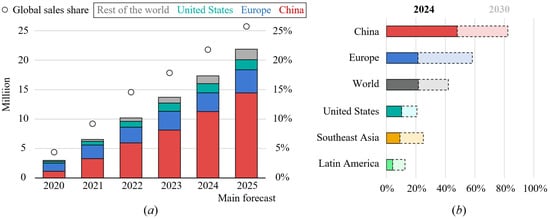
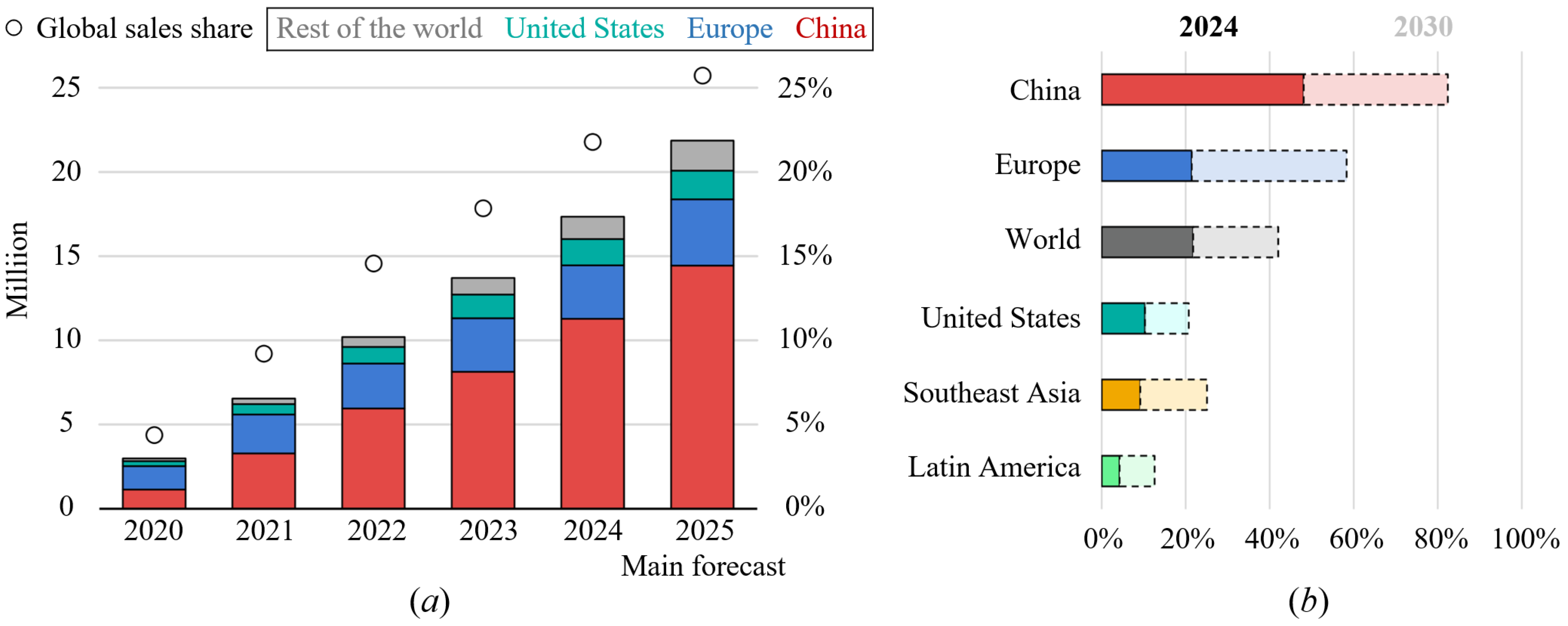
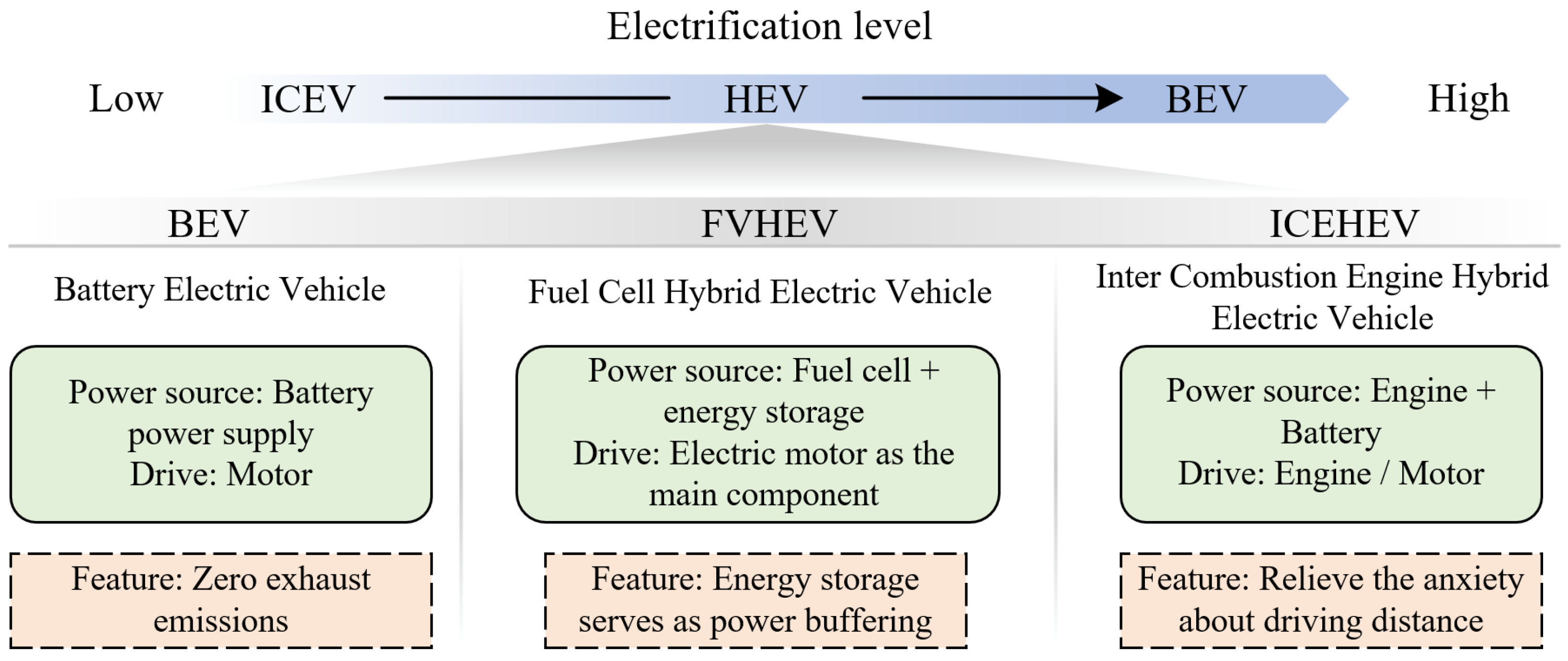
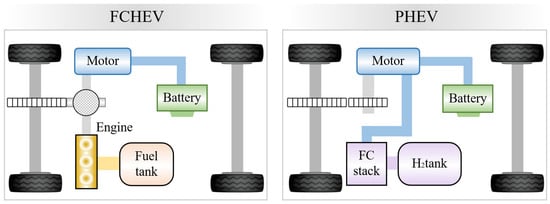
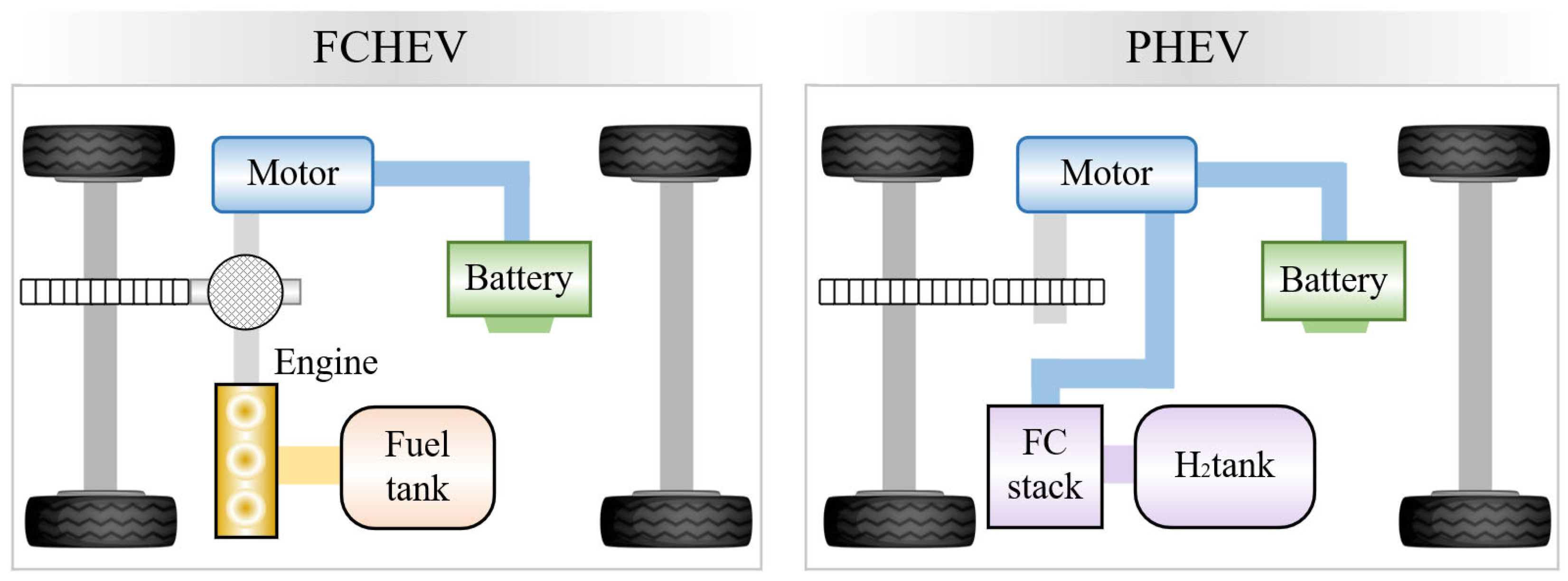
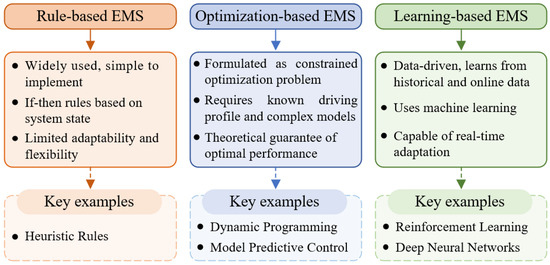
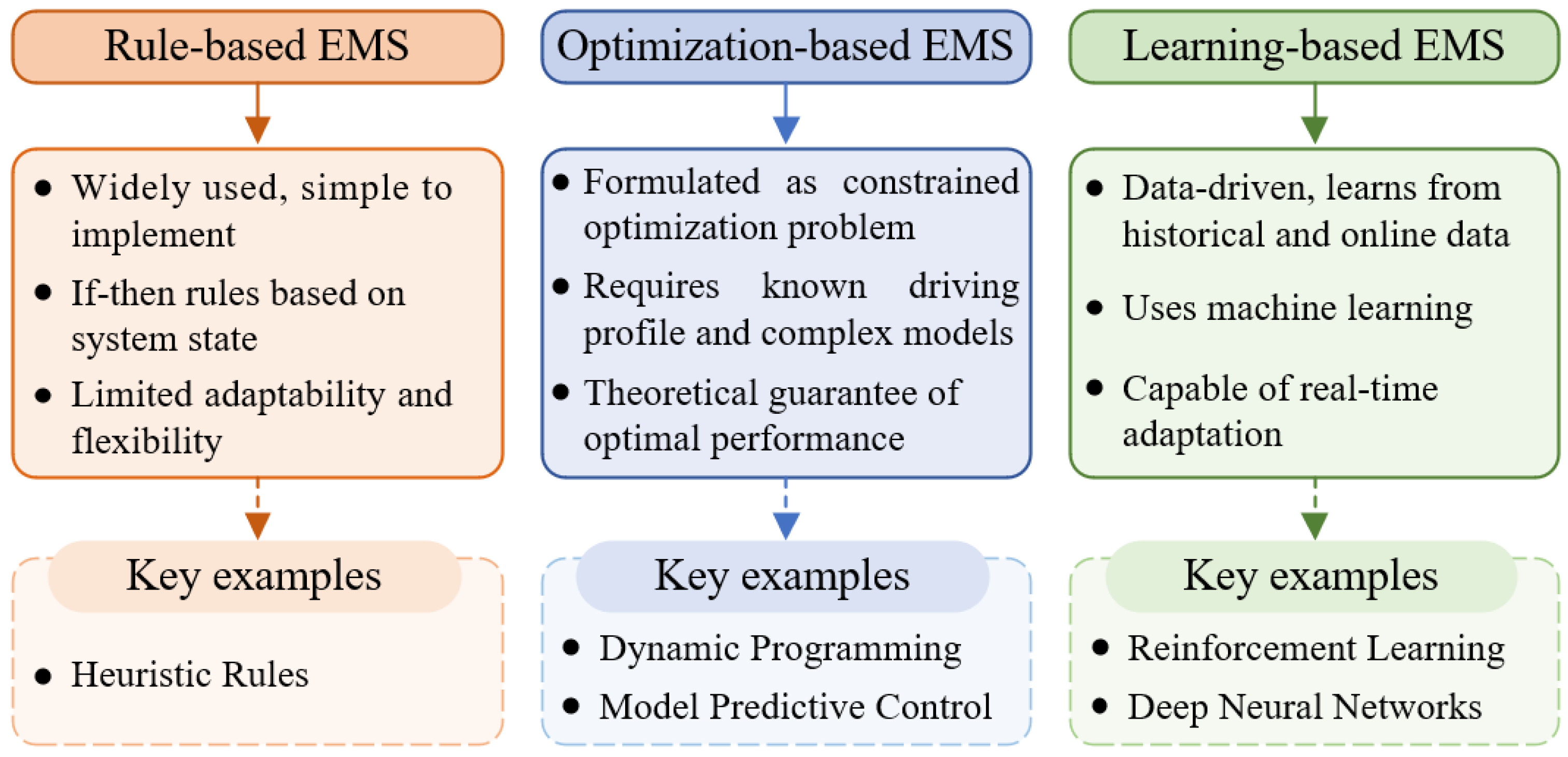
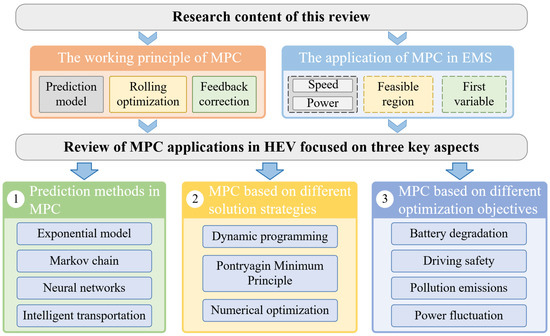
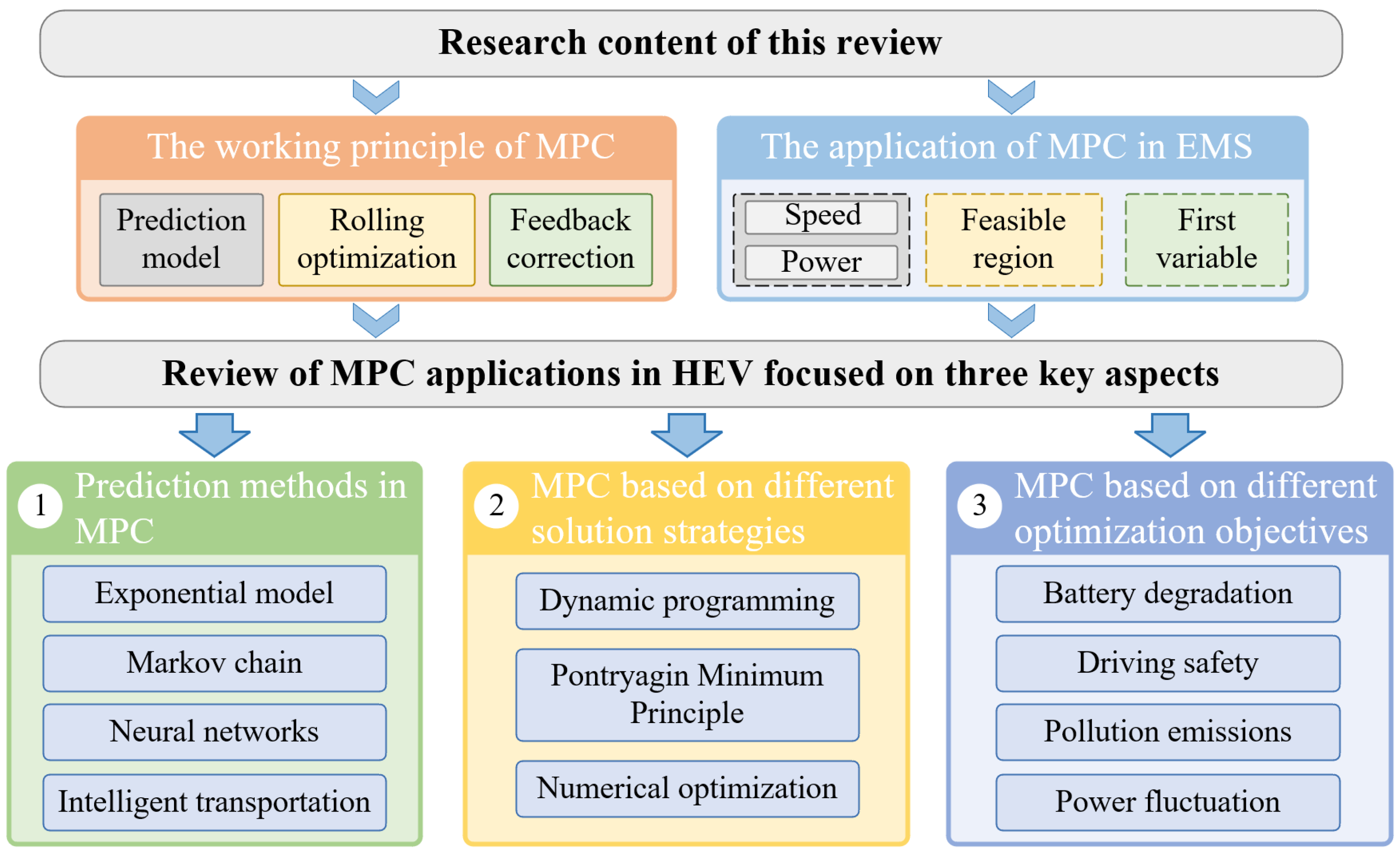
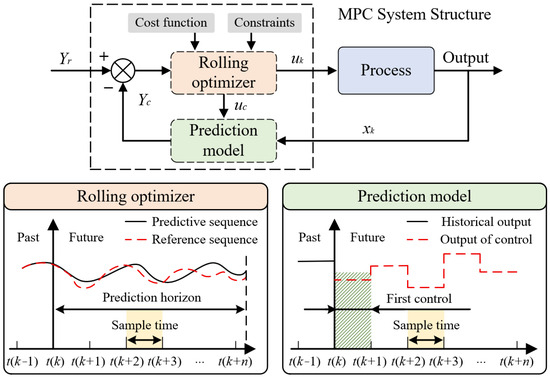
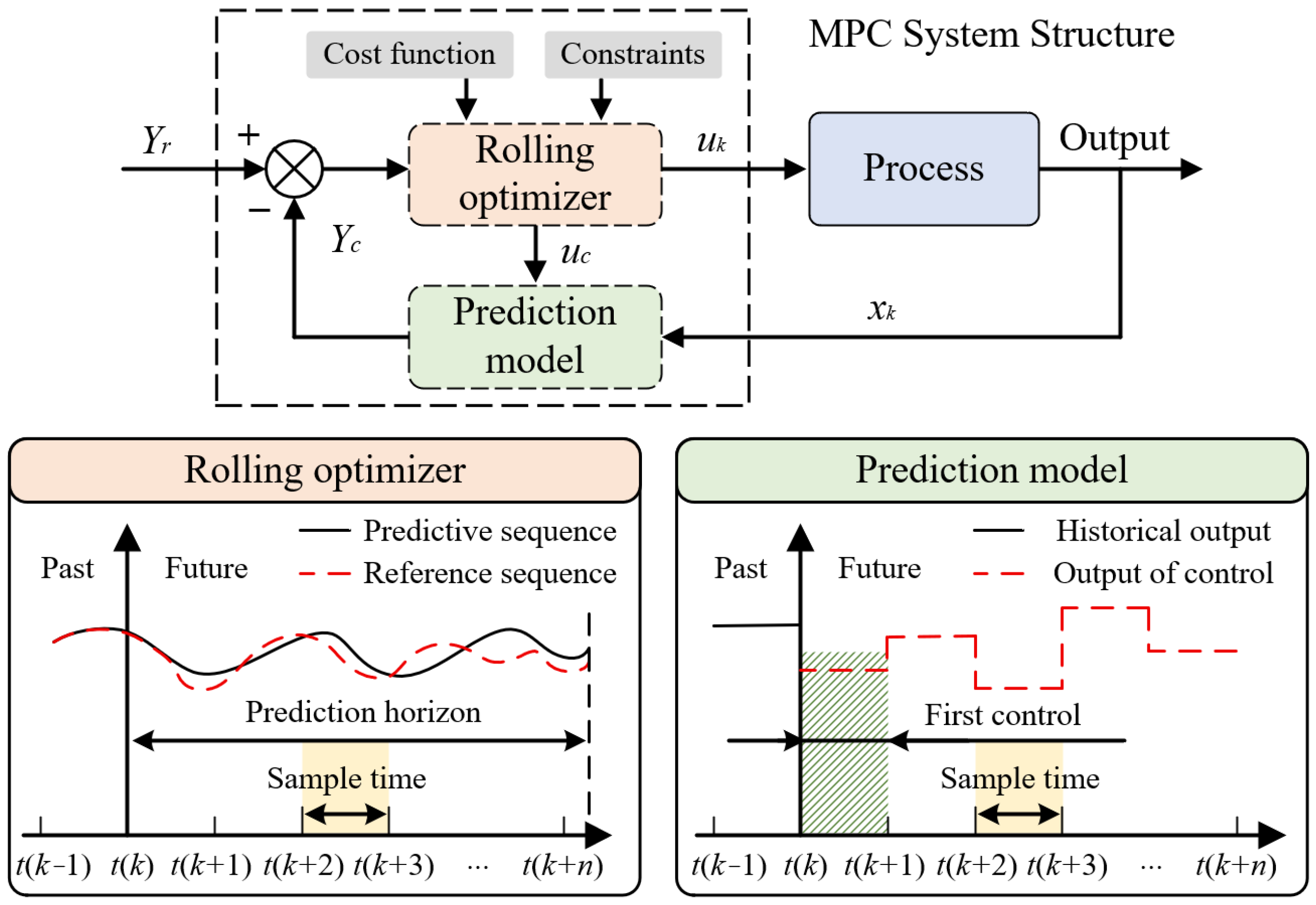
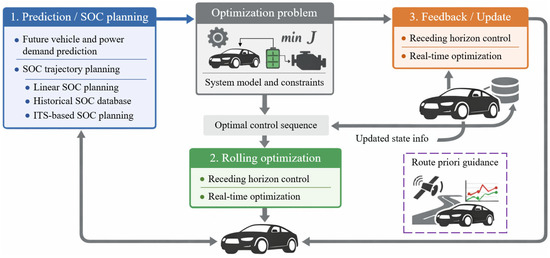
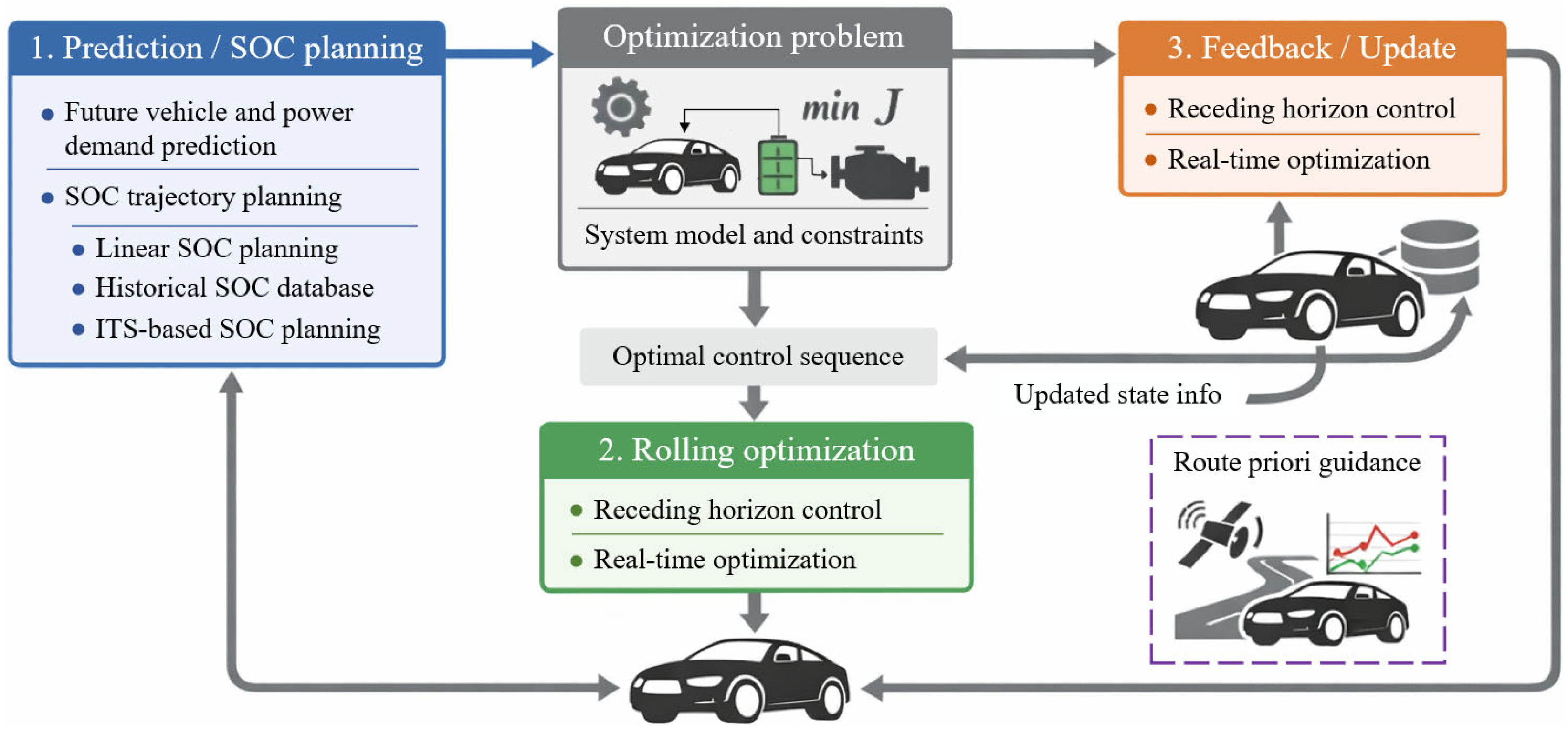
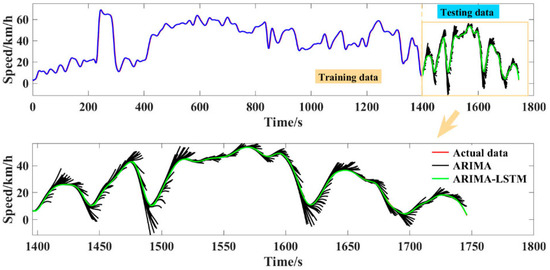
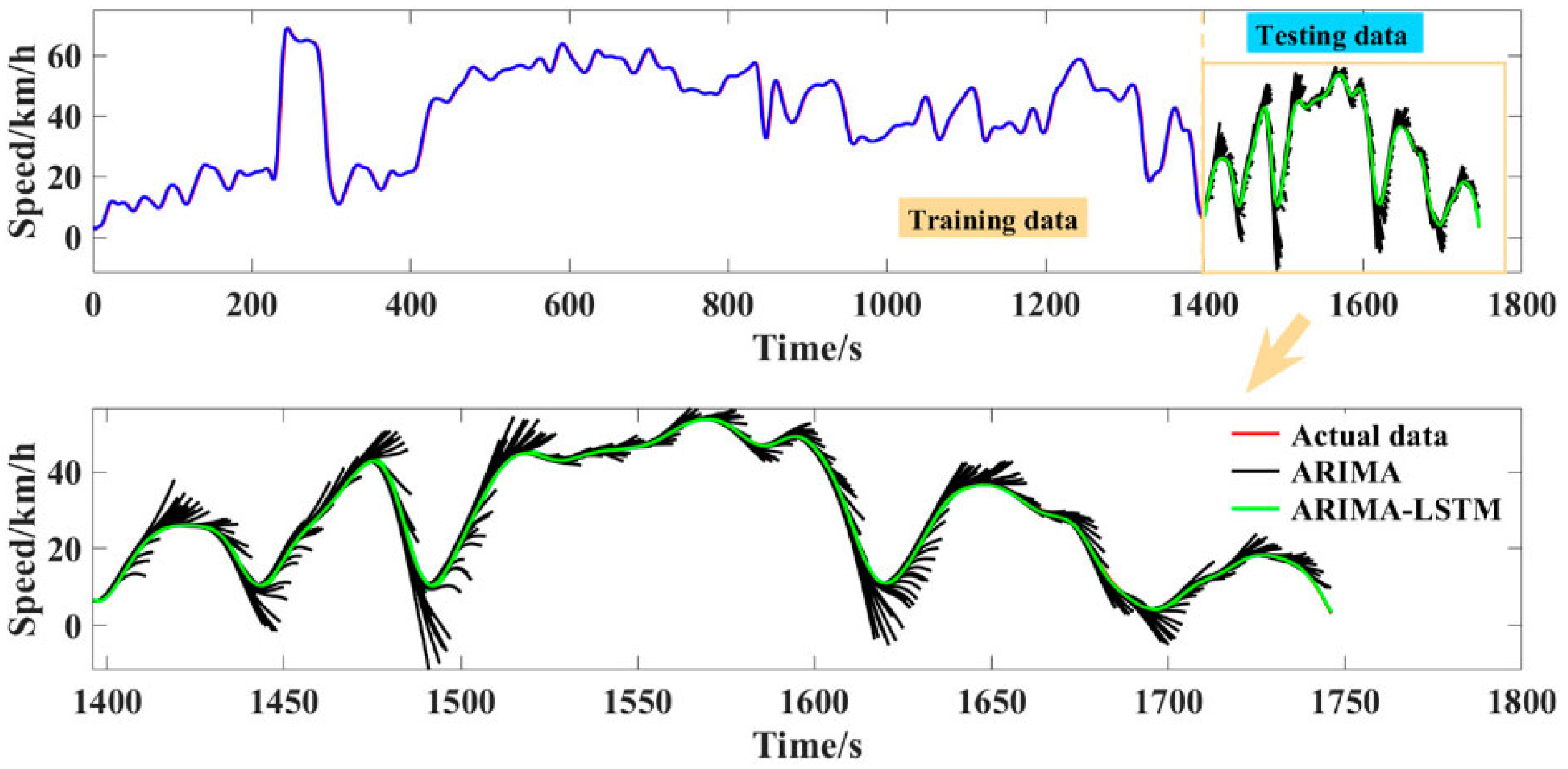
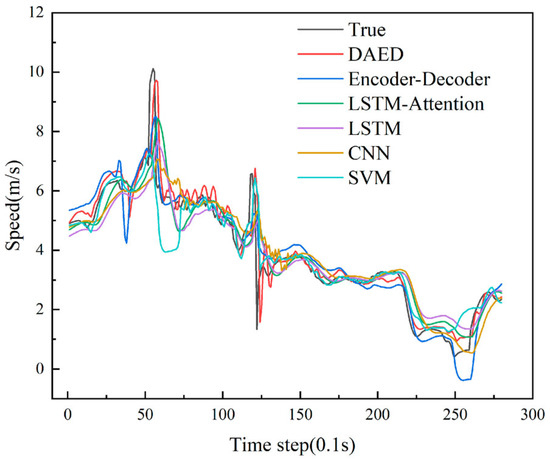
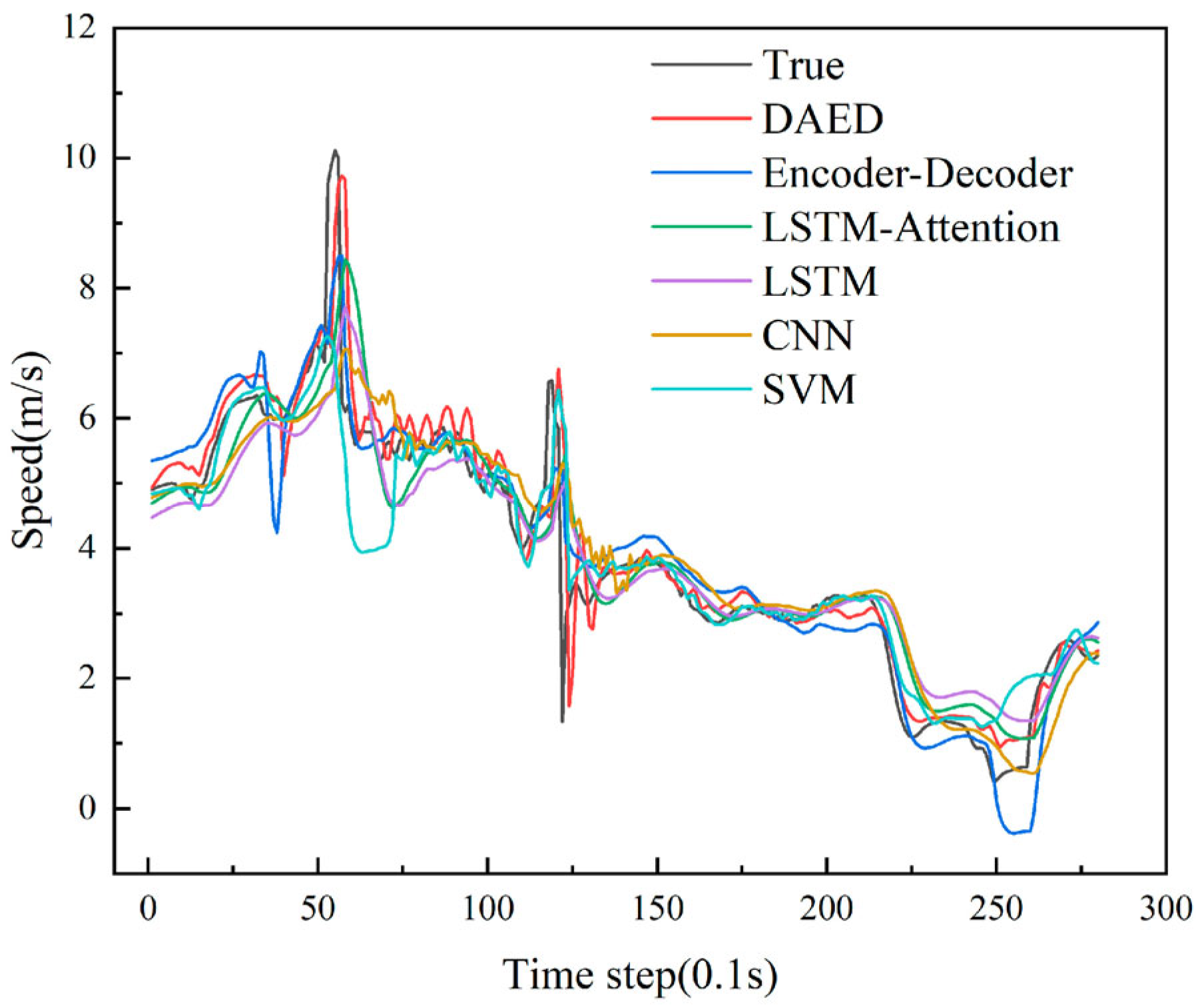
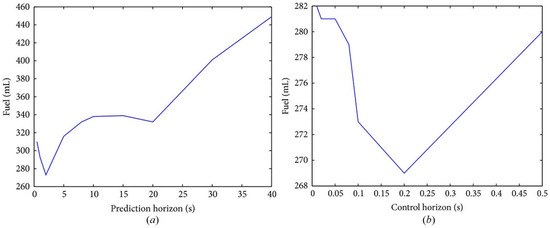
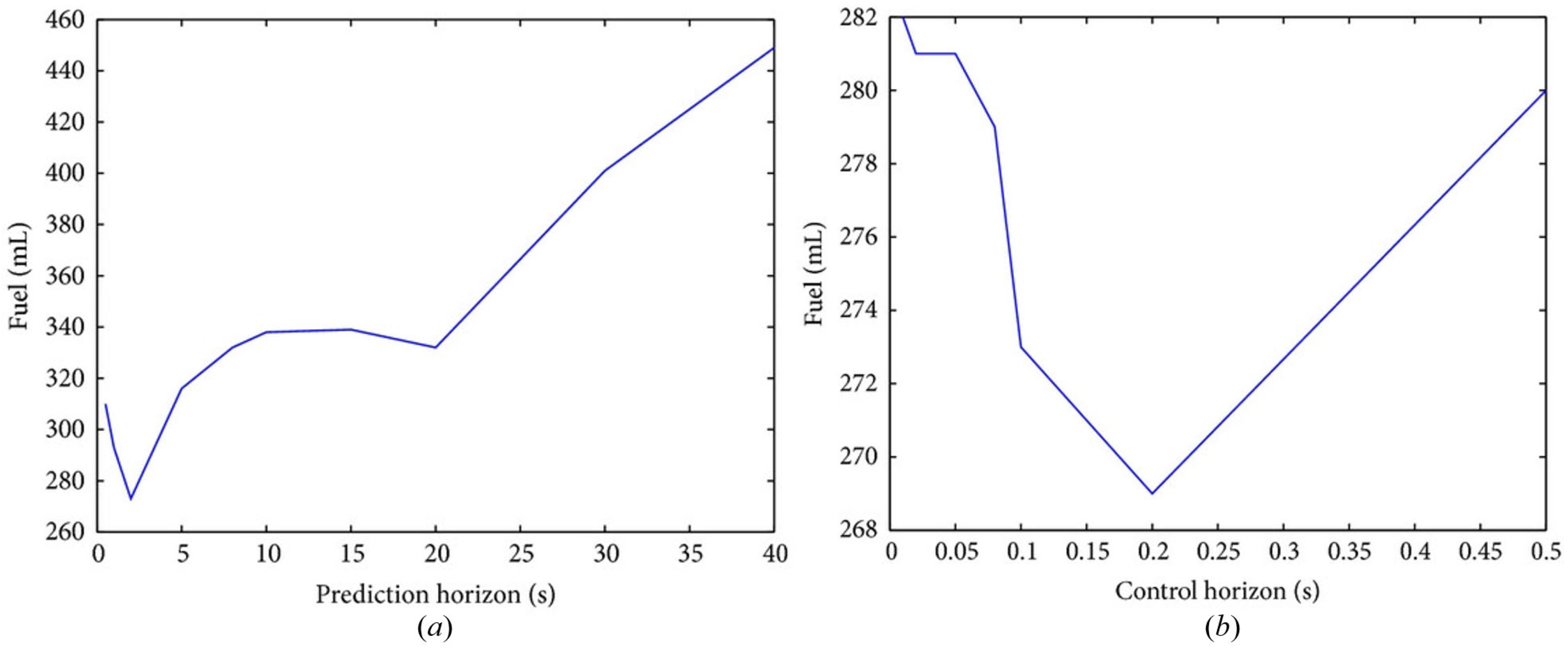
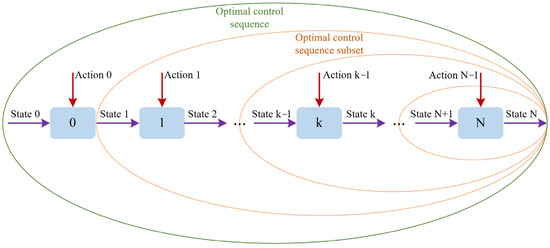
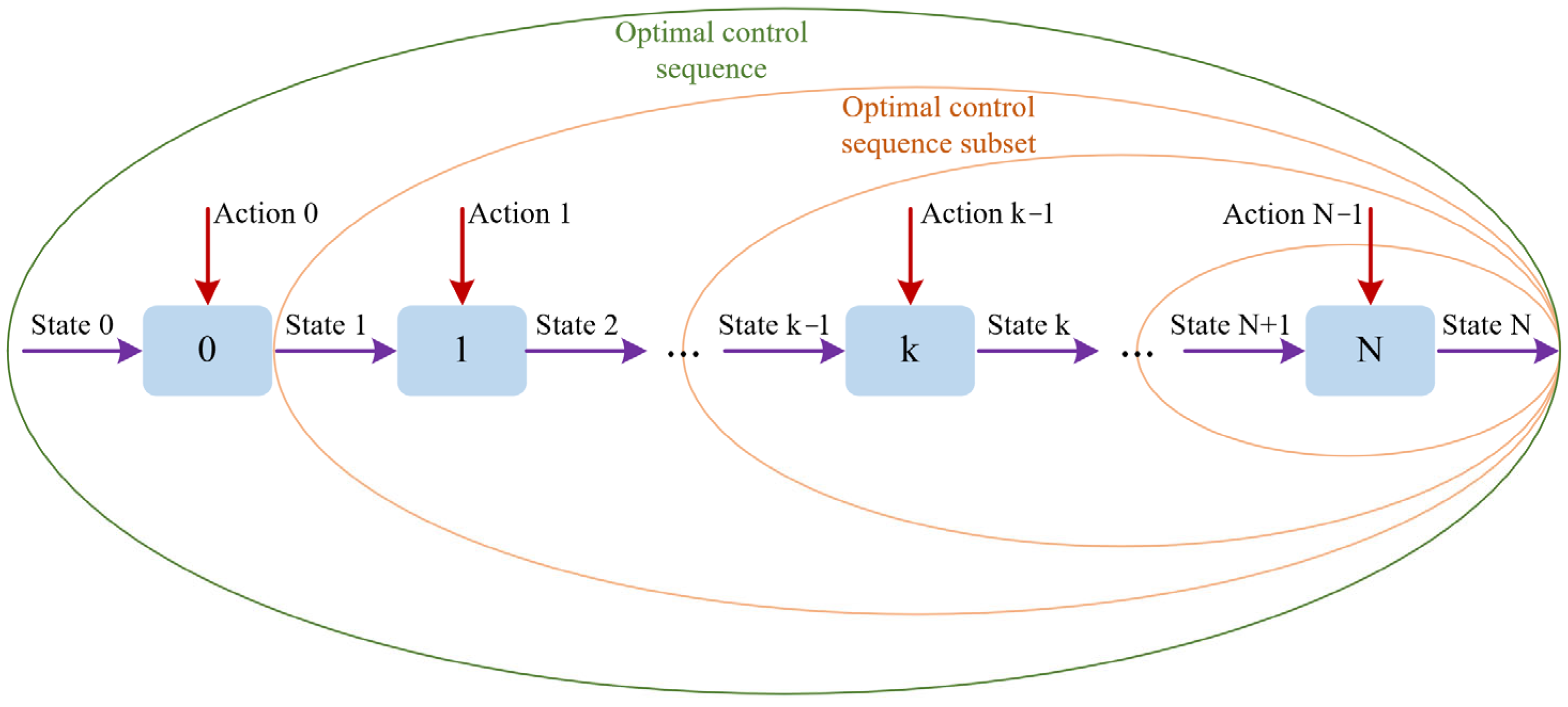
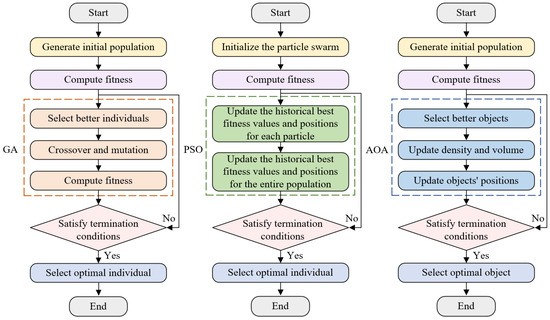
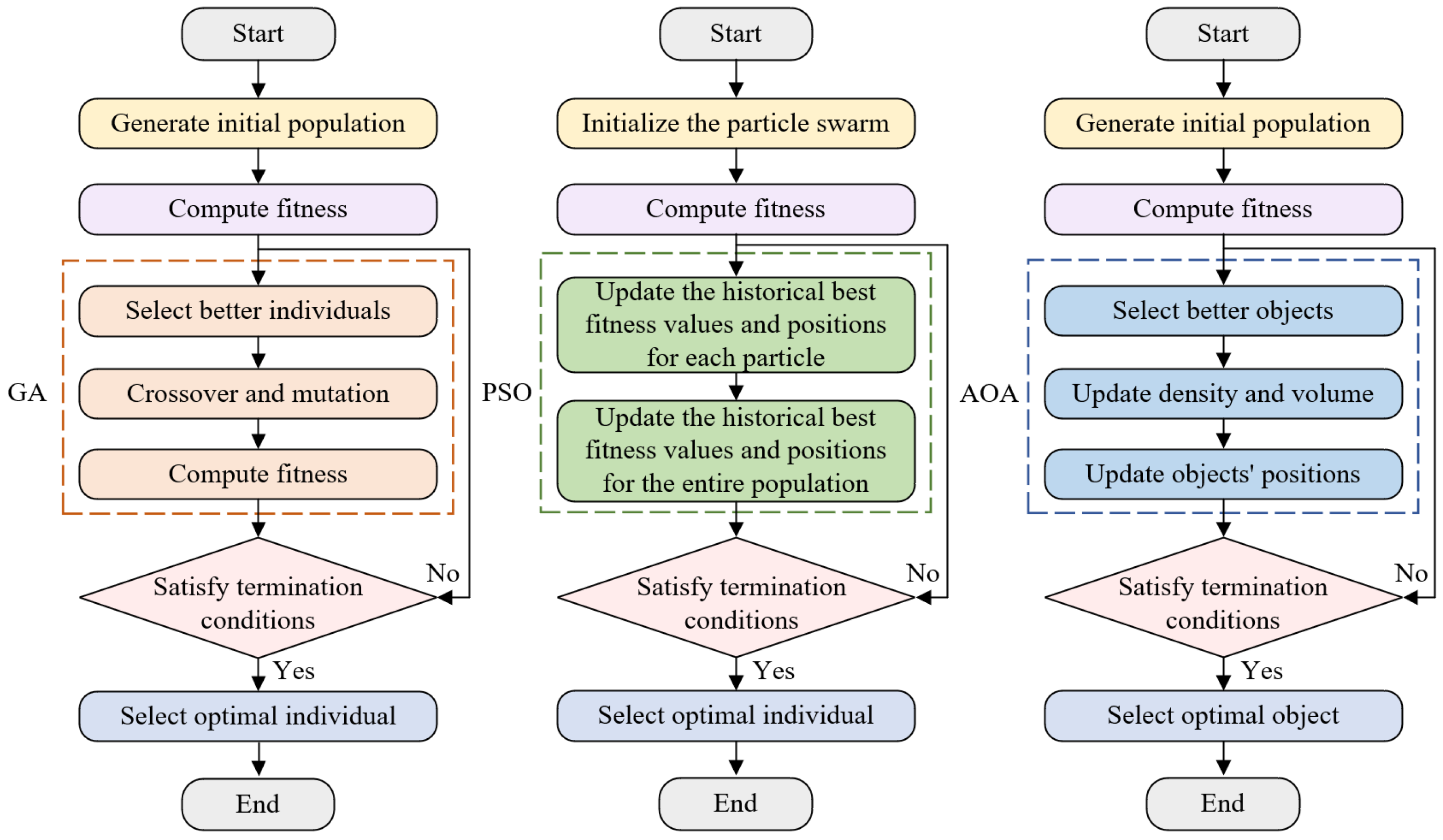
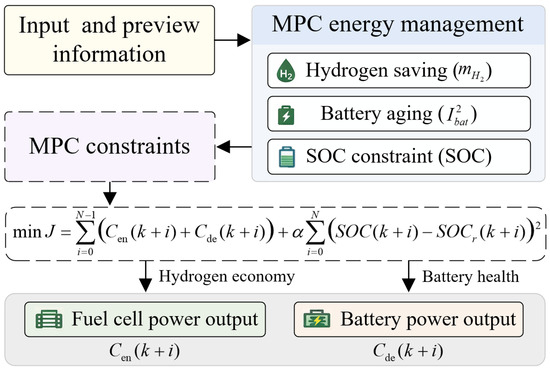
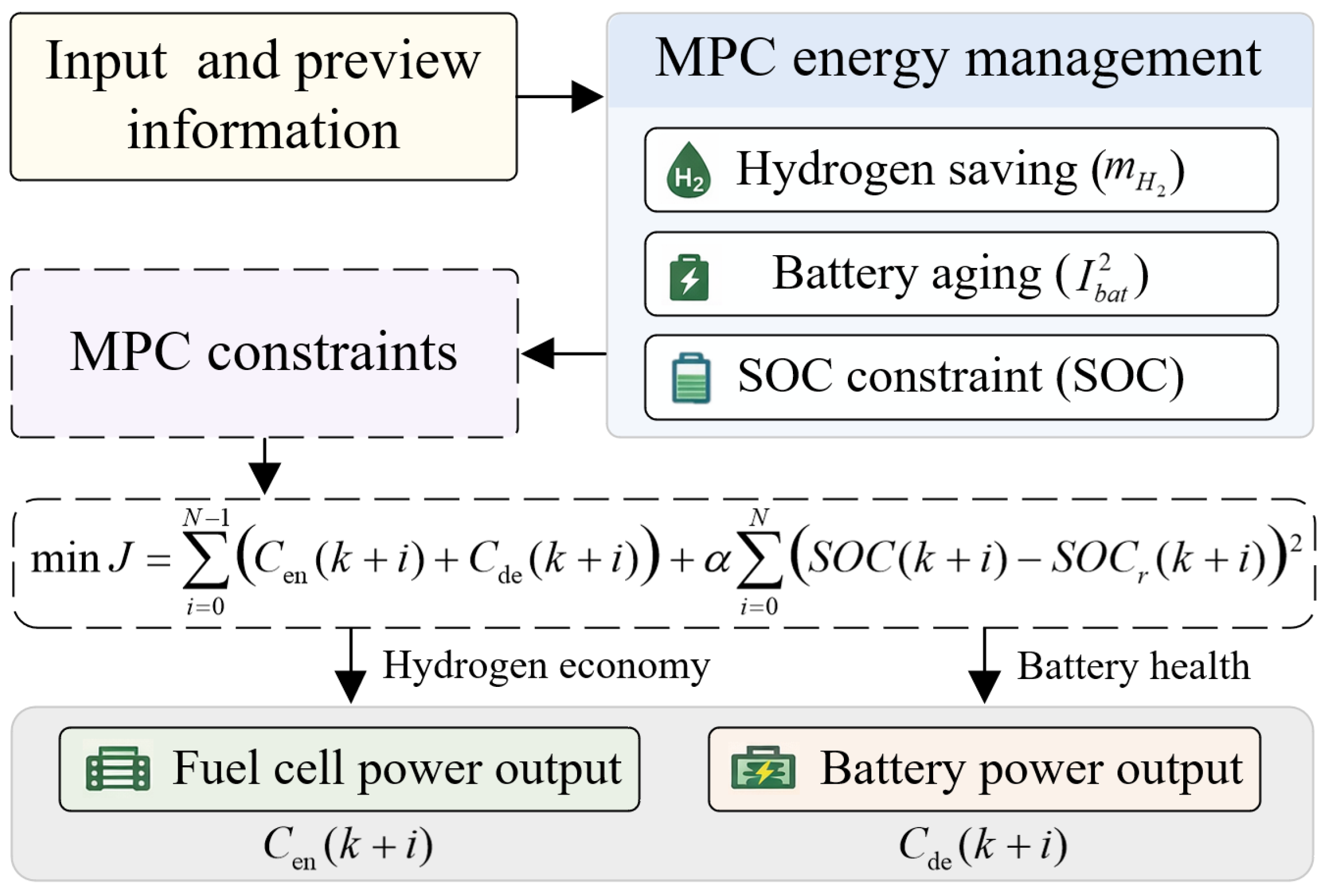
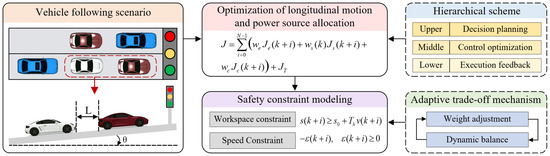
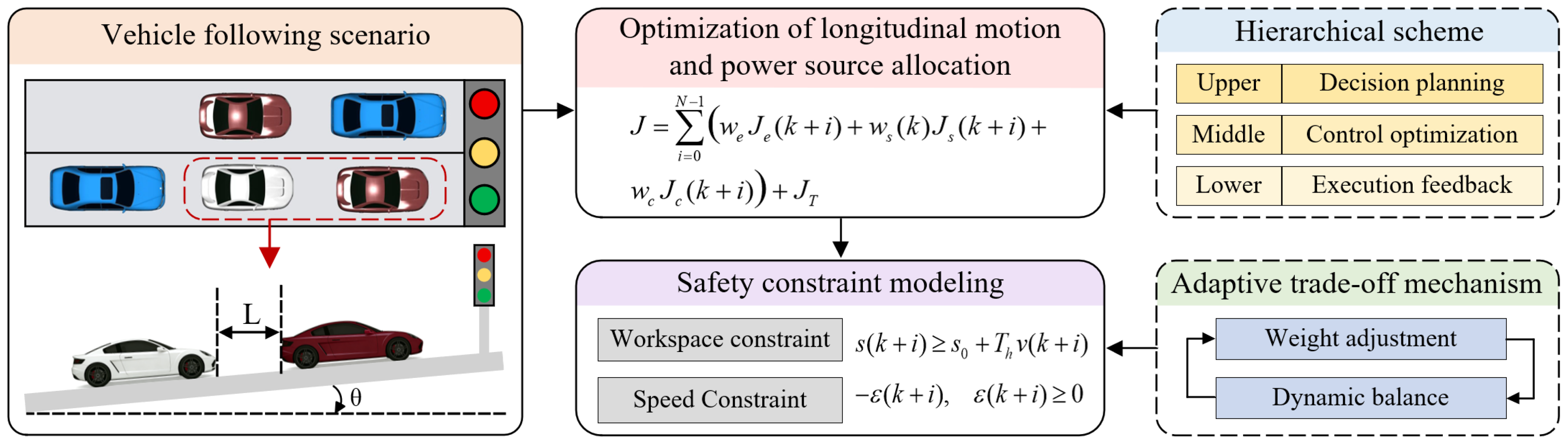
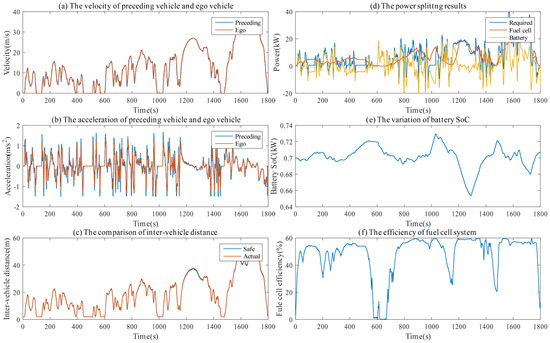
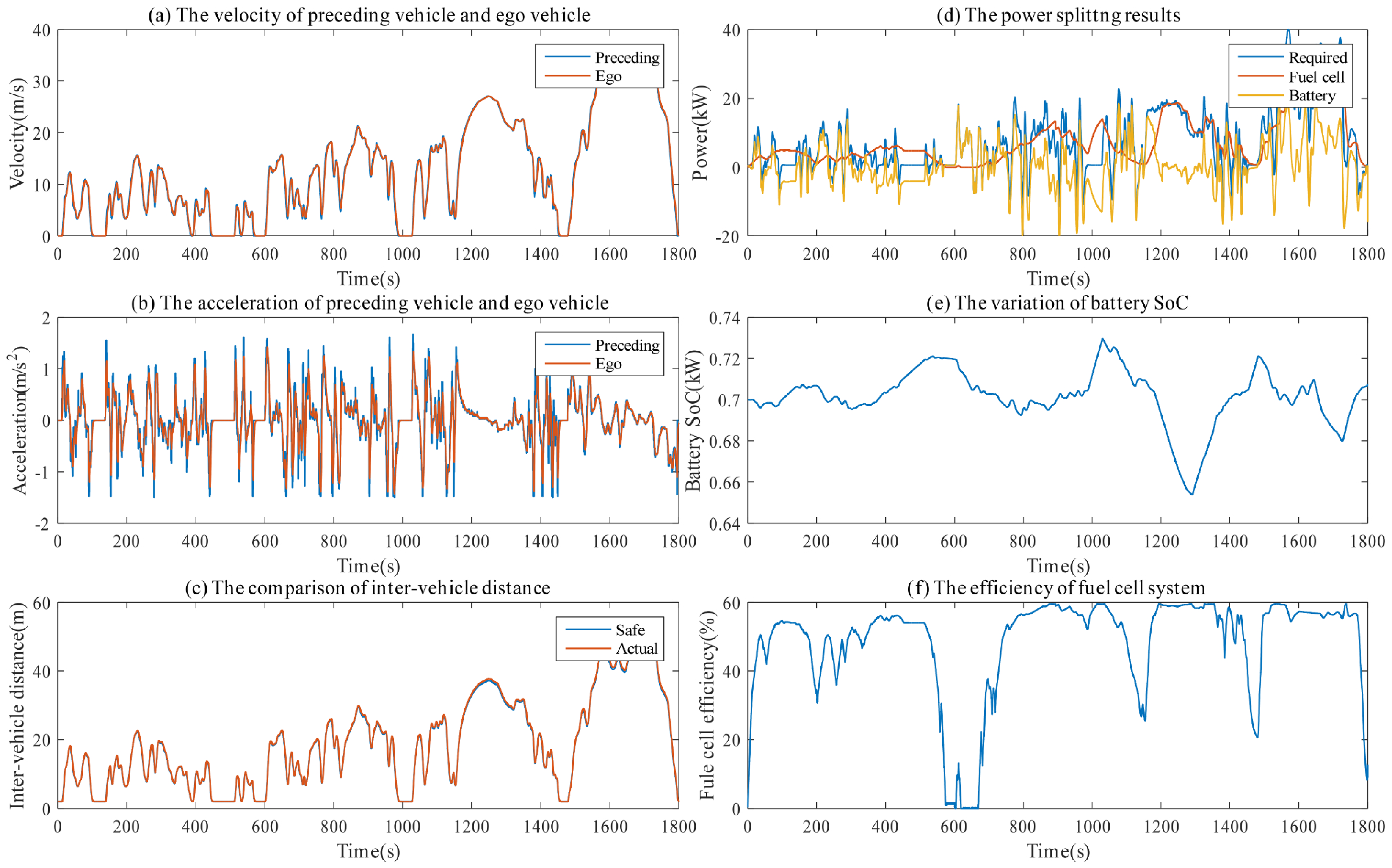
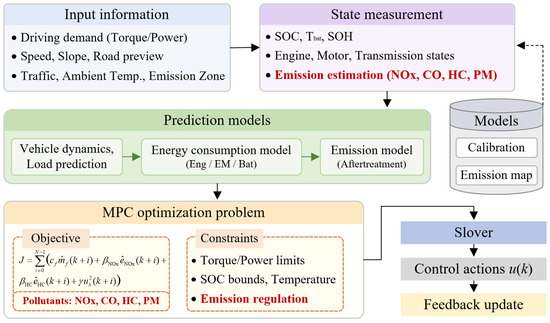
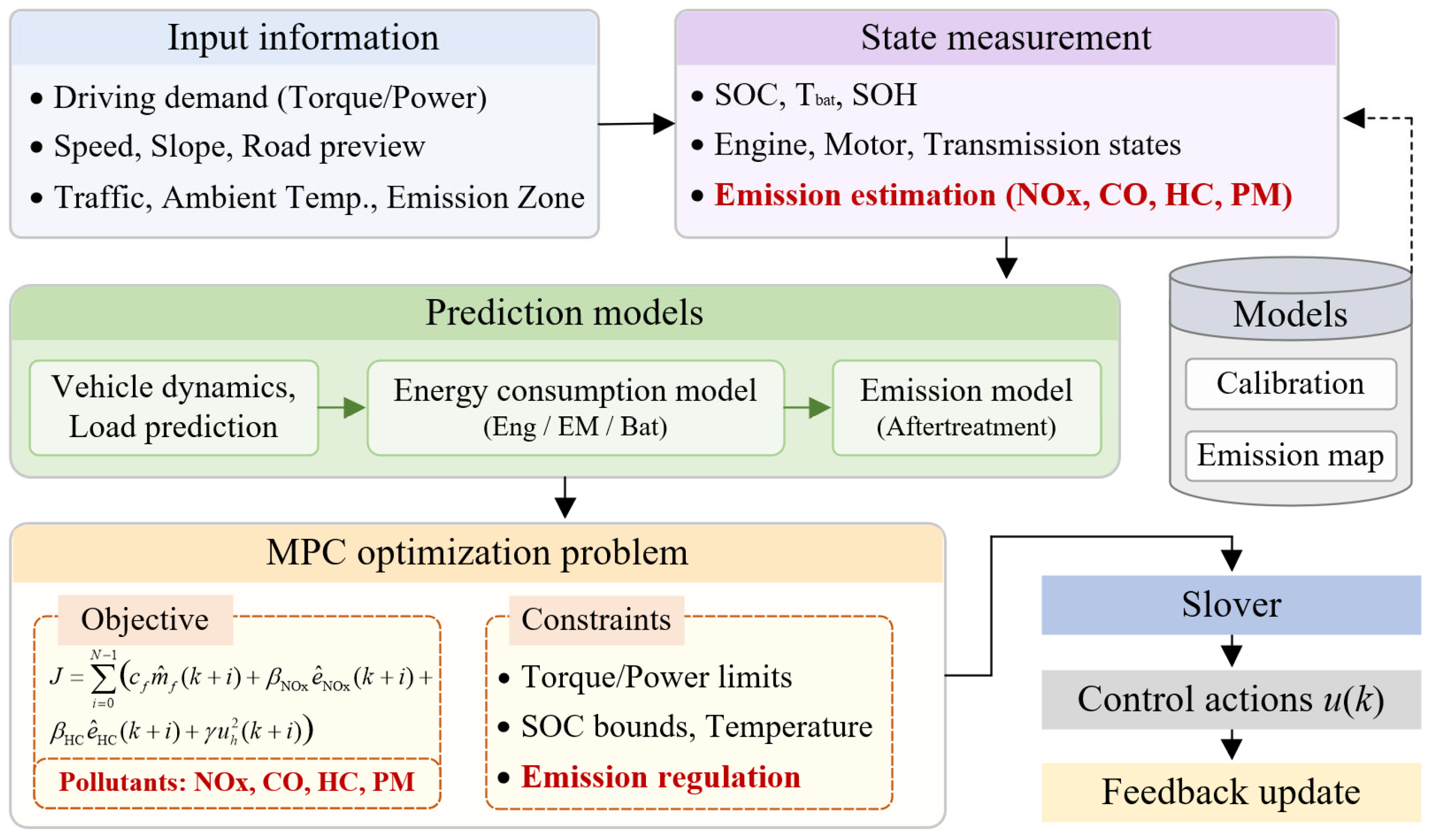
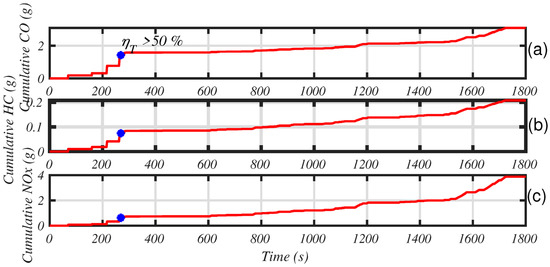
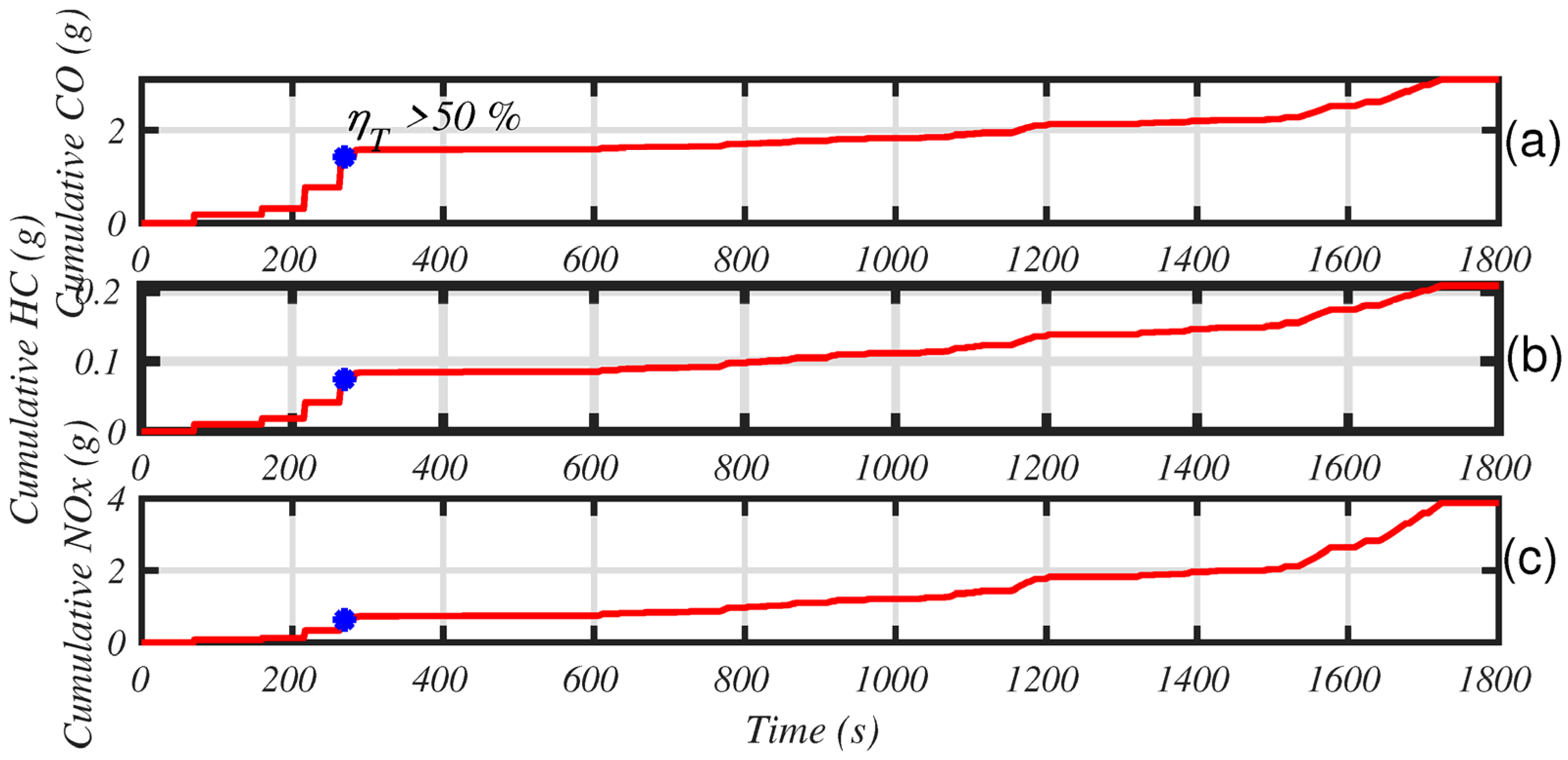
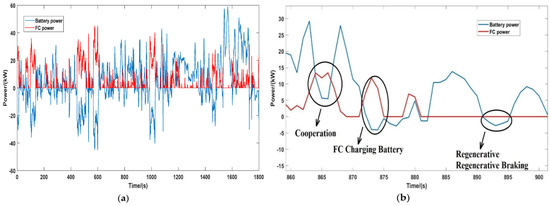
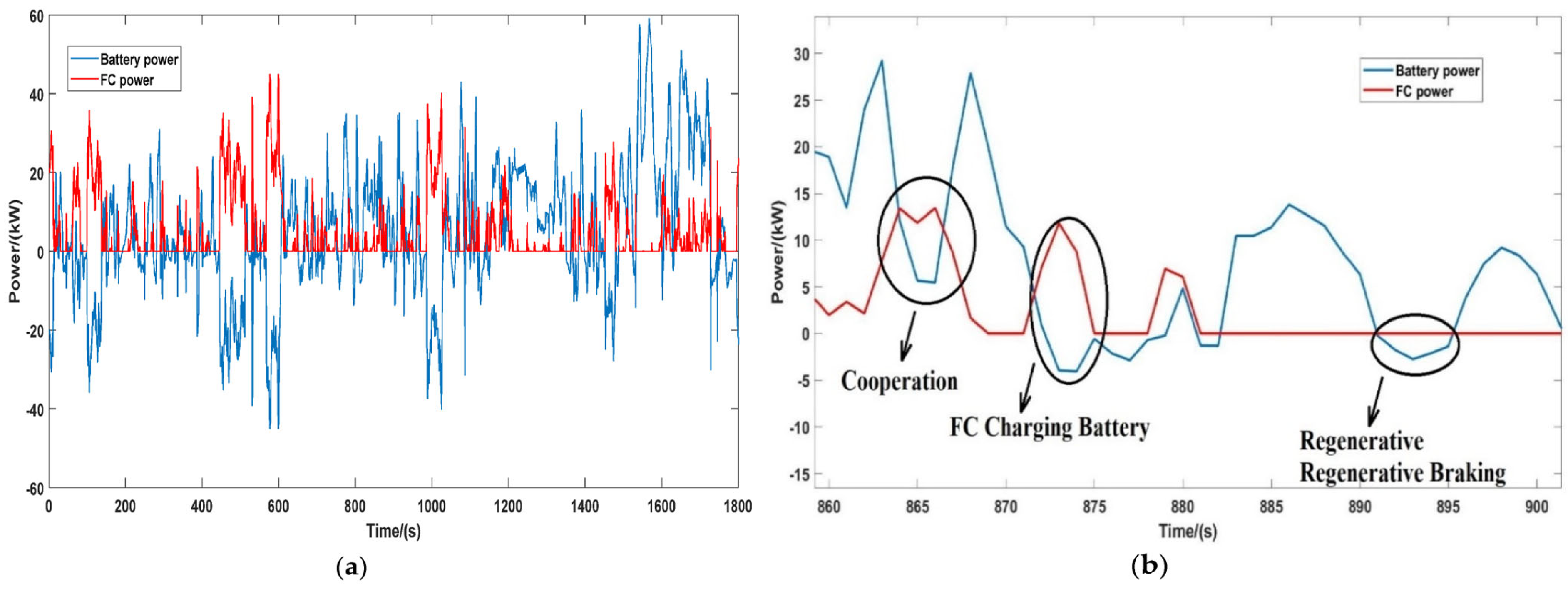

Disclaimer/Publisher’s Note: The statements, opinions and data contained in all publications are solely those of the individual author(s) and contributor(s) and not of MDPI and/or the editor(s). MDPI and/or the editor(s) disclaim responsibility for any injury to people or property resulting from any ideas, methods, instructions or products referred to in the content. |
© 2026 by the authors. Licensee MDPI, Basel, Switzerland. This article is an open access article distributed under the terms and conditions of the Creative Commons Attribution (CC BY) license.