A Hybrid Heuristic–Benders Method for Wind–Hydrogen Investment Planning with Non-Analytical Cost Functions

 ,
,
Abstract
1. Introduction
- 1.
- A hybrid GSOA-Benders framework is developed for a practically relevant class of WH-IES planning problems with black-box first-stage investment costs and scenario-based linear second-stage operation. The novelty is application-level and algorithmic integration, not the first use of heuristic decomposition in the literature.
- 2.
- The role and limitation of Benders cuts are clarified formally. The cuts provide valid lower approximations for the convex expected recourse function, whereas the non-convex black-box investment term is handled by a derivative-free master solver. Therefore, the reported convergence measure is defined as a stability gap and is not overstated as a rigorous global optimality gap.
- 3.
- A transparent case study compares the proposed framework with monolithic, reformulation-based, exhaustive simulation, and heuristic-decomposition benchmarks. The discussion is deliberately balanced: commercial solvers remain preferred for explicit models, while the proposed method is intended for cases where black-box first-stage costs prevent direct exact formulation.
- 4.
- The revised model discussion explicitly addresses practical modeling issues raised by reviewers, including hydrogen losses, component lifetime and degradation, the stylized nature of the sinusoidal tank-cost benchmark, scalability boundaries, and possible emission-reduction extensions.
2. Mathematical Formulation
2.1. Position Relative to C&CG and Classical Benders Decomposition
2.2. Two-Stage Optimization Framework
- 1.
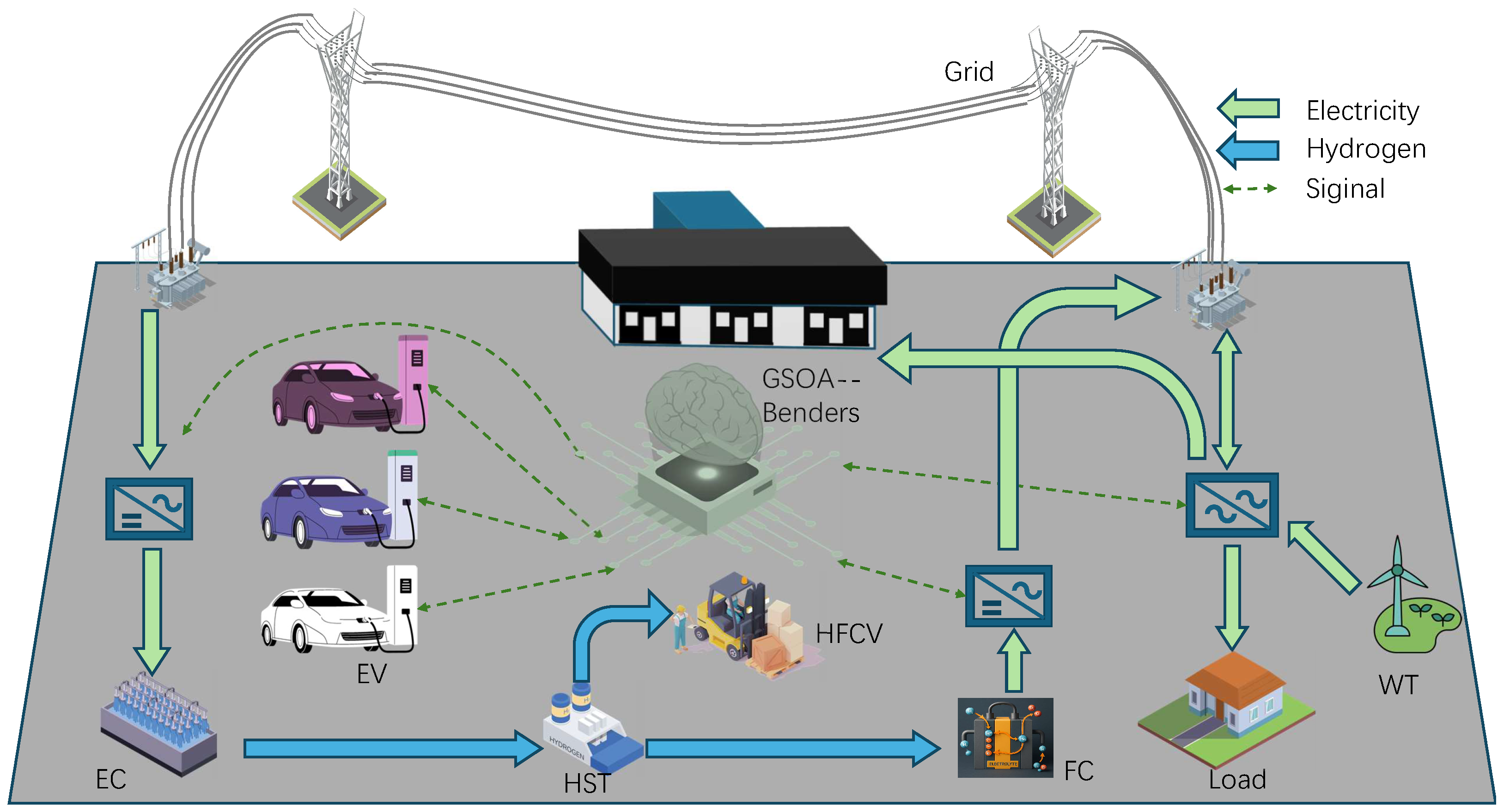
- Stage I (Investment Decisions): These represent the here-and-now decisions. The planner determines the optimal installed capacities of the equipment, denoted by the decision vector (), prior to the realization of uncertainties (e.g., wind power availability and load demand).
- 2.
- Stage II (Operational Decisions): These correspond to the wait-and-see recourse decisions. Once the uncertainty (, representing a specific operational scenario) is realized, the system operator determines the optimal operational strategy () based on the fixed capacity () under scenario .
2.3. Master Problem (MP): Investment Decision Model
- (1)
- Decision Variables (): The investment decision vector () comprises the following:
- : Binary decision for wind farm construction (1 denotes construction; 0 otherwise);
- : Installed capacity of the electrolyzer (MW);
- : Capacity of the hydrogen storage tank (MWh);
- : Installed capacity of the fuel cell (MW).
- (2)
- Investment Cost Function: The annualized investment cost () is calculated over a lifespan of years:
2.3.1. Wind Power Cost (Binary)
2.3.2. Electrolyzer and Fuel-Cell Costs (Linear)
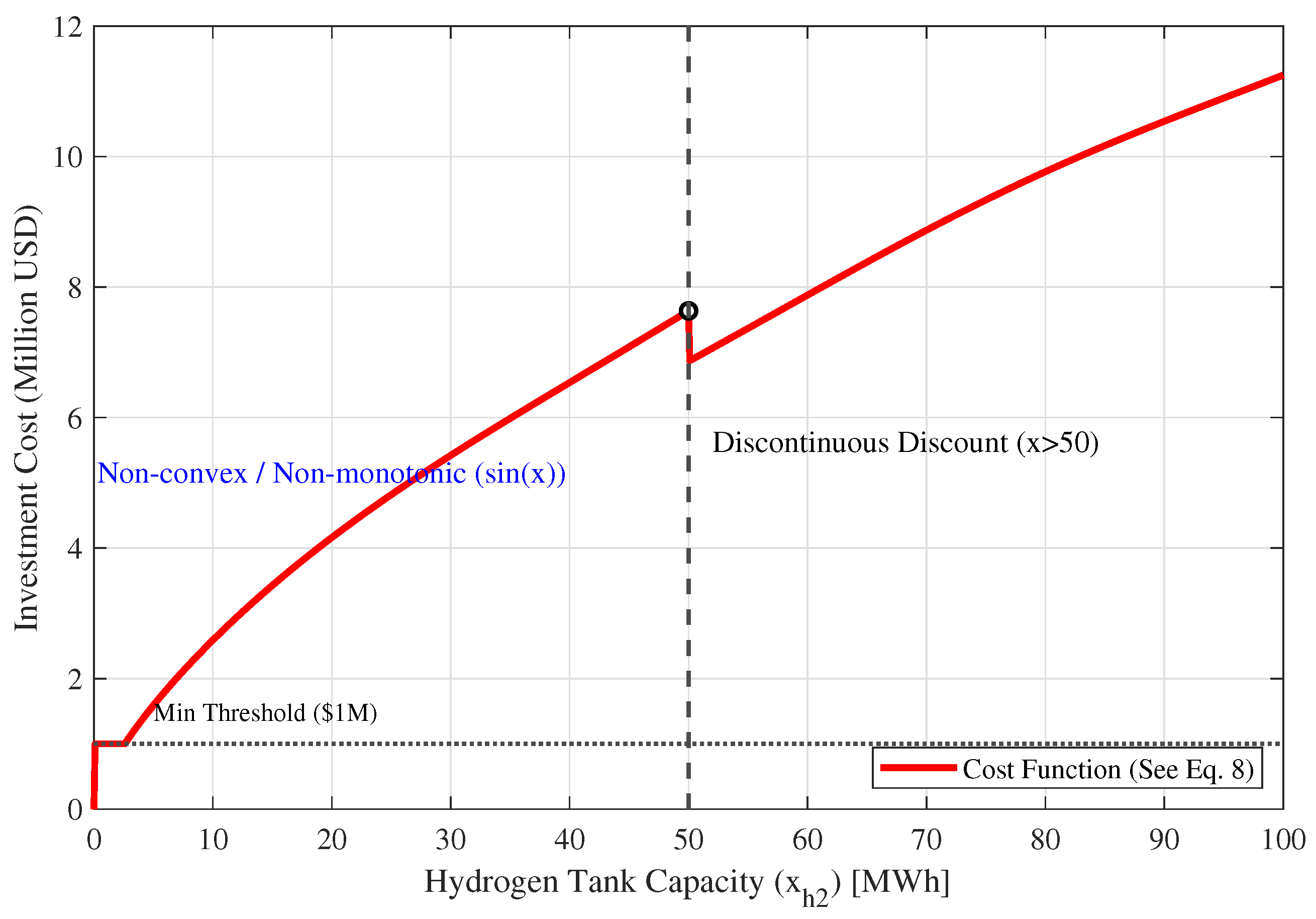
2.3.3. Hydrogen Tank Cost (Complex Non-Convex Model) [26]
- (1)
- Base Cost with Discount Scheme (Piecewise & Non-convex): Reflecting economies of scale, the base cost follows a power function (). Furthermore, a step-wise discount is applied when the capacity exceeds a critical threshold (50 MWh), introducing a discontinuity in the marginal cost:
- (2)
- Cyclic Modularity Cost (Highly Non-convex): This component introduces a controlled, non-convex perturbation to the cost surface. It is not claimed to be a first-principles engineering cost law for hydrogen tanks. Instead, it is used as a stylized numerical proxy to represent irregular cost perturbations that may arise from land constraints, modular procurement, installation logistics, or supplier-specific pricing rules. The purpose of this term is to construct a reproducible black-box benchmark on which the proposed algorithm can be tested:
- (3)
- Parameter Settings: The coefficient expressed as is selected to keep the tank cost on the same order of magnitude as the other investment terms. The exponent of is used to emulate economies of scale, a standard sub-linear behavior in capacity–cost relationships, whereas the factor of represents a stylized bulk-purchase discount beyond 50 MWh. The perturbation amplitude is set to , and the minimum entry cost is . These values should be interpreted as benchmark settings for methodological evaluation rather than universally valid equipment prices.
2.4. Sub-Problem (SP): Multi-Scenario Operational Model
2.4.1. Operational Decision Variables (ys)
- : Actual dispatched wind power (MWh);
- : Power consumption of the electrolyzer (MWh);
- : Hydrogen production rate (Nm3);
- : State of Charge (SoC) of the hydrogen tank (Nm3);
- : Power purchased from/sold to the utility grid (MWh);
- : Power generation from the fuel cell (MWh);
- : Vector of slack variables for load shedding (ensuring feasibility).
2.4.2. Objective Function
2.4.3. Constraints
- (1)
- Power Balance Constraint: The system must maintain real-time power equilibrium. The sum of generation and imports must equal the sum of consumption and exports:
- (2)
- Hydrogen Mass Balance Constraint: The hydrogen storage level evolves according to production, fuel-cell consumption, exogenous hydrogen demand, and storage loss. and denote the energy-to-volume and volume-to-electricity conversion coefficients, respectively. is the hourly storage-loss coefficient:The storage level must also satisfy the cyclic boundary condition (). In the numerical base case, is set to zero because reliable leakage data are not available; however, the variable is retained in the formulation so that boil-off, leakage, or purification losses can be activated directly when engineering data are available.
- (3)
- Investment Capacity Constraints: Operational variables are strictly bounded by the installed capacities determined in Stage I ():Note: Equation (17c) includes to convert the decision variable (, MWh) into storage volume limits (Nm3). All operational variables are non-negative ().
2.5. Assumptions, Scope, and Limitations
- System scope. The studied WH-IES includes wind generation, electrolyzer capacity, hydrogen storage, and fuel-cell conversion. Photovoltaic generation and other storage technologies are not included. This simplification isolates the wind–hydrogen investment trade-off, but it may underestimate the value of multi-energy complementarity in sites with strong solar resources.
- Wind representation. The operational model uses scenario-based available wind power as exogenous input data. Detailed aerodynamic turbine modeling is omitted because the focus is planning under uncertainty and black-box investment costs, not turbine performance identification.
- Hydrogen conversion and losses. Electrolyzer and fuel-cell processes are represented by linear conversion coefficients in the second-stage LP. This preserves tractability across many scenarios and hourly periods, but it neglects part-load efficiency, start-up dynamics, temperature effects, and degradation. Hydrogen storage loss is represented by and in the revised mass-balance equation; the base case sets due to the absence of site-specific leakage data.
- Component lifetime and cycling. The base case uses a 10-year economic recovery horizon for comparability with the original numerical experiment. This is shorter than the possible physical lifetime of wind assets, which can reach 20–30 years with proper maintenance and life-extension decisions [28]. Electrolyzer and fuel-cell replacement is not modeled explicitly. A practical extension is to introduce equivalent operating-hour or cycle constraints, for example,where is the electrolyzer operating indicator and is the allowable equivalent operating hours before stack replacement. Replacement costs can then be added to through a component-specific replacement factor.
- Financial scope. Taxes, inflation, salvage value, and detailed replacement schedules are not included. The sensitivity in Section 4.6 explains how the annualization horizon affects economic interpretation.
- Environmental scope. The present manuscript focuses on economic planning and algorithmic tractability. CO2 accounting, life-cycle impacts, LCOE/LCOH2, and social–environmental externalities are not included in the objective function. A simple extension is to add an emission term or a carbon price to the operating cost, as discussed in Section 4.6.
- Methodological scope. The sinusoidal perturbation in the hydrogen-tank cost is a stylized black-box benchmark. It should be interpreted as a proxy for irregular non-analytical pricing, not as a universal engineering cost model.
3. Solution Methodology: The GSOA-Benders Framework
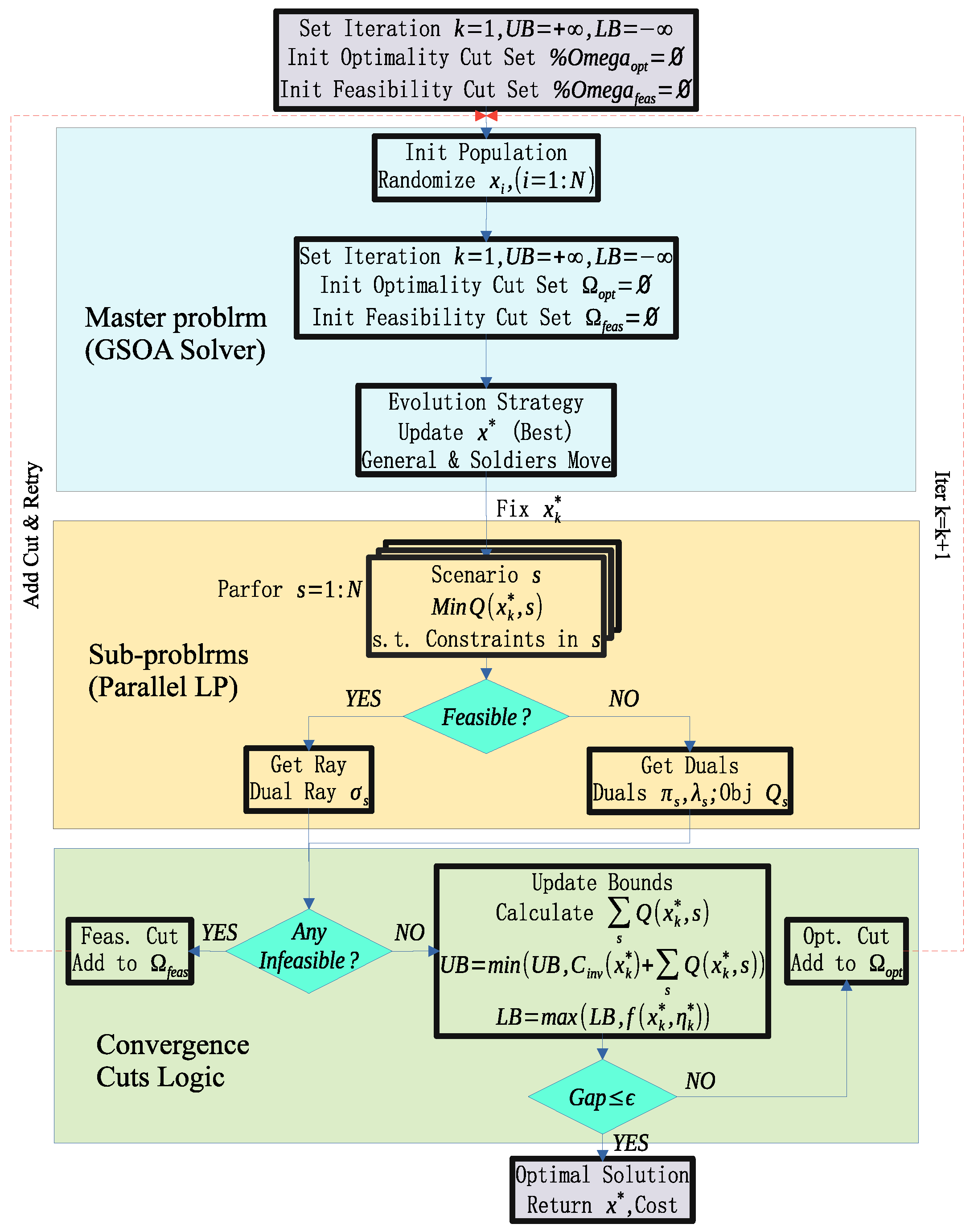
- 1.
- Preservation of Explicit Sub-structures: The multi-scenario operational Sub-Problem (SP) remains an explicit, highly structured Linear Programming (LP) problem. Consequently, we retain the use of precise mathematical programming solvers (specifically, the dual-simplex algorithm) to ensure computational efficiency and optimality for this stage.
- 2.
- Isolation of Implicit Complexity: The implicit “black-box” investment decision process within the master problem is isolated from the linear definitions. We employ the General Soldiers Optimization Algorithm (GSOA)—a metaheuristic specifically engineered for such derivative-free landscapes—to solve the MP.
3.1. Hybrid Heuristic Decomposition Framework
- Recourse convexity. For a fixed scenario (s), the operational subproblem can be written in the generic LP form:Under complete recourse or with sufficiently penalized slack variables, the subproblem is feasible for all . According to LP duality, is the pointwise maximum of affine functions in and is therefore convex and piecewise linear. Consequently, the expected recourse function, i.e.,is also convex and admits supporting hyperplanes generated from optimal dual solutions.
- Benders cut validity. Let be an optimal dual vector of scenario s at the incumbent investment vector (). A valid expected recourse cut isThis cut lower-bounds only the expected second-stage operating cost (). It does not convexify the black-box investment function () and therefore does not, by itself, prove the global optimality of the total objective.
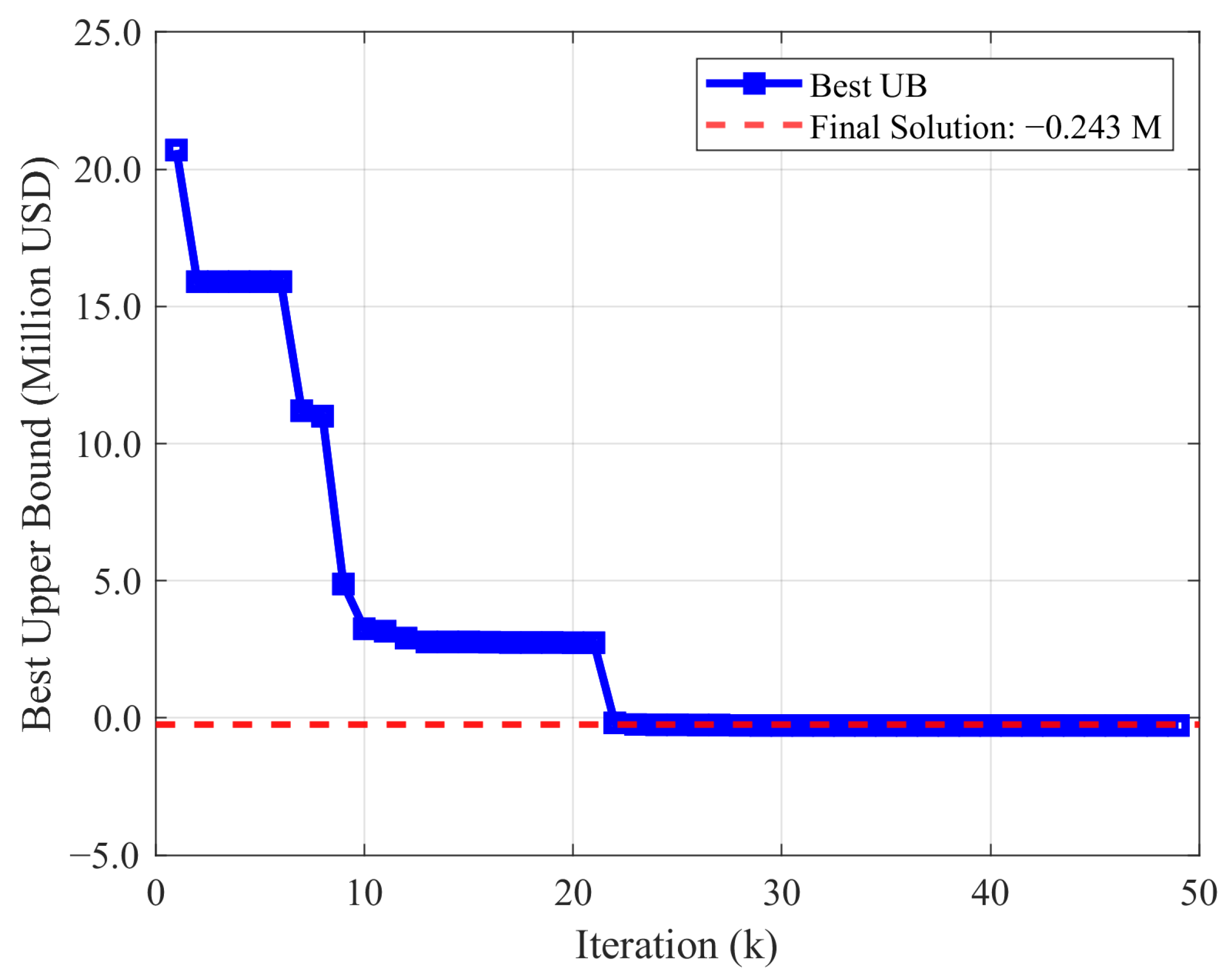
- Stability-gap definition. Because GSOA is a derivative-free metaheuristic, the master problem is not solved with a deterministic global optimality guarantee. We therefore report a stability gap rather than a strict optimality gap. At iteration k, the best feasible upper bound isLet be the best master value found by the GSOA over the current cut approximation. The stability gap is defined asThe stopping rule is , together with no material improvement in for a fixed number of iterations. This criterion indicates that the incumbent solution is stable with respect to the accumulated cut-plane approximation, but it should not be interpreted as a mathematical certificate of global optimality for a non-convex black-box master problem.
- Solution-quality safeguards. To improve reliability, the implementation uses bounded decision domains, feasibility cuts when subproblem infeasibility is detected, repeated GSOA starts, and ex-post evaluation of the final investment vector by solving all scenario subproblems. These safeguards make the method suitable as an engineering decision-support procedure, while the limitation regarding global optimality is explicitly acknowledged.
3.2. Master Problem Solver: The GSOA Algorithm
- 1.
- Model Agnosticism: The GSOA does not mandate the objective function to be differentiable, continuous, or convex. It requires solely a “Fitness Function” mechanism that accepts an input decision vector () and evaluates it to return a scalar cost value.
- 2.
- Superior Flexibility: This characteristic enables the fitness function to directly encapsulate the “black-box” logic—specifically, the sinusoidal terms () detailed in Equation (11). This represents a modeling capability that is fundamentally unattainable by standard gradient-based solvers.
- 3.
- Mixed-Integer Handling Capability: The GSOA seamlessly processes both binary variables (e.g., ) and continuous variables (e.g., ) simultaneously, utilizing simple boundary constraints and discrete rounding mechanisms.
3.3. Sub-Problem Solution and Expected Cut Generation
3.3.1. Sub-Problem (SP) Solution
3.3.2. Expected Cut Generation
- Expected Operational Cost:
- Expected Dual Variables:
4. Case Study
4.1. Experimental Setup
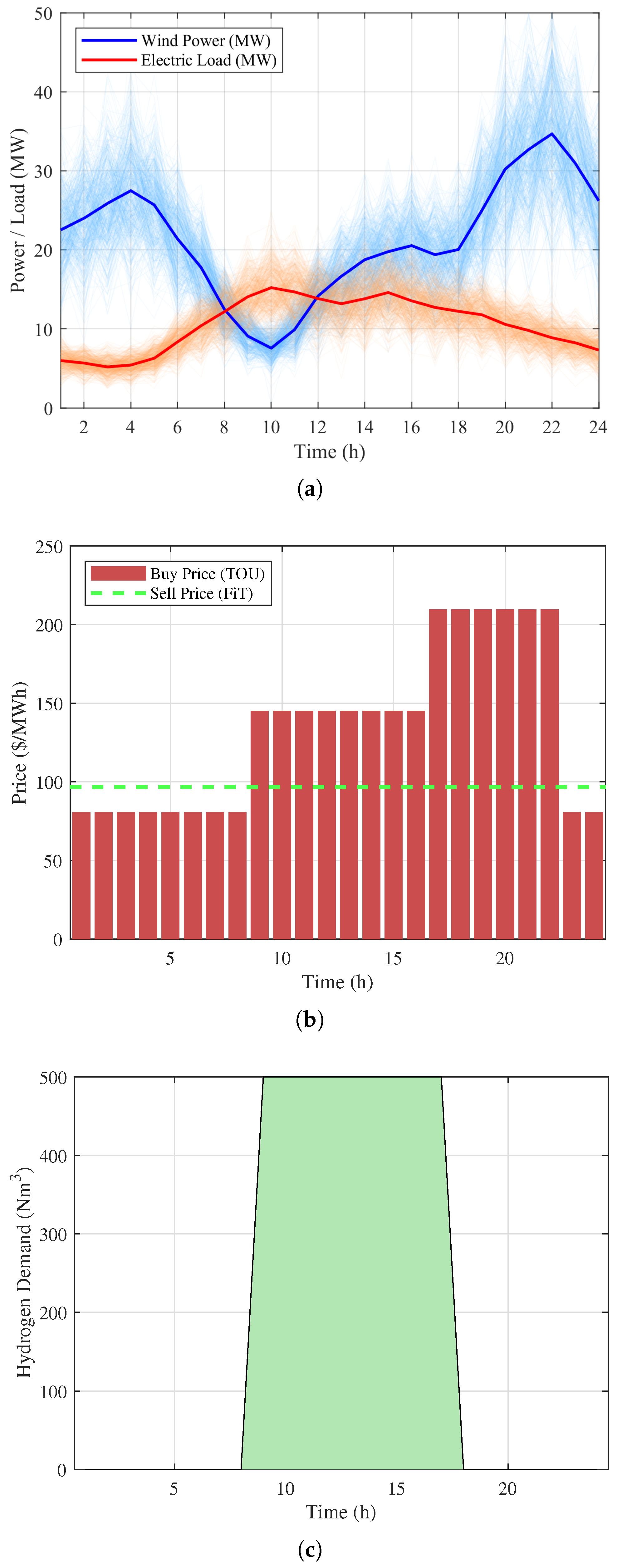
4.1.1. Uncertainty Scenario Generation
4.1.2. Hardware Platform
4.1.3. Benchmark Algorithms
- Algorithm A (Benchmark 1): Gurobi–MonolithicThe traditional “monolithic” approach consolidates the master problem and all N operational sub-problems into a single, integrated Mixed-Integer Non-Linear Programming (MINLP) model and attempts to solve it directly using the Gurobi 12.0 solver.
- Algorithm B (Benchmark 2): MILP-Benders (Reformulation) [20]The “mathematical reformulation” approach attempts to approximate the black-box costs (e.g., step-wise costs) by reformulating them into explicit Mixed-Integer Linear Programming (MILP) constraints (e.g., via Big-M techniques) that are solvable by Gurobi.
- Algorithm C (Benchmark 3): GSOA + Simulation (Exhaustive)The “simulation-based optimization” approach, unlike the proposed framework, does not utilize Benders cuts. Instead, for every fitness evaluation in the master problem, the GSOA performs an exhaustive loop over all N scenarios by calling the subproblem routine to compute the actual operational cost.
- Algorithm D (Benchmark 4): SFOA-Benders [30]As a comparative heuristic decomposition framework, this approach shares an identical structural architecture with GSOA-Benders but substitutes the master problem solver with the Starfish optimization algorithm (SFOA) [31] to evaluate the impact of the specific heuristic engine.
- Algorithm E (Proposed): GSOA-BendersThis approach comprises the novel hybrid heuristic decomposition framework established in Section 3.
4.2. Experiment I: Explicit Non-Convex Problem ()
4.3. Experiment II: The “Intractable” Black-Box Problem ()
4.3.1. Modeling Infeasibility of Gurobi and MILP Benchmarks
- Intractability of Approximation: To approximate the high-frequency sinusoidal component with sufficient precision, a piecewise linear formulation would require an excessive number of binary variables.
- Fundamental Infeasibility: More critically, if the cost function were a true black box (e.g., a compiled external simulation or a neural network), explicit reformulation would be mathematically impossible, rendering direct application of a conventional explicit solver impossible unless an additional surrogate or approximation layer is introduced.
4.3.2. Computational Intractability of Simulation-Based Optimization
4.3.3. Performance Superiority of the Proposed Framework
- Flexibility: Our black-box solver successfully handled the sinusoidal costs () that Gurobi failed to model natively.
- Efficiency: By utilizing Benders cuts as a dynamic “surrogate model”, our framework completed the optimization task in 35.86 s. This represents a substantial speedup over the estimated 4.86 h required by the “Simulation + Optimization” approach under the same LP-call assumptions. Furthermore, compared to the SFOA-Benders benchmark, the proposed GSOA-Benders achieved a 1.43× speedup.
4.4. Economic Analysis and Insights
4.4.1. Wind Power Dominance vs. Fuel-Cell Viability
- 1.
- Wind Power (): The algorithm identified the construction of the 50 MW wind farm as the primary revenue driver, prioritizing electricity sales to the grid to maximize profit.
- 2.
- Fuel Cell (): Conversely, the solution confirms that the “Power-to-Gas-to-Power” (P2G2P) round-trip energy storage arbitrage is economically unviable under the current cost parameters. The efficiency losses in the hydrogen–electricity conversion loop outweigh the arbitrage revenue. Consequently, the algorithm strictly avoided any capital expenditure on fuel cells.
4.4.2. Strategic Exploitation of Non-Convex Cost Structures ()
- 1.
- Exploiting Local Cost Minima: Unlike simple step-wise costs, the intractable black-box function (incorporating terms) creates specific local minima or “cost valleys”. The algorithm detected that the capacity of MWh coincides with a valley in the sinusoidal cost curve, offering a distinct marginal cost advantage.
- 2.
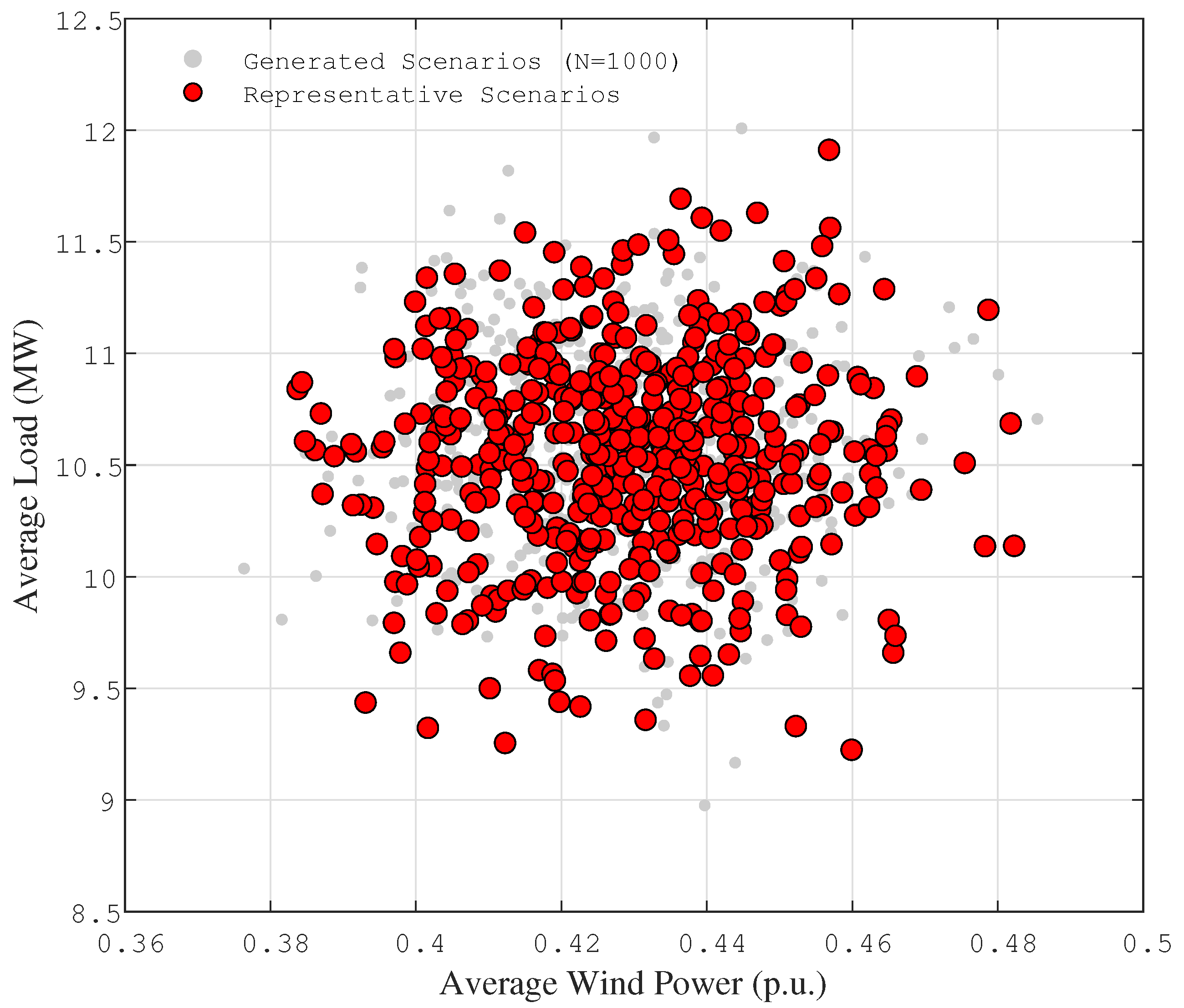
- Balancing Scale and Operational Flexibility: The algorithm determined that at this specific capacity, the benefits of economies of scale (driven by the power term), combined with the provided scenario-based operational flexibility (smoothing fluctuations across 500 scenarios) outweighed the marginal investment cost.
- 3.
- Discovery of Counterintuitive Solutions: This validates a critical capability, i.e., that the GSOA-Benders framework does not merely “accommodate” the complexity of black-box functions; it actively exploits their non-convex characteristics to discover superior, counterintuitive solutions that traditional linear approximations might overlook.
4.5. Operational Dispatch Analysis
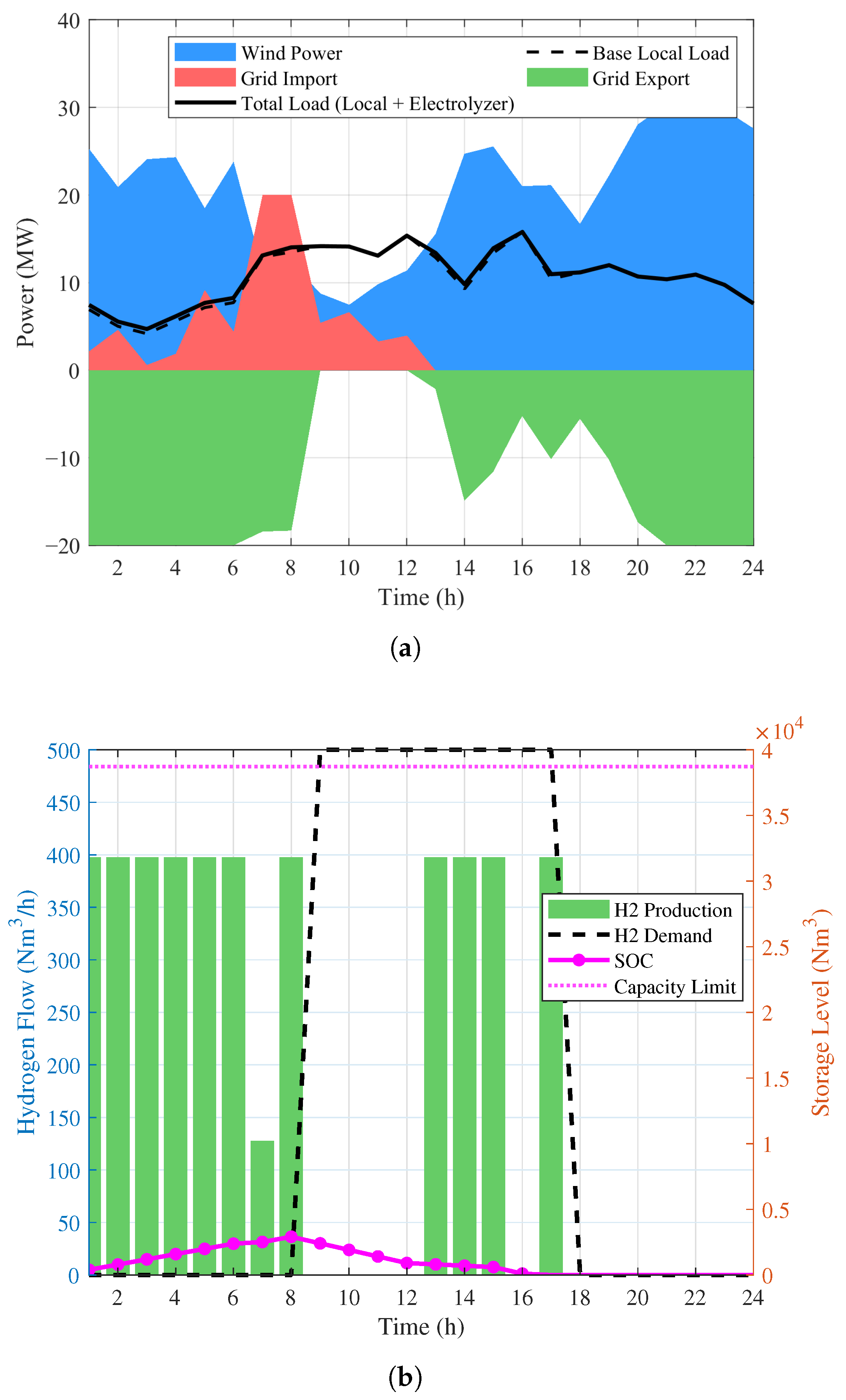
4.5.1. Electricity-Side Operation Analysis
- 1.
- Wind Accommodation and Revenue Generation: The blue region represents wind power generation. During most periods (especially at night and early morning), wind output significantly exceeds the system’s internal load (solid black line). This surplus power is exported to the grid (green region below the X-axis), generating substantial Feed-in Tariff (FiT) revenue. This validates the algorithm’s strategic preference for maximizing wind power investment in Stage I.
- 2.
- Price-Responsive Electrolyzer Scheduling: Observing the deviation between the total load (solid black line) and the base load (dashed black line), it is evident that electrolyzer operation is concentrated in the 00:00–08:00 and 22:00–24:00 intervals. This strategy is economically driven. The algorithm identifies these windows as having both abundant wind resources and off-peak electricity prices, making them the most cost-effective periods for hydrogen production.
- 3.
- Strategic Grid Imports (Pre-charging): Notably, during intervals such as 07:00–09:00, significant grid power purchases (red region) occur despite the presence of wind generation. This is because the electrolyzer maintains high-power operation to accumulate sufficient hydrogen reserves before the onset of high-price periods. Consequently, the total load temporarily exceeds wind output. This strategy of “purchasing power to store hydrogen” (strategic pre-charging) while increasing instantaneous costs avoids the necessity of producing hydrogen during peak-price hours or incurring penalty costs for shortages later in the day, thereby achieving global optimality over the daily horizon.
4.5.2. Hydrogen-Side Operation Analysis
- 1.
- Temporal Supply–Demand Mismatch: Hydrogen production (green bars) is concentrated at night, whereas the hydrogen demand (black dashed line) is rigidly distributed during daytime working hours (09:00–17:00). This creates a significant temporal mismatch between supply and demand.
- 2.
- Buffering Role of Storage Tank: The pink line represents the State of Charge (SoC) of the hydrogen tank, illustrating four distinct phases:
- Charging Phase (00:00–08:00): As the electrolyzer runs at full capacity, the SoC rises continuously, converting surplus wind energy into stored hydrogen.
- Standby Phase (08:00–09:00): Hydrogen production ceases. The SoC remains high, effectively “standing by” for the upcoming peak demand.
- Discharging Phase (09:00–17:00): During the rigid demand window, the electrolyzer shuts down to avoid high electricity prices. The system relies entirely on the storage tank to satisfy demand. Consequently, the SoC curve exhibits a near-linear depletion trajectory.
- Depletion Phase (17:00–18:00): By the time demand ends, the SoC drops to near-zero levels.
- 3.
- High-Capacity Utilization: It is noteworthy that the peak SoC reaches approximately Nm3 (corresponding to roughly 23 MWh), which aligns precisely with the investment decision derived in Stage I. This confirms that the algorithm not only calculated the optimal capacity but also fully utilized this capacity in the actual operational dispatch, leaving no redundant investment.
4.6. Sensitivity, Scalability Boundary, and Environmental Extension
4.6.1. Project Lifetime Sensitivity
4.6.2. Scalability Boundary
4.6.3. Emission-Reduction Extension
5. Conclusions
- 1.
- Structural Limitations of Monolithic Solvers: While commercial solvers like Gurobi demonstrate exceptional speed (solving explicit scenarios in 36 s) for mathematically well-posed MINLP problems, they exhibit formulation rigidity. They are not intended to directly process “implicit”, “non-analytical”, and externally evaluated black-box cost functions unless an additional reformulation, approximation, or surrogate layer is introduced.
- 2.
- Flexibility and Decomposition Efficiency of GSOA-Benders: By decoupling the implicit black-box master problem from the explicit scenario subproblems, the proposed framework handles a class of problems where direct gradient-based or exact algebraic modeling is difficult. It serves as a practical bridge between complex engineering cost evaluators and structured mathematical optimization.
- 3.
- Practical Viability: Case studies show that for the tested problem involving scenarios and non-convex black-box cost functions, GSOA-Benders is a viable decision-support tool. It successfully converged within 36 s, identifying a high-quality stochastic investment strategy (yielding a total annualized cost of $243 k), thereby effectively balancing economic efficiency with operational reliability.
Author Contributions
Funding
Data Availability Statement
Acknowledgments
Conflicts of Interest
Appendix A. GSOA Pseudocode
| Algorithm A1 General Soldiers Optimization Algorithm Used in the Master Problem |
|
References
- Gielen, D.; Boshell, F.; Saygin, D.; Bazilian, M.D.; Wagner, N.; Gorini, R. The role of renewable energy in the global energy transformation. Energy Strategy Rev. 2019, 24, 38–50. [Google Scholar] [CrossRef]
- IRENA. Renewable Energy Statistics 2025; International Renewable Energy Agency: Abu Dhabi, United Arab Emirates, 2025. [Google Scholar]
- IEA. Electrolysers; International Energy Agency: Paris, France, 2024.
- Kroposki, B.; Johnson, B.; Zhang, Y.; Gevorgian, V.; Denholm, P.; Hodge, B.M.; Hannegan, B. Achieving a 100% renewable grid: Operating electric power systems with extremely high levels of variable renewable energy. IEEE Power Energy Mag. 2017, 15, 61–73. [Google Scholar] [CrossRef]
- Clegg, S.; Mancarella, P. Storing renewables in the gas network: Modelling of power-to-gas seasonal storage flexibility in low-carbon power systems. IET Gener. Transm. Distrib. 2016, 10, 566–575. [Google Scholar] [CrossRef]
- Götz, M.; Lefebvre, J.; Mörs, F.; Koch, A.M.; Graf, F.; Bajohr, S.; Reimert, R.; Kolb, T. Renewable Power-to-Gas: A technological and economic review. Renew. Energy 2016, 85, 1371–1390. [Google Scholar] [CrossRef]
- Zhu, R.; Jiang, J.; Sun, J.; Guo, D.; Wei, M.; Zhao, Z. Optimal planning of integrated electricity-natural gas distribution systems with hydrogen enriched compressed natural gas operation. Int. J. Electr. Power Energy Syst. 2024, 161, 110174. [Google Scholar] [CrossRef]
- Davis, S.J.; Lewis, N.S.; Shaner, M.; Aggarwal, S.; Arent, D.; Azevedo, I.L.; Benson, S.M.; Bradley, T.; Brouwer, J.; Chiang, T.-M.; et al. Net-zero emissions energy systems. Science 2018, 360, eaas9793. [Google Scholar] [CrossRef]
- Walawalkar, R.; Apt, J.; Mancini, R. Economics of electric energy storage for energy arbitrage and regulation in New York. Energy Policy 2007, 35, 2558–2568. [Google Scholar] [CrossRef]
- Liu, X.; Wang, Y.; Wei, Z.; Tian, J.; Xiao, G.; Wang, P. Cost and capacity optimization of regional wind-hydrogen integrated energy system. Int. J. Hydrogen Energy 2024, 49, 571–585. [Google Scholar] [CrossRef]
- Pan, G.; Gu, W.; Lu, Y.; Qiu, H.; Lu, S.; Yao, S. Optimal Planning for Electricity-Hydrogen Integrated Energy System Considering Power to Hydrogen and Heat and Seasonal Storage. IEEE Trans. Sustain. Energy 2020, 11, 2662–2676. [Google Scholar] [CrossRef]
- Khodaei, A. Provisional microgrid planning. IEEE Trans. Smart Grid 2017, 8, 1096–1104. [Google Scholar] [CrossRef]
- Zeng, B.; Zhao, L. Solving two-stage robust optimization problems using a column-and-constraint generation method. Oper. Res. Lett. 2013, 41, 457–461. [Google Scholar] [CrossRef]
- Bertsimas, D.; Litvinov, E.; Sun, X.A.; Zhao, J.; Zheng, T. Adaptive robust optimization for the security constrained unit commitment problem. IEEE Trans. Power Syst. 2013, 28, 52–63. [Google Scholar] [CrossRef]
- Wang, C.; Liu, F.; Wang, J.; Wei, W.; Mei, S. Risk-Based Admissibility Assessment of Wind Generation Integrated into a Bulk Power System. IEEE Trans. Sustain. Energy 2016, 7, 325–336. [Google Scholar] [CrossRef]
- Liang, Z.; Chung, C.Y.; Wang, Q.; Chen, H.; Yang, H.; Wu, C. Fortifying renewable-dominant hybrid microgrids: A bi-directional converter based interconnection planning approach. Engineering 2025, 51, 130–143. [Google Scholar] [CrossRef]
- Gurobi Optimization, LLC. Gurobi Optimizer Reference Manual. 2023. Available online: https://www.gurobi.com (accessed on 3 April 2026).
- Chen, X.; Dong, W.; Yang, Q. Robust optimal capacity planning of grid-connected microgrid considering energy management under multi-dimensional uncertainties. Appl. Energy 2022, 323, 119642. [Google Scholar] [CrossRef]
- Vielma, J.P. Mixed integer linear programming formulation techniques. SIAM Rev. 2015, 57, 3–57. [Google Scholar] [CrossRef]
- Belotti, P.; Kirches, C.; Leyffer, S.; Linderoth, J.; Luedtke, J.; Mahajan, A. Mixed-integer nonlinear optimization. Acta Numer. 2013, 22, 1–131. [Google Scholar] [CrossRef]
- Khan, T.; Yu, M.; Waseem, M. Review on recent optimization strategies for hybrid renewable energy system with hydrogen technologies: State of the art, trends and future directions. Int. J. Hydrogen Energy 2022, 47, 25155–25201. [Google Scholar] [CrossRef]
- Kennedy, J.; Eberhart, R. Particle swarm optimization. In Proceedings of the ICNN′95—International Conference on Neural Networks, Perth, Australia, 6 August 2002; Volume 4, pp. 1942–1948. [Google Scholar]
- Mirjalili, S.; Mirjalili, S.M.; Lewis, A. Grey Wolf Optimizer. Adv. Eng. Softw. 2014, 69, 46–61. [Google Scholar] [CrossRef]
- Kaabeche, A.; Belhamel, M.; Ibtiouen, R. Sizing optimization of grid-independent hybrid photovoltaic/wind power generation system. Energy 2011, 36, 1214–1222. [Google Scholar] [CrossRef]
- Audet, C.; Hare, W. Derivative-Free and Blackbox Optimization; Springer: Berlin/Heidelberg, Germany, 2017. [Google Scholar]
- Schmidt, O.; Gambhir, A.; Staffell, I.; Hawkes, A.; Nelson, J.; Few, S. Future cost and performance of water electrolysis: An expert elicitation study. Int. J. Hydrogen Energy 2017, 42, 30470–30492. [Google Scholar] [CrossRef]
- Hu, D.; Fan, Y.; Shao, W. Optimal sizing and operation of microgrid considering renewable energy uncertainty based on scenario generation. J. Energy Storage 2025, 109, 115174. [Google Scholar] [CrossRef]
- U.S. Department of Energy; WINDExchange. Wind Energy End-of-Service Guide. 2025. Available online: https://www.energy.gov/cmei/wind/windexchange/windexchange/wind-energy-end-service-guide (accessed on 27 April 2026).
- Morales, H.; Conejo, A.J.; Liu, K.; Zhong, J. Pricing electricity in pools with wind producers. IEEE Trans. Power Syst. 2012, 27, 1366–1376. [Google Scholar] [CrossRef]
- Shahidehpour, M.; Fu, Y. Benders decomposition. IEEE Power Energy Mag. 2005, 3, 20–25. [Google Scholar] [CrossRef]
- Zhong, C.; Li, G.; Meng, Z.; Li, H.; Yildiz, A.R.; Mirjalili, S. Starfish optimization algorithm (SFOA): A bio-inspired metaheuristic algorithm for global optimization compared with 100 optimizers. Neural Comput. Appl. 2025, 37, 3641–3683. [Google Scholar] [CrossRef]



| Algorithm | Variables/Constraints | Time (s) | Optimal Cost |
|---|---|---|---|
| Gurobi | 240,005/192,000 | 36.58 | −381,058.9 |
| GSOA-Benders | 4/240 | 45.66 | −342,939.52 |
| Algorithm | Solution Status | Time (s) | Cost |
|---|---|---|---|
| A | Direct exact solve unavailable | 0.00 | (N/A) |
| B | Direct exact solve unavailable | 0.00 | (N/A) |
| C | Failed (Timeout) | >17,500 | (N/A) |
| D | Successfully Converged | 51.15 | −242,940.18 |
| E | Successfully Converged | 35.86 | −242,940.18 |
| Parameter/Lifetime | 10 Years | 20 Years | 30 Years |
|---|---|---|---|
| Straight-line factor (1/L) | 0.100 | 0.050 | 0.033 |
| CRF () | 0.149 | 0.102 | 0.089 |
| Interpretation | Conservative recovery | Typical asset | Wind-life extension |
Disclaimer/Publisher’s Note: The statements, opinions and data contained in all publications are solely those of the individual author(s) and contributor(s) and not of MDPI and/or the editor(s). MDPI and/or the editor(s) disclaim responsibility for any injury to people or property resulting from any ideas, methods, instructions or products referred to in the content. |
© 2026 by the authors. Licensee MDPI, Basel, Switzerland. This article is an open access article distributed under the terms and conditions of the Creative Commons Attribution (CC BY) license.
Share and Cite
Xiong, H.; Feng, B.; Yan, F.; Kang, Y.; Hu, Y.; Li, Q.; Tan, Q. A Hybrid Heuristic–Benders Method for Wind–Hydrogen Investment Planning with Non-Analytical Cost Functions. Energies 2026, 19, 2172. https://doi.org/10.3390/en19092172
Xiong H, Feng B, Yan F, Kang Y, Hu Y, Li Q, Tan Q. A Hybrid Heuristic–Benders Method for Wind–Hydrogen Investment Planning with Non-Analytical Cost Functions. Energies. 2026; 19(9):2172. https://doi.org/10.3390/en19092172
Chicago/Turabian StyleXiong, Haozhe, Bingyang Feng, Fangbin Yan, Yiqun Kang, Yuxuan Hu, Qiangsheng Li, and Qinyue Tan. 2026. "A Hybrid Heuristic–Benders Method for Wind–Hydrogen Investment Planning with Non-Analytical Cost Functions" Energies 19, no. 9: 2172. https://doi.org/10.3390/en19092172
APA StyleXiong, H., Feng, B., Yan, F., Kang, Y., Hu, Y., Li, Q., & Tan, Q. (2026). A Hybrid Heuristic–Benders Method for Wind–Hydrogen Investment Planning with Non-Analytical Cost Functions. Energies, 19(9), 2172. https://doi.org/10.3390/en19092172