Experimental Study and Performance Analysis of a Li-Br Single-Effect/Two-Stage Hybrid Absorption Chiller


Abstract
1. Introduction
2. Chiller Description
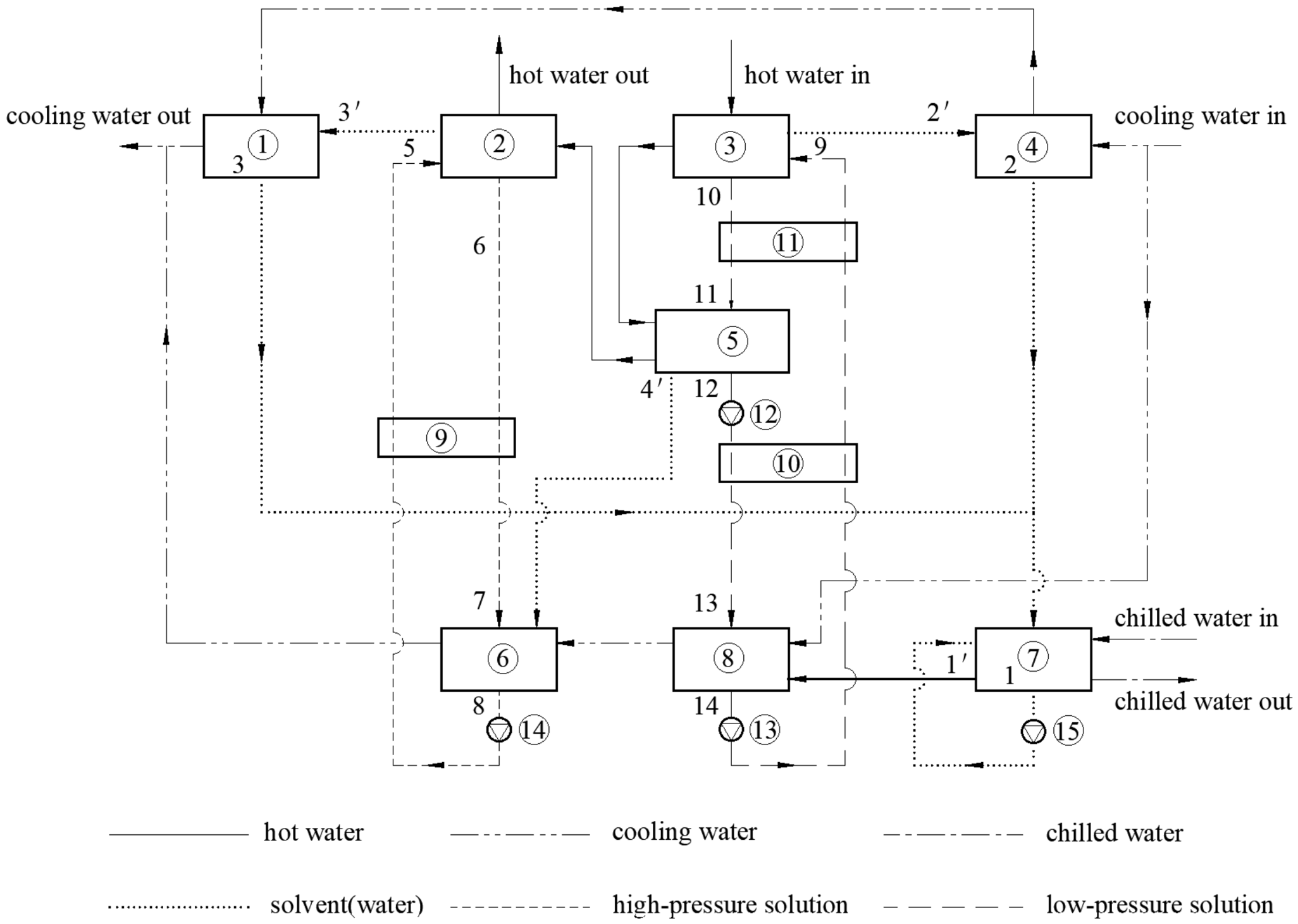
2.1. Configuration Design
2.2. Fluid Circulation
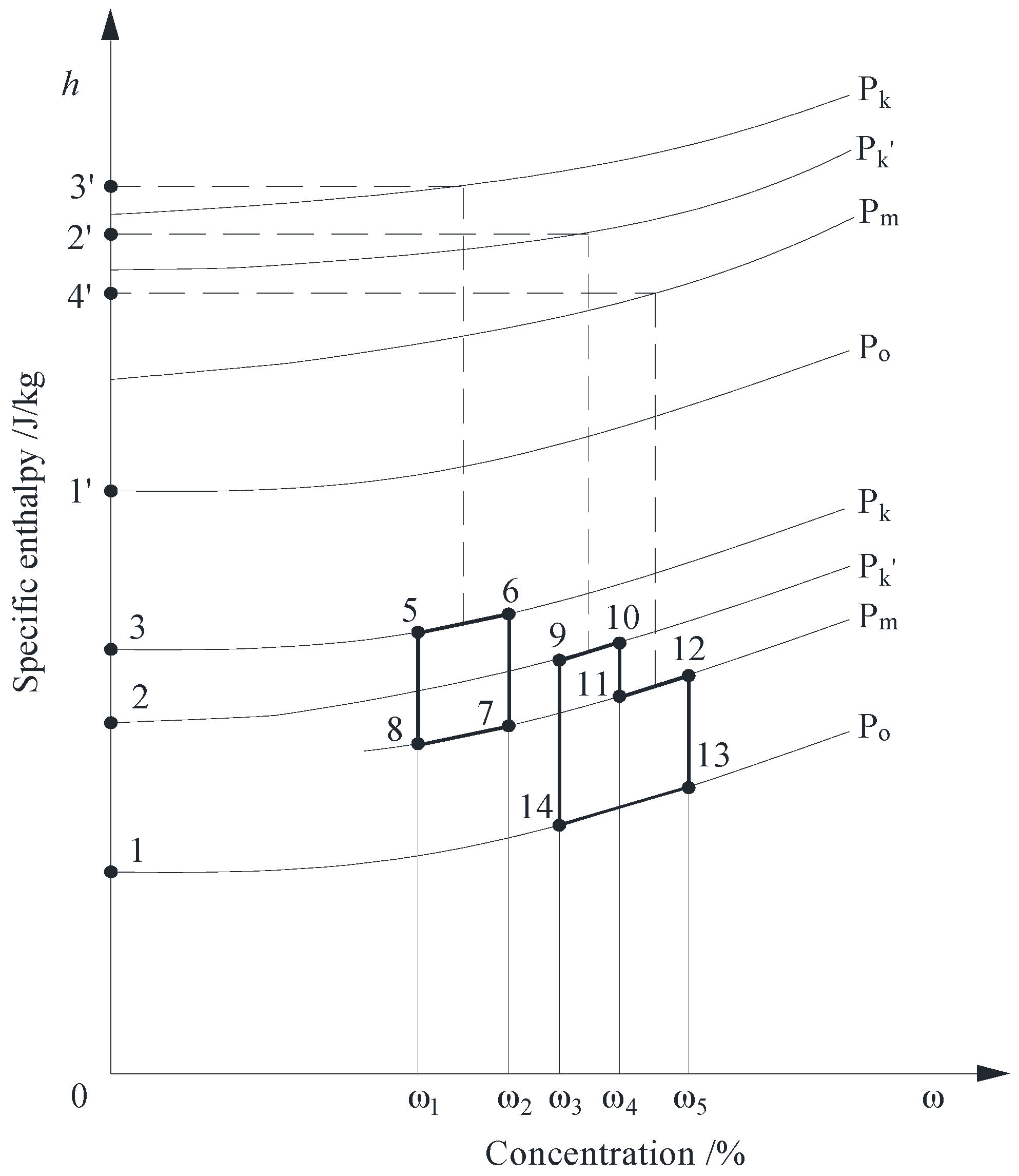
2.3. Refrigeration Cycle and State Parameters
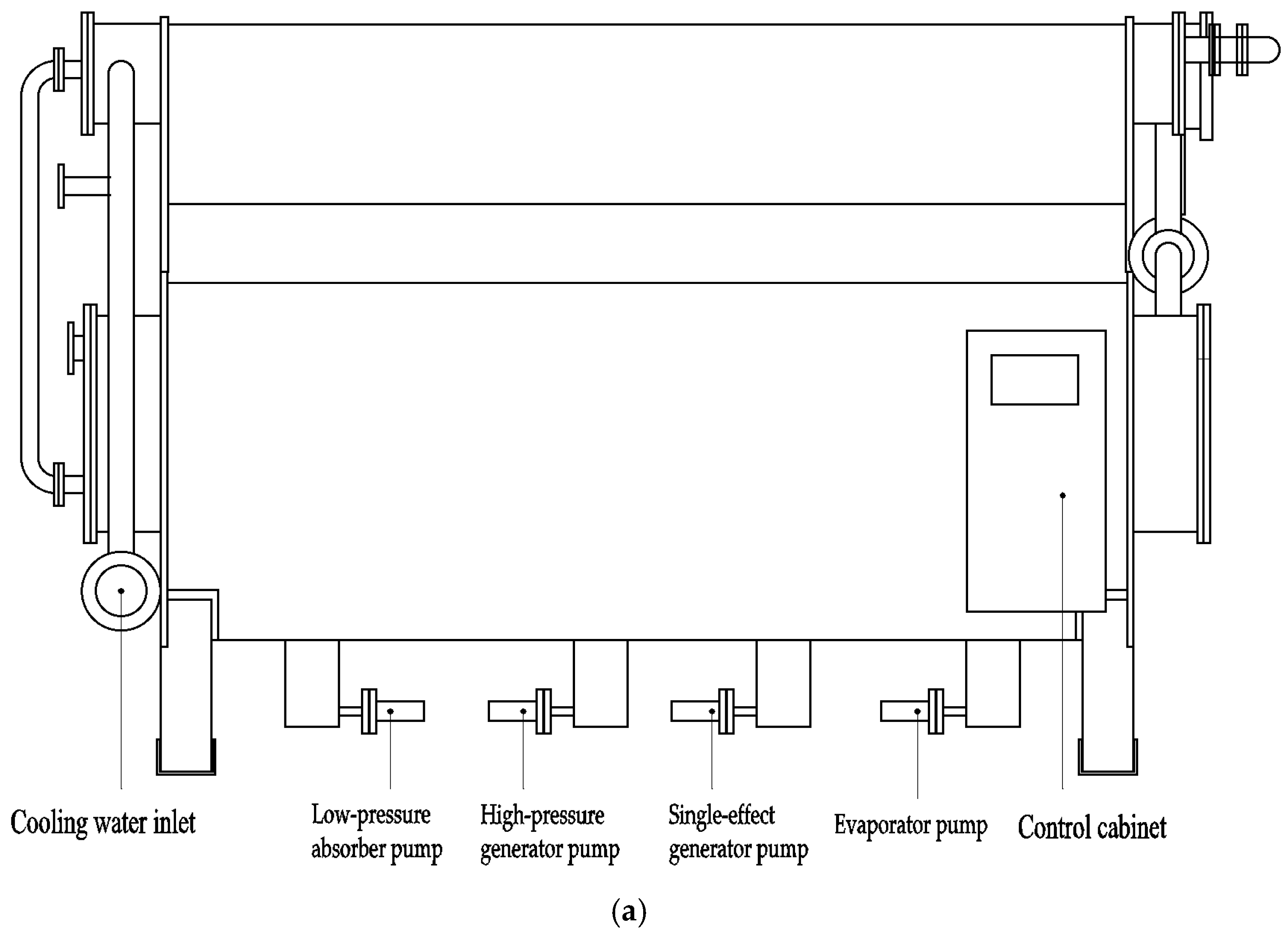
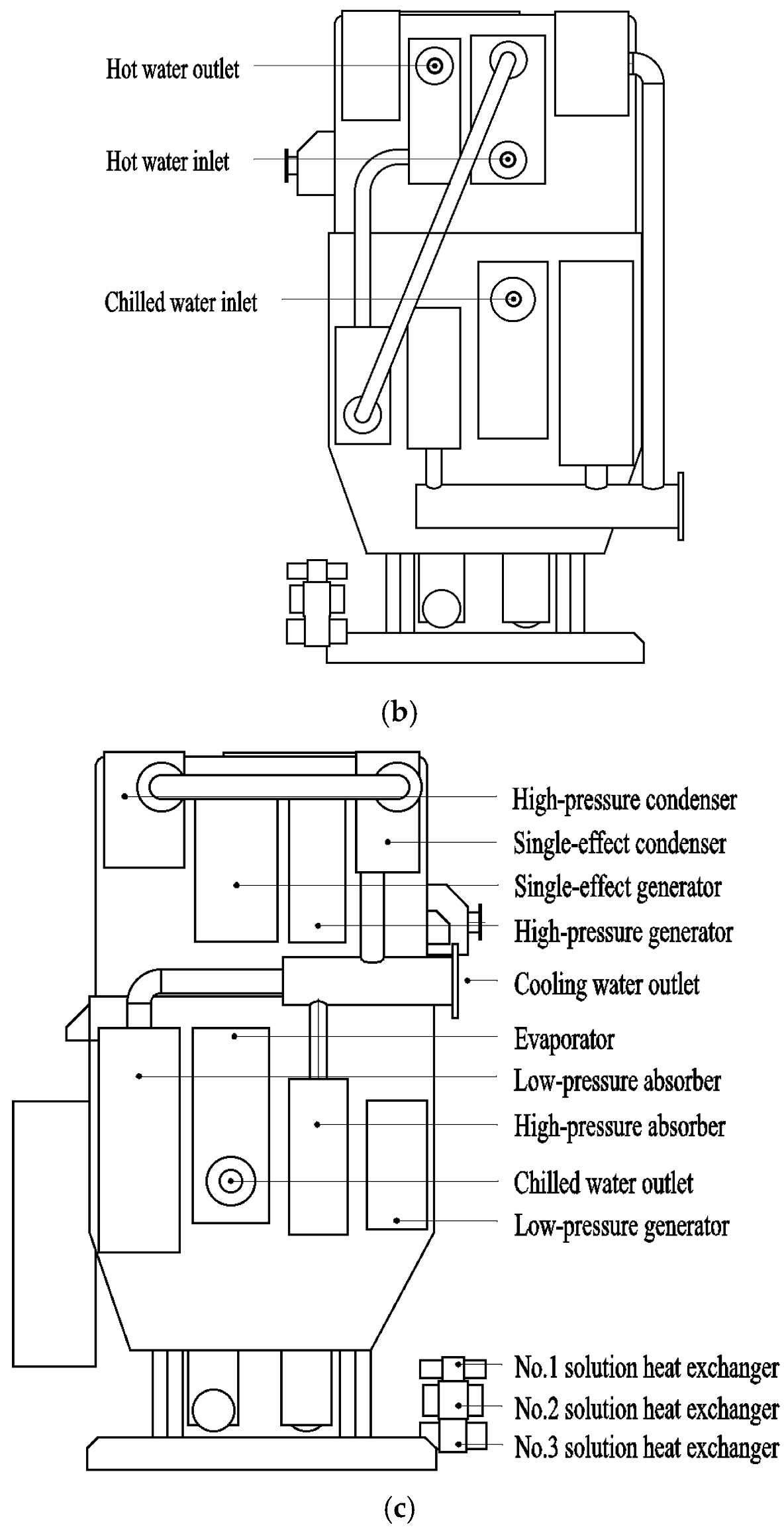
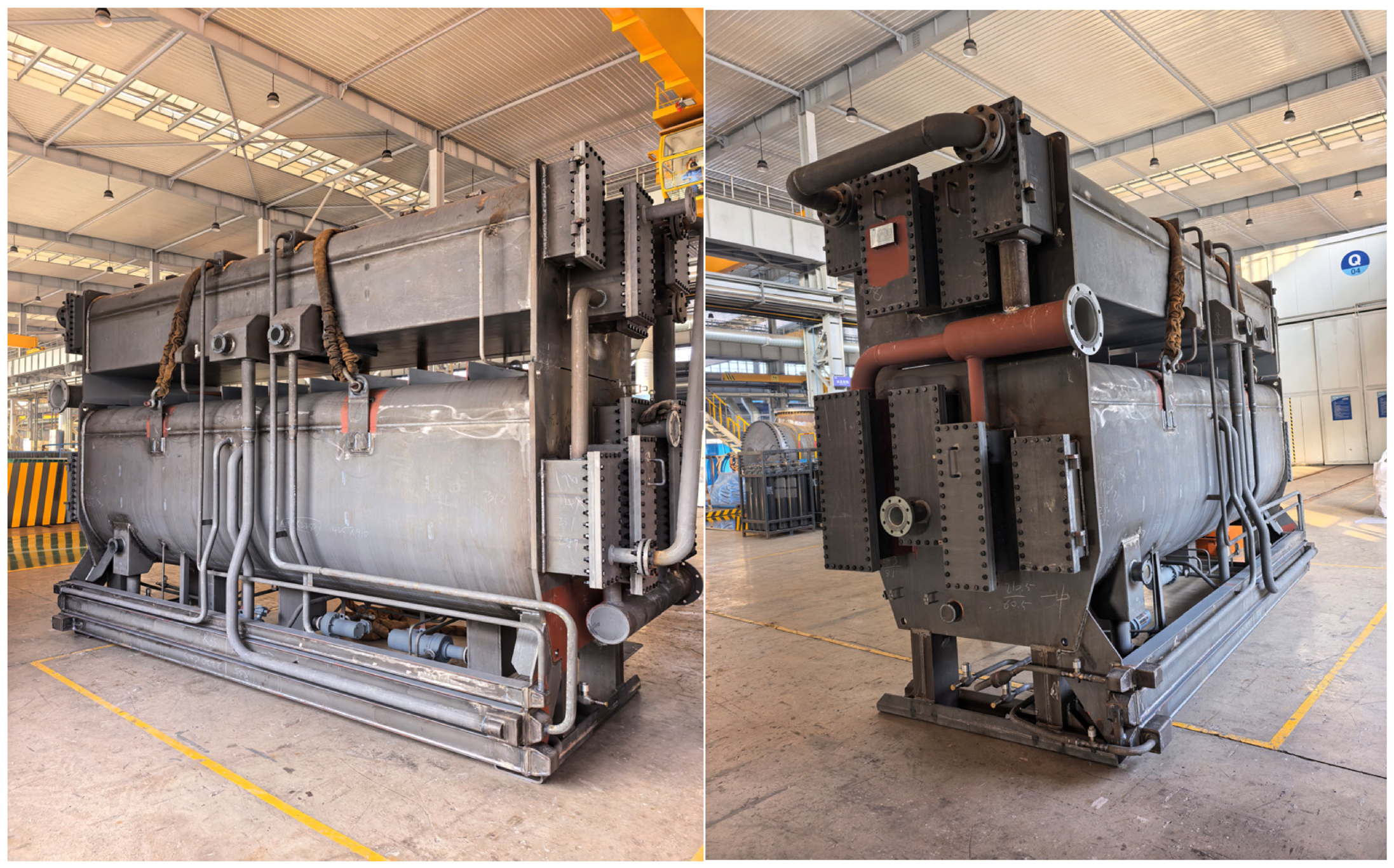
2.4. Structure and Design Parameters
3. Numerical Simulation
3.1. Governing Equations
- The working medium (Li-Br solution or water/steam) at each state point is in thermodynamic equilibrium, with uniform temperature and pressure.
- The system operates under steady-state conditions; all parameters (temperature, pressure, flow rate, concentration) are invariant with time.
- All heat exchange equipment and pipelines are assumed to have no heat loss.
- There is no pressure loss within pipelines, valves, or heat exchangers. The throttling process is considered isenthalpic.
- The heat transfer capacity of each heat exchanger can be evaluated using the lumped parameter method. Heat is transferred only in the radial direction within each heat exchanger, with no heat conduction along the flow direction.
- The working fluid in the evaporation, condensation, generation, and absorption processes is always in a saturated state.
- High-pressure generator
- (1)
- Total mass conservation equation:
- (2)
- Lithium bromide mass conservation equation:
- (3)
- Energy conservation equation:
- (4)
- Calculation equation of heat exchange at hot-water side:
- 2.
- High-pressure condenser
- (1)
- Mass conservation equation:
- (2)
- Energy conservation equation:
- (3)
- Calculation equation of heat exchange at cooling-water side:
- 3.
- Single-effect generator
- (1)
- Total mass conservation equation:
- (2)
- Lithium bromide mass conservation equation:
- (3)
- Energy conservation equation:
- (4)
- Calculation equation of heat exchange at hot-water side:
- 4.
- Single-effect condenser
- (1)
- Mass conservation equation:
- (2)
- Energy conservation equation:
- (3)
- Calculation equation of heat exchange at cooling-water side:
- 5.
- High-pressure absorber
- (1)
- Total mass conservation equation:
- (2)
- Lithium bromide mass conservation equation:
- (3)
- Energy conservation equation:
- (4)
- Calculation equation of heat exchange at cooling-water side:
- 6.
- Low-pressure generator
- (1)
- Total mass conservation equation:
- (2)
- Lithium bromide mass conservation equation:
- (3)
- Energy conservation equation:
- (4)
- Calculation equation of heat exchange at hot-water side:
- 7.
- Low-pressure absorber
- (1)
- Total mass conservation equation:
- (2)
- Lithium bromide mass conservation equation:
- (3)
- Energy conservation equation:
- (4)
- Calculation equation of heat exchange at hot-water side:
- 8.
- Evaporator
- (1)
- Mass conservation equation:
- (2)
- Energy conservation equation:
- (3)
- Calculation equation of heat exchange at cooling-water side:
- 9.
- No. 1 solution heat exchanger
- (1)
- Energy conservation equation:
- (2)
- Calculation equation of heat exchange
- 10.
- No. 2 solution heat exchanger
- (1)
- Energy conservation equation:
- (2)
- Calculation equation of heat exchange
- 11.
- No. 3 solution heat exchanger
- (1)
- Energy conservation equation:
- (2)
- Calculation equation of heat exchange
- High-pressure generator pump
- 2.
- Single-effect generator pump
- 3.
- Low-absorber pump
- 4.
- Evaporator pump
3.2. Mathematical Model
- System global variable vector
- 2.
- Residual equation
- The equations of each component are converted into the form of residual equation as follows:
- Therefore, the residual equations corresponding to the above independent variables are established
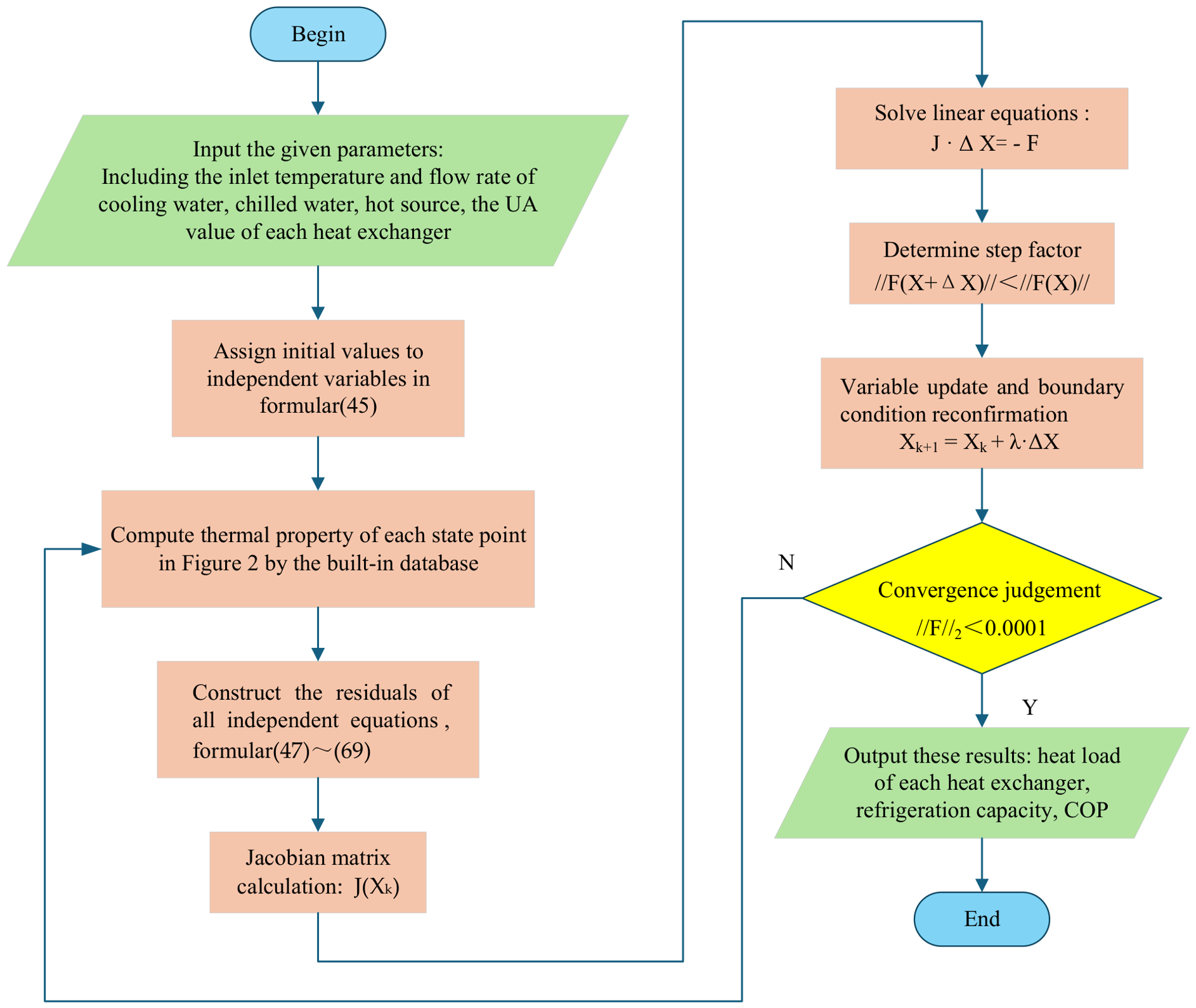
3.3. Program Flow
4. Performance Testing
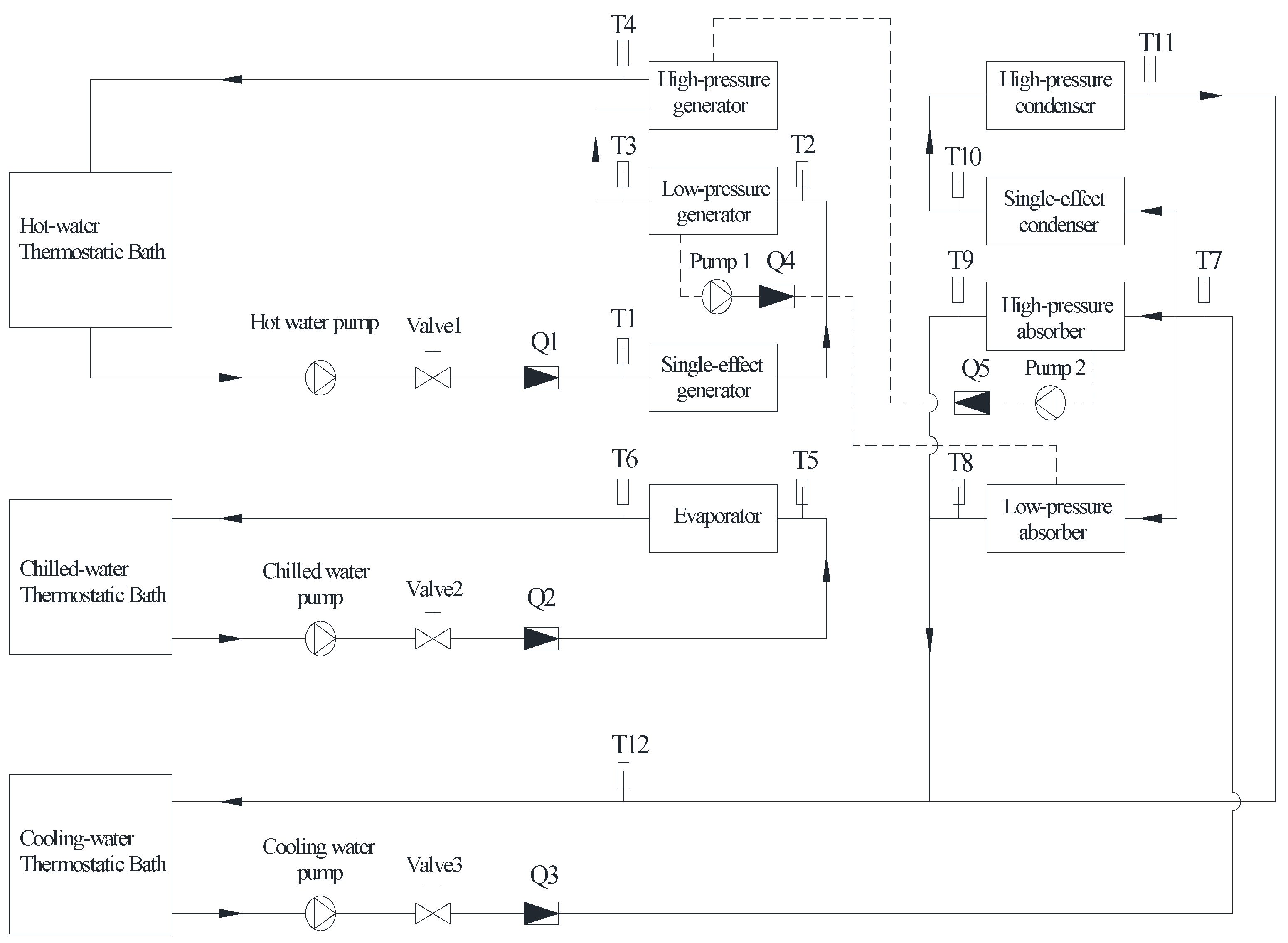
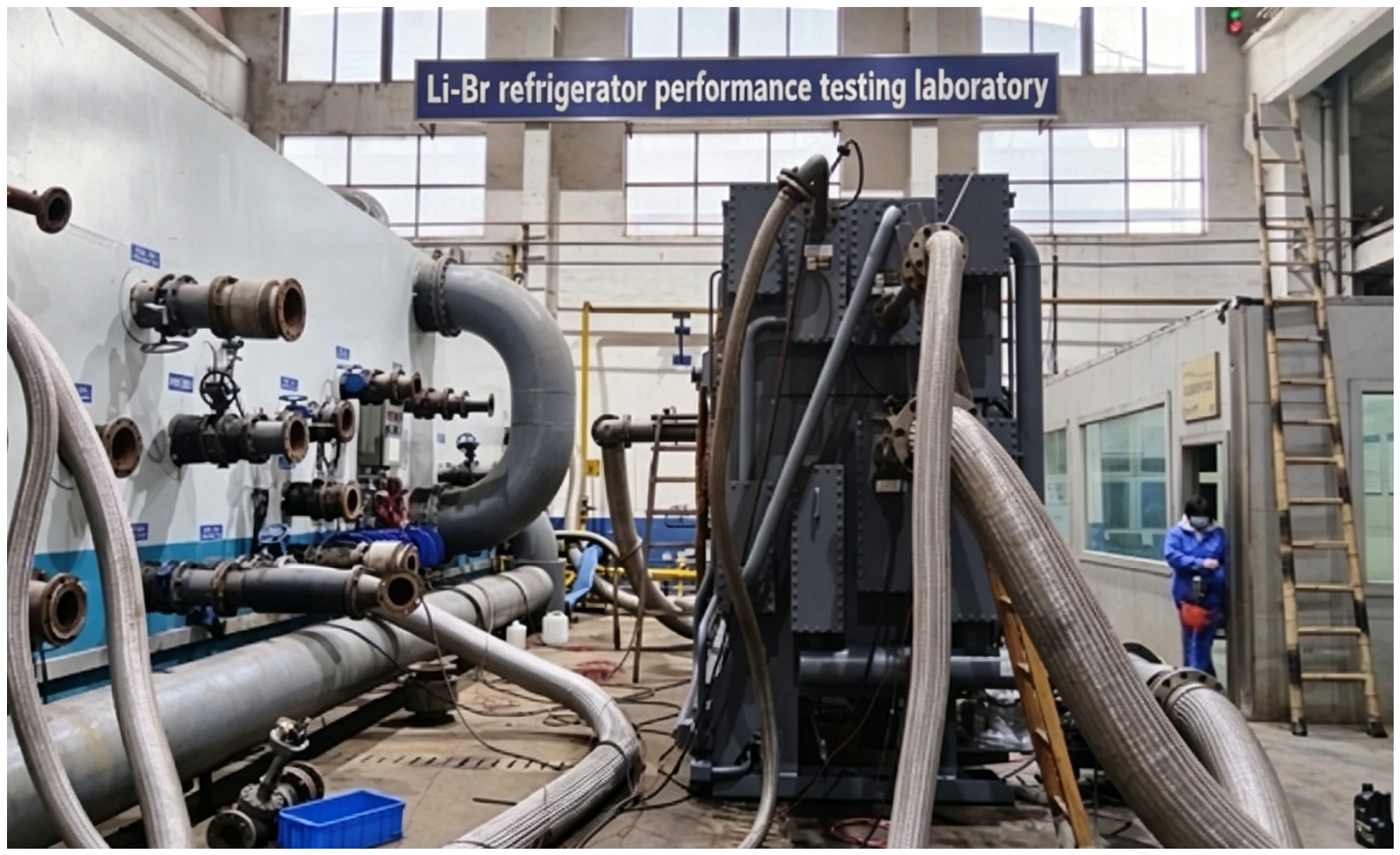
4.1. Testing Setup
4.2. Calculation Method
- 1.
- Heating loadwhere Wheat is the heating load provided by the hot water, kW; q1 is the mass flow rate of hot water, kg/s; t1 is the inlet temperature of hot water, °C; t4 is the outlet temperature of hot water, °C; Cw is the specific heat of water, taken as 4.2 kJ/(kg·°C).
- 2.
- Refrigeration capacitywhere Wrefri is the refrigeration capacity provided by the chilled water, kW; q2 is the mass flow rate of chilled water, kg/s; t5 is the inlet temperature of chilled water, °C; t6 is the outlet temperature of chilled water, °C.
- 3.
- Heat dissipation capacitywhere Wdissi is the heat dissipation capacity provided by the cooling water, kW; q3 is the mass flow rate of cooling water, kg/s; t7 is the inlet temperature of cooling water, °C; t12 is the total return water temperature of cooling water, °C.
- 4.
- Coefficient of performance
- 5.
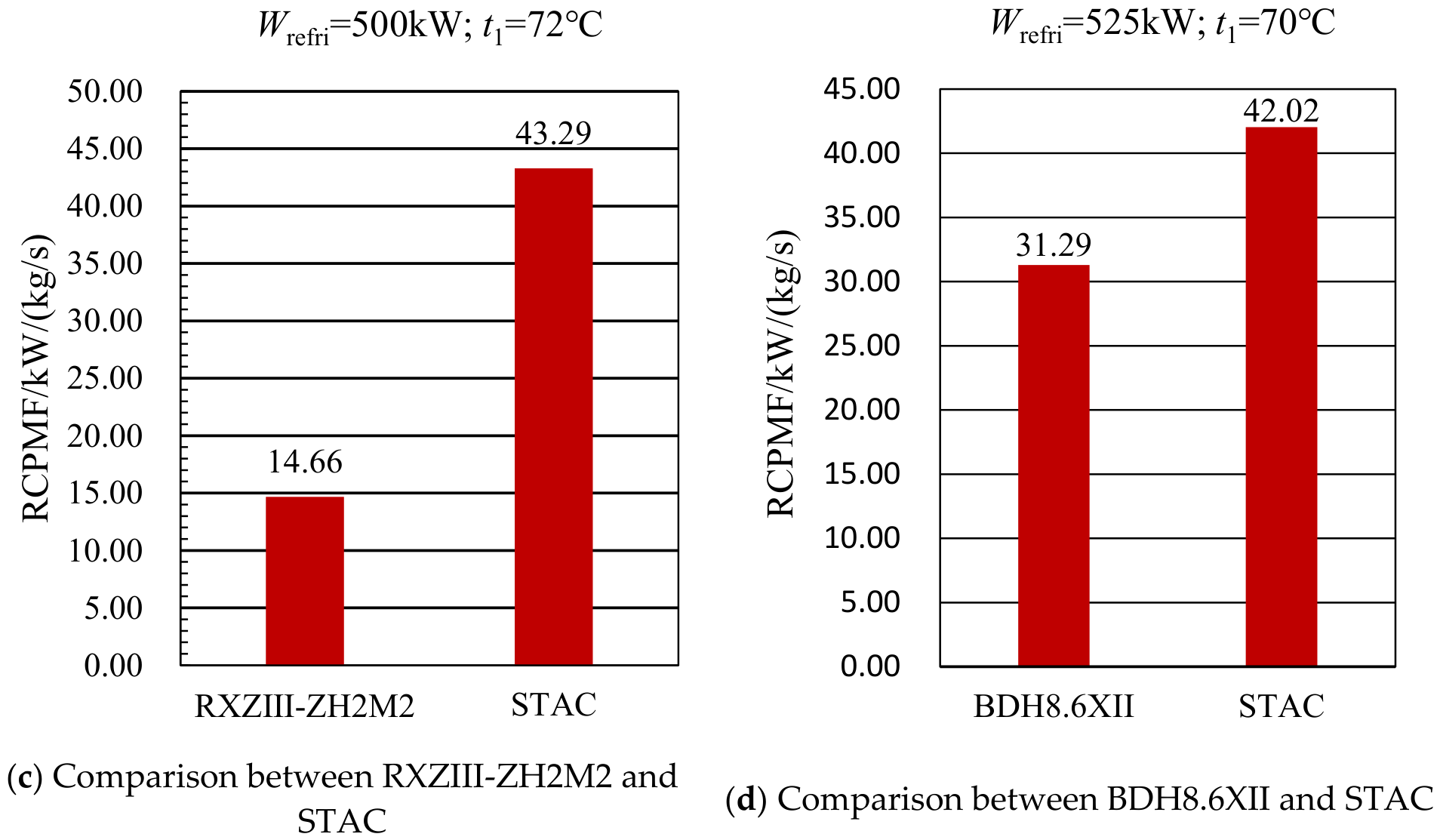
- Refrigeration capacity per unit mass flow
4.3. Measurement Uncertainty
4.4. Testing Results and Model Validation
5. Results and Discussion
5.1. Research on Refrigeration Performance Under Varying Operating Conditions
5.2. Water-Saving Properties Analysis
6. Conclusions
- The design temperature difference between the inlet and outlet of the hot water for the STAC is 30 °C (90 °C to 60 °C). This temperature difference can be extended to 70 °C (120 °C to 50 °C) when the hot-water flow rate is reduced and the inlet hot-water temperature is increased. Increasing the temperature difference between the inlet and outlet of the hot water enhances water conservation.
- The design inlet temperature of hot water for the STAC is 90 °C. The chiller remains operational even when the inlet hot-water temperature drops to 70 °C. Under this condition, the temperature difference between the inlet and outlet of the hot water is 10 °C (70 °C to 60 °C)
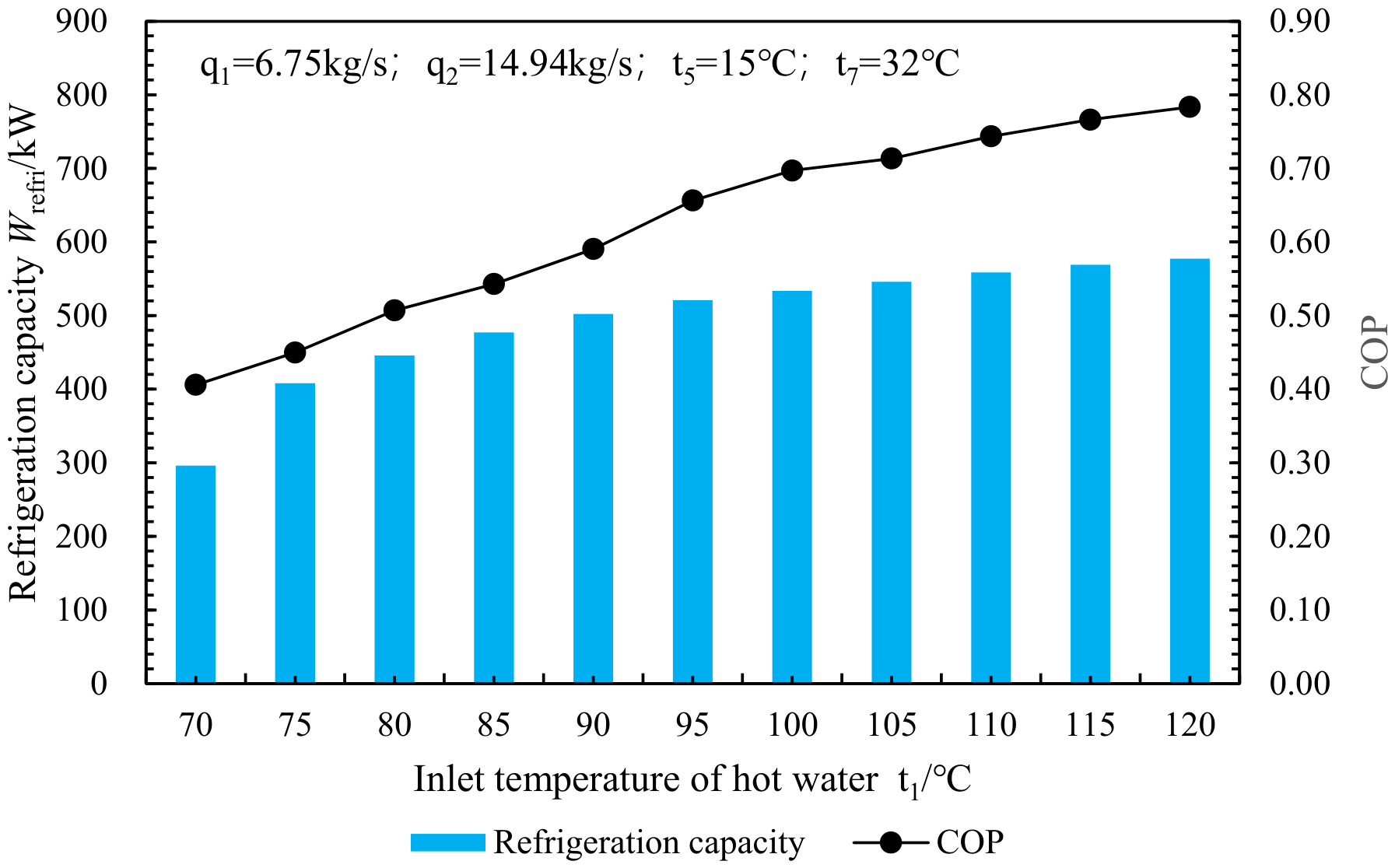
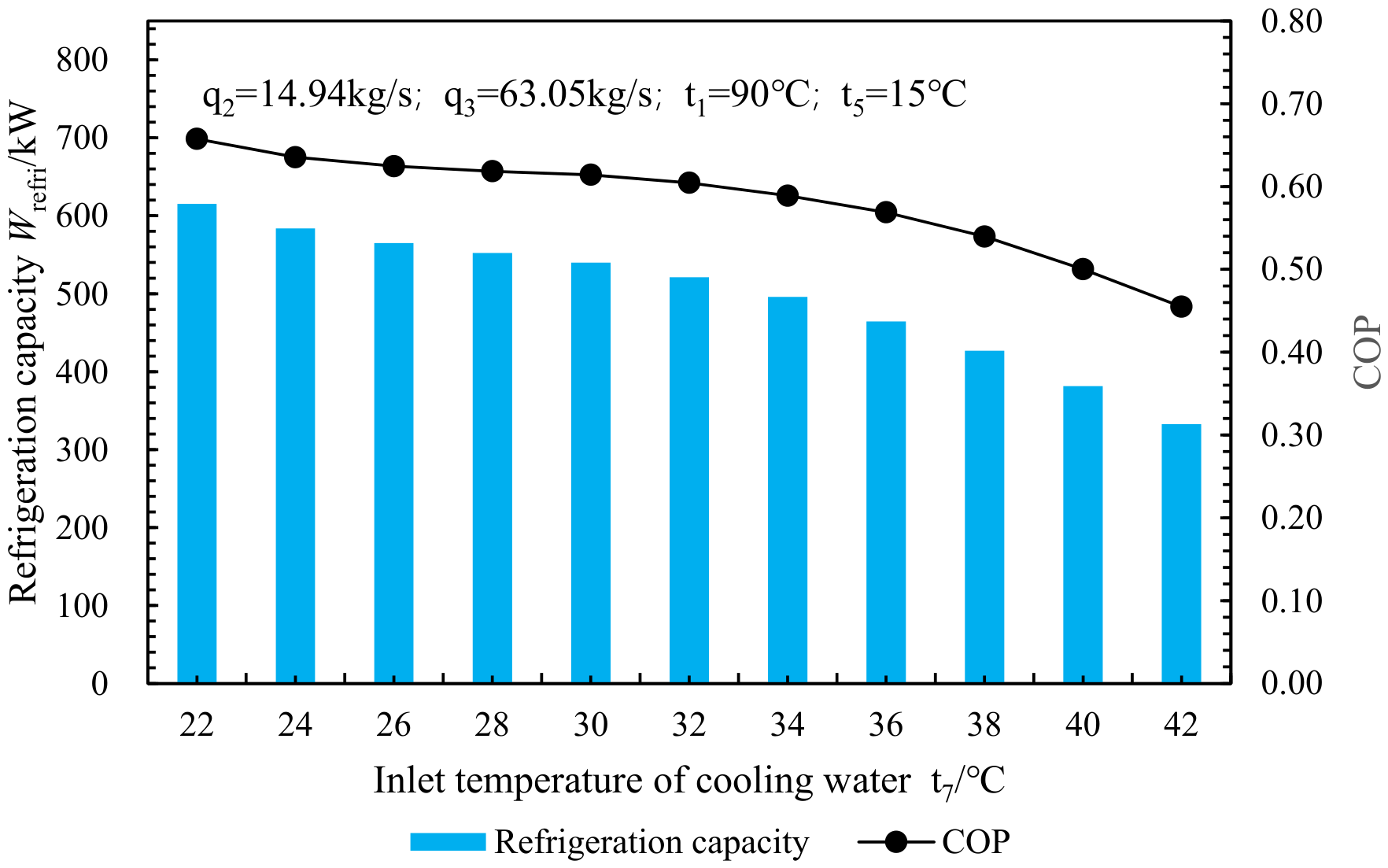
- Both the refrigeration capacity and the COP of the STAC increase with rising hot-water inlet temperature. When the hot-water inlet temperature increases from 70 °C to 120 °C, the refrigeration capacity increases from 296 kW to 577 kW, and the COP rises from 0.41 to 0.78. Conversely, the refrigeration capacity and COP exhibit a negative correlation with the cooling-water inlet temperature. As the cooling-water inlet temperature increases from 22 °C to 42 °C, the refrigeration capacity decreases from 615 kW to 333 kW, and the COP drops from 0.66 to 0.45.
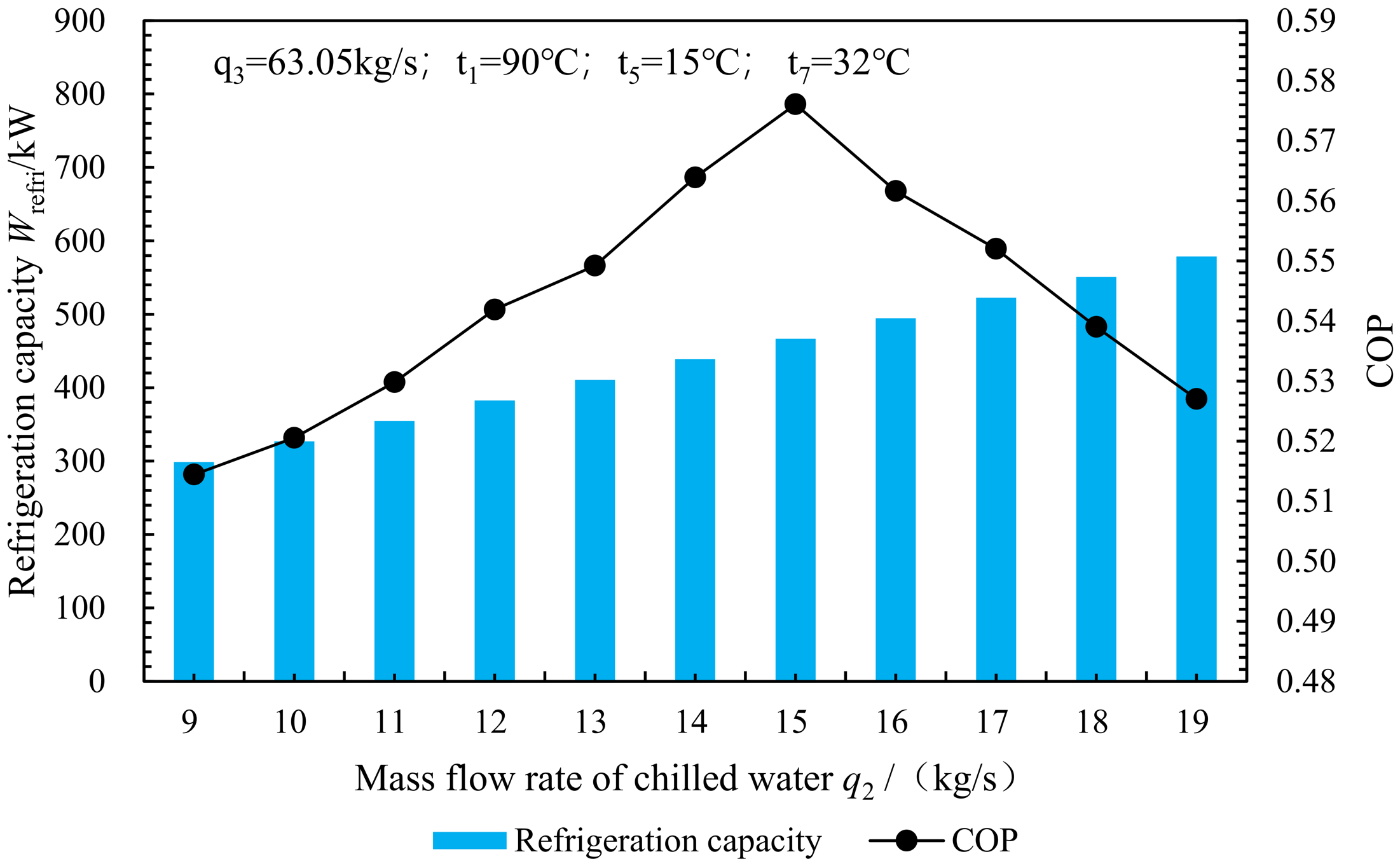
- As the chilled-water mass flow rate increases from 9 kg/s to 19 kg/s, the refrigeration capacity increases from 299 kW to 579 kW, while the COP initially rises from 0.51 to 0.58 (reaching a peak at 15 kg/s) and then decreases from 0.58 to 0.53.
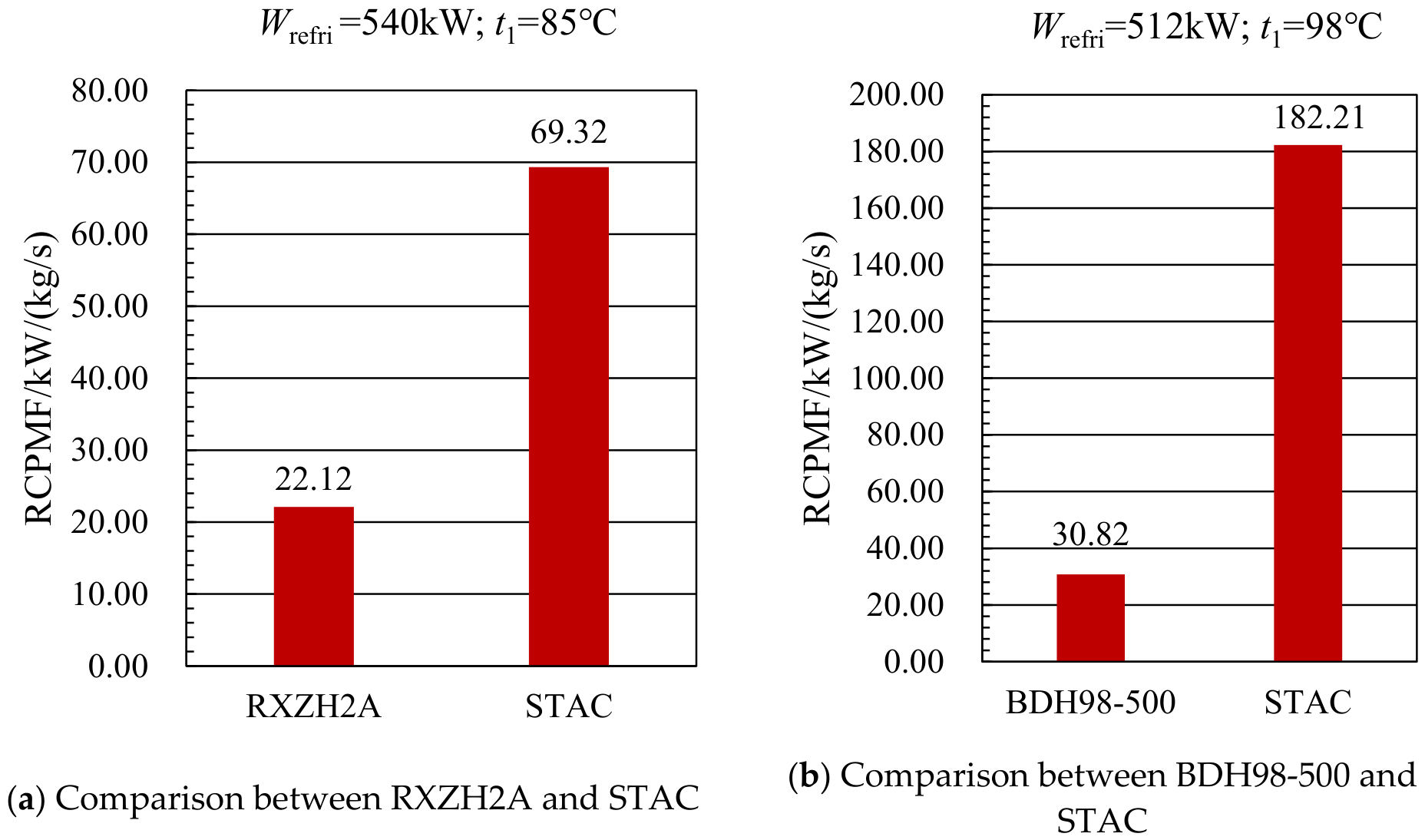
- Under the same refrigeration capacity and hot-water inlet temperature, the RCPMF values of the STAC are substantially higher than those of single-effect and two-stage refrigerators. Specifically, the RCPMF values of the STAC range from 134% to 591% of those of current commercial products, demonstrating that the STAC exhibits excellent water-saving performance.
Author Contributions
Funding
Data Availability Statement
Acknowledgments
Conflicts of Interest
Nomenclature
| Abbreviations | |
| AR | Adsorption refrigeration |
| COP | Coefficient of performance |
| DSAC | Double-section absorption cycle |
| SEAC | Single-effect absorption cycle |
| STAC | Single-effect/two-stage coupled Li-Br absorption chiller |
| TSAC | Two-stage absorption cycle |
| Symbols | |
| A | heat transfer area (m2) |
| c | isobaric specific heat (kJ/ (kg·°C)) |
| %e | percent error (%) |
| f | circulation ratio |
| g | gravitational acceleration (m/s2) |
| h | specific enthalpy (kJ/kg) |
| H | height difference (m) |
| K | Heat transfer coefficient (kW/(m2·°C)) |
| mass flow rate in computer program (kg/s) | |
| P | pressure (Pa) |
| q | mass flow rate measured by flowmeter (kg/s) |
| Q | heat exchange (kW) |
| RCPMF | refrigeration capacity per unit mass flow (kw/ (kg/s)) |
| T | Temperature (°C) |
| ΔT | temperature difference (°C) |
| W | capacity (kW) |
| ω | concentration (%) |
| ρ | density (kg/m3) |
| η | coefficient of performance in computer program |
| Subscripts | |
| cold | Low temperature solution flow channel |
| dissi | heat dissipation |
| E | evaporator |
| heat | heat-supply |
| HA | high-pressure absorber |
| HC | high-pressure condenser |
| HE1 | No. 1 solution heat exchanger |
| HE2 | No. 2 solution heat exchanger |
| HE3 | No. 3 solution heat exchanger |
| HG | high-pressure generator |
| in | inlet |
| k | high-pressure condensation |
| k′ | single-effect condensation |
| l | Liquid of solvent |
| log | logarithmic mean |
| LA | low-pressure absorber |
| m | high-pressure absorption |
| o | evaporation |
| out | outlet |
| pump | pump |
| refri | refrigeration |
| s | Li-Br solution |
| SC | single-effect condenser |
| SG | single-effect generator |
| v | vapor of solvent |
| w | water of external supply |
| - | From one position to another position |
References
- Luberti, M.; Gowans, R.; Finn, P.; Santori, G. An estimate of the ultralow waste heat available in the European Union. Energy 2022, 238, 121967. [Google Scholar] [CrossRef]
- Sohrabi, A.; Liu, S.; Cuce, E.; Shen, Y.; Khan, S.Y.; Kumar, M. Utilization of low-grade thermal energy for residential applications: A review of the existing and potential technologies. Renew. Sustain. Energy Rev. 2025, 219, 115832. [Google Scholar] [CrossRef]
- Maryami, R.; Dehghan, A.A. An exergy based comparative study between LiBr/water absorption refrigeration systems from half effect to triple effect. Appl. Therm. Eng. 2017, 124, 103–123. [Google Scholar] [CrossRef]
- Chen, B.B.; Fang, C.H.; Xiong, B.; Lu, Z.N.; Yao, Y. Experimental Study on Variable Operating Characteristics of Two-Stage Absorption Lithium Bromide Refrigeration Chiller. Energies 2026, 19, 401. [Google Scholar] [CrossRef]
- Huang, B.; Leng, C.; Zhao, J. Low carbon optimized scheduling and operation of combined cooling, heating and power generation energy considering uncertainty. Power Syst. Big Data 2025, 28, 1–9. [Google Scholar] [CrossRef]
- Lubis, A.; Giannetti, N.; Alhamid, M.; Saito, K.; Yabase, H. Dynamic analysis of single–double-effect absorption chiller with variable thermal conductance during partial-load operation. Appl. Therm. Eng. 2023, 218, 119424. [Google Scholar] [CrossRef]
- Altamirano, A.; Le Pierrès, N.; Stutz, B. Review of small-capacity single-stage continuous absorption systems operating on binary working fluids for cooling: Theoretical, experimental and commercial cycles. Int. J. Refrig. 2019, 106, 350–373. [Google Scholar] [CrossRef]
- Su, W.; Han, Y.; Liu, Z.; Jin, X.; Liu, Z.; Yang, D.; Zhang, X. Absorption heat pumps for low-grade heat utilization: A comprehensive review on working pairs, classification, system advances and applications. Energy Convers. Manag. 2024, 315, 118760. [Google Scholar] [CrossRef]
- Beniwal, R.; Garg, K.; Tyagi, H. Thermodynamics analysis of a novel absorption heat transformer-driven combined refrigeration and desalination system. Energy Convers. Manag. 2023, 277, 116597. [Google Scholar] [CrossRef]
- Liu, Z.; Lu, D.; Shen, T.; Guo, H.; Bai, Y.; Wang, L.; Gong, M. New configurations of absorption heat transformer and refrigeration combined system for low-temperature cooling driven by low-grade heat. Appl. Therm. Eng. 2023, 228, 120567. [Google Scholar] [CrossRef]
- Rodríguez-Muñoz, J.L.; Ramírez-Minguela, J.J.; Ituna-Yudonago, J.F.; González-Hernández, I.J. Performance improvement by rectifier heat integration in an alternative absorption-compression hybrid refrigeration system. Appl. Therm. Eng. 2025, 277, 127139. [Google Scholar] [CrossRef]
- Zhang, Z.; Li, Z.; Chen, H. Parametric study of absorption-compression hybrid refrigeration cycle with multi-stage heat recovery. Appl. Therm. Eng. 2025, 260, 124985. [Google Scholar] [CrossRef]
- Peng, Z.; Li, Z.; Zeng, J.; Yu, J.; Lv, S. Thermo-economic analysis of absorption-compression hybrid cooling systems with parallel subcooling and recooling for small scale low-grade heat source and low temperature application. Int. J. Refrig. 2022, 138, 220–232. [Google Scholar] [CrossRef]
- Chen, Y.; Xu, X. Molecular dynamics study on the influence of working pairs on membrane distillation process applied in absorption refrigeration systems. J. Mol. Liq. 2025, 433, 127796. [Google Scholar] [CrossRef]
- Chen, Y.; Du, F.; Xu, X. Investigation on molecular interactions between membrane and solution for improving the performance of membrane distillation-based absorption refrigeration systems. J. Mol. Liq. 2025, 417, 126696. [Google Scholar] [CrossRef]
- Ali, E. Integrated membrane distillation and absorption chiller driven by solar energy: Concept and analysis. J. Renew. Sustain. Energy 2024, 16, 053706. [Google Scholar] [CrossRef]
- Chen, Y.; Zhu, Y.; Geng, W.; Zhang, J. SE/DL absorption refrigeration cycle driven by low temperature heat resources. Acta Energiae Solaris Sin. 2002, 23, 102–107. [Google Scholar]
- Wang, J.; Zheng, D. Performance of one and a half-effect absorption cooling cycle of H2O/LiBr system. Energy Convers. Manag. 2009, 50, 3087–3095. [Google Scholar] [CrossRef]
- Xu, Y.-J.; Zhang, S.-J.; Xiao, Y.-H. Modeling the dynamic simulation and control of a single effect LiBr–H2O absorption chiller. Appl. Therm. Eng. 2016, 107, 1183–1191. [Google Scholar] [CrossRef]
- Alcântara, S.C.S.; da Costa, J.Â.P.; de Novaes Pires Leite, G.; da Silveira, I.C.; de Araújo Caldas, A.M.; Altamirano, A.; Altamirano, A. Critical Review of Advances and Numerical Modeling in Absorbers and Desorbers of Absorption Chillers: CFD Applications, Constraints, and Future Prospects. Energies 2025, 18, 314. [Google Scholar] [CrossRef]
- Kyriakides, A.-S.; Papadopoulos, A.I.; Seferlis, P.; Hassan, I. Dynamic modelling and control of single, double and triple effect absorption refrigeration cycles. Energy 2020, 210, 118529. [Google Scholar] [CrossRef]
- González, J.M.; Ochoa, A.A.V.; Cardemil, J.M.; Godoy, F.; Zapata, M.Z. Unraveling the absorption chiller dynamics, quasi-linear behavior and potential for advanced control applications. Energy Convers. Manag. 2026, 353, 121191. [Google Scholar] [CrossRef]
- Hu, X.; Zhang, S.; Peng, Z.; Tang, S.; Liu, N. Dynamic Modeling and Operation Characteristics Analysis of LiBr Absorption Heat Pump. E3S Web Conf. 2021, 257, 01022. [Google Scholar] [CrossRef]
- Ochoa, A.A.V.; Dutra, J.C.C.; Henríquez, J.R.G.; Santos, C.A.C.D. Dynamic study of a single effect absorption chiller using the pair LiBr/H2O. Energy Convers. Manag. 2016, 108, 30–42. [Google Scholar] [CrossRef]
- Kohlenbacha, P.; Ziegler, F. A dynamic simulation model for transient absorption chiller performance. Part I: The model. Int. J. Refrig. 2022, 138, 220–232. [Google Scholar] [CrossRef]
- ISO/IEC Guide 98-3:2008; Uncertainty of Measurement—PART 3: Guide to the Expression of Uncertainty in Measurement (GUM:1995). International Organization for Standardization: Geneva, Switzerland, 2008.



| Design Parameters | Values |
|---|---|
| Rated refrigeration capacity (kW) | 500 |
| Inlet temperature of chilled water (°C) | 15 |
| Outlet temperature of chilled water (°C) | 7 |
| Mass flow of chilled water (kg/s) | 14.94 |
| Inlet temperature of cooling water (°C) | 32 |
| Outlet temperature of cooling water (°C) | 37 |
| Mass flow of cooling water (kg/s) | 63.05 |
| Inlet temperature of hot water (°C) | 90 |
| Outlet temperature of hot water (°C) | 60 |
| Mass flow of hot water (kg/s) | 6.75 |
| Mass flow of high-pressure solution (kg/s) | 4.43 |
| Mass flow of low-pressure solution (kg/s) | 4.86 |
| Mass flow of vapor (kg/s) | 0.22 |
| UA of evaporator (kW/K) | 12.5 |
| UA of condenser (kW/K) | 9.4 |
| UA of generator (kW/K) | 11.6 |
| UA of absorber (kW/K) | 13.8 |
| UA of solution heat exchanger (kW/K) | 6.7 |
| coefficient of performance (COP) | 0.59 |
| power supply | 3 Φ-380 V-50 Hz |
| total electrical load (kW) | 5.6 |
| Adjustment range of refrigerating capacity | 50~120% |
| Variable range of chilled-water flow rate | 60~120% |
| Overall dimensions (mm) | 5450 × 2170 × 3300 |
| Name | Main Parameter |
|---|---|
| STAC prototype | See Table 1 for details |
| Hot-water thermostatic bath | Heating capacity: 2 MW |
| Water temperature range: ambient temperature ~100 °C | |
| Control accuracy: ±0.5 °C | |
| Chilled-water thermostatic bath | Water temperature range: 5~20 °C |
| Control accuracy: ±0.5 °C | |
| Cooling-water thermostatic bath | Water temperature range: 5~40 °C |
| Control accuracy: ±0.5 °C | |
| Hot-water pump | Flow range: 15~35 m3/h |
| Adjustment accuracy: 10 RPM | |
| Liquid temperature range: −15~120 °C | |
| Chilled-water pump | Flow range: 30~65 m3/h |
| Adjustment accuracy: 10 RPM | |
| Liquid temperature range: −15~120 °C | |
| Cooling-water pump | Flow range: 110~300 m3/h |
| Adjustment accuracy: 10 RPM | |
| Liquid temperature range: −15~120 °C | |
| Solution pump (Pump1, 2) | Flow range: 1~20 m3/h |
| Adjustment accuracy: 5 RPM | |
| Liquid temperature range: 0~150 °C | |
| Temperature sensor (T1~T12) | Temperature measuring range: −200~260 °C |
| Measurement accuracy: ±0.1 °C | |
| Water flow meters (Q1, Q2, Q3) | Maximum fluid temperature: 120 °C |
| Flow measuring range: 10~300 m3/h | |
| Measurement accuracy: ±0.5% | |
| Solution flow meters (Q4, Q5) | Maximum fluid temperature: 150 °C |
| Flow measuring range: 0.5~10 m3/h | |
| Measurement accuracy: ±0.5% |
| No. | Parameters | Symbol | Unit | Uncertainty |
|---|---|---|---|---|
| 1 | Temperature | T | °C | ±0.06 °C |
| 2 | Mass flow rate | q | kg/s | ±0.3% |
| 3 | Heating load | Wheat | kW | ±0.4% |
| 4 | Refrigeration capacity | Wrefri | kW | ±0.4% |
| 5 | Heat dissipation capacity | Wdissi | kW | ±0.4% |
| 6 | Coefficient of performance | COP | ±0.5% | |
| 7 | Refrigeration capacity per unit mass flow | RCPMF | kW/(kg/s) | ±0.6% |
| Main Design Parameters | Design Values | Test Results | Deviation Rate |
|---|---|---|---|
| t1 (°C) | 90 | 90.5 | 0.5% |
| t4 (°C) | 60 | 61.4 | 2.3% |
| q1 (kg/s) | 6.75 | 6.81 | 0.8% |
| t7 (°C) | 32 | 32.3 | 0.9% |
| t12 (°C) | 37 | 36.7 | 0.8% |
| q3 (kg/s) | 63.05 | 64.16 | 1.8% |
| t6 (°C) | 7 | 7.5 | 4.6% |
| t5 (°C) | 15 | 15.7 | 7.1% |
| q2 (kg/s) | 14.94 | 15.21 | 1.5% |
| Wrefri (kW) | 500 | 522.34 | 4.4% |
| COP | 0.59 | 0.627 | 6.3% |
| Parameters | Design Condition | Off-Design Condition-1 | Off-Design Condition-2 | |||
|---|---|---|---|---|---|---|
| Test Results | Model Results | Test Results | Model Results | Test Results | Model Results | |
| t1 (°C) | 90.5 | 90.5 | 120.2 | 120.2 | 70.4 | 70.4 |
| t4 (°C) | 61.4 | 59.8 | 50.6 | 51.7 | 60.1 | 60.5 |
| q1 (kg/s) | 6.81 | 6.81 | 1.83 | 1.83 | 14.78 | 14.78 |
| t7 (°C) | 32.3 | 31.3 | 31.8 | 31.8 | 32.1 | 32.1 |
| t11 (°C) | 36.7 | 36.5 | 35.1 | 34.6 | 37.5 | 38.2 |
| q3 (kg/s) | 64.16 | 64.16 | 63.61 | 63.61 | 42.03 | 42.03 |
| t6 (°C) | 7.5 | 7.3 | 9.2 | 9.5 | 7.1 | 6.8 |
| t5 (°C) | 15.7 | 15.7 | 17.3 | 17.3 | 15.6 | 15.6 |
| q2 (kg/s) | 15.21 | 15.21 | 10.11 | 10.11 | 7.64 | 7.64 |
| Wrefri (kW) | 522.34 | 535.08 | 343.98 | 331.24 | 272.71 | 282.33 |
| %e of Wrefri | 2.4% | 3.7% | 3.5% | |||
| COP | 0.627 | 0.609 | 0.642 | 0.628 | 0.426 | 0.417 |
| %e of COP | 2.9% | 2.2% | 2.1% | |||
| Chiller Type | Model Number | Producer | Wrefri (kW) | t1 (°C) | q1 (kg/s) | q2 (kg/s) | q3 (kg/s) |
|---|---|---|---|---|---|---|---|
| Single-effect chiller | RXZH2A | Shuangliang | 540 | 85 | 24.42 | 25.83 | 49.17 |
| BDH98-500 | Broad | 512 | 98 | 16.61 | 17.47 | 40.28 | |
| Two-stage chiller | RXZIII-25ZH2M2 | Shuangliang | 500 | 72 | 34.11 | 23.89 | 67.22 |
| BDH8.6XII | Broad | 525 | 70 | 16.78 | 25.08 | 75.25 |
Disclaimer/Publisher’s Note: The statements, opinions and data contained in all publications are solely those of the individual author(s) and contributor(s) and not of MDPI and/or the editor(s). MDPI and/or the editor(s) disclaim responsibility for any injury to people or property resulting from any ideas, methods, instructions or products referred to in the content. |
© 2026 by the authors. Licensee MDPI, Basel, Switzerland. This article is an open access article distributed under the terms and conditions of the Creative Commons Attribution (CC BY) license.
Share and Cite
Chen, Z.; Tan, Z.; Wu, X.; Li, H.; Hu, H. Experimental Study and Performance Analysis of a Li-Br Single-Effect/Two-Stage Hybrid Absorption Chiller. Energies 2026, 19, 2147. https://doi.org/10.3390/en19092147
Chen Z, Tan Z, Wu X, Li H, Hu H. Experimental Study and Performance Analysis of a Li-Br Single-Effect/Two-Stage Hybrid Absorption Chiller. Energies. 2026; 19(9):2147. https://doi.org/10.3390/en19092147
Chicago/Turabian StyleChen, Zerui, Zhukui Tan, Xin Wu, Huan Li, and Houpeng Hu. 2026. "Experimental Study and Performance Analysis of a Li-Br Single-Effect/Two-Stage Hybrid Absorption Chiller" Energies 19, no. 9: 2147. https://doi.org/10.3390/en19092147
APA StyleChen, Z., Tan, Z., Wu, X., Li, H., & Hu, H. (2026). Experimental Study and Performance Analysis of a Li-Br Single-Effect/Two-Stage Hybrid Absorption Chiller. Energies, 19(9), 2147. https://doi.org/10.3390/en19092147