Article

Methane Hydrate Formation Enhanced by the Biofriendly Peptide-Based Promoter L-Glutathione: An Analysis of the Influencing Factors in Formation Kinetics

by
Qing-Cui Wan
1,*,
Bo Li
2,3,* and
Yuan-Le Li
2,3
1
School of Safety Science and Engineering, Chongqing University of Science and Technology, Chongqing 401331, China
2
State Key Laboratory of Coal Mine Disaster Dynamics and Control, Chongqing University, Chongqing 400044, China
3
School of Resources and Safety Engineering, Chongqing University, Chongqing 400044, China
*
Authors to whom correspondence should be addressed.
Energies 2026, 19(9), 2051; https://doi.org/10.3390/en19092051
Submission received: 21 March 2026 / Revised: 16 April 2026 / Accepted: 16 April 2026 / Published: 23 April 2026

Abstract

With natural gas demand growing rapidly in this century, solidified natural gas technology holds great potential for strengthening energy resilience and delivering secure global gas supply. However, this technology is still impeded by insufficient gas uptake capacity and sluggish hydrate formation rate. Environmentally benign peptides have recently emerged as a novel class of green hydrate promoters. Different from single amino acids, peptides exhibit significant structural diversity owing to their varying sequences and combinations of their constituent amino acid monomers, showing great potential in hydrate-based applications. In this work, a unique tripeptide promoter, L-glutathione reduced (GSH), was employed, and the thermodynamic influence factors in methane hydrate formation were systematically investigated. Furthermore, as a highly hydrophilic amino acid, L-arginine was chosen for a comparative kinetic investigation with extremely hydrophilic GSH. The results revealed that experimental pressure showed a strong effect on the methane uptake rate, while it presented little influence on final methane storage capacity. The initial temperature greatly affected the average induction time, the rate of hydrate growth, and the yields of hydrates promoted by GSH. Increasing temperature resulted in a significant reduction in both the hydrate formation rate and methane uptake at 3 h. Therefore, in the GSH-promoted hydrate formation process, suitable pressure and temperature should be carefully chosen for desirable hydrate performance. Furthermore, the initial 15 min hydrate formation rate of 0.3 wt% L-arginine is 52.4% lower than that of 0.3 wt% GSH. The final methane uptake of 0.3 wt% arginine is substantially smaller than that of 0.3 wt% GSH. Although both GSH and arginine exhibit strong hydrophilic properties, the tripeptide GSH is more effective than the amino acid arginine in enhancing methane hydrate formation. The insights gained from this work offer a theoretical foundation for the application of peptide-based promoters in solidified natural gas technology.

1. Introduction

Natural gas (NG), being the cleanest fossil fuel, plays an important role in the fast development of modern society. NG is mainly composed of methane. The global demand for NG is projected to continue growing over the coming decades due to its widespread use in power generation, chemical production, energy supply for heating and cooking, etc. [1,2]. Currently, the commonly used approaches for NG storage and transport involve compressed natural gas (CNG) and liquefied natural gas (LNG). CNG is characterized by the requirement for high-pressure storage and transportation, usually at 20–25 MPa, which brings about issues of high costs and safety hazards. LNG requires an extremely low-temperature (−162 °C) condition, which means vast energy consumption and expensive insulated tanks, and the associated boil-off issue is inevitable [3]. A novel approach to natural gas storage, storing NG via solid clathrate hydrates, has emerged as a promising solution over the past two decades, offering a compact mode of gas storage and cost-effective, eco-friendly, and safe alternative by storing energy under moderate pressure and temperature conditions [4,5,6].
Gas hydrates, also known as clathrate hydrates, are ice-like inclusive compounds formed by hydrogen-bonded water cages holding guest molecules such as methane, ethane, and carbon dioxide, under suitable pressure and temperature conditions [7]. One unit volume of solid methane hydrate has the capacity to store up to approximately 172 volumes of methane gas under STP conditions [8]. Solidified natural gas (SNG) technology offers various advantages and demonstrates significant commercial prospects. Nevertheless, this technology is still confronted with some critical challenges to be addressed. Specifically, hydrate formation kinetics and energy storage capacity need to be further enhanced in the SNG process, especially in large-scale hydrate formation and energy storage scenarios.
An enhancement in natural gas hydrate formation kinetics is of great importance for the commercialization of SNG technology. Numerous efforts have been made to propose various promotion methods, which mainly include the following categories [5]: (i) the introduction of gas hydrate promoters that enhance hydrate formation kinetics [9]; (ii) innovative reactor design facilitating enhanced gas–liquid contact for rapid hydrate formation [10]; and (iii) a synergistic combination of the above two approaches. Introducing promoters into gas hydrate formation systems has been shown to be a good way to advance SNG technology [9,11,12]. Surfactants have been utilized and investigated in gas hydrate formation since the early 1990s [13,14,15,16]. Sodium dodecyl sulfate (SDS) represents one of the most extensively researched surfactants because of its significant promoting effect on methane hydrate formation. However, hydrates formed with the addition of surfactant will produce a considerable amount of foam in the process of hydrate dissociation, which will have a negative effect on gas recovery in large-scale practical applications. Veluswamy et al. [17] reported that these foams could remain even after 4 h of hydrate dissociation. Moreover, since many surfactants are difficult to break down naturally, their extensive application may cause undesirable environmental issues [5]. Under such circumstances, amino acids, as a category of environmentally benign additives, have been discovered and proven to be potential alternative promoters for gas hydrate formation.
Amino acids are the fundamental units that make up proteins. The structure of an amino acid comprises a hydrogen atom, a carboxyl group, an amino group, and a distinctive side chain. Being the structural building blocks of proteins, amino acids are biodegradable and environmentally friendly, providing an eco-friendly solution in comparison to traditional surfactants. Based on the characteristics of their distinctive side chains, amino acids can be categorized into different types: nonpolar (hydrophobic) and polar (hydrophilic) [9,18]. It has been documented that the structural features of hydrophobic amino acids are similar to those of surfactants [9]. Many amino acids, particularly hydrophobic ones, demonstrate a promoting effect on the formation of methane hydrate. Early research by Liu et al. [19] revealed that 0.2 wt% L-leucine was capable of yielding a methane storage capacity up to 144 mg/g. Veluswamy et al. [5] compared the influence of histidine (which is a polar amino acid characterized by an aromatic side chain), arginine (which is a polar amino acid characterized by an aliphatic side chain), and tryptophan (which is a nonpolar amino acid characterized by an aromatic side chain) on CH4 hydrate formation kinetics in stirred and unstirred conditions. It was reported that tryptophan showed the strongest kinetic promotion effect on hydrate kinetics among the tested amino acids. And they inferred that the aromatic side chain and hydrophobic property contributed to the promotion of methane hydrate formation kinetics [5]. Subsequently, Pandey et al. [20] investigated the effect of L-valine, L-methionine, L-arginine and L-histidine on methane hydrate kinetics. They found that the hydrophobic amino acids of L-valine and L-methionine exhibited higher gas uptake capacity and shorter induction time relative to the hydrophilic amino acids of L-arginine and L-histidine. And they believed that the hydrophobic property of amino acids was of great importance in the formation of CH4 hydrate. They also conducted research on the formation of methane hydrate within silica sand, utilizing L-valine, L-methionine, L-histidine and SDS [21]. Similarly, the hydrophobic amino acids of L-valine and L-methionine effectively promoted CH4 hydrate formation kinetics in unconsolidated sediments, demonstrating comparable promoting performance to the traditional surfactant SDS. Furthermore, the amino acids of L-valine, L-leucine, and L-methionine were used for CH4 hydrate formation at 277.2 K and 8 MPa in a hybrid combinatorial reactor in a study by Chaovarin et al. [22], which demonstrated that L-methionine worked as the most effective kinetic promoter among the employed additives. Considering the hydrophobicity factors, side chain type, and length of amino acids, Burla et al. [23] selected five different amino acids of L-phenylalanine, L-valine, L-threonine, L-cysteine, and L-methionine for CH4 hydrate formation and evaluated their methane storage performance under the conditions of a non-stirred reactor. The average gas uptake capacities obtained in their work were 123.9, 128.7, 136.7, 136.8 and 50.4 v/v for L-methionine, L-phenylalanine, L-valine, L-cysteine, and L-threonine, respectively. Recently, Li et al. [24] comprehensively studied the influence of the concentration of L-cysteine on methane uptake and compared it with L-arginine, L-threonine, and L-valine under 8 MPa and 275.2 K. They discovered that L-cysteine showed the most remarkable effects among the studied amino acids. Overall, a number of amino acids have been found to effectively enhance the formation kinetics of methane hydrate, with their promoting effect affected by multiple factors such as side chain characteristics, hydropathy index, concentration, and interfacial tension [9,25]. However, amino acids are limited in number, and only some amino acids are demonstrated to show positive kinetic promoting effects. An exploration of other more effective kinetic promoters for industrial hydrate applications is still needed.
To date, most studies have mainly been focused on environmentally friendly amino acids in the field of gas hydrate, while limited research has explored the role of peptides in gas hydrate formation. Peptides are composed of individual amino acids that are linked through peptide bonds. Since amino acids can be arranged and combined in various ways, peptides can exhibit more structural versatility, and this allows them to potentially perform more functions than their single amino acid components. Initially, peptides were studied as gas hydrate inhibitors. Alanine-rich short peptides were designed by Li et al. [26] as green kinetic inhibitors for the purpose of pipeline flow assurance. Dipeptides L-alanyl–glycine, L-alanyl-L-alanine, and Glycylglycine were also identified as effective and environmentally friendly inhibitors for methane hydrate [27]. Their study revealed that L-alanyl–glycine showed the best inhibitory effect among them. Furthermore, Mu et al. [28] investigated the inhibitory efficacy of poly N-vinyl caprolactam (PVCap) combined with a glycine monomer, glycine pentapeptide and glycine tripeptide on methane hydrates. Glycine pentapeptide was demonstrated to have a strong synergistic inhibition effect with PVCap, while glycine tripeptide competed with PVCap [28]. Interestingly, peptides were also identified as a novel class of efficient hydrate kinetic promoters in our recent study [4]. Hydrophilic tripeptide L-glutathione (reduced), which is formed from L-glutamic acid, L-cysteine, and glycine, has recently been found to be an effective kinetic promoter for enhancing CH4 hydrate formation, and the effect of its concentration on hydrate growth behavior has been studied. However, as a newly discovered hydrate promoter, the influence of thermodynamic factors on methane hydrate formation in the presence of reduced L-glutathione remains unexplored. Furthermore, as a hydrophilic peptide, a comparison between L-glutathione (reduced) and other hydrophilic amino acids has not been conducted. These are urgent issues to be studied to thoroughly understand the promotional capabilities of such kinds of peptide-based hydrate promoters for the operation parameter optimization of SNG technology.
Clarifying the distinct roles of various influencing factors in hydrate formation in the presence of peptide-based promoters is essential for understanding their formation characteristics, as well as providing essential support for the design of experiments and facilitating engineering-related research. Therefore, this work aims to comprehensively investigate the impacts of thermodynamic parameters, including pressure and temperature, on the formation kinetics of CH4 hydrate in the presence of reduced L-glutathione (GSH) under a stirred vessel configuration. Moreover, L-arginine, a highly hydrophilic amino acid, is selected for a comparative analysis of hydrate kinetics with the extremely hydrophilic tripeptide GSH. The findings of this work provide a theoretical foundation for applying peptide-based promoters to the advancement of SNG technology.

2. Experimental Section

2.1. Materials

The methane gas (purity: 99.99%) used for hydrate formation was purchased from Chongqing Jiarun Gas Co., Ltd., Chongqing, China. Reduced L-glutathione (C10H17N3O6S) of 99% purity and L-arginine (C6H14N4O2, purity: 98%) were provided by Shanghai Macklin Biochemical Technology Co., Ltd., Shanghai, China. Ultrapure water (resistivity ≥ 18.2 MΩ·cm) was employed for all experiments. The molecular structures of reduced L-glutathione and L-arginine are presented in Table 1.

2.2. Experimental Setup

A crystallizer fabricated from stainless steel and equipped with two visual viewing windows was used for hydrate kinetic experiments. It can work under high-pressure conditions. A detailed schematic of the experimental setup was presented in our previous study [24]. The reaction solution was precisely maintained at the designed target temperature by employing an external cooling jacket linked to a Gimino MD10-10 circulating water bath system supplied by Suzhou Jiminuo Instrument Co., Ltd., Suzhou, China. A Pt100 temperature sensor, which has a measurement range of −10–90 °C, was utilized to monitor the system temperature inside the reactor. Pressure measurements were carried out using pressure transducers supplied by Trafag AG (Bubikon, Switzerland) with an accuracy of 0.1% and a range of 0–25 MPa. Both the pressure and temperature sensors were connected to a data acquisition system that was used to capture and record the corresponding temperature and pressure measurement data in the crystallizer at desired intervals. A magnetic stirring bar was positioned in the vessel and regulated by a magnetic stirrer for solution stirring.

2.3. Experimental Procedure

The fully dissolved target solution was first prepared and introduced into the reaction vessel. The system was then allowed to cool and stabilize at the designed temperature. Subsequently, the reactor was purged three times using high-purity CH4 gas to clear out residual air. After that, the system was gradually pressurized to the designed experimental pressure. To achieve stabilization, the system was left undisturbed, enabling both temperature and pressure to stabilize at their designed values. Following this, the electromagnetic stirrer was turned on and kept running at a rotation speed of 500 rpm, marking the beginning of the hydrate formation experiment. Continuous stirring was applied throughout the hydrate formation stage. Pressure and temperature data were recorded at five-second intervals. A Toup Tek XP4K8MA camera (Hangzhou ToupTek Photonics Co., Ltd., Hangzhou, China) was used to capture images of the gas hydrate, allowing for the observation of hydrate crystal morphological evolution during the formation process. The “induction time” was defined as the time interval from the onset of stirring to the very first visible appearance of hydrate crystal in the solution [4]. As methane hydrates continued to grow, the system pressure correspondingly decreased because of gas consumption.
Gas uptake is a critical parameter that is employed to quantify the change in the amount of gas present in the vessel’s gaseous phase during hydrate formation. It can be calculated using Equation (1), in which V, P, and T respectively denote the volume of the gaseous phase, the corresponding pressure, and temperature. The compressibility factor, z, is determined via the Pitzer formula, while R represents the universal gas constant.
( Δ n g ) t = ( P V Z R T ) 0 ( P V Z R T ) t   ( m m o l )
The calculation method of volumetric gas uptake followed in this work is consistent with that reported in our earlier work [4], which is conducted via Equation (2).
V o l u m e t r i c   g a s   u p t a k e = Δ n C H 4   ×   V m ( S T P ) ( n H 2 O     H y d r a t i o n   N u m b e r   ×   Δ n C H 4 )   ×   M W H 2 O ρ H 2 O + Δ n C H 4   ×   M W M e t h a n e   h y d r a t e ρ M e t h a n e   h y d r a t e
where Vm indicates the molar volume of methane at standard temperature and pressure (STP), ρ H 2 O represents the density of water, and ρ M e t h a n e   h y d r a t e represents the density of hydrate. M W M e t h a n e   h y d r a t e and M W H 2 O stand for the molecular mass of methane hydrate and water, respectively.
NR15 is used to represent the normalized rate of hydrate formation for the first 15 min from the nucleation [29]. To enable a fair comparison, normalized t90 is determined according to the method described in research [24,30]. Furthermore, the hydrate yield is defined as the percentage of water that is converted into hydrate during the formation process, and it can be determined via Equation (3).
H y d r a t e   y i e l d = Δ n C H 4 × H y d r a t i o n   N u m b e r n H 2 O × 100
where n C H 4 is the mole number of the final methane uptake, and n H 2 O represents the total moles of water considered for the gas hydrate formation experiment.
For calculations, the hydration number is taken as 6.1 according to the study [31]. We perform each set of experiments in triplicate under the same conditions to ensure their repeatability.

3. Results and Discussion

3.1. Effect of Experimental Pressure on GSH-Promoted Hydrate Formation

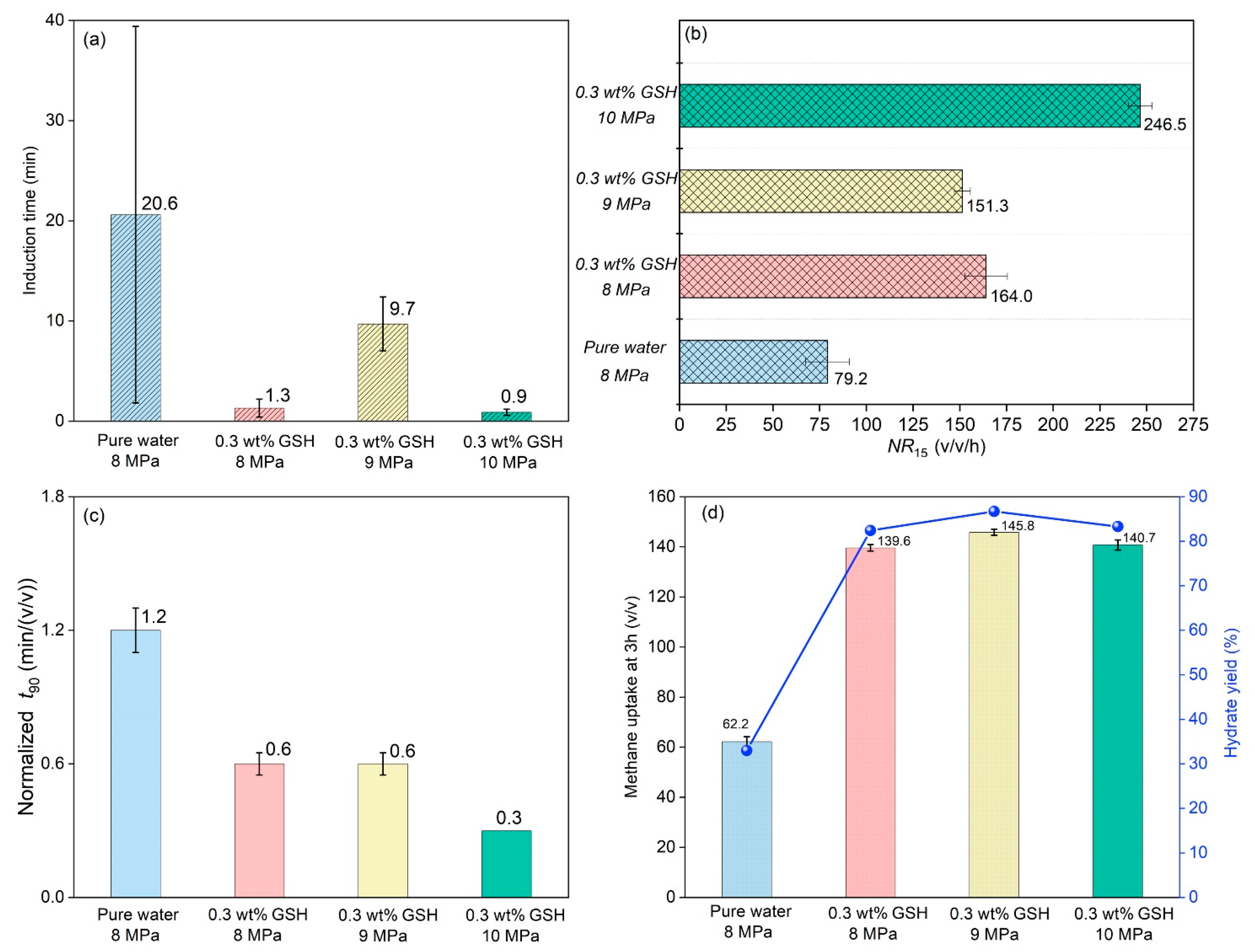
To elucidate the influence of experimental pressure on methane hydrate formation in the tripeptide GSH system, we conducted methane uptake experiments at 9 MPa and 10 MPa using 0.3 wt% GSH under stirring at 500 rpm, 275.2 K. The control group data for 8 MPa using pure water and 8 MPa using 0.3 wt% GSH were obtained from our previous study [4]. The experimental conditions and the related results including induction time, t90, normalized t90, NR15, methane uptake at 3 h and hydrate yield are presented in Table 2 and Figure 1. As shown in Table 2 and Figure 1a, the average induction times for 8 MPa, 9 MPa, and 10 MPa in the presence of 0.3 wt% GSH are 1.3 min, 9.7 min and 0.9 min respectively, all of which are lower than that of pure water (20.6 min). The result under the 10 MPa condition in the GSH system among all these experiments shows the shortest average induction time, indicating immediate hydrate nucleation upon stirring at 10 MPa. However, as shown in Table 2, the induction times in GSH cases range from 0.2 min to 13.1 min, while those in pure water cases change from 0.3 min to 45.6 min. This indicates the strong stochastic behavior of induction time in both systems.
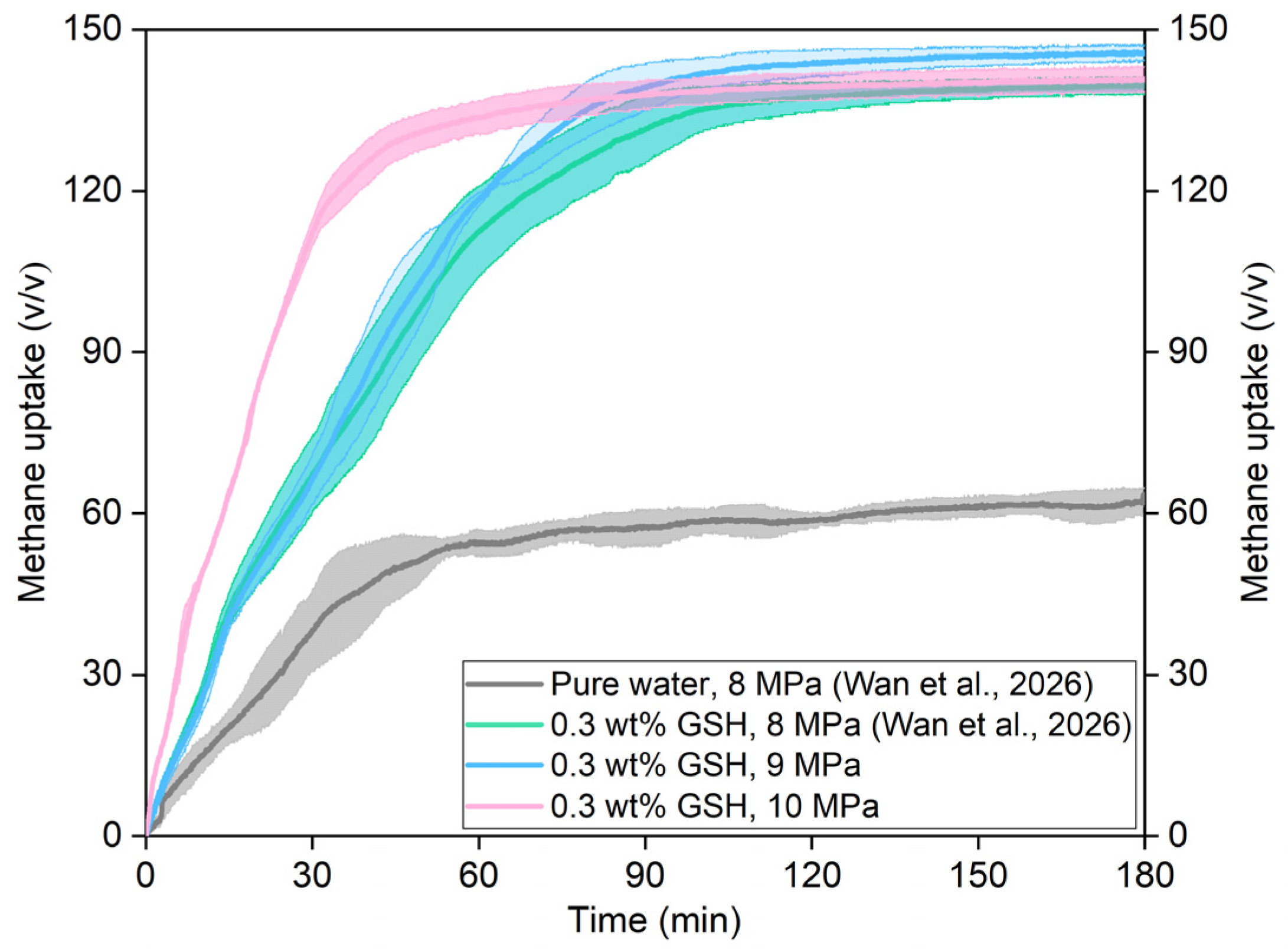
Figure 2 plots the methane uptake curves during hydrate formation under different pressures (8 MPa, 9 MPa, and 10 MPa) in 0.3 wt% tripeptide GSH systems at 275.2 K, along with the pure water case at 8 MPa. Overall, both the hydrate growth rate and the methane uptake capacity in the GSH systems at 8 MPa, 9 MPa, and 10 MPa are significantly enhanced relative to pure water. Notably, the methane uptake profiles of the 8 MPa and 9 MPa cases are very close to each other and partially overlap at some time points, with the 9 MPa case showing a more rapid formation rate and achieving a higher final gas uptake capacity in the later stages of the formation process. In contrast, the 10 MPa case demonstrates a markedly faster growth rate compared to both 8 MPa and 9 MPa, highlighting the superior efficiency in methane hydrate formation under 10 MPa. This indicates that the enhanced driving force is generally more favorable for faster hydrate nucleation and growth under higher-pressure conditions. This is because higher pressure means that the methane gas molecules can be transferred more easily from the gaseous phase to the liquid phase with a faster rate to provide more abundant gas supply for hydrate formation. On the other hand, changes in pressure alter the equilibrium temperature. When we conduct experiments at a temperature of 275.2 K, a higher pressure leads to a higher equilibrium temperature, thereby creating a higher subcooling degree which facilitates mass and heat transfer and promotes hydrate growth. Figure 2 suggests that the cases in the presence of GSH under different pressure conditions show a comparable final methane uptake and hydrate yield, with the 9 MPa case having a slightly higher gas uptake. In other words, the total amount of formed hydrates is not strongly dependent on the initial pressure tested. Moreover, the gas uptake capacity of GSH is comparable to that of leucine and tryptophan, as documented in previous studies [5,31], confirming its role as an effective promoter.
To further illustrate how pressure influences the kinetics of hydrate formation in the GSH system, the normalized hydrate formation rate for the first 15 min NR15, the normalized t90, and the methane uptake at 3 h, as well as the final hydrate yield under different pressures, are calculated and presented in Figure 1. As shown in Figure 1b, the NR15 values for the 8 MPa, 9 MPa and 10 MPa cases are 164.0 v/v h−1, 151.3 v/v h−1, and 246.5 v/v h−1, respectively, which are significantly higher than that of pure water (79.2 v/v h−1). These results also indicate an overall pressure-dependent increase in the GSH-promoted hydrate growth rate. Compared with 8 MPa, the NR15 in the 9 MPa case exhibits a slight drop. In contrast, the 10 MPa case demonstrates a more pronounced 50.3% increase relative to the 8 MPa case. NR15 appears to be significantly affected by the increase in pressure in the GSH-promoted systems, especially when the pressure is raised to a relatively high level. Higher pressure is accompanied by higher driving force, which correspondingly leads to a faster hydrate formation rate. As for t90, it demonstrates a significant reduction with increasing pressure, as shown in Table 2. Compared with the 8 MPa case, the t90 values for hydrate formation at 9 MPa and 10 MPa in GSH systems were reduced by 5.0% and 47.2%, respectively. The normalized t90 in Figure 1c follows a similar trend. The average normalized t90 at 8 MPa, 9 MPa and 10 MPa is 0.6, 0.6 and 0.3 respectively. The normalized t90 at 10 MPa was shortened by 50% relative to the 8 MPa case in GSH systems. So normalized t90 also exhibits a significant response to pressure increase. Both normalized t90 and NR15 values demonstrate that GSH-promoted hydrate formation at 10 MPa shows great superiority over that at 8 MPa and 9 MPa. This may be attributed to the fact that hydrate formation in the GSH system at a high pressure of 10 MPa exhibits much stronger pressure-driven force for the acceleration of the hydrate formation rate, which will significantly shorten the whole formation process.
As displayed in Figure 1d, 0.3 wt% GSH at different pressures achieves a comparable final methane uptake, significantly exceeding that of pure water. Interestingly, the 9 MPa case reaches the highest gas uptake of 145.8 (±1.2) v/v at 3 h, with a 4.4% and 3.6% increase over the 8 MPa and 10 MPa cases, respectively. And the hydrate yields of the 8 MPa, 9 MPa and 10 MPa cases are 82.4%, 86.7% and 83.3%, respectively. This indicates that the different pressures ranging from 8 MPa to 10 MPa do not significantly influence the ultimate water-to-hydrate conversion in tripeptide GSH systems. Hydrate formation is not only dependent on the initial system pressure but also associated with other factors such as the remaining gas/water and their mass transfer in the reactor. Collectively, the average induction times of hydrate formation in the 0.3 wt% GSH system under different pressures are lower than that of pure water. Furthermore, the final methane uptake and water-to-hydrate conversion are less influenced by pressure. However, the normalized t90 and NR15 are both significantly affected by pressure. The 10 MPa case in 0.3 wt% GSH solution exhibits the highest hydrate growth rate (NR15: 246.5 v/v h−1) compared to the 8 MPa and 9 MPa cases. Therefore, during the hydrate production stage, higher pressure accelerates the hydrate formation rate, shortens formation periods and enhances overall production efficiency. Thus, in practical SNG applications, the optimal formation pressure should be determined based on specific production needs and efficiency requirements.

3.2. Effect of Experimental Temperature on GSH-Promoted Hydrate Formation

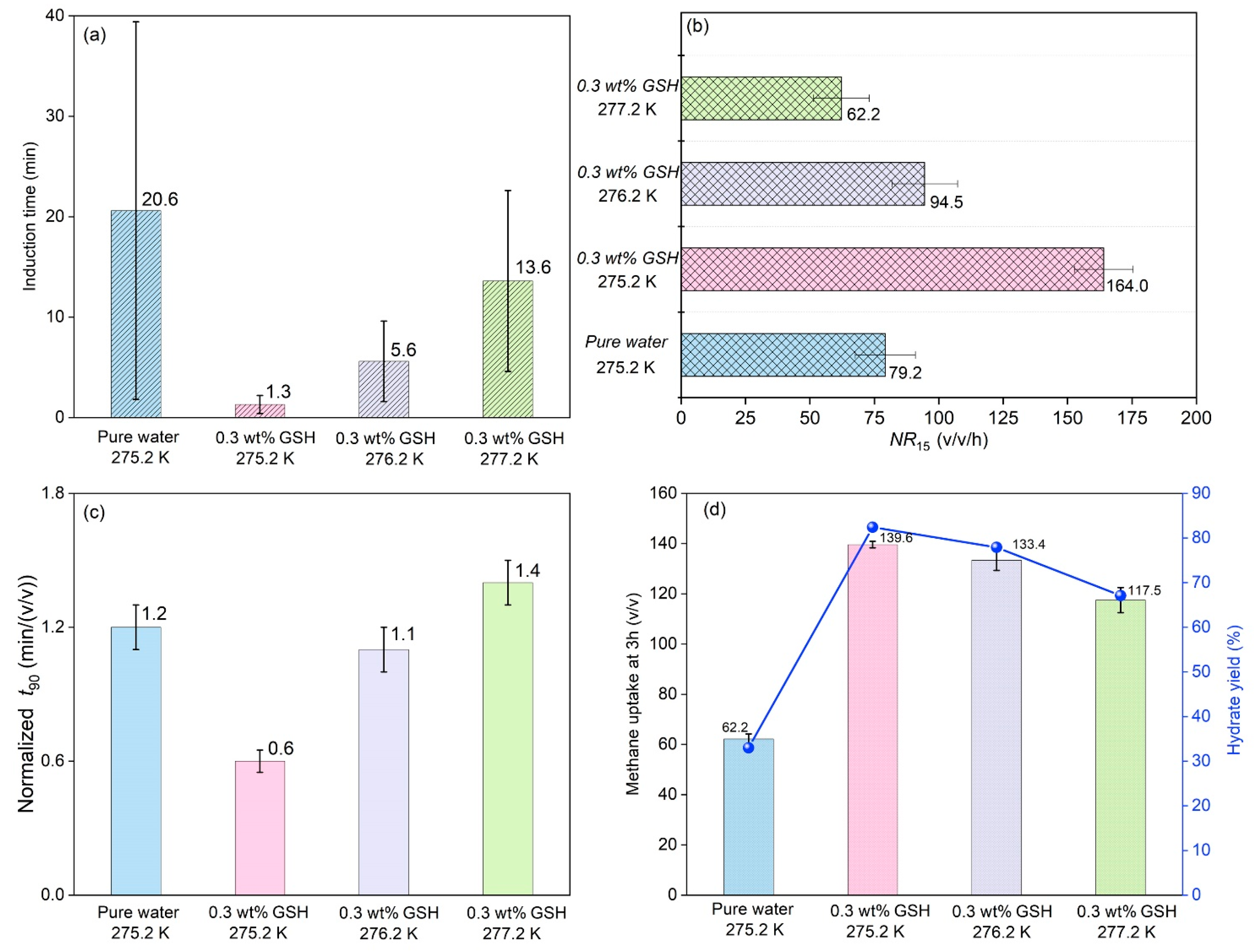
As another important thermodynamic factor, experimental temperature also affects methane hydrate formation. To elucidate the influence of initial temperature on methane hydrate formation in the tripeptide GSH system, we conducted hydrate formation experiments using 0.3 wt% GSH at 275.2 K, 276.2 K, and 277.2 K in a stirred tank reactor under 8 MPa and 500 rpm. The control group data using 0.3 wt% GSH under 275.2 K and 8 MPa are listed in Table 2, and they were obtained from our previous research [4]. The corresponding experimental conditions and the related results including induction time, NR15, t90, normalized t90, methane uptake at 3 h and hydrate yield are summarized in Table 3 and Figure 3. As depicted in Figure 3a, the average induction times for 275.2 K, 276.2 K, and 277.2 K under the introduction of 0.3 wt% GSH are 1.3 min, 5.6 min and 13.6 min respectively. Despite being shorter than that of pure water (20.6 min), the induction times increase with rising temperature, obviously showing a temperature-dependent pattern.
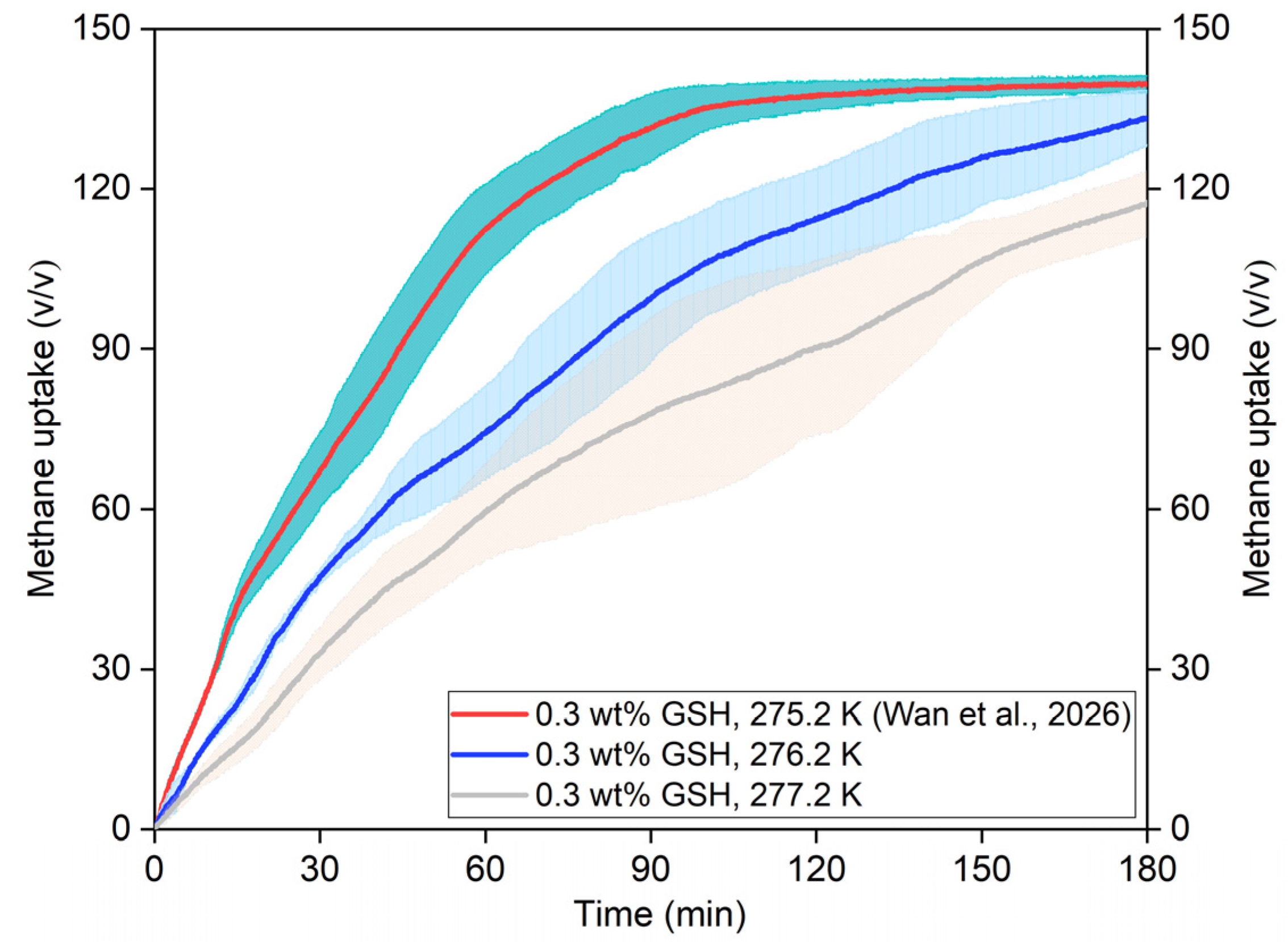
It can also be seen from Figure 4 that the hydrate growth profile of the low-temperature system is obviously faster than that of the high-temperature scenario. This observation aligns with the NR15 value. As presented in Figure 3b, the NR15 for the 275.2 K, 276.2 K, and 277.2 K cases in GSH systems is 164.0 v/v h−1, 94.5 v/v h−1, and 62.2 v/v h−1, respectively. Notably, hydrate formation in 0.3 wt% GSH at 275.2 K yields the highest NR15, implying the most favorable kinetic conditions for hydrate formation within the tested temperature range. In contrast, the NR15 in the 276.2 K and 277.2 K cases is decreased by 42.4% and 62.1% relative to that in the 275.2 K case, respectively. This distinct trend demonstrates a clear inverse correlation between temperature and the hydrate formation rate, where increasing temperature leads to a significant reduction in NR15. This suggests that the GSH-promoted hydrate formation process is more favored at lower temperature. Note that the NR15 in the GSH system at 277.2 K is even lower than that of the pure water case at 275.2 K, meaning that the selection of the system temperature is extremely important for enhancing gas hydrate formation.
As displayed in Table 2 and Table 3, the average t90 in the GSH systems at 275.2 K, 276.2 K, and 277.2 K is 78.2 min, 133.7 min and 146.5 min, respectively. Thus, high temperatures also result in a prolonged hydrate formation process. The normalized t90 values in the 275.2 K, 276.2 K, and 277.2 K cases are 0.6, 1.1, and 1.4 respectively. Normalized t90 increases with a rise in temperature. The 275.2 K case exhibits the lowest normalized t90, which is only half of that of pure water. The normalized t90 in the 276.2 K case and 277.2 K case increases by 83.3% and 133.3% compared to the 275.2 K case. Note that the normalized t90 in the GSH system in the 277.2 K case is even higher than that of pure water at 275.2 K. The results indicate that temperature is a key operation parameter that can strongly determine the GSH-promoted hydrate growth behavior. In terms of final methane uptake, it also shows a declining trend, as observed in Table 3 and Figure 3d. All the gas uptakes at the three different temperatures are higher than that in the pure water case. The low-temperature 275.2 K case achieves the highest average methane uptake of 139.6 v/v, followed by the 276.2 K case (133.4 v/v) and 277.2 K case (117.5 v/v). Compared to the 275.2 K case, the 276.2 K case and 277.2 K case exhibit a 4.4% and 15.8% reduction, respectively. And the hydrate yield at t = 3 h observed from Table 2 and Table 3 for the 275.2 K case, 276.2 K case and 277.2 K case is 82.4%, 77.9% and 67.1% respectively. Higher temperature leads to a reduced hydrate formation rate and then lower hydrate yields at t = 3 h. This value is well aligned with the kinetic profiles in Figure 4, which show both reduced kinetics and ultimate methane uptake in the curves. This may be attributed to the fact that higher temperature results in a lower driving force that is unfavorable for hydrate formation. At the same experimental pressure of 8 MPa, its phase equilibrium temperature remains at approximately 11.0 °C. A lower initial experimental temperature corresponds to a higher subcooling degree, resulting in a stronger driving force and enhanced heat transfer that promotes the formation of gas hydrates. Therefore, in the SNG process, the temperature should also be carefully chosen for desirable hydrate performance.

3.3. Comparison of Hydrate Kinetics with Hydrophilic Amino Acids

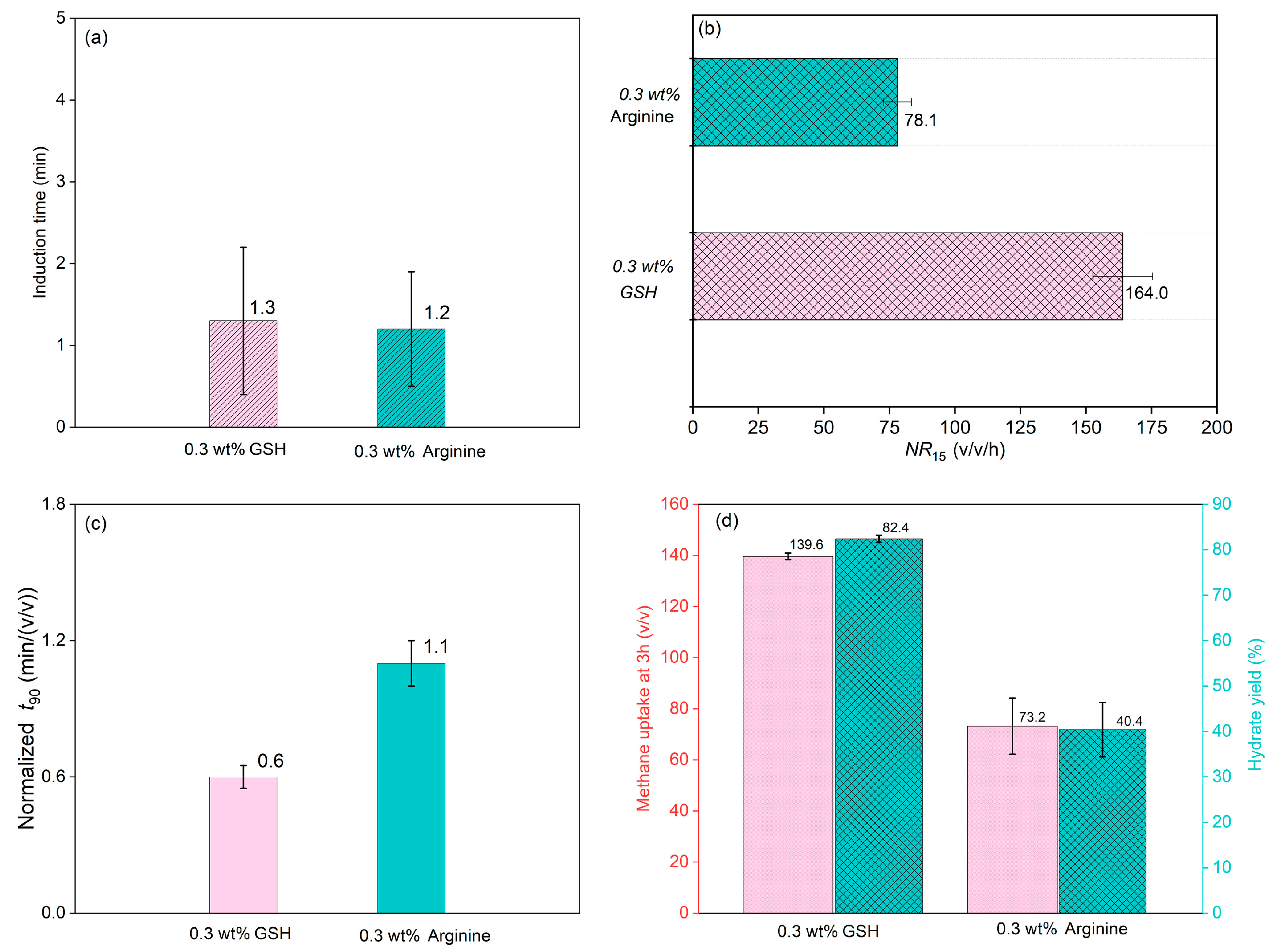
The hydropathy of additives, referred to as hydrophobicity and hydrophilicity characteristics, usually has a significant impact on the formation kinetics of gas hydrate. Generally, hydrophobic amino acids may show stronger promoting effects for methane hydrate formation [9]. The hydropathy index could be used to characterize the hydrophilic or hydrophobic nature of an amino acid according to the study [32]. Typically, a higher hydropathy index indicates the greater hydrophobicity of the amino acid [32]. L-arginine, with a hydropathy index value of −4.5, is the most hydrophilic amino acid [9]. For peptide-based promoters, reduced L-glutathione (GSH) is an extremely hydrophilic tripeptide [33]. As both GSH and L-arginine exhibit a strong hydrophilic nature, here, we compare the impact of a hydrophilic tripeptide and hydrophilic amino acid on methane hydrate formation performance. In this study, 0.3 wt% L-arginine is used for comparison with 0.3 wt% reduced L-glutathione in the same reaction vessel under the same conditions of 275.2 K, 8 MPa and 500 rpm. The related results of gas hydrate formation employing 0.3 wt% L-arginine are presented in Table 4 and Figure 5.
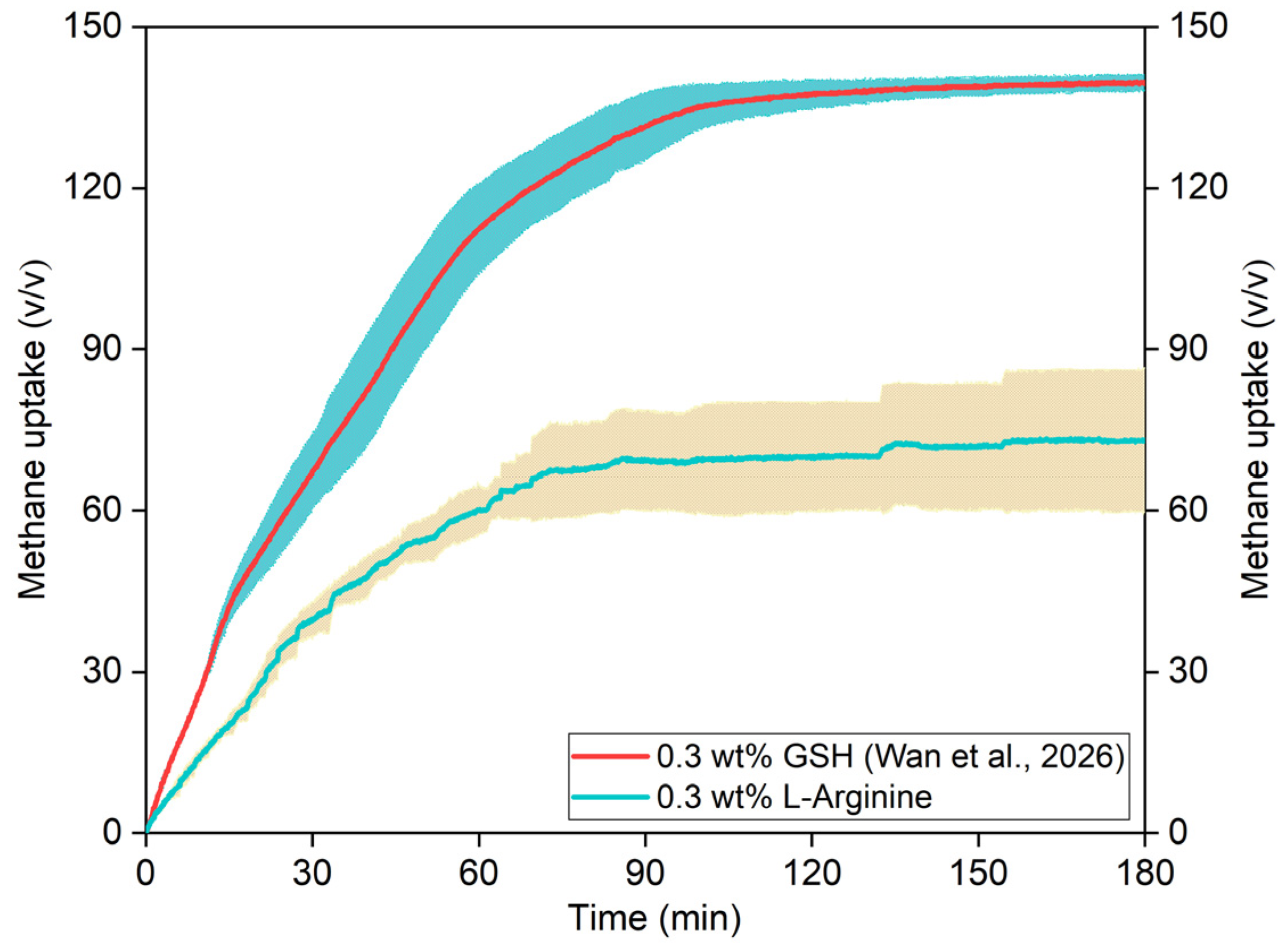
As presented in Figure 5a, the average induction time of 0.3 wt% arginine (1.2 min) is slightly shorter than that of 0.3 wt% GSH (1.3 min), both of which are significantly shorter than that in the pure water case. This suggests that the two additives have comparable ability to promote the nucleation of methane hydrate. However, the NR15 of 0.3 wt% arginine is merely 78.1 v/v h−1, which is significantly lower than that of 0.3 wt% GSH, demonstrating a 52.4% reduction relative to that of 0.3 wt% GSH. The NR15 of 0.3 wt% arginine is even lower than that of pure water (79.2 v/v h−1). It can also be clearly observed from the kinetic profiles in Figure 6 that the curve of 0.3 wt% arginine is always below the curve of 0.3 wt% GSH, implying that both the formation rate of methane hydrate and the final methane uptake of 0.3 wt% arginine solution are significantly lower than those of 0.3 wt% GSH. For normalized t90, shown in Figure 5c, the value is 0.6 in 0.3 wt% GSH, while it increases to 1.1 in the 0.3 wt% arginine case. Normalized t90 is increased by 83.3% relative to 0.3 wt% GSH. This indicates that hydrophilic tripeptide GSH has a stronger promoting effect and can result in a faster formation rate than hydrophilic amino acid arginine, thereby reducing normalized t90. As shown in Figure 5d, the final methane uptake of 0.3 wt% arginine (73.2 v/v) is substantially lower than that of 0.3 wt% GSH (139.6 v/v). And the hydrate yield also drops from 82.4% to 40.4%. Although both GSH and L-arginine exhibit strong hydrophilic properties, these results show that the tripeptide GSH is more effective than the amino acid arginine in enhancing methane hydrate formation. The promotion mechanism may stem from the change in surface tension and the favorable hydrate morphology induced by the presence of L-glutathione reduced [4]. On the other hand, the observed promotional activity of GSH might be attributed to a balance between the inhibitory effect of its glycine segment and the promoting contribution of its L-cysteine residue, as indicated in our previous study [4]. Molecular dynamic simulation for in-depth mechanistic insights represents the future direction of research.

4. Conclusions

L-glutathione reduced (GSH), a unique tripeptide, was employed as a promoter to enhance methane hydrate formation. This work comprehensively investigated the thermodynamic effects on methane hydrate formation in L-glutathione reduced systems. The effect of L-glutathione reduced (0.3 wt%) on CH4 hydrate formation was investigated under a series of initial pressures (8 MPa, 9 MPa, and 10 MPa) at 275.2 K. It was found that the 10 MPa case demonstrated a significantly faster growth rate than both the 8 MPa and 9 MPa cases. Higher pressure brings higher driving force, which leads to a faster hydrate formation rate. Meanwhile, the final methane uptake and water-to-hydrate conversion are less influenced by the system pressure. Additionally, 0.3 wt% GSH at different pressures of 8 MPa, 9 MPa, and 10 MPa achieves a comparable final methane uptake of 139.6, 145.8, and 140.7 v/v, respectively.
The impact of temperature on the kinetic behavior of CH4 hydrate in the GSH system was also examined. The findings demonstrate a clear inverse correlation between temperature and hydrate formation rate, where increasing temperature leads to a significant reduction in NR15. Hydrate formation in the GSH system is more favored at lower temperature, which leads to both an increased hydrate formation rate and a higher methane uptake capacity at t = 3 h. Therefore, in the GSH-promoted SNG process, temperature should also be carefully chosen for desirable hydrate formation performance.
Given the strong hydrophilicity of tripeptide L-glutathione reduced, L-arginine, a highly hydrophilic amino acid, was chosen for a comparative kinetic investigation under the same experimental conditions. The hydrate formation rate NR15 of 0.3 wt% L-arginine is merely 78.1 v/v h−1, which is significantly lower than that of 0.3 wt% GSH (164 v/v h−1), demonstrating a 52.4% reduction relative to that of 0.3 wt% GSH. Moreover, the final methane uptake of 0.3 wt% L-arginine is substantially lower than that of 0.3 wt% GSH. Although both GSH and arginine exhibit strong hydrophilic properties, the experimental results show that the tripeptide GSH is more effective than the amino acid arginine in enhancing methane hydrate formation. The findings of this study provide a theoretical foundation for applying peptide-based promoters to the advancement of SNG technology.

Author Contributions

Conceptualization, Q.-C.W.; methodology, Q.-C.W.; software, Y.-L.L.; validation, Q.-C.W.; formal analysis, Q.-C.W.; investigation, Q.-C.W. and Y.-L.L.; resources, Q.-C.W.; data curation, Q.-C.W.; writing—original draft preparation, Q.-C.W.; writing—review and editing, Q.-C.W. and B.L.; visualization, Q.-C.W.; supervision, B.L.; project administration, Q.-C.W. and B.L.; funding acquisition, Q.-C.W. and B.L. All authors have read and agreed to the published version of the manuscript.

Funding

The authors gratefully acknowledge the funding support from the National Natural Science Foundation of China (52306225); the Natural Science Foundation of Chongqing, China (Grant No. CSTB2022NSCQ-MSX0422); Science and Technology Research Program of Chongqing Municipal Education Commission (Grant No. KJQN202301534); Chongqing University of Science and Technology (No. ckrc2022016); and the National Natural Science Foundation of China (52276170).

Data Availability Statement

The original contributions presented in this study are included in the article. Further inquiries can be directed to the corresponding author.

Conflicts of Interest

The authors declare no conflicts of interest.

References

  1. Cronshaw, I. World Energy Outlook 2014 projections to 2040: Natural gas and coal trade, and the role of China. Aust. J. Agric. Resour. Econ. 2015, 59, 571–585. [Google Scholar] [CrossRef]
  2. Sun, N.R.; Zhang, Y.; Bhattacharjee, G.; Li, Y.J.; Qiu, N.X.; Du, S.Y.; Linga, P. Seawater-based sII hydrate formation promoted by 1,3-Dioxolane for energy storage. Energy 2024, 286, 129606. [Google Scholar] [CrossRef]
  3. Bahadori, A. Liquefied Natural Gas (LNG). In Natural Gas Processing; Bahadori, A., Ed.; Gulf Professional Publishing: Houston, TX, USA, 2014; Chapter 13; pp. 591–632. [Google Scholar] [CrossRef]
  4. Wan, Q.C.; Li, Y.L.; Li, B.; Li, G.C.; Liu, X.M. Hydrophilic tripeptide L-glutathione enhanced methane hydrate formation with high energy density and rapid methane uptake: Implications for gas storage. Chem. Eng. J. 2026, 530, 173092. [Google Scholar] [CrossRef]
  5. Veluswamy, H.P.; Lee, P.Y.; Premasinghe, K.; Linga, P. Effect of biofriendly amino acids on the kinetics of methane hydrate formation and dissociation. Ind. Eng. Chem. Res. 2017, 56, 6145–6154. [Google Scholar] [CrossRef]
  6. Bhattacharjee, G.; Goh, M.N.; Arumuganainar, S.E.K.; Zhang, Y.; Linga, P. Ultra-rapid uptake and the highly stable storage of methane as combustible ice. Energy Environ. Sci. 2020, 13, 4946–4961. [Google Scholar] [CrossRef]
  7. Englezos, P. Clathrate hydrates. Ind. Eng. Chem. Res. 1993, 32, 1251–1274. [Google Scholar] [CrossRef]
  8. Zhang, Y.; Xu, H.Z.; Bhattacharjee, G.; Linga, P. Methane storage in simulated seawater enabled by 1,3-dioxane as an environmentally benign promoter. Energy Fuels 2023, 37, 8272–8283. [Google Scholar] [CrossRef]
  9. Bhattacharjee, G.; Linga, P. Amino acids as kinetic promoters for gas hydrate applications: A mini review. Energy Fuels 2021, 35, 7553–7571. [Google Scholar] [CrossRef]
  10. Wang, X.M.; Miao, Y.; Guo, Y.L.; Li, M.G.; Tian, X.Y.; Gao, Q.; Fu, Z.X.; Lin, Y.; Wang, P.; Farhadian, A.; et al. Designing internal container architectures to control methane hydrate formation with high energy density. Energy 2025, 340, 139333. [Google Scholar] [CrossRef]
  11. Veluswamy, H.P.; Kumar, A.; Seo, Y.; Lee, J.D.; Linga, P. A review of solidified natural gas (SNG) technology for gas storage via clathrate hydrates. Appl. Energy 2018, 216, 262–285. [Google Scholar] [CrossRef]
  12. Tan, K.; Lv, J.Y.; Yin, Z.C.; Ren, M.L.; Wang, F.; Sun, M.T. Research progress on bio-additives in hydrate-based energy technologies: Application scenarios, classification, functions and mechanisms. Appl. Energy 2025, 394, 126164. [Google Scholar] [CrossRef]
  13. Kutergin, O.B.; Melnikov, V.P.; Nesterov, A.N. Influence of surfactants on the mechanism and kinetics of the formation of gas hydrates. Dokl. Akad. Nauk 1992, 323, 549–553. [Google Scholar]
  14. Zhong, Y.; Rogers, R.E. Surfactant effects on gas hydrate formation. Chem. Eng. Sci. 2000, 55, 4175–4187. [Google Scholar] [CrossRef]
  15. Kumar, A.; Bhattacharjee, G.; Kulkarni, B.D.; Kumar, R. Role of surfactants in promoting gas hydrate formation. Ind. Eng. Chem. Res. 2015, 54, 12217–12232. [Google Scholar] [CrossRef]
  16. Zhang, H.M.Q.; Zhang, J.M.; Shang, L.Y.; Pan, Z.; Liu, Z.M. Rapid promotion of methane hydrate generation using OPS-98, SDS, and amino acids. Chem. Eng. Sci. 2026, 320, 122359. [Google Scholar] [CrossRef]
  17. Veluswamy, H.P.; Hong, Q.W.; Linga, P. Morphology study of methane hydrate formation and dissociation in the presence of amino acid. Cryst. Growth Des. 2016, 16, 5932–5945. [Google Scholar] [CrossRef]
  18. Bavoh, C.B.; Lal, B.; Osei, H.; Sabil, K.M.; Mukhtar, H. A review on the role of amino acids in gas hydrate inhibition, CO2 capture and sequestration, and natural gas storage. J. Nat. Gas Sci. Eng. 2019, 64, 52–71. [Google Scholar] [CrossRef]
  19. Liu, Y.; Chen, B.Y.; Chen, Y.L.; Zhang, S.H.; Guo, W.Q.; Cai, Y.H.; Tan, B.; Wang, W.X. Methane storage in a hydrated form as promoted by Leucines for possible application to natural gas transportation and storage. Energy Technol. 2015, 3, 815–819. [Google Scholar] [CrossRef]
  20. Pandey, J.S.; Daas, Y.J.; Karcz, A.P.; von Solms, N. Methane hydrate formation behavior in the presence of selected amino acids. In 2019 8th International Conference on Chemical Science and Engineering (ICCSE); Iop: Bristol, UK, 2020; Volume 1580. [Google Scholar] [CrossRef]
  21. Pandey, J.S.; Daas, Y.J.; Von Solms, N. Methane hydrate formation, storage and dissociation behavior in unconsolidated sediments in the presence of environment-friendly promoters. In Proceedings of the SPE Europec Featured at 82nd EAGE Conference and Exhibition; Society of Petroleum Engineers: Amsterdam, The Netherlands, 2020. [Google Scholar] [CrossRef]
  22. Chaovarin, C.; Yodpetch, V.; Inkong, K.; Veluswamy, H.P.; Kulprathipanja, S.; Linga, P.; Rangsunvigit, P. Improvement of methane hydrate formation using biofriendly amino acids for natural gas storage applications: Kinetic and morphology insights. Energy Fuels 2022, 36, 12826–12841. [Google Scholar] [CrossRef]
  23. Burla, S.K.; Pinnelli, S.R.P.; Sain, K. Explicating the amino acid effects for methane storage in hydrate form. RSC Adv. 2022, 12, 10178–10185. [Google Scholar] [CrossRef]
  24. Li, B.; Li, Y.L.; Liu, X.M.; Zhang, T.T.; Wan, Q.C.; Li, G.C. Rapid formation of high-energy-density methane hydrates promoted by L-cysteine: A promising approach for solidified natural gas. Gas Sci. Eng. 2025, 139, 205638. [Google Scholar] [CrossRef]
  25. Nasir, Q.; Suleman, H.; Elsheikh, Y.A. A review on the role and impact of various additives as promoters/inhibitors for gas hydrate formation. J. Nat. Gas Sci. Eng. 2020, 76, 103211. [Google Scholar] [CrossRef]
  26. Li, S.X.; Lv, R.J.; Yan, Z.S.; Huang, F.; Zhang, X.R.; Chen, G.J.; Yue, T.T. Design of alanine-rich short peptides as a green alternative of gas hydrate inhibitors: Dual methyl group docking for efficient adsorption on the surface of gas Hydrates. ACS Sustain. Chem. Eng. 2020, 8, 4256–4266. [Google Scholar] [CrossRef]
  27. Go, W.; Yun, S.; Lee, D.; Seo, Y. Dipeptides as environmentally friendly CH4 hydrate inhibitors: Experimental and computational approaches. Fuel 2022, 329, 125479. [Google Scholar] [CrossRef]
  28. Mu, H.Y.; Liu, Y.; Ding, L.; Wang, W.L.; Lv, X.F.; Yu, Y.S.; Ma, Q.L.; Wang, C.S.; Li, X.Y.; Zhou, S.D. A molecular study of synergistic inhibition of methane hydrate growth with glycine-based peptides and PVCap. Fuel 2026, 414, 138327. [Google Scholar] [CrossRef]
  29. Khandelwal, H.; Qureshi, M.F.; Zheng, J.; Venkataraman, P.; Barckholtz, T.A.; Mhadeshwar, A.B.; Linga, P. Effect of L-tryptophan in promoting the kinetics of carbon dioxide hydrate formation. Energy Fuels 2021, 35, 649–658. [Google Scholar] [CrossRef]
  30. Jeenmuang, K.; Pornaroontham, P.; Inkong, K.; Bhattacharjee, G.; Kulprathipanja, S.; Linga, P.; Rangsunvigit, P. Roles of amino acid hydrophobicity on methane-THF hydrates in the context of storage and stability. Chem. Eng. J. 2023, 454, 140326. [Google Scholar] [CrossRef]
  31. Veluswamy, H.P.; Kumar, A.; Kumar, R.; Linga, P. An innovative approach to enhance methane hydrate formation kinetics with leucine for energy storage application. Appl. Energy 2017, 188, 190–199. [Google Scholar] [CrossRef]
  32. Kyte, J.; Doolittle, R.F. A simple method for displaying the hydropathic character of a protein. J. Mol. Biol. 1982, 157, 105–132. [Google Scholar] [CrossRef]
  33. Liu, M.Y.; Sharma, M.; Lu, G.L.; Yin, N.B.; Al Gailani, M.; Sreebhavan, S.; Wen, J.Y. Preformulation studies of l-glutathione: Physicochemical properties, degradation kinetics, and in vitro cytotoxicity investigations. Drug Dev. Ind. Pharm. 2020, 46, 717–731. [Google Scholar] [CrossRef]
Figure 1. The results of (a) induction time, (b) NR15, (c) normalized t90, (d) methane uptake at 3 h and hydrate yield for pure water under 8 MPa, and 0.3 wt% L-glutathione reduced (GSH) under different pressures with 8 MPa, 9 MPa and 10 MPa at 275.2 K under 500 rpm. The data of the pure water case and 0.3 wt% GSH at 8 MPa were obtained from our previous research [4].
Energies 19 02051 g001
Figure 2. Profiles of methane uptake for experiments carried out at different pressures (8 MPa, 9 MPa, and 10 MPa) using 0.3 wt% GSH under conditions of 275.2 K and 500 rpm, along with pure water case at 8 MPa. Solid lines denote average data, whereas shaded regions denote standard deviation. Curves of pure water case and 0.3 wt% GSH at 8 MPa were obtained from our previous research [4].
Energies 19 02051 g002
Figure 3. The results of (a) induction time, (b) NR15, (c) normalized t90, (d) methane uptake at 3 h and hydrate yield for pure water at 275.2 K and 0.3 wt% L-glutathione reduced (GSH) at different temperatures of 275.2 K, 276.2 K and 277.2 K at 8 MPa under 500 rpm. The data of the pure water case and 0.3 wt% GSH case at 275.2 K and 8 MPa were obtained from our previous research [4].
Energies 19 02051 g003
Figure 4. Methane uptake profiles for experiments using 0.3 wt% GSH conducted at different temperatures of 275.2 K, 276.2 K, and 277.2 K under conditions of 8 MPa and 500 rpm. The formation process was conducted under continuous stirring. The solid lines denote the average data, whereas the shaded regions denote the standard deviation. The curves of 0.3 wt% GSH at 275.2 K and 8 MPa were obtained from our previous research [4].
Energies 19 02051 g004
Figure 5. Results of (a) induction time, (b) NR15, (c) normalized t90, (d) methane uptake at 3 h and hydrate yield for 0.3 wt% L-glutathione reduced (GSH) and 0.3 wt% L-arginine under conditions of 275.2 K, 8 MPa and 500 rpm. Data of 0.3 wt% GSH at 275.2 K and 8 MPa were obtained from our previous research [4].
Energies 19 02051 g005
Figure 6. Methane uptake profiles for experiment with 0.3 wt% L-glutathione reduced (GSH) and 0.3 wt% L-arginine under conditions of 275.2 K, 8 MPa and 500 rpm. Solid lines denote average data, whereas shaded regions denote standard deviation. Curve of 0.3 wt% GSH at 275.2 K and 8 MPa was obtained from our previous research [4].
Energies 19 02051 g006
Table 1. The molecular structure of additives used for hydrate formation.
NameMolecular StructurePurity
L-glutathione reduced
(GSH) [4]
Energies 19 02051 i00199%
L-arginineEnergies 19 02051 i00298%
Table 2. Summary of experimental conditions and results of methane hydrate formation using water and 0.3 wt% GSH at different pressures. Data of cases A1, A2, A3, B1, B2, and B3 were obtained from our previous research [4].
Case No.ConditionsInduction
Time (min)
Normalized Methane Uptake Rate, NR15
(v/v/h)
Time Taken for 90% Completion, t90 (min)Normalized
t90 (min/(v/v))
Methane Uptake at t = 3 h (v/v)Hydrate Yield (%)Ref.
A1Water, 8 MPa45.695.262.91.162.833.3[4]
A2Water, 8 MPa0.367.772.01.264.334.2[4]
A3Water, 8 MPa1674.871.11.359.431.6[4]
averageWater, 8 MPa20.6 ± 18.879.2 ± 11.768.7 ± 4.11.2 ± 0.162.2 ± 2.033.0 ± 1.1[4]
B1GSH, 8 MPa1.5178.472.20.6139.982.5[4]
B2GSH, 8 MPa0.2163.373.30.6141.083.3[4]
B3GSH, 8 MPa2.3150.489.00.7137.881.3[4]
averageGSH, 8 MPa1.3 ± 0.9164.0 ± 11.478.2 ± 7.70.6 ± 0.05139.6 ± 1.382.4 ± 0.8[4]
P1GSH, 9 MPa13.1146.073.30.6145.186.2
P2GSH, 9 MPa6.6151.270.60.5147.587.9
P3GSH, 9 MPa9.5156.679.10.6144.886.0
average GSH, 9 MPa9.7 ± 2.7151.3 ± 4.374.3 ± 3.50.6 ± 0.05145.8 ± 1.286.7 ± 0.9
R1GSH, 10 MPa1.3239.043.20.3138.081.4
R2GSH,10 MPa0.9254.741.30.3141.483.9
R3GSH, 10 MPa0.6245.739.30.3142.784.5
averageGSH, 10 MPa0.9 ± 0.3246.5 ± 6.441.3 ± 1.6 0.3 ± 0.0140.7 ± 2.083.3 ± 1.3
Table 3. Summary of experimental conditions and results for methane hydrate formation using 0.3 wt% GSH at different initial temperatures of 276.2 K and 277.2 K. Experiments were conducted at pressure of about 8 MPa, with formation process carried out under continuous stirring at 500 rpm.
Case No.ConditionsInduction
Time (min)
Normalized Methane Uptake Rate, NR15 (v/v/h)Time Taken for 90% Completion, t90 (min)Normalized
t90 (min/(v/v))
Methane Uptake at t = 3 h (v/v)Hydrate Yield (%)
H1276.2 K3.6112.2142.81.2130.475.8
H2276.2 K2.089.0137.81.2130.575.9
H3276.2 K11.282.2120.50.96139.282.0
average276.2 K5.6 ± 4.094.5 ± 12.8133.7 ± 9.61.1 ± 0.1133.4 ± 4.177.9 ± 2.9
K1277.2 K2.077.4142.61.4113.564.4
K2277.2 K24.053.3144.41.3124.571.8
K3277.2 K14.855.8152.61.5114.565.1
average277.2 K13.6 ± 9.062.2 ± 10.8146.5 ± 4.41.4 ± 0.1117.5 ± 5.067.1 ± 3.3
Table 4. Summary of experimental conditions and results for methane hydrate formation using 0.3 wt% L-arginine.
Case No.L-Arginine
Concentration
Induction
Time (min)
Normalized Methane Uptake Rate, NR15 (v/v/h)Time Taken for 90% Completion, t90 (min)Normalized
t90 (min/(v/v))
Methane Uptake at t = 3 h (v/v)Hydrate Yield (%)
G10.3 wt%1.474.063.11.164.835.0
G20.3 wt%2.085.698.11.288.748.7
G30.3 wt%0.274.761.81.066.037.4
average0.3 wt%1.2 ± 0.778.1 ± 5.374.3 ± 16.81.1 ± 0.173.2 ± 11.040.4 ± 6.0
Disclaimer/Publisher’s Note: The statements, opinions and data contained in all publications are solely those of the individual author(s) and contributor(s) and not of MDPI and/or the editor(s). MDPI and/or the editor(s) disclaim responsibility for any injury to people or property resulting from any ideas, methods, instructions or products referred to in the content.