Article

Enhancing Sustainability Through a Hybrid Organic Rankine Cycle and Hydrogen Production Systems: A Thermo-Economic Analysis


1
Dipartimento Engineering, Università della Campania, 81031 Aversa, Italy
2
Istituto di Scienze e Tecnologie per l’Energia e la Mobilità Sostenibili (STEMS), National Research Council of Italy, via Marconi, 4, 80125 Napoli, Italy
*
Author to whom correspondence should be addressed.
Energies 2026, 19(8), 1862; https://doi.org/10.3390/en19081862
Submission received: 15 January 2026 / Revised: 5 March 2026 / Accepted: 7 April 2026 / Published: 10 April 2026
(This article belongs to the Special Issue Numerical Study of Waste and Exhaust Heat Recovery)

Abstract

This study investigates the integration of Organic Rankine Cycle systems with hydrogen production and use to enhance energy efficiency and economic viability in waste heat recovery applications. A comprehensive thermodynamic, exergoeconomic, and environmental assessment evaluates multiple ORC configurations and six working fluids across hospital and hotel facilities. The analysis quantifies component-level exergy costs, system-level economics, and operational CO2 emission reductions, focusing on optimal sizing strategies and threshold conditions under which hydrogen storage enhances energy autonomy without compromising economic viability. Results reveal fundamental design trade-offs: Basic ORC achieved the lowest LCOE at 0.033 $/kWh through operational simplicity, while complex configurations extract up to 70% more power at 14–32% higher cost. N-pentane exhibits superior thermodynamic–economic performance in the Parallel Dual ORC configuration, achieving 20% thermal efficiency and 40% exergy efficiency. R1233zd emerges as the preferred alternative from a safety perspective, exhibiting comparable performance with minimal penalties in both power generation and efficiency metrics. System-level analysis shows that properly sized ORC–hydrogen integration reduces Hospital 1 user LCOEtot from 0.23 $/kWh to 0.069 $/kWh—a 70% reduction achieved by minimizing grid dependence. Environmental benefits strongly correlate with grid carbon intensity, with operational CO2 emission reductions ranging from 181 tons annually in Spain to 752 tons in Poland.

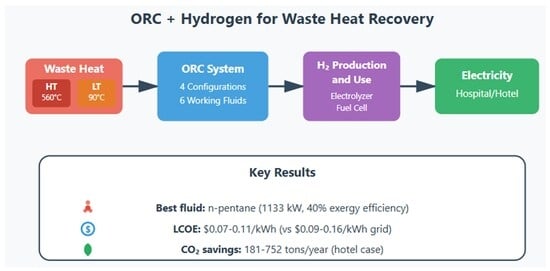
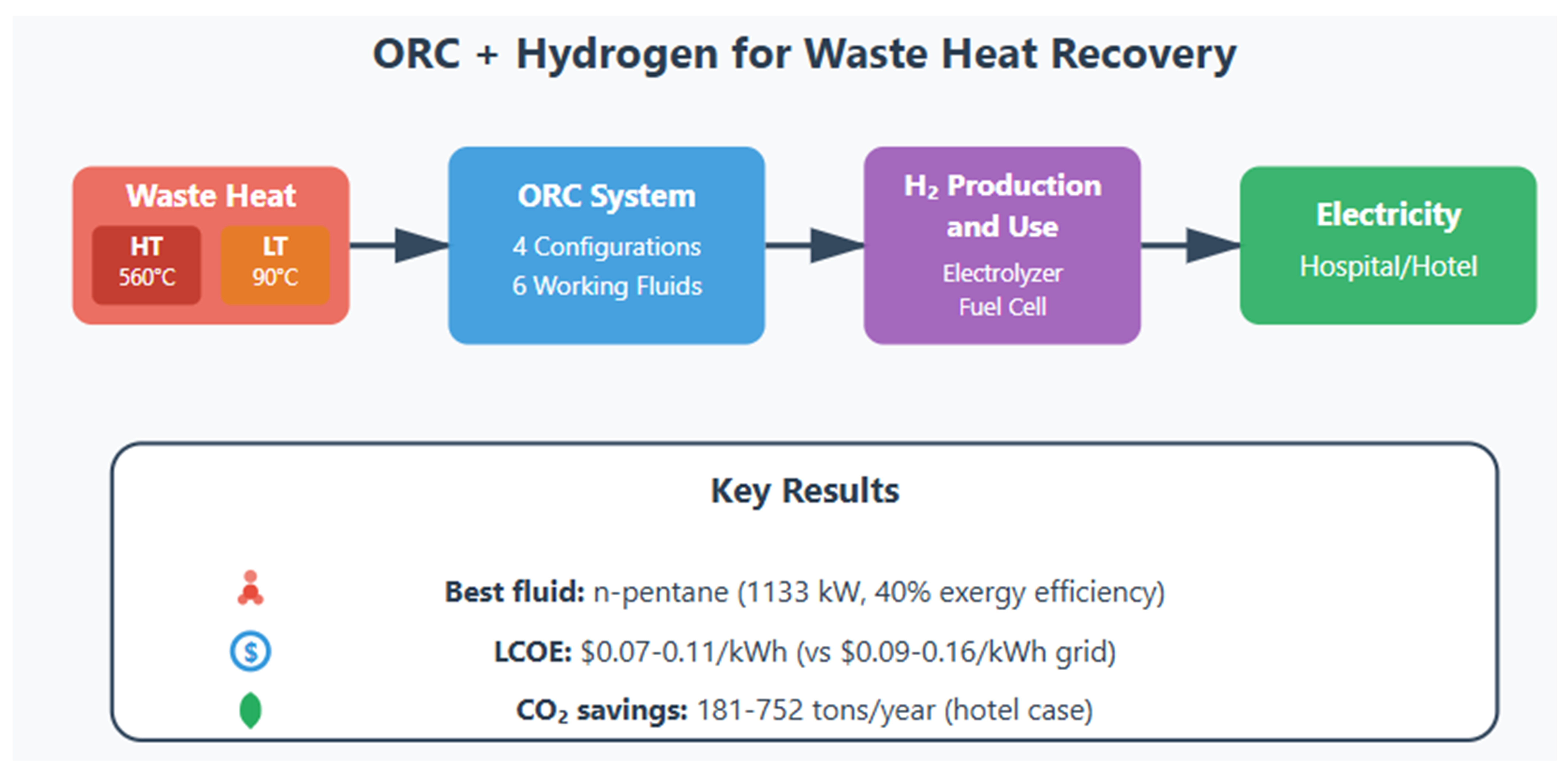
Graphical Abstract

1. Introduction

Growing global interest in clean and efficient energy systems has accelerated research into advanced methods of power generation and energy storage. Among these, Organic Rankine Cycle (ORC) systems have gained prominence for their ability to convert low-to-medium-temperature heat sources into usable work [1]. Unlike conventional Rankine cycles that use water as the working fluid, ORC systems employ organic fluids with lower boiling points, enabling efficient energy conversion from various renewable and waste heat sources, including geothermal energy, industrial waste heat, and solar thermal systems [2]. The adaptability of ORC technology has led to the development of multiple configurations to enhance efficiency, power output, and thermal utilization. These configurations include the Basic ORC (BORC), Reheat ORC, Parallel Dual ORC (PDORC), and more advanced complex ORC systems. Each configuration offers specific advantages depending on the characteristics of the heat source and operating conditions, thereby influencing overall system performance and applicability [3].
A key factor in ORC performance is the selection of working fluids, as their thermophysical properties significantly impact cycle efficiency, thermal stability, environmental impact, safety, and economic feasibility [4]. In this paper, various working fluids, including R1233zd(E), R1234yf, R245fa, R601 (n-pentane), R600a (Isobutane), and R152a, have been investigated for their suitability in different ORC configurations. These fluids exhibit distinct boiling points, thermal conductivities, and environmental footprints, which directly affect heat transfer characteristics, turbine efficiency, and hence cycle thermodynamic performance [1]. This study conducted a comprehensive comparative assessment of multiple ORC configurations using different working fluids to evaluate their thermodynamic and economic performance, highlighting optimal combinations to improve energy efficiency by leveraging waste heat (WH) from industrial processes and to respond to the energy demand of different user types. WH, intended as both latent and sensible heat not used for a system’s main function, is typically released through exhaust gases, cooling fluids, or steam. In ref. [5] the authors explored the technical and economic potential of WH recovery in industrial settings, for heating and cooling via heat transformation technologies. The authors distinguished among the theoretical potential, constrained by physical laws; the technical potential; the feasibility of extraction and reuse; and the economically feasible potential, defined by the profitability of recovery. Industrial sectors are significant energy consumers, with the largest WH emissions occurring in the food, tobacco, pulp and paper, basic metals, chemicals, and non-metallic minerals sectors. WH is generally classified by temperature: high (>400 °C, HT), medium (100–400 °C, MT), and low (<100 °C, LT). HT WH is generally the most reusable, although industrial exhaust gases can vary widely, from as low as 30 °C to more than 1200 °C. In ref. [6] the authors estimated, in 2019, the future global emissions of WH and their environmental impact in terms of greenhouse gas emissions. Their simulations across the power generation, industrial, transport, and building sectors showed that between 49% and 53% of input energy will be lost as WH by 2030. Yet only a fraction of this is recoverable: approximately 11% to 12% is thermodynamically recoverable, and only 6% to 9% is economically viable. Most of this WH (approximately 64–65%) is discharged at LT, which limits recovery options. However, MT WH, although present in smaller quantities, accounts for the largest share—approximately 63%—of the theoretical recovery potential due to its more favorable thermodynamic properties. The power generation sector produces the most WH overall (42–45%) but contributes only 8–10% to the recovery potential, due to low exhaust temperatures and thermodynamic limits of current technologies. In contrast, the industrial sector, which accounts for approximately 27–29% of total WH, has the highest recoverable potential (approximately 44%) because it emits more MT and HT WH. Thus, industry is particularly well suited to heat recovery efforts. Full recovery of the theoretical WH potential could reduce annual CO2 emissions by 10–19%, with about 85% of the benefit attributable to avoided CO2 emissions. Interestingly, although carbon capture and storage (CCS) systems generate additional WH, they still yield a net environmental benefit because the avoided CO2 impacts outweigh the increased thermal emissions. In a comparative study [7], the ORC and Kalina cycle were evaluated for recovering low-temperature WH in a crude oil refinery. The goal was to recover 12.1 MW of heat from a hydrocarbon stream that had previously been rejected by an air cooler. The ORC, using n-pentane, produced up to 862 kW with a thermal efficiency of 10.0%, reducing CO2 emissions by 2200 t/year and yielding a payback period of 4.7–5.3 years. The Kalina cycle, using an ammonia–water mixture, slightly outperformed the ORC, generating 996 kW at 10.57% thermal efficiency and cutting CO2 by 2600 t/year with a 4.8-year payback. A thermodynamic and exergoeconomic analysis of a hybrid energy system combining a PEM fuel cell with an ORC was conducted by [8]. The ORC recovers the fuel cell WH, increasing overall exergy efficiency by around 4% compared to a standalone PEMFC. The study highlighted water management as crucial in the fuel cell model and identified the compressor and condenser as economic bottlenecks. Most costs were associated with exergy destruction in the fuel cell, and system performance depended heavily on tuning operational parameters. A methodology for generating industrial WH profiles across subsectors was developed in ref. [9]. Their model enables temporal and thermal analysis at the plant level, differentiating between energy-intensive and non-energy-intensive sectors. Their work underlines the importance of time-resolved data and clearly defined system boundaries for optimizing WH recovery.
The exergoeconomic optimization of an ORC for thermal energy savings in a power plant was examined explicitly in ref. [10], through multi-objective optimization. A key finding was that one of the models outperformed the other thermodynamic models considered, achieving higher cost and exergy efficiencies. The study found that a mixture identified as R245fa/Pentane was the most efficient working fluid. To ensure a continuous and reliable energy supply, integrating effective energy storage solutions into ORC-based power systems is crucial [11]. Among the various energy storage technologies, hydrogen production via proton exchange membrane (PEM) electrolysis has gained significant attention as an efficient and scalable method for surplus energy storage. PEM electrolyzers use electricity to split water into hydrogen and oxygen, providing a high-purity hydrogen output with rapid response times and high conversion efficiency [12]. The generated hydrogen can be stored, enabling long-term energy storage and subsequent utilization in fuel cells or direct combustion systems. Compared with other energy storage methods, hydrogen offers several advantages, including long-term storage capacity and zero-emission conversion, making it a suitable solution for balancing supply and demand in renewable energy-integrated systems [13]. Comparing hydrogen storage with a Battery Energy Storage System (BESS), Marocco et al. [14] demonstrated that battery-only off-grid systems require 11 times the battery capacity and twice the installed Renewable Energy System power compared with hybrid battery–hydrogen configurations, resulting in a 56% higher LCOE (0.64 vs. 0.41 €/kWh). Hydrogen prevents this costly oversizing by providing long-duration storage with lower capital intensity, particularly important given that ORC surplus electricity in our system varies with ICE load and seasonal demand patterns. Second, despite lower conversion efficiency, Shahverdian et al. [15] found hydrogen systems achieve 13.7% lower LCOE (0.51 vs. 0.58 $/kWh) due to reduced replacement and maintenance costs over the project lifetime. Moreover, lifetime CO2 emissions were more than halved, from 150.3 to 66.3 tons, due to the high carbon intensity of battery manufacturing—a critical consideration for hospital and hotel applications, where environmental performance directly affects sustainability targets and regulatory compliance. Additionally, Yue et al. [16] showed that when waste heat recovery is included in the analysis, hydrogen system round-trip efficiency can reach 48.8%, substantially narrowing the efficiency gap with BESS while maintaining the economic and environmental advantages. The integration of ORC technology with hydrogen production and storage presents a novel hybrid energy system designed to enhance overall efficiency, flexibility, and sustainability [17]. In this study, various ORC configurations are coupled with PEM electrolysis to assess the feasibility of using WH and surplus electricity for hydrogen production. The primary objective is to maximize energy use by directing excess thermal energy from ORC systems toward hydrogen production, thereby reducing energy losses and enhancing system efficiency. The stored hydrogen can serve as a versatile energy carrier, either for direct electricity generation via fuel cells or as a clean fuel for industrial applications. Furthermore, this research examines various optimization strategies to improve the thermodynamic and economic performance of the integrated ORC–hydrogen system, with a focus on factors such as working fluid selection, cycle configuration, heat recovery techniques, and hydrogen storage efficiency. Mariani et al. [18] assessed the performance of ORC using a new refrigerant, the R1233zd(e), with low levels of flammability, health hazard, and environmental impact. The performance of the ORC system was compared with a standard working fluid. In addition, experimental data from an internal combustion engine, including exhaust-gas mass flow rates and temperatures, enabled the determination of the available WH as a function of engine load. Three plant configurations were investigated: single-pressure, dual-pressure, and reheating.
Recent research on integrated ORC and hydrogen (H2) systems has largely focused on steady-state thermodynamic assessments, primarily employing first- and second-law efficiency analyses to evaluate feasibility and performance [19]. While general ORC reviews have discussed combined heat sources and working fluids [3,20], relatively few recent studies explicitly examine ORC integration with H2 production systems, and those that do often focus primarily on techno-economic feasibility rather than comprehensive system performance under realistic load variations [17,21]. Techno-economic evaluations in the ORC–H2 literature are frequently simplified, relying on static capital cost assumptions and fixed hydrogen prices, while comprehensive assessments incorporating life-cycle costing and uncertainty analysis remain relatively scarce [17]. Several recent hybrid system case studies, such as biomass-based ORC power and hydrogen production [21], and solar-ORC integrated H2 systems [22], have begun to explore broader integration scenarios, but these efforts are still at early stages of development. In detail, while individual studies have examined ORC–hydrogen integration [8,17], no comprehensive analysis exists that simultaneously evaluates: (1) four different ORC configurations with (2) six working fluids, (3) component-level exergoeconomic costs using the SPECO method, (4) system-level economics under realistic user demand profiles for hospital and hotel applications, and (5) quantified threshold conditions under which hydrogen production and use enhances energy autonomy without compromising economic viability. The contribution of this work lies in its systematic integration and in identifying optimal sizing strategies through multidimensional comparisons.
The objective of this study is to perform a comprehensive thermo-economic and exergoeconomic comparison of four ORC configurations (BORC, Reheat, PDORC, Reheat–PDORC) integrated with hydrogen production and storage for waste heat recovery in hospital and hotel applications. Unlike prior ORC–hydrogen studies that focus on cycle-level performance or assume hydrogen viability a priori, this work advances the field through component-level exergoeconomic analysis, revealing how monetary costs propagate through successive equipment and evidencing which components provide the greatest economic benefit, identifying where design interventions yield maximum economic return. Additionally, systematic variation in ORC–demand ratios establishes quantitative thresholds at which hydrogen storage transitions from economically counterproductive to marginally viable, enabling evidence-based sizing decisions. The main findings show that BORC achieved the lowest LCOE at 0.034 $/kWh, while complex configurations delivered up to 70% more power at approximately 10–32% higher cost. N-pentane demonstrated optimal thermodynamic–economic performance, achieving 1133 kW with 20% thermal efficiency and 40% exergy efficiency. Operational CO2 emission reductions ranged from 181 to 752 tons/year annually depending on regional grid carbon intensity.
However, the study is subject to certain limitations such as the steady-state analysis, which does not capture dynamic coupling between components with different response timescales, where ORC systems respond over 10 to 30 min while electrolyzers and fuel cells respond within seconds to minutes. Additionally, the environmental assessment quantifies only operational emissions and excludes full life-cycle impacts from equipment manufacturing, working fluid production, and end-of-life disposal.

2. Methodology

2.1. Thermodynamic Analysis

2.1.1. ORC Configurations and Design

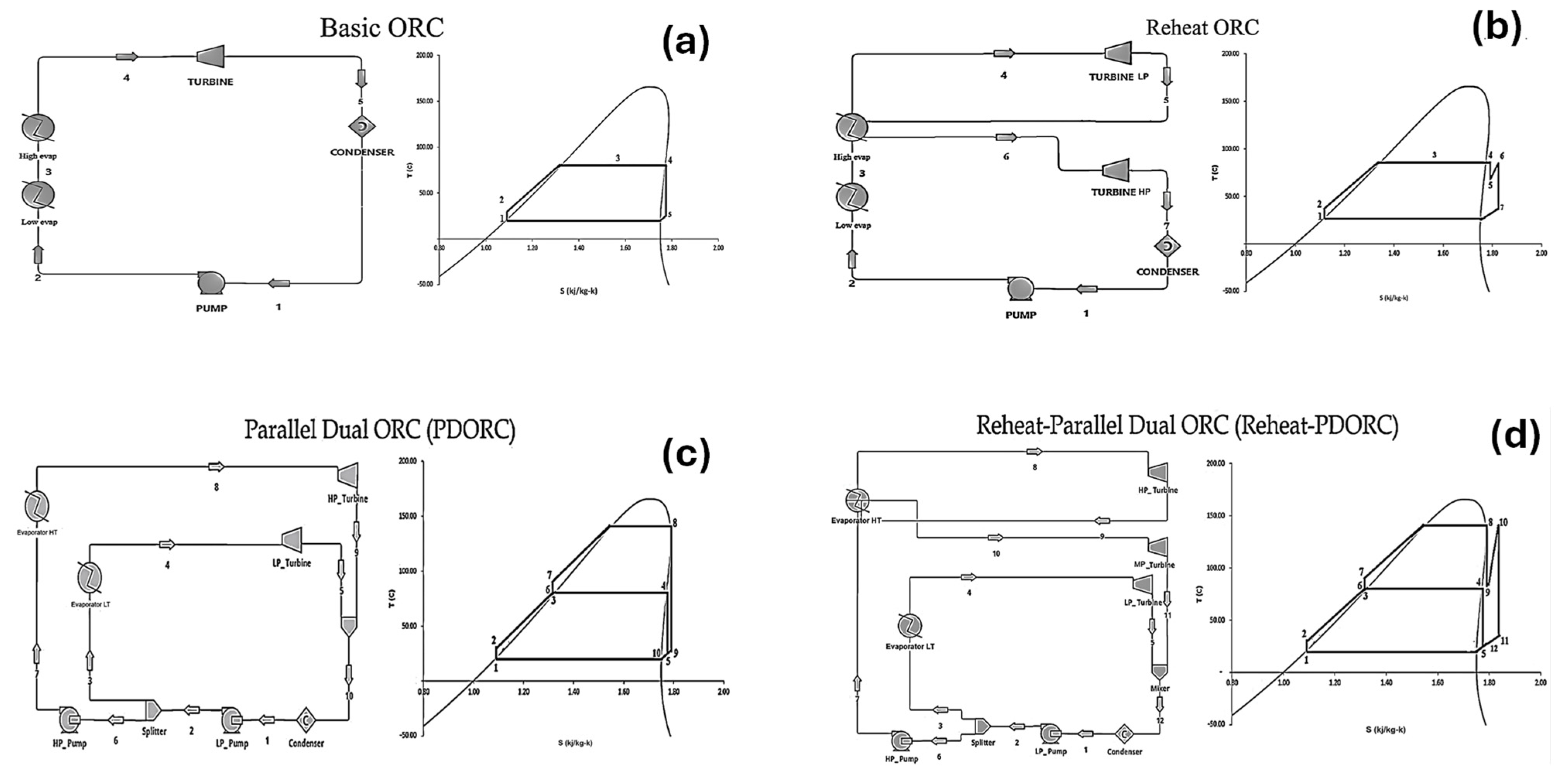
ORC is a closed-loop thermodynamic system designed to convert heat into mechanical work, with various configurations developed to enhance both efficiency and power output [23]. ORC systems use the phase change properties of organic working fluids, making them effective for power generation from low-to-medium-temperature heat sources [24]. Figure 1 shows the schematic of ORC systems and the corresponding T−s diagrams for the ORC configurations.
Reheat ORC introduces a reheating stage between two pressure levels. In this setup, the working fluid partially expands in the first turbine (high pressure, HP) to an intermediate pressure, is reheated in a heat exchanger, and then undergoes further expansion in a second turbine (low pressure, LP). This staged expansion reduces exergy destruction by allowing the working fluid to absorb additional heat at a relatively high temperature during reheating. Maintaining a higher average heat addition temperature improves thermal matching between the heat source and the working fluid, resulting in more effective energy conversion and higher thermal efficiency [25].
When multiple temperature-level heat sources are available, the PDORC configuration can become advantageous. It employs two separate loops, each with its evaporator and turbine. The working fluid is divided into two streams, which independently undergo thermodynamic processes suited to different temperature levels before merging in a mixer ahead of the condenser. This configuration enhances heat recovery by adapting to varying thermal input profiles. The Reheat–Parallel Dual ORC (Reheat–PDORC) further advances this approach by incorporating reheating between the turbine stages, maximizing power output from complex or staged heat sources [26].
Each ORC configuration has been modeled using energy and exergy balance equations applied to the system components. The accompanying T–s diagrams illustrate the thermodynamic evolution of the working fluid throughout the cycle. Configuration-specific changes directly affect entropy generation, heat recovery, and system irreversibility, enabling more effective conversion of low- and medium-grade heat into work, depending on the working fluid and heat source temperatures.
The working fluid circulates in a closed-loop circuit through the pump, evaporator, turbine, and condenser. The thermodynamic modeling assumes steady-state conditions and one-dimensional flow throughout the system. Pressure drops within heat exchangers are considered negligible for each fluid. Potential and kinetic energy changes are neglected because their contributions are relatively small compared with thermal and mechanical energy transfers, and heat losses to the environment are assumed negligible unless otherwise stated [27]. The regime has been assumed to be steady for all components of the hybrid plant. The properties of the ORC working fluid states have been calculated using CoolProp [28].
The mathematical relations for the ORC configurations investigated, in terms of the net output work, heat and exergy input quantities, are reported in Table A1 of Appendix A.1.
In this study, ORC systems operate under well-defined thermodynamic conditions. At the exit of the evaporator, the working fluid reaches a dry saturated vapor state (quality of the vapor 1). The condenser inlet receives the fluid as overheated vapor and exits as saturated liquid (quality = 0), assuming water is used as the coolant, at an inlet temperature of 15 °C. Expansion and compression are assumed isentropic, to facilitate comparative performance evaluation across different configurations. The pressure values in both the evaporator and condenser vary and are constrained by the thermophysical properties of each working fluid. These pressures must remain within limits that ensure safe operation and optimal phase-change behavior for each specific fluid.
The thermal efficiency of ORC measures how effectively the cycle converts the heat input Q i n into a useful work output W n e t . It is calculated as the ratio of the net output work of the cycle to the heat input provided to the working fluid in the evaporator [2,29].
η t h = W n e t Q i n
Exergy analysis helps identify irreversibilities within the plant and determine the cycle’s efficiency in accordance with the Second Law of Thermodynamics. To conduct a detailed thermo-economic analysis, it is necessary to calculate the exergy of each stream and quantify exergy destruction in all system components. The general exergy balance equation, for a steady regime, can be written as:
E ˙ x i n = E ˙ x o u t + E ˙ x d e s t r
where in refers to all entering terms, diffusive or convective; out to the output terms; and destr to the exergy destruction, which represents the irreversibilities of the process.
Table 1 shows the exergy terms involved in the balance equations for each ORC component.
The exergy efficiency equation for the ORC is defined as follows [30], with the exergy input defined as in Equation (2) for each configuration:
η e x = W n e t E x e r g y   I n p u t
The total exergy of a stream is given by the sum of the physical and chemical components (neglecting the kinetic and potential terms):
e x t o t = e x p h + e x c h e m
The physical exergy of the working fluid is evaluated as:
E ˙ x p h = m ˙ h o u t h i n T 0 s o u t s i n
with m ˙ being the mass flow rate, h the enthalpy, s the entropy assessed at the appropriate port section and T0 the environment temperature, set equal to 298 K.
The steady-state assumption, negligible pressure losses in heat exchangers, and isentropic behavior of turbomachinery are adopted to ensure internal consistency and comparability among different ORC configurations and working fluids. These assumptions are commonly employed in comparative ORC studies and allow the influence of configuration complexity and fluid selection to be isolated, rather than providing a detailed off-design or transient analysis. The steady-state analysis approach does not capture dynamic coupling between components with different response times. However, because the daily and seasonal load-shifting strategies examined involve transitions that occur over hours, these dynamic effects remain secondary.

2.1.2. Working Fluids

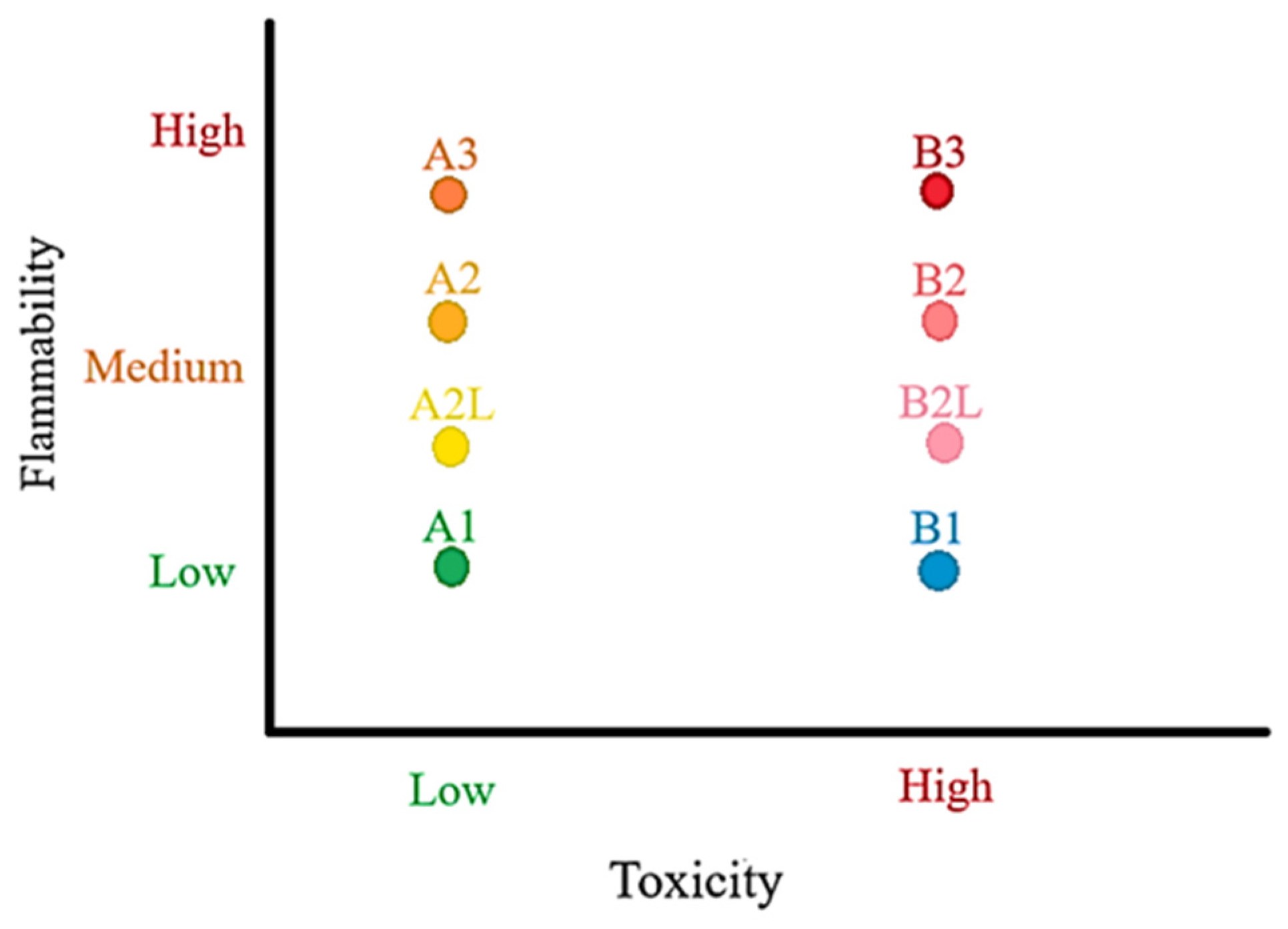
Table 2 presents key thermophysical properties of the selected fluids, including critical temperature and pressure, boiling point, thermal stability, and environmental impact indicators such as the Global Warming Potential (GWP100), Ozone Depletion Potential (ODP) and safety classification, according to ASHRAE.
R1233zd(E) and R245fa are nowadays commonly used in industrial heat recovery and geothermal applications due to their high thermal stability and non-flammability. R1234yf, with a lower boiling point, is suitable for low-temperature recovery, particularly in automotive applications. R601 (n-pentane) and R600a (Isobutane) exhibit higher critical temperatures and are preferred in geothermal and micro-ORC systems, although their flammability requires careful handling. R152a, characterized by its high critical pressure and moderate thermal stability, is a promising option for low-temperature ORC applications but requires precautions due to its mild flammability [31,32].
These fluids have been selected to evaluate ORC performance under various heat source conditions, thereby ensuring an optimal balance among efficiency, safety, and environmental sustainability. Further aspects of safety and fluid types are discussed in Appendix A.2.

2.1.3. Proton Exchange Membrane Electrolyzer PEMEC and Fuel Cells PEMFC

Electrolyzers (ECs) decompose water (H2O) into hydrogen (H2) and oxygen (O2) by supplying external energy, as the reaction is endothermic [33]:
H 2 O + E n e r g y H 2 + 1 2 O 2
In electrolyzers, the total energy required for water splitting equals the enthalpy change (ΔH), which is given by the sum of the minimum electrical energy required (ΔG) and the thermal energy (T·ΔS), according to the relation ΔH = ΔG + T ΔS. Thus, theoretically, the minimum electrical energy required to produce one kilogram of hydrogen would be equal to 32.7 kWh/kgH2. The actual minimum energy requirement is higher because the reaction is not isothermal, requiring additional thermal energy to compensate for the entropy change. This is the so-called “thermo-neutral” case, which would require 39.4 kWh/kgH2 [34].
In practical applications, the actual voltage required to drive electrolysis is higher than the theoretical minimum due to various intrinsic losses. These include activation losses ( V a c t ) , which result from energy barriers at the electrodes and are influenced by factors such as temperature, current density, and electrochemical kinetics, as well as Ohmic losses ( V o h m ) , which arise from the electrical resistance of the membrane and other cell components, depending on parameters like membrane thickness, ionic conductivity, and hydration level [35]. Additionally, concentration losses ( V c o n c ) occur prominently at high current densities, where limitations in mass transport hinder the effective delivery of reactants to the reaction sites [36]. The total voltage that must be applied to the electrolyzer ( V E C ) is the sum of the thermodynamic and loss components:
V E C = E + V a c t + V o h m + V c o n c
The efficiency of a single cell of the electrolyzer can then be expressed as the ratio of the minimum voltage for the “thermo-neutral” case, given by ΔH/n.F = 1.48 V, to the operational voltage VEC:
η c e l l = 1.48 V E C
whereas for the entire EC, the definition of efficiency can be based on the Lower Heating Value (LHV) of hydrogen, as in:
η E C = m ˙   L H V W ˙ e l
in which W ˙ e l is the electrical power input required for the electrolysis process.
Fuel cells (FCs) are electrochemical devices that are the reverse of electrolyzers, converting the chemical energy of hydrogen directly into electrical energy through redox reactions. Among the various types of fuel cells, PEMFCs are distinguished by their high efficiency, compact design, and suitability for low-temperature operation (70–100 °C). These characteristics make them ideal for applications requiring rapid start-up and shutdown, including transportation and portable power generation [37].
The energy released in a PEMFC originates from the enthalpy of formation (ΔH) of water, resulting from the reaction of hydrogen ( H 2 ) and the oxygen ( O 2 ) in the air [38], assuming a typical composition, with 79% of N2 and 21% of O2:
H 2 + 1 2 O 2 + 3.76 N 2 H 2 O + 1 2 3.76 N 2 + E n e r g y
The total enthalpy change for water electrolysis is ΔH = −285.84 kJ/mol, corresponding to the higher heating value (HHV) of hydrogen. Thus, the efficiency of the FC can be calculated as in ref. [39]:
η F C = W ˙ e l m ˙ H 2 H H V
The required voltage depends on temperature and gas partial pressures, as higher temperature increases the thermal component and the required voltage. However, real systems require higher voltages due to three main losses: activation losses (electrode kinetics), Ohmic losses (membrane/electrode resistance), and concentration losses (mass transport limits at high current densities). The required voltage for the electrolysis process is influenced by factors such as temperature and the partial pressures [40].
The output voltage of a single cell can be defined as the result of the following expression [41]:
V F C = E V a c t V o h m V c o n c
Actual output voltage VFC deviates from the theoretical Nernst potential E due to irreversible losses categorized as activation, Vact, Ohmic, Vohm, and concentration, Vconc, overpotentials. When electrochemical reactions occur, as in the electrolyzer (EC) and fuel cell (FC), the chemical exergy component should be included in the calculations. Since hydrogen and oxygen are released from two different electrodes of the electrolyzer, they do not mix at the exit. Thus, the total exergy of each exiting stream is given by Equation (4). In Table 3, the exergy terms involved in the EC and FC are reported. The chemical component of each substance is extracted from the tables in ref. [42]. For the EC and FC, the exergy associated with heat absorbed or released by the component is assumed to be zero, since the thermal reservoir is taken to be the environment at 298 K.

2.2. Integration of ORC Power Generation and Hydrogen System

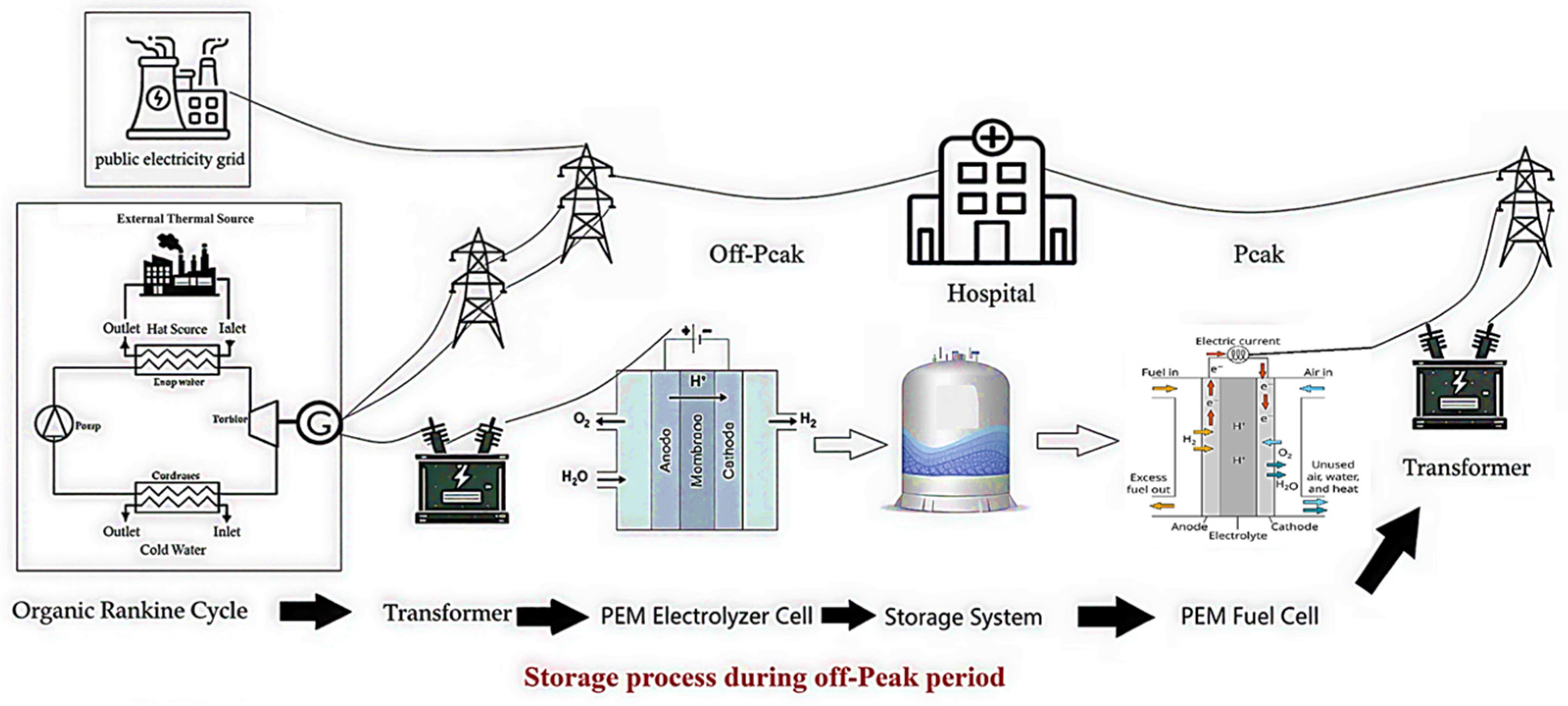
Figure 2 presents the energy system investigated in this research. The configuration integrates an Internal Combustion Engine (ICE), primarily used to meet the electrical energy requirements of industrial applications, with an ORC unit that recovers WH and converts it into additional electrical power. The resulting electricity of the ORC plant is delivered to ensure a reliable supply to critical infrastructure such as hospitals and thereby enhancing both energy efficiency and system resilience. During off-peak periods, characterized by low energy demand and typically lower electricity prices, a portion of the generated electricity is allocated to hydrogen production via a PEMFC. This strategic approach enables efficient energy storage by converting surplus, low-cost electrical energy into hydrogen, which is then stored in the integrated storage system for subsequent use. The excess energy is calculated by comparing the hourly user energy demand with the electricity produced by the ORC, which acts as a WH recovery bottoming cycle independent of the ICE’s electrical load management strategy.
Although hydrogen-based energy storage systems exhibit significantly lower round-trip efficiencies, typically 30–40%, than Battery Energy Storage Systems, usually larger than 85%, hydrogen is not considered in this study as an efficiency-optimized short-term storage solution. Instead, it is investigated as a system-level flexibility option in scenarios where electricity is generated as a byproduct of WH recovery and cannot be modulated directly at the source. In this context, hydrogen storage is evaluated as a marginal energy carrier that can increase energy autonomy and reduce grid dependence, rather than as a competitor to electrochemical storage technologies optimized for daily load-shifting.
During peak-demand periods, when electricity consumption and prices are highest, stored hydrogen is fed into the PEMFC to generate electricity. This approach provides a continuous and stable energy supply while optimizing the use of excess electricity produced during low-demand periods.
The sequential process flows from ORC-based power generation through the transformer to the PEMEC for hydrogen production and storage during off-peak hours, and finally to the PEMFC for electricity generation during peak periods. By strategically managing electricity production, storage, and utilization through this integrated hydrogen storage system, the methodology enhances energy efficiency and reduces the costs of power generation. Additionally, this integration offers a sustainable solution to mitigate energy fluctuations and enhance grid stability, while meeting critical infrastructure needs.

2.3. Thermoeconomic Assessment

The economic analysis is based on discounted cash flows. The cash flows account for the initial capital investment (CAPEX) and the annual cash flow from operating costs (OPEX) incurred by the working plant, including both variable and fixed costs [43].
LCOE is a key economic metric for assessing the cost-effectiveness and financial sustainability of power generation technologies [44]. Expressed in $/kWh, LCOE is the levelized total cost of electricity production over a plant’s lifespan, encompassing all capital (CAPEX) and operating expenditures (OPEX), adjusted for economic factors such as discount rates and inflation.
CAPEX comprises upfront costs for construction, equipment procurement (e.g., turbines, pumps, heat exchangers), installation, and grid interconnection. This initial investment significantly affects the LCOE, depending on the system’s scale and complexity. OPEX comprises ongoing expenses, including maintenance, labor, spare parts, and working fluid replenishment, which affect the plant’s long-term financial performance.
To determine LCOE, the plant’s Annual Electricity Generation is estimated based on installed capacity, operational hours, and capacity factor. The Total Annual Cost is obtained by summing the annualized CAPEX and OPEX, and then dividing it by the annual estimated electricity generation to derive the LCOE. Mathematically, LCOE is expressed as [45]:
L C O E = C 0 + t = 1 N M t + F t 1 + i t t = 1 N E l t 1 + i t
where C0 is the investment expenditure, Mt the annual operations and maintenance costs for energy production and storage, Ft the fuel expenditures per year, Elt is the annual estimated electricity production, i the yearly discount rate, and N is the operating lifetime of the project.
Similarly, the levelized cost of hydrogen (LCOH), expressed in $/kg of H2 produced, reflects the levelized cost of hydrogen production. It can be calculated using a similar approach [45]:
L C O H = C 0 + t = 1 N M t + C E t 1 + i t t = 1 N H Y t 1 + i t
where CEt represents the annual cost expenditure of any fuels to produce hydrogen and HYt the annual hydrogen production (in kg).
Exergoeconomic analysis combines thermodynamic exergy principles with economic evaluation, providing valuable insights to enhance system efficiency by assessing the costs of irreversibilities. In this study, the Specific Exergy Costing (SPECO) method is applied, utilizing exergy balances and unit cost calculations for each system component, supplemented by auxiliary cost relations, to systematically assess the economic performance of the overall system [46].
The cost balance equations for the ORC employed in the present analysis are presented in Table 4 with Zk being the cost rate given by the sum of the capital investment (C0) and the operating and maintenance (OM) cost rates:
Z ˙ k = Z ˙ k C 0 + Z ˙ k O M
where each cost rate C0 is calculated by dividing the annual contribution by the time, expressed in hours per year, indicated by τ in the Equation (16):
Z ˙ k C 0 = C 0 C R F τ
and the Capital Recovery Factor (CRF) defined as:
C R F = i 1 + i N 1 + i N 1
where i is the effective annual discount rate, N is the lifespan of the plant, and τ the operating hours per year, assumed equal to 7000 h/y, except where otherwise stated. A discount rate of 8.0% and a project lifetime of 15 years are assumed for economic evaluations. The Z ˙ k O M is obtained by dividing the annual OPEX by τ. The cost balance equations for the EC and FC are presented in Table 5.
The CAPEX costs of the ORC components are obtained from [43,47] for which:
C a p e x H X = 6940 A r e a 0.412
considering the area of each heat exchanger involved, i.e., condenser and evaporators, and a shell and tube U-tube configuration [47].
The specific CAPEX for the turbines and pumps is, respectively:
C a p e x T u r = 6000 P 0.7
C a p e x P u m p = 3540 P 0.71
with P the rated power of the turbine and pump. Design, commissioning, pipes, valves, electric generator, building, and other auxiliaries are computed at 150% of the total CAPEX, as a function of the plant’s complexity.
The electrolyzers’ CAPEX is estimated using the equation given in ref. [48]:
C a p e x E C = k 0 + k Q Q α V V 0 β
CapexEC is the specific electrolyzer plant cost per kW. The constants k0, k, α, and β are fitting parameters. Q represents the electrolyzer design power absorption in kW. V and V0 denote the plant installation year and the reference year (2020), respectively. Similarly, for PEMFC, an equivalent correlation has been used to estimate CAPEX.
C a p e x P E M F C = k Q Q r e f γ V V 0 β

3. Results

Harnessing wasted energy, whether from off-peak electricity or unused heat in industrial processes, is essential for improving overall energy efficiency. Recovering this otherwise lost energy not only provides an additional power source but also helps reduce environmental impacts, such as greenhouse gas emissions and global warming [6]. By strategically exploiting these underutilized resources, it is possible to recover valuable energy across a wide range of facilities and industrial sectors.

3.1. Thermodynamic Results

The comparative analysis of different working fluids across various ORC configurations reveals significant variations in thermal and exergy efficiencies, power output, and mass flow rate, all of which are critical performance indicators.
ORC systems are supplied with realistic industrial WH sources, selected from an internal combustion engine system, among the most viable and accessible facilities for heat recovery. Two WH streams are considered: the first is the fluid in the engine’s cooling system, jacket water, at 90 °C with a mass flow rate of 150,000 kg/h; the second is exhaust gases at 560 °C with a mass flow rate of 170,000 kg/h. Both fluids are employed as heat sources for the ORC fluid in two separate heat exchangers. This data pertains to the full-load condition of a 9 MW internal combustion engine, which is intended to operate continuously at full load as a generator set for an external industry. These data are based on actual operating conditions in engine systems from companies such as Wärtsilä and Caterpillar, as documented in industrial reports and the technical literature [49,50]. The condensing stage is achieved using cooling water, with the condenser inlet temperature set to 15 °C.
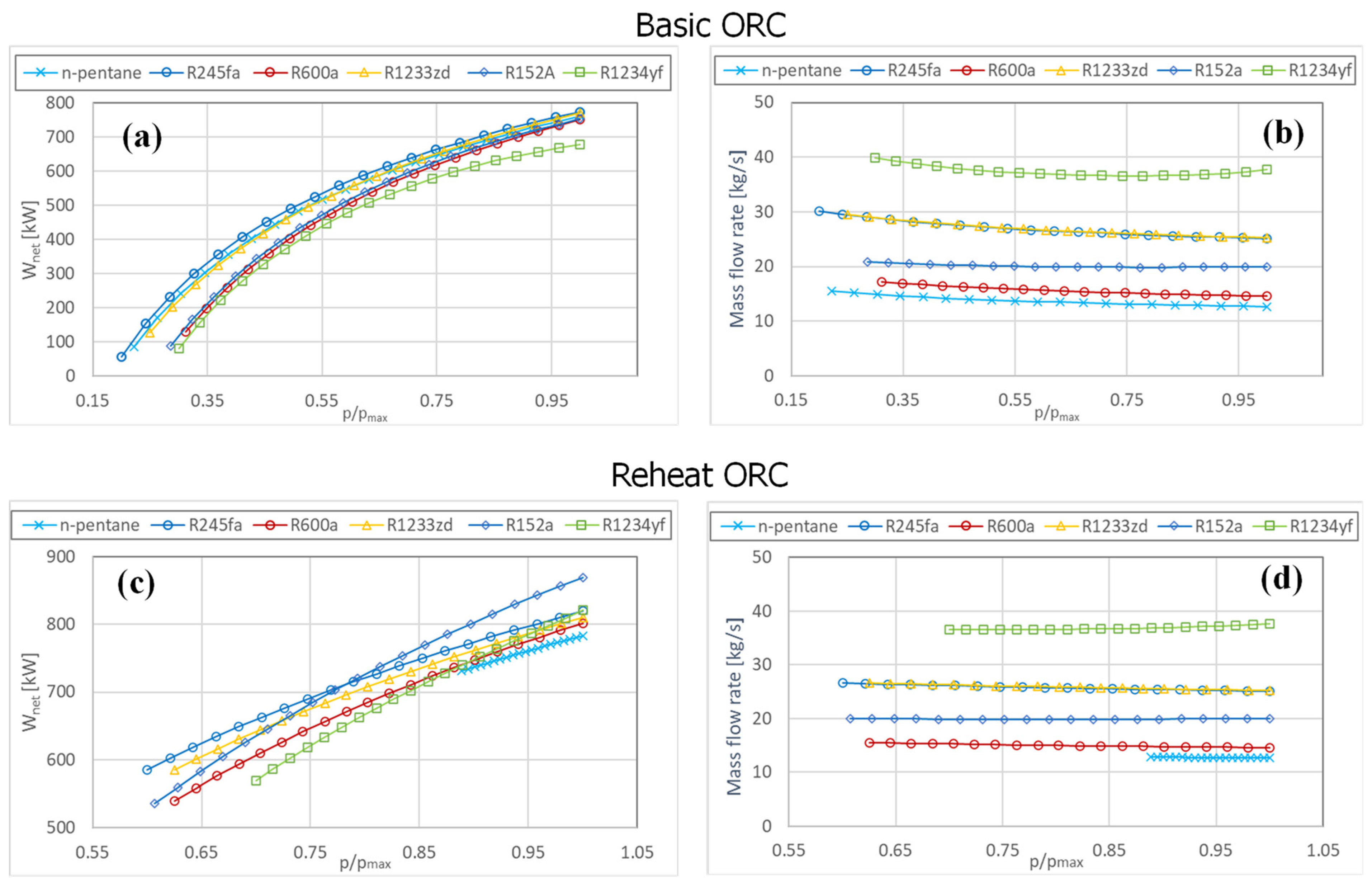
Figure 3 presents the net output power and mass flow rate characteristics for the six refrigerant fluids investigated in both BORC and Reheat BORC configurations. Figure 3a illustrates the relationship between net power output (Wnet) and the reduced pressure ratio (p/pmax), where p is the pressure during the heat addition phase and pmax denotes the maximum pressure attainable in the heating phase for each fluid in the BORC configuration, constrained by the lowest heat source temperature. All the fluids exhibit curves with net output power ranging from less than 100 kW to 775 kW as p/pmax increases. R245fa demonstrates superior performance, achieving approximately 775 kW at p = pmax (for pmax = 33 bar), while R1234yf exhibits the lowest output at 677 kW at its maximum pressure (pmax = 30 bar). The most notable performance divergence occurs between R245fa and R1234yf, with a 12.5% reduction. The Reheat configuration, Figure 3c, yields substantially higher performance across all refrigerants, with R152a reaching 870 kW and R245fa and R1234yf achieving 820 kW, R600a and R1233zd showing intermediate performance (800 to 810 kW). Notably, the reheat system operates at elevated pressure ratios (p/pmax ≥ 0.5) with steeper gradients, indicating enhanced thermodynamic efficiency. However, n-pentane exhibits limited operability in reheat mode, which is only possible for p/pmax > 0.9, because the intermediate pressure is already high, yielding approximately 783 kW. Figure 3b shows the dependence of the mass flow rate on the pressure ratio for the BORC systems. They exhibit different mass flow trends: R1234yf shows the maximum flow rate, 37 to 40 kg/s, with a non-monotonic trend, while n-pentane and R600a show the minimum (12.6 to 15 kg/s). R152a requires approximately 20 kg/s; R245fa and R1233zd approximately 26 kg/s. All fluids exhibit a decreasing trend with increasing p/pmax, except for R1234yf. In contrast, the Reheat configuration, Figure 3d, maintains nearly constant mass flow rates independent of the pressure ratio, stratified by working fluid: R1234yf (37 kg/s), R245fa/R1233zd (26 kg/s), R152a (20 kg/s), R600a (15 kg/s), and n-pentane (13 kg/s). This invariance largely simplifies turbomachinery design.
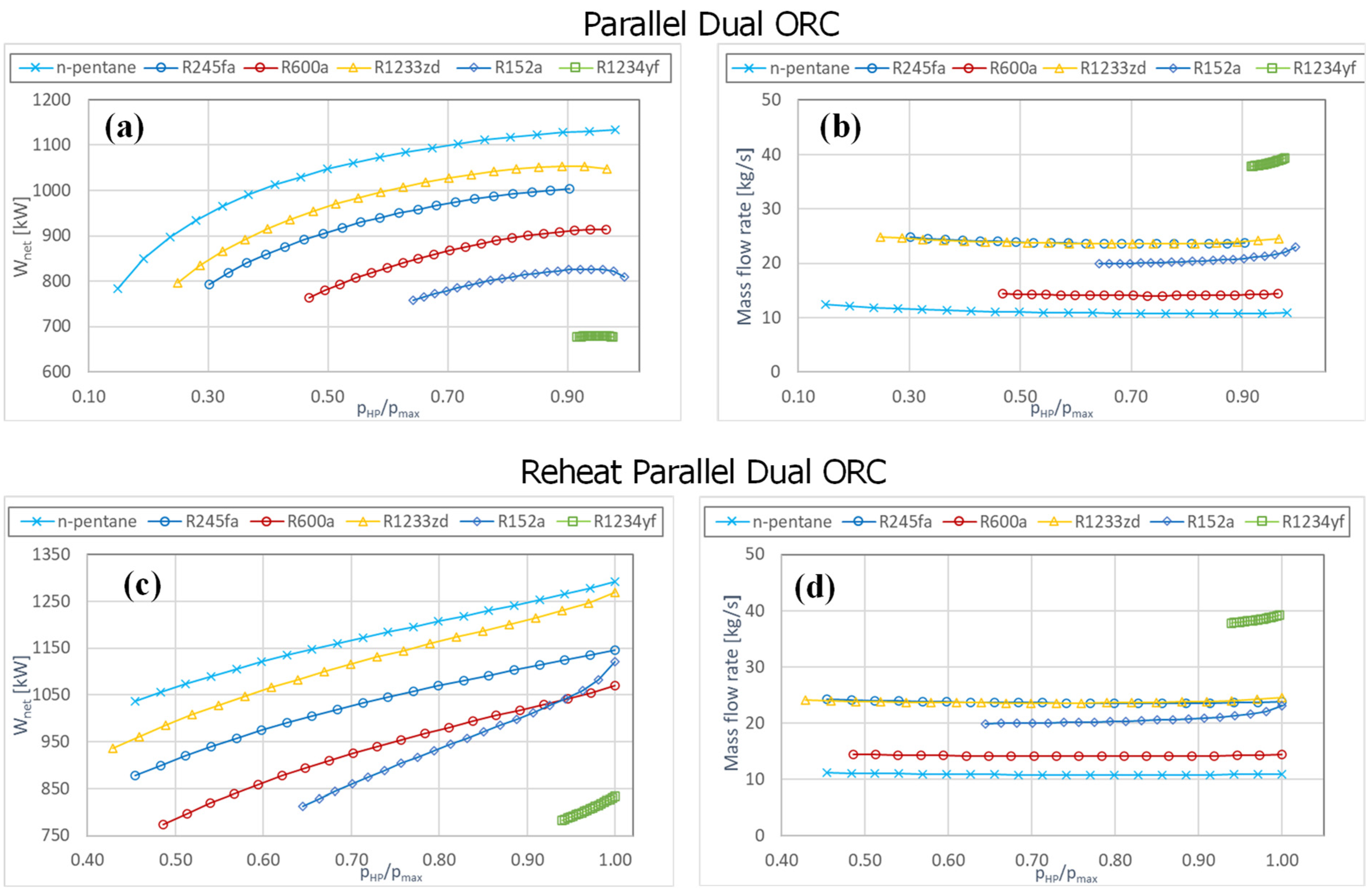
Figure 4 presents the net power output and mass flow rate characteristics of the PDORC and PDORC with Reheat configurations. Figure 4a,c illustrate the relationship between net power output (Wnet) and the reduced high-pressure ratio (pHP/pmax), where pHP represents the pressure in the HP branch of the cycle. In the PDORC configuration, all working fluids exhibit characteristic curves with power output ranging from approximately 820–1140 kW at pHP/pmax ≈ 1.0. N-pentane demonstrates the highest performance, achieving approximately 1140 kW, followed by R1233zd at around 1050 kW. R245fa delivers approximately 1000 kW, whereas R600a delivers approximately 913 kW. R152a shows significantly lower performance at approximately 826 kW, whereas R1234yf exhibits the most limited performance, with a restricted operating range (pHP/pmax ≈ 0.95) and a maximum power output of approximately 680 kW. The curves demonstrate smooth increases throughout the pressure range, with steeper gradients in the low-to-mid range (pHP/pmax = 0.2–0.6) and gradual saturation at higher pressure ratios. The Reheat + PDORC configuration demonstrates substantially enhanced performance across all fluids. N-pentane achieves the highest output at approximately 1293 kW, followed by R1233zd at around 1270 kW, R600a at approximately 1170 kW, and R245fa at about 1146 kW. R152a reaches approximately 1122 kW, whereas R1234yf maintains its restricted operating range (pHP/pmax ≈ 1.0) with an output of approximately 835 kW. The reheat system operates at higher pressure ratios (pHP/pmax ≥ 0.4) with consistently steeper gradients, indicating superior thermodynamic efficiency compared to the standard PDORC configuration.
Figure 4b,d depict the dependence of the mass flow rate on the pressure ratio. PDORC systems exhibit relatively stable mass flow trends across the pressure range, with a slight decline at higher ratios. R1234yf requires the highest mass flow rate, approximately 39 kg/s, within its limited operating range. R1233zd, R245fa, and R152a exhibit clustered behavior, with mass flow rates ranging from approximately 21 to 25 kg/s. R600a maintains around 14–15 kg/s, while n-pentane exhibits the lowest mass flow requirements at approximately 11–12 kg/s throughout the operating range. In the Reheat + PDORC configuration, mass flow rates remain essentially constant across the operating pressure range with distinct stratification: R1234yf maintains the highest flow at approximately 39 kg/s, R245fa and R1233zd cluster around 24–25 kg/s, R152a shows an increasing trend from approximately 20 to 23 kg/s, R600a maintains approximately 14 kg/s, and n-pentane the lowest tier around 10–11 kg/s.
This happens because in BORC, varying the evaporator pressure directly affects the fluid’s specific enthalpy rise and density. Since the heat input is fixed by the available WH, the mass flow rate must adjust accordingly, producing the observed variability. In Reheat and PDORC configurations, the additional degrees of freedom from dual heat addition stages (two evaporators or evaporator and reheater) allow pressure ratio adjustments to redistribute energy between HP and LP stages without altering the total mass throughput, since the combined thermal input remains constant. This results in the nearly constant mass flow rates observed in Figure 3d and Figure 4d. This relatively constant behavior simplifies turbomachinery design and reflects the thermophysical properties governing PDORC operation.
Performance variations reflect fluid thermophysical properties near the critical point. R1234yf’s low critical temperature (below 95 °C) limits its operating range in basic configurations. Exergy destruction shifts from evaporator-dominated (low p/pmax, poor thermal matching) to condenser-dominated (high p/pmax), with optimal performance at intermediate pressure ratios balancing these competing irreversibilities.
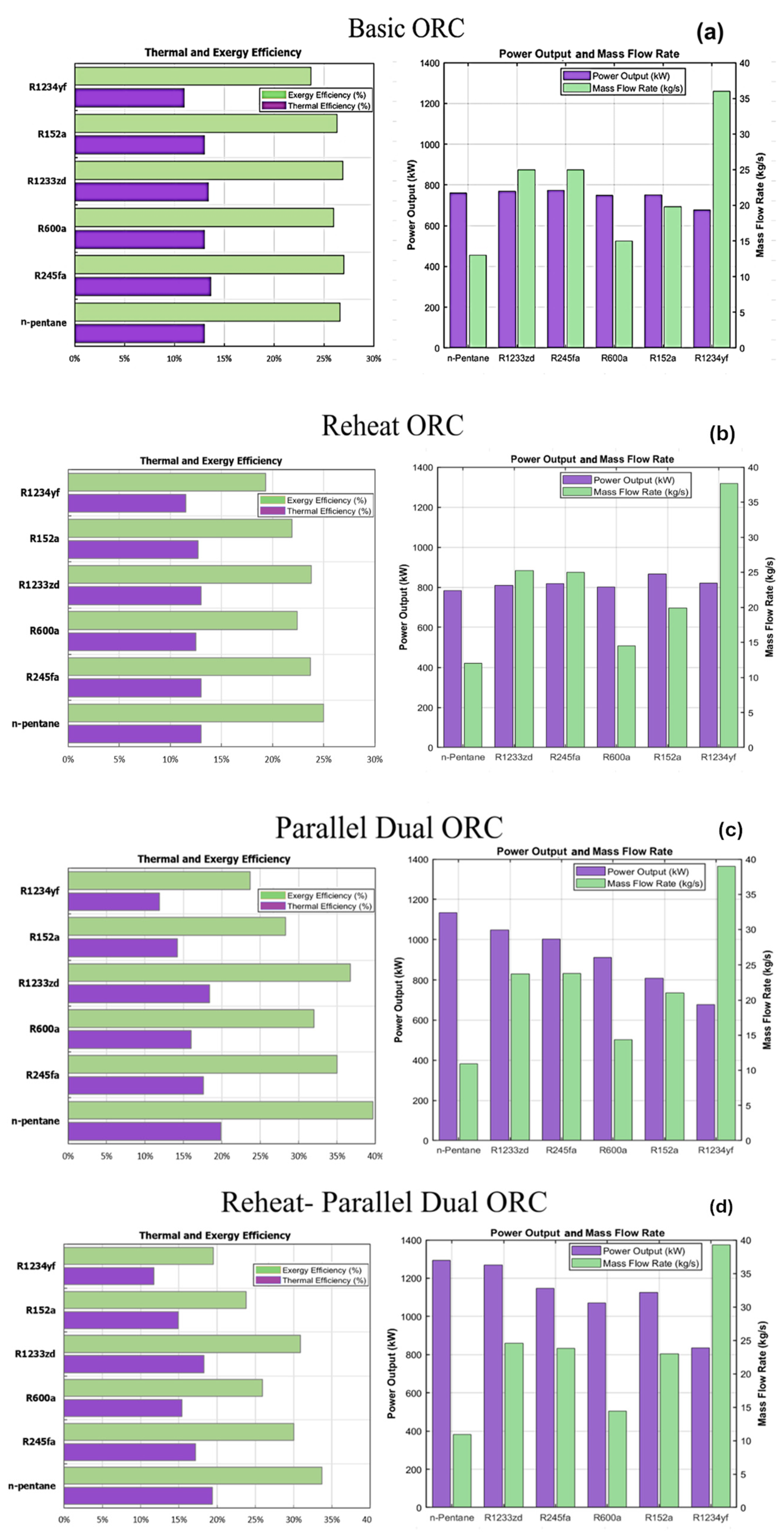
In Figure 5, a global comparison of the best performance for each ORC configuration and fluid is shown, highlighting the results from the previous investigation (Figure 3 and Figure 4). In the Basic ORC (BORC), as shown in Figure 5a, the fluids exhibit consistent performance clustering. R245fa achieves the highest thermal efficiency (14%) and exergy efficiency (27%) and produces the highest power output (774 kW). N-pentane and R1233zd exhibit comparable thermal and exergy efficiencies (13% and 27%) and similar power outputs (761 kW and 769 kW). N-pentane is preferable due to its much lower mass flow rate of 13 kg/s, compared with R245fa and R1233zd, which require 25 kg/s. Conversely, R1234yf performs worst across all metrics, with a thermal efficiency of 11% and an exergy efficiency of 24%, and delivers the lowest power output of 677 kW. It also necessitates the highest mass flow rate at 36 kg/s. These findings highlight the trade-offs between efficiency and fluid flow rates, with fluids that require lower flow rates being preferred since they impose lower operational demands.
The Reheat ORC, Figure 5b, which adds an additional heating stage, increases power output across all fluids while maintaining similar thermal efficiencies (approximately 13%, except for R1234yf, which is 12%). R152a achieves the highest power output at 867 kW, despite having a moderate thermal efficiency of 13% and an exergy efficiency of 22%. N-pentane maintains high efficiency (13% thermal, 25% exergy) and delivers 783 kW with the lowest mass flow rate of 12 kg/s. R1234yf, which requires the highest mass flow rate (37.7 kg/s), produces an output of 821 kW. Although the power gains from reheat are modest, the increase in power output underscores the advantages of incorporating reheat. The increases in power output between the BORC and the Reheat BORC range from 3% for n-pentane to 21.3% for R1234yf.
The Parallel Dual ORC (PDORC) in Figure 5c, which operates at two evaporation pressures to optimize energy extraction from the two-level heat sources, exhibits distinct performance trends. N-pentane attains the highest thermal efficiency of 20% and the highest exergy efficiency of 40%, generating a substantial 1133 kW with the lowest mass flow rate of 10.9 kg/s. R245fa closely follows, with an 18% thermal efficiency and 35% exergy efficiency, producing 1003 kW at a mass flow rate of 23.8 kg/s. R1233zd achieves an exergy efficiency of 18% and generates 1047 kW. R1234yf again ranks lowest in efficiency (12% thermal, 20% exergy) and power output (677.6 kW), while using the most fluid (39 kg/s), making it the least viable option.
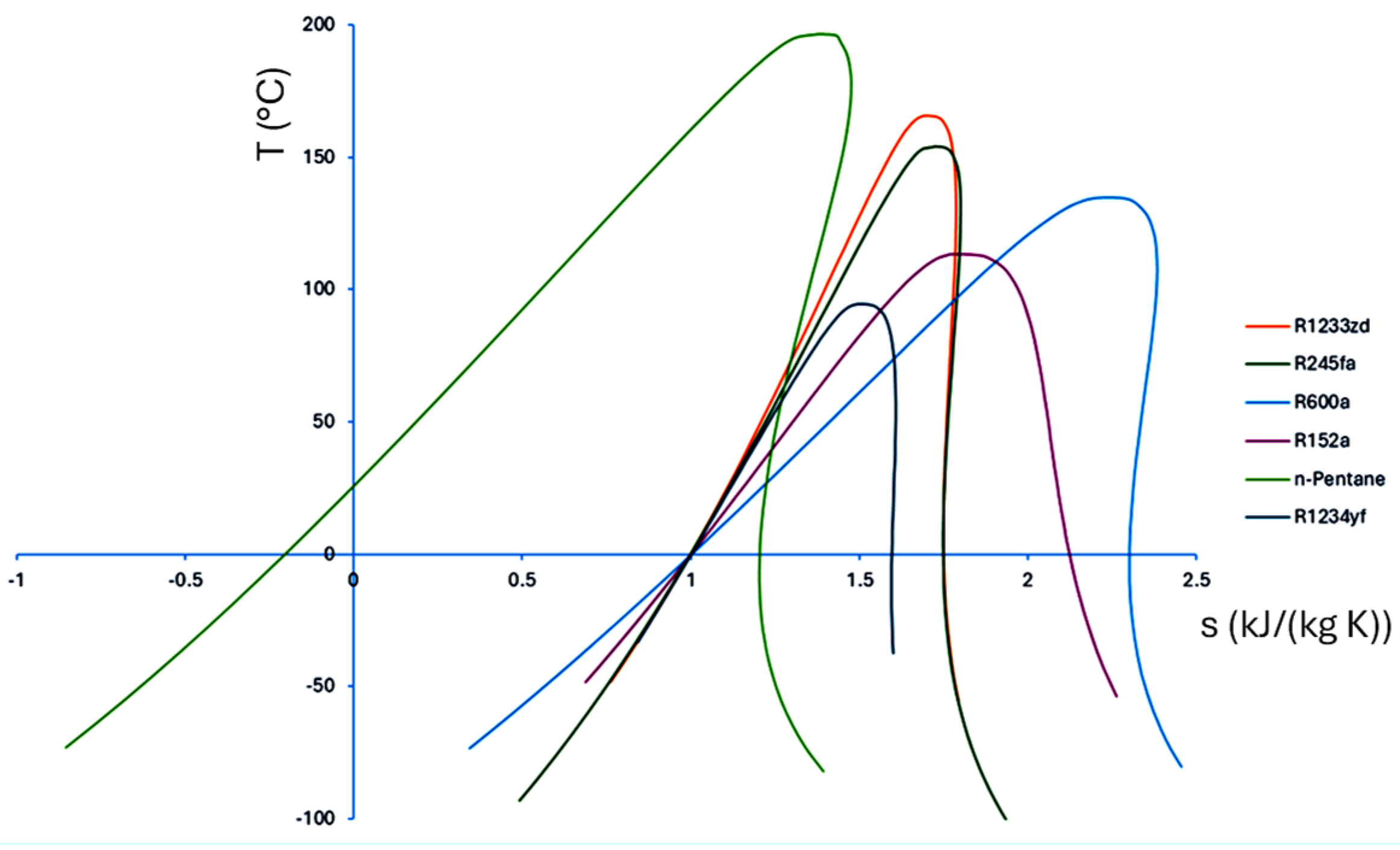
The Reheat PDORC combines reheat and dual-pressure features (Figure 5d). N-pentane achieves the highest power output of 1293 kW and the highest exergy efficiency of 34%, while maintaining the lowest fluid flow rate of 10.9 kg/s. R1233zd delivers 1269 kW of power with a thermal efficiency of 18% and an exergy efficiency of 31%. R245fa and R152a also perform commendably, generating 1146 kW and 1125 kW, respectively. R1234yf performs the worst, with the lowest thermal (12%) and exergy (20%) efficiencies and a power output of 834.7 kW, alongside the highest mass flow rate at 39.3 kg/s. These outcomes confirm that the Reheat PDORC configuration optimizes power output, with n-pentane consistently proving to be the most thermodynamically effective choice due to its high efficiency and minimal fluid consumption across all enhanced cycles. The power output increments from the simple PDORC to the corresponding Reheat BORC range from 14% for n-pentane to a much larger 38.6% for R152a. The reason lies in the shape of each fluid’s saturation curve on the T−s diagram. N-pentane is a dry fluid with a gently sloping saturated vapor line; single-stage isentropic expansion already keeps the fluid well into the superheated region, so reheating adds little thermodynamic benefit. R1234yf, by contrast, has a steep saturation curve and a low critical temperature. In single-stage expansion, the fluid quickly approaches or enters the two-phase region, reducing turbine efficiency and power output. Reheating restores the fluid to a superheated state before LP expansion, recovering a substantial share of potentially lost work. R152a behaves similarly as wet fluid and shows large reheat gains (+17.8%).

3.2. Economic Results

The cost structure of any system depends on component selection and operational requirements. High initial investments in critical components like turbines, heat exchangers, and control systems can improve efficiency and reliability. At the same time, maintenance and replacement costs must be accounted for to ensure long-term economic sustainability. Balancing capital (CAPEX) and operating and maintenance expenditures (OPEX) is crucial to optimizing the economic performance and feasibility of ORC implementations [51]. The economic parameters used in the subsequent analyses are reported in Section 2.3 and the discount rate was chosen equal to 5, 8 and 12% to allow for a sensitivity analysis. The 8% discount rate was used as the reference value.
The exergy unit cost is the cost per unit of exergy transferred through a component, expressed in $/kWh. It serves as a key exergoeconomic indicator for identifying where exergy is most expensive within the system. The equations are reported in Table 4 and Table 5.
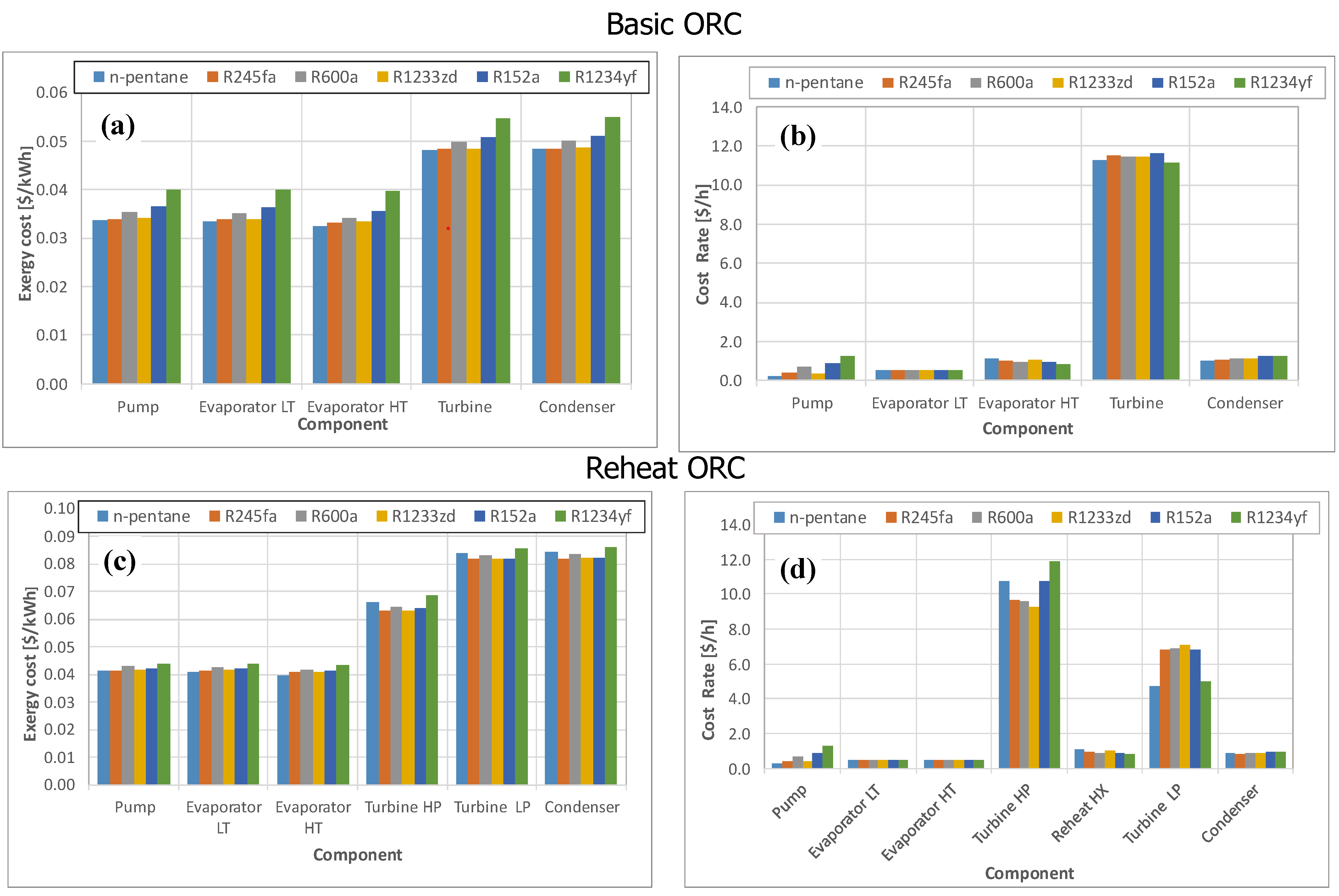
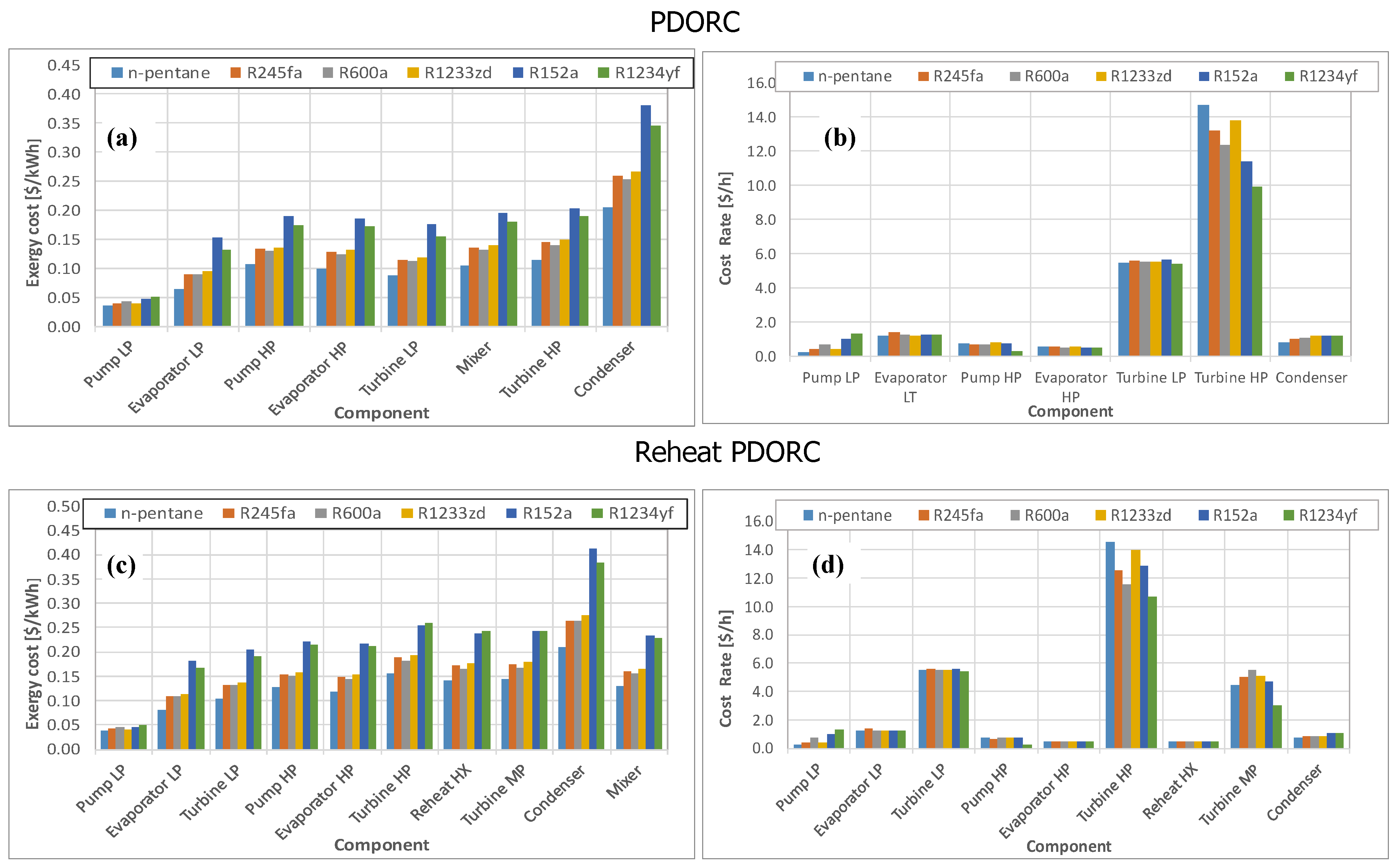
Figure 6 and Figure 7 present the exergoeconomic analysis of the four investigated ORC configurations—BORC, Reheat, simple PDORC, and Reheat PDORC—across six working fluids, with the configurations yielding the maximum Wnet, and assuming a discount rate i = 8%. The exergy cost plots directly link the monetary cost to the exergy, quantifying the exergy destroyed in each component. Indeed, the exergy costs also demonstrate that the thermodynamic history and cumulative costs, rather than the component’s own capital cost alone, determine the exergy cost of the output stream.
In detail, Figure 6a presents the exergy unit cost ($/kWh) for each BORC component across all six working fluids. A consistent observation in the BORC is that the condenser and turbine components incur the highest exergy cost per unit of energy produced for most working fluids, approximately 0.05 $/kWh, with the R1234yf being the most expensive fluid. This is a critical exergy aspect, as high exergy costs indicate significant irreversibility, primarily driven by substantial heat transfer across finite temperature differences within the heat exchangers. While the turbines have the highest absolute cost rates ($/h), their exergy cost per kWh is generally lower than that of the heat exchangers, owing to their very high initial capital cost. The figures show that the exergy costs are particularly high for certain fluids, such as R1234yf, R152a and R600a, in the condenser section ranging from 0.049 to 0.055 $/kWh, indicating that exergy destruction and transfer losses in the condenser contribute significantly to the overall economic burden. The turbine also exhibits high exergy unit costs, particularly for R1234yf, R152a and R600a, owing to the capital-intensive nature of turbine equipment. In fact, by exploring Figure 6b it can be observed that their total cost rates Z ˙ are larger by one order of magnitude compared with the other components. The turbine cost rate is around 11 $/h for all the fluids, and the condenser cost rate ranges from 1.0 to 1.2 $/h. In contrast, the two evaporators (LT and HT) exhibit the lowest unit costs, ranging from 0.033 to 0.040 $/kWh, which are close to the pump costs, reflecting their lowest total costs due to low CAPEX and efficient exergy transfer from the heat source to the working fluid. Non-meaningful differences are found between the LT and HT evaporators. Among the working fluids, R1234yf and R600a generally have slightly higher unit costs for most components, whereas n-pentane, R245fa, and R1233zd have lower unit costs.
Figure 6c shows the exergy unit cost for each component across all six working fluids in the Reheat ORC. The condenser has the highest exergy unit cost for all fluids, ranging from approximately 0.082 to 0.086 $/kWh, higher than in the BORC because the two turbines reject heat at higher temperatures after the LP turbine. A primary observation is that the condenser and LP turbine components consistently exhibit the highest exergy costs across almost all working fluids, ranging from approximately 0.084 to 0.088 $/kWh for fluids such as R245fa and R600a. This indicates that these sections are where the quality of energy is most expensively lost or where the accumulated cost of the flowing stream is highest relative to the exergy produced. The two turbines (LP and HP) also exhibit relatively high unit costs (Figure 6c), at approximately 0.068–0.088 $/kWh, reflecting the capital investment required for dual-stage expansion equipment. The HP turbine has a 20% lower exergy cost than the LP turbine. The LP turbine is inherently part of a flow that has already been processed by the HP turbine and the reheater. The cost of exergy entering the LP turbine includes the cumulative costs of all upstream components (evaporator, HP turbine, reheater). While the LP turbine generates additional work, the quality and economic value of the energy stream entering it are already high due to these accumulated upstream costs. The principles of exergoeconomics dictate that these costs are borne throughout the system. Consequently, the cost per unit of product exergy generated by the LP turbine appears higher because it is the final major work-producing stage before the high-exergy-destruction condenser. As shown in Figure 6c, the LP turbine exergy cost ranges from 0.084 to 0.088 $/kWh, depending on the fluid, and the HP turbine ranges from 0.065 to 0.07 $/kWh. This means that, although the LP turbine operates isentropically, its contribution to overall system cost-effectiveness is weighted by the fluid stream’s cost history. In essence, the HP turbine is a more expensive component, but the LP turbine processes a more “expensive” fluid stream due to the thermodynamic history and upstream capital costs of the complex Reheat BORC system. The stream entering the reheater has already accumulated the costs from the evaporators and the high-pressure turbine. As heat is added to the reheater, the stream’s exergy increases, as does its total accumulated monetary cost. The value shown in the figure (approximately 0.084–0.089 $/kWh) reflects the cumulative value. While the reheater does cause exergy destruction internally due to the temperature difference between the heat source and the working fluid—which implies irreversibilities—the primary reason for the magnitude of the exergy cost value in Figure 6c is the high value of the fluid stream flowing through it after several expensive upstream processes. This demonstrates that the thermodynamic history and cumulative costs, rather than the component’s own capital cost alone, determine the exergy cost of the output stream. The pump presents intermediate values across all fluids, ranging from 0.041 to 0.044 $/kWh. Among the working fluids, n-pentane, R245fa, and R1233zd exhibit more consistent, generally lower unit costs across most components, whereas R600a and R1234yf tend to show slightly higher values, particularly in the turbines and condenser.
In the more advanced PDORC and Reheat PDORC configurations shown in Figure 7, the exergy analysis reveals an even greater concentration of exergy costs on the heat-rejection side. Specifically, the HP condenser in these multi-pressure systems incurs exceptionally high exergy costs, sometimes exceeding 0.3 $/kWh. The figures demonstrate that the choice of working fluid critically affects which component bears the greatest exergy cost burden in a given cycle design. The exergy cost comparison between Figure 7a (PDORC) and Figure 7c (Reheat PDORC) highlights how adding a reheat stage fundamentally alters the distribution of thermodynamic inefficiencies or economic burden throughout the cycle. Both configurations represent complex, high-efficiency systems, but they manage the cumulative cost of destroyed exergy differently. In the standard PDORC (Figure 7a), the exergy cost profile exhibits a single sharp peak at the final stage, the condenser. For all six working fluids, the condenser consistently exhibits the highest exergy cost, exceeding 0.3 $/kWh for R1234yf and R152a, with the former fluid showing a consistently higher value of 0.35 $/kWh compared with a much lower 0.20 $/kWh for n-pentane. The entire cost burden of the upstream pumps, evaporators, and turbines converges here, making the final heat-rejection process the most “expensive” thermodynamic bottleneck. The Reheat PDORC (Figure 7c), by contrast, presents a more distributed profile of high exergy costs. While the condenser remains a significant cost spot, the values are sometimes slightly lower than in the standard PDORC because the reheat process helps manage the temperature profile more effectively earlier in the cycle. Instead of one single peak, several components with high exergy costs are observed: the HP turbine, the reheat HX, and the condenser. This means that irreversibilities are distributed across multiple heat-addition and heat-rejection stages. The added complexity of the reheat loop mitigates some of the peak exergy destruction observed in the simpler PDORC condenser, but it introduces additional areas of high accumulated cost within the cycle.
Comparing exergy costs across the four cycle configurations (Figure 6 and Figure 7) highlights substantial differences in the magnitude and distribution of thermodynamic inefficiencies as cycle complexity increases. The most striking difference is the overall scale of the exergy costs. The Basic and Reheat ORC configurations, Figure 6, operate within a maximum exergy cost range of approximately 0.01 $/kWh to 0.09 $/kWh. The primary cost locations here are the condenser and turbines. In sharp contrast, the advanced PDORC and Reheat PDORC configurations (Figure 7) exhibit significantly higher peak exergy costs, which can exceed 0.30 $/kWh in certain components, particularly the condensers. This represents a three-to-five-fold increase relative to the simpler cycles. Regarding distribution, the simpler cycles in Figure 6 show a more moderate, relatively even spread of costs across most components. The complex cycles, Figure 7, localize extremely high exergy costs to specific components, primarily the condensers in both PDORC configurations. This indicates that while advanced cycles may offer better overall system efficiency by optimizing certain processes, they introduce specific, highly inefficient thermodynamic bottlenecks that concentrate the monetary value of exergy destruction at specific points. The figures clearly illustrate that moving from a single-pressure to a dual-pressure system drastically changes the economic–thermodynamic landscape, increasing the “cost” of useful exergy lost during the heat-rejection phases.
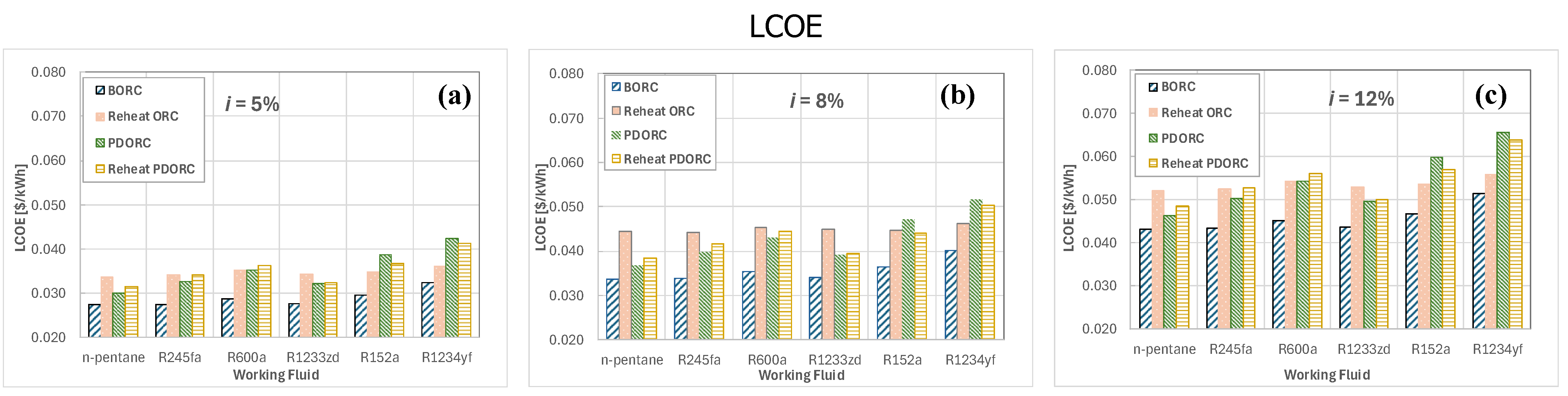
Figure 8 presents the LCOE ($/kWh) of the four ORC configurations across six working fluids, serving as the final economic summary of the previously discussed thermodynamic and capital costs, assuming 7000 h/y and using the three different discount rates. These figures highlight that the simplest cycle design consistently offers the most economically viable power generation. The BORC configuration, with the reference discount rate set to 8%, Figure 8b, shown by the leftmost bars, achieves the lowest LCOE for all analyzed working fluids, remaining within a narrow band of approximately 0.033 to 0.040 $/kWh. This outcome suggests that the lower capital investment of a simpler system outweighs the potential efficiency gains of more complex designs under these operating conditions. The choice of working fluid also plays a main economic role. Several fluids (n-pentane, R245fa, R1233zd) exhibit nearly identical LCOE values of approximately 0.035 $/kWh. In contrast, R1234yf is clearly the least economically attractive fluid in this analysis, with the highest LCOE across all four system types, at 0.040 $/kWh. Conversely, the more complex configurations—the Reheat ORC, PDORC, and Reheat PDORC—yield higher LCOEs. The Reheat BORC (orange dotted bars) frequently exhibits the highest LCOEs, with a 15–32% increase; the lowest increase is for R1234yf, and the largest is for R1233zd, with a 32% increase. The PDORC configurations are always more expensive than the BORC, with increases of 9% and 18% for n-pentane and R245fa, but are more costly for R152a and R1234yf, with increases of more than 29% relative to the BORC configuration. The Reheat PDORC can either be as low-priced as the BORC (e.g., for n-pentane and R1233zd with increments around 14 to 16%) or quite expensive (e.g., for R1234yf), exhibiting the least cost-effective performance among the fluids. The figure ultimately demonstrates that, although complex systems may optimize certain thermodynamic aspects, the simple BORC provides the most cost-effective solution for power generation among the configurations presented under the assumed constraints. In any case, the LCOE of any investigated ORC is always largely more affordable than the price of electricity from the grid. N-pentane demonstrates the best economic performance across all cycle configurations, followed by R1233zd, while R1234yf exhibits the poorest. Among the cycle types, the BORC and PDORC configurations yield the lowest LCOE values for the two best-performing working fluids and will therefore be employed in subsequent analysis. The BORC configuration demonstrates a significant techno-economic advantage through architectural simplification, requiring only four components compared to seven or eight in more complex configurations. This simpler design reduces capital expenditure by 40–50% while retaining 80–85% of the power output achievable with advanced architectures, resulting in superior LCOE performance.
This is true considering all the employed discount rates. When the lowest discount rate, i = 5%, is considered (Figure 8a), the largest reduction compared with the reference discount rate, i = 8%, is achieved with the PDORC configuration, with similar reductions across all fluids of approximately 18%. The LCOE of BORC is approximately 19% less than the reference discount rate (i = 8%) across all working fluids. The largest LCOE reduction is achieved with the Reheat ORC configuration, at around −23%. Figure 8c considers the discount rate i = 12%. In this case, the LCOE increases and the largest increment is attained for the BORC configuration, with around 28%, nearly equivalent across all the working fluids. The smallest increment, between 17.1% and 21.3%, is obtained for the Reheat BORC configuration. PDORC and Reheat PDORC configurations exhibit 26% and 27% increases in LCOE across all fluids.
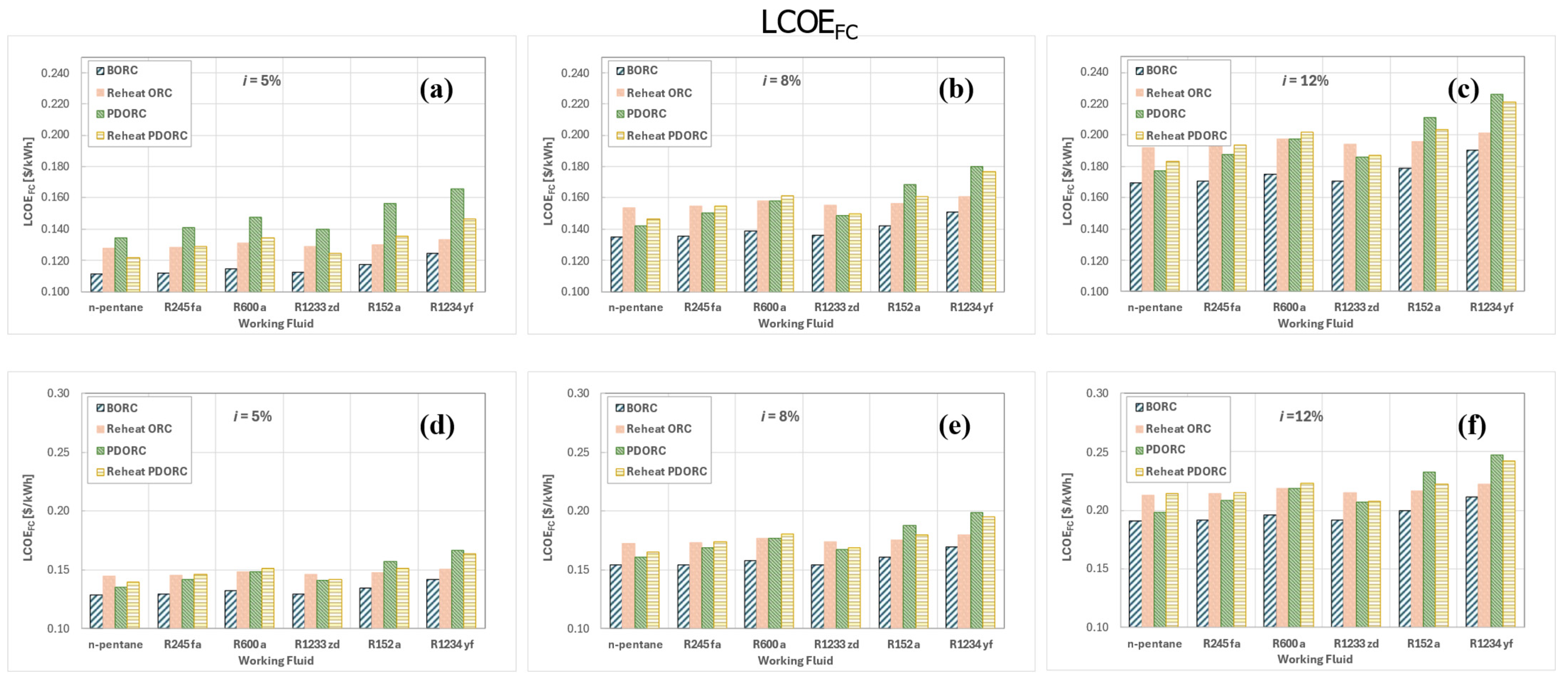
Figure 9 and Figure 10 display the LCOEFC across different CAPEX values, and the LCOH under the same CAPEX conditions. The operating hours are assumed to be the same, i.e., 3000 h/y for the hydrogen systems and 7000 h/y for the ORC, and assuming the three discount rate values, to carry on a sensitivity analysis. The efficiency of the EC has been assumed to be 70%, and that of the FC 50%.
In Figure 9a–c, the low investment costs of the hydrogen system (500 $/kW for the PEM EC and 1000 $/kW for the PEM FC) result in consistently low LCOE values for the FC across all working fluids and ORC configurations. The capital recovery component dominates the cost structure because the fuel cell operates only 3000 h/y, so its relatively low utilization factor amplifies the impact of CAPEX on the levelized cost. As a result, although the thermodynamic differences between BORC, Reheat ORC, PDORC, and Reheat PDORC are still visible, their influence on LCOEFC is partially masked by the strong weight of capital costs. Specifically, for n-pentane, the maximum increase is approximately 14% when comparing the Reheat ORC with the BORC. For the same fluid, the PDORC shows a reduction of approximately 5.3%. Instead, comparing LCOE costs for R1234yf, the maximum increase is for the PDORC (+19.5%), whereas the minimum is 6.6% for the Reheat BORC. Considering the smallest discount rate, Figure 9a, LCOEFC values are smaller and the differences among all the configurations and fluids show a similar trend. In this case, the most expensive configuration is PDORC with R1234yf, with an LCOEFC of 0.166 $/kWh; the least expensive is the BORC for n-pentane, R245fa, and R1233zd, with a value of 0.112 $/kWh. When the greatest discount rate is analyzed (Figure 9c), a similar behavior is observed: the largest LCOEFC is obtained by the PDORC configuration using R1234yf as the working fluid, at 0.226 $/kWh; the smallest is for the BORC, at 0.170 $/kWh, considering the same fluids. When comparing the economic results for the two discount rates with the reference rate (i = 8%), it is evident that the reduction in the lowest discount rate ranges from −6% to −17.3% across all fluids, depending on the PDORC configuration. The increments account for approximately 25% more when the largest discount rate is considered and this is nearly the same for all the configurations and fluids.
In Figure 9d–f, where the CAPEX assumptions are increased to 1000 $/kW for the EC and 1200 $/kW for the FC, the entire set of LCOEFC curves increase. This indicates that the increase in investment costs hinders all configurations almost uniformly, without significantly altering their relative rankings. The comparison between Figure 9a–f, therefore, highlights that, under fixed operating hours, operating parameters and discount rate values (i = 5, 8 and 12%), the absolute value of the LCOEFC is highly sensitive to hydrogen system CAPEX, while the relative performance of different ORC layouts remains primarily governed by efficiency rather than economics. Similar considerations apply when comparing different ORC configurations for each working fluid. In fact, n-pentane shows the smallest changes, as is the case with the lowest CAPEX, with a maximum LCOEFC variation of around 8% among the least and the most expensive configurations, and approximately 10% comparing the PDORC with the BORC. R1234yf performs worse than any other fluid, considering that the minimum LCOEFC value is 0.142 $/kWh for the BORC when the discount rate is equal to 5% and the maximum LCOE is 0.247 $/kWh for the PDORC using the largest discount rate. The maximum variation for the same fluid occurs when comparing PDORC with BORC, with approximately +17% across all discount rates. Globally, the figures show that, for the case in Figure 9c, the maximum is 0.226 $/kWh (fluid R1234yf, PDORC configuration, and maximum discount rate) and the minimum is 0.112 $/kWh (fluid R245fa, BORC configuration and minimum discount rate), both of which remain affordable relative to the electricity market price. The configurations with higher CAPEX (Figure 9b) exhibit a minimum of 0.154 $/kWh and a maximum of 0.200 $/kWh at a discount rate of i = 8%, indicating that this LCOE is comparable to, or even cheaper than, that of grid electricity. Under these conditions, the economic penalty associated with converting electricity to hydrogen and back becomes more pronounced, given a round-trip efficiency of approximately 35%. Even if the ORC performs well thermodynamically, the conversion of electricity to hydrogen and back to electricity increases the capital cost burden. Consequently, differences between ORC layouts or working fluids are secondary to the dominant role of EC and FC CAPEX.
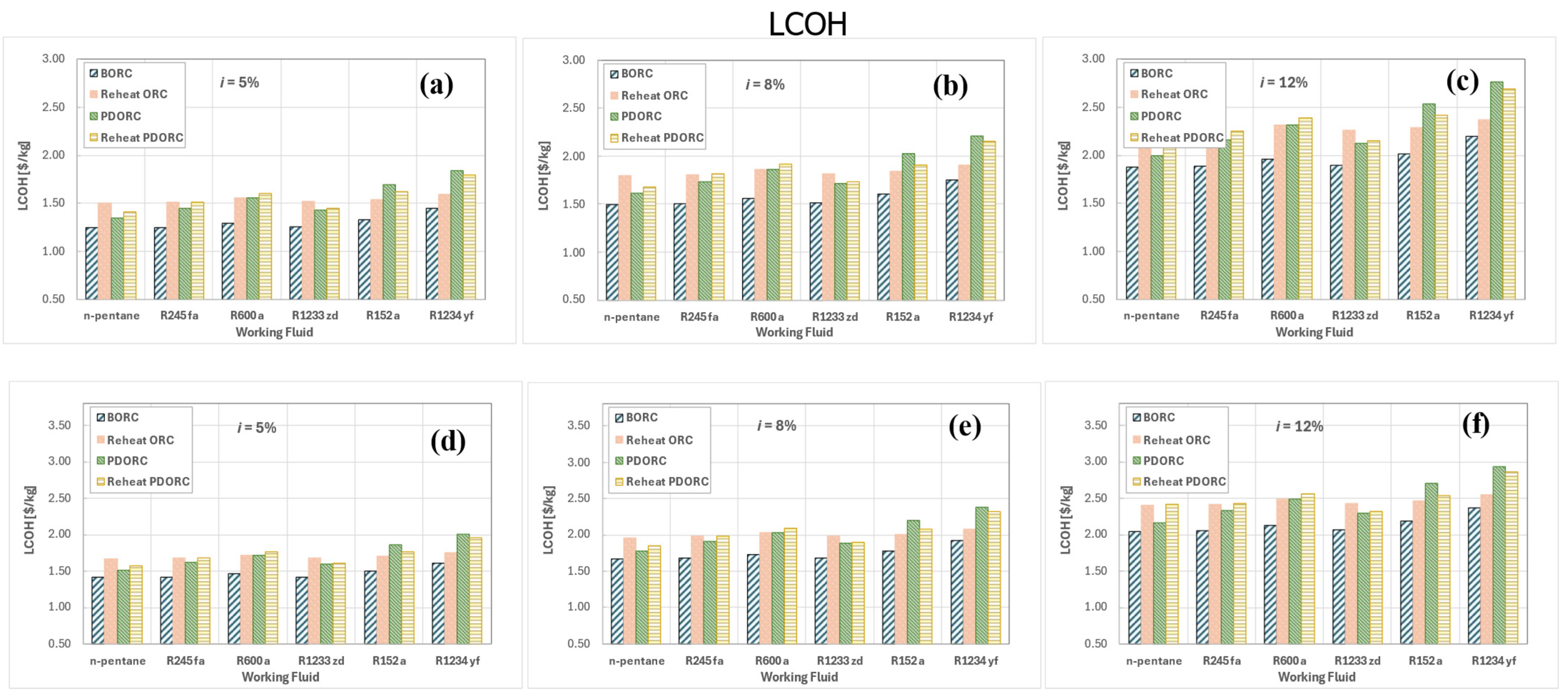
A similar but complementary interpretation applies when comparing Figure 10a–f, which present the LCOH under the same two CAPEX scenarios and different discount rates. In this case, the LCOH represents an intermediate cost for the plant, since hydrogen is used to produce electricity. Figure 10a–c, corresponding to lower EC and FC capital costs, shows lower hydrogen production costs for all working fluids and ORC configurations. Although the ORC is assumed to operate for 7000 h/y, the EC’s capital intensity remains a major determinant of LCOH.
The more thermodynamically efficient configurations, such as Reheat ORC and Reheat PDORC, consistently exhibit higher LCOH, but the gap relative to simpler layouts remains limited by the dominant CAPEX contribution. In Figure 10d–f, the higher EC CAPEX significantly increases the LCOH, again producing a general upward shift in the curves while preserving their relative ordering. Specifically, the LCOH for the lowest CAPEX is 1.51 $/kg for the R245fa fluid, close to the n-pentane (1.50 $/kg) in the BORC configuration, i = 8%, and 2.21 $/kg for the R1234yf in the PDORC configuration. In the most unfavorable situation, with higher CAPEX, these values are 1.68 $/kg and 1.67 $/kg, respectively. Across different discount rates, when the higher CAPEX and the minimum discount rate are used, the minimum cost is 1.41 $/kg for the BORC with n-pentane (similar to R245fa), slightly lower than R1233zd at 1.42 $/kg. For the highest discount rate, the ranking is the same, but the absolute values increase: n-pentane BORC is 2.05 $/kg, 2.07 $/kg for R1233zd, and the maximum cost is for R1234yf in the PDORC configuration, at 2.94 $/kg.
Taken together, the comparison of Figure 9 and Figure 10 clearly shows that the economic performance of both electricity reconversion and hydrogen production remains strongly dependent on the assumed CAPEX of PEM EC and FC, but also on the ORC configuration, since its CAPEX is embedded in the evaluation of the LCOEFC and LCOH. Lower CAPEX scenarios primarily affect absolute cost levels, whereas the comparative advantages among ORC configurations and working fluids are driven by their thermodynamic performance and are largely preserved across all figures. In any case, the use of WH enables lower hydrogen production costs than current methods. Thus, the present analysis yields an LCOH in the range of 1.5–3.0 $/kg, depending on the ORC configuration and discount rate, approaching parity with established Steam Methane Reforming processes while offering a significant economic advantage over grid electrolysis, which typically incurs costs of 4–6 $/kg.
Across both scenarios, a consistent trend emerges regarding the ORC design itself: the Basic ORC (BORC) (leftmost blue bars in figures) consistently offers the lowest LCOE regardless of the specific capital cost assumptions for the EC and FC. This highlights the inherent cost-effectiveness of the simplest WH recovery system. The complex Reheat PDORC configuration invariably remains the most expensive option in both contexts, demonstrating the impact of its increased complexity on the system’s cost for the specific application.

3.3. Analysis of the Scenarios

After the static assessment of the performance of different working fluids and system configurations, this section presents a more operational analysis that accounts for three distinct energy consumption users. The key assumptions adopted for the economic evaluation are as follows: a plant lifetime of 15 years; a discount rate between 5 and 12%; ORC operating hours limited to a maximum of 18 h/day, determined by the electricity price from the grid; and the adoption of BORC and PDORC configurations using R1233zd(E) as the working fluid. In fact, for risk-averse applications such as hospitals, R1233zd(E) is recommended as the preferred working fluid. It is classified A1 (non-flammable, low toxicity), has near-zero GWP (GWP100 = 1), and exhibits only marginal performance penalties compared to n-pentane: thermal efficiency decreases by less than 1%, power output by approximately 4%, and LCOE increases by roughly 2%. These small penalties are fully justified by the elimination of flammability risk and full compliance with hospital safety regulations. N-pentane remains optimal for industrial or isolated installations where flammability can be managed through standard engineering controls. In addition, hydrogen production and utilization are assumed to operate for no more than 15 h/day, and only during periods when electricity generation from the ORC system exceeds on-site demand.

3.3.1. Analysis of Electricity Consumption Patterns for Hotels and Hospitals

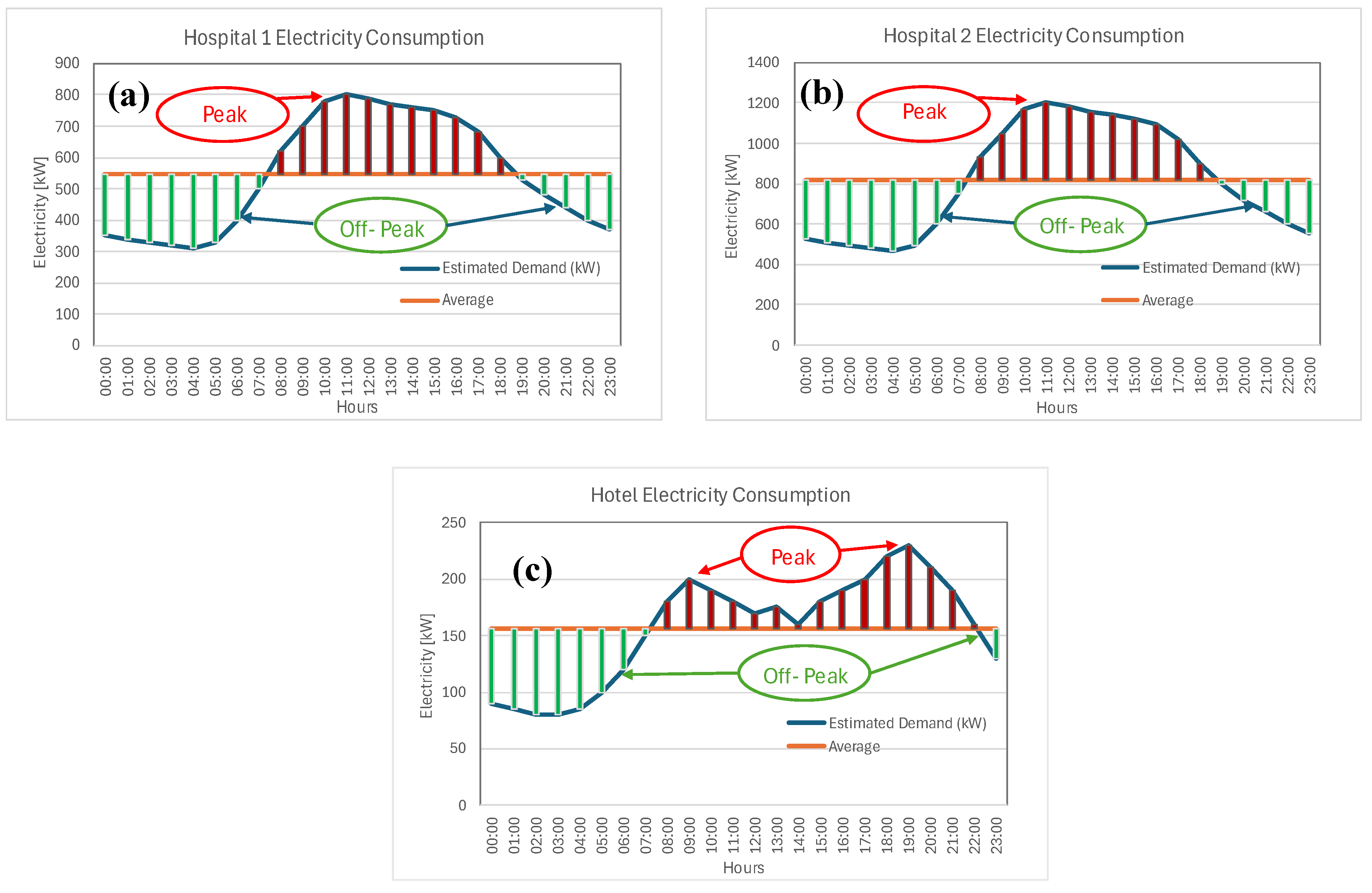
Figure 11 illustrates representative electricity consumption profiles for hotel and hospital facilities [52,53]. These example profiles are drawn from typical patterns reported in the literature. For instance, hotels often exhibit two daily peak periods: a morning peak between 08:00 and 12:00 and a more pronounced evening peak between 17:00 and 22:00 [53]. In contrast, off-peak consumption typically occurs during nighttime hours (00:00 to 06:00), when demand is less than half of peak levels. These generalized patterns serve as illustrative examples to support the analysis and are not based on direct measurements conducted in this study. The hotel’s daily electricity consumption is 3755 kWh/d, average power consumption is 157 kW, and annual energy consumption is 1371 MWh/y.
In the case of the hospitals [52], a different electricity consumption pattern is evident. The facilities maintain a single, extended peak period from 09:00 to 18:00, characterized by relatively stable high demand. Off-peak periods occur mainly at night, between 00:00 and 06:00, during which demand drops significantly below peak levels. Additionally, a gradual decline in electricity consumption is observed after 20:00. The user Hospital 1 has a total daily energy demand of 13,080 kWh/d, with an average power absorption of 545 kW. Hospital 1’s annual energy consumption is 4774 MWh/y, whereas Hospital 2, with the same time profile, has a total daily electricity demand of 19,620 kWh an annual consumption of 7160 MWh/y and a daily average power absorption of 818 kW. These two users represent hospitals with, respectively, 220 and approximately 295 beds, according to [54], which are small-to-medium-sized facilities. In the scenarios under scrutiny, both users assume that electricity consumption profiles apply throughout the year (i.e., 365 days).
These consumption patterns reveal a strategic opportunity for implementing a hydrogen-based energy storage system. During off-peak hours, excess grid capacity can be used to produce hydrogen. This process allows surplus electrical energy to be converted into storable chemical energy in the form of hydrogen. The stored hydrogen can then be used during peak-demand periods via fuel cells to supplement the electricity supply and alleviate grid overloading.

3.3.2. Electricity Market Dynamics Related to the Power Generation

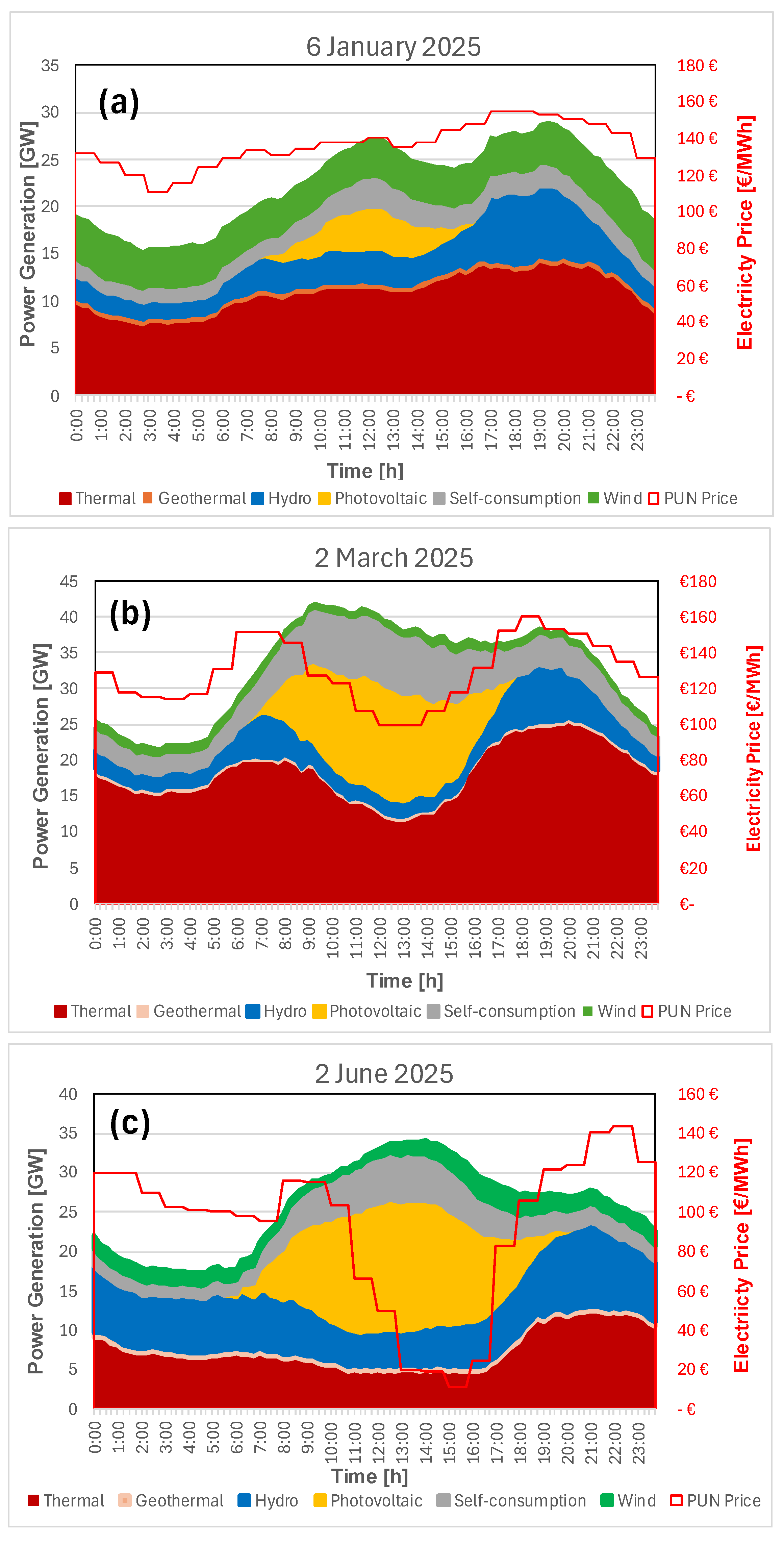
Figure 12 shows a 24 h profile of electricity generation by source along with the gross market price in Italy for three representative days in 2025 (January, March, and June). The figure illustrates the dynamic relationship between renewable energy output and electricity pricing in the Day-Ahead Market (MGP), which accounts for approximately 80% of total electricity traded in the Italian market.
The dual-axis chart uses stacked area graphs for power generation (GW). The red line represents hourly electricity prices in €/MWh. This format provides a clear view of how supply influences market dynamics. In fact, based on the system’s Marginal Price philosophy [55], as is the case for most European electricity markets, when photovoltaic sources make a significant contribution to power generation system, electricity prices decrease. In fact, on 6 January 2025, the maximum contribution of photovoltaic systems to the electric grid was approximately 16%, whereas thermal plants reached more than 41% at the same time (Figure 12a). The nationwide electricity cost (denoted in Italian as PUN) was approximately 138 €/MWh at the same time. On the same day, when the grid requested a maximum power generation of 29 GW, the price rose to 155 €/MWh because photovoltaic systems made no contribution. The maximum price span was equal to 44.6 €/MWh. Figure 12b shows the same data on 5 March 2025. The photovoltaic contribution was more consistent, attaining a maximum of about 38% during the day and the dynamics of the PUN reflect this behavior. In fact, although the maximum price was similar to that on the 6 January, when the photovoltaic contribution is at its maximum, the price fell to approximately 100 €/MWh, representing a 37.5% reduction. On 2 June, the situation is different. On this day, Figure 12c shows that the contribution of photovoltaics is approximately 50%, with electricity production throughout the day equal to approximately 22%. The PUN attained a minimum of approximately 10 €/MWh at 15:00 and a maximum of 144 €/MWh at 22:00, when the largest share of electricity is produced by thermoelectric plants (primarily CCGT plants). Considering that end users pay not only for the energy itself but also for additional charges related to distribution, taxes, and other ancillary costs, the final electricity price is estimated to be approximately 2.15 times the wholesale market price, which is reasonable. The days shown in Figure 12 were selected because they are representative of the average values of the daily energy price distribution across different seasons.
Table 6 presents the primary data used to evaluate the hybrid system in the subsequent analyses. In this section, one fluid, n-pentane, is investigated, along with only two ORC configurations: BORC and PDORC. The size of the EC ranges between 0 and 200 kW and the FC between 0 and 100 kW.
Given the daily energy demand of each end user (Hospital 1, Hospital 2, or Hotel) and the selected ORC configuration and working fluid, energy imbalances are managed as follows: Negative imbalances (demand exceeding ORC production) are offset by purchases of grid electricity at current market prices. Positive imbalances (ORC production exceeding demand) are used to generate hydrogen via electrolysis, with the stored hydrogen serving as fuel for the fuel cell system during supply shortfalls or periods of unfavorable grid pricing.
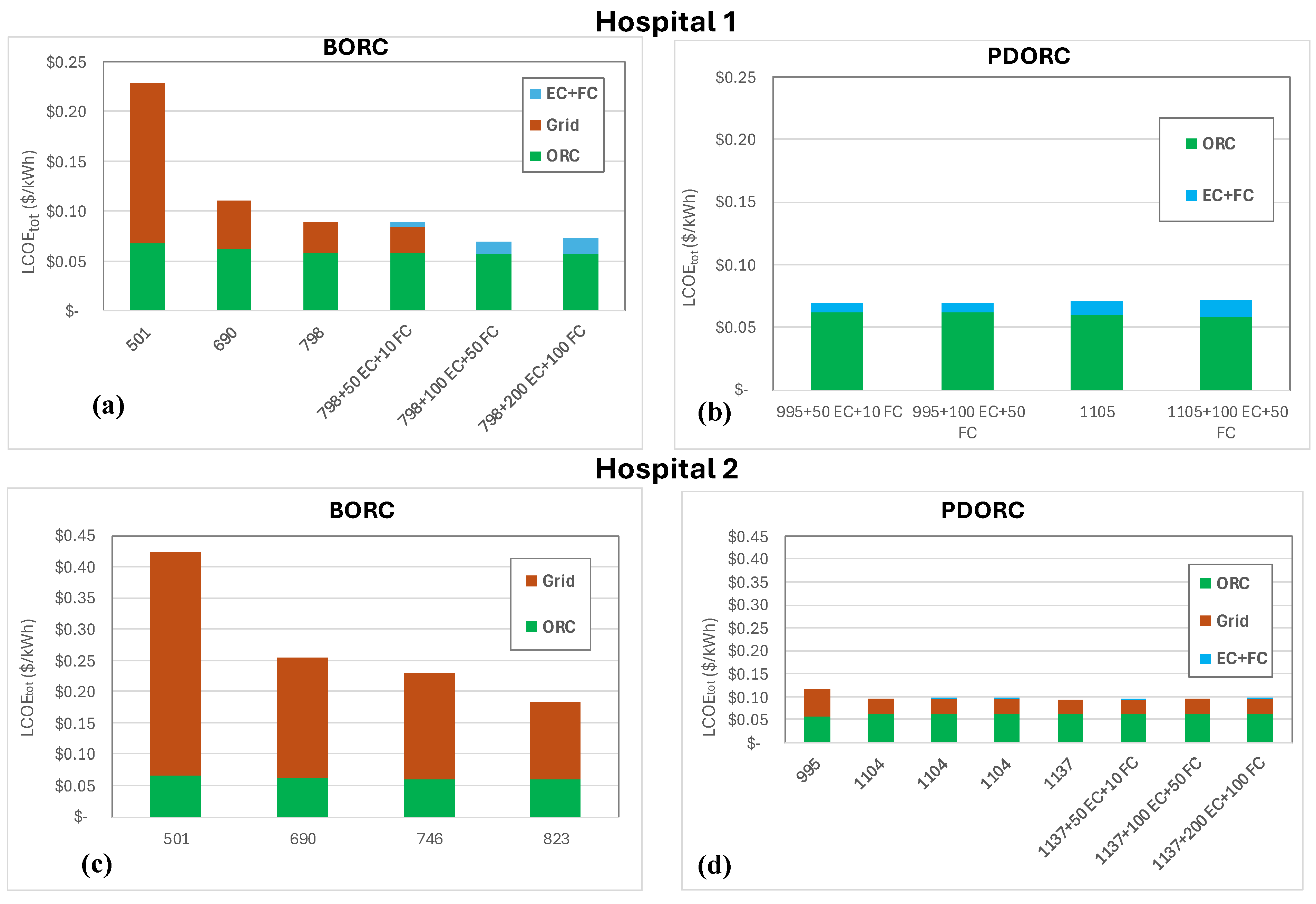
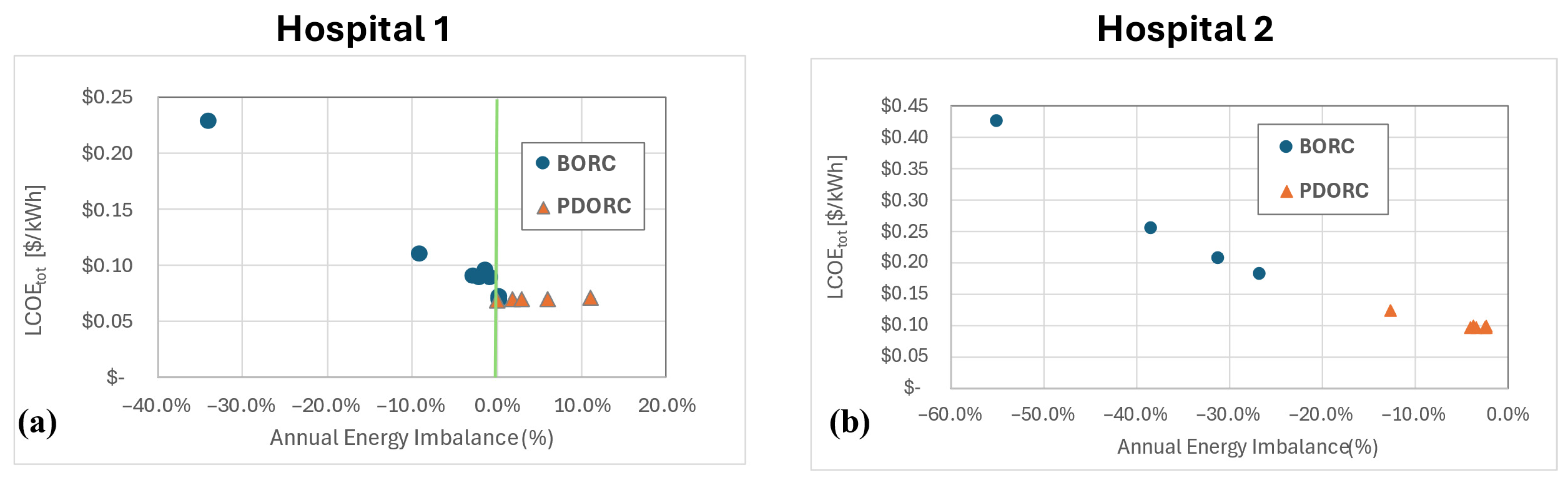
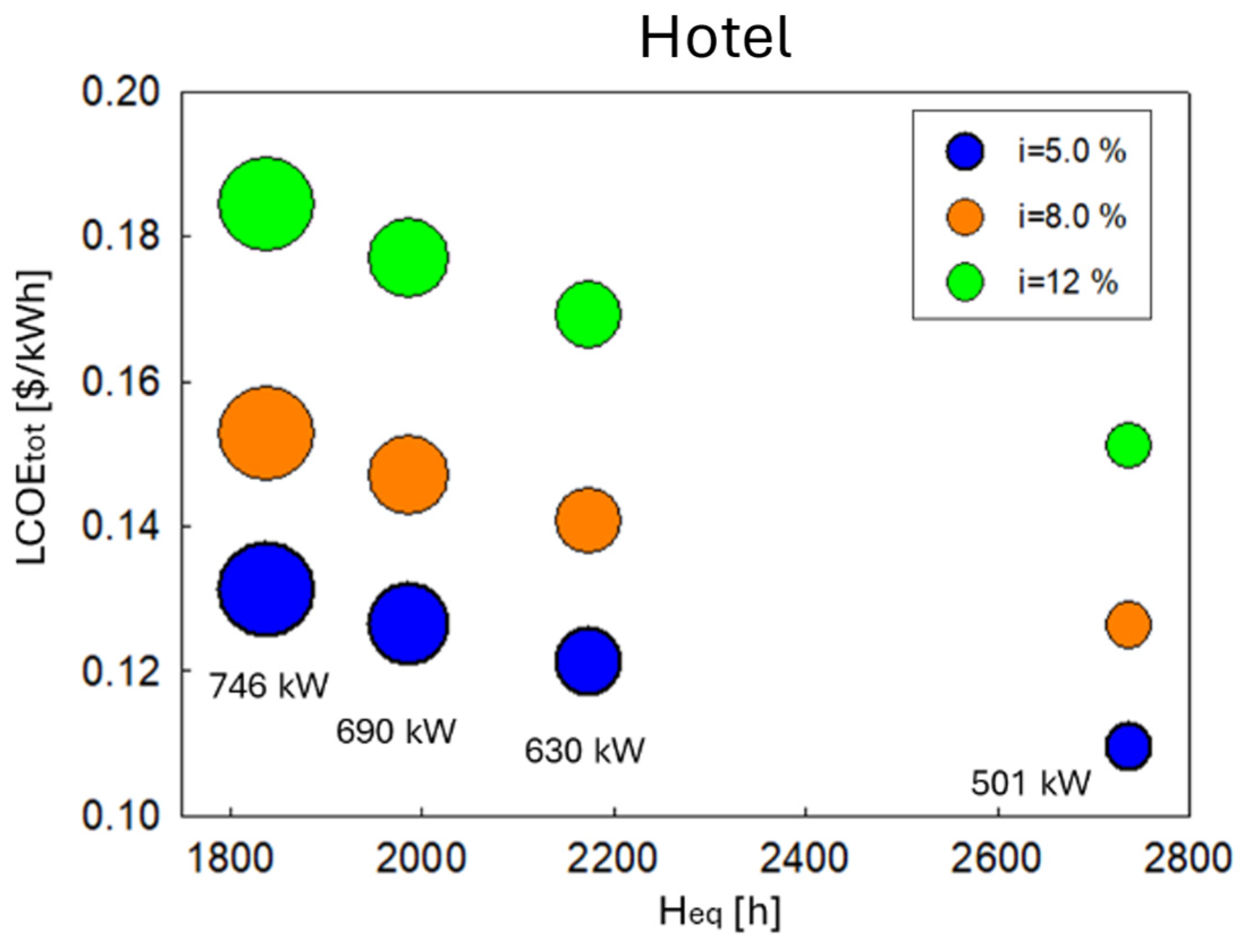
The total LCOE (LCOEtot) encompasses the entire electricity generation system, including the ORC unit, hydrogen storage pathway (electrolyzer and fuel cell), and grid electricity procurement during periods of negative energy balance. The calculation integrates the CAPEX and OPEX of all components, weighed by their respective annual operating hours. This approach provides a comparable economic metric against prevailing electricity market prices.
Figure 13a–d presents the levelized cost of energy (LCOE) breakdown for the proposed hybrid WH recovery systems serving the two hospital facilities, Hospital 1 and Hospital 2, with different energy consumption and different ORC power. On the x-axes of the figures, the power of the ORC is displayed with a number, the power of the electrolyzer with the suffix EC and that of the fuel cell system with the suffix FC. The first configuration (leftmost bars in Figure 13a,c), for BORC at 500 kW without a hybrid system, exhibit similar cost structures across the two hospital users, although their values differ. In fact, the Hospital 1 BORC system exhibits a substantially high LCOEtot (approximately 0.23 $/kWh) because a large share of the electricity is sourced from the grid (about 34%), at much higher costs than the ORC’s production cost.
The breakdown shows that although the electricity cost from the ORC is low (approximately 0.066 $/kWh), the grid price is approximately 0.16 $/kWh. For Hospital 2, the LCOEtot is even higher, reaching 0.43 $/kWh, owing to the substantial electricity supplied by the grid. As the power of the ORC system increases, LCOEtot decreases in both cases. For Hospital 1 (Figure 13a), the 690 kW ORC reduces LCOEtot to approximately half of the previous value, approximately 0.113 $/kWh, and the 798 kW ORC further reduces it to less than 0.100 $/kWh. Considering the largest BORC power plant of 798 kW, the value reduces to 0.089 $/kWh. A similar trend is observed for Hospital 2 (Figure 13c) for larger BORC systems, 746 and 823 kW. The LCOEtot decreases to −47% for the former and to −56.6% for the latter plant. Larger ORC power plants deliver a larger LCOEtot reduction, capped at 0.09 $/kWh, thanks to the parallel hydrogen system. It is evident that in this second case, Hospital 2, the ORC system is not sufficient to self-sustain the energy demand and a small amount of electric energy is absorbed from the grid.
Figure 14 clearly illustrates this behavior, in which LCOEtot is displayed as a function of the electricity imbalance (negative values indicate a deficit to be drawn from the grid). The larger the negative imbalance, the higher the LCOEtot of the hybrid system (ORC + Grid + EC + FC). When the system is nearly self-sufficient, the LCOEtot falls below 0.10 $/kWh for all investigated users. When hybrid systems are fully operative, i.e., when the ORC plant power is such that the portion of electricity produced by the ORC is used to produce hydrogen and then it is converted back to electricity by the FC system, the LCOEtot attains values as low as 0.070 $/kWh, which represents the best economic performance. This occurs for a 798 kW BORC with a 100 kW EC and 50 kW FC. The last two bars in Figure 13a highlight this occurrence. In the case of hospitals, the BORC, driven by the WH, has low power output, which prevents it from producing hydrogen, and a large amount of electricity must be drawn from the grid. Considering the PDORC plants serving Hospital 1 (Figure 13b), it is evident that the ORC plants are self-sustaining and can use excess electricity to produce hydrogen. This yields a capped LCOEtot of approximately 0.070 $/kWh across all configurations reported in the figure. Increasing the ORC power and the corresponding EC and FC powers does not necessarily bring an economic advantage. In fact, comparing Figure 13b,d, in which the PDORC is scrutinized, there is always an “optimal” configuration. In fact, for the Hospital 1 case, PDORC 995 kW plus an electrolyzer of 50 kW and fuel cell of 10 kW attains an LCOEtot of 0.069 $/kWh, which increases slightly assuming a 100 kW EC and a 50 kW FC. Similar considerations can be drawn from the analysis of Hospital 2. In this case, a 1137 kW PDORC is not sufficient to self-sustain the user, thus some electricity is absorbed from the grid and the LCOEtot is approximately 0.10 $/kWh. For this fluid, R1233zd, the largest ORC plant delivers 1137 kW, which is insufficient to generate more electricity than requested; thus, the most economic configuration is a simple PDORC with a LCOEtot of 0.096 $/kWh. In this case, for hydrogen devices, the LCOE increases to 0.10 $/kWh. Figure 14 supports these findings. Due to the high grid electricity price, the hybrid system yields a higher LCOEtot when it is used. Instead, when the hybrid system is near self-sufficiency, i.e., the annual energy imbalance is close to 0, the economic value of the produced electricity tends toward the LCOE of the ORC system, which can be as low as 0.070 $/kWh, as displayed in Figure 14a,b.
The situation is completely different for the case of the hotel. In this case, all the ORC configurations, when operated for the same equivalent hours as the hospitals, would vastly exceed the energy demand. For this reason, a different approach is sought. The working hours for each season have been established to ensure that demand is perfectly matched by the ORC plant. No hybrid system is required, as the BORC can meet energy demand. Figure 15 shows LCOEtot as a function of operating hours for four BORC power systems and the three investigated discount rates. It is evident that when i = 8%, the lowest LCOE, equal to 0.126 $/kWh, is achieved for the minimum BORC power of 501 kW, corresponding to maximum operating hours of approximately 3000 h/y, while the maximum LCOE, 0.153 $/kWh, is achieved for the 746 kW plant. In any case, the four BORC plants afford lower energy costs than those from the grid, approximately 0.23 $/kWh. When the lowest discount rate is assumed, the trend is similar but shows lower values: at 501 kW, the plant delivers energy at 0.109 $/kWh, and at 746 kW, at 0.131 $/kWh. Even at the highest discount rate, the LCOE values are well below 0.20 $/kWh.
From an economic perspective, the investment expenditure should yield cost savings that translate into a short payback period. In this case, using the previously defined economic parameters, the BORC plants yield the results reported in Table 7, which presents the Simple Payback (SPB) and Discounted Payback (DPB) times, the Net Present Worth (NPW), and the Profitability Index (PI) for each power rating and the three discount rates. The DPB, which represents a realistic value of this economic time indicator, is excellent for power ratings of 501 kW, corresponding to 5.5 years. This indicator increases when BORC powers of 690 and 746 kW are considered. With an investment cost of approximately 1.0 to 1.64 M$, these DPB times represent efficient economic performance. Based on the revenue indicators, they are excellent; in fact, the NPW is always positive given the plant’s lifespan, and the PI shows substantial revenue at the end of the plant’s life, ranging from 98% to a smaller 26%. When the lowest discount rate is assumed, economic results improve with a DPB of 5.0 years, an NPW of 1.57 M$ and a PI of 139% for the 501 kW ORC plant. For the highest discount rate, the results worsen, attaining 6.5 years of DPB and 57% of PI.
The environmental impact, based on greenhouse gas savings, depends on the plant’s location. In the next step, the savings are calculated based on the data for the year 2025, for each country investigated [56,57]. The present analysis quantifies operational CO2 emission reductions only, comparing the proposed ORC–hydrogen system versus a conventional fuel mix-generated electricity supply.
Table 8 shows annual CO2 emission reductions from the hybrid ORC–hydrogen system for a hotel in seven European regions. Poland achieves the highest savings (752.4 t CO2/year)—2.3 times the EU-27 average (328.9 t CO2/year)—due to its coal-intensive electricity generation (662 g CO2/kWh). Each kWh displaced from Poland’s grid yields maximum environmental benefit. Mediterranean countries’ performance varies significantly. Italy saves 413.9 t CO2/year with minimal North–South variation (387.9 vs. 409.8 t CO2/year), while Spain shows the lowest savings at 180.9 t CO2/year, reflecting its cleaner electricity mix with higher renewable penetration. Germany (309.7 t CO2/year) aligns with the EU-27 average despite a higher grid carbon intensity (371 g CO2/kWh vs. 242 g CO2/kWh). CO2 savings scale proportionally with grid carbon intensity. The 4.2:1 ratio between Poland and Spain’s CO2 savings (Table 8) demonstrates that hydrogen system value is not geographically universal, since it scales directly with grid carbon intensity. Renewable-rich grids reduce both the economic and environmental benefits of waste heat recovery systems.

4. Discussion

The economic behavior of the integrated ORC + EC + FC system highlights a key distinction between component-level costs and system-level performance, often overlooked in hybrid energy assessments. While the FC subsystem exhibits a relatively high levelized cost of electricity compared to ORC (Figure 8 and Figure 9), the system-level results demonstrate that this does not translate into a proportional increase in the overall cost of supplied electricity. Instead, LCOEtot is primarily determined by ORC performance and the extent to which grid electricity is displaced (Figure 14). This finding reinforces the idea that, in hybrid systems, the most expensive component does not necessarily determine the system cost, provided that its contribution to annual electricity supply remains limited. Similar conclusions have been reported in sustainability-oriented assessments of FC-based systems, in which they add value primarily through flexibility, resilience, and autonomy rather than through low-cost electricity generation [17]. In the present study, the FC consistently operates as a marginal generator, activated only to balance the electricity supply, whereas the ORC remains the dominant source of delivered electricity.
A second important outcome concerns the integration of hydrogen production and storage. The results clearly indicate that hydrogen technologies do not improve system economics in a continuous or linear manner. Instead, their economic relevance emerges only once the ORC approaches demand coverage and generates a sufficient surplus to be valorized. Below this threshold, enlarging EC and FC capacities yields diminishing returns, as surplus electricity availability, rather than hydrogen conversion efficiency, becomes the limiting factor (Figure 13). This behavior is consistent with previous techno-economic analyses of ORC-based hydrogen production systems, which report that hydrogen integration becomes economically meaningful only under conditions of high utilization and adequate surplus generation [17]. The approximate 35% round-trip efficiency of hydrogen production and use represents a significant energy penalty. However, in waste heat-driven applications, this limitation must be contextualized: the input energy originates from heat otherwise rejected to the environment, and economic value derives from displacing expensive grid electricity purchases (0.20–0.29 $/kWh) through temporal load-shifting. The results demonstrate that LCOEtot approaches standalone ORC costs (0.07 $/kWh) when the hydrogen system is properly sized as a marginal balancing component (Figure 13b,d).
The decoupling observed between LCOH and LCOEFC further supports this interpretation. Although the levelized cost of hydrogen decreases substantially with increasing EC size, the cost of electricity reconverted through the FC remains high and weakly correlated with hydrogen cost (Figure 9 and Figure 10). This reflects the dominant role of FC capital costs, limited operating hours, and balance-of-plant requirements, as widely documented in the FC literature [58,59]. Therefore, improving the economics of hydrogen production alone is insufficient to lower the cost of reconverted electricity; system-level benefits instead arise from reducing external electricity imports.
From a broader perspective, these results confirm that hydrogen should be interpreted as a system-enabling vector rather than as a low-cost electricity pathway in ORC-based hybrid configurations. The economic value of hydrogen lies in its ability to absorb surplus generation, decouple production from demand, and stabilize the electricity supply portfolio, particularly in systems driven by low-temperature WH recovery. Similar roles for hydrogen and fuel cells have been identified in poly-generation and WH-driven hybrid systems, where the primary objective is to enhance overall system robustness rather than to minimize component-level costs [60,61].
Finally, the results suggest that optimal system design cannot be derived from isolated cost metrics, such as LCOH or LCOEFC alone. Instead, the sizing of the ORC and the hydrogen subsystems must be jointly optimized with respect to demand coverage and surplus availability. Oversizing the hydrogen section in the absence of a sufficient ORC surplus leads to higher capital costs without measurable system-level benefits, whereas appropriately sized hydrogen integration can achieve near-autonomous operation with negligible penalties in LCOEtot. This reinforces the need for system-level techno-economic frameworks when assessing hybrid ORC–hydrogen configurations, particularly in applications targeting energy autonomy, grid support, or resilience rather than pure cost minimization.

5. Conclusions

This study presents a comprehensive techno-economic assessment of integrated Organic Rankine Cycle systems with hydrogen production and storage for waste heat recovery in hospitals and hotels, examining different plant configurations across six working fluids.
The results reveal a fundamental trade-off in ORC system design. The simplest configuration, BORC, consistently achieved the lowest levelized cost of electricity at 0.033 $/kWh, with an 8% discount rate, demonstrating cost-effectiveness through lower capital investment and operational simplicity. In contrast, complex configurations such as Reheat–PDORC extracted between 23% and 70% more power, depending on the fluid, despite incurring 14 to 32% higher costs. This inverse relationship between economic efficiency and thermodynamic performance confirms that configuration selection must align with specific application priorities: simpler configurations for budget-constrained applications, complex configurations when maximum power extraction is prioritized.
Working fluid selection proved equally critical. N-pentane demonstrated the best overall trade-off, achieving 1133 kW in the PDORC configuration with 20% thermal efficiency and 40% exergy efficiency. However, for hospital applications where flammability concerns are paramount, R1233zd(E) is recommended. This non-flammable alternative (ASHRAE A1 classification) exhibits only marginal performance penalties: less than 1% reduction in thermal efficiency and an approximately 2% increase in LCOE compared with n-pentane, fully justified by regulatory compliance and the elimination of safety risks.
System-level analysis using realistic demand profiles demonstrated that economic performance is primarily determined by ORC capacity-matching and grid electricity dependence, with hydrogen playing a complementary balancing role. For Hospital 1 (545 kW average demand), a 798 kW BORC with 100 kW electrolyzer and 50 kW fuel cell reduced LCOEtot cost from 0.23 $/kWh to 0.069 $/kWh—a 70% reduction. Hospital 2 (818 kW average demand) reached 0.096 $/kWh using a 1137 kW PDORC with hydrogen storage and use, with a 58% reduction. The hotel application (157 kW average demand) achieved 0.127 $/kWh with a 501 kW BORC, with a 45% economic saving, operating less than 3000 h per year, a Discounted Payback period between 5.0 and 6.5 years and a Profitability Index between 139% and 57%, depending on the assumed discount rate.
Environmental benefits strongly correlate with regional grid carbon intensity. For the hotel application, annual operational CO2 emission reductions ranged from 181 tons in Spain to 752 tons in Poland—a 4.2:1 ratio that directly reflects grid carbon intensity differences. These figures represent operational reductions only; a full life-cycle assessment, including equipment manufacturing and component replacement, would reduce net savings by an estimated 15–30%.
In conclusion, waste heat recovery through properly sized hybrid ORC + hydrogen systems delivers electricity at 0.07–0.11 $/kWh, substantially below typical European grid prices of 0.09–0.16 $/kWh. Hydrogen storage adds strategic value through energy autonomy and grid independence rather than conversion efficiency. System optimization requires the coordinated sizing of ORC and hydrogen components based on demand profiles, waste heat availability, and surplus generation capacity.
Study limitations include the steady-state analysis approach, which does not capture dynamic coupling between components with different response times. For the daily and seasonal load-shifting strategies examined, where transitions occur over hours, these dynamic effects remain secondary. However, future research should incorporate dynamic modeling to optimize control strategies and evaluate grid services. Additionally, the environmental analysis covers only operational emissions and excludes full life-cycle impacts from manufacturing, working fluid synthesis, and disposal.

Author Contributions

Conceptualization, B.M. and A.U.; methodology, B.M., A.U. and A.M.; software, S.S.; validation, S.S., B.M., D.D.F. and A.M.; resources, B.M.; data curation, D.D.F., S.S. and A.M.; writing—original draft preparation, B.M.; writing—review and editing, A.U., D.D.F., A.M. and S.S.; visualization, D.D.F. and S.S.; funding acquisition, A.U. and B.M. All authors have read and agreed to the published version of the manuscript.

Funding

This research was partially funded by Università della Campania “L. Vanvitelli”, project HYERI, 2024–2025 Funding of fundamental and applied research projects dedicated to researchers not recipients of other funding grant n. CUP: B63C24000990005 and by the Italian Ministry of the Environment and Energy Safety (formerly Ministry of the Ecological Transition) in the NEXT GENERATION EU framework (PNRR), “Green revolution and ecological transition”, component 2 “Renewable Energy, Hydrogen, Grid and Sustainable Mobility” under the grant CUP: 600 F29J22001310004 project “SOSPIRI” 2023-25.

Data Availability Statement

The original contributions presented in the study are included in the article, further inquiries can be directed to the corresponding author.

Conflicts of Interest

The authors declare no conflicts of interest.

Abbreviations

The following abbreviations are used in this manuscript:
BORCBasic Organic Rankine Cycle
DPBDiscounted Payback Time
ECElectrolyzer
FCFuel cell
HTHigh Temperature
HPHigh Pressure
GWPGlobal Warming Potential
LTLow Temperature
LPLow Pressure
LCOELevelized Cost of Energy
LCOHLevelized Cost of Hydrogen
LHVLower Heating Value
MTMedium Temperature
NPWNet Present Worth
ODPOzone Depletion Potential
ORCOrganic Rankine Cycle
PDORCDual Parallel Organic Rankine Cycle
PEMECProton Exchange Membrane Electrolyzer
PEMFCProton Exchange Membrane Fuel Cell
PIProfitability Index
PUNItalian Electricity Market Price
SPBSimple Payback Time
WHWaste Heat

Appendix A

Appendix A.1

Table A1 presents the mathematical relations for various configurations of the ORC, showing how net output work, heat and exergy input quantities are calculated for each design configuration. The equations provide essential relationships for analyzing and comparing the performance of different cycle arrangements.
Table A1. Energy and exergy main balance equations for different ORC configurations.
ConfigurationNet Output WorkHeat InputExergy Input
BORC W n e t = W t u r b i n e   W p u m p Q i n = Q e v a p Q e v a p ( 1 T 0 T h e a t )
Reheat W n e t = W t u r b i n e   I +   W t u r b i n e   I I W p u m p Q i n = Q e v a p + Q R e h e a t ( Q e v a p + Q R e h e a t ) ( 1 T 0 T h e a t )
PDORC W n e t = W t u r b i n e   I + W t u r b i n e   I I W p u m p I W p u m p I I Q i n = Q e v a p   L P + Q e v a p   H P Q e v a p   H P 1 T 0 T h e a t   I
+ Q e v a p   L P 1 T 0 T h e a t   I I
Reheat–PDORC W n e t = W t u r b i n e   I + W t u r b i n e   I I + W t u r b i n e   I I I W p u m p I W p u m p I I Q i n = Q e v a p   L P + Q e v a p   H P + Q R e h e a t ( Q e v a p   H P + Q R e h e a t )
1 T 0 T h e a t   H + Q e v a p   L P 1 T 0 T h e a t   L

Appendix A.2

Regarding safety, Figure A1 illustrates the ASHRAE safety classification for ORC fluids based on their toxicity and flammability. The horizontal axis represents toxicity: Group A refrigerants have low toxicity, whereas Group B presents high toxicity. The vertical axis indicates flammability, increasing from Class 1 (non-flammable) at the bottom to Class 3 (highly flammable) at the top. Each organic fluid is labeled with a combination from A1 (low toxicity, non-flammable) to B3 (high toxicity, highly flammable). This classification helps ensure the safe selection and handling of refrigerants in cooling and heating systems [62]. The working fluids selected in this research belong to Group A, indicating low toxicity, and vary in their flammability classifications.
Figure A1. Safety classification for working fluids.
Energies 19 01862 g0a1
Figure A2 shows temperature–entropy (T–s) diagrams for various organic fluids. Each curve represents a different fluid (R1233zd, R245fa, R600a, R152a, R601, and R1234yf), illustrating their phase change behavior. The curves form dome-like shapes, with the left side representing the saturated liquid line, the right side representing the saturated vapor line, and the area between representing the two-phase (liquid–vapor) region. The horizontal axis shows specific entropy (s) in kJ/(kg·K), while the vertical axis shows temperature (T) in °C.
Figure A2. (T−s) diagram of the different organic working fluids.
Energies 19 01862 g0a2
Based on the slope of the saturated vapor line on the T–s diagram, fluids can be classified into three types: wet, isentropic, and dry [63]:
  • Wet fluids (e.g., water and R152a) exhibit a negative slope in the saturated vapor line. This means that after isentropic expansion in the turbine, the working fluid may enter the two-phase region, leading to droplet formation and potential damage to turbine blades.
  • Isentropic fluids (e.g., R1234yf) have a vertical saturated vapor line, where isentropic expansion ends precisely at the saturated vapor condition.
  • Dry fluids (e.g., R1233zd, R245fa, R601, and R600a) show a positive slope, which ensures that the fluid remains in the superheated region after expansion, avoiding condensation and improving turbine safety and efficiency.
Each fluid shown in the figure has distinct critical points and suitable operating temperature ranges, which influence its selection for specific low- or medium-temperature applications in ORC systems.

References

  1. Chowdhury, A.S.; Ehsan, M.M. A Critical Overview of Working Fluids in Organic Rankine, Supercritical Rankine, and Supercritical Brayton Cycles Under Various Heat Grade Sources. Int. J. Thermofluids 2023, 20, 100426. [Google Scholar] [CrossRef]
  2. Jiménez-García, J.C.; Ruiz, A.; Pacheco-Reyes, A.; Rivera, W. A Comprehensive Review of Organic Rankine Cycles. Processes 2023, 11, 1982. [Google Scholar] [CrossRef]
  3. Gonidaki, D.; Bellos, E. A Detailed Review of Organic Rankine Cycles Driven by Combined Heat Sources. Energies 2025, 18, 526. [Google Scholar] [CrossRef]
  4. Wang, S.; Liu, C.; Li, Q.; Liu, L.; Huo, E.; Zhang, C. Selection Principle of Working Fluid for Organic Rankine Cycle Based on Environmental Benefits and Economic Performance. Appl. Therm. Eng. 2020, 178, 115598. [Google Scholar] [CrossRef]
  5. Turek, V.; Kilkovský, B.; Daxner, J.; Babička Fialová, D.; Jegla, Z. Industrial Waste Heat Utilization in the European Union—An Engineering-Centric Review. Energies 2024, 17, 2084. [Google Scholar] [CrossRef]
  6. Firth, A.; Zhang, B.; Yang, A. Quantification of Global Waste Heat and Its Environmental Effects. Appl. Energy 2019, 235, 1314–1334. [Google Scholar] [CrossRef]
  7. Varga, Z.; Palotai, B. Comparison of Low Temperature Waste Heat Recovery Methods. Energy 2017, 137, 1286–1292. [Google Scholar] [CrossRef]
  8. Li, Y.; Yang, M.; Ma, Z.; Zheng, M.; Song, H.; Guo, X. Thermodynamic Modeling and Exergy Analysis of A Combined High-Temperature Proton Exchange Membrane Fuel Cell and ORC System for Automotive Applications. Int. J. Mol. Sci. 2022, 23, 15813. [Google Scholar] [CrossRef]
  9. Josef Binderbauer, P.; Hammer, A.; Lachner, E.; Klingenstein, N.; Kienberger, T. Regarding the Generation of Time Resolved Industrial Waste Heat Profiles. Appl. Therm. Eng. 2023, 232, 120969. [Google Scholar] [CrossRef]
  10. Mehrdad, S.; Dadsetani, R.; Amiriyoon, A.; Leon, A.S.; Safaei, M.R.; Goodarzi, M. Exergo-Economic Optimization of Organic Rankine Cycle for Saving of Thermal Energy in a Sample Power Plant by Using of Strength Pareto Evolutionary Algorithm II. Processes 2020, 8, 264. [Google Scholar] [CrossRef]
  11. Thermal Energy Storage|EASE: Why Energy Storage?|EASE. Available online: https://ease-storage.eu/publication/thermal-energy-storage/ (accessed on 11 August 2025).
  12. Wang, C.R.; Stansberry, J.M.; Mukundan, R.; Chang, H.M.J.; Kulkarni, D.; Park, A.M.; Plymill, A.B.; Firas, N.M.; Liu, C.P.; Lang, J.T.; et al. Proton Exchange Membrane (PEM) Water Electrolysis: Cell-Level Considerations for Gigawatt-Scale Deployment. Chem. Rev. 2025, 125, 1257–1302. [Google Scholar] [CrossRef]
  13. Yue, M.; Lambert, H.; Pahon, E.; Roche, R.; Jemei, S.; Hissel, D. Hydrogen Energy Systems: A Critical Review of Technologies, Applications, Trends and Challenges. Renew. Sustain. Energy Rev. 2021, 146, 111180. [Google Scholar] [CrossRef]
  14. Marocco, P.; Ferrero, D.; Lanzini, A.; Santarelli, M. The Role of Hydrogen in the Optimal Design of Off-Grid Hybrid Renewable Energy Systems. J. Energy Storage 2022, 46, 103893. [Google Scholar] [CrossRef]
  15. Shahverdian, M.H.; Soltanifar, F.; Sohani, A.; Sayyaadi, H.; Hoseinzadeh, S. A 3E Comparative Study to Choose the Best Storage Method for PV Solar System for Off-Grid Applications: Hydrogen or Battery? J. Energy Storage 2025, 117, 116111. [Google Scholar] [CrossRef]
  16. Yue, J.; Fu, L.; Chen, X.; Zhou, Y.; Shen, B. Energy, Exergy, Economic, Environmental Analysis of Scaled Energy Storage through Green Hydrogen. J. Energy Storage 2026, 152, 120359. [Google Scholar] [CrossRef]
  17. Baral, S.; Šebo, J. Techno-Economic Assessment of Green Hydrogen Production Integrated with Hybrid and Organic Rankine Cycle (ORC) Systems. Heliyon 2024, 10, e25742. [Google Scholar] [CrossRef]
  18. Mariani, A.; Morrone, B.; Laiso, D.; Prati, M.V.; Unich, A. Waste Heat Recovery in a Compression Ignition Engine for Marine Application Using a Rankine Cycle Operating with an Innovative Organic Working Fluid. Energies 2022, 15, 7912. [Google Scholar] [CrossRef]
  19. Colonna, P.; Casati, E.; Trapp, C.; Mathijssen, T.; Larjola, J.; Turunen-Saaresti, T.; Uusitalo, A. Organic Rankine Cycle Power Systems: From the Concept to Current Technology, Applications, and an Outlook to the Future. J. Eng. Gas Turbine. Power 2015, 137, 100801. [Google Scholar] [CrossRef]
  20. Matuszewska, D. Solar Organic Rankine Cycle (ORC) Systems: A Review of Technologies, Parameters, and Applications. Energies 2024, 17, 5106. [Google Scholar] [CrossRef]
  21. Budovich, L.S. Energy, Exergy Analysis in a Hybrid Power and Hydrogen Production System Using Biomass and Organic Rankine Cycle. Int. J. Thermofluids 2024, 21, 100584. [Google Scholar] [CrossRef]
  22. Karabuga, A.; Utlu, Z.; Yakut, M.Z. Exergy and Economic Approaches for Integrating Power and Green Hydrogen Production with a Novel Solar-ORC System. Therm. Sci. Eng. Prog. 2025, 61, 103552. [Google Scholar] [CrossRef]
  23. Liu, H.; Lu, B.; Xu, Y.; Ju, X.; Wang, W.; Zhang, Z.; Shi, L.; Tian, H.; Shu, G. Experimental Investigation of a Splitting Organic Rankine Cycle for Dual Waste Heat Recovery. Energy Convers. Manag. 2024, 320, 119005. [Google Scholar] [CrossRef]
  24. Khennich, M.; Sorin, M.; Galanis, N. Equivalent Temperature-Enthalpy Diagram for the Study of Ejector Refrigeration Systems. Entropy 2014, 16, 2669–2685. [Google Scholar] [CrossRef]
  25. Klamrassamee, T.; Kittijungjit, T.; Sukjai, Y.; Laoonual, Y. Thermodynamic, Economic, and Carbon Emission Evaluation of Various Organic Rankine Cycle Configurations for Maximizing Waste Heat Recovery Potential. Energy Convers. Manag. X 2025, 26, 100943. [Google Scholar] [CrossRef]
  26. Du, Y.; Yang, Y.; Hu, D.; Hao, M.; Wang, J.; Dai, Y. Off-Design Performance Comparative Analysis between Basic and Parallel Dual-Pressure Organic Rankine Cycles Using Radial Inflow Turbines. Appl. Therm. Eng. 2018, 138, 18–34. [Google Scholar] [CrossRef]
  27. Rayegan, R.; Tao, Y.X. A Procedure to Select Working Fluids for Solar Organic Rankine Cycles (ORCs). Renew. Energy 2011, 36, 659–670. [Google Scholar] [CrossRef]
  28. Bell, I.H.; Wronski, J.; Quoilin, S.; Lemort, V. Pure and Pseudo-Pure Fluid Thermophysical Property Evaluation and the Open-Source Thermophysical Property Library CoolProp. Ind. Eng. Chem. Res. 2014, 53, 2498. [Google Scholar] [CrossRef]
  29. Goodarzi, M.; Soltani, H.D. Thermal Performance Analysis of a Reheating-Regenerative Organic Rankine Cycle Using Different Working Fluids. Mechanika 2015, 21, 28–33. [Google Scholar] [CrossRef][Green Version]
  30. Wang, W.; Deng, S.; Zhao, D.; Zhao, L.; Lin, S.; Chen, M. Application of Machine Learning into Organic Rankine Cycle for Prediction and Optimization of Thermal and Exergy Efficiency. Energy Convers. Manag. 2020, 210, 112700. [Google Scholar] [CrossRef]
  31. Fluid Properties—CoolProp 6.7.0 Documentation. Available online: http://www.coolprop.org/fluid_properties/ (accessed on 10 March 2025).
  32. Zini, A.; Socci, L.; Vaccaro, G.; Rocchetti, A.; Talluri, L. Working Fluid Selection for High-Temperature Heat Pumps: A Comprehensive Evaluation. Energies 2024, 17, 1556. [Google Scholar] [CrossRef]
  33. Lamy, C.; Millet, P. A Critical Review on the Definitions Used to Calculate the Energy Efficiency Coefficients of Water Electrolysis Cells Working under near Ambient Temperature Conditions. J. Power Sources 2020, 447, 227350. [Google Scholar] [CrossRef]
  34. Bespalko, S.; Mizeraczyk, J. Overview of the Hydrogen Production by Plasma-Driven Solution Electrolysis. Energies 2022, 15, 7508. [Google Scholar] [CrossRef]
  35. Zhang, H.; Lin, G.; Chen, J. Evaluation and Calculation on the Efficiency of a Water Electrolysis System for Hydrogen Production. Int. J. Hydrogen Energy 2010, 35, 10851–10858. [Google Scholar] [CrossRef]
  36. Omran, A.; Lucchesi, A.; Smith, D.; Alaswad, A.; Amiri, A.; Wilberforce, T.; Sodré, J.R.; Olabi, A.G. Mathematical Model of a Proton-Exchange Membrane (PEM) Fuel Cell. Int. J. Thermofluids 2021, 11, 100110. [Google Scholar] [CrossRef]
  37. Mansourian, R.; Mousavi, S.M.; Rahimpour, M.R. Fuel Cells. In Current Trends and Future Developments on (Bio-) Membranes: Advances on Membrane Engineering; Elsevier: Amsterdam, The Netherlands, 2024; pp. 99–129. [Google Scholar] [CrossRef]
  38. Saeed, E.W.; Warkozek, E.G. Modeling and Analysis of Renewable PEM Fuel Cell System. Energy Procedia 2015, 74, 87–101. [Google Scholar] [CrossRef]
  39. Harrison, K.; Remick, R.; Hoskin, A.; Martin, G. Hydrogen Production: Fundamentals and Case Study Summaries (Presentation); National Renewable Energy Laboratory (NREL): Golden, CO, USA, 2010. [Google Scholar]
  40. Manoharan, P.; Ravichandran, S.; Kavitha, S.; Tengku Hashim, T.J.; Alsoud, A.R.; Sin, T.C. Parameter Characterization of PEM Fuel Cell Mathematical Models Using an Orthogonal Learning-Based GOOSE Algorithm. Sci. Rep. 2024, 14, 20979. [Google Scholar] [CrossRef] [PubMed]
  41. Kaleybar, H.J.; Brenna, M.; Li, H.; Zaninelli, D. Fuel Cell Hybrid Locomotive with Modified Fuzzy Logic Based Energy Management System. Sustainability 2022, 14, 8336. [Google Scholar] [CrossRef]
  42. Kotas, T.J. The Exergy Method of Thermal Plant Analysis; Elsevier: Amsterdam, The Netherlands, 1985. [Google Scholar]
  43. Seider, W.D.; Lewin, D.R.; Seader, J.D.; Widagdo, S.; Gani, R.; Ng, K.M. Product and Process Design Principles: Synthesis, Analysis, and Evaluation, 4th ed.; John Wiley & Sons Inc.: Hoboken, NJ, USA, 2019. [Google Scholar]
  44. Kost, C.; Muller, P.; Schweiger, J.S.; Fluri, V.; Thomsen, J. Levelized Cost of Electricity—Renewable Energy Technologies; Fraunhofer ISE: Freiburg, Germany, 2024. [Google Scholar]
  45. Serag, S.; Echchelh, A.; Morrone, B. Hydroelectric and Hydrogen Storage Systems for Electric Energy Produced from Renewable Energy Sources. Energy Eng. 2024, 121, 2719–2741. [Google Scholar] [CrossRef]
  46. Lazzaretto, A.; Tsatsaronis, G. SPECO: A Systematic and General Methodology for Calculating Efficiencies and Costs in Thermal Systems. Energy 2006, 31, 1257–1289. [Google Scholar] [CrossRef]
  47. Gibala, D. Heat Exchanger Cost Estimation. MATLAB Central File Exchange. 2010. Available online: https://www.mathworks.com/matlabcentral/fileexchange/30410-heat-exchanger-cost-estimation (accessed on 15 September 2025).
  48. Reksten, A.H.; Thomassen, M.S.; Møller-Holst, S.; Sundseth, K. Projecting the Future Cost of PEM and Alkaline Water Electrolysers; a CAPEX Model Including Electrolyser Plant Size and Technology Development. Int. J. Hydrogen Energy 2022, 47, 38106–38113. [Google Scholar] [CrossRef]
  49. White Papers from Wärtsilä. Available online: https://www.wartsila.com/insights/whitepapers (accessed on 21 April 2025).
  50. Oom, M.; Feru, E.; De Jager, B.; De Lange, R.; Ouwerkerk, H. Temperature Control of Evaporators in Automotive Waste Heat Recovery Systems. Energy Procedia 2017, 129, 794–801. [Google Scholar] [CrossRef]
  51. van Kleef, L.M.T.; Oyewunmi, O.A.; Markides, C.N. Multi-Objective Thermo-Economic Optimization of Organic Rankine Cycle (ORC) Power Systems in Waste-Heat Recovery Applications Using Computer-Aided Molecular Design Techniques. Appl. Energy 2019, 251, 112513. [Google Scholar] [CrossRef]
  52. 13 Factors Affecting How Much Electricity Does a Hospital Use per Day. Available online: https://esource.bizenergyadvisor.com/article/hotels-and-motels#toc-0 (accessed on 6 August 2025).
  53. Business Energy Advisor|Hospitals. Available online: https://smud.bizenergyadvisor.com/article/hospitals (accessed on 20 April 2025).
  54. González, A.G.; García-Sanz-Calcedo, J.; Salgado, D.R. Evaluation of Energy Consumption in German Hospitals: Benchmarking in the Public Sector. Energies 2018, 11, 2279. [Google Scholar] [CrossRef]
  55. Gestore dei Mercati Energetici GME How the Electric Market Works in Italy. Available online: https://www.mercatoelettrico.org/it-it/Home/Mercati/Mercato-Elettrico/DescrizioneElettricita (accessed on 6 September 2025).
  56. Power Sector CO2 Emissions. Available online: https://ember-energy.org/latest-insights/european-electricity-review-2024/eu-electricity-trends/#power-sector-co2-emissions (accessed on 8 January 2026).
  57. Carbon Intensity. Available online: https://app.electricitymaps.com/dashboard (accessed on 8 January 2026).
  58. Wang, D.; Dhahad, H.A.; Ali, M.A.; Almojil, S.F.; Almohana, A.I.; Alali, A.F.; Alyousuf, F.Q.A.; Almoalimi, K.T. Environmental/Economic Assessment and Multi-Aspect Optimization of a Poly-Generation System Based on Waste Heat Recovery of PEM Fuel Cells. Appl. Therm. Eng. 2023, 223, 119946. [Google Scholar] [CrossRef]
  59. Tampe, A.; Höse, K.; Götze, U. Sustainability-Oriented Assessment of Fuel Cells—A Literature Review. Sustainability 2023, 15, 14368. [Google Scholar] [CrossRef]
  60. Georgousopoulos, S.; Braimakis, K.; Grimekis, D.; Karellas, S. Thermodynamic and Techno-Economic Assessment of Pure and Zeotropic Fluid ORCs for Waste Heat Recovery in a Biomass IGCC Plant. Appl. Therm. Eng. 2021, 183, 116202. [Google Scholar] [CrossRef]
  61. Li, L.; Tao, L.; Li, Q.; Hu, Y. Experimentally Economic Analysis of ORC Power Plant with Low-Temperature Waste Heat Recovery. Int. J. Low-Carbon Technol. 2021, 16, 35–44. [Google Scholar] [CrossRef]
  62. Ashrae, U.E. Update on New Refrigerants Designations and Safety Classifications; United Nations Environment Programme: Nairobi, Kenya, 2022. [Google Scholar]
  63. Bahrami, M.; Hamidi, A.A.; Porkhial, S. Investigation of the Effect of Organic Working Fluids on Thermodynamic Performance of Combined Cycle Stirling-ORC. Int. J. Energy Environ. Eng. 2013, 4, 12. [Google Scholar] [CrossRef]
Figure 1. Schematic of ORC systems and T−s diagram of ORC configurations: (a) BORC; (b) Reheat ORC; (c) PDORC; (d) Reheat PDORC.
Energies 19 01862 g001
Figure 2. Integrated ORC and hydrogen-based energy storage system.
Energies 19 01862 g002
Figure 3. Net power output and mass flow rates as a function of the p/pmax ratio of ORC configurations with varying working fluids and cycles: (a,b) BORC; (c,d) BORC with Reheat.
Energies 19 01862 g003
Figure 4. Net power output and mass flow rates as a function of the pHP/pmax ratio of ORC configurations with varying working fluids and cycles: (a,b) PDORC; (c,d) PDORC with Reheat.
Energies 19 01862 g004
Figure 5. Performance metric comparison of ORC configurations with varying working fluids and cycles: (a) BORC; (b) BORC with Reheat; (c) PDORC; (d) PDORC with Reheat.
Energies 19 01862 g005
Figure 6. Exergy costs of BORC (a) and ORC with Reheating (c), and total cost rates Z ˙ of BORC (b) and ORC with Reheat (d), for each component with discount rate i = 8%.
Energies 19 01862 g006
Figure 7. Exergy costs of PDORC (a) and PDORC with Reheating (c) and total cost rates Z ˙ of PDORC (b) and PDORC with Reheat (d) for each component.
Energies 19 01862 g007
Figure 8. LCOE for various ORC configurations with different working fluids and three discount rates: (a) i = 5%; (b) i = 8%; (c) i = 12%.
Energies 19 01862 g008
Figure 9. Fuel cell system LCOEFC: (ac) CAPEXFC = 1000 $/kW, CAPEXEC = 500 $/kW; (df) CAPEXFC = 1200 $/kW and CAPEXEC = 1000 $/kW, with different discount rates i.
Energies 19 01862 g009
Figure 10. Electrolyzer LCOH: (ac) CAPEXFC = 1000 $/kW, CAPEXEC = 500 $/kW; (df) CAPEXFC = 1200 $/kW and CAPEXEC = 1000 $/kW, with different discount rates i.
Energies 19 01862 g010
Figure 11. Representative daily electricity consumption profiles of: (a) Hospital 1, (b) Hospital 2 and (c) Hotel facilities [52,53].
Energies 19 01862 g011
Figure 12. Electricity generation over 24 h on three exemplificative days and gross electricity price variation on the same days: (a) 6 January 2025; (b) 5 March 2025; (c) 2 June 2025.
Energies 19 01862 g012
Figure 13. LCOEtot breakdown for R1233zd fluid for two users: Hospital 1: (a) BORC, (b) PDORC; and Hospital 2: (c) BORC, (d) PDORC, with a discount rate i = 8%.
Energies 19 01862 g013
Figure 14. LCOEtot as a function of the annual energy imbalance: (a) Hospital 1; (b) Hospital 2, using R1233zd as fluid and with discount rate i = 8%. The green line identifies the null imbalance.
Energies 19 01862 g014
Figure 15. LCOEtot as a function of the operating hours for the hotel with BORC using R1233zd as fluid and three discount rate values.
Energies 19 01862 g015
Table 1. Exergy balance equations and destruction terms for principal components in ORC systems.
ComponentExinExoutExdestr
Evaporator E x s o u r c e , i n E x s o u r c e , o u t E x f l u i d ,   o u t E x f l u i d , i n E x i n p u t E x o u t
Turbine E x t u r b , i n   E x t u r b , o u t W t u r b
Condenser E x f l u i d , i n E x f l u i d , o u t E x s i n k , o u t E x s i n k , i n
Pump W p u m p E x p u m p , o u t E x p u m p , i n
Mixer E x H P , i n E x L P , i n E x o u t
Distributor E x i n E x H P ,   o u t E x L P , o u t
Reheater E x s o u r c e , i n E x s o u r c e , o u t E x f l u i d ,   o u t E x f l u i d , i n
Table 2. Main thermophysical properties and safety classification of the working fluids [31].
FluidCritical Temperature (°C)Critical Pressure (bar)Thermal StabilityGWP100Safety ClassificationODP
R1233zd(E)16536.6Moderate1A10
R1234yf94.733.8Moderate<1A2L0
R245fa154.136.5High950A10
R601196.633.7Moderate0A30
R600a134.736.5Moderate<5A30
R152a113.345.2Moderate124A20
Table 3. Exergy balance equations for PEM electrolyzer and fuel cell components in hydrogen energy storage system.
Component E x i n p u t E x p r o d u c t
PEMEC-EC W e l e c , i n + E x w a t e r , i n E x H 2 ,   o u t + E x O 2 ,   o u t
PEMFC-FC E x H 2 ,   i n + E x A i r , i n W e l e c , o u t + E x w a t e r , o u t
Table 4. Cost balance equations for the ORC components.
ComponentCost Balance Equations
Pump Z p u m p + C W , p u m p = C p u m p , o u t C p u m p , i n
Condenser C f l u i d , i n + Z c o n d + C w a t e r , i n = C f l u i d , o u t + C w a t e r , o u t
Turbine C t u r b , i n + Z t u r b = C t u r b , o u t + C W , t u r b
Evaporator C f l u i d , i n + Z e v a p + C w a t e r , i n = C f l u i d , o u t + C w a t e r , o u t
Mixer C f l u i d , i n 1 + C f l u i d , i n 2 + Z M i x e r   = C f l u i d , o u t
Distributor C f l u i d , i n + Z d i s t r i b   = C f l u i d , o u t 1 + C f l u i d , o u t 2
Reheater C f l u i d , i n + Z r e h e a t e r + C w a t e r , i n   = C f l u i d , o u t + C w a t e r , o u t
Table 5. Cost balance equations for the EC and FC equipment.
ComponentCost Balance Equations
EC C e l e c , i n + C w a t e r , i n + Z E C = C H 2 + C O 2
FC C H 2 + C O 2 + Z F C = C e l e c , i n + C w a t e r , o u t
Table 6. Days and hours per season, maximum ORC operating hours per season and average electricity market price.
SeasonWinterSpring–AutumnSummer
Days per season12015392
Hours per year288036722208
Average electricity market price ($/kWh) 10.1360.1300.093
Average electricity price to users ($/kWh)0.2920.2790.200
Maximum ORC operating hours per year216027541380
ORC operating time percentage75%75%62.5%
1 The euro dollar exchange rate was considered 1 to 1.
Table 7. Economic indicators for the hotel case, using R1233ze fluid.
Discount Rate (%)BORC Power (kW)SPB (y)DPB (y)NPW ($)PI (%)
i = 8%5014.35.5$1,100,38697.4%
6906.28.8$534,99739%
7466.810.2$370,82425.7%
i = 5%5014.35.0$1,574,701139.3%
6906.28.8$940,52668.6%
7466.810.2$756,03452.5%
i = 12%5014.36.5$644,72057.0%
6906.211.8$145,41310.6%
7466.815.0$7600.1%
Table 8. Greenhouse gas savings across European countries for the hotel case.
EU 27 Average Value (t CO2/y)Italy
(t CO2/y)
North Italy
(t CO2/y)
South Italy
(t CO2/y)
Spain
(t CO2/y)
Germany
(t CO2/y)
Poland
(t CO2/y)
328.9413.9387.9409.8180.9309.7752.4
Disclaimer/Publisher’s Note: The statements, opinions and data contained in all publications are solely those of the individual author(s) and contributor(s) and not of MDPI and/or the editor(s). MDPI and/or the editor(s) disclaim responsibility for any injury to people or property resulting from any ideas, methods, instructions or products referred to in the content.