1. Introduction
Brewer’s spent grain (BSG) is a major by-product of the brewing process, typically generated during the wort filtration stage. This solid residue consists mainly of the husks of malted barley, seed coats, and cell wall fragments, which remain after the extraction of soluble sugars and extract components during mashing. From an industrial perspective, BSG is one of the largest by-product streams in breweries, accounting for approximately 85% of all by-products generated in brewing [
1]. This high volume of waste, often described as wet BSG with moisture content ranging from 70% to 80%, poses significant logistical challenges [
2].
The composition of BSG varies depending on the type of raw materials, malting processes, and brewing techniques employed. This variability affects key parameters such as moisture content, protein, fat, ash, and phenolic compound levels, making BSG a heterogeneous material. As a result, its use in energy or biorefining processes requires careful consideration of its characteristics [
3,
4]. Additionally, differences in brewery size, technology, and beer styles further contribute to the heterogeneity of the material, highlighting the need for tailored approaches to its utilization [
5].
In recent years, the potential of BSG as a renewable energy source has been increasingly recognized. Its calorific value, while moderate compared to other fuels, makes it suitable for various thermochemical and biological conversion pathways, including anaerobic digestion (AD), pyrolysis, gasification, combustion, and hydrothermal processes (HTC/HTL) [
1,
6]. These technologies not only enable energy recovery but also offer a platform for generating high-value co-products, such as biogas, biochar, or bio-oil, contributing to a circular economy model in the brewing industry [
7].
Furthermore, integrating BSG valorization into biorefineries is a promising solution for enhancing sustainability. By coupling BSG conversion processes with other energy systems, such as combined heat and power (CHP) or waste heat recovery, breweries can achieve higher energy efficiencies, reduce operational costs, and lower environmental footprints [
8]. Despite these promising opportunities, several barriers exist, including issues related to feedstock variability, process scalability, and regulatory acceptance, which must be addressed for widespread adoption [
9,
10].
This manuscript aims to provide a structured and comparative review of brewer’s spent grain (BSG) valorization pathways for energy recovery and brewery-oriented biorefinery integration. The paper evaluates the main biological and thermochemical conversion routes in terms of technical performance, environmental implications, operational constraints, and implementation potential, with particular emphasis on feedstock variability, moisture-related limitations, long-term operational risks, and scale-up challenges. In addition, the manuscript proposes a harmonized comparative perspective by linking pathway-specific evidence with broader classification and evaluation frameworks, and identifies current research and deployment gaps relevant to technology selection and integrated energy management in the brewing industry [
11,
12].
2. Methods
This paper employed a literature review methodology based on the widely used PSALSAR framework (Protocol, Search, Appraisal, Synthesis, Analysis, Report), which is described in detail by Mengist et al. [
13]. In cases where data heterogeneity prevented a meta-analysis, the SWiM guidelines (synthesis without meta-analysis reporting items) were used for narrative synthesis [
14]. The review protocol was defined a priori and included the research scope, search strategy, study selection criteria, and synthesis plan.
The literature search was conducted in the following databases: Scopus, ScienceDirect, Wiley Online Library, and Taylor & Francis Online. The search covered studies published between 1995 and 2026, and the final search update was performed on 25 February 2026. The search strategy combined terms related to brewer’s spent grain (BSG) and energy valorization. Representative search strings included: brewer’s spent grain, BSG, energy, energy recovery, waste-to-energy, anaerobic digestion, AD, biogas, biomethane, combustion, co-combustion, pyrolysis, gasification, hydrothermal carbonization, HTC, hydrothermal liquefaction, HTL, biofuel, biorefinery, and circular economy. Where appropriate, database-specific adaptations of syntax and field restrictions were applied (e.g., title, abstract, and keywords).
Studies were included if they addressed BSG as the main substrate or one of the primary substrates, focused on energy recovery/conversion pathways, or closely related energy-integrated valorization routes, reported technological, environmental, operational, or integration-related findings relevant to BSG-to-energy systems, were published in peer-reviewed journals, and were available in English. Next, studies were excluded if they focused exclusively on food/feed/material applications without a clear energy or energy integration dimension, were conference abstracts, editorials, notes, or non-peer-reviewed sources, did not provide sufficient methodological or technical information, were duplicates, or were not accessible in full text.
All records retrieved from the databases were exported and merged into a single dataset. After duplicate removal, records were screened in three stages: (i) title screening, (ii) abstract screening, and (iii) full-text eligibility assessment.
A total of records were initially identified. After removal of duplicates, records were screened by title and abstract. Of these, records were excluded for not meeting the review scope. The full texts of articles were assessed for eligibility, and studies were finally included in the qualitative synthesis.
Eligible studies were appraised based on their relevance to the review scope, clarity of methodology, and adequacy of reported technical or environmental outcomes. Data were extracted into structured evidence tables including: feedstock characteristics, conversion pathway, pretreatment requirements, operating conditions, reported performance metrics, environmental aspects, and implementation constraints.
Because of substantial heterogeneity in study design, feedstock characterization, process scale, reporting units, and outcome measures, a quantitative meta-analysis was not feasible. Therefore, a narrative synthesis consistent with SWiM guidance was undertaken. The included studies were grouped by major conversion pathway (AD, combustion/co-combustion, pyrolysis, gasification, HTC/HTL) and then comparatively analyzed with respect to technical performance, environmental implications, integration potential, and technology readiness. Next, the synthesis was documented and the final dataset was incorporated into the manuscript.
3. Brewer’s Spent Grains (BSGs): Production, Availability, and Raw Material Properties
3.1. BSG Generation, Flow Variability, and Raw Material Characteristics
The main constant by-product of the wort mashing and filtration process is BSG, which is the residue of the filter bed in the lauter tun. According to the characteristics presented in the literature, this substrate is composed mainly of barley husks, fruit pericarp fragments, and insoluble cell wall tissues [
1]. Production indicators point to yields of around 17–20 kg of wet BSG for every hectoliter of beer brewed. The high water content in fresh raw materials (70–80%) is a key factor limiting microbiological stability and the efficiency of logistical operations [
2].
BSG is inherently heterogeneous because its flow rate and composition depend on recipe and process conditions (e.g., malt and adjunct share, milling, mashing, and filtration setpoints), and substantial within-plant and between-brewery variation has been documented for moisture, protein, lipids, ash, and phenolics [
3,
4]. This variability becomes more pronounced with increased product diversity (e.g., craft brewing), where malt type and degree of thermal treatment can shift BSG characteristics and even correlate with beer color proxies, reinforcing the need to describe the BSG source and verify key design parameters on site for each case study [
1,
5,
15].
In compositional terms, BSG is a lignocellulosic–protein matrix with cellulose, hemicellulose (notably arabinoxylans), lignin, and proteins as dominant fractions; reported values vary with feedstock, fractionation, and analytical approach, but typical examples for barley-derived BSG include ~20–22% protein, ~25–30% hemicellulose, ~18–20% cellulose, and ~8–10% lignin (d.w.), while other syntheses indicate wider ranges for the same stream [
9,
16]. The AX–cellulose–lignin network underlies BSG recalcitrance by limiting water/enzyme access, so carbohydrate availability is governed not only by composition but also by cross-linking and surface/porosity features, which is critical for downstream biorefinery and energy pathways [
16,
17,
18]. Alongside structural fractions, routine characterization should capture physicochemical properties (e.g., moisture, ash/minerals, pH, and thermal and structural features) because they condition both processing performance and comparability across studies [
19].
As discussed, the composition of BSG varies significantly depending on the raw materials used, brewing processes, and operational conditions. This variability plays a crucial role in determining the performance of different conversion technologies. For example, the protein and carbohydrate content significantly influences the AD process, while the lignin content impacts pyrolysis and gasification efficiency [
16,
19].
Based on the data in
Table 1, the values reported in the literature (in % d.w.) are approximately within the ranges: cellulose 0.3–33 (average ~24), hemicellulose 2.48–41.9 (av. ~23), lignin 9.19–27.8 (av. ~17), protein 14.2–26.7 (av. ~22.8), and ash 1.1–9.4 (av. ~4.05). For additional components, literature data is scarcer, but it indicates lipids 6–13 (av. ~10.6), phenolics 1.0–2.0 (av. ~1.6), and starch 1–12 (av. ~5).
3.2. Critical Parameters for the Energy Sector
Moisture is the primary parameter limiting the direct use of BSG in thermal processes, as fresh material from the brewery is usually highly hydrated and requires dewatering and drying before combustion, co-combustion, or gasification [
16]. Reference studies have reported, among other things, 70.46% (
w/
w) for fresh BSG (before drying) and 72.32% (moisture) in the analysis of a sample from a craft brewery, while literature data indicate that moisture can reach ~80% (
w/
w) immediately after production [
34]. Such high humidity reduces energy density and, in practice, shifts technological preferences toward (i) solutions that tolerate wet feedstock (e.g., hydrothermal processes) or (ii) heat recovery integrated systems where the drying stage is energy-balanced [
35].
Ash and mineral composition determine the amount of solid residue and the operational risks of boilers (fouling, slagging, deposit corrosivity) [
36]. For BSG, ash content of a few percent dry matter has been reported—for example, 3.37% for dried BSG intended for pelleting and 4.05% in the analysis of a sample from a craft brewery—and in a study on HTC, a decrease in ash content from approximately 4.3 (feedstock) to approximately 1.9 (product) after HTC was indicated. From the perspective of problematic ash components, the proportion of oxides and elements that promote deposits is significant: the ash analysis of BSG was dominated by SiO
2 (62.2%) and P
2O
5 (20.2%), with contributions from CaO (8.06%) and K
2O (4.43%) and the presence of trace elements such as ZnO, while the EDX analysis indicated Ca, P, K, and S as the main mineral elements [
34].
The calorific value of BSG is relatively favorable on a dry mass basis, but its usefulness in energy production depends on the fuel preparation method (drying, densification, hydrothermal treatment). For BSG, for example, HHV was reported as 18.7 MJ/kg (sample from a craft brewery) and HHV = 21 MJ/kg for dried BSG (before pelletizing), while BSG pellets achieved an LHV of approximately 17.65 MJ/kg [
33]. HTC processing can further improve fuel parameters. In the HTC study, an HHV of approximately 26.5 MJ/kg was obtained for the hydrochar, while simultaneously reducing the ash content and improving combustion-related parameters [
35].
Problematic elements (N, S, Cl, and metals) are crucial from the perspective of emissions (e.g., NOx, SOx, HCl), high-temperature corrosion, and ash deposition mechanisms. In the BSG intended for pelletizing, a content of N = 3.76%, S = 0.03%, and Cl = 0.03% was found, and the authors indicated that elevated nitrogen could predict an increase in NOx emissions in combustion applications [
34]. Regardless, the literature on biomass combustion emphasizes that biomass fuels often contain elevated levels of K, Na, and chlorine (with relatively low sulfur content), which promotes the formation of corrosive deposits and exacerbates fouling problems in biomass boilers and co-combustion systems [
36].
3.3. Current Land Use Trends and Their Limitations
In current industrial practice, BSG is primarily utilized in low-margin applications, with animal feed (feeding cattle and other livestock) being the dominant use, followed to a lesser extent by composting, disposal, and selected bioconversion pathways [
9]. Literature data from recent years indicate that a significant portion of the global BSG stream is still directed for feed purposes (on the order of ~70%), while the share of energy recovery (e.g., biogas) is reported to be significantly smaller (e.g., ~10%), and the remaining portion may go to landfills or other forms of disposal depending on local conditions [
37]. The growing interest in BSG feed (e.g., through solid-state fermentation (SSF)) is described in the literature as one of the most realistic short-term pathways for scaling up the utilization of this stream, because feed utilization already has an existing BSG collection infrastructure [
38].
In the food and functional ingredients sector, BSG is used as a fiber-protein additive (e.g., to bread and cereal products) or as a raw material for obtaining value-added fractions (e.g., proteins, hydrolysates, phenolic compounds, fibrous fractions) [
28]. However, the transition from feed to food is limited by technological and quality barriers, including, among others, the impact of BSG on the rheological properties and texture of products, sensory issues (color, graininess), and the need for raw material stabilization and standardization [
39]. Additionally, for BSG to function as a food ingredient in a repeatable and scalable manner, preparation processes (drying, milling, fractionation, and potentially fermentation) are required, which increase costs and the complexity of the supply chain [
40].
Energy pathways primarily include AD (biogas, biomethane) and thermal energy recovery methods (combustion, co-combustion, pyrolysis, gasification), with the practical share of these applications being heavily dependent on local infrastructure and the costs of wet feedstock logistics [
37]. Compared to feedstocks, energy often requires more extensive pretreatment (e.g., drying for thermal processes) or process integration, and consequently faces implementation barriers related to energy balances and operability with variable feedstock quality [
41].
Among environmental applications, BSG is sometimes considered as a feedstock for composting or other forms of processing into soil products (including in connection with the circular economy concept), but the literature emphasizes that the use of composting is not as well-described and standardized as feed, and the selection of process conditions must take into account the specific moisture content and C/N balance [
42]. Simultaneously, the number of studies highlighting the potential of BSG as a raw material for producing functional materials (e.g., biosorbents, material additives, polymer fractions) is growing, but these are largely pathways being developed at the research and demonstration level [
43,
44,
45,
46].
The key limitations common to most current applications stem from BSG being a material with high moisture content and high susceptibility to microbial degradation, which directly restricts transport and storage options and favors geographically close recipients (e.g., farms near the brewery). As a result, the dominance of its use as animal feed in many locations is a consequence not only of the nutritional value of BSG, but also of the lowest processing requirements and the fastest disposal route under conditions of limited raw material stability [
16]. Further limitations include variability in composition between breweries and batches, the need for standardization (especially for food and material applications), and the lack of widely implemented, economically competitive processes that would offset the costs of stabilization or logistics for more advanced valorization pathways [
47].
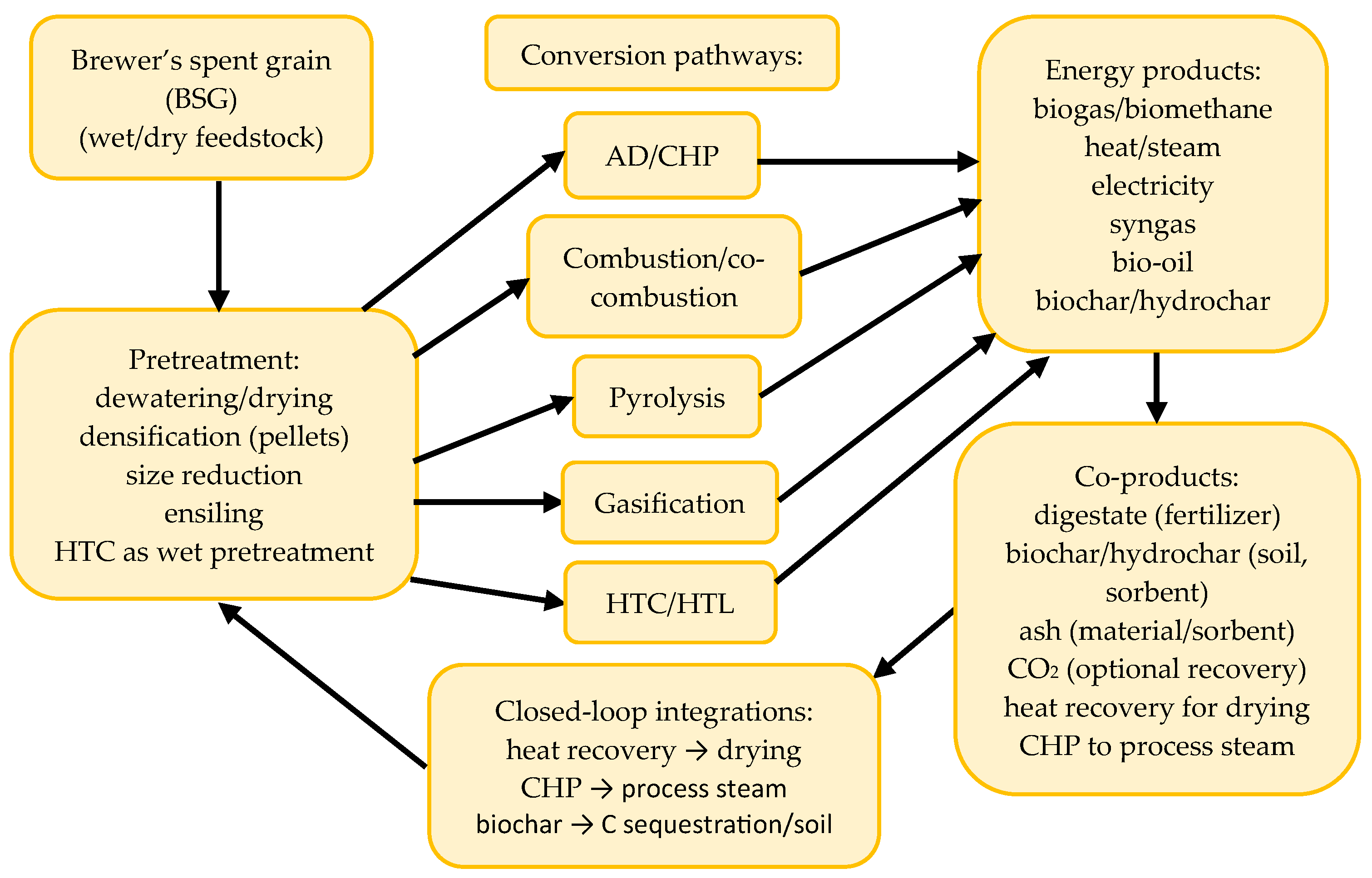
Based on the physicochemical properties and intrinsic variability of BSG discussed above,
Figure 1 presents a simplified system-level overview of the main BSG valorization routes. The scheme links feedstock conditioning steps with the major conversion pathways, the resulting energy products and co-products, and selected opportunities for process integration within a brewery-oriented biorefinery framework.
3.4. Cross-Cutting Challenges for BSG-to-Energy Pathways
Several constraints discussed throughout this review are not specific to a single conversion route but rather represent cross-cutting challenges that shape the feasibility, performance, and scalability of nearly all BSG-to-energy pathways. These include feedstock variability, high moisture content, ash and mineral chemistry, and the need for site-specific characterization before process selection and scale-up.
Firstly, BSG is an inherently heterogeneous material whose composition depends on raw materials, brewing technology, operating conditions, and brewery scale. Variations in protein, lignocellulosic fractions, moisture, ash, and minor components can significantly affect process behavior, making direct transfer of performance data between studies or brewery sites uncertain [
3,
4,
5,
15,
19]. As a result, the same conversion technology may perform differently depending on the origin and physicochemical properties of the BSG stream.
Secondly, high moisture content is a cross-cutting limitation that strongly affects logistics, storage stability, and process selection. Fresh BSG typically contains around 70–80% moisture, which reduces energy density, accelerates microbial degradation, and often imposes a major pretreatment burden for thermochemical routes [
2,
16,
34]. This feature tends to favor wet-processing pathways such as AD or hydrothermal conversion, whereas combustion, pyrolysis, and gasification generally require prior dewatering, drying, or densification [
16,
35].
Thirdly, ash content and mineral composition are critical from the standpoint of operational reliability, especially in thermal processes. Alkalis, chlorine, sulfur, and other problematic inorganic constituents may promote slagging, fouling, corrosion, deposit formation, and emissions, while also complicating the interpretation of fuel quality and process performance [
34,
36]. These constraints are particularly relevant for combustion and gasification, but they also influence the downstream usability of solid products such as ash, char, or hydrochar.
Finally, because of the combined effects of variability, moisture, and mineral composition, on-site characterization should be treated as a basic requirement for process design and implementation. Parameters such as moisture, ash, elemental composition, calorific value, and key inorganic species should be verified for each case study or industrial stream rather than inferred solely from literature averages [
1,
5,
19]. In this sense, feedstock characterization is not only an analytical step but also a prerequisite for selecting a realistic conversion pathway and defining an appropriate pretreatment and integration strategy.
The cross-cutting challenges summarized above should therefore be considered as a common interpretive framework for the pathway-specific sections that follow. In later sections, these issues are referred to only insofar as they create route-specific consequences for operability, environmental performance, or integration potential.
3.5. Component-Specific Process Adjustment and Mixing-System Routes
Because BSG is a heterogeneous lignocellulosic–protein material, the optimal operating strategy depends not only on the selected conversion pathway but also on which feedstock properties dominate in a given stream. From an engineering perspective, the most relevant parameters requiring adjustment are moisture content, lignocellulosic recalcitrance, protein-related nitrogen content, mineral/ash composition, and batch-to-batch variability.
High moisture content primarily affects logistics, storage stability, and the feasibility of thermochemical conversion. In practice, high-moisture BSG should either be directed to wet-compatible pathways such as AD or HTC or subjected to staged dewatering and drying if combustion, pyrolysis, or gasification is intended [
16,
35]. For pyrolysis and gasification, moisture reduction is not only a pretreatment step but also a decisive factor for process stability, net energy balance, and product quality [
19,
48].
Protein-rich BSG fractions are especially relevant to biological conversion because they influence the carbon-to-nitrogen ratio and may improve methane formation up to a certain threshold, beyond which excess nitrogen may increase ammonia stress or destabilize digestion. In such cases, process adjustment should include control of organic loading, co-digestion with carbon-richer streams, and, where necessary, adaptation of feeding strategy and retention time [
49,
50,
51]. By contrast, lignin-rich fractions are more resistant to biodegradation and therefore less favorable for direct biological conversion, but they may be more suitable for thermochemical pathways, especially when the objective is solid carbonaceous product formation, such as biochar [
19,
48,
52].
Fly ash and mineral composition are particularly important in combustion and gasification systems. Elevated alkali, chlorine, sulfur, or ash-forming fractions increase the risk of slagging, fouling, corrosion, and deposit formation, so process adjustment may require leaching, blending, densification, mineral additives, or stricter control of combustion and gasification temperature windows [
34,
36,
53,
54,
55]. In this sense, parameter adjustment should be interpreted not only as reactor tuning but also as feedstock conditioning and quality control before conversion.
In practical implementation, these component-specific constraints often justify the use of mixing systems rather than single-stream processing. Three representative technical routes can be distinguished. The first is a co-digestion route, in which BSG is mixed with brewery wastewater, sludge, trub, yeast, or other wet organic streams to improve rheology, organic-load distribution, and biochemical stability in AD systems [
50,
56,
57]. The second is a co-combustion or co-gasification route, in which dried and conditioned BSG is blended with more stable solid fuels such as wood biomass or lignite in order to improve feeding behavior, dilute problematic ash components, and stabilize thermal conversion [
7,
58]. The third is a fraction-oriented hybrid route, in which wet BSG or liquid fractions are directed to AD or hydrothermal processing, while the separated and conditioned solid fraction is routed to pyrolysis, gasification, or combustion [
48,
59,
60].
These mixing routes should therefore be understood as process design strategies for matching the physicochemical profile of BSG to the requirements of the most appropriate conversion pathway. For this reason, the practical selection of a BSG valorization route should be preceded by feedstock characterization and by identifying whether the dominant challenge is moisture, nitrogen balance, lignocellulosic recalcitrance, mineral fraction, or stream instability.
To clarify how the variability of BSG composition translates into process adjustment and pathway selection,
Table 2 summarizes the main component-specific sensitivities, the corresponding technical responses, and representative mixing-system routes across the principal BSG valorization technologies.
As shown in
Table 2, the preferred technical route depends not only on the selected conversion pathway, but also on which BSG property dominates in a given stream and whether this constraint is best addressed through pretreatment, parameter adjustment, blending, or fraction-specific routing.
4. Logistics, Warehousing, and Preparation of BSG for Energy Conversion
4.1. High Humidity and Its Consequences
The high water content in fresh BSG determines the entire logistical process of this stream; namely, it limits the safe storage time, increases sanitary requirements, and in practice forces rapid utilization or stabilization near the brewery [
16]. From the perspective of preparing for energy conversion, the key point is that material stability is strongly correlated with water activity. In studies on moisture sorption, it was pointed out that conditions corresponding to low water activity (e.g., around a
w ≈ 0.4) favor the stabilization of BSG during storage and serve as a practical reference point for selecting drying parameters or other conditioning methods [
61].
High humidity also promotes rapid microbiological changes, which translate into risks of material quality loss (spoilage, development of undesirable microflora) and variability in the feedstock for bioenergy processes. Microbiome analyses and storage tests under conditions similar to industrial ones showed that storage for up to 14 days under anaerobic conditions can lead to bacterial proliferation (including Bacilli, lactic acid bacteria, and acetic acid bacteria), while aerobic storage increases the risk of intense fungal contamination, including by potentially toxigenic species (e.g.,
Aspergillus flavus) [
62]. Importantly, BSG can already exhibit a suitable microflora on the day of production, the composition and abundance of which vary between breweries, further complicating the standardization of storage conditions and the prediction of the degradation rate [
4].
The logistical consequences also include transport costs and limitations; namely, transporting wet BSG largely means transporting water, which reduces the efficiency of the supply chain and decreases the economically viable range for delivery to the conversion plant (especially with solutions requiring stream centralization) [
10]. Industrial pre-dewatering (e.g., pressing, dewatering) reduces the transported mass but generates a liquid stream (press, wash water) with an elevated pollutant load (high COD) and phosphorus content, which requires treatment. In the literature, it is pointed out that such a stream can be rationally integrated, for example, with wastewater treatment or a biogas plant [
16].
In practice, the above conditions mean that strategies for handling BSG before the energy transition should be designed as a unified logistical and process system (storage along with stabilization and transport), rather than as a single technological step [
63]. Therefore, it is justified to divide BSG management methods into (i) those that limit water activity (drying, densification) and (ii) biological and chemical stabilization (e.g., fermentation, acidification), which can extend durability while also shaping the suitability of BSG as feedstock for energy processes [
64].
To connect the logistical constraints of wet BSG with pathway-specific feedstock requirements,
Table 3 summarizes the key quality targets (moisture/TS, physical form, critical inorganics) and the corresponding pretreatment steps and typical operational bottlenecks for the main BSG-to-energy routes.
Fresh BSG is typically wet and logistically unstable; moisture management is the key differentiator between thermochemical routes (dry feed needed) and hydrothermal routes (wet feed tolerated). For combustion or gasification, inorganic fraction control (K/Na/Cl, ash, N) often becomes as important as physical pellet quality for stable long-term operation.
4.2. Dewatering and Drying: Low- and High-Energy Solutions
Dewatering (mechanical removal of free water) and drying (thermal removal of bound water) should be considered as two complementary stages of BSG conditioning, as the energy required to evaporate water is usually orders of magnitude greater than the energy needed for its mechanical separation [
16].
4.2.1. Drainage Mechanical
In industrial practice, the first step is to increase drying efficiency through simple mechanical operations (gravity drainage, screw presses, belt presses, vacuum filtration, or centrifugal dewatering), which reduces the mass flow directed to the dryer and shortens the time and cost of raw material stabilization. From a project perspective, it is important to note that the mechanical stage is relatively low-energy, but it produces a liquid fraction whose utilization (e.g., inclusion in wastewater treatment or fermentation) should be considered in the overall BSG preparation process balance [
16].
4.2.2. Drying Options: Low-Energy and Intensified Approaches
Drying of BSG can be achieved using either low-energy or intensified approaches, with the choice depending on the required throughput, target moisture level, energy availability, and the intended downstream conversion route. Low-energy options include solar drying, natural convection drying, and low-temperature airflow processes. These methods minimize electricity demand and may reduce the environmental footprint, but they usually require longer drying times and are therefore better suited to applications where installation simplicity and low operating costs are prioritized over processing speed [
65].
By contrast, intensified drying methods, such as hot-air drying (belt or chamber), rotary drying, and vacuum-microwave drying, enable faster moisture removal and more effective material stabilization, although at the cost of higher energy consumption and greater capital requirements [
40]. For BSG, the selection of drying conditions is particularly important because high moisture content increases viscosity, cohesion, and the tendency toward adhesion and agglomeration, which may impair heat transfer and lead to uneven drying, especially in rotary systems [
66]. At the same time, studies on vacuum-microwave drying have demonstrated favorable energy performance compared with conventional convective drying, indicating that intensified methods may be advantageous when rapid stabilization is required [
40].
From a process design perspective, the choice between low-energy and intensified drying should be based not only on energy use but also on product stability and safety criteria. Sorption isotherms and water activity data can support the determination of target drying endpoints by indicating whether the moisture level has been sufficiently reduced to limit microbial growth and ensure stable storage of the dried material [
67]. Thus, drying strategy selection for BSG should be treated as a balance between energy demand, drying rate, and the degree of stabilization required for subsequent logistics and conversion processes.
4.2.3. Technology Selection Criteria
The choice of a low- or high-energy drying method should be based on the intended conversion technology, as different moisture and quality requirements are imposed by solid fuel preparation (e.g., pelletizing and storage logistics) and by biological processes, where excessive drying can be economically and process-wise unjustified. Consequently, the most rational systems for BSG are often sequential: (i) mechanical dewatering as an energy-efficient process step, (ii) mild or intensive drying tailored to the required stability and performance parameters, and (iii) integration with further processing (e.g., shredding, pelletizing) only if the energy and cost balance is positive for the entire process cycle [
16,
34].
4.3. Storage and Stabilization
The main objectives of BSG storage are to preserve organic matter (minimize dry matter losses) and maintain predictable feedstock properties for further energy conversion. In practice, this means selecting a strategy that minimizes oxygen access, inhibits the growth of unwanted microorganisms, and limits the formation of quality-degrading compounds (e.g., protein breakdown products), while remaining cost-effective and logistically feasible [
68].
4.3.1. Biological Stabilization
Biological stabilization of BSG is primarily based on the rapid establishment of anaerobic conditions, most commonly through ensiling, co-ensiling, or controlled fermentation. These approaches promote the activity of lactic acid bacteria and the formation of organic acids, which reduce pH, inhibit spoilage microflora, and improve feedstock stability during storage [
69,
70]. For wet BSG, co-ensiling with drier materials such as plant biomass or agricultural by-products is particularly useful because it improves dry matter balance and facilitates the formation of a stable silage mass [
71]. The use of additives, including bacterial inoculants, propionic acid, sodium formate, calcium propionate, or absorbent materials, can further improve fermentation quality, reduce undesirable microbiological changes, and enhance aerobic stability [
72,
73,
74,
75].
From a practical perspective, biological stabilization is especially relevant when BSG is intended for anaerobic digestion or other biological conversion routes, because it preserves the wet feedstock without requiring energy-intensive drying. Controlled fermentation may also be considered a form of in situ bioconservation, particularly where fermentation infrastructure or biogas facilities are available near the brewery [
64,
76].
4.3.2. Physical and Chemical Preservation
Physical and chemical preservation methods aim to limit degradation during storage by reducing microbial activity or slowing biochemical changes. Chemical preservation of wet BSG typically involves the use of acid mixtures or yeast- and mold-inhibiting additives, such as propionic- or formic acid-based systems, which can significantly reduce spoilage under anaerobic conditions [
72,
75,
77]. However, in industrial practice, the choice of preservative must take into account regulatory constraints, occupational safety, and possible effects on downstream conversion processes, particularly biological ones [
68].
Among physical methods, cooling or refrigeration can temporarily slow microbial and biochemical degradation, but their large-scale application is usually limited by high energy demand and unfavorable life cycle performance [
68,
78]. Therefore, these methods are more suitable for short-term buffering or niche applications than for routine BSG management. Regardless of the preservation strategy used, effective storage of BSG requires minimizing oxygen access, preventing rewetting, and monitoring signs of self-heating or degradation, since storage losses directly reduce the fuel and energy value of the material [
79,
80].
In practical terms, biological stabilization is generally the preferred option for wet BSG intended for AD or other fermentation-based pathways, whereas physical and chemical preservation plays a supporting role when short-term storage, transport buffering, or protection against rapid spoilage is required before further processing.
4.4. Shredding and Densification
Crushing and densification of BSG are a crucial step in thermochemical conversion processes because they improve flowability, dosing characteristics, and fuel feeding stability, reducing bridging and clogging in hoppers, which is a typical phenomenon for lightweight, fibrous materials [
81]. In terms of practical application, densification transforms low-density material into a feedstock with “commodity-like” characteristics (more uniform geometry, better handling and transportability), which has a direct impact on the continuous operation of boilers, gasifiers, and fuel feeding systems [
82].
Mechanical size reduction in BSG (e.g., by grinding, cutting) leads to a narrowing of the particle size distribution and improved binding in the pelletizing or briquetting process, but at the same time, it generates energy costs and can increase the proportion of fine particles, which cause atmospheric dust and worsen dosing stability. From the perspective of densification technology, achieving a particle size compromise is a critical factor. Particles that are too coarse hinder shaping and reduce the mechanical strength of the agglomerate, while particles that are too fine increase the grinding energy requirement and can exacerbate problems with pneumatic transport and erosion of feeding elements [
81].
Densification increases bulk density and facilitates the processes of automatic fuel feeding. In the literature on pellet fuels, typical bulk densities of around 1000–1400 kg/m
3 and bulk densities of approximately ~700 kg/m
3 are indicated, which translate into reduced storage and transportation costs and improved solid fuel logistics [
82]. In the case of BSG pellets, it has been demonstrated that good fuel physical parameters for logistics, such as bulk density ≈ 663 kg/m
3 and LHV ≈ 17.65 MJ/kg, can be achieved, while also indicating that limitations for combustion applications are more likely due to chemical composition (e.g., the presence of N, ash) rather than the mechanical quality of the pellets [
34].
In the context of combustion and co-combustion, densification primarily affects heat and mass transfer parameters and fuel feeding stability, which can improve ignition and burnout characteristics compared to loose material with low density and non-uniform geometry. Comparative studies on agricultural biomass indicate that densification can increase the ignition and burnout rates determined from TG/DTG analysis and affect the emission and composition of particulate matter (PM), which is important for designing dust collection systems and selecting combustion parameters for agrofuels [
83]. Regarding BSG, it has been shown that this material can be evaluated as fuel for energy recovery processes based on its elemental composition, ash content, and thermoxidative decomposition kinetics. However, practical operation requires control of the risks arising from poor ash quality and emissions of volatile substances (e.g., NOx) [
6].
For gasification processes (especially in co-current or downdraft reactors), the benefits of pelletization are particularly evident because the uniform shape and size of the feedstock stabilize the bed flow, reduce channeling, and facilitate maintaining repeatable conditions for oxidation and reduction reactions [
59]. Pilot studies on the downdraft gasification of BSG pellets have demonstrated the possibility of direct electricity generation (averaging approximately 1 kWh from ~1.3 kg of BSG pellets) and obtaining gas with a lower heating value (LHV) of around ~5.8–6.6 MJ/m
3, with process efficiencies (cold gas efficiency) reaching approximately ~75–83% under the tested conditions. From the perspective of limitations, pelletization does not eliminate the chemical problems of the feedstock (e.g., N content, ash content, and ash-forming elements), which is why parallel control of process parameters and management of solid residue and deposits are crucial for the stable operation of a gasifier [
84].
In practical implementation, the crushing and densification of BSG should be designed taking into account the requirements of the specific device. For combustion, the most important factors are the stability of the fuel feeding stage, mechanical durability, and the reduction in the dust fraction. However, for the gasification process, the homogeneity of the feedstock and the predictability of the flow resistance in the bed are also important. For this reason, it is worth clearly defining aspects such as: the target fuel form (pellets, briquettes), quality criteria (e.g., bulk density, mechanical durability, fines), and the method of linking mechanical parameters with the assessment of device performance (power stability, gas quality, emissions, and ash residue) [
81].
4.5. Pretreatment for Biological Processes
Biological BSG conversion pathways (especially methane fermentation, but also lactic acid, volatile fatty acid, or alcohol fermentations) are limited by the resistance of the lignocellulosic fraction to hydrolysis, which means the slow stage of structural sugar availability to the microbiota [
85]. In practice, pretreatment is designed to increase the solubility and reactivity of the polysaccharide fraction (increase in sCOD, availability of hemicellulose and cellulose), reduce diffusion barriers, and/or partially remove lignin, while maintaining a positive energy and economic balance for the entire process cycle [
86].
4.5.1. Mechanical Processing
Mechanical disintegration (grinding, rubbing, intensive homogenization) increases the specific surface area and the availability of enzymatic or microbiological reaction sites, which can shorten the hydrolysis phase and facilitate the leaching of fermentable compounds in two-stage processes [
86]. At the same time, it is a group of methods where electricity consumption can increase rapidly when aiming for very fine fractions, so the choice of the degree of comminution should result from an analysis of the possibility of achieving maximum biodegradability yield per unit of energy and be synchronized with the type of reactor (e.g., CSTR, EGSB, two-stage systems) [
87].
4.5.2. Physical, Thermal, and Hydrothermal Treatments
Hydrothermal methods (e.g., autohydrolysis, hot pressurized water) can partially hydrolyze hemicelluloses and increase carbohydrate bioavailability with relatively limited chemical input, which is particularly advantageous in continuous systems integrated with AD. Regarding BSG, it has been shown that hydrothermal pretreatment can significantly improve methanogenesis parameters in continuous operation (increased methane productivity and volatile solid (VS) degradation rate) and promote functional shifts in the microbial community toward more intensive methanogenesis [
88]. A particular variation of this type of method is subcritical water hydrolysis, which can intensively release sugars and soluble fractions (including protein compounds), but requires process control to limit the formation of inhibitors (e.g., furfural, HMF, phenols) that are detrimental to fermentation [
89].
4.5.3. Chemical and Physicochemical Treatments
Alkaline and physicochemical pretreatment methods are primarily used for partial delignification and to increase porosity and wettability, which translates into faster hydrolysis and a higher biochemical methane potential (BMP), but at the cost of reagent consumption and the need for leachate management [
90]. For BSG, it has been shown that microwave-assisted alkaline treatment can simultaneously increase the material’s specific surface area, remove a significant portion of lignin and hemicelluloses, and lead to an increase in BMP. However, considering the cost analysis, the price of caustic soda (NaOH) relative to energy and gas carriers can be crucial. In practice, this means that a highly effective laboratory method will not always be the best in industry if the costs of chemicals, neutralization, and water treatment outweigh the energy benefits [
91].
Physical methods, such as ultrasound, are being considered as milder pretreatments to improve the availability of organic matter and methane fermentation parameters. However, the feasibility of their application depends on the relationship between energy input and methane production growth [
92]. From a process design perspective, ultrasound and microwaves are most often evaluated not as standalone solutions, but as hybrid elements (e.g., short, pulsed assistance for alkalization or hydrolysis), where the selection of parameters minimizing energy losses, as well as inhibitors, is crucial [
91].
4.5.4. Enzymatic and Biological Treatments
The use of enzymes (e.g., cellulases and hemicellulases) to hydrolyze BSG allows for some of the hydrolytic processes to be carried out before entering the reactor. This is extremely important in high-load systems (e.g., EGSB), where operational stability depends on precise dosing of readily biodegradable substances. Studies have confirmed the possibility of biomethanating enzymatically hydrolyzed BSG in EGSB-type reactors, while also highlighting the crucial role of the organic loading rate increase rate for maintaining process stability and the structure of microbial communities [
93].
Biological pretreatment methods using filamentous fungi or enzyme production directly within the system (in situ) are gaining increasing interest. Their goal is to partially break down the fibers and improve their biodegradability while reducing the use of strong chemicals. For example, an approach was proposed that utilizes Aspergillus oryzae cells and mycelia-associated cellulolytic complexes for the initial degradation of BSG before BMP tests, which confirms the potential of biological–enzymatic methods as an alternative or supplement to thermal or chemical pretreatments [
94].
4.5.5. Integration with the Fermentation System and Inhibitor Control (AD/VFA/H2)
In the production of fatty acids (LKT/VFA), BSG is often first processed into a liquid, for example, through mild hydrolysis and separation of the sediment. This allows the solution, rather than the problematic solid, to enter the reactor, which simplifies load control (OLR) and enables more precise control over the resulting products [
95]. Excessive treatment can lead to the formation of harmful compounds (such as phenols or sugar degradation products) that contaminate the water cycle and inhibit further processes. For this reason, the parameters should be chosen to achieve high efficiency while avoiding the formation of inhibitors and the need for costly purification or dilution of the solution [
90].
The pretreatment method should be tailored individually, taking into account the nature of the biological process (e.g., biogas or fatty acid production), the type of reactor and its resistance to solids, as well as local energy resources and environmental requirements, such as salinity levels or the amount of wastewater generated [
91].
4.6. Pretreatment for Thermochemical Processes
Unlike drying or densification, the pretreatment of BSG for thermochemical methods aims to change its fuel properties. Thanks to it, the combustion process becomes more stable, ash and corrosion are less likely to build up, and the quality of the raw material remains consistent even with variable deliveries [
59].
4.6.1. Dry Torrefaction as a Method for Improving the Quality Parameters of Solid Fuel
Torrefaction is a mild thermochemical valorization process for biomass, usually carried out in an inert atmosphere or under anaerobic conditions. This process causes partial depolymerization and a decrease in the oxygen content within the material structure, which allows for the production of fuel with physicochemical parameters similar to coal (more favorable O/C and H/C ratios, hydrophobicity, and increased grindability) [
96]. From a process perspective, torrefaction is crucial for gasification and co-combustion systems. Increased brittleness and improved grindability enable the production of a homogeneous fuel, which directly translates into stabilizing the reaction kinetics and minimizing fluctuations in temperature and process gas composition [
97].
In the case of BSG, torrefaction is seen not only as a method of energy valorization but also as a process of cascading biomass utilization. It allows for the simultaneous production of high-value-added products for the brewing industry (e.g., natural dyes) and high-calorie solid fuel, which aligns with the plant’s strategy of full raw material integration [
98]. From the perspective of thermochemical technologies, a key design aspect of torrefaction is achieving a compromise between improving fuel properties and mass and energy losses due to volatile emissions (torr-gas), which determines the energy and economic balance of the installation [
99].
4.6.2. Wet Torrefaction and Hydrothermal Carbonization (HTC) as Methods for Processing High-Moisture Raw Materials
For feedstocks like BSG, where dry processing may be limited by feedstock preparation requirements, hydrothermal treatments, including HTC, are particularly important, leading to the production of hydrochar with modified fuel properties and improved storage stability [
100]. Research shows that HTC can be considered a pretreatment step that improves the suitability of BSG for further thermochemical processes (including hybrid chains, where the impact of HTC on pyrolysis behavior is analyzed), while simultaneously producing a water stream that requires process management [
60].
It should be noted that the literature describes two-stage process variants (using, for example, hydrolysis or acid catalysis) that allow for the intensification of raw material valorization without the need to raise the temperature. These solutions are particularly important when designing installations dedicated to waste streams with high heterogeneity (variable composition) [
100].
4.6.3. Washing with Water and Mild Extraction as a Method for Preparing Feedstock for Combustion and Gasification Processes
A separate group of pretreatments is washing processes (leaching/water washing), which aim to reduce the content of selected inorganic components responsible for operational problems in boilers and gasifiers (including K, Na, and Cl) through simple liquid-phase extraction. The literature on leaching indicates that solid–liquid extraction can effectively reduce the alkali and chloride content in many types of biomass, which translates into a lower risk of high-temperature deposition and corrosion [
53]. Importantly, the impact of leaching is also analyzed in the context of gasification, as a pretreatment that modifies ash properties and fuel reactivity, often directly compared to torrefaction in studies on other biomasses [
101].
4.6.4. Ash Conditioning with Mineral Additives
In situations where unfavorable ash composition prevents the fuel from being used in standard installations, in situ strategies utilizing mineral additives are implemented. The use of kaolin, aluminosilicates, or calcium-rich components (e.g., dolomite) allows for the chemical binding of volatile alkaline fractions. This leads to an increase in the ash melting temperature and a change in its transformation mechanisms, which effectively minimizes slagging, sintering, and deposit formation. The literature in the field of biomass energy indicates that aluminosilicate sorbents can reduce the emission of volatile alkali compounds and limit the formation of deposits, with effectiveness depending on the dosage, fuel type, and furnace type [
54]. This type of additive can be dosed into the fuel (including during the formation of solid fuels) or introduced into the combustion zone or bed, which offers implementation flexibility but requires verification of its impact on the properties of the final ash and waste streams [
102].
4.6.5. Integrated Technological Chains: Synergy of Pretreatment Processes with Equipment Performance Parameters
Modern industrial standards impose a sequential approach to biomass valorization (e.g., through the system: leaching → torrefaction/HTC → granulation). This process integration allows for the simultaneous optimization of logistical parameters, the elimination of ash chemistry-related risks, and the maximization of kinetic efficiency during combustion or gasification [
103]. Designing the pretreatment path requires a customer-centric approach, meaning the reactor (considering the grain size distribution, grindability, and ash limits). This choice must be verified by an energy–economic audit, as valorization processes such as torrefaction or HTC involve a trade-off between improving fuel quality and energy losses contained in the removed volatile fractions, as well as the costs of wastewater disposal [
96].
5. Biological Technologies: Biogas Production and Other Energy Carriers
5.1. Methanogenic Fermentation
Anaerobic digestion (AD) of BSG is considered a “waste-to-energy” technology that fits into the circular bioeconomy model, where brewery by-products (BSG, yeast, wastewater, and sludge from treatment plants) are combined in biorefineries to produce biogas, biomethane, and digestate with fertilizer potential [
49]. A barrier to using BSG in anaerobic fermentation processes is the slow breakdown of fibers. In practice, this problem is solved by choosing between monofermentation and cofermentation with other substrates, properly designing the reactor, and ensuring process stability, including by dosing micronutrients and controlling the sludge retention time [
50].
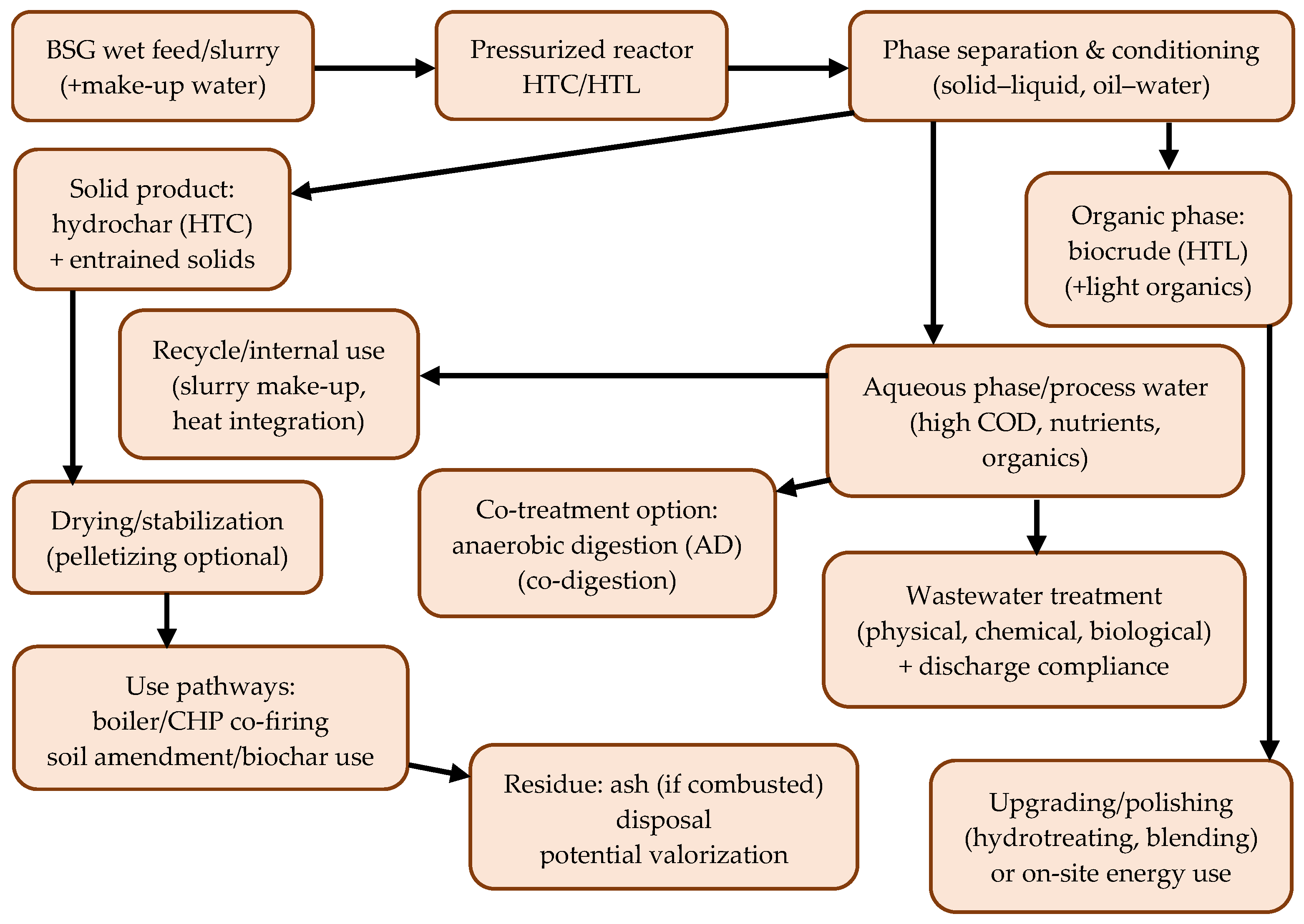
For clarity,
Figure 2 summarizes the core unit operations of the AD-based conversion chain for BSG, from feedstock preparation through fermentation and biogas cleaning/upgrading to CHP or biomethane utilization and digestate handling.
5.1.1. Monofermentation and Cofermentation
BSG monofermentation is feasible, provided strict control of the organic load is maintained, which prevents excessive accumulation of volatile fatty acids (VFAs). In this case, the efficiency of biogas production is closely linked to the technology used, such as the dry process (dry AD) or a two-phase system that separates the hydrolysis and acidogenesis phase from the methane production stage [
104]. Cofermentation is usually the preferred solution, as it allows for optimal balancing of the substrate mixture (e.g., equalizing the availability of easily degradable fractions, improving the C:N ratio). This method also allows for the effective utilization of internal waste streams from the brewery—wastewater and sludge—which serve as a co-substrate or a source of active biomass [
56].
The composition of BSG, particularly the protein and carbohydrate content, affects the carbon-to-nitrogen (C:N) ratio, which is a key factor in the efficiency of the AD process. Variations in BSG composition can lead to fluctuations in methane production, with higher protein content generally improving biogas yield. However, excess nitrogen can inhibit the process, requiring optimization of feedstock composition or supplementation with other substrates [
49,
51].
In the biorefinery approach for breweries, it has been shown that the addition of BSG to a mixture of brewery wastewater and wastewater treatment plant (WWTP) sludge can significantly increase methane yield, and the effect is dependent on the BSG proportion and test conditions [
56]. At the same time, the development of BSG co-digestion processes with other organic substrates (e.g., sewage sludge or animal manure) is aimed at improving the biochemical stability of the system and increasing methane yield. This strategy also allows for the optimization of biogas quality, although its effectiveness depends on strict adherence to the mixture proportions and the reactor feeding schedule [
50].
5.1.2. Reactor Configurations, Process Conditions, and Stability
Research on anaerobic fermentation of BSG at laboratory and pilot scales includes static tests (BMP), used to determine specific methane yield, as well as continuous and semi-continuous processes. The latter allow for a comprehensive assessment of the system’s biochemical stability by monitoring pH, buffering capacity (VFA/alkalinity ratio), the degree of organic matter degradation (sCOD/VS), and determining kinetic parameters [
105]. For feedstocks with a significant solid fraction and low hydrolysis kinetics, two-phase systems are used. The first stage is dedicated to hydrolysis and acidogenesis processes (often carried out as dry fermentation), while the second is dedicated to methanogenesis itself (e.g., in UASB reactors). This separation allows for the isolation of sensitive methanogenic archaea from rapid changes in organic load [
106].
The biotechnological stability of the process usually depends on the organic loading rate (OLR); an excess of it leads to the accumulation of volatile fatty acids (VFAs) and acidification of the environment (a decrease in pH). An additional critical factor is the micronutrient deficiency in lignocellulosic biomass, which inhibits the activity of methanogens even at high concentrations of available organic substrate. Analysis of the cofermentation of BSG with brewery wastewater allowed for the identification of the optimal organic loading range (the so-called operating window). In this area, the process occurs with minimal VFA accumulation and limited methanogenesis inhibition, demonstrating that precise control of the OLR parameter is critical for the stability of systems utilizing BSG [
49].
5.1.3. Biogas Yield: Controlling Factors and Data Comparability
Significant variation in the units used in the literature to report biogas and methane yields from BSG (including L CH
4/kg VS, mL CH
4/g VS/TVS, NmL CH
4/g COD) makes direct comparison of results difficult. A reliable data compilation requires a clear definition of the reference point (VS, TS, or COD), consideration of standard conditions (STP), and correction for methane production from the inoculum itself. For this reason, standardization guidelines and protocols (IWA BMP protocol) and normative approaches to BMP tests are increasingly being invoked, which limit variability resulting from inoculum selection, ISR, mixing, and data reporting methods [
105].
Data from brewery streams confirm that the highest methane potential may be associated with fractions other than just BSG (e.g., trub, yeast), while mixing streams can be beneficial in terms of the total volume of methane recoverable in a brewery. Using the example of hot sediments (trub), a significant methane yield (BMP) was demonstrated, which was further increased after enriching the mixture of trub and BSG with crude glycerol in a precisely defined proportion. This case confirms that the efficiency of the process is strongly determined by the composition of the substrates and the presence of easily degradable organic fractions introduced with the co-substrate [
57].
In studies dedicated solely to BSG processing, it was demonstrated that long-term process stability can be maintained in a two-phase configuration, combining a solid-phase reactor (hydrolysis and acidogenesis stage) with a granular biomass system (methanogenesis stage). The authors analyzed methane yield per dry weight (TS) under process conditions, while simultaneously noting the presence and degree of degradation of troublesome intermediate metabolites such as p-cresol [
106]. Alternatively, in batch dry fermentation (dry AD) processes, a significant degree of solid fraction degradation was observed, which, in terms of a balance, presents a real opportunity for the recovery of electricity and heat for the brewery’s needs. However, it should be noted that the reported methane yield is strictly dependent on the methodology used to define organic dry matter (TVS) and the precision of the mass balance during the studies [
104].
Factors controlling CH
4 yield in AD of BSG include, among others, the type and adaptation of the inoculum (e.g., sludge from brewery wastewater treatment), the availability of trace elements (Fe, Co, Ni, etc.), the feeding strategy (continuous vs. batch), the temperature (mesophilic/thermophilic), and stabilization interventions (e.g., bioaugmentation, biostimulation) [
51].
5.1.4. Postfermentation: Utilization, Risks, Fertilizer Potential
Digestate is a by-product of AD, whose agricultural value stems from its macronutrient content (N, P, K) and the increased availability of certain nitrogen forms after the fermentation process, making it a potential substitute for some mineral fertilizers in a circular economy [
107]. At the same time, the utilization of digestate requires an assessment of environmental and sanitary risks and quality control, as contaminants (e.g., heavy metals, pharmaceutical residues, antibiotics, microplastics) and emission problems related to storage and application (NH
3, odors) may be present depending on the feedstock and technology [
108].
Industrial implementations include actions that increase the market value and safety of digestate. Standard practices include: separation into solid and liquid fractions, sanitization, and sludge thickening. Final agricultural use is planned based on the nutrient balance and current legal requirements for fertilization [
107]. For applications in breweries, it is also important that cofermentation of BSG with wastewater and other streams can change the characteristics of the digestate (e.g., N:P ratio, conductivity, salinity), which should be considered in the risk assessment and fertilizer potential [
56].
5.1.5. Biogas Purification, Upgrading, and Utilization
The use of biogas from AD in a brewery is most often considered in cogeneration systems (CHP) and as a source of process heat, while in development scenarios, it is considered as upgraded biomethane (e.g., for injection into the grid or as a transport fuel) [
109]. The choice of biogas utilization pathway determines the necessary purification processes. While the critical factor in CHP units is the elimination of H
2S, water vapor, and siloxanes, the process of upgrading to biomethane additionally requires high CO
2 removal efficiency. The final product must meet specific quality criteria imposed by local legislation or network operators [
110].
Currently, physicochemical processes such as pressure swing adsorption (PSA), membrane techniques, absorption, and cryogenic processes are dominant in the biogas upgrading sector. Simultaneously, biological methods based on biomethanation (CO
2 conversion using H
2) are being intensively developed. These solutions offer great potential for integration with RES systems and the hydrogen sector, but their commercial scaling and full industrial implementation still represent a significant technological barrier [
109]. The variability in biogas composition, resulting from the dynamics of operational parameters (e.g., switching from mono- to co-digestion, OLR variability), poses a significant challenge for brewing systems. The condition for maintaining the continuous operation of cogeneration units and upgrading systems is the implementation of rigorous quality monitoring focused on the detection of organosilicon compounds and H
2S [
110]. To support the discussion in
Section 4 on methane-yield comparability,
Table 4 summarizes representative AD studies on brewery-derived substrates, explicitly reporting the substrate type, reactor configuration, yield units, and the main limiting or confounding factors.
When comparing studies, it should be noted that VS-added, VS-removed, TS-based, and COD-based methane yields are not interchangeable without additional mass balances and consistent definitions of the reference basis. Likewise, volumetric methane production rates (e.g., L CH
4 L
−1 d
−1) capture process productivity under specific OLR/HRT conditions and cannot be directly compared to BMP-style specific yields (e.g., mL CH
4 g
−1 VS) unless the organic loading, conversion efficiency, and normalization conditions are aligned. Therefore, the most defensible cross-study comparisons in
Section 4 should either (i) be restricted to datasets reported on the same basis (preferably STP-corrected mL CH
4 g
−1 VS with inoculum blank correction) or (ii) be recalculated to a common basis using the authors’ reported solids/COD balances.
5.2. Fermentations for Bioethanol, Biobutanol, and BioH2
Besides methane fermentation, BSG can serve as a feedstock for the so-called sugar platform, which is aimed at producing liquid and gaseous fuels (bioethanol, biobutanol, bioH
2). The effectiveness of these processes depends on the efficient release of fermentable sugars from the carbohydrate fraction and the elimination of inhibitory compounds [
41]. While some barriers can be overcome in the AD process (anaerobic fermentation by extending the retention time), the production of ethanol, butanol, or hydrogen is more sensitive to: (i) the sugar profile of the hydrolysate (proportions of glucose to pentoses), (ii) the concentration of inhibitors such as furans, phenols, and organic acids, and (iii) osmotic stress and the toxicity of the resulting metabolites (particularly critical in the ABE process) [
113].
5.2.1. Bioethanol from BSG: Process Variants and Limitations
The dominant methods for producing bioethanol from BSG are based on a process sequence that includes pretreatment, enzymatic hydrolysis, and fermentation in SHF, SSF configurations, or their hybrid variants. The main technological difficulty is still the low efficiency of parallel processing of hexoses (C6) and pentoses (C5) present in lignocellulosic hydrolysates. Typical BSG studies have shown that after mild acid treatment and enzymatic hydrolysis, a mixture of hexoses and pentoses is produced, which limits ethanol yield when using standard pentose-non-fermenting strains of
Saccharomyces cerevisiae [
113]. In the literature, you can find analyses of methods to increase the efficiency of sugar conversion from BSG by intensifying hydrolysis processes, for example, using non-thermal techniques to assist in the breakdown of the lignocellulosic matrix. Another approach is to optimize the fermentation itself, achieved through the selection of specific yeast strains, the use of sequential systems, or the implementation of hybrid configurations, which allows for more complete utilization of available carbohydrates [
114].
The limitations for the implementation scale primarily concern the variability in the quality of the hydrolysates (including inhibitors), the cost of enzymes, and the need to integrate unit operations (e.g., phase separation, hydrolysate clarification, and ethanol recovery and dehydration) [
115]. In practice, ethanol processes are only economically competitive when integrated into a broader biorefinery concept (co-products: protein fractions, phenols, fiber, or streams for other conversions), which is strongly emphasized in reviews dedicated to BSG biorefineries [
41].
5.2.2. Biobutanol (ABE) from BSG Hydrolysates: Potential and Bottlenecks
Biobutanol is characterized by high energy potential and favorable logistical properties as a standalone fuel or a component of fuel blends. However, the process of its biotechnological production (ABE fermentation) is limited by strong product inhibition and the high sensitivity of
Clostridium bacteria to toxic compounds present in lignocellulosic hydrolysates [
116]. The feasibility of the ABE process using BSG on substrates prepared by acid hydrolysis was confirmed. In this case, the efficiency of fermentation is determined by the rigor of the pretreatment, the availability of the sugar fraction, the proportion of the solid phase, and the specific composition of the inhibitors present in the resulting hydrolyzate [
117]. At the same time, it was shown that pretreatment aimed at reducing inhibitors (e.g., enzymatic–biological approaches like laccase treatment) can improve the fermentability of BSG hydrolysates and increase the comparability of results with synthetic media [
118].
In the case of ABE fermentation, the system architecture is crucial: the two-phase nature of the metabolism (transition from acidogenesis to solventogenesis) and the method used for metabolite recovery (e.g., in situ separation). These factors significantly influence productivity rates and process economics, as reflected in numerous publications on the biotechnological production of acetone and butanol [
119]. In the context of BSG, this means that even with good laboratory yields, the key challenges remain the stable fermentation of real hydrolysates and the cost-effective recovery of dilute butanol from the fermentation broth [
118].
5.2.3. BioH2 (Dark Fermentation) from BSG Hydrolysates: The Role of Process Conditions and Integration
BioH
2 production via dark fermentation is a complementary pathway, particularly in systems where the goal is rapid conversion of the easily fermentable fraction into gas and intermediate products (VFAs) that can be further valorized (e.g., in AD, MCC, or bioproduct synthesis) [
120]. Studies on BSG hydrolysates indicate that H
2 yield and productivity are strongly influenced by operational parameters (initial pH, temperature, inoculum-to-substrate ratio) and the quality of the hydrolysate (sugar concentration, inhibitors), which was confirmed for dark fermentation (DF) of BSG hydrolysate in experimental systems [
121].
Considering technological realism, DF is most often treated as an intermediate step in the conversion chain (e.g., in two-stage H
2 + methanation systems). This is due to the fact that limitations in the electron balance and the lack of complete substrate mineralization mean that a significant amount of energy potential remains deposited in liquid metabolites (VFAs), which require further processing [
122]. The literature indicates that in the case of lignocellulosic substrates (e.g., BSG), optimizing pretreatment and hydrolysis to ensure maximum yield of fermentable sugars with minimal inhibitor concentration is crucial. This is due to the fact that the microorganisms responsible for H
2 production typically lack the ability to directly degrade the structural polymers of biomass [
123].
5.2.4. Technological Perspectives: Conditions for the Justification of Integrating Alternative Conversion Pathways with AD Systems
From a systemic perspective, the implementation of bioethanol and biobutanol production gains importance in situations where the plant has a well-developed pretreatment and hydrolysis line, as well as product separation systems. Full efficiency is achieved by closing the material cycle, in which digestate and process wastewater are sent to biogas plants (AD) or treatment systems [
41]. Biohydrogen production via DF is most justified as a pretreatment process for methanation or as a module within a biorefinery structure focused on the synthesis of intermediate metabolites (VFAs). In this arrangement, H
2 is treated as a valuable by-product, not the main and only final energy carrier [
120].
5.3. New Directions: Microbial Consortia, Process Intensification, Integration with Water and Heat Cycles in the Brewery
Modern biological technologies in brewing are evolving from simple biogas production toward advanced microbiome engineering and high-rate systems [
124]. Currently, integrated systems are being designed with water and heat management, where process efficiency is based on precise control of the structure of microbial consortia (e.g., syntrophic relationships) and a close link between wastewater treatment and energy and water recovery [
125].
5.3.1. Microbiome Engineering: Consortia, Metagenomics, and Bioaugmentation
Modern fermentation diagnostics is evolving from simple species composition identification toward advanced functional analysis. The use of metagenomic and metataxonomic tools allows for the precise determination of the metabolic roles of individual microorganisms in real time, which translates into a higher degree of control over the process [
124]. In the context of brewery streams, a metataxonomic approach was demonstrated for assessing the cofermentation of brewery by-products within a biorefinery concept, linking operational results with an analysis of the microbiome community and function [
104].
Current trends in the development of biological processes (emerging pathways) focus on actively supporting technological processes through bioaugmentation (selective inoculation) or biostimulation (enhancing functions, such as stress tolerance). These methods are critical for effectively processing demanding substrates [
126]. In the context of BSG, the effectiveness of the synergy between bioaugmentation, cofermentation, and supporting additives has been demonstrated, which sets a new paradigm: managing the biocenosis instead of solely passively controlling environmental conditions [
51].
Modern process engineering is increasingly turning to modeling synthetic microbial consortia. This approach allows for the deliberate “programming” of fermentation efficiency through the separation of trophic niches and the enhancement of desirable interspecies interactions, which directly translates into the stability of the AD process [
127].
5.3.2. Process Intensification Methods
The second trend involves intensifying kinetics and stabilizing processes through the use of conductive materials that facilitate direct interspecies electron transfer (DIET). This approach effectively eliminates “bottlenecks” in syntrophy while increasing the system’s resilience to load fluctuations [
128]. Research on the use of biochar produced from BSG has shown its potential in optimizing methane fermentation, which supports the hypothesis that these materials promote electron transfer and stabilize the overall process [
129].
A key area of innovation is microbial electrochemical technologies integrated with anaerobic fermentation (e.g., BEAD systems). These solutions significantly increase the efficiency of methanogenesis and process stability at high loads, which is particularly important in the continuous treatment of brewery wastewater. Research shows that BEAD-type configurations outperform conventional AD reactors in terms of specific methane production across a wide range of organic loading rates (OLRs), making them an attractive method for process intensification in reactors with limited volume [
112].
A parallel development direction concerns anaerobic membrane bioreactors (AnMBRs) and their variants (e.g., FO-AnMBRs), which combine AD with membrane separation, maintaining a high biomass concentration (shorter HRT while preserving a longer SRT) and enabling simultaneous water recovery during biogas production. In the literature on brewery wastewater, the potential of FO-AnMBR is highlighted as a solution aimed at simultaneously reducing water consumption and improving the energy balance of treatment [
130].
5.3.3. From Wastewater Treatment Plant to Biorefinery: Full Integration of Water and Heat Cycles in a Modern Brewery
A modern approach to water and energy management in brewing is based on the full integration of bioprocesses: wastewater is treated as an energy carrier (COD conversion into biogas), and wastewater treatment systems are designed with water recycling and operational cost optimization in mind. Current literature analyses indicate a clear shift toward technologies that enable the simultaneous recovery of water, energy, and biogenic components. This favors the implementation of hybrid systems, such as combining AD/AnMBR reactors with polishing and reuse processes [
131].
From an energy perspective, integration is based on the utilization of biogas in cogeneration (CHP) systems and industrial heat cycles (steam, hot water). Future scenarios envision expanding this model with advanced biomethanation and Power-to-Gas (H
2) technologies, which will improve fuel quality parameters and enable more efficient energy storage [
132]. Previous implementations confirm that AD reactors located directly on brewery premises can effectively power heating systems with waste biogas, making them an integral component of the plant’s energy infrastructure [
133].
In summary, modern trends in brewing biotechnology are focused on three pillars: (i) precise programming of microbiome activity using metagenomics and designed consortia, (ii) process acceleration through DIET mechanisms, electro-biological systems, and AnMBR reactors, and (iii) full resource circularity, transforming a brewery into an integrated biorefinery for energy, water, and heat [
124].
6. Thermochemical Technologies: Solid, Liquid, and Gaseous Energy from BSG
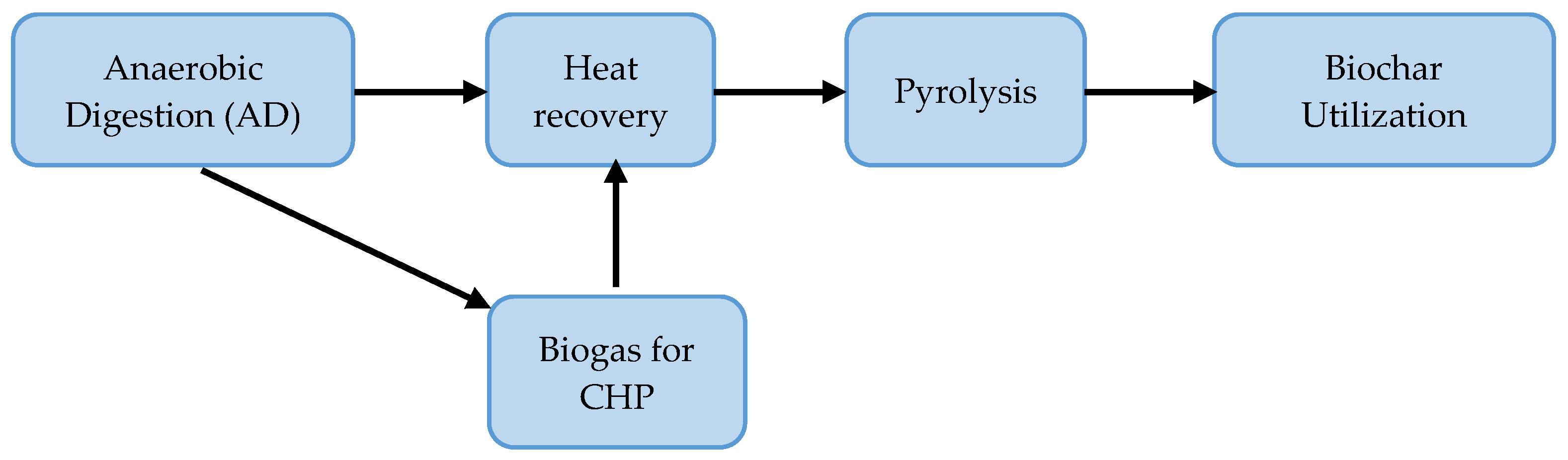
To provide a process-engineering overview of the dry thermochemical routes discussed in
Section 6,
Figure 3 summarizes a generic thermochemical conversion chain for BSG, from dewatering/drying and fuel conditioning through the reactor stage (combustion, pyrolysis, gasification), flue gas/syngas cleanup, and final energy conversion with heat recovery. The scheme highlights the unit operations that largely determine feasibility at brewery scale, particularly feedstock conditioning and gas cleaning requirements.
6.1. Burning and Co-Burning of BSG
Thermal utilization of BSG, including co-combustion with fossil fuels or woody biomass, is a mature “waste-to-heat/power” route, but its feasibility depends less on nominal calorific value than on maintaining consistent fuel quality, meeting emission limits, and controlling ash-related operational risks in real boiler systems [
6]. Co-combustion with lignite is sometimes considered a transitional option because mineral interactions may stabilize combustion and partly mitigate unfavorable biomass ash behavior, although this requires detailed chemical compatibility assessment and plant-specific optimization [
7].
The main process risks are associated with inorganic phase transformations and the formation of low-melting eutectics, which promote slagging, sintering, deposit formation, and, in fluidized-bed systems, bed agglomeration [
134]. Since conventional biomass indices may not adequately predict these effects, mineralogical characterization and indicators accounting for chlorine and volatile alkalis are recommended [
135]. In this context, co-combustion can also serve as a form of “chemical tuning” of ash behavior through controlled blending [
7].
Boiler type strongly influences tolerance to fuel variability and the available risk-management strategy. Grate-fired units are generally more tolerant of heterogeneous fuels but require stable feeding and optimized air staging to limit unburned losses and CO/OGC emissions [
136]. In practice, blending BSG with more stable biomass streams, such as wood, is often more realistic than full substitution, especially for steam generation [
58]. Fluidized-bed boilers (BFB/CFB) offer greater feedstock flexibility and favorable conditions for NOx mitigation, but they remain vulnerable to agglomeration caused by alkali–bed interactions, making careful inorganic fraction control and, in some cases, the use of alternative bed materials or mineral additives necessary [
137,
138]. Overall, stable operation requires feed homogenization, appropriate air distribution, and attention to ash fusion behavior and characteristic temperatures [
58].
Emission management should address three main groups: (i) NOx and acid gases, (ii) incomplete-combustion products such as CO and VOCs, and (iii) particulate matter with associated metals and volatiles, preferably reported per unit of useful energy [
7]. Fuel-bound nitrogen is typically the main source of NOx in biomass combustion, so primary measures such as thermal control and air staging are the first line of mitigation, with SNCR/SCR applied where necessary [
139]. Where fine fly ash fractions are generated, high-performance particulate control, such as fabric filters or electrostatic precipitators, becomes essential [
140]. For breweries, the main advantage of BSG combustion lies in the supply of process heat and/or CHP integration, but practical implementation still requires site-specific energy balance assessment against actual heat demand and boiler constraints [
58].
6.2. BSG Pyrolysis
BSG pyrolysis is a thermochemical process that allows for the simultaneous production of biochar, bio-oil, and a gaseous fraction. The conversion efficiency, mass distribution, and quality parameters of the obtained products are strictly determined by the process conditions, including temperature, heating rate, and vapor residence time, as well as the type of atmosphere used, catalysis, and the degree of feedstock preparation and moisture content [
48].
6.2.1. Operating Window, Product Distribution, and Key Barriers in BSG Pyrolysis
The performance of BSG pyrolysis is governed by the operating window defined by temperature, heating rate, vapor residence time, atmosphere control, and feedstock quality, all of which determine product distribution and product quality [
48]. In BSG studies, slow pyrolysis is commonly conducted in the range of 673–873 K, where increasing temperature generally promotes deeper devolatilization, a higher degree of biochar aromatization and stabilization, and a shift in product distribution from liquid toward gaseous fractions [
48,
52]. Comparative studies at 673, 773, and 873 K showed that the fuel properties of the resulting biochar are strongly temperature-dependent, with biochar produced at 673 K exhibiting the most favorable characteristics for energy applications, which highlights the need to balance carbonization intensity against preservation of useful fuel properties [
52].
Intermediate pyrolysis represents an alternative pathway, typically operated at 350–450 °C with solid residence times of several minutes, and may offer a more balanced product split. For BSG, experiments conducted in a Pyroformer reactor at 450 °C reported yields of approximately 51% bio-oil, 29% char, and 19% permanent gases, providing an important reference point for mass and energy balance considerations in process design [
48]. More generally, higher heating rates tend to favor condensable products, whereas longer vapor–char contact promotes secondary cracking and repolymerization reactions, which can reduce bio-oil stability and alter gas composition [
48].
From the perspective of product distribution, BSG pyrolysis yields three main streams: biochar, bio-oil, and gas. Biochar becomes more aromatic, thermally stable, and less reactive as treatment severity increases, although these properties do not always correspond to optimal calorific performance in energy applications [
48,
52]. Bio-oil is often the most problematic fraction because it may separate into aqueous and organic phases and contains reactive compounds that promote aging, viscosity increase, and tar formation, thereby limiting its direct use in engines or CHP systems without upgrading [
48]. At the same time, the composition of volatile products, including phenolic, nitrogen-containing, and lipid-derived compounds, creates opportunities for selective chemical valorization as well as challenges related to emissions and downstream use [
141]. The gaseous fraction, particularly when coupled with catalytic upgrading or steam reforming, can become a significant energy carrier; post-catalytic reforming at 500–850 °C has been shown to increase permanent gas production and produce gas with a calorific value of 10.8–25.2 MJ/m
3, depending on temperature and steam conditions [
48].
The main barriers to efficient BSG pyrolysis arise from feedstock properties and downstream product handling. High moisture content lowers process efficiency and reduces the calorific value of both biochar and bio-oil, making pre-drying or blending with other feedstocks important for stable operation [
19]. In addition, lignin-rich composition affects volatile release because lignin is more resistant to thermal degradation, while gas quality remains strongly dependent on thermal regime, tar control, and the effectiveness of catalytic integration before condensation [
19,
48]. Consequently, BSG pyrolysis appears most suitable in systems where biochar is treated as the primary product and the volatile fractions are recovered energetically within an integrated brewery energy configuration [
48,
52].
6.2.2. Biochar: Energy and Non-Energy Applications
Biochar from BSG is a potential solid fuel, but its actual energy utility is determined by the ash characteristics, combustion process stability, and emission parameters of the specific installation (including the risk of slagging and the presence of problematic elements). This necessitates a “fit-for-purpose” assessment for each thermal technology [
52]. Simultaneously, biochar is gaining recognition as a functional material in nonfuel applications, which is shifting research priorities: instead of maximizing calorific value (LHV), surface properties, sorption capacity, and chemical stability of the structure are becoming key [
142].
In the agricultural and environmental sector, biochar is recognized as an effective means of improving water retention, soil physical structure, and nutrient availability. Its implementation promotes the reduction in greenhouse gas emissions and sustainable carbon sequestration, which is a key element of co-benefits in life cycle assessments (LCAs) [
142]. Research on biochar from BSG, including phytotoxicity and germination tests, confirms its suitability as an agro-additive. This strengthens the position of pyrolysis as a technology that integrates energy recovery with the production of high-value environmental products [
52].
An extension of the concept of co-benefits is the design of biochar with sorption properties, dedicated to the recovery of biogens (e.g., N, P) from waste and wastewater streams. This strategy, which also includes co-pyrolysis processes, aligns with the trend of modern biorefineries and the paradigm of multifunctional valorization of waste biomass [
143].
6.3. Gasification: Raw Material Quality Requirements, Gas Cleaning, and Installation Scale
Gasification of BSG enables the production of combustible gas (producer gas/syngas), which can be used in combined heat and power (CHP) systems, gas boilers, or—after advanced conditioning—in high-purity hydrogen production processes. Critical factors determining technological feasibility are: (i) the homogeneity of the feedstock parameters (moisture content, granulation, mineral fraction characteristics), (ii) the choice of reactor architecture (e.g., fixed bed downdraft or fluidized bed), and (iii) the degree of gas purification, which is closely correlated with the requirements of the receiving unit [
84].
Gasification efficiency is strongly influenced by the moisture content and particle size of BSG. High moisture content can reduce thermal efficiency and syngas quality. Moreover, variations in the cellulose and hemicellulose content affect the temperature and syngas yield, requiring careful feedstock preparation to maintain consistent gasifier operation [
144,
145].
6.3.1. Quality Requirements for BSG Feedstock for Gasification
Deployment gasification analyses focus on the use of feedstock that has undergone pretreatment, both thermal and mechanical (e.g., pelletization). Ensuring a stable bed flow and repeatable reaction kinetics requires homogenizing the fuel geometry and eliminating hydraulic instabilities within the reactor. Experiences with downdraft pilot installations confirm that hammer pelletizing guarantees the operational stability of the device under conditions similar to industrial ones, which is difficult to achieve with loose raw material [
84]. In contrast, in fluidized-bed systems, precise control of process parameters (e.g., oxidant excess ratio) and feedstock conditioning becomes crucial for stabilizing gas quality and minimizing ash-related risks [
146].
The critical properties of the feedstock in the gasification process are the content and chemical composition of the mineral fraction (alkalis, chlorine, sulfur). These parameters determine the intensity of deposit formation, the risk of bed agglomeration in fluidized-bed reactors, and the presence of inorganic contaminants in the syngas (e.g., volatile alkali salts), which accelerate the degradation of installation components [
55]. In the context of powering engines and turbines, the proportion of fine particles (fines) and susceptibility to carryover are also crucial, as these factors increase the load on filtration systems and exacerbate the risk of erosion of mechanical components [
147].
6.3.2. Gas Cleaning and Scaling Constraints in BSG Gasification
The main limitation of energetic gas utilization from BSG gasification is the need to remove tar, dust, aerosols, and trace inorganic contaminants to prevent condensation, equipment fouling, and malfunction of downstream units. Because tar formation depends strongly on reactor configuration and process conditions, primary (in situ) measures are usually insufficient, and secondary gas cleaning systems are typically required [
148]. In practice, gas conditioning involves staged cleaning, including pre-dusting (e.g., cyclones or inertial separators) followed by wet scrubbing or hot-gas cleaning with high-temperature filtration and catalytic tar conversion, with the final configuration depending on the intended end use of the gas [
55].
For small-scale CHP or internal combustion engine applications, wet cleaning systems may achieve the required gas quality, including tar and dust levels below 100 mg/Nm
3, but they generate a secondary wastewater stream contaminated with tar compounds, which must be included in the operational and environmental assessment [
149]. In more demanding applications, such as synthesis gas production or membrane-based H
2 recovery, deeper removal of sulfur, chlorine, and alkalis is also necessary, since even trace concentrations may damage catalysts, membranes, or product quality [
150]. As a result, the gas cleaning module remains one of the most cost-intensive components of gasification systems, and its complexity increases substantially as the final gas application becomes more advanced [
151].
From the perspective of industrial deployment, small- and medium-scale gasification integrated with local CHP systems appears to be the most realistic short-term configuration, particularly where heat can be used on site and biomass transport distances are limited [
147]. Pilot studies in downdraft systems have demonstrated the feasibility of electricity generation from BSG pellets, with reported yields of approximately 1 kWh from about 1.3 kg of feedstock [
84]. In parallel, IEA Bioenergy reports indicate the commercial availability of CHP modules at around 1 MWe, which is compatible with the demand profile of many industrial plants, provided that fuel preparation and gas cleaning performance are sufficiently reliable [
152].
In brewery applications, the practical feasibility of gasification depends on matching gas purity requirements to the selected receiving unit, whether a boiler, CHP system, or more advanced hydrogen-oriented application. Consequently, the effectiveness of tar and dust removal remains a decisive factor for plant availability, operating cost, and the economic viability of small-scale BSG gasification projects [
147].
6.4. Hydrothermal Processes: Particularly Attractive for Wet BSG
Hydrothermal processes, particularly HTC and HTL, have become promising and energy-efficient methods for processing wet biomass feedstocks like BSG. These processes utilize subcritical water conditions (typically temperatures ranging from 180 °C to 250 °C), which allow for the conversion of high-water-content feedstocks like BSG into solid biofuels called “hydrochar” without the need for an energy-intensive drying phase [
100].
To complement the discussion of HTC/HTL as wet-processing options,
Figure 4 outlines a generic hydrothermal processing chain (unit operations) for BSG, including wet feed handling (slurry feeding), the pressurized HTC/HTL reactor, downstream phase separation/conditioning (solid–liquid and oil–water), and product finishing (drying/stabilization and optional upgrading). The scheme also emphasizes the key output streams (hydrochar or biocrude and the process water/aqueous phase) that drive integration needs and wastewater management.
Given that the aqueous phase (process water) is often the critical stream governing integration complexity and wastewater compliance in HTC/HTL systems,
Figure 5 provides a simplified management flowchart for the main post-separation streams. The scheme summarizes typical routing options for the aqueous phase (recycle, co-treatment via AD, or dedicated wastewater treatment) and the handling of solid products (hydrochar) and downstream residues (e.g., ash if combusted). The aqueous phase often dominates integration and compliance needs, and solids or ash handling closes the material loop.
BSG is a difficult feedstock to process in traditional thermochemical processes such as pyrolysis or gasification, mainly due to its high water content (ranging from 60% to 90%). In traditional methods like combustion or pyrolysis, the presence of water in the BSG significantly reduces the energy efficiency of the process and increases operational costs because the water needs to be evaporated before effective conversion can begin. HTC, on the other hand, avoids this problem by using water as a reaction medium, allowing the raw material to be processed without the need for pre-drying [
60].
HTC offers several benefits when applied to BSG. Firstly, this process leads to a significant reduction in the oxygen content of the material, which increases its calorific value, making it a more efficient fuel for combustion or gasification. Research has shown that processing BSG using the HTC method can increase the energy density of the feedstock, raising the higher heating value (HHV) from approximately 18–21 MJ/kg for dried BSG to about 26.5 MJ/kg for the resulting hydrochar. Additionally, HTC processing reduces the ash content in the material, which is crucial for mitigating operational challenges such as equipment clogging and deposit formation in energy systems [
100].Additionally, HTC is improving the storage stability of BSG, which is very unstable in its wet form, making it easier to transport and reducing logistics costs. This process also changes the chemical composition of the BSG, reducing problematic elements like potassium and chlorine, which can lead to corrosion during combustion [
60].
Importantly, the energy balance of the HTC process is more favorable compared to other drying methods. Eliminating the need for pre-drying reduces the total energy consumption during the raw material preparation stage, making this method more sustainable and cost-effective, especially in industrial applications where large quantities of wet BSG are produced [
98].
In summary, hydrothermal processes such as HTC and HTL are particularly well suited for processing wet BSG, offering a promising alternative to traditional drying methods. By converting this wet biomass into an upgraded solid fuel with higher energy value and reducing operational risks, these processes contribute to the broader goal of efficient and sustainable bioenergy production from brewing waste [
98].
6.5. Other Processes: Carbonization, Co-Processing with Other Biomass or Waste, Hybrid Solutions
In the context of thermochemical technologies, alongside classic methods like pyrolysis and gasification, alternative approaches such as carbonization, co-processing with other biomass or waste, and hybrid solutions are gaining increasing interest. These processes offer additional benefits in biomass processing, including beer production by-products (BSG), enabling a more sustainable and efficient conversion of biomass into energy products while reducing emissions and improving process efficiency [
153].
Carbonization is a thermochemical process that takes place under anaerobic conditions at elevated temperatures (typically in the range of 300–800 °C), leading to the production of biochar. Carbonization of BSG allows for a significant increase in the calorific value of the raw material, while simultaneously reducing the content of volatile substances. This is a process that not only improves the energy properties of BSG but also enables effective management of carbon oxide and methane emissions that can be released during combustion or other energy processes [
154].
Co-processing BSG with other biomass is becoming a popular approach to increase the efficiency of thermochemical processes. Combining BSG with other organic materials, such as straw, wood, or agricultural waste, allows for an improvement in the quality of the resulting syngas, which is particularly important in the case of gasification. Co-processing not only optimizes energy consumption but also reduces the risk of deposits and corrosion in energy conversion equipment [
155].
Hybrid solutions, combining different thermochemical technologies, are gaining importance in industry. Combining HTC with pyrolysis is one example where it is possible to obtain biochar with improved energy parameters while simultaneously reducing greenhouse gas emissions. Research has shown that combining these processes can improve biogas yield in fermentation processes, particularly in BSG biomethanation systems, which increases the stability and efficiency of this process [
60].
By using alternative processing methods such as carbonization, co-processing with other biomass, and hybrid solutions, it is possible to obtain more sustainable energy products while reducing emissions and improving the quality parameters of the raw materials used in these processes [
156].
7. Integration in Biorefineries and Closed-Loop Energy Cycles in the Brewing Industry
7.1. Biorefinery Concepts: Cascading Valorization vs. Energy Only
A biorefinery can be defined as an integrated processing system in which biomass is converted into a portfolio of value-added products, such as biofuels, energy carriers, platform chemicals, biomaterials, and functional ingredients, through interconnected physical, chemical, thermochemical, and biological processes. In contrast to single-purpose utilization routes, the biorefinery concept aims to maximize overall resource efficiency by valorizing multiple biomass fractions and by linking product generation with energy recovery, waste minimization, and circular use of secondary streams. In the context of BSG, this concept is particularly relevant because BSG is not only a potential energy substrate but also a heterogeneous lignocellulosic–protein feedstock that can be directed toward multiple valorization pathways depending on technological objectives and local integration opportunities [
157].
Within this broader framework, the concept of cascading valorization refers to the process of repeatedly using a single feedstock in different processing stages, which can include the production of biofuels, biochemicals, and other valuable products. This approach is in contrast to the concept where raw materials such as brewery by-products (BSG) are used solely for energy production, e.g., in combustion or gasification processes. Cascade valorization enables the full utilization of BSG’s potential by adapting technologies to different product types, which promotes more sustainable biorefinery development. Within this approach, BSG can be processed first into high-quality biochemicals, then into biofuels, and finally into energy, allowing for the multiple use of valuable organic components and waste minimization [
157].
This approach is crucial in biorefineries because it enables the simultaneous production of various high-value-added products such as proteins, polysaccharides, organic acids, and bioplastics, which can be used in the food, pharmaceutical, or cosmetic industries. Research shows that cascade valorization allows for increased raw material efficiency, waste reduction, and improvement of the energy balance of biorefining processes [
157].
On the other hand, an approach focused solely on energy production from BSG (e.g., through combustion, pyrolysis, or gasification) has its limitations, primarily in terms of energy efficiency and long-term sustainability. While this approach may be quick and simple to implement, it leads to the loss of potential benefits associated with multiple uses of the raw material, which could be achieved through the application of more complex biorefining processes. Therefore, while energy production from BSG is a significant element of a biomass-based economy, in the context of biorefineries, it is worth considering integration with more comprehensive processes that allow for the full potential of this feedstock to be utilized [
158].
In biorefineries, the concept of cascading valorization is particularly valuable because it supports the development of sustainable industrial processes that minimize waste and maximize added value. Conversely, processes focused solely on energy may prove insufficient in the context of the need for sustainable use of natural resources and the production of higher-value products. Thanks to approaches like cascade valorization, it is possible to achieve synergy between different processing stages, which promotes more efficient and environmentally friendly production within a biorefinery [
159].
At present, the practical implementation of the biorefinery concept for brewer’s spent grain (BSG) remains uneven across technological levels. Some biorefinery elements are already implemented industrially, particularly in breweries where anaerobic treatment of wastewater and organic residues is integrated with biogas recovery and combined heat and power (CHP) generation. Such systems demonstrate that brewery by-products can already be incorporated into on-site circular energy management. However, the literature also indicates that fully developed multiproduct BSG biorefineries, in which proteins, carbohydrates, lignin-rich fractions, fuels, and energy carriers are recovered in one coordinated processing chain, are still relatively rare and are mostly reported at the laboratory, pilot, or early demonstration stage rather than as mature industrial installations. Therefore, current practice more often reflects partial biorefinery implementation than fully integrated BSG biorefinery deployment. For example, brewery-integrated anaerobic digestion systems coupled with biogas utilization in CHP units have already been reported as practical on-site solutions, whereas broader cascading BSG biorefinery platforms remain much less common at industrial scale [
160].
By contrast, fully integrated multiproduct BSG biorefineries, in which proteins, carbohydrate-rich fractions, lignin-rich streams, fuels, and energy carriers are recovered within one coordinated processing chain, remain relatively rare at an industrial scale. Recent reviews indicate that although the BSG biorefinery concept is well developed at the conceptual, laboratory, and pilot levels, industrial-scale applications are still limited, and many pathways remain constrained by technological complexity, feedstock variability, scale-up uncertainty, and integration costs. Therefore, current practice more often reflects partial or modular implementation of the biorefinery approach than the widespread deployment of fully mature BSG biorefinery platforms [
161].
Accordingly, in the present review, the biorefinery concept is understood not as a single fixed technological configuration but as a spectrum of integration strategies ranging from partial recovery of energy and by-products to advanced cascading systems designed to maximize the value extracted from BSG under specific industrial conditions.
7.2. Technology Integration Scenarios
Technology integration in BSG-based biorefineries is primarily aimed at improving energy efficiency, reducing feedstock losses, and increasing the recovery of value-added products through coordinated use of biological, thermochemical, and heat recovery pathways. The most relevant integration archetypes include: (i) AD coupled with CHP and heat recovery, (ii) AD linked with downstream pyrolysis of digestate or solid residues, (iii) wet-processing configurations based on HTC, and (iv) gasification-based CHP systems for conditioned solid fuels [
162,
163,
164,
165].
Among these, AD-centered systems are the most frequently discussed, particularly where biogas is used in CHP units to supply electricity and process heat, including heat for drying or other preparatory steps [
162]. Coupling AD with pyrolysis may further increase material valorization by converting digestate or residual solids into biochar and bio-oil while also creating opportunities for internal recycling of biochar as an AD-support additive or for external use as a soil amendment or sorbent [
163,
164]. Hybrid concepts may also include the use of waste heat from thermochemical units to support drying or extraction stages, as well as the reuse of hydrothermal liquid streams for nutrient recovery or further biological processing [
165].
In practice, however, the feasibility of these configurations depends on how effectively heat, process streams, and by-products can be matched to actual brewery utility demand, material handling constraints, and site-specific infrastructure. For this reason, hybrid systems should be evaluated not only in terms of theoretical circularity but also with regard to integration risks, operational complexity, and the practical conditions under which they are most plausible. To structure this comparison,
Table 5 summarizes the main integration archetypes, their key couplings, outputs, risks, and boundary conditions, while
Figure 6 provides a conceptual illustration of closed-loop integration in a brewery-oriented biorefinery system [
162,
163,
164,
165].
7.3. Mass and Energy Balance at the Brewery Scale
Mass and energy balances are essential tools for evaluating how BSG valorization can be integrated into brewery operations. In this context, they are used to identify where material and energy flows occur, how much heat and electricity are required by the brewery, and to what extent BSG-derived energy can offset external utility demand [
166,
167].
At brewery scale, such balances are particularly useful for locating major energy-demanding stages, estimating the availability of BSG and other residues, and assessing whether recovery pathways such as anaerobic digestion, thermochemical conversion, or CHP integration can be matched to actual process needs [
168]. This is especially important because energy demand differs substantially between large industrial breweries and smaller craft or microbrewery systems, where specific electricity and heat consumption per unit of beer is often higher and heat recovery is less developed [
169].
From the perspective of BSG-to-energy integration, the main value of mass and energy analysis lies in identifying practical insertion points for heat, steam, and electricity recovery, as well as in evaluating whether the energy recovered from BSG can be used efficiently on site. In particular, these balances support the design of heat recovery systems, CHP-based integration, and utility matching under real production conditions [
168,
169].
Accordingly,
Figure 7 presents a conceptual overview of the main brewery-scale material and energy flows, highlighting where BSG-derived energy can be integrated into the system through biogas production, thermal conversion, cogeneration, and heat recovery [
168,
169].
To complement the conceptual integration map (
Figure 7) with an intuitive energy balance view,
Figure 8 provides a semi-quantitative Sankey-style diagram that visualizes where useful heat/steam and electricity are supplied and where conversion losses occur within the brewery boundary.
Arrow thickness is proportional to the magnitude of each energy stream (illustrative, normalized example). The diagram highlights the relative contribution of BSG-to-energy insertion points to brewery electricity loads and process heat/steam demand, and it makes the “hidden” loss channels (e.g., conversion and auxiliary losses) explicit. For case-specific use, the normalized values can be replaced with site data (e.g., MWh·yr−1 or MJ·hL−1).
In large-scale industrial breweries, mass and energy balances are often performed using advanced process modeling methods, which not only allows for the accounting of individual streams but also supports decisions about investments in energy efficiency technologies. These analyses cover both thermal energy (steam, hot water) and electrical energy, as well as the mass of raw materials and by-products such as water, wort, sediments, CO
2, and waste heat [
170].
In summary, mass and energy balances in brewing are a key element in assessing operational efficiency and the sustainability of beer production at various scales of operation. This knowledge enables the identification of areas with high energy demand, support for energy recovery initiatives, reduction in resource consumption, and the design of more technologically and environmentally efficient production systems, which is particularly important for both microbreweries and large industrial plants [
169].
7.4. Integration with the Local Energy System
Integration with the local energy system is an important component of brewery decarbonization because it can improve energy management, reduce greenhouse gas emissions, and lower operating costs [
171]. In practice, the most relevant options are on-site cogeneration (CHP) and, where local conditions allow, connection to district heating networks.
CHP systems are particularly attractive in breweries because they enable simultaneous production of electricity and useful heat from biogas or other internally recovered energy carriers, improving overall efficiency and reducing dependence on external energy supply [
48,
171,
172]. Their value is greatest where recovered heat can be directly matched to brewery demand, such as process water heating, mashing, wort boiling, or space heating [
48].
A complementary option is integration with district heating, where excess heat from brewery processes or conversion systems can be exported to external users. This can further improve overall energy efficiency and support regional decarbonization strategies, especially in areas with established heat-network infrastructure [
173].
More broadly, local energy integration may also involve coupling CHP with other BSG valorization routes, including thermochemical systems that recover energy while generating additional products such as biochar. In this way, brewery energy systems can move beyond isolated waste treatment toward more integrated and circular low-carbon configurations [
84,
174].
8. Comparative Technical and Environmental Assessment of BSG-to-Energy Pathways
8.1. Harmonized Comparison Framework and KPIs: Technical and Environmental
In order to conduct a comprehensive assessment of various BSG (brewery spent grain) conversion pathways to energy, it is essential to develop a consistent comparative framework that considers both technical and environmental aspects. A key element of this framework is the reference units, which allow for a reliable comparison of the performance of different conversion technologies. Typical reference units are, for example, dry matter unit (e.g., per ton of BSG dry matter) or energy unit (e.g., per MJ of energy in the raw material). Thanks to these units, it is possible to compare the results of different technologies in a uniform manner, regardless of the technology used and the scale of operations [
120,
158].
Key performance indicators (KPIs) that can be used to evaluate BSG conversion technologies include a variety of technical and environmental parameters. The first of these is energy efficiency, which can be measured as the amount of energy obtained per unit mass of raw material (e.g., MJ/kg). This indicator allows for the assessment of energy conversion efficiency in processes such as pyrolysis, gasification, or biogas production [
175]. Another important indicator is CO
2 emission intensity, which measures the amount of greenhouse gases emitted per unit of energy produced. This type of indicator allows for assessing the impact of a given technology on emission reduction, which is crucial in the context of industrial decarbonization [
176].
Equally important are indicators related to environmental sustainability, such as water consumption, natural resource utilization, and emissions of other pollutants (e.g., NOx, SOx), which can help assess how different technologies impact the environment. This assessment becomes particularly important in the context of processes with high raw material and energy consumption, such as pyrolysis or gasification [
52,
163]. Additionally, it is worth considering the operational efficiency of the technology, including indicators related to reliability, downtime, ease of integration with existing systems, and operating costs, which have a direct impact on the profitability and practicality of implementing a given technology in the brewing industry [
163,
177].
In order to enable a reliable and comprehensive assessment of different technologies, it is necessary to use uniform reference units and KPI definitions that will allow for the comparison of the results of various BSG conversion pathways. This approach allows for the consideration of multiple dimensions of efficiency, both technical and environmental, which is crucial in the context of sustainable development. Standardizing these indicators allows for an objective comparison of technologies such as pyrolysis, gasification, and methane fermentation, and for selecting the most optimal solutions for the brewing industry that will have a positive impact on the environment and operational efficiency [
86,
178].
Because indicators in the literature are reported on different bases (TS/VS/COD) and in non-uniform units, direct comparisons of results can be subject to significant uncertainty. To reduce this incomparability,
Table 6 presents a set of recommended KPIs along with definitions, units, reference base, and required input data, facilitating both the interpretation of results and their conversion to a common basis.
8.2. Proposed Classification Framework for BSG Resource Utilization Technologies
To enhance the comparative and decision-support value of this review, a three-dimensional classification framework for BSG resource utilization technologies is proposed. The framework is intended to move beyond simple pathway listing and to organize the main technologies according to the practical constraints and priorities that most strongly determine their suitability in brewery applications.
The first dimension is feedstock-state compatibility, which reflects the extent to which a given technology can accommodate the intrinsic characteristics of BSG, particularly its high moisture content, compositional variability, and mineral fraction. In this dimension, technologies can be grouped as follows: (i) wet-feed-compatible pathways (e.g., AD, HTC/HTL), (ii) dry-feed-dependent pathways (e.g., combustion, gasification, pyrolysis), and (iii) feed-preparation-intensive pathways, where drying, densification, or compositional conditioning strongly affects feasibility and net performance.
The second dimension is the primary valorization objective, which distinguishes whether a pathway is oriented mainly toward: (i) energy recovery, (ii) combined energy and material valorization, or (iii) cascading biorefinery use, in which energy recovery is integrated with the recovery of higher-value fractions or multifunctional by-products. This distinction is important because some technologies are best evaluated as energy systems, whereas others generate part of their value through digestate, biochar, nutrient recovery, or integration with broader biorefinery schemes.
The third dimension is implementation and integration level, which reflects the complexity of industrial deployment in brewery conditions. In this dimension, pathways may be grouped as follows: (i) mature standalone options with relatively high deployment readiness, (ii) utility-integrated systems linked to CHP, heat recovery, or wastewater infrastructure, and (iii) hybrid high-complexity systems, which require stronger process coupling, more advanced control, and greater infrastructural compatibility.
Within this framework, AD can be classified as a wet-feed-compatible, energy-oriented, utility-integrated technology with relatively high implementation readiness. Combustion and gasification belong to dry-feed-dependent pathways but differ in maturity and gas cleaning complexity. Pyrolysis occupies an intermediate position because it can serve both energy recovery and material valorization objectives, particularly when biochar is treated as a functional co-product. Hydrothermal technologies are especially relevant as wet-feed-compatible options but remain more demanding in terms of engineering complexity and scale-up.
This classification framework does not replace detailed quantitative assessment; rather, it provides a structured first-order interpretation of BSG valorization technologies. It is therefore proposed as a conceptual bridge between the descriptive review sections and the comparative evaluation tools presented later in this manuscript.
8.3. Integrated Technical–Economic–Environmental Evaluation Index
In addition to the classification framework proposed above, this review introduces an integrated evaluation structure for BSG valorization technologies that combines technical, economic/implementation, and environmental/circularity dimensions. The purpose of this index system is not to generate a single universal ranking independent of context but to define a transparent set of evaluation domains that can be adapted to brewery-specific decision-making.
The technical dimension includes indicators related to conversion performance, operational feasibility, and integration potential. Representative criteria include gross energy yield, net energy balance, moisture tolerance, pretreatment burden, process robustness to feedstock variability, technology readiness, and compatibility with brewery heat and electricity demand profiles.
The economic and implementation dimension includes indicators related to capital intensity, operating complexity, and practical deployment conditions. Suggested criteria include CAPEX sensitivity, OPEX drivers, service and staffing requirements, the need for auxiliary systems (e.g., gas cleaning, drying, and wastewater treatment), infrastructure compatibility, and scale suitability for micro, craft, medium, or industrial breweries.
The environmental and circularity dimension includes indicators describing climate impact, emissions, and resource-loop closure. Relevant criteria include greenhouse gas intensity, air pollutant burden, nutrient recycling potential, carbon retention, water use intensity, and the valorization potential of secondary streams such as digestate, biochar, hydrochar, and fly ash.
From a methodological perspective, this three-pillar structure can be operationalized as a comprehensive evaluation index system or used as the criteria matrix for subsequent MCDA analysis. In this sense, the proposed structure links the harmonized KPI logic presented earlier with the pathway selection logic discussed later, while also making explicit that the preferred option depends on the decision context, brewery scale, and integration objectives.
Accordingly, the present review proposes that future comparative studies on BSG valorization should move from single-metric assessments toward integrated technical–economic–environmental evaluation. Such an approach better captures the real decision space of brewery implementation and provides a more robust basis for pathway selection than comparisons based solely on energy yield or nominal efficiency.
To enhance the comparative value of this review,
Table 7 proposes a classification and integrated evaluation framework for the main BSG resource utilization technologies. The framework combines three interpretive dimensions—feedstock-state compatibility, valorization objective, and integration level—with a structured set of technical, economic, and environmental/circularity criteria. Its purpose is not to replace pathway-specific analysis but to support transparent preselection and context-sensitive comparison of BSG valorization options under brewery-specific conditions.
As shown in
Table 6, the preferred pathway depends not only on nominal energy efficiency, but also on the compatibility of the technology with the physical state of BSG, the desired product portfolio, and the level of infrastructural and operational complexity that can be justified at brewery scale.
8.4. Energy Performance Metrics Across Pathways
Comparing “BSG-to-energy” pathways requires a consistent set of metrics describing energy yield, conversion efficiency, and net balance (after accounting for the energy consumed in feedstock preparation and process operation). In practice, it is recommended to report the results both in terms of mass (e.g., MJ·kg
−1 dry matter or kWh·t
−1 dry matter) and energy (e.g., MJ of useful energy/MJ of chemical energy in the feedstock) to separate the influence of BSG properties from the influence of the technology and system configuration. This approach facilitates the transfer of results across scales (micro/mini vs. industrial) and reduces errors resulting from differences in humidity and raw material preparation [
179].
In a comparative approach, the basic metric is the gross energy yield, understood as the chemical energy contained in energy products (e.g., methane in biogas, producer gas/syngas, liquid fraction, biochar) relative to a unit of feedstock. For AD pathways, the starting point is most often the methane yield (e.g., NmL CH
4·g
−1 VS), which is then converted into an energy equivalent (MJ) using the methane heating value; in studies on the co-digestion of brewery waste, both kinetic parameters and bioenergy potential are reported simultaneously, which directly supports comparisons between process variants and substrates [
56,
104].
For thermochemical pathways, it is crucial to divide the energy into carriers (heat, electricity, solid/liquid/gaseous fuel) and explicitly indicate the partial and overall efficiencies of the system. For example, in a BSG pellet gasification system coupled with an energy generation unit, it was demonstrated that approximately 1.0 kWh of electrical energy was obtained from ~1.3 kg of BSG pellets, corresponding to an average electrical efficiency of 16.5%, which serves as a direct comparative metric for “electricity from BSG” scenarios (particularly in analyses of self-consumption and energy export) [
84].
Higher-resolution technical analysis uses the net energy balance (NEB) and related indicators (e.g., net energy ratio/net energy efficiency), which subtract auxiliary energy consumption (mixing, pumping, heating, biogas compression/purification, shredding, pelletizing, drying) from the energy in the products. For example, in studies on biomethane from BSG, both the energy produced and the theoretical energy consumed by the AD plant were taken into account simultaneously, which allows for the classification of variants not only by methane yield but also by the actual “net gain” of energy [
180].
In the context of a brewery, the distinction between self-consumption and energy export (to the power grid or in the form of usable heat) is particularly important because the same amount of energy produced can have different operational value depending on the heat and power demand profile. Metrics such as “share of heat/electricity demand covered by the brewery” or “net kWh exported per ton of BSG” should be compared with the energy consumption characteristics of brewing processes (e.g., MJ/hL and operational efficiency) to avoid comparisons that are detached from the reality of system integration at the plant [
170,
179].
The results of energy comparisons are strongly determined by the moisture content of the BSG and the resulting raw material preparation requirements. BSG usually leaves the brewery as a high-moisture material (around ~80%
w/
w), which on the one hand favors “wet” pathways (e.g., AD) but on the other hand poses a significant energy barrier for many thermochemical pathways that require moisture reduction and/or densification [
16,
34].
In pyrolysis and gasification pathways, moisture affects both the conversion process and the net balance (the “hidden” energy in drying can dominate the benefits of fuel production). The literature on biomass pyrolysis identifies moisture content as a design and operational parameter that determines product distribution, condensation requirements, and the energy consumption of feedstock preparation, which should be explicitly considered in metrics like NEB/NER for a fair comparison of technologies [
181].
To ensure comparability of results, it is recommended to standardize reporting based on a common reference base. The key set of indicators should include: (i) gross energy obtained per ton of dry raw material, (ii) conversion efficiencies (electrical, thermal, and total), (iii) net energy balance (NEB/NER) with a precise breakdown into energy-intensive processes such as drying or granulation, and (iv) the ratio of self-consumption to exported energy. This approach allows for an assessment of the actual energy surplus available to the plant, taking into account the impact of feedstock moisture content and preparation costs [
84,
179].
8.5. Emissions and Environmental Impacts
A comprehensive ecological assessment of “BSG-to-energy” technology requires a holistic approach, considering both stack emissions and the carbon footprint of the supply chain (auxiliary energy, transportation). According to the literature on LCA, the demand for energy media and the method of accounting for the impact of by-products determine the resulting emission balance. Proper selection of the system boundaries is therefore essential for a reliable interpretation of the real environmental benefits resulting from BSG energy valorization [
168].
The resulting carbon footprint of BSG-based technologies is determined by the chosen allocation model (mass, energy, or economic) and the consideration of the substitution effect (e.g., replacing mineral fertilizers with biochar). Problems with the multifunctionality of bioenergy systems often lead to inconsistent conclusions in the LCA literature. To enable a reliable comparison of the hammer valuation pathways, it is necessary to use a uniform hierarchy of solutions and to explicitly declare the system boundaries and emission credits for avoided burdens [
182].
In the thermochemical conversion processes of BSG (combustion, gasification, pyrolysis), biogenic gas emissions are dominant, but the final carbon footprint depends on the energy intensity of the upstream processes—mainly drying the raw material—and the efficiency of the CHP units. The literature indicates that dewatering efficiency and the optimization of fuel blends (e.g., co-combustion with wood chips) are key factors determining the net balance. These parameters determine the actual decarbonization potential of the technology compared to traditional energy carriers [
58].
Besides the GHG balance, a key environmental aspect of BSG combustion and co-combustion is the emission of conventional pollutants such as NOx, SOx, and particulate matter (PM). The high protein nitrogen content in the sludge increases the risk of nitrogen oxide generation, necessitating the use of reduction methods (e.g., flue gas recirculation, SNCR/SCR systems). Therefore, additional energy inputs, reagent consumption, and process waste streams resulting from gas purification should be included in LCA analyses. The literature indicates that the parameters of nitrogen-rich fuels can limit their use in smaller installations lacking advanced emission control systems [
34,
139].
To consolidate the main pathway-specific emission and residue risks, and to link them to monitoring priorities and practical mitigation options,
Table 8 summarizes the problem–mechanism–control logic across BSG-to-energy routes, including implications for LCA and regulatory acceptance.
When BSG is co-fired with fossil fuels or biomass of a different elemental composition, not only do the conversion efficiency and susceptibility to operational problems (slagging, deposits) change, but also the NOx/SOx emission potential resulting from the N and S balance in the fuel mixture; therefore, the environmental assessment must refer to the actual co-firing proportions, boiler technology, and the selection of flue gas cleaning equipment. Analyses of BSG combustion and co-combustion with coal (e.g., lignite) highlight the importance of fuel characteristics and mixtures for process parameters and potential environmental burdens, which in practice determines the scope of necessary emission reduction measures [
7].
In the case of BSG gasification and subsequent use of the syngas in power units, the emission profile (NOx, CO, VOCs) is determined by both the degree of gas purification and the stability of the combustion process. From an LCA perspective, it is crucial to extend the system boundaries to include gas conditioning stages. Considering the consumption of sorbents, the operation of scrubbers, and the disposal of process waste is essential, as these factors often become critical points (hotspots) in terms of environmental acidification and the formation of secondary dust [
7,
139].
In LCA analyses of biogas systems based on BSG, the main determinants of the carbon footprint are methane emissions (so-called methane slip) resulting from leaks in the installation and energy inputs for auxiliary processes such as mixing and temperature control of the digesters. Equally important are the emissions of ammonia and nitrous oxide generated during the agricultural use of digestate. The final result shows a high sensitivity to the emission credits received for the substitution of fossil energy and artificial fertilizers. The literature indicates that it is the digestate logistics and methane losses that often shift critical points (hotspots) from the fermentation phase to the downstream stage [
183,
184].
Pyrolysis technologies offer unique potential to achieve an additional “climate effect” through the permanent sequestration of carbon in biochar, for example, by applying it to the soil. However, this application requires a precise assessment within an LCA analysis, as the final balance is highly dependent on the stability of the biochar, the end-of-life scenario adopted for the product, and the rules for allocating credits for substitution (e.g., of mineral fertilizers). Research on biochar from BSG highlights the close link between the plant’s energy balance and the way the remaining products (pyrolysis oil and gas) are utilized. In the biochar systems literature, it is recommended to avoid overly optimistic assumptions about negative emissions and to transparently report system boundaries and biochar end-use scenarios [
185,
186].
To ensure the reliability of technological comparisons, it is recommended to adopt a uniform reporting methodology that includes: (1) separating direct (process) emissions from indirect (chain) emissions, (2) transparently identifying the sources of conventional pollutants (NOx, SOx, PM) and the mitigation measures applied, and (3) analyzing the sensitivity of the results to key operational variables: feedstock moisture content, heat balance model (autoconsumption vs. export), and by-product utilization scenarios. This approach aligns with the findings from LCA analyses for the brewing sector, which highlight that scalability, energy mix, and heat recovery efficiency have a fundamental impact on the final environmental impact ranking [
168,
182].
8.6. Circularity and Resource Efficiency
In the context of BSG-to-energy systems, circularity should be assessed not only through energy recovery but also through the closure of material cycles (C, N, P, K) and the reduction in primary resource consumption by valorizing by-products as useful secondary streams [
10]. In AD pathways, digestate is central to this logic because, if quality standards are met, it enables nutrient recycling and partial substitution of mineral fertilizers, thereby combining energy recovery with material recirculation [
129,
179]. However, from a comparative perspective, digestate should be evaluated not only by quantity but also by nutrient recovery efficiency, agronomic quality, storage needs, and the risk of nitrogen losses [
129].
In thermochemical pathways, circularity is primarily linked to the valorization of biochar and ash. Biochar has multifunctional potential as an energy material, soil amendment, sorbent, or relatively durable carbon carrier and may also improve AD stability and digestate quality when recirculated into biological systems [
129,
185,
187]. Ashes and slags from combustion or gasification may also act as secondary raw materials in binders, geopolymers, ceramics, or sorption applications, although their use requires strict control of alkali and trace-metal composition [
188,
189,
190].
At brewery scale, resource efficiency also depends on water and heat integration. Material and energy flow analyses indicate that waste heat recovery, lower utility consumption, and unit operation optimization significantly influence the environmental performance of BSG valorization systems, regardless of the selected pathway [
168,
169]. In particular, coupling BSG conversion with process heat demand, for example, through CHP-based recovery, can improve plant-level efficiency, although these benefits should be interpreted as effects of successful integration rather than as intrinsic properties of a given conversion technology [
191,
192]. For this reason, comparative assessment should include circularity-oriented KPIs alongside energy metrics, including by-product utilization rates, nutrient recycling, carbon retention, water use, and heat recovery efficiency [
179,
185,
188].
8.7. Economic Feasibility and Business Application Cases
The economic feasibility of BSG-to-energy systems depends not only on nominal energy yield but also on the full process chain required to transform a wet and heterogeneous brewery by-product into a usable energy carrier. In practice, the most important economic determinants include: (i) feedstock conditioning costs, particularly dewatering, drying, densification, and storage; (ii) process-specific auxiliary systems, such as gas cleaning, condensate handling, digestate management, or process water treatment; (iii) compatibility between the generated energy carrier and the actual brewery demand profile; and (iv) the value that can be attributed to co-products, avoided disposal, and partial substitution of purchased heat, electricity, or fertilizers [
10,
16,
179,
193,
194].
From a comparative perspective, AD generally offers the most favorable economic logic, where wet BSG can be processed with limited pretreatment and where biogas can be used on site in CHP systems. Under such conditions, economic performance is strengthened by avoided waste management costs, internal heat utilization, and the possibility of integrating BSG with brewery wastewater or other residues. By contrast, thermochemical pathways such as combustion, gasification, and pyrolysis often face a stronger pretreatment penalty because drying and feed homogenization may dominate both OPEX and the net energy balance, especially at small and medium scales [
2,
7,
10,
50,
179,
194].
Combustion and co-combustion become economically more plausible where a brewery has a stable and continuous heat demand, existing boiler infrastructure, and access to blending options that improve fuel quality and reduce ash-related risks. Pyrolysis and gasification may be justified in cases where there is either a strong demand for electricity or a value pathway for co-products such as biochar, but their business feasibility remains more sensitive to equipment complexity, gas- or liquid-product conditioning, and maintenance requirements. Hydrothermal technologies are conceptually attractive for wet BSG because they avoid intensive drying, yet their current economic feasibility is constrained by pressure equipment costs, process water management, and still-limited industrial maturity [
7,
10,
52,
58,
194].
From a business application perspective, three implementation archetypes appear particularly relevant. The first is the large brewery AD/CHP model, in which BSG and other brewery residues are integrated with wastewater treatment and used for on-site heat and electricity generation. The second is the solid fuel substitution model, more relevant for medium-sized sites, where conditioned BSG or BSG-based blends are used in combustion or co-combustion systems to offset purchased thermal energy. The third is the shared regional processing model, in which more capital-intensive pathways such as advanced gasification, pyrolysis, HTC, or HTL are implemented not as standalone solutions for a single brewery, but through centralized or hub-based systems serving multiple feedstock suppliers [
7,
10,
50,
58,
179].
Accordingly, economic feasibility should be interpreted as context-dependent rather than technology-intrinsic. Technologies that appear favorable in laboratory or pilot conditions may become economically weak when full pretreatment, utility mismatch, service requirements, or infrastructure adaptation are considered. For this reason, future comparative studies should complement technical and environmental indicators with a minimum economic set including CAPEX intensity, OPEX sensitivity, pretreatment burden, internal energy substitution potential, co-product value, and scale-dependent implementation fit [
10,
16,
179,
193].
To complement the technical and environmental comparison,
Table 9 summarizes the main economic feasibility logic of the principal BSG valorization pathways. Rather than presenting a single cost ranking, the table identifies the dominant CAPEX and OPEX drivers, the most plausible business cases, the main economic risks, and the scale or implementation context in which each pathway is most likely to be justified.
As shown in
Table 9, economic feasibility depends less on nominal conversion efficiency alone than on the full implementation chain, especially feedstock conditioning burden, infrastructure compatibility, internal energy substitution potential, and the ability to capture value from co-products or avoided disposal.
8.8. Operability, Robustness, and Process Integration in Breweries
The practical value of BSG conversion technologies depends not only on technical and environmental performance but also on operability, robustness, and compatibility with brewery infrastructure [
195]. Key boundary conditions include variability of brewery residues, seasonality, limited space, and the need to match energy carriers from conversion systems to actual heat and electricity demand [
196].
AD is attractive where biochemical stability can be maintained and recovered biogas can be integrated with low-temperature heat demand, although performance remains sensitive to substrate composition, organic loading, and process control [
104,
196,
197]. Combustion systems are generally more operationally tolerant and technologically mature, but they require strict control of fuel quality, ash behavior, and emissions; in practice, pelletization, blending, and additive-based ash management are often needed to maintain stable operation [
7,
34,
134,
198]. Pyrolysis is more demanding because it requires controlled feed preparation, low moisture content, and reliable management of condensable products and gas cleaning, which increases operational complexity compared with simple boiler systems [
67,
156]. Hydrothermal routes are conceptually attractive for wet BSG, but their practical viability is constrained by high-pressure operation, slurry handling, corrosion, process water management, and maintenance requirements [
199,
200,
201].
At the system level, successful integration depends on how well a pathway can be matched to brewery utilities through stream balancing, heat recovery, and site-specific infrastructure design. Methods such as pinch analysis are particularly relevant in medium-sized plants, whereas smaller breweries may favor simpler modular solutions with lower implementation and staffing requirements [
195,
202,
203]. Overall, combustion is usually the most tolerant option, AD requires stable biochemical control and heat integration, and pyrolysis and hydrothermal systems shift the main risks toward apparatus complexity and feedstock conditioning [
196,
199].
8.9. Technology Readiness and Scalability (TRL)
For BSG-to-energy systems, technology readiness should be understood not only as the maturity of the core reactor technology but also as the readiness of the full implementation chain, including feedstock logistics, stabilization, product conditioning, and integration with brewery infrastructure [
204]. In this broader sense, the most mature options are combustion/co-combustion and AD coupled with CHP, because these routes have already been validated under industrial conditions, even though practical bottlenecks often occur in feed preparation, storage, or downstream handling rather than in the conversion unit itself [
205,
206].
Gasification and pyrolysis occupy an intermediate position. Both offer higher product flexibility, but their effective deployment depends on reliable gas cleaning, tar control, or liquid-product upgrading, which lowers the readiness of the full chain relative to more established steam- or AD-based systems [
148,
205,
207,
208]. Hydrothermal technologies, especially HTC/HTL, remain less mature at an industrial scale despite their strong conceptual suitability for wet BSG. Their main scale-up barriers include continuous operation, treatment of the liquid phase, high-pressure slurry handling, corrosion, erosion, and product separation [
200,
201,
209,
210].
From the perspective of breweries, especially smaller ones, scalability is also shaped by service requirements, ATEX and safety constraints, ease of operation, and the possibility of handling by-products such as digestate, ash, or process water [
201,
206]. Accordingly, the most realistic deployment pathway is phased: first mature and relatively simple options such as AD/CHP or biomass boilers, then pilot and demonstration systems for pyrolysis, gasification, and HTC, and only later more complex high-pressure technologies such as HTL, provided long-term performance and infrastructure compatibility are confirmed [
211].
To complement the text discussion of TRL as a scale-dependent, system-level attribute,
Figure 9 summarizes an indicative TRL/maturity roadmap for the main BSG-to-energy pathways across brewery scales. This visual overview provides a rapid pre-screening context for the detailed implementation and operational profiles.
To synthesize the deployment profile of the main BSG-to-energy options in breweries,
Table 10 compares technology readiness (by brewery scale) alongside the dominant CAPEX/OPEX drivers, operational/service requirements, typical instability modes, and the overall fit to brewery energy demand profiles.
8.10. Multi-Criteria Comparison (MCDA)
Because BSG valorization involves trade-offs among energy efficiency, environmental performance, operability, logistics, and technology maturity, pathway selection is inherently a multi-criteria problem. For this reason, MCDA approaches such as AHP, TOPSIS, ELECTRE, or PROMETHEE are well suited to ranking alternatives, especially when combined with LCA-based environmental indicators and clearly defined technical criteria [
8,
11,
12,
212,
213].
For BSG, the most informative MCDA framework should include at least five criteria groups: (i) net energy performance, including NEB/NER and self-consumption potential; (ii) environmental impact, including GHG emissions and air pollutants; (iii) operational stability and resilience to substrate variability; (iv) technology readiness and scale-up barriers; and (v) fuel and feedstock properties, especially moisture content and densification requirements [
8,
34,
181,
212,
214]. This is particularly important because moisture strongly determines both feasibility and net performance, often favoring AD or HTC for wet feedstocks, while pyrolysis and gasification become more realistic only after drying or densification [
34,
35,
181,
214,
215].
Within this framework, hybrid systems may rank more favorably when the decision context prioritizes circularity and by-product valorization, because criteria such as biochar use, digestate recovery, or nutrient recirculation can alter the final ranking relative to a purely energy-based assessment [
165,
214].
Table 11 provides a comparative overview of the main conversion pathways for BSG, including AD, pyrolysis, and gasification. The table summarizes energy yields, efficiencies, and important operational parameters, offering a direct quantitative comparison that helps to evaluate the performance of each technology in different operational contexts.
Figure 10 presents a heuristic pre-screening logic based on brewery energy profile, moisture/logistics constraints, environmental priorities, and acceptable technology risk. The final MCDA step should then include transparent normalization, weight definition, sensitivity analysis, and dominance checks, since the literature on WtE and energy system MCDA shows that these choices largely determine the robustness and transferability of the ranking results [
8,
11].
8.11. Summary: Pathway Recommendations by Constraints—Technical and Environmental
In brewing practice, the choice of technology for converting BSG into energy is determined by a set of boundary conditions (raw material moisture and logistics, plant scale, available waste heat, emission requirements, and operational risks), which is why “which option when” type recommendations are more useful than a single universal solution [
10,
16].
Limitation 1. High humidity of the BSG and lack of a cheap heat source for drying.
If BSG is available mainly as a high-water-content stream and the brewery does not have a stable source of low-cost waste heat, wet processes are preferred, primarily anaerobic digestion (AD into biogas, biomethane, and next to CHP), as they eliminate the energy-intensive drying step and are compatible with media management in food processing plants [
104,
179].
Hydrothermal processes (especially HTC) are also justified within the same group of constraints as an option for producing solid fuel from wet BSG, provided that the water phase management is well developed and the system is thermally integrated [
35].
Limitation 2. The possibility of redrying and densification (or access to waste heat) and the need for solid fuel or gas.
Utilizing waste heat sources (e.g., from breweries, refrigeration, or CHP) or off-site drying and densification options promotes the feasibility of thermochemical pathways (combustion, gasification, pyrolysis) by stabilizing fuel parameters and streamlining logistics [
179]. The literature emphasizes that the feedstock moisture content is a critical design parameter for pyrolysis, influencing product yields and energy demand, which implies that processing wet BSG without heat recovery is generally energy-inefficient [
181]. Experimental work on the gasification of BSG pellets, after appropriate fuel preparation, confirms the technical feasibility of electricity production, which is particularly important in the context of energy export or meeting the plant’s own needs [
84].
Limitation 3. Brewery scale and infrastructure limitations.
In the micro and craft brewery sector, characterized by a batch production system and limited operational space, the priority for environmental optimization should be the reduction in media consumption and the recovery of waste heat. Since energy and water are the main critical points (hotspots) in the beer life cycle, implementing thermal integration systems demonstrates higher operational efficiency and lower investment barriers compared to advanced BSG thermochemical conversion plants [
168,
169].
In the context of medium- and large-scale breweries, the stability of the BSG biomass stream and the economies of scale make it possible to justify the economic and technical feasibility of more complex waste management systems. Potentially profitable technologies include: AD with high-efficiency combined heat and power (CHP) and integrated digestate management, gasification of appropriately prepared solid fuel, and hydrothermal processes. Continuous substrate supply minimizes operational downtime for the plant, maximizing its efficiency [
35,
179].
Limitation 4. Availability and usability of waste heat.
If a brewery has the possibility of deep thermal integration (e.g., through pinch analysis and heat exchanger network modernization), then cascading heat and better closing energy balances become feasible, which improves the boundary conditions for BSG-to-energy pathways (e.g., AD stabilization through heating, supporting dewatering, drying, covering hot water and CIP needs) [
191,
202].
Recent field studies on thermal systems in breweries emphasize that the reallocation of recovered heat (e.g., from flash steam) requires consideration of competing consumers (wort heating, building heating), which means that BSG technology recommendations must be consistent with the entire heat management system in the plant [
192].
Limitation 5. Environmental objectives and operational risk assessment.
In a situation where the primary goal is to reduce greenhouse gas (GHG) emissions while simultaneously meeting strict local air quality standards (minimizing dust and NOx emissions, which is typical for urban areas), the optimal solution is to focus the strategy on biogas or biomethane production. The use of these fuels in high-efficiency combined heat and power (CHP) systems, combined with effective gas management to minimize methane losses, is the preferred technological pathway [
179].
However, if the goal is also to produce circular material (e.g., biochar) and, at the same time, conditions exist to ensure stable process parameters, pyrolytic pathways using by-products can be considered, keeping in mind that the environmental outcome is sensitive to the process configuration and stream management [
185,
216].
Recommended development directions depending on resources are as follows:
In the case of wet BSG processing with limited infrastructure and a desire to minimize technological risk (high TRL), implementing a biogas plant (AD) is the most justified. The use of cogeneration (CHP) with priority heat recovery for the plant’s own needs provides an optimal stability and efficiency profile [
104,
179].
In the variant utilizing wet BSG and existing heat recovery infrastructure, HTC technology allows for the production of a stable carbon product. However, implementation requires optimization of the water and wastewater management system and full integration with the brewery’s energy system [
35,
217].
If a stable stream of densified BSG (pellets/briquettes) is available, the most effective solution is thermal conversion through combustion or gasification. These models are particularly economically justified in scenarios focused on maximizing electricity generation and selling it to the external grid, assuming full control over emission standards [
84].
In conditions of a limited investment budget (micro and craft breweries), the modernization path should begin with maximizing energy efficiency (waste heat recovery, optimization of water management). Only after achieving operational readiness should a method for BSG disposal or conversion be selected, based on the actual power demand and logistical capabilities of the unit [
169,
202].
In summary, technological recommendations for BSG in a brewery should be based on a logical sequence: (1) the plant’s energy profile and constraints (heat, power, recovery), (2) BSG moisture content and logistics, (3) environmental requirements (GHG vs local emissions), (4) risk tolerance and technology maturity, and only then on a comparison of gross energy yields [
10].
8.12. Long-Term Operational Risks and Scale-Up Challenges Across BSG-to-Energy Pathways
The long-term viability of BSG-to-energy systems depends not only on nominal conversion efficiency but also on whether stable operation can be maintained under real industrial conditions, where feedstock quality, utility demand, storage time, and maintenance constraints vary over time. In this context, the main cross-cutting risks are the heterogeneity of BSG, its high moisture content, rapid microbiological instability during storage, and the presence of ash-forming and potentially corrosive inorganic constituents. These factors directly affect process control, net energy balance, and the transferability of laboratory- or pilot-scale results to continuous industrial operation [
2,
3,
4,
5,
15,
16,
19,
34,
35,
36].
In AD, the principal long-term risks are associated with slow hydrolysis of the lignocellulosic fraction, accumulation of volatile fatty acids, instability under fluctuating organic loading rates, and sensitivity to nutrient balance and feed composition. Although AD is one of the most mature pathways for wet BSG, long-term stability still depends on conservative reactor operation, co-digestion strategy, and continuous monitoring of pH, alkalinity, gas quality, and digestate characteristics. At larger scales, the bottleneck often shifts from methane generation itself to the integrated management of CHP utilization, gas upgrading, and digestate handling. Therefore, the practical scalability of AD is highest where wet BSG is generated continuously and where there is a stable on-site demand for recovered heat and electricity [
49,
50,
51,
56,
57,
104,
105,
106,
107,
108,
109,
110].
For combustion and co-combustion systems, long-term operability is governed less by the nominal calorific value of BSG than by the ability to maintain stable fuel quality and to control ash-related degradation mechanisms. Slagging, fouling, high-temperature corrosion, deposit formation, and, in fluidized-bed systems, bed agglomeration remain the principal risks during prolonged operation. These problems are intensified by variable moisture, nitrogen content, and inorganic composition, and they often require fuel blending, additive-assisted ash conditioning, and more advanced flue gas cleaning. As a result, combustion can be regarded as technologically mature, but its scale-up is still conditional on reliable pretreatment, emission compliance, and maintenance management over long operating campaigns [
7,
34,
36,
58,
134,
137,
138,
139,
140].
Pyrolysis offers product flexibility, especially through the combined generation of biochar, bio-oil, and gas, but its long-term industrial deployment is constrained by the need for consistently dried and homogenized feedstock, stable thermal control, and robust handling of condensable fractions. In particular, bio-oil instability, phase separation, aging, and fouling of condensation systems remain major barriers for continuous operation. For this reason, the scale-up of BSG pyrolysis is more plausible in configurations where biochar is treated as the primary product and where volatile fractions can be internally recovered for process energy rather than marketed as standalone fuels. Thus, the feasibility of pyrolysis at scale depends not only on reactor performance but also on downstream product management and the availability of heat integration to offset drying demand [
19,
48,
52,
141].
Gasification faces similar feed preparation constraints, but the dominant long-term bottlenecks are associated with syngas cleaning and downstream equipment reliability. Tar formation, dust carryover, alkali contamination, and the need to meet gas-quality specifications for engines, CHP systems, or more advanced applications make gas cleaning performance a decisive factor for plant availability. In this sense, gasification scale-up is limited less by the gasifier core itself than by the reliability and cost of the entire chain, including drying, densification, filtration, tar conversion, and secondary wastewater or residue management. Accordingly, gasification appears most realistic in small- to medium-scale CHP-oriented systems only when conditioned fuel and stable gas cleaning performance can be assured over extended operating periods [
55,
84,
147,
148,
149,
150,
151,
152].
Hydrothermal technologies, especially HTC and HTL, are particularly attractive from the perspective of wet BSG handling because they avoid energy-intensive pre-drying. However, their long-term industrial deployment is still constrained by challenges related to slurry feeding, corrosion, erosion, pressure equipment reliability, product separation, and management of the aqueous phase. For HTC in particular, the process water stream may become the dominant source of integration complexity, shifting the operational challenge from feedstock drying to liquid-phase treatment and recirculation. Consequently, despite their conceptual suitability for wet feedstocks, hydrothermal systems still require more evidence from continuous, long-duration campaigns before they can be regarded as fully scalable brewery solutions [
60,
100,
199,
200,
201,
209,
210].
The highest level of complexity is observed in hybrid systems combining biological and thermochemical routes, such as AD coupled with pyrolysis or HTC. Although such systems offer the strongest circularity potential, they also create cumulative operational risks because the stability of one unit depends on the consistency of intermediate streams generated by another. In practice, mismatches in heat quality, solids routing, moisture management, or by-product utilization may offset the theoretical benefits of integration. Therefore, future research should complement yield-based comparisons with long-term operability data, including failure modes, cleaning frequency, maintenance intervals, gas and liquid quality fluctuations, and the robustness of utility integration at brewery scale [
162,
163,
164,
165,
195,
202,
203].
Overall, the comparative evidence indicates that AD/CHP and combustion/co-combustion currently represent the most deployment-ready pathways from a long-term operational perspective, although each has different dominant risks. Pyrolysis and gasification remain conditionally scalable, primarily where feedstock conditioning and downstream product or gas management are well controlled. Hydrothermal and hybrid systems are promising but still require stronger evidence from continuous operation and full-chain integration before they can be considered mature large-scale options for breweries [
204,
205,
206,
207,
208,
209,
210,
211].
8.13. Policy Regulations and Global Applicability
The practical deployment of BSG-to-energy technologies depends not only on technical, environmental, and economic performance but also on the regulatory and policy context in which these systems are implemented. In particular, the feasibility of BSG valorization is influenced by how BSG and its derived streams are legally classified (e.g., waste, by-product, or secondary raw material), because this classification determines the permissible processing routes, handling requirements, and end-use options [
43,
193].
From a regulatory perspective, several domains are particularly relevant. Firstly, air-emission standards directly affect the applicability of combustion, co-combustion, and gasification systems, especially in small- and medium-scale installations where advanced flue gas cleaning may not be economically justified. Secondly, the agricultural or environmental reuse of digestate, biochar, ash, or hydrochar depends on quality assurance, contaminant control, and national rules governing fertilizer products, soil amendments, or secondary raw materials. Thirdly, the implementation of AD-based biomethane systems depends on local gas-quality standards, grid-injection rules, and the regulatory conditions for using biogas in CHP or transport applications. As a result, the same BSG conversion pathway may be considered technically promising but practically constrained under a different regulatory regime [
55,
108,
193].
The policy environment also shapes economic viability through renewable-energy incentives, carbon-reduction policies, industrial decarbonization strategies, waste management regulations, and circular economy programs. Supportive frameworks may improve the attractiveness of CHP, biogas upgrading, nutrient recycling, or by-product valorization, whereas the absence of such instruments may favor only the simplest and most mature routes [
10,
193].
For this reason, the global applicability of BSG-to-energy systems should be interpreted as context-dependent rather than universal. In regions with developed utility infrastructure, wastewater treatment integration, heat recovery systems, and stable regulatory support for renewable energy and circular bioeconomy, more integrated BSG valorization pathways are easier to justify. By contrast, in regions with limited drying infrastructure, weak emissions-control capacity, poor access to capital, or no market for co-products such as digestate or biochar, implementation may remain restricted to low-complexity options or non-energy uses [
10,
16,
160,
193].
This context dependence also applies to the brewery scale. Large industrial breweries in highly regulated environments may be able to support integrated AD/CHP, hybrid biorefinery, or advanced thermochemical systems, whereas smaller breweries are more likely to adopt simpler, modular, or externally shared solutions. Therefore, future research and implementation planning should evaluate BSG valorization pathways not only against technical indicators but also against regulatory fit, infrastructure readiness, and regional market conditions [
10,
179,
193].
9. Implementation Barriers and Success Factors
9.1. Operational Barriers: Humidity, Storage, and Transport
One of the key implementation barriers for BSG utilization is the fact that this stream typically leaves the brewery as a highly hydrated and microbiologically susceptible material, which limits its safe and predictable utilization and necessitates “just-in-time” operational processes (rapid collection and consumption or immediate stabilization) [
16].
Fresh BSG usually contains a very high amount of water (~70–85%
w/
w), which impairs its storability (rapid spoilage), increases the mass and volume of the stream in logistics, and complicates its use in processes requiring solid fuel with stable parameters (e.g., combustion, pyrolysis) without prior dewatering or drying [
16,
40].
High humidity combined with a wealth of easily biodegradable components (including protein and carbohydrate fractions) makes BSG a material highly susceptible to rapid microbial degradation, the generation of undesirable odors, and the risk of quality deterioration (e.g., for feed or biotechnological applications) within a short period of time [
62,
218].
A significant practical problem is also that at high humidity, BSG can be difficult to stabilize aerobically (including composting), which is related, among other things, to its susceptibility to microbial activity and non-optimal parameters for conducting a stable process without input adjustments [
16].
The storage of fresh wet BSG is limited by its short shelf life. The literature indicates that fresh material can undergo significant quality deterioration within just a few days (around 3–5 days), which in practice necessitates either rapid utilization or the application of preservation and stabilization methods (e.g., drying, ensiling, fermentation) [
40,
78].
From an operational perspective, infrastructure limitations are particularly felt by the brewery. Studies on examples of European breweries show that the lack of technologies enabling longer and safer on-site storage (e.g., cold storage, dewatering, drying) increases the risk of exceeding available storage capacity, and irregular collection can, in extreme cases, force production to be halted for purely logistical reasons [
219].
From a process perspective, an additional barrier is often the fact that wet raw material has unfavorable handling properties (viscosity, tendency to clump and form deposits), which can hinder not only storage but also subsequent preparation operations (e.g., drying in rotary equipment, where the problem of material adhesion to working surfaces has been described) [
66].
The high water content means that a significant portion of the cost and logistical footprint is actually due to the transport of non-energy mass (transporting the mass of water), which limits the economically viable delivery range of BSG to recipients (e.g., farms, biogas plants, thermochemical installations) and strongly depends on the local density of recipients and the distance [
16,
78].
Analyses of craft breweries highlight that in many locations, the problem is not a lack of potential uses for BSG, but a lack of stable and geographically close collection channels (e.g., an insufficient number of farms or buyers nearby). This increases operational risk (the need for ad hoc sales or disposal) and emphasizes the importance of long-term contracts and collection guarantees as a factor in successful implementation [
10,
219].
Consequently, moisture–storage–transport barriers should be treated as a coupled logistical and operational node. Time constraints on stability necessitate rapid collection or stabilization, and the high costs of transporting wet material limit the logistical range, meaning that technological solutions (energy, materials) must be selected in close connection with local infrastructure and the availability of recipients [
16,
40].
9.2. Technological Barriers: Process Stability, Contamination, and Quality Standardization
From an implementation perspective, BSG is a challenging feedstock not only due to logistics but also because of the variability in process properties (biological or thermochemical), risks associated with the inorganic fraction (ash, alkali elements, chlorine), and the lack of uniform, practical quality standardization tailored to the target technology [
220].
In biological pathways (AD), the barrier is susceptibility to acid–base imbalance and the accumulation of volatile fatty acids (VFAs) during changes in organic loading rate (OLR), hydraulic retention time (HRT), temperature, or influent quality, which directly reduces methane yield and increases the risk of reactor upset [
221].
In response to this barrier, the literature highlights the need to implement early warning indicators (e.g., related to acid–base balance and VFA degradation dynamics) and monitoring strategies that allow for intervention before a decline in productivity becomes irreversible at an operational scale [
221].
In the case of BSG waste, an additional limitation is often the hydrolysis of the fibrous fraction (substrate release rate), which in practice increases the system’s sensitivity to changes in operating regime and justifies the use of cofermentation or selected pretreatments only if they do not destabilize subsequent stages (e.g., by excessive loading with dissolved organic matter) [
222].
For thermochemical pathways (combustion, co-combustion, gasification, pyrolysis), one of the main barriers is ash-related issues, such as slagging, fouling of heat exchange surfaces, agglomeration (in the bed), and high-temperature corrosion, which shorten operating campaigns and increase maintenance costs [
134].
This risk is exacerbated by the fact that biomass can be relatively rich in alkalis and chlorine compounds, and the interaction of K/Na-Cl-S in the ash promotes the formation of low-melting phases and deposits, which is particularly significant in high-heat-flux installations with limited tolerance for deposits [
223].
Research on the use of BSG as a solid fuel indicates that parameters such as ash and nitrogen content can be unfavorable from the perspective of operation and emissions (e.g., NOx), even if the physical characteristics of the pellets are correct. This means that not only the conversion technology, but also inorganic management (fuel blending, selection of combustion regime, mineral additives, ash deformation temperature control), becomes a real implementation barrier [
34].
In practical industrial configurations (e.g., steam cogeneration), the literature shows that co-firing BSG with other biomass (e.g., wood chips) is sometimes used to mitigate the adverse effects of ash properties and improve boiler operational stability, which confirms that the technological feasibility of BSG is strongly dependent on mixture composition control and fly ash management [
58].
A parallel barrier is the lack of practical standardization of BSG quality as a fuel or substrate, as numerous studies indicate significant variability in the physicochemical properties of BSG between breweries (and—in the case of microbreweries—also between batches), which makes stable process tuning and plant design for constant feed parameters difficult [
220].
In the energy context, standardization primarily means defining and routinely reporting a set of critical parameters (e.g., moisture/TS, fly ash, LHV/HHV, N-S-Cl, bulk density, particle size distribution, mechanical durability, and for combustion—ash deformation or sintering temperatures), as these determine operational and emission risks [
224].
Market standards are set by solid biofuel certification systems such as ENplus or DINplus, which are based on strict normative requirements. However, laboratory verification of manufacturers’ declarations often reveals significant quality discrepancies. For the plant operator, this poses a direct operational risk, particularly in terms of N and Cl content and ash fusion characteristics, which have a critical impact on corrosion and combustion stability [
225].
In summary, the technological barriers to BSG can be reduced to three interconnected dimensions: (i) stability (particularly AD—the need for monitoring and control rules), (ii) inorganic risks (ash, alkalis, chlorine in thermochemistry—deposits, corrosion, emissions), and (iii) the lack of a repeatable quality specification that would enable the design and operation of installations at predictable feedstock parameter settings [
221].
9.3. Regulatory and Market Barriers: Waste Status vs. By-Product, Market Acceptance, and Value Chain
A key implementation barrier for BSG utilization is that the feasibility of many pathways is determined not only by technology but also by the legal framework for material circulation and the existence of a stable market (demand pull) for energy and by-products within the local value chain [
160].
The main difference in EU law is that material classified as waste is subject to the obligations arising from the Waste Framework Directive, while material meeting the criteria for a by-product can be traded as a raw material or product outside the waste system, which in practice changes the requirements for permits, transport documents, and supervision [
226].
Directive 2008/98/EC introduces a framework for distinguishing between “waste vs. by-product” and “end-of-waste” mechanisms, which, from BSG’s perspective, means that a company must demonstrate, among other things, certainty of further use and that the material can be used without processing beyond normal industrial practice to reduce the risk of legal classification as waste [
226].
In economic practice, BSG status translates into transaction costs and regulatory risk for both the brewery and the recipient. If the stream is treated as waste, the administrative burden and uncertainty increase (e.g., requirements for an authorized waste collector), which can weaken the motivation to invest in new valorization channels [
219].
For many BSG pathways for energy purposes, a market barrier is the need to shift from the definition of “waste management” to “placing a product on the market,” where clear quality and compliance criteria are required (e.g., as fertilizer, soil improver), and the lack of a clear framework can hinder demand and funding for implementations [
226].
A significant barrier is the inconsistent legal status of biochar in the EU, which is strictly dependent on the characteristics of the substrates and the parameters of the carbonization process. The lack of a precise dichotomy between waste status and qualification as a fertilizer product creates regulatory uncertainty. This phenomenon hinders the sector’s scalability and prevents the construction of stable, long-term supply chains [
227].
On the other hand, digestate, as a by-product of AD processes, requires compliance with quality and process criteria if it is to be placed on the market as a fertilizer product (e.g., under the EU Fertilizing Products Regulation), which shifts the barrier from the fermentation technology itself to regulatory compliance and quality control [
228,
229].
Despite the technical feasibility of conversion processes, the main market barrier is the lack of full final acceptance and the challenges in achieving product-market fit. In the case of food applications, such as wheat fractions or functional extracts from BSG, the commercialization process is determined by stringent food safety parameters, organoleptic (sensory) requirements, and psychological aspects of consumer perception [
47].
The traditional model for utilizing BSG as a feed component is limited by the low flexibility of local demand and a critical dependence on the distance from the receiving farms. In many regions, this leads to a structural oversupply of the raw material, forcing the search for alternative valorization pathways with higher added value [
10,
16].
In brewing practice, a systemic barrier is the fragmentation of supply (especially in the craft segment) and the lack of sustainable offtake mechanisms (purchase agreements) for new BSG products, which hinders CAPEX financing and stable plant operation planning (e.g., when the final product requires continuous sales or disposal) [
10].
The transition from niche projects to full commercialization requires a comprehensive streamlining of the supply chain. Key success factors include: raw material certification and standardization, a stable logistics network, guaranteed offtake, and a fair distribution model for the margin between the brewery and technology operators. Without such a systemic closure, innovations remain merely local projects [
159,
219].
In summary, the key regulatory and market barriers in the context of BSG utilization should be viewed as critical control points (gatekeeping barriers), determining the possibility of commercial technology implementation. The feasibility of the technical pathway is strictly dependent on meeting the following criteria: (i) obtaining clear legal status for the raw material (by-product/end-of-waste), (ii) ensuring product compliance for by-products (e.g., biochar, digestate) with applicable standards (e.g., EU Fertilizing Products Regulation), and (iii) establishing a stable and integrated value chain, guaranteeing consistent uptake and full market acceptance of the final products [
10,
226,
227].
9.4. Safety: Dust and Pellet Fires, Occupational Health and Safety in Biomass Storage, and Biological Risks
In the context of implementing BSG processing technology, operational safety plays a crucial role, particularly in relation to dust fires, occupational health and safety in biomass storage, and biological risks associated with the storage and processing of this material. Any technologies that utilize BSG, especially in the form of pellets or briquettes, carry the risk of dust explosions and fires, which is particularly significant in the context of thermochemical processes such as combustion, gasification, or pyrolysis. Wood and organic dusts, including BSG, are particularly susceptible to spontaneous combustion under improper storage conditions, especially when wet, as the material tends to develop intense microbial growth [
80,
230].
In the context of biomass dust, one of the main hazards is dust explosions, which can occur during transport, storage, and in combustion or pyrolysis equipment. This phenomenon is particularly dangerous for biomass with a large surface area in contact with air, which applies to BSG after the densification process (e.g., pelleting). An increased surface area of the material (e.g., in the form of pellets) makes it more susceptible to spontaneous heating and the formation of hotspots, which can lead to self-ignition [
80,
231].
To prevent such hazards, it is essential to ensure adequate ventilation and temperature monitoring systems in biomass storage facilities, as well as to control the moisture content of the material during storage. Appropriate procedures for cleaning systems and installations of deposited dust should also be considered [
59,
232].
Storing BSG, especially in large quantities, carries the risk of microbial contamination and the development of undesirable microorganisms such as
Bacillus cereus, which may be present in the raw material due to improper storage conditions. Material moisture is a key factor influencing its microbiological stability here. Storing BSG under anaerobic conditions (e.g., ensiling) can minimize microbiological risks, while in the case of storage under aerobic conditions, it is necessary to use preservatives such as organic acids, which limit the growth of bacteria and fungi [
67].
Also, proper ventilation in warehouses is crucial for ensuring safety. Poor ventilation can lead to uncontrolled temperature and humidity increases, which promotes the growth of undesirable microorganisms and can also cause material degradation and a loss of BSG’s energy value [
68].
In addition to the risks associated with dust fires, BSG can also be a source of biological hazards. High humidity and the presence of proteins and carbohydrates in BSG favor the growth of unwanted microorganisms, including pathogenic bacteria (e.g.,
Aspergillus flavus and
Fusarium, which can produce mycotoxins) [
4,
47].
Additionally, BSG, being a source of readily available organic ingredients, provides a suitable environment for the proliferation of microorganisms such as lactic acid bacteria or yeasts, which, depending on the conditions, can transform into pathogens. To ensure health and safety, the temperature and pH, as well as the frequency of monitoring the microflora in the BSG fermentation and methanogenesis processes, should be controlled to prevent uncontrolled fermentation, which in some cases can lead to health problems for the people involved in material processing [
16].
In conclusion, operational safety in BSG-related processes requires a multi-faceted approach: managing dust fire risks, ensuring appropriate storage conditions, controlling microbiological hazards, and implementing strict occupational health and safety procedures. Only then is it possible to ensure process stability and minimize the risk of failures or health hazards.
10. Research Gaps and Development Prospects
10.1. Data Logs
In the context of evaluating “BSG-to-energy” pathways, there are several significant data gaps that limit the accuracy and comprehensiveness of the analyses. One of the main challenges is the comparability of data from different studies, particularly due to the diversity of methodologies, experimental parameters, and research scales. An example is the differences in how biogas yield is reported (e.g., different units are used in the literature, such as L CH
4/kg VS, mL CH
4/g VS/TVS), which makes direct comparisons of results from different studies difficult. Additionally, the use of different reference units and the lack of uniform testing conditions often make research results incomparable, and the interpretation of technological effects becomes problematic [
104,
106].
To address the comparability issues caused by inconsistent KPI definitions, units, and reference bases across studies,
Table 12 proposes a standardized reporting template (units, STP/LHV–HHV basis, required inputs, and conversion rules) for the most commonly used “BSG-to-energy” performance metrics.
Another gap in the available data is the lack of industrial-scale testing. Most research on BSG technology is based on laboratory or pilot-scale studies, which does not allow for a full assessment of their effectiveness under real-world conditions typical of industrial brewing installations. The small number of studies conducted on a small scale makes it difficult to assess the impact of operational variables, such as raw material quality variability, on process stability and efficiency. An example is the lack of full-scale industrial tests for BSG pyrolysis, where results obtained in smaller installations may differ from those in large systems due to changes in process parameters such as processing time, temperature, or feedstock composition [
52,
67].
A necessary step toward a full assessment of the technology is conducting long-term test campaigns that will allow for an accurate evaluation of process stability under varying operating conditions, such as different BSG quality, changing load profiles, and interactions with other waste streams, e.g., brewery wastewater. The lack of long-term tests that allow for the observation of long-term effects such as pollutant accumulation in ash or a decrease in biogas production efficiency poses a significant barrier to industrial scale. Additionally, these studies can also help provide a better understanding of the impact of factors such as raw material moisture content on process efficiency, which is often overlooked in laboratory-scale research [
49].
Gaps in data related to comparability of results, lack of industrial-scale testing, and absence of long-term research campaigns pose significant challenges in the assessment and implementation of BSG-to-energy technology. To overcome these barriers, further industrial-scale research and standardization of reporting methods are essential, which will enable more precise comparisons and the development of technology toward effective integration with industrial processes.
10.2. Research Priorities for AD, Pyrolysis, Combustion, and Hydrothermal Processes
Research into various technologies for converting BSG encompasses a wide range of methods, including AD, pyrolysis, combustion, and hydrothermal processes (HTC, HTL), which require further development and adaptation to specific industrial conditions. Each of these technologies has its own challenges and research needs that should be considered in future projects.
AD, as one of the key methods for processing BSG into biogas, still faces several challenges. The first is the optimization of operational parameters such as retention time, the C:N ratio in the feedstock, and the optimization of the microbial consortium. Research should focus on the efficiency of methanogenesis and improving the biochemical stability of the system, particularly in the context of changing feedstock quality and load variability. Additionally, co-digestion of BSG with other organic wastes (e.g., sewage sludge, manure) is a promising strategy aimed not only at increasing biogas yield but also at stabilizing the process and reducing the risks associated with microbiological instability [
104].
BSG pyrolysis is primarily considered for the production of biochar, bio-oil, and gas. The research priority in this area should be optimizing the thermal conditions (temperature, contact time), which have a crucial impact on the quality of the final products. Another important issue is the efficiency of removing tar fractions, which affects the gas quality and the possibilities of using this product in cogeneration (CHP) processes. Additionally, ash quality control, including the identification of components that can lead to deposition and corrosion problems in installations, is a key aspect of improving pyrolysis efficiency. The influence of pyrolysis parameters on biochar yield and its potential non-energy applications, such as agro-fertilizer or sorbent material, should also be analyzed [
48,
52].
The combustion of BSG, both in its pure form and co-combusted with other fuels, is relatively well understood, but it still requires improvement in terms of emission reduction and combustion process optimization. A significant research objective is to understand the influence of fuel moisture on process stability and energy efficiency. Additionally, managing ash and contaminants such as K, Na, and Cl, which contribute to deposits, slagging, and corrosion, can be problematic. Future research should focus on the development of exhaust gas cleaning technologies and fuel mixing strategies to minimize these operational problems [
7].
Hydrothermal processes, including HTC, offer a highly promising alternative for wet BSG, particularly in the context of producing hydrochar with improved energy parameters. In the field of HTC and HTL research, the priority should be to optimize process parameters in the context of different types of biomass to obtain higher calorific values and improve product storage stability. Research indicates the need to integrate HTC with other thermochemical technologies (e.g., pyrolysis), which could lead to synergies in the utilization of feedstock and by-products. In this context, hydrothermal pretreatment as the first step in thermochemical processes seems particularly promising, but it requires further research into process water management and optimizing gas and heat yields [
60,
100].
Research on AD, pyrolysis, combustion, and hydrothermal processes in the context of BSG should focus on optimizing operational parameters, improving the quality of by-products (such as biochar and bio-oil), and integrating technologies to enhance energy and environmental efficiency. Furthermore, future work should focus on industrial-scale research to provide a complete assessment of the feasibility of these technologies under real operating conditions in breweries and other industrial facilities.
10.3. Hybrid and Integrative Solutions
Hybrid and integrated solutions, combining different BSG-to-energy conversion technologies, represent a promising research area that can benefit both energy efficiency and the environment. An example of such solutions is the combination of AD with thermochemical processes like pyrolysis or HTC, particularly for the conversion of the solid fraction of BSG, such as biochar.
Combining anaerobic fermentation with pyrolysis or gasification is a promising approach to optimizing BSG utilization. In this context, the AD process allows for the production of biogas from the organic fraction of BSG, while thermochemical processes convert the remaining solid fraction into biochar or gas with a higher calorific value. This combination allows for fuller utilization of the BSG’s energy potential while minimizing waste and improving the efficiency of the entire system [
59].
Research shows that combining AD with the thermochemistry of BSG solid fraction, where the solid fraction after the pyrolysis or gasification process is used for energy production, can improve energy efficiency and greenhouse gas emission reduction compared to standalone processes that do not take this synergy into account [
48].
The benefits of integrating AD and thermochemical processes include not only high energy efficiency but also the possibility of producing valuable by-products. An example is the production of biomethane from biogas obtained from BSG through the AD process, as well as biochar produced through pyrolysis, which can be used as a sorbent material or fertilizer. This approach, based on a closed-loop material cycle, contributes to greater circularity and sustainability in brewing [
8].
Despite numerous benefits, integrating AD with thermochemistry still faces challenges related to optimizing operational parameters. Key challenges include differences in feedstock quality, which affect process stability, the risk of overloading biogas systems, and the need for precise temperature and reaction time management in thermochemical processes [
67].
Another challenge is the scalability of these technologies. Most research on hybrid solutions is limited to the pilot scale, which makes it difficult to assess the effectiveness of the processes under industrial conditions [
120].
In the future, research priorities for hybrid solutions should be optimizing integration parameters such as temperature and reaction time, as well as precise management of the C:N ratio in AD processes, which affects biogas stability. Furthermore, it is crucial to continue developing monitoring and automation technologies to enable the scaling of these solutions within the brewing industry [
84].
In conclusion, hybrid solutions combining AD with BSG thermochemical processes offer a promising direction for the development of waste-to-energy conversion technologies for brewery by-products. Further research should focus on optimizing operational parameters, developing integration technologies, and the scalability of these processes under industrial conditions. Implementing such systems also requires consideration of issues related to raw material quality and process stability in the long-term operational perspective.
10.4. Five–Ten-Year Perspective on the Greatest Implementation Potential
Looking ahead 5–10 years in the development of BSG conversion technologies, the technologies with the greatest implementation potential are those that offer energy efficiency optimization, integration with existing industrial systems, and predictable economic benefits in terms of investment and operating costs.
AD technology with biogas production has very high implementation potential, especially in medium- and large-scale breweries, where waste heat from the biogas process can be fully utilized in cogeneration systems (CHP). Research indicates that integrating AD systems with wastewater treatment processes and biogas production is a promising strategy, ensuring the optimization of operational costs and increased energy efficiency. When combined with biogas, it is possible to ensure the plant’s energy autonomy, which is becoming increasingly attractive in an era of rising energy prices and environmental requirements [
109].
Pyrolysis and gasification technologies, particularly those based on biochar, are gaining importance, mainly due to their potential in biochar production and integration with heat recovery systems. The added value of pyrolysis processes lies in the possibility of using gaseous fractions (e.g., syngas) to power energy systems. In the coming years, research should focus on optimizing gas purification processes (e.g., tar removal) and the scale of implementation, as despite numerous pilot-scale demonstrations, BSG pyrolysis has not yet achieved full commercialization. It is also worth investigating the possibilities of using biochar in agricultural applications and as a sorbent material [
48,
52].
Hydrothermal processes (HTC/HTL), which offer the possibility of processing wet BSG without the need for pre-drying, are very promising, especially in the context of producing solid fuels (hydrochar) with increased calorific value. However, these technologies require further development in terms of scalability and process integration under industrial conditions, particularly in small- and medium-sized breweries, where integration with existing energy processes can improve operational efficiency. Over the next 5–10 years, research into optimizing process parameters and ensuring consistent raw material quality will be crucial [
60].
In the coming years, widespread implementation of hybrid solutions that combine AD with thermochemical processes, particularly pyrolysis or gasification, is possible, enabling comprehensive utilization of BSG. This approach allows for the production of biogas and biochar in a single process, which can lead to high energy efficiency and waste minimization. The added value of such technologies will also be their flexibility in the context of different types of BSG and possible processing options. Over the next 5–10 years, hybrid solutions will focus on energy efficiency and the circular economy, minimizing waste and producing high-value products (e.g., biochar as fertilizer) [
67].
In the 5–10 year perspective, the technologies with the greatest implementation potential are those that integrate biological and thermochemical processes (AD and pyrolysis or gasification), enabling the full utilization of BSG in energy and the bioeconomy. Further development of hydrothermal processes will also be key, enabling the conversion of wet BSG without the need for expensive drying. The ultimate success of the implementations will depend on further optimization of operational parameters, the development of BSG storage and stabilization technology, as well as the scalability and integration of these technologies with existing industrial systems.
11. Limitations of the Review
Despite the broad scope of the reviewed literature, several limitations should be acknowledged when interpreting the comparative assessment of BSG-to-energy pathways.
Firstly, the available studies are highly heterogeneous in terms of methodology, reporting basis, and performance indicators. Technical results are reported using different reference units (e.g., TS, VS, COD, dry matter, useful energy), which limits direct cross-study comparability. This problem is particularly visible in the case of anaerobic digestion, where methane yields, productivity rates, and energy balances are often expressed on non-equivalent bases.
Secondly, the physicochemical composition of brewer’s spent grain is inherently variable and depends on raw materials, brewing technology, product type, and operating conditions. As a result, performance data reported for one BSG stream cannot always be transferred directly to another industrial setting. This variability affects both biological and thermochemical routes and complicates the identification of universally optimal operating conditions.
Thirdly, the literature differs substantially with respect to process scale and technological maturity. Many studies are based on laboratory-scale or pilot-scale experiments, whereas long-term industrial demonstrations remain limited. Consequently, the operational robustness, economic viability, and integration feasibility of several pathways are still insufficiently documented under real brewery conditions.
Fourthly, net energy and environmental comparisons remain sensitive to system boundaries, pretreatment assumptions, and allocation choices. In particular, drying, densification, gas cleaning, digestate management, and process water handling may significantly alter the practical performance of a pathway, even when gross conversion efficiencies appear favorable.
Fifthly, the comparative interpretation of the reviewed pathways is constrained by the uneven availability of data across technologies. Some routes, such as anaerobic digestion, are supported by a relatively broad evidence base, whereas others, including hybrid and integrated systems, are represented by fewer case studies and less standardized datasets.
Finally, from an implementation perspective, important barriers remain, including feedstock heterogeneity, storage instability of wet BSG, pretreatment requirements, equipment integration complexity, and uncertainty regarding scale-up economics. These factors should be considered when translating literature-based performance claims into practical deployment strategies.
For these reasons, the results of this review should be interpreted as a structured comparative synthesis rather than as a definitive ranking of all BSG-to-energy technologies. Future work should prioritize harmonized reporting, industrial-scale validation, and integrated techno-economic and environmental assessments under site-specific brewery conditions.
12. Conclusions
This review confirms that brewer’s spent grain (BSG) is a promising feedstock for energy recovery and broader biorefinery use, but its practical valorization cannot be assessed solely on the basis of nominal conversion efficiency. The comparative analysis shows that the suitability of a given pathway depends strongly on the physical state of BSG, especially its high moisture content, storage instability, compositional variability, and inorganic fraction.
Among the reviewed pathways, anaerobic digestion (AD) remains one of the most deployment-ready options for fresh wet BSG, particularly when integrated with CHP and brewery wastewater management. Its main advantages are compatibility with wet feedstock and strong integration potential, whereas its long-term limitations are associated with slow hydrolysis of the lignocellulosic fraction, process stability under fluctuating loading conditions, and digestate/gas management requirements. Hydrothermal processes (HTC/HTL) are also highly attractive for wet BSG because they avoid energy-intensive pre-drying, but their wider industrial implementation is still constrained by pressure equipment requirements, process water handling, and the need for stronger evidence from continuous long-duration operation.
By contrast, combustion/co-combustion, pyrolysis, and gasification are generally more dependent on feedstock conditioning, especially dewatering, drying, densification, and control of ash-forming constituents. Combustion and co-combustion are relatively mature from a technological perspective, but long-term operability depends on maintaining stable fuel quality and controlling slagging, fouling, corrosion, and emissions. Gasification offers attractive CHP-oriented potential, yet its scalability is strongly limited by gas cleaning complexity, tar management, and downstream reliability. Pyrolysis provides broader flexibility because it can combine energy recovery with biochar production, but its industrial feasibility remains conditional on stable feed preparation and reliable management of bio-oil and condensable fractions.
A key contribution of this review is the introduction of a harmonized comparison logic for BSG valorization pathways, including a classification framework based on feedstock-state compatibility, valorization objective, and implementation level, as well as an integrated technical–economic–environmental interpretation of pathway selection. This perspective shows that pathway choice should be based on brewery-specific constraints rather than on a universal ranking.
Overall, the evidence indicates that the most realistic near-term solutions are context-dependent. For wet BSG and risk-averse implementation strategies, AD-based systems are currently the most justified. Where strong heat integration and water phase management are feasible, hydrothermal options may become more competitive. Dry thermochemical routes become more attractive only when stable conditioned fuel and adequate emission/gas cleaning control can be ensured. Hybrid systems offer the highest circularity potential but also the greatest integration complexity and the strongest need for industrial validation.
Future research should focus on harmonized reporting of performance indicators, industrial-scale and long-term operational studies, pathway-specific scale-up evidence, and integrated techno-economic–environmental assessments under real brewery conditions. In this way, BSG valorization can move from promising laboratory concepts toward robust and context-appropriate implementation in the brewing industry.
Funding
This research received no external funding.
Data Availability Statement
The original contributions presented in this study are included in the article. Further inquiries can be directed to the corresponding author.
Acknowledgments
The author has reviewed and edited the output and takes full responsibility for the content of this publication.
Conflicts of Interest
The author declares no conflicts of interest.
Abbreviations
ABE—acetone–butanol–ethanol, AD—anaerobic digestion, AnMBR—anaerobic membrane bioreactor, ATEX—explosive atmospheres (equipment/area classification), AX—arabinoxylans, BEAD—bioelectrochemical anaerobic digestion, BFB—bubbling fluidized bed, BMP—biochemical methane potential, BSG—brewer’s spent grain, BW—brewery wastewater, BY—brewery yeast, CFB—circulating fluidized bed, CFBC—circulating fluidized-bed combustion, CHP—combined heat and power, CSTR—continuous stirred-tank reactor, CO—carbon monoxide, CO2—carbon dioxide, CO2e—carbon dioxide equivalent, COD—chemical oxygen demand, DF—dark fermentation, DIET—direct interspecies electron transfer, DM—dry matter, EC—European Commission/European Community, EGSB—expanded granular sludge bed, EU—European Union, FO-AnMBR—forward osmosis anaerobic membrane bioreactor, GHG—greenhouse gas(es), GWP—global warming potential, HCl—hydrogen chloride, HMF—hydroxymethylfurfural, HRT—hydraulic retention time, H2—hydrogen, HTC—hydrothermal carbonization, HTL—hydrothermal liquefaction, ISR—inoculum-to-substrate ratio, IWA—International Water Association, KPI—key performance indicator, LCA—life cycle assessment, LHV/HHV—lower/higher heating value, MCDA—multi-criteria decision analysis, MCDM—multi-criteria decision-making, MPW—municipal wastewater, NEB—net energy balance, NER—net energy ratio, NmL/Nm3—normalized volume at standard conditions, NOx—nitrogen oxides, OGC—organic gaseous carbon, OLR—organic loading rate, PM—particulate matter, PSA—pressure swing adsorption, PSALSAR—Protocol, Search, Appraisal, Synthesis, Analysis, Report, RES—renewable energy sources, SCR—selective catalytic reduction, SHF—separate hydrolysis and fermentation, SNCR—selective non-catalytic reduction, SOx—sulfur oxides, SS—sewage sludge, SSF—simultaneous saccharification and fermentation; solid-state fermentation, STP—standard temperature and pressure, SWiM—synthesis without meta-analysis, TAN—total ammonia nitrogen, TG/DTG—thermogravimetric/derivative thermogravimetric analysis, TRL—technology readiness level, TS—total solid, TVS—total volatile solid, UASB—upflow anaerobic sludge blanket, VFA/VFAs—volatile fatty acid(s), VOCs—volatile organic compounds, VS—volatile solid, WtE—waste-to-energy.
References
- Mussatto, S.I. Brewer’s spent grain: A valuable feedstock for industrial applications. J. Sci. Food. Agric. 2014, 94, 1264–1275. [Google Scholar] [CrossRef] [PubMed]
- Milew, K.; Manke, S.; Grimm, S.; Haseneder, R.; Herdegen, V.; Braeuer, A.S. Application, characterisation and economic assessment of brewers’ spent grain and liquor. J. Inst. Brew. 2022, 128, 96–108. [Google Scholar] [CrossRef]
- Santos, M.; Jiménez, J.J.; Bartolomé, B.; Gómez-Cordovés, C.; del Nozal, M.J. Variability of brewer’s spent grain within a brewery. Food Chem. 2003, 80, 17–21. [Google Scholar] [CrossRef]
- Robertson, J.A.; I’Anson, K.J.A.; Treimo, J.; Faulds, C.B.; Brocklehurst, T.F.; Eijsink, V.G.H.; Waldron, K.W. Profiling brewers’ spent grain for composition and microbial ecology at the site of production. LWT—Food Sci. Technol. 2010, 43, 890–896. [Google Scholar] [CrossRef]
- Universa, A.E.; Banis, A.; Kince, T.; Kruma, Z.; Dabina-Bicka, I. Nutritional Characterization of Brewer’s Spent Grains Depending on Brewery Scale and Beer Production Technology. Foods 2025, 14, 4052. [Google Scholar] [CrossRef]
- Gil-Castell, O.; Mascia, N.; Primaz, C.; Vásqez-Garay, F.; Baschetti, M.G.; Ribes-Greus, A. Brewer’s spent grains as biofuels in combustion-based energy recovery processes: Evaluation of thermo-oxidative decomposition. Fuel 2022, 312, 122955. [Google Scholar] [CrossRef]
- Vasileiadou, A. Energy recovery from brewers’ spent grain combustion/co-combustion with lignite. Int. J. Environ. Sci. Technol. 2024, 21, 5335–5350. [Google Scholar] [CrossRef]
- Vlachokostas, C.; Michailidou, A.V.; Achillas, C. Multi-Criteria Decision Analysis towards promoting Waste-to-Energy Management Strategies: A critical review. Renew. Sustain. Energy Rev. 2021, 138, 110563. [Google Scholar] [CrossRef]
- Mussatto, S.I.; Dragone, G.; Roberto, I.C. Brewers’ spent grain: Generation, characteristics and potential applications. J. Cereal Sci. 2006, 43, 1–14. [Google Scholar] [CrossRef]
- Mainardis, M.; Hickey, M.; Dereli, R.K. Lifting craft breweries sustainability through spent grain valorisation and renewable energy integration: A critical review in the circular economy framework. J. Clean. Prod. 2024, 447, 141527. [Google Scholar] [CrossRef]
- Mardani, A.; Zavadskas, E.K.; Khalifah, Z.; Zakuan, N.; Jusoh, A.; Nor, K.M.; Khoshnoudi, M. A review of multi-criteria decision-making applications to solve energy management problems: Two decades from 1995 to 2015. Renew. Sustain. Energy Rev. 2017, 71, 216–256. [Google Scholar] [CrossRef]
- Torkayesh, A.E.; Rajaeifar, M.A.; Rostom, M.; Malmir, B.; Yazdani, M.; Suh, S.; Heidrich, O. Integrating life cycle assessment and multi criteria decision making for sustainable waste management: Key issues and recommendations for future studies. Renew. Sustain. Energy Rev. 2022, 168, 112819. [Google Scholar] [CrossRef]
- Mengist, W.; Soromessa, T.; Legese, G. Method for conducting systematic literature review and meta-analysis for environmental science research. MethodsX 2020, 7, 100777. [Google Scholar] [CrossRef] [PubMed]
- Campbell, M.; McKenzie, J.E.; Sowden, A.; Katikireddi, S.V.; Brennan, S.E.; Ellis, S.; Hartmann-Boyce, J.; Ryan, R.; Shepperd, S.; Thomas, J.; et al. Synthesis without meta-analysis (SWiM) in systematic reviews: Reporting guideline. BMJ 2020, 368, l6890. [Google Scholar] [CrossRef]
- Hejna, A.; Aniśko-Michalak, J.; Skórczewska, K.; Barczewski, M.; Sulima, P.; Przyborowski, J.A.; Cieśliński, H.; Marć, M. Brewers’ Spent Grain from Different Types of Malt: A Comprehensive Evaluation of Appearance, Structure, Chemical Composition, Antimicrobial Activity, and Volatile Emissions. Molecules 2025, 30, 2809. [Google Scholar] [CrossRef]
- Dancker, P.; Glas, K.; Gastl, M. Potential utilisation methods for brewer’s spent grain: A review. Int. J. Food Sci. Technol. 2025, 60, vvae022. [Google Scholar] [CrossRef]
- Liu, L.; Chen, M.; Coldea, T.E.; Yang, H.; Zhao, H. Emulsifying properties of arabinoxylans derived from brewers’ spent grain by ultrasound-assisted extraction: Structural and functional properties correlation. Cellulose 2023, 30, 359–372. [Google Scholar] [CrossRef]
- de Almeida, J.B.; Vaz, D.P.; Freitas, F.F.; Castiglioni, G.L.; Montano, I.D.C.; Suarez, C.A.G. Overcoming the Lignin Barrier in Brewer’s Spent Grain: Synergistic Effect of Additives on Enzymatic Hydrolysis. ACS Omega 2025, 10, 57025–57037. [Google Scholar] [CrossRef]
- Castro, L.E.N.; Colpini, L.M.S. All-around characterization of brewers’ spent grain. Eur. Food Res. Technol. 2021, 247, 3013–3021. [Google Scholar] [CrossRef]
- Kanauchi, O.; Mitsuyama, K.; Araki, Y. Development of a Functional Germinated Barley Foodstuff from Brewer’s Spent Grain for the Treatment of Ulcerative Colitis. J. Am. Soc. Brew. Chem. 2001, 59, 59–62. [Google Scholar] [CrossRef]
- Carvalheiro, F.; Esteves, M.P.; Parajó, J.C.; Pereira, H.; Gírio, F.M. Production of oligosaccharides by autohydrolysis of brewery’s spent grain. Bioresour. Technol. 2004, 91, 93–100. [Google Scholar] [CrossRef] [PubMed]
- Silva, J.P.; Sousa, S.; Rodrigues, J.C.; Antunes, H.; Porter, J.; Gonçalves, I.; Ferreira-Dias, S. Adsorption of acid orange 7 dye in aqueous solutions by spent brewery grains. Sep. Purif. Technol. 2004, 40, 309–315. [Google Scholar] [CrossRef]
- Mussatto, S.I.; Roberto, I.C. Chemical characterization and liberation of pentose sugars from brewer’s spent grain. J. Chem. Technol. Biotechnol. 2006, 81, 268–274. [Google Scholar] [CrossRef]
- Celus, I.; Brijs, K.; Delcour, J.A. The effects of malting and mashing on barley protein extractability. J. Cereal Sci. 2006, 44, 203–211. [Google Scholar] [CrossRef]
- Xiros, C.; Topakas, E.; Katapodis, P.; Christakopoulos, P. Hydrolysis and fermentation of brewer’s spent grain by Neurospora crassa. Bioresour. Technol. 2008, 99, 5427–5435. [Google Scholar] [CrossRef]
- Jay, A.J.; Parker, M.L.; Faulks, R.; Husband, F.; Wilde, P.; Smith, A.C.; Faulds, C.B.; Waldron, K.W. A systematic micro-dissection of brewers’ spent grain. J. Cereal Sci. 2008, 47, 357–364. [Google Scholar] [CrossRef]
- Treimo, J.; Westereng, B.; Horn, S.J.; Forssell, P.; Robertson, J.A.; Faulds, C.B.; Waldron, K.W.; Buchert, J.; Eijsink, V.G. Enzymatic solubilization of brewers’ spent grain by combined action of carbohydrases and peptidases. J. Agric. Food Chem. 2009, 57, 3316–3324. [Google Scholar] [CrossRef]
- Waters, D.M.; Jacob, F.; Titze, J.; Arendt, E.K.; Zannini, E. Fibre, protein and mineral fortification of wheat bread through milled and fermented brewer’s spent grain enrichment. Eur. Food Res. Technol. 2012, 235, 767–778. [Google Scholar] [CrossRef]
- Meneses, N.G.T.; Martins, S.; Teixeira, J.A.; Mussatto, S.I. Influence of extraction solvents on the recovery of antioxidant phenolic compounds from brewer’s spent grains. Sep. Purif. Technol. 2013, 108, 152–158. [Google Scholar] [CrossRef]
- Sobukola, O.P.; Babajide, J.M.; Ogunsade, O. Effect of brewers spent grain addition and extrusion parameters on some properties of extruded yam starch-based pasta. J. Food Process. Preserv. 2013, 37, 734–743. [Google Scholar] [CrossRef]
- Kemppainen, K.; Rommi, K.; Holopainen, U.; Kruus, K. Steam explosion of Brewer’s spent grain improves enzymatic digestibility of carbohydrates and affects solubility and stability of proteins. Appl. Biochem. Biotechnol. 2016, 180, 94–108. [Google Scholar] [CrossRef] [PubMed]
- Yu, D.; Sun, Y.; Wang, W.; O’Keefe, S.F.; Neilson, A.P.; Feng, H.; Wang, Z.; Huang, H. Recovery of protein hydrolysates from brewer’s spent grain using enzyme and ultrasonication. Int. J. Food Sci. Technol. 2020, 55, 357–368. [Google Scholar] [CrossRef]
- Coronado, M.A.; Montero, G.; Montes, D.G.; Valdez-Salas, B.; Ayala, J.R.; García, C.; Carrillo, M.; León, J.A.; Moreno, A. Physicochemical Characterization and SEM-EDX Analysis of Brewer’s Spent Grain from the Craft Brewery Industry. Sustainability 2020, 12, 7744. [Google Scholar] [CrossRef]
- Arranz, J.I.; Sepúlveda, F.J.; Montero, I.; Romero, P.; Miranda, M.T. Feasibility Analysis of Brewers’ Spent Grain for Energy Use: Waste and Experimental Pellets. Appl. Sci. 2021, 11, 2740. [Google Scholar] [CrossRef]
- Jackowski, M.; Semba, D.; Trusek, A.; Wnukowski, M.; Niedzwiecki, L.; Baranowski, M.; Krochmalny, K.; Pawlak-Kruczek, H. Hydrothermal Carbonization of Brewery’s Spent Grains for the Production of Solid Biofuels. Beverages 2019, 5, 12. [Google Scholar] [CrossRef]
- Shao, Y.; Wang, J.; Preto, F.; Zhu, J.; Xu, C. Ash Deposition in Biomass Combustion or Co-Firing for Power/Heat Generation. Energies 2012, 5, 5171–5189. [Google Scholar] [CrossRef]
- Mitri, S.; Salameh, S.-J.; Khelfa, A.; Leonard, E.; Maroun, R.G.; Louka, N.; Koubaa, M. Valorization of Brewers’ Spent Grains: Pretreatments and Fermentation, a Review. Fermentation 2022, 8, 50. [Google Scholar] [CrossRef]
- Eliopoulos, C.; Arapoglou, D.; Chorianopoulos, N.; Markou, G.; Haroutounian, S.A. Conversion of brewers’ spent grain into proteinaceous animal feed using solid state fermentation. Environ. Sci. Pollut. Res. Int. 2022, 29, 29562–29569. [Google Scholar] [CrossRef]
- Pérez-Alva, A.; Martín-del-Campo, S.T.; Baigts-Allende, D.K. Brewer’s spent grain (BSG) as an ingredient for leavened bread making: Challenges and opportunities. J. Cereal Sci. 2025, 124, 104223. [Google Scholar] [CrossRef]
- Carella, A.; Lamacchia, C. Drying techniques for the valorization of brewer’s spent grains: Impacts on nutritional quality, sensory properties, and process efficiency. A review. Appl. Food Res. 2025, 5, 101429. [Google Scholar] [CrossRef]
- Pabbathi, N.P.P.; Velidandi, A.; Pogula, S.; Gandam, P.K.; Baadhe, R.R.; Sharma, M.; Sirohi, R.; Thakur, V.K.; Gupta, V.K. Brewer’s spent grains-based biorefineries: A critical review. Fuel 2022, 317, 123435. [Google Scholar] [CrossRef]
- Assandri, D.; Pampuro, N.; Zara, G.; Cavallo, E.; Budroni, M. Suitability of Composting Process for the Disposal and Valorization of Brewer’s Spent Grain. Agriculture 2021, 11, 2. [Google Scholar] [CrossRef]
- Agrawal, D.; Gopaliya, D.; Willoughby, N.; Khare, S.K.; Kumar, V. Recycling potential of brewer’s spent grains for circular biorefineries. Curr. Opin. Green Sustain. Chem. 2023, 40, 100748. [Google Scholar] [CrossRef]
- Kalak, T. The use of post-production waste generated in the brewing industry for the effective bioremoval of Cu(II) ions. Des. Water Treat. 2022, 271, 124–142. [Google Scholar] [CrossRef]
- Kalak, T.; Walczak, J.; Ulewicz, M. Adsorptive Recovery of Cd(II) Ions with the Use of Post-Production Waste Generated in the Brewing Industry. Energies 2021, 14, 5543. [Google Scholar] [CrossRef]
- Kalak, T. Characterization and Sustainable Valorization of Brewers’ Spent Grain for Metal Ion and Organic Substance Removal. Sustainability 2025, 17, 9288. [Google Scholar] [CrossRef]
- Virdi, A.S.; Mahajan, A.; Devraj, M.; Sanghi, R. Brewers’ spent grains: Techno-functional challenges and opportunity in the valorization for food products. LWT 2025, 227, 117785. [Google Scholar] [CrossRef]
- Mahmood, A.S.; Brammer, J.G.; Hornung, A.; Steele, A.; Poulston, S. The intermediate pyrolysis and catalytic steam reforming of Brewers spent grain. J. Anal. Appl. Pyrolysis 2013, 103, 328–342. [Google Scholar] [CrossRef]
- Fernandes, A.R.A.C.; Fonseca, Y.A.d.; Torres, M.C.; Baêta, B.E.L. Brewer’s Spent Grain in Circular Bioeconomy: Co-Digestion as a Tool for Enhancing Biomethane Potential. Waste Biomass Valoriz. 2025, 17, 1369–1381. [Google Scholar] [CrossRef]
- Szaja, A.; Montusiewicz, A.; Lebiocka, M.; Bis, M. A combined anaerobic digestion system for energetic brewery spent grain application in co-digestion with a sewage sludge. Waste Manag. 2021, 135, 448–456. [Google Scholar] [CrossRef]
- Edunjobi, T.D.; Agbede, O.O.; Aworanti, O.A.; Adebayo, A.O.; Agarry, S.E.; Ogunkunle, O.; Laseinde, O.T. Enhanced anaerobic digestion of brewers’ spent grain: Effect of inoculum, poultry manure application and iron (iii) chloride supplementation on biogas production and its kinetics. Biomass Convers. Biorefin 2024, 14, 29561–29577. [Google Scholar] [CrossRef]
- Zabaleta, R.; Torres, E.; Sánchez, E.; Torres-Sciancalepore, R.; Fabani, P.; Mazza, G.; Rodriguez, R. Brewer’s spent grain-based biochar as a renewable energy source and agriculture substrate. J. Mater. Cycles Waste Manag. 2024, 26, 3787–3801. [Google Scholar] [CrossRef]
- Yu, C.; Thy, P.; Wang, L.; Anderson, S.N.; VanderGheynst, J.S.; Upadhyaya, S.K.; Jenkins, B.M. Influence of leaching pretreatment on fuel properties of biomass. Fuel Process. Technol. 2014, 128, 43–53. [Google Scholar] [CrossRef]
- Míguez, J.L.; Porteiro, J.; Behrendt, F.; Blanco, D.; Patiño, D.; Dieguez-Alonso, A. Review of the use of additives to mitigate operational problems associated with the combustion of biomass with high content in ash-forming species. Renew. Sustain. Energy Rev. 2021, 141, 110502. [Google Scholar] [CrossRef]
- Rey, J.R.C.; Longo, A.; Rijo, B.; Pedrero, C.M.; Tarelho, L.A.C.; Brito, P.S.D.; Nobre, C. A review of cleaning technologies for biomass-derived syngas. Fuel 2024, 377, 132776. [Google Scholar] [CrossRef]
- Sganzerla, W.G.; Tena, M.; Sillero, L.; Magrini, F.E.; Sophiatti, I.V.M.; Gaio, J.; Paesi, S.; Forster-Carneiro, T.; Solera, R.; Perez, M. Application of Anaerobic Co-digestion of Brewery by-Products for Biomethane and Bioenergy Production in a Biorefinery Concept. BioEnergy Res. 2023, 16, 2560–2573. [Google Scholar] [CrossRef]
- Oliveira, J.V.; Alves, M.M.; Costa, J.C. Biochemical methane potential of brewery by-products. Clean Technol. Environ. Policy 2018, 20, 435–440. [Google Scholar] [CrossRef]
- Castro, L.E.N.; Sganzerla, W.G.; Matheus, L.R.; Mançano, R.R.; Ferreira, V.C.; Barroso, T.L.C.T.; da Rosa, R.G.; Colpini, L.M.S. Application of brewers’ spent grains as an alternative biomass for renewable energy generation in a boiler combustion process. Sustain. Chem. Environ. 2023, 4, 100039. [Google Scholar] [CrossRef]
- Basu, P.; Kaushal, P. Biomass Gasification, Pyrolysis, and Torrefaction: Practical Design, Theory, and Climate Change Mitigation, 4th ed.; Academic Press: London, UK, 2023; 706p. [Google Scholar]
- Olszewski, M.P.; Nicolae, S.A.; Arauzo, P.J.; Titirici, M.-M.; Kruse, A. Wet and dry? Influence of hydrothermal carbonization on the pyrolysis of spent grains. J. Clean. Prod. 2020, 260, 121101. [Google Scholar] [CrossRef]
- Sanches, M.A.R.; Augusto, P.E.D.; Polachini, T.C.; Telis-Romero, J. Water sorption properties of brewer’s spent grain: A study aimed at its stabilization for further conversion into value-added products. Biomass Bioenergy 2023, 170, 106718. [Google Scholar] [CrossRef]
- Hermansen, C.; Chong, Q.K.; Ho, S.; Natali, F.; Weingarten, M.; Peterson, E.C. Microbiome Evolution of Brewer’s Spent Grain and Spent Coffee Ground Solid Sidestreams Under Industrial Storage Conditions. Appl. Sci. 2024, 14, 9759. [Google Scholar] [CrossRef]
- Bianco, A.; Budroni, M.; Zara, S.; Mannazzu, I.; Fancello, F.; Zara, G. The role of microorganisms on biotransformation of brewers’ spent grain. Appl. Microbiol. Biotechnol. 2020, 104, 8661–8678. [Google Scholar] [CrossRef] [PubMed]
- Shetty, R.; Petersen, F.R.; Podduturi, R.; Molina, G.-E.S.; Wätjen, A.P.; Madsen, S.K.; Zioga, E.; Ozmerih, S.; Hobley, T.J.; Bang-Berthelsen, C.H. Fermentation of brewer’s spent grain liquids to increase shelf life and give an organic acid enhanced ingredient. LWT 2023, 182, 114911. [Google Scholar] [CrossRef]
- Capossio, J.P.; Fabani, M.P.; Reyes-Urrutia, A.; Torres-Sciancalepore, R.; Deng, Y.; Baeyens, J.; Rodriguez, R.; Mazza, G. Sustainable Solar Drying of Brewer’s Spent Grains: A Comparison with Conventional Electric Convective Drying. Processes 2022, 10, 339. [Google Scholar] [CrossRef]
- Pinto, G.H.A.; Freire, J.T.; Freire, F.B.; Saldarriaga, J.F.; Freire, F.B. Effects of Adherence in the Drying of Brewer’s Spent Grain with Rotating Equipment. Waste Biomass Valor. 2024, 15, 2925–2936. [Google Scholar] [CrossRef]
- Santos, M.V.; Ranalli, N.; Orjuela-Palacio, J.; Zaritzky, N. Brewers spent grain drying: Drying kinetics, moisture sorption isotherms, bioactive compounds stability and Bacillus cereus lethality during thermal treatment. J. Food Eng. 2024, 364, 111796. [Google Scholar] [CrossRef]
- Chaoui, H.; Eckhoff, S.R. Biomass Feedstock Storage for Quantity and Quality Preservation. In Engineering and Science of Biomass Feedstock Production and Provision; Shastri, Y., Hansen, A., Rodríguez, L., Ting, K., Eds.; Springer: New York, NY, USA, 2014; pp. 165–193. [Google Scholar]
- Tan, Z.; Pang, H.; Cai, Y. Principle of Silage Fermentation. In Cultural History and Modern Production Technology of Silage; Cai, Y., Ataku, K., Eds.; Springer: Singapore, 2025; pp. 45–54. [Google Scholar]
- Okoye, C.O.; Wang, Y.; Gao, L.; Wu, Y.; Li, X.; Sun, J.; Jiang, J. The performance of lactic acid bacteria in silage production: A review of modern biotechnology for silage improvement. Microbiol. Res. 2023, 266, 127212. [Google Scholar] [CrossRef]
- Dai, T.; Wang, J.; Dong, D.; Yin, X.; Zong, C.; Yushan Jia, Y.; Shao, T. Effects of brewers’ spent grains on fermentation quality, chemical composition and in vitro digestibility of mixed silage prepared with corn stalk, dried apple pomace and sweet potato vine. Ital. J. Anim. Sci. 2022, 21, 198–207. [Google Scholar] [CrossRef]
- Braidot, M.; Sarnataro, C.; Romanzin, A.; Piani, B.; Spanghero, M. Improve the quality of ensiled brewers’ grains by pressing raw material and including additives. Anim. Feed Sci. Technol. 2025, 328, 116465. [Google Scholar] [CrossRef]
- Mishra, D.B.; Tyagi, N. Silage Additives. In Feed Additives and Supplements for Ruminants; Mahesh, M.S., Yata, V.K., Eds.; Springer: Singapore, 2024; pp. 449–458. [Google Scholar]
- Schneider, R.M.; Harrison, J.H.; Loney, K.A. The Effects of Bacterial Inoculants, Beet Pulp, and Propionic Acid on Ensiled Wet Brewers Grains. J. Dairy Sci. 1995, 78, 1096–1105. [Google Scholar] [CrossRef]
- Lv, J.; Fang, X.; Feng, G.; Zhang, G.; Zhao, C.; Zhang, Y.; Li, Y. Effects of Sodium Formate and Calcium Propionate Additives on the Fermentation Quality and Microbial Community of Wet Brewers Grains after Short-Term Storage. Animals 2020, 10, 1608. [Google Scholar] [CrossRef]
- Wendt, L.M.; Zhao, H. Review on Bioenergy Storage Systems for Preserving and Improving Feedstock Value. Front. Bioeng. Biotechnol. 2020, 8, 370. [Google Scholar] [CrossRef]
- Moriel, P.; Piccolo, M.B.; Artioli, L.F.A.; Santos, G.S.; Poore, M.H.; Ferraretto, L.F. Method of propionic acid–based preservative addition and its effects on nutritive value and fermentation characteristics of wet brewers grains ensiled in the summertime. PAS 2016, 32, 591–597. [Google Scholar] [CrossRef]
- Terefe, G. Preservation techniques and their effect on nutritional values and microbial population of brewer’s spent grain: A review. CABI Agric. Biosci. 2022, 3, 51. [Google Scholar] [CrossRef]
- Anerud, E.; Krigstin, S.; Routa, J.; Brännström, H.; Arshadi, M.; Helmeste, C.; Bergström, D.; Egnell, G. Dry Matter Losses During Biomass Storage: Measures to Minimize Feedstock Degradation; IEA Bioenergy: Paris, France, 2019; pp. 1–45. [Google Scholar]
- Wei, J.; Yao, C.; Sheng, C. Modelling Self-Heating and Self-Ignition Processes during Biomass Storage. Energies 2023, 16, 4048. [Google Scholar] [CrossRef]
- Tumuluru, J.S. Biomass Densification: Systems, Particle Binding, Process Conditions, Quality Attributes, Conversion Performance, and International Standards, 1st ed.; Springer: Cham, Switzerland, 2020; 191p. [Google Scholar]
- Stelte, W.; Holm, J.K.; Sanadi, A.R.; Barsberg, S.; Ahrenfeldt, J.; Henriksen, U.B. Fuel pellets from biomass: The importance of the pelletizing pressure and its dependency on the processing conditions. Fuel 2011, 90, 3285–3290. [Google Scholar] [CrossRef]
- Yang, W.; Lv, L.; Han, Y.; Li, Y.; Liu, H.; Zhu, Y.; Zhang, W.; Yang, H. Effect of Densification on Biomass Combustion and Particulate Matter Emission Characteristics. Atmosphere 2022, 13, 1582. [Google Scholar] [CrossRef]
- Ferreira, S.; Monteiro, E.; Calado, L.; Silva, V.; Brito, P.; Vilarinho, C. Experimental and Modeling Analysis of Brewers’ Spent Grains Gasification in a Downdraft Reactor. Energies 2019, 12, 4413. [Google Scholar] [CrossRef]
- Sawatdeenarunat, C.; Surendra, K.C.; Takara, D.; Oechsner, H.; Khanal, S.K. Anaerobic digestion of lignocellulosic biomass: Challenges and opportunities. Bioresour. Technol. 2015, 178, 178–186. [Google Scholar] [CrossRef]
- Zhao, L.; Sun, Z.-F.; Zhang, C.-C.; Nan, J.; Ren, N.-Q.; Lee, D.-J.; Chen, C. Advances in pretreatment of lignocellulosic biomass for bioenergy production: Challenges and perspectives. Bioresour. Technol. 2022, 343, 126123. [Google Scholar] [CrossRef]
- Camargo, F.P.; Rabelo, C.A.B.S.; Duarte, I.C.S.; Silva, E.L.; Varesche, M.B.A. Biogas from lignocellulosic feedstock: A review on the main pretreatments, inocula and operational variables involved in anaerobic reactor efficiency. Int. J. Hydrogen Energy 2023, 48, 20613–20632. [Google Scholar] [CrossRef]
- Bucci, P.; Cantero, D.; Casas, A.; Marcos, E.; Menalla, E.; Muñoz, R. Hydrothermal pretreatment of brewer’s spent grain: A pathway to sustainable biogas production and waste valorization. Biomass Bioenergy 2026, 204, 108399. [Google Scholar] [CrossRef]
- Sganzerla, W.G.; Ampese, L.C.; Mussatto, S.I.; Forster-Carneiro, T. Subcritical water pretreatment enhanced methane-rich biogas production from the anaerobic digestion of brewer’s spent grains. Environ. Technol. 2022, 47, 1143–1161. [Google Scholar] [CrossRef] [PubMed]
- Eswari, A.P.; Ravi, Y.K.; Kavitha, S.; Rajesh Banu, J. Recent insight into anaerobic digestion of lignocellulosic biomass for cost effective bioenergy generation. e-Prime-Adv. Electr. Eng. Electron. Energy 2023, 3, 100119. [Google Scholar] [CrossRef]
- Kan, X.; Zhang, J.; Tong, Y.W.; Wang, C.-H. Overall evaluation of microwave-assisted alkali pretreatment for enhancement of biomethane production from brewers’ spent grain. Energy Convers. Manag. 2018, 158, 315–326. [Google Scholar] [CrossRef]
- Buller, L.S.; Sganzerla, W.G.; Lima, M.N.; Muenchow, K.E.; Timko, M.T.; Forster-Carneiro, T. Ultrasonic pretreatment of brewers’ spent grains for anaerobic digestion: Biogas production for a sustainable industrial development. J. Clean. Prod. 2022, 355, 131802. [Google Scholar] [CrossRef]
- Wang, H.; Tao, Y.; Temudo, M.; Bijl, H.; Kloek, J.; Ren, N.; van Lier, J.B.; de Kreuk, M.K. Biomethanation from enzymatically hydrolyzed brewer’s spent grain: Impact of rapid increase in loadings. Bioresour. Technol. 2015, 190, 167–174. [Google Scholar] [CrossRef]
- Vieira, B.F.; Bueno, L.C.G.; Ferrari, L.D.; Masarin, F.; de Paula, A.V.; Andrade, G.S.S. A novel pre-treatment of brewery spent grains using mycelium-bound cellulase from Aspergillus oryzae for biogas production. Biomass Bioenergy 2025, 194, 107691. [Google Scholar] [CrossRef]
- Castilla-Archilla, J.; Heiberger, J.; Mills, S.; Hilbig, J.; Collins, G.; Lens, P.N.L. Continuous Volatile Fatty Acid Production from Acid Brewery Spent Grain Leachate in Expanded Granular Sludge Bed Reactors. Front. Sustain. Food Syst. 2021, 5, 664944. [Google Scholar] [CrossRef]
- Niu, Y.; Lv, Y.; Lei, Y.; Liu, S.; Liang, Y.; Wang, D.; Hui, S. Biomass torrefaction: Properties, applications, challenges, and economy. Renew. Sustain. Energy Rev. 2019, 115, 109395. [Google Scholar] [CrossRef]
- Zhou, Q.; Shen, Y.; Gu, X. Progress in torrefaction pretreatment for biomass gasification. Green Chem. 2024, 26, 9652–9670. [Google Scholar] [CrossRef]
- Jackowski, M.; Niedźwiecki, Ł.; Mościcki, K.; Arora, A.; Saeed, M.A.; Krochmalny, K.; Pawliczek, J.; Trusek, A.; Lech, M.; Skřínský, J.; et al. Synergetic Co-Production of Beer Colouring Agent and Solid Fuel from Brewers’ Spent Grain in the Circular Economy Perspective. Sustainability 2021, 13, 10480. [Google Scholar] [CrossRef]
- Nunes, L.J.R.; De Oliveira Matias, J.C.; Da Silva Catalão, J.P. Torrefaction of Biomass for Energy Applications: From Fundamentals to Industrial Scale, 1st ed.; Academic Press: London, UK, 2017; 254p. [Google Scholar]
- Arauzo, P.J.; Olszewski, M.P.; Kruse, A. Hydrothermal Carbonization Brewer’s Spent Grains with the Focus on Improving the Degradation of the Feedstock. Energies 2018, 11, 3226. [Google Scholar] [CrossRef]
- Sibiya, N.T.; Oboirien, B.; Lanzini, A.; Gandiglio, M.; Ferrero, D.; Papurello, D.; Bada, S.O. Effect of different pre-treatment methods on gasification properties of grass biomass. Renew. Energy 2021, 170, 875–883. [Google Scholar] [CrossRef]
- Morris, J.D.; Daood, S.S.; Nimmo, W. The use of kaolin and dolomite bed additives as an agglomeration mitigation method for wheat straw and miscanthus biomass fuels in a pilot-scale fluidized bed combustor. Renew. Energy 2022, 196, 749–762. [Google Scholar] [CrossRef]
- Zhang, Y.; Hou, D.; Sun, X.; Zhu, X.; Yan, B.; Chen, G. Different pretreatment of biomass for gasification: A critical review. J. Energy Inst. 2025, 119, 101992. [Google Scholar] [CrossRef]
- Sganzerla, W.G.; Costa, J.M.; Tena-Villares, M.; Buller, L.S.; Mussatto, S.I.; Forster-Carneiro, T. Dry Anaerobic Digestion of Brewer’s Spent Grains toward a More Sustainable Brewery: Operational Performance, Kinetic Analysis, and Bioenergy Potential. Fermentation 2023, 9, 2. [Google Scholar] [CrossRef]
- Angelidaki, I.; Alves, M.; Bolzonella, D.; Borzacconi, L.; Campos, J.L.; Guwy, A.J.; Kalyuzhnyi, S.; Jenicek, P.; van Lier, J.B. Defining the biomethane potential (BMP) of solid organic wastes and energy crops: A proposed protocol for batch assays. Water Sci. Technol. 2009, 59, 927–934. [Google Scholar] [CrossRef]
- Panjičko, M.; Zupančić, G.; Marinšek Logar, R.; Tišma, M.; Zelić, B. Anaerobic digestion of brewery spent grain as a mono-substrate in a two-stage anaerobic digestion using solid-state digestion reactor and granulated biomass reactor. In Proceedings of the 2nd South East European Conference on Sustainable Development of Energy, Water and Environment Systems; Repository of University of Nova Gorica: Piran, Slovenia, 2016. [Google Scholar]
- Lukehurst, C.T.; Frost, P.; Al Seadi, T. Utilisation of Digestate from Biogas Plants as Biofertilizer; IEA Bioenergy: Paris, France, 2010; pp. 1–24. [Google Scholar]
- Sobhi, M.; Elsamahy, T.; Zakaria, E.; Gaballah, M.S.; Zhu, F.; Hu, X.; Zhou, C.; Guo, J.; Huo, S.; Dong, R. Characteristics, limitations and global regulations in the use of biogas digestate as fertilizer: A comprehensive overview. Sci. Total Environ. 2024, 957, 177855. [Google Scholar] [CrossRef]
- Khan, M.U.; Lee, J.T.E.; Bashir, M.A.; Dissanayake, P.D.; Ok, Y.S.; Tong, Y.W.; Shariati, M.A.; Wu, S.; Ahring, B.K. Current status of biogas upgrading for direct biomethane use: A review. Renew. Sustain. Energy Rev. 2021, 149, 111343. [Google Scholar] [CrossRef]
- Piechota, G. Biogas/Biomethane Quality and Requirements for Combined Heat and Power (CHP) Units/Gas Grids with a Special Focus on Siloxanes-a Short Review. Sustain. Chem. Eng. 2022, 3, 1–10. [Google Scholar] [CrossRef]
- Vitanza, R.; Cortesi, A.; Gallo, V.; Colussi, I.; De Arana-Sarabia, M.E. Biovalorization of Brewery Waste by Applying Anaerobic Digestion. Chem. Biochem. Eng. Q. 2016, 30, 351–357. [Google Scholar] [CrossRef]
- Pan, H.; Feng, Q.; Zhao, Y.; Li, X.; Zi, H. Influence of Organic Loading Rate on Methane Production from Brewery Wastewater in Bioelectrochemical Anaerobic Digestion. Fermentation 2023, 9, 932. [Google Scholar] [CrossRef]
- White, J.S.; Yohannan, B.K.; Walker, G.M. Bioconversion of brewer’s spent grains to bioethanol. FEMS Yeast Res. 2008, 8, 1175–1184. [Google Scholar] [CrossRef] [PubMed]
- Ravindran, R.; Sarangapani, C.; Jaiswal, S.; Lu, P.; Cullen, P.J.; Bourke, P.; Jaiswal, A.K. Improving enzymatic hydrolysis of brewer spent grain with nonthermal plasma. Bioresour. Technol. 2019, 282, 520–524. [Google Scholar] [CrossRef] [PubMed]
- Beluhan, S.; Mihajlovski, K.; Šantek, B.; Ivančić Šantek, M. The Production of Bioethanol from Lignocellulosic Biomass: Pretreatment Methods, Fermentation, and Downstream Processing. Energies 2023, 16, 7003. [Google Scholar] [CrossRef]
- Baral, N.R.; Shah, A. Microbial inhibitors: Formation and effects on acetone-butanol-ethanol fermentation of lignocellulosic biomass. Appl. Microbiol. Biotechnol. 2014, 98, 9151–9172. [Google Scholar] [CrossRef]
- Plaza, P.E.; Gallego-Morales, L.J.; Peñuela-Vásquez, M.; Lucas, S.; García-Cubero, M.T.; Coca, M. Biobutanol production from brewer’s spent grain hydrolysates by Clostridium beijerinckii. Bioresour. Technol. 2017, 244, 166–174. [Google Scholar] [CrossRef]
- Giacobbe, S.; Piscitelli, A.; Raganati, F.; Lettera, V.; Sannia, G.; Marzocchella, A.; Pezzella, C. Butanol production from laccase-pretreated brewer’s spent grain. Biotechnol. Biofuels 2019, 12, 47. [Google Scholar] [CrossRef]
- Vees, C.A.; Neuendorf, C.S.; Pflügl, S. Towards continuous industrial bioprocessing with solventogenic and acetogenic clostridia: Challenges, progress and perspectives. J. Ind. Microbiol. Biotechnol. 2020, 47, 753–787. [Google Scholar] [CrossRef]
- Pérez-Barragán, J.; Martínez-Fraile, C.; Muñoz, R.; Quijano, G.; Maya-Yescas, R.; León-Becerril, E.; Castro-Muñoz, R.; García-Depraect, O. Brewery spent grain valorization through fermentation: Targeting biohydrogen, carboxylic acids and methane production. Process Saf. Environ. Prot. 2024, 191, 206–217. [Google Scholar] [CrossRef]
- Soares, J.F.; Mayer, F.D.; Mazutti, M.A. Hydrogen production from Brewer’s spent grain hydrolysate by dark fermentation. Int. J. Hydrogen Energy 2024, 52, 352–363. [Google Scholar] [CrossRef]
- Liu, Y.; Min, J.; Feng, X.; He, Y.; Liu, J.; Wang, Y.; He, J.; Do, H.; Sage, V.; Yang, G.; et al. A Review of Biohydrogen Productions from Lignocellulosic Precursor via Dark Fermentation: Perspective on Hydrolysate Composition and Electron-Equivalent Balance. Energies 2020, 13, 2451. [Google Scholar] [CrossRef]
- Marakana, P.; Chokhawala, K.; Morker, H.; Dey, A.; Saini, B. Chapter 7—Biohydrogen production from dark fermentation of lignocellulosic biomass. In Bio Refinery of Wastewater Treatment; Development in Wastewater Treatment Research and Processes; Shah, M.P., Sarkar, A., Eds.; Elsevier: Amsterdam, The Netherlands, 2025; pp. 93–112. [Google Scholar]
- Zhang, X.; Wang, Y.; Jiao, P.; Zhang, M.; Deng, Y.; Jiang, C.; Liu, X.-W.; Lou, L.; Li, Y.; Zhang, X.-X.; et al. Microbiome-functionality in anaerobic digesters: A critical review. Water Res. 2024, 249, 120891. [Google Scholar] [CrossRef] [PubMed]
- Cao, Q.; Mills, S.; Wu, G. Microbial Ecology of Anaerobic Digestion. In Anaerobic Digestion. Green Energy and Technology; Wu, G., Ed.; Springer: Cham, Germany, 2024; pp. 57–81. [Google Scholar]
- Chen, L.; Li, S.; Zhang, J.; Zhen, F.; Shang, Z.; Yan, M.; Zhang, Y.; Zhang, P.; Sun, Y.; Li, Y. A critical review on bioaugmentation assisted anaerobic digestion for methane production: Performances, microbiome-functionalities and challenges. J. Environ. Manag. 2025, 380, 125127. [Google Scholar] [CrossRef]
- Jourdain, L.; Gu, W. Designing synthetic microbial communities for enhanced anaerobic waste treatment. Appl. Environ. Microbiol. 2025, 91, e0040425. [Google Scholar] [CrossRef]
- Wang, J.; Liu, S.; Feng, K.; Lou, Y.; Ma, J.; Xing, D. Anaerobic digestion of lignocellulosic biomass: Process intensification and artificial intelligence. Renew. Sustain. Energy Rev. 2025, 210, 115264. [Google Scholar] [CrossRef]
- Świechowski, K.; Rasaq, W.A.; Syguła, E. Anaerobic digestion of brewer’s spent grain with biochars—Biomethane production and digestate quality effects. Front. Energy Res. 2023, 11, 1141684. [Google Scholar] [CrossRef]
- Schneider, C.; Oñoro, A.E.; Hélix-Nielsen, C.; Fotidis, I.A. Forward-osmosis anaerobic-membrane bioreactors for brewery wastewater remediation. Sep. Purif. Technol. 2021, 257, 117786. [Google Scholar] [CrossRef]
- Ashraf, A.; Ramamurthy, R.; Rene, E.R. Wastewater treatment and resource recovery technologies in the brewery industry: Current trends and emerging practices. Sustain. Energy Technol. Assess. 2021, 47, 101432. [Google Scholar] [CrossRef]
- Arantes, M.K.; Alves, H.J.; Sequinel, R.; da Silva, E.A. Treatment of brewery wastewater and its use for biological production of methane and hydrogen. Int. J. Hydrogen Energy 2017, 42, 26243–26256. [Google Scholar] [CrossRef]
- Bocher, B.T.; Agler, M.T.; Garcia, M.L.; Beers, A.R.; Angenent, L.T. Anaerobic digestion of secondary residuals from an anaerobic bioreactor at a brewery to enhance bioenergy generation. J. Ind. Microbiol. Biotechnol. 2008, 35, 321–329. [Google Scholar] [CrossRef] [PubMed]
- Niu, Y.; Tan, H.; Hui, S. Ash-related issues during biomass combustion: Alkali-induced slagging, silicate melt-induced slagging (ash fusion), agglomeration, corrosion, ash utilization, and related countermeasures. Prog. Energy Combust. Sci. 2016, 52, 1–61. [Google Scholar] [CrossRef]
- Lachman, J.; Baláš, M.; Lisý, M.; Lisá, H.; Milčák, P.; Elbl, P. An overview of slagging and fouling indicators and their applicability to biomass fuels. Fuel Process. Technol. 2021, 217, 106804. [Google Scholar] [CrossRef]
- Koppejan, J.; van Loo, S. The Handbook of Biomass Combustion and Co-Firing, 1st ed.; Routledge: UK, London, 2008; 464p. [Google Scholar]
- Basu, P. Combustion and Gasification in Fluidized Beds, 1st ed.; CRC Press: Boca Raton, FL, USA, 2006; 496p. [Google Scholar]
- Benny, M.; Suraj, P.; Arun, P.; Muraleedharan, C. Agglomeration behavior of lignocellulosic biomasses in fluidized bed gasification: A comprehensive review. J. Therm. Anal. Calorim. 2023, 148, 9289–9308. [Google Scholar] [CrossRef]
- Ozgen, S.; Cernuschi, S.; Caserini, S. An overview of nitrogen oxides emissions from biomass combustion for domestic heat production. Renew. Sustain. Energy Rev. 2021, 135, 110113. [Google Scholar] [CrossRef]
- Ozgen, S. Methods for particulate matter emission reduction from pellet boilers. Biomass Convers. Biorefin. 2024, 14, 8189–8213. [Google Scholar] [CrossRef]
- Sobek, S.; Zeng, K.; Werle, S.; Junga, R.; Sajdak, M. Brewer’s spent grain pyrolysis kinetics and evolved gas analysis for the sustainable phenolic compounds and fatty acids recovery potential. Renew. Energy 2022, 199, 157–168. [Google Scholar] [CrossRef]
- Ullah, M.S.; Malekian, R.; Randhawa, G.S.; Gill, Y.S.; Singh, S.; Esau, T.J.; Zaman, Q.U.; Afzaal, H.; Du, D.L.; Farooque, A.A. The potential of biochar incorporation into agricultural soils to promote sustainable agriculture: Insights from soil health, crop productivity, greenhouse gas emission mitigation and feasibility perspectives—A critical review. Rev. Environ. Sci. Biotechnol. 2024, 23, 1105–1130. [Google Scholar] [CrossRef]
- Zhang, J.; Wang, Q. Sustainable mechanisms of biochar derived from brewers’ spent grain and sewage sludge for ammonia–nitrogen capture. J. Clean. Prod. 2016, 112, 3927–3934. [Google Scholar] [CrossRef]
- Suparmin, P.; Purwanti, N.; Nelwan, L.O.; Tambunan, A.H. Syngas production by biomass gasification: A meta-analysis. Renew. Sustain. Energy Rev. 2024, 206, 114824. [Google Scholar] [CrossRef]
- Gao, Y.; Wang, M.; Raheem, A.; Wang, F.; Wei, J.; Xu, D.; Song, X.; Bao, W.; Huang, A.; Zhang, S.; et al. Syngas Production from Biomass Gasification: Influences of Feedstock Properties, Reactor Type, and Reaction Parameters. ACS Omega 2023, 8, 31620–31631. [Google Scholar] [CrossRef] [PubMed]
- Jiang, H.; Guo, H.; Li, Y.; Yang, H.; Wang, C.; Lyu, J. CPFD modeling of air-steam gasification of brewer’s spent grains in a bubbling fluidized bed. Fuel 2024, 372, 132132. [Google Scholar] [CrossRef]
- Thomson, R.; Kwong, P.; Ahmad, E.; Nigam, K.D.P. Clean syngas from small commercial biomass gasifiers; a review of gasifier development, recent advances and performance evaluation. Int. J. Hydrogen Energy 2020, 45, 21087–21111. [Google Scholar] [CrossRef]
- Cortazar, M.; Santamaria, L.; Lopez, G.; Alvarez, J.; Zhang, L.; Wang, R.; Bi, X.; Olazar, M. A comprehensive review of primary strategies for tar removal in biomass gasification. Energy Convers. Manag. 2023, 276, 116496. [Google Scholar] [CrossRef]
- Rey, J.R.C.; Brito, P.S.D.; Nobre, C. Wet Cleaning Technologies for Biomass-Derived Syngas: A Review. In Proceedings of the 3rd International Conference on Water Energy Food and Sustainability (ICoWEFS 2023); Springer Nature: Cham, Switzerland, 2024. [Google Scholar]
- Alique, D.; Molina, G.; Maroño, M.; Santos-Carballés, A.J.; Sánchez-Hervás, J.M.; Ortíz, I.; Sanz, R.; Calles, J.A.; Martínez-Miguélez, A.; Navarro, C. Green hydrogen production by brewery spent grain valorization through gasification and membrane separation towards fuel-cell grade purity. Int. J. Hydrogen Energy 2025, 142, 9–25. [Google Scholar] [CrossRef]
- Gupta, P.K.; Datta, S.; Saw, S.K.; Kumari, S.; Sahu, G.; Singh, R.K.; Chauhan, V.; Chavan, P.D. Syngas Cleaning Technologies in Gasification Process for Downstream Applications. In Proceedings of the 10th Asian Mining Congress 2023. AMC 2023; Springer Proceedings in Earth and Environmental Sciences; Sinha, A., Sarkar, B.C., Mandal, P.K., Eds.; Springer: Cham, Switzerland, 2023. [Google Scholar]
- Urbas, P. Operating experience small scale gasification—CHP. In Proceedings of the IEA Bioenergy Task 33 Workshop: Small scale gasification for CHP; Gasification of Biomass and Waste; Hrbek, J., Whitty, K., Eds.; IEA Bioenergy Task 33: Innsbruck, Austria, 2017. [Google Scholar]
- Joshi, N.C.; Sinha, S.; Bhatnagar, P.; Nath, Y.; Negi, B.; Kumar, V.; Gururani, P. A concise review on waste biomass valorization through thermochemical conversion. Curr. Res. Microb. Sci. 2024, 6, 100237. [Google Scholar] [CrossRef]
- Emmanuel, J.K.; Nganyira, P.D.; Shao, G.N. Evaluating the potential applications of brewers’ spent grain in biogas generation, food and biotechnology industry: A review. Heliyon 2022, 8, e11140. [Google Scholar] [CrossRef]
- Sieradzka, M.; Mlonka-Mędrala, A.; Magdziarz, A. Comprehensive investigation of the CO2 gasification process of biomass wastes using TG-MS and lab-scale experimental research. Fuel 2022, 330, 125566. [Google Scholar] [CrossRef]
- Olszewski, M.P.; Arauzo, P.J.; Maziarka, P.A.; Ronsse, F.; Kruse, A. Pyrolysis Kinetics of Hydrochars Produced from Brewer’s Spent Grains. Catalysts 2019, 9, 625. [Google Scholar] [CrossRef]
- Evaristo, R.B.W.; Costa, A.A.; Nascimento, P.G.B.D.; Ghesti, G.F. Biorefinery Development Based on Brewers’ Spent Grain (BSG) Conversion: A Forecasting Technology Study in the Brazilian Scenario. Biomass 2023, 3, 217–237. [Google Scholar] [CrossRef]
- Pasquet, P.-L.; Villain-Gambier, M.; Trébouet, D. By-Product Valorization as a Means for the Brewing Industry to Move toward a Circular Bioeconomy. Sustainability 2024, 16, 3472. [Google Scholar] [CrossRef]
- de Paula, M.; Latorres, J.M.; Martins, V.G. Potential valorization opportunities for Brewer’s spent grain. Eur. Food Res. Technol. 2023, 249, 2471–2483. [Google Scholar] [CrossRef]
- Zeko-Pivač, A.; Tišma, M.; Žnidaršič-Plazl, P.; Kulisic, B.; Sakellaris, G.; Hao, J.; Planinić, M. The Potential of Brewer’s Spent Grain in the Circular Bioeconomy: State of the Art and Future Perspectives. Front. Bioeng. Biotechnol. 2022, 10, 870744. [Google Scholar] [CrossRef] [PubMed]
- Makepa, D.C.; Chihobo, C.H. Barriers to commercial deployment of biorefineries: A multi-faceted review of obstacles across the innovation chain. Heliyon 2024, 10, e32649. [Google Scholar] [CrossRef] [PubMed]
- Mu, L.; Li, K.; Wang, Y.; Wang, B.; Cheng, Z.; Sun, Y.; Song, Y.; Chen, G. Integration of AD and pyrolysis for char fertilizer: Pyrolysis and nutrient characteristics of biogas residue at different fermentation degrees. Biomass Bioenergy 2026, 204, 108455. [Google Scholar] [CrossRef]
- Yang, J.; Tang, S.; Song, B.; Jiang, Y.; Zhu, W.; Zhou, W.; Yang, G. Optimization of integrated anaerobic digestion and pyrolysis for biogas, biochar and bio-oil production from the perspective of energy flow. Sci. Total Environ. 2023, 872, 162154. [Google Scholar] [CrossRef]
- Sirohi, R.; Kumar, M.; Vivekanand, V.; Shakya, A.; Tarafdar, A.; Singh, R.; Sawarkar, A.D.; Hoang, A.T.; Pandey, A. Integrating biochar in anaerobic digestion: Insights into diverse feedstocks and algal biochar. Environ. Technol. Innov. 2024, 36, 103814. [Google Scholar] [CrossRef]
- Hidalgo, D.; Urueña, A.; Martín-Marroquín, J.M.; Díez, D. Integrated Approach for Biomass Conversion Using Thermochemical Routes with Anaerobic Digestion and Syngas Fermentation. Sustainability 2025, 17, 3615. [Google Scholar] [CrossRef]
- Fraga, E.S. Process Analysis—The Importance of Mass and Energy Balances. In Concepts of Chemical Engineering for Chemists, 2nd ed.; Simons, S., Ed.; The Royal Society of Chemistry: London, UK, 2016; pp. 1–21. [Google Scholar]
- Rizvi, S.S.H. Mass and Energy Balances. In Food Engineering Principles and Practices; Springer: Cham, Switzerland, 2024. [Google Scholar]
- Salazar Tijerino, M.B.; San Martín-González, M.F.; Velasquez Domingo, J.A.; Huang, J.-Y. Life Cycle Assessment of Craft Beer Brewing at Different Scales on a Unit Operation Basis. Sustainability 2023, 15, 11416. [Google Scholar] [CrossRef]
- Peterson, S.D.; Amón, R.; Wong, T.; Spang, E.S.; Simmons, C.W. Material and energy flow analysis of craft brewing: A case study at a California microbrewery. Front. Sustain. Food Syst. 2022, 6, 1028520. [Google Scholar] [CrossRef]
- Jemigbeyi, O.S.; Salau, T.A.O.; Oyewola, O.M. Energetic, exergetic, and exergoeconomic analyses of beer wort production processes. Front. Energy Res. 2024, 12, 1456688. [Google Scholar] [CrossRef]
- Ferreira, S.; Monteiro, E.; Brito, P.; Castro, C.; Calado, L.; Vilarinho, C. Experimental Analysis of Brewers’ Spent Grains Steam Gasification in an Allothermal Batch Reactor. Energies 2019, 12, 912. [Google Scholar] [CrossRef]
- Jankes, G.; Trninic, M.; Stamenic, M.; Simonović, T.; Tanasić, N.; Labus, J.M. Biomass gasification with CHP production: A review of state of the art technology and near future perspectives. Therm. Sci. 2012, 16, 115–130. [Google Scholar] [CrossRef]
- Reszewski, S.; Hałon, T. Heat recovery from large scale brewery cooling system. Arch. Thermodyn. 2025, 46, 109–115. [Google Scholar] [CrossRef]
- Saletnik, A.; Saletnik, B. Technology–Economy–Policy: Biochar in the Low-Carbon Energy Transition—A Review. Appl. Sci. 2025, 15, 5882. [Google Scholar] [CrossRef]
- Palacios, A.; Krabben, Y.; Linder, E.; Thamm, A.-K.; Arpagaus, C.; Paranjape, S.; Bless, F.; Carbonell, D.; Schuetz, P.; Worlitschek, J.; et al. Thermal Energy Storage Technology Roadmap for Decarbonising Medium-Temperature Heat Processes—A Review. Sustainability 2025, 17, 9693. [Google Scholar] [CrossRef]
- Sun, J.W. The decrease of CO2 emission intensity is decarbonization at national and global levels. Energy Policy 2005, 33, 975–978. [Google Scholar] [CrossRef]
- Krzywonos, M.; Piekara, A. Circular economy in craft breweries: Innovative strategies for waste reduction and sustainable development. Sci. J. Gdyn. Marit. Univ. 2025, 135, 79–90. [Google Scholar] [CrossRef]
- Alonso, A.M.; Sipols, A.E.; Santos-Martín, M.T. Energy forecast for a cogeneration system using dynamic factor models. Comp. Ind. Eng. 2024, 197, 110525. [Google Scholar] [CrossRef]
- Sganzerla, W.G.; Buller, L.S.; Mussatto, S.I.; Forster-Carneiro, T. Techno-economic assessment of bioenergy and fertilizer production by anaerobic digestion of brewer’s spent grains in a biorefinery concept. J. Clean. Prod. 2021, 297, 126600. [Google Scholar] [CrossRef]
- Di Mario, J.; Gambelli, A.M.; Gigliotti, G. Biomethane Production from Untreated and Treated Brewery’s Spent Grain: Feasibility of Anaerobic Digestion After Pretreatments According to Biogas Yield and Energy Efficiency. Agronomy 2024, 14, 2980. [Google Scholar] [CrossRef]
- Fonseca, F.G.; Funke, A.; Niebel, A.; Dias, A.P.S.; Dahmen, N. Moisture content as a design and operational parameter for fast pyrolysis. J. Anal. Appl. Pyrol. 2019, 139, 73–86. [Google Scholar] [CrossRef]
- Pelletier, N.; Ardente, F.; Brandão, M.; De Camillis, C.; Pennington, D. Rationales for and limitations of preferred solutions for multi-functionality problems in LCA: Is increased consistency possible? Int. J. Life Cycle Assess. 2015, 20, 74–86. [Google Scholar] [CrossRef]
- Pérez-Camacho, M.N.; Curry, R.; Cromie, T. Life cycle environmental impacts of biogas production and utilisation substituting for grid electricity, natural gas grid and transport fuels. Waste Manag. 2019, 95, 90–101. [Google Scholar] [CrossRef]
- Praktiknjo, A.J. Stated preferences based estimation of power interruption costs in private households: An example from Germany. Energy 2014, 76, 82–90. [Google Scholar] [CrossRef]
- Newman, E.; Nitin, N.; Spang, E.; Fox, G. Carbon Footprint Assessment on the Viability of Utilizing Brewer’s Spent Grain to Produce Biochar. Appl. Sci. 2025, 15, 5525. [Google Scholar] [CrossRef]
- Schaubroeck, T.; Schaubroeck, S.; Heijungs, R.; Zamagni, A.; Brandão, M.; Benetto, E. Attributional & Consequential Life Cycle Assessment: Definitions, Conceptual Characteristics and Modelling Restrictions. Sustainability 2021, 13, 7386. [Google Scholar] [CrossRef]
- Shyam, S.; Ahmed, S.; Joshi, S.J.; Sarma, H. Biochar as a Soil amendment: Implications for soil health, carbon sequestration, and climate resilience. Discov. Soil 2025, 2, 18. [Google Scholar] [CrossRef]
- Zhai, J.; Burke, I.T.; Stewart, D.I. Beneficial management of biomass combustion ashes. Renew. Sustain. Energy Rev. 2021, 151, 111555. [Google Scholar] [CrossRef]
- Bülbül, F.; Courard, L. Turning Waste into Greener Cementitious Building Material: Treatment Methods for Biomass Ashes—A Review. Materials 2025, 18, 834. [Google Scholar] [CrossRef] [PubMed]
- Kalak, T.; Cierpiszewski, R. Comparative studies on the adsorption of Pb(II) ions by fly ash and slag obtained from CFBC technology. Pol. J. Chem. Technol. 2019, 21, 72–81. [Google Scholar] [CrossRef]
- Willaert, R.G.; Baron, G.V. Applying sustainable technology for saving primary energy in the brewhouse during beer brewing. Clean Technol. Environ. Policy 2004, 7, 15–32. [Google Scholar] [CrossRef]
- Huang, J.; Sun, Z.; Zhang, X.; Deng, J.; Guo, X.; Peng, C.; Qiang, W.; Wei, Q.; Zhang, H. Field test and evaluation of improving alternatives in brewing thermal process: A case study of a large-scale brewery in China. Appl. Therm. Eng. 2025, 279, 127686. [Google Scholar] [CrossRef]
- Haring, N.; Drábová, B.; Chňapek, M. Circular Valorization of Brewer’s Spent Grain and Brewer’s Yeast: Pathways, Sustainability Implications, Techno-Economic Feasibility, and Policy Perspectives. Sustainability 2026, 18, 2464. [Google Scholar] [CrossRef]
- Ortiz, I.; Torreiro, Y.; Molina, G.; Maroño, M.; Sánchez, J.M. A Feasible Application of Circular Economy: Spent Grain Energy Recovery in the Beer Industry. Waste Biomass Valoriz. 2019, 10, 3809–3819. [Google Scholar] [CrossRef]
- Sturm, B.; Hugenschmidt, S.; Joyce, S.; Hofacker, W.; Roskilly, A.P. Opportunities and barriers for efficient energy use in a medium-sized brewery. Appl. Therm. Eng. 2013, 53, 397–404. [Google Scholar] [CrossRef]
- Sturm, B.; Butcher, M.; Wang, Y.; Huang, Y.; Roskilly, T. The feasibility of the sustainable energy supply from bio wastes for a small scale brewery—A case study. Appl. Therm. Eng. 2012, 39, 45–52. [Google Scholar] [CrossRef]
- Rawalgaonkar, D.; Zhang, Y.; Walker, S.; Kirchman, P.; Zhang, Q.; Ergas, S.J. Recovery of Energy and Carbon Dioxide from Craft Brewery Wastes for Onsite Use. Fermentation 2023, 9, 831. [Google Scholar] [CrossRef]
- Vassilev, S.V.; Baxter, D.; Andersen, L.K.; Vassileva, C.G. An overview of the composition and application of biomass ash. Part 1. Phase–mineral and chemical composition and classification. Fuel 2013, 105, 40–76. [Google Scholar] [CrossRef]
- Heidari, M.; Dutta, A.; Acharya, B.; Mahmud, S. A review of the current knowledge and challenges of hydrothermal carbonization for biomass conversion. J. Energy Inst. 2019, 92, 1779–1799. [Google Scholar] [CrossRef]
- Cavali, M.; Dresch, A.P.; Belli, I.M.; Libardi Junior, N.; Woiciechowski, A.L.; Soares, S.R.; de Castilhos Junior, A.B. Hydrothermal carbonization—A critical overview of its environmental and economic sustainability. J. Clean. Prod. 2025, 491, 144838. [Google Scholar] [CrossRef]
- Ghavami, N.; Özdenkçi, K.; Salierno, G.; Björklund-Sänkiaho, M.; De Blasio, C. Analysis of operational issues in hydrothermal liquefaction and supercritical water gasification processes: A review. Biomass Convers. Biorefin 2023, 13, 12367–12394. [Google Scholar] [CrossRef]
- Eiholzer, T.; Olsen, D.; Hoffmann, S.; Sturm, B.; Wellig, B. Integration of a solar thermal system in a medium-sized brewery using pinch analysis: Methodology and case study. Appl. Therm. Eng. 2017, 113, 1558–1568. [Google Scholar] [CrossRef]
- Carvajal-Mariscal, I.; De León-Ruíz, J.E.; Belman-Flores, J.M.; Salazar-Huerta, A. Experimental evaluation of a thermosyphon-based waste-heat recovery and reintegration device: A case study on low-temperature process heat from a microbrewery plant. Sustain. Energy Technol. Assess. 2022, 49, 101760. [Google Scholar] [CrossRef]
- Yfanti, S.; Sakkas, N. Technology Readiness Levels (TRLs) in the Era of Co-Creation. Appl. Syst. Innov. 2024, 7, 32. [Google Scholar] [CrossRef]
- Filho, F.B.D.; Santiago, Y.C.; Lora, E.E.S.; Palacio, J.C.E.; del Olmo, O.A.A. Evaluation of the maturity level of biomass electricity generation technologies using the technology readiness level criteria. J. Clean. Prod. 2021, 295, 126426. [Google Scholar] [CrossRef]
- Mainardis, M.; Flaibani, S.; Mazzolini, F.; Peressotti, A.; Goi, D. Techno-economic analysis of anaerobic digestion implementation in small Italian breweries and evaluation of biochar and granular activated carbon addition effect on methane yield. J. Environ. Chem. Eng. 2019, 7, 103184. [Google Scholar] [CrossRef]
- Bridgwater, A.V. Review of fast pyrolysis of biomass and product upgrading. Biomass Bioenergy 2012, 38, 68–94. [Google Scholar] [CrossRef]
- Sharifzadeh, M.; Sadeqzadeh, M.; Guo, M.; Borhani, T.N.; Konda, N.V.S.N.M.; Garcia, M.C.; Wang, L.; Hallett, J.; Shah, N. The multi-scale challenges of biomass fast pyrolysis and bio-oil upgrading: Review of the state of art and future research directions. Prog. Energy Combust. Sci. 2019, 71, 1–80. [Google Scholar] [CrossRef]
- Ho, T.T.-T.; Nadeem, A.; Choe, K. A Review of Upscaling Hydrothermal Carbonization. Energies 2024, 17, 1918. [Google Scholar] [CrossRef]
- Mazhkoo, S.; Soltanian, S.; Odebiyi, H.O.; Norouzi, O.; Ubene, M.; Hayder, A.; Pourali, O.; Santos, R.M.; Brown, R.C.; Dutta, A. Process intensification in hydrothermal liquefaction of biomass: A review. J. Environ. Chem. Eng. 2025, 13, 115722. [Google Scholar] [CrossRef]
- Harmsen, J. Industrial Process Scale-Up: A Practical Guide from Idea to Commercial Implementation, 1st ed.; Elsevier: Oxford, UK, 2013; pp. 1–116. [Google Scholar]
- Kumar, A.; Sah, B.; Singh, A.R.; Deng, Y.; He, X.; Kumar, P.; Bansal, R.C. A review of multi criteria decision making (MCDM) towards sustainable renewable energy development. Renew. Sustain. Energy Rev. 2017, 69, 596–609. [Google Scholar] [CrossRef]
- Dias, L.C.; Freire, F.; Geldermann, J. Perspectives on Multi-criteria Decision Analysis and Life-Cycle Assessment. In New Perspectives in Multiple Criteria Decision Making; Multiple Criteria Decision Making; Doumpos, M., Figueira, J., Greco, S., Zopounidis, C., Eds.; Springer: Cham, Switzerland, 2019. [Google Scholar]
- Pecchi, M.; Baratieri, M. Coupling anaerobic digestion with gasification, pyrolysis or hydrothermal carbonization: A review. Renew. Sustain. Energy Rev. 2019, 105, 462–475. [Google Scholar] [CrossRef]
- Ipiales, R.P.; de la Rubia, M.A.; Diaz, E.; Mohedano, A.F.; Rodriguez, J.J. Integration of Hydrothermal Carbonization and Anaerobic Digestion for Energy Recovery of Biomass Waste: An Overview. Energy Fuels 2021, 35, 17032–17050. [Google Scholar] [CrossRef]
- Kim, J.Y.; Kim, M.; Lee, J.; Park, J.H.; Kwon, E.E. Reducing CO2 emissions in brewing industry through sustainable valorisation of brewer’s spent grain using CO2-assisted pyrolysis. J. Anal. Appl. Pyrolysis. 2025, 190, 107165. [Google Scholar] [CrossRef]
- Xu, T.; Chen, M.; Meng, X.; Kuang, W.; Zhang, S.; Li, D.; Leng, L.; Li, H.; Zhan, H. Acid/alkali-assisted hydrothermal valorization of brewer’s spent grain: Insights from element distribution and product potential. J. Clean. Prod. 2025, 519, 145990. [Google Scholar] [CrossRef]
- Xie, Z.; Dan, M.; Zhao, G.; Wang, D. Recent advances in microbial high-value utilization of brewer’s spent grain. Bioresour. Technol. 2024, 408, 131197. [Google Scholar] [CrossRef]
- Bolwig, S.; Mark, M.S.; Happel, M.K.; Brekke, A. Beyond animal feed?: The valorisation of brewers’ spent grain. In From Waste to Value: Valorisation Pathways for Organic Waste Streams in Circular Bioeconomies; Taylor & Francis: Abingdon, UK, 2019; pp. 107–126. [Google Scholar]
- Naibaho, J.; Korzeniowska, M. The variability of physico-chemical properties of brewery spent grain from 8 different breweries. Heliyon 2021, 7, e06583. [Google Scholar] [CrossRef]
- Wu, D.; Liu, H.; Xing, T.; Xiao, F.; Liu, Y.; Zhen, F.; Sun, Y. An integrated evaluation strategy for anaerobic digestion monitoring based on acid-base balance and thermodynamics of volatile fatty acid degradation. Chem. Eng. J. 2024, 486, 150340. [Google Scholar] [CrossRef]
- Gunes, B.; Stokes, J.; Davis, P.; Connolly, C.; Lawler, J. Pre-treatments to enhance biogas yield and quality from anaerobic digestion of whiskey distillery and brewery wastes: A review. Renew. Sustain. Energy Rev. 2019, 113, 109281. [Google Scholar] [CrossRef]
- Luan, J.; Wang, Q.; Shao, D.; Cui, B.; Han, P.; He, Q. Research progress on influencing factors and control methods of slagging in biomass combustion. Front. Energy Res. 2025, 13, 1634354. [Google Scholar] [CrossRef]
- Toscano, G.; De Francesco, C.; Gasperini, T.; Fabrizi, S.; Duca, D.; Ilari, A. Quality Assessment and Classification of Feedstock for Bioenergy Applications Considering ISO 17225 Standard on Solid Biofuels. Resources 2023, 12, 69. [Google Scholar] [CrossRef]
- Drobniak, A.; Jelonek, Z.; Mastalerz, M.; Jelonek, I.; Widziewicz-Rzońca, K. Quality assessment of biomass pellets available on the market; example from Poland. Environ. Sci. Pollut. Res. 2024, 31, 33942–33959. [Google Scholar] [CrossRef] [PubMed]
- Directive 2008/98/EC of the European Parliament and of the Council of 19 November 2008 on Waste and Repealing Certain Directives. Available online: https://eur-lex.europa.eu/legal-content/EN/ALL/?uri=CELEX:32008L0098 (accessed on 7 January 2026).
- Štrubelj, L. Waste, Fertilising Product, or Something Else? EU Regulation of Biochar. J. Environ. Law 2022, 34, 529–540. [Google Scholar] [CrossRef]
- Regulation (EU) 2019/1009 of the European Parliament and of the Council of 5 June 2019 Laying Down Rules on the Making Available on the Market of EU Fertilising Products and Amending Regulations (EC) No 1069/2009 and (EC) No 1107/2009 and Repealing Regulation (EC) No 2003/2003. Available online: https://eur-lex.europa.eu/eli/reg/2019/1009/oj/eng (accessed on 9 February 2026).
- Commission Delegated Regulation (EU) 2022/1519 of 5 May 2022 Amending Regulation (EU) 2019/1009 of the European Parliament and of the Council as Regards the Requirements Applicable to EU Fertilising Products Containing Inhibiting Compounds and the Post Processing of Digestate. Available online: https://eur-lex.europa.eu/eli/reg_del/2022/1519/oj (accessed on 9 February 2026).
- Ayub, Y.; Zhou, J.; Shi, T.; Ren, J. Process safety assessment of thermal technologies for biomass valorization by numerical descriptive approach. Process Saf. Environ. Prot. 2023, 171, 803–811. [Google Scholar] [CrossRef]
- Nježić, Z.; Cvetković, B.; Kormanjoš, Š.; Banjac, V.; Živković, J. Briquetting and pelleting the biomass: Protection from fire and explosions. Zast. Mater. 2014, 55, 86–90. [Google Scholar] [CrossRef]
- Krigstin, S.; Wetzel, S.; Jayabala, N.; Helmeste, C.; Madrali, S.; Agnew, J.; Volpe, S. Recent Health and Safety Incident Trends Related to the Storage of Woody Biomass: A Need for Improved Monitoring Strategies. Forests 2018, 9, 538. [Google Scholar] [CrossRef]
Figure 1.
Conceptual scheme of the main BSG valorization pathways, including pretreatment, energy conversion routes, resulting products, co-products, and selected closed-loop integration options in brewery systems.
Figure 1.
Conceptual scheme of the main BSG valorization pathways, including pretreatment, energy conversion routes, resulting products, co-products, and selected closed-loop integration options in brewery systems.
Figure 2.
AD chain (unit operations; outputs: digestate (liquid/solid)).
Figure 2.
AD chain (unit operations; outputs: digestate (liquid/solid)).
Figure 3.
Thermochemical chain (unit operations; outputs: ash + biochar (if pyrolysis)).
Figure 3.
Thermochemical chain (unit operations; outputs: ash + biochar (if pyrolysis)).
Figure 4.
Hydrothermal chain (unit operations; outputs: hydrochar (HTC) and biocrude (HTL) and process water (critical stream)).
Figure 4.
Hydrothermal chain (unit operations; outputs: hydrochar (HTC) and biocrude (HTL) and process water (critical stream)).
Figure 5.
Hydrothermal aqueous-phase and residue management (HTC/HTL).
Figure 5.
Hydrothermal aqueous-phase and residue management (HTC/HTL).
Figure 6.
Hybrid technology integration scenario in biorefinery.
Figure 6.
Hybrid technology integration scenario in biorefinery.
Figure 7.
Conceptual mass and energy integration at brewery scale, highlighting BSG-to-energy insertion points.
Figure 7.
Conceptual mass and energy integration at brewery scale, highlighting BSG-to-energy insertion points.
Figure 8.
Brewery energy flow diagram (semi-quantitative, normalized example). Illustrative values in energy units (useful energy + losses = 100; totals: electric loads = 30 (25 grid + 5 CHP); heat/steam = 55 (48 boiler + 7 CHP); losses = 15 (7 boiler + 8 CHP)).
Figure 8.
Brewery energy flow diagram (semi-quantitative, normalized example). Illustrative values in energy units (useful energy + losses = 100; totals: electric loads = 30 (25 grid + 5 CHP); heat/steam = 55 (48 boiler + 7 CHP); losses = 15 (7 boiler + 8 CHP)).
Figure 9.
Indicative TRL/maturity roadmap for BSG-to-energy pathways vs. brewery scale.
Figure 9.
Indicative TRL/maturity roadmap for BSG-to-energy pathways vs. brewery scale.
Figure 10.
Decision logic for selecting a BSG-to-energy pathway.
Figure 10.
Decision logic for selecting a BSG-to-energy pathway.
Table 1.
Chemical composition of BSG reported in selected studies.
Table 1.
Chemical composition of BSG reported in selected studies.
| Ref. | Moisture [%] | Lignin [%] | Cellulose [%] | Hemicellulose [%] | Ash [%] | Protein [%] | Lipids [%] | Phenolics [%] | Starch [%] |
|---|
| [20] | N.D. | 11.9 | 25.4 | 21.8 | 2.4 | 24 | 10.6 | N.D. | N.D. |
| [21] | N.D. | 21.7 | 21.9 | 29.6 | 1.2 | 24.6 | N.D. | N.D. | N.D. |
| [22] | N.D. | 16.9 | 25.3 | 41.9 | 4.6 | N.D. | N.D. | N.D. | N.D. |
| [23] | N.D. | 27.8 | 16.8 | 28.4 | 4.6 | 15.2 | N.D. | N.D. | N.D. |
| [24] | N.D. | N.D. | 0.3 | 22.5 | 3.3 | 26.7 | N.D. | N.D. | 1 |
| [25] | N.D. | 11.5 | 12 | 40 | 3.3 | 14.2 | 13 | 2.0 | 2.7 |
| [26] | N.D. | 20–22 | 31–33 | N.D. | N.D. | 15–17 | 6–8 | 1.0–1.5 | 10–12 |
| [27] | N.D. | 12.6 ± 0.1 | 45.9 * | 23.4 ± 1.4 | N.D. | N.D. | N.D. | N.D. | 7.8 ± 0.2 |
| [4] | N.D. | 13–17 | N.D. | 22–29 | N.D. | 20–24 | N.D. | N.D. | 2–8 |
| [28] | N.D. | N.D. | 26 | 22.2 | 1.1 | 22.1 | N.D. | N.D. | N.D. |
| [29] | N.D. | 19.4 ± 0.34 | 21.73 ± 1.36 | 19.27 ± 1.18 | 4.18 ± 0.03 | 24.69 ± 1.04 | N.D. | N.D. | N.D. |
| [30] | N.D. | 9.19 ± 0.011 | 60.64 ± 0.26 * | 2.48 ± 0.02 | 6.18 ± 0.13 | 24.39 ± 0.46 | N.D. | N.D. | N.D. |
| [31] | N.D. | 19.6 | 45 * | 4.1 | N.D. | 20.3 | N.D. | N.D. | N.D. |
| [32] | N.D. | N.D. | 51.0 ± 0.7 * | 4.1 ± 0.1 | 9.4 ± 0.1 | 23.4 ± 0.2 | N.D. | N.D. | N.D. |
| [33] | 77.32 | 17.13 | 26.8 | 37.17 | 4.05 | N.D. | N.D. | N.D. | N.D. |
Table 2.
Component-specific process adjustment guidelines and representative mixing-system routes for BSG valorization.
Table 2.
Component-specific process adjustment guidelines and representative mixing-system routes for BSG valorization.
| Dominant BSG Property/Component | Main Process Sensitivity | Recommended Parameter Adjustment | Most Relevant Pathway(s) | Recommended Mixing Strategy/Technical Route |
|---|
| High moisture content | Low energy density; poor storage stability; drying burden for thermal routes | Prefer wet-compatible routes or apply staged dewatering and drying; use heat recovery where possible | AD, HTC/HTL, combustion, pyrolysis, gasification | Wet BSG into AD/HTC; separated dry fraction into combustion/pyrolysis/gasification |
| High protein/nitrogen content | C imbalance; possible ammonia stress in AD; higher NOx risk in combustion | Control OLR and feeding rate; use co-substrates with higher carbon content; account for NOx mitigation in thermal systems | AD, combustion/co-combustion | BSG + wastewater/sludge/trub for AD; BSG + wood-type fuels for combustion dilution |
| High lignin content | Lower biodegradability; higher thermal resistance; stronger biochar tendency in pyrolysis | Favor thermochemical routes or stronger pretreatment before AD; optimize temperature and residence time in pyrolysis | Pyrolysis, gasification, combustion, pretreated AD | Fractionate or pretreat before biological conversion; direct lignin-rich solids to pyrolysis |
| High ash/alkali/chlorine content | Slagging, fouling, corrosion, bed agglomeration, emissions | Leaching; blending; mineral additives; stricter temperature control; ash characterization | Combustion, gasification, pyrolysis-char use | BSG blended with cleaner biomass; leached or conditioned fuel route |
| High batch-to-batch variability | Unstable reactor performance; inconsistent fuel quality; poor reproducibility | Homogenization, blending, buffer storage, routine on-site characterization, adaptive process control | All pathways | Mixing tank/blending silo/buffered co-feed system before conversion |
| Wet unstable solid fraction | Limited pumpability, storage losses, microbial spoilage | Rapid stabilization by ensiling, co-ensiling, pressing, or immediate routing to wet processing | AD, storage/preconditioning systems | BSG + drier biomass for co-ensiling; BSG + brewery liquid streams for co-digestion |
Table 3.
BSG quality requirements vs. conversion pathway.
Table 3.
BSG quality requirements vs. conversion pathway.
| Conversion Pathway | Target Moisture/TS (Typical) | Recommended Particle Size/Physical Form | Critical Contaminants/Properties to Control | Required/Typical Pretreatment | Typical Operational Bottleneck |
|---|
| Anaerobic digestion (AD) | Wet feed acceptable; typically handled as fresh BSG (often 70–80% moisture) | Size reduction/maceration to increase accessible surface; pumpability depends on reactor type (CSTR vs. high-solids options) | Hydrolysis limitation of lignocellulosic fraction; risk of acidification/VFA accumulation with OLR/HRT/quality changes | Mechanical disintegration; optional hydrothermal/thermal pretreatments to improve carbohydrate availability (but must avoid inhibitor formation) | Process stability (acid–base imbalance, VFA spikes) and slow hydrolysis limiting methane productivity |
| Combustion/co-combustion | Requires dewatering + drying; fresh BSG moisture often ~70–80% (too wet for direct firing) | Densified fuel (pellets/briquettes) for stable feeding; reduce dust/fines and ensure durability | Ash/alkalis/Cl → slagging, fouling, corrosion; N → NOx risk | Drying + densification; water washing (leaching) to reduce K/Na/Cl; mineral additives (e.g., aluminosilicates) to condition ash chemistry | Energy penalty of drying + deposit/corrosion control (ash chemistry + emissions abatement) |
| Gasification | Strong preference for low moisture; fresh BSG is challenging (reported 60–90% water content) | Homogeneous pellets/briquettes; predictable bed permeability/flow resistance; controlled fines fraction | Ash-forming elements (K/Na/Cl) → bed agglomeration, deposits; ash + N still matter | Drying + densification; leaching to reduce K/Na/Cl; optional torrefaction to improve grindability/homogeneity | Tar management & stable syngas quality plus bed agglomeration/ash behavior and feedstock homogeneity |
| Pyrolysis | Requires pre-drying (water lowers efficiency and increases costs); fresh BSG moisture can be 60–90% | Typically dried, size-reduced feed; pellets can help with feeding consistency (reactor-dependent) | High moisture is the dominant limiter; ash/alkalis can still affect fouling and product quality in integrated systems | Drying; size reduction; optional upstream HTC as pretreatment (for hybrid chains) to improve fuel properties and stability | Drying energy demand + maintaining stable thermal regime and managing condensables/quality of liquid fraction (system-specific) |
| HTC/HTL (hydrothermal routes) | Designed for wet feedstocks; can process high-water BSG without energy-intensive pre-drying | Wet slurry/solid feed; less sensitive to pellet form (depends on reactor feeding system) | Aim to reduce problematic K/Cl (corrosion/deposits downstream) and ash-related risks by upgrading to hydrochar | No drying; HTC/HTL as conversion (and sometimes pretreatment step for downstream thermochemical routes); needs management of process water stream | Handling/treatment of process water + pressure/temperature equipment demands and integration with brewery utilities |
Table 4.
Comparative map of AD studies on brewery-derived substrates.
Table 4.
Comparative map of AD studies on brewery-derived substrates.
| Ref. | Substrate Type (BSG/BW/Trub/Yeast) | Configuration | Reporting Units (as in Source) | CH4 Yield (as Reported) | Key Limiting Factor/Comparability Note |
|---|
| [106] | BSG (mono-substrate; high-solids) | Two-stage: solid-state hydrolysis/acidogenesis + granular biomass methanogenesis | L CH4 kg−1 TS (also biogas per TS) | 230 ± 34 L CH4 kg−1 TS | Potential inhibition markers reported (e.g., p-cresol up to 45 mg L−1), and strong dependence on solids basis (TS vs. VS) limits direct comparison with BMP-on-VS studies. |
| [104] | BSG (dry/high-solids AD) | Batch, agitated tank (dry AD) | L CH4 kg−1 TVS | 10.53 L CH4 kg−1 TVS | Unit basis (TVS) and the specific definition of “yield” used in the paper constrain comparability with typical BMP (mL g−1 VS) reporting; sensitive to inoculum fraction and start-up recipe. |
| [50] | BSG + municipal wastewater carrier (MPW) + sewage sludge (SS) (co-digestion; BSG cavitated) | Semi-flow reactor; HRT ~20–21 d (process-scale co-digestion) | m3 CH4 kg−1 VS added (also TS added/removed bases) | 0.26–0.28 m3 CH4 kg−1 VS added (depending on run) | Performance is highly dependent on pretreatment (HC) and “carrier” choice (MPW vs. leachate), so results are not directly comparable to BMP batch tests without normalizing for HRT/OLR and process mode. |
| [57] | Trub (dead yeast); also Trub:Spent grain mixture ± crude glycerol | Batch BMP assays | L CH4 kg−1 VS | Trub: 515 ± 4 L kg−1; Tr:SG + 10% crude glycerol: 573 ± 9 L kg−1 | Strong “substrate identity” effect: trub is far more readily degradable than lignocellulosic BSG; co-substrate dosing changes yields—compare only when mixture ratios and BMP protocol are aligned. |
| [111] | Exhausted brewery yeast (BY) (and BSG, for reference) | Fed-batch stirred biomethanation tests | L CH4 g−1 COD | BY: 0.255 L CH4 g−1 COD (BSG: 0.284 L CH4 g−1 COD) | Yeast can show low conversion despite high theoretical potential; authors indicate low C/N and COD/N as a plausible constraint—COD-basis reporting complicates comparison to VS-based datasets. |
| [112] | Brewery wastewater (BW) | Continuous BEAD (bioelectrochemical AD) at varying OLR | L CH4 L−1 d−1 (production rate) | 0.48 → 5.64 L L−1 d−1 (OLR 2 → 20 g COD L−1 d−1) | This is a rate metric, not a mass-specific yield; comparability requires coupling with influent COD/VS load, HRT, and removal efficiency—OLR-driven instability is the key boundary condition. |
Table 5.
Archetypes of hybrid integration.
Table 5.
Archetypes of hybrid integration.
| Hybrid Archetype | Inputs | Key Coupling (Heat/Streams) | Energy Product(s) | Material Product(s) | Biggest Integration Risk | When It Makes Sense (Boundary Conditions) |
|---|
| AD → CHP + drying (heat-to-drying loop) | Wet BSG to AD; wet solids/digestate stream; brewery utilities network | CHP heat (and/or recovered low-grade heat) used for sludge/solid drying or partial drying of BSG/solids | Biogas → CHP (electricity + heat/steam) | Digestate (fertilizer route if applicable) | Heat integration mismatch (available heat grade/timing vs. dryer demand), plus ATEX/utility integration complexity | When the brewery can self-consume CHP heat (hot water/steam demand) and has a clear place to use recovered heat for conditioning/drying |
| AD + pyrolysis of digestate/solids | Wet BSG → AD; separated digestate/solid fraction to pyrolysis | Digestate/solids become feedstock for pyrolysis; potential heat cascade (waste heat supports conditioning; pyrolysis gas heat to utilities) | Biogas (CHP) + pyrolysis gas/energy (system-dependent) | Biochar + bio-oil; biochar can be used as soil amendment/adsorbent or potentially as an AD-support additive | Managing two “sensitive” units: AD stability + pyrolysis operability; logistics of digestate handling and consistent solids feed | When circularity/material recovery is a priority and there is an end-use pathway for biochar (soil/sorbent) |
| AD + HTC (wet–wet hybrid) | Wet BSG (or AD solids) + HTC unit; AD/CHP utilities | HTC handles wet streams; integrate via heat recovery and stream routing (solids to hydrochar; aqueous phase to nutrient recovery options) | Biogas (CHP) + potential use of hydrochar as solid fuel (downstream) | Hydrochar (solid fuel/material), plus aqueous phase requiring management | Process water phase management (COD/nutrients) and integration into brewery wastewater handling; pressure equipment integration | When BSG is predominantly high-moisture and the site can support water phase management + thermal integration |
| HTC → pyrolysis of hydrochar (wet upgrading → dry refinement) | Wet BSG → HTC (as wet conversion/pretreatment), then hydrochar to pyrolysis | HTC improves storage stability and reduces problematic K/Cl, supporting safer downstream thermal processing; pyrolysis further upgrades solid/vapors | Heat/power from downstream thermal use of products (system-dependent) | Improved biochar-grade solid (via hydrochar → pyrolysis char); potential reduction in corrosion/deposit risk in thermal use | Complexity and CAPEX of two-step thermal chain; ensuring net-positive energy once utilities + water treatment are included | When the objective is solid fuel/material quality improvement and there’s a strong driver to mitigate corrosion/deposit risk from inorganics |
| Gasification + CHP + heat recovery (power-leaning integrated thermal route) | Dried/densified BSG (or conditioned solid fraction) → gasification; CHP/engine block; heat exchanger network | Syngas → engine/CHP, and heat recovery (pinch/HX network) for process heat/steam and (optionally) conditioning steps | Electricity + process heat/steam (from CHP and recovered heat) | Solid residues/ash streams depending on configuration (plus potential solid fuel logistics upstream) | Syngas quality management (tar/cleanup) + stable fuel prep; integration risk if heat recovery is not matched to actual brewery sinks | When there is a clear electricity value and the brewery can self-consume heat (prioritize self-consumption before export) and has a robust drying/conditioning solution |
Table 6.
Harmonized KPI dictionary (definitions, units, baseline, required inputs).
Table 6.
Harmonized KPI dictionary (definitions, units, baseline, required inputs).
| KPI | One-Sentence Definition | Recommended Unit | Recommended Reference Basis | Inputs Required for Calculation/Conversion |
|---|
| Gross energy yield (GEY) | Chemical energy contained in the energy products (e.g., CH4/biogas, syngas, bio-oil, biochar) per unit of feedstock. | GJ/t DM (or MJ/kg DM) and optionally MJ/MJ (feedstock) | t DM BSG (primary) + optionally MJ in feedstock | Product yields (CH4/syngas/oil/char), product LHV/HHV, feedstock DM and moisture content |
| Specific CH4 yield | Methane produced per unit of organic matter added (or removed), used as the core conversion metric for AD. | NmL CH4/g VS added (preferred) | g VS added (preferred); TS or COD only if clearly defined and mass-balanced | TS/VS (and/or COD), CH4 volume corrected to STP, inoculum blank correction, clear “added vs removed” definition |
| Volumetric CH4 productivity (rate) | Methane production rate normalized to reactor volume (a rate metric, not directly comparable to BMP yield without context). | L CH4/L·d | L reactor (volumetric) | OLR, HRT, stability indicators, STP correction, gas composition and flow |
| Electrical efficiency (η_el) | Ratio of net (or gross—must be stated) electricity output to the chemical energy input of the feedstock (or intermediate fuel). | [%] (or kWh_e/MJ_in) | MJ in feedstock | Net/gross electricity, auxiliary electricity, LHV/HHV of feedstock (or fuel), generator/CHP assumptions |
| Thermal efficiency (η_th) | Ratio of useful heat delivered (with stated temperature level/quality) to the chemical energy input of the feedstock. | [%] (or kWh_e/MJ_in) | MJ in feedstock | Useful heat delivered, heat quality/temperature level, heat losses, heat recovery assumptions |
| Total efficiency (η_tot) | Combined useful energy efficiency: (useful heat + useful electricity) divided by chemical energy input. | [%] | MJ in feedstock | Electricity and useful heat, energy input (LHV/HHV), quality boundary for useful heat |
| Net Energy Balance (NEB) | Net energy output: energy in products minus all auxiliary energy required for preparation and operation (drying, pelletizing, grinding, pumping, heating, compression/clean-up, etc.). | GJ/t DM (or kWh/t DM) | t DM BSG | GEY plus itemized auxiliary electricity/heat (especially drying/pelletizing), moisture content, heat recovery |
| Net Energy Ratio (NER) | Net performance ratio (definition must be explicit), e.g., useful energy out per auxiliary energy in, reported alongside NEB. | (dimensionless) | t DM or MJ_in (with explicit numerator/denominator) | Same as NEB + explicit NER formula (e.g., E_out/E_aux or (E_out−E_aux)/E_in) |
| Auxiliary energy intensity (by operation) | Auxiliary energy demand broken down by unit operations (drying, pelletizing, size reduction, gas cleaning), enabling transparent NEB/NER. | kWh/t DM per operation | t DM BSG | Electricity/heat per unit operation, equipment efficiencies, operating time, target moisture level |
| Self-consumption coverage (heat/electricity) | Share of the brewery’s heat and/or electricity demand met by the BSG-to-energy system (time-profile-dependent). | [%] (separately for heat and electricity) | Brewery system KPI | Brewery demand profiles, time-resolved production, storage/curtailment, distribution losses |
| Net export intensity | Net energy exported outside the brewery boundary per unit of BSG processed. | kWh/t DM | t DM BSG | Net production, self-consumption, export constraints, seasonal demand variation |
| GHG intensity (CO2e intensity) | Life cycle greenhouse gas emissions per unit of useful energy delivered, including supply chain and auxiliary energy where applicable. | kg CO2e/MWh_useful (or g CO2e/MJ_useful) | MJ/MWh useful energy | LCA system boundaries, electricity/heat mix, transport, auxiliaries, allocation choices, methane leakage (if AD) |
| Water use intensity | Water use associated with BSG conversion (direct process and/or supply chain, as defined) per unit of feedstock or useful energy. | m3/t DM (or L/MJ_useful) | t DM BSG or MJ_useful | Direct water use (process/CIP if included), recirculation assumptions, water balance |
| Air pollutant emissions (NOx/SOx/PM) | Emissions of regulated air pollutants per unit of useful energy (or per feedstock), especially relevant for thermochemical routes. | g/kWh_useful (or mg/Nm3 and conversion) | MJ/kWh useful energy | Flue gas concentrations and flow, reference conditions, load/efficiency, abatement systems, normalization to useful output |
Table 7.
Proposed classification and integrated evaluation framework for BSG resource utilization technologies.
Table 7.
Proposed classification and integrated evaluation framework for BSG resource utilization technologies.
| Pathway | Feedstock-State Compatibility | Primary Valorization Objective | Integration Level | Key Technical Criteria | Key Economic Criteria | Key Environmental/Circularity Criteria |
|---|
| Anaerobic digestion (AD) | High compatibility with wet BSG; tolerant to high moisture, but sensitive to lignocellulosic recalcitrance and substrate variability | Energy recovery (biogas/biomethane) with additional nutrient recovery through digestate | Medium to high; particularly suitable for integration with CHP, wastewater treatment, and brewery heat demand | Methane yield; VS degradation; process stability (OLR, VFA/pH control); pretreatment need; CHP integration potential | CAPEX of digester and gas handling; OPEX for heating, mixing, monitoring, digestate handling; sensitivity to scale and ATEX requirements | GHG reduction potential; methane leakage risk; digestate utilization; nutrient recycling (N, P, K); fertilizer substitution potential |
| Combustion/co-combustion | Low compatibility with fresh wet BSG; requires drying, homogenization, and often densification; sensitive to ash and inorganic composition | Direct heat and/or power generation | Medium; high fit where stable process heat demand exists; can be integrated with boilers and CHP systems | Fuel moisture; calorific value; ash fusion behavior; slagging/fouling tendency; emission control; feeding stability | Drying and densification costs; boiler retrofitting; ash handling; flue gas cleaning costs; fuel blending requirements | Air emissions (NOx, SOx, PM); ash valorization potential; overall heat recovery efficiency; dependence on upstream drying energy |
| Pyrolysis | Moderate compatibility; generally requires pre-dried and size-conditioned BSG; moisture strongly affects net performance and product quality | Combined energy and material valorization (biochar, bio-oil, gas) | Medium to high; suitable for integrated systems with heat recovery and biochar utilization pathways | Operating temperature; product distribution; biochar quality; bio-oil stability; gas quality; tar management; feed preparation burden | CAPEX of reactor and condensation system; OPEX for drying, inert atmosphere, gas cleaning, upgrading; higher service complexity | Carbon retention in biochar; biochar valorization potential; emissions from volatile fractions; net energy impact of drying and upgrading |
| Gasification | Moderate to low compatibility with fresh BSG; requires low moisture, homogeneous particle size, and usually densified fuel | Energy recovery with emphasis on syngas for CHP, boilers, or upgraded gas use | Medium to high; best suited to conditioned solid fuel systems with reliable gas cleaning infrastructure | Syngas yield and quality; tar level; gas cleaning requirements; ash/agglomeration risk; feed homogeneity; cold gas efficiency | CAPEX of gasifier and gas cleaning train; OPEX for conditioning, tar removal, maintenance, and fuel preparation; strong dependence on reliable operation | Air-emission profile of syngas use; secondary waste from gas cleaning; ash management; heat and electricity self-consumption potential |
| HTC/HTL | Very high compatibility with wet BSG; avoids energy-intensive pre-drying, but requires slurry handling and pressure-based processing | Upgrading of wet biomass into hydrochar, biocrude, and process water streams; energy and material valorization | Medium; particularly relevant where wet feed handling, wastewater integration, and thermal integration are feasible | Ability to process wet feedstock; hydrochar/biocrude quality; process water management; pressure stability; corrosion and continuous-operation feasibility | CAPEX of pressure reactors and separation systems; OPEX for heat, pumping, corrosion control, water treatment, and maintenance | Reduced drying burden; process water treatment demand; hydrochar valorization; possible reduction in problematic inorganics; water and carbon management performance |
| Hybrid systems | Variable; can be designed to match wet and dry fractions through staged processing and selective pretreatment | Cascading valorization combining energy recovery with by-product and material utilization | High; requires coordinated integration of multiple units, heat flows, and residue streams | System compatibility; heat integration; stream matching; process robustness; overall NEB/NER; compatibility between sequential units | Highest CAPEX and design complexity; OPEX depends on number of linked units, utility balance, and service requirements; strong dependence | Highest circularity potential; combined nutrient recovery, carbon retention, and by-product valorization; risk that environmental benefits are offset by integration complexity if poorly matched |
Table 8.
Emissions and residue risks (ash/biochar/digestate) with typical mitigation measures (problem, consequence, mitigation).
Table 8.
Emissions and residue risks (ash/biochar/digestate) with typical mitigation measures (problem, consequence, mitigation).
| Pathway | Main Emissions/Residue-Related Risks (NOx/SOx/HCl/PM/Tars/Odor) | Source Mechanism (Why It Happens) | Key Monitoring Parameters | Typical Mitigation Techniques (Examples) | Implications for LCA/Regulatory Acceptance |
|---|
| Combustion/co-combustion | NOx, SOx, PM; deposit/slagging/corrosion risk linked to ash chemistry | High fuel-N (protein) → higher NOx potential; alkalis/Cl in ash promote low-melting phases → deposits and high-T corrosion | Flue gas NOx/SOx/PM, O2/CO, furnace temperature profile; ash fusion/deformation indices; fuel N–S–Cl and ash composition (K/Na/Cl) | Fuel blending (e.g., with wood chips) to dilute problematic ash components; SNCR/SCR/flue gas recirculation for NOx; mineral additives (kaolin/aluminosilicates/dolomite) for ash conditioning to reduce slagging/deposits; leaching (K/Na/Cl reduction) when applicable | Emission control and reagent/waste streams from gas cleaning should be included as LCA “hotspots”; smaller units may be limited by ability to deploy advanced controls |
| Gasification (syngas → CHP/ICE) | Tars + dust/aerosols + trace inorganics (S/Cl/alkalis); downstream emissions profile depends on gas cleaning and combustion stability | Incomplete cracking → tar formation; carryover of fines/dust; trace S/Cl/alkalis can poison catalysts/damage engines and increase maintenance/downtime | Tar and dust (e.g., mg/Nm3 targets), pressure drop across filters, syngas LHV/composition; trace S/Cl/alkalis; wastewater quality if wet scrubbing is used | Sequential gas conditioning: cyclones/inertial separators → wet scrubbing or hot-gas cleaning + catalytic tar conversion; deeper removal of S/Cl/alkalis for advanced uses; fuel conditioning/pelletization to stabilize bed and reduce operational variability (supports lower particulate carryover) | LCA boundaries must include conditioning stages (sorbents, scrubber operation, waste disposal); these stages can become critical environmental hotspots (e.g., secondary dust/acidification drivers) |
| Pyrolysis (biochar + vapors/gas/bio-oil) | Tars/tarry fractions in vapors; potential deposits; bio-oil instability (phase separation, aging/viscosity increase) affecting practical use; biochar fuel use limited by ash/emission performance | Condensable organics form tarry fractions; moisture and thermal regime affect vapor composition; bio-oil contains reactive components → aging; ash chemistry impacts char combustion stability and emissions | Tar content (gas/vapor), condenser fouling rates, temperature/contact time; bio-oil water content/viscosity/stability; biochar ash content and emission performance in target device | Optimize thermal regime and tar elimination before/around condensation (incl. catalytic integration); stabilize/upgrade bio-oil where engine use is intended; “fit-for-purpose” biochar assessment and, where needed, upstream inorganic management (blending/additives/leaching) | Potential LCA credits via carbon sequestration depend strongly on biochar stability and end-use scenario; avoid overly optimistic “negative emissions” assumptions and report boundaries transparently |
| Anaerobic digestion (AD) + digestate use | Main residue risks: digestate emissions during storage/application (NH3, odors); potential contaminants depending on co-substrates; climate hotspot can be methane leakage | NH3 volatilization and odor from digestate handling; methane slip from leaks; downstream emissions depend on digestate logistics and agronomic management | CH4 leakage monitoring (gas tightness, pressure decay), biogas composition; digestate TAN/TS, pH, conductivity/salinity (esp. with wastewater co-digestion); odor complaints | Digestate separation (solid/liquid), sanitization, thickening and quality control; tightness programs and CHP tuning to reduce methane slip (including in LCA) | LCA results are highly sensitive to methane losses and digestate emissions (NH3/N2O) and to credits for fertilizer substitution; downstream stage can dominate the hotspots |
| HTC/HTL (hydrothermal) | Key risk shifts to process water management and engineering safety; HTC can reduce problematic K/Cl linked to corrosion in downstream combustion | Wet conversion generates an aqueous phase that requires treatment/recirculation; high-P/T operation and slurry handling constraints dominate feasibility | COD/TOC and composition of process water, corrosion indicators, pressure/temperature stability, solids carryover; hydrochar ash/Cl/K levels if used as fuel | Integrate water purification/recirculation modules; consider HTC as pretreatment step before thermochemical routes; verify trade-offs vs. wastewater disposal and integration constraints | Environmental acceptability depends on including process water treatment energy and waste streams in boundaries; benefits (e.g., corrosion risk reduction via lower K/Cl) should be credited only when evidenced |
Table 9.
Economic feasibility logic and representative business application cases for BSG valorization pathways.
Table 9.
Economic feasibility logic and representative business application cases for BSG valorization pathways.
| Pathway | Main CAPEX Drivers | Main OPEX Drivers | Best Business Case | Main Economic Risk | Most Plausible Scale/Application Context |
|---|
| AD/CHP | Digester construction; gas storage and handling; CHP unit; digestate storage and post-treatment; integration with wastewater and utility systems | Reactor heating; mixing; monitoring and control; digestate handling; CHP maintenance; gas cleaning/upgrading; compliance and ATEX-related operating requirements | On-site circular energy use in breweries with stable wet BSG generation, wastewater streams, and year-round heat demand | Weak economics when biogas heat cannot be internally utilized, when digestate management is costly, or when feedstock flow is too small for stable operation | Medium to large breweries; sites with wastewater treatment infrastructure and steady low-temperature/process heat demand |
| Combustion co-combustion | Drying and densification equipment; boiler retrofits or dedicated combustion unit; storage; flue gas cleaning; ash handling systems | Drying energy; pelletizing/briquetting costs; fuel blending; ash disposal/valorization; emissions compliance; maintenance related to deposits and corrosion | Substitution of purchased thermal energy where conditioned BSG can be used in existing or adapted boiler systems | Drying and fuel-conditioning costs may outweigh energy benefits; unstable ash behavior may increase maintenance and compliance costs | Medium and large breweries with strong and continuous heat demand; cases with access to co-firing infrastructure or blending biomass |
| Pyrolysis | Reactor and controlled-atmosphere system; condensers; char and oil handling; gas cleaning; optional upgrading systems for bio-oil or gas | Drying and size conditioning; reactor operation; condenser cleaning; upgrading of bio-oil; maintenance of gas and liquid handling systems | Integrated systems where biochar has additional commercial or internal value beyond fuel use, and waste heat can offset drying demand | High sensitivity to product valorization assumptions; poor bio-oil marketability and upgrading costs can undermine feasibility | Medium to large industrial sites or specialized integrated biorefineries; niche cases with a clear biochar outlet |
| Gasification | Gasifier; gas cleaning train; filtration and tar-control systems; engine/CHP block; fuel preparation and densification line | Drying and pelletization; tar removal; gas cleaning consumables; engine maintenance; downtime risk from gas-quality instability | CHP-oriented electricity and heat generation where conditioned solid fuel can be supplied reliably and on-site power has high value | Gas cleaning and tar control often dominate costs; insufficient operating reliability can quickly erode profitability | Medium to large breweries; distributed CHP projects with reliable operation and strong internal electricity/heat use |
| HTC/HTL | Pressure reactor system; slurry feeding and discharge; corrosion-resistant materials; phase separation; process water handling and treatment | Heat and pumping demand; maintenance of pressure systems; corrosion control; process water treatment; product finishing/upgrading | Wet feed upgrading where avoidance of thermal drying creates a strategic advantage and integration with water/heat systems is possible | High capital intensity and uncertain full-chain economics due to process water treatment, maintenance burden, and still-limited market maturity | Large breweries, regional hubs, or demonstration-scale facilities with engineering support and strong integration capability |
| Hybrid systems | Multiple linked units; heat exchanger network; control and automation; storage and routing of intermediate streams; integration infrastructure | Combined OPEX of several units; utility balancing; higher service requirements; residue and by-product management; monitoring complexity | Circular biorefinery configurations where multiple value streams are monetized simultaneously (energy, heat, biochar, digestate, nutrient recovery) | Economic feasibility is highly sensitive to integration quality; poor stream matching or over-complex design can negate theoretical benefits | Large industrial breweries, industrial clusters, or centralized/shared valorization platforms with stable feedstock supply and advanced utility integration |
Table 10.
Technological implementation and summary of operational profiles for BSG conversion pathways, including energy yields, efficiencies, and key operational parameters.
Table 10.
Technological implementation and summary of operational profiles for BSG conversion pathways, including energy yields, efficiencies, and key operational parameters.
| Technology/Pathway | TRL in Breweries (Micro/Craft vs. Medium/Large) | Main CAPEX Drivers | Main OPEX Drivers | Service/Competency Requirements | Typical Failure/Instability Modes | Fit to Brewery Energy Profile |
|---|
| Combustion/co-combustion (boiler + flue gas cleaning) | Highest TRL (validated full chain); micro/craft: feasible mainly as simple, robust boiler if fuel prep is solved; medium/large: commonly justifiable at scale | Boiler/CHP island, fuel preparation (drying, pelletizing/briquetting), storage, and emission control hardware | Drying energy, ash handling, consumables for deposit mitigation, inspections/cleaning, compliance monitoring | Standard boiler O & M; ash chemistry awareness and fuel QC (moisture/homogeneity/ash properties) | Fouling/slagging and high-T corrosion driven by moisture/fraction/ash chemistry; fuel variability shifting the “critical point” to prep & storage | Strong for steady heat demand (hot water, CIP, space/process heat). Electricity export typically needs additional power block; best where thermal uptake is reliable |
| Anaerobic digestion (AD) + CHP (biogas/biomethane) | Highest TRL (industrial validation); micro/craft: possible but integration/space/ATEX can dominate; medium/large: very strong fit due to stable substrate stream and CHP heat use | Digester + gas handling, CHP unit, digestate logistics, ATEX compliance and integration works | Heating/stabilization energy, monitoring/control, digestate handling, maintenance of CHP and gas management (leak control) | Needs bioprocess control capability and conservative design/advanced control due to substrate variability | Reactor upset from physicochemical variability (OLR/C:N), integration risks (ATEX zones, post-digestion logistics) | Best when there is continuous low-temperature heat demand and CHP heat can be matched to loads (minimizing heat losses) |
| Gasification (often with engine/CHP; syngas conditioning) | Medium TRL/maturity; micro/craft: harder (complexity + service); medium/large: possible if stable densified fuel and robust gas cleanup are ensured | Gasifier + gas cleanup/conditioning train (tar removal, filtration), engine/turbine block, fuel prep and handling | Consumables/maintenance for cleanup and catalysts; downtime from tar/contamination; fuel QC and preprocessing | Higher skill needs (process control, gas cleaning, engine integration); stronger dependence on external service ecosystem | Tar drives reliability of engines/catalysts; chain readiness depends on whole system, not reactor alone | Better when brewery can use both heat + power and has steady operation; attractive for scenarios emphasizing electricity generation/export |
| Pyrolysis (incl. catalytic variants; heat recovery/co-product bio-oil/biochar) | Medium TRL/maturity, but commercialization hindered by bio-oil issues and chain complexity; micro/craft: usually too complex unless modularized; medium/large: feasible as integrated system when utilities & service are available | Reactor + inert atmosphere, condensation and recovery, upgrading (if bio-oil targeted), strict feed prep (pre-drying, sorting) | Drying energy, maintenance of condensers/cleanup, upgrading chemicals/catalysts (where used), higher monitoring burden | Higher operational competency (feeding stability, controlled atmosphere, condensation handling); increased service needs vs. boilers | Deposit/tar formation; sensitivity to moisture → unstable product quality/energy balance; bio-oil corrosiveness/instability prompting costly upgrading | Good where waste heat recovery can offset drying and where there is a value route for biochar/co-products; otherwise, complexity can outweigh benefits |
| HTC (hydrothermal carbonization; hydrochar + process water management) | Lower TRL than AD/combustion; pilot/optimization needed; micro/craft: challenging due to integration limits; medium/large: promising if water/wastewater system and energy integration are feasible | Pressure reactor system, feeding/discharge for wet solids, corrosion-resistant materials, integration with water/wastewater treatment | Utilities for pressure/heat, maintenance of slurry handling, process water treatment/recirculation costs | Needs higher engineering/operational capability (high-P/T safety, slurry rheology, corrosion control) | Scale-up barrier: continuous operation, handling high-COD liquid fraction; reliability hinges on feeding/discharge and water phase management | Strong for breweries dealing with wet BSG and aiming for a stable solid fuel/material (hydrochar), provided water management and heat integration are in place |
| HTL/SCWG-class high-pressure hydrothermal (biocrude/gas; advanced integration) | Emerging/lower TRL for distributed brewery deployment; often better as central hub/shared installation unless modular, proven units appear | High-pressure pumping of suspensions, corrosion/erosion-resistant materials, separation of biocrude, high safety systems | High maintenance from plugging/corrosion/catalyst issues; safety compliance; process water handling burden | Requires specialized high-pressure operations, strict safety culture, strong service support; higher reliability engineering demands | Plugging, corrosion, catalyst deactivation, rheology-driven feeding issues → reliability/maintenance cost escalation | Potentially attractive for wet streams, but infrastructure and reliability requirements often exceed what single breweries (esp. small/medium) can justify |
Table 11.
Comparative overview of BSG conversion pathways.
Table 11.
Comparative overview of BSG conversion pathways.
| Conversion Pathway | Energy Yield (MJ/kg BSG) | Conversion Efficiency (%) | Key Operational Parameters | Limitations/Challenges | Remarks |
|---|
| Anaerobic Digestion (AD) | 10–20 (biogas) | 50–70 (biogas to energy) | C:N ratio, retention time, reactor type (e.g., CSTR, EGSB) | High moisture content, substrate variability | Biogas production efficiency varies with C:N ratio |
| Pyrolysis | 15–30 (biochar, bio-oil) | 60–80 (biochar to energy) | Temperature (450–600 °C), heating rate, feedstock preparation | Tar removal, ash quality control | Energy yields depend on moisture and lignin content |
| Gasification | 20–40 (syngas) | 70–85 (syngas to energy) | Feedstock size (pellets), gasifier type (e.g., downdraft) | Feedstock preparation, emissions control | High moisture content reduces thermal efficiency |
Table 12.
Standardized KPI reporting for BSG-to-energy pathways (units, reference conditions, basis, corrections).
Table 12.
Standardized KPI reporting for BSG-to-energy pathways (units, reference conditions, basis, corrections).
| KPI | Recommended Base Unit | Reference Conditions (State Explicitly) | Required Input Data (Minimum) | Common Comparison Pitfalls | How to Convert/Normalize (Rules of Thumb) |
|---|
| Methane yield (AD) | mL CH4 g−1 VS added (or Nm3 CH4 kg−1 VS added) | STP definition (e.g., 0 °C & 1 atm or 0 °C & 1.013 bar; specify) + dry gas basis | VS added, CH4 vol% (or CH4 volume), biogas volume, blank correction, inoculum/substrate ratio, test duration | Reporting per wet mass vs. VS, missing STP, using “biogas yield” as CH4 yield, omitting blanks, mixing “added” vs. “destroyed” VS | Convert mL/g to Nm3/kg: 1 mL/g = 1 Nm3/t (same STP). If you only have biogas yield: CH4 yield = biogas yield × CH4 fraction (ensure both at same STP and dry basis). |
| Biogas yield (AD) | Nm3 biogas kg−1 VS added | STP + dry basis | Biogas volume, VS added | Using different STP; wet gas volume (water vapor not removed); comparing to CH4 yield without CH4 [%] | Normalize to dry gas and a single STP. If wet gas: correct for water vapor (state method). |
| Volatile solids reduction (AD) | % VS destruction (or g VS destroyed per g VS added) | Basis: VS_added vs. VS_in (define) | Initial/final TS & VS, mass balance (substrate + inoculum), sampling protocol | Confusing VS removed with VS destroyed, ignoring inoculum contribution, inconsistent sampling time | Use mass balance: VS_destroyed = VS_in − VS_out; report whether inoculum is included/excluded. |
| Net energy balance/ratio (NEB/NER) | NER = E_out/E_in (dimensionless) + NEB = E_out − E_in (MJ kg−1 dry BSG or per kg VS) | Energy basis: LHV vs. HHV (choose one, specify) + boundary (gate-to-gate/cradle-to-gate) | Product energy (electricity + useful heat), conversion efficiency, auxiliary electricity/heat, drying energy, transport/storage energy | Mixing LHV/HHV, omitting drying energy, counting “recoverable heat” without matching to real demand (over-crediting CHP heat) | Convert HHV↔LHV with fuel H-content if available (state method). For CHP: report useful heat delivered (not merely produced). |
| Cold gas efficiency (gasification) | % (LHV_syngas/LHV_feedstock) | Use LHV for both syngas and feed; specify syngas conditions (dry, STP) | Syngas composition (H2/CO/CH4/CO2/N2), syngas flow, feed rate, feed LHV (dry basis) | Using HHV for feed and LHV for gas; syngas flow at different T/P; reporting “producer gas” diluted with N2 without stating basis | Compute syngas LHV from composition; normalize volumetric flow to the same STP; use dry gas unless explicitly stating wet. |
| Electrical efficiency (CHP/engine/turbine) | % (P_electric/(ṁ_fuel × LHV_fuel)) | LHV basis; define whether gross vs. net electric | Electrical output (kW), fuel flow and LHV, auxiliary power | Reporting gross as net; different duty cycles; excluding parasitic loads (gas cleanup, pumps, blowers) | Net = gross − auxiliaries (report both if possible). |
| Thermal efficiency/useful heat recovery | % (Q_useful/(ṁ_fuel × LHV_fuel)) | Define “useful”: temperature level and real heat sink; LHV basis | Heat delivered (kWth), return temps, utilization profile | Crediting heat that cannot be used (no sink), mixing produced vs. utilized heat | Report utilization factor: Q_utilized/Q_recovered; use utilized heat in NEB/NER. |
| GHG intensity | g CO2e MJ−1 useful energy (separate for electricity and heat, or combined with clear allocation) | GWP horizon (e.g., 100y), system boundary, allocation method (energy/economic), electricity grid factor year/region | Fuel chain emissions, auxiliaries, methane slip (AD), emission control consumables, credits (fertilizer substitution/biochar sequestration) | Inconsistent boundaries; ignoring methane leakage; over-crediting co-products; mixing “per MJ fuel” with “per MJ useful energy” | Always normalize to useful delivered energy. If allocating CHP: specify method (e.g., energy allocation) and provide both allocated and total, if possible. |
| Criteria pollutant intensity (PM/NOx/SOx/HCl) | mg MJ−1 useful energy (or mg Nm−3 at reference O2 plus conversion to mg/MJ) | Reference O2 for flue gas (e.g., 6% or 11% O2), dry gas at STP | Stack concentration + flow, O2%, useful energy output over same period | Comparing mg/Nm3 at different reference O2; not converting to energy basis; short tests vs. long-term averages | If given mg/Nm3: correct to common reference O2, then convert to mg/MJ using flue gas flow and useful energy delivered during the sampling window. |
| Tar content (gasification/pyrolysis vapors) | g Nm−3 (or mg Nm−3) at defined sampling protocol | Dry gas, STP; specify tar definition/method (gravimetric, SPA, etc.) | Sampling method, temperature, solvent train, isokinetic conditions (if applicable) | Different tar definitions; reporting “condensables” as tar; missing method | Only compare studies using the same tar definition/method; otherwise report as separate categories. |
| Residue quality (ash/biochar/digestate) | Ash: wt% (dry basis) + key elements (K/Na/Cl/S, ash fusion) Biochar: C content, H/C_org, ash, stability indicator Digestate: TS/VS, TAN, nutrients | Specify basis (dry), analytical method, and intended end-use (soil/fuel/fertilizer) | Ultimate/proximate analysis, elemental ash chemistry, leachability (when relevant), contamination screen | Treating all residues as equivalent; missing end-use requirements; ignoring regulatory thresholds for land application | Normalize all residue properties to dry basis; for ash/biochar, include key inorganics; for digestate, include N forms and stability/odor proxies. |
| Disclaimer/Publisher’s Note: The statements, opinions and data contained in all publications are solely those of the individual author(s) and contributor(s) and not of MDPI and/or the editor(s). MDPI and/or the editor(s) disclaim responsibility for any injury to people or property resulting from any ideas, methods, instructions or products referred to in the content. |