Article

Financing the Clean Energy Transition: A Spatial Analysis of Green Finance and Energy Poverty

1
School of Business, Chongqing City Vocational College, Chongqing 402160, China
2
School of Economics and Management, Shanxi University, Taiyuan 030006, China
3
Institute of Applying the New Development Philosophy, College of Economics and Management, Guizhou University of Engineering Science, Bijie 551700, China
4
School of Applied Economics, Guizhou University of Finance and Economics, Guiyang 550025, China
*
Authors to whom correspondence should be addressed.
Energies 2026, 19(8), 1825; https://doi.org/10.3390/en19081825
Submission received: 6 March 2026 / Revised: 28 March 2026 / Accepted: 31 March 2026 / Published: 8 April 2026

Abstract

Green finance seeks to reconcile economic expansion with environmental protection and may, by relaxing financing constraints on clean-energy projects, contribute to lower energy poverty. Using provincial panel data from China over 2010–2019, this study examines the relationship between green finance development and energy poverty and evaluates potential spatial spillovers. The results show that green finance development is negatively associated with energy poverty, and this relationship remains statistically robust in dynamic-panel specifications estimated using system generalized method of moments (system GMM). Mechanism analyses further provide suggestive evidence that this negative association may operate partly through greater energy-supply investment and improved energy-infrastructure conditions. Spatial econometric evidence also indicates the presence of spillover effects: improvements in green finance in one province are associated with lower energy poverty in neighboring provinces. These findings imply that efforts to eradicate energy poverty should explicitly incorporate green finance, recognize regional heterogeneity in green finance development, and improve the transmission of green finance into tangible investment in clean energy and energy infrastructure. Interprovincial policy coordination is also warranted given spatial interdependence.

1. Introduction

Modern economies cannot function without reliable and affordable energy; nevertheless, energy poverty remains pervasive, and its associated consequences—including adverse health outcomes, gender inequality, and air pollution—undermine social welfare and intensify environmental pressures [1,2]. According to The Energy Progress Report 2024 and World Energy Outlook 2025, 685 to 770 million people worldwide lack access to electricity, and reliance on traditional cooking fuels such as biomass, coal, and kerosene contributes to millions of premature deaths annually [3,4]. These dynamics impede progress toward the United Nations’ Sustainable Development Goals (SDGs), particularly those related to poverty reduction and access to affordable and clean energy. Consequently, alleviating energy poverty has become a salient concern for policymakers and researchers.
Accelerating the clean-energy transition plays a dominant role in eliminating energy poverty [5,6]. Yet the energy transition requires substantial investment in clean-energy infrastructure and is inherently capital-intensive [7]. Clean-energy projects are often characterized by high upfront costs, comparatively uncertain and delayed returns, long asset lifetimes, and a strong dependence on external financing [8,9,10]. In many contexts, traditional financial institutions exhibit greater willingness to fund fossil-energy projects than clean-energy investments [11]. As a result, financing constraints can delay large-scale deployment of cleaner energy systems, notwithstanding the well-documented environmental, economic, and public-health costs of continued fossil-fuel dependence. A central policy question, therefore, concerns how to mobilize sufficient finance to redirect investment toward clean energy.
Green finance—financial services and instruments designed to support environmentally sustainable investment—has been proposed as a potential lever for reducing energy poverty [12,13,14,15]. Unlike conventional finance that may primarily price private returns, green finance explicitly integrates environmental objectives and can mobilize both public and private capital toward energy-efficient and low-carbon activities. More specifically, green finance may relax financing constraints faced by clean-energy projects via instruments such as green credit, green bonds, and green insurance [16]. In principle, therefore, green finance can facilitate the transition to clean energy and thereby mitigate energy poverty.
In addition, financial development may generate spatial spillovers in poverty outcomes [17]. However, whether similar spillovers arise for green finance in the context of energy poverty remains insufficiently understood. Although much of the literature implicitly treats financial development as independent across regions [18,19], green finance is not isolated within provincial boundaries, particularly given capital mobility, information diffusion, and policy emulation. Ignoring spatial dependence may therefore produce biased or inconsistent estimates. Moreover, limited attention has been paid to the spatial spillover effects of green finance development on energy poverty, which may lead to policy designs that neglect important spatial and regional linkages.
Motivated by the pressing imperative to reconcile financial innovation with green transition, this study investigates the nexus between green finance development and energy poverty. Using provincial panel data from China over 2010–2019, this study aims to address these gaps by empirically examining the effect of green finance development on energy poverty. Then, this paper disentangles the underlying transmission mechanisms. Additionally, we also explore the spillover effects of green finance development on energy poverty in provinces among China. The results contribute to policy formulation for mitigating energy poverty in China and may also inform progress toward SDGs 1 and 7 (no poverty; affordable and clean energy).
This paper makes three contributions. First, on the basis of [20,21], we construct a comprehensive provincial index of energy poverty that reflects five dimensions—availability, affordability, cleanliness, completeness, and efficiency—thereby enabling macro-level assessment. This systematic measurement not only enables a more granular macro-level assessment of provincial energy deprivation but also provides a rigorous quantitative foundation for tracking the trajectory toward SDGs 1 and 7. Second, the heterogeneity analysis shows that the energy-poverty-reducing role of green finance is not evenly distributed across regions but is significantly stronger in provinces characterized by higher initial energy poverty and relatively lower levels of economic development. This finding extends the existing literature like [8,9] by suggesting that the contribution of green finance lies not merely in its average association with lower energy poverty but also in its differentiated effectiveness under conditions of regional disparity. Third, unlike previous literature that paid little attention to spatial perspective [2,6,9,11], we evaluate spatial spillovers using spatial econometric methods, highlighting that interregional interactions should be considered when designing and implementing energy-poverty-reduction strategies. This finding shifts the traditional policy paradigm, highlighting that optimal energy-poverty-reduction strategies may benefit from interregional synergies rather than operating in geographical silos.
The remainder of the paper is organized as follows: Section 2 reviews the literature. Section 3 describes the data, variables, and methods. Section 4 presents the empirical results. Section 5 concludes and discusses policy implications.

2. Literature Review

2.1. Green Finance and Environmental Outcomes

Green finance is increasingly understood as a policy–market mechanism through which environmental objectives are incorporated into financial instrument. Therefore, it has been widely regarded as a panacea for promoting corporate environment performance and advancing sustainable development of the society [10]. Over the past decade, scholars have reached a consensus that green finance could improve environmental performance by easing financing constraints on environmental-friendly companies while increasing financing constraints of polluting enterprises [22,23]. A growing literature documents that green finance improves environmental quality by reducing a wide range of pollutants, such as carbon dioxide, dust, and solid waste [24,25].
Regarding the underlying channels, a growing body of literature suggests that green finance development can improve environmental quality through both the resource allocation mechanism and the signaling mechanism [26]. The resource allocation mechanism posits that green finance reallocates capital toward environmentally friendly sectors through differentiated credit policies and targeted green investment, while constraining financing access for heavily polluting firms, thereby accelerating the diffusion of clean energy and green technologies [27]. By contrast, the signaling mechanism implies that access to green finance conveys credible information about a firm’s environmental commitment and governance capacity, thereby alleviating information asymmetry between firms and external stakeholders. This signal enhances reputational incentives and external monitoring, encouraging firms to translate symbolic environmental claims into substantive improvements in environmental performance.

2.2. Green Finance Development and Energy Poverty

Green finance has attracted increasing attention because it seeks to balance economic growth with environmental protection [15,28]. Unlike conventional finance that may prioritize private profitability while externalizing environmental costs, green finance is commonly defined as the set of instruments and policies that scale up financing for projects delivering environmental benefits. These instruments include green bonds, carbon-market instruments, fiscal and prudential policies, green central banking initiatives, fintech-enabled tools, and community-based green funds, among others [9,29]. By mobilizing capital toward low-carbon investment and by easing financing constraints that can impede the energy transition, green finance may improve energy self-sufficiency and energy security and thus help alleviate energy poverty [30].
Financial constraints constitute a key barrier to clean-energy expansion and, by extension, to the alleviation of energy poverty [31,32]. Financial markets and institutions can support energy transition by mobilizing funds, collecting information, sharing risk, and enhancing project governance [33,34]. On the one hand, green finance—particularly green credit—may directly relax financing constraints, thereby reducing energy shortages and enabling infrastructure investment [10,31]. By financing clean-energy transformation projects, societies may facilitate substitution from traditional biomass fuels to modern energy services, helping to reduce energy poverty [16,33,35]. On the other hand, green finance may also tighten liquidity for high-emission projects if financial institutions incorporate environmental risks into credit allocation, potentially accelerating reallocation away from fossil-energy-dominated energy mixes.

2.3. Spatial Spillovers of Energy Policy

According to Tobler’s first law of geography, everything is related to everything else, but near things are more related than distant things [36]. Because regions are interconnected through trade, migration, capital flows, and policy learning, spatial dependence is common in macroeconomic outcomes [37]. Following this logic, energy policies designed to reshape patterns of energy production and consumption are widely understood to generate positive spatial spillovers, such that policy interventions implemented in one region may affect outcomes in neighboring regions [38]. Ref. [39] finds that clean energy development can effectively suppress haze pollution and exhibit a favorable neighbor-friendly pattern. Likewise, recent evidence suggests that green finance, as a core component of energy policy, also exhibits significant spatial spillovers and cross-regional policy interdependence [40,41].
As a core instrument of energy policy, green finance generates significant spatial spillovers, characterized by local and neighborhood reciprocity [42]. Through these spillovers, green finance development not only curbs carbon emissions in the local region but also contributes to emission reductions in adjacent areas [43]. Put differently, green finance facilitates the low-carbon transformation of local energy structures while raising the level of low-carbon transition in neighboring regions [44]. Taken together, energy policy is difficult to conceptualize as a set of isolated local interventions. Rather, green finance development and energy poverty are better understood within a broader framework of regional interaction, cross-regional feedback, and policy diffusion. Accordingly, analyses of green finance and energy poverty should account not only for economic mechanisms but also for geographic attributes and spatial interactions.

3. Methodology and Data

3.1. Data

This study uses a balanced panel of 29 Chinese provinces covering 2010–2019 to examine the relationship between energy poverty and green finance development. Data used to construct the energy poverty index are sourced from the China Energy Statistical Yearbook, the China Price Statistical Yearbook, the China Statistical Yearbook, the China Electric Power Statistical Yearbook and provincial statistical yearbooks. Green finance development is measured using the green finance development database compiled by [45], which draws on sources including the China Statistical Yearbook, the China Insurance Yearbook, provincial statistical yearbooks, and commercial databases (e.g., Wind and EPS). Additional control variables are obtained from the China Industrial Statistical Yearbook, the China Energy Statistical Yearbook, and relevant government reports. Descriptive statistics for the main variables are reported in Table 1.

3.2. Variables

3.2.1. Dependent Variable

Prior studies commonly measure energy poverty using indicators reflecting energy-service availability [46,47,48], affordability [49], and satisfaction of basic energy needs [50,51,52]. However, these measures may focus on micro-level outcomes or may not comprehensively capture the quantity and quality of energy access at the macro level. Some scholars argue that energy poverty measurement should account not only for subsistence needs but also for security and development considerations.
Following [20], we construct a comprehensive energy poverty index tailored to China’s national context and data availability. First, because near-universal electricity access has reportedly been achieved in China [53], we do not include electricity-coverage indicators; instead, we use indicators related to energy consumption and supply. Second, where post-2014 indicators used in prior studies are unavailable, we exclude them. Third, to ensure feasible and internally coherent construction, we adopt a five-dimensional, two-level index system rather than the four-dimensional, three-level structure used in some prior work [20,35,47]. The index measures energy poverty across five dimensions—availability, affordability, cleanliness, completeness, and efficiency—using 5 primary indicators and 19 secondary indicators (Table 2). Availability captures convenience and adequacy of energy services; cleanliness measures the low-carbon structure of household energy consumption; completeness reflects the completeness and effectiveness of residential energy management systems; affordability captures the cost burden of energy services; and efficiency reflects efficiency-related aspects of household energy equipment and consumption habits. The construction method is described in Appendix A.

3.2.2. Independent Variable

To measure the level of green finance development at the provincial level, this study constructs a composite green finance development index (GFDI) based on four dimensions: green credit, green securities, green investment, and green insurance. This multidimensional framework is consistent with the institutional structure of China’s green finance system and follows the classification proposed by the Green Finance Committee of the China Society for Finance and Banking. Conceptually, these four dimensions capture the main channels through which finance can support environmentally sustainable development, namely bank-based credit allocation, capital-market financing, environmentally oriented investment, and risk-sharing or compensation mechanisms.
The choice of these sub-components is motivated by both theoretical relevance and data availability. Given the absence of continuous and comparable provincial-level statistics on several core green-finance items during the full sample period, each dimension is proxied by a feasible indicator with clear economic meaning. Green credit is inversely measured by the proportion of interest expenditure in six high-energy-consuming industries to total industrial interest expenditure, so that a lower share implies less credit tied to energy-intensive sectors. Green securities are proxied by the market-value share of environmental protection enterprises in the total market value of listed companies, reflecting the capacity of local capital markets to support environmentally oriented firms. Green investment is measured by the ratio of investment in environmental pollution control to GDP, which captures the intensity of environmentally related capital expenditure. Owing to the lack of continuous provincial data on environmental pollution liability insurance or climate insurance, green insurance is approximated by the ratio of agricultural insurance income to total agricultural output value, which reflects a broader ecological risk-sharing mechanism rather than a narrow measure of environmental liability insurance.
Taken together, these four indicators provide a feasible and policy-relevant measure of provincial green finance development under China’s existing statistical conditions. It is worth emphasizing that the GFDI is designed to capture the relative level and multidimensional structure of green finance development across provinces, rather than the exact volume of green financial transactions. The indicator system is reported in Table 3, and the detailed standardization and weighting procedures are presented in Appendix B. For ease of interpretation, the final index is multiplied by 10 in the regression analysis; this transformation does not affect the ordering, significance, or substantive meaning of the estimates.

3.2.3. Control Variables

Given China’s vast territory and substantial heterogeneity in resource endowments, industrial structure, and regional development, we control for urbanization, industrial upgrading, trade openness, population density, and technological innovation following related studies [45,53].

3.2.4. Mediating Variables

The energy transition and energy-infrastructure improvement can support energy-poverty alleviation [9]. Financing constraints are a core barrier to both. Prior research suggests that green finance can mobilize both public and private actors to reduce these constraints and thereby mitigate energy poverty [30,35,54,55]. Accordingly, we employ energy infrastructure (EI) and clean-energy investment (CEI) as mediators. EI is proxied by natural gas pipeline length; CEI is proxied by total investment in energy production multiplied by the share of installed clean energy capacity in total installed capacity.

3.3. Descriptive Statistics

3.3.1. Energy Poverty in China

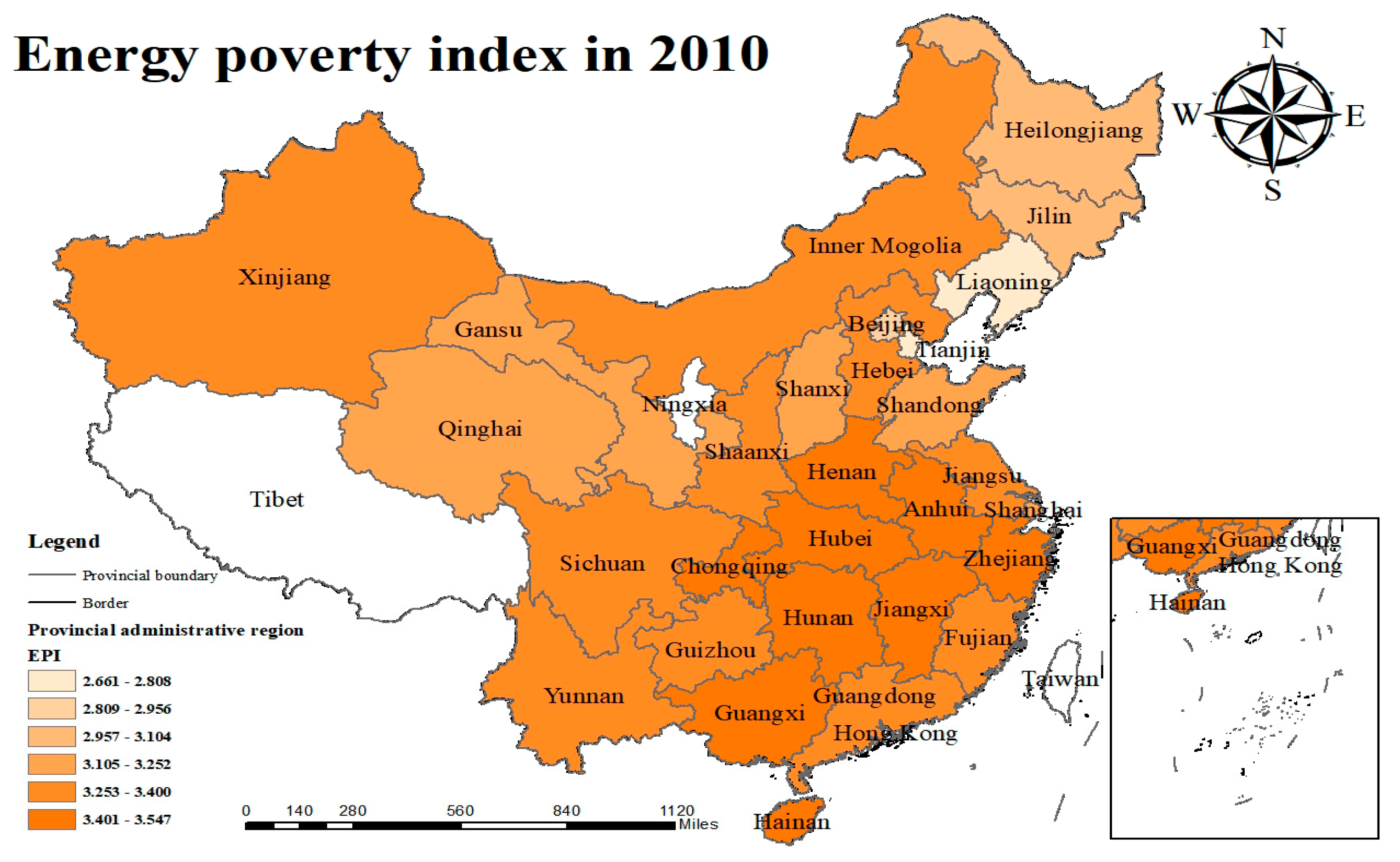
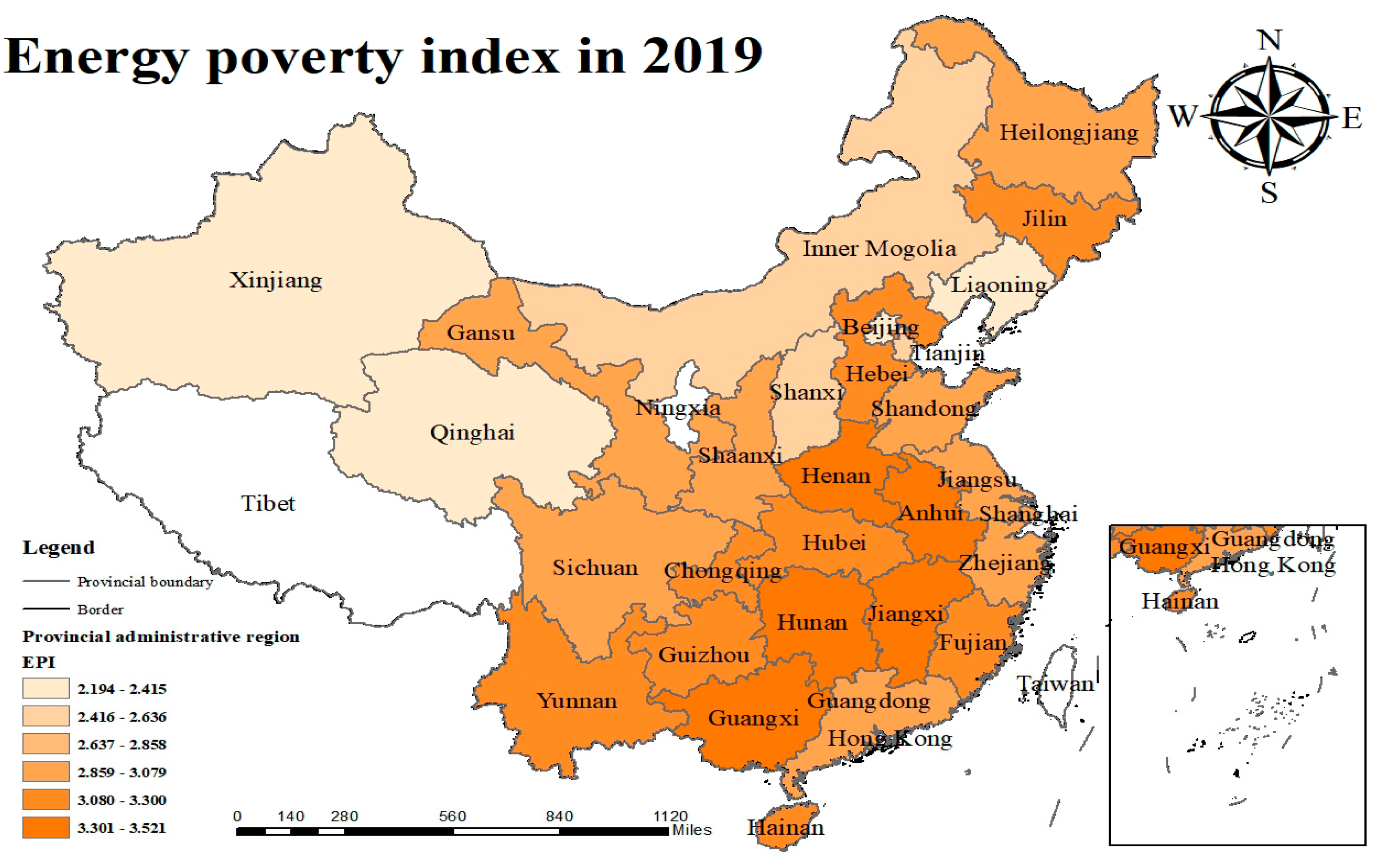
Figure 1 and Figure 2 present provincial energy poverty in China in 2010 and 2019. Over 2010–2019, Liaoning, Beijing, Tianjin, Xinjiang, and Qinghai have comparatively low energy poverty index values, indicating relatively mild energy poverty, whereas Henan, Hainan, Anhui, Hunan, and Guangxi exhibit higher values, suggesting more severe energy poverty. Over time, energy poverty declines across all provinces. At the national level, the energy poverty index decreases from 2.48 in 2010 to 2.25 in 2019, plausibly reflecting economic growth and structural change. Overall, economically advanced provinces such as Beijing, Shanghai, and Guangdong show lower energy poverty, whereas less-developed provinces such as Guangxi, Hainan, and Guizhou continue to face substantial challenges.

3.3.2. The Development of Green Finance

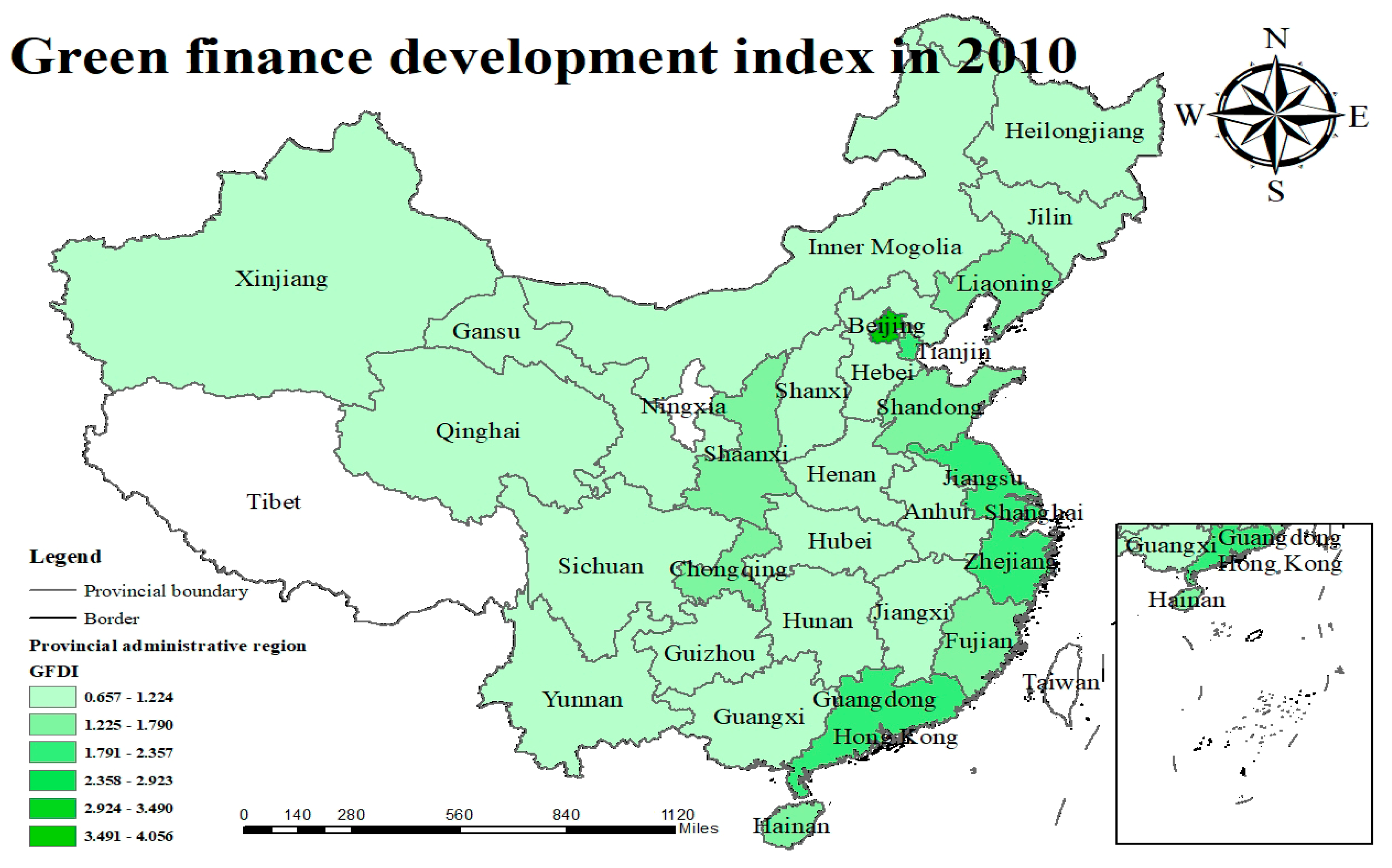
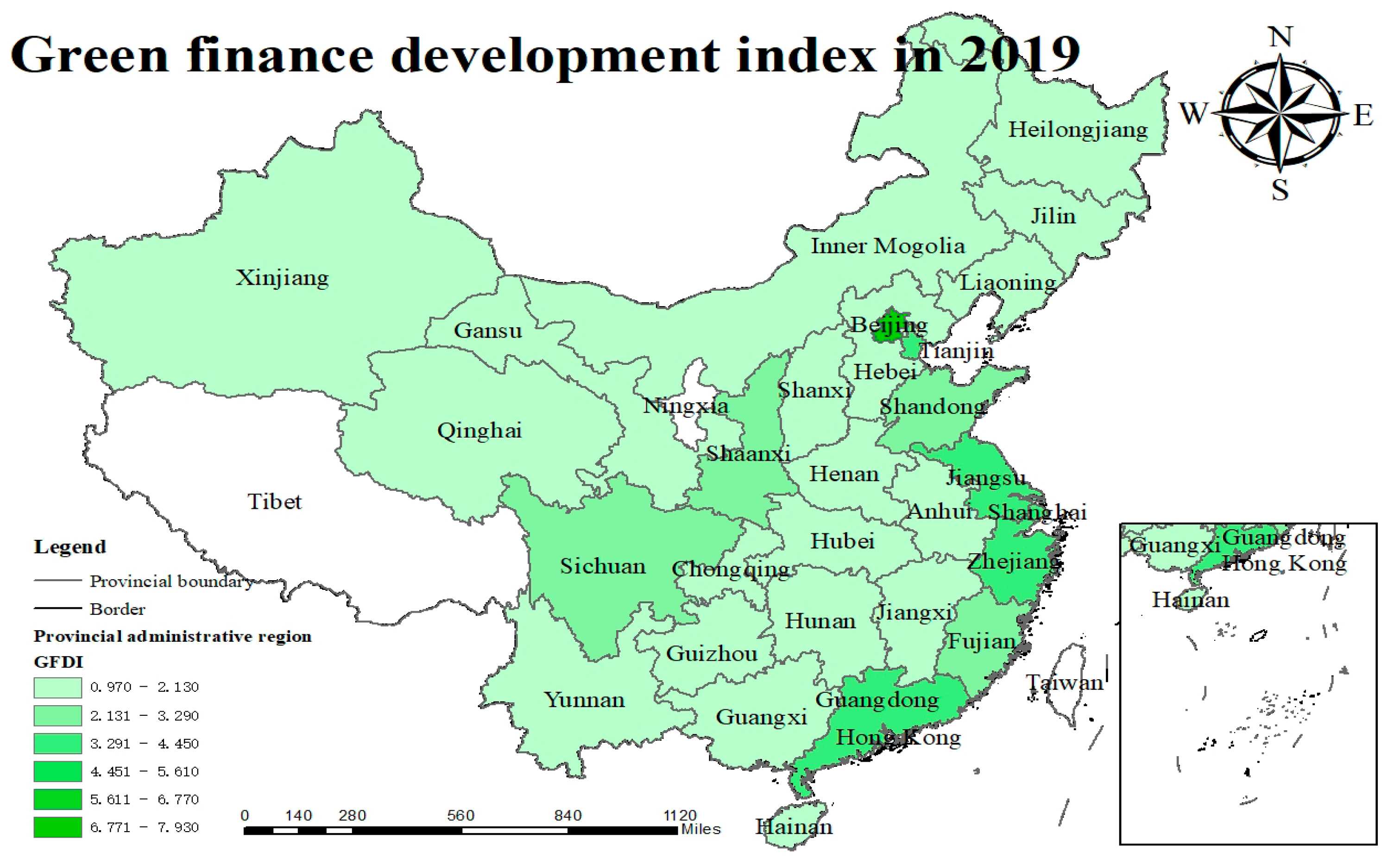
Figure 3 and Figure 4 show provincial green finance development in 2010 and 2019. Green finance development rises across provinces over time, indicating steady progress. Spatially, green finance development is stronger in eastern coastal regions than in western regions, consistent with differences in economic development and financial-market maturity. Provinces with more developed traditional finance (e.g., Beijing, Shanghai, and Guangdong) also tend to lead in green finance development, reflecting comparative advantages in financial infrastructure and institutional capacity.

3.3.3. The Relationship Between Green Finance Development and Energy Poverty

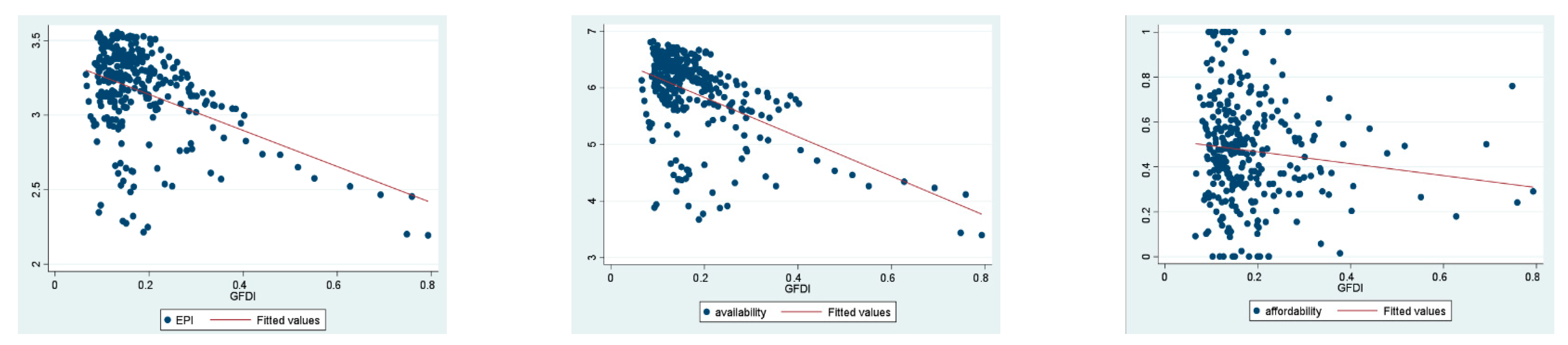
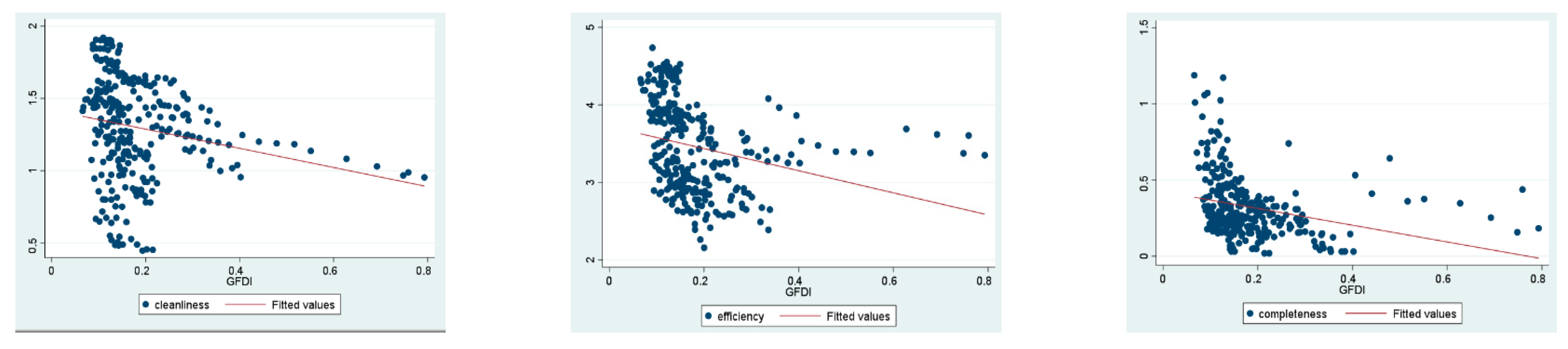
Figure 5 depicts the relationship between green finance development and energy poverty. The figure indicates a negative correlation between green finance development and overall energy poverty as well as its sub-dimensions, suggesting that green finance may be associated with improvements in the availability, affordability, cleanliness, completeness, and efficiency of household energy services.

4. Empirical Results

4.1. The Model

To investigate the effect of green finance development (GFDI) on energy poverty (EP), we specify the following baseline two-way fixed-effects model:
E P i = α 0 + α 1 G F D I + α 2 C o n s + ε 0
where E P i i = 1 , 2 , 3 , 4 , 5 , 6 denotes energy poverty (and its sub-dimensions: availability, affordability, cleanliness, completeness, and efficiency); G F D I is the green finance development index; C o n s denotes control variables; and ε 0 the error term is assumed to be mean-zero.

4.2. Baseline Regression

We estimate the baseline model using a fixed-effects specification. Table 4 reports the results. Columns 2–7 show that the coefficient on GFDI is significantly negative for EP and for four sub-dimensions (availability, cleanliness, completeness, and affordability), indicating that green finance development is associated with lower energy poverty and improved energy-service conditions. The coefficient on efficiency is negative but statistically insignificant, suggesting that green finance development has not yet generated a robust improvement in energy efficiency during the sample period.
It is widely acknowledged that the clean energy transition is inherently capital-intensive and historically hindered by severe financing constraints. The baseline results indicate that provinces with higher levels of green finance development tend to exhibit lower overall energy poverty, together with better performance in energy availability, completeness, cleanliness, and affordability. These findings are consistent with the view that green finance may help improve the financing environment for cleaner energy projects and energy-related infrastructure. However, given the observational nature of the data, the results should not be interpreted as definitive evidence that green finance corrects capital misallocation or generates large-scale structural effects by itself. Rather, they suggest that the expansion of green finance is associated with conditions under which cleaner energy supply and related infrastructure investment may be more likely to occur.
Conversely, the impact of green finance on energy efficiency remains statistically insignificant during the sample period. Frustrating as it may be, this non-significant result highlights the micro-level frictions inherent in the energy transition. While macro-level financial instruments excel at stimulating large-scale supply-side investments, they often face pronounced “transmission lags” when attempting to alter individual consumption habits or accelerate the replacement cycles of household energy appliances. Therefore, it remains to be seen whether subsequent, highly targeted financial innovations can eventually bridge this micro-macro divide and foster comprehensive energy efficiency improvements.
Regarding controls, population density is positively associated with energy poverty, implying that population concentration may exacerbate energy poverty pressures. Urbanization is negatively associated with energy poverty; one plausible mechanism is an income effect: higher urbanization tends to raise household income and reduce the share of income devoted to energy expenditures, thereby alleviating energy poverty. Industrial upgrading is positively associated with availability; one interpretation is that structural change may increase industrial and urban energy-service capacity even if broader “scale effects” and “structural dividends” are not fully realized during the transition.

4.3. Addressing Endogeneity Concerns: System GMM Estimates

To alleviate concerns related to reverse causality, dynamic persistence, and omitted variables, we complement the baseline fixed-effects estimates with system generalized method of moments (system GMM) regressions. This approach is useful in dynamic panel settings because it incorporates lagged dependent variables and exploits internal instruments. At the same time, given the relatively short time dimension of the sample and the possibility that green finance development co-evolves with broader regional development conditions, the system GMM results should be interpreted as supplementary evidence rather than definitive causal identification. Table 5 reports the corresponding estimates. The Sargan test p-values do not reject the validity of the instrument set at conventional significance levels, and the AR(2) test results provide no evidence of second-order serial correlation. These diagnostics suggest that the dynamic-panel specification is empirically acceptable. More importantly, the coefficient on GFDI remains negative and statistically significant across most specifications, indicating that the negative relationship between green finance development and energy poverty is not driven solely by contemporaneous fixed-effects estimation or simple persistence in the dependent variable. Overall, the system GMM estimates are broadly consistent with the baseline results: provinces with higher green finance development tend to exhibit lower energy poverty and better outcomes in several related dimensions.
In terms of the regression results, the first-order lag of Affordability is statistically insignificant in the current period, whereas the first-order lags of EP and four sub-dimensions—Availability, Cleanliness, Completeness, and Efficiency—exert statistically significant persistence effects, with coefficients of 0.15, 0.63, 0.15, 0.42, and 0.46, respectively. This pattern indicates pronounced inertia (i.e., non-trivial path dependence) in energy poverty and most of its sub-dimensions, implying that substantial improvements may not materialize in the short run; by contrast, household energy affordability can be improved more rapidly through financial instruments, consistent with weaker persistence and hence a limited lag effect. In addition, the coefficients on the GFDI are significantly negative across specifications, indicating that the development of green finance continues to exert a significantly inhibitory effect on energy poverty even after endogeneity is taken into account.

4.4. The Mediating Effect

Following [56], we test mediation using EI and CEI as proxies for energy infrastructure and clean-energy investment. The mediation models are specified as:
E P = α 1 + β 1 G F D I + C o n s 1 + ε 1
M = α 2 + β 2 G F D I + C o n s 2 + ε 2
E P = α 3 + β 3 G F D I + φ 3 M + C o n s 3 + ε 3
where E P is energy poverty; G F D I is green finance development; M is the mediator; and controls include urbanization, population density, innovation, openness and industrial upgrading.
The results reported in Table 6 present a pattern that is broadly consistent with the proposed transmission channels, although the mechanism evidence should be interpreted with caution. In the baseline specification, GFDI is negatively associated with overall energy poverty, and it is also positively associated with EI; when both GFDI and EI are included simultaneously, EI is negatively associated with EP, while the coefficient on GFDI remains statistically significant, which is consistent with a partial mediation pattern through energy infrastructure. A similar result is observed for the investment channel: GFDI is positively associated with CEI, and when both variables enter the same specification, CEI is negatively associated with EP, while GFDI remains significant. Taken together, these findings do not establish a strictly causal mechanism, but they do suggest that the negative association between green finance development and energy poverty may be partly related to better energy-infrastructure conditions and stronger investment support.

4.5. Heterogeneity Analysis

Following the mechanism analysis, this study further explores regional heterogeneity in the effect of green finance development on energy poverty. Using the median level of initial energy poverty in 2010 as the threshold, the full sample is divided into low- and high-energy-poverty groups. The results in Columns 2 and 3 of Table 7 indicate that green finance development significantly reduces energy poverty in both groups, with a stronger effect observed in provinces characterized by higher initial energy poverty. This suggests that green finance is particularly effective in alleviating energy poverty in more deprived regions. In addition, when the sample is divided into the economically developed eastern provinces and the relatively less developed non-eastern provinces, the estimated coefficients remain significantly negative for both groups, but are larger in magnitude for the central and western provinces. This finding implies that the poverty-reduction effect of green finance is more pronounced in economically lagging regions.

4.6. The Spatial Effect Analysis

4.6.1. Spatial Autocorrelation Analysis

Given the interprovincial heterogeneity in the relationship between green finance development and energy poverty, it is therefore essential to examine the spatial spillover effects between them. To this end, Moran’s I is employed to test the global spatial autocorrelation between green finance development and energy poverty under an inverse-distance weight matrix. The corresponding statistic is computed as follows:
M o r a n I = i = 1 n j = 1 n w i j ( x i x ¯ ) ( x j x ¯ ) / i = 1 n ( x i x ¯ ) 2
Table 8 reports the Moran’s I results. Overall, the inverse-distance weight matrix yields positive global Moran’s I values for both GFDI and EP throughout 2010–2019, and these statistics are statistically significant (at least at the 10% level), implying that spatial dependence cannot be regarded as negligible in either green finance development or energy poverty across Chinese provinces. Put differently, provinces do not evolve in a manner that is not spatially correlated; instead, they tend to exhibit discernible spatial clustering.
From a temporal perspective, the Moran’s I of energy poverty increases from 0.12 in 2010 to 0.13 in 2011 and then declines persistently thereafter, suggesting that the overall intensity of spatial agglomeration has weakened over time and that the earlier pattern of spatially concentrated provinces with similar development levels is not unchanged. Nevertheless, the positive and significant Moran’s I values indicate that the sample provinces still display classic spatial clustering patterns—most notably “high–high” and “low–low” agglomerations—rather than a spatially random distribution.

4.6.2. Spatial Effect Analysis

Given the above evidence of spatial dependence, an appropriate spatial econometric specification is essential; otherwise, parameter estimates may be biased and statistical inference may be inconsistent. Accordingly, this study conducts LM tests, LR tests, and Wald tests (see Appendix C) to determine the suitable spatial model. The LR and Wald test results reject the null hypothesis that the Spatial Durbin Model (SDM) can be simplified into the SAR or SEM models, indicating that the SDM is not unnecessary for capturing the spatial data-generating process. In addition, the Hausman test results (see Appendix D) support a two-way fixed effects specification, implying that unobserved heterogeneity is not safely ignorable.
Table 9 presents the SDM estimates under the inverse-distance weight matrix. The estimated local effect of green finance development on energy poverty is significantly negative, corroborating that green finance development reduces energy poverty within a province. Importantly, the spatial spillover term associated with green finance development is also negative and statistically significant, indicating that improvements in green finance in one province are not without consequences for its neighbors; rather, they contribute to energy poverty alleviation in surrounding provinces as well.
Substantively, such spillovers may operate through several non-mutually exclusive channels. First, local policy actions and institutional innovations related to green finance can diffuse across space via policy learning, benchmarking, and inter-jurisdictional competition—so that one region’s successful experience is not unlikely to be emulated by geographically or economically proximate regions. Second, the green technology progress and factor reallocation induced by green finance (e.g., capital deepening in clean energy industries and the diffusion of low-carbon technologies) may generate externalities that extend beyond administrative borders. Third, interregional economic linkages—through industrial chains, trade, and investment networks—may transmit the benefits of green transformation from economically leading provinces to spatially related provinces, thereby reinforcing a “prosperity-for-all” pattern in the energy-poverty-reduction process. Consequently, alleviating energy poverty is not merely a local agenda but also a regional coordination task, and provinces should not be expected to achieve optimal outcomes in isolation.

4.6.3. Spatial Effect Decomposition

Because the SDM incorporates spatial lags of both the dependent and independent variables, the estimated coefficients cannot be mechanically interpreted as marginal effects. In particular, spatial feedback loops imply that the significance of coefficient estimates does not necessarily mean that the corresponding impacts “truly exist” in the sense of interpretable partial derivatives [57,58]. To avoid conclusions that are not free from misinterpretation, this study further decomposes spatial effects into direct, indirect (spillover), and total effects, as reported in Table 9.
The decomposition results indicate that the direct effect of green finance development on energy poverty is negative and significant at the 1% level, suggesting that higher green finance development is associated with lower energy poverty within a province. Meanwhile, the indirect effect is also negative and statistically significant, implying that the advancement of green finance in a given province is associated with beneficial spillovers that contribute to lower energy poverty in surrounding provinces. Notably, the comparison between the indirect and total effects suggests that the spillover component is economically meaningful and should not be overlooked when designing regionally coordinated policies for energy poverty reduction. Possible explanations can be summarized from two perspectives. First, owing to interprovincial electricity transfers—exemplified by the West-to-East Power Transmission Project—the benefits of energy infrastructure are likely to involve substantial cross-regional spillovers. Second, under the dual pressures of the dual-carbon targets and performance evaluation, local governments may have incentives to emulate green finance policies through policy diffusion and tournament-style competition. To avoid potential bias arising from the inverse-distance matrix in spatial effect estimation, we further adopt an economic distance matrix to re-examine the spatial effects of green finance development on energy poverty (see Appendix E). The results show that the spatial effect remains significant, which further supports the robustness of the empirical results presented in Table 9, although the relative magnitude of spillovers should still be interpreted with caution.

4.7. Robustness Test

We employ the following four approaches to conduct robustness checks on our baseline regression results. First, considering that the weighting scheme of the entropy method might introduce bias into the empirical findings, we apply an equal-weighting approach to reassign weights across the five dimensions of energy poverty and re-estimate the baseline model. The results in Column 2 of Table 10 indicate that green finance development continues to exert a significant negative effect on energy poverty, which alleviates concerns that our findings are driven by the chosen weighting method. Second, we address the inherent limitations of using currently available structured data to measure green finance development. For instance, substituting agricultural insurance for green insurance due to the unavailability of environmental pollution liability insurance data is a practical but suboptimal compromise. To overcome this, we utilize textual analysis to re-measure the level of green finance development. In the absence of precise structured data, textual analysis can effectively capture the underlying developmental trends of the target variable. The results in Column 3 of Table 10 indicate that the coefficient and significance of GDFI are broadly consistent with baseline results, supporting robustness to measurement choice. Third, given the banking sector’s dominant role in China’s financial market, we use green credit as a proxy for green finance and re-run the regression. The results for Column 4 in Table 10 show that the estimated coefficient of the independent variable is highly consistent with the baseline regression, further confirming the robustness of our primary results. Finally, to rule out the potential confounding effects of time trends, we regress the comprehensive energy poverty index on the lagged term of the green finance development index. The results in Column 5 of Table 10 demonstrate that the lagged green finance index still exerts a significant negative effect on energy poverty, indicating that our baseline findings remain robust and compelling even when accounting for temporal dynamics.

5. Conclusions and Policy Implications

Using panel data from 29 Chinese provinces over 2010–2019, this paper examines the relationship between green finance development and multidimensional energy poverty, explores possible transmission channels, and evaluates spatial spillovers. The empirical results point to a robust negative association between green finance development and energy poverty. Mechanism analyses suggest that provinces with more developed green finance also tend to exhibit better energy-infrastructure conditions and higher energy-supply investment, which are in turn associated with lower energy poverty. Spatial estimates further show that the association is not confined to the local level, indicating that interprovincial spillovers are economically meaningful.
These results support two policy implications more directly than others. First, since the mechanism evidence is most consistent with improved energy infrastructure and energy-supply investment, policy priority should be placed on strengthening the transmission of green finance to these project categories, especially in provinces where deficiencies in energy availability, cleanliness, and completeness remain more severe. Second, because the estimated indirect effect exceeds the direct effect in absolute value, interprovincial coordination should be treated as a practical priority rather than a generic policy slogan. Cross-provincial information sharing, joint project evaluation, and coordination in the financing of infrastructure with regional externalities may therefore yield broader welfare gains than purely isolated local interventions.

Author Contributions

Conceptualization, H.Y. and Z.Z.; methodology, Y.W.; software, Y.H.; validation, H.Y., Y.H., Y.W. and Z.Z.; formal analysis, Y.W.; investigation, H.Y.; resources, Y.H.; data curation, Y.H.; writing—original draft preparation, H.Y.; writing—review and editing, Z.Z.; visualization, Y.W.; supervision, Z.Z.; project administration, Y.W.; funding acquisition, Z.Z. All authors have read and agreed to the published version of the manuscript.

Funding

This research was funded by the Chongqing Social Science Planning Project (No. 2025BS057), National Social Science Foundation of China (No. 25BJY196), Guizhou Provincial Department of Education Humanities and Social Sciences Research Project (No. 25GZGXRWJD0322), Bijie Municipal Party Committee Policy Research Office, Bijie Social Science Association, Guizhou University of Engineering Science Joint Fund (No. LHXM202207).

Data Availability Statement

The raw data supporting the conclusions of this article will be made available by the authors on request.

Conflicts of Interest

The authors declare no conflicts of interest.

Appendix A

Based on indicators applicable to energy poverty evaluation in China, we construct a comprehensive index consisting of five categories: (1) energy service availability (Availability), (2) energy consumption cleanliness (Cleanliness), (3) energy management completeness (Completeness), (4) energy service affordability (Affordability), and (5) energy service efficiency (Efficiency). Availability is measured by residential energy consumption and supply. Cleanliness captures the household energy-consumption structure. Completeness reflects improvement potential in energy management, measured via management agencies and energy investment. Efficiency reflects household equipment and pollution outcomes. Affordability is captured via household energy expenditures. In total, the index includes 5 categories and 19 measurements.
Because these measurements differ in units and directionality, we standardize them to dimensionless indicators with a common direction, where lower values indicate a better energy-poverty situation. Benefit and cost indicators are processed via:
Positive   indicator :   y i t = max i , t   x i t x i t max x i t min x i t
Negative   indicator :   y i t = x i t min x i t max x i t min x i t
where x i t denotes the original value of the i th measurement in year t and y i t represents the corresponding dimensionless value (0 ≤ y i t ≤ 1). Moreover, the index incorporates two threshold measurements: the percentage of residential energy (electricity and fuel) expenses relative to total per capita expenses in urban areas, and the corresponding percentage of residential fuel expenses in rural areas. In alignment with established practices, this study adopts a threshold ( α i ) of 8% for urban households and 2.5% for rural households. These threshold indicators are processed using the following equations:
y i t = ( α x i t ) min i , t ( α x i t ) max i , t ( α x i t ) min i , t ( α x i t ) 0 , x i t α i   ,   x i t <   α i  
y i t = x i t min i , t   x i t max i , t   x i t min i , t   x i t , x i t <   α i α min i , t   x i t max i , t   x i t min i , t   x i t , x i t α i
To objectively determine the relative importance of each indicator, their weights are calculated utilizing a data-driven approach. Specifically, to enhance the discriminatory power of the energy poverty index, a larger weight is assigned to a measurement if its coefficient of variation is relatively larger than those of other indicators, and vice versa. Building upon the aforementioned dimensionless transformation and weighting procedures, China’s comprehensive energy poverty index is computed via:
E P t = A v a i l a b i l i t y t + C l e a n l i n e s s t + C o m p l e t e n e s s t + E f f i c i e n c y t + A f f o r d a b i l i t y t = i = 1 n w i y i t
where E P t denotes the value of China’s energy poverty comprehensive index at year t , y i t is the value of the i th measurements at year t , and w i is the weight of the i th measurements. The total score of the comprehensive index ranges from 0 to 100. Correspondingly, the maximum possible scores for the five sub-dimensions—Availability, Cleanliness, Completeness, Efficiency, and Affordability—are bounded at 30, 15, 15, 15, and 25, respectively. As structured, a higher final value invariably signifies a more pronounced degree of energy poverty.

Appendix B

The green finance development index is constructed in three steps.
Step 1: Indicator standardization. Because the four sub-indicators are measured in different units and include both positive and negative attributes, all indicators are first normalized using the min–max method. For a positive indicator, the standardized value is calculated as:
Z i j t = X i j t min X j max X j min X j
For a negative indicator, the standardized value is calculated as:
Z i j t = max X j X i j t max X j min X j
Here, X i j t denotes the original value of indicator j for province i in year t , while max X j and min X j represent the maximum and minimum values of indicator j observed in the sample, respectively. This transformation ensures comparability across indicators and converts all variables into the same direction, such that a larger standardized value always indicates a higher level of green finance development.
Step 2: Entropy-based weighting. After standardization, the proportion of indicator j for province i in year t is calculated as:
P i j t = Z i j t i Z i j t
Based on this proportion, the information entropy of each indicator is computed as:
E j = k i P i j t ln P i j t , k = 1 ln n
The degree of diversification of indicator j is then defined as:
D j = 1 E j
and the corresponding entropy weight is:
W j = D j j D j
where n is the number of provinces. The entropy value reflects the amount of useful information contained in each indicator. If the dispersion of an indicator across provinces is larger, the indicator provides more information for distinguishing provincial green finance development and therefore receives a larger weight. Compared with subjective weighting schemes, the entropy method determines weights according to the variation in the underlying data and therefore helps reduce arbitrariness in composite index construction.
Step 3: Composite-index aggregation. Finally, the green finance development index for province i in year t is calculated as:
G F D I i t = j W j Z i j t
A higher value of G F D I i t indicates a higher level of green finance development. Since the entropy method preserves the multidimensional structure of the index while using an objective data-driven weighting rule, it is well suited to the construction of a provincial green finance indicator under conditions of incomplete direct statistical coverage.

Appendix C

Table A1. The results of LR and Wald tests.
Test TypeStatisticsp-Value
LM-err6.85 ***0.00
R-LM-err5.64 **0.01
LM-lag6.67 **0.01
R-LM-lag5.46 **0.01
LR test (SAR)13.48 **0.03
LR test (SEM)11.72 *0.06
Wald test (SAR)14.02 **0.02
Wald test (SEM)11.09 **0.04
N290290

Appendix D

Table A2. The results of Hausman test.
Test TypeNull HypothesisTest LevelResult
Hausman testRandom effect126.83 ***Fixed effect
Fixed effects testProvince nested in both26.86 ***Time and province double fixed effects

Appendix E

Table A3. The estimation results of SDM: economic distance matrix.
VariableLocal EffectSpatial EffectDirect EffectIndirect EffectTotal Effect
GFDI−0.34 ***
(0.12)
−1.07 **
(0.49)
−0.33 **
(0.16)
−1.02 **
(0.05)
−1.35 **
(0.61)
ControlYesYesYesYesYes
TimeFixedFixedFixedFixedFixed
ProvinceFixedFixedFixedFixedFixed
N290290290290290

References

  1. Churchill, S.A.; Smyth, R. Ethnic diversity, energy poverty and the mediating role of trust: Evidence from household panel data for Australia. Energy Econ. 2020, 86, 104663. [Google Scholar] [CrossRef]
  2. Wang, X.; Liu, W.; Sun, X.; Ahmad, M. Digital inclusive finance and energy poverty: Empirical evidence from China. Renew. Sustain. Energy Rev. 2025, 211, 115308. [Google Scholar] [CrossRef]
  3. IEA; IREA; UNSD; Word Bank; WHO. Tracking SDG 7: The Energy Progress Report 2024; Word Bank: New York, NY, USA, 2024. [Google Scholar]
  4. IEA. World Energy Outlook; IEA: Paris, France, 2025. [Google Scholar]
  5. Zhang, X.; Cui, X.; Li, B.; Hidalgo-Gonzalez, P.; Kammen, D.M.; Zou, J.; Wang, K. Immediate actions on coal phaseout enable a just low-carbon transition in China’s power sector. Appl. Energy 2022, 308, 118401. [Google Scholar] [CrossRef]
  6. Liu, Y.; Sander, M. What Drives Energy Efficiency in the G20? Evidence From Finance, Education, and Sustainable Development. Sustain. Dev. 2026, 34, 1838–1855. [Google Scholar] [CrossRef]
  7. Yoshino, N.; Taghizadeh–Hesary, F.; Nakahigashi, M. Modelling the social funding and spill-over tax for addressing the green energy financing gap. Econ. Model. 2019, 77, 34–41. [Google Scholar] [CrossRef]
  8. Ghimire, L.P.; Kim, Y. An analysis on barriers to renewable energy development in the context of Nepal using AHP. Renew. Energy 2018, 129, 446–456. [Google Scholar] [CrossRef]
  9. Sachs, J.D.; Woo, W.T.; Yoshino, N.; Taghizadeh-Hesary, F. Importance of green finance for achieving sustainable development goals and energy security. In Handbook of Green Finance; Springer: Singapore, 2019; pp. 3–12. [Google Scholar]
  10. Yi, H.; Zhang, Z. Green financial structure and carbon emissions: A structural matching perspective. J. Clean. Prod. 2024, 434, 140103. [Google Scholar] [CrossRef]
  11. Yoshino, N.; Taghizadeh-Hesary, F. Alternatives to private finance: Role of fiscal policy reforms and energy taxation in development of renewable energy projects. In Financing for Low-Carbon Energy Transition: Unlocking the Potential of Private Capital; Springer: Singapore, 2018; pp. 335–357. [Google Scholar]
  12. Cong, J.; Pang, T.; Peng, H. Optimal strategies for capital constrained low-carbon supply chains under yield uncertainty. J. Clean. Prod. 2020, 256, 120339. [Google Scholar] [CrossRef]
  13. An, S.; Li, B.; Song, D.; Chen, X. Green credit financing versus trade credit financing in a supply chain with carbon emission limits. Eur. J. Oper. Res. 2021, 292, 125–142. [Google Scholar] [CrossRef]
  14. Cheng, H.; Taghizadeh-Hesary, F. How green finance can bridge the energy poverty gap: Policies to mitigate socioeconomic and environmental consequences. Energy Policy 2023, 182, 113758. [Google Scholar] [CrossRef]
  15. Lee, C.-C.; Li, M.; Li, X.; Song, H. More green digital finance with less energy poverty? The key role of climate risk. Energy Econ. 2025, 141, 108144. [Google Scholar] [CrossRef]
  16. Yu, C.-H.; Wu, X.; Zhang, D.; Chen, S.; Zhao, J. Demand for green finance: Resolving financing constraints on green innovation in China. Energy Policy 2021, 153, 112255. [Google Scholar] [CrossRef]
  17. Scarpellini, S.; Hernández, M.A.S.; Moneva, J.M.; Portillo-Tarragona, P.; Rodríguez, M.E.L. Measurement of spatial socioeconomic impact of energy poverty. Energy Policy 2019, 124, 320–331. [Google Scholar] [CrossRef]
  18. Imai, K.; Keele, L.; Tingley, D. A general approach to causal mediation analysis. Psychol. Methods 2010, 15, 309. [Google Scholar] [CrossRef] [PubMed]
  19. Berhane, G.; Gardebroek, C. Does microfinance reduce rural poverty? Evidence based on household panel data from northern Ethiopia. Am. J. Agric. Econ. 2011, 93, 43–55. [Google Scholar] [CrossRef]
  20. Li, J.; Chen, S.; Wan, G.; Fu, C. Study on the spatial correlation and explanation of regional economic growth in China: Based on analytic network process. Econ. Res. J. 2014, 49, 4–16. [Google Scholar]
  21. Zhang, Z.; Shu, H.; Yi, H.; Wang, X. Household multidimensional energy poverty and its impacts on physical and mental health. Energy Policy 2021, 156, 112381. [Google Scholar] [CrossRef]
  22. Guild, J. The political and institutional constraints on green finance in Indonesia. J. Sustain. Financ. Investig. 2020, 10, 157–170. [Google Scholar] [CrossRef]
  23. Zhang, Z.; Hao, L.; Linghu, Y.; Yi, H. Research on the energy poverty reduction effects of green finance in the context of economic policy uncertainty. J. Clean. Prod. 2023, 410, 137287. [Google Scholar] [CrossRef]
  24. Al Mamun, M.; Boubaker, S.; Nguyen, D.K. Green finance and decarbonization: Evidence from around the world. Financ. Res. Lett. 2022, 46, 102807. [Google Scholar] [CrossRef]
  25. Umar, M.; Safi, A. Do green finance and innovation matter for environmental protection? A case of OECD economies. Energy Econ. 2023, 119, 106560. [Google Scholar] [CrossRef]
  26. Tamazian, A.; Rao, B.B. Do economic, financial and institutional developments matter for environmental degradation? Evidence from transitional economies. Energy Econ. 2010, 32, 137–145. [Google Scholar] [CrossRef]
  27. Verdolini, E.; Galeotti, M. At home and abroad: An empirical analysis of innovation and diffusion in energy technologies. J. Environ. Econ. Manag. 2011, 61, 119–134. [Google Scholar] [CrossRef]
  28. Wang, W.; Xiao, W.; Bai, C. Can renewable energy technology innovation alleviate energy poverty? Perspective from the marketization level. Technol. Soc. 2022, 68, 101933. [Google Scholar] [CrossRef]
  29. Li, G.; Wu, H.; Jiang, J.; Zong, Q. Digital finance and the low-carbon energy transition (LCET) from the perspective of capital-biased technical progress. Energy Econ. 2023, 120, 106623. [Google Scholar] [CrossRef]
  30. Yoshino, N.; Taghizadeh-Hesary, F.; Tawk, N. Decline of oil prices and the negative interest rate policy in Japan. Econ. Polit. Stud. 2017, 5, 233–250. [Google Scholar] [CrossRef]
  31. Peng, D.; Poudineh, R. An appraisal of investment vehicles in the Tanzania’s electricity sector. Util. Policy 2017, 48, 51–68. [Google Scholar] [CrossRef]
  32. Pan, R.; Tian, Z.; Zhu, X.; Tian, Y. Can inclusive finance alleviate household energy poverty? Fresh evidence from survey data in China. Energy 2025, 316, 134525. [Google Scholar] [CrossRef]
  33. Hall, S.; Foxon, T.J.; Bolton, R. Investing in low-carbon transitions: Energy finance as an adaptive market. Clim. Policy 2017, 17, 280–298. [Google Scholar] [CrossRef]
  34. Cheng, S.; Wei, T.; Wang, F.; Zhuang, L. Does financial market participation eradicate household energy poverty? Energy Econ. 2023, 122, 106687. [Google Scholar] [CrossRef]
  35. Zhao, X.; Mahendru, M.; Ma, X.; Rao, A.; Shang, Y. Impacts of environmental regulations on green economic growth in China: New guidelines regarding renewable energy and energy efficiency. Renew. Energy 2022, 187, 728–742. [Google Scholar] [CrossRef]
  36. Tobler, W.R. A computer movie simulating urban growth in the Detroit region. Econ. Geogr. 1970, 46, 234–240. [Google Scholar] [CrossRef]
  37. Shao, S.; Fan, M.; Yang, L. Economic restructuring, green technical progress, and low-carbon transition development in China: An empirical investigation based on the overall technology frontier and spatial spillover effect. J. Manag. World 2022, 38, 46–69. (In Chinese) [Google Scholar]
  38. Zhou, S.; Solomon, B.D.; Brown, M.A. The spillover effect of mandatory renewable portfolio standards. Proc. Natl. Acad. Sci. USA 2024, 121, e2313193121. [Google Scholar] [CrossRef]
  39. Huang, X.; Tian, P. Polluting thy neighbor or benefiting thy neighbor: Effects of the clean energy development on haze pollution in China. Energy 2023, 268, 126685. [Google Scholar] [CrossRef]
  40. Huo, D.; Zhang, X.; Meng, S.; Wu, G.; Li, J.; Di, R. Green finance and energy efficiency: Dynamic study of the spatial externality of institutional support in a digital economy by using hidden Markov chain. Energy Econ. 2022, 116, 106431. [Google Scholar] [CrossRef]
  41. Guo, Q.-t.; Dong, Y.; Feng, B.; Zhang, H. Can green finance development promote total-factor energy efficiency? Empirical evidence from China based on a spatial Durbin model. Energy Policy 2023, 177, 113523. [Google Scholar] [CrossRef]
  42. Wan, Y.; Sheng, N.; Wei, X.; Su, H. Study on the spatial spillover effect and path mechanism of green finance development on China’s energy structure transformation. J. Clean. Prod. 2023, 415, 137820. [Google Scholar] [CrossRef]
  43. Su, X.; Qiao, R.; Xu, S. Impact of green finance on carbon emissions and spatial spillover effects: Empirical evidence from China. J. Clean. Prod. 2024, 457, 142362. [Google Scholar] [CrossRef]
  44. Lee, C.-C.; Wang, F.; Chang, Y.-F. Does green finance promote renewable energy? Evidence from China. Resour. Policy 2023, 82, 103439. [Google Scholar] [CrossRef]
  45. Chen, X.; Chen, Z. Can green finance development reduce carbon emissions? Empirical evidence from 30 Chinese provinces. Sustainability 2021, 13, 12137. [Google Scholar] [CrossRef]
  46. IEA. World Energy Outlook; IEA: Paris, France, 2002. [Google Scholar]
  47. Wang, K.; Wang, Y.-X.; Li, K.; Wei, Y.-M. Energy poverty in China: An index based comprehensive evaluation. Renew. Sustain. Energy Rev. 2015, 47, 308–323. [Google Scholar] [CrossRef]
  48. Zhang, D.; Li, J.; Han, P. A multidimensional measure of energy poverty in China and its impacts on health: An empirical study based on the China family panel studies. Energy Policy 2019, 131, 72–81. [Google Scholar] [CrossRef]
  49. Mould, R.; Baker, K.J. Documenting fuel poverty from the householders’ perspective. Energy Res. Soc. Sci. 2017, 31, 21–31. [Google Scholar] [CrossRef]
  50. Nussbaumer, P.; Bazilian, M.; Modi, V. Measuring energy poverty: Focusing on what matters. Renew. Sustain. Energy Rev. 2012, 16, 231–243. [Google Scholar] [CrossRef]
  51. Okushima, S. Gauging energy poverty: A multidimensional approach. Energy 2017, 137, 1159–1166. [Google Scholar] [CrossRef]
  52. Mendoza, C.B., Jr.; Cayonte, D.D.D.; Leabres, M.S.; Manaligod, L.R.A. Understanding multidimensional energy poverty in the Philippines. Energy Policy 2019, 133, 110886. [Google Scholar] [CrossRef]
  53. Dong, K.; Ren, X.; Zhao, J. How does low-carbon energy transition alleviate energy poverty in China? A nonparametric panel causality analysis. Energy Econ. 2021, 103, 105620. [Google Scholar] [CrossRef]
  54. Aassouli, D.; Asutay, M.; Mohieldin, M.; Nwokike, T.C. Green Sukuk, Energy Poverty, and Climate Change: A Roadmap for Sub-Saharan Africa; World Bank Policy Research Working Paper; World Bank: Washington, DC, USA, 2018. [Google Scholar]
  55. Duppati, G.R.; Hailemariam, S.; Murray, R.; Kivell, J. Electricity access and green financing in the African Region. Int. J. Manag. Financ. 2025, 21, 265–285. [Google Scholar] [CrossRef]
  56. Wen, Z.; Chang, L.; Hau, K.-T.; Liu, H. Testing and application of the mediating effects. Acta Psychol. Sin. 2004, 36, 614. [Google Scholar]
  57. LeSage, J.; Pace, R.K. Introduction to Spatial Econometrics; Chapman and Hall/CRC: New York City, NY, USA, 2009. [Google Scholar]
  58. Chen, Q. Advanced Econometrics and Stata Applications; Higher Education Press: Beijing, China, 2014. [Google Scholar]
Figure 1. Provincial–level energy poverty in 2010.
Energies 19 01825 g001
Figure 2. Provincial–level energy poverty in 2019.
Energies 19 01825 g002
Figure 3. Provincial–level green finance index in 2010.
Energies 19 01825 g003
Figure 4. Provincial–level green finance index in 2019.
Energies 19 01825 g004
Figure 5. Scatter plots of the green finance index against the energy poverty index and its sub-dimensions.
Energies 19 01825 g005aEnergies 19 01825 g005b
Table 1. The definition and statistical description of variables.
VariableDefinitionAbbreviationMeanSEMinMax
Green finance developmentGreen finance development indexGFDI0.180.110.060.79
Energy povertyEnergy poverty indexEPI2.150.190.293.55
AffordabilityAffordability of energyAffordability0.470.2301
AvailabilityAvailability of energyAvailability5.890.713.396.82
CleanlinessEnergy cleanlinessCleanliness1.290.340.441.91
CompletenessEnergy completenessCompleteness0.320.210.191.18
EfficiencyEnergy efficiencyEfficiency3.530.582.264.84
UrbanizationUrbanization (%)Urban0.570.120.330.89
Industrial upgradingAdded value of secondary industry/Added value of tertiary industry (%)IU0.900.570.194.23
Trade opennessTotal export-import volume/GDP (%)Openness0.290.320.011.58
Population densityThousand people per sqkm of land areaPopden5.491.092.058.27
InnovationR&D input/GDP (%)Innovation0.290.110.150.59
Energy infrastructureNatural gas pipeline lengthEI2.811.70.228.7
Clean energy investmentTEI × C-share 1CEI0.610.538 × 10−42.41
1 TEI refers to total investment in energy production, and C-share refers to the share of installed clean energy capacity in total installed capacity.
Table 2. Energy poverty index system.
IndexIndex DescriptionProperties
AvailabilityPer capita electricity consumptionBenefit
Per capita heat consumptionBenefit
Per capita natural gas consumptionBenefit
Per capita capacity of steam supply in citiesBenefit
Per capita LPG supply in citiesBenefit
Per capita supply of urban natural gasBenefit
AffordabilityEnergy price levelThreshold
Percentage of residential energy expense to total expense per capita in urban areasThreshold
Percentage of residential energy expense to total expense per capita in rural areasThreshold
CompletenessNumber of rural energy management agencies per million peopleBenefit
Per capita energy investment for rural residentsBenefit
Per capita investment in fixed assets of state-owned units in electricity, steam, hot
water production and supply
Benefit
CleanlinessPercentage of non-solid fuel to commercial energy of household sectorThreshold
Percentage of residential traditional biomass consumptionThreshold
EfficiencyOwnership of air-conditions per hundred urban householdsBenefit
Ownership of refrigerator per hundred urban householdsBenefit
Ownership of fuel-saving stoves per hundred rural householdsBenefit
Per capita sulfur dioxide in waste gas from residential sectorCost
Per capita smoke and dust emission in waste gas from residential sectorCost
Table 3. Green finance development index system.
IndexIndex DescriptionIndex Attribute
Green creditProportion of interest expense of high-energy consumption
industry
Interest expense of six high-energy
consuming industrial industries/Total
Industrial interest expenditure
negative
Green securitiesProportion of market value of environmental protection
enterprises
Market value of environmental protection enterprises/Total market value of listed
companies
positive
Green investmentProportion of investment in
environmental pollution control in GDP
Investment in pollution control/GDPpositive
Green insuranceProportion of agricultural
insurance scale
Agricultural insurance income/Total value of agricultural outputpositive
Table 4. Green finance development and energy poverty.
VariableEPAvailabilityAffordabilityCleanlinessCompletenessEfficiency
GFDI−1.51 ***
(0.19)
−2.69 ***
(0.59)
−0.79 *
(0.42)
−0.88 ***
(0.17)
−0.74 ***
(0.29)
−0.97
(0.81)
Urban−1.49 ***
(0.48)
−2.87 ***
(1.18)
−0.52
(0.57)
−1.51 ***
(0.29)
−2.04 ***
(0.52)
−1.49 *
(0.83)
Openness0.03
(0.02)
−0.08
(0.05)
0.05
(0.05)
0.01
(0.01)
0.01
(0.03)
−0.02
(0.05)
Popden0.69 **
(0.27)
1.59 *
(0.88)
1.25 **
(0.53)
−8.72 × 10⁻⁵
(0.11)
−0.36
(0.47)
−0.31
(1.12)
IU−0.01
(0.01)
0.05 **
(0.02)
8.75 × 10⁻⁵
(0.02)
0.01
(0.01)
0.01
(0.11)
0.04 **
(0.02)
Innovation0.03
(0.01)
−1.64 × 10⁻⁸
(0.01)
5.73 × 10⁻⁷
(8.74 × 10⁻⁶)
−9.14 × 10⁻⁸
(5.77 × 10⁻⁷)
0.58
(0.48)
0.01
(0.18)
Cons3.92 ***
(0.33)
7.12 ***
(0.87)
0.16
(0.52)
1.94 ***
(0.61)
1.60 ***
(0.38)
2.63 ***
(0.92)
TimeFixedFixedFixedFixedFixedFixed
ProvinceFixedFixedFixedFixedFixedFixed
R 2 0.180.120.310.410.220.23
N290290290290290290
Note: *, **, and *** indicate significance at the levels of 10%, 5% and 1%, respectively. Standard error denotes in parentheses, the same applies below.
Table 5. The effect of green finance development on energy poverty: SGMM.
VariableEPAvailabilityCleanlinessCompletenessAffordabilityEfficiency
L.EP0.15 **
(0.07)
L. Availability 0.63 ***
(0.18)
L. Cleanliness 0.15 ***
(0.05)
L. Completeness 0.42 ***
(0.02)
L. Affordability 0.13
(0.10)
L. Efficiency 0.46 ***
(0.02)
GFDI−0.14 **
(0.07)
−0.06 ***
(0.02)
−0.07 ***
(0.02)
−0.05 *
(0.03)
−0.14 **
(0.06)
−0.07
(0.21)
Urban−1.44 ***
(0.24)
−1.86 ***
(0.42)
−1.38 ***
(0.19)
−1.23 ***
(0.24)
−0.25
(0.57)
1.06 ***
(0.23)
Openness−0.02 **
(0.01)
−0.01
(0.01)
−0.05 ***
(8.76 × 10⁻⁵)
0.03 ***
(0.01)
0.10 **
(0.04)
−0.02 **
(0.01)
Popden0.52 ***
(0.16)
0.89
(0.55)
0.05 ***
(3.13 × 10⁻⁶)
−0.57 ***
(0.19)
0.46
(0.80)
−0.51
(0.36)
IU0.09
(0.12)
−0.25 **
(0.12)
−2.58 × 10⁻⁶ ***
(3.12 × 10⁻⁷)
−0.02 **
(0.01)
0.02
(0.02)
−0.02 **
(0.01)
Innovation0.26
(0.17)
0.76 **
(0.33)
0.11
(0.10)
0.39
(0.22)
1.47 *
(0.78)
0.12
(0.21)
Cons3.57 ***
(0.29)
3.09 ***
(0.52)
0.21 ***
(0.13)
0.79 ***
(0.14)
0.11
(0.65)
1.71 ***
(0.19)
N290290290290290290
AR(2)0.630.760.170.240.640.18
Sargan0.160.220.150.130.170.12
Table 6. The mediating effect.
VariableEPEIEPEPCEIEP
GFDI−1.51 ***
(0.18)
1.35 *
(0.75)
−1.46 ***
(0.19)
−1.51 ***
(0.18)
0.53 ***
(0.12)
−1.44 ***
(0.40)
EI −0.09 ***
(0.03)
CEI −0.21 ***
(0.05)
ControlYesYesYesYesYesYes
R 2 0.080.030.090.080.120.17
TimeFixedFixedFixedFixedFixedFixed
ProvinceFixedFixedFixedFixedFixedFixed
N290290290290290290
Table 7. Green finance development and energy poverty: Heterogeneity analysis.
VariableLow-Initial Energy
Poverty
High-Initial Energy PovertyEastern ProvincesNon-Eastern Provinces
GFDI−1.06 **
(0.48)
−1.85 ***
(0.31)
−1.21 ***
(0.41)
−2.10 ***
(0.24)
ControlYesYesYesYes
R 2 0.160.240.140.22
TimeFixedFixedFixedFixed
ProvinceFixedFixedFixedFixed
N140150110180
Table 8. Moran’s index of the spatial correlation between GFDI and EP.
YearGFDIEP
20100.06 **0.12 ***
20110.06 ***0.13 ***
20120.06 ***0.09 ***
20130.06 ***0.08 ***
20140.06 ***0.05 **
20150.05 ***0.04 **
20160.04 ***0.03 **
20170.03 **0.02 **
20180.06 ***0.02 *
20190.06 ***0.02 *
Table 9. The estimation results of SDM: inverse-distance weight matrix.
VariableLocal EffectSpatial EffectDirect EffectIndirect EffectTotal Effect
GFDI−0.84 ***
(0.27)
−3.57 **
(1.48)
−0.74 ***
(0.26)
−1.83 *
(0.96)
−2.58 **
(1.04)
ControlYesYesYesYesYes
TimeFixedFixedFixedFixedFixed
ProvinceFixedFixedFixedFixedFixed
N290290290290290
Table 10. The results of robustness checks.
VariableE-EPEPEPEP
GFDI−1.49 ***
(0.32)
T-GFDI −0.72 ***
(0.14)
G-Credit −1.82 ***
(0.14)
L-GFDI −1.32 ***
(0.39)
ControlYesYesYesYes
R 2 0.210.090.150.16
TimeFixedFixedFixedFixed
ProvinceFixedFixedFixedFixed
N290290290261
Disclaimer/Publisher’s Note: The statements, opinions and data contained in all publications are solely those of the individual author(s) and contributor(s) and not of MDPI and/or the editor(s). MDPI and/or the editor(s) disclaim responsibility for any injury to people or property resulting from any ideas, methods, instructions or products referred to in the content.