1. Introduction
In ASEAN countries, building-related energy consumption is increasing at about 4% per year, which is higher than the global average [
1]. In the building sector, the primary energy demands are associated mostly in HVAC (heating, ventilation, and air conditioning) systems, emperical studies indicating that approximately half of this energy is used for indoor climate control [
2,
3]. Recently, the application of heat pipe technology has increased in industrial buildings, particularly increasing energy savings in HVAC systems [
4]. Heat recovery systems that use heat pipes are considered effective tools for saving energy and reducing the effects of global warming [
5,
6,
7]. In an HVAC system, heat recovery can be achieved by installing a Heat Pipe Heat Exchanger (HPHX) in the ducting system as a precooling medium for air before passing through the cooling coil so that the energy consumption for cooling can be reduced and the time needed to reach the dew point temperature will be faster [
8,
9,
10]. Moreover, the HPHX can serve a role in the dehumidification process by functioning as a reheater, thereby lowering the relative humidity of the air prior to its entry into the conditioned space [
11].
Extensive research has been carried out on the development of HPHX, with numerous studies focusing on evaluating its thermal performance as well as quantifying the energy savings attainable through the implementation of different geometrical configurations and design modifications [
12,
13,
14]. This suggests that further research is required to generalize the findings across diverse climatic contexts and system configurations [
15]. Among heat pipe applications, heat exchanger integration stands out for maximizing heat transfer rates while minimizing manufacturing costs, weight, size, and thermal resistance [
16]. HPHX plays pivotal roles in electronic cooling, energy storage, solar energy collection, air conditioning, and waste heat recovery, and exhibits diverse utilities [
17] and is widely used in several industries, including electronic part cooling [
18,
19], photovoltaics [
20,
21], energy storage [
22,
23], heating, ventilating, air conditioning [
24,
25,
26], and heat recovery system [
27,
28,
29]. The overall performance of heat pipes is strongly influenced by several key design and operational parameters, such as the working fluid filling ratio, inclination angle, and geometric configuration [
30,
31,
32].
Heat pipes have an interior that is essential for capillary action, facilitating fluid return from the condenser to the evaporator, thereby ensuring uninterrupted operation in unfavorable orientations. Porous materials are used in designs to enhance the fluid flow and augment the capillary pressure for specific purposes [
33,
34]. Recent advancements in heat pipe technology have facilitated the development of wickless configurations, in which gravitational force is utilized to return the working fluid. This design strategy simplifies construction, reduces manufacturing complexity and associated costs, and enhances system durability. Wickless heat pipes have demonstrated particular suitability for applications that prioritize robustness and simplicity, especially in systems operating under gravitationally aligned orientations [
35]. The utilization of heat pipelines in heat exchangers is a notable example because they optimize heat transfer rates while simultaneously reducing manufacturing costs, weight, size, and thermal resistance [
36].
A notable advancement in thermal management technology is the use of WLHP deployed in air handling units, which optimizes air precooling and reheating processes in commercial and industrial HVAC systems [
37]. Wraparound loop heat pipes (WLHP) are commonly fabricated from copper, primarily due to its high thermal conductivity, which ensures efficient heat transfer and reliable thermal performance [
38]. Each pipe is integrated with a fin and tube matrix similar to conventional heating and cooling coils, a configuration that plays a critical role in increasing the effective heat transfer surface area and thereby improving the overall efficiency of the exchanger. In a WLHP system, the physical arrangement is characterized by a wraparound configuration, in which the pipes are strategically positioned around the primary cooling coil within the air handling unit [
39]. This specific configuration enables the WLHP to function dually as a pre cooler reducing the temperature of incoming air prior to its passage through the cooling coil and as air heater, which moderates the air temperature following the cooling process. Through this dual action, the WLHP effectively decreases the thermal load imposed on the cooling coil and contributes to a measurable improvement in the overall energy efficiency of the air-conditioning system [
40]. Recent investigations have highlighted the transformative role of wraparound loop heat pipes (WLHP) in enhancing both the functionality and efficiency of ventilation systems. The integration of WLHP into air handling units has led to notable design innovations, primarily through the use of copper selected for its superior thermal conductivity as the construction material. These systems typically incorporate a fin-and-tube matrix that substantially enlarges the effective heat-transfer surface area. By adopting this configuration, WLHP effectively reduce the thermal load on the cooling coil and significantly improve the overall energy efficiency of HVAC systems employed in commercial and industrial applications [
25,
41].
Recent studies have emphasized that WLHP can improve the adaptability and efficacy of HVAC systems. By minimizing the physical space required for air handling devices, WLHP enables the retrofitting of existing systems to comply with contemporary energy efficiency standards without requiring substantial overhauls [
42]. The application of WLHP technology has demonstrated substantial reductions in both operational costs and environmental impacts, with reported energy savings of approximately 45 kWh per cubic meter per second of supply air. Furthermore, the adoption of WLHP enables material conservation by minimizing coil dimensions, aligning with international objectives aimed at enhancing energy efficiency and mitigating greenhouse gas emissions [
43]. These characteristics position WLHP as a highly attractive solution for both newly designed systems and retrofitting applications, offering versatility across a wide range of implementation scenarios.
Subsequent design advancements, most notably the development of WLHP, have extended operational boundaries and improved performance across diverse environmental conditions. The introduction of alternative working fluids, such as R134a, has further enhanced the effectiveness of heat pipes, particularly in medium to high power applications. Moreover, the substantial energy savings demonstrated by WLHP integration, together with performance evaluations in HVAC systems employing R134a, underscore the technology potential for advancing energy efficient thermal management solutions [
44,
45,
46]. Despite considerable advancements in this domain, notable research gaps remain. Specifically, the influence of operational parameters such as coolant flow rate, inclination angle, and geometric configuration on the performance of WLHP systems employing R134a has not been comprehensively explored. The majority of existing studies have focused on conventional working fluids such as water, ethanol, and ammonia, while only limited investigations have addressed the behavior of R134a under varying environmental conditions and heat loads [
47].
Distinct from prior investigations, the present study employs WLHP dimensions representative of industrial scale applications, with a total pipe length of 2280 mm. Furthermore, advanced predictive techniques such as Principal Component Analysis (PCA) have been seldom applied for the optimization of heat pipe parameters, leaving considerable untapped potential for identifying the most influential factors governing system performance [
48,
49]. In addition, research on the potential implications of high coolant flow rates, such as 3.2 L/min, on the efficacy of heat pipes is scarce, and the issue of long term reliability under changing environmental conditions and fluctuating burdens has not yet been adequately addressed. This study seeks to address these research gaps through an experimental investigation of a WLHP charged with R134a. The analysis focuses on thermal resistance as a function of heat load, inclination angle, and coolant temperature under conditions of elevated coolant flow rates. In addition, predictive modeling based on Principal Component Analysis (PCA) is employed to provide a more comprehensive understanding of thermal performance across diverse operating conditions [
49].
The findings demonstrate that optimal evaporator wall temperatures can be achieved through adjustments in inclination angle, while a direct correlation was observed between decreasing thermal resistance and increasing heat load. Moreover, the temperature gradient between the evaporator and condenser was shown to be strongly influenced by coolant water temperature. Principal Component Analysis (PCA) further identified heat load and evaporator wall temperature as the dominant parameters governing thermal resistance. These insights provide practical value for medium- to high-power thermal management systems, thereby contributing to the advancement of robust and energy-efficient heat pipe technologies.
This research aims to substantially advance the understanding of wraparound loop heat pipe (WLHP) performance in industrial scale thermal management applications by undertaking a systematic investigation of the principal operational parameters. Specifically, it examines the effects of heat load variations across a wide operating range, evaluates the influence of heat pipe geometry on overall heat transfer efficiency, and employs Principal Component Analysis (PCA) to identify the most significant parameters governing system performance. The experimental results demonstrated a clear and direct correlation between reduced thermal resistance and increased heat loading, signifying enhanced heat transport capability under higher operational demands. Furthermore, the temperature gradient between the evaporator and condenser was found to be highly sensitive to the coolant water temperature, highlighting the strong coupling between working fluid dynamics and external cooling conditions. PCA results reinforced these findings by identifying heat load and evaporator wall temperature as the dominant parameters affecting thermal resistance, thus providing a robust predictive framework for system optimization. This study not only contributes to a deeper mechanistic understanding of WLHP behavior but also offers practical insights for the design of reliable and efficient medium-to-high-power thermal management systems. These outcomes underscore the relevance of WLHPs in supporting future industrial cooling technologies, where energy efficiency, operational stability, and scalability are critical performance requirements. Notwithstanding the significant advancement of heat pipe technology, empirical investigations into industrial scale wraparound loop heat pipes (WLHPs) are still few, especially for wickless designs functioning under varying thermal loads, tilt angles, and coolant temperatures. The utilization of statistical methods, specifically principal component analysis (PCA), to discern predominant thermal factors and streamline predictive modeling in WLHP systems remains underexplored. This study experimentally examines the thermal performance of an industrial-scale wickless WLHP under regulated operating settings and employs PCA-based regression analysis to determine the most significant parameters influencing thermal resistance.
Table 1 summarizes the key research gaps identified in existing studies on wraparound loop heat pipes relative to the present investigation.
2. Material and Methods
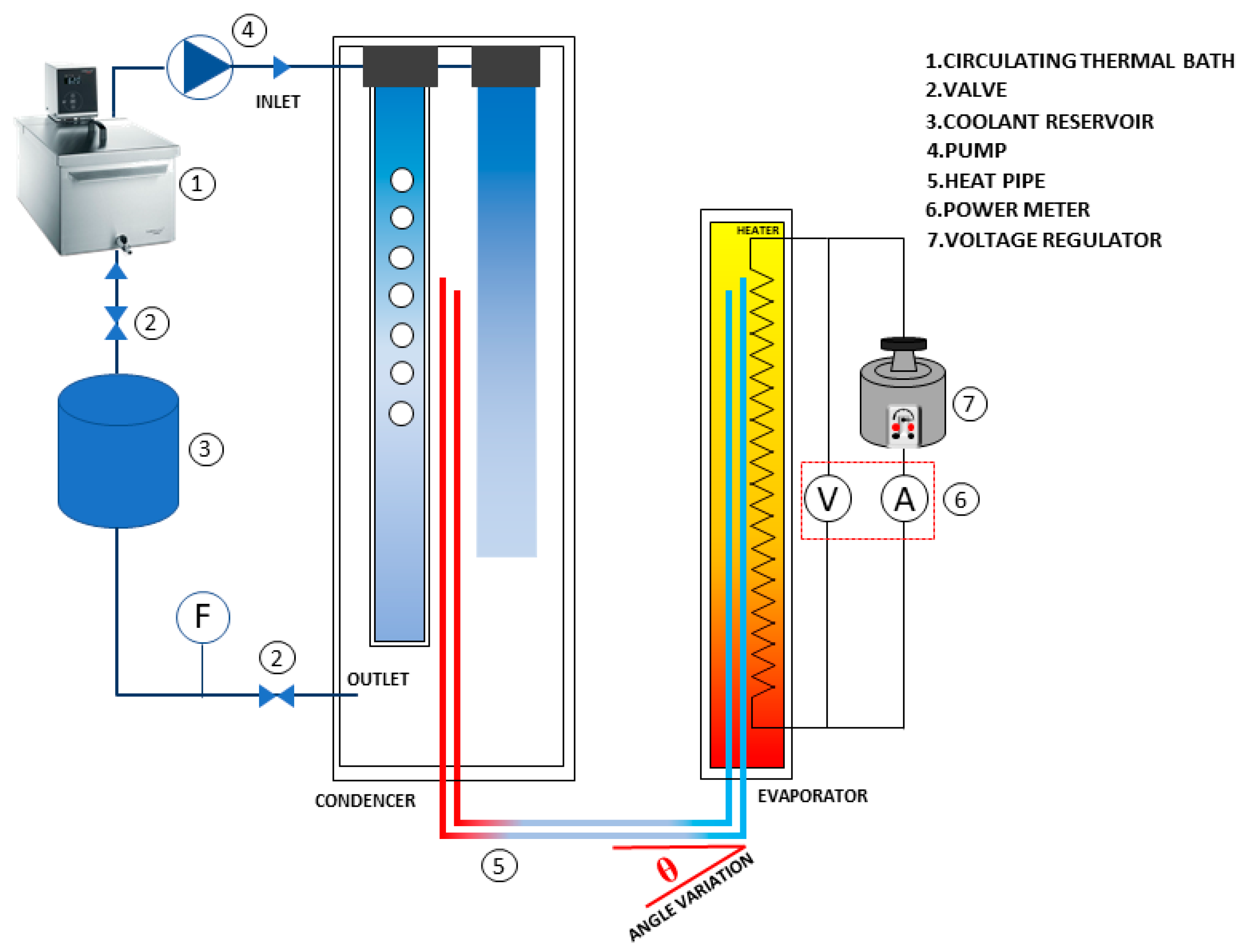
The experimental setup used in this study employed a specially shaped pipe section, as shown in
Figure 1, designed to fit within a steel tube lined with a layer of thermal insulation. This experimental arrangement aimed to determine the thermal resistance within the system and assess the effectiveness of heat transfer from the system. Fins were not used on the pipes in this study because the focus was to investigate the inherent thermal resistance of the pipes used. Consequently, only the copper tube of the heat pipe was exposed, allowing direct temperature measurements at predetermined points on the surface of the copper pipe. Water was used as the medium within the test tube to ensure that no temperature bias occurred during the experiments, which might have been the case if ambient air had been used [
51]. To provide controlled thermal boundary conditions, the evaporator was heated and the condenser cooled using a regulated setup. As illustrated in
Figure 1, the experimental system consisted of a 500 W electrical heater, a WLHP, a water-based cooling circuit for temperature regulation, thermal insulation, and an integrated data acquisition unit. This arrangement facilitated accurate and reproducible evaluation of thermal transfer performance and resistance under well-controlled laboratory conditions. Various measuring tools were employed to assess the system’s performance. Temperatures were recorded with K-type thermocouples type KXFF46, LTC Glodok, Jakarta, Indonesia. Pressure was quantified via a pressure transmitter Type 511, Huba Control AG, Würenlos, Switzerland. The water flow rate was monitored with a tube rotameter 10–110 L/min range, LTC Glodok, Jakarta, Indonesia.
2.1. Experimental Setup
The structural configuration of the WLHP is depicted in
Figure 1. The heat conduit is fabricated from copper, with both the evaporator and condenser sections designed in a two-pass configuration. Each active straight pass has an internal diameter of 8.5 mm and a total length of 2280 mm. Prior to the charging process, the internal surfaces of the loop were meticulously cleaned with acetone followed by distilled water to eliminate residual contaminants such as particulates, oils, or fluids. Following the cleaning procedure, the WLHP was charged with R134a as the working fluid, ensuring sufficient filling to occupy the evaporator section legs during periods of non-operation. The outer diameter of 8.5 mm was selected as a compromise between mechanical manufacturability, structural robustness, working fluid inventory, and heat transfer performance for the present industrial-scale wickless WLHP. This diameter provides sufficient passage for vapor flow and liquid return in a gravity-assisted loop, while maintaining mechanical integrity under the operating pressure range and ensuring practical fabrication for the overall loop configuration. In addition, the selected diameter lies within the dimensional range reported in previous studies, thereby enabling meaningful comparison with prior experimental investigations. The charging process was performed according to the methodology outlined by Faghri [
44].
In the evaporator section, each side of the heating plates, which cover the two lower pipelines of the loop, is capable of delivering a maximum thermal output of 500 W. The plates were arranged with uniform spacing to ensure consistent heating and to avoid direct alignment above the thermocouples used for surface temperature measurements of the heat pipe. The rate of heat input to the evaporator was accurately quantified using an inline wattmeter, with a voltage regulator employed to control the electrical supply to the heaters. To minimize thermal losses to the surroundings, the evaporator and associated radiators were enclosed within a substantial layer of insulation, as illustrated in
Figure 1.
The condenser section, consisting of the two upper pipelines of the loop, utilizes a two-pass shell-and-tube heat exchanger to enable effective cooling. To promote uniform distribution of the incoming coolant, an auxiliary pipe was installed at the center of the loop. The heat exchanger is enclosed within a 10 mm-thick acrylic shell lined with fiberglass wool, providing both transparency for visual inspection and thermal insulation to limit heat losses. Heat transfer was facilitated by circulating the heat pipe’s working fluid through the internal tubes while chilled water was directed through the surrounding shell, thereby ensuring efficient thermal exchange.
A critical subsystem within the experimental rig is the water condenser circuit, which delivers coolant to the heat exchanger at controlled inlet temperatures and mass flow rates, ensuring close thermal contact with the copper tubing of the heat pipe. The heat exchanger assembly was mounted securely on a custom-fabricated wooden platform to provide structural stability. The elevation difference between the condenser and evaporator was carefully adjusted so that the condenser was positioned higher, thereby enabling the gravitational return of the condensed working fluid to the evaporator [
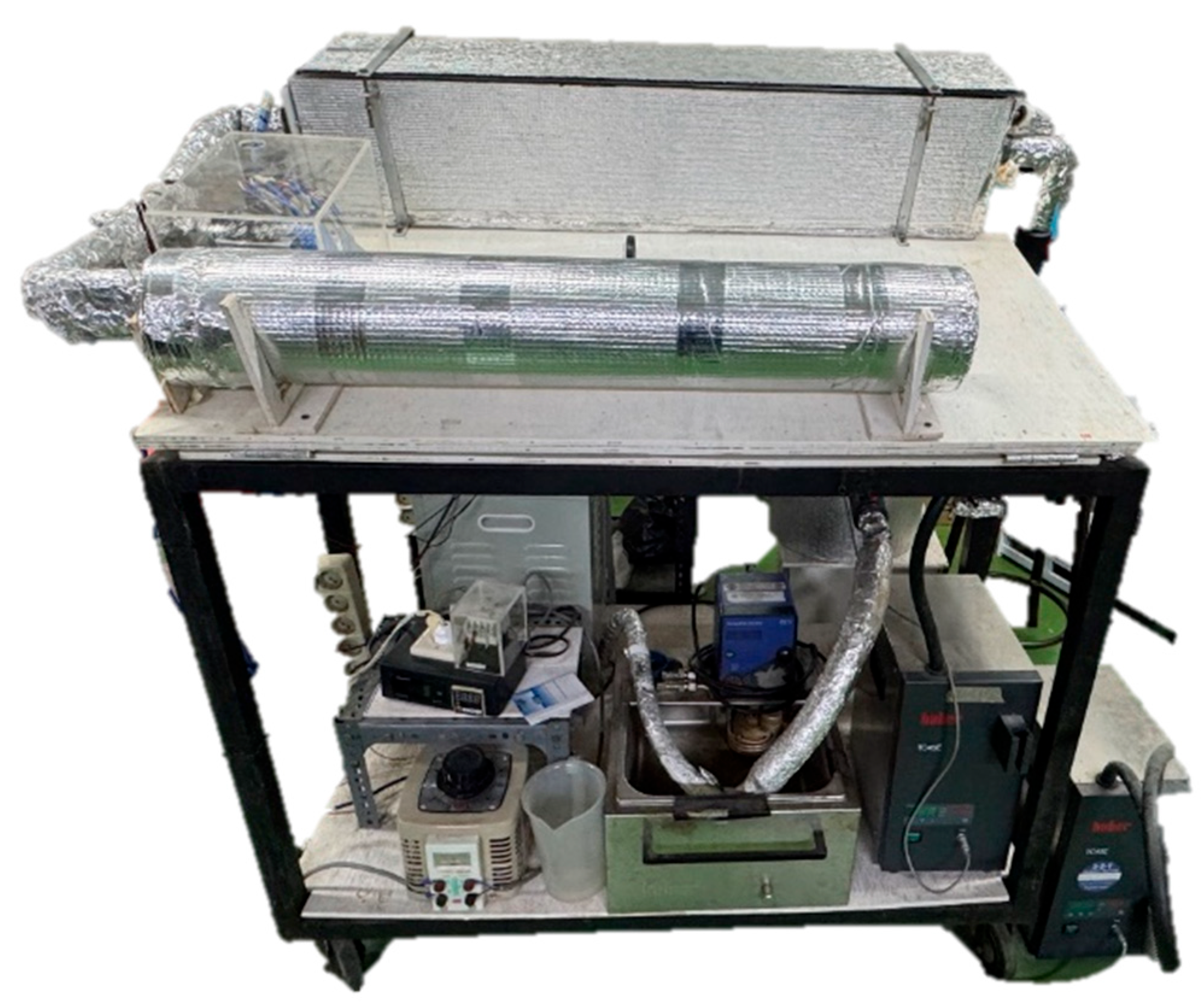
52]. The complete experimental arrangement of the wraparound loop heat pipe is shown in
Figure 2, comprising the condenser integrated within the water-cooled enclosure and tube segment, together with the insulated evaporator section.
The operating principle of the heat pipe is based on the absorption of heat from a resistance heater, which induces evaporation of the working fluid within the evaporator section [
43]. The generated vapor then traverses the adiabatic section and enters the condenser, where it undergoes phase change in two passes through the shell, thereby transferring latent heat to the circulating cooling water. In the absence of a wick structure within the conduit, the condensate returns to the evaporator solely under the influence of gravitational forces.
To ensure consistency across all trials, a closed-loop water circuit was employed to maintain a stable coolant mass flow rate through the condenser heat exchanger. Flow regulation was achieved using a flowmeter, which simultaneously measured the volumetric flow rate at the heat exchanger shell inlet. For all experiments, the hydronic side flow rate was fixed at 3.2 L/min, while the minimum electrical heating input was set at 200 W. Prior to data collection, the system was allowed to stabilize for 30 min to ensure steady state operation. Temperature measurements were subsequently recorded over a period of 1 h and 20 min using a data acquisition system connected to thermocouples distributed along the legs of the heat pipe. The procedure was repeated under varying electrical input voltages to evaluate system performance under different heat load conditions.
The selected testing ranges were determined to represent stable and practically relevant operating conditions for the present industrial scale wickless WLHP. The heat load range of 200–500 W was chosen to match the controllable capacity of the electrical heating system while representing medium to high power thermal management conditions relevant to HVAC-related applications. The inclination angles of 15° and 30° were selected because loop orientation strongly affects condensate return in wickless gravity assisted operation, making inclination an important parameter in the overall heat transfer process. The coolant temperatures of 5–15 °C were chosen to represent controlled chilled-water conditions and to evaluate the effect of condenser side temperature differences on thermal resistance. Meanwhile, the coolant flow rate was fixed at 3.2 L/min to maintain a stable condenser-side boundary condition and to isolate the effects of heat load, inclination angle, and coolant temperature during the experiments. It should be noted that all experiments were conducted in a spacious laboratory maintained at approximately 25 °C using a standard air-conditioning system. In addition, the evaporator and condenser temperatures were strictly controlled at constant operating conditions, and no significant fluctuations in the surrounding air conditions were observed during the experiments. The experimental conditions used in this study are listed in
Table 2.
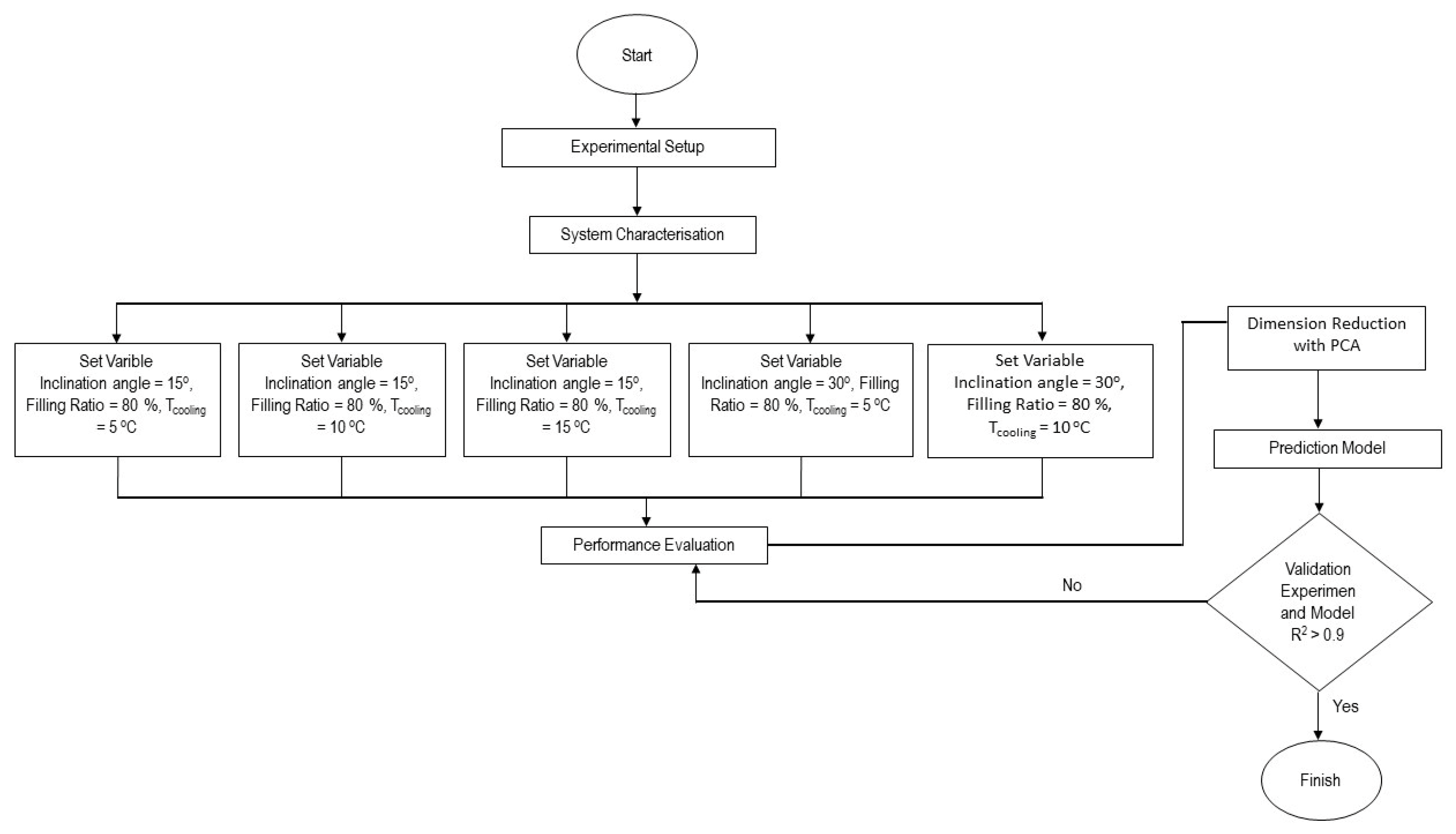
The flowchart in
Figure 3 shows the methodology for the experimental investigation and predictive model development. The process begins with a well-structured experimental setup and system characterization to establish a robust foundation for the analysis. Controlled experiments are conducted by systematically varying critical parameters, including inclination angles (15° and 30°), a fixed filling ratio of 80%, and cooling temperatures (5 °C, 10 °C, and 15 °C).
Performance evaluation under the specified operating conditions yields comprehensive datasets, which are subsequently processed through Principal Component Analysis (PCA) to reduce dimensionality and improve interpretability while preserving critical variance. Based on this analysis, a predictive model is developed and rigorously validated against experimental results using a stringent criterion of R2 > 0.9 to ensure high predictive reliability. In cases where this benchmark is not achieved, iterative refinements are implemented to progressively enhance model accuracy. The methodological framework is considered complete once the required precision is attained, thereby providing a robust, scalable approach that advances the integration of experimental investigation with computational modeling in the field of thermal management research.
2.2. Performance Analysis
In this study, the mean values obtained over a 20 min interval were adopted as the reference standard for evaluating the parameters under investigation. The thermal resistance of the wraparound loop heat pipe was subsequently assessed by defining the thermal resistance parameter, denoted as R.
where T
c and T
e represent the mean temperatures of the external surfaces of the copper tubes in the condenser and evaporator sections, respectively [
28]. The actual heat transfer rate in the evaporator section is represented by Q [
53], which also represents the input thermal load in this case [
36]. The input thermal burden was previously supplied by electrical power. The mean temperature of the evaporator is calculated using the following equation:
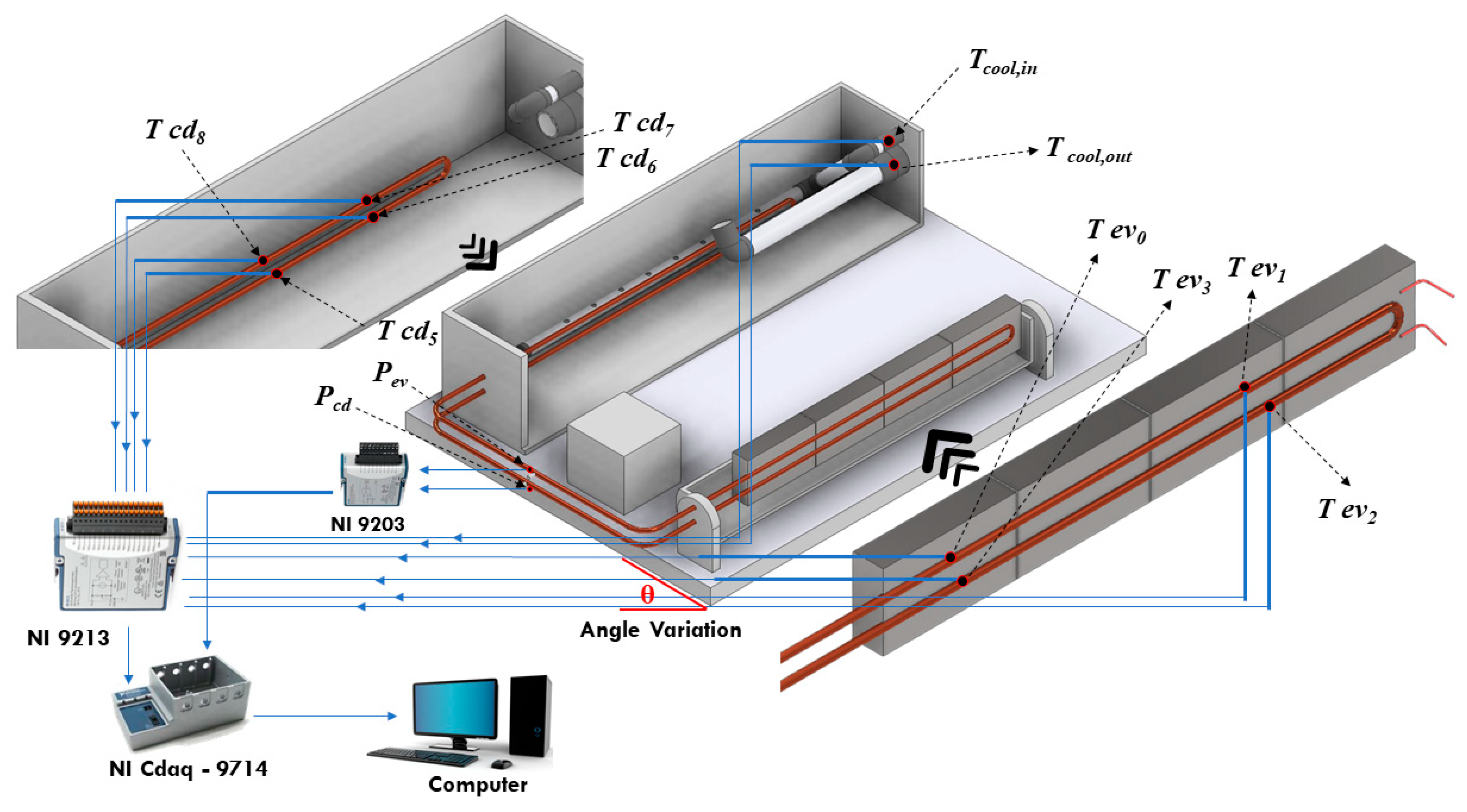
As illustrated by the experimental configuration in
Figure 4, the temperatures recorded by the four thermocouples situated in the evaporator section are represented by the symbols T
ev,0, T
ev,1, T
ev,2, and T
ev,3. The average temperature of the condenser was determined using the following equation:
Consequently, it is advisable to calculate thermal resistance using the input heat burden rather than the actual heat transfer rate.
2.3. Uncertainty Analysis
The uncertainty evaluation involves a combination of separate standard uncertainties [
54]. It was assumed that the sought-after parameter y was contingent on each subject’s experimental x
1, x
2, x
3, …, to random and independent variations. Essentially, y can be depicted as a function of x
1, x
2, x
3, …, and is expressed as
Consequently, the aggregate uncertainty of parameter y [
36]:
where
ux1 denotes the uncertainty of each parameter. The thermal resistance uncertainty can be estimated using the following equation [
28]:
Throughout this investigation, the accuracy of current and voltage measurements was maintained within ±0.1%, while the uncertainty in determining the heating power input was restricted to less than 5%. Temperature measurements obtained via thermocouples exhibited an accuracy of ±0.5 °C, with an associated uncertainty of ±0.7 °C for temperature variations. The overall uncertainty in thermal resistance, which is a function of both heat input and temperature differential, was rigorously evaluated through detailed error analysis and was found to remain below 9.8% across all experimental conditions. A comprehensive summary of the measurement devices and associated parameters is provided in
Table 2, whereas the experimental conditions defining the measurement points are detailed in
Table 3.
2.4. Predictive Modeling Methodology
2.4.1. Dimension Reduction
Dimension reduction using Principal Component Analysis generates several comprehensive variables (principal components) from the original variables using orthogonal transformation, thereby substituting the original variables [
53]. The main components are uncorrelated and retain critical information about the original variables [
53]. Assume that the original dataset D contains n historical data points, each of which is influenced by g factors, namely, D (d
1, d
2, …, d
g) and d
j = [d
1j, d
2j, …, d
nj]
T. The dataset was standardized to mitigate the potential impact of various dimensions [
53].
The standardized data are denoted as
,
, whereas the unprocessed data are denoted as. The standardized dataset covariance matrix is denoted as [
53].
where D is the normalized matrix, and D
T is the transposed matrix of D. Calculate the eigenvalues of the covariance matrix and orthogonalized unit eigenvector a
i using the singular value decomposition algorithm. The
ith principal component
PCi of the original variable can be expressed as follows [
53]:
where
m is the number of principal components. The contribution rate and cumulative contribution rate can be expressed as [
53]
The cumulative variance contribution rate denotes the percentage of information reserved by the primary component. The correlation between the cumulative contribution rate and data dimensionality reduction indicates a tradeoff between computational efficiency and information loss [
53]. The number of principal components was determined from their cumulative contribution rate [
53]. As the cumulative contribution rate increased, the data loss was mitigated. As the cumulative significance rate approaches 95%, the first m principal components comprise the majority of the information in the original data set [
53]. The primary component factor load matrix is represented as [
53]
The principal component scores were determined by incorporating the original data into the principal component expressions [
53].
The experimental study produced a multivariable dataset that included heat load, wall temperatures at several evaporator and condenser sites, and pressure measurements. The thermal coupling of these variables and potential redundancy complicate the direct understanding of their individual effects on thermal resistance. Consequently, Principal Component Analysis (PCA) was utilized as a dimensionality reduction technique to discern the predominant variables while maintaining the primary variance pattern of the experimental dataset. A regression-based statistical model was subsequently created to estimate thermal resistance utilizing the distilled and pertinent information derived from the experimental data. The statistical analysis enhances the experimental research by augmenting interpretability and predicting accuracy.
2.4.2. Multiple Linear Regression with Various Parameters
Multiple linear regression equations with various parameters were employed to integrate the configuration parameters from the various configurations. The multiple linear regression equation is typically represented as [
55]
where y is the dependent variable and d
1, d
2, …, d
z are q independent variables. The random error term is denoted by ε, and the regression coefficient is represented by β
0, β
0, … β
z, representing z + 1. To ascertain the regression coefficient and establish a regression relationship, a minimum of z + 1 set of observation data (d
i1, d
i2 … d
iq); y
i (i = 1, 2, …, z + 1) is required if y is linearly related to d
1, d
2, …, d
z, respectively [
20]. If the interaction terms between independent variables are considered, the regression relationship between y and q of the independent variables (e.g., z = 3) is [
55]
A minimum of 2
3 observation data sets are required [
55]:
where
D is a 2
z × 2
z matrix, referred to as the design matrix, which can be predetermined based on subjective factors. When (D
TD)
−1 is present, the regression parameter least-squares estimate is [
55]
An empirical regression equation with various parameters was established at this juncture (taking z = 3 as an example).
where
and
are the regression coefficients and dependent variable estimates, respectively [
55]. The model must be validated using experimental data obtained under various input conditions. The procedure was terminated when the Mean Square Error (MSE) of the training exceeded that of the validation. To determine the most effective estimator during the prediction phase, we implemented the coefficient of determination (R
2) and MSE [
56].
where y
act is the experimental efficiency, y
r,mdl = the thermal resistance model, y
avg is the average thermal resistance, and N is proportional to the amount of data [
56].
3. Results and Discussion
In this section, a series of systematic experimental comparisons were performed to evaluate the thermal resistance of the circumferential heat pipes. The analysis considered multiple parameters, including working fluid pressure and temperature, as well as the wall temperature distributions along the evaporator and condenser sections.
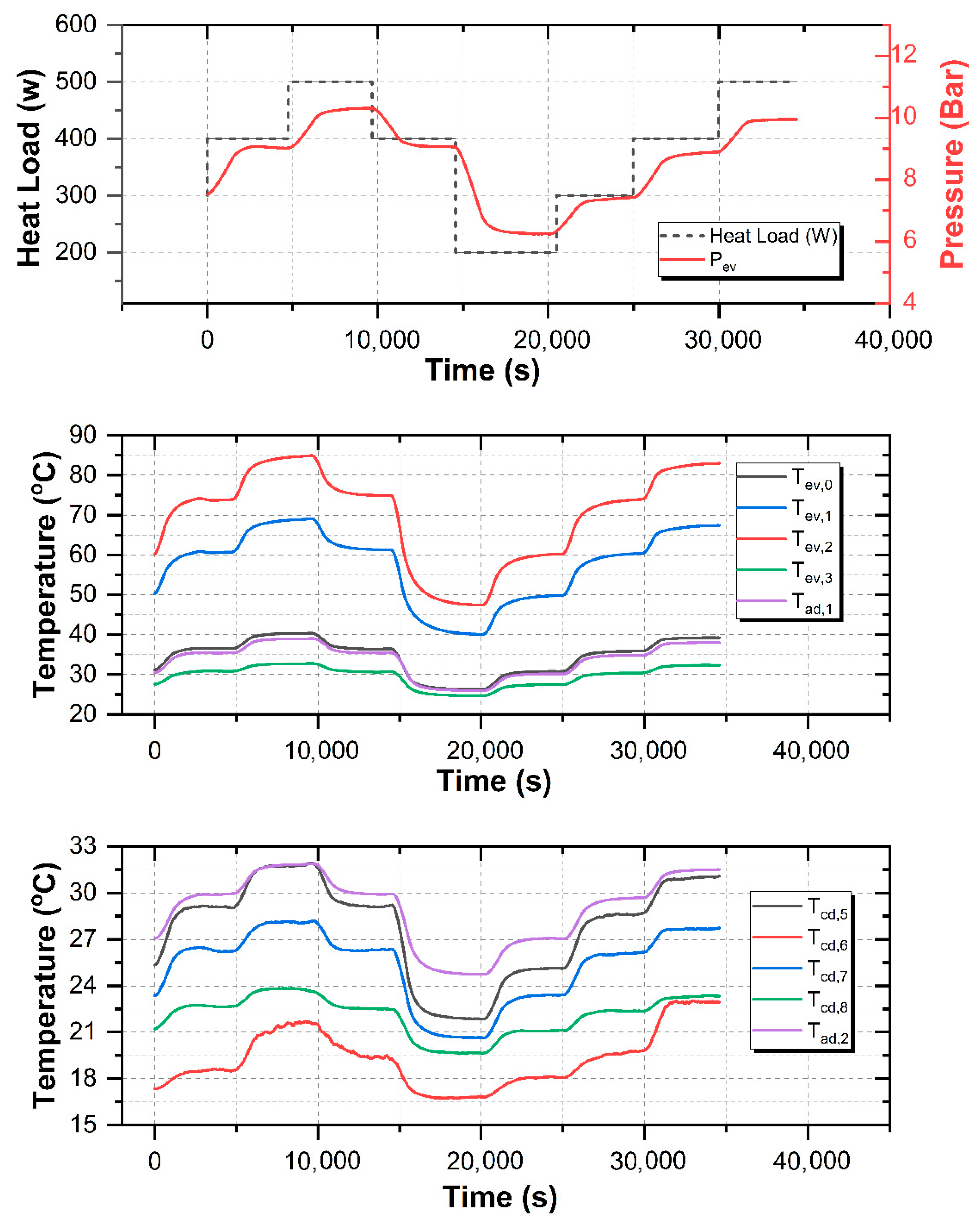
Figure 5 presents the temperature profiles of the heat conduit during operation at various time intervals. Throughout all experiments, the filling ratio, based on the outer diameter, was maintained at a constant value of 80%. Prior to the application of thermal loading, each thermocouple measurement corresponded to the ambient temperature of the surrounding environment.
A thermal input of 200 W was employed to analyze working fluid pressure and wall temperature behavior [
6]. At a maximum heat load of 500 W, the operating pressure of the working fluid exceeded 12.5 bar. Within the evaporator section, the external wall temperatures consistently remained higher than those of the working fluid across all heat loads, with the temperature differential between the copper tube surface and the fluid increasing proportionally with the applied thermal capacity [
19]. Conversely, the condenser walls exhibited markedly lower temperatures compared to the working fluid, with the upper condenser tube maintaining a higher temperature than the lower tube. Under high thermal loads, the local temperature at T
cd,7 fluctuated by approximately 3 °C, with oscillation amplitudes intensifying as the heat load increased. By contrast, incremental increases in heating power produced only modest temperature rises at T
cd,8, indicating that the working fluid vapor exiting the evaporator underwent complete condensation.
3.1. The Thermal Resistance of the Circumferential Heat Conduit Is Influenced by the Inclination Angle
In addition, a series of experiments were performed under a variety of heat load cycles to verify the functionality of the heat pipe and analyze its reaction to periodic heat loads [
57]. From
Table 4, across all tested heat load characteristics, it is evident that the heat pipe operates efficiently and responds rapidly to random variations in the heating power. As illustrated earlier, the angle of inclination, which is the angle between the axis of the adiabatic tube and the horizontal reference line, exerts a substantial influence on the working fluid distribution within the heat pipe.
In the absence of heat input, a fixed filling ratio may lead to incomplete liquid distribution within the evaporator section, with excess fluid accumulating in the condenser [
58]. For this reason, optimization of the inclination angle is essential, as it plays a critical role in governing heat transfer processes in circumferential heat pipes. The thermodynamic behavior of a heat pipe with an 80% filling ratio and a 9.5 mm diameter was examined across inclination angles ranging from 15° to 30°. At constant inclination, increasing heat load resulted in progressive rises in both temperature and pressure until maximum operating values were reached. Furthermore, the temperature differentials between inclination angles widened with higher thermal input. Notably, systems configured with greater inclination angles exhibited markedly lower evaporator wall temperatures under elevated heat loads compared to smaller inclination angles. For instance, at a thermal load of 500 W and an inlet temperature of 15 °C, the working fluid pressures were recorded at 12.5 bar and 9.9 bar for inclination angles of 15° and 30°, respectively. Under identical conditions, the evaporator wall temperature at 30° inclination was approximately 55 °C, representing a reduction of about 5 °C relative to that at 15°. This improvement is attributable to enhanced heat transfer mechanisms, including more effective conduction, intensified natural convection of the working fluid, and accelerated vapor transport.
At an inlet temperature of 15 °C and a thermal load of 500 W, the thermal resistance values obtained for inclination angles of 15° and 30° were 0.067 °C/W and 0.058 °C/W, respectively. These results highlight the significant influence of inclination angle and gravitational orientation on the thermal resistance of the circumferential heat pipe, particularly under configurations where the lower condenser tube is positioned at or below the level of the upper evaporator tube. Conversely, when the lower condenser tube is situated above the upper evaporator tube, the thermal resistance becomes largely independent of orientation, a phenomenon attributable to the combined stabilizing effects of gravity and inclination angle.
3.2. The Circumferential Heat Pipe Thermal Efficacy Is Examined in This Section in Relation to the Coolant Temperature
Lowering the coolant temperature increases the temperature gradient between the evaporator and condenser, thereby enhancing the efficiency of heat transfer across the system. In conventional air-conditioning systems, outdoor air is cooled below both the evaporator and condenser surface temperatures, as well as the dew point, to achieve effective moisture removal under hot and humid conditions [
59]. Typically, the ambient air temperature and relative humidity are controlled to approximately 10 °C and 100%, respectively, to ensure the discharge of adequately cooled and dehumidified air from the refrigeration coil. Consequently, it becomes essential to investigate the influence of coolant temperature variations on the operational performance of circumferential heat pipes [
32].
Table 5 summarizes the influence of chilled-water temperature on the thermal resistance of the heat pipe as a function of applied heat input. The maximum operating pressures of the working fluid were calculated as 8.4 bar, 10.3 MPa, and 12.5 MPa for coolant temperatures of 5 °C, 10 °C, and 15 °C, respectively. A greater temperature differential between the condenser surface and the coolant promotes condensation of the working fluid, thereby increasing the pressure gradient between the evaporator and condenser. This effect enhances heat transfer and intensifies liquid circulation within the heat pipe; however, it may also result in a considerable increase in energy consumption.
Coolant temperature variations exhibited negligible influence on thermal resistance under high heat load conditions. Nonetheless, as heat input increased, the thermal resistance associated with each coolant temperature progressively declined, with values ranging from 0.056 °C/W to 0.086 °C/W. The minimum thermal resistance was observed at 0.075 °C/W under a coolant temperature of 15 °C with a heat input of 200 W. The relatively stable evaporator temperatures across different coolant temperatures can be attributed to the absence of efficient vaporization mechanisms. Conversely, at lower heat loads, the condenser temperatures declined with decreasing coolant temperature, thereby increasing the average temperature differential between the evaporator and condenser and resulting in elevated thermal resistance.
3.3. Dimension Reduction Using Principal Component Analysis
The KMO value was between 0 and 1 in
Table 6. A value closer to 1 indicates that the data are appropriate for factor analysis. A KMO value exceeding 0.8 is referred to as a meritorious sampling, indicating that the sample size is sufficient for analysis [
60].
Bartlett’s test was conducted to determine whether the correlation matrix was significantly different from the identity matrix, where variables are uncorrelated. A statistically significant result (
p < 0.05) indicated that the data contained correlations suitable for factor analysis [
60]. The test yielded a Chi-Square value of 811.851, with a degree of freedom (df) of 66, and a
p-value of >0.001. The null hypothesis could be refuted because of the small
p-value (<0.05), suggesting that the correlation matrix was not an identity matrix. In other words, the variables demonstrated sufficient correlation, indicating that factor analysis was the most appropriate method for analyzing these data.
PCA is a multivariate data analysis technique that can be used to condense a large dataset of numerous correlated variables into a smaller dataset while preserving the original patterns and trends of the dataset [
49]. PCA transforms a dataset into a set of values, referred to as principal components, with objectives that include variable selection, outlier detection, simplification, data reduction, and prediction. PCA was applied in this study to 11 input variables—heat load, T
ev,0, T
ev,1, T
ev,2, T
ev,3, T
cd,5, T
cd,6, T
cd,7, T
cd,8, P
cd, and P
ev. To identify the most sensitive parameters for the thermal resistance prediction of a wraparound loop.
Table 6 presents the results of the Principal Component Analysis (PCA). The rotated component matrix provided therein enables clearer interpretation by illustrating the correlations between individual variables and the underlying factors following rotation [
53]. This statistical rotation enhances the ability to distinguish and assign meaning to the extracted factors by highlighting the variables most strongly associated with each component. In doing so, the data structure is refined, thereby allowing for the derivation of more precise and insightful conclusions regarding the interrelationships among variables and the dominant factors influencing system behavior.
The PCA results reveal that the first principal component, with an eigenvalue of 9.922, accounts for 82.7% of the overall variance, while the second component, with an eigenvalue of 1.188, explains an additional 9.9%. Collectively, these two components capture 92.6% of the variance, highlighting their dominant role in explaining the underlying structure of the dataset. The contribution of the remaining components was found to be minimal, indicating that the variance in system performance can be effectively described using only the first two principal components.
The significance of these findings is reinforced by the eigenvalue criterion, which designates components with eigenvalues greater than one as statistically meaningful. Thus, the first two components not only satisfy this requirement but also provide a robust dimensionality reduction, ensuring that the majority of system variability is retained. From a thermal systems perspective, this suggests that WLHP performance can be predominantly characterized by two critical underlying factors, thereby simplifying both experimental analysis and predictive modeling. This reduction in dimensionality enhances interpretability, supports the identification of dominant performance drivers, and establishes a more efficient framework for optimizing WLHP design and operational strategies in industrial-scale HVAC applications.
Table 7 summarizes the PCA. The top two principal components were used to represent individual and cumulative data variabilities. Variables with substantial coefficients in each component (comp 1, comp 2) were classified as sensitive variables using the PCA selection method because they contained most of the dataset information. A parameter value near 1 indicates a high correlation, while a value near zero indicates a low correlation. This information led to the inclusion of some variables in
Table 6 as sensitive variables from principal components 1 (T
cd,6, T
cd,7, T
cd,8) and 2 (Heat Load, T
ev,1 T
ev,2).
Principal Component 2 (PC2) emerged as the most significant factor sequence, aligning closely with the empirical thermal resistance formulation presented in
Table 6. This alignment arises from the fact that PC2 emphasizes the dominant influence of evaporator temperature and heat load on experimental outcomes, consistent with the theoretical framework of thermal resistance. By comparison, the condenser temperature at Point 5 exhibited a lower degree of influence relative to the evaporator temperature and heat load. Conversely, Principal Component 1 (PC1) prioritized the condenser temperature as the most significant variable, whereas PC2 consistently ranked condenser temperature below the evaporator temperature and heat load. This distinction is attributable to the inherent stability of condenser temperature within the heat transfer process, as the condenser is directly coupled with external cooling media, such as air or water, which possess relatively high thermal capacities [
61,
62].
The relative stability of the condenser temperature results in its minimal contribution to overall system variability. In contrast, PC2 captures the more dynamic variations occurring in the evaporator, primarily driven by changes in heat load. As the heat input (Q) increases, the evaporator temperature exhibits substantial rises due to its direct role in heat absorption, while the condenser temperature remains comparatively stable. This behavior is reflected in the high weighting factor of 0.954 assigned to heat load in PC2. The functional distinction between the two sections of the heat pipe reinforces this outcome: the evaporator undergoes pronounced temperature fluctuations owing to continuous heat absorption, whereas the condenser dissipates heat more consistently through its interaction with the external cooling medium [
61,
62,
63]. Accordingly, PC2 more accurately characterizes the correlation between evaporator temperature dynamics and heat load than it does for condenser temperature.
3.4. Statistic Modeling
The model was implemented in a series of stages, including model determination, evaluation, and validation, to observe 11 independent variables for a single response. In addition, an empirical correlation was established by analyzing the inputs and responses. This was followed by a statistical analysis using multiple regression to generate the predicted results. The heat loads T
ev,0, T
ev,1, T
ev,2, T
ev,3, T
cd,5, T
cd,6, T
cd,7, T
cd,8, P
cd, and P
ev were adjusted to observe variations in the thermal resistance of the single response. The model analysis is presented in
Table 7, while
Table 4 illustrates the use of the experimental design for the input parameters.
These results highlight the patterns through which the input, including their squares and interactions, facilitated the output analysis. This underscores the significance of the observed characteristics for evaluating the generated model. The F-value of the constructed model without PCA for thermal resistance was 21.29, while the model incorporating PCA yielded an F-value of 42.18, with a p-value of less than 0.0001. This indicates that both model terms (p < 0.05) were significant, suggesting the appropriateness of the experimental parameters implemented.
The values of the devised model and the estimation of the thermal resistance are also listed in
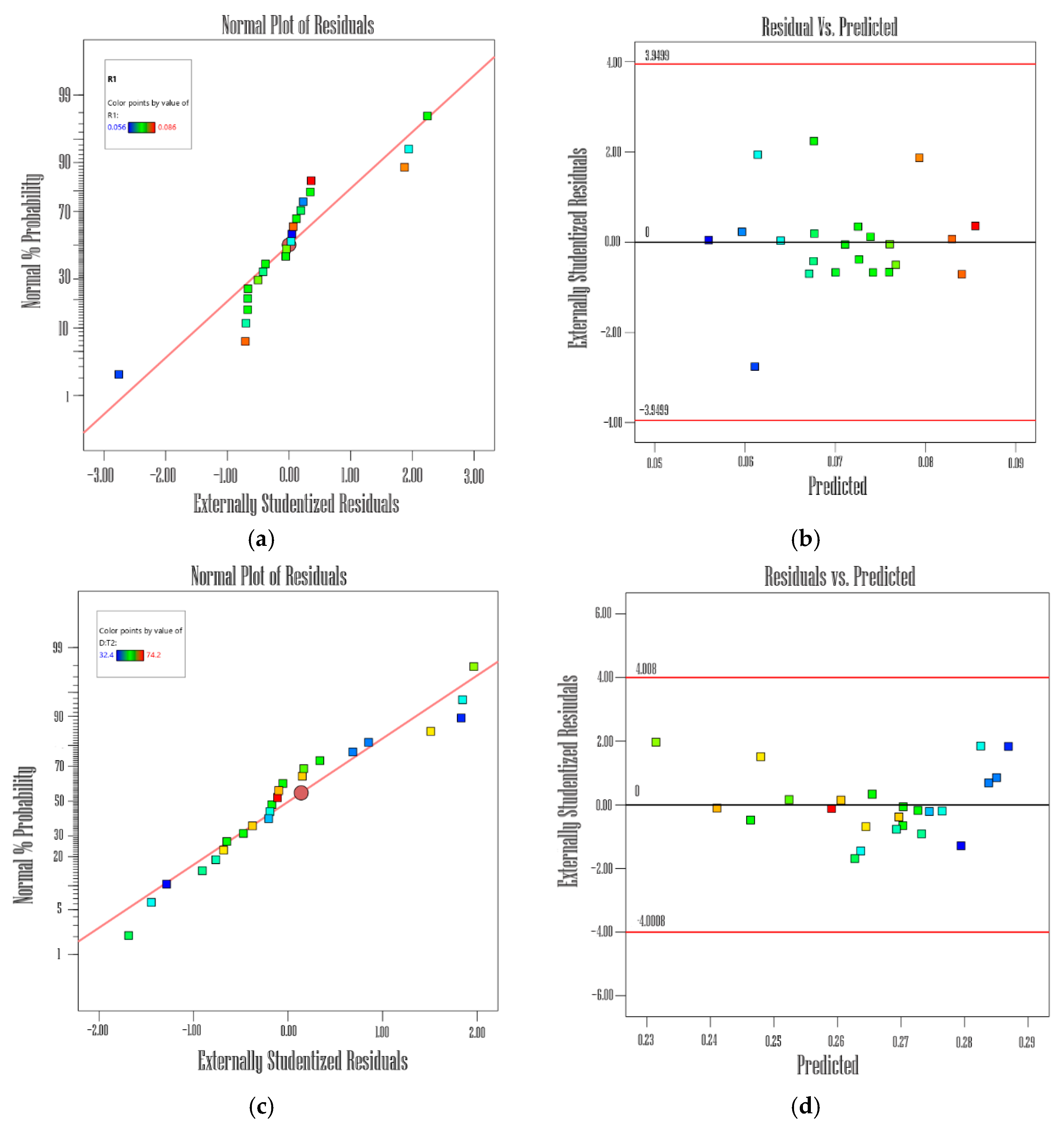
Table 7. The proposed model was subsequently evaluated for data adequacy and abnormalities using normal graphs for residuals and outliers. In this scenario, it is anticipated that an acceptable model will not adhere to any particular trend or sequence and that the nodes should be close to a straight line. The residual and outlier diagrams for the thermal resistance are illustrated in
Figure 6. The model predictability was confirmed by the fact that all data points were arbitrarily distributed and did not follow any sequence, as illustrated in
Figure 6a,c. In addition,
Figure 6b does not adhere to any particular sequence, confirming the predictability of the model. The outlier charts for thermal resistance were also depicted in
Figure 6b,d, where data points that exceeded the permissible range of ±4 were deemed anomalous.
In
Figure 6a,c, the selection of the two normal probability plots is dependent on their alignment with the red diagonal line and the distribution of colors. The residuals in both plots are consistent with the red line, suggesting that the data are normal. Nevertheless, graphs with points closer to the red line generally suggest a greater adherence to normality assumptions.
Figure 6a is slightly more dispersed at the lower end, suggesting that it may contain more outliers, although both plots have similar deviation patterns.
The initial plot color distribution indicates a more restricted range of values, with a greater degree of concentration around the center.
Figure 6c appears to be slightly more aligned with more evenly distributed points along the line, indicating a more normal distribution of the residuals. In conclusion,
Figure 6c is slightly more aligned than
Figure 6a owing to the more equitably distributed points along the line, implying a more normal distribution of the residuals. However, the plots were relatively similar.
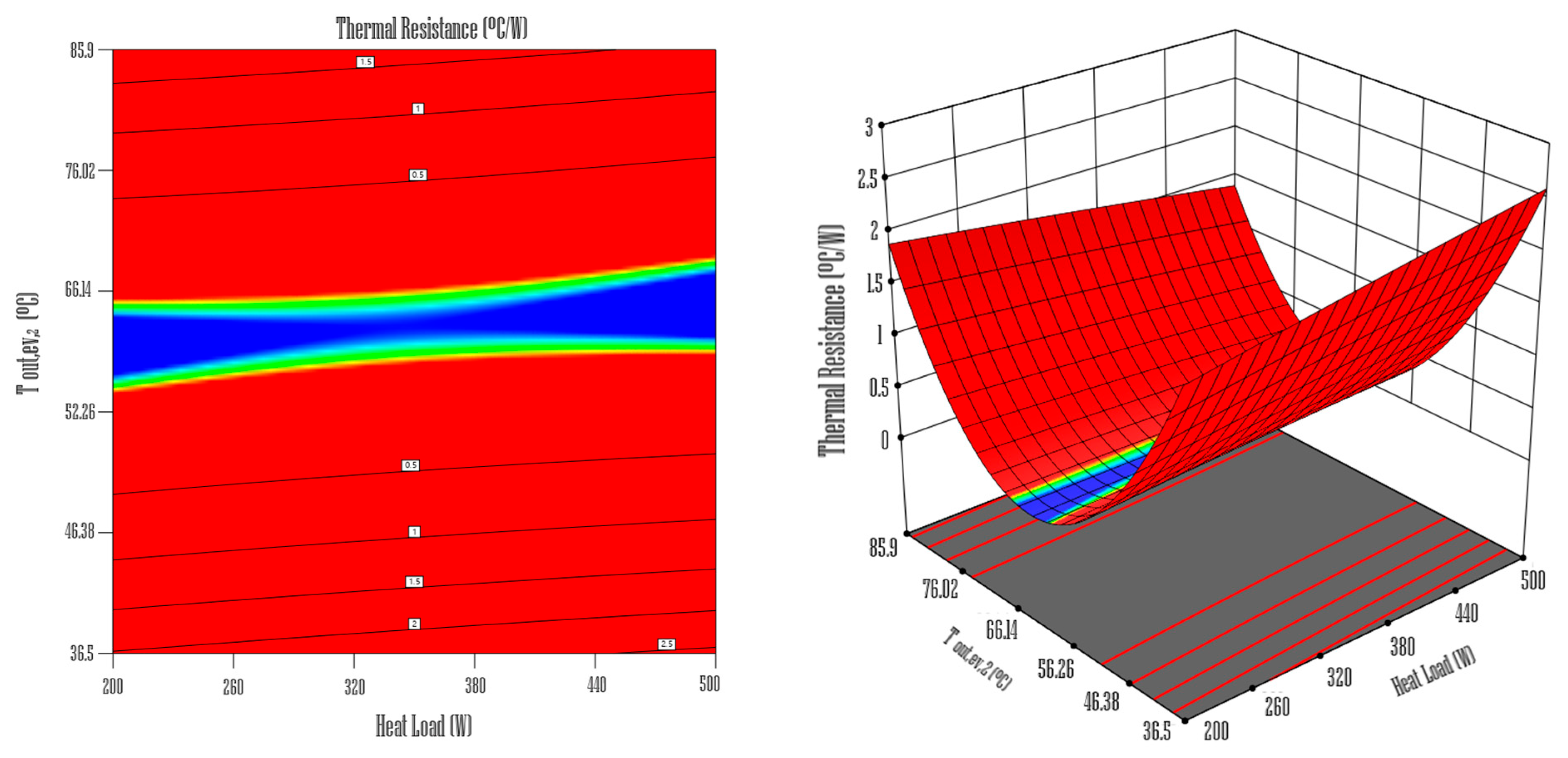
As shown in
Figure 7 [
48], lower heat loads and reduced evaporator wall temperatures (T
ev,2) correspond to higher thermal resistance. This trend is consistent with the general principle that insufficient heat loading limits heat transfer effectiveness, as the temperature differential is inadequate to drive efficient phase change or thermal transport processes [
64,
65]. With increasing heat load, thermal resistance progressively decreases until reaching a minimum value, signifying optimal heat transfer performance. This minimization of thermal resistance at intermediate T
ev,2 values along the axis defines the optimal operating range of the heat pipe system, where phase-change mechanisms and thermal conductivity are maximized.
The thermal resistance of the evaporator exhibits an increase under both extremely low and excessively high temperature conditions, which can be attributed to system inefficiencies. At low temperatures, limited vapor generation occurs because the working fluid approaches its saturation point without acquiring sufficient energy for effective phase transition, resulting in a weak evaporation process and consequently higher thermal resistance [
34,
66,
67]. Conversely, at elevated temperatures, potential dry-out phenomena may occur, further impairing heat transfer performance. In both cases, the reduced efficiency of the phase-change mechanism leads to diminished thermal transport and elevated thermal resistance within the evaporator.
Table 8 presents the coefficient of determination (R
2) and root mean square error (RMSE) values for the evaluated models. The R
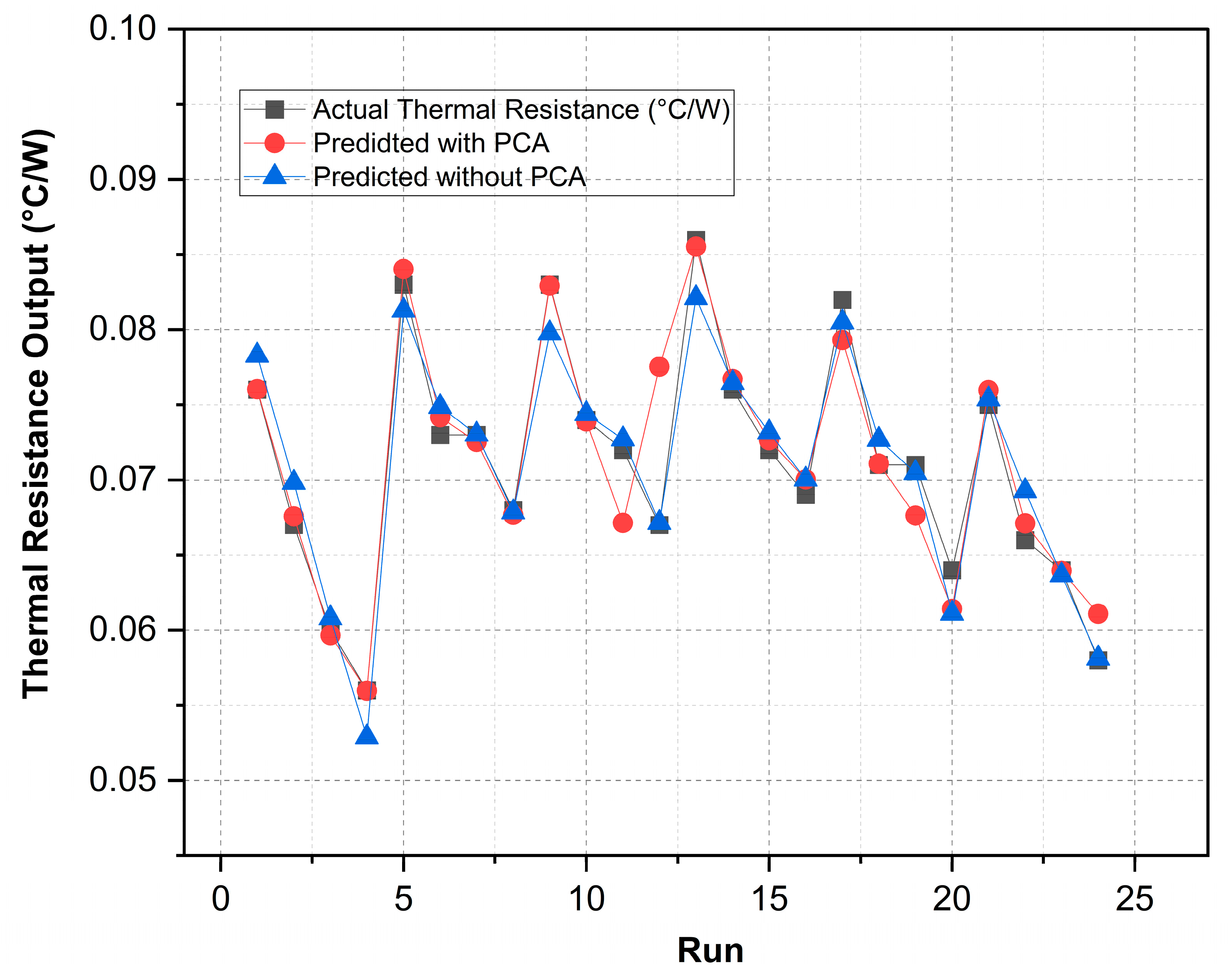
2 results demonstrate that the linear regression performance of both models—with and without PCA was nearly equivalent, with values approaching unity, thereby confirming strong predictive capability in each case. Similarly, the small RMSE values observed for both models indicate minimal prediction error, further validating the reliability and accuracy of the regression analysis.
Figure 8 presents the results of actual data, predicted data without PCA, and predicted data utilising PCA; the data generated appears nearly identical.
3.5. Analysis Compared to Previous Investigations
Literature reviews were used to assess the performance of the WLHP system implementing r-134a by comparing the experimental outcomes with those of previous studies. The information presented in
Table 9 includes details, such as the type of refrigerant used.
The present investigation employed a copper tube with an outer diameter of 8.5 mm, placing it within the medium dimensional range compared to previous studies. For instance, Pedro L. O. Machado reported the use of 9.45 mm diameter tubes, while Cong Guo explored a broader span of 8–16 mm [
35,
48]. The thermal input range applied in this study, between 200 and 500 W, is comparable to the reported ranges of Hussam Jouhara (50–500 W) and Cong Guo (70–540 W) [
46]. However, it is considerably greater than the operational ranges used by Machado (5–45 W) and Dai (2–40 W) [
50], thereby emphasizing the industrial relevance of the present configuration, which reflects medium- to high-power thermal management conditions.
Water was employed as the evaporator-side medium, while R-134a served as the working fluid, a selection consistent with prior research by Jouhara and Guo. The adoption of this fluid pair follows established trends in heat transfer studies, underscoring its relevance for both experimental investigation and practical implementation in thermal systems. The coolant flow rate in this study, maintained at 3.2 L/min, significantly exceeds the flow rates reported by Jouhara (0.2–0.8 L/min). This higher flow rate likely contributed to enhanced thermal performance by improving convective heat transfer and maintaining a more stable condenser-side temperature profile.
The system demonstrated thermal resistance values ranging from 0.056 to 0.086 °C/W, which fall within the ranges previously reported by Jouhara (0.048–0.072 °C/W) and Guo (0.05–0.18 K/W). The consistency of these results with existing literature not only validates the experimental methodology but also situates the present study as a meaningful contribution to ongoing efforts in optimizing copper-based heat pipes. The ability to achieve low thermal resistance values under elevated power loads demonstrates the robustness of the design for medium-to-high-power applications, bridging the gap between laboratory-scale investigations and industrial-scale requirements.
In summary, the integration of a high coolant flow rate, R-134a as the working fluid, water as the heat exchange medium, and optimized conduit geometry enabled the system to exhibit superior heat transfer efficiency compared to several prior studies. These results highlight the potential of the investigated configuration as a benchmark for the design and optimization of industrial-scale wraparound loop heat pipes (WLHPs). Beyond validating known performance trends, this study demonstrates that careful adjustment of conduit dimensions and operating parameters can deliver measurable improvements in energy efficiency, system reliability, and operational scalability. Consequently, the findings contribute not only to advancing WLHP research but also to supporting broader global initiatives aimed at improving energy efficiency and reducing the environmental footprint of HVAC and industrial cooling technologies.
4. Conclusions
This study examined the thermal performance of an industrial-scale circumferential wraparound loop heat pipe (WLHP) fabricated from copper tubes (8.5 mm OD, 2280 mm length) and charged with R-134a. Results demonstrated that thermal resistance decreased with rising heat input, reaching a minimum of 0.056 °C/W at 500 W across the tested range of 200–500 W. Inclination angle strongly influenced performance, with a 30° configuration lowering evaporator wall temperatures by ~5 °C compared to 15°, thereby reducing thermal resistance to 0.058 °C/W. Similarly, decreasing coolant temperature improved the evaporator–condenser gradient and enhanced heat transfer, though at lower heat loads resistance increased due to limited phase-change activity.
Predictive modeling using Principal Component Analysis (PCA) identified heat load and evaporator wall temperatures as the most critical variables influencing thermal resistance. The PCA-based model achieved high predictive accuracy (R2 = 0.94), comparable to the non-PCA model (R2 = 0.95), confirming PCA’s effectiveness in dimensionality reduction while retaining essential variability. The empirical regression-based model developed further provides a reliable framework for design optimization.
Novel contributions include: (i) industrial-scale validation of WLHP performance under realistic loads, (ii) integration of PCA for predictive optimization, and (iii) demonstration of superior efficiency (0.056–0.086 °C/W) relative to prior studies. These findings confirm WLHP’s potential as a high-performance, energy-efficient solution for medium- to high-power HVAC and industrial applications, supporting broader initiatives in sustainable thermal management.