1. Introduction
Currently, approximately 90% of the energy in the global transportation sector relies on petroleum products. Consequently, large-scale petroleum extraction remains unavoidable in the short-term [
1,
2]. Petroleum is primarily extracted using beam-pumping units (nodding donkeys) [
3,
4]. These operate by performing cyclic up-and-down reciprocating motions several times per minute to lift oil. To date, such equipment suffers from relatively low operational efficiency, high energy consumption, and cumbersome design during long strokes [
5,
6]. Common strategies to address these issues include variable-frequency speed control to reduce mechanical wear, integration with sensors for intelligent monitoring to lower costs, or technical modifications to reduce the load on the pumping rod, which can simultaneously improve energy efficiency and extend equipment lifespan [
7,
8,
9]. While various designs aim to reduce losses from the reciprocating motion of pumping units, the harvested energy is better viewed as auxiliary power rather than a means to cut the main energy consumption of pumping. The TENG developed here can capture small amounts of electrical energy from the reciprocating motion, which can be used to power low-power monitoring or sensing devices in oilfields [
10].
The solid–liquid triboelectric nanogenerator (TENG), based on the coupling effect of triboelectrification and electrostatic induction, is an emerging micro-energy harvesting system capable of efficiently converting low-frequency, irregular mechanical energy from water into electrical energy. It offers advantages such as light weight, diverse material choices, and low cost [
11,
12,
13]. Furthermore, solid–liquid TENGs have numerous precedents in harvesting mechanical energy from the environment, such as capturing the gravitational potential energy of raindrops or ocean energy [
14,
15]. Currently, approaches to enhance the electrification performance of solid–liquid TENGs primarily fall into two categories: first, modifying the device structure to improve performance; second, modifying the solid surface friction layer to enhance electrification [
16]. For instance, Lin et al. improved the output performance of a solid–liquid TENG by modifying the surface morphology of polytetrafluoroethylene (PTFE) to increase its contact area with water molecules [
17]. In 2022, Liu et al. employed an iterative rheo-forging process to produce dielectric films with excellent mechanical properties and good transparency. Due to the effective modulation of surface functional group composition, crystallinity, and dielectric constant, the fluorinated ethylene propylene (FEP) films prepared via this method maintained a high charge density of 510 μC·m
−2 [
18].
The aforementioned methods for modifying polymeric materials are limited by the short-range ordered but long-range disordered structure of polymers, which hinders the full potential for increasing the contact electrification signal with water [
19]. Therefore, we utilized a self-assembly approach to introduce characteristic functional groups onto the surface. This technique allows the introduced functional groups to bond chemically with the film surface, significantly enhancing the contact electrification efficiency with water [
20,
21].
For the beam-pumping unit (nodding donkey) used in petroleum extraction equipment, we designed a tubular solid–liquid TENG. Different from the conventional solid–liquid TENGs that adopt unmodified PDMS or simple modified PDMS as the solid friction layer, the solid film material for this TENG was chosen to be fluorinated self-assembled PDMS. The surface of this self-assembled film features an ordered long-chain molecular structure that provides more contact sites when interacting with water molecules, thereby improving the electrical signal [
22]. Furthermore, due to the presence of fluorine in the functional groups—an element with strong electronegativity—the friction layer surface can generate more negative charge after contact with water, resulting in superior electrification performance [
23]. Additionally, considering the unique operational mode of the beam-pumping unit (reciprocal swing) and the deficiency that existing tubular TENGs rarely integrate with petroleum extraction equipment and lack volumetric effect design, we designed an enclosed tubular structure. When this device moves with the reciprocating swing of the pumping unit, the internal auxiliary electrodes periodically contact and separate from the liquid [
24]. We also tested the impact of different liquid compositions on electrification performance [
25]. Experiments demonstrated that varying liquid components influence the electrical signal, which is primarily determined by the working mechanism of solid–liquid TENGs, yet a stable electrical output was maintained [
26]. Recent studies on oil-related triboelectric nanogenerators have provided valuable insights: Li et al. [
27] systematically studied the regulation of oil–solid interface electrification by solid wall properties and developed a self-powered early-warning sensor; Rodrigues et al. [
28] verified that TENGs can operate stably in crude oil environments with pressures up to 830 bar and temperatures up to 120 °C. However, existing oil-related TENG studies either focus on electrostatic hazard prevention [
27] or general harsh environment adaptation [
28], and few are tailored for the specific reciprocating motion of beam-pumping units. In summary, these findings indicate that this tubular solid–liquid TENG can be utilized to harvest the mechanical energy generated during the operation of beam-pumping units. This fills the gap between solid–liquid TENG technology and practical application in petroleum extraction, complementing the existing oil-related TENG research and providing a new solution for energy recovery in beam-pumping unit operation.
2. Materials and Methods
2.1. Materials
Trichloro(3,3,3-trifluoropropyl)silane (MW: 231.5, Shanghai Aladdin Biochemical Technology Co., Ltd., Shanghai, China), dodecyltrichlorosilane (MW: 303.77, Shanghai Aladdin Biochemical Technology Co., Ltd.), 1H,1H,2H,2H-perfluorodecyltrichlorosilane (MW: 681.57, Shanghai Aladdin Biochemical Technology Co., Ltd.), trichloro(1H,1H,2H,2H-tridecafluorooctyl) silane (MW: 481.53, Shanghai Aladdin Biochemical Technology Co., Ltd.), polydimethylsiloxane (PDMS) prepolymer, PDMS curing agent, N,N-dimethylformamide (DMF), NaCl crystals, and FeCl3 crystals were all purchased from Shanghai Aladdin Biochemical Technology Co., Ltd. The platinum (Pt) electrode (purity 99.99%) was obtained from Shanghai Yuemag Electronic Co., Ltd. (Shanghai, China). Poly(methyl methacrylate) (PMMA) was supplied by Suzhou Shuangxiang Optical Material Co., Ltd. (Suzhou, China). Aluminum foil was provided by Jiangyin Meiyuan Industrial Co., Ltd. (Jiangyin, China).
2.2. Preparation of Self-Assembled PDMS
First, 4 g of polydimethylsiloxane (PDMS) prepolymer and 0.4 g of PDMS curing agent were weighed using an analytical balance. The prepolymer and curing agent were mixed at a mass ratio of 10:1 and stirred thoroughly. The mixture was degassed under a vacuum of −0.09 MPa for 20 min using a vacuum pump to eliminate air bubbles introduced during stirring. Subsequently, the homogeneous mixture was poured into a horizontally placed polytetrafluoroethylene (PTFE) mold. After allowing the mixture to spread evenly within the mold, it was transferred to an oven and cured at 60 °C for 6 h. Following curing, the resulting PDMS film was peeled off from the mold. The above procedure was repeated to prepare five PDMS films. These films were cut into pieces measuring 20 mm × 50 mm. Four samples were selected and subjected to oxygen plasma surface treatment at 50 W for 30 s under a pressure of 0.2 mbar. Each treated film was then placed in a separate glass weighing bottle. Next, four portions of N,N-dimethylformamide (DMF), each 15 milliliters, were prepared. Into each portion, 0.1 g of one of the four different fluorinated compounds was added. At this point, the concentration of the fluorinated compound in the liquid was 6.67 g/L. At this concentration, the number of fluorinated compound molecules in the solution was sufficient to form a dense and ordered adsorption layer on the substrate surface. It could not only avoid the problems of incomplete self-assembly and discontinuous film caused by too low concentration, but also prevented the excessive aggregation of molecules due to too high concentration, which would further lead to uneven film thickness, rough surface, and poor structural stability. Each mixture was sonicated for 5 min to ensure complete dissolution of the compound in DMF. The resulting solutions were separately poured into the glass weighing bottles containing the plasma-treated PDMS films. The bottles were sealed and left undisturbed for 48 h. After this immersion period, the films were removed. Residual compounds on the film surfaces were cleaned off using ethanol. Finally, the films were air-dried, yielding four types of self-assembled PDMS films.
2.3. Characterizations and Measurement
X-ray photoelectron spectroscopy (XPS) was utilized to characterize the chemical states of the various elements present in PDMS, using a Thermo Scientific K-Alpha instrument (Waltham, MA, USA). The valence states of these elements can be further inferred from the acquired chemical state information. The morphology and corresponding roughness parameters of the obtained films were investigated under ambient conditions using an atomic force microscope (AFM, Bruker Dimension Icon, Berlin, Germany). To determine the chemical composition of the obtained films and surface modifications, attenuated total reflectance Fourier transform infrared spectroscopy (ATR-FTIR) was performed using a fully digital vacuum FTIR spectrometer (VERTEX 80V, Bruker, Berlin, Germany). All TENG signals were measured by an electrometer, Keithley 6514 (provided by Tektronix, Beaverton, OR, USA).
3. Results
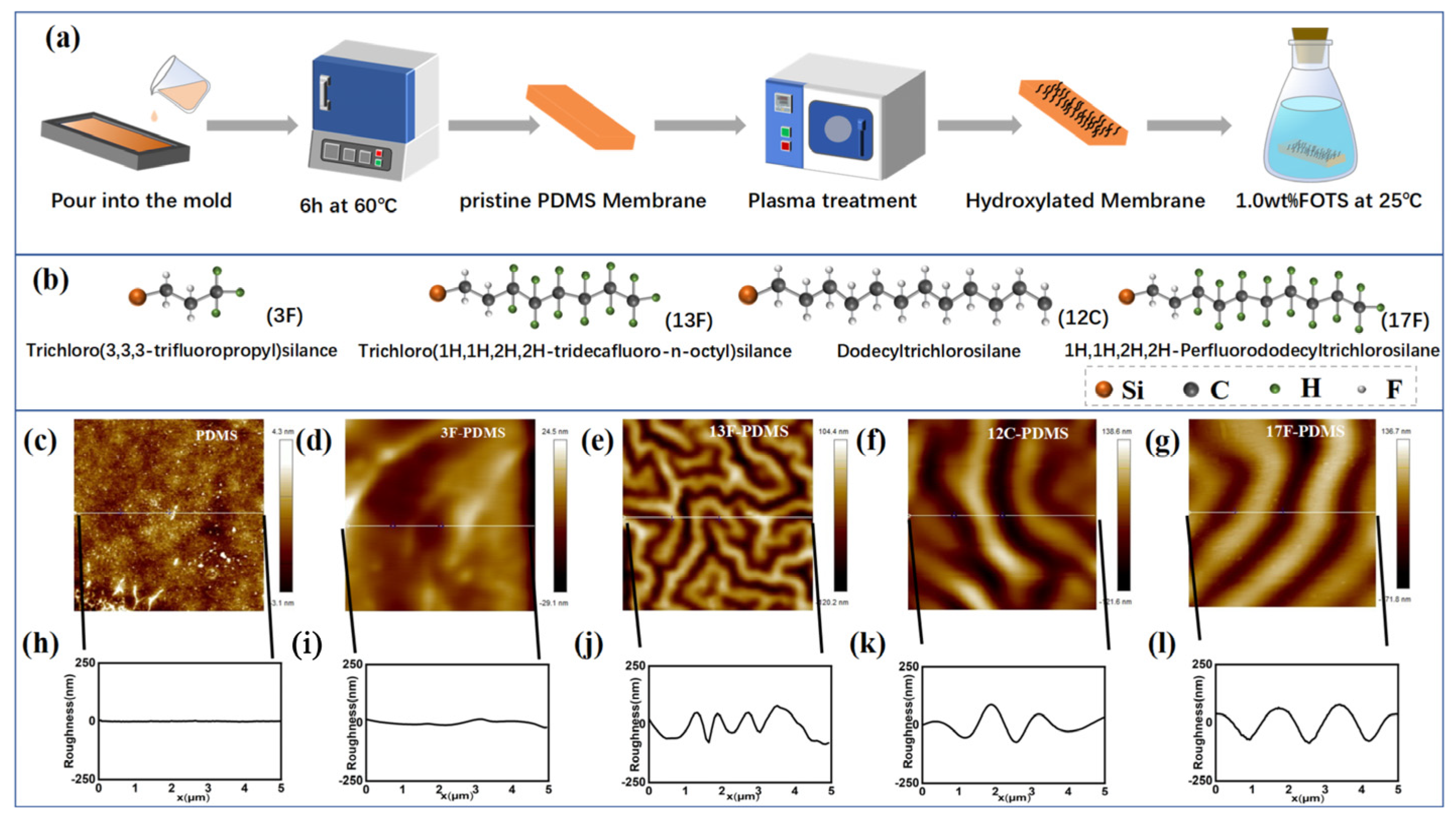
The fabrication process flow for the four types of self-assembled PDMS films is illustrated in
Figure 1a, and schematic diagrams of the molecular chains of the four chemical agents are shown in
Figure 1b. Detailed fabrication procedures can be found in the Experimental section.
Atomic force microscopy (AFM) characterization was performed on the five prepared PDMS films.
Figure 1c–g presents the AFM images of the five PDMS films, while
Figure 1h–l shows schematic illustrations of the surface roughness profiles for the five PDMS samples. The surface of the non-fluorinated PDMS film was relatively smooth with low roughness. In contrast, the PDMS film modified with molecular chains via self-assembly exhibited a micro-nano structure with distinct wrinkles, while maintaining overall uniformity.
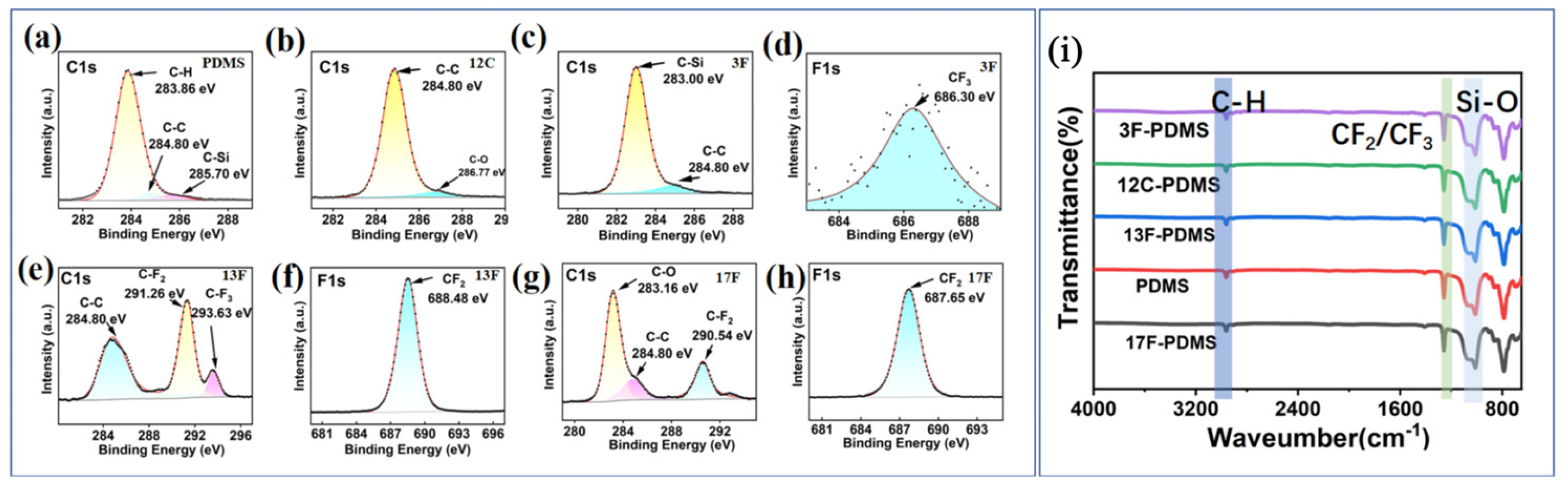
To elucidate the chemical bonding information on the surfaces of the five self-assembled PDMS films, high-resolution C1s and F1s XPS surface characterization analyses were conducted. As shown in
Figure 2a, the C1s spectrum of the non-fluorinated PDMS revealed three characteristic peaks: the C-H bond at 283.86 eV, the C-C bond at 284.80 eV, and the C-Si bond at 285.70 eV.
Figure 2b shows that the C1s spectrum of 12C-PDMS exhibited two characteristic peaks: the C-C bond at 284.80 eV and the C-O bond at 286.77 eV. The presence of the C-O bond may result from the plasma treatment applied to the sample.
Figure 2c,d presents the C1s and F1s spectra of 3F-PDMS. The characteristic peak for the CF
3 bond appearing at 686.30 eV in the F1s spectrum indicates the successful attachment of fluorosilane molecular chains to the PDMS film surface [
29].
Figure 2e,f shows the C1s and F1s spectra of 13F-PDMS. In the C1s spectrum, two characteristic peaks appeared at 291.26 eV and 293.63 eV, corresponding to the CF
2 and CF
3 bonds, respectively. Concurrently, the characteristic peak at 688.48 eV in the F1s spectrum was attributed to the CF
2 bond. The presence of CF
2/CF
3 bonds confirms the successful introduction of fluorosilane molecular chains onto the 13F-PDMS surface.
Figure 2g,h displays the C1s and F1s spectra of 17F-PDMS. Similar characteristic features were observable in these spectra, with the characteristic peaks at 290.54 eV in the C1s spectrum and at 687.65 eV in the F1s spectrum both assigned to CF
2 bonds. The above XPS data collectively indicate the successful grafting of fluorosilane molecular chains onto the PDMS surface.
The chemical bonding characteristics of the samples were further validated using Fourier transform infrared (FTIR) spectroscopy. As illustrated in
Figure 2i, the five PDMS films exhibited several characteristic absorption peaks: the peak at 1042 cm
−1 was attributed to the asymmetric stretching vibration of the Si-O-Si bond; the characteristic peak at 1256 cm
−1 corresponded to the stretching vibration of the C-F bond in organofluorine compounds; and the absorption band observed at 2959 cm
−1 can be ascribed to the symmetric stretching vibration of C-H bonds [
30]. The FTIR results confirm that the different fluorinated molecular chains have successfully bonded to the PDMS.
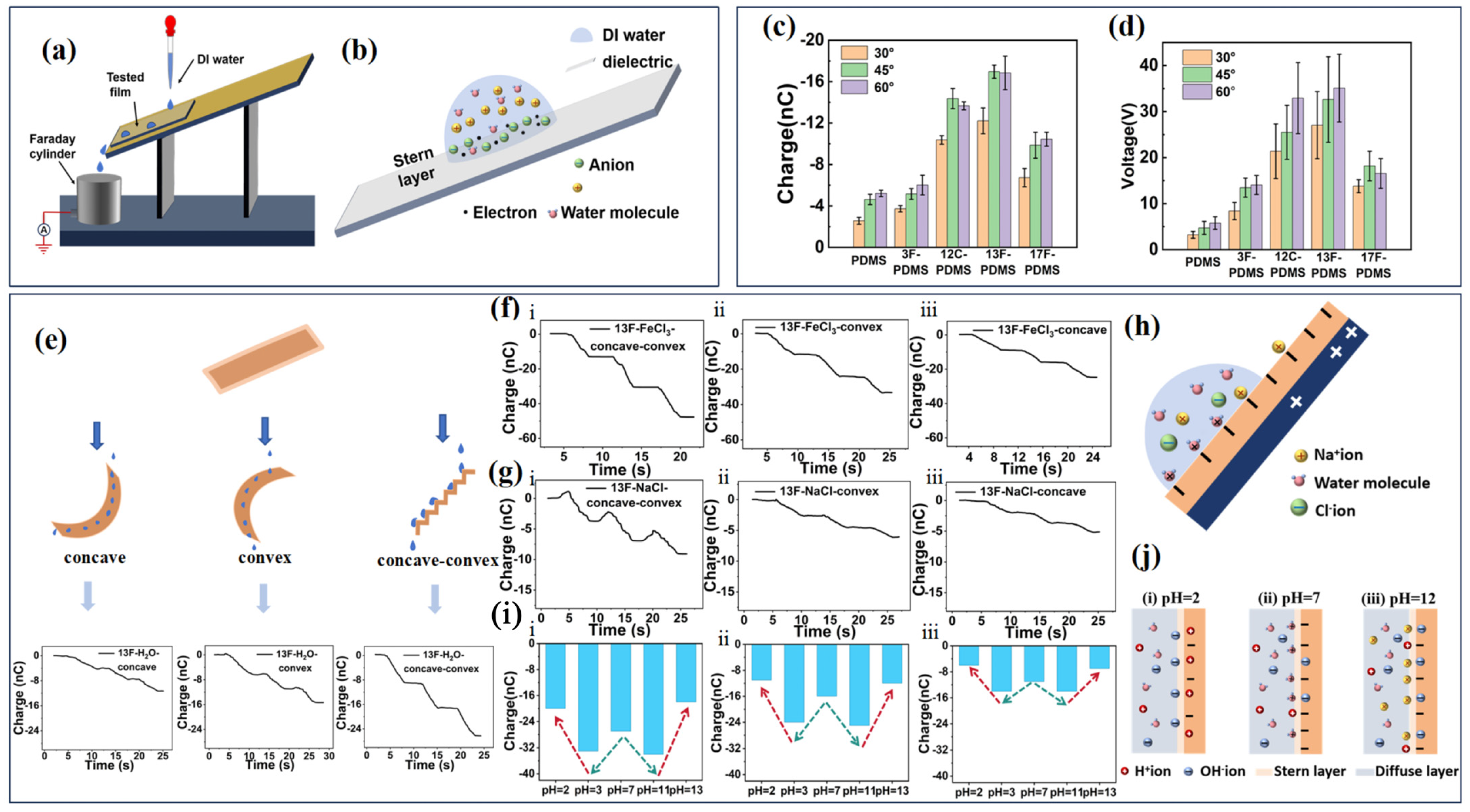
To evaluate the electrification performance of the five different PDMS films, an electrical signal measurement system was constructed, as shown in
Figure 3a [
31]. The test PDMS film (20 mm × 50 mm) was fixed onto a plate with adjustable inclination. A rubber-bulb dropper was positioned above the film to dispense 2 mL of deionized water per droplet. A Faraday cup was placed directly beneath the film to collect the water after it flowed over the film surface. The triboelectric charge carried by the droplet was measured as it fell into the Faraday cup. According to the electric double layer (EDL) model illustrated in
Figure 3b, the Stern layer is tightly adsorbed onto the test film, indicating that the triboelectric charge is associated with the diffuse layer retained within the droplet. Therefore, the internal triboelectric charge of the liquid and the surface potential can be used to indicate the charge density on the test film.
Using the aforementioned test system, measurements were conducted on the five PDMS films at inclination angles of 30°, 45°, and 60°. The results showed that the electrical signals of the fluorinated PDMS films were enhanced to varying degrees. This improvement is primarily attributed to the ordered surface structure providing more contact sites with water molecules, thereby enhancing the electrical signal. Furthermore, the presence of fluorine in the functional groups—an element with strong electronegativity—enables the generation of more negative charges on the friction layer surface after contact with water, leading to superior electrification performance. Among them, the 13F-PDMS film exhibited the best electrification performance, with its charge transfer amount enhanced by 2.7 times compared to the untreated PDMS film. Additionally, the signal intensity generally increased with a larger inclination angle across the three tested angles, mainly because a steeper angle results in a higher relative velocity of the droplet over the film surface.
To further investigate the influence of film morphology on electrification performance, the surface of the 13F-PDMS film (which showed the best performance) was modified from flat to three different types: concave, convex, and concave-convex, thereby increasing the contact area between the droplet and the film. The electrification performance of these three morphologies was tested using the same system. The results, shown in
Figure 3e, indicate that while the concave-convex morphology performed best among the three modified types, all yielded lower signals than the flat 13F-PDMS. This is primarily because although the contact area increased, the droplet flow velocity decreased, with the uneven morphology having the least impact on slowing the droplet [
32,
33,
34].
Subsequently, to study the effect of different ion concentrations on electrification performance, deionized water was replaced with a 1.69 mol/L FeCl
3 solution and a saturated NaCl solution. The electrical signals for the three 13F-PDMS morphologies in these solutions are shown in
Figure 3f,g, respectively. In the 1.69 mol/L FeCl
3 solution, the electrification performance of all three morphologies increased to varying degrees. This is because the increased ion concentration in the solution enhances its conductivity, reduces the solution resistance (R_W), and thereby significantly accelerates electron transfer in the external circuit. Conversely, in the saturated NaCl solution, the performance of all three morphologies decreased. High NaCl concentration can also suppress electrical output, as a large number of Na+ ions can screen the local surface negative charges on the 13F-PDMS, forming an interfacial screening effect as illustrated in
Figure 3i, leading to a reduction in effective surface charge density.
Furthermore, during testing of the 13F-PDMS, pure water (pH 7), acidic (HCl) solutions (pH 2 and 3), and sodium hydroxide (NaOH) solutions (pH 11 and 12) were used to assess the impact of pH on output performance. At pH 3 or 11, the electrical signals for all three 13F-PDMS morphologies increased. This is primarily attributed to the appropriate increase in ion concentration lowering the liquid’s resistance, as mentioned earlier. Additionally, 13F-PDMS tends to adsorb hydroxyl ions (OH-) from water, as shown in
Figure 3j(iii), which contributes significantly to charge storage. However, under strong acid and strong alkaline conditions (pH2, pH12), the performance dropped sharply, even below that at pH 7. In alkaline environments, as pH increases, the concentration of Na+ ions also rises, thereby enhancing the screening effect and inhibiting electron transfer. In strongly acidic environments, a high concentration of H
+ ions not only suppresses electron transfer to reduce output, but also adsorbs onto the 13F-PDMS surface, causing a reversal of surface potential, as depicted in
Figure 3j(i).
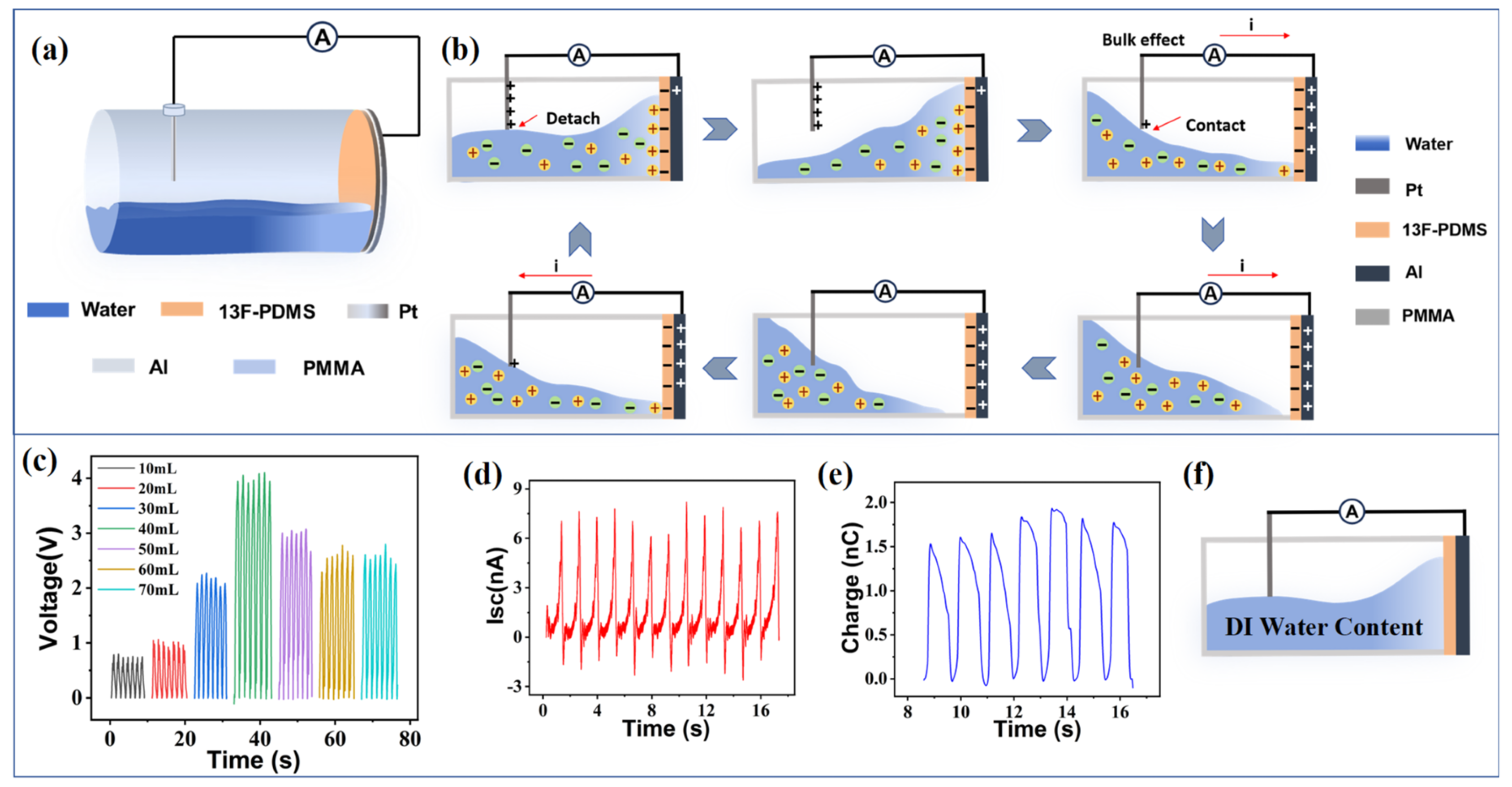
Based on the aforementioned research, we designed a tubular solid–liquid triboelectric nanogenerator (TEB-TENG) utilizing 13F-PDMS as the solid material, as shown in
Figure 4a. A 13F-PDMS film was cut into a circular shape with a diameter of 4 cm and attached at the back to an aluminum (Al) electrode. A platinum (Pt) electrode with a length of 2 cm was vertically inserted into a 12-cm-long, 4-cm-diameter PMMA tube, positioned at a distance of 8 cm from the film surface. Contact between the Pt electrode and the liquid completes a closed circuit. This design induces a volumetric effect, as the attached (Pt) electrode periodically contacts and separates from the liquid during the device’s swinging motion. Furthermore, the enclosed tubular structure effectively prevents liquid contamination.
After finalizing the device structure, we conducted experiments to investigate the influence of varying liquid volume on the electrification signal. The TEB-TENG was operated at a 45° inclination with a periodic motion frequency of 0.75 Hz, using deionized water as the liquid medium. To accurately simulate the reciprocating motion of beam-pumping units, the displacement amplitude of the periodic motion was quantified as 50 mm, the acceleration was measured as 0.89 m/s
2, and the mechanical energy input per cycle was calculated to be 0.013 J. The liquid volume was incrementally increased by 10 mL from an initial 10 mL. The voltage output is shown in
Figure 4c. Experiments revealed that the optimal electrification performance was achieved at a liquid volume of 40 mL. This is determined by the working principle of the solid–liquid TENG. We define the moment when the liquid and the Pt electrode become separated as t1, and the moment when they re-establish contact as t2. Between t1 and t2, with the electrode separated from the water, the overall circuit is open. The change in the contact area between the 13F-PDMS and water during this interval creates a potential difference between the 13F-PDMS and its back electrode. A greater difference in the water-13F-PDMS contact area between t1 and t2 results in a larger potential difference, leading to a stronger instantaneous current upon re-contact at t2. A detailed working principle schematic is provided in
Figure 4b.
Figure 4d,e shows the output current and transferred charge during operation with 40 mL of deionized water.
Figure 4f is a schematic diagram of the device during operation. A single device achieved an output current of up to 8.5 nA and a transferred charge of 2 nC in deionized water. Its electrification performance can be further enhanced by increasing the ion concentration in the liquid or by connecting multiple devices in series.
After establishing the fundamental working principle, we further investigated the influence of different device dimensions on the electrical signal output. The diameter of the device was varied—reduced to 2 cm and increased to 8 cm—while maintaining the same operational mode and using deionized water as the liquid medium. The corresponding electrical signals are shown in
Figure S1. The experiments revealed that reducing the diameter leads to an overall decrease in output performance. This is primarily attributed to the reduced contact area between the water and the 13F-PDMS film in smaller diameters, resulting in a smaller accumulated potential difference during the circuit-open period. Conversely, increasing the diameter enlarges the water-13F-PDMS contact area and thus increases the accumulated potential difference. However, while the spatial footprint quadruples when the diameter increases from 4 cm to 8 cm, the enhancement in electrical signal is limited and far from quadruple. Therefore, under the constraint of a similar spatial footprint, we considered connecting multiple devices in series.
Consequently, we replaced the deionized water with the aforementioned 1.69 mol/L FeCl
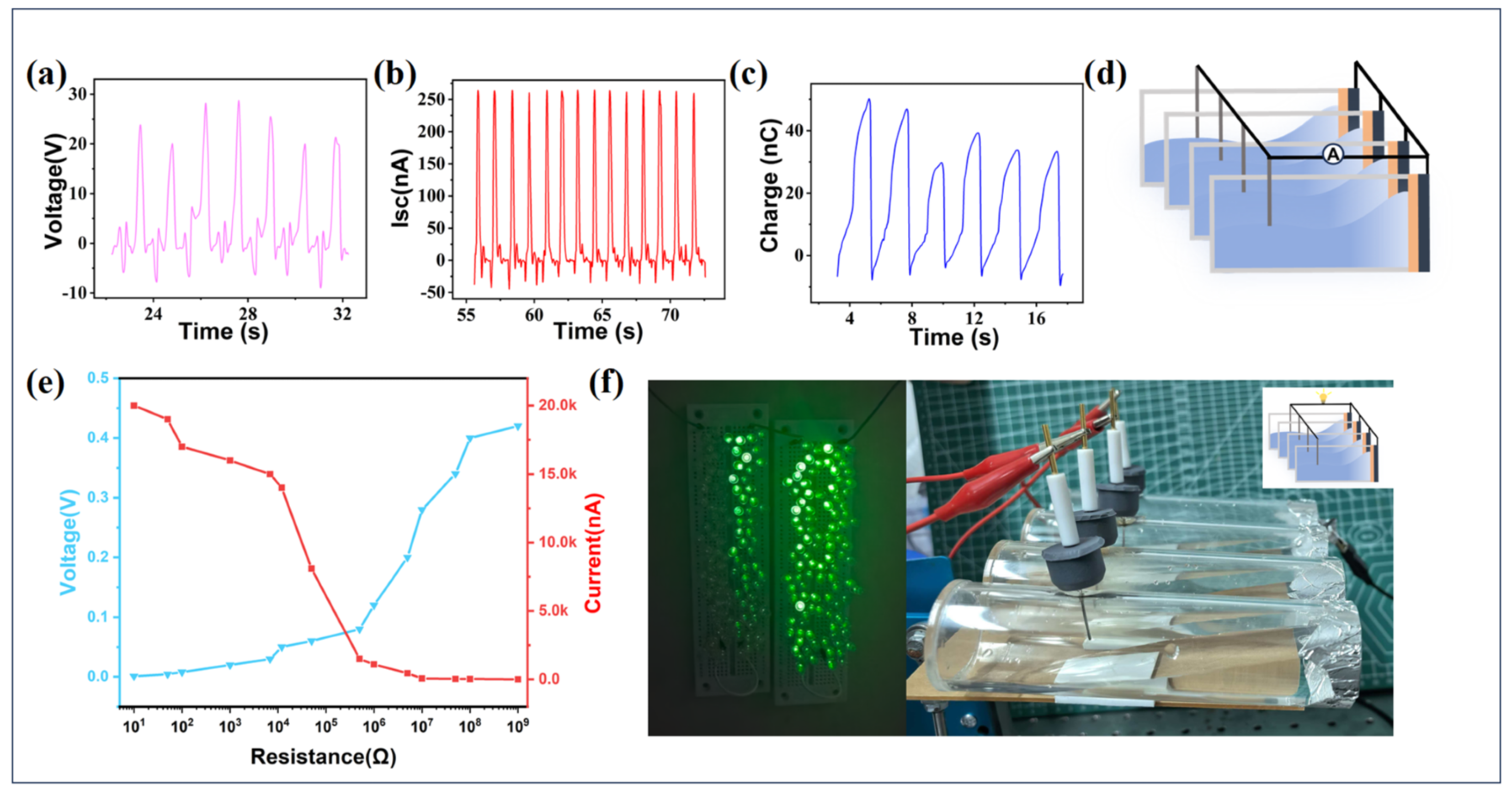
3 aqueous solution and connected four TEB-TENG units, each with a 4 cm diameter, in series, as shown in
Figure 5d. The electrical output performance is presented in
Figure 5a–c. The open-circuit voltage and short-circuit current reached 29 V and 263 nA, respectively, with a transferred charge of 10 nC per motion cycle. The charge density was calculated to be 0.796 nC/cm
2.
The output current and voltage of the four series-connected TBE-TENGs under different load resistances were measured in the 1.69 mol/L FeCl
3 solution, as shown in
Figure 5e. As the load resistance increased from 10 Ω to 109Ω, the output current decreased from 21 μA to 0.003 μA. The maximum output power of the four series-connected TEB-TENGs reached 2.49 mW at a load resistance of 250 kΩ, corresponding to a power density of 49.52 mW/cm
2.
Figure 5f shows a photograph of the setup successfully powering 150 LED bulbs during the operation of the four TBE-TENGs. Additionally, the energy conversion efficiency was calculated to be 19.15%. Furthermore, the device could still maintain a stable current output under long-term operation mode, as shown in
Figure S2.