1. Introduction
Proton exchange membrane fuel cells (PEMFCs), characterized by high efficiency, zero emissions, and low noise [
1], are regarded as a key technology in clean energy systems and have demonstrated broad application prospects in transportation, portable power supplies, and distributed generation [
2]. However, durability degradation remains a critical bottleneck restricting their large-scale commercialization [
3]. Therefore, developing accurate degradation trend prediction models capable of describing future trajectory evolution and uncertainty is of significant theoretical and practical importance for optimizing operation strategies, reducing maintenance costs, and extending service life [
4].
Existing PEMFC degradation prediction approaches can generally be classified into three categories: mechanism-based models [
5], data-driven models [
6], and hybrid models [
7]. Mechanism-based models establish mathematical representations based on electrochemical reactions, heat and mass transfer, and material aging mechanisms [
8]. Although they provide strong physical interpretability, parameter identification becomes challenging under multi-physics coupling and dynamic load conditions, leading to limited generalization capability.
Data-driven approaches extract hidden degradation patterns directly from large volumes of operational data. Representative techniques include Echo State Networks (ESN) [
9], Relevance Vector Machines (RVM) [
10], and deep learning models such as Convolutional Neural Networks (CNN) [
11], Long Short-Term Memory networks (LSTM) [
12], and Gated Recurrent Units (GRU) [
13]. Previous studies have demonstrated that data-driven methods can achieve high prediction accuracy under both steady and dynamic operating conditions. For example, recent studies have applied deep learning techniques for state-of-health estimation of PEMFC systems under dynamic operating conditions, demonstrating strong capability in capturing nonlinear degradation patterns from operational data [
14]. For instance, Wang et al. [
15] proposed a WTD-RS-LSTM framework that effectively captured nonlinear aging features of PEMFC data, while Hua et al. [
16] developed PSO-LSTM and ENSACO-LSTM models for accurate degradation trend prediction. Nevertheless, the “black-box” nature of these models weakens interpretability and limits their ability to explicitly reveal the relationship between key influencing factors and degradation mechanisms.
To balance prediction accuracy and physical interpretability, hybrid modeling strategies have been introduced. Reference [
17] proposed a PEMFC degradation prediction method combining Deep Belief Networks (DBN) and Extreme Learning Machines (ELM). Liu et al. [
18] integrated degradation mechanisms with machine learning to improve long-term performance prediction, while Gao et al. [
19] employed Group Method of Data Handling (GMDH) with wavelet analysis for lifetime estimation. In addition, a LASSO-ESN-based framework was reported in [
20], where LASSO was used to evaluate feature contributions and iteratively update inputs for trend prediction. Although hybrid models often enhance predictive performance, they substantially increase structural and computational complexity, which may hinder online deployment and real-time applications.
Despite these advances, several important limitations remain in existing PEMFC degradation prediction studies. First, most studies focus on point prediction of RUL or End-of-Life (EOL), while neglecting future trajectory morphology and probabilistic interval outputs, which are essential for uncertainty assessment in engineering practice. Second, under dynamic loads and start-stop disturbances, PEMFC voltage sequences typically exhibit composite behavior consisting of long-term gradual degradation and short-term abrupt fluctuations. It should be noted that such abrupt voltage variations may originate from two mechanisms: irreversible degradation jumps and reversible recovery phenomena caused by transient electrochemical relaxation processes. Recent studies have reported that voltage recovery may occur following transient disturbances due to water redistribution and catalyst surface state changes within the fuel cell stack [
21].
However, existing prediction methods rarely address the joint modeling of long-range dependency and mutation behavior under dynamic operating conditions. Conventional short-memory Gaussian models, such as Wiener processes [
22] and ARIMA [
23], struggle to simultaneously characterize long-range dependence and stochastic jump behaviors. Recent research indicates that fractional stochastic processes possess advantages in modeling long-range correlation and non-stationary degradation. fBm [
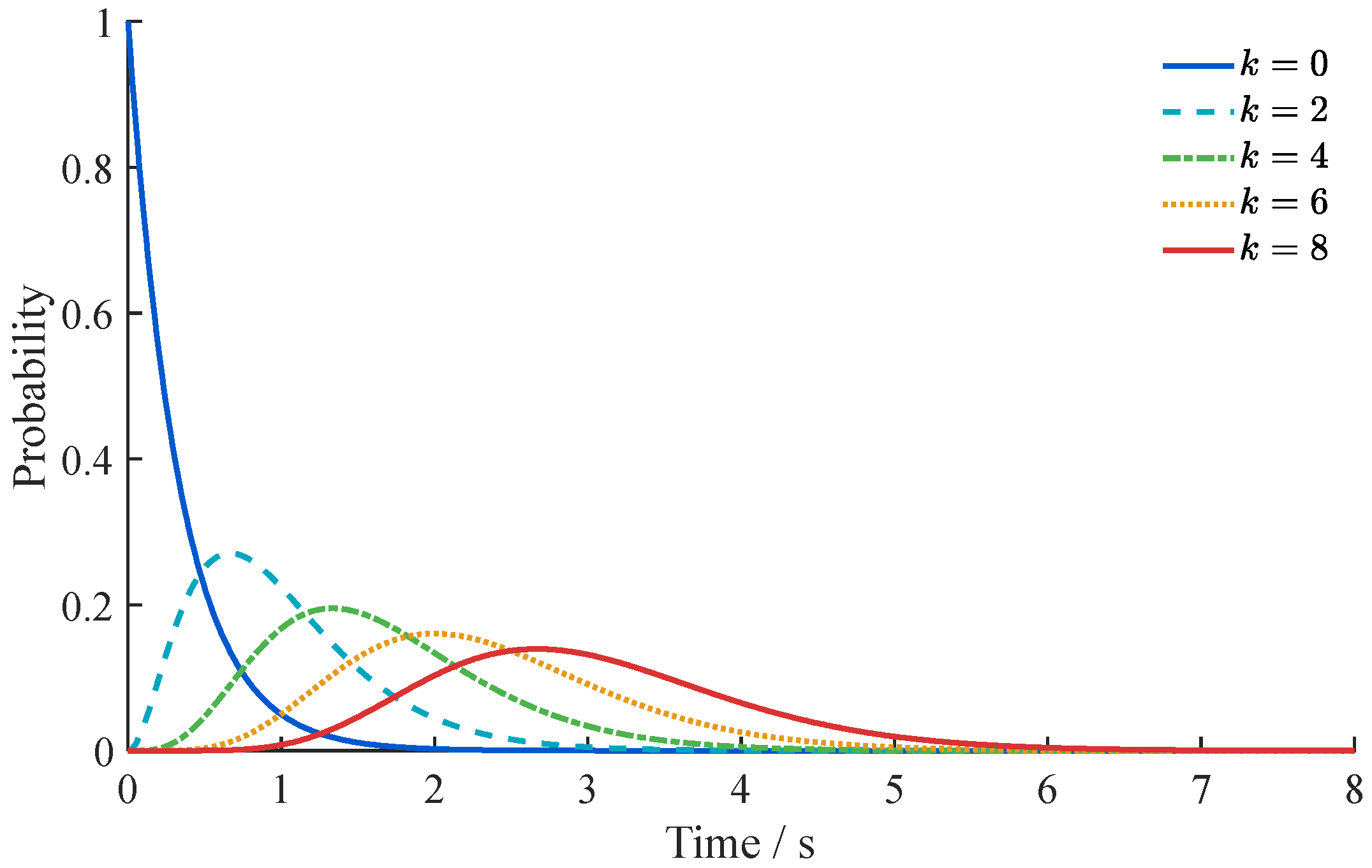
24] describes persistent memory through the Hurst exponent, while the fPp captures sparse shocks and non-exponential waiting times via the Mittag-Leffler distribution [
25]. Nevertheless, the integration of long-memory stochastic processes with interpretable feature analysis for PEMFC degradation prediction under dynamic operating conditions remains insufficiently explored. Tang et al. [
26] have explored hybrid mechanism-data-driven modeling strategies for long-term degradation prediction under dynamic conditions, demonstrating improved predictive performance. However, these approaches often rely on complex architectures and lack explicit interpretability.
To address these challenges, this study proposes a SHAP-driven mechanism-data fusion fractional stochastic degradation modeling framework for PEMFC degradation trend prediction. The proposed approach integrates fBm to characterize long-range dependence and a fPp to model stochastic mutation behaviors, enabling unified modeling of continuous degradation trends and abrupt disturbances in voltage sequences. Furthermore, SHAP-based feature attribution is incorporated to identify dominant influencing factors and enhance the interpretability of the degradation prediction model.
The main contributions are summarized as follows:
- (1)
Mechanism-data fusion modeling: A terminal voltage mechanism model considering activation, ohmic, and concentration polarization losses is constructed, and SHAP is introduced to quantify multi-source feature contributions and identify dominant factors.
- (2)
Long-memory and jump characteristic identification: SHAP analysis combined with Hurst exponent testing verifies that PEMFC degradation sequences exhibit both significant long-range dependence and load-induced jump behaviors.
- (3)
Fractional fBm-fPp degradation model: fBm and fractional Poisson jumps are integrated to jointly characterize continuous attenuation and discrete abrupt variations, with a discrete solution scheme provided.
- (4)
Multi-step probabilistic prediction framework: A unified output mechanism of mean trajectory, confidence intervals, and probability density functions is established to simultaneously predict degradation trends and uncertainties.
- (5)
Multi-condition validation: Comparative experiments on both steady (FC1) and dynamic (FC2) datasets demonstrate that the proposed model outperforms fBm, Wiener, and CNN-LSTM methods in multi-step prediction accuracy and stability.
Based on the above motivation, the electrochemical mechanism analysis and degradation feature identification are first presented to support the construction of the proposed fractional stochastic degradation model.
The remainder of this paper is organized as follows.
Section 2 introduces the PEMFC electrochemical mechanism, polarization loss modeling, and degradation feature analysis, followed by SHAP-based feature contribution analysis and long-range dependence testing.
Section 3 presents the fractional long-range degradation modeling and parameter estimation methods.
Section 4 conducts multi-step degradation trend prediction and comparative experiments based on the public FCLAB dataset.
Section 5 concludes the study and outlines future research directions.
2. PEMFC Degradation Modeling and Feature Analysis
2.1. Overall Prediction Framework and Data Source
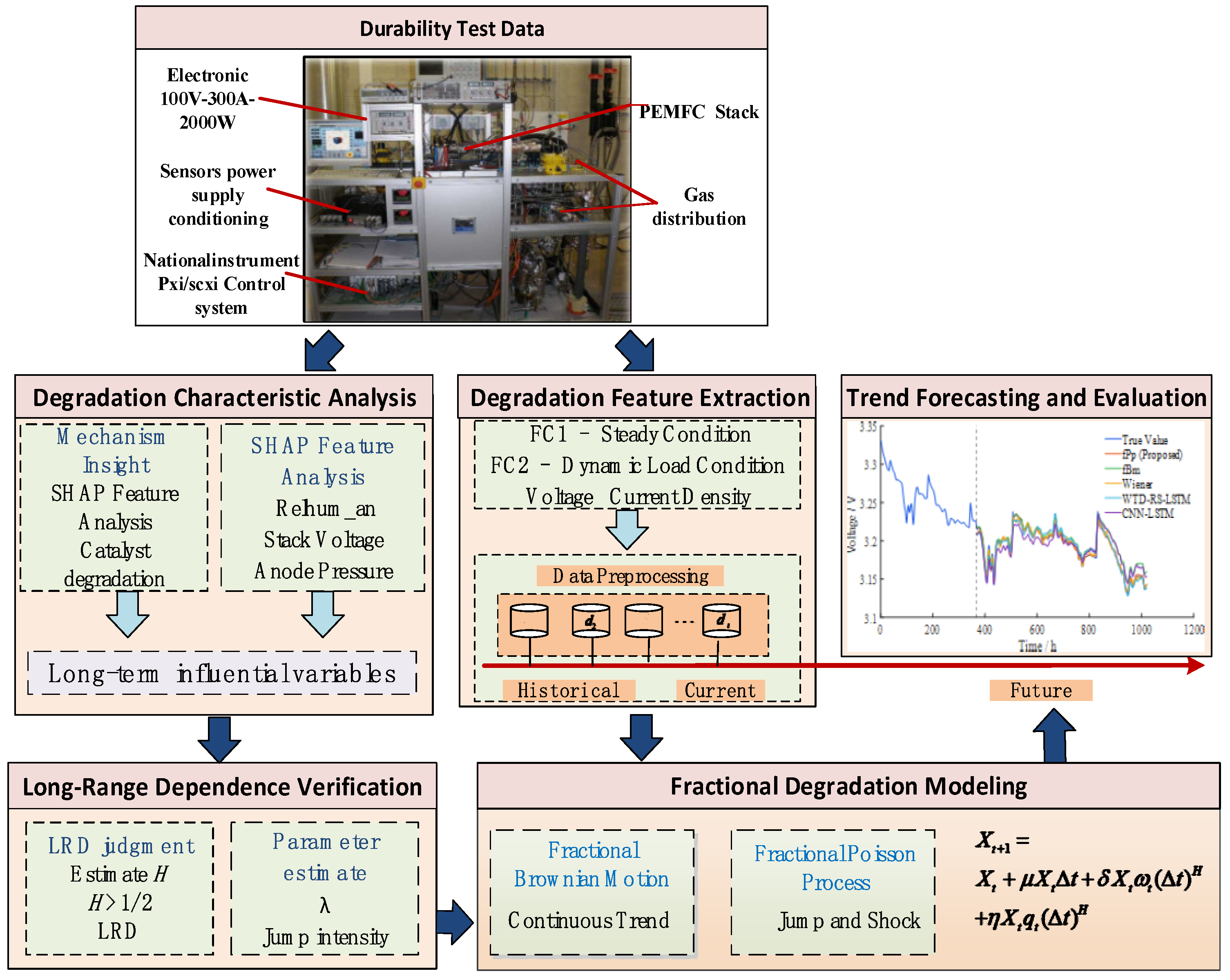
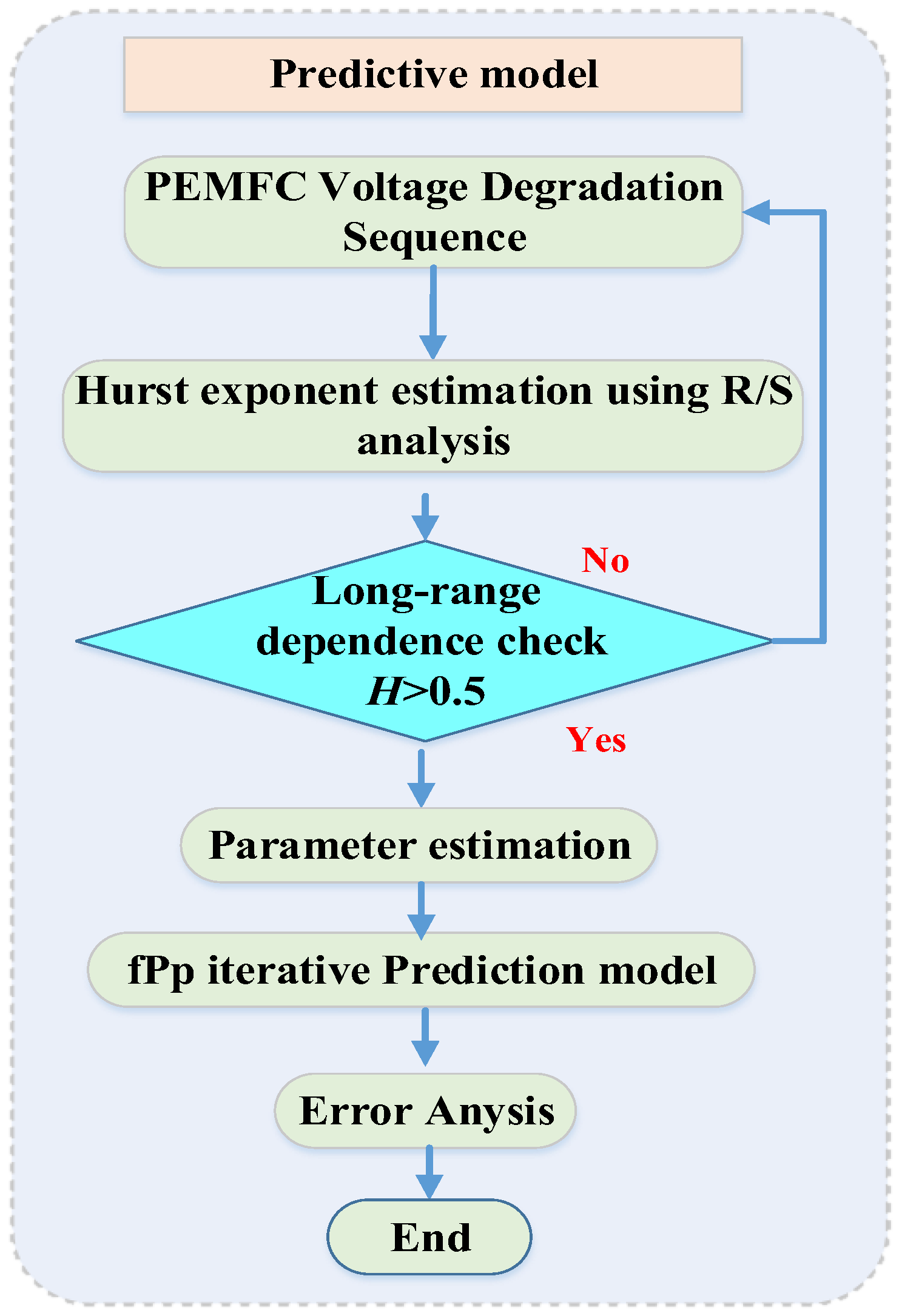
The overall methodological framework of this study is illustrated in
Figure 1. First, the voltage degradation mechanism of PEMFCs is described based on a polarization loss model, and multi-source degradation datasets are constructed by integrating durability data under both steady and dynamic load conditions. The SHAP method is then employed to quantify the long-term contributions of key variables to voltage attenuation. Subsequently, the Hurst exponent and jump intensity analysis are applied to identify the long-memory dependence and abrupt variation characteristics of the voltage sequence. On this basis, a fractional degradation model that integrates fBm and a fPp is established to jointly characterize continuous degradation and discrete shock behaviors. Finally, multi-step trajectory prediction and comparative evaluations are conducted to verify the predictive accuracy and interpretability of the proposed model under both steady and dynamic operating conditions.
The framework therefore combines degradation mechanism analysis with fractional stochastic modeling, enabling the model to capture both the physical degradation characteristics and the long-range statistical dependence of PEMFC voltage decay.
The experimental data used in this study are obtained from the publicly available aging dataset provided by the French Fuel Cell Laboratory (FCLAB) [
27]. The test platform consists of five single cells connected in series, each with an effective active area of 100 cm
2. During the experiments, the current density ranges from 0.70 to 21.0 A·cm
−2. The dataset contains two representative operating conditions: FC1, a steady constant-current condition used to analyze smooth degradation trends, and FC2, a dynamic load condition designed to capture abrupt degradation behaviors induced by start–stop events and load fluctuations.
2.2. Polarization Loss Mechanism Model of PEMFC
To establish the physical basis for degradation trend prediction, the output voltage of the PEMFC is modeled according to the polarization loss mechanism. The steady-state stack output voltage can be expressed as [
28]:
where
E denotes the Nernst voltage,
,
and
represent the ohmic, concentration, and activation polarization voltages, respectively. The Nernst voltage is determined by the reactant partial pressures and operating temperature of the fuel cell.
Based on the classical semi-empirical PEMFC voltage model derived from the Nernst equation under standard reference conditions (298.15 K and 1 atm), the reversible voltage and temperature correction terms can be expressed as follows [
29]:
The activation polarization reflects the kinetic limitation of the electrode reaction and can be expressed as [
30]:
The ohmic polarization is caused by the membrane resistance and contact resistance:
The concentration polarization describes the mass-transfer limitation effect [
31]:
In these expressions, (K) denotes the stack operating temperature, and represent the hydrogen and oxygen partial pressures at the anode and cathode, respectively (bar). R is the universal gas constant (8.314 J·mol−1·K−1), and F is the Faraday constant (96,485 C·mol−1). is the charge transfer coefficient (dimensionless). (A·cm−2) is the operating current density. (A·cm−2) is the exchange current density, (A·cm−2) is the crossover current density, m (V) and n (A·cm−2) are empirical coefficients associated with the concentration polarization loss.
Considering that the stack is composed of multiple single cells connected in series, an equivalent single-cell model based on the average output voltage is adopted to reduce random fluctuations caused by cell-to-cell variations, thereby ensuring temporal consistency and identifiability of the mechanism parameters.
To simplify the electrochemical modeling, several assumptions are adopted:
- (1)
The reactant gases are treated as ideal gases;
- (2)
Activation, ohmic, and concentration losses are represented using lumped semi-empirical expressions;
- (3)
The electrochemical process is assumed to be quasi-steady within each sampling interval.
The external operating conditions and fundamental structural parameters of the fuel cell are summarized in
Table 1.
Referring to the study of Chen et al. [
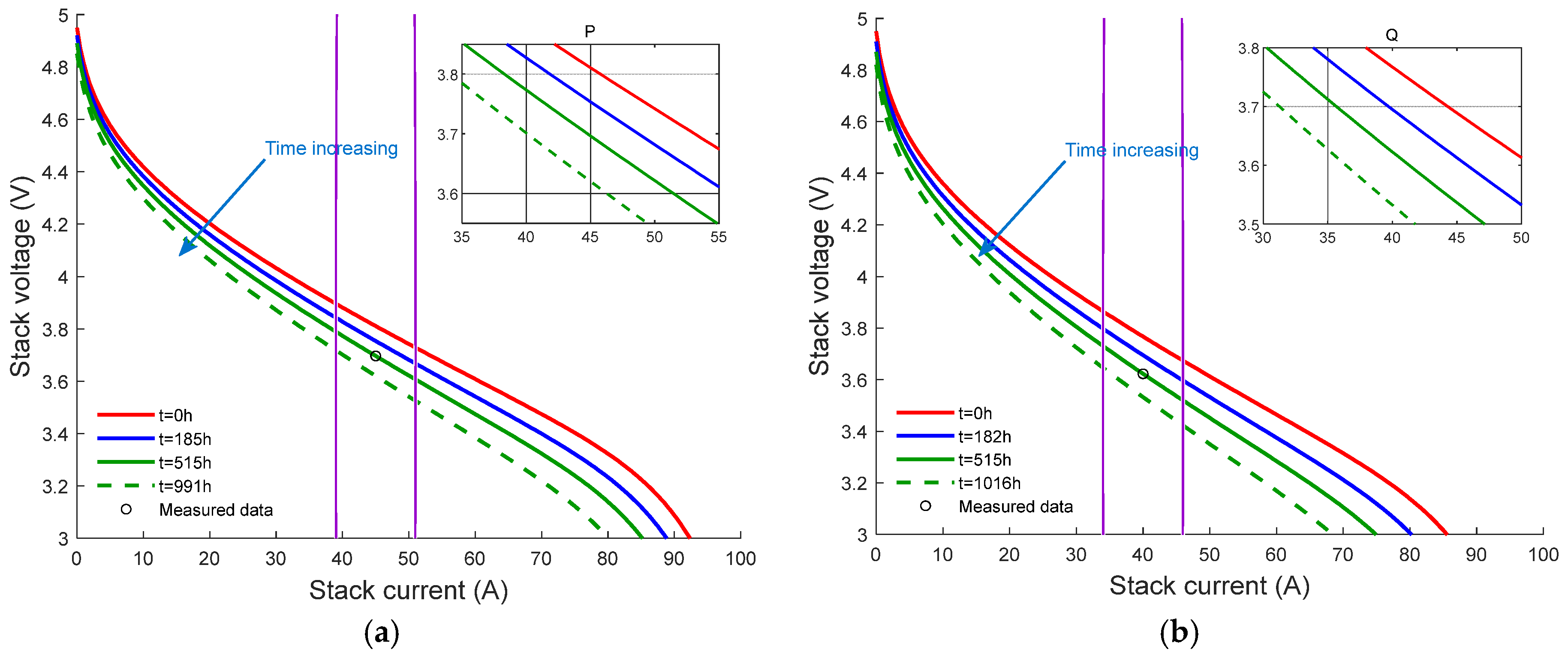
32] on the influence of sampling intervals, a time resolution of 30 min is selected to construct the degradation data sequence. The dataset contains stack output voltages and the corresponding polarization curves at different operating times, as shown in
Figure 2. In this study, the historical voltage denotes the time-series stack voltage measurements recorded during the long-term operation of the PEMFC system. These values are directly obtained from the experimental dataset and are used to construct the degradation sequence for subsequent modeling and prediction.
As shown in
Figure 2, with increasing operating time, the polarization curves under both FC1 and FC2 conditions exhibit an overall downward shift accompanied by a gradual reduction in slope, indicating continuous performance degradation of the stack. This behavior is consistent with the time-varying characteristics of the key parameters in Equations (3)–(5), including the decrease in exchange current density, the increase in equivalent ohmic resistance, and the intensification of mass-transfer limitations. Recent studies have demonstrated that advanced optimization-based parameter estimation techniques can significantly improve convergence accuracy and reduce modeling errors in polarization loss terms under dynamic operating conditions [
33]. This indicates that accurate identification of key parameters such as exchange current density and polarization coefficients is essential for enhancing the robustness and reliability of the PEMFC voltage model.
Compared with the steady-state FC1 condition, the dynamic load condition FC2 presents a larger downward shift and a more pronounced bending in the high-current region, revealing an amplification effect of load fluctuations on the degradation rate. The locally enlarged regions (P and Q zones) further highlight the subtle voltage differences in the medium-load range, with more significant deviations under FC2. This observation indicates that the degradation process exhibits both persistence and accumulation characteristics, as well as evident temporal correlation. Such evolutionary behavior provides experimental support for the subsequent long-range dependence verification and fractional-order degradation modeling.
2.3. Time-Varying Electrochemical Parameters and Degradation Interpretation
Although the polarization model in
Section 2.2 describes the instantaneous electrochemical behavior of PEMFCs, several parameters involved in polarization losses evolve during long-term operation due to catalyst degradation, membrane aging, and mass-transport deterioration. These parameter variations provide a physical explanation for the voltage attenuation observed in PEMFC systems.
Among these parameters, the exchange current density
i0 plays a key role in activation polarization. Catalyst degradation processes, such as platinum agglomeration and carbon support corrosion, reduce the electrochemical active surface area (ECSA), resulting in a decrease in
i0. The corresponding increase in activation overpotential can be expressed as:
where
i0 and
i0′ denote the initial and degraded exchange current densities, respectively. Meanwhile, membrane aging and interface deterioration increase the equivalent resistance
R ohm, which can be approximated as:
where
R0 denotes the initial ohmic resistance and
kr represents the ohmic degradation coefficient describing the resistance growth rate.
Similarly, degradation of porous transport layers reduces oxygen diffusion capability and intensifies concentration polarization, which can be represented by the gradual increase in the parameter m in Equation (5):
where
m0 is the initial concentration loss coefficient and
km represents the mass-transport degradation coefficient. These time-varying electrochemical parameters jointly lead to the downward shift in the polarization curves observed in
Figure 2 and provide a mechanistic explanation for the progressive voltage degradation of PEMFC systems, which is consistent with recent studies on parameter-evolution-driven degradation mechanisms [
34].
2.4. Key Feature Identification Based on SHAP
To identify the key driving factors influencing the degradation trend of PEMFCs, a regression model based on the Gradient Boosting Tree (GBT) is constructed, and the SHAP (SHapley Additive exPlanations) method [
32] is introduced to quantitatively evaluate the contributions of multi-source operating variables. SHAP is derived from cooperative game theory and measures the impact of each feature on the model output by computing its weighted marginal contribution across all possible feature subsets. It is defined as:
where
denotes the prediction model output,
S represents a feature subset that does not contain feature
, and
ω(
S) is the weighting coefficient used to ensure the fairness of contribution allocation among features.
To enhance the transparency and reproducibility of the SHAP analysis, the feature engineering process and model configuration are explicitly described. The candidate input variables were selected based on their physical relevance to PEMFC electrochemical behavior, including operating conditions and measurable electrochemical indicators related to polarization losses. Catalyst degradation indicators such as ECSA were not included because such measurements are not available in the publicly released FCLAB dataset used in this study.
The SHAP values were computed based on a Gradient Boosting Tree (GBT) regression model. The implementation of SHAP was conducted using the open-source SHAP library (version 0.44), which provides a unified framework for calculating Shapley values for tree-based machine learning models. The detailed feature descriptions and model settings are summarized in
Table 2 and
Table 3.
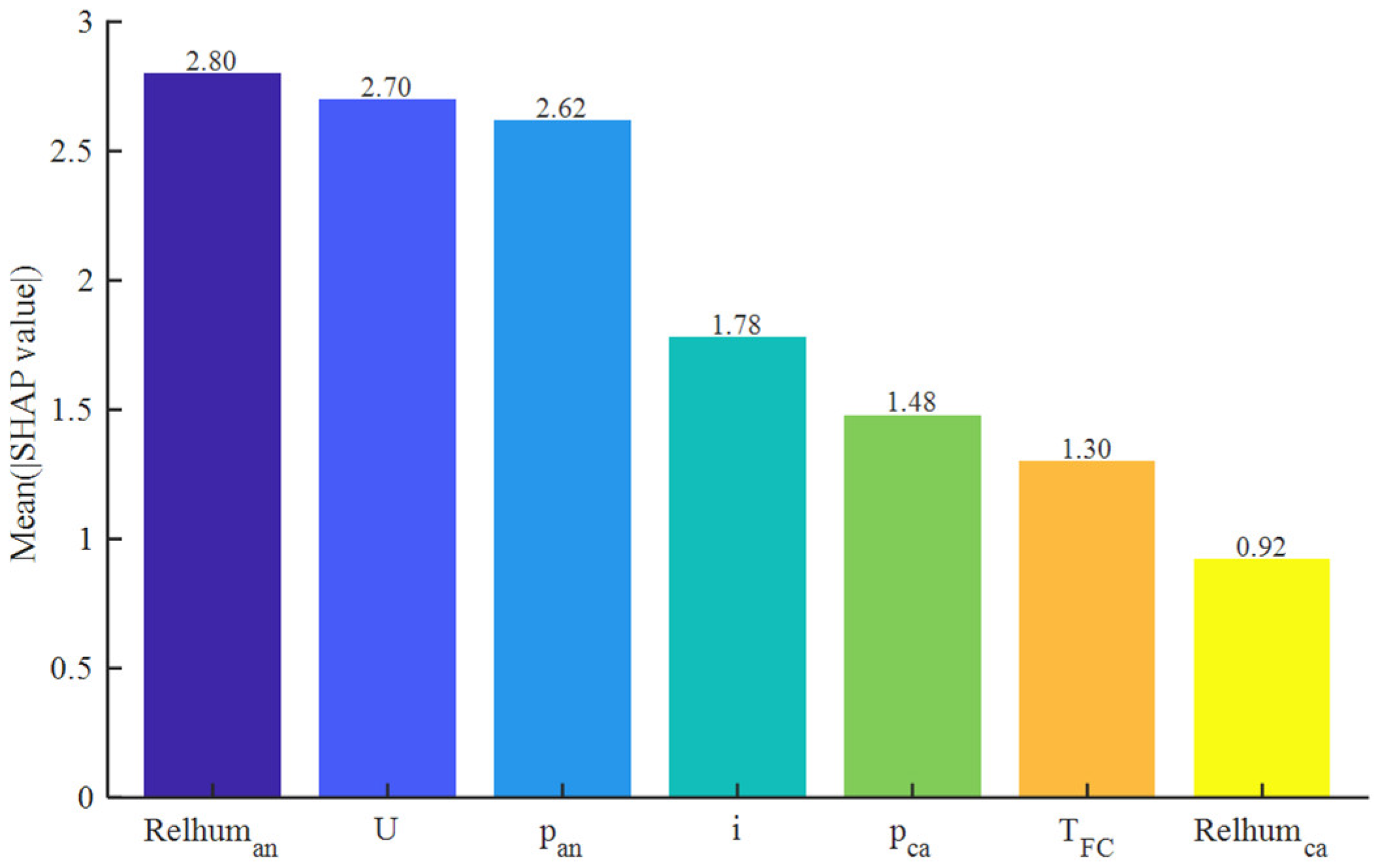
Using the trained GBT model and the SHAP framework, the feature contributions of the selected variables are quantified. The corresponding feature importance ranking is illustrated in
Figure 3. It can be observed that anode relative humidity, historical voltage, and anode pressure exhibit relatively high mean absolute SHAP values, indicating their persistent dominant roles in the voltage degradation process. In contrast, cathode relative humidity shows a relatively smaller contribution among the considered variables. Temperature and reactant partial pressures show comparatively lower contributions and mainly exert stage-dependent influences. However, temperature sensitivity remains a critical factor affecting PEMFC degradation, as temperature variations influence electrochemical reaction kinetics, membrane conductivity, and water management, thereby accelerating degradation under dynamic operating conditions. Incorporating such temperature-adaptive characteristics into the SHAP-based analysis further enhances the physical interpretability of feature contributions, consistent with recent findings in the literature [
35].
Further temporal analysis reveals that the high-contribution features evolve consistently with the voltage degradation trajectory, reflecting pronounced historical dependence and cumulative effects in the degradation process. These findings provide data-driven evidence supporting the time-varying mechanism of polarization parameters and offer a rational basis for the selection of key variables in the subsequent fractional long-range dependence degradation modeling, while strengthening the linkage between data-driven feature importance and underlying electrochemical degradation mechanisms.
2.5. Long-Range Dependence Verification of Degradation Sequences
The Hurst exponent
H is employed to characterize the long-range dependence of the degradation curve. In this study, the rescaled range (
R/
S) analysis is adopted for its estimation, and the calculation procedure is expressed as follows [
36]:
where
Xi denotes the
i-th observation in the sequence, and
is the mean value of the series.
N represents the length of the observation window.
H is the estimated Hurst exponent and
is a constant. The Hurst exponent
H is obtained from the slope of the linear regression between ln(
R(
N)/
S(
N)) and ln(
N). A value of
H > 0.5 indicates persistent long-range correlation,
H = 0.5 implies a random process, and
H < 0.5 suggests anti-persistence.
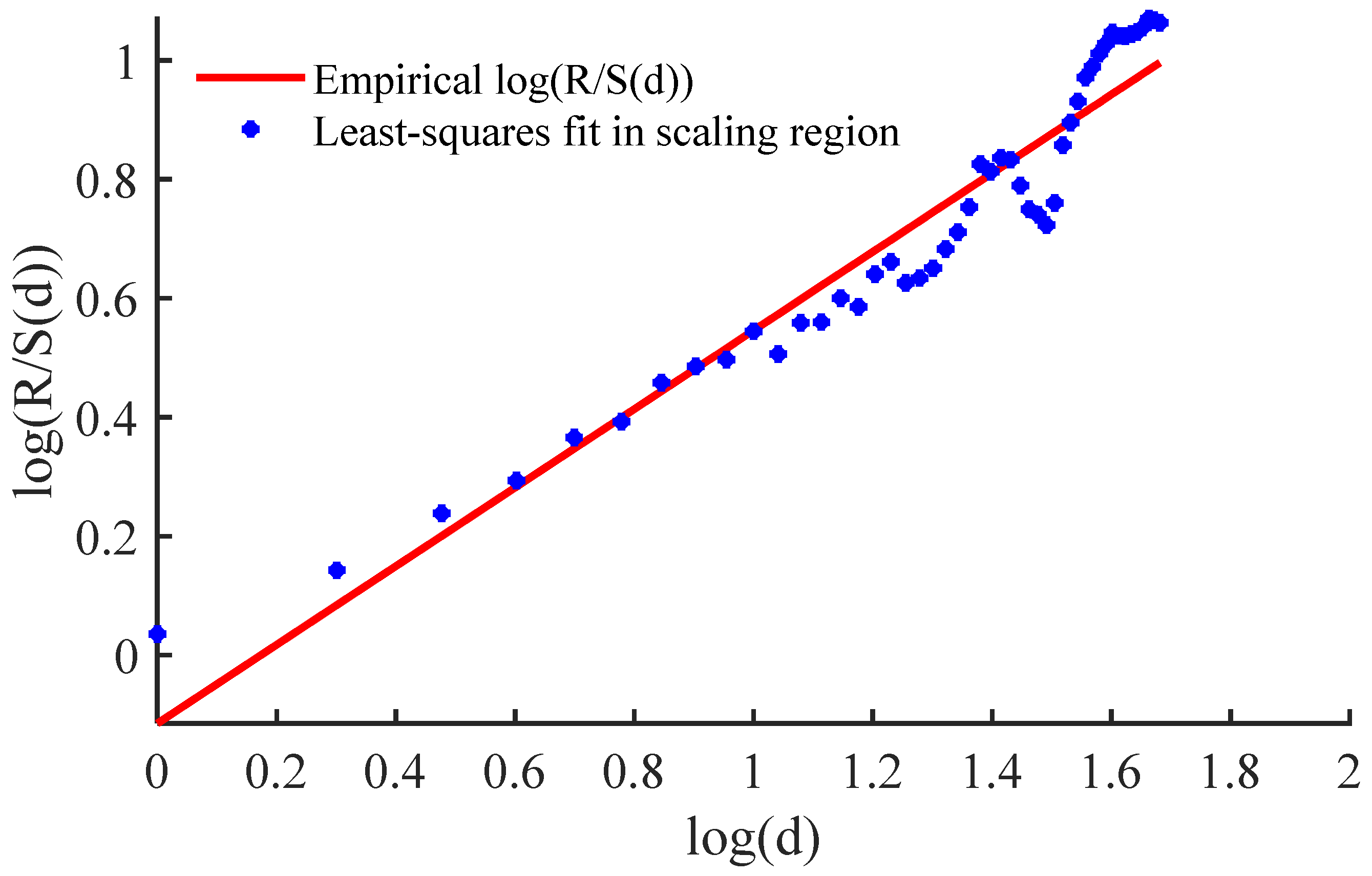
To improve the reliability of the estimation, the degradation sequence is divided into multiple non-overlapping subintervals with different lengths N. The rescaled range values are calculated at multiple time scales, and the Hurst exponent is estimated through linear regression in the log–log coordinate system.
Figure 4 presents the corresponding regression result, where the estimated Hurst exponent is
H = 0.85, indicating strong long-range dependence in the PEMFC degradation sequence.
It should be noted that the FC2 dataset corresponds to dynamic operating conditions where load fluctuations and start–stop disturbances may introduce abrupt voltage variations. These jump-like behaviors may lead to local deviations in the R/S curve. However, the overall scaling relationship between R(N)/S(N) and N remains stable, indicating that the long-range dependence characteristic of the degradation sequence is robust.
To further evaluate the robustness of the estimation, a sensitivity analysis was conducted using different temporal resolutions. The Hurst exponent was calculated under multiple sampling intervals, and detrended fluctuation analysis (DFA) was additionally introduced for comparison. The estimated
H values under different resolutions are summarized in
Table 4.
The results show that the Hurst exponent remains consistently greater than 0.5 across different time resolutions and exhibits good agreement between the R/S and DFA methods, confirming the stability of the long-range dependence property. These findings provide theoretical support for employing fractional stochastic processes to model PEMFC degradation dynamics.
2.6. Identification of Operating Condition Shocks and Jump Characteristics
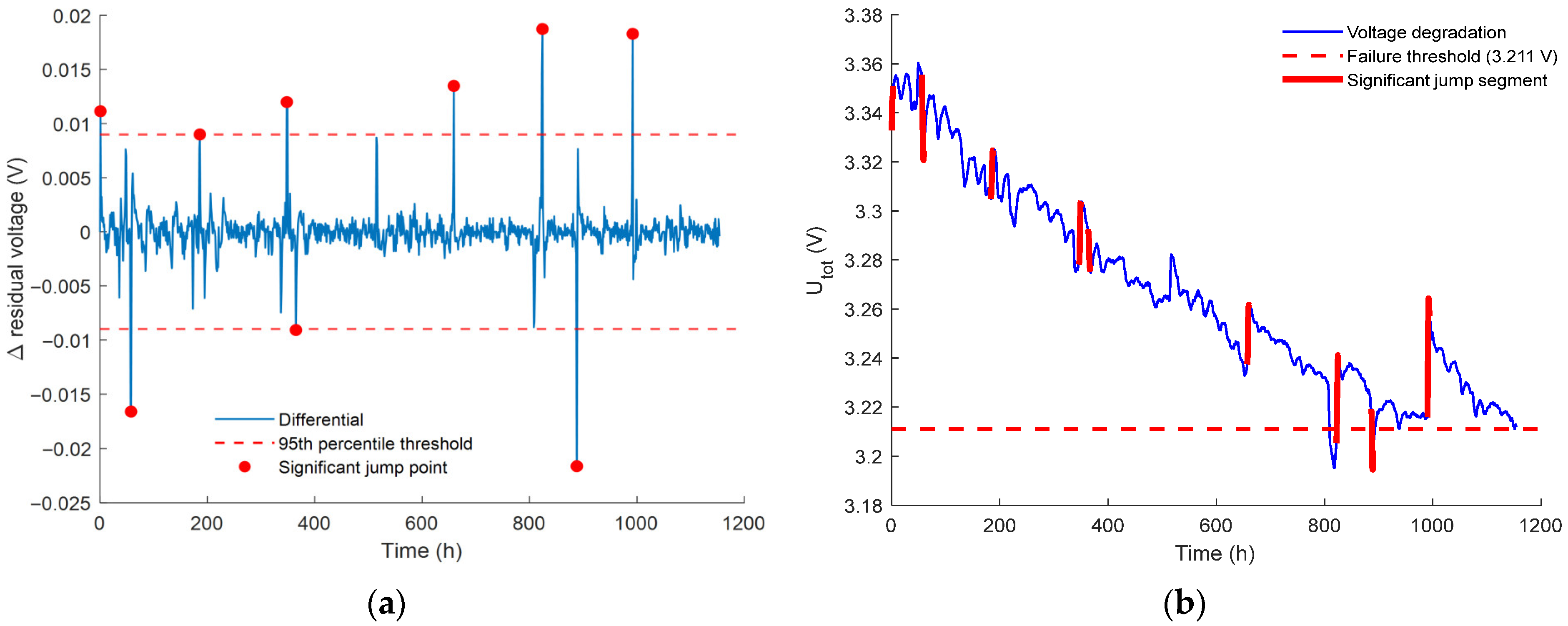
To detect abrupt variations in the degradation sequence, a quantile-based criterion is employed to identify jump events. Prior to statistical analysis, the voltage degradation sequence is detrended to remove the long-term trend component, thereby reducing the influence of non-stationarity.
where Δ
X(
t) denotes the detrended voltage increment at time
t, and
Q0.95(|Δ
X|) represents the 95th percentile of the absolute voltage increment distribution, which is used as the threshold for identifying significant jump events. Time instants satisfying Equation (11) are classified as jump points, which correspond to instantaneous shocks occurring during the degradation or recovery processes of the PEMFC, as illustrated in
Figure 5a.
As shown in
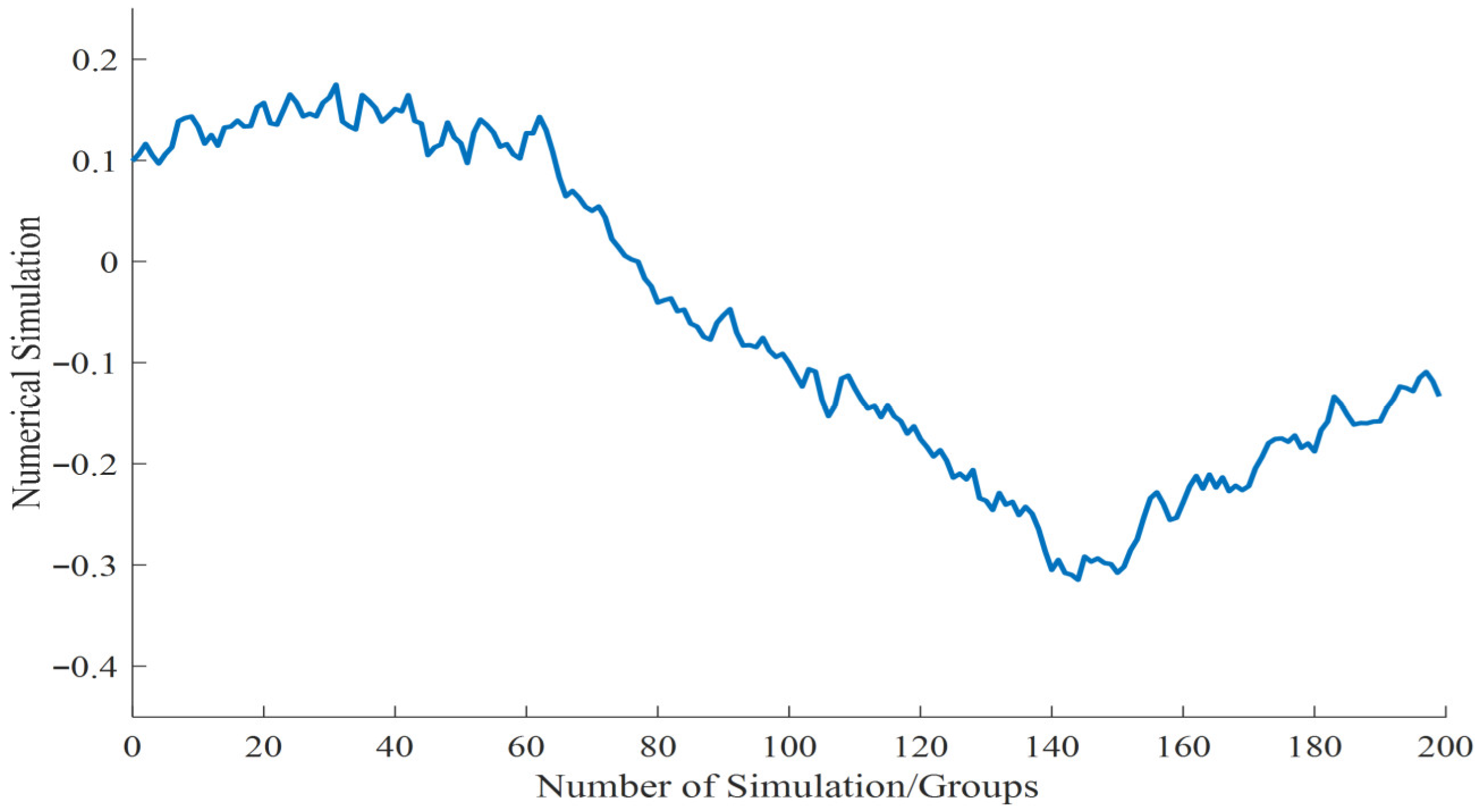
Figure 5b, certain points cannot be adequately fitted by stochastic fluctuations driven solely by an fBm–based stochastic differential model. This observation indicates that the PEMFC degradation process is governed by a composite stochastic mechanism consisting of continuous heavy-tailed fluctuations and discrete jump disturbances. Such characteristics provide a theoretical basis for the subsequent modeling using Lévy stable motion and fPp. The abrupt voltage variations observed in the FC2 dataset may contain both irreversible degradation components and reversible recovery effects under dynamic load disturbances.
4. Experimental Results and Prediction Evaluation
To verify the applicability and robustness of the proposed fractional long-range dependence model under different operating conditions, degradation trend modeling and multi-step trajectory prediction were conducted for both steady-state and dynamic load scenarios.
4.1. Degradation Trend Trajectory Prediction Results
The proposed fractional degradation prediction model (fPp) was applied to two PEMFC experimental datasets for voltage forecasting. Each dataset was divided into a historical segment and a future segment based on the historical voltage measurements defined in
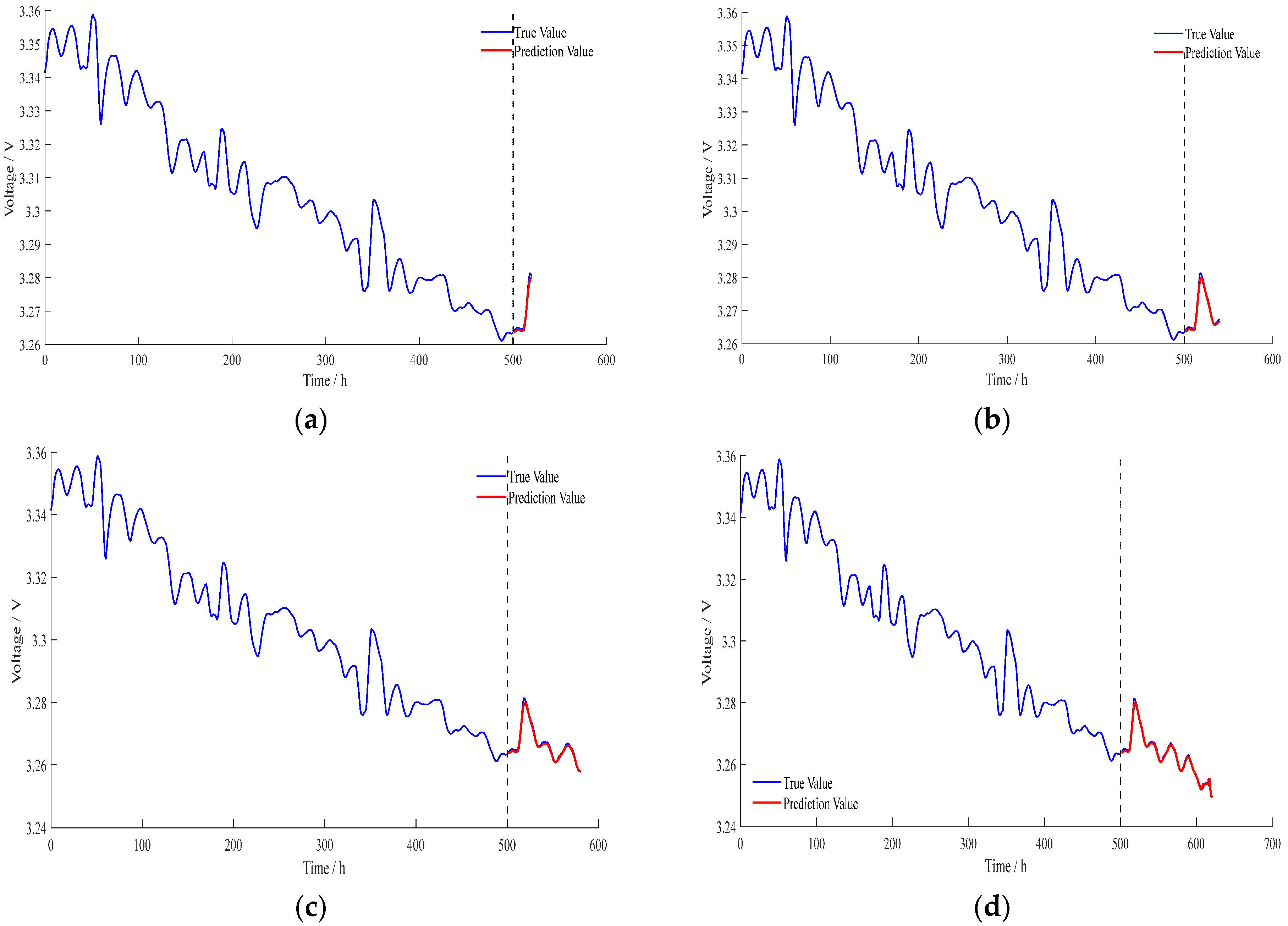
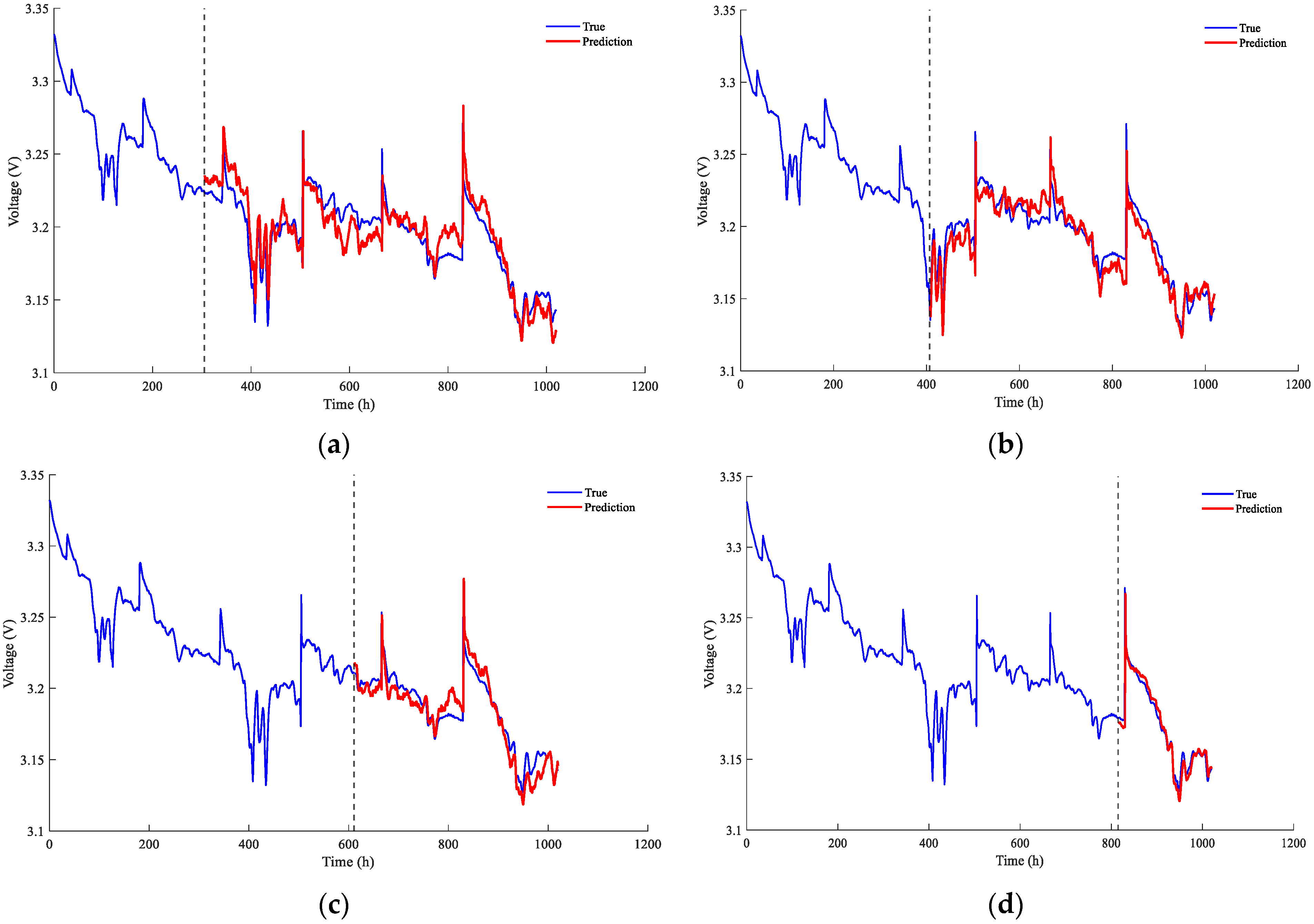
Section 2.2. For the FC1 dataset, the historical interval covers 0–500 h of operation, and multi-step predictions were performed for 20, 40, 80, and 120 steps ahead. For the FC2 dataset, the full operational span spans 0–808 h, and different proportions of the historical data (30%, 40%, 60%, and 80%) were investigated for performance evaluation. Each prediction step corresponds to a 30 min sampling interval; therefore, 20, 40, 80, and 120 steps correspond to 10 h, 20 h, 40 h, and 60 h, respectively. The corresponding model parameters are listed in
Table 5, and the prediction results are illustrated in
Figure 9 and
Figure 10.
The identified Hurst indices for both datasets exceed 0.75, indicating pronounced long-memory characteristics in the degradation sequences, which is consistent with the actual operating behavior of PEMFC systems.
The results in
Figure 9 demonstrate that, within short prediction horizons, the estimated trajectories exhibit high consistency with the actual voltage evolution. As the prediction horizon increases, local deviations gradually enlarge; however, no evident drift in the overall degradation direction is observed. The zoomed-in views further confirm that the model maintains satisfactory trend synchronization in fine-scale intervals. Overall, the proposed model can stably capture long-term degradation behavior under the coexistence of continuous decay and stochastic jumps, revealing strong long-memory preservation and trend robustness.
Figure 10 illustrates the voltage prediction results of the fPp model for the FC2 dataset under different proportions of historical observations. The dashed vertical line indicates the start of the prediction horizon. As shown in
Figure 10a–d, the model parameters are estimated using 30%, 40%, 60%, and 80% of the historical voltage data, respectively. In all scenarios, the predicted voltage trajectories follow the overall degradation trend of the true voltage, indicating that the fPp model can effectively capture the degradation dynamics of the system. Moreover, increasing the proportion of historical observations leads to progressively improved prediction accuracy, as the predicted curves become closer to the true voltage evolution. This improvement suggests that longer historical sequences enable more reliable parameter estimation. Overall, the results demonstrate that the proposed method provides accurate and robust voltage prediction under both steady-state and dynamic operating conditions.
To further quantitatively evaluate the prediction performance of the proposed fPp model, the metrics MAE, RMSE, and R
2 are calculated under different experimental settings, and the results are summarized in
Table 6. For the FC1 dataset, the prediction error gradually increases as the prediction horizon extends, indicating the accumulation of uncertainty in long-term forecasting. In contrast, for the FC2 dataset, increasing the proportion of historical observations significantly improves the prediction accuracy. These results further demonstrate that sufficient historical information plays an important role in enhancing the robustness and reliability of degradation trajectory prediction.
4.2. Comparison with Benchmark Models
To evaluate the effectiveness of the proposed method in degradation trend prediction, the Wiener process, fBm, and CNN-LSTM models were selected as benchmark baselines. Multi-model prediction experiments were conducted on the FC1 dataset under identical training intervals and prediction starting points. To ensure fairness and reproducibility of the comparative experiments, all models were implemented under identical data preprocessing procedures, consistent training–testing splits, and unified prediction horizons. For stochastic models (e.g., Wiener and fBm), model parameters such as drift, diffusion, and Hurst exponent were estimated using standard statistical methods, including maximum likelihood estimation and R/S analysis. For data-driven models (e.g., CNN–LSTM and WTD-RS-LSTM), the model configurations followed those reported in the original literature without additional parameter tuning, ensuring that the comparative results reflect the intrinsic modeling capabilities rather than optimization bias.
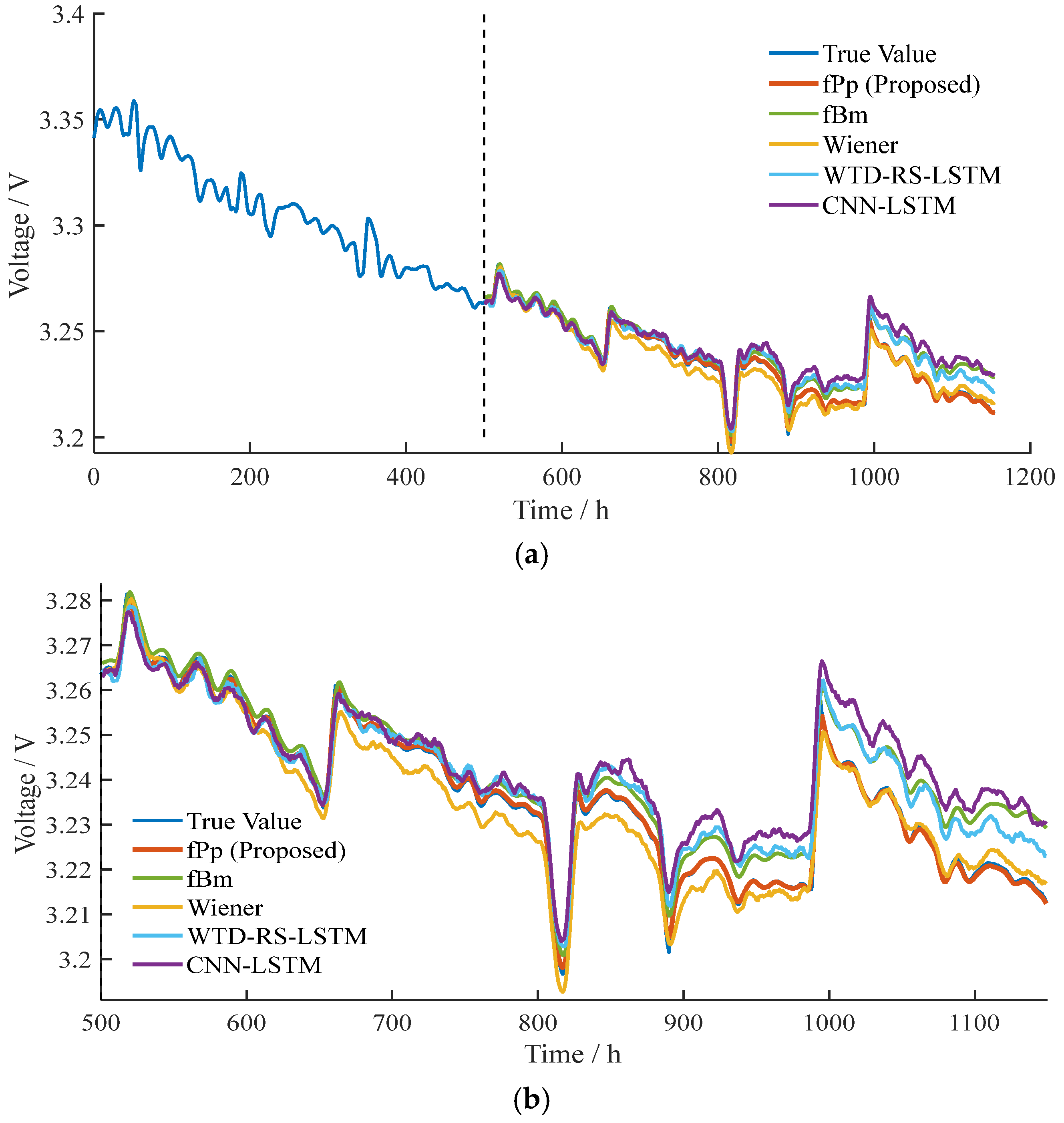
As shown in
Figure 11a, all models capture the overall downward voltage trend, while notable differences appear during fluctuation phases. The proposed fPp model maintains the closest agreement with the ground truth and exhibits more stable error distributions. The enlarged view in
Figure 11b further highlights local dynamic responses. During abrupt variations and intensified stochastic fluctuations, the Wiener and CNN-LSTM models show evident deviations or oversmoothing effects. The WTD-RS-LSTM model improves the prediction stability compared with CNN-LSTM but still presents noticeable bias in capturing sharp stochastic variations. In contrast, the fPp and fBm models better preserve trend continuity and amplitude tracking. These results indicate that incorporating long-memory dependence and stochastic jump mechanisms improves the robustness of degradation prediction under non-stationary operating conditions. Overall, the proposed approach achieves superior predictive performance in both global trend preservation and local fluctuation characterization.
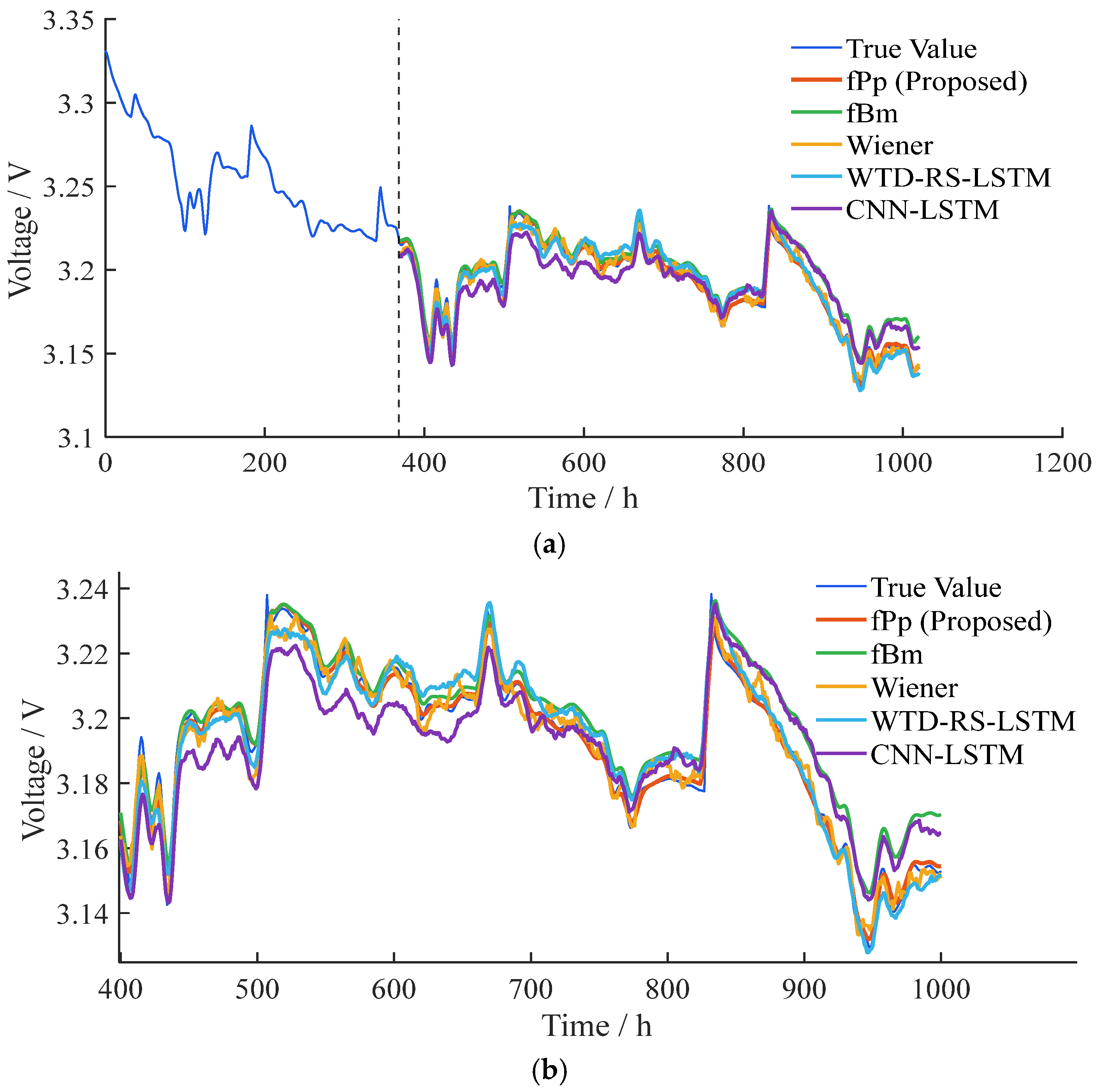
To further assess adaptability under dynamic load conditions, additional comparisons were performed on the FC2 dataset, as illustrated in
Figure 12. In the full-range prediction (
Figure 12a), all models reflect the overall voltage decline; however, significant discrepancies emerge during repeated load transients and sudden voltage drops. The fPp model consistently shows the highest agreement with the measured trajectory, while CNN-LSTM exhibits cumulative drift in long-horizon predictions. The WTD-RS-LSTM model improves the prediction stability compared with CNN-LSTM but still shows noticeable deviations during several stochastic fluctuation intervals. The local enlargement in
Figure 12b reveals that both Wiener and fBm capture short-term variations reasonably well, with Wiener slightly outperforming fBm at several abrupt points.
In contrast, CNN-LSTM presents noticeable lag and overshoot in later stages. while WTD-RS-LSTM reduces the prediction error to a certain extent but still cannot fully capture the rapid voltage fluctuations under dynamic operating conditions. Considering both global and local responses, the proposed fPp model demonstrates the best overall predictive performance under non-stationary degradation conditions, with strong long-memory retention and adaptability to stochastic shocks.
To further explain the superior robustness of the proposed model under dynamic operating conditions, the prediction results can be interpreted together with the SHAP analysis presented in
Figure 3. The SHAP results reveal that several operational variables, particularly humidity-related parameters and historical voltage, have dominant contributions to the degradation process and introduce strong historical dependence and stochastic disturbances in the voltage sequence. Traditional deep learning models such as CNN-LSTM mainly rely on data-driven statistical correlations and therefore tend to produce prediction lag or cumulative drift when abrupt fluctuations occur under dynamic conditions. In contrast, the proposed fractional stochastic framework explicitly incorporates these degradation characteristics into the modeling structure. fBm captures the long-range dependence revealed by the Hurst exponent analysis, while the fPp models stochastic jump disturbances induced by load fluctuations and start-stop events. This mechanism-oriented modeling strategy improves the stability and robustness of degradation prediction under non-stationary operating environments.
4.3. Evaluation Metrics
To quantitatively assess the predictive performance of the proposed method, the root mean square error (RMSE), mean absolute percentage error (MAPE), and coefficient of determination (
R2) were adopted as evaluation metrics [
41]. Their formulations are given in Equations (26)–(28),
where
denotes the true value,
the predicted value,
the mean of the true values, and
the sample size.
To further verify the effectiveness of the fPp model, comparative experiments were conducted with the fBm, Wiener, WTD-RS-LSTM and CNN–LSTM models under identical prediction starting points. Quantitative evaluation was performed using MAE, RMSE, MAPE, and
R2, and the results are summarized in
Table 7.
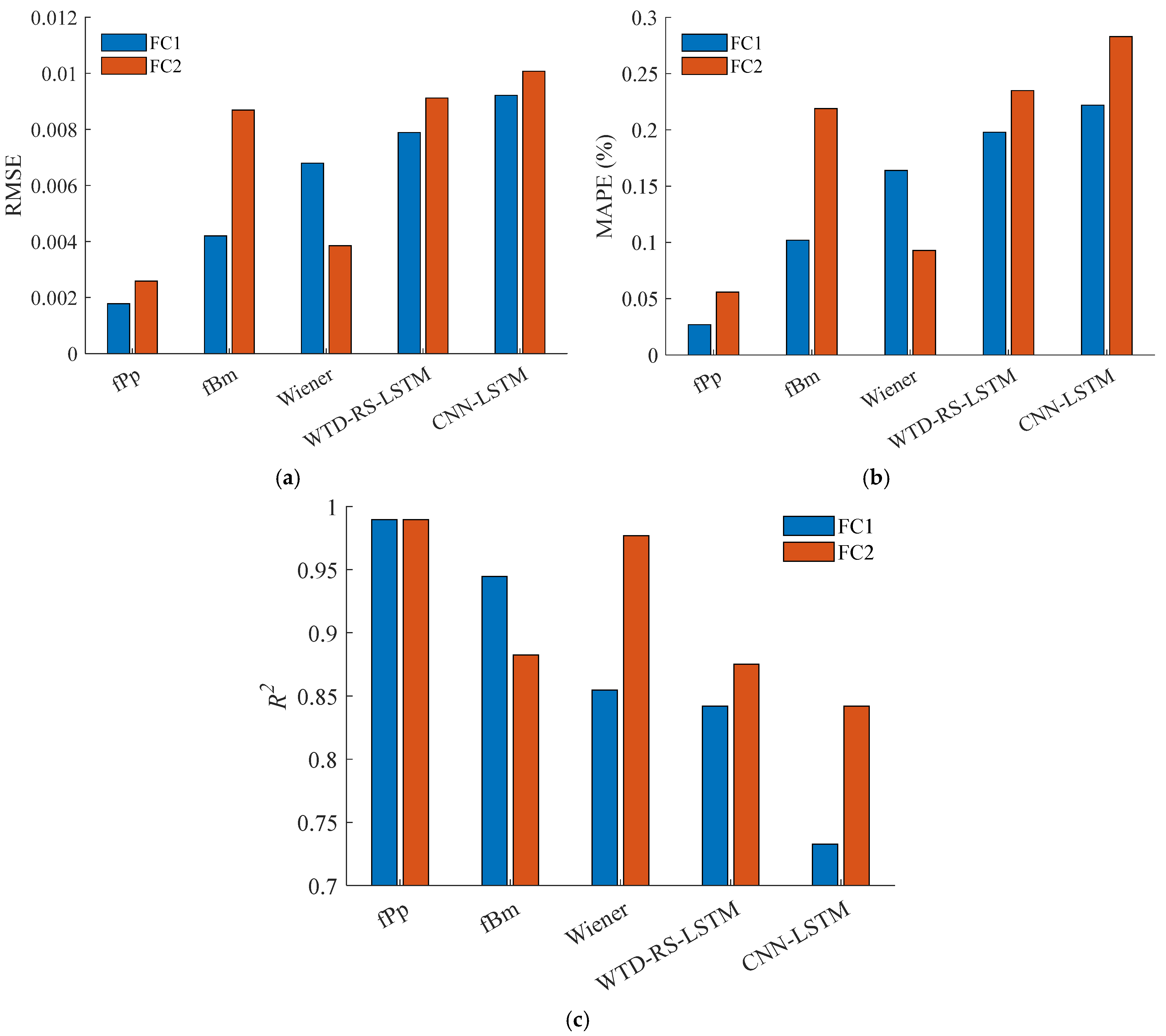
As shown in
Table 7 and
Figure 13, under the FC1 steady-state condition, the fPp model achieves the lowest prediction errors (MAPE = 0.027%, RMSE = 0.00178) and the highest coefficient of determination (
R2 = 0.9895), significantly outperforming the benchmark models. In contrast, CNN–LSTM yields the largest errors and the lowest R
2 (0.7327), while the WTD-RS-LSTM model slightly improves the prediction accuracy compared with CNN–LSTM but still exhibits higher errors than the stochastic models. Under the FC2 dynamic condition, prediction errors increase for all models, yet the relative performance ranking remains largely consistent, with fPp still achieving the best overall accuracy (MAPE = 0.056%, RMSE = 0.00259,
R2 = 0.9896). Notably, the Wiener model exhibits lower RMSE (0.00385) and higher
R2 (0.9769) than fBm in this scenario, indicating stronger short-term fitting capability; however, its overall accuracy remains inferior to fPp. Meanwhile, WTD-RS-LSTM reduces the prediction error compared with CNN–LSTM but still fails to capture several rapid stochastic fluctuations observed in the measured trajectory.
Overall, the prediction performance across both operating conditions follows a stable ranking of fPp > stochastic models (fBm and Wiener) > Wiener > WTD-RS-LSTM > CNN–LSTM. These results suggest that dominant degradation mechanisms vary with operating conditions, and models integrating long-memory dependence with stochastic jump characteristics demonstrate superior robustness and generalization in complex dynamic environments.
5. Conclusions
This paper developed a SHAP-driven fractional long-range dependence model to predict PEMFC voltage degradation trends under steady and dynamic conditions. By integrating degradation mechanism analysis, SHAP-based feature attribution, and fractional stochastic modeling, the proposed framework captures both the physical characteristics and statistical properties of PEMFC degradation processes. Results show that the proposed approach achieves superior multi-step prediction accuracy, stability, and uncertainty characterization compared with benchmark models, while maintaining strong robustness under load fluctuations.
Feature attribution and long-range dependence tests reveal that degradation exhibits evident historical persistence and cumulative effects, indicating that conventional short-memory models may not adequately capture the degradation dynamics. In contrast, fractional stochastic modeling is effective in describing non-Gaussian behaviors. In particular, the introduction of a stochastic jump mechanism improves the model’s ability to capture abrupt voltage drops and transient disturbances under dynamic operating conditions.
Overall, the method provides a balanced solution between accuracy and interpretability, offering a practical tool for PEMFC health assessment and operational decision support. Future work will extend the validation of the proposed framework to PEMFC systems with different stack configurations, power ratings, and operating conditions in order to further verify its generalization capability.