1. Introduction
Lithium-ion batteries have become critical energy storage devices for new energy vehicles, portable electronic devices, and energy storage systems due to their high energy density and low self-discharge rate [
1,
2]. As the core control unit of battery systems, the battery management system (BMS) is responsible for real-time monitoring, evaluation, and management of battery states, which is essential for ensuring the safe, stable, and efficient operation [
3,
4]. Accurate estimation of the state of charge (SOC) and state of health (SOH) is a critical task of the BMS, as both parameters directly affect battery reliability, lifetime prediction, and energy efficiency management [
5,
6].
SOC is a key parameter for evaluating the performance of power batteries in new energy vehicles, and it directly affects vehicle energy management, remaining energy assessment, driving range prediction, and overcharge/overdischarge protection [
7,
8]. Commonly used SOC estimation algorithms mainly include the ampere-hour (Ah) integration method, Kalman filter-based algorithms, and data-driven methods based on neural networks [
9,
10]. The Ah integration method has a simple structure and high computational efficiency [
11]. However, its estimation accuracy heavily depends on the accuracy of the initial SOC, and any initial error accumulates during integration, compromising the reliability of subsequent estimates [
12,
13]. The neural network method leverages machine learning technology to establish a nonlinear mapping between inputs and SOC using historical data. While it performs well with sufficient data, it is sensitive to sample size and distribution, making it prone to overfitting or estimation bias [
14,
15]. Currently, methods combining equivalent circuit models (ECM) and filtering algorithms are widely adopted in onboard BMS, and related estimation strategies have been continuously optimized in recent years [
16]. For example, Li et al. [
17] explored the correlation between noise variance and parameter identification bias in the least squares algorithm. They proposed three collaborative estimation methods that integrate bias-compensated recursive least squares with the extended Kalman filter (EKF) to reduce the impact of noise on SOC and model parameter estimation. Although these methods exhibit good accuracy under Gaussian and uniform noise, their effectiveness under constant-current bias interference has not been thoroughly investigated. Lin [
18] pointed out from theoretical and systematic perspectives that constant-current bias noise can significantly affect SOC estimation. However, most existing filter-based state estimation algorithms still struggle to effectively suppress such noise interference. Therefore, introducing a bias compensation mechanism into the state equation is of great significance for improving the robustness of SOC estimation under complex noise conditions.
Currently, SOH estimation methods for lithium-ion batteries are primarily categorized into three types: direct measurement methods, model-based methods, and data-driven methods [
19,
20]. Direct measurement methods typically involve determining the actual battery capacity through techniques such as coulomb counting in a controlled environment. These approaches are conceptually straightforward and do not rely on complex models or long-term data. However, they generally require offline operation and have high requirements for equipment and environmental conditions, making real-time monitoring difficult. Model-based methods can be further divided into empirical degradation models, equivalent circuit models, and electrochemical models [
21,
22]. Empirical degradation models have simple structures and low computational cost, but they show limited generalization ability under complex dynamic operating conditions. Equivalent circuit models require minimal data but are susceptible to noise and modeling errors. Electrochemical models, while capable of accurately reflecting internal aging mechanisms, are computationally complex and often fail to meet the real-time requirements of onboard BMS [
23]. In contrast to the above two categories, data-driven methods do not depend on battery mechanisms or prior models. Instead, they establish mapping relationships between input features-such as current, voltage, and temperature collected during charge/discharge cycles-and SOH [
24]. For instance, Liu et al. [
25] proposed a hybrid neural network integrating a hidden Markov model, Transformer, and bidirectional gated recurrent units, with parameters optimized via differential evolution algorithms. Yang et al. [
26] designed an improved generative adversarial network to reconstruct degradation feature distributions and introduced a multi-modal time-series collaborative framework incorporating STL decomposition. This framework decomposes time-series data into trend, seasonal, and residual components, enabling fine-grained multi-scale feature modeling and thereby achieving collaborative SOH estimation.
SOC and SOH are strongly coupled. As batteries undergo cyclic aging, their maximum available capacity gradually degrades. If this dynamic change in SOH is not considered, SOC estimation accuracy decreases; conversely, errors in SOC estimation also affect SOH estimation accuracy [
27,
28]. In response, various joint estimation frameworks for SOC and SOH have been proposed in existing studies. For example, Lin et al. [
29] introduced a dual-filter joint estimation framework that operates at different time scales. Through a mutually coupled structure, it integrates real-time SOC dynamics with long-term SOH degradation trends, enabling continuous performance correction and adaptive capacity tracking under aging conditions. Chen et al. [
30] developed an estimation model based on incremental capacity features, combining a multi-scale channel attention network with an adaptive denoising filter for joint SOC and SOH estimation under complex operating conditions. Current mainstream joint estimation methods fall into two categories: model-driven and data-driven approaches. Model-driven methods exhibit relatively good stability under ideal conditions but show limited adaptability in complex real-world scenarios. Data-driven methods can capture system evolution trends through training data and have strong generalization ability. However, their performance is constrained by sample size and quality, and they are often less robust to parameter disturbances or anomalous data. Consequently, hybrid estimation strategies that integrate model mechanisms with data-driven features are a promising research direction. Such approaches can enhance estimation accuracy while improving the overall robustness of the system.
SOC estimation accuracy is affected by both constant current bias interference and SOH degradation due to battery aging. Meanwhile, accurate SOH assessment relies on robust health feature extraction and effective data-driven modeling. To overcome the limitations of existing methods, this paper proposes a second-order RC equivalent circuit model integrated with a constant current bias compensation mechanism. This model is combined with a hybrid FATA–Transformer–GRU algorithm to construct a collaborative SOC and SOH estimation framework. The main contributions of this paper include the following:
- (1)
In SOC estimation based on a second-order RC equivalent circuit model, a constant-current bias compensation term was incorporated into the Kalman filtering framework. Comparative experiments were conducted under four dynamic operating conditions and three types of bias noise. The accuracy and robustness of SOC estimation were effectively enhanced as a result.
- (2)
The fata morgana algorithm (FATA) was introduced, which integrates a population search strategy based on the mirage filtering mechanism and a local search mechanism based on the principle of light propagation. Using FATA, the hyperparameters of the Transformer encoder and gated recurrent unit (GRU) were jointly optimized. Subsequently, a FATA–Transformer–GRU fusion model was con-structed to achieve high-precision SOH estimation.
- (3)
Time-based and fitted curve coefficient features extracted from the bias-compensated SOC estimation results were fed into the SOH estimation model. The estimated SOH was then utilized to dynamically correct the actual available capacity of the battery, thereby improving the accuracy of SOC estimation. Ultimately, a collaborative SOC-SOH estimation architecture integrating model-driven and data-driven approaches was established.
The organization of this paper is as follows.
Section 2 introduces construction of the experimental platform and the modeling method for lithium-ion batteries.
Section 3 validates the accuracy of the proposed SOC estimation method under different operating conditions and bias noise scenarios.
Section 4 details the process of health feature extraction and evaluates the effectiveness of the FATA–Transformer–GRU model in SOH estimation.
Section 5 provides a comprehensive analysis of the joint estimation results, based on the coupling relationship between SOC and SOH.
Section 6 summarizes the main research content and conclusions of the study.
2. Lithium-Ion Battery Experimental Design and Modeling
2.1. Experimental Platform and Protocol
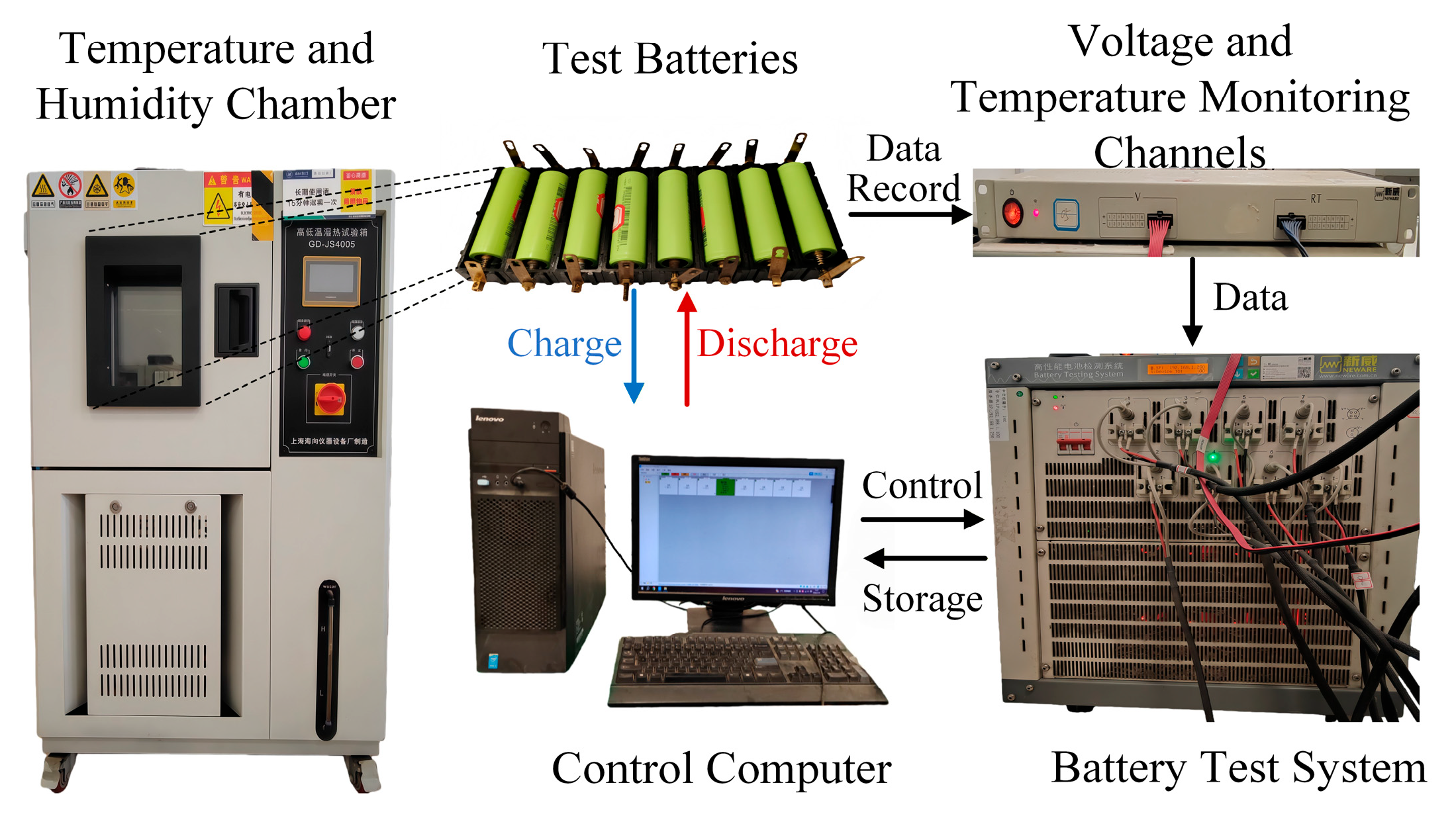
To systematically investigate lithium-ion battery state estimation and accurately record the full lifecycle capacity degradation process, we designed and constructed a comprehensive experimental platform. The platform primarily consists of a host computer control unit, a battery charge/discharge test system, an auxiliary temperature monitoring device, and a constant-temperature and constant-humidity environmental chamber. A schematic diagram of the overall structure is shown in
Figure 1.
The experiment utilized cylindrical ternary lithium-ion batteries with a rated capacity of 2.6 Ah, employing lithium cobalt oxide as the cathode material and graphite as the anode material. Eight ternary lithium-ion batteries with consistent initial states were selected and labeled B1 to B8. They were divided into two batches: the first batch comprised B1–B4, and the second batch comprised B5–B8. Batteries B1 and B2 were tested under a hybrid driving cycle after every 100 cycles of aging in a constant-temperature environment at 25 °C. Each cycle of this hybrid condition consisted of 10 segments of the Dynamic Stress Test (DST), 5 segments of the New European Driving Cycle (NEDC), and 5 segments of the Urban Dynamometer Driving Schedule (UDDS). This combined driving cycle is referred to as the DNU Hybrid Cycle (DNU-HC). Under the same constant-temperature condition (25 °C), batteries B3 and B4 were tested using the UDDS cycle after every 100 aging cycles. Batteries B5 and B6 were tested under the China Light-duty Vehicle Test Cycle (CLTC) after every 100 aging cycles. Additionally, batteries B7 and B8 were tested under the NEDC dynamic driving cycle after every 100 aging cycles at room temperature.
The aforementioned experimental conditions are primarily designed to support research on SOC estimation. Meanwhile, SOH, a key indicator of battery degradation over its lifespan, is typically defined as the percentage of the battery’s current capacity relative to its rated capacity, as expressed in the following formula:
The rated capacity is determined before the battery aging test begins. To ensure a consistent initial state, all tested batteries are first charged at a constant current of 0.3 C to the cut-off voltage under standard ambient temperature, followed by a constant voltage charge until the current drops to 0.03 C. Finally, they are discharged at a constant current of 0.3 C to the cut-off voltage. This procedure is repeated three times, and the average of the three discharge capacities is taken as the rated capacity of the battery. The current capacity is measured throughout the battery’s entire lifecycle. The test procedure is similar to that for determining the rated capacity, except that charging is performed at 0.5 C using constant current and constant voltage, and discharging is performed at a constant current of 1 C. The maximum capacity during the discharge phase of each cycle is recorded as the maximum available capacity for that aging stage.
2.2. Establishment of a Second-Order RC Equivalent Circuit Model
The accuracy of SOC estimation is largely constrained by the trade-off between the representational capability of the battery model under dynamic conditions and its computational complexity [
31]. In engineering practice, model selection must balance accurately capturing dynamic battery behavior with algorithmic feasibility and computational burden [
32]. Therefore, a second-order RC equivalent circuit model is adopted in this study. This model effectively simulates battery polarization while having a concise structure, a moderate number of parameters, and is suitable for real-time computation and engineering implementation.
The system state equations for this model are as follows:
Here, U and I represent the terminal voltage and current of the battery, respectively; Uoc denotes the open-circuit voltage; R0, R1, and R2 correspond to the ohmic resistance, electrochemical polarization resistance, and concentration polarization resistance, respectively; U1 and U2 are the voltages across R1 and R2; τ1 and τ2 are the time constants; Qc indicates the maximum capacity of the battery; Δt represents the sampling interval; and n stands for the discrete time index.
In this paper, the Forgetting Factor Recursive Least Squares (FFRLS) method is employed to identify the resistance and capacitance parameters of the model in real time based on sampled battery operating data. The recursive procedure is outlined as follows:
The system transfer function is established as follows:
Let
θn = [
b1,
b2,
b3,
b4,
b5]
T be the undetermined coefficient vector at time n, and
φn = [
Zn−1,
Zn−2,
In,
In−1,
In−2]
T. Equation (4) is discretized and transformed into a difference equation, where
Zn represents the output value of the difference equation at time
n:
The resistance and capacitance parameters of the model are calculated as follows:
A recursive loop is established based on the difference equation as follows:
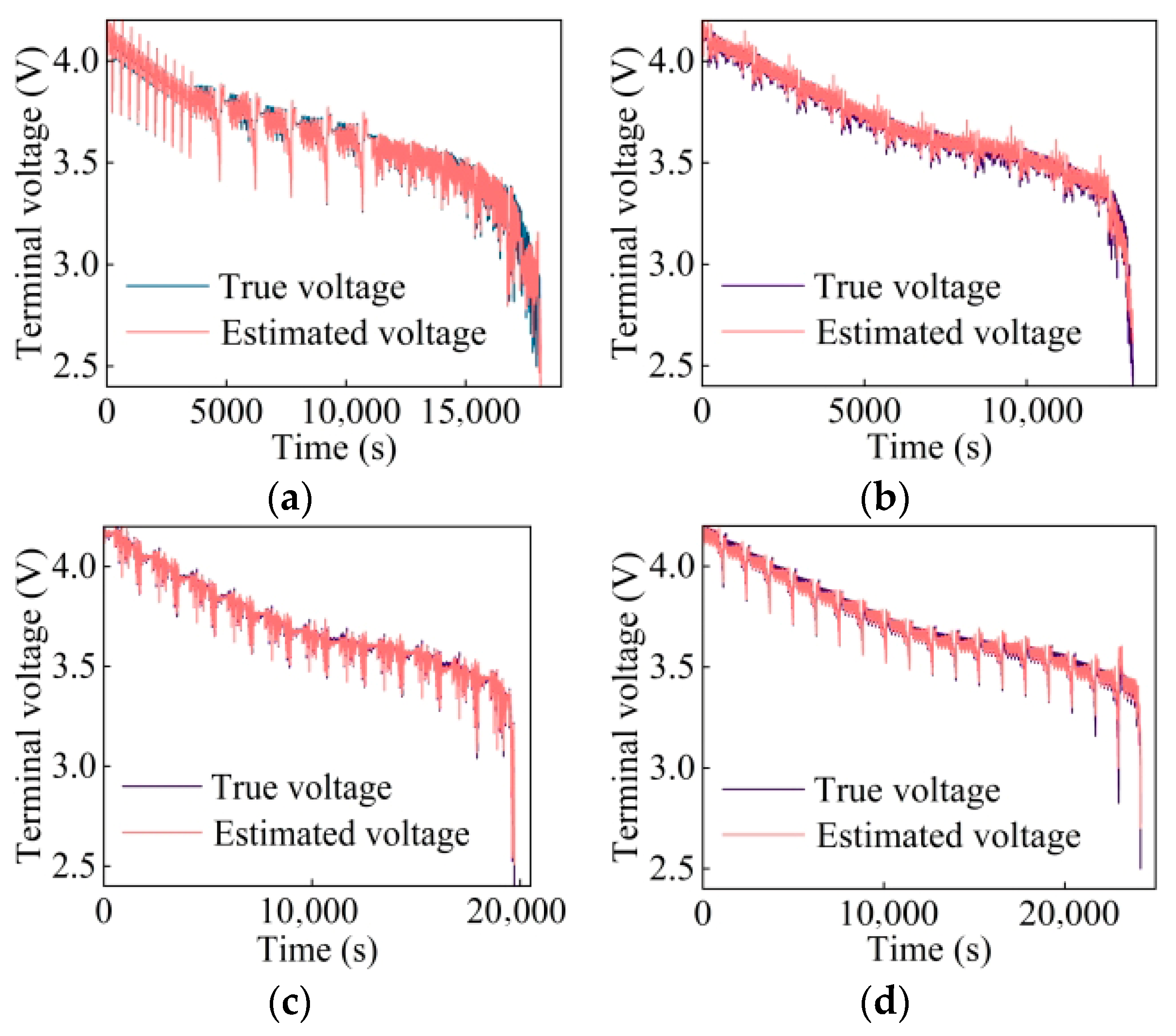
To validate the effectiveness of the selected second-order RC equivalent circuit model and its parameter identification method, simulated output voltages of the model were compared with actual measured values under four typical dynamic cycles: DNU-HC, UDDS, NEDC, and CLTC. The results are shown in
Figure 2. As indicated by the curves, the battery voltage gradually decreases during the discharge process. Under each operating condition, the simulated voltage from the model closely tracks the actual voltage variations, with overall voltage errors maintained within a small range. These results demonstrate that the model parameters identified using the FFRLS algorithm exhibit good accuracy, thereby providing a reliable model foundation for subsequent SOC estimation algorithms.
2.3. FATA–Transformer–GRU Model Implementation
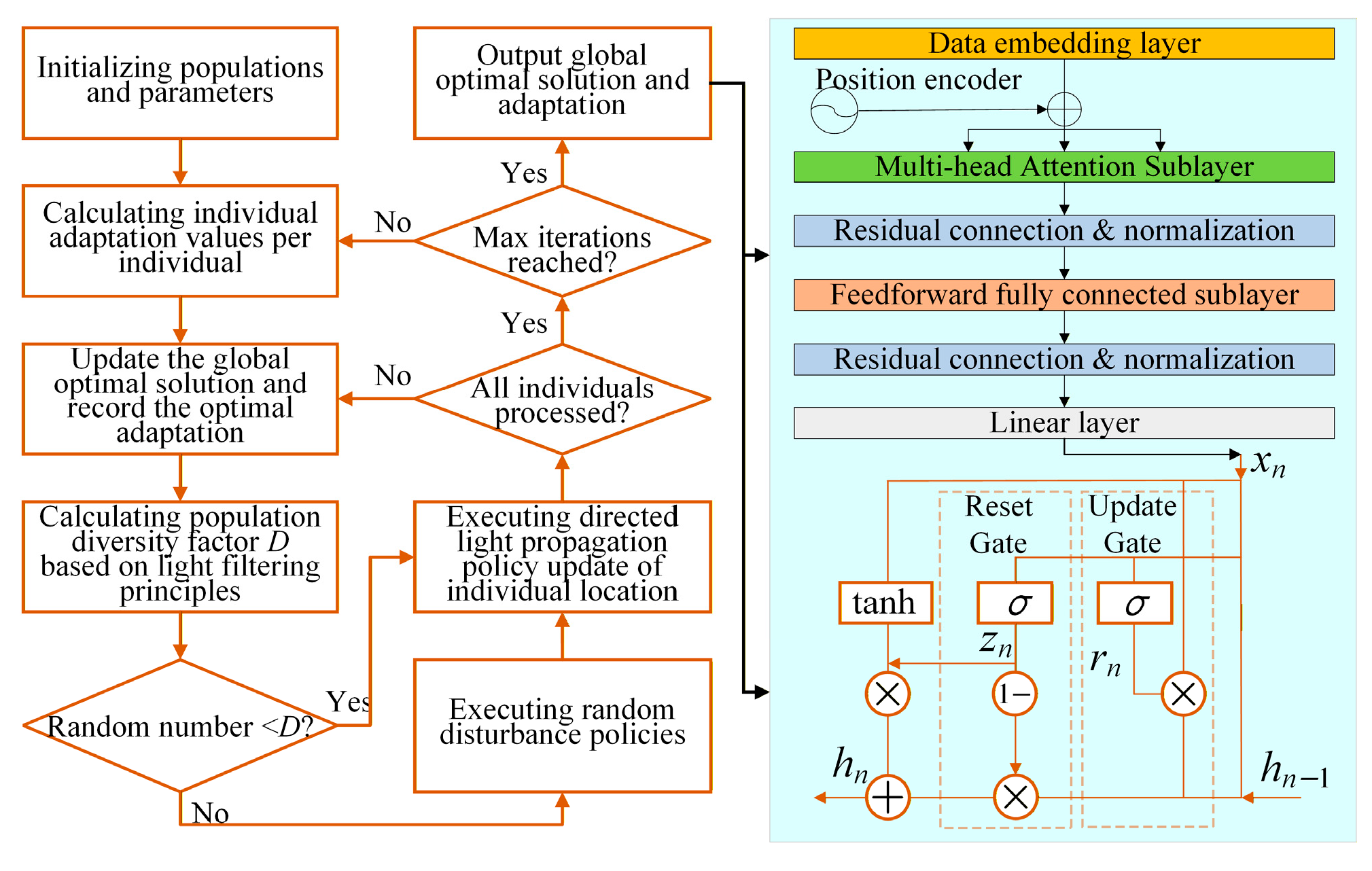
To achieve accurate SOH estimation for lithium-ion batteries, a hybrid modeling approach integrating an intelligent optimization algorithm and deep neural network techniques is proposed in this study-namely, the FATA–Transformer–GRU model. This model primarily consists of three components: a Transformer encoder, a Gated Recurrent Unit (GRU) network, and the FATA optimization module. Through collaborative interaction, these components form a closed-loop SOH estimation system. The overall architecture is illustrated in
Figure 3.
2.3.1. FATA Optimization Algorithm
The FATA optimization algorithm is inspired by the formation mechanism of mirages [
33]. By simulating the refraction and propagation characteristics of light in this process, the algorithm constructs two search strategies: a population-based global search strategy based on the “mirage filtering” principle, and an individual-based refined search strategy based on the “light propagation” mechanism.
The FATA algorithm consists of two main stages. In the first stage, the algorithm dynamically evaluates a multi-source population based on the mirage filtering principle derived from definite integrals. By quantifying both individual and population fitness, the overall quality of the population is assessed. The second stage, executed after mirage filtering, implements a light propagation mechanism. This mechanism incorporates trigonometric functions to formulate individual search strategies, specifically including first-half-phase refraction, second-half-phase refraction, and total reflection strategies. The physical changes occurring during light propagation in heterogeneous media essentially correspond to information exchange among individuals. The algorithm guides the search direction through this process and ultimately generates an optimal solution. These two strategies work synergistically, achieving an effective balance between global exploration and local exploitation. Consequently, the algorithm fully realizes its potential in multi-scale search tasks [
34].
2.3.2. Transformer Network
With advances in the field of deep learning, sequence prediction methods based on the Transformer architecture have become a focus of research. The self-attention mechanism in Transformer enables effective modeling of long-range dependencies among different time steps in input sequences [
35]. The model typically comprises the following core components: a positional encoding module, multi-head attention layers, a feed-forward neural network, and normalization modules that integrate residual connections and layer normalization.
The input to the Transformer is first processed through positional encoding of the embedded data to capture positional information within the sequence. The positional encoding method is described by Equation (8) as follows:
Here, pos denotes the time step; 2n indicates even-indexed dimensions; 2n + 1 represents odd-indexed dimensions; and d refers to the dimensionality of the input vector.
The attention layer serves as the core component of the Transformer. It generates a weighted representation for each position, thereby capturing global dependencies within the input sequence. The corresponding formulation is given by Equation (9) as follows:
Here, Q represents the query matrix; K denotes the key matrix; V corresponds to the value matrix; and dk indicates the dimensionality of the keys.
The feedforward neural network is a simple two-layer structure composed of fully connected layers and the ReLU activation function. Linear transformation and nonlinear activation are applied to the output layer, as expressed in the following equation:
Here, x represents the input vector data with dimensionality d; b1 and b2 denote bias parameters; and W1 and W2 are the parameter matrices for linear mapping.
2.3.3. GRU Network
The GRU is an improved version of the Recurrent Neural Network (RNN) architecture [
36]. Compared with traditional RNNs, GRU introduces update and reset gate mechanisms. This enables selective retention and forgetting of historical information, thereby significantly enhancing its capability for modeling and predicting time-series data. The core expressions are given as follows:
Here, zn and rn denote the update gate and reset gate, respectively; xn, hn, and represent the input, hidden state, and candidate hidden state at time n, respectively; Wz and Wr are the weight matrices for the input corresponding to the update gate and reset gate, respectively; Uz and Ur are the weight matrices for the hidden state at time n-1 corresponding to the update gate and reset gate, respectively; Wh and Uh are the weight matrix and bias term for the candidate hidden state, respectively; σ represents the sigmoid activation function; and tanh denotes the hyperbolic tangent function.
3. State of Charge Estimation Based on Current Bias Conditions
Lithium-ion batteries are typical nonlinear time-varying systems characterized by complex dynamic coupling among their internal state variables. As two core states in a BMS, SOC and SOH are not independent of each other: the fluctuation range of SOC and the charge–discharge behavior directly affect the aging process of the battery, thereby constraining the evolution of SOH. Conversely, the capacity degradation represented by SOH inversely impacts the accuracy of SOC estimation. Therefore, the estimation accuracy of SOC is not only a fundamental function of the BMS but also a prerequisite for achieving reliable SOH estimation. Based on this, this section focuses on the constant current bias noise commonly present in current measurement, introducing a bias compensation mechanism within the Kalman filter framework to obtain more accurate SOC estimates, thereby providing reliable state inputs for subsequent SOH modeling.
In conventional SOC estimation research, system noise is typically modeled as Gaussian white noise. However, current data in practical battery systems are often collected by low-cost sensors and are inevitably subject to multiple sources of interference. Among these, zero-mean Gaussian white noise can be effectively suppressed by state observers such as the Kalman filter. Nevertheless, most existing filter-based estimation algorithms exhibit limited capability in mitigating constant-current bias noise. This leads to reduced SOC estimation accuracy and may cause errors to accumulate continuously during the integration process [
37].
To address the issue of constant deviation in current measurement, a current bias compensation term is introduced into the system model and extended as an additional state variable. When the Kalman filter is applied to estimate the system state of the second-order RC equivalent circuit model, simultaneous joint estimation of SOC and current bias is achieved. The revised system state equation is expressed as follows:
Here, U1,n+1, U2,n+1, and Un+1 represent the terminal voltages across R1, R2, and the battery at time n+1, respectively; and In denote the current bias and measured current at time n; w and v indicate the process noise and measurement noise, respectively.
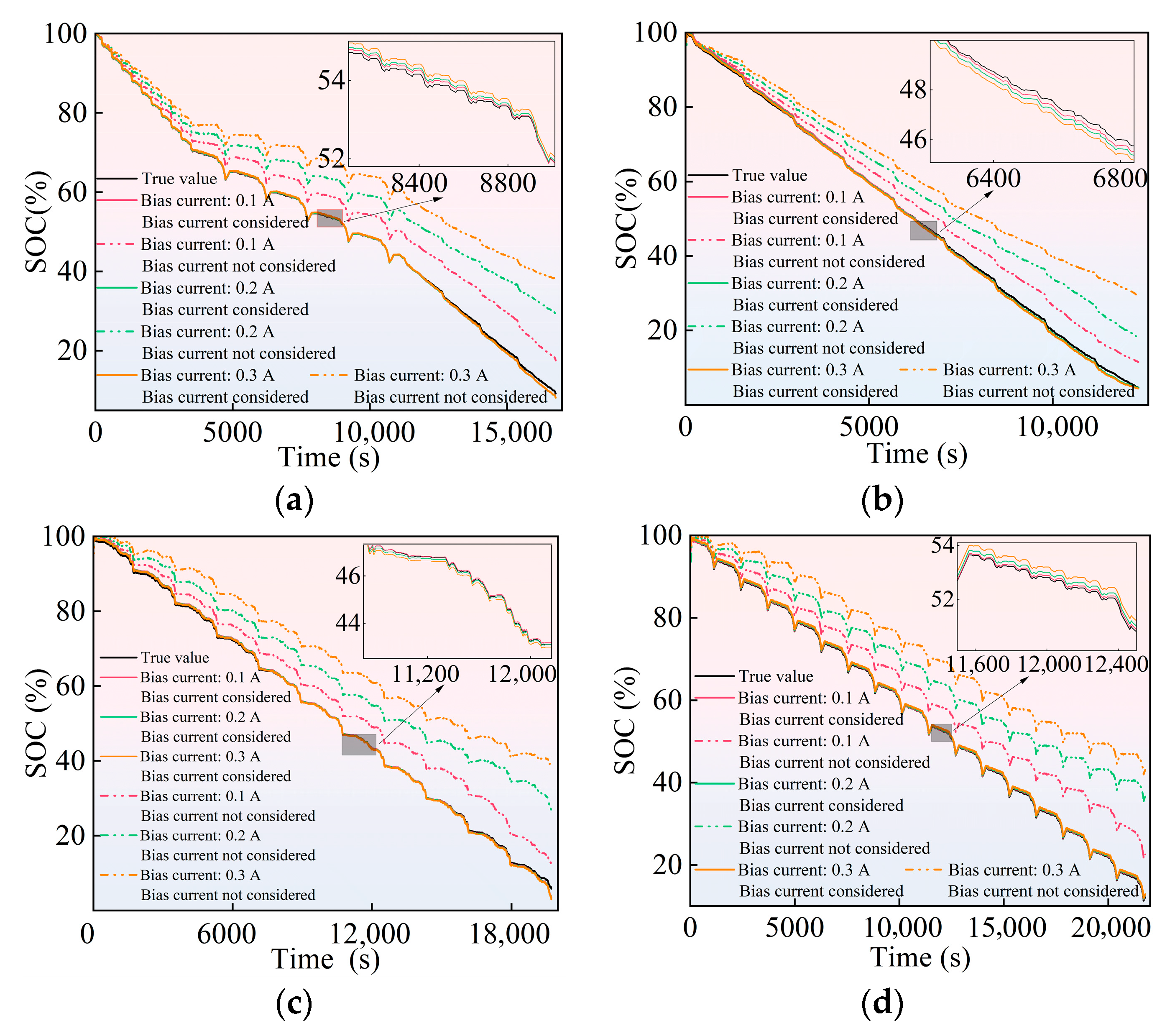
To validate the effectiveness of the proposed estimation method, SOC estimation experiments were conducted under three different current bias scenarios (bias currents of 0.1 A, 0.2 A, and 0.3 A). Experimental data were sourced from four typical driving cycles-DNU-HC, UDDS, CLTC, and NEDC-collected in the laboratory, ensuring the generality and reliability of the validation results.
Figure 4 presents a comparison of SOC estimation results with and without current compensation under different operating conditions and bias noise scenarios.
Based on the results shown in
Figure 4, it is evident that current bias noise significantly interferes with SOC estimation accuracy. When the current bias is 0.1 A, the cumulative SOC errors under the DNU-HC, UDDS, CLTC, and NEDC cycles reach 8.43%, 6.88%, 6.47%, and 10.36%, respectively. As the current bias noise increases to 0.2 A and 0.3 A, the cumulative errors continue to rise. For 0.2 A bias, the errors reach 19.77%, 13.57%, 20.62%, and 24.43%, respectively; for 0.3 A bias, they reach 28.55%, 24.77%, 32.89%, and 30.89%, respectively. These data indicate that stronger current bias noise leads to progressively larger cumulative SOC errors, causing the estimated results to increasingly deviate from the true values. After implementing the current bias compensation strategy, the SOC estimation curves under all tested cycles effectively track the true SOC variation, with estimation deviations consistently maintained within a low range.
After incorporating the current bias compensation mechanism, the Root Mean Square Error (RMSE) and Mean Absolute Error (MAE) of the estimated SOC under various noise scenarios are presented in
Table 1. The data show that with the proposed method, both RMSE and MAE for SOC estimation remain below 0.70% under different operating conditions and multiple noise disturbances. The experimental results indicate that adding a current bias compensation term to the Kalman filter algorithm effectively mitigates the impact of varying current bias noise, ensuring robust SOC estimation across all tested conditions and yielding high consistency between the estimated and true values.
In summary, to address the prevalent issue of constant current bias noise in practical current measurement, this section introduces a current bias compensation term into the system state equation, thereby achieving joint estimation of SOC and bias noise. Tests and analyses under various operating conditions and multiple noise scenarios demonstrate that the proposed method effectively mitigates the cumulative error caused by bias noise, significantly enhancing the accuracy and robustness of SOC estimation (with RMSE/MAE both below 0.70%). It is worth emphasizing that in the subsequent joint estimation of SOC and SOH, the high-precision SOC estimates obtained in this section will assume a dual role: on one hand, as the front-end output of the joint estimation framework, they need to reflect the battery state in real time; on the other hand, the accurate charging phase information will serve as the core basis for extracting key health features of SOH in the next chapter (such as the constant current charging time, tc). Therefore, the current bias compensation method proposed in this section is not only an effective means to achieve high-precision SOC estimation, but also an important foundation for constructing a reliable closed loop for joint SOC-SOH estimation.
4. Data-Driven Model Construction
In the joint SOC-SOH estimation framework established in this paper, high-precision SOC estimation serves as a prerequisite for subsequent SOH modeling. Building upon the SOC results obtained in
Section 3 with the introduction of bias compensation—particularly the charging phase information embedded therein—this section further focuses on the state of health estimation of lithium-ion batteries. Specifically, multi-dimensional health features are first extracted from the constant current-constant voltage charging process. Subsequently, a FATA–Transformer–GRU hybrid neural network model is constructed to achieve accurate SOH estimation, thereby providing support for the closed-loop feedback correction discussed in
Section 5.
4.1. Feature Extraction and Analysis
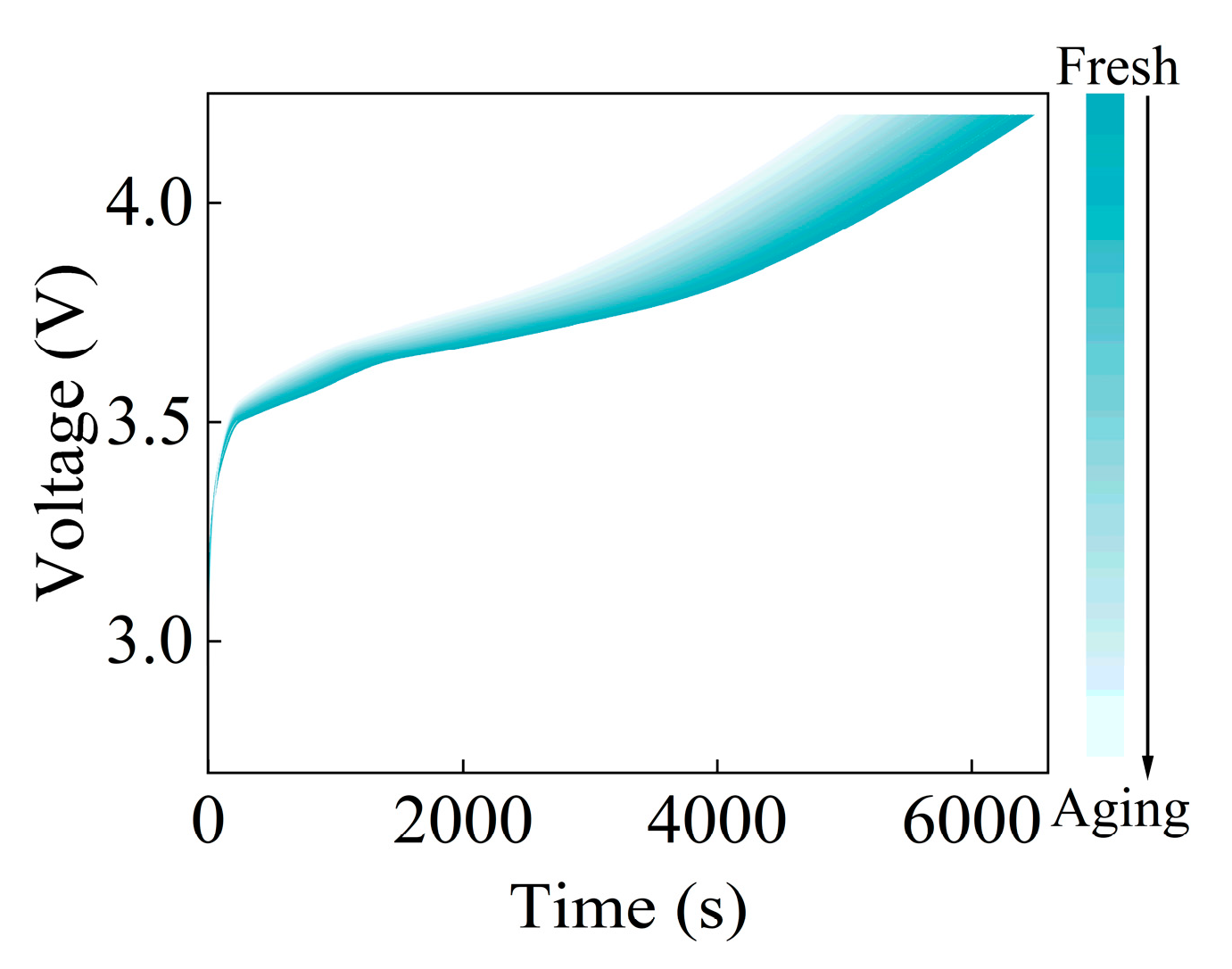
In this section, we validate the effectiveness of the constructed data-driven model using measured data from eight batteries collected in the laboratory. Considering the complexity of discharge conditions in practical applications and the high time cost associated with rest periods, multidimensional health features are extracted from the constant-current and constant-voltage charging phases. During the CC charging process, the voltage response exhibits a distinct temporal evolution pattern.
Figure 5 depicts the constant current charging voltage curves for the B1 battery under different aging stages. It can be observed from the figure that as battery aging progresses, the rate of voltage rise gradually accelerates, leading to a corresponding decrease in the duration of the constant-current phase.
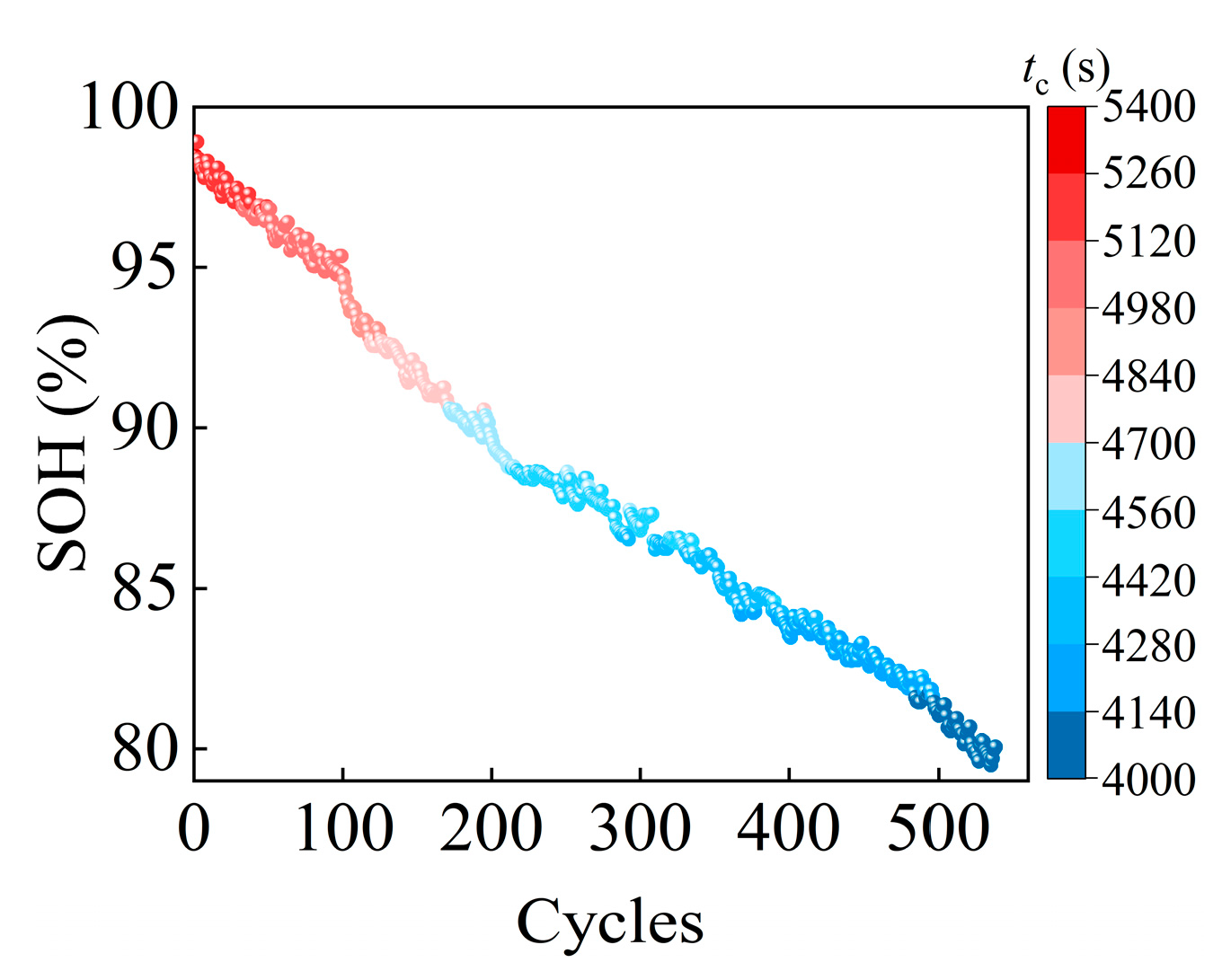
In battery SOH evaluation, the actual charging capacity is typically calculated by integrating current over time. This method directly reflects the capacity degradation process, making charging duration a commonly used health feature for SOH estimation. However, in practical usage scenarios, the initial SOC is prone to fluctuations due to human factors, and complete charging processes are difficult to maintain consistently. Consequently, directly using charging time as a feature presents limitations. To address these issues, the moment SOC reaches 20% during the constant-current charging phase is defined as the starting point in this study. The end time of this phase, denoted as tc, is adopted as a health feature and labeled HF1.
Figure 6 illustrates the variation in SOH and constant-current charging time of Battery B1 with increasing cycle number. As shown in the figure, with the progression of battery aging (indicated by the gradual darkening of the curve color), the constant-current charging time exhibits a clear trend. This demonstrates a clear correlation between this feature and the battery capacity degradation process.
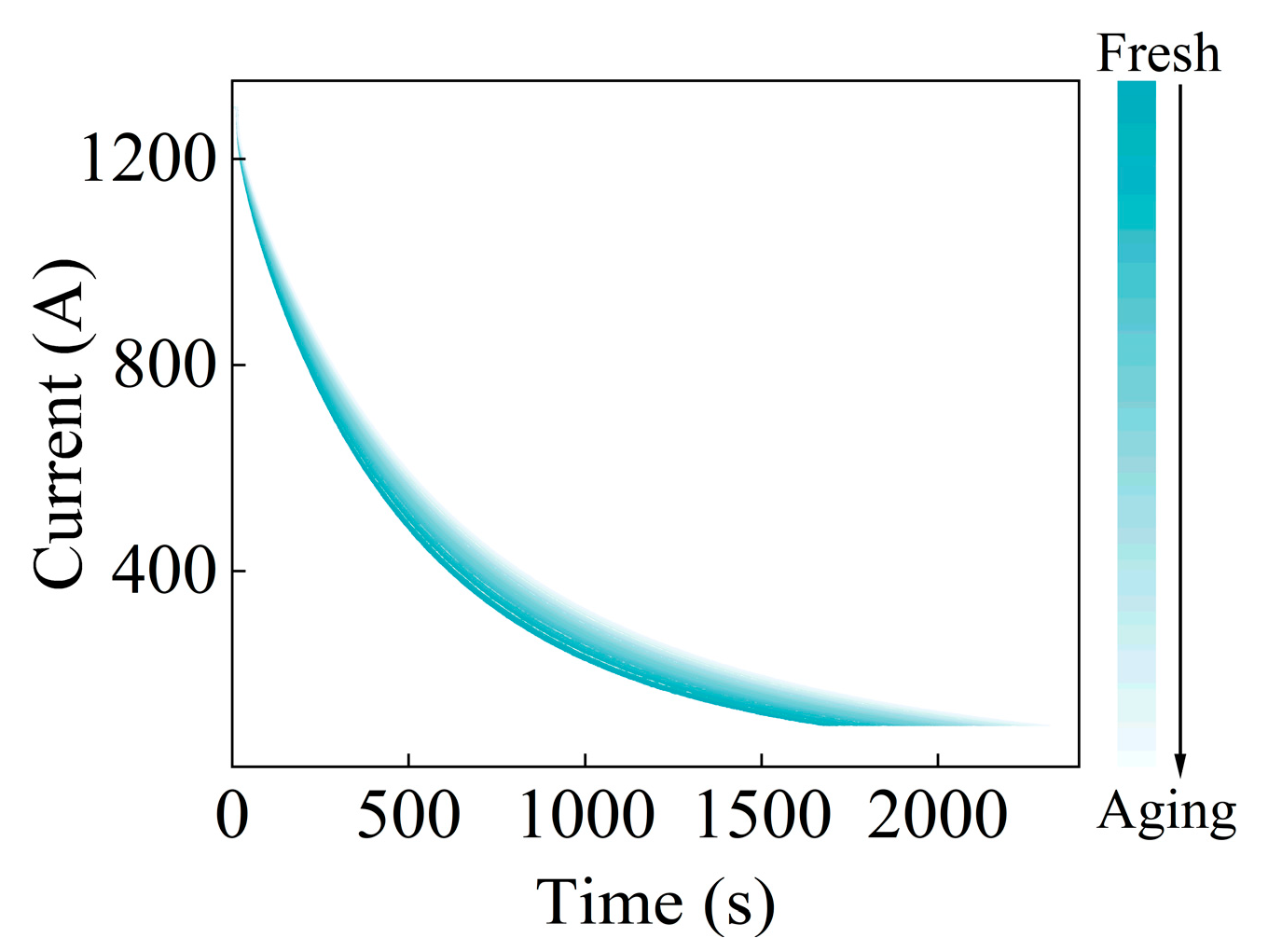
The constant-voltage charging phase is crucial for ensuring the battery is fully charged. Charging continues as long as the battery voltage remains below a predefined threshold.
Figure 7 presents the current variation curves during the constant-voltage charging phase at different aging states. As shown in the figure, as the battery capacity degrades, the total time required for constant-voltage charging increases. Furthermore, the current decline rate in the later stage of charging slows noticeably.
To more effectively characterize the nonlinear trend of current variation in the constant-voltage phase of lithium-ion batteries, a logit polynomial model is introduced in this study for curve fitting. By extracting the coefficients of the fitted polynomial, we can transform this nonlinear process into quantitative features for SOH estimation. The logit polynomial fitting model is given as follows:
where
I′ represents the normalized current value;
a1–
an are the fitting coefficients; and
b denotes the intercept. As lithium-ion batteries age, the fitting coefficients continuously change, which can serve as indirect health indicators for battery degradation.
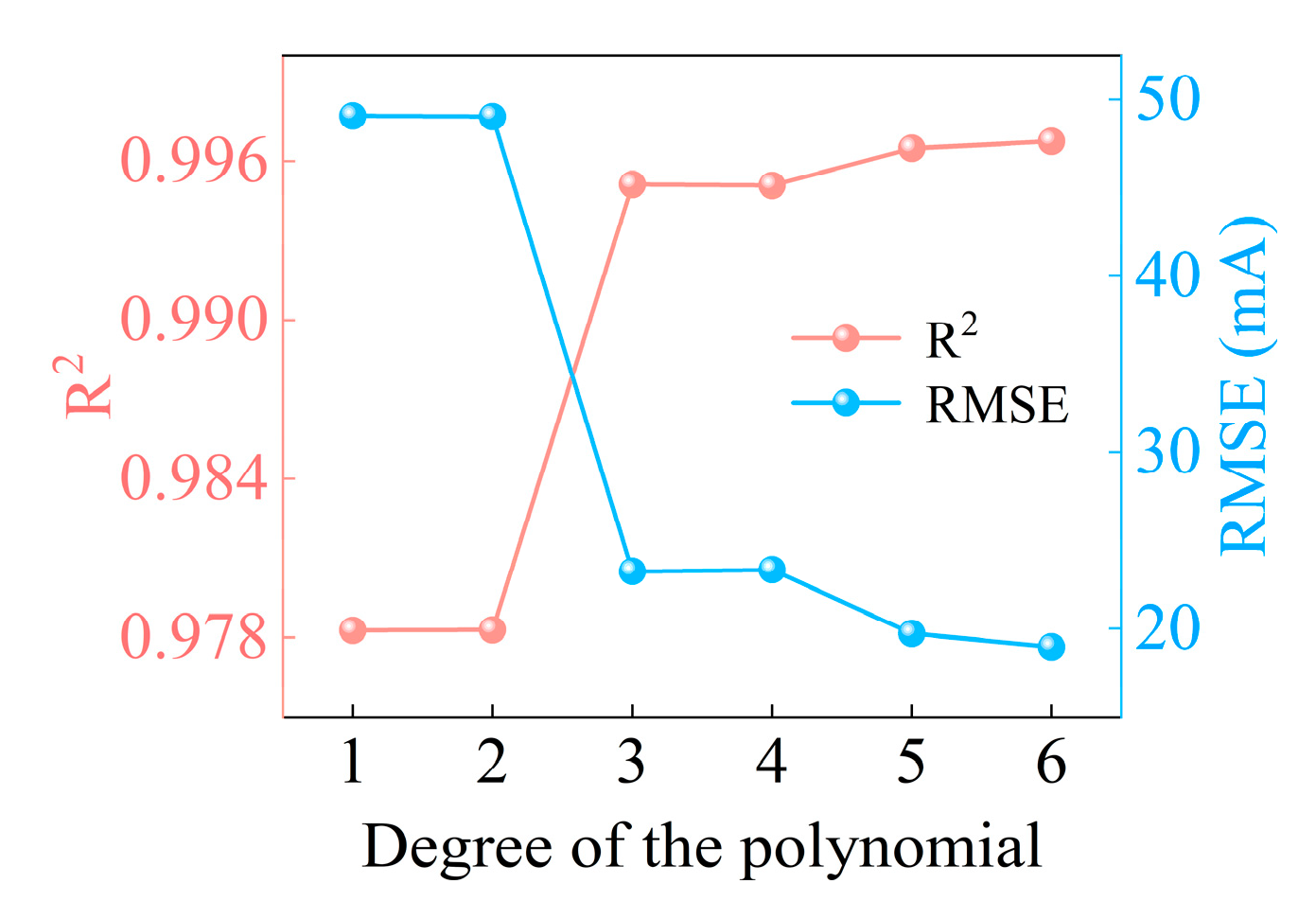
To determine the optimal polynomial order for current curve fitting, we conducted a comprehensive evaluation by plotting R
2 and RMSE as functions of polynomial order, as shown in
Figure 8. To balance fitting accuracy and computational efficiency, we ultimately selected a third-order polynomial to fit the current variation curve.
To quantitatively analyze the correlation between features and SOH, we introduced Pearson and Spearman correlation analysis.
Table 2 presents the Pearson correlation coefficients between the extracted health features and SOH. The analysis shows that the absolute values of the correlation coefficients for time-based features extracted during the constant-current phase are all above 0.97. Among the four features extracted from the constant-voltage phase, the absolute correlation coefficients of features
a3 and
b vary significantly across batteries, while the other two features maintain absolute correlation coefficients above 0.9. Based on these correlation analysis results, we ultimately selected three features—
tc,
a1 and
a2—which exhibit high and stable correlations, as health features for SOH estimation.
4.2. FATA–Transformer–GRU Model Validation
To systematically validate the effectiveness of the FATA–Transformer–GRU model, two types of comparative experiments were designed. First, an ablation study was conducted by comparing the proposed model with its variants (FATA–Transformer–LSTM, Transformer–GRU, and FATA–Transformer) to analyze the impact of different components. Second, several representative algorithms, including BiGRU, BiLSTM, CNN, CNN-LSTM, TCN, and GNN, were selected for horizontal comparison to comprehensively evaluate the overall performance of the proposed model. Finally, to validate the effectiveness of FATA, it was compared with the Genetic Algorithm (GA), Particle Swarm Optimization (PSO), and Sparrow Search Algorithm.
Prior to introducing the experimental setup, this section first provides a detailed exposition of the FATA–Transformer–GRU model’s architecture and training details. To ensure the reproducibility of this study, all parameters are extracted directly from the operational code and experimental logs. After multiple parameter tuning and comparisons,
Table 3 comprehensively presents the model’s input data processing, network architecture, FATA optimization algorithm settings, training parameters, and data partitioning method.
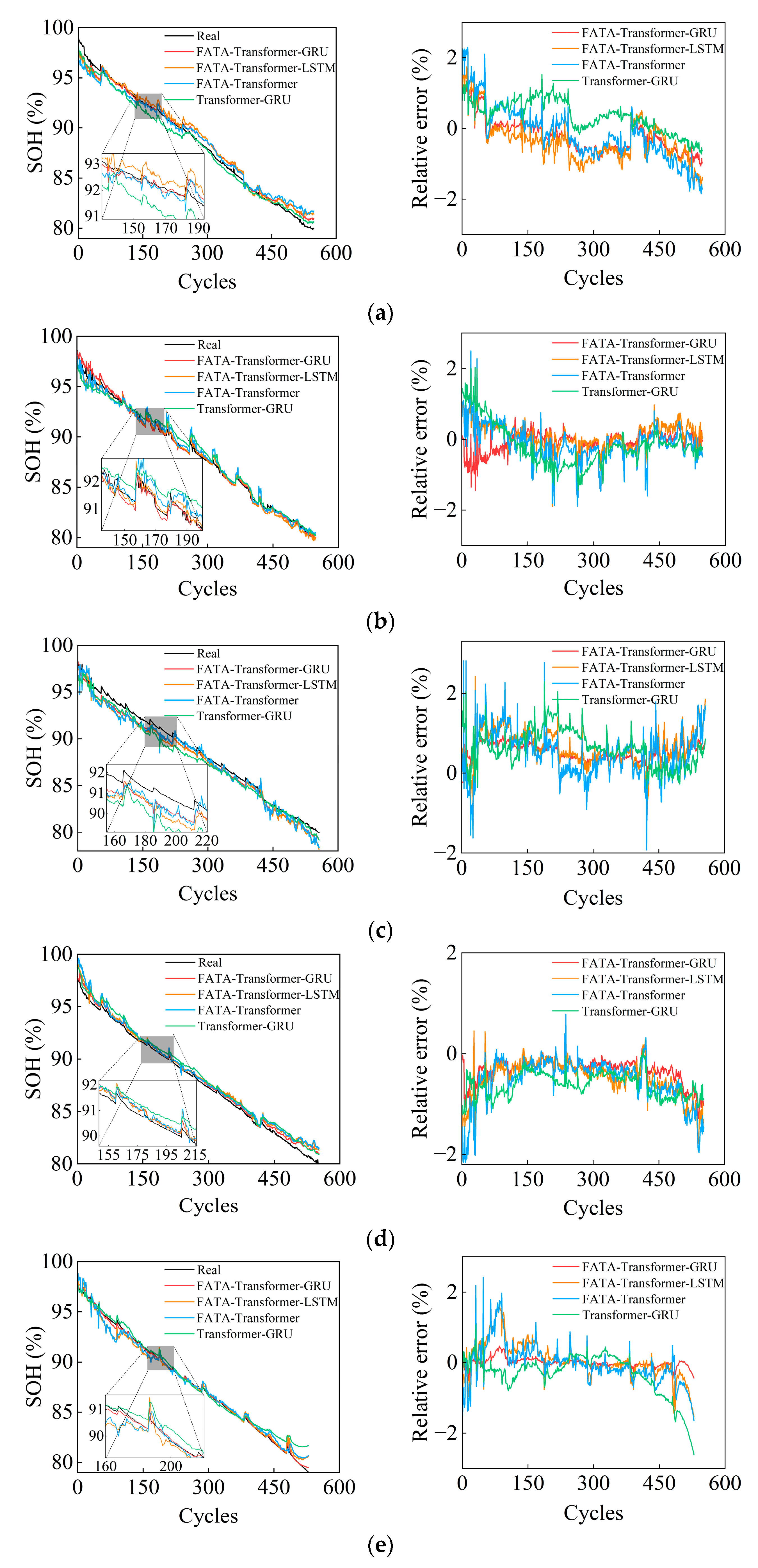
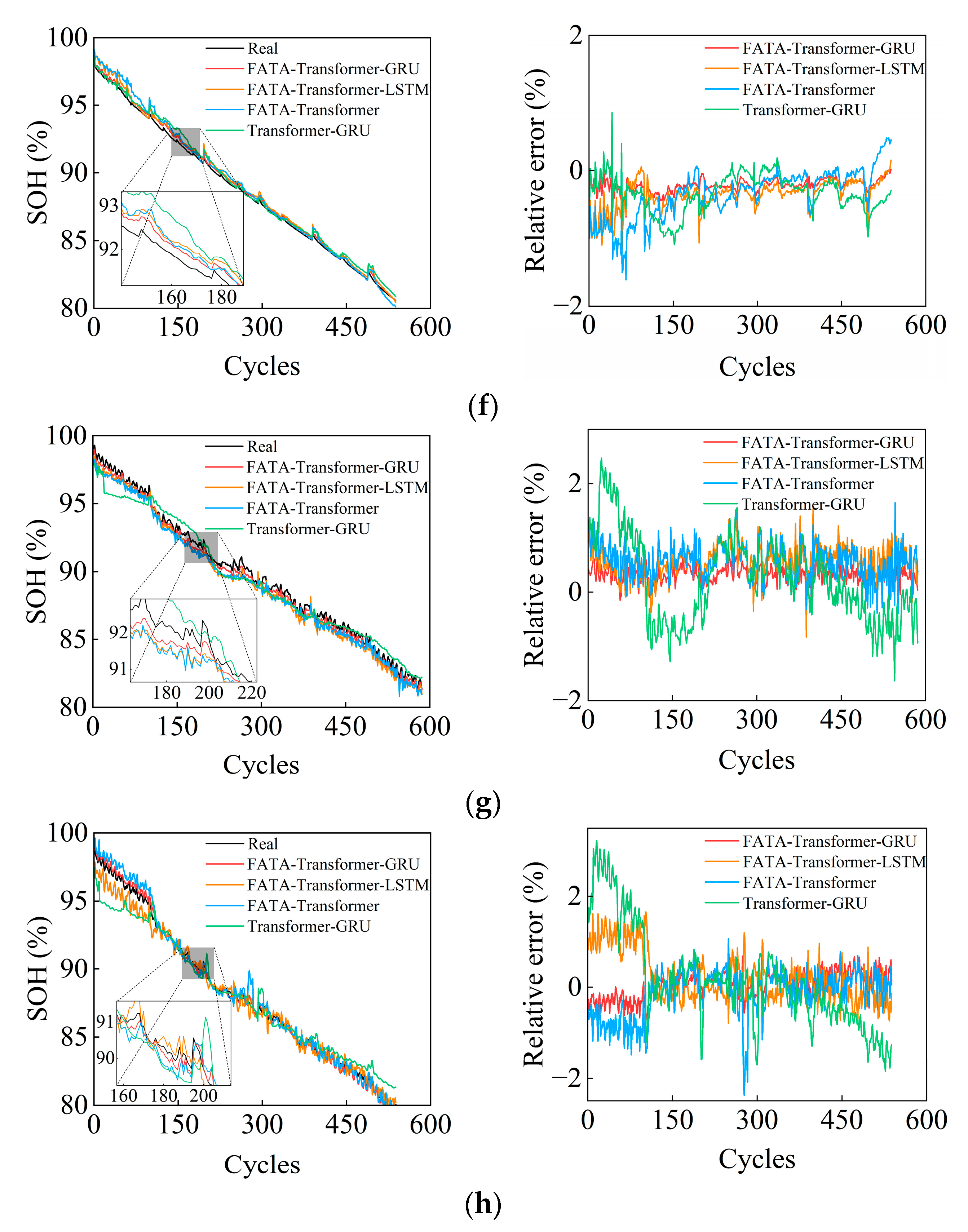
The ablation results on the laboratory-built dataset of batteries B1–B8 are shown in
Figure 9. As shown in the figure, the SOH of all batteries gradually degrades as the cycle number increases. All four compared models are able to generally track the true SOH variation trend. Among them, the estimation curve of the FATA–Transformer–GRU model aligns most closely with the true degradation curve. Especially during the mid-stage of battery aging, all models demonstrate reasonably good estimation performance, indicating that the selected health features effectively characterize capacity degradation behavior. Further analysis of the relative error curves shows that the proposed FATA–Transformer–GRU model achieves the smallest relative error throughout the aging cycle, with its absolute value consistently below 1%, demonstrating good stability and accuracy. The FATA–Transformer–LSTM model performs well in the mid-to-late aging stages, with error levels close to those of the proposed model, though its error is higher during early aging. The FATA–Transformer model only achieves low error on certain batteries (e.g., B7), while its error increases notably at capacity regeneration points in other batteries, reflecting limited generalization capability. In contrast, the relative error of the Transformer–GRU model is significantly higher than that of FATA–Transformer–GRU, and its error fluctuates considerably, failing to achieve reliable SOH estimation.
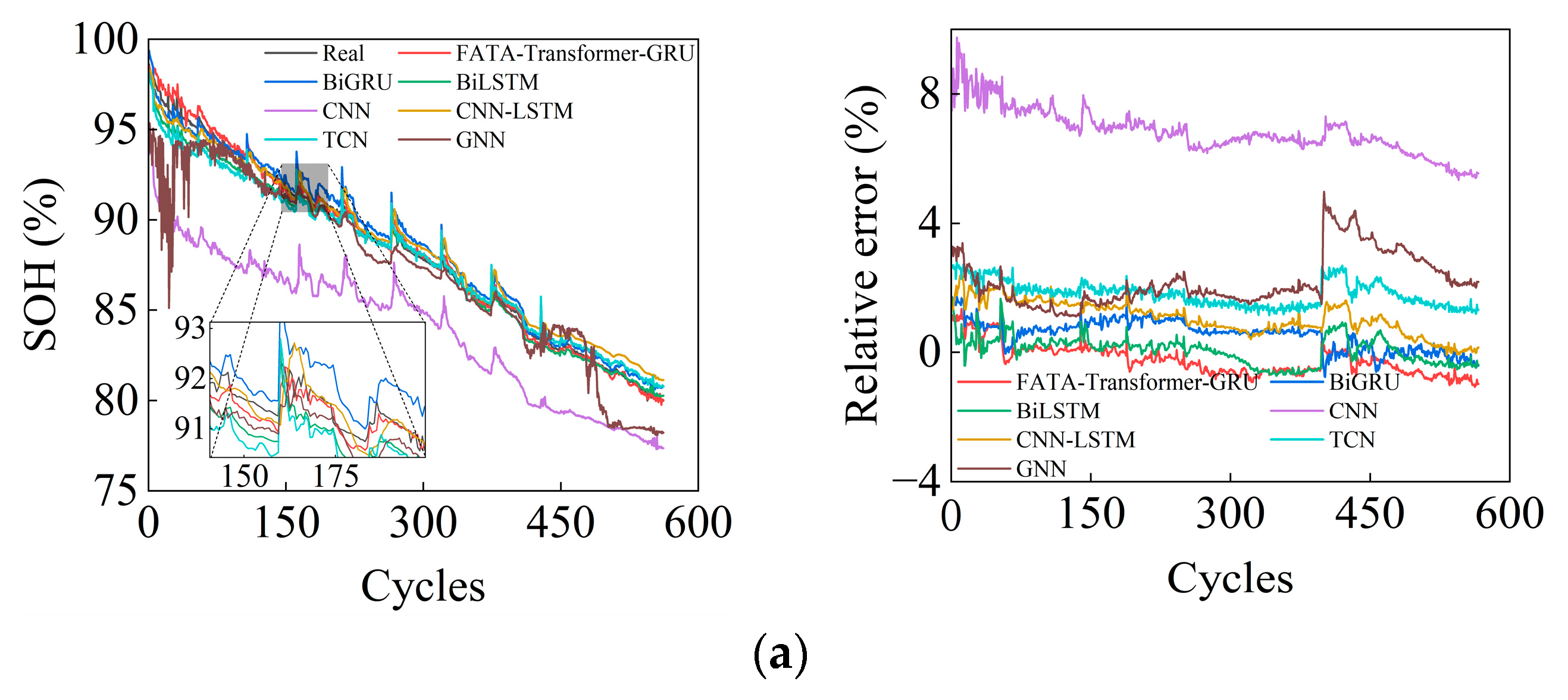
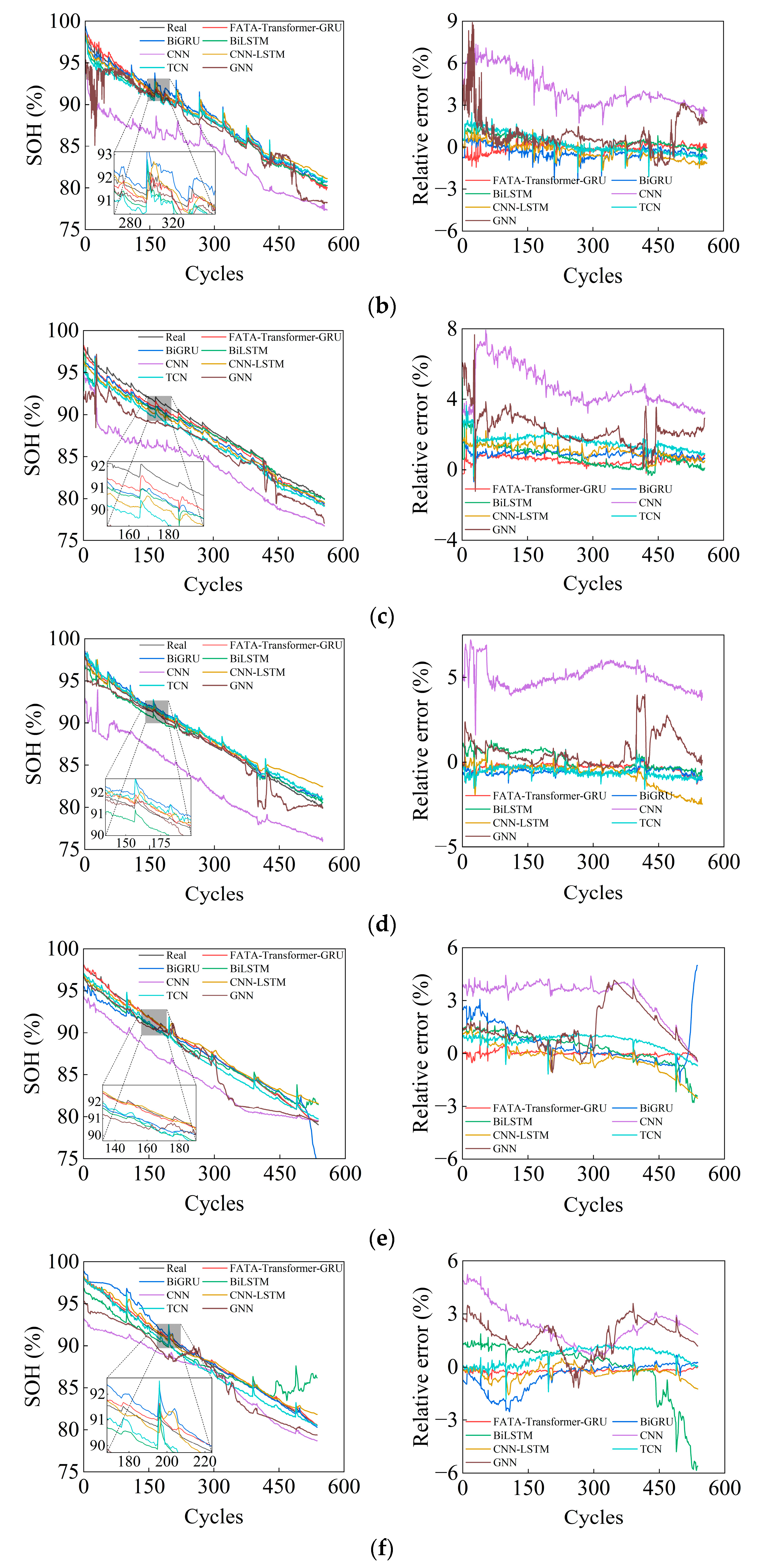
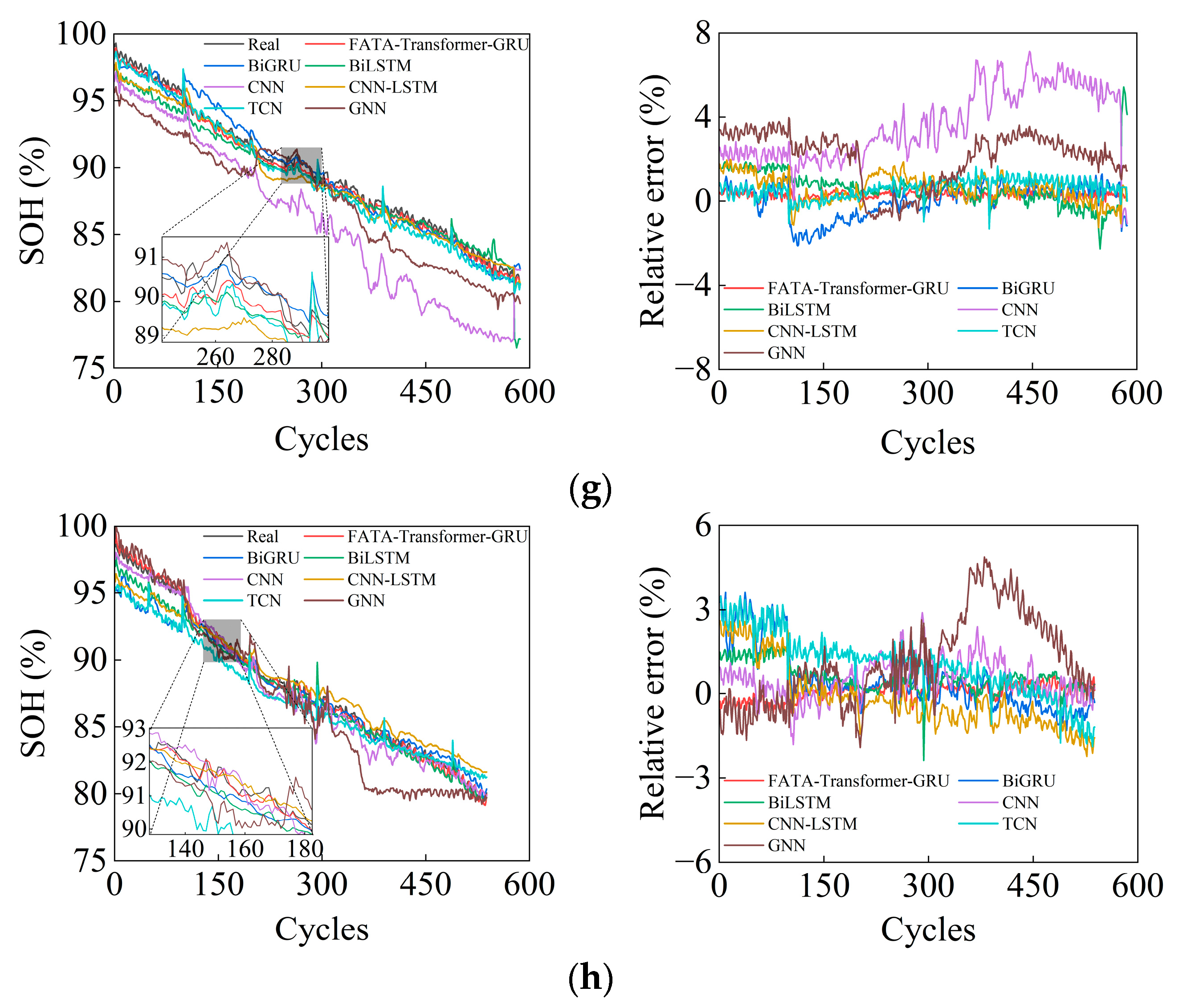
To further validate the performance advantages of the proposed model, we conducted a comparative analysis using BiGRU, BiLSTM, CNN, CNN-LSTM, TCN, and GNN as baseline models. The SOH estimation results of each model are presented in
Figure 10. The comparative results indicate that the estimation curve of the FATA–Transformer–GRU model aligns most closely with the true capacity degradation curve, demonstrating the best SOH estimation performance. Compared to the other baseline models, the proposed method maintains smaller estimation errors during both the early and later stages of battery aging, exhibiting more stable estimation and stronger overall robustness.
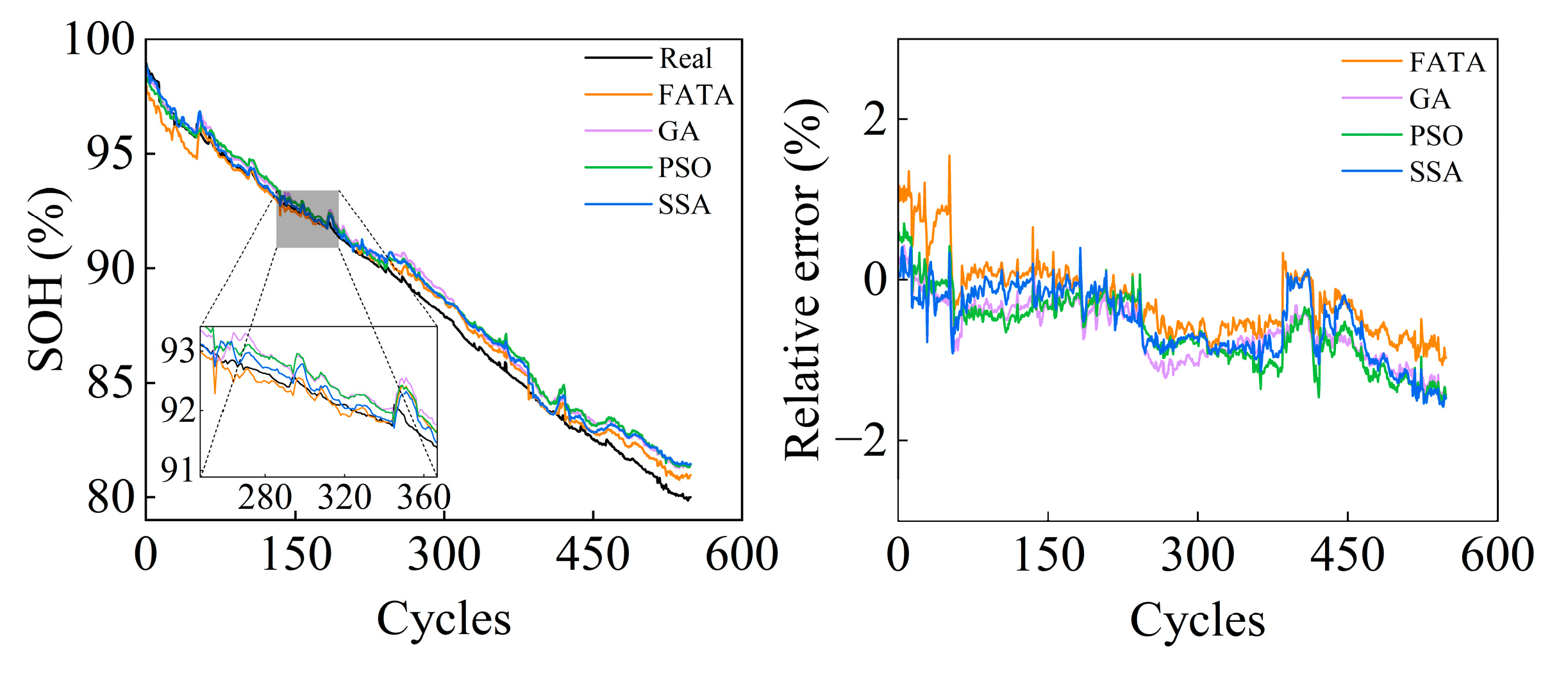
To further validate the effectiveness of the FATA algorithm in hyperparameter optimization, this study compares it with three commonly used metaheuristic optimization algorithms: GA, PSO and SSA. The experimental setup is as follows: the Transformer–GRU model structure is kept unchanged, and all four optimization algorithms search within the same hyperparameter space, with the validation set MSE serving as the optimization objective. The optimal hyperparameters obtained by each optimization algorithm are shown in the
Table 4.
Figure 11 illustrates the estimation results and relative errors of battery B1 under the four optimization algorithms, with the corresponding error metrics presented in
Table 5. It can be observed that in the early stage of battery aging, GA, PSO, and SSA achieve relatively good estimation results. However, as the charge–discharge cycles progress, the errors of these three methods gradually increase. Overall, the FATA algorithm yields the lowest estimation errors, with an MAPE of 0.4953% and an RMSPE of 0.6068%, significantly outperforming GA, PSO, and SSA. It is worth noting that while the ablation studies in
Section 4.2 have already demonstrated the superiority of the FATA–Transformer–GRU model over other model architectures, the comparative experiments in this section further reveal that even with the same Transformer–GRU model structure, the choice of optimization algorithm has a significant impact on estimation accuracy. This fully underscores the importance of selecting an appropriate hyperparameter optimization algorithm and validates the rationality of choosing FATA in this study.
In summary, this section addresses the problem of state of health estimation for lithium-ion batteries by constructing a hybrid neural network model, FATA–Transformer–GRU. Through systematic ablation studies and comparative experiments with multiple models, the proposed model demonstrates significant advantages in SOH estimation accuracy, exhibiting excellent estimation performance and strong generalization capability. It is worth emphasizing that, as a crucial component of the joint SOC-SOH estimation framework established in this paper, the SOH estimation results obtained in this section assume a key role in feedback correction. On one hand, they are employed to dynamically update the maximum available capacity
Qc in the SOC estimation model from
Section 3, thereby continuously mitigating the cumulative SOC error caused by aging throughout the battery’s lifecycle. On the other hand, these high-precision SOH results provide reliable inputs for the joint estimation validation in
Section 5, enabling a systematic evaluation of the closed-loop framework’s overall performance. Therefore, the FATA–Transformer–GRU model proposed in this section is not only an effective means to achieve high-precision SOH estimation, but also a core component in constructing a complete closed-loop framework for joint SOC-SOH estimation.
5. Analysis of SOC-SOH Joint Estimation Results
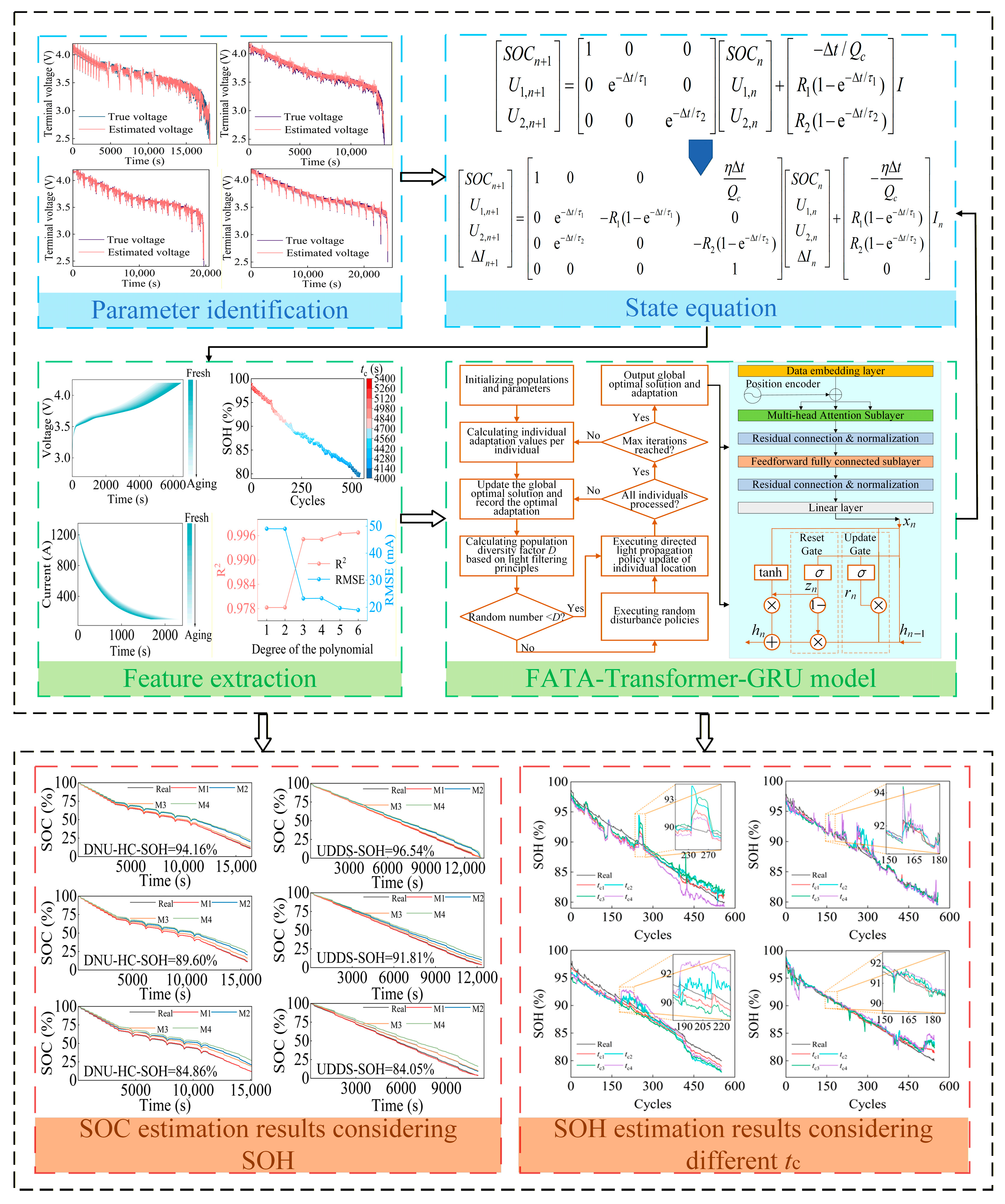
In the study of joint estimation of SOC and SOH for lithium-ion batteries, modeling and analysis were conducted based on a self-built experimental dataset. Most current SOC estimation methods treat the maximum battery capacity as a fixed value. However, in practical usage, battery capacity continuously declines with aging, leading to significant deviations between the theoretical charge/discharge rate and actual operating conditions. Therefore, the maximum capacity must be dynamically updated. For SOH estimation, the duration of the constant-current charging phase is selected as the key health indicator. While this parameter can be directly obtained from battery testing equipment under experimental conditions, it must be derived indirectly from SOC estimates in practical applications. This implies that the accuracy of SOC estimation directly affects the reliability of this health feature, thereby limiting SOH assessment performance. Given the aforementioned coupling relationship between SOC and SOH, a joint estimation framework is constructed in this work.
The joint framework is shown in the
Figure 12. The framework first improves SOC estimation accuracy by introducing bias correction during the constant-current phase and incorporating dynamic SOH calibration. Subsequently, high-precision SOC information is utilized to extract the constant-current charging time feature, which is then combined with a voltage fluctuation coefficient. These features are fed into a fused neural network based on FATA–Transformer and GRU to ultimately achieve robust SOH estimation. This framework fully exploits the interactive relationship between SOC and SOH, enabling their joint optimization and enhancing the reliability and adaptability of the estimation system in real-world applications.
5.1. SOC Estimation Considering SOH
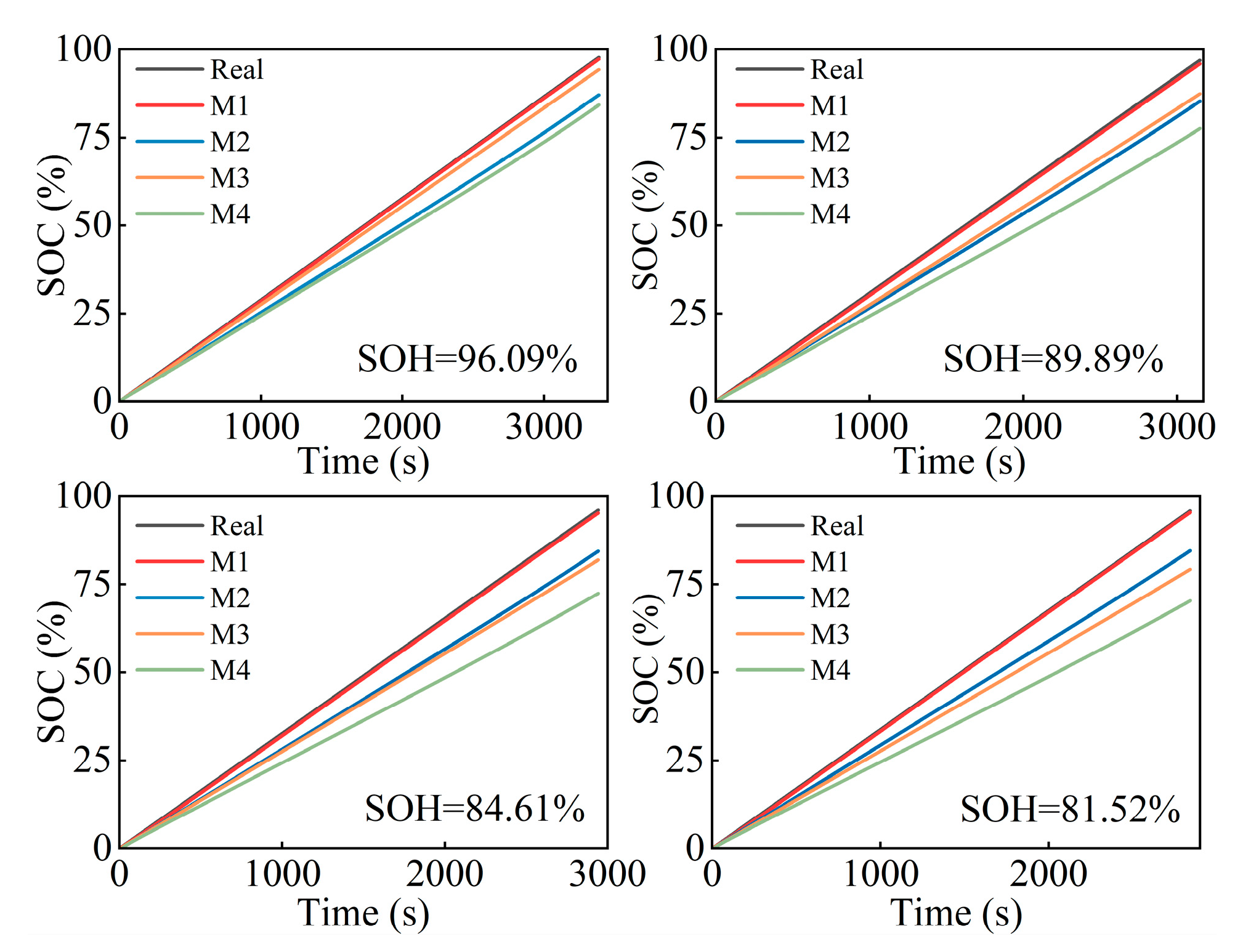
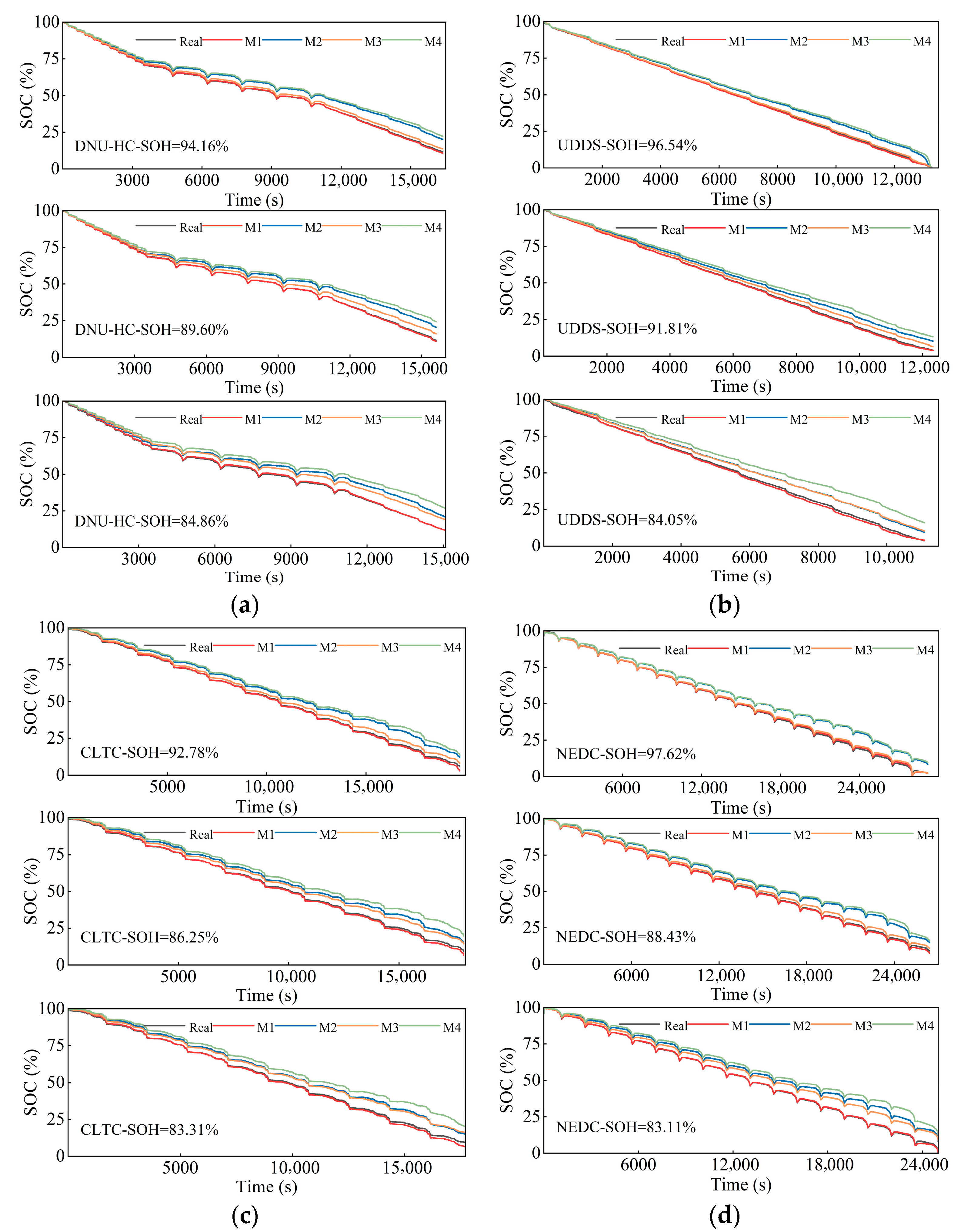
To systematically evaluate the improvement in SOC estimation accuracy achieved by the joint estimation method, experimental validation was conducted under both constant-current charging conditions and complex dynamic discharging conditions. For the purpose of analysis, four SOC estimation strategies are defined in this paper: M1 (joint estimation with bias compensation), M2 (joint estimation without bias compensation), M3 (standalone estimation with bias compensation), and M4 (standalone estimation without bias compensation). Among these, M1 represents the method proposed in this paper, while M4 denotes the conventional approach. Based on the aforementioned four estimation strategies, four constant current charging time features, denoted as tc1 to tc4, are further defined to represent the time required for the SOC estimated by M1–M4 to charge from 20% to full capacity, respectively.
Taking battery B1 as an example,
Figure 13 presents the SOC estimation results obtained by the four estimation strategies under constant current conditions at different aging stages. Analysis reveals that as the SOH decreases from 96.09% to 81.52%, the standalone estimation methods (M3 and M4) fail to account for the actual degradation of maximum capacity, leading to a continuous accumulation of SOC estimation errors and a progressively increasing deviation from the true values. In contrast, the M1 method, by dynamically updating the maximum available capacity online, maintains good agreement with the true values across different aging stages. Notably, the proposed M1 achieves the smallest estimation errors at all aging stages, thereby validating the dual effectiveness of the joint estimation framework and the bias compensation mechanism.
Specifically, with current bias compensation, the joint estimation reduced the final SOC errors by 2.98%, 8.52%, 13.47%, and 16.22% compared with standalone estimation across the four SOH levels. Moreover, within the joint estimation framework, the introduction of current bias compensation further reduced the final SOC errors by 10.17%, 10.64%, 10.89%, and 10.93% at the corresponding SOH levels compared to the case without compensation. Analysis of the error metrics shows that by simultaneously integrating dynamic maximum capacity correction and current bias compensation into the state equation, we can effectively improve SOC estimation accuracy. This enables SOC estimates to maintain good consistency with the true values across different battery health states.
To validate the applicability of the SOC estimation method under different scenarios, we conducted experimental evaluation using four typical dynamic driving cycles: DNU-HC, UDDS, NEDC, and CLTC. The SOC estimation results under four dynamic driving cycles at different SOH levels are presented in
Figure 14. As shown in the figure, compared with traditional standalone estimation methods, the proposed joint estimation method dynamically identifies the parameters of the second-order RC equivalent circuit model based on the battery SOC state and cycling process. Simultaneously, the maximum usable capacity is updated in real time as battery aging progresses, enabling high estimation accuracy to be maintained even as SOH continuously declines. Furthermore, by incorporating a current bias compensation term into the model, the estimated SOC values under all driving cycles closely align with the true values, with overall estimation deviation consistently maintained within a low range.
The experimental results demonstrate that integrating a joint estimation framework with current bias compensation effectively reduces SOC estimation errors caused by capacity degradation and bias noise across different aging stages of lithium-ion batteries, while significantly improving the stability and adaptability of state estimation. These findings are supported by comparative experiments under constant-current charging and four dynamic discharging conditions, which evaluated standalone estimation, joint estimation, and the effect of including or excluding current bias compensation.
5.2. SOH Estimation for Different tc
Under practical non-experimental conditions, the time required to charge from 20% SOC to full capacity, denoted as
tc, must be indirectly obtained through SOC estimates. To verify the necessity of SOC estimation accuracy for reliable SOH estimation and to evaluate the effectiveness of the proposed joint SOC-SOH estimation method, this section conducts a comparative analysis of SOH estimation accuracy using the four time characteristics defined in
Section 5.1.
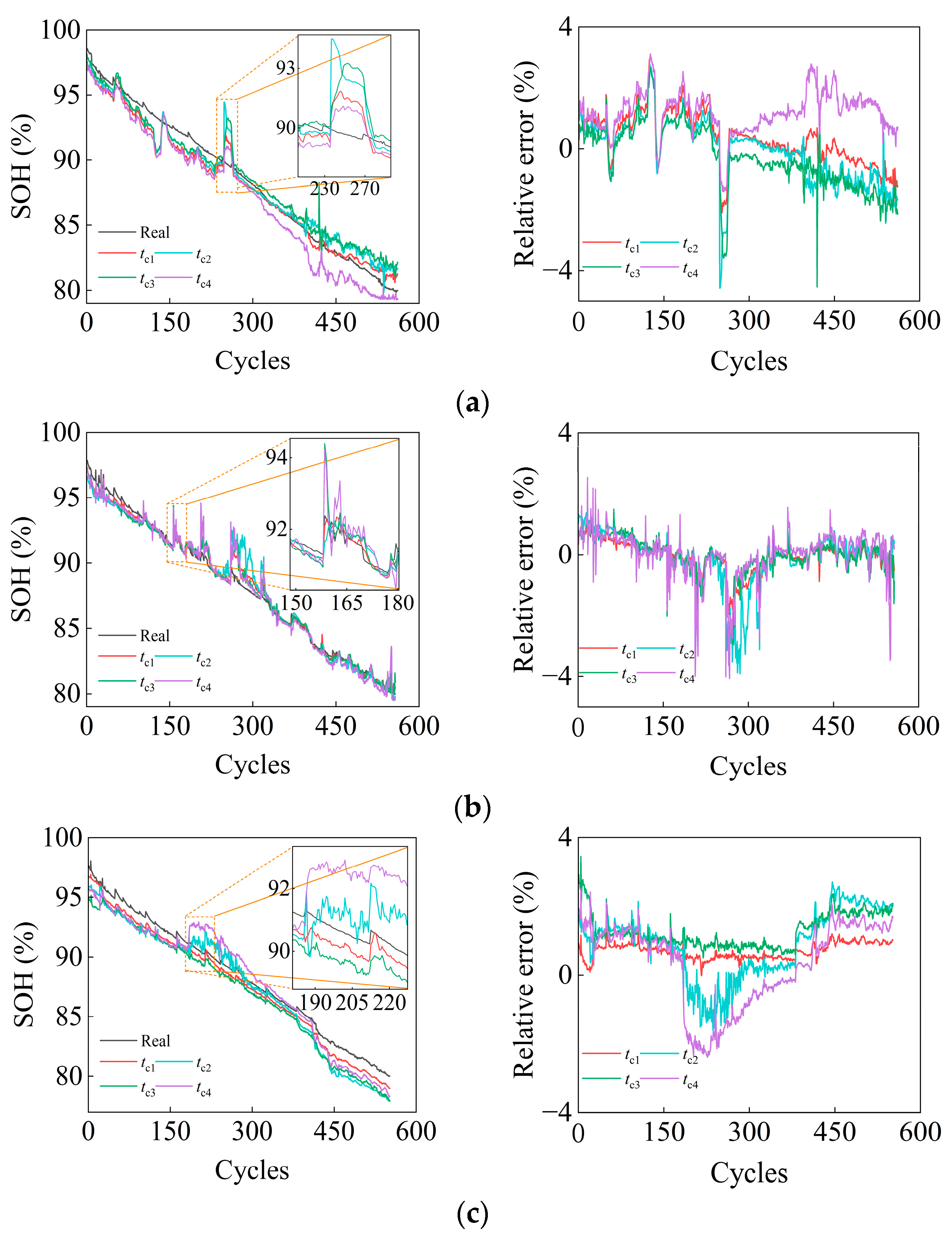
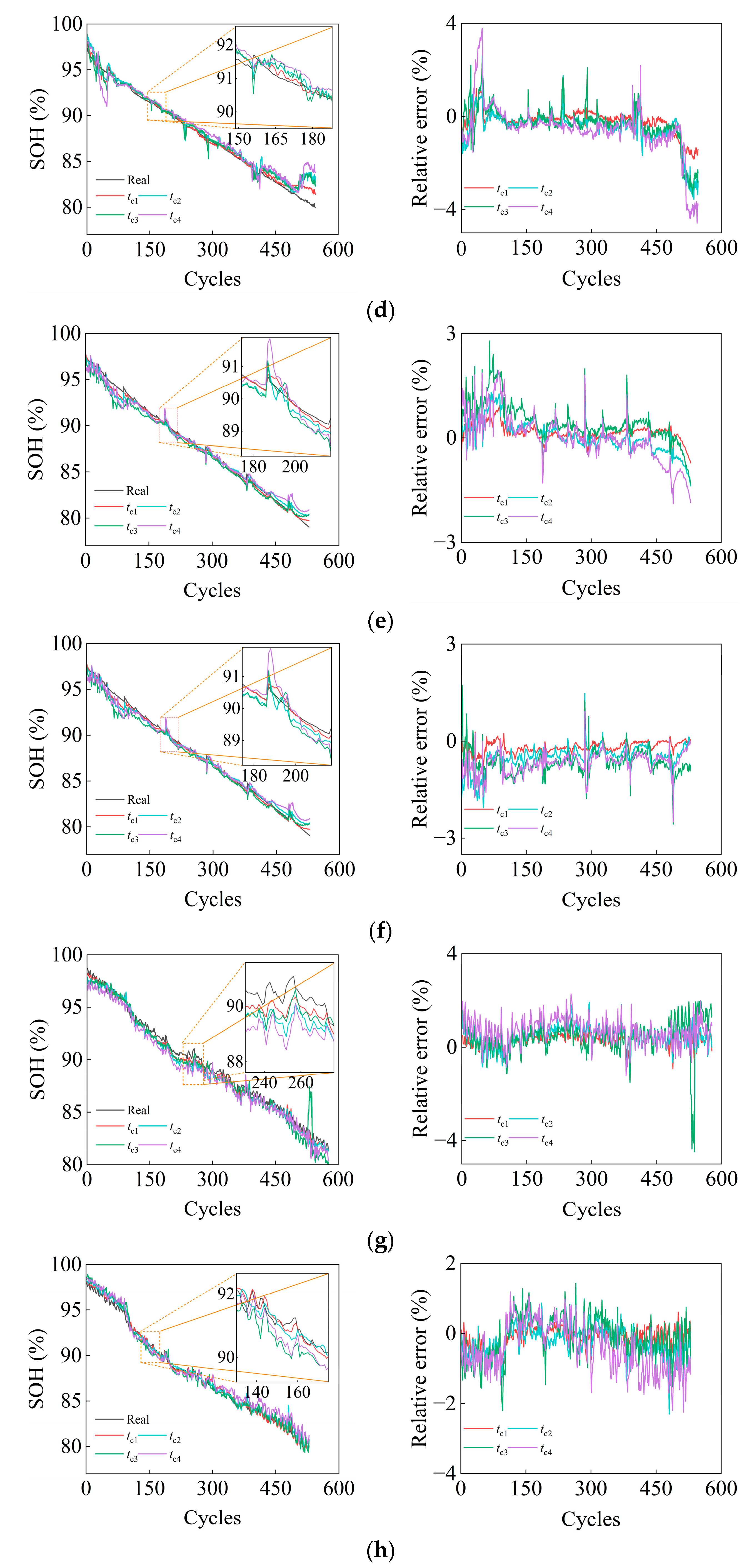
Figure 15 presents the SOH estimation results and relative errors for the eight batteries under the four time characteristics, with the corresponding numerical errors listed in
Table 6. When
tc1 is used as the health feature, SOH estimation accuracy is significantly better than that obtained with the other three features. Taking Battery B3 as an example, the MAPE and RMSPE of SOH estimation are 0.7972% and 0.8442%, respectively, when
tc1 is employed. In contrast, both error metrics exceed 1.2% when
tc2,
tc3, or
tc4 are used. The analysis shows that SOH estimation errors based on
tc1 are markedly lower than those based on the other three time features, and the estimation results align more closely with the true values. If aging and bias compensation are not considered in SOC estimation, the resulting decline in accuracy directly leads to poor performance of the extracted time feature in SOH estimation. These results indicate that high-precision SOC estimation is a crucial prerequisite for accurate SOH estimation. The proposed joint estimation method, which simultaneously integrates aging correction and bias compensation, effectively enhances the final accuracy of SOH estimation.