1. Introduction
Data centers are rapidly becoming industrial-scale electricity consumers. The International Energy Agency (IEA) estimates global data center electricity use at approximately 415 TWh in 2024, roughly 1.5% of global electricity, and projects it to more than double by 2030. While the global share remains modest, the operational impacts are highly local and concentrated, and the central constraint is increasingly not generation alone but delivering reliable power at speed, through adequate grid connection capacity and flexibility [
1,
2]. In this context, AI-focused facilities are best understood not as conventional IT loads, but as large, reliability-sensitive industrial plants whose growth can expose grid bottlenecks and infrastructure lead-time risks.
In parallel, green hydrogen systems are scaling and are similarly constrained by the availability of abundant, low-carbon electricity. This creates a natural question at the energy-system level: can reliability-driven computing loads and flexibility-seeking electrolysis loads be co-designed as a single integrated hub, sharing renewable generation and firming assets, while improving utilization of capital-intensive equipment? Conceptually, schedulable compute can absorb periods of high renewable output that would otherwise be curtailed, while export-linked hydrogen offtake can pull electrolyzer operation beyond surplus-only hours. If data center waste heat can be recovered into an industrial heat sink, the integration tightens further.
Saudi Arabia presents a particularly compelling setting for this question. The Kingdom’s National Energy Strategy targets 130 GW of renewable capacity by 2030, with solar bids as low as 1.04 cents/kWh already on record [
3]. On the hydrogen side, Neom’s 2 GW electrolysis project backed by 4+ GW of dedicated renewables is the most advanced Gulf example [
4]. On the computing side, the HUMAIN initiative has attracted partnerships from NVIDIA, Amazon Web Services, AMD-Cisco, and Blackstone-AirTrunk, collectively exceeding 5 GW of planned data center capacity [
3,
5,
6,
7,
8,
9,
10]. Both buildouts are proceeding in parallel, competing for the same renewable electricity, yet no existing optimization framework jointly captures flexible compute demand, PV–battery dispatch, Proton Exchange Membrane (PEM) electrolysis, and data center waste heat recovery under an explicit hydrogen export pathway.
1.1. Multi-Energy Systems and Energy Hubs
The energy hub concept arose from a practical need: electricity, heat, and fuel networks share conversion and storage assets, and planning them separately misses cross-vector savings. Geidl and Andersson [
11] established the foundational multi-carrier optimal power flow formulation, enabling coordinated optimization across energy vectors within a unified framework. Mancarella broadened this into the multi-energy systems (MES) paradigm, offering an integrated view of multi-vector infrastructures, converters, and storage that directly links modeling choices to cross-sector decarbonization potential [
12]. Subsequent work by Orehounig et al. demonstrated neighborhood-scale applications achieving 64–92% energy autonomy, with CO
2 emissions varying between 52 and 98 tons per year depending on the technology mix [
13].
As MES research matured toward industrial applications, the focus shifted from demonstrating that energy carriers can be coupled to measuring how much integration actually saves and what trade-offs appear at scale. Taqvi et al. demonstrated refinery-wide multi-energy hub integration, reporting that low-emission configurations could cut CO
2 by approximately 9.8 kilotons at modest additional cost [
14]. Terlouw et al. showed that an optimally designed MES on the Norwegian island Eigerøy achieved 73% GHG emission reduction and 92% natural gas displacement with only 18% cost increase, while identifying that technology construction phases can contribute up to 80% of certain life-cycle environmental impacts [
15]. Both studies confirm that deep industrial decarbonization is technically feasible. The economics, however, depend on how effectively multi-grade heat, storage, and external revenue streams are managed within the operating strategy [
16]. Lu et al. provide a comprehensive review of hydrogen energy chain planning within multi-energy systems, covering production, compression, storage, transport, and application links [
17]. Their survey of over 100 studies confirms that collaborative planning improves renewable integration and cross-sectoral synergies, yet none of the reviewed works incorporate computing infrastructure as an active participant in dispatch optimization.
The gap is notable. Industrial energy hub studies have evolved from conceptual multi-carrier formulations to facility-scale planning with real cost and emissions numbers, yet they remain focused on coordinating energy carriers and process loads. A rapidly growing industrial actor, the Artificial Intelligence High-Performance Computing (AI/HPC) data center, which functions simultaneously as a flexible electrical demand and a concentrated, recoverable heat source, has not been incorporated into these frameworks.
1.2. Green Hydrogen Production Economics
Hydrogen techno-economics have converged on several dominant cost drivers: electrolyzer capital expenditure, electricity price (or its opportunity cost), and, critically, the capacity factor, which governs how fixed costs are spread across production volume. Saba et al. documented a narrowing of electrolyzer investment cost estimates from 306–4748 EUR/kW in the 1990s to 397–955 EUR/kW for 2030 projections, establishing a foundational benchmark for LCOH studies [
18]. The U.S. Department of Energy reports a current PEM electrolyzer LCOH of 5–7 USD/kg on the basis of installed capital costs averaging 2000 USD/kW, renewable electricity costs near 0.03 USD/kWh, and capacity factors of 50–75% [
19].
PEM electrolyzer economics depend on a trade-off: lower current densities extend stack life and raise efficiency, but reduce throughput per unit of installed capacity [
20]. This tension is particularly acute in renewable-dominated systems, where intermittent generation limits the hours available for electrolysis and raises a practical design question: whether capacity factor is best improved by oversizing the renewable supply, adding electrical storage, importing grid power, or developing new hydrogen offtake streams that pull electrolyzer dispatch beyond surplus-only hours.
Regional context amplifies these dynamics. Saudi Arabia simultaneously offers globally competitive renewable electricity and ambitious export strategies. The NEOM Green Hydrogen Project, scheduled for commissioning in 2027, will deploy over 2 GW of electrolysis capacity powered by 4+ GW of dedicated renewables to produce 600 tons per day of green hydrogen, with downstream conversion to 1.2 million tons per year of green ammonia for marine export [
4]. Export-linked utilization is no longer a theoretical sensitivity parameter; it is being built at infrastructure scale. Regional techno-economic analyses report a green hydrogen LCOH of 4.23 USD/kg (PV) to 4.95 USD/kg (CSP) for a 1 MW Solid Oxide Electrolysis Cells (SOEC) system in Dhahran, providing a site-specific benchmark against which hub-integrated production costs can be compared [
21].
While electrolyzer costs and PEM performance roadmaps are increasingly well-characterized, the techno-economic literature typically assumes utilization and offtake conditions as exogenous inputs rather than endogenously optimized variables. Cross-sector coupling, for example pairing electrolysis with flexible demand sources and export sinks that can “pull” dispatch toward higher capacity factors, remains largely unexplored.
1.3. Data Center Energy Systems
AI and HPC data centers have crossed the threshold from IT infrastructure to industrial-scale electricity consumers. As accelerator counts per server increase, rated power can exceed 10 kW for eight-accelerator configurations compared with under 2 kW for two-accelerator servers [
1], and individual hyperscale facilities are now routinely planned at 100 MW or above. Power usage effectiveness (PUE), remains the core operational metric, and a growing body of work now frames energy management around data center operations as a distinct optimization problem [
22].
Waste heat recovery from data centers offers a measurable economic benefit that has attracted growing research attention, and recent reviews have synthesized the available recovery technologies and their performance trade-offs [
23,
24]. Ebrahimi et al. established the technological basis for data center cooling and identified low-grade waste heat as a recoverable resource [
25]. Wahlroos et al. advanced this into engineering–economic territory, reporting waste heat utilization rates exceeding 95% across pricing scenarios in Nordic district heating integration, with heat pump COPs of 3.0–6.3 enabling temperature lifts from data center output (25–60
°C, depending on cooling technology) to usable thermal supply [
26]. Wang et al. [
27] and Tervo et al. [
28] confirm that waste heat recovery delivers material operational savings, with cost reductions of 0.6–7.3% in district heating applications, although only when heat sinks, temperature requirements, and infrastructure are co-designed.
Beyond thermal integration, carbon-aware computing provides a second source of operational flexibility that can interact with energy system dispatch. Nkwawir et al. demonstrated carbon-aware workload management achieving up to 35% daily CO
2 reductions and 44% energy cost reductions when data centers participate in district heating networks under carbon-aware Mixed-Integer Linear Programming (MILP) dispatch [
29]. Radovanovic et al. [
30] and Rodrigues et al. [
31] further establish that data centers are not fixed loads but operationally flexible assets whose scheduling can interact productively with energy system dispatch.
A separate line of work has begun coupling hydrogen systems directly with data center power supply, though without reaching the level of integration pursued here. Chen et al. proposed a PV–PEM–PEMFC polygeneration system with absorption cooling for a single data center, demonstrating waste heat utilization from fuel cells and electrolyzers but without dispatch optimization or export pathways [
32]. Liu et al. optimized a wind–solar–diesel–hydrogen system for off-grid data center reliability, exploring hydrogen as surplus energy storage, though without industrial hub integration or multi-sink hydrogen allocation [
33]. Newkirk et al. developed a techno-economic framework comparing AC-coupled, DC-coupled, and natural gas microgrids for AI data centers across the continental U.S., finding that DC-coupled solar reduces costs by 17%; however, their analysis considers standalone facilities without hydrogen integration or industrial co-location [
34].
Despite this growing body of work, most studies optimize data center operations against an external energy system (grid or district heating) rather than treating the data center as an endogenous component of an industrial multi-energy hub that simultaneously co-produces electricity, hydrogen, and useful heat.
1.4. The Gap
At the intersection of these three research streams, targeted work exists but stops short of the coupling this paper quantifies. Celestine et al. discussed hydrogen for data centers primarily as an energy storage and reliability pathway [
35], which is adjacent to integration but does not optimize electrolysis as a co-product system tied to export value and hub-level dispatch. The DC-IES and carbon-aware MILP literatures demonstrate substantial cost and emissions improvements, yet they exclude renewable-to-hydrogen conversion with explicit export sinks that reshape electrolyzer utilization economics.
No existing study has optimized the operational coupling between (i) flexible AI/HPC compute demand, (ii) PV–battery dispatch, (iii) PEM electrolyzer operation, (iv) waste-heat-to-industrial-heating recovery, and (v) an explicit hydrogen export pathway to ammonia and methanol markets. Nor has prior work quantified the resulting economic synergies, specifically electrolyzer capacity factor uplift and LCOH reduction, within a single unified MILP hub framework.
The reason is disciplinary. Data centers sit in computer systems and facilities engineering. Hydrogen techno-economics sit in chemical and energy engineering. Multi-energy system optimization sits in power systems. Each field carries its own datasets, objective functions, and boundary conventions. Bridging the three requires a formulation that treats compute, power, and hydrogen as jointly optimized decision variables under one objective function.
Table 1 summarizes the modeling approaches, scope, and limitations of representative studies. No prior work combines calibrated commercial-tool sizing with MILP-based operational optimization for a multi-sink hydrogen hub co-located with a data center.
1.5. Research Question and Contributions
This study tests whether co-locating a renewable hydrogen hub with an AI/HPC data center can raise electrolyzer utilization, monetize waste heat, and reduce the levelized cost of hydrogen, and identifies the export and operational conditions under which these benefits materialize.
The question is particularly timely for Yanbu. Beyond being an established industrial city, Yanbu is emerging as a giga-scale green hydrogen export location: recent project disclosures describe the Yanbu Green Hydrogen Hub as a 10 GW dedicated wind–solar development coupled to 4.0–4.4 GW of electrolysis, targeting roughly 400,000 t/yr of green hydrogen and 2.2–2.5 Mt/yr of green ammonia for export [
4,
36]. Together with NEOM, these Red Sea coast developments position Saudi Arabia to supply an estimated 10% of global hydrogen exports by 2030.
This paper addresses the question above by developing a unified optimization framework for an integrated renewable–hydrogen–data center hub, using Yanbu Industrial City as a case study. The specific contributions are:
A single MILP formulation that co-optimizes PV generation, battery storage, PEM electrolysis, data center critical versus flexible demand, waste heat recovery, and a hydrogen export pathway within one consistent framework.
Quantification showing that export-driven coupling raises electrolyzer capacity factor from 8.65% to 24.3% and reduces LCOH from 10.5 to 6.8 USD/kg.
Demonstration of system-level integration value: 8.2% annual cost savings (36.9 M USD/yr) and 28% emissions reduction versus a separate-build counterfactual.
Identification of battery storage as the dominant cost–carbon lever, with removal increasing LCOE by 250% and CO2 emissions by a factor of 1510.
Generalizable design principles for industrial energy hub planners considering data center co-location in high-solar regions with hydrogen export ambitions.
2. Materials and Methods
The analysis employs a two-layer workflow to size and operate a large-scale industrial multi-energy system (MES) in Yanbu, Saudi Arabia, and then extend it into an integrated energy–compute–hydrogen hub. HOMER Pro is used first for capacity sizing and dispatch-based benchmarking. The Pyomo optimization model is then calibrated against the HOMER baseline and extended to represent data center flexibility, multi-sink H2 allocation, and low-temperature waste heat integration.
The methodological design draws on the Smart Energy Systems paradigm, which represents a shift from single-sector optimization to coherent multi-vector energy systems understanding [
37]. Unlike Smart Grid approaches that address the electricity sector in isolation, the Smart Energy Systems framework integrates electricity, heating, cooling, industry, and transportation, enabling the identification of more affordable decarbonization pathways through sector coupling. The MILP formulation adopted in this study accordingly follows established practice in multi-carrier energy system optimization [
38], employing the energy hub concept to model input–output relationships via coupling matrices that capture conversion efficiencies across electricity, heat, cooling, and hydrogen vectors.
2.1. Case Study and System Boundaries
2.1.1. Yanbu Industrial Context
Yanbu is a major Saudi industrial and logistics hub on the Red Sea coast, hosting refineries, petrochemical complexes, and emerging digital infrastructure. The case study represents a large-scale industrial park MES designed to supply electricity, low- and high-temperature heat, and hydrogen for domestic use, with optional export pathways when the integrated hub module is active. Prior work on this site established a HOMER Pro baseline for a hybrid PV–wind–battery–hydrogen microgrid serving Yanbu’s industrial demand, reporting a net present cost of 10.6 billion USD and an LCOE of 0.15 USD/kWh [
39]. Separately, a regional renewable integration analysis for Saudi Arabia’s Vision 2030 targets documented solar electricity costs as low as 1.04 cents/kWh and wind at 1.33 cents/kWh [
3]. The present study extends both contributions by replacing the single-technology HOMER sizing with a calibrated Pyomo MILP that adds data center load integration, multi-sink hydrogen export allocation, and waste heat recovery.
2.1.2. System Boundaries
The system boundaries are defined along four dimensions. The spatial boundary encompasses an electrically islanded system serving Yanbu industrial loads; grid interconnection is excluded to isolate the value of integrated renewable–storage–hydrogen infrastructure, following established practice in industrial microgrid and off-grid H
2 hub studies [
40,
41]. The temporal boundary covers a single representative year (8760 h) using Yanbu typical meteorological year (TMY) solar data. The cost boundary expresses all values in 2024 USD at a real discount rate of 8% with a zero-inflation assumption [
42]. The product boundary defines four system outputs: (i) electricity to industrial loads, (ii) low- and high-temperature heat, (iii) hydrogen for domestic industrial use, and (iv) hydrogen derivatives (ammonia, methanol) for export when the integrated hub module is active.
2.1.3. Demand Magnitudes
Baseline annual demands adopted in both modeling layers are:
Electricity load: 5.29 TWh/yr (peak demand 1640 MW)
Industrial thermal demand: 8.76 GWhth/yr (60% low-temperature <150 °C, 40% high-temperature)
Domestic hydrogen demand: 25.55 M kg/yr
Total hydrogen production in the Original scenario (26.17 M kg/yr) slightly exceeds the stated domestic demand to maintain minimum tank inventory levels and accommodate hourly demand variability.
2.2. HOMER Pro Baseline Model
2.2.1. Components and Operating Logic
The HOMER Pro baseline co-optimizes and dispatches the following assets: flat-plate PV, lithium-ion battery storage, bidirectional AC–DC converter, PEM electrolyzer, steam methane reformer (SMR), pressurized H2 tank, H2 reciprocating genset, natural gas genset (NGG), and NG boiler.
2.2.2. Baseline Scenarios
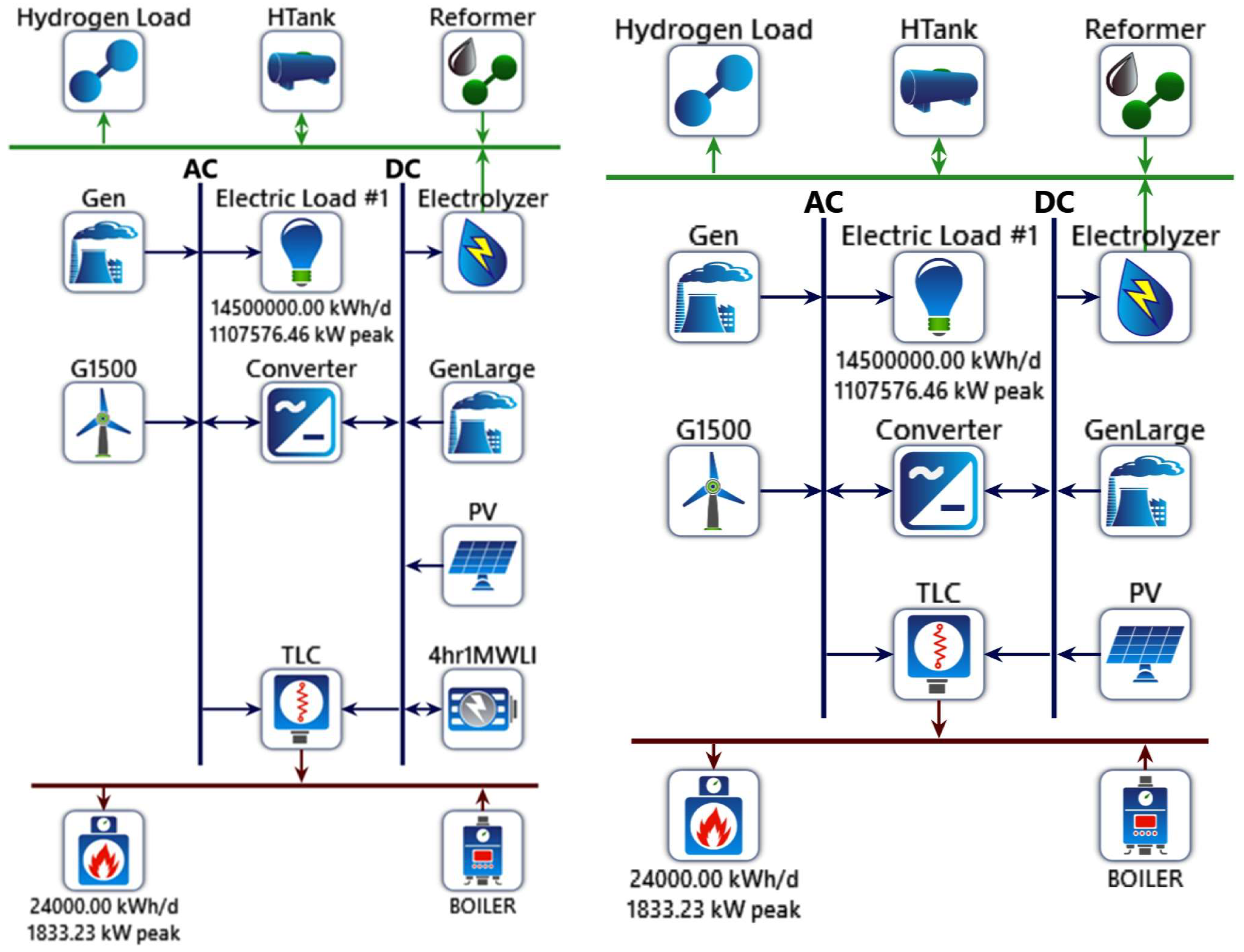
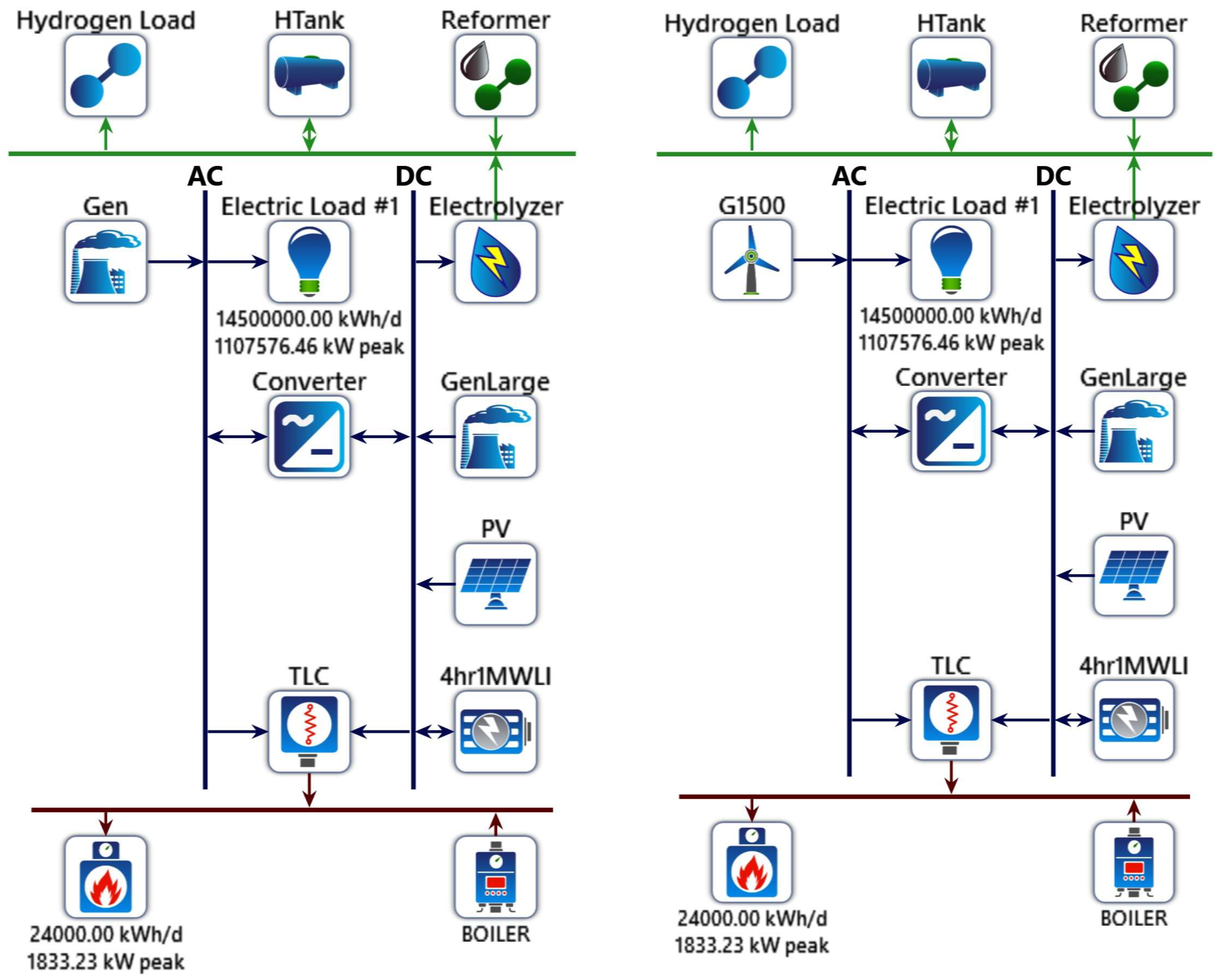
Four baseline scenarios were defined using HOMER-optimized capacities (
Figure 1):
Original (PV–Battery–H2): PV 3790 MW; battery 33.5 GWh; electrolyzer 600 MW; H2 tank 500 t; H2 genset 800 MW; NGG installed but operationally idle.
No-Wind: PV 3698 MW; battery 39.4 GWh; electrolyzer 500 MW. Removing wind triggers an 18% increase in battery capacity.
Non-Battery: PV 691 MW; no battery; electrolyzer 500 MW; NGG 1400 MW.
No-NGG: Identical to Original but with NGG capacity set to zero.
2.3. Mathematical Formulation
The optimization model minimizes total annualized system cost subject to energy balance, storage dynamics, capacity limits, and operational constraints [
43].
2.3.1. Sets and Indices
t ∈ T = {1, 2, …, 8760}: Hourly time steps
d ∈ D = {1, 2, …, 365}: Daily index for flexible compute
k ∈ K: Technology set {PV, bat, conv, ely, SMR, tank, H2G, NGG, boi}
s ∈ S: Hydrogen sink set {dom, NH3, MeOH}
b ∈ B: Heat band set {low, high}
2.3.2. Efficiency Conventions
All efficiencies are reported on a lower heating value (LHV) basis:
The specific energy consumption (SEC) converts electrical input to hydrogen mass output:
2.3.3. Capital Recovery Factor
The capital recovery factor (
CRF) annualizes upfront investment over the project lifetime:
For r = 0.08 and N = 25 years: CRF = 0.0937.
2.3.4. Objective Function
The objective function minimizes total annualized system cost, balancing capital investment, operating expenditure, fuel costs, and export revenues:
The objective function includes annualized capital costs, fixed and variable O&M, fuel costs, carbon price terms, penalty costs for unmet demand (electricity, thermal, and compute), and a revenue credit for hydrogen derivative exports (NH
3 at
$3.0/kgH
2, MeOH at
$2.5/kgH
2) [
52,
53,
54].
2.3.5. Electricity Balance
Baseline MES (without data center):
Electricity supply must equal or exceed demand plus storage charging, electrolysis, and curtailment in every hour:
Extended MES (with data center):
When the data center is active, its critical and flexible loads (multiplied by PUE) enter the electricity balance:
where PUE = 1.40, consistent with modern hyperscale facilities [
34].
2.3.6. Battery Storage Constraints
Battery state of charge tracks hourly charging and discharging, accounting for one-way efficiencies:
State of charge dynamics:
Operating limits and cyclic condition:
Power and energy limits prevent over-charging and deep discharge, and the cyclic boundary condition ensures that year-end storage equals the starting level:
2.3.7. Hydrogen System Constraints
Electrolyzer hydrogen output is set by the electrical input divided by the specific energy consumption:
The hydrogen tank mass balance tracks inflows from electrolysis and reforming against outflows to sinks and the genset:
Reformer hydrogen output depends on natural gas input, the gas LHV, and the SMR efficiency:
2.3.8. Thermal Balance Constraints
Low-temperature heat balance with waste heat recovery:
Low-temperature heat demand is met by a combination of recovered data center waste heat and boiler output:
Waste heat availability limit:
The available waste heat is limited by the data center IT load and the recovery fraction:
where
ηwaste = 0.40 and
ηnet = 0.92 [
55].
High-temperature heat demand is met entirely by the boiler, as data center waste heat temperatures (35–50 °C) are insufficient for direct high-temperature supply.
2.3.9. Flexible Compute Constraints
Daily completion requirement:
Flexible compute must complete a fixed daily energy budget, allowing the optimizer to shift GPU workloads to solar-rich hours:
The flexible load has a daily energy target of
= 480 MWh/day, corresponding to a 20 MW average over 24 h, bounded instantaneously by
Pₜᴰᶜ
,ᶠˡᵉˣ = 30 MW. This reflects the assumption that schedulable AI training and HPC batch workloads occupy approximately two-thirds of the flexible cluster’s nameplate capacity on average [
56].
2.4. Calibration Against HOMER Pro
The Pyomo model was calibrated by synchronizing (1) identical hourly load profiles, (2) identical Yanbu TMY solar resource assumptions, and (3) identical techno-economic inputs.
Table 2 shows calibration targets for the Original scenario.
2.5. KPI Definitions
Net Present Cost (NPC)
The net present cost converts the annualized total cost back to a present-value basis:
Levelized Cost of Electricity (LCOE)
The levelized cost of electricity divides total annualized cost by total served electrical demand:
Levelized Cost of Hydrogen (LCOH)
The levelized cost of hydrogen attributes electrolyzer, reformer, and storage costs to total hydrogen output:
where
is decomposed as:
with:
(electrolyzer CAPEX + electricity at opportunity cost)
(SMR CAPEX + O&M + fuel)
(storage CAPEX)
Levelized Cost of Heat (
)
When waste heat is available, it displaces a portion of the low-temperature boiler load, reducing gas consumption according to:
Levelized Cost of Storage—Battery ()
The battery levelized cost of storage divides annualized battery costs by total discharge energy:
Levelized Cost of Electricity from Hydrogen Reconversion ()
The round-trip cost of storing electricity via the hydrogen pathway (electrolysis → storage → genset) includes electrolyzer, tank, and genset contributions:
where
, and
is the fraction of electrolyzer output used for reconversion.
Levelized Cost of Compute ()
The levelized cost of compute normalizes data center costs by total GPU-hours delivered:
where
GP = 667 GPU-hr/MWh, derived from NVIDIA H100 power consumption (1.5 kW per GPU, yielding 1000/1.5 ≈ 667 GPU-hr per MWh of IT load). The denominator uses nameplate IT capacity (60 MW × 8760 h × GP = 350.4 M GPU-hr/yr), representing the full annual compute potential of the installed infrastructure.
includes annualized infrastructure CAPEX, IT equipment CAPEX, fixed O&M (3% of total CAPEX), and the electricity cost allocated to the data center at the system LCOE.
The 23% reduction in for the Integrated Hub (0.042 vs. 0.055 USD/GPU-hr) reflects three mechanisms: shared PV/battery infrastructure (−12% total RE capacity vs. separate builds), avoided transmission costs from co-location, and temporal coordination between compute scheduling and renewable availability that reduces effective electricity cost.
2.6. Core Assumptions
Technology cost inputs, including capital, replacement, and O&M for all nine components, were adopted from the HOMER Pro default library and calibrated vendor data to maintain internal consistency across scenarios.
Table 3 lists the core techno-economic assumptions.
Data center costs are separated into infrastructure (building, cooling, power distribution) at 1500 USD/kW and IT equipment (GPU servers) at 2000 USD/kW of IT capacity, for a combined 3500 USD/kW. Annual operations and maintenance are set at 3% of total CAPEX. The IT equipment cost of 2000 USD/kW reflects a blended estimate for NVIDIA H100 GPU deployments at hyperscale; actual per-GPU costs are higher (~6700 USD/kW at list pricing) but decrease with volume procurement and multi-generation fleet averaging. The data center electricity cost is allocated at the system LCOE, consistent with the islanded operation assumption.
Tables S1–S5 in the Supplementary Materials provide the full nomenclature, detailed KPI derivations, system-level parameters, and HOMER Pro scenario capacity configurations.
3. Results
Results are organized in three sections.
Section 3.1 validates the Pyomo model against the HOMER Pro baseline.
Section 3.2 through
3.3 examine cost and emission drivers across the four baseline scenarios.
Section 3.4 through
3.8 evaluate the integrated hub configuration, including data center co-location, hydrogen export allocation, extended levelized cost metrics, sensitivity analysis, and literature benchmarking.
Tables S6 and S7 provide extended model validation metrics and additional baseline scenario KPIs.
3.1. Model Validation Against HOMER Pro
Table 4 compares the Pyomo optimization model against HOMER Pro for the Original scenario. Deviations remain below 2% for all reported KPIs. The sub-2% deviation across all five KPIs confirms that the Pyomo formulation captures the same dispatch logic as HOMER Pro when given identical input data. NPC agreement (0.08% deviation) is the most important metric because it aggregates capital, operating, and fuel costs into a single present-value figure; matching it closely means that the annualized cost decomposition feeding all downstream KPIs is internally consistent.
3.2. Storage as the Dominant Cost–Carbon Lever
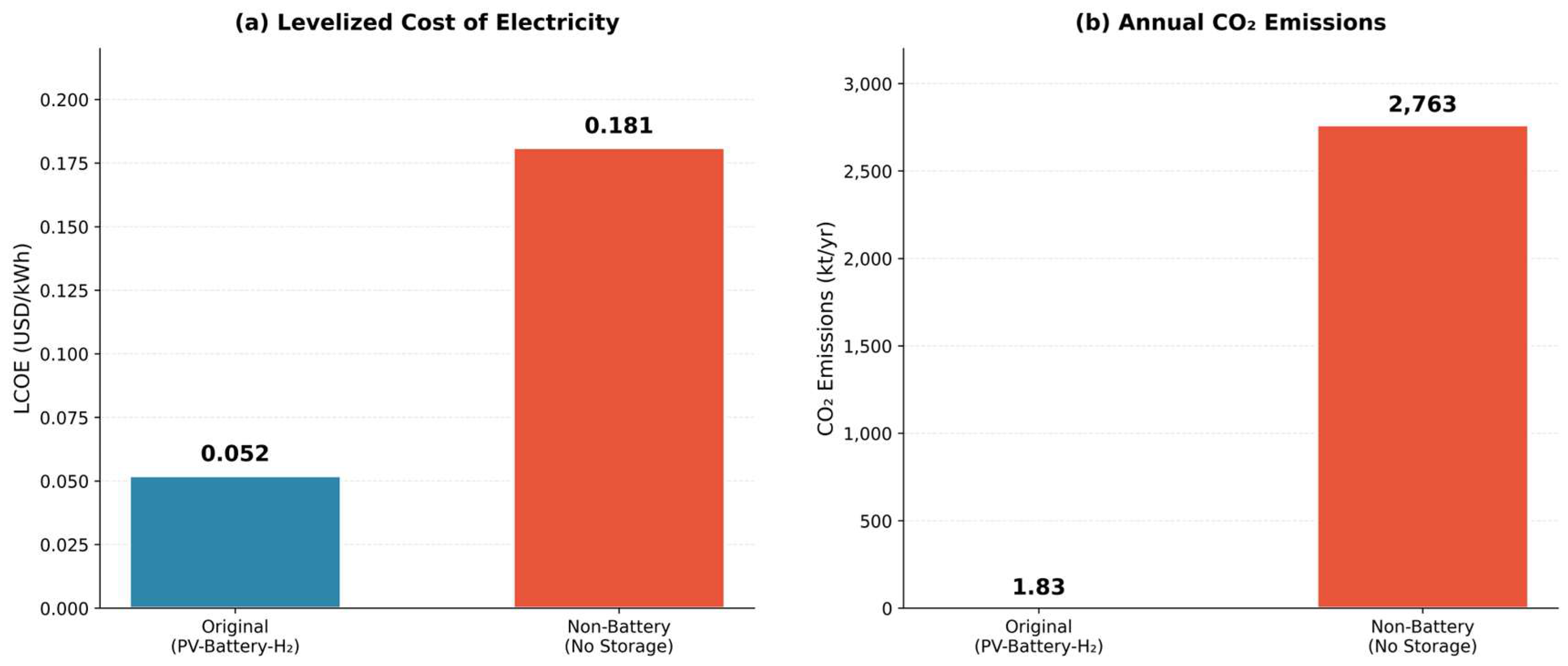
The Non-Battery scenario, in which all battery storage is removed from the system, resulted in a 250% increase in LCOE, from 0.052 to 0.181 USD/kWh, and a 1510-fold increase in CO
2 emissions, from 1.83 to 2763 kt/yr. The mechanism is threefold: (i) PV capacity shrinks from 3790 to 691 MW (−82%); (ii) NGG fuel consumption rises to approximately 1.42 billion m
3/yr, dominating OPEX; and (iii) the Original scenario curtails only 548 GWh (7.9%), while the Non-Battery scenario foregoes 5.64 TWh of potential solar generation. The 1510-fold emission increase deserves a detailed explanation, because the absolute numbers appear extreme. In the Original scenario, CO
2 emissions total only 1.83 kt/yr, which is a very small base, because 99.85% of electricity comes from PV and battery. The reformer contributes the remaining emissions. When batteries are removed, PV capacity drops to 691 MW and can only serve 0.48% of demand directly. The remaining 99.52% falls on natural gas gensets running at 1400 MW. At the stated 40% electrical efficiency and an emission factor of 1.94 kg CO
2/m
3, the NGG fleet consumes approximately 1.42 billion m
3 of natural gas per year, producing roughly 2763 kt CO
2. The extreme ratio (1510×) is therefore not a modeling artifact but a direct consequence of the low-carbon baseline: any system that achieves near-zero emissions will show extreme percentage swings when its low-carbon assets are removed.
Figure 2 shows the impact of battery storage on LCOE and CO
2 emissions.
3.3. Baseline Scenario Performance Comparison
Table 5 compares performance indicators across the four baseline scenarios, which reveal a clear structural pattern. The Original and No-NGG scenarios produce identical results across every KPI, confirming that the natural gas genset contributes nothing to system operation when 33.5 GWh of battery storage is available. The natural gas genset remains idle for all 8760 h, because PV generation (6.9 TWh/yr) combined with battery time-shifting is sufficient to serve the full 5.29 TWh/yr electrical demand, with 548 GWh of curtailment absorbing the surplus. The No-Wind scenario shows only marginal cost increase (+1.4%), indicating that wind resources at the Yanbu site add limited value when PV is already oversized relative to demand. This is consistent with the site’s solar-dominated resource profile (capacity factor 20.8% for PV versus lower and less predictable wind at this latitude). The Non-Battery scenario stands apart: LCOE nearly quadruples, renewable fraction drops to 0.48%, and CO
2 emissions increase by more than three orders of magnitude. This extreme outcome is not a modeling anomaly but a structural consequence of removing the only asset that converts intermittent PV into firm supply.
3.4. Integration Value Versus Separate-Build Counterfactual
The extended Pyomo model was used to evaluate an Integrated Hub incorporating the baseline MES, a 60 MW data center (30 MW critical, 30 MW flexible), multi-sink H
2 export, and waste heat integration. The performance of this configuration was compared against a separate-build counterfactual in which the MES and data center are sized and operated independently.
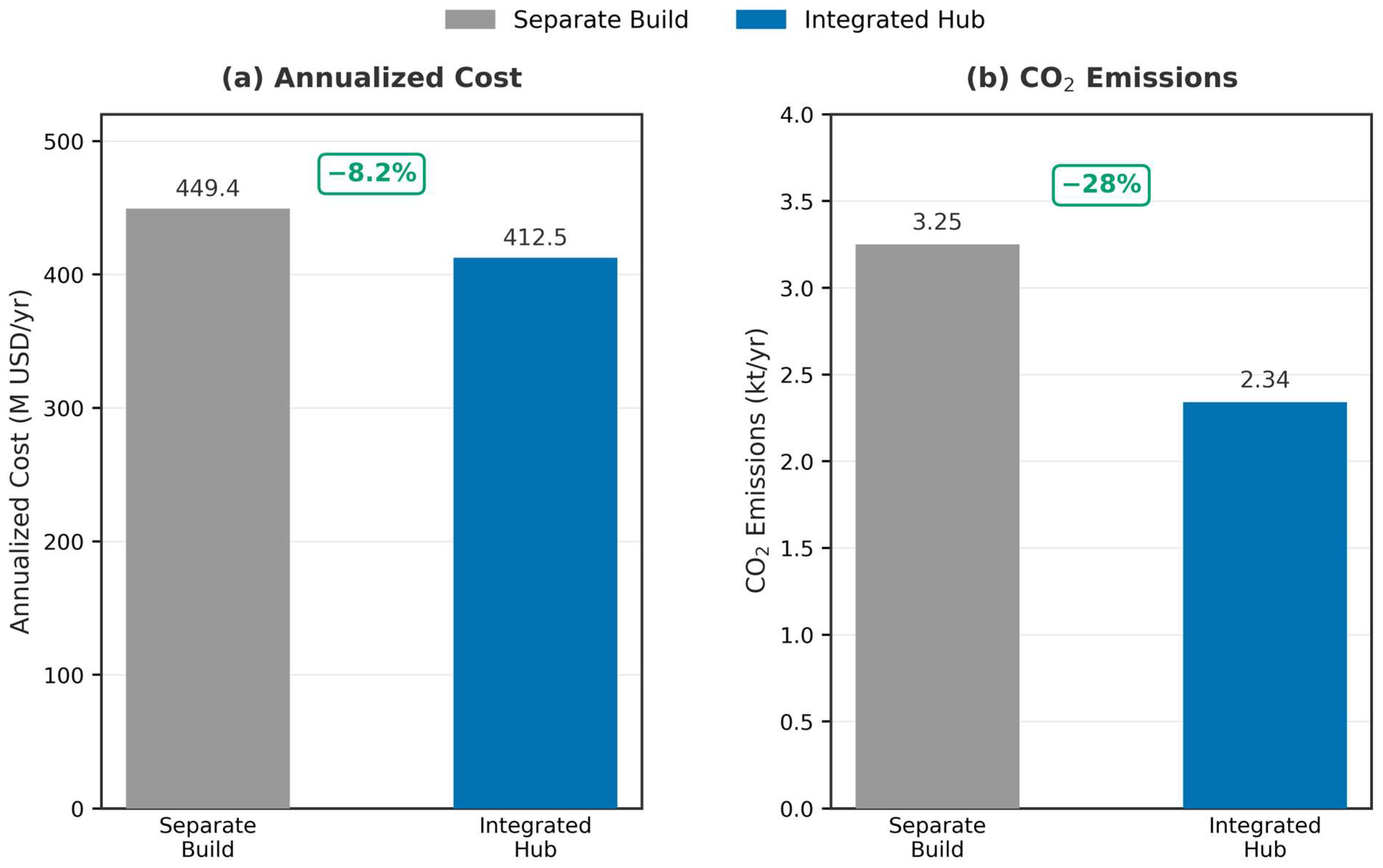
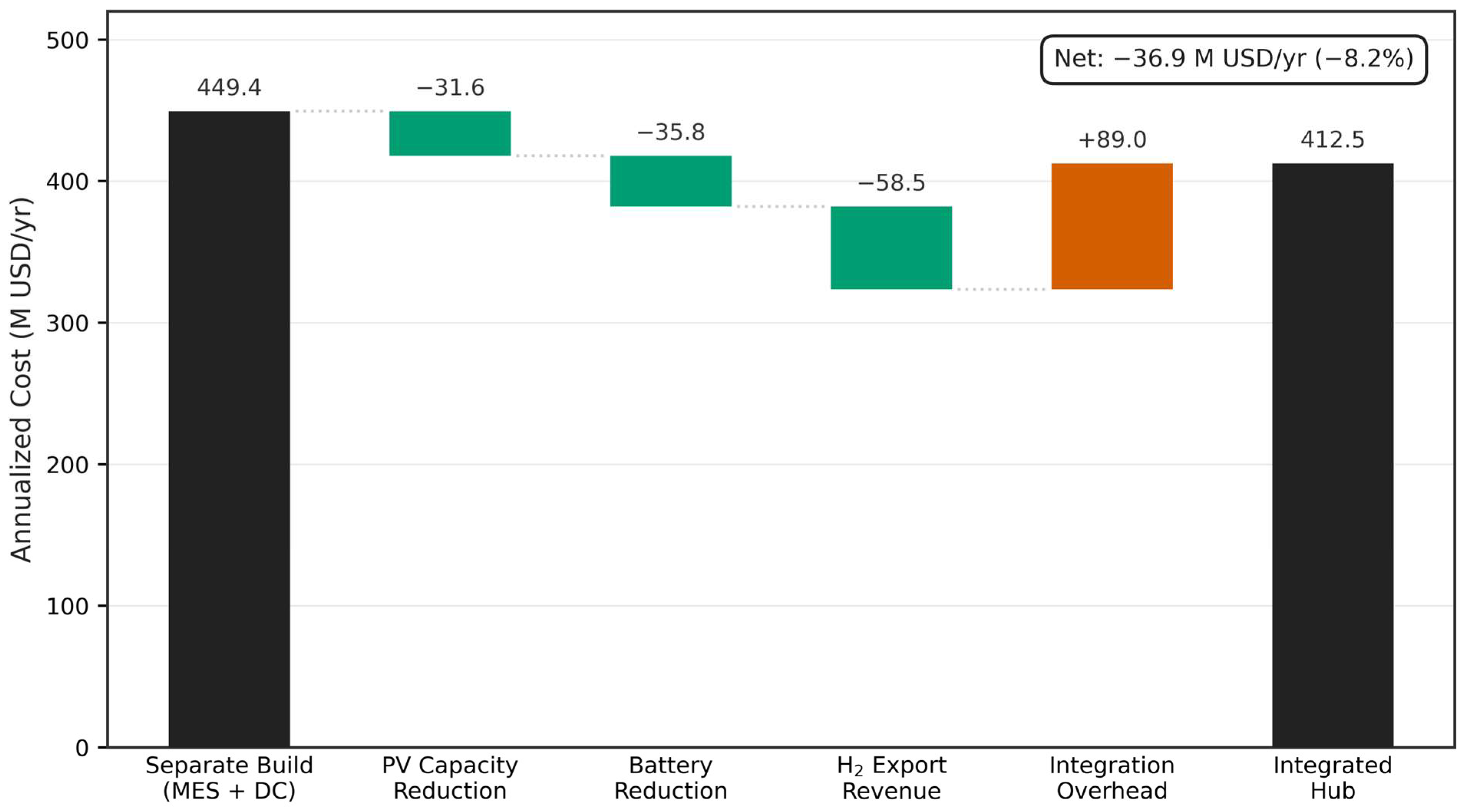
Table 6 quantifies the cost and emission differences, while
Figure 3 and
Figure 4 present the comparative cost and CO
2 breakdown and the annualized cost decomposition, respectively.
The 8.2% cost reduction is driven by two mechanisms. The first is infrastructure sharing: the Integrated Hub requires 560 MW less PV and 5.1 GWh less battery than the sum of standalone systems, because the data center’s flexible load absorbs midday solar that would otherwise be curtailed or stored, reducing the oversizing needed to guarantee evening supply. The second mechanism is revenue injection: hydrogen export through ammonia and methanol sinks generates 58.5 M USD/yr that directly offsets annualized system costs. Without export, the electrolyzer runs only during surplus solar hours and produces hydrogen at 10.5 USD/kg, which exceeds the delivered natural gas alternative. With export sinks, the optimizer keeps the electrolyzer active for three times as many hours, spreading fixed costs over a larger production volume and reducing LCOH to 6.8 USD/kg, a level at which green hydrogen begins to approach competitiveness with grey alternatives in Gulf markets.
3.5. Electricity and Hydrogen Allocation Mechanisms
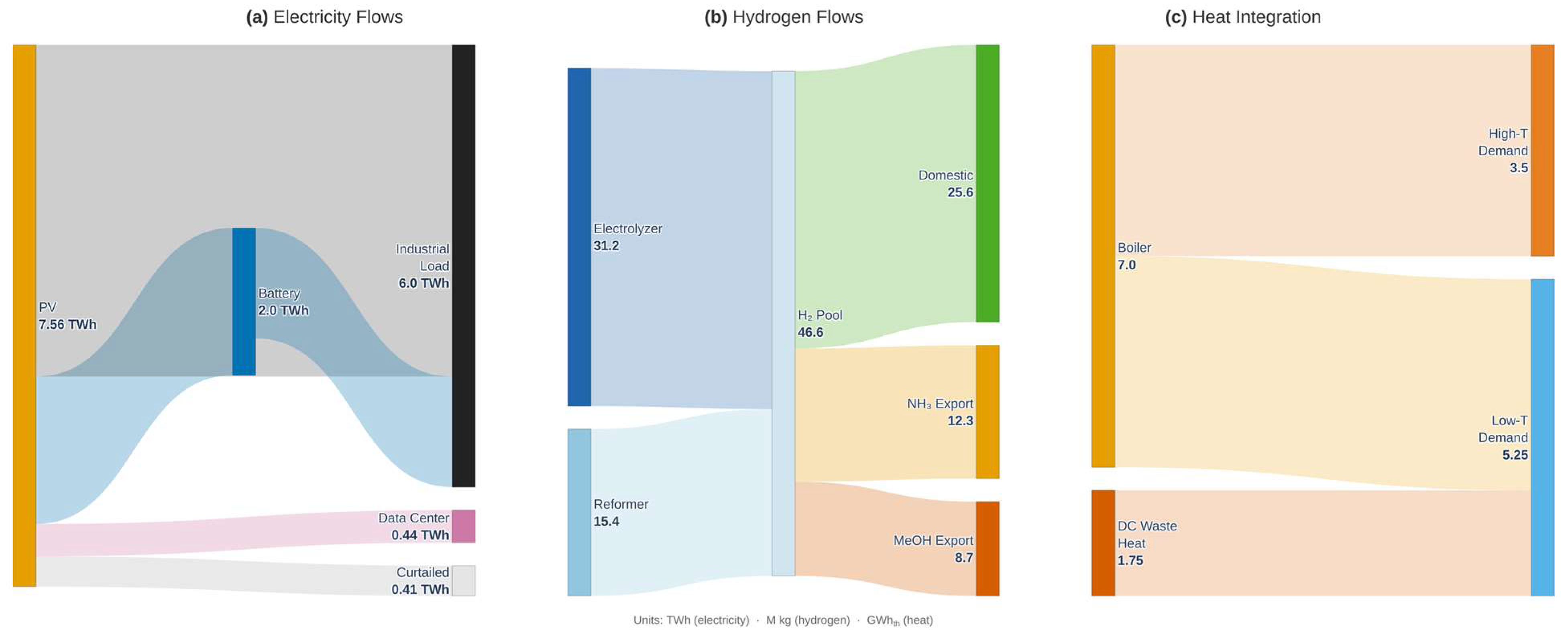
In the Integrated Hub configuration, PV generation totals 7.56 TWh/yr, of which 7.15 TWh/yr is delivered to end-use loads and 0.44 TWh/yr is consumed by the data center. The remaining 0.41 TWh/yr is curtailed at a rate of 5.4%, which is lower than the 7.9% observed in the Original scenario because the data center absorbs a portion of the midday PV surplus that would otherwise require curtailment.
Figure 5 illustrates the energy flow allocation for the Integrated Hub.
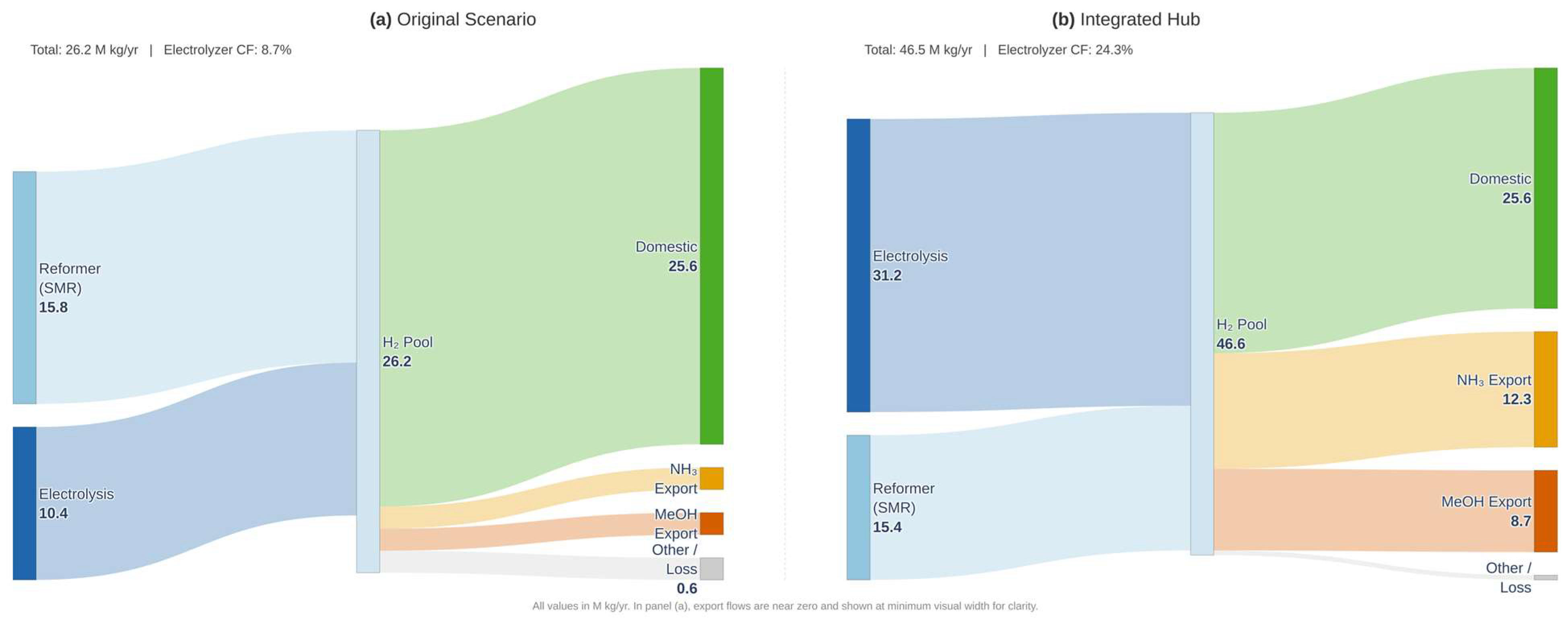
The Integrated Hub produces 46.55 M kg/yr with multi-sink allocation: domestic use (25.55 M kg), ammonia export (12.30 M kg → 69,492 t NH
3), and methanol export (8.70 M kg → 69,600 t MeOH). Export demand raises electrolyzer CF from 8.65% to 24.3%. The shift in allocation is driven by the optimizer routing surplus PV generation to the electrolyzer rather than curtailing it. In the Original scenario, only 10.4 M kg/yr comes from electrolysis (the rest from SMR), because there is insufficient demand to justify running the electrolyzer beyond solar surplus hours. With export sinks, the optimizer keeps the electrolyzer active for 2130 full-load hours per year (up from 758 h), and the SMR share of total H
2 production drops from 60% to 33%.
Figure 6 compares the hydrogen allocation between the Original and Integrated Hub configurations.
3.6. Extended Levelized Cost Metrics
Table 7 compares levelized cost metrics across the Original, Integrated Hub, and standalone data center configurations. Several patterns in the data are worth examining in detail. LCOE drops from 0.052 to 0.049 USD/kWh in the Integrated Hub, a 5.8% reduction that arises from spreading PV and battery fixed costs across a larger demand base (the data center adds 0.44 TWh/yr of served load). The standalone data center shows a higher LCOE (0.062 USD/kWh), because it must build its own renewable capacity without access to the hub’s oversized PV fleet. LCOH falls 35% (from 10.5 to 6.8 USD/kg), almost entirely because export demand raises electrolyzer utilization. The LCOE(H
2) of 245 USD/MWh confirms that hydrogen reconversion remains far more expensive than battery storage (LCOS 22.3 USD/MWh), a factor of 11 that reflects the 30% round-trip efficiency of the electrolysis–storage–genset chain (0.76 × 0.40) versus 89.5% for lithium-ion. The ratio
reflects:
This confirms the economic hierarchy: batteries for diurnal storage (hours), hydrogen for extended duration and cross-sector flexibility (days to seasons).
This cost hierarchy means that hydrogen reconversion is reserved for extended outages that exceed battery duration, not for routine diurnal cycling. The LCO (compute) of 0.042 USD/GPU-hr is difficult to benchmark directly, because few published studies report comparable metrics for off-grid AI facilities, but it translates to roughly 0.063 USD/kWh at the IT rack level, which is competitive with grid-connected hyperscale operators paying 0.04 to 0.08 USD/kWh in major markets.
3.7. Sensitivity Analysis
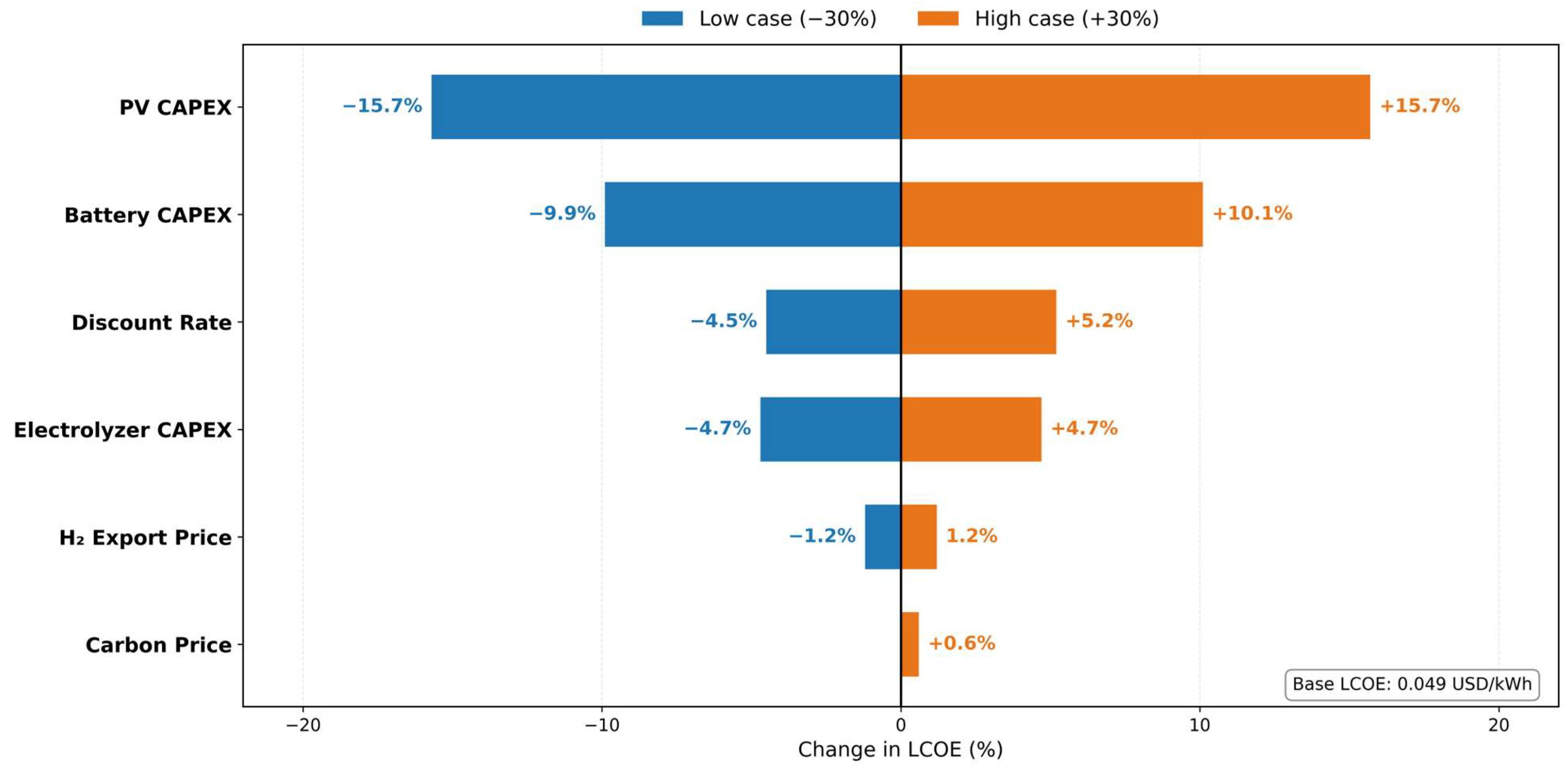
A one-at-a-time sensitivity analysis was performed to determine how variations in key techno-economic parameters affect the Integrated Hub results. As shown in
Figure 7, PV CAPEX exerts the largest influence on Integrated Hub LCOE (±15.7%), followed by battery CAPEX (−9.9%/+10.1%), discount rate (−4.5%/+5.2%), and electrolyzer CAPEX (±4.7%). Three practical conclusions emerge from the sensitivity results. First, PV CAPEX is the parameter with the largest influence on system economics, which aligns with the fact that PV supplies over 99% of generation. A 30% PV cost reduction (from 150 to 105 USD/kW) cuts LCOE by 18.1%, while the same percentage reduction in battery CAPEX yields a 20.1% saving, reflecting the high share of battery investment in total NPC. Second, the Non-Battery scenario is far more sensitive to external cost shocks than the Original. A carbon price of 100 USD/t raises Original LCOE by only 0.6% but increases Non-Battery LCOE by 22.3%, because the gas-dependent system absorbs the full carbon penalty on its 2763 kt/yr emissions (
Table 8). This asymmetry means that carbon pricing policy disproportionately penalizes systems that underinvest in storage. Third, the Integrated Hub retains its cost advantage (5.8 to 10.4%) across every sensitivity case tested, indicating that the integration benefit is not contingent on any single cost assumption.
Table 8 summarizes the sensitivity results for key parameters.
3.8. Literature Benchmarking
Table 9 compares the key metrics obtained in this study against published benchmarks to establish the plausibility of the model outputs. All five metrics fall within or near published ranges, which supports the plausibility of the model outputs despite the absence of operational validation data. The LCOE of 0.041 to 0.052 USD/kWh aligns with recent Saudi auction prices (1.04 cents/kWh for utility-scale PV) once storage costs are added, and it sits within the broader 0.03-to-0.06-USD/kWh band reported for PV–battery systems in high-irradiance regions. The LCOH range (6.8 to 10.5 USD/kg) is at the upper end of global projections because the model includes SMR backup and system-level integration costs that standalone electrolyzer studies typically omit. Saif et al. report 4.23 USD/kg for a PV-powered SOEC system in Dhahran, but that estimate covers electrolysis costs alone without storage, reformer backup, or hub infrastructure. The LCOS of 22 to 25 USD/MWh is consistent with lithium-ion storage cost surveys that report 20 to 40 USD/MWh for large-scale systems. The waste heat temperature range (35 to 50
°C) matches measured data from air-cooled hyperscale facilities. LCO(compute) has limited published benchmarks for off-grid configurations, making the 0.042 USD/GPU-hr value reported here one of the first estimates of its kind for an islanded industrial hub.
4. Discussion
4.1. Key Findings and Their Implications
The battery dominance observed across all scenarios is not an artifact of the optimization solver. It emerges from the interaction of three structural features of an islanded, PV-dominant industrial system: storage converts otherwise-curtailed midday PV generation into firm evening and overnight supply; storage substitutes for the ramping and firming services that would otherwise be provided by natural gas generation; and the marginal cost of battery discharge is small relative to the avoided marginal cost of dispatchable thermal generation. The combined effect is a regime shift: removing batteries forces PV capacity to collapse from 3790 to 691 MW and replaces the missing flexibility with NGG dispatch, driving the 250% LCOE increase and the 1510-fold CO
2 increase reported in
Section 3.2.
It is evident from the No-NGG result that this finding inverts conventional grid planning logic. Standard practice treats natural gas as the default reliability backstop and battery storage as a supplementary technology. Under the high-irradiance conditions at Yanbu, the relationship is reversed: when storage is sized for adequacy, dispatchable thermal backup provides no operational value and sits idle for all 8760 h. For Saudi industrial cities pursuing decarbonization alongside cost competitiveness, the principal policy lever is not marginal improvements in gas efficiency but accelerated deployment of PV-plus-storage infrastructure.
4.2. Mechanisms Behind the Battery Dominance Result
The 250% LCOE step-change between Original and Non-Battery scenarios (from 0.052 to 0.181 USD/kWh) is not a single effect but the product of three compounding mechanisms.
The first mechanism is curtailment capture. Without storage, the optimizer has no way to time-shift midday PV surplus into evening and nighttime hours. As a result, PV capacity shrinks from 3790 to 691 MW, an 82% reduction, because there is no economic rationale for generating electricity that cannot be delivered to load. The 33.5 GWh battery in the Original scenario converts 3.28 TWh of otherwise-curtailed solar generation into dispatchable supply, which is equivalent to 62% of annual demand.
The second mechanism is fuel cost avoidance. When batteries are absent, the 1400 MW NGG fleet must serve all non-solar-hour demand, consuming approximately 1.42 billion cubic meters of natural gas per year. At the assumed gas price of 0.06 USD per cubic meter, this adds roughly 85 M USD/yr in fuel costs that the battery-equipped system avoids entirely.
The third mechanism is autonomy value. The 33.5 GWh battery provides approximately 55 h of nominal autonomy at average demand (33,500 MWh/604 MW), or roughly 47 h when accounting for the 10–90% SOC operating range and discharge efficiency, enabling the system to ride through multi-day low-solar periods without thermal backup. This autonomy is what allows the renewable fraction to reach 99.85%. In the Non-Battery scenario, the renewable fraction collapses to 0.48%, meaning that natural gas supplies over 99% of electricity and all associated emissions.
These three mechanisms compound rather than add linearly: removing storage simultaneously shrinks PV, increases fuel burn, and eliminates the buffering that makes high renewable fractions feasible.
4.3. Hydrogen System Interpretation
The baseline LCOH of 10.5 USD/kg exceeds the 2-to-6-USD/kg range commonly cited for dedicated green hydrogen plants, and understanding why is important for interpreting the integration benefit. Two structural features explain the gap. First, the electrolyzer operates at only 8.65% capacity factor in the Original scenario, because its sole function is to absorb excess PV generation that exceeds electrical demand and battery charging capacity. During cloudy hours and nighttime, the electrolyzer sits idle. At 8.65% capacity factor, annualized CAPEX of 300 USD/kW translates to a fixed-cost contribution of roughly 3.5 USD/kg before adding electricity costs. Second, the SMR reformer supplies 60% of total hydrogen demand (15.8 out of 26.2 M kg/yr) because the electrolyzer alone cannot meet the 25.55 M kg/yr domestic requirement during low-solar periods.
The Integrated Hub transforms this picture by adding ammonia and methanol export sinks that absorb 21.0 M kg H2/yr beyond domestic needs. Export demand creates an economic pull that keeps the electrolyzer running for 2130 full-load hours per year, up from 758 h in the Original scenario. At 24.3% capacity factor, the same 300 USD/kW CAPEX contributes only 1.2 USD/kg in fixed costs, explaining most of the LCOH decline to 6.8 USD/kg. The SMR share of total production drops from 60% to 33%, reducing both natural gas consumption and associated CO2 emissions. Export revenues of 58.5 M USD/yr (36.9 M from ammonia at 3.0 USD/kgH2, 21.8 M from methanol at 2.5 USD/kgH2) offset 14% of total annualized system costs, making the export pathway a net economic benefit rather than an additional expense.
The 6.8 USD/kg LCOH remains above the U.S. Department of Energy 2030 target of 2 to 4 USD/kg, primarily because this study includes system-level costs (storage, reformer backup, hub infrastructure) that dedicated production estimates omit. As electrolyzer CAPEX continues to decline toward 150 USD/kW (the sensitivity lower bound), LCOH in this configuration would approach 5.0 USD/kg, narrowing the gap with standalone benchmarks.
4.4. Data Centers as Controllable Energy Assets
The 60 MW data center modeled here (30 MW critical plus 30 MW flexible) represents a hyperscale-class facility. The optimizer served 92% of the annual flexible compute target (160.8 out of 175.2 GWh), deferring workloads on 199 of 365 days when solar availability was insufficient. This penalty-based formulation allows the optimizer to trade compute completeness against system cost rather than enforcing rigid completion. The resulting LCO(compute) declined from 0.055 USD/GPU-hr in the standalone configuration to 0.042 USD/GPU-hr in the Integrated Hub, a 23% reduction attributable to shared PV and battery infrastructure, co-location savings, and temporal coordination between compute scheduling and renewable availability. The 50% flexible load fraction adopted in this study is a moderate assumption within the range reported in the literature: Radovanovic et al. demonstrated that Google shifts 15–25% of workloads for carbon reduction, while batch-heavy HPC clusters can defer 40–60% of jobs by several hours [
30]. In practice, the economic incentive for flexibility is substantial, as the optimizer concentrates GPU batch jobs during the midday solar peak (10:00–15:00) when marginal electricity cost is lowest, and reduces flexible dispatch during evening hours when battery discharge carries a higher marginal cost. Power distribution losses within the data center are captured implicitly through the PUE factor of 1.40; component-level power flow modeling, as demonstrated by Newkirk et al. [
34], who traced 4–6 conversion steps with measured efficiencies, is left for future work.
4.5. Waste Heat Realism and Industrial Heat Decarbonization
Data centers reject low-grade heat at 35 to 50
°C, and in this model, 40% of the IT electrical load is treated as recoverable thermal output. This fraction is conservative. Ebrahimi et al. reported that purpose-built heat capture systems recover 50 to 70% of the IT load [
25], and Yuan et al. confirmed similar ranges in a recent review of data center waste heat for district heating [
55]. The 92% network efficiency used here reflects indirect integration through a secondary heat exchanger loop, a mature configuration documented by Wahlroos et al. in Nordic district heating systems [
26].
In the Integrated Hub configuration, recovered waste heat supplied 1752 MWh-th per year, displacing 20% of total industrial thermal demand (8760 MWh-th/yr), and reduced the LCO(heat) from 18.4 to 15.2 USD/MWh-th, corresponding to a 17% cost saving driven entirely by displaced boiler fuel consumption and the associated CO
2 emissions [
26,
28]. Two points qualify this result. First, the benefit is limited to processes below roughly 60
°C unless a heat pump is added to lift the temperature. The model does not include explicit heat pump sizing, so the 17% saving applies only to the low-temperature fraction (60% of total thermal demand). Second, at larger data center scales (100 MW and above), dedicated liquid cooling could push the recovery fraction to 60 or 70%, which would increase the heat cost saving beyond what is reported here [
27]. The trade-off is additional capital for liquid cooling infrastructure and heat exchangers, which was not modeled. These limitations are addressed in the future work section.
4.6. Methodological Contribution
The two-layer approach used here addresses a tension common in energy systems research: commercial tools like HOMER Pro offer validated sizing algorithms and industry-accepted default libraries, but they lack the extensibility needed to represent novel system configurations such as data center co-optimization and multi-sink hydrogen allocation. Custom MILP models offer full extensibility but require careful calibration to avoid producing results that are difficult to compare with established benchmarks.
By calibrating the Pyomo MILP against HOMER Pro to within 2% across five KPIs, this study anchors its extended results to a reproducible commercial baseline. This calibration step means that the data center and export extensions can be evaluated as incremental additions to a validated foundation, rather than as outputs of an uncalibrated custom model.
4.7. Policy Implications
The results point to four implications for Saudi industrial energy policy that are discussed below.
The first concerns storage deployment. The 250% LCOE increase and 1510-fold emission rise when batteries are removed shows that storage is not a supplementary technology but the foundation of affordable, low-carbon industrial power in high-irradiance regions. At the battery cost assumed here (75 USD/kWh [
58]), solar-plus-storage already undercuts gas generation when the natural gas price exceeds 0.04 USD/m
3. The Saudi domestic gas price of 0.06 USD/m
3 is above this threshold, meaning that new-build PV-plus-battery is cost-competitive with gas today for large industrial loads [
42]. Policy should therefore focus on removing permitting and grid-connection barriers to storage rather than subsidizing marginal gas efficiency improvements.
The second implication relates to hydrogen export infrastructure. Building electrolyzers to serve only domestic demand yields a capacity factor of 8.65% and an LCOH of 10.5 USD/kg, which is uncompetitive with grey hydrogen. Adding ammonia and methanol export sinks raises the capacity factor to 24.3% and brings LCOH down to 6.8 USD/kg. This is still above the U.S. Department of Energy 2030 target of 2 to 4 USD/kg [
19], but well within the range of recent Gulf-region projections [
42]. Hydrogen infrastructure in Yanbu and similar industrial cities should accordingly be designed from the outset with export capacity, even if initial export volumes are small, because the capacity factor benefit is what makes the economics work. These LCOH values are consistent with regional benchmarks: Saif et al. report 4.23 USD/kg for PV-powered SOEC in Dhahran, while the present study’s higher values reflect the inclusion of SMR backup, hydrogen storage, and system-level costs that standalone production estimates omit [
21].
Third, the 23% reduction in LCO (compute) from 0.055 to 0.042 USD/GPU-hr provides a quantitative basis for siting AI data centers inside industrial energy hubs rather than in standalone grid-connected facilities. Three mechanisms drive this saving: shared PV and battery infrastructure reduces total renewable capacity by 11.9% compared with separate builds, co-location avoids transmission costs, and temporal coordination between compute scheduling and solar availability lowers the effective electricity price. For the HUMAIN initiative, this suggests that Yanbu, Jubail, and Ras Al-Khair industrial cities are not just possible data center sites but economically preferred ones. Radovanovic et al. showed that Google already shifts 15 to 25% of workloads to align with low-carbon electricity supply [
30]. The 50% flexible fraction modeled here is higher but consistent with batch-heavy AI training workloads that can tolerate delays of several hours [
56].
Fourth, the identical performance of the Original and No-NGG scenarios confirms that gas backup provides no operational value when battery storage is sized for adequacy. The natural gas genset installed in the Original scenario (capable of 1400 MW) dispatched zero hours across the full 8760 h simulation. Retaining gas backup as a regulatory or contractual requirement would add capital cost (600 USD/kW [
64]) without improving reliability, availability, or emissions. This finding is specific to islanded systems with sufficient storage and should be validated for grid-connected operation before generalizing to the broader Saudi grid.
4.8. Generalizability Assessment
Three findings from the Yanbu case study are likely to transfer to other industrial energy hubs in high-irradiance regions.
First, battery storage acts as the dominant cost–carbon lever in any PV-heavy industrial system, because the fundamental mechanism (time-shifting surplus solar into firm supply) does not depend on the specific demand profile. The magnitude of the LCOE step-change (250%) will vary with storage cost and demand shape, but the qualitative conclusion that battery investment matters more than marginal improvements in thermal generation efficiency should hold wherever solar capacity factor exceeds roughly 18%.
Second, cross-sector integration delivers cost savings in the 5-to-10% range when loads with different temporal profiles share renewable infrastructure. The 8.2% saving observed here arises because the data center’s flexible demand fills solar surplus hours that would otherwise produce curtailment or low-value electrolyzer operation. Similar savings are plausible for any combination of firm and flexible industrial loads.
Third, the storage cost hierarchy (battery LCOS roughly 11 times lower than hydrogen reconversion LCOE) is determined by round-trip efficiency differences (89.5% versus 30%) rather than by site-specific factors, and should therefore hold across configurations.
Key enabling conditions for these findings include a solar capacity factor above 18%, natural gas price above 0.04 USD per cubic meter, and electrolyzer CAPEX below 1100 USD/kW. Saudi Arabia satisfies all three conditions today. Other Gulf Cooperation Council states, North Africa, and parts of Australia and the southwestern United States share similar characteristics [
15,
68].
5. Conclusions
This study developed and validated a two-layer techno-economic framework for an integrated renewable–hydrogen–data center hub sized for Yanbu Industrial City, Saudi Arabia. A Pyomo-based mixed-integer linear program was calibrated against a HOMER Pro baseline, reproducing all key performance indicators within 2%, and then extended to include a 60 MW data center (30 MW critical, 30 MW flexible), multi-sink hydrogen allocation (domestic, ammonia export, methanol export), and low-grade waste heat recovery. Five principal findings resulted from this analysis. Battery storage was the dominant cost and emissions lever across all scenarios: removing it raised the levelized cost of electricity from 0.052 to 0.181 USD/kWh (a 250% increase) and multiplied CO2 emissions by a factor of 1510, from 1.83 to 2763 kt/yr. This extreme ratio is a direct consequence of the near-zero emission baseline; once the PV and battery assets that deliver 99.85% renewable electricity are removed, gas generation fills the gap and emissions rise from a very low base. The Integrated Hub reduced annualized costs by 8.2% (36.9 M USD/yr) and emissions by 28% compared with a separate-build counterfactual, driven by shared PV and battery infrastructure and hydrogen export revenues of 58.5 M USD/yr. Hydrogen export demand transformed electrolyzer economics, raising the capacity factor from 8.65% to 24.3% and reducing LCOH from 10.5 to 6.8 USD/kg, because the optimizer could route surplus solar generation to the electrolyzer for sustained periods rather than curtailing it. Cross-sector co-location delivered additional savings: waste heat recovery cut the levelized cost of heat by 17%, and shared infrastructure reduced the levelized cost of compute by 23%. Finally, PV-dominated configurations showed strong regulatory resilience, with a 100 USD/t carbon price increasing LCOE by less than 1% in the Original scenario versus 22.3% in the gas-dependent Non-Battery case.
The framework has several limitations that define the scope of these conclusions. The system was modeled as electrically islanded; grid interconnection would likely reduce storage requirements and allow participation in ancillary service markets, altering the cost balance. Waste heat was assumed to be directly usable at 35 to 50 ° C without heat pump integration, which limits the benefit to low-temperature processes (below roughly 60 °C) and understates the potential for medium-temperature industrial heat recovery. The 60 MW data center represents a single facility at hyperscale; scaling to 100 to 500 MW may reveal non-linear cost structures in cooling, land use, and grid interconnection that this model does not capture. Hydrogen export prices were fixed at 3.0 USD/kgH2 (ammonia) and 2.5 USD/kgH2 (methanol), whereas real offtake agreements involve price corridors, volume commitments, and take-or-pay clauses that could shift the optimal allocation. Technology costs were adopted from the HOMER Pro default library to preserve calibration fidelity; site-specific procurement data would refine absolute cost levels without changing the comparative findings. Future work should extend the model to grid-connected operation with time-of-use tariffs and ancillary service revenues, incorporate stochastic solar variability across multiple meteorological years, add explicit heat pump sizing for industrial temperature lift above 60 °C, and evaluate larger data center scales with detailed liquid cooling and thermal storage representation. The Yanbu case study provides a replicable blueprint for integrated industrial energy hubs in the Gulf region and other high-irradiance zones where hydrogen export ambitions coincide with growing demand for low-carbon AI compute.