Research on the Coordinated Optimisation of Green Asset-Backed Note Financing and Hydrogen Energy Storage Market Transactions Based on Stackelberg Games

Abstract
1. Introduction
1.1. Challenges Facing Intraday Electricity Market Mechanisms and Hydrogen Energy Storage Participation
1.2. The Enabling Mechanism of Green Asset-Backed Notes (ABN)
1.3. Research Status on Electricity Market Trading Strategies Based on Stackelberg Games
- (1)
- Distributed Energy Resource Aggregators and Market Transactions. Extensive literature has examined games where distributed energy resource (DER) aggregators act as leaders, with users or distribution system operators as followers. For instance, one study constructed a data-driven Stackelberg game model to analyse DER aggregators’ strategic bidding behaviour in day-ahead markets [3]; another proposed a Nash–Stackelberg hybrid game approach to examine bidding strategies among multiple DER aggregators in electricity markets [6].
- (2)
- Virtual Power Plants (VPPs) and Electric Vehicle (EV) Management. Addressing how VPP operators can guide orderly EV charging through pricing strategies, a Stackelberg game model was established with VPP as the leader and EV users as followers, incorporating wind power output uncertainty [7].
- (3)
- Integrated Energy Systems and Hydrogen Trading. With growing attention on electricity-hydrogen coupling, research has begun applying Stackelberg games to systems integrating hydrogen energy. For instance, one study developed Stackelberg game-based optimised bidding and management strategies for regional electricity–hydrogen integrated systems, where electricity–hydrogen operators serve as leaders [8]. Another research proposed a multi-objective robust dynamic pricing and operational strategy optimisation method based on Stackelberg games for integrated energy systems incorporating hydrogen energy storage (HES) [9].
- (4)
- Market design and investment decisions. Game models have also been employed to analyse higher-level market design issues. For instance, one study utilised a financial Stackelberg game approach to analyse optimal capacity expansion and differentiated capacity payment mechanisms under risk aversion and market power [1]. Another research constructed a distribution system expansion planning model based on a two-layer Stackelberg game, incorporating long-term renewable energy contracts [10].
- (5)
- Bidding Strategies for Hydrogen Systems. Some research directly addresses hydrogen systems’ market participation. For instance, one study explored optimal bidding strategies for hydrogen storage systems synergising with renewables in electricity markets [11]; another analysed risk-constrained bidding strategies for electro–hydrogen coupling systems in day-ahead and reserve markets [12]. Furthermore, the literature has evaluated the value of power-to-gas (P2G) as a flexibility option in integrated electricity and hydrogen markets, analysing how flexible electricity demand from hydrogen electrolysers can stabilise the market value of wind and solar power [2].
2. Analysis of Intraday Electricity Market Clearing Mechanisms with Hydrogen Energy Storage Participation
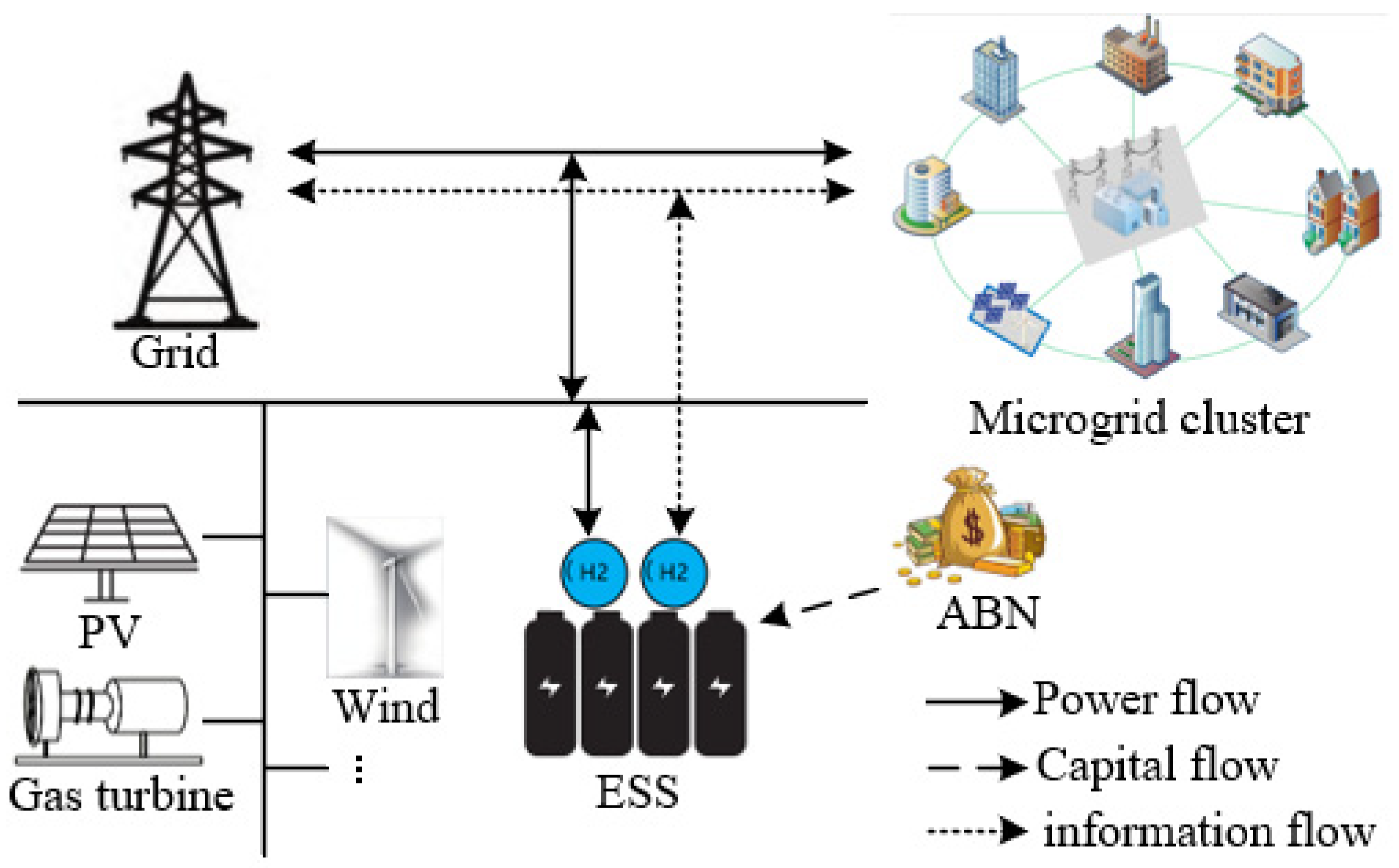
2.1. Hydrogen Energy Storage Participation in Electricity Market Transactions
2.1.1. Functions of Hydrogen Energy Storage in the Intraday Market
- (1)
- As a controllable load, it actively absorbs electricity during renewable energy surpluses, performing peak shaving and valley filling to smooth net load curves.
- (2)
- As a generation unit, it sells electricity during peak pricing periods, participating in energy market auctions to capture arbitrage profits.
- (3)
- Hydrogen storage systems offer rapid response times and high regulation precision, reliably providing ancillary services such as frequency regulation and reserve capacity, significantly enhancing the reliability and flexibility of power systems.
2.1.2. Mathematical Model of Hydrogen Energy Storage Systems
- (1)
- Electrolyser
- (2)
- Hydrogen Storage Tank
- (3)
- Fuel Cell Systems
2.2. Green Asset-Backed Notes
- The issuer enters into an agreement with investors to issue asset-backed notes, committing to repay principal and interest using cash flows generated from the underlying assets.
- The issuer continues to operate the underlying assets, ensuring they generate stable and reliable cash flows.
- The issuer enters into an agreement with a bank, designating it as the escrow bank responsible for safeguarding and recording cash inflows from the underlying assets.
- Within stipulated timeframes, the escrow bank transfers corresponding receivables to the bond registration and settlement institution per the agreement, ensuring principal and interest payments on the ABN.
- The bond registration and settlement institution transfers funds to investor accounts during settlement periods to repay principal and interest.

2.3. Microgrids
- (1)
- Industrial load
- (2)
- Morning and Evening Residential Load
- (3)
- Commercial Load
2.4. Multi-Microgrid Energy Trading Platform
3. Collaborative Optimisation Strategy for Electricity Market Transactions Based on Stackelberg Game Theory
3.1. Upper-Level Model: Hydrogen Storage Operator
- (1)
- Objective Function
- (2)
- Constraints
- (3)
- Decision Variables and Coupling Variables
3.2. Lower-Level Model: Microgrid Cluster
- (1)
- Objective Function
- (2)
- Constraints
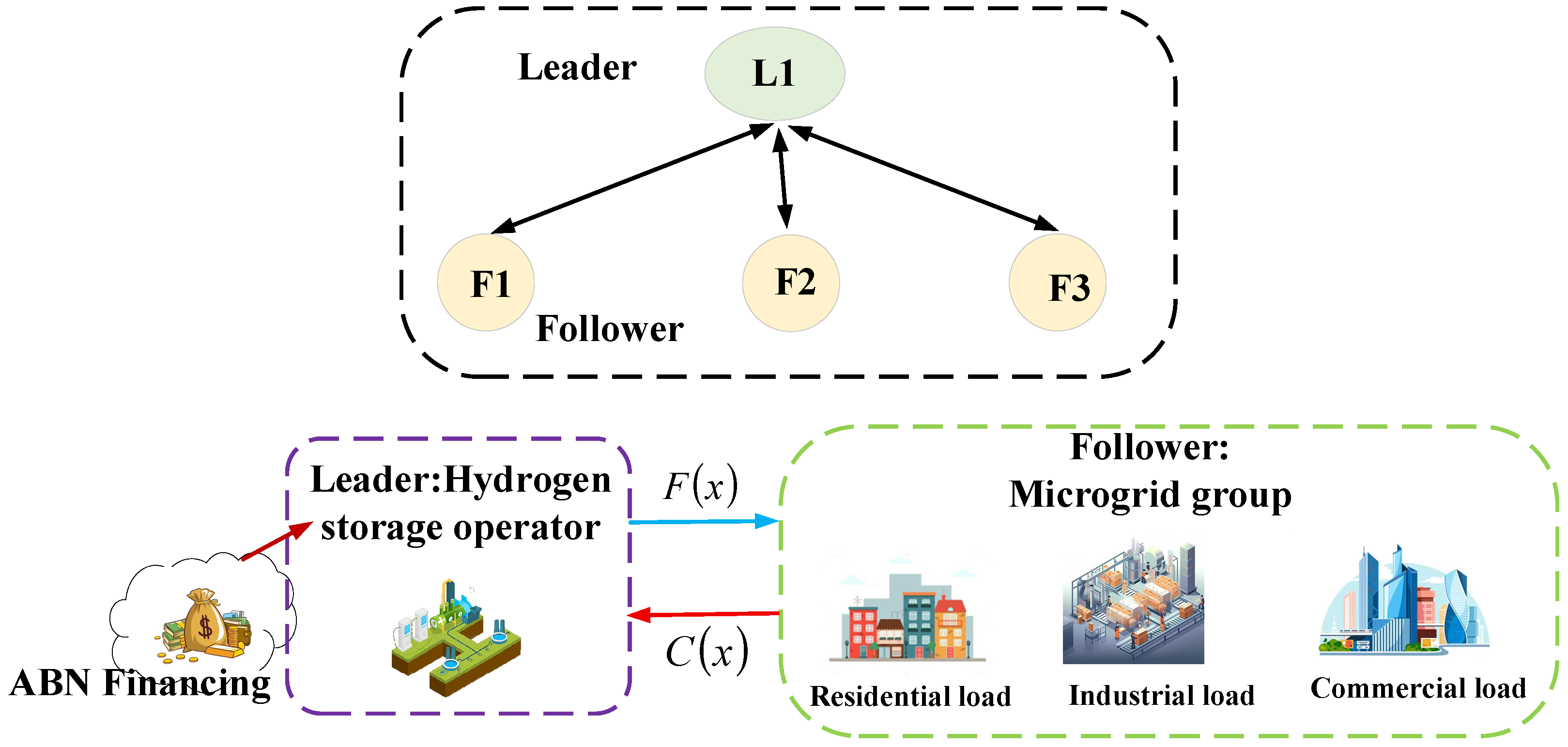
3.3. Stackelberg Game
4. Case Study Analysis
4.1. Simulation Environment
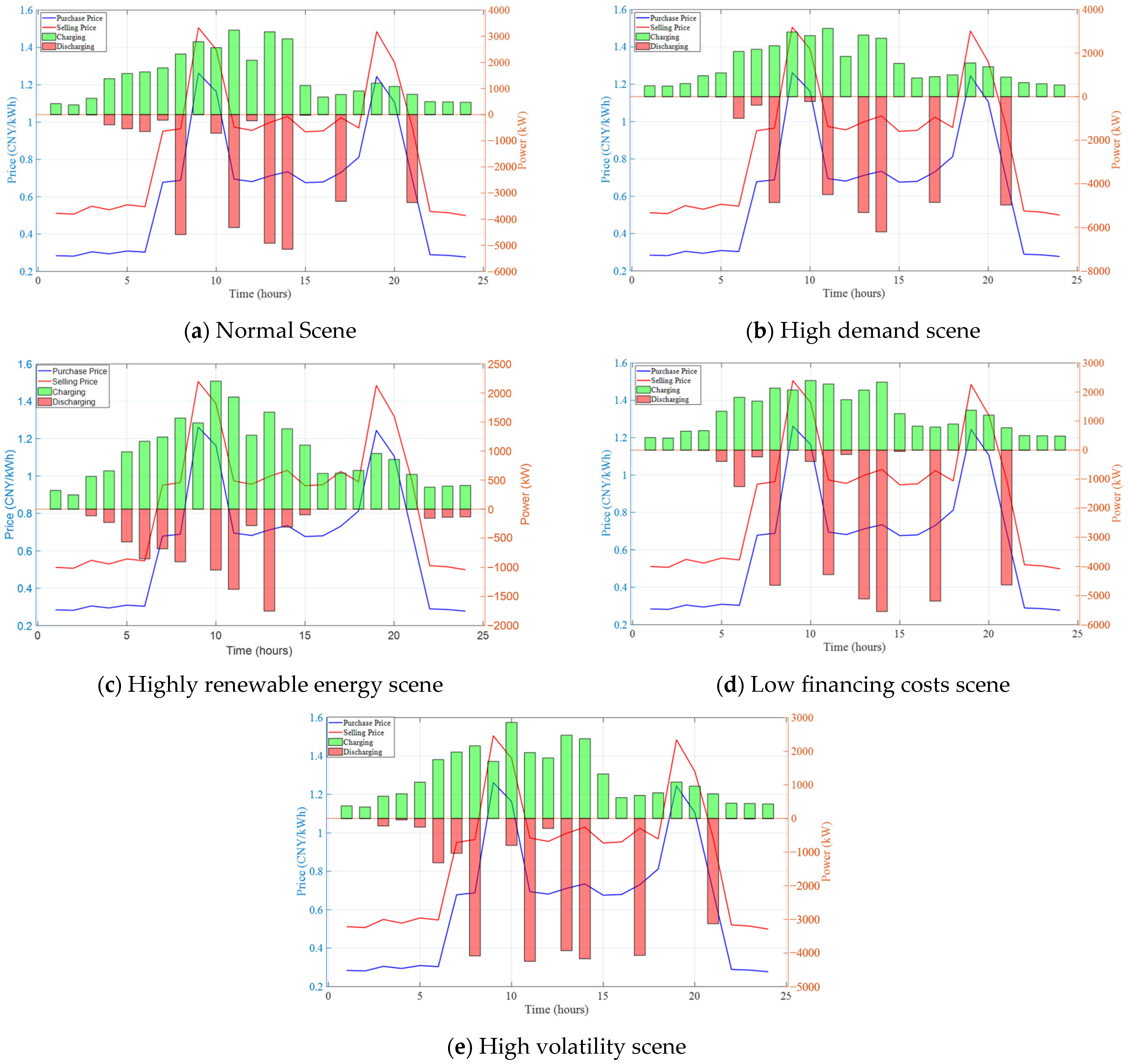
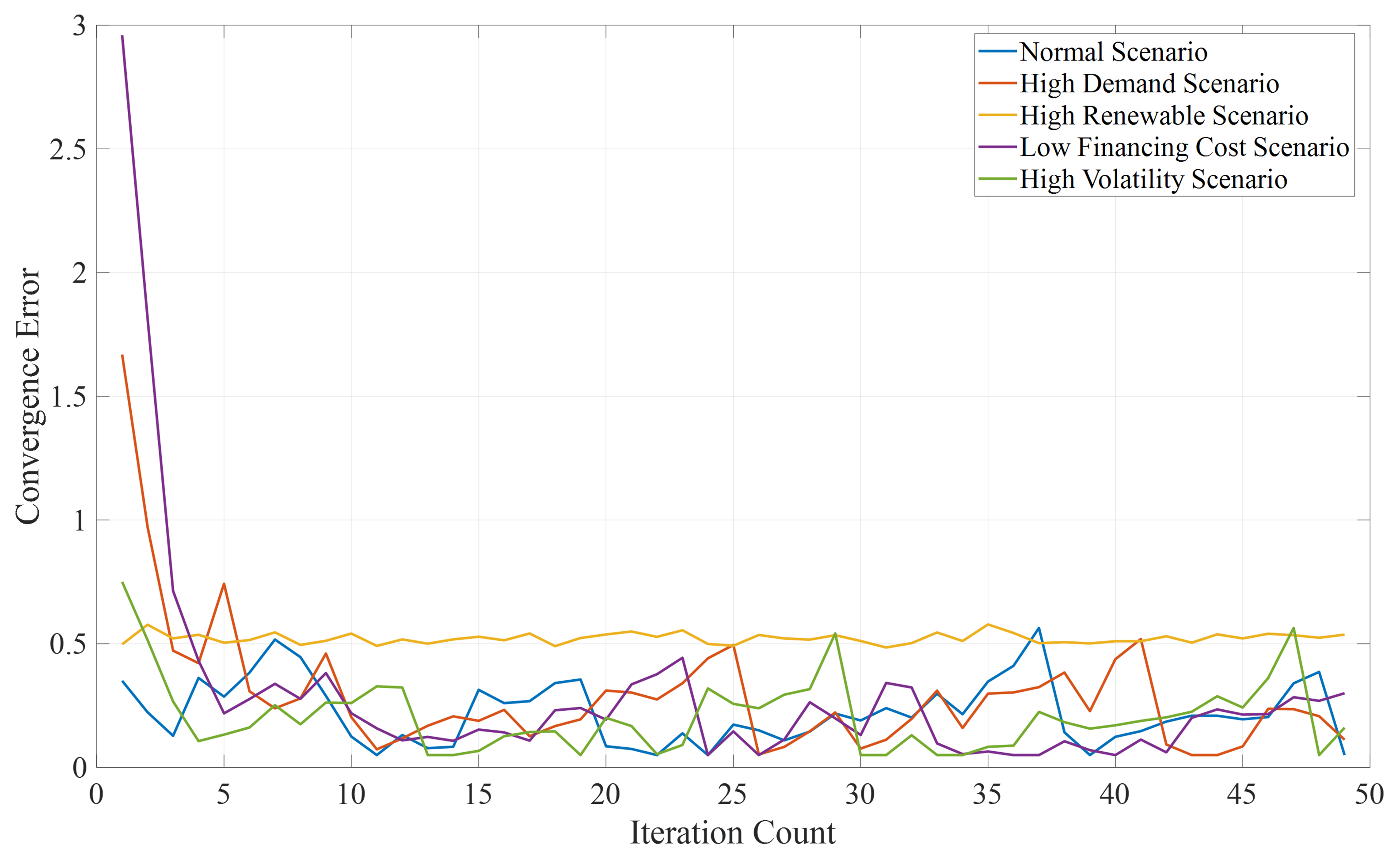
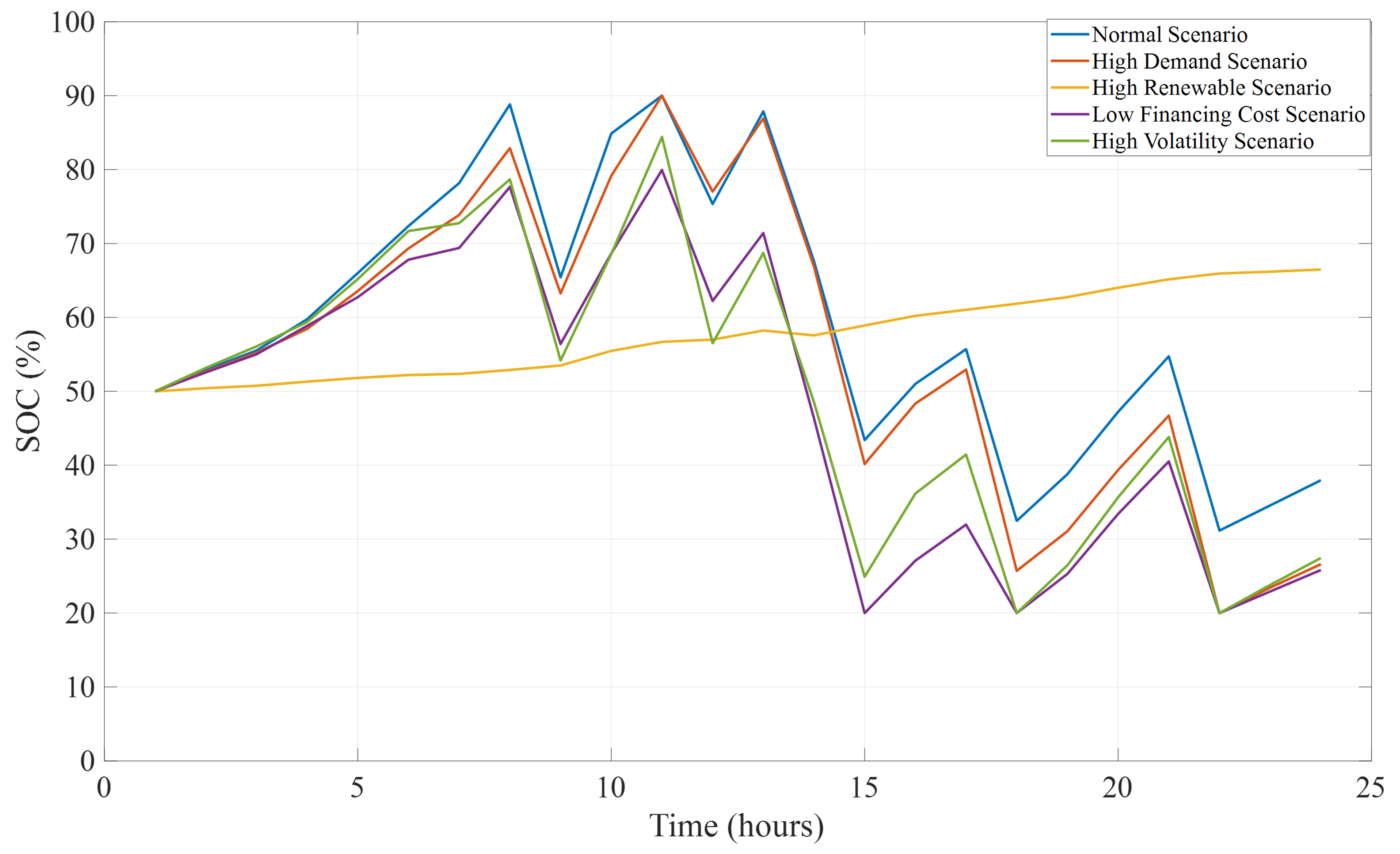
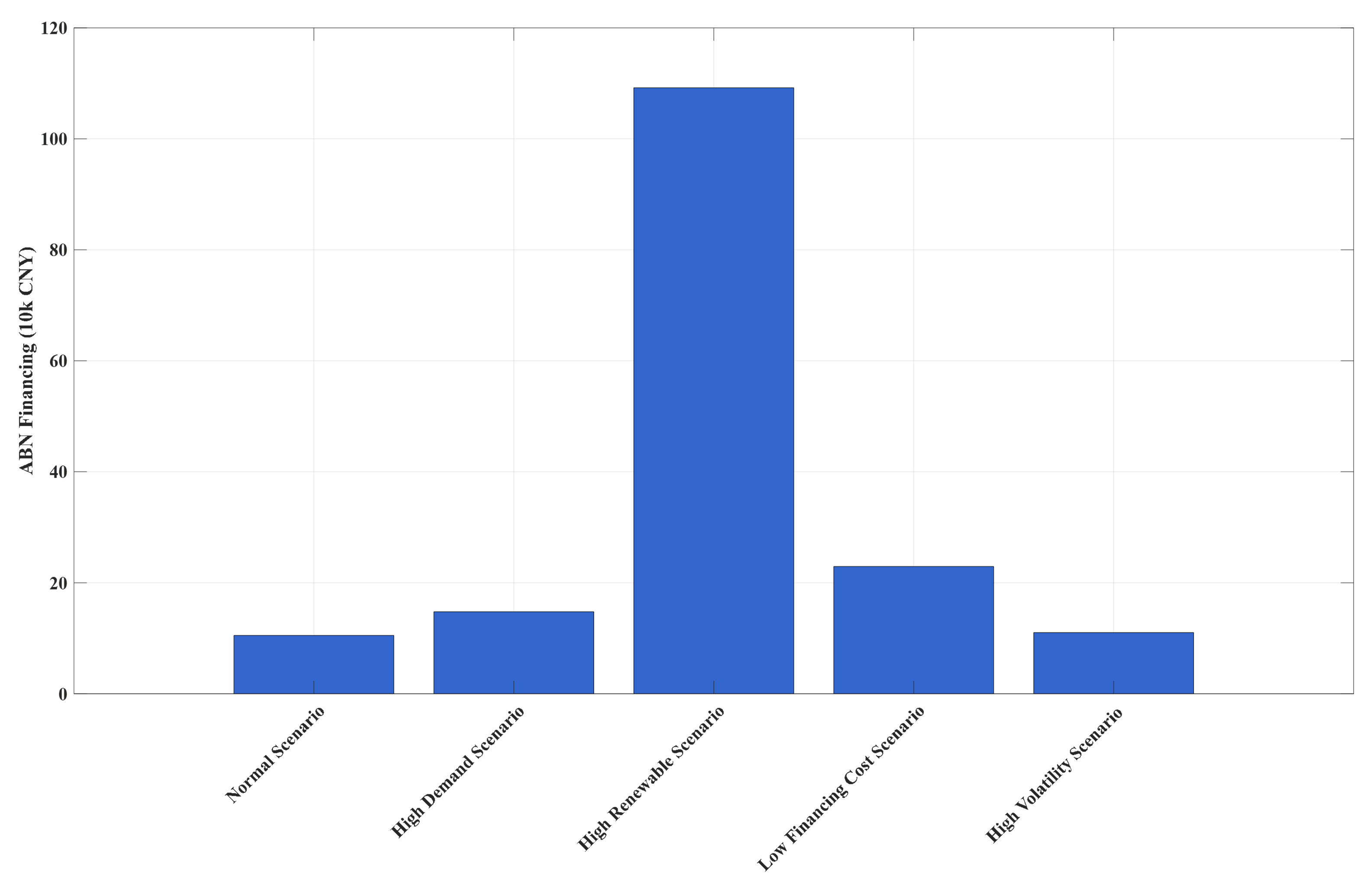
4.2. Simulation Analysis
5. Conclusions
Author Contributions
Funding
Data Availability Statement
Acknowledgments
Conflicts of Interest
References
- Bichuch, M.; Hobbs, B.F.; Song, X. Identifying optimal capacity expansion and differentiated capacity payments under risk aversion and market power: A financial Stackelberg game approach. Energy Econ. 2023, 120, 106567. [Google Scholar] [CrossRef]
- Loschan, C.; Schwabeneder, D.; Maldet, M.; Lettner, G.; Auer, H. Hydrogen as short-term flexibility and seasonal storage in a sector-coupled electricity market. Energies 2023, 14, 5333. [Google Scholar] [CrossRef]
- Lei, Z.; Liu, M.; Shen, Z.; Lu, W.; Lu, Z. A Data-Driven Stackelberg Game Approach Applied to Analysis of Strategic Bidding for Distributed Energy Resource Aggregator in Electricity Markets. SSRN Electron. J. 2022, 215, 118959. [Google Scholar] [CrossRef]
- Patari, S.; Sinkkonen, K. Energy Service Companies and Energy Performance Contracting: Is there a need to renew the business model? Insights from a Delphi study. J. Clean. Prod. 2014, 66, 264–271. [Google Scholar] [CrossRef]
- Ma, T.; Wu, J.; Hao, L.; Yan, H.; Li, D. A Real-Time Pricing Scheme for Energy Management in Integrated Energy Systems: A Stackelberg Game Approach. Energies 2018, 11, 2858. [Google Scholar] [CrossRef]
- Lei, Z.; Liu, M.; Shen, Z.; Lu, J.; Lu, Z. A Nash–Stackelberg game approach to analyze strategic bidding for multiple DER aggregators in electricity markets. Sustain. Energy Grids Netw. 2023, 35, 101111. [Google Scholar] [CrossRef]
- Liu, Q.; Tian, J.; Zhang, K.; Yan, Q. Pricing strategy for a virtual power plant operator with electric vehicle users based on the Stackelberg game. World Electr. Veh. J. 2023, 14, 72. [Google Scholar] [CrossRef]
- Wang, Q.; Wang, Y.; Chen, Z. Stackelberg equilibrium-based energy management strategy for regional integrated electricity–hydrogen market. Front. Energy Res. 2023, 11, 1169089. [Google Scholar] [CrossRef]
- Zhao, Y.; Wei, Y.; Tang, Y.; Guo, Y.; Sun, H. Multi-objective robust dynamic pricing and operation strategy optimization for integrated energy system based on stackelberg game. Int. J. Hydrogen Energy 2024, 83, 826–841. [Google Scholar] [CrossRef]
- Gao, H.; Wang, R.; He, S.; Wang, Z.; Liu, J. Bi-level stackelberg game-based distribution system expansion planning model considering long-term renewable energy contracts. Prot. Control. Mod. Power Syst. 2023, 8, 1–15. [Google Scholar] [CrossRef]
- Li, C.; Zuo, X. Effects of hydrogen storage system and renewable energy sources for optimal bidding strategy in electricity market. Energy Eng. 2022, 119, 1879–1903. [Google Scholar] [CrossRef]
- Xu, Y.; He, Y.; Liu, H.; Kang, H.; Chen, J.; Yue, W.; Xiao, W.; Pan, Z. Optimization Configuration of Electric–Hydrogen Hybrid Energy Storage System Considering Power Grid Voltage Stability. Energies 2025, 18, 3506. [Google Scholar] [CrossRef]
- Zhang, H.; Tian, Y.; He, W.; Liang, Z.; Zhang, Z.; Zhang, N. The Generation Load Aggregator Participates in the Electricity Purchase and Sale Strategy of the Electric Energy–Peak Shaving Market. Energies 2025, 18, 370. [Google Scholar] [CrossRef]
- Clemens, T.; Hunyadi-Gall, M.; Lunzer, A.; Arekhov, V.; Datler, M.; Gauer, A. Wind–Photovoltaic–Electrolyzer-Underground Hydrogen Storage System for Cost-Effective Seasonal Energy Storage. Energies 2024, 17, 5696. [Google Scholar] [CrossRef]
- Fu, J.; Ng, A.W. Scaling up Renewable Energy Assets: Issuing Green Bond via Structured Public-Private Collaboration for Managing Risk in an Emerging Economy. Energies 2021, 14, 3076. [Google Scholar] [CrossRef]
- Li, B.; Yu, R.; Gan, K.; Ruan, G.; Liu, S.; Yang, M.; Xie, D.; Dai, W.; Zhong, H. A Large-Scale Residential Load Dataset in a Southern Province of China. Sci. Data 2025, 12, 450. [Google Scholar] [CrossRef] [PubMed]
- Gielen, D.; Boshell, F.; Saygin, D.; Bazilian, M.D.; Wagner, N.; Gorini, R. The role of renewable energy in the global energy transformation. Energy Strategy Rev. 2019, 24, 38–50. [Google Scholar] [CrossRef]
- Monasterolo, I.; Raberto, M. The EIRIN flow-of-funds behavioural model of green fiscal policies and green sovereign bonds. Ecol. Econ. 2018, 144, 228–243. [Google Scholar] [CrossRef]
- Scholtens, B. Financial and Social Performance of Socially Responsible Investments in the Netherlands. Corp. Gov. Int. Rev. 2007, 15, 1090–1105. [Google Scholar] [CrossRef]



| Features/Advantages | Instruction |
|---|---|
| Risk structure | Through asset pooling and bankruptcy isolation via special purpose vehicles (SPVs), we diversify technical and operational risks associated with individual projects, attract diverse capital sources, and reduce the overall financing costs and risk exposure of renewable energy projects. |
| Transparency and certification | Relying on independent third parties to verify and continuously disclose the project’s ‘green attributes’ (such as carbon reduction quantities and energy efficiency improvement metrics), in compliance with technical standards within the power industry, enhances credibility and compliance. |
| Policy coordination | Benefiting from policy incentives such as green bond certification, fiscal interest subsidies, and priority grid connection, these measures align with the objectives of new power system development, thereby establishing a coordinated mechanism linking policy, technology, and finance. |
| Liquidity design | Supports structured securities design (such as senior/subordinated structures) to cater to investors with varying risk appetites, enhancing the liquidity of long-term power infrastructure investments in the secondary market and accelerating capital recycling. |
| System function | Provide scalable financing channels for key sectors including clean energy, energy storage, and smart grids to drive technological upgrades and low-carbon transformation of power assets, thereby enhancing grid resilience and energy security. |
| Number | Scene Name | Demand Factor | Renewable Energy Factor | Market Volatility | ABN Financing Cost Ratio | Scene Description |
|---|---|---|---|---|---|---|
| 1 | Normal | 1.0 | 1.0 | 0.10 | 5.0% | Benchmark scenario, with all parameters at average levels |
| 2 | High demand | 1.4 | 0.8 | 0.15 | 4.0% | Electricity demand has increased significantly, while the proportion of renewable energy has decreased. |
| 3 | Highly renewable energy | 0.8 | 1.6 | 0.12 | 3.0% | Renewable energy generation has increased substantially, while electricity demand has decreased. |
| 4 | low financing costs | 1.0 | 1.0 | 0.08 | 2.0% | ABN financing costs have been significantly reduced, with all other parameters remaining normal. |
| 5 | High volatility | 1.2 | 1.1 | 0.3 | 6.0% | Market prices fluctuate sharply, presenting a high degree of risk. |
| Scenario | NPV (10k CNY) | IRR (%) | Payback Period (Years) | Avg. Arbitrage Gain (CNY/Day) |
|---|---|---|---|---|
| Normal | 1250 | 8.5 | 9.2 | 3450 |
| High demand | 1680 | 10.2 | 8.1 | 4120 |
| Highly renewable energy | 2100 | 12.4 | 7.3 | 4980 |
| Low financing costs | 2350 | 14.1 | 6.5 | 5620 |
| High volatility | 820 | 6.3 | 11.8 | 2780 |
Disclaimer/Publisher’s Note: The statements, opinions and data contained in all publications are solely those of the individual author(s) and contributor(s) and not of MDPI and/or the editor(s). MDPI and/or the editor(s) disclaim responsibility for any injury to people or property resulting from any ideas, methods, instructions or products referred to in the content. |
© 2026 by the authors. Licensee MDPI, Basel, Switzerland. This article is an open access article distributed under the terms and conditions of the Creative Commons Attribution (CC BY) license.
Share and Cite
Liang, J.; Wu, Z. Research on the Coordinated Optimisation of Green Asset-Backed Note Financing and Hydrogen Energy Storage Market Transactions Based on Stackelberg Games. Energies 2026, 19, 1455. https://doi.org/10.3390/en19061455
Liang J, Wu Z. Research on the Coordinated Optimisation of Green Asset-Backed Note Financing and Hydrogen Energy Storage Market Transactions Based on Stackelberg Games. Energies. 2026; 19(6):1455. https://doi.org/10.3390/en19061455
Chicago/Turabian StyleLiang, Jian, and Zhongqun Wu. 2026. "Research on the Coordinated Optimisation of Green Asset-Backed Note Financing and Hydrogen Energy Storage Market Transactions Based on Stackelberg Games" Energies 19, no. 6: 1455. https://doi.org/10.3390/en19061455
APA StyleLiang, J., & Wu, Z. (2026). Research on the Coordinated Optimisation of Green Asset-Backed Note Financing and Hydrogen Energy Storage Market Transactions Based on Stackelberg Games. Energies, 19(6), 1455. https://doi.org/10.3390/en19061455