Review of Degradation Models of Battery Energy Storage for Potential Integration into Unit Commitment Problems



Abstract
1. Introduction
2. Review and Analysis of Energy Throughput Models
3. Review and Analysis of Cycle-Counting Models
4. Discussion and Insights
- 1.
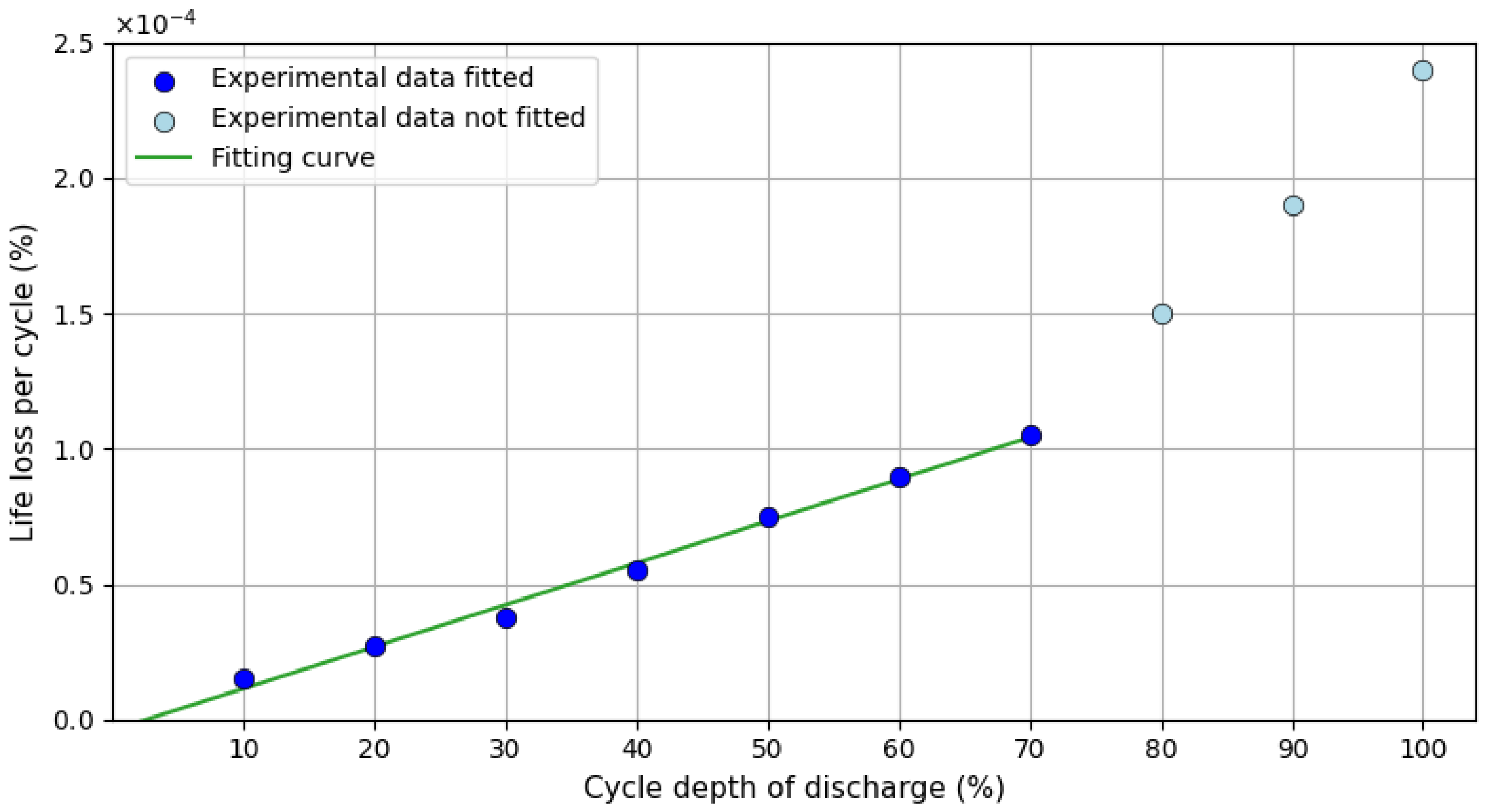
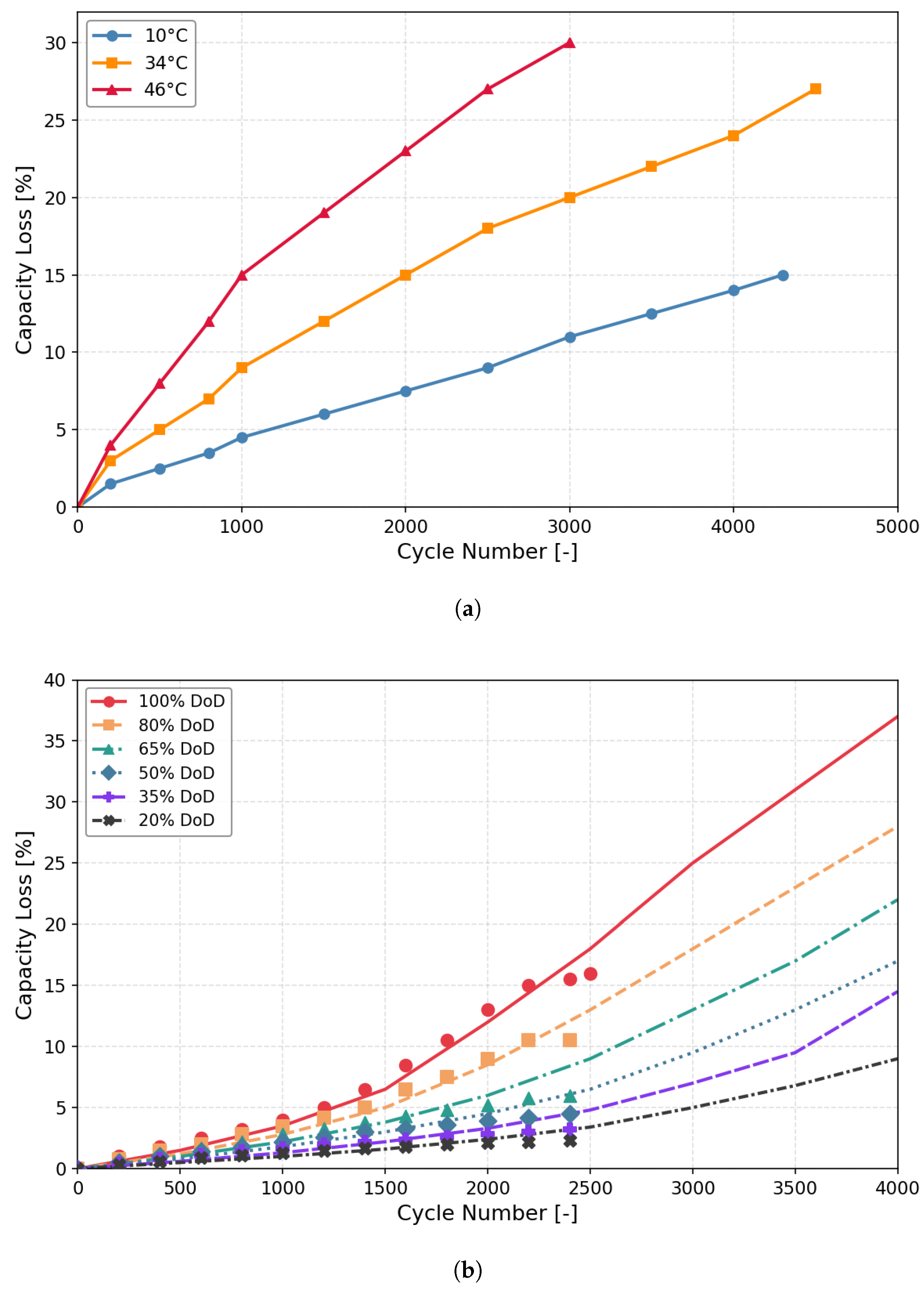
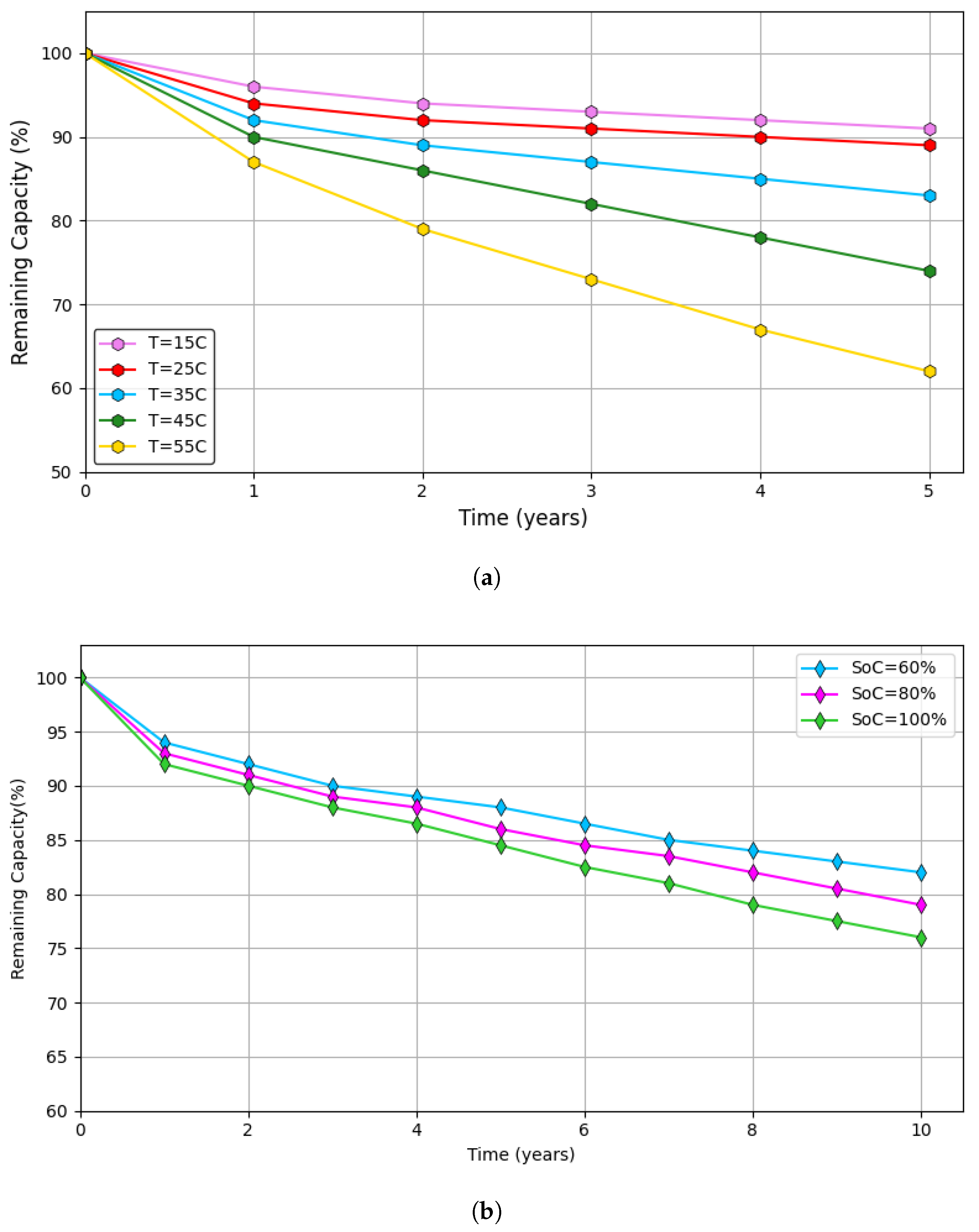
- Nonlinearity and Computational Complexity: Battery degradation is characterized by nonlinear and chemistry-specific behaviors. As shown in the empirical relationships of DOD, SOC, temperature, and cycle life, degradation mechanisms are inherently nonlinear and often nonconvex. UC problems, however, are predominantly solved using MILP formulations to ensure tractability within operational time limits. Incorporating nonlinear degradation terms, therefore, requires linearization or approximation, which can either oversimplify the physics or significantly increase model size. In addition, computational complexity is increased when degradation is included. Additional variables such as remaining capacity, stress factors, accumulated wear, number of cycles, or SOC-dependent coefficients expand the dimensionality of the UC problem. More detailed models require capturing multiple interacting stress factors, further increasing the computational burden and potentially challenging real-time or day-ahead operational timelines.
- 2.
- Parameter Sensitivity and Uncertainty: Degradation parameters are highly sensitive to battery chemistry, temperature, SOC range, and experimental conditions. These parameters vary significantly across manufacturers and operational settings, meaning that degradation-aware UC solutions may be sensitive to mis-specified or uncertain model parameters. Underestimation may accelerate battery wear, while overestimation may discourage the economically optimal use of storage assets.
- 3.
- Temporal Mismatch Between UC and Battery Aging: The mismatch between UC’s short-term operational horizon and the long-term nature of battery degradation introduces conceptual challenges. UC is typically solved over a 24 to 36 h horizon, whereas battery aging occurs over months or years. Mapping short-term dispatch decisions onto long-term wear requires assumptions about the amortization of degradation cost, yet these assumptions may not fully capture interactions between long-term degradation trajectories and short-term operational behavior.
- 4.
- Lack of Standardization and Market Alignment: There is currently no industry consensus or standardized regulatory approach for incorporating degradation costs into UC formulations. Market rules in most regions do not explicitly compensate for degradation-aware operation, and system operators vary in how degradation is treated operationally. This lack of standardization limits adoption and challenges the development of universally applicable degradation-aware UC models.
5. Conclusions
Author Contributions
Funding
Data Availability Statement
Conflicts of Interest
References
- California Independent System Operator (CAISO). 2023 Special Report on Battery Storage. 2023. Available online: https://www.caiso.com/documents/2023-special-report-on-battery-storage-jul-16-2024.pdf (accessed on 27 December 2025).
- Habibi, M.; Vahidinasab, V.; Aghaei, J.; Mohammadi-Ivatloo, B. Assessment of energy storage systems as a reserve provider in stochastic network constrained unit commitment. IET Smart Grid 2021, 4, 139–150. [Google Scholar] [CrossRef] [Scilit]
- Park, H.; Kim, M. Expected Benefits of Coordinated Energy Storage Operation in Stochastic Unit Commitment with Enhanced Deliverability of Reserves. IEEE Access 2024, 12, 18280–18294. [Google Scholar] [CrossRef] [Scilit]
- Moreira, A.; Fanzeres, B.; Silva, P.; Heleno, M.; Marcato, A.L.M. On the role of Battery Energy Storage Systems in the day-ahead Contingency-Constrained Unit Commitment problem under renewable penetration. Electr. Power Syst. Res. 2024, 235, 110856. [Google Scholar] [CrossRef] [Scilit]
- Schade, C.; Egging-Bratseth, R. Battery degradation: Impact on economic dispatch. Energy Storage 2024, 6, e588. [Google Scholar] [CrossRef] [Scilit]
- Wankmüller, F.; Thimmapuram, P.R.; Gallagher, K.G.; Botterud, A. Impact of battery degradation on energy arbitrage revenue of grid-level energy storage. J. Energy Storage 2017, 10, 56–66. [Google Scholar] [CrossRef] [Scilit]
- Shchurov, N.I.; Dedov, S.I.; Malozyomov, B.V.; Shtang, A.A.; Martyushev, N.V.; Klyuev, R.V.; Andriashin, S.N. Degradation of lithium-ion batteries in an electric transport complex. Energies 2021, 14, 8072. [Google Scholar] [CrossRef] [Scilit]
- Manoharan, P.; Chandrasekaran, K.; Chandran, R.; Ravichandran, S.; Mohammad, S.; Jangir, P. An effective strategy for unit commitment of microgrid power systems integrated with renewable energy sources including effects of battery degradation and uncertainties. Environ. Sci. Pollut. Res. 2024, 31, 11037–11080. [Google Scholar] [CrossRef] [Scilit]
- Wood, A.J.; Wollenberg, B.F.; Sheblé, G.B. Power Generation, Operation, and Control; John Wiley & Sons: Hoboken, NJ, USA, 2013. [Google Scholar]
- Pozo, D.; Contreras, J.; Sauma, E.E. Unit commitment with ideal and generic energy storage units. IEEE Trans. Power Syst. 2014, 29, 2974–2984. [Google Scholar] [CrossRef] [Scilit]
- Chen, Y.; Baldick, R. Battery storage formulation and impact on day ahead security constrained unit commitment. IEEE Trans. Power Syst. 2022, 37, 3995–4005. [Google Scholar] [CrossRef] [Scilit]
- Xu, B.; Oudalov, A.; Ulbig, A.; Andersson, G.; Kirschen, D.S. Modeling of Lithium-Ion Battery Degradation for Cell Life Assessment. IEEE Trans. Smart Grid 2018, 9, 1131–1140. [Google Scholar] [CrossRef] [Scilit]
- Peterson, S.B.; Apt, J.; Whitacre, J. Lithium-ion battery cell degradation resulting from realistic vehicle and vehicle-to-grid utilization. J. Power Sources 2010, 195, 2385–2392. [Google Scholar] [CrossRef] [Scilit]
- Xu, B. The role of modeling battery degradation in bulk power system optimizations. MRS Energy Sustain. 2022, 9, 198–211. [Google Scholar] [CrossRef] [Scilit]
- Preger, Y.; Barkholtz, H.M.; Fresquez, A.; Campbell, D.L.; Juba, B.W.; Romàn-Kustas, J.; Ferreira, S.R.; Chalamala, B. Degradation of Commercial Lithium-Ion Cells as a Function of Chemistry and Cycling Conditions. J. Electrochem. Soc. 2020, 167, 120532. [Google Scholar] [CrossRef] [Scilit]
- Ecker, M.; Nieto, N.; Käbitz, S.; Schmalstieg, J.; Blanke, H.; Warnecke, A.; Sauer, D.U. Calendar and cycle life study of Li(NiMnCo)O2-based 18650 lithium-ion batteries. J. Power Sources 2014, 248, 839–851. [Google Scholar] [CrossRef] [Scilit]
- Xu, B.; Wang, Y.; Dvorkin, Y.; Fernandez-Blanco, R.; Silva-Monroy, C.A.; Watson, J.P.; Kirschen, D.S. Scalable Planning for Energy Storage in Energy and Reserve Markets. IEEE Trans. Power Syst. 2017, 32, 4515–4527. [Google Scholar] [CrossRef] [Scilit]
- Zia, M.F.; Elbouchikhi, E.; Benbouzid, M. Optimal operational planning of scalable DC microgrid with demand response, islanding, and battery degradation cost considerations. Appl. Energy 2019, 237, 695–707. [Google Scholar] [CrossRef] [Scilit]
- Preis, V.; Biedenbach, F. Assessing the incorporation of battery degradation in vehicle-to-grid optimization models. Energy Inform. 2023, 6, 33. [Google Scholar] [CrossRef] [Scilit]
- Vermeer, W.; Mouli, G.R.C.; Bauer, P. A comprehensive review on the characteristics and modeling of lithium-ion battery aging. IEEE Trans. Transp. Electrif. 2021, 8, 2205–2232. [Google Scholar] [CrossRef] [Scilit]
- Ortega-Vazquez, M.A. Optimal scheduling of electric vehicle charging and vehicle-to-grid services at household level including battery degradation and price uncertainty. IET Gener. Transm. Distrib. 2014, 8, 1007–1016. [Google Scholar] [CrossRef] [Scilit]
- Watanabe, S.; Kinoshita, M.; Hosokawa, T.; Morigaki, K.; Nakura, K. Capacity fade of LiAlyNi1-x-yCoxO2 cathode for lithium-ion batteries during accelerated calendar and cycle life tests (surface analysis of LiAlyNi1-x-yCoxO2 cathode after cycle tests in restricted depth of discharge ranges). J. Power Sources 2014, 258, 210–217. [Google Scholar] [CrossRef] [Scilit]
- Vetter, J.; Novák, P.; Wagner, M.; Veit, C.; Möller, K.C.; Besenhard, J.; Winter, M.; Wohlfahrt-Mehrens, M.; Vogler, C.; Hammouche, A. Ageing mechanisms in lithium-ion batteries. J. Power Sources 2005, 147, 269–281. [Google Scholar] [CrossRef] [Scilit]
- Laresgoiti, I.; Käbitz, S.; Ecker, M.; Sauer, D.U. Modeling mechanical degradation in lithium ion batteries during cycling: Solid electrolyte interphase fracture. J. Power Sources 2015, 300, 112–122. [Google Scholar] [CrossRef] [Scilit]
- Wang, J.; Liu, P.; Hicks-Garner, J.; Sherman, E.; Soukiazian, S.; Verbrugge, M.; Tataria, H.; Musser, J.; Finamore, P. Cycle-life model for graphite-LiFePO4 cells. J. Power Sources 2011, 196, 3942–3948. [Google Scholar] [CrossRef] [Scilit]
- Millner, A. Modeling lithium ion battery degradation in electric vehicles. In Proceedings of the 2010 IEEE Conference on Innovative Technologies for an Efficient and Reliable Electricity Supply; IEEE: Piscataway, NJ, USA, 2010; pp. 349–356. [Google Scholar]
- Kassem, M.; Bernard, J.; Revel, R.; Pelissier, S.; Duclaud, F.; Delacourt, C. Calendar aging of a graphite/LiFePO4 cell. J. Power Sources 2012, 208, 296–305. [Google Scholar] [CrossRef] [Scilit]
- Apribowo, C.H.B.; Sarjiya, S.; Hadi, S.P.; Wijaya, F.D. Optimal planning of battery energy storage systems by considering battery degradation due to ambient temperature: A review, challenges, and new perspective. Batteries 2022, 8, 290. [Google Scholar] [CrossRef] [Scilit]
- Xu, B.; Zhao, J.; Zheng, T.; Litvinov, E.; Kirschen, D.S. Factoring the Cycle Aging Cost of Batteries Participating in Electricity Markets. IEEE Trans. Power Syst. 2018, 33, 2248–2259. [Google Scholar] [CrossRef] [Scilit]
- Lee, Y.R.; Kim, H.J.; Kim, M.K. Optimal operation scheduling considering cycle aging of battery energy storage systems on stochastic unit commitments in microgrids. Energies 2021, 14, 470. [Google Scholar] [CrossRef] [Scilit]
- Lee, J.O.; Kim, Y.S. Novel battery degradation cost formulation for optimal scheduling of battery energy storage systems. Int. J. Electr. Power Energy Syst. 2022, 137, 107795. [Google Scholar] [CrossRef] [Scilit]
- Liu, C.; Ma, H.; Zhang, H.; Shi, X.; Shi, F. A MILP-based battery degradation model for economic scheduling of power system. IEEE Trans. Sustain. Energy 2022, 14, 1000–1009. [Google Scholar] [CrossRef] [Scilit]
- Saxena, S.; Roman, D.; Robu, V.; Flynn, D.; Pecht, M. Battery stress factor ranking for accelerated degradation test planning using machine learning. Energies 2021, 14, 723. [Google Scholar] [CrossRef] [Scilit]
- Nebuloni, R.; Ilea, V.; Berizzi, A.; Bovo, C.; Meraldi, L.; Moretti, L.; Raboni, P. A MILP Battery Degradation Logarithmic Model with Real-Time Cycle Counting Calculation. IEEE Trans. Ind. Appl. 2025, 61, 8297–8306. [Google Scholar] [CrossRef] [Scilit]



| Criteria | Energy Throughput Models [6,12,13,16,17,18,19,20,21] | Cycle-Counting Models [22,23,24,25,26,27,28,29,30,31,32,33,34] |
|---|---|---|
| Core Principle | Degradation is proportional to cumulative energy processed | Degradation depends on individual cycle characteristics (DOD, SOC, temperature) |
| Key Parameters | DOD, SOC range, replacement cost, energy throughput | DOD, mean SOC, temperature, replacement cost, cycle count, full/half cycles |
| Physical Fidelity | Low to moderate: aggregates wear, ignores cycle depth distribution | High: captures DOD nonlinearity, SOC-cycle parameters, calendar aging |
| Computational Tractability | High: linear or convex, minimal binary variables | Low to moderate: requires rainflow model preprocessing or reformulation |
| Data Requirements | Low: manufacturer cycle life curves, replacement cost | High: detailed aging test data, temperature/SOC stress functions |
| UC Integration Suitability | Direct, mature, widely implemented | Indirect or via linearization; emerging MILP-compatible formulations |
| Strengths | Simple, fast, easy to parameterize, suitable for large systems | Captures realistic aging dynamics, chemistry-specific, decision-dependent |
| Limitations | Ignores cycle-by-cycle variation; may over/underestimate wear | Computationally intensive; rainflow-based non-linear; parameter-sensitive |
| Representative Equations | Equations (1)–(3) | Equations (4)–(7) |
Disclaimer/Publisher’s Note: The statements, opinions and data contained in all publications are solely those of the individual author(s) and contributor(s) and not of MDPI and/or the editor(s). MDPI and/or the editor(s) disclaim responsibility for any injury to people or property resulting from any ideas, methods, instructions or products referred to in the content. |
© 2026 by the authors. Licensee MDPI, Basel, Switzerland. This article is an open access article distributed under the terms and conditions of the Creative Commons Attribution (CC BY) license.
Share and Cite
Maakestad, R.; Hyder, F.; Ramnarase, G.; Yan, B. Review of Degradation Models of Battery Energy Storage for Potential Integration into Unit Commitment Problems. Energies 2026, 19, 1425. https://doi.org/10.3390/en19061425
Maakestad R, Hyder F, Ramnarase G, Yan B. Review of Degradation Models of Battery Energy Storage for Potential Integration into Unit Commitment Problems. Energies. 2026; 19(6):1425. https://doi.org/10.3390/en19061425
Chicago/Turabian StyleMaakestad, Rhianna, Farhan Hyder, Gharvin Ramnarase, and Bing Yan. 2026. "Review of Degradation Models of Battery Energy Storage for Potential Integration into Unit Commitment Problems" Energies 19, no. 6: 1425. https://doi.org/10.3390/en19061425
APA StyleMaakestad, R., Hyder, F., Ramnarase, G., & Yan, B. (2026). Review of Degradation Models of Battery Energy Storage for Potential Integration into Unit Commitment Problems. Energies, 19(6), 1425. https://doi.org/10.3390/en19061425